World Nuclear Industry Status Report 2026 (HTML version)

With a foreword by
KONO Taro
Member of the House of Representatives Former Minister for Foreign Affairs, Japan
Mycle Schneider
Independent Analyst
Paris, France
Project Coordinator and Lead Author
Julie Hazemann
Director of EnerWebWatch
Paris, France
Documentary Research, Modelling, and Datavisualization
Kristin Dietrich
Research Associate at the Workgroup for Economic and Infrastructure Policy (WIP), Berlin University of Technology (TU)
Berlin, Germany
Contributing Author
Eva Dou
Independent Journalist
Washington D.C., United States
Contributing Author
Phred Dvorak
Independent Journalist
Washington D.C., United States
Contributing Author
Dmitry Gorchakov
Nuclear Adviser, Bellona Foundation
Vilnius, Lithuania
Contributing Author
Özgür Gürbüz
Independent Consultant and Researcher
Istanbul, Türkiye
Contributing Author
Paul Jobin
Associate Research Fellow,
Institute of Sociology, Academia Sinica
Taipei, Taiwan
Contributing Author
Timothy Judson
Independent Consultant
Syracuse, New York, United States
Contributing Author
Yuki Kobayashi
Senior Research Fellow, Security Studies Program, Sasakwa Peace Foundation
Tokyo, Japan
Contributing Author
Heonseok Lee
Policy Advisor, Energy Justice Action
Seoul, South Korea
Contributing Author
M.V. Ramana
Simons Chair in Disarmament, Global and Human Security with the School of Public Policy and Global Affairs (SPPGA), University of British Columbia
Vancouver, Canada
Contributing Author
Urvashi Sarkar
Independent Journalist
Mumbai, India
Contributing Author
Sebastian Stier
European Patent Attorney
Munich, Germany
Contributing Author
Tatsujiro Suzuki
President, Peace Depot
Visiting Professor, Research Center for Nuclear Weapons Abolition, Nagasaki University (RECNA),
Former Vice-Chairman of the Japan Atomic Energy Commission
Japan
Contributing Author
Stephen Thomas
Emeritus Professor of Energy Policy
Public Services International Research Unit (PSIRU)
Business School, University of Greenwich
Editor-in-Chief, Energy Policy
London, United Kingdom
Contributing Author
Yun-Chung Ting
Assistant Professor,
Center for General Education,
Taipei Medical University
Taipei, Taiwan
Contributing Author
Alexander Wimmers
Research Associate at the Workgroup for Economic and Infrastructure Policy (WIP), Berlin University of Technology (TU)
Berlin, Germany
Contributing Author
Hartmut Winkler
Professor, University of Johannesburg
South Africa
Contributing Author
Maahin Ahmed
Freelance Copyeditor
Calgary, Canada
English Language Copy-editor
Nina Schneider
Proofreader and Translator
Paris, France
Fact-checker, Proofreader, Producer
Agnès Stienne
Artist, Graphic Designer, Cartographer
Le Mans, France
Graphic Design and Layout
Friedhelm Meinass
Visual Artist, Painter
Rodgau, Germany
Cover-page Design and Layout
Paris, 2026
© A Mycle Schneider Consulting Project
Table of contents
Executive Summary and Conclusions
Operation, Power Generation, Age Distribution
The IAEA’s Operating Reactors Data Revisions
Construction Times of Reactors Currently Under Construction
Construction Times of Past and Currently Operating Reactors
Construction Starts and Cancellations
China’s Construction Costs and Capabilities
China’s Growing Range of Nuclear Technologies
Nuclear Unavailability Review 2025
Stress Corrosion Cracking and Thermal Fatigue
Decennial Inspections and Lifetime Extensions
Climate Resilience in Question
Flamanville-3: Difficult Construction, Bumpy Road to Commissioning
Regulatory Measures—TEPCO Resumed Operation
Legal Cases Against Reactor Restarts and Operation
Closed Power Reactors in Japan
Prospects for Nuclear Power vs. Renewable Energy Deployment
The Pomeranian Project (Lubiatowo-Kopalino)
A Second Nuclear Power Plant Project (Bełchatów or Konin-Pątnów)
Perspectives on SMR Deployment
Nuclear Interdependencies and Sanctions
Introduction: From Long-term Nuclear Phaseout to Newbuild
Three Major Megaprojects: Electricity Demand Driven by AI, Semiconductors, and Data Center Expansion
Increasingly Aging Power Plants
Reactors Under Construction and Planned
Launch of the High-Level Radioactive Waste Management Commission
SMRs: Roadmap for R&D and Regulatory Framework Development
Lifetime Extensions for an Aging, Underperforming, Fleet?
Swedish Nuclear Policy Reversal—Embracing Newbuild
Nuclear Restart Under Review with Conditions
Local Briefing as a Site of Contestation of Nuclear Restart
The Potential Restart of Maanshan
Spent Fuel Management—Pools and Dry Storage
Final Disposal: Institutional Inertia
Public Attitude: Less Support for Nuclear-Free Homeland Policy
Power Sector Under War Conditions
Russian Attacks on Nuclear Facilities
UK Power Mix and Energy Policy
Subsidies and Financing for Nuclear Power
Reactor Closures, Proposed Restarts, and Power Uprates
New Reactors: Proposals, Planning, and Policy Developments
Industry Restructuring and Emerging Business Models
Criminal Investigations of Nuclear Power Corporations
Removing Highly Radioactive Nuclear Fuel Debris
Peering Inside the Damaged Reactors
Dealing with Contaminated Soil
Elements of National Decommissioning Policies
Overview of Reactors with Completed Decommissioning
Overview of Ongoing Reactor Decommissioning
Conclusion on Reactor Decommissioning
Potential Newcomer Countries with Active Reactor Construction
Potential Nuclear Newcomer Countries in Africa
Russia Nuclear Interdependencies
Russia’s Role in the Global Nuclear Fuel Supply Chain
Enriched Uranium Trade: Russia–China–United States
Fuel Supply Services to the European Union
Fuel Manufacturing for Russian Designed Reactors in the EU
Framatome and VVER Fuel Manufacturing in Lingen and Romans-sur-Isère
Russia’s Dependencies and Potential Sanctions
Modular Designs with Components Built on Production Lines
Advanced Modular Reactor (AMR) Designs
Project Developments by Country
European Industrial Alliance on SMRs
Nuclear Power vs. Renewable Energy Deployment
Interesting Facts from Around the Globe
Electricity Generation Cost Development
Installed Capacity and Electricity Generation
Photovoltaics and Batteries—The Game Changer Association
Status and Trends in China, the European Union, India, and the United States
Annex 1 – Overview by Region and Country
Annex 2 – Chinese Nuclear Reactor Fleet
Annex 3 – Russia Nuclear Interdependencies
Annex 4 – Status of Nuclear Power in the World
Annex 5 – Nuclear Reactors in the World “Under Construction”
Table of Figures
Figure 1 · National Nuclear Power Programs Development, 1954–2026
Figure 2 · Nuclear Electricity Generation in the World... and China
Figure 3 · Nuclear Electricity Generation and Share in National Power Generation
Figure 4 · Nuclear Power Reactor Grid Connections and Closures in the World
Figure 5 · Nuclear Power Reactor Grid Connections and Closures World/China
Figure 6 · World Nuclear Reactor Fleet, 1954–mid-2026
Figure 7 · Nuclear Reactors “Under Construction” in the World
Figure 8 · Nuclear Reactors “Under Construction” – China and the World
Figure 9 · Nuclear Reactors “Under Construction” by Technology-Supplier Country
Figure 10 · Average Annual Construction Times in the World
Figure 11 · Delays for Units Commissioned 2023–2025
Figure 12 · Construction Starts in the World
Figure 13 · Construction Starts in the World/China
Figure 14 · Cancelled or Suspended Reactor Constructions
Figure 15 · Age Distribution of Operating Reactors in the World
Figure 16 · Reactor-Fleet Age of Top 5 Nuclear Generators
Figure 17 · Age of World Nuclear Fleets
Figure 18 · Age Distribution of Closed Nuclear Power Reactors
Figure 19 · Nuclear Reactor Closure Age
Figure 20 · The Expansion of the Chinese Nuclear Fleet, 1991–2026
Figure 21 · Forty Years of Nuclear Constructions in China, 1985–2026
Figure 22 · Evolution of Reactor Construction Times in China, 1991–2026
Figure 23 · Operating Nuclear Fleet and Capacity in France
Figure 24 · Startups and Closures in France
Figure 25 · Nuclear Electricity Production vs. Installed Capacity in France
Figure 26 · Nuclear Electricity Production vs. Nuclear Share in France
Figure 27 · Monthly Nuclear Electricity Generation, 2012–mid-2026
Figure 28 · “Forced” and “Planned” Unavailability of Nuclear Reactors in France in 2025
Figure 29 · Unavailabilities of French Nuclear Reactors, 2021–2025
Figure 30 · Age Distribution of the French Nuclear Fleet
Figure 31 · Production Losses Due to Climatic Impacts in France
Figure 32 · Nuclear Power Reactors in France (by Size and Cooling System)
Figure 33 · Construction Times and Project Cost Estimates for Flamanville-3
Figure 34 · Rise, Fall, Slow Restart of the Japanese Nuclear Program
Figure 35 · Status of the Japanese Reactor Fleet
Figure 36 · Age Distribution of the Japanese Nuclear Fleet
Figure 37 · Electricity Production by Source in Poland
Figure 38 · Nuclear Production Versus Installed Capacity in Russia
Figure 39 · Startups and Closures in Russia
Figure 40 · Age Distribution of the Russian Nuclear Fleet
Figure 41 · Electricity Generation in South Korea, 2016–2025
Figure 42 · Age Distribution of the South Korean Nuclear Fleet
Figure 43 · Electricity Production in Taiwan, 2000–2025
Figure 44 · Histogram of Taiwan Nuclear Fleet
Figure 45 · Electricity Generation Mix in Türkiye
Figure 46 · Age Distribution of UK Nuclear Fleet
Figure 47 · UK Reactor Startups and Closures
Figure 48 · Electricity Generation by Source in the UK – The Coal Plunge
Figure 49 · Age Distribution of US Nuclear Fleet
Figure 50 · History of Early Retirement Announcement and Reversals
Figure 51 · Status of License Renewal Applications in the US
Figure 52 · Evolution of Average Reactor Closure Age in the US
Figure 53 · Reactor Startups and Closures in the US
Figure 54 · Seventy Years of Nuclear Reactor Constructions in the US
Figure 55 · Percentages of Treated Water and Water to be Retreated
Figure 56 · Overview of Completed Reactor Decommissioning Projects
Figure 57 · Chinese Imports of Russian Enriched Uranium, 2019–2025
Figure 58 · Providers of Nuclear Fuel Services to the EU
Figure 59 · EU Imports of Russian Nuclear Fuel Elements
Figure 60 · Solar and/or Wind Overtake Nuclear Power
Figure 61 · Global Investment in Renewables and Nuclear Power, 2004–2025
Figure 62 · The Declining Costs of Renewables vs. Traditional Power Sources
Figure 63 · Sharp Decline in Battery Costs
Figure 64 · Global Wind, Solar, and Nuclear Installed Capacity and Electricity Production
Figure 65 · Nuclear vs. Non-Hydro Renewable Electricity Production in the World
Figure 66 · Electricity Generation in the World by Source, 2000–2025
Figure 67 · Power Generation in the World, Annual Production Compared to 2014
Figure 68 · Grid-Connected Battery Storage Additions, 2020–2025
Figure 69 · Behind the Meter Solar Boom in Pakistan
Figure 70 · Wind, Solar, and Nuclear Installed Capacity and Electricity Production in China
Figure 71 · Nuclear vs. Non-Hydro Renewables in China, 2000–2025
Figure 72 · Electricity Generation Mix in China, 2000–2025
Figure 73 · Wind, Solar, and Nuclear Capacity and Electricity Production in the EU27
Figure 74 · Electricity Generation in the EU27 by Fuel, 2016–2025
Figure 75 · Wind, Solar, and Nuclear Installed Capacity and Electricity Production in India
Figure 77 · Nuclear Reactors Startups and Closures in the EU27, 1959–1 July 2026
Figure 78 · Nuclear Reactors and Net Operating Capacity in the EU27
Figure 79 · Construction Starts of Nuclear Reactors in the EU27
Figure 80 · Age Evolution of EU27 Reactor Fleet, 1959–2025
Figure 81 · Age Distribution of the EU27 Reactor Fleet
Figure 82 · Age Distribution of the Western European Reactor Fleet (incl. Switzerland and the UK)
Figure 83 · Nuclear Power Generation in Belgium vs. Nuclear Share
Figure 84 · Nuclear Power Generation in Belgium vs. Installed Nuclear Capacity
Table of tables
Table 1 · Nuclear Reactors “Under Construction” (as of 1 July 2026)
Table 2 · Duration from Initial Construction Start to Grid Connection, 2016–2025
Table 3 · Total Unavailabilities at French Nuclear Reactors, 2019–2025 (in Reactor-Days)
Table 4 · Fourth Decennial Visits of French 900-MW Reactors, 2019–2026
Table 5 · Official Reactor Closures Post-3/11 in Japan (as of 1 July 2026)
Table 6 · Status of the Russian Nuclear Reactor Fleet (as of 1 July 2026)
Table 7 · Nuclear Reactors Under Construction in Russia (as of 1 July 2026)
Table 8 · Changes in Nuclear Power Plant Construction Events by Administration Since 2017
Table 9 · Load Factors for Coal, Gas, and Nuclear Plants, 2015–2025 (in percent)
Table 10 · Korean Reactors with Operating License Expiry Dates Prior to 2030
Table 11 · Spent Fuel Storage at Korea’s Nuclear Power Plant Sites
Table 12 · Korean Designs of Small Modular Reactor (SMR)
Table 13 · Timetable Regarding the Potential Restart of Maanshan Reactors
Table 14 · Spent Fuel Storage at Taiwan’s Nuclear Power Plant Sites
Table 15 · Timetable of Events on Nuclear Waste Management (2025 to mid-2026)
Table 16 · Status of EDF’s UK AGR Nuclear Reactor Fleet (as of 1 July 2026)
Table 17 · Key Financial Aspects of the Hinkley Point C and Sizewell C Projects
Table 18 · Overview of Status of the Decommissioning (as of mid-2026)
Table 19 · Overview of Reactor Decommissioning Worldwide (as of 1 July 2026)
Table 20 · Fuel Supply for Soviet-designed Reactors in the EU and Ukraine (as of mid-2026)
Table 21 · LWR SMR Designs in Advanced Regulatory Stages in Various Countries
Table 22 · Advanced Modular Reactor Designs in Advanced Regulatory Stages in UK and US
Table 23 · Status of Canadian Nuclear Fleet - PLEX and Expected Closures
Table 24 · Status of the Spanish Nuclear Fleet (as of 1 July 2026)
Table 25 · Chinese Nuclear Reactors in Operation (as of 1 July 2026)
Table 26 · Chinese Nuclear Reactors in LTO
Table 27 · Fuel Supply for Soviet-designed Reactors in the EU and Ukraine (as of mid-2026)
Table 28 · Status of Nuclear Power in the World (as of 1 July 2026)
Table 29 · Nuclear Reactors in the World “Under Construction” (as of July 2026)
The World Nuclear Industry Status Report (WNISR) has been published annually since 2007—with a double-number in 2010–2011—in various formats, a starkly expanding team across the globe, widening issues, and increasing volumes.
The core of the WNISR is its database, designed and maintained by data manager and information engineer Julie Hazemann—who has been there from the start. She also develops most of the drafts for the graphical illustrations and continues to expand her contributions over the years, including pre-drafting statistical sections and analysis as well as the PowerPoint presentations for the launch events. There would be no WNISR without her. Thanks a billion.
M.V. Ramana has been an essential contributing author for over a decade. Thank you for your sustained great efforts and thank you for who you are.
Tatsujiro Suzuki, remains an indispensable member of the core team. Thank you for co-contributing essential parts to the report for the fifth year in a row and for the third time in what has turned into a fruitful tandem cooperation with Yuki Kobayashi who we have the privilege to now consider part of the core team. A big thanks to both of you.
Alex Wimmers, in his fifth contribution year has been a super solid and highly reliable pillar of the core team. Thank you for your many diverse contributions to the project—much obliged.
Tim Judson has also contributed for the fifth year and made his encyclopedic knowledge available to the WNISR Project. Thank you unlimited.
Hartmut Winkler joined the team in 2023… expanded contributions in 2024 to two chapters and kept it that way in 2025 and 2026. Thank you very much for the generous and fruitful cooperation.
Sebastian Stier contributed a full-scale chapter the first time to WNISR2024 that was not originally designed to become permanent. Thanks so much for all your efforts to turn the piece into an indispensable part of the project.
Phred Dvorak contributed her first piece to WNISR2025, and guess what, we are so incredibly fortunate to profit again from her decades-long research experience and wonderful writing skills for another outstanding WNISR contribution. Very grateful to you.
Dmitry Gorchakov in 2025 made his much-appreciated debut appearance. He smoothly and intelligently adapted to the project framework. That was a real pleasure. In 2026, he has taken on a much larger burden of contributions. That was another effective, pleasant experience. Thanks so much. Keep it coming!
Özgür Gürbüz, and Paul Jobin together with Yun-Chung Ting, provided excellent extended updates to their respective pieces. So glad to have you with us again. Thank you very much.
Stephen Thomas has been a regular WNISR contributor between 2009 and 2016. Exactly ten years later he is back with a remarkable contribution. Much appreciated. Very grateful.
Kristin Dietrich, Eva Dou, Heonseok Lee, and Urvashi Sarkar contributed to the WNISR for the first time. Thanks a million to the four of you for your great contributions and for your patience with our challenging proofing and editing procedure. Greatly appreciated.
KONO Taro provided an eloquent, thoughtful and thought-provoking foreword to this WNISR edition. Thanks so much for having taken the time to honor the project with your excellent contribution.
Nina Schneider’s role has long exceeded careful proof-reading, source verification, and factchecking. The entire team appreciates her precision and attention to detail. In addition, she is the indispensable central element to the production process. Tausend Dank.
We are lucky to have copyeditor Maahin Ahmed working on the WNISR for the third year in a row. Once again, she applied her intelligent, balanced approach to English language copy-editing to this edition. Thank you for your excellent work under challenging conditions.
Artist and graphic designer Agnès Stienne—in her 10th edition! Congratulations!—keeps innovating and improving our graphic illustrations that are praised, reused, and reprinted around the world. Thank you very much, also for your continuous flexibility and ability to deal with impossible deadlines.
Arnaud Martin, web-designer and full-stack developer, super-sonic, always there when needed, and his work on the dedicated WNISR Project website www.WorldNuclearReport.org is reliable, functional, and attractive. Thanks a million.
For the eighth year in a row, we owe idea, design, and realization of the original report-cover to renowned visual artist and painter Friedhelm Meinaß. His work has turned into a series of art pieces that is a display of different conceptual ideas, styles, and techniques—thoughtful and beautiful. Wholehearted thanks, again.
This work has greatly benefitted from partial proofreading, editing suggestions, comments, or other input by Ian Fairlie, Tomas Kåberger, Chris Meder, Hisako Sakiyama, and many others. Thank you all. Special thanks to Thibault Laconde for providing data.
The project coordinator wishes to thank especially Jochen Ahlswede, Hendrik Schopmans, Fanny Böse, Thomas Augustin, Eva Gratzer-Heilingsetzer, Jutta Paulus, Stefan Krabbes, Nils Epprecht, and Angela Schneider for their enthusiastic and sustainable support of this project.
And everybody involved is grateful to the German Federal Office for the Safety of Nuclear Waste Management, the Austrian Federal Ministry for Agriculture and Forestry, Climate and Environmental Protection, Regions and Water Management, the Greens-EFA Group in the European Parliament, the Swiss Energy Foundation and Anne Jatzekewitz for their financial support.
Note
This report contains a very large amount of factual and numerical data. While we do our utmost to verify and double-check, nobody is perfect. The authors are always grateful for corrections and suggested improvements.
Coordinator Contact Information
Mycle Schneider
45, Allée des Deux Cèdres - 91210 Draveil (Paris) France
Ph: +33-1-69 83 23 79
by KONO Taro1
The US attack on Iran and the subsequent crisis in the Strait of Hormuz exposed Japan’s vulnerability as a nation dependent on imported energy. Going forward, Japan must reduce its reliance on imported fossil fuels and uranium and instead expand domestically produced renewable energy as much as possible—an approach that would significantly benefit Japan’s economy, bolster national security, and improve disaster resilience.
Japan’s electricity consumption increased from the 1990s through the 2000s, peaked around 2007–2010, and then declined throughout the 2010s and early 2020s. In addition to a decline in population, changes in industrial structure, and increased adoption of energy-efficient appliances, the economic slowdown following the Global Financial Crisis of 2008 and nationwide power-saving efforts after the Great East Japan Earthquake contributed to a nearly 15-percent reduction from the peak. After the Fukushima nuclear accidents in 2011, all domestic nuclear plants were shut down, and the government shifted its policy toward “reducing dependence on nuclear power as much as possible.” Crude oil imports also fell by 36 percent between 2010 and 2025.
During this period, the share of renewable energy in Japan’s electricity mix increased by about one percentage point each year, doubling over the past decade. If electricity consumption continued to decline and renewable energy adoption accelerated—growing by about two percentage points annually—Japan could potentially achieve energy selfsufficiency through renewables alone by 2050, without relying on thermal or nuclear power.
However, electricity consumption in Japan has begun to rise again since 2025. Documents from the Ministry of Economy, Trade and Industry explicitly designate AI and data centers as primary drivers of this change.2 Training AI models requires enormous amounts of electricity, and operating and cooling data centers also consumes substantial power. The second driver of increasing electricity consumption is decarbonization. As climate measures advance, automobiles are shifting from gasoline to EVs, while heating, cooling, and industrial processes are transitioning from gas and oil to electricity. Various demand projections have been published, including estimates suggesting that even full operation of all domestic nuclear plants would not be enough to meet future demand.
Under the KISHIDA Fumio administration, the government reversed course on its nuclear policy, citing the need for a stable electricity supply and decarbonization goals as reasons to effectively extend nuclear reactor lifespans and promote restarts. The Seventh Strategic Energy Plan released in February 2025 removed the phrase “reducing dependence on nuclear power as much as possible” and instead stated that nuclear power would be “utilized to the maximum extent,” including replacing existing reactors with next-generation advanced reactors at current sites. For thermal power, the plan incorporates ammonia co-firing and Carbon Capture, Utilization and Storage (CCUS) to achieve decarbonization while maintaining the generation capacity needed for a stable supply. Electricity demand from data centers can vary greatly depending on the scale of AI usage, the power consumption of AI chips, and improvements in data-center efficiency. If AI adoption grows exponentially, demand could exceed government projections; if the efficiency of AI chips and data-center cooling systems improves rapidly, electricity demand may not increase significantly even as computational workloads grow.
The government envisions meeting electricity demand in fiscal year 2040 with 40–50 percent renewables, around 20 percent nuclear, and roughly 30–40 percent thermal power. Given the increasing severity of climate-related disasters, decarbonization is an urgent priority. Expanding renewable energy can reduce dependence on nuclear power. The central question is: “Which decarbonized power sources can help us meet the rising electricity demand of the AI era?”
Although the Seventh Strategic Energy Plan states that renewables will serve as a main power source, its 2040 targets remain limited. Japan can raise its energy self-sufficiency rate by increasing the share of renewables. Solar power can be expanded through the use of residential rooftops, apartment balconies, and abandoned farmland, and new lightweight, flexible perovskite solar films could greatly broaden solar potential. Offshore wind, geothermal power, and improvements to transmission networks and battery storage would further increase renewables-based self-sufficiency.
In Japan, electricity prices for many households and businesses are higher during the daytime and lower at night, yet inexpensive daytime solar power is often curtailed and wasted. Fully utilizing solar power and batteries could reduce electricity prices. Indeed, in parts of Australia, household electricity has even become free for three hours during sunny daytime periods starting this year.
In Japan, 54 percent of household refrigerators nationwide were manufactured before 2015, and many air conditioners have been used for more than 15 years. Older refrigerators and air conditioners are inefficient; replacing them can reduce energy consumption by 20–30 percent and 14 percent, respectively.3 Moreover, 60–70 percent of household heat escapes through windows. Renovating existing homes with double-glazed or multi-layered windows can significantly improve energy efficiency. Advancing such energy saving measures would reduce domestic electricity consumption and lower household electricity bills.
While the government’s Seventh Strategic Energy Plan estimates Japan’s energy self-sufficiency rate in 2040 at 30–40 percent, studies have demonstrated that accelerating and optimizing renewable energy deployment could raise this figure to around 75 percent.
A major challenge in the era of social media is the widespread online dissemination of anti-science and anti-intellectual misinformation, such as anti-vaccine narratives. The energy sector is no exception. Conspiracy-minded commentators who describe themselves as “conservative” often praise nuclear power and attack renewable energy without sufficient scientific basis or data. Japan’s slower adoption of renewables compared with other advanced economies is partly due to politicians being intimidated by such narratives.
Policy discussions in government and industry are also frequently influenced by optimistic assumptions not grounded in data. When phrases like “the introduction of innovative next-generation reactors such as SMRs” appear in debates about 2040 energy policy, they can sound realistic, even though such technologies for industrial purposes—as this report has shown year after year—cannot be expected to be ready in time.
Japan’s energy plans also discuss future technologies such as ammonia co-firing, CCUS, and nuclear fusion. Yet immediate measures—strengthening insulation standards through revisions to the Building Standards Act, requiring rooftop solar on new homes, and easing regulations to accelerate battery deployment—continue to be neglected.
The security implications of nuclear power are becoming unavoidable. Due to President Trump’s attitude, Western countries have increasingly questioned the credibility of US extended deterrence. The question of whether Washington would sacrifice Los Angeles or San Francisco to defend Tokyo is not new, but recent developments have led some countries to argue more emphatically that they should possess their own nuclear weapons. Some politicians argue that acquiring nuclear-powered submarines or reprocessing nuclear spent fuel [to separate weapons-usable plutonium, editor’s note] represent small steps toward eventual nuclear armament. Moreover, Western nuclear power systems have long depended on Russia for fuel and other components, raising concerns about future vulnerabilities. As new forms of warfare—such as drone attacks—spread, efforts to introduce nuclear power in conflict-prone regions raise additional worries that nuclear plants could become targets during crises.
This report provides invaluable, up-to-date data that serves as a foundation for energy discussions among governments, private companies, research institutions, and NGOs around the world. I would like to express my deep respect and gratitude to all those who have worked tirelessly over many years to produce this report.

Annual Reactor Startup/Closure Balance Negative—Operating Capacity Slightly Down
- Seven units were closed in 2025, while only 4 new ones started up. For the first time since 2021, the annual balance between startups and closures turned negative.
- At the end of 2025, the operating capacity stood at 368.6 GW, a minor decrease of 0.5 GW from record year 2024.
- As of 1 July 2026, a total of 411 reactors—excluding Long-Term Outages (LTOs)—were operating in 31 countries, 3 more than reported for mid-2025 due to 6 restarts from LTO.
- 30 units were in LTO, including 18 in Japan and 6 in Ukraine.
- The average age of operating nuclear plants, increasing since 1984, was 32.9 years as of mid-2026.

More Nuclear Reactors Under Construction, Driven by China
- As of mid-2026, 13 countries—2 more than mid-2025, 3 fewer than mid-2023—are hosting 73 reactor construction projects, 10 more than mid-2025. Of these, 25–28 are delayed, with 11 reporting increased delays.
- None of the 16 reactors connected to the grid in 9 countries in the 3 years 2023–2025 was built on time.
- China has the most reactors under construction (37), five more than mid-2025 and more than half of the total worldwide. Russia dominates the international market with 29 units under construction, 22 of them in 9 other countries.
- Construction started on 12 reactors in 2025—3 more than in 2024, the highest number since 2010—including 9 in China, 2 in Russia, and one in South Korea.
- Chinese and Russian government-controlled companies implemented all but one of the 52 construction starts globally in the 6 years 2020–2025.
- 95 percent of all ongoing construction projects (69 of 73) are carried out either in Nuclear Weapon States (NWS) or by NWS-controlled companies in other countries.

New Global Production Record, Decline Outside China
- Global nuclear power generation increased by 1.1 percent to record 2,703 net terawatt-hours (TWh or billion kilowatt-hours) of electricity, entirely due to China’s 7.6 percent increase. Nuclear production outside China declined marginally by 0.2 percent, stagnating at the level of global production already reached in the mid-1990s.
- Nuclear’s share of global commercial gross electricity generation in 2025 dropped by marginal 0.14 percentage points from 9 percent to 8.8 percent, the lowest value in four and a half decades and about half of the peak of 17.5 percent in 1996.
- Over the past two decades 2006–2025, there were 104 startups and 106 closures. Of these, China had 53 startups and zero closures. Thus, outside China, there has been a drastic net decline of 55 units over the same period.

Some Major National Developments in 2025/2026
- China. In 2025, two reactors started up with a combined capacity of 2.5 GW, while solar alone grew by an estimated 314 GW.
- France. Nuclear power generation increased to 373 TWh in 2025 but remains significantly below the 400 TWh considered normal a decade ago. By August 2026, annual nuclear production losses due to climate effects had exceeded 5.6 TWh, which the operator had expected for 2050. In mid-September, the 10 TWh mark had been surpassed.
- Hungary. In February 2026, Rosatom started constructing a new reactor, while a few months later climate-induced draught forced output reductions of up to 90 percent at the operating 4-unit Paks plant. The incoming government is reviewing the newbuild project.
- Sweden. The outgoing government prepared for newbuild e.g. with financing schemes, including large loans, aiming to support up to 5 GW of new capacity until 2037. The September elections could have substantial implications.
- Türkiye. The first of four reactors Rosatom is building at the Akkuyu site has been delayed again but is reportedly moving closer to startup. Meanwhile, renewables provided over 43 percent of the country’s electricity, making Türkiye the 10th top solar market globally in terms of new capacity additions.
- Ukraine. The Zaporizhzhia site, shut down and occupied by Russia, and the nine other operating reactors remain a constant cause of concern due to the ongoing war.
- United States. As of mid-2026, not a single power reactor was under construction in the country, though TerraPower obtained a construction permit for a sodium-cooled fast reactor in Wyoming. Holtec started fuel loading procedures at the 55-year-old Palisades reactor in Michigan in an effort to restart it from closure.

Fukushima Status Report
Complex onsite and offsite challenges persist. A focus on health issues reveals controversy about the effects of radiation exposure due to the catastrophic events. There is no controversy about the severe indirect impact of the Fukushima events on health, which have led to at least 2,350 deaths certified by Fukushima prefectural municipalities as “disaster-related”—largely thought to reflect the effect of the nuclear catastrophe.

Decommissioning
Of 224 closed power reactors, only 25 have been fully decommissioned and 10 released from regulatory control as greenfield sites.

Potential Newcomer Countries
Many countries have made announcements, taken legal steps, made plans, but, so far, only Bangladesh, Egypt, Türkiye, and newly Uzbekistan are hosting active construction sites—all 11 of them are Russian projects.

Russia Nuclear Interdependencies
Russia continues its key role as supplier of fuel services involving uranium mining and conversion. Russia is also a significant client for parts and services of Western nuclear companies. Despite discussions about sanctions, and comprehensive contracting with alternative fuel assembly suppliers, significant interdependencies remain.

Small Modular Reactors
So far, there is only one design certification (NuScale in the US) and one active construction (BWRX in Canada) in the West. There is still not a single SMR under construction in the EU nor in the UK.
Nuclear Power vs. Renewable Energy Deployment
Many records were made in 2025. Numerous countries and regions registered countless maximum achievements in renewables investments, newbuild, power generation, and storage additions. Nuclear generation reached a new maximum, but the increase was marginal and entirely due to growth in China. In contrast, nuclear operating capacity slightly declined.
Battery Boom Supports Continuous Large Solar Rollout—Nuclear Stagnates. Worldwide, in 2025 solar and wind power capacities grew by 510 GW (27 percent) and 159 GW (14 percent), respectively, while net nuclear operating capacity declined. For the first time, net solar production alone surpassed nuclear’s net output. Solar and wind combined produced more than twice the nuclear output. All non-hydro renewables combined recorded a year-on-year increase of 861 TWh gross (15.9 percent), covering the entire growth of 855 TWh in total global gross electricity production for the first time ever.
Battery Revolution. About 78 percent of the world’s overall grid-scale Battery Energy Storage System (BESS) has been added in the three years 2023–2025. In 2025 alone, 104 GW of capacity and 257 GWh of BESS energy were connected to the grid.
China. Solar power generation increased by 40 percent and added some 330 TWh in 2025, that is 10 times the growth in nuclear’s output in absolute numbers. Solar and wind combined produced five times as much power as nuclear reactors. Solar panels generated 1,162 TWh, close to Russia’s total power generation and more than the annual electricity production of any other country except for the US.
European Union. The rising wind plus solar share in total electricity production reached 30 percent, outcompeting nuclear’s stable 23-percent share. For the second year in a row, solar and wind together generated more power in the EU than all fossil fuels combined.
Hungary. At over 27 percent, the country had the largest solar share in national electricity production in the world in 2025.
India. Nuclear output was slightly down to 51 TWh in 2025, half of wind power generation that soared to 103 TWh. In just five years, India has increased its solar output by a factor of 2.8 to 167 TWh. Solar and wind production combined outpaced nuclear by a factor of over 5.
United States. In 2025, for the first time, wind and solar combined generated more power than nuclear reactors. In California, during daytime, solar regularly provides over 23 GW, covering over 60 percent of the load, ten times more than the two nuclear reactors. By the end of 2025, Texas had an installed capacity of 17 GW of grid-connected batteries, up from 5 GW in 2023 and expected to reach 27 GW by the end of 2026.
Overall Conclusion
The growth rates speak for themselves. The year 2025 confirmed nuclear power’s decades long stagnation, and there is no sign of a global surge. Outside China, nuclear capacity additions remain anecdotal. Solar (and wind) expansion is accelerating in many regions, with cost increases in all power technologies, renewables included, compensated by a plunge in stationary battery costs.
Executive Summary and Conclusions
The World Nuclear Industry Status Report 2026 (WNISR2026) provides a comprehensive overview of nuclear power plant data, including information on age, operation, production, and construction of reactors. WNISR2026 includes various topical focus chapters. The traditional chapter Nuclear Power vs. Renewable Energy Deployment provides a detailed overview of the continued strong expansion in the renewables sector, especially in combination with the accelerating deployment of battery storage capacity on the one hand, and the stagnating nuclear sector on the other. While the 2025 nuclear generation growth rate was in the 1-percent range year-on-year, the operational capacity slightly decreased. The balance between reactor startups and closures was negative for the first time since 2021, but more units are under construction in more countries. Meanwhile annual solar output has increased by 30 percent and exceeded the global production of nuclear plants for the first time.
The Focus Countries chapter includes a detailed overview of trends in ten of the 31 nuclear countries including the top 5 generators—i.e., the United States, China, France, Russia, and South Korea—as well as Hungary, Japan, Sweden, Ukraine, and the United Kingdom. The chapter also assesses developments in nuclear phaseout country Taiwan, and potential newcomer countries Poland and Türkiye.
The chapter on Potential Newcomer Countries includes an Africa Focus section that examines the status of planning in four selected countries on the continent. In addition, the chapter analyzes the status of seven other potential newcomers, including three (Bangladesh, Egypt, Uzbekistan) that are currently building.
The traditional chapter on Small Modular Reactors (SMRs) looks at some of the most advanced designs on the path of deployment and potential host countries. Despite over a decade of promises and announcements, only one SMR is under construction in the Western world at the Darlington site in Canada.
Russia Nuclear Interdependencies provides a comprehensive update on the mutual nature of dependencies between nuclear industries in the West and Russia.
The Fukushima Status Report has been updated all around and provides an overview of the controversy around health issues linked to the ongoing disaster 15 years after it began.
The Decommissioning Status Report now covers 224 closed reactors, one third of all the units ever connected to the grid over the past 71 years.
Finally, Annex 1 presents overviews of nuclear power programs in each of the countries not covered in the Focus Countries chapter.
Production and Role of Nuclear Power
Reactor Operation and Capacity. As of 1 July 2026, a total of 411 reactors—excluding those in Long-Term Outages (LTOs)—were operating in 31 countries, three more than reported for mid-2025.4 There were 30 units in LTO, including 18 in Japan, six in Ukraine, three in South Korea, and one each in Argentina, China, and India. Operating units are also seven less than in 1989—the first peak and the end of the preceding uninterrupted rise—and 27 less than the historic peak of 438 units in 2002. As of the end of 2025, the operating capacity stood at 368.6 GW, a minor decrease of 0.5 GW from record year 2024. As of mid-2026, operating capacity exceeded the previous record by 1.7 percent and stood at 374.7 GW.
Nuclear Electricity Generation. In 2025, the world nuclear fleet generated 2,703 net terawatt-hours (TWh or billion kilowatt-hours) of electricity. After a 4.4 percent drop in 2022, production increased by 2.1 percent in 2023, 2.9 percent in 2024, and 1.1 percent in 2025.
China, with a 7.6-percent increase (compared to 11.3 percent in 2021 and 3.7 percent in 2024), produced more net nuclear electricity than France for the sixth year in a row, and there is no prospect of France catching up again.5 China remains in second place—behind the US—among the top nuclear power generators. Nuclear production outside China declined marginally by 0.2 percent, stagnating at the level of global production already reached in the mid-1990s prior to most of China’s nuclear buildout. If global nuclear generation exceeded the 2006 record by a modest 40 TWh in 2025, nuclear generation outside China remained 369 TWh below the 2006 level, a significant plunge of 14 percent.
Share in Electricity/Energy Mix. Nuclear energy’s share of global commercial gross electricity generation in 2025 dropped marginally by 0.14 percentage points from 9 percent to 8.8 percent, the lowest value in four and a half decades and a drop to about half of the peak of 17.5 percent in 1996.
Reactor Startups and Closures
Startups. In 2025, four reactors were connected to the grid, two in China and one each in India and Russia. In the first half of 2026, two units were connected to the grid in the world, both in China.6
Closures.7 Seven units were closed over the year 2025, three each in Belgium and Russia and one in Taiwan. The annual balance between startups and closures turned negative for the first time since 2021. No unit was closed in the first half of 2026.
Over the past two decades 2006–2025, there were 104 startups and 106 closures. Of these, 53 startups were in China, which did not close any reactors. As a result, outside China, there has been a drastic net decline of 55 units over the same period. As larger units were started up (totaling 97.4 GW) than closed (totaling 75.8 GW), the net nuclear capacity added worldwide over the 20-year period was still 21.5 GW. However, since China alone added over half of the capacity or 52.3 GW, the net installed capacity outside China declined by almost 30.7 GW.
Construction Data8
As of 1 July 2026, 73 reactors were considered as under construction, ten more than WNISR reported a year ago, four more than in 2013, and the highest number since 1987. Of these, 36 units were under construction outside China, an increase of five from mid-2025 and the highest number since 2022. China, with 37 units under construction, accounts for more than half the units under construction worldwide as well as half of the year-on-year increase in units under construction.
Of the 69 reactors listed at the end of 2013, six projects were subsequently abandoned or suspended.
Fourteen countries are building nuclear plants, down from 16 as of mid-2023 but up from 11 as of mid-2025 with construction starts in Canada, Hungary, and Uzbekistan (a newcomer country). Nine in ten of all reactors are being built in Asia or Eastern Europe.
Building vs. Vendor Countries
- As of mid-2026, China had by far the most reactors under construction with 37 units—five more than one year earlier and more than half of the total worldwide.
- Russia is by far the dominant supplier on the international market, with 29 units under construction in the world as of mid-2026, two more year-on-year. Seven of these are being built domestically. The remaining 22 units are being constructed in nine countries, including four each in China, Egypt, India, and Türkiye.9 It remains uncertain to what extent the various rounds of sanctions imposed on Russia following its invasion of Ukraine have impacted or will impact these projects. However, direct and indirect sanctions clearly have led to delays in various projects.
- Besides Russia’s Rosatom, there is only France’s EDF (Électricité de France), China’s CNNC (China National Nuclear Corporation), and the US-Japan consortium GE Vernova-Hitachi presently building abroad.
Construction Times
- None of the 16 reactors connected to the grid in nine countries in the three years 2023–2025 was built on time. The average time between initial construction start and grid connection was 10.9 years.10 Delays varied widely from one month to many years, with China largely outperforming the other countries.
- For the 73 reactors currently being built, on average 5.1 years have passed since construction start, which is slightly lower than the mid-2025 average of 5.3 years of the fleet under construction then. The lower average reflects the additional construction starts over the year, and many units remain far from completion.
- In at least five of the 14 builder-countries, all under construction reactors have experienced delays, sometimes by many years.
- Of the 25–28 reactors behind schedule, at least 11 have experienced increased delays.
- At the beginning of 2025, 13 reactors were scheduled to be connected to the grid during the year (including seven that were pushed back from 2024 to 2025), but less than one-third (4 units) actually generated first power in 2025, while the commissioning of the other nine was delayed—or further delayed—at least into 2026.
- The initial construction start of the Mochovce-4 reactor in Slovakia dates back over 40 years, and its grid connection has been delayed once again but is getting closer with the start of fuel loading in June 2026. Bushehr-2 in Iran originally started construction 50 years ago in 1976 and resumed construction in 2019 after a 40-year-long suspension. Grid connection is currently scheduled for 2029.
- Two additional reactors, both in India, have accumulated delays of a decade or more: the Prototype Fast Breeder Reactor (PFBR), under construction since 2004, finally went critical in April 2026, and Rajasthan-8, under construction since 2011, is currently set to be commissioned before the end of the year.
Construction Starts
- Twelve construction starts were documented for 2025—the highest number since 2010. Nine of these were in China, two in Russia, and one in South Korea. In other words, over the six years between January 2020 and the end of 2025, all 52 construction starts in the world, except one in South Korea, were either implemented by the Chinese or the Russian nuclear industries at home or abroad.
- Eight reactors got underway in the world in the first half of 2026, three of them in China, one each in Canada, Hungary, India, South Korea, and Uzbekistan.
Operating Age
- The average age (from grid connection) of operating nuclear power plants has been increasing for over 40 years since 1984 and as of mid-2026 stands at 32.9 years, up from 32.5 years in mid-2025.
- A total of 269 reactors, two-thirds of the world’s operating fleet, have operated for 31 or more years, including 169—more than one in three—that have operated for at least 41 years.
- In 20 of the 31 nuclear countries, the average fleet age of operating nuclear reactors as of mid-2026 is over 30 years, and in 12 countries it is over 40. Three in four, that is 23 of the countries are operating one or more reactors that are over 40 years old, but only six countries are operating reactors over 50 years old.
- The mean age at closure of the 29 units taken off the grids in the five-year period between 2021 and 2025 was just 44.2 years.
Focus Countries
The following 13 Focus Countries include seven of the top 10 nuclear power generators in the world as well as nuclear phaseout country Taiwan, and potential newcomer countries Poland and Türkiye. The following are key developments in each for 2025 and the first half of 2026:11
China. Nuclear power generation increased by 7.6 percent and provided 4.6 percent of total electricity generation, a 0.1 percentage point increase after slipping slightly for three years in a row. Two new reactors started up, increasing nuclear capacity by 2.5 GW in 2025. Meanwhile solar capacity alone grew by estimated 314 GW. Solar output rose by 40 percent year-on-year to 1,162 TWh, almost as much as the total Russian power generation and more than the national electricity generation of any other country in the world with the exception of the US. Solar and wind together generated almost five times more electricity than nuclear reactors.
France. Nuclear power generation increased by 3.1 percent to reach 373 TWh, but remains still significantly below the 400 TWh considered normal a decade ago. Nuclear power represented 68 percent of the country’s total power generation, the highest nuclear share in the world. However, nuclear represented only around 18 percent of final energy, while fossil fuels provided 56 percent.
The number of reactor-days with zero-production in 2025 dropped to the lowest in the past seven years, though still an average of three months or 90 days per reactor. While the number of outage-days declared “planned” dropped significantly since 2022, those declared “forced” remained high, peaking at 559 reactor-days in 2025, an (unexplained) increase of 63 percent year-on-year. The average downtime per reactor of the 56-reactor fleet (not including Flamanville-3) over the five-year period 2021–2025 was 18.5 months or 31 percent of the time.
On 11 August 2026, production losses in 2026 due to climatic effects reached the level of 5.6 TWh operator EDF had envisaged by 2050. As of mid-September, losses had reached already twice that level.
The decision on the newbuild program consisting of six EPR2 units was reconfirmed; cost estimates were adjusted to €202072.8 billion (US$100 billion in current money), with the first scheduled startup in 2038. Currently, there is no reactor under construction in the country, while solar newbuild had another record year adding 5.9 GW of capacity—an increase of 24 percent following a record 26-percent jump in 2024—to reach a total of 30.4 GW.
Hungary. The four-unit Paks plant generated the second highest amount of power in 2025 behind record year 2019. At the same time, nuclear’s share in the power mix continued to decline and fell from its peak of 53 percent in 2014 to 39 percent in 2025. A key reason is the development of renewables, especially solar that increased output by a factor of 50 over the same time span, making Hungary the country with the world’s highest solar share, 27 percent, in its electricity mix. It is also the only EU country to host a Russian nuclear construction site, underway since February 2026, although the project is under review by the incoming government. The country also had to deal with climate induced drought forcing output reductions of up to 90 percent at Paks.
Japan. One additional reactor—the first TEPCO-owned unit since the Fukushima disaster started in 2011—was restarted since mid-2025, bringing the total number of “operable” units to 15, while 18 reactors remain in LTO. Nuclear power generation increased by 7.7 percent, and the nuclear share in total electricity rose slightly from 8.4 percent in 2024 to 9.2 percent in 2025. Other restart schedules have been delayed again, or even suspended, e.g., at the Hamaoka site where operator Chubu Electric was revealed to have falsified data concerning seismic assumptions that serve as the basis for the reactor’s seismic design. No active reactor construction is currently underway in the country.
Poland. In the mid-1980s, the country abandoned the construction of its first two reactors. Currently, there is a project for three Westinghouse AP1000 units, a vague second initiative for two or three reactors of unknown design, and various private-sector-driven initiatives based on Small Modular Reactors (SMRs). Meanwhile, in the first half of 2026, at close to 40 percent, Poland has seen by far the strongest growth rate year-on-year in solar deployment amongst the top five solar markets in the EU.12
Russia. State-controlled Rosatom is the leading international nuclear power plant builder in the world implementing 28 reactor projects (excluding Mochovce-4) in nine countries representing 39 percent of the global total. The country started up a new unit at home and remains the world’s fourth largest nuclear electricity producer. For the fourth year in a row, Rosatom maintained its proactive role in the military occupation of Europe’s largest nuclear power plant, Zaporizhzhia, in Ukraine.
South Korea. The country operates the fifth largest nuclear power program by capacity and production in the world. Incoming President Lee Jae-myung has taken a rather cautious stance about nuclear power and has favored a renewables-based strategy in the past. In 2025, non-hydro renewables still accounted for less than 10 percent in the power mix. Meanwhile, the Lee administration announced plans to go ahead with the building of two new large reactors and several SMRs.
Sweden. Due to a series of technical issues with the 44-year-old reactor fleet, nuclear output dropped by almost 8 percent in 2025 compared to the previous year. The operators nevertheless intend to extend operational lifetimes up to 80 years. The outgoing government was also preparing for newbuild with recently developed financing schemes, including large loans, aiming to support up to 5 GW of new capacity until 2037. These projects include large reactors as well as SMRs.
Taiwan. With the country’s last reactor closing in May 2025, the country has completed its nuclear phaseout. But a national referendum carried out in August 2025 showed almost three quarters of votes in favor of a lifetime extension of the two most recent reactors. While voter participation was below the minimum required to make the referendum result binding, it gave a boost to proponents of a reactor restart. Incoming President William Lai (Lai Ching-te) linked a potential restart to three challenging conditions: compliance with stringent nuclear safety standards, acceptance by affected local communities, and the availability of a viable solution for nuclear waste storage and disposal.
Türkiye. Rosatom is building four nuclear reactors at the Akkuyu site. Startup of Unit 1, originally scheduled for 2023, has been delayed again. Critics have pointed out that the country strongly relies on Russian fossil fuels, and that the nuclear project would further increase its dependence on Russia. Further projects including large reactors and SMRs are in early stages of discussions. Meanwhile, renewables provided over 43 percent of the electricity in the country, which was the 10th top solar market in the world by means of new capacity additions. Decentralized installations on the roofs of industrial estates and small businesses represented an estimated 84 percent of solar additions in 2025.
Ukraine. Six of the country’s 15 operable reactors are at the Russian occupied Zaporizhzhia site and stay in the LTO category as of mid-2026. Zaporizhzhia and the remaining operating reactors are a constant cause of concern in a country engaged in a full-blown war. Nuclear power production is down almost 40 percent compared to pre-war levels, but at over 50 percent, Ukraine keeps its rank with the third highest nuclear share in total electricity generation in the world. Four years after Westinghouse began partnering with Ukrainian companies on a project to build two AP1000s (of potentially nine in the country), no construction is underway. In November 2025, a huge corruption scandal involving national operator Energoatom and a former Minister of Energy exposed an alleged scheme systematically extorting 10- to 15-percent kickbacks from Energoatom’s contractors. Investigators estimated that approximately US$100 million passed through the scheme’s laundering channel.
United Kingdom. Then-Prime Minister Keir Starmer stated that “together with the US, we’re building a golden age of nuclear that puts both countries at the forefront of global innovation and investment.” In the meantime, unless further lifetime extensions are granted, by the end of the decade the UK nuclear fleet will be down to one unit. As of mid-2026, there were nine reactors left operating versus 36 closed. Nuclear power generation dropped by 12 percent in 2025, contributing 12 percent of the total supply. Newbuild at Hinkley Point C continues, and the Final Investment Decision was taken for the follow-up project at Sizewell C. Various SMR projects are progressing without any construction start scheduled yet. Meanwhile, renewables accounted for 52 percent of the electricity mix with wind turbines alone providing 2.4 times as much power as nuclear plants. In 2025, for the first time since statistical records began, coal-fired power plants did not feed any electricity into the grid for the entire calendar year.
United States. Nuclear output increased marginally again (+0.4 percent) in 2025 compared to a growth rate of 28 percent for solar. For the first time, wind and solar power generation (853 TWh) exceeded nuclear production (785 TWh). The nuclear share of utility-scale electricity generation decreased another 0.4 percentage points to 17.7 percent—the lowest share since 1987. As of mid-2026, the US nuclear fleet is still the world’s largest with 94 units as well as one of the oldest with a mean age of 44.7 years. There is an increasing number of initiatives, plans, projects, financing schemes, mock-up reactor designs and even building, but little is happening on the ground on the commercial side other than systematic operational lifetime extensions. As of mid-2026, there is not a single power reactor under construction in the country. Noteworthy developments include TerraPower’s acquisition of a construction permit for a sodium-cooled fast reactor in Wyoming and Holtec’s initiation of procedures on 30 August 2026 to load fuel into the 55-year-old Palisades reactor after numerous technical issues delayed the reactor’s restart from closure.13
Fukushima Status Report
Fifteen years have passed since the East Japan Great Earthquake on 11 March 2011 triggered the start of the Fukushima Daiichi nuclear power plant disaster (also referred to as 3/11). The situation remains far from stabilized.
Overview of Onsite and Offsite Challenges
Onsite Challenges
Fuel Debris Removal. In November 2024 and in April 2025, two samples of fuel debris were taken from the molten core of Unit 2. The total amount was 0.9 grams. There are an estimated 880 tons of fuel debris in Units 1–3, about a billion times the amount sampled, to be eventually extracted from the reactors and safely stored somewhere. Larger samples are to be extracted with a new device starting in the second half of 2026. Even with that kind of device, it could take between 70 to 170 years to remove all molten fuel according to one estimate.
Spent Fuel Removal. All spent fuel from the pools of Units 3 and 4 have been removed. Preparatory work is still underway on Unit 1 and removal began in June 2026 at Unit 2. TEPCO had completed spent fuel removal from the pool of the relatively little impacted Unit 6 in April 2025. It started removal from Unit 5 in July 2025 and later paused, prioritizing removal from Units 1 and 2. TEPCO aims to have all the spent and fresh fuel assemblies removed from Units 1–6 by end of 2031, more than 20 years after the disaster began. The company has sent back some fresh fuel assemblies to the US manufacturer.
Contaminated Water Management. As water injection continues to cool the fuel debris, highly contaminated water continues to run out of the cracked containments, mixing with groundwater in the basements. Various measures have reduced the influx of water from up to 540 m3/day in 2015 to about 60 m3/day in FY2025 (ending March 2026). Nonetheless, the excess water must be decontaminated and stored in 1,000‑m3 tanks, at a pace that would fill a new tank every two and a half weeks.
The safety authority has allowed operator TEPCO to release treated contaminated water into the ocean, and as of the end of mid-2026, TEPCO had reduced the amount of stored treated water by about 7 percent. As of the end of March 2026, two thirds of the 1.25 million m3 of stored water needed to be treated again in order to meet regulatory standards before being released into the ocean. At the pace of reduction TEPCO has achieved so far, bringing the total to zero could take around 40 years, well past the official decommissioning deadline of 2051. The ocean discharges also remain contested in Japan and overseas.
Offsite Challenges
Offsite, the future of tens of thousands of evacuees, various types of health impacts, and the management of decontamination waste, all remain major challenges.
Evacuees. Although down from a peak of nearly 165,000 in May 2012, about 23,400 residents of Fukushima Prefecture remained living as evacuees as of 1 February 2026. The total number of people who have returned to former evacuation zones is uncertain and varies widely between locations. About 2.2 percent of the area of Fukushima Prefecture still continues to be designated as a “difficult-to-return zone”, virtually unchanged over the past few years.
Disposal of Contaminated Soil. Most of the soil, leaves, timber, and other waste removed in decontamination efforts is currently stored in interim facilities at two towns near the nuclear plant. There was around 14.4 million cubic meters of waste as of June 2026, enough to fill 5,600 Olympic swimming pools, even though much of the heavily forested and mountainous prefecture remains untouched. The government plans to use—e.g., in a range of construction applications—the soil that is judged safe for reuse, with radiation levels below 8,000 Bq per kilogram. Many communities have protested plans to use the contaminated soil in pilot projects around the country.
Health Issues. This section of the report addresses the highly sensitive and controversial question of the Fukushima disaster’s impact on human health.
In mid-2011, the Fukushima prefectural government set up the Fukushima Health Management Survey (FHMS), to “estimate external exposure doses of the people in Fukushima Prefecture and to ascertain their health status” over the long-term. The Fukushima Medical University (FMU) conducts the studies in five areas including radiation exposure, thyroid health, physical and mental health of evacuees, and pregnancy/childbirth-related issues. By March 2025, about 28 percent of the 2 million eligible people had registered for the survey program. Independent experts have criticized the lack of independence of that work, which is funded by the Japanese Government and implemented by FMU, with datasets which are not fully accessible to outside experts.
The Japanese Government has approved compensation claims made by several Fukushima Daiichi workers for illnesses associated with radiation exposure. Not so in the case of residents, where the government has followed the reasoning of several international organizations. The United Nations Scientific Committee on the Effects of Atomic Radiation (UNSCEAR), for example, concluded that “no adverse health effects among Fukushima residents have been documented that are directly attributable to radiation exposure” from the Fukushima disaster and that radiation-dose estimates would be so low that “future radiation-associated health effects are unlikely to be discernible.” UNSCEAR recognizes that this does not mean that there would be no risk of health effects but that they could not be proven. Other scientists point to UNSCEAR’s own results showing that the whole-body lifetime collective effective dose from the accident to the Japanese population was estimated at 44,000 person-Sv, i.e., a very large number, “approximately 10–15% of the corresponding value for European populations exposed to radiation following the Chernobyl accident.” A World Health Organization report estimated the Chornobyl death toll at 9,000 in the three most affected countries, Belarus, Russia, and Ukraine alone, while other studies estimate delayed deaths in the tens of thousands throughout Europe.
There is rather consensus about “disaster-related” deaths. For the 2011 disasters, the term covers the indirect health effects of the earthquake, tsunami, and nuclear meltdowns, but in Fukushima Prefecture the deaths are largely thought to be related to the Fukushima Daiichi catastrophe. Factors recognized by the town of Minamisōma include “deterioration or cessation of functions of medical institutions and nursing facilities, disruptions to lifelines, worsening of transportation conditions, evacuation life, stress and other changes in living conditions.” By 31 December 2025, Fukushima municipalities had certified 2,350 deaths as disaster-related. Fukushima’s death toll in this category is far greater than that of other prefectures in northeast Japan, and it outnumbered deaths directly caused by the earthquake or tsunami within the prefecture by a ratio of three to two. Also, in Fukushima, the number of disaster-related deaths, which include suicides, continued to rise for years, even as they leveled off in two neighboring prefectures, suggesting long-term health consequences of the nuclear disaster.
Decommissioning Status Report
As an increasing number of nuclear facilities either reach the end of their operational lifetime or close due to excessive lifetime extension costs, timely decommissioning is becoming a key challenge.14
- The number of closed power reactors reached 224 units by mid-2026—six more than in WNISR202515 and about one-third of all reactors connected to the grid in the past 71 years. These had a total operating capacity of 111 GW. Over 100 units were closed in the past 20 years alone.
- A total of 199 units are awaiting or are in various stages of decommissioning. (including five in the US subject to restart plans). Of these, 97 are in the “warm-up stage”, 33 in the “hot-zone stage”, 27 in the “ease-off” stage, and 42 in “long-term enclosure”.
- Only 25 units—about 11 percent of the closed reactors—have been fully decommissioned, one more than a year earlier: 17 in the US, four in Germany, and one each in Japan, Spain, Sweden, and Switzerland. Of these, only 10 units or 4 percent of all closed reactors, have been released from regulatory oversight as greenfield sites.
- The average duration of the decommissioning process is 22 years, with a large range of 6–51 years (both extremes are for reactors with very low power ratings of 22 MW and 10 MW, respectively).
- To date, four of the early major nuclear states—Canada, France, Russia, and the UK—have not fully decommissioned a single reactor.
Potential Newcomer Countries
This chapter provides an overview of the countries that have started building their first nuclear power plant and of some of the countries that have engaged in a process aimed at the introduction of nuclear power. There are many other countries that have made declarations about ideas, intentions, strategies, plans, or even policy decisions to introduce nuclear energy. Most of them are too far from implementation to be covered in an annual report about the industry. The examples hereunder represent a range of progress towards national nuclear power programs. They are far from constituting a comprehensive coverage, and there are other countries that have made noteworthy progress towards the introduction of a nuclear power program that would have justified coverage in this section.
Potential Newcomer Countries with Active Reactor Construction
There are four potential newcomer countries with active reactor construction: Bangladesh, Egypt, Türkiye (see Focus Countries above), and newly Uzbekistan. All these projects are implemented by the Russian nuclear industry.
Bangladesh. Two reactors of Russian design have been under construction since 2017–2018. They were scheduled to start up in 2023 and 2024. Commissioning of Unit 1 had been pushed back several times, until fuel loading finally began in April 2026. Delays have been attributed to “the Covid-19 pandemic, the Russia–Ukraine war, complications in financial transactions, logistical challenges in importing equipment, visa issues for experts, and foreign currency shortages.” The delays, and alleged corruption, led to cost increases of an already expensive project, and by the end of 2025 Bangladesh had become Russia’s largest state debtor.
Egypt. Construction of the first nuclear power plant comprising four VVER-1200 reactors was launched at the El Dabaa site on 20 July 2022, even as the war in Ukraine was ongoing. Building of Units 2, 3, and 4 began in November 2022, May 2023, and January 2024, respectively. Startup of the first unit was originally planned for 2026 but was delayed to 2028. The host country is to start repayment of a US$25-billion Russian loan by 2029.
Uzbekistan. Construction started in June 2026 on a Russian designed 55-MW SMR at the Jizzakh site, marked by a ceremony attended by the IAEA’s Director General Rafael Mariano Grossi and joined virtually by the presidents of Russia and Uzbekistan. The country is also the world’s fifth-largest producer and supplier of natural uranium.
Potential Newcomer Nuclear Countries in Africa
Only South Africa operates two aging reactors in continental Africa (see South Africa in Annex 1). China and especially Russia have been the most aggressive promoters of nuclear power on the continent. In recent years, the US also started promoting nuclear technology there, often marketing SMRs in particular. These efforts have focused on economically stronger countries such as Ghana and Kenya. China in turn is also involved in the implementation of large non-nuclear projects, solar in particular, on the continent.
Ghana. The country has set up a Nuclear Regulatory Authority, the Ghana Atomic Energy Commission with a Nuclear Power Institute, and the company Nuclear Power Ghana to develop the first nuclear power plant project. The US considers Ghana an important ally in the region, and a US-Japan initiative aims at establishing Ghana as an African leader in SMR rollouts. However, besides a comprehensive financing package, Ghana would first have to initiate some critical legislative steps related to liabilities as well as nuclear waste and spent fuel management. Also, the country’s total installed power generating capacity stagnating at around 5 GW would not allow for the integration of a large reactor.
Kenya. The country has set up an official Nuclear Power Energy Agency (NuPEA) and announced plans to start construction of a large reactor in March 2027, which in turn has galvanized opposition from local communities and non-governmental organizations as well as parliamentary opposition. As of mid-2026, there is no indication of the plant type, individual unit capacity, financing schemes or who would build the plant which makes a construction start in 2027 highly unrealistic.
Nigeria. The country signed nuclear cooperation agreements with several countries and considered the option of developing up to 4 GW of nuclear capacity. In May 2025, the Power Minister stated he would favor SMRs over large units. Despite pronounced ambitions, it is telling that the 2024 Nigeria Integrated Resource Plan, the country’s official roadmap for electricity generation, did not include any nuclear power in its projections leading all the way to 2045. Instead, the country has witnessed a substantial growth in solar power generation. In 2025, it overtook Egypt to become the African country with the second-most Chinese solar panel imports after South Africa.
Uganda. The country offers a striking illustration of the disconnect between reality and plans for nuclear development: the Ugandan Government reaffirmed in September 2025 its intent to build 24 GW of nuclear capacity, 12 times the country’s total installed capacity as of 2025. The first two large units would double the current installed capacity and are imagined for startup by 2033. There is no provider, no financing, no legislative framework, and no appropriate grid.
Other Examples
Early potential newcomers include Jordan, Kazakhstan, and Saudi Arabia, briefly analyzed hereunder.
Jordan. Set up in 2008, the Jordan Atomic Energy Commission developed various plans for the construction of large nuclear reactors in what is one of the water poorest countries in the world. Ten years later, these plans were abandoned, and the focus has since been redirected to SMRs, but still without noteworthy progress towards implementation. Meanwhile, over the same decade, wind and solar went from virtually zero to a 24 percent share in the power mix in 2025.
Kazakhstan. The country is one of five to have discontinued the use of nuclear power in the past. It has been the world’s leading uranium producer for more than a decade. The restart of a commercial nuclear power program has been contemplated for the past two decades. In March 2025, the President created the national Atomic Energy Agency by decree. In June 2025, the agency announced Rosatom as the supplier of the first new Kazakhstani nuclear plant and a forthcoming agreement with China for a second plant, to which a potential third plant was later added. Active construction work of the first of a pair of Russian supplied 1200-MW reactors is scheduled for 2027, but no binding contracts had been signed as of mid-2026. At the same time, the government aims to more than double renewable power capacity to 14.5 GW by 2035.
Saudi Arabia. The King Abdullah City for Atomic and Renewable Energy (KA‑CARE) was established in 2010. In November 2025, a government representative stated that “the project to establish the Kingdom’s first large-scale nuclear power plant is making tangible progress”, but no vendor has been chosen and no contract signed. Significant progress has been made in negotiations with the US and in February 2026, a so-called 123-Agreement was sent to Congress for review. Contrary to previous international US agreements, this one would ultimately allow uranium enrichment in Saudi Arabia, seen by many as a potential route to a nuclear weapons program.
Meanwhile, solar capacity has grown from 24 MW in 2015 to 6.6 GW in 2024 and 12 GW in 2025, almost doubling in one year and a 500-fold increase over a decade, yet it still represents only about 4 percent of power generation.
Russia Nuclear Interdependencies
Russia is a major global supplier of nuclear fuel services, including uranium mining, conversion, enrichment, and fuel assembly fabrication for Soviet-designed VVER pressurized water reactors, of which there are 19 in the EU and 15 in Ukraine. Since Russia’s full-scale invasion of Ukraine in February 2022, EU members and others in the region have taken measures to deprive Russia of the considerable revenue streams provided by such businesses and reduce the inherent risk of the region’s dependence on Russia. The dependency is multifaceted. Russia is also dependent on the West for European companies’ cutting-edge technology used in its reactors, and business interests of these same companies have certainly contributed to the prevention or delays of sanctions.
In 2025, US imports of enriched uranium from Russia increased by 20 percent (after falling by about half in 2024), and Russia was the US’s second-largest Low Enriched Uranium (LEU) supplier after the UK. Meanwhile, Chinese imports of Russian LEU more than doubled between 2023 and 2025.
In the EU, Rosatom’s share slightly increased again in 2025 following a spike in 2023 and a subsequent drop in 2024 in the three categories natural uranium, uranium conversion, and uranium enrichment. Rosatom still accounted for a 16–24.5 percent share of the respective services in 2025 compared to a 23.5–38 percent share in 2023. The EU’s fuel assembly imports from Russia for the 19 Soviet-designed reactors have further declined to 379 tons in 2025, from 438 tons in 2024, and down from a peak of 573 tons in 2023, but they are still significantly above the pre-Ukraine war volume of 279 tons in 2021 (figures not including Bulgaria).
As of mid-2026, alternative fuel supply agreements exist in all VVER-operating countries in the EU, including Hungary which signed agreements with Framatome in October 2024 and with Westinghouse in November 2025. However, Framatome does not yet have any operational VVER fuel manufacturing plant. A Lyon-based Russian-French joint venture chose Framatome’s Lingen site in Germany for a VVER-1000 dedicated fuel-assembly production-line project that ran into political problems with the German authorities and significant public opposition.16 VVER-440 fuel is to be manufactured at Framatome’s Romans-sur-Isère site.
The long-standing business relations between Framatome, its partner Siemens Energy, and Rosatom create a mutual dependency, including significant Russian dependence on the West, which may become increasingly relevant when further sanctions are considered. For at least a decade Russia has received from Framatome and Siemens Energy Instrumentation & Control (I&C) technology not only for the initial construction but also modernization and servicing of existing reactors which last long into the future. The most recent reported case involves a Framatome I&C system, due to be fully installed at the newbuild Kursk II nuclear power plant with Unit 1 connected to the grid in December 2025 and Unit 2 still under construction.
With few exceptions, Rosatom implemented the vast majority of power reactor construction sites started outside China over the past five years and a half, and providers of parts, e.g. France’s Arabelle turbines, is struggling to diversify its foreign customers besides Rosatom. Framatome and Siemens Energy I&C systems are deeply engrained into the operation of Rosatom nuclear reactors which, together with the reactors’ continuous service and modernization needs, creates a strong, long-lasting dependency of Russia on its Western partners.
Moreover, the fleet of VVER reactors in the EU might be growing with construction having started in February 2026 on the first of two reactors at the Paks II nuclear power plant in Hungary, which is being built by Rosatom.
Small Modular Reactors (SMRs)
WNISR2015 concluded in the first WNISR chapter dedicated to SMRs: “For decades, small modular reactors have been held out as holding great promise for expanding nuclear power into various new markets. Remarkably similar claims have been made by the nuclear industry in multiple countries. Nowhere have these claims come true.” Another decade later, the conclusion is very similar, except that the gap between hype and industrial reality never stopped growing. This, however, did not prevent many governments to keep allocating increasing public funding towards an also growing number of plans and projects.
WNISR2026 looks at claimed advantages of SMRs, including size, modular designs, safety, waste production, and ease of siting. Most of the SMR designs commercially offered by OECD-based vendors are in fact 300-MW or larger, about one-third of the average size newbuild reactor, but still a large facility. Modular designs are best suited for high volume products with a predictable market, not something nuclear power has offered yet. So-called passive safety features are not unique to SMR designs and are equally claimed for a range of large reactor designs. An analysis of waste generation by various SMR designs shows that nuclear waste volumes would increase by a factor of 2 to 30. As many SMR projects aim for multiple unit deployment per site, the apparent advantage of a smaller footprint per unit could quickly disappear.
The chapter focuses on the designs that appear closest to being offered commercially, especially through projects in the US, the UK, and Canada because their governments have committed significant amounts of public money to building SMRs. The selected designs include a group of light water reactors: GE Vernova’s BWRX-300, Holtec’s SMR-300, the Rolls-Royce SMR, and NuScale’s VOYGR as well as so-called advanced modular reactors: TerraPower’s Natrium, X-energy’s Xe-100, Kairos Power’s Hermes, and Newcleo. In addition, the chapter provides a brief overview of Chinese and Russian designs.
Country-by-Country Project Overview
Canada. In April 2025, the Canadian Nuclear Safety Commission (CNSC) approved a license request by Ontario Power Generation (OPG) for the construction of a BWRX-300 reactor designed by GE-Hitachi at the Darlington site. Construction started in April 2026 with the laying of the prefabricated basemat. Various other SMR projects in early stages are under consideration in other provinces.
China. China has been developing its ACP100 PWR (125 MW) design, called Linglong One, for nearly 20 years. A demonstration plant, Changjiang SMR-1, started construction in July 2021 and was reportedly in the final stages of testing in January 2026 with no additional information available as of mid-2026. In 2022, China completed a 200-MW station at Shidao Bay comprising two 100-MW reactors feeding into one turbine using the HTR-PM design. The nominal capacity has been downrated by one quarter from combined 200 MW to 150 MW for unknown reasons. The load factor remains low at around 52 percent in 2025. No reliable information is available on the reasons for its poor performance. Construction started in January 2026 on a project eventually aiming at the combination of two large Hualong One reactors with six HTR-PM modules to provide power and superheated steam for industrial use.
Czech Republic. In 2025, CEZ acquired a 20-percent stake in Rolls-Royce SMR with the plan to build Rolls-Royce SMRs at the Temelín site. It appears contracts would be for one reactor initially. It would be surprising if the Czech Republic went ahead before the Wylfa order is placed in the UK (expected not before 2029) and forecasts of the construction cost based on the regulatory requirements and the detailed design are known. The project therefore appears still quite a distance from a final investment decision.
European Union. In 2024, the European Commission launched the European Industrial Alliance on SMRs, “aiming to accelerate the development, demonstration and deployment” of SMRs in Europe “by the early 2030s.” In 2024, it pre-selected nine projects that would benefit from the setting up of Project Working Groups (PWGs), one of which was abandoned. By 2026, the most advanced of these, the Rolls-Royce project in the Czech Republic appears at least three years from a final investment decision being taken. Thus, the Commission’s goal to bring Europe’s first SMRs online by the early 2030s does not seem feasible. A second call for projects was announced in June 2026. It remains to be seen how effective these PWGs turn out to be in helping the emergence of SMR projects.
Russia. Russia is building both light water and fast neutron SMRs, with a special focus on barge-mounted reactors for coastal locations. Two 30-MW “floating reactors”, the Akademik Lomonosov, were started up in December 2019 and have been underperforming since. At least one more barge-mounted project is under construction designed to host two RITM-200C reactors. Construction on a different, land-based SMR project, a lead-cooled fast reactor design called BREST-300, started in 2021. The projected startup date has been delayed to 2028/2029. If successful, the design is planned to scale up to 1200 MW, so it is probably not appropriate to categorize Brest-OD-300 as an SMR, as it is not intended to be built in series.
Sweden. In June 2026, Videberg Kraft, a subsidiary of the state-owned electric utility Vattenfall, decided to build three Rolls-Royce SMR modules next to the Ringhals site. Vattenfall announced it would sell a majority stake (60 percent) in the project to the Swedish state. As with the Czech project, this one might follow on after the UK Wylfa project that is schedule to provide first power at the earliest in the mid-2030s. Various other SMR projects involving different vendors are under discussion.
United Kingdom. Since 2014, Rolls-Royce has been developing the “UK SMR”, which is now a 470-MW reactor (exceeding the size-limit of 300 MW for the generally adopted SMR definition). The regulator is currently carrying out a Generic Design Assessment (GDA) that is scheduled to be completed by December 2026. Three Rolls-Royce modules are planned for the Wylfa site. The government allocated £2.6 billion (US$3.5 billion) to take the project to a final investment decision expected in 2029.
Two other SMR designs are under GDA: Holtec’s SMR-300 and GE-Hitachi’s BWRX-300. Up to four Holtec modules are envisaged at the former Cottam coal power station. There are currently no concrete plans to deploy the BWRX in the UK. Another vendor, X-energy, imagines building up to twelve 80-MW HTGR modules at the Hartlepool site. The design failed the regulator’s GDA entry test but was re-presented in early 2026. All of these projects are many years away from construction start.
United States. The Department of Energy (DOE) is the largest funder of SMR development in the US and awarded several billion dollars to SMR promoters. Four projects in particular have made significant progress since early 2025: Clinch River, Kemmerer, Long Mott, and Oak Ridge.
• GE Vernova/Clinch River. In May 2025, the Tennessee Valley Authority (TVA) applied to the Nuclear Regulatory Commission (NRC) for a construction permit for a single BWRX-300 SMR at the Clinch River site which is targeted for construction start in April 2029 and commercial operation in December 2033.
• TerraPower/Kemmerer. In March 2026, TerraPower received a construction permit for the Kemmerer SFR plant to house a single 345-MW Natrium reactor with an associated molten salt energy storage facility to add an additional 150 MW. Despite misleading company communication, as of mid-2026, the reactor is not yet under construction.
• X-energy/Long Mott Generating Station. In March 2025, X-energy applied for a construction permit for four 80-MW Xe-100 HTGRs at the Long Mott site and expects the permit to be issued in early 2027. Forecast completion is in 2033.
• Kairos Power/Oak Ridge. The Hermes-1 project for a 35-MWt reactor with no power circuit started construction in July 2024 and should have been completed in 2026 but was delayed by at least 28 months. Ground was broken in April 2026 for Hermes-2 comprising two reactors with a total capacity of 50 MWe. There appears to be no firm projects for the Hermes-3 commercial version of the plant yet.
Nuclear Power vs. Renewable Energy Deployment
The year 2025 was a year of many records. While numerous countries and regions registered countless maximum achievements in renewables investments, newbuild, power generation, and storage additions, nuclear power generation reached a new maximum entirely due to growth in China. In fact, outside China, electricity production by nuclear reactors slightly declined compared to the previous year.
In 2021, for the first time solar and wind combined generated more electricity than nuclear. Only four years later, the two renewable energy sources generated twice as much power as nuclear reactors. Also, in 2025, for the first time ever, solar panels alone generated more power than nuclear reactors in the world. And drawing very close, the power output of wind turbines came within 16 TWh of nuclear production. Between March 2025 and June 2026, in every month either solar or wind individually exceeded nuclear production. In March, April, and May 2026, solar and wind both outpaced nuclear individually.
The battery revolution is increasingly functioning as an enabler for variable renewables. Their growth rate is spectacular. Globally, grid-scale battery power capacity grew by 104 GW or 79 percent in 2025, exceeding the 75-percent average Compound Annual Growth Rate (CAGR) during 2020–2025 and bringing the total power capacity from less than 17 GW in 2020 to just over 263 GW in 2025.
Investment. For more than two decades, investments in renewable power generation globally have exceeded those in nuclear energy which hardly changed over the past decade. In 2025, mainly due to significant reductions in China, for the first time since 2013, investments in renewables declined by 9.5 percent to US$690 billion. However, since nuclear investments also retracted by 5.8 percent to US$35.6 billion, renewables investments remain almost 20 times higher in comparison.
Electricity Generation/Storage Cost Development. Due to supply-chain issues and the global market situation, average electricity costs from all sources have increased to varying degrees in 2025—utility solar by 19 percent (still −81 percent since 2009) to US$69/MWh, onshore wind by 11.5 percent (−50 percent since 2009) to US$68/MWh, and nuclear by 19.4 percent (+75 percent since 2009) to US$215/MWh, according to Lazard’s annual Levelized Cost of Energy (LCOE) analysis based on US prices. UN agency IRENA sees a stabilization of renewables’ costs globally and calculated a third to over 50-percent lower LCOEs than Lazard for solar (at US$44/MWh) and onshore wind (at US$33/MWh). Whatever the origin of the estimate, the gap between nuclear and solar or wind power generation costs appears to keep widening. At the same time, battery prices have come down even faster; BloombergNEF estimates a 63-percent plunge from US$188/kWh to US$70/kWh since 2022 alone.
Installed Capacity. Solar photovoltaic (PV) and wind capacity grew by 510 GW (27 percent) and 159 GW (14 percent), respectively. These numbers compare with a net decline of 0.5 GW of operating nuclear capacity and with a net marginal increase of 1.5 GW of installed nuclear capacity (including reactors in LTO).
Electricity Generation. In 2025, solar output grew by 638 TWh (about 30 percent) to 2,783 TWh net and wind power generation grew by 197 TWh (8 percent) to 2,689 TWh net. This is the first time that solar generation exceeds wind as well as nuclear output on an annual basis. Non-hydro renewables generated 6,270 TWh gross, an increase of 861 TWh (15.9 percent) year-on-year, and for the first time ever covered entirely the growth in total global gross electricity production, of 855 TWh.
Nuclear reactors increased production by 30 TWh gross or 1.1 percent over the year and generated 2,845 TWh gross (2,703 TWh net). The new global record is marginally above the 2024-record but remains 14 percent below the 2006-generation level outside China.
Battery Revolution. The acceleration of grid-scale Battery Energy Storage System (BESS) installations is impressive. Over 78 percent of the overall BESS capacity has been added in the three years 2023–2025. In 2025 alone, 104 GW of capacity and 257 GWh of BESS energy were connected to the grid. In the first half of 2026, global BESS shipments increased by 71 percent compared to the first half of 2025 to reach over 461 GWh, while China’s share decreased.
Boom Behind the Meter. The International Energy Agency (IEA) estimates that a majority of about 55 percent of all PV capacity additions in 2025 were decentralized while around 43 percent were utility-scale. By definition a significant share of decentralized rooftop facilities is not grid-connected, thus behind the meter. Pakistan is a prime example. Between the beginning of 2017 and mid-2026, the country imported a cumulated total of more than 58 GW of solar panels from China—40 GW (69 percent) of that in the two and a half years from 2024 to mid-2026—and has turned into the second largest single country import market behind the Netherlands which acts as a hub in Europe. Pakistan has installed more solar capacity in two years than France in 30 years, but most of it is not grid-connected. In 2025, the country generated an estimated 60 percent more power with solar panels than its six operating nuclear reactors. The global, booming behind-the-meter phenomenon will amplify with the availability of cheap, affordable batteries and further complicate the statistical analysis of developments in the global power sector.
China. In 2025, China alone accounted for 60 percent of global solar PV capacity additions, and its estimated 314 GW (+35 percent) of new capacity brought the total to some 1,200 GW. Solar power generation outpaced wind output for the first time and by a big margin. While wind turbines generated 130 TWh more electricity than in the previous year to provide 1,117 TWh, solar output soared by a breathtaking 40 percent from 831 TWh to 1,162 TWh. In contrast, China’s nuclear reactors produced 461 TWh, up 33 TWh (7.6 percent), one tenth of the solar surge. Since 2010, the output of solar increased by a factor of over 1,000, wind by a factor of 23, and nuclear by a factor of 6.5.
European Union. Wind output slightly dropped over the previous year but still contributed 17 percent to the overall electricity generation, while solar contributed 13 percent gaining two percentage points. Nuclear power provided a stable 23-percent share, of which 60 percent was generated in one country, France. The wind plus solar contribution of 30 percent to the total electricity production, however, not only outcompetes the nuclear share in the EU, but is also much higher than in China (22 percent), the US (18 percent), or the global average (17 percent). For the second year in a row, solar and wind generated more power in the EU than all fossil fuels combined.
The EU’s nuclear power generation increased by a marginal 1.5 TWh or 0.2 percent. As France’s nuclear output increased by 9.1 TWh, nuclear production declined by around 7 TWh in the rest of the EU, following a drop of almost 12 TWh in 2024.
Germany. In June 2026, solar generated 35.5 percent of total electricity, more than all fossil fuels combined (30.8 percent).
Hungary. In 2025, at 27.3 percent, Hungary had the largest solar share in national electricity production in the world.
India. The 2025 renewable energy production growth was double the previous 2022 record. While annual wind generation stagnated in 2024, it soared in 2025 to 103 TWh. In just five years India has increased available solar capacity by a factor of 3.5 to 135 GW, while its output grew by a factor of 2.8 to 167 TWh. Nuclear output was slightly down from 52 TWh in 2024 to 51 TWh in 2025, half of the wind power generation. In 2025, the combined solar and wind power generation outpaced nuclear by a factor of 5.3, similar to the ratio in China but on a much smaller level.
United Arab Emirates. A 5.2 GW mega solar project, which broke ground in October 2025, will be paired with 19 GWh of battery storage in Abu Dhabi. The hybrid facility is designed to provide 1 GW of power 24/7.
United States. Wind and solar in 2025 have grown, respectively, by 4 percent and 19 percent in capacity and by 2.8 percent and 28 percent in electricity generation. This compares to a marginal increase of 0.4 percent in nuclear production. For the first time, wind and solar combined generated more power than nuclear reactors.
Within the US, there are significant differences between states. Unlike in Europe, there is no nation-wide electricity market. The rules of electricity markets differ considerably, and so do the shares of renewables and nuclear, as well as their developments.
In California, during daytime, solar regularly provides over 23 GW, covering over 60 percent of the load, ten times more than the two nuclear reactors. On 29 March 2026, between 9 a.m. and 3 p.m., solar covered over 70 percent of the load. In the evening battery discharge peaked at 44 percent of the load, injecting enough to cover more than 20 percent of the load for close to four hours. By the end of 2025, Texas had an installed capacity of 17 GW of grid-connected batteries, up from 5 GW in 2023 and expected to reach 27 GW by the end of 2026. Solar and wind provided 43.5 percent of the power in Texas in the first half of 2026, outpacing gas at 36.6 percent.
The year between mid-2025 and mid-2026 was marked with significant developments concerning the energy landscape and the nuclear sector, unfolding against a backdrop of several armed conflicts impacting nuclear plants and unprecedented climatic conditions around the planet.
The World Nuclear Industry Status Report 2026 (WNISR2026) documents key events, policy decisions, and industrial implementation on the ground. It highlights the differences between political rhetoric and economic realities, wishful thinking and industrial feasibility, short-term needs and long lead times, individual indicators and the systemic landscape.
Some nuclear indicators are on the rise: record electricity generation, more reactor constructions, and more countries building. However, closer analysis shows that a major global trend shift is not identifiable. In 2025, four new reactors started up in the world while seven closed, with the annual balance turning negative for the first time since 2021. The operating nuclear capacity declined. The global nuclear power fleet still generated a record amount of electricity but with a small 1.1-percent increase year-on-year, negligible if compared to the 30-percent growth rate of solar, which surpassed nuclear in annual net power generation for the first time. In addition, the modest global growth was entirely due to the increase in China’s nuclear output, as outside China nuclear electricity generation slightly declined and remained 14 percent below the level achieved two decades ago. The share of nuclear power in global electricity generation slipped again, falling to about half of its historic peak three decades ago.
As of mid-2026, there were 73 reactors under construction in the world, ten more than a year earlier, in 14 countries, two more than in mid-2025 but three less than in mid-2023. Of these units, 63 are implemented by Chinese or Russian nuclear companies at home and abroad, including a Small Modular Reactor (SMR) being built by Russia in a newcomer country, Uzbekistan. That leaves only 10 units of other designs under construction, including four units in South Korea, three domestic projects in India, two Franco-German reactors in the UK, and the Western world’s only SMR under construction in Canada, which is also the sole active construction in the Americas.
Meanwhile, the battery revolution joined the solar takeoff. The acceleration of developments in both areas over the past two years has been spectacular, especially when coupled with wind power’s strong foundation in the renewable energy sector. Solar and wind together generated twice as much electricity as the global nuclear fleet in 2025. Worldwide battery power capacity increased for the first time by over 100 GW in one year. By the end of 2025, Texas had an installed capacity of 17 GW of grid-connected batteries, up from 5 GW in 2023 and expected to reach 27 GW by the end of 2026. In California, daytime solar generation regularly provides 23 GW, which at those times covers over 60 percent of the demand and is ten times the capacity of the two nuclear reactors in the state. On 29 March 2026, for six hours, solar covered over 70 percent of the electricity consumption in the state. In the evening, batteries took over and provided up to 44 percent of state-wide demand, injecting enough power to cover more than 20 percent of the load for close to four hours.
None of these developments have entered collective consciousness. Meanwhile, the gap between public perception and reality of the nuclear industry’s limited role in the global energy sector keeps widening and deepening. And the WNISR continues its efforts to bridge this gap.
The traditional chapter Nuclear Power vs. Renewable Energy Deployment provides a detailed overview of the continued astonishing dynamics of the renewables sector, especially in combination with the soaring deployment of battery storage and the stagnating nuclear sector.
The updated and expanded Focus Countries chapter provides an overview of major developments in 13 countries around the world, including China, France, Hungary, Japan, Russia, South Korea, Sweden, Ukraine, United Kingdom, United States, nuclear phaseout country Taiwan, and potential newcomer countries Poland and Türkiye.
The chapter Russia Nuclear Interdependencies has been entirely updated and documents why the dependency of Western nuclear companies on Russia as a client is as significant as their dependency on Russia as a supplier of materials and services. The international market for nuclear reactors remains a seller’s market dominated by Russia.
The traditional chapter on Small Modular Reactors (SMRs), in spite of overwhelming attention by policy makers and the media as well as a continued flurry of non-binding and some binding agreements, has rare concrete progress to report: one construction start each in Canada and in potential newcomer country Uzbekistan.
Many countries have signed nuclear cooperation agreements and have announced intentions to start national nuclear power programs. A selection of these initiatives can be found in the Potential Newcomer Countries chapter. Only four potential newcomers are in the course of building reactors (Bangladesh, Egypt, Türkiye, and now Uzbekistan); many other plans fail the industrial and economic credibility test.
The Fukushima Status Report has been fully updated and expanded with an analysis of the controversy around health effects of the ongoing disaster.
The Decommissioning Status Report now covers 224 closed reactors, one third of all the units ever connected to the grid over the past 71 years. Only one in ten closed reactors (25) have been technically fully decommissioned, while just 10, or one in 22, of the sites have been returned to “greenfield” status, free for any use.
Editor’s note: The WNISR’s general editorial and data deadline is mid-year. Sometimes authors or editors find post-1 July 2026 information that is considered essential or contradictory to the text. If time permits, such information is, very exceptionally, added to the main text or, more often, inserted as a footnote.
Throughout the report, to the best of our ability, amounts in foreign currencies that were allocated, estimated or spent during the ongoing year are translated into US$2026 by applying the monthly exchange rate as of June 2026—unless the amount is explicitly based on the value of a different year, in which case the yearly exchange rate of the corresponding year is applied.
On Our Own Behalf—Support Welcome!
The World Nuclear Industry Status Report (WNISR) Project enjoys an excellent reputation as a go-to source for reliable information on the status and trends of the nuclear power industry. As Japan’s former Minister for Foreign Affairs KONO Taro writes in his Foreword, the WNISR “provides invaluable, up-to-date data that serves as a foundation for energy discussions among governments, private companies, research institutions, and NGOs around the world.” There is no other comparable comprehensive independent review of the nuclear power sector. Published annually since 2007 in various formats, the WNISR writes the ongoing (hi)story of the international nuclear industry and serves as a reality check to the industry’s own narratives.
The project has achieved phenomenal global success, drawing record-breaking traffic of over 150,000 monthly visitors to the website. These users are actively engaging with the Annual Reports, the irregular blog posts, and the fully upgraded and redesigned interactive Datavisualization tool that launched in April 2026.
After three years of a stabilized funding situation, two major funders discontinued their regular support to the project due to reasons entirely independent of the WNISR Project. While we have been successful in acquiring exceptional support from funders to assure 80 percent of the nominal budget for WNISR2026, the situation looks very challenging for the future. We have made some cuts to the original outline, e.g., there is no special topical chapter in this edition, yet our team has grown and we continue our commitment to maintaining an overall quality that meets the readers’ expectations.
If you have access to potential funding sources or can provide support yourself, please get in touch with WNISR Project Coordinator Mycle Schneider at mycle@worldnuclearreport.org or +33-1-69 83 23 79.
The role of nuclear power in the global energy landscape keeps shrinking but the number of construction sites went up by ten of which half are located in China. But even in China, nuclear power development gets dwarfed by booming solar and wind deployment.
As of mid-2026, 31 countries operated nuclear power programs in the world. Figure 1 illustrates how the spread of nuclear power throughout the world took place at a significantly slower pace and smaller scope than anticipated in the early 1970s:
- Fourteen countries had operating nuclear power reactors (grid connected) when the Treaty on the Non-Proliferation of Nuclear Weapons (commonly known as the nuclear Non-Proliferation Treaty, or NPT) entered into force in 1970.
- Sixteen additional countries were operating power plants by 1985, the year when reactor startups peaked.
- Five countries (China, Romania, Iran, United Arab Emirates, and Belarus) started up power reactors for the first time over the past 35 years, of which two started in 2020.
- The number of countries operating power reactors in 1996–1997 reached 32. It took another 23 years to reach a new peak at 33 countries which held only for three years.
- Five countries (Germany, Italy, Kazakhstan, Lithuania, and Taiwan) abandoned their nuclear programs between 1987 and 2025.17
- Ten of the 31 nuclear countries have active reactor construction programs, two more (Canada and Hungary) than as of mid-2025.
- Twenty-one nuclear countries—two thirds—are not constructing any reactors currently (or construction is suspended); of these, two have either nuclear phaseout or no-newbuild legislation (still) in place (Spain). Some of these program-limitation policies, such as in Belgium, the Netherlands, and Sweden, have been revised, lifetime extensions implemented or newbuild envisaged. Policy changes in some countries already reopen or open the door for nuclear newbuild, but actual work on the ground remains years away.
In 2025, the world nuclear fleet generated a record 2,703 net terawatt-hours (TWh or billion kilowatt-hours) of electricity18, (see Figure 2). After a decline in 2020, nuclear production increased by 4.2 percent in 2021, dropped by 4.4 percent in 2022, increased by 2.1 percent in 2023, again by 2.9 percent in 2024, and 1.1 percent in 2025.
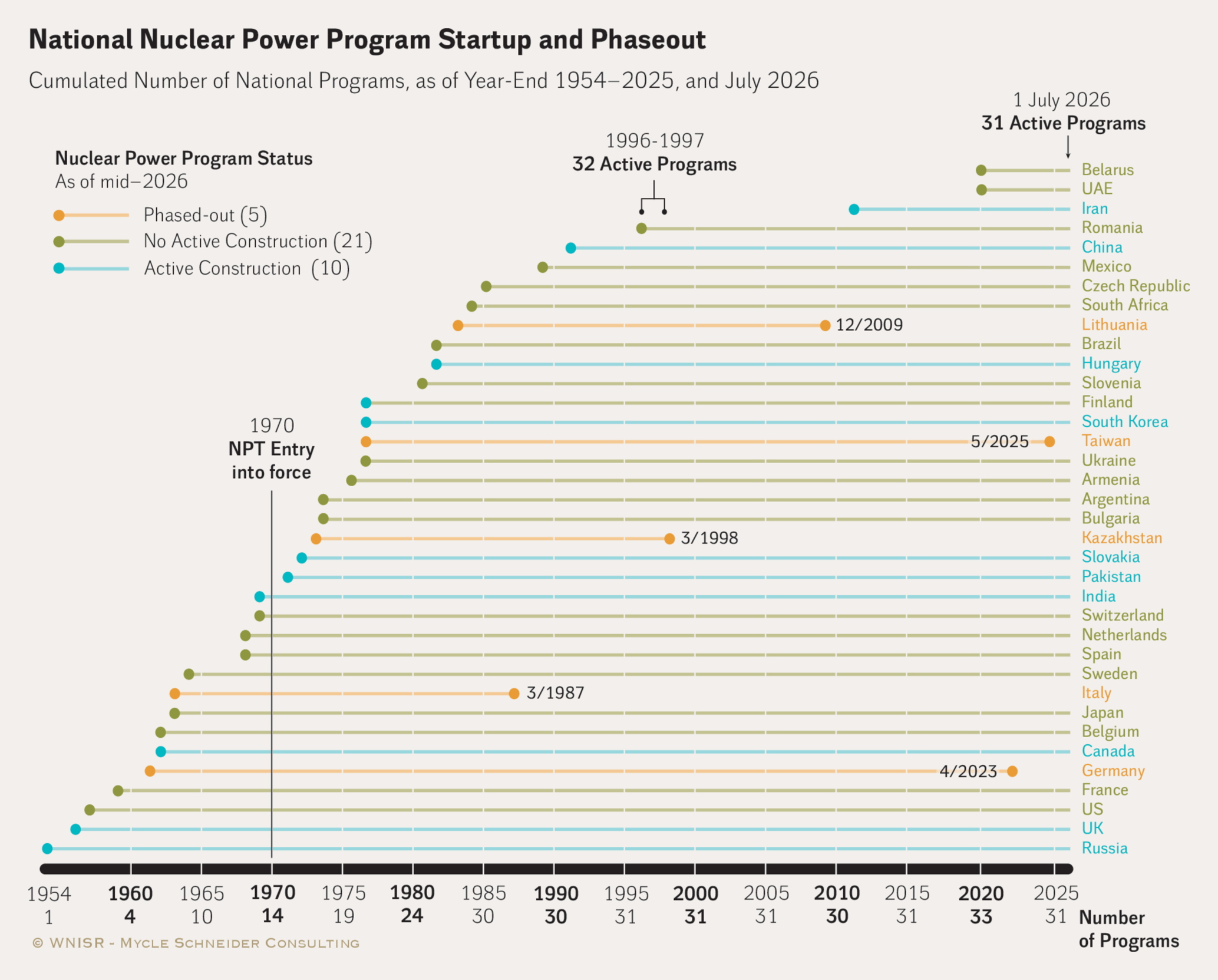
Sources: Various, compiled by WNISR with IAEA-PRIS, 2026
China, with a 7.6-percent increase (compared to 11.3 percent in 2021, 2.5 percent in 2022, 4.1 percent in 2023, and 3.7 percent in 2024), produced more nuclear electricity than France for the sixth year in a row, and there is no perspective for France to catch up again. China remains in second place—behind the US—of the top nuclear power generators.
Nuclear production outside China declined marginally (−0.2 percent) and stagnates at a level of global production reached in the mid-1990s prior to most of China’s nuclear buildout. If global nuclear generation in 2025 increased by 26 TWh year-on-year and exceeded the 2006-record by modest 40 TWh, outside China, the 2025 nuclear generation was down by 4 TWh compared to 2024 and fell 369 TWh below the 2006 level, a significant 14-percent plunge.
Compared to 2024, nuclear energy’s share of global commercial gross electricity generation in 2025 declined marginally by 0.14 percentage points to 8.8 percent—the lowest value in four and a half decades19—and dropped by almost half since the peak of 17.5 percent in 1996.
Nuclear’s main competitors, non-hydro renewables, grew their gross output by 15.9 percent (following an increase of 14.9 percent in 2024) and their share in global gross power generation increased by 2.2 percentage points to 19.5 percent, more than twice the nuclear share and higher than nuclear has ever been.
Global primary energy generation from non-hydro renewables, primarily solar, wind, and biofuels, increased by 10 percent, raising their share to 5.9 percent. Based on the Physical Energy Content methodology, non-hydro renewables now account for a larger share than nuclear energy, at 5.2 percent. This highlights the still-modest contributions of both technologies to the global energy mix, despite their starkly diverging development patterns.20
In 2025, there were six countries—compared to five in 2024—that increased the nuclear share in their respective electricity mix, including Belarus which generated nuclear power for the first time in 2020, while eight decreased the share, and 18 remained at a constant level (change of less than 1 percentage point). Besides Belarus, six countries (Argentina, China, Czech Republic, Pakistan, Slovakia, and the UAE) achieved or maintained their largest ever nuclear production.
The following noteworthy developments for the year 2025 illustrate the often volatile operational situation of the individual national reactor fleets (see country-specific sections for details):
- Belarus has seen another increase of 8.3 percent in nuclear generation after large growth in the two previous years due to the startup of Belarusian-2 and improved operation of Belarusian-1.
- Belgium’s nuclear generation dropped by more than 5 percent in 2024 and another 24 percent in 2025 with the scheduled closure of three more reactors. Consequently, the nuclear share dropped by close to 8 percentage points year-on-year to 32.6 percent.
- China started up two units with nuclear generation increasing 7.6 percent, following three years of growth at around 4 percent. The nuclear share increased by 0.1 percentage point to 4.6 percent, below levels in the years 2020–2022.
- France’s nuclear generation increased by 2.5 percent but remained below 400 TWh—average between 2005 and 2015—for the tenth year in a row.
- India’s nuclear output and share slightly dipped providing just 2.6 percent of the country’s power.
- Iran’s nuclear generation, following a record year, plunged by 23.4 percent, certainly as a consequence of the war.
- Japan’s nuclear output grew by 10.8 percent following the restart of two units towards the end of 2024. Nuclear represented 9.2 percent of total power generation in the country. No further reactor restarted in 2025, but one unit was brought back online in February 2026 bringing the total operational reactors to 15 as of mid-2026.
- The Netherlands’ only over 50-year-old reactor produced 12.4 percent more following a 10.3-percent drop in the previous year as its load factor had dropped below 80 percent for the first time since 2018.
- Pakistan’s nuclear output increased—for the tenth year in a row—by 3.7 percent. But for the second year in a row nuclear’s relative share has been declining, to below 14 percent. That is clearly a consequence of the country’s solar boom.
- Slovakia’s nuclear share at a record 65.2 percent—after a 5.8-percent rise in nuclear generation led to a jump of 4.6 percentage points—maintains the second highest level in the world behind France.
- Taiwan’s nuclear output went down by almost three quarters and with the closure of its last reactor in May 2025 and the completion of its nuclear phaseout program, the nuclear share dropped to a trickle at 1.1 percent.
- The UAE’s nuclear generation marginally increased by 0.1 percent but nuclear’s share in national electricity generation slightly slipped—by 0.6 percentage points—for the first time since the country started its first reactor in 2020.
- The UK’s nuclear power production fell by 11.7 percent year-on-year providing only 12.3 percent of the country’s electricity compared to the historic peak of 28 percent in 1997.
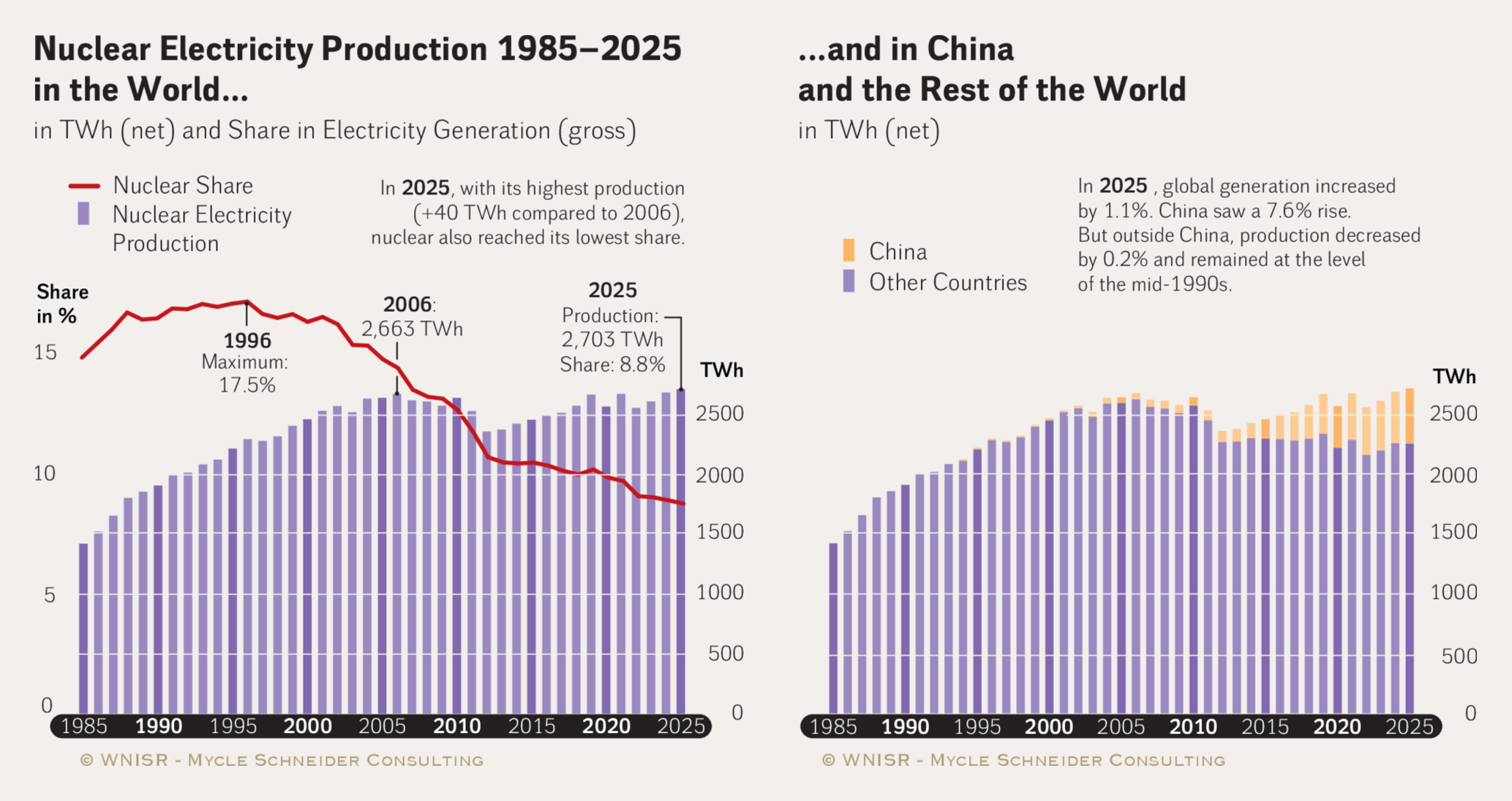
Sources: WNISR with Energy Institute, 2026
Similar to previous years, far from being a distributed planetary phenomenon, in 2025, the “big five” nuclear generating countries—the US, China, France, Russia, and South Korea, in that order—generated 74 percent of all nuclear electricity in the world (see Figure 3, left side).
In 2002, China was 15th in terms of global production levels; in 2007, it was tenth, and it reached third place in 2016. In 2020, China became the second largest nuclear generator in the world, a position that France held since the early 1980s. That has not changed since.
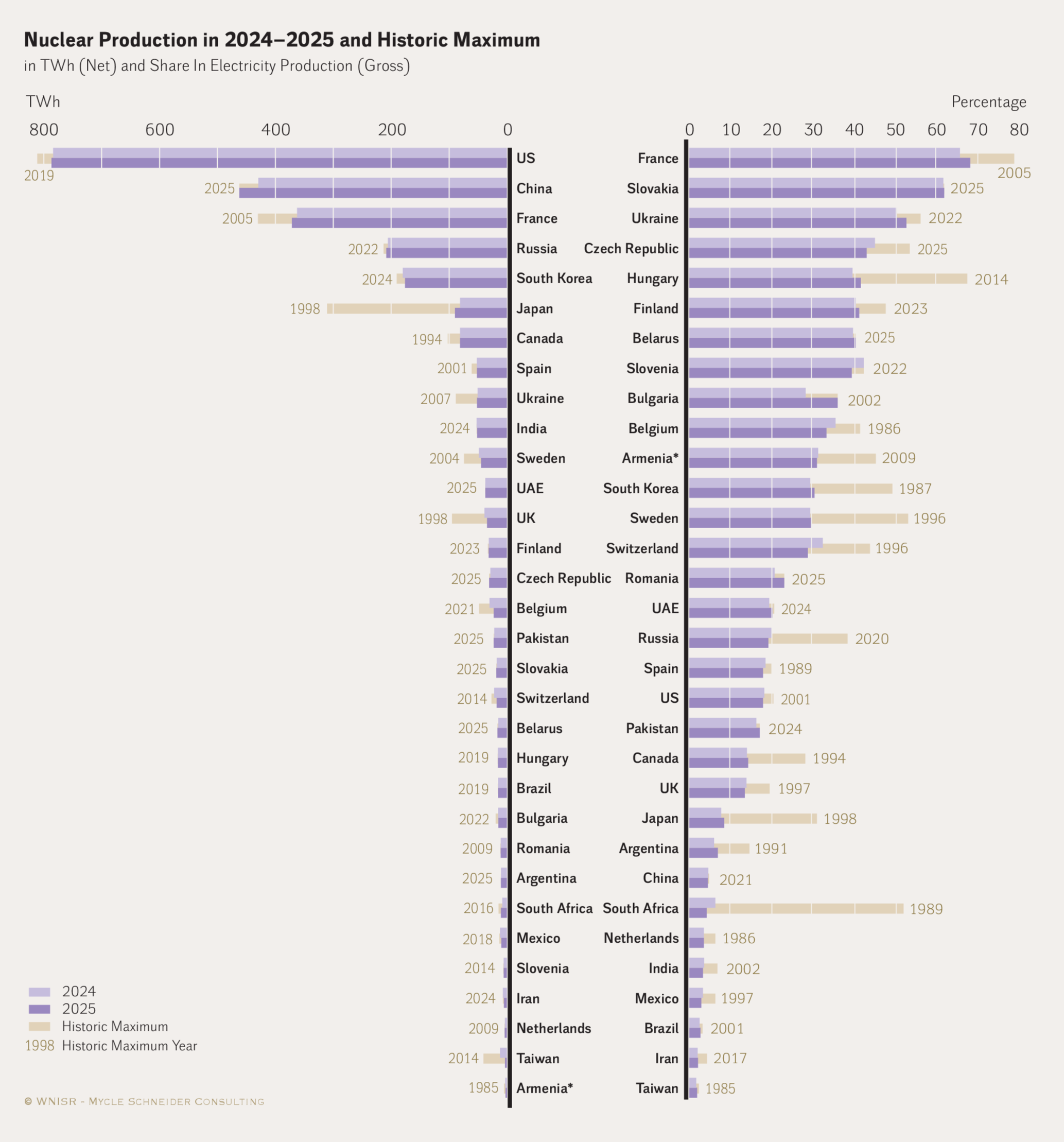
Sources: compiled by WNISR with Energy Institute, 2026
Notes
For comparison purposes, data used in this graphic are Energy Institute data21, and may differ from data used in the country sections.
Production: in TWh net; Share: calculated from gross data (nuclear and total generation), except for Armenia* (IAEA-PRIS).
In 2025, the top three countries, the US, China, and France, remained at around 60 percent of global nuclear output, underscoring the concentration of nuclear power generation in a very small number of countries.
In many cases, even where nuclear power generation increased, the addition is not keeping pace with overall increases in electricity production, leading to a nuclear share below the respective historic maximum (see Figure 3, right side). Five of the 31 countries that operated nuclear reactors in 2025 achieved their historically largest nuclear shares in the 1980s, seven in the 1990s, six in the 2000s, two in the 2010s, eleven or one third in the 2020s with four in 2025.
Operation, Power Generation, Age Distribution
Since the first nuclear power reactor was connected to the Soviet power grid at Obninsk in 1954, there have been two major waves of startups. The first peaked in 1974, with 26 grid connections in the year. The second reached a historic maximum in 1984 and 1985, just before the Chornobyl disaster began in 1986, reaching 33 grid connections in each year. By the end of the 1980s, the uninterrupted net increase of operating units had ceased, and in 1990 for the first time the number of reactor closures22 outweighed the number of startups.
The 1996–2005 decade globally saw slightly more startups than closures (43/37), while in the decade 2006–2015, startups compensated only for three quarters of the closures (41/54) (see Figure 4).
In the decade 2016–2025, the number of startups (63) increased by 50 percent compared to the previous decade—of which almost half (31) in China—but closures reached 52 none of which occurred in China. In other words, a global net increase of 11 reactors but a net decline of 15 units outside China.
Over the past two decades 2006–2025, there were 104 startups and 106 closures. Of these, 53 startups were in China which did not close any reactors. As a result, outside China, there has been a drastic net decline by 55 units over the same period (see Figure 5). As larger units were started up (totaling 97.4 GW) than closed (totaling 75.9 GW) the net nuclear capacity added worldwide over the 20-year period was still 21.5 GW. However, since China alone added over half of the capacity or 52.3 GW, the net capacity outside China declined by almost 30.8 GW.

Sources: WNISR with IAEA-PRIS, 2026
Note: WNISR considers reactors closed as of the date of their last electricity production, and not as of their closure announcement (which can be made years after the reactor ceased production). The Lucens reactor in Switzerland—considered a research reactor—initially was not taken into account in the WNISR Database. However, as it was once (briefly) connected to the grid, WNSIR decided to reintroduce this experimental reactor in the Database; its grid connection (1968) and closure (1969) are represented here.
In 2025, four reactors were connected to the grid, two in China, and one each in India and Russia, while seven units were closed, three each in Belgium and Russia, and one in Taiwan. The annual balance turned negative for the first time since 2021.
In the first half of 2026, two units were connected to the grid in the world, both in China (see Figure 5).23
As of 1 July 2026, a total of 411 nuclear reactors—three more than reported for mid-2025—were operating in 31 countries,24 and the world fleet had a record total electric net operating capacity of 375 GW. At the same time, there were 30 units (27 GW) in Long-Term Outage (LTO): 18 in Japan, six in Ukraine, three in South Korea, and one each in Argentina, China, and India.25 As the annual statistics always reflect the status at year-end, the situation will have changed again by the end of 2026.

Sources: WNISR with IAEA-PRIS, 2026
At the end of 2025, the operating capacity stood at 368.6 GW, a minor decrease of 0.5 GW from record year 2024. As of mid-2026, operating capacity at 375 GW exceeded the previous record by 1.7 percent.
The number of operating reactors remains by seven below the fleet size already reached in 1989 and by 27 below the 2002-peak (see Figure 6).
For many years, the capacity increased more than the number of reactors as a result of the combined effects of larger units replacing smaller ones and “uprating”. In 1989, the average size of an operational nuclear reactor was about 740 MW, in 2025 it was around 900 MW. Technical alterations have raised capacity at existing plants resulting in larger electricity output, a process known as uprating.26 In the US alone, the Nuclear Regulatory Commission (NRC) has approved 172 uprates since 1977. The cumulative approved uprates in the US total 8 GW, the equivalent of eight large reactors. These include seven minor uprates (<2 percent of reactor capacity) approved since mid-2020, of which only one since mid-2021.27 So this is a program that appears pretty much completed on most of the US fleet.
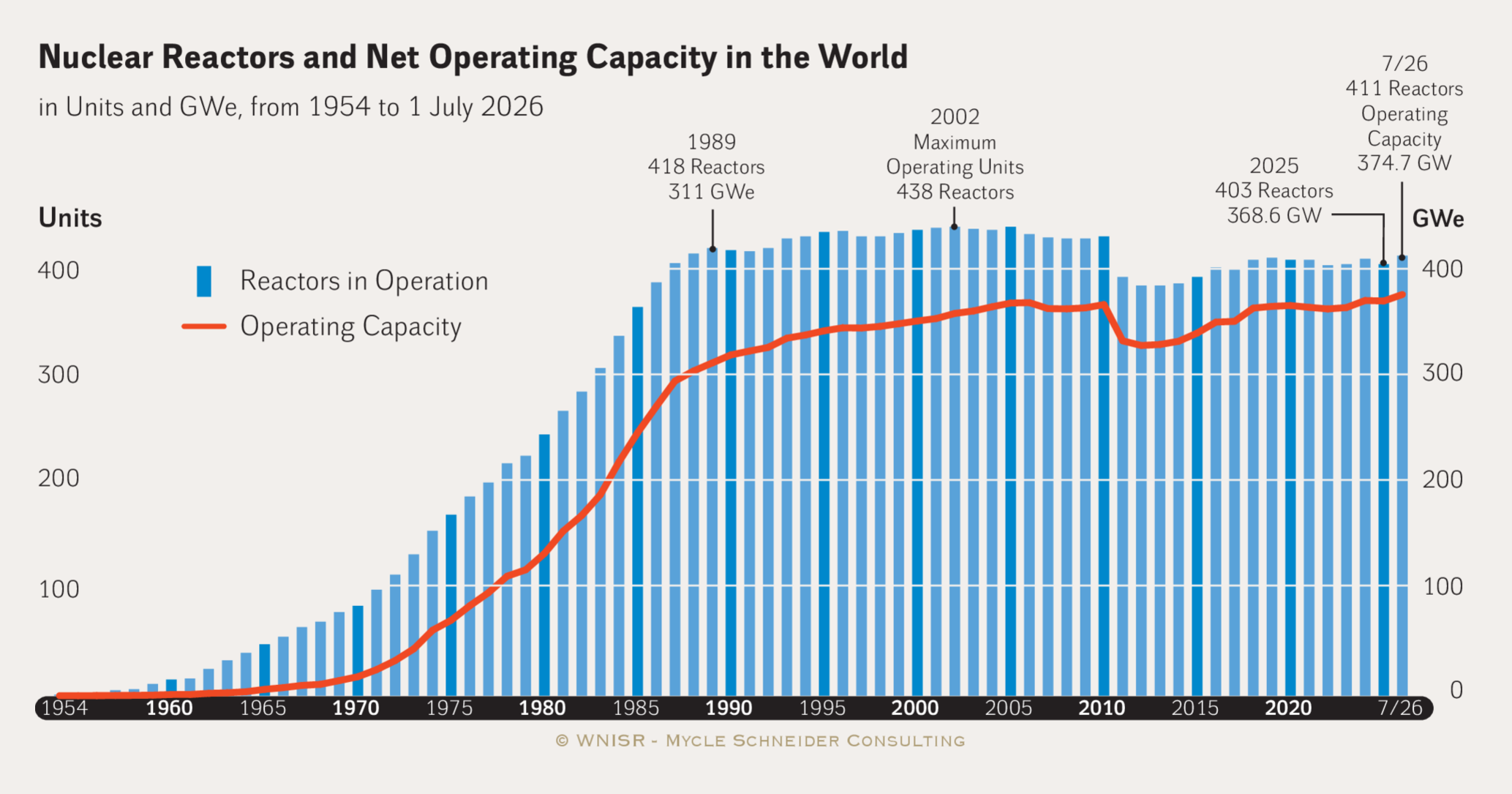
Sources: WNISR with IAEA-PRIS, 2026
A similar trend of uprates and major overhauls in view of lifetime extensions of existing reactors has been seen in Europe. The main incentive for lifetime extensions is economical, but this argument is being increasingly challenged as refurbishment costs soar and alternatives become cheaper.
The IAEA’s Operating Reactors Data Revisions
Until September 2022, the IAEA’s online Power Reactor Information System (PRIS) database counted 33 reactors as operational/operating in Japan, whereas 20 of these had not produced power since 2010–2012, and an additional three units had been shut down even since the Niigata Earthquake in 2007.
For almost a decade WNISR had been calling for an appropriate reflection in world nuclear statistics of the unique situation in Japan. The approach taken by the IAEA, the Japanese government, utilities, industry, and many research bodies as well as other governments and organizations to continue classifying the entire stranded reactor fleet in the country as “in operation” or “operational” was clearly misleading.
Faced with this dilemma, the WNISR team in 2014 decided to create a new category with a simple definition, based on empirical fact, without room for speculation: “Long-Term Outage” or LTO. Its definition:
A nuclear reactor is considered in Long-Term Outage or LTO if it has not generated any electricity in the previous calendar year and in the first half of the current calendar year. It is withdrawn from operational status retroactively from the day it has been disconnected from the grid.
A specific case involves reactors that cease operations due to the expiration of their operating licenses but are firmly expected to restart: they are considered to be in LTO as of the date of their latest power generation.28
For cases in which the decision is subsequently taken to close a reactor, the closure status starts with the day of the last electricity generation, and the WNISR statistics are retroactively modified accordingly.
The IAEA’s Category of “Suspended Operation”
In September 2022, the IAEA-PRIS database gradually withdrew twelve Japanese reactors29 from the list of “Operating” or “Operational” reactors, and their status changed to “Long-term Shutdown” (LTS). By mid-October 2022, the category title was changed to “Suspended Operation” on the PRIS website,30 and in November 2022, four more Japanese units31 joined the new category as well as one Indian reactor (Rajastan-1) that had not generated any power since 2004 and is considered closed by WNISR. In April 2023, seven additional Japanese units joined the “Suspended Operation” category, followed in May 2023 by three additional Indian reactors, that have not produced power since 2018 (Madras-1) and 2020 (Tarapur-1 & -2).
It is important to understand that the application of this new rule modifies retroactively all of the IAEA’s statistics on operating reactors—in most cases as of day of last production—back to 2007. This dramatically modifies the IAEA’s representation of the Japanese nuclear reactor fleet’s evolution. The changes obviously also impact the IAEA’s representation of the long-term evolution of the entire global nuclear power-reactor fleet (see a detailed discussion in WNISR2023).
The differences between the IAEA and WNISR statistics are greatly reduced, and the remaining ones mostly relate to official closure dates, as WNISR statistics consider the end of electricity production as reference for dating closures, and not the “announcement” or “political decision” to permanently withdraw a reactor from the grid. Currently, a significant difference is that the IAEA considers the six Zaporizhzhia reactors as operational although they have not produced any power in years (see hereunder and Ukraine Focus).
IAEA vs. WNISR Assessment
WNISR’s assessment of “operating” reactors has shown significant differences with IAEA statistics since the beginning of the Fukushima disaster in 2011. However, after major changes in the PRIS statistics (see above), those differences were reduced to minor disparities during the period September 2022 to May 2023.
In the WNISR statistics, which consider reactors closed from the day they stop producing electricity and systematically apply the LTO status to reactors not operating for a certain period, a maximum number of 438 operating reactors was reached as soon as 2002, and again in 2005. At the end of 2025, with a balance of minus 0.5 GW between closed and newly started-up reactors during the year plus a balance of two more reactors in LTO, the operating capacity slightly decreased from its maximum of 369.1 GW as of end 2024 to 368.6 GW.
Although not the only case, the Japanese fleet still provides the main and more visible differences between the two datasets, especially over the decade 2011–2020. This applies in particular to reactors that were declared permanently closed years after they stopped producing electricity (“Closed at a later date”) as well as reactors that did not produce electricity for several years before they returned to service (designated as “LTO later restarted” or “Restarted from LTO”.
Applying this definition to the world nuclear reactor fleet, as of 1 July 2026, leads WNISR to classifying ten units as in LTO which are considered “in operation” by the IAEA:
- Atucha-1 in Argentina Atucha-1 that was shut down for refurbishment after its license expired on 29 September 2024.
- Kori-3, Kori-4 and Hanbit-1 in South Korea, shut down in September 2024, August 2025 and December 2025 respectively, after 40 years of operation and the expiration of their operating license. Currently, they are expected to be restarted at an unknown date, pending inspection results and potential upgrading, and therefore they are considered in LTO (see South Korea Focus).
- The six reactors at Zaporizhzhia in Ukraine that did not produce any electricity in 2023 and 2024 and are considered in LTO as of the end of 2022.
As of mid-2026, the IAEA classified 19 reactors in Japan and two in India as suspended. With the exception of one reactor in India (Rajasthan-1) considered closed since the end of 2004, and Kashiwazaki-Kariwa-6 that was restarted in February 2026, WNISR classifies all of them in LTO.
On the other hand, WNISR statistics do include additional reactors in China:
- Shidao-Bay-1: The IAEA considers the two 100-MW modules as one reactor as they drive a single 200-MW turbine. WNISR considers that each module is a separate reactor.
- Shidaowan Guohe One-1 and -2: The first of two CAP1400 at Shidao Bay that started operating in 2024 and 2025 respectively. For unknown reasons, the two units are not listed in the IAEA database.
- China Experimental Fast Reactor (CEFR): The IAEA has simply deleted the file for the reactor without any indication of reasons. Chinese sources have argued it should have never been in the IAEA’s PRIS database in the first place as it is to be considered an experimental reactor. However, as this is a grid-connected nuclear power reactor, it is considered as such by WNISR. Its current operational status is uncertain. In the absence of operational data, WNISR considers it in LTO as of May 2023 (but still operating as of December 2022).32
As of 1 July 2026, 73 reactors were considered as under construction33—including 37 units, more than half, in China—ten more than the WNISR reported a year ago, four more than in 2013, and the highest number since 1987 (see Figure 7 and Figure 8). Outside China, 36 units were under construction, an increase of five from mid-2025 and the highest number since 2022, China alone accounting for half of the increase year-on-year.
Of the 69 reactors listed at the end of 2013, six projects were subsequently abandoned or suspended.
Nine in ten of all reactors are being built in Asia or Eastern Europe (see Building vs. Vendor Countries). Fourteen countries are building nuclear plants, down from 16 as of mid-2023 but up from 11 as of mid-2025 with construction starts in Canada, Hungary, and Uzbekistan (a newcomer country).
Only four countries—China, India, Russia and South Korea—have construction ongoing at more than one site, and six countries only have a single reactor under construction (see Table 1 and Annex 5 for details). Between mid-2025 and mid-2026, construction of fifteen units was launched worldwide, nine in China and one each in Canada, Hungary, India, Russia, South Korea, and Uzbekistan.
The 73 reactors listed as under construction represent less than one third of the 234 units—totaling more than 200 GW—listed in 1979. However, 48 of those projects listed at the time were never finished (see Figure 7). The year 2005, with 26 units listed as under construction, was the lowest since the early nuclear age in the 1950s.
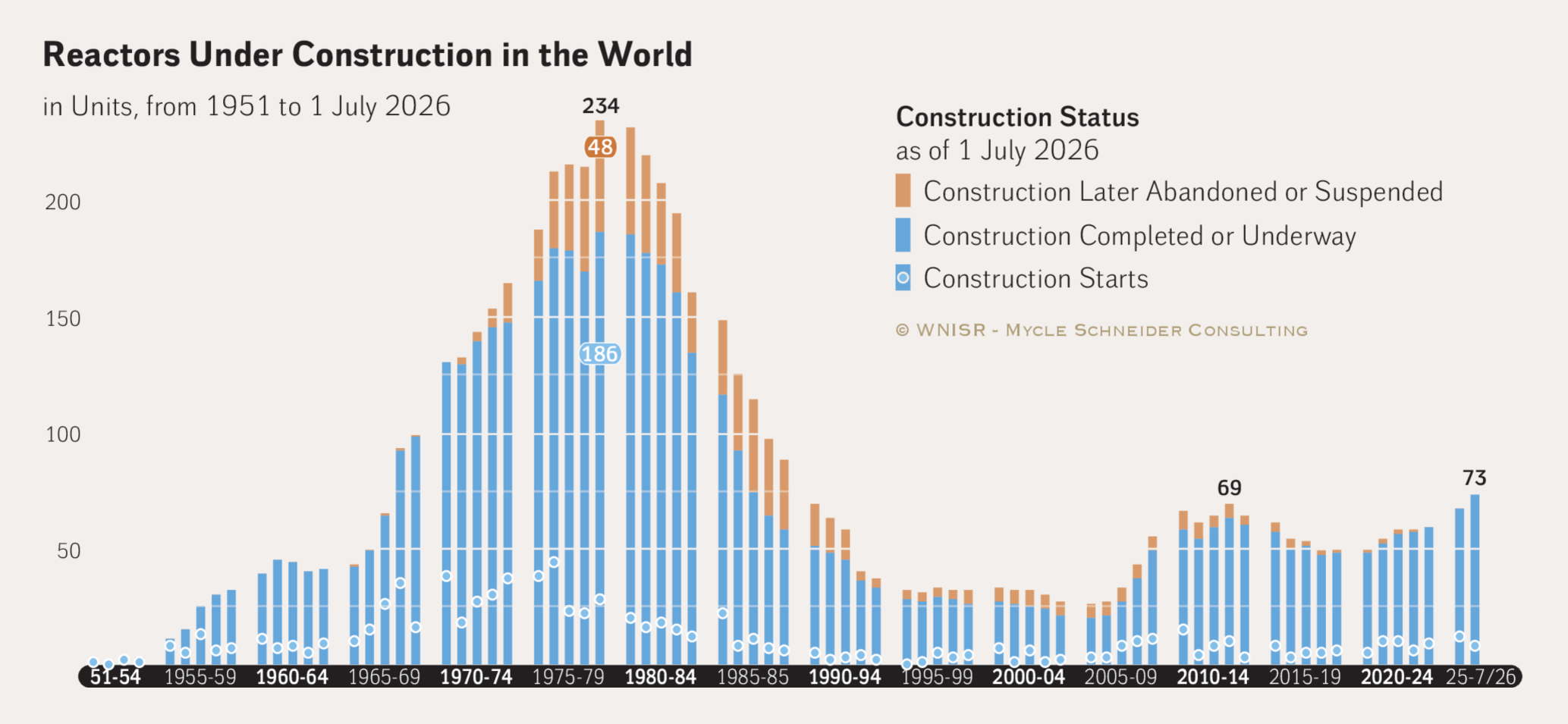
Sources: WNISR with IAEA-PRIS, 2026
Notes: This figure includes construction of two CAP1400 reactors at Rongcheng/Shidaowan, although their construction has not been communicated by the IAEA, one of which has been connected to the grid in 2024 and the second one in 2025 (see China Focus), and does include one unit under construction at Kaiga in India (see section on India).
Compared to mid-2025, with 73 reactors representing 74.4 GW (an average of just over 1 GW per reactor) there are ten more units and an additional 9 GW under construction in the world.
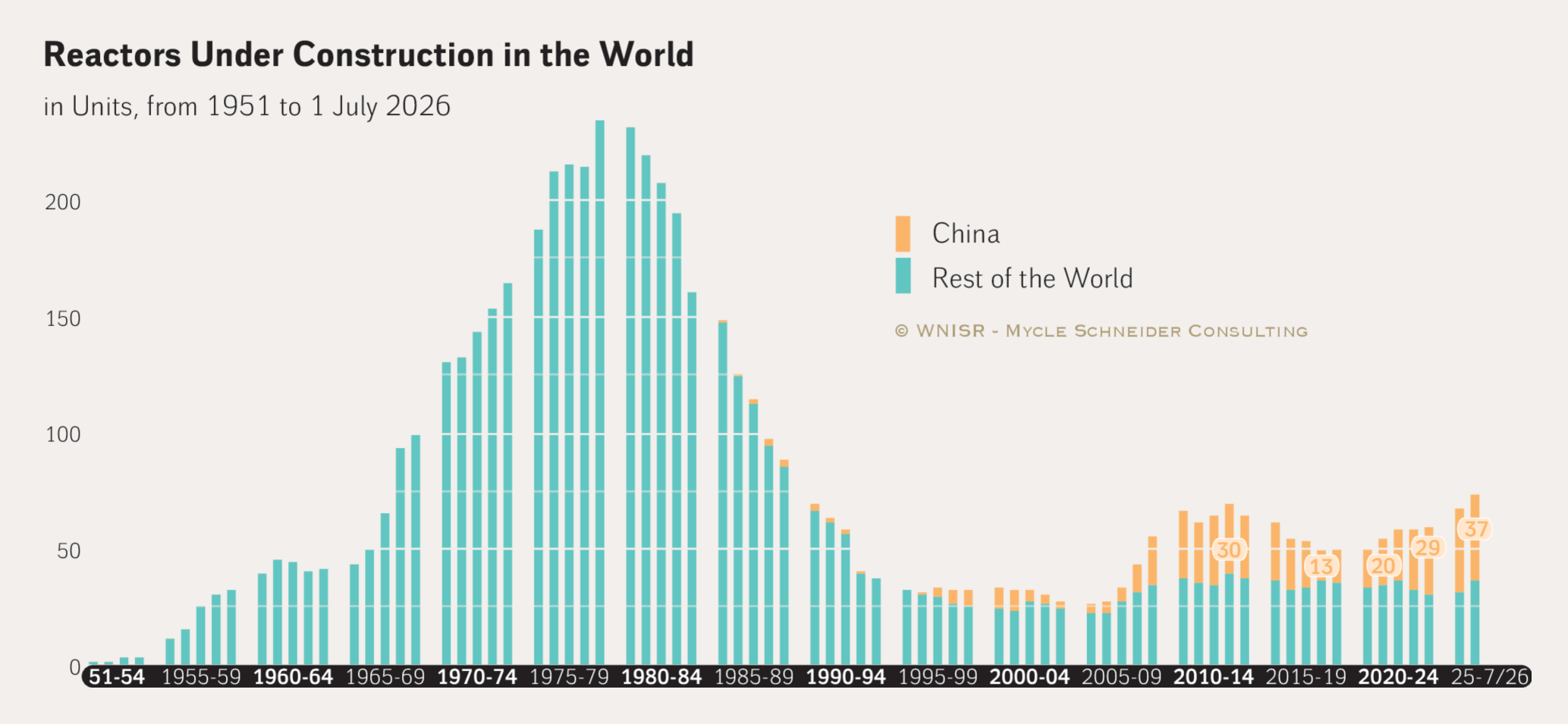
Sources: WNISR with IAEA-PRIS, 2026
As of mid-2026, China hosted over half of all reactors under construction in the world. But so far, Chinese companies have only exported nuclear power reactors to Pakistan, where they started building another unit in December 2024.
At the end of 2025, there was not a single active construction on the entire American continent, from Alaska to Cape Horn, including the United States, that hosts the world’s largest nuclear power fleet. In April 2026, construction started on an SMR on the Darlington site in Ontario, Canada (see Figure 9). This is the first construction start in four decades in Canada.
Russia continues to dominate the international market as a technology supplier with 29 units under construction in the world, as of mid-2026, of which seven at home and 22 in nine different countries, including four each in China, Egypt, India, and Türkiye, two in Bangladesh, and one each in Hungary, Iran, and Uzbekistan. One unit in Slovakia in the process of startup is of Russian design and has been completed by a Czech-led consortium. It remains uncertain to what extent these projects were and remain impacted by the various layers of sanctions imposed on Russia following its full-scale invasion of Ukraine. But there is increasing evidence of significant delays as a consequence of direct (restrictions on parts transfers) or indirect (restrictions on financial institutions) impact of the sanctions (see respective country sections for details).
Besides Russia’s Rosatom, there is only France’s EDF (Électricité de France), China’s CNNC (China National Nuclear Corporation), and the US-Japan consortium GE Vernova-Hitachi presently building abroad (see Figure 9 and Table 1).
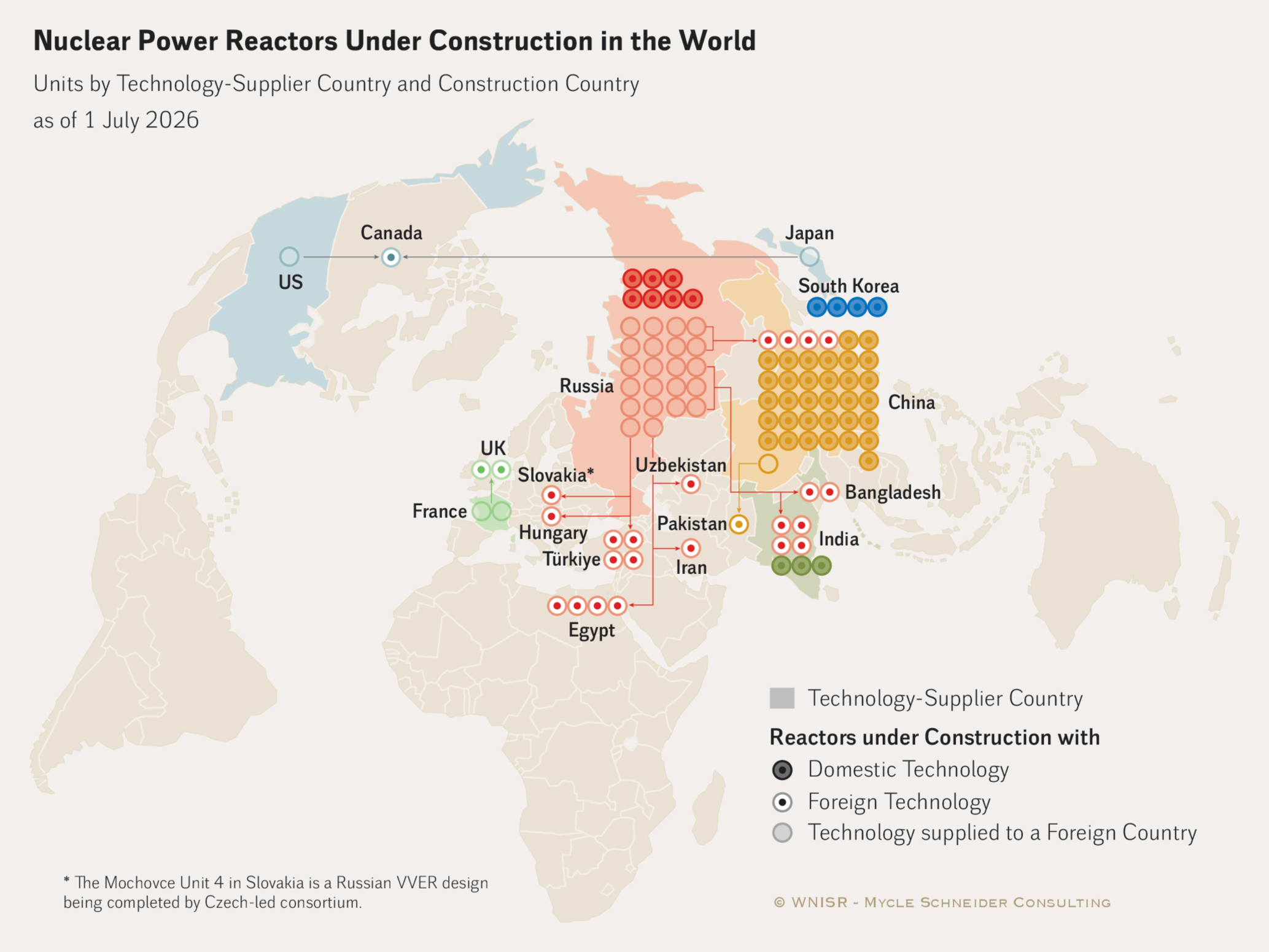
Sources: WNISR with IAEA-PRIS, 2026
- Nuclear Reactors “Under Construction” (as of 1 July 2026)34
|
Country |
Units |
Other Vendor |
Capacity |
Construction Start |
Grid Connection |
Units Behind Schedule |
|
China |
37 (33) |
Russia: 4 |
39 952 |
2017 – 2025 |
2026 – 2031 |
3 (3?) |
|
India |
7 (3) |
Russia: 4 |
5 398 |
2004 – 2026 |
2026 – 2031 |
6 |
|
Russia |
7 (7) |
– |
5 106 |
2019 – 2025 |
2027 – 2032 |
4 |
|
Egypt |
4 (–) |
Russia: 4 |
4 400 |
2022 – 2024 |
2028 – 2031 |
- |
|
South Korea |
4 (4) |
– |
5 360 |
2017 – 2026 |
2026 – 2033 |
2 |
|
Türkiye |
4 (–) |
Russia: 4 |
4 456 |
2018 – 2022 |
2026 – 2029 |
4 |
|
Bangladesh |
2 (–) |
Russia: 2 |
2 160 |
2017 – 2018 |
2026 – 2027 |
2 |
|
UK |
2 (–) |
France: 2 |
3 260 |
2018 – 2019 |
2030 – 2031 |
2 |
|
Canada |
1 (–) |
US/Japan: 1 |
300 |
2026 |
2030 |
|
|
Hungary |
1 (–) |
Russia: 1 |
1 185 |
2026 |
2031 |
|
|
Iran |
1 (–) |
Russia: 1 |
974 |
1976 |
2029 |
1 |
|
Pakistan |
1 (–) |
China: 1 |
1 117 |
2024 |
2030 |
|
|
Slovakia |
1 (–) |
Russia: 1(a) |
440 |
1985 |
2026 |
1 |
|
Uzbekistan |
1 (–) |
Russia: 1 |
55 |
2026 |
2029 |
|
|
World |
73 |
74 163 |
1976 – 2026 |
2026 – 2033 |
25 (28?) |
|
|
Total per Vendor Country: Russia: 29 – China: 34 – South Korea: 4 – France: 2 – India: 3 – US/Japan: 1 |
||||||
Sources: Various, compiled by WNISR, 2026
(a) – Mochovce -4 is a Russian VVER design being completed by a Czech-led consortium.
Note: This table does not contain suspended or abandoned constructions. It does include two floating reactors of Russian design to be deployed in Russia—thus counted under Country-Russia, but with the barges built in China, also delayed.
Construction Times of Reactors Currently Under Construction
A closer look at projects listed as “under construction” as of 1 July 2026 illustrates the level of uncertainty and problems associated with many of these projects, especially given that most builders continue to claim a five-year construction period in their project proposals:
- For the 73 reactors being built, an average of 5.1 years have passed since construction start—slightly lower than the mid-2025 average of 5.3 years of the fleet under construction then—and many remain far from completion.
- All reactors under construction in at least five of the 14 building countries have experienced often year-long delays. Over one third (25) of the building projects are documented to be delayed. The status of an additional three units in China remains uncertain. Most of the units—32 of 45—which are nominally being built on-time (yet) were begun within the past three years (mid-2023–mid-2026) and 31 of the 45 are in China, making it difficult to assess whether they are on schedule, because of lack of systematic access to information.
- It remains also unclear what will happen with Russian designed and/or implemented projects at home and in eight other countries (not including Slovakia), as sanctions have or likely will have an impact on supply chains. Russian projects in five of the nine countries are already documented to be delayed (Bangladesh, India, Iran, Slovakia, Türkiye), some of them due to sanctions’ impacts.
- Of the 25–28 constructions behind schedule, at least eleven—in Bangladesh, India, Russia, Slovakia, and South Korea—have reported increased delays, two have confirmed delay indications, and three delays have been identified for the first time over the past year.
- At the beginning of 2025, 13 reactors were scheduled to be connected to the grid during the year (including seven pushed back from 2024 to 2025), but less than one third (4) made it to generate first power, while the commissioning of the other nine was delayed at least into 2026.
- The initial construction start of the Mochovce-4 reactor in Slovakia dates back over 40 years and its grid connection has—again—been further delayed but is getting closer with fuel loading started in June 2026. Bushehr-2 in Iran originally started construction 50 years ago, in 1976 and resumed construction in 2019 after a 40-year-long suspension. Grid connection is currently scheduled for 2029.
- Two additional reactors—both in India—have accumulated delays of a decade or more: the Prototype Fast Breeder Reactor (PFBR) under construction since 2004 finally went critical in April 2026, and Rajasthan-8 with building underway since 2011 originally planned to start up in 2016 and currently to be commissioned before the end of the year.
The actual lead time for nuclear plant projects includes not only the construction itself but, in most countries, also lengthy political and legal processes, licensing procedures, complex financing negotiations, site preparation, and other infrastructure development.
Construction Times of Past and Currently Operating Reactors
Since the beginning of the nuclear power age, there has been a clear global trend towards increasing construction times. National building programs were faster in the early years of nuclear power, when units were smaller, and safety and environmental regulations were less stringent.
As Figure 10 illustrates, average times between construction start and grid connection of reactors completed in the 1970s and 1980s were quite homogeneous, while in the past two decades they have varied widely.
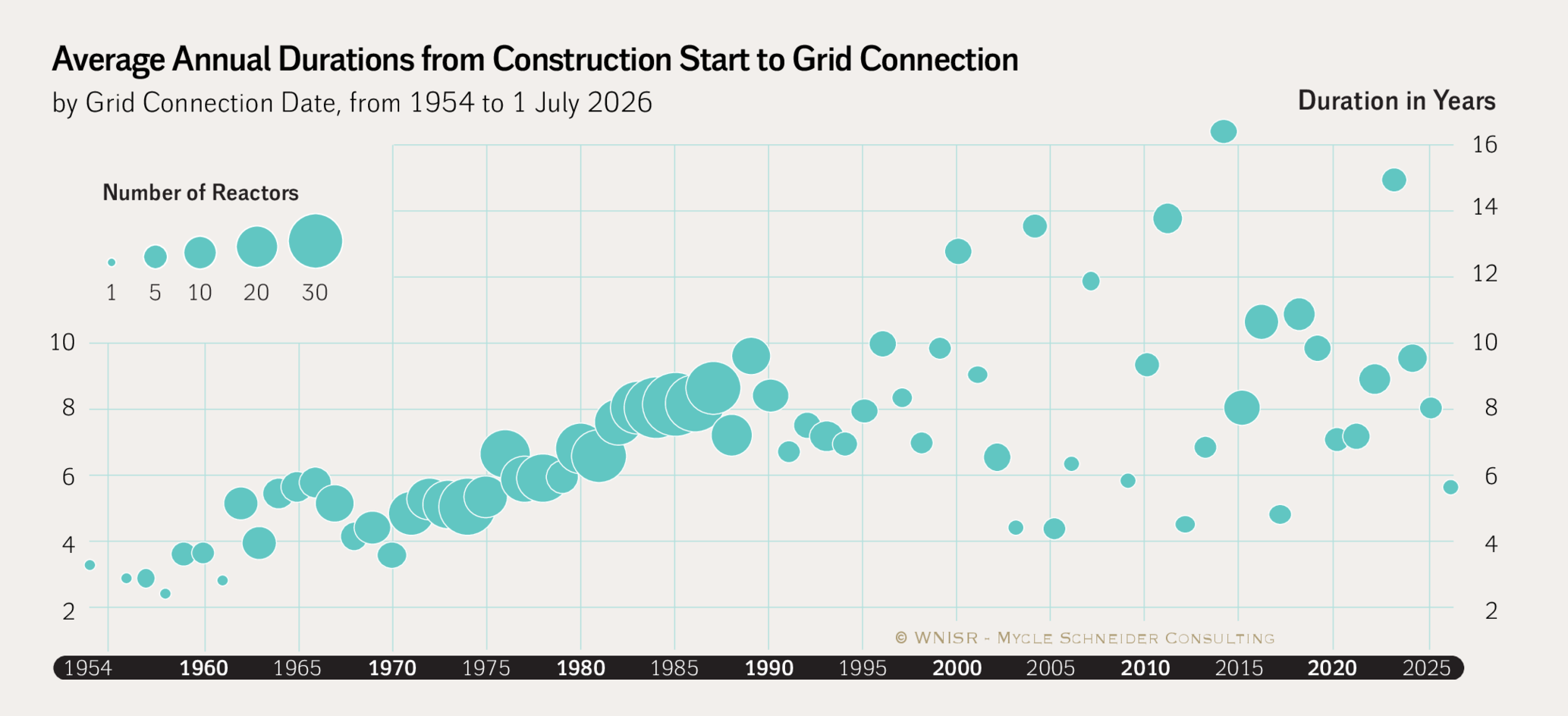
Sources: WNISR with IAEA-PRIS, 2026
In the three years 2023–2025, there were 16 startups in nine countries after an average 10.9‑year construction time. None of them was on-time, delays varied from a few weeks to many years (see Figure 11). The longest construction time was seen for Mochovce-3 at 38 years in total or at 22 years net, taking into account the 16-year-long construction suspension, followed by the French Flamanville-3 European Pressurized Water Reactor (EPR) at 17.1 years, and Rajasthan-7 at 13.7 years. The longest construction time experienced in China, overall a significantly better performer than its foreign competitors, was seen for Fangchenggang-4 (Hualong One) at 7.3 years. The six units completed in 2023–2025 in China took on average six years to build.
The four reactors commissioned in the world in 2025 average a construction time of 8.1 years with two units in China at 5.2 and 5.7 years, and one each in Russia and India at 7.7 and 13.7 years respectively.35 The total average compares to the 9.6 years for the seven units started up in the world in 2024.
Only two units began power generation in the first half of 2026, Sanao-1 and Taipingling-1 after 5.2 and 6.1 years of construction respectively.36
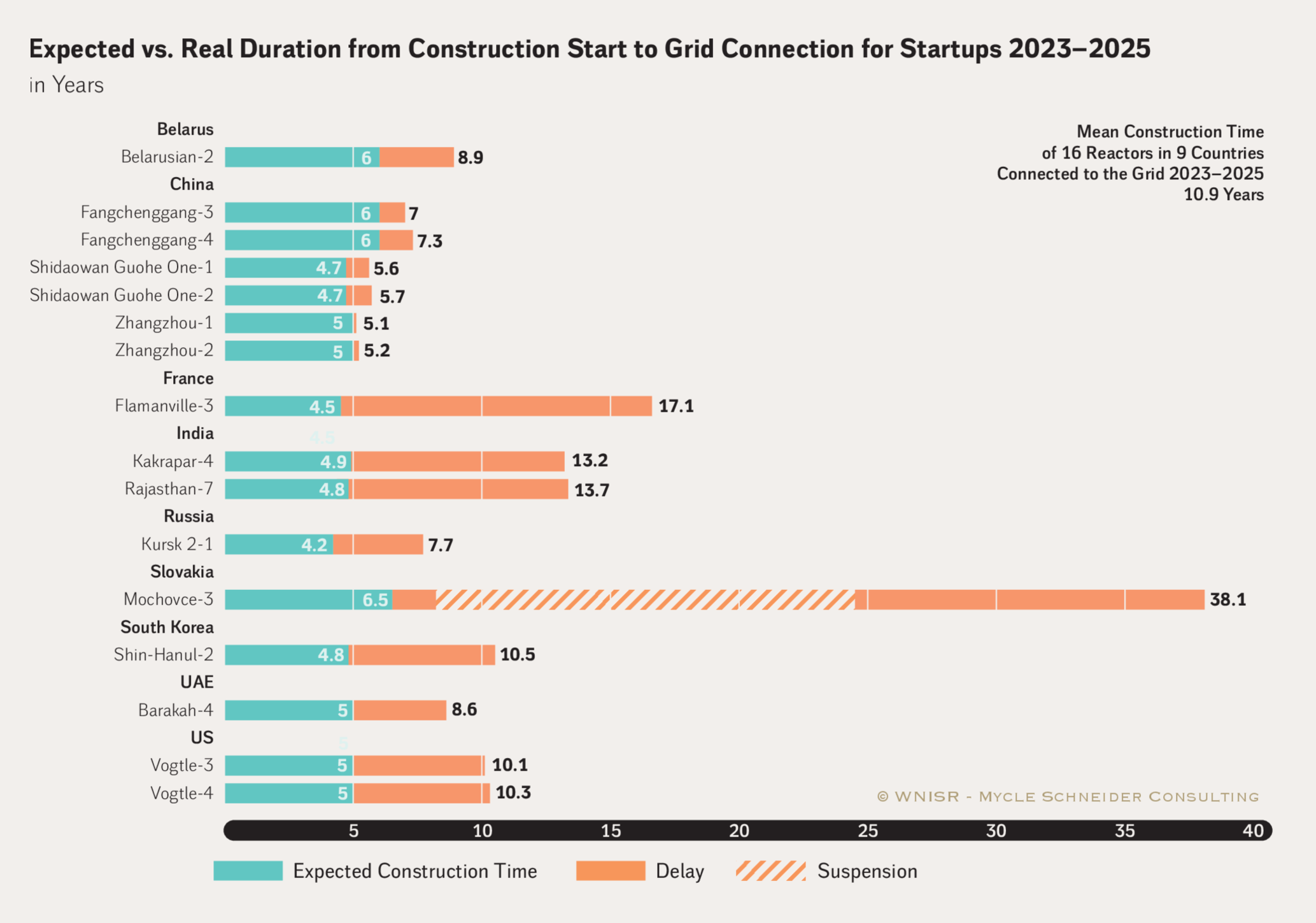
Sources: Various, compiled by WNISR, 2026
Notes: Expected construction time is based on grid connection data provided at construction start when available; alternatively, best estimates are used, based on commercial operation, completion, or commissioning targets.
The second of the Guohe One reactor at Shidaowan was connected to the grid in the summer of 2025, but no exact date was provided.
The longer-term perspective confirms that short construction times remain the exceptions. Builders completed 63 reactors in eleven countries over the decade 2016–2025—of which 31 in China alone—with an average construction time of 9.5 years (see Table 2), slightly more than the 9.4 years of the decade 2015–2024 but less than the 9.9 years of mean construction time in the decade 2014–2023.
The durations from the beginning of concreting of the foundations of the reactor building to first grid connection have varied but have averaged out around 10 years for over a decade, with a slow decline in recent years and a broad range between countries and between projects inside individual countries, with remarkably shorter times over the long run for Chinese industry projects, at home and in Pakistan.
|
Construction Times* of 63 Units Started Up 2016–2025 |
||||
|
Country |
Units |
Construction Time (in Years) |
||
|
Mean Time |
Minimum |
Maximum |
||
|
China |
31 |
6.4 |
4.1 |
9.8 |
|
Russia |
8 |
13.3 |
7.7 |
35.1 |
|
India |
4 |
12.8 |
10.1 |
14.2 |
|
Pakistan |
4 |
5.6 |
5.5 |
5.8 |
|
South Korea |
4 |
9.3 |
7.2 |
10.5 |
|
UAE |
4 |
8.3 |
8.0 |
8.6 |
|
US |
3 |
21.1 |
10.1 |
42.8 |
|
Belarus |
2 |
8.0 |
7.0 |
8.9 |
|
Finland |
1 |
16.6 |
16.6 |
|
|
France |
1 |
17.1 |
17.1 |
|
|
Slovakia |
1 |
38.1 |
38.1 |
|
|
World |
63 |
9.5 |
4.1 |
42.8 |
Sources: Various, compiled by WNISR, 2026
Note: * Including potential work suspension times.
Construction Starts and Cancellations
The number of annual construction starts in the world peaked in 1976 at 44, of which 11 projects were later abandoned. In 2010, there were 15 construction starts—10 in China and five implemented by Russia—the highest level since 1985 (see Figure 12 and Figure 13). That number dropped to five in 2020 (including four in China), while building started on ten units in 2021 (including six in China), as well as in 2022 (including five in China). Six constructions started in 2023, of which five in China and one in Egypt implemented by the Russian nuclear industry. Nine constructions started in 2024, of which six in China, one in Russia, one in Pakistan implemented by Chinese companies, and one in Egypt implemented mainly by Russian companies.
Twelve construction starts were documented for 2025—the highest number since 2010—nine of which were in China, two in Russia, and one in South Korea. In other words, over the six years between January 2020 and the end of 2025, all of the 52 construction starts in the world but one (in South Korea) were either implemented by the Chinese or the Russian nuclear industries.
Construction of eight reactors got underway during the first half of 2026, three of them in China, one each in Canada, Hungary, India, South Korea, and Uzbekistan. Chinese and Russian government-owned or -controlled companies launched all but three of the 55 reactor constructions in the world over the 66-month period from the beginning of 2021 to mid-2026.
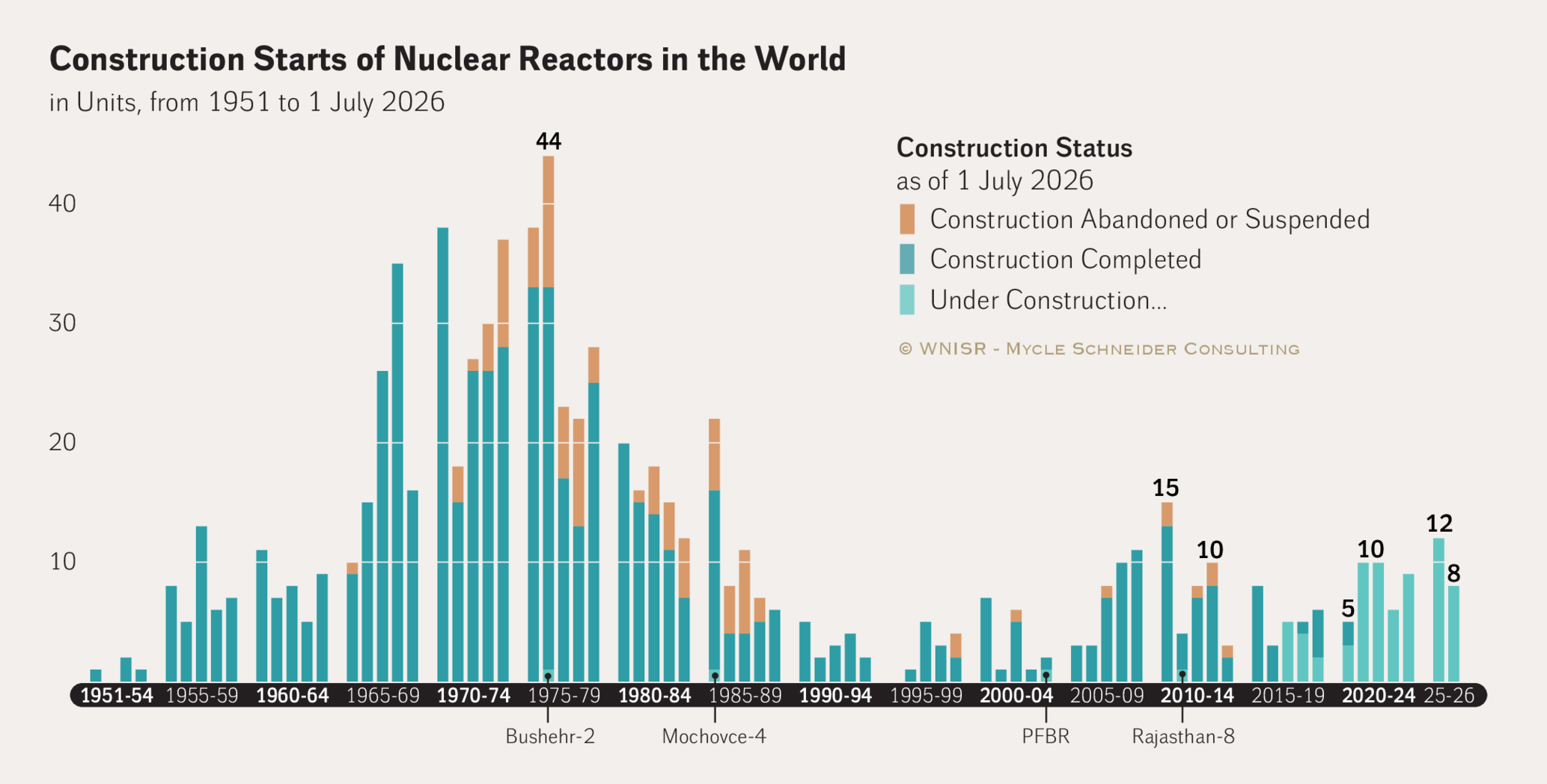
Sources: WNISR with IAEA-PRIS, 2026
Over the decade 2016–2025, construction began on 71 reactors in the world, of which 42 (59 percent) in China. As of mid-2026, 10 of those units had started up, while 61 remain under construction.
Seriously affected by the Fukushima events, China did not start any construction in 2011 and 2014 and began work on “only” eight units in total in 2012 and 2013. While Chinese utilities started building six more units in 2015, the number shrank to two in 2016, only a demonstration fast reactor in 2017, none in 2018, but four each in 2019 and 2020, six in 2021, five each in 2022 and 2023, six in 2024, nine in 2025, and three in the first half of 2026 (see Figure 13). While this increase might signal the restart of large-scale reactor building in China, the level continues to remain far below expectations.
The five-year plan 2016–2020 had fixed a target of 58 GW operating and 30 GW under construction by 2020. As of the end of 2020, China had 49 units with 51 GW (47.5 GW net) operating, one reactor in LTO (CEFR), and 17 units (17.5 GW gross / 16 GW net) under construction, much lower than the original target. With an operating capacity of around 64 GW as of the end of 2025, the 14th Five-Year Plan (2021–2025) target of 70 GW operational capacity was also missed (for details and references, see China Focus).
Experience shows that having an order for a reactor or even having a nuclear plant at an advanced stage of construction, is no guarantee of ultimate grid connection and power production. The two V.C. Summer units, abandoned in July 2017 after four years of construction and following multi-billion-dollar investment, are only examples in a long list of failed significantly advanced nuclear power plant projects. Another recent example is the Small Modular Reactor (SMR) CAREM-25, an Argentinian domestic design, that was abandoned in 2024 after ten years of construction.
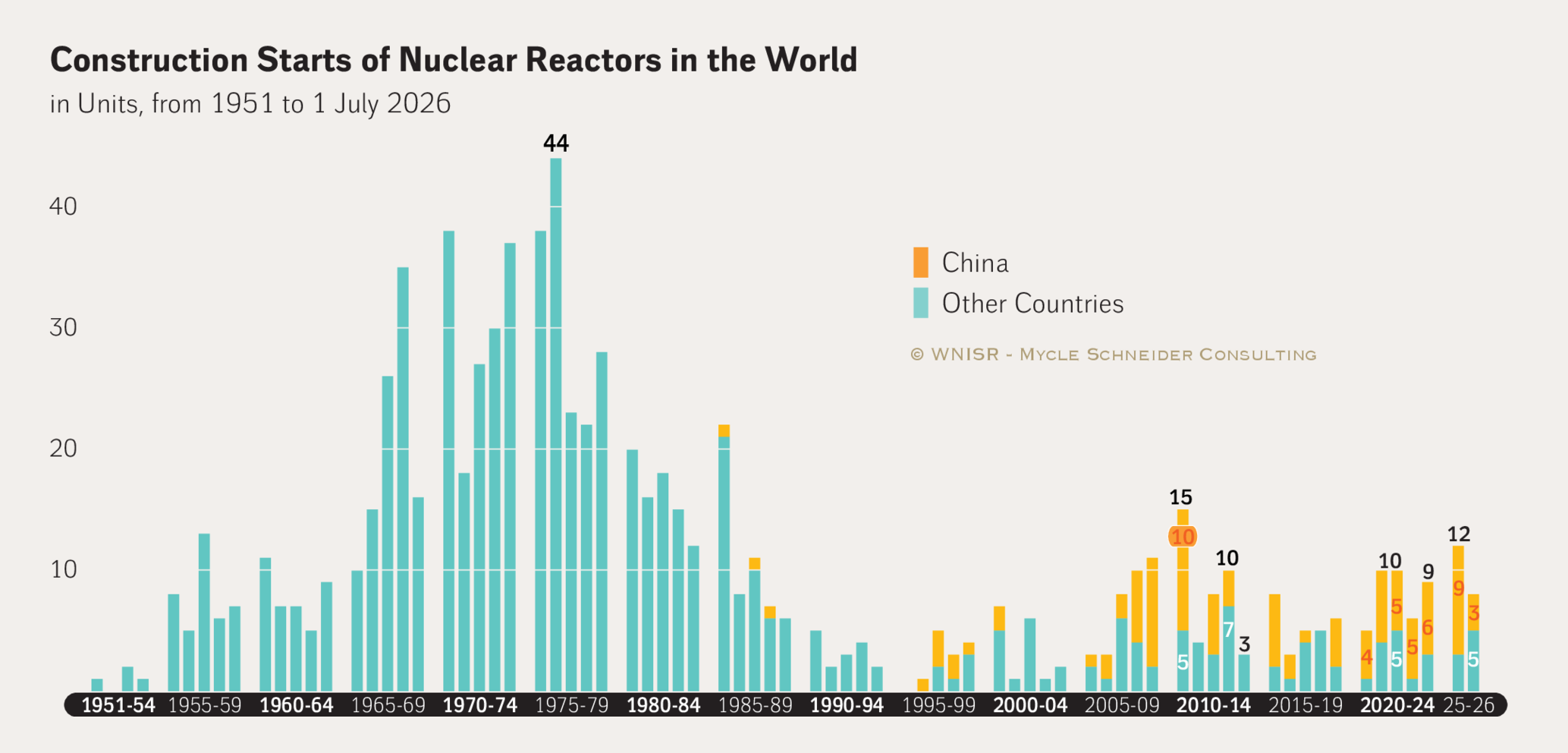
Sources: WNISR with IAEA-PRIS, 2026
French Alternative Energies and Atomic Energy Commission (CEA) statistics through 2002 indicate 253 “cancelled orders” in 31 countries, many of them at an advanced construction stage (see also Figure 14). The United States alone accounted for 138 of these order cancellations.37 Unfortunately, the data series does not distinguish between “orders” and “constructions” and it has been discontinued.
Of the 833 reactor constructions launched between 1951 and 1 July 2026, at least 95 units in 20 countries had been abandoned or suspended between 1970 and 2024. This means that 11.4 percent—or one in nine—of nuclear constructions have been abandoned.
Close to three-quarters (66 units) of all cancelled projects were in four countries alone—the US (42), Russia (12), Germany and Ukraine (six each). Some units were 100-percent completed—including Kalkar in Germany and Zwentendorf in Austria—before it was decided not to operate them.
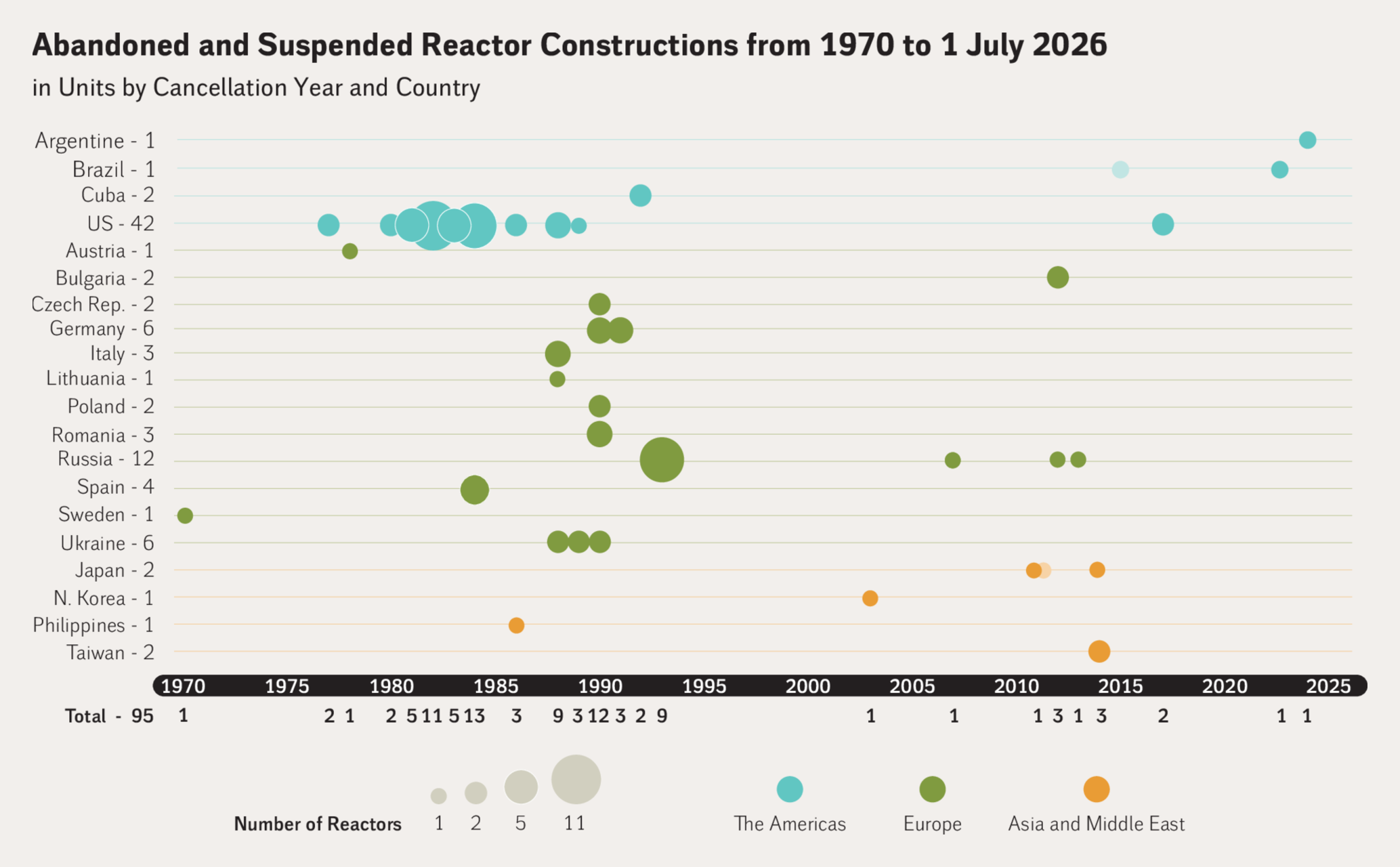
Sources: Various, compiled by WNISR, 2026
Notes
The shaded colors indicate the first suspension in the case of reactors where construction was suspended several times (e.g. Brazil and Japan).
This figure only includes constructions that had officially started with the concreting of the base slab of the reactor building. Many more projects have been cancelled at earlier stages of construction/site preparation and equipment manufacturing.
In the absence of significant, successful newbuild over many years, the average age (from grid connection) of operating nuclear power plants has been increasing for over 40 years, since 1984, and as of mid-2026 stands at 32.9 years, up from 32.5 years in mid-2025 (see Figure 15).38
A total of 269 reactors, two-thirds of the world’s operating fleet, have operated for 31 or more years, including 169—more than one in three—for at least 41 years.
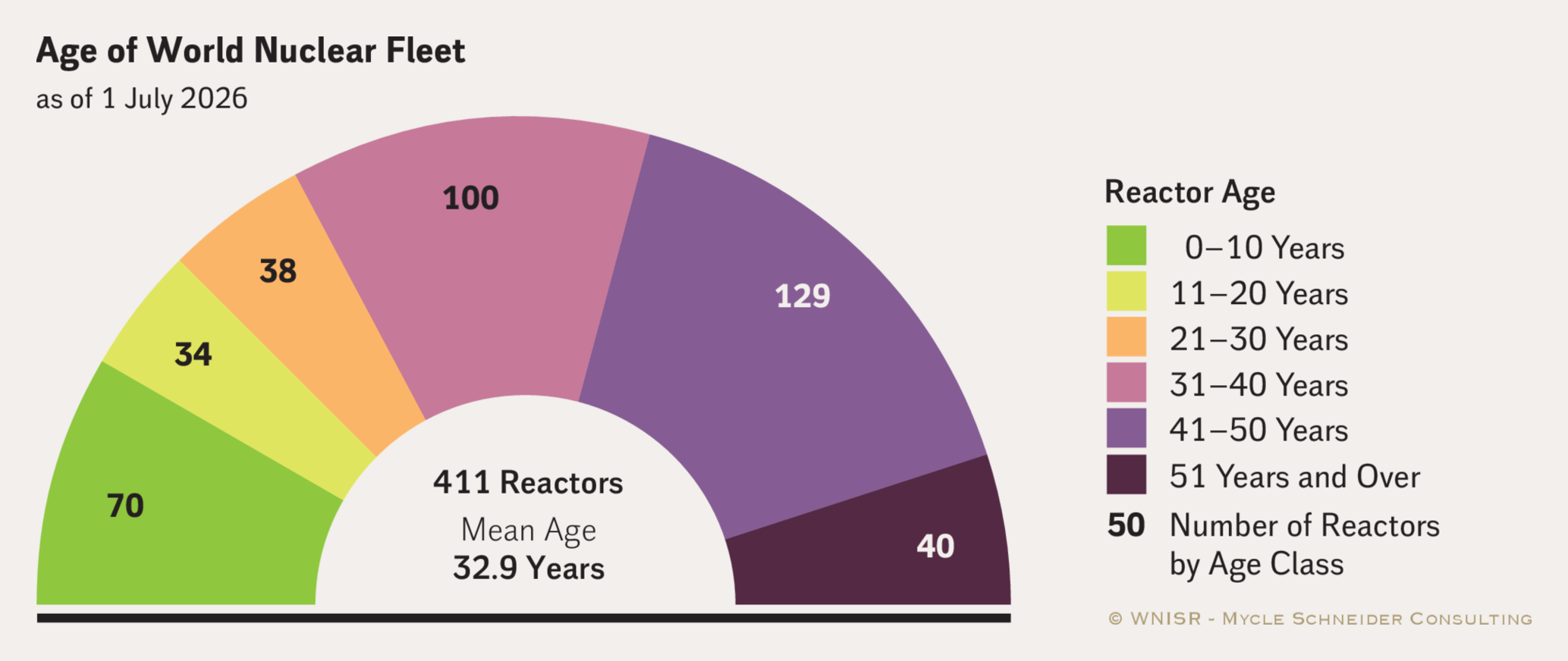
Sources: WNISR with IAEA-PRIS, 2026
In 1990, the average age of the operating reactors in the world was 11.3 years; in 2000, it was 18.9 years, and it stood at 26.3 years in 2010. The leading nuclear nation also has the oldest reactor fleet of the top-five nuclear generators: the average age of reactors in the US passed 40-years in 2020 and reached 44.2 years as of the end of 2025. France’s fleet passed 40 years in early 2026. Russia’s fleet age peaked in 2017, declined for a few years before starting to increase in 2020 and declining again in 2025 with the closure of three old reactors and startup of one reactor in the last days of the year. South Korea’s reactors reached 24.7 years (including three reactors in LTO) at year-end 2025 and the operating fleet, with an average age of 21.8 years remained half as old as the US fleet. And China, the outrunner, had an average fleet age of only 11.2 years by year-end (see Figure 16).
Many nuclear utilities are now expecting, preparing for, or implementing average reactor lifetimes beyond 40 years up to 60 and even 80 years. In the US, reactors are initially licensed to operate for 40 years, but nuclear operators can request a license renewal from the Nuclear Regulatory Commission (NRC) for an additional 20 years. As of mid-2026, the NRC had granted 90 of the 94 operating US units a first 20-year license extension;39 25 of these obtained a Subsequent Renewed Operating License which theoretically permit operation from 60 to 80 years. A further three reactors have their re-licensing applications still under review, and owners have notified of their intention to submit applications for a further 36 reactors between 2026 and 2034, including three currently retired reactors.40 See Extended Reactor Licenses and Figure 51 in United States Focus for details and references.
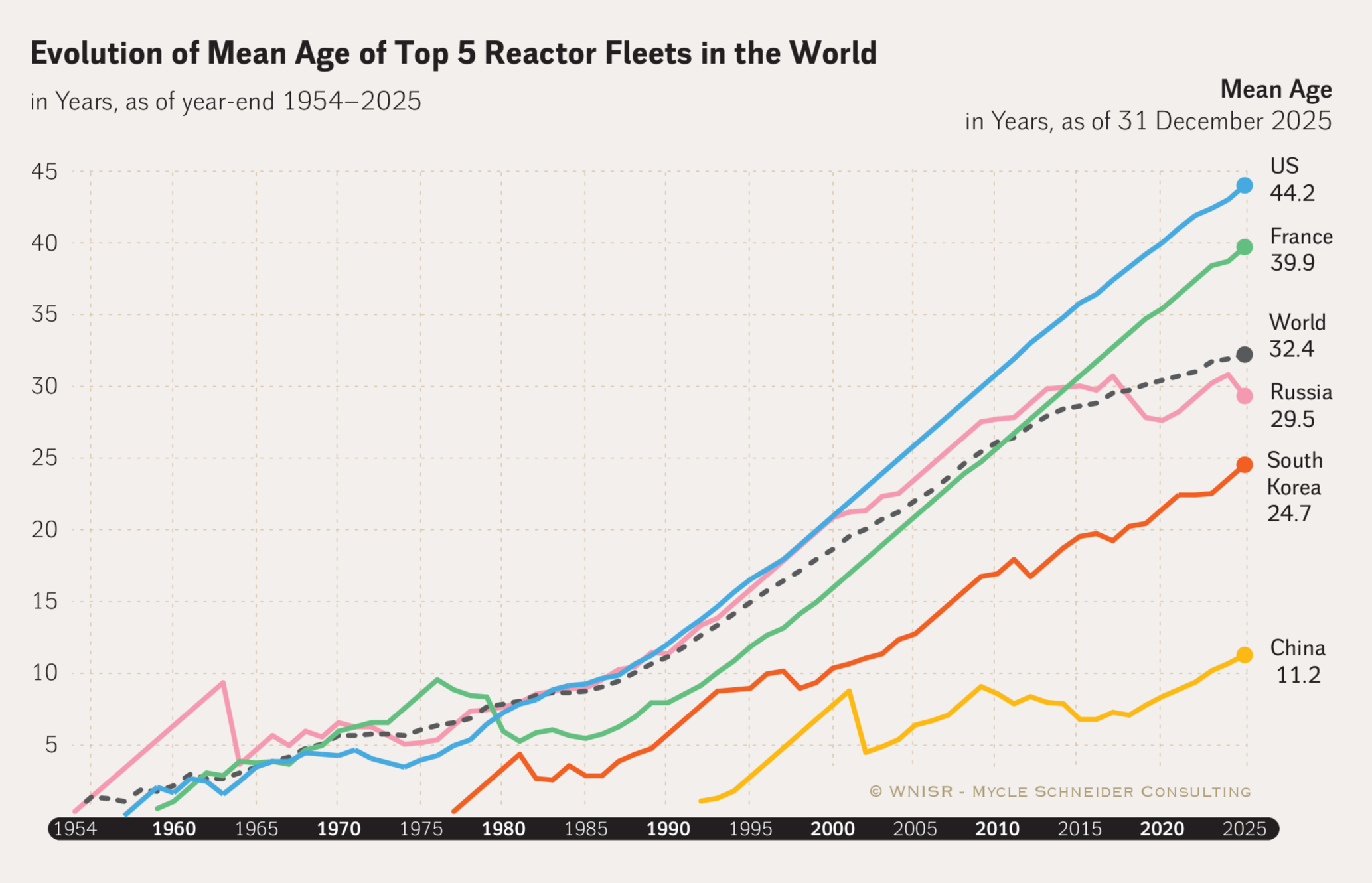
Sources: WNISR with IAEA-PRIS, 2026
Only nine of the 41 closed units in the US had reached 40 years on the grid. All nine had obtained licenses to operate up for 60 years but were closed long before, mainly for economic reasons. In other words, almost one quarter of the 135 reactors connected to the grid in the US never reached their initial design lifetime of 40 years. Only one of those already closed had just reached 50 years of operation (Palisades, closed after 50.4 years, and currently undergoing a restart process). The mean age at closure of those 41 units was 22.8 years.
On the other hand, of the 94 currently operating plants, 66 units have already operated for 41 years or more, of which 30 have been on the grid for 51 years or more; thus, 70 percent of the units with license renewals have entered the lifetime extension period, and that share is growing rapidly with the mid-2026 mean age of the US operational fleet exceeding 44.7 years (see Figure 49).
Many countries have no specific time limits on operating licenses. In France, for example, reactors must undergo in-depth inspection and testing every decade against reinforced safety requirements. As mentioned, the French reactors have operated for over 40 years on average, as of mid-2026.
EDF’s approach to lifetime extension had been reviewed by the French regulator (then ASN) and its Technical Support Organization. In February 2021, ASN granted a conditional generic agreement to lifetime extensions of the 32 reactors of the 900-MW series that has been amended since. Lifetime extensions beyond 40 years require reactor-specific licensing procedures involving public inquiries in France and transborder consultations. For an assessment of the status of decennial inspections see Decennial Inspections – Lifetime Extensions in France Focus.
Recently commissioned reactors and units under construction, e.g., in South Korea and the UK, seek a 60-year operating license from the start or intend to do so.
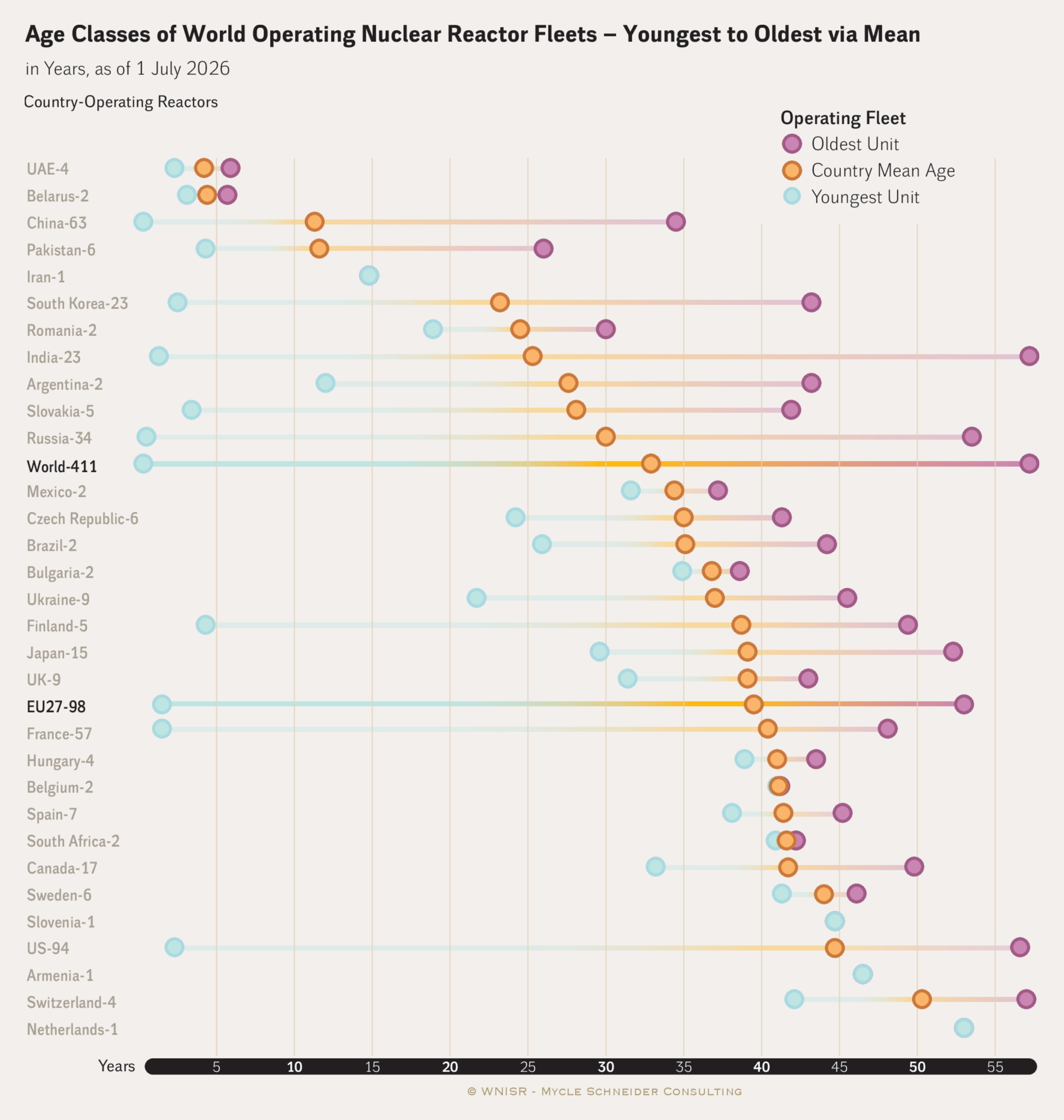
Sources: WNISR with IAEA-PRIS, 2026
Note: This figure only takes into account reactors operating as of 1 July 2026, thus excluding reactors in LTO.
Figure 17 shows that in 20 of the 31 countries the average fleet age of operating nuclear reactors as of mid-2026 is over 30 years, and in 12 countries over 40. Two in three, that is 23 of the countries have been operating one or more reactors for more than 40 years, but only six countries operate reactors that are over 50 years (not including Argentina, with Atucha-1 in LTO for refurbishment connected to the grid over 50 years ago).
In assessing the likelihood of reactor fleets being able to operate for 50 or 60 years, it is useful to compare the age distribution of reactors that are currently operating with the 224 units that have already closed (see Figure 15 and Figure 18). In total, 116 reactors were closed prior to reaching 31 years of operation of which exactly half or 58 between 21 and 30 years. The mean age of the closed units is about 29 years.
At the same time, for the first time, in 2024 reactors closed that have been operating for 51 years and more (Pickering-1 and -2 in Canada). So far, only few other units have been closed after exceeding 50 years of operational lifetime, including Doel-1 & -2 and Tihange-1 in Belgium, Palisades in the US, and Bilibino-2 & -3 in Russia.
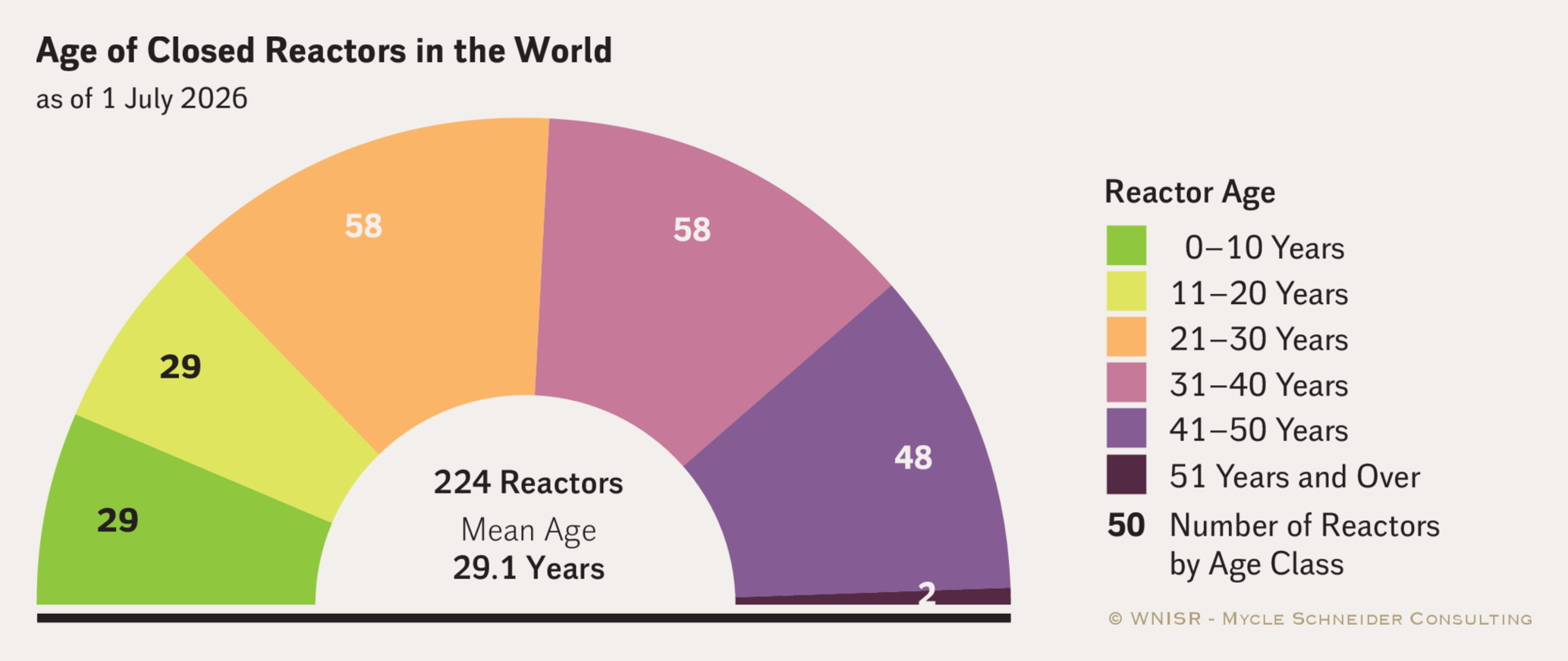
Sources: WNISR with IAEA-PRIS, 2026
While the operating time prior to closure has clearly increased continuously, the mean age at closure of the 29 units taken off the grids in the five-year period between 2021 and 2025 was just 44.2 years (see Figure 19).
As a result of the Fukushima nuclear disaster (also referred to as 3/11), many analysts have questioned the wisdom of operating older reactors. The Fukushima Daiichi units (1 to 4) were connected to the grid between 1971 and 1974. The license for Unit 1 had been extended for another 10 years in February 2011, just one month before the catastrophe started unfolding. Four days after the initial events in Japan, the German government ordered the closure of eight reactors that had started up before 1981, two of which were already closed at the time and never restarted. The sole selection criterion was operational age—30 years or more. Other countries did not adopt the same approach, but clearly the 3/11 events in Japan had an impact—at least temporarily—on previously assumed extended lifetimes in other countries. Some of the main nuclear countries closed their oldest units, at the time, before or long before age 50, including Germany at age 37, South Korea at 40, Sweden at 46. France closed its two oldest units in Spring 2020 at age 43. The US closed its oldest unit, Palisades, at age 50 in 2022 but is now in the course of reopening it.
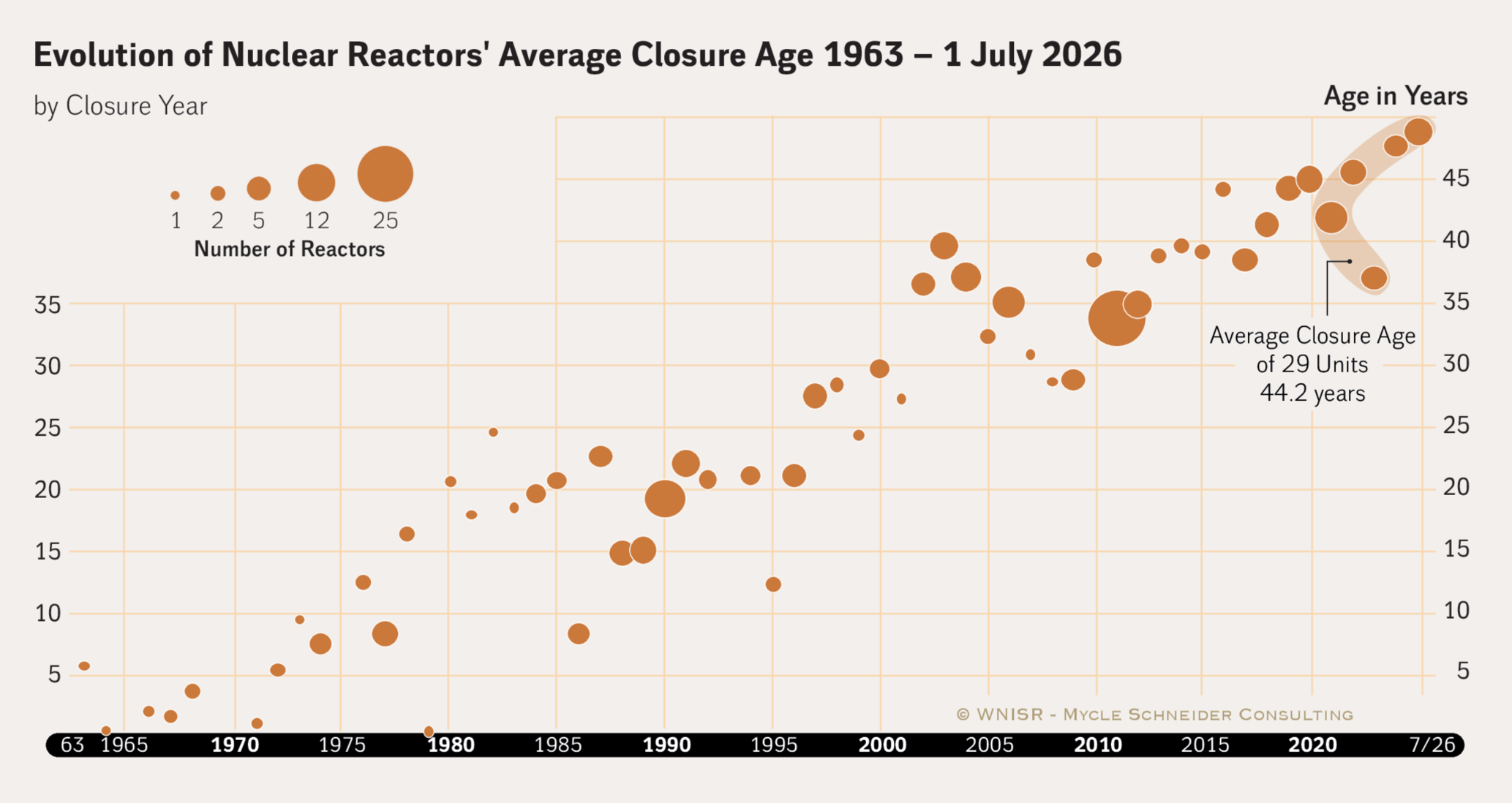
Sources: WNISR with IAEA-PRIS, 2026
This chapter provides an updated and expanded overview of major developments in 13 countries around the world, including China, France, Hungary, Japan, Russia, South Korea, Sweden, Ukraine, United Kingdom, United States, nuclear phaseout country Taiwan, and potential newcomer countries Poland and Türkiye.

China ranks second in the world, behind the United States, both in terms of number of operational nuclear reactors and volume of nuclear electricity generated, with aspirations to have the world’s largest nuclear capacity by 2030. As of 1 July 2026, it had 37 reactors under construction,41 more than any other country, accounting for half of the 73 units under construction worldwide.
As of mid-2026, China operated 63 nuclear reactors with a combined capacity of 61.5 GW.42, 43 This count exceeds the IAEA’s tally of 60 because the WNISR records the Shidao Bay project’s twin High-Temperature Reactor Pebble-bed Modules (HTR-PM) as two separate reactors and includes the CAP1400 Shidaowan Guohe One-1 and Shidaowan Guohe One-2. (see Table 25 and Table 26 in Annex 2).
In 2025, nuclear plants generated a record 485 TWh gross electricity, a 7.6 percent increase from 2024.44 One new reactor grid connection was officially announced in 2025: Zhangzhou-2 in Fujian Province.45 The Shidaowan Guohe One-2 plant also began providing electricity during the year, but its grid connection date was not officially released. Two other reactors, Taipingling-1 in Guangdong Province and Sanao-1 in Zhejiang Province, began operation in the first half of 2026.
Wind and solar accounted for 83 percent of China’s new power capacity added in 2025, while coal-fired power generation fell for the first time in a decade.
China’s total electricity consumption grew by 5 percent to a total of 10,368 TWh.46 Nuclear Energy accounted for 4.6 percent of China’s total electricity production in 2025, slightly up from 4.5 percent in 2024, making it a relatively small part of the nation’s overall power generation.47 Wind and solar accounted for 83 percent of China’s new power capacity added in 2025, while coal-fired power generation fell for the first time in a decade.48
China has fallen short of its ambitious nuclear construction targets in recent years, even as it outpaced all others in capacity growth and continues to raise its targets. The country’s 62.5 GW in gross operating nuclear capacity as of the end of 202549 fell over 10 percent short of Beijing’s target to reach “around 70 GW” by the end of the year, as laid out in its 14th Five-Year Plan (2021–2025).50
Chinese authorities reported increased nuclear plant performance across the fleet in 2025, with average load factor rising to an impressive 93 percent compared to 90 percent in 2024.
In March 2026, China approved its 15th Five-Year Plan (2026–2030), which set a target to reach 110 GW of gross operating nuclear capacity by 2030.51 Reaching this goal would make China the world leader in nuclear power capacity, considering that the United States has 102.5 GW of gross capacity (97 GW net) and currently no new plants under construction (see United States Focus for details).
Chinese authorities reported increased nuclear plant performance across the fleet in 2025, with average load factor rising to an impressive 93 percent compared to 90 percent in 2024.52, 53 However, China’s National Nuclear Safety Administration (NNSA) reported four unplanned reactor shutdowns during 2025 without providing further detail.54 Separately, several reactors were listed as underperforming in 2025:
- The twin HTR-PM reactors continued to report the lowest activity in the country’s fleet, though their load factor improved from under 21 percent in 2024 to 52 percent in 2025.55 The individual load factors per module are not available.56 Their combined nominal gross capacity was downgraded for unknown reasons from 211 MW to 150 MW according to CNEA’s 2025 annual report.
- Taishan-1 reported a load factor of 69 percent. The site reported an incident in May 2025, in which a faulty link triggered the emergency diesel generator, and another in April–May 2026, in which two small foreign objects were removed from one of the steam generators.57 Both were listed as Level 0 deviations, or low-risk occurrences.
- Shidaowan Guohe-1 and -2 began operation in 2024 and 2025, respectively, but did not report power generation figures in CNEA’s annual report.
Construction began on nine new reactors in 2025, six Hualong Ones and three CAP1000s:58
- Bailong-1 in Guangxi Province (CAP1000, 1160 MW),
- Jinqimen-1 in Zhejiang Province (Hualong One, 1233 MW),
- Lufeng-1 and Lufeng-2 in Guangdong Province (CAP1000, 1250 MW each),
- Ningde-6 in Fujian Province (Hualong One, 1117 MW),
- Sanao-3 (also spelt San’ao) in Zhejiang Province (Hualong One, 1208 MW),
- Shidaowan-2 in Shandong Province (Hualong One, 1134 MW),
- Taipingling-3 in Guangdong Province (Hualong One, 1209 MW), and
- Zhaoyuan-1 in Shandong Province (Hualong One, 1117 MW).
Construction started on three more Hualong One reactors in the first half of 2026:59
- Jinqimen-2 in Zhejiang Province (Hualong One, 1233 MW),
- Taipingling-4 in Guangdong Province (Hualong One, 1209 MW),
- Xuwei-1 in Jiangsu Province (Hualong One, 729 MW).
China also continued its only active international nuclear project under construction. The first concrete for Unit 5 of Pakistan’s Chashma Nuclear Power Plant (or Chasnupp) was poured in December 2024, and the 1117-MW Hualong One reactor is expected to be operational by 2030. It is the third unit of the 1200-MW class that China has exported to its neighbor. Previously, between 1993 and 2017, China had delivered four units of the 300-MW class to Pakistan, which remains the sole country hosting Chinese-built reactors. The IAEA’s Board of Governors approved Pakistan’s application of safeguards for the new unit in March 2026.60 See section on Pakistan.
Domestically, construction approvals have proceeded apace, with six reactors approved in 2019, four in 2020, five in 2021, 10 each in 2022 and 2023, 16 in 2024, and 10 in 2025.61
On 27 April 2025, the Chinese State Council approved five projects (10 reactors) reportedly costing an estimated total of over CNY200 billion (US2025$27.8 billion):62
- Fangchenggang Phase III in Guangxi Province (two Hualong Ones),
- Taishan Phase II in Guangdong Province (two Hualong Ones),
- Sanmen Phase III in Zhejiang Province (two Hualong Ones),
- Haiyang Phase II in Shandong Province (two CAP1000s), and
- Xiapu PWR Phase I in Fujian Province (two Hualong Ones, co-located with two 600-MW sodium-cooled fast reactors with uncertain status, see Non-Proliferation Concerns Around Plutonium Separation and Use hereunder).
Sanmen Phase I and II in Zhejiang Province used the AP1000 design, or its Chinese adaptation—the CAP1000—for the two latest units, while Taishan Phase I in Guangdong Province employed the European Pressurized Water Reactor (EPR); both sites will switch to Hualong One for future units. As of mid-2026, there have been no new approvals this year.
In the decade 2016–2025, China expanded its fleet from 36 to 61 operating reactors and raised its operating nuclear capacity from 31.4 GW to 59.2 GW (see Figure 20).
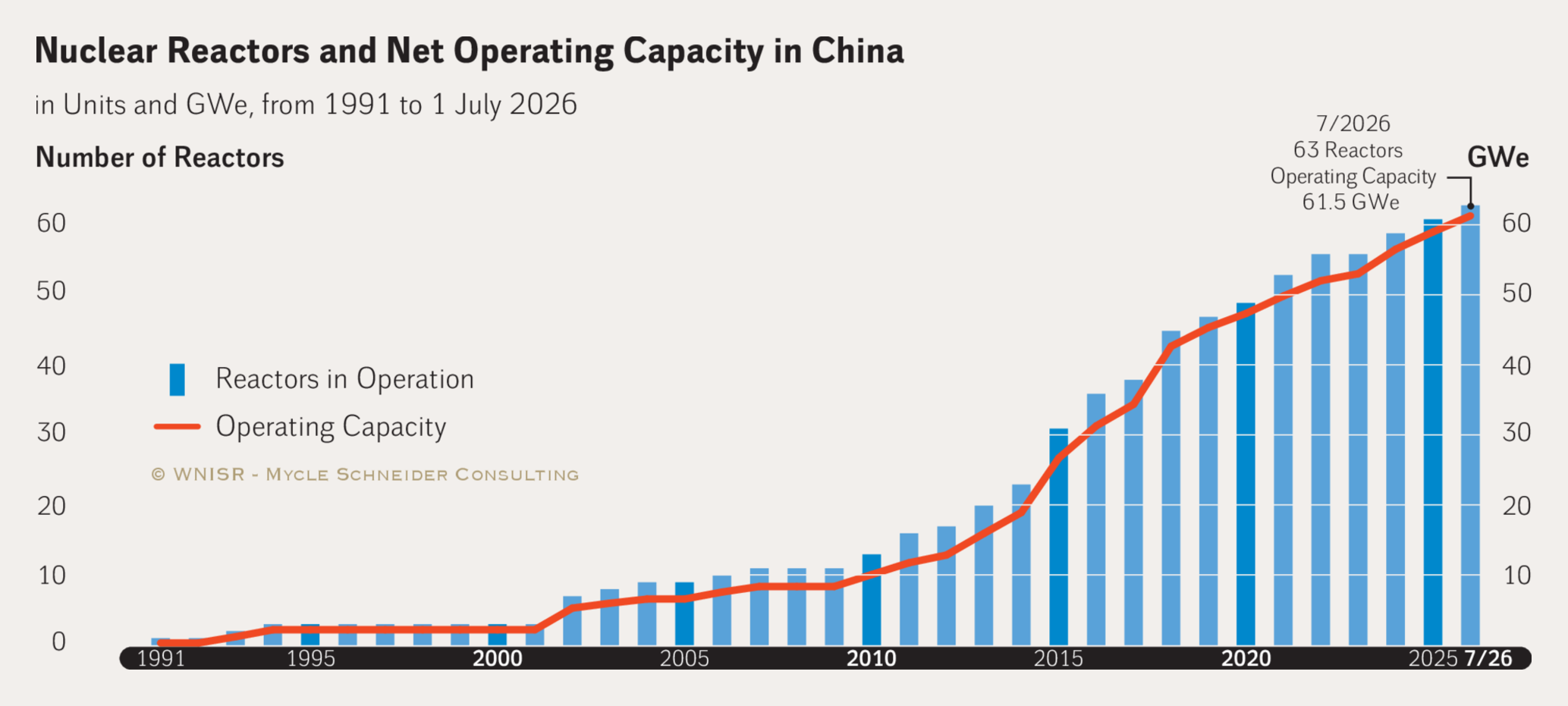
Sources: WNISR with IAEA-PRIS and NNSA, 2026
With the startup of four AP1000 reactors in 2018, China began operating its first so-called Generation III (Gen III) reactors.63 The first Hualong One, China’s domestic Gen III design, was connected to the grid in 2020, followed by one each in 2022 and 2023, two in 2024, one in 2025, and, as of mid-year, two in 2026.64
State-Owned Giants: China National Nuclear Corporation (CNNC) and China General Nuclear Power Corporation (CGNPC or CGN)
China’s nuclear sector is dominated by two state-owned giants: CNNC and CGNPC (or simply CGN). Though both are centrally owned, they have distinct mandates and histories and operate under a model of state-guided competition. This “one industry, multiple champions” approach is a hallmark of China’s strategy in critical areas such as energy and infrastructure.
Today, CNNC is considered the more strategic of the two companies, overseeing the full nuclear fuel chain, military nuclear assets, and civilian power plants. CGN was established in 1994 to focus on civilian nuclear energy and facilitate technology transfer. It is a commercially-oriented, central State-Owned Enterprise (SOE) known for its operational efficiency and international partnerships. (See China Focus in WNISR2025 for more detail on CNNC and CGN.)
As of mid-2026, China National Nuclear Power Co., Ltd. (CNNP), CNNC’s primary domestic operating platform, managed 27 reactors with a combined installed capacity of 25 GW (gross).65
CGN Power, the main listed subsidiary of CGN Group, operated 28 commercial reactors, with 32.9 GW net capacity,66 making it a central player in China’s nuclear landscape.67
In August 2019, the US added CGN to its Entity List,68 citing national security concerns regarding alleged attempts to acquire US technology for military purposes.69 This restricted CGN’s access to certain technologies and affected its international partnerships, including involvement in nuclear projects in the United Kingdom. Later, CNNC was also added to the Entity List.70 The sanctions reinforced China’s focus on self-reliance, accelerating the transition from foreign technologies to the domestically developed Hualong One design.
China has dominated global nuclear power development over the past quarter-century, though its recent Five-Year Plan targets have proven challenging to meet. (See China Focus in WNISR2025 for a review since the 10th Five-Year Plan.)
China’s Construction Costs and Capabilities
China’s nuclear power sector has systematically reduced construction costs and has kept them under control while advancing its technological capabilities, partly by shifting to localized technology development.
A study published in the journal Nature in July 2025 found that reactor construction costs in China had halved by the early 2000s and remained rather stable since, with the authors attributing the savings largely to domestic development of components and Beijing’s stable industrial policy support such as low-interest financing.71 China’s cost control has bucked the global trend of the costs of nuclear plant projects continuing to rise. The study found that overnight construction costs (which do not include financing costs) for Chinese nuclear power plants in construction as of mid-2025 were in the range of US$20201,670–2,580/kW, comparable to the range of US$20201,620–3,370/kW for reactors that began commercial operation in China over the preceding decade.
According to 2022 investor disclosures from CNNC, the construction cost for Hualong One reactors stood at about CNY16,000/kW (US$20222,375/kW)—significantly lower than the CNY20,000/kW (US$20222,970/kW) for AP1000 units built in China per the same statement72 and a fraction of the estimated US$15,000/kW for the two AP1000s completed at Vogtle in the United States.73 The industry continues working toward a target of CNY13,000/kW (~US$1,900/kW) for Generation III reactors, which would match China’s official Generation II construction costs.74 Apparently, there is no published independent assessment of these numbers.
Several factors contribute to these apparent significant cost advantages. The sector benefits from a highly skilled workforce cultivated over three decades of continuous nuclear development, according to analysis by the consultancy affiliated with China Reform Holdings Corporation, a state-owned investment holding company.75
China’s first Hualong One and AP1000 projects significantly exceeded expected construction times. Sanmen’s AP1000s faced long delays—construction time was 111 months (2009–2018) for Unit 1 and 104 months for Unit 2—partially due to post-Fukushima safety modifications and technical issues with the first-of-a-kind passive cooling systems and modular components, particularly the problematic main coolant pump that required redesigning.76 China’s second AP1000 at Haiyang took less time—still just under 100 months (2010–2018)—benefiting from lessons learned at Sanmen.
The efficiency gains for Hualong One initially appeared more significant. At Fuqing, China’s inaugural Hualong One unit required over 66 months from first concrete in May 2015 to grid connection in November 2020, as engineers made real-time design adjustments and established localized supply chains for critical components like reactor coolant pumps.
A later Hualong One project, Zhangzhou-1 (October 2019–November 2024) was completed in 61 months—5 months faster than Fuqing-5. Originally, Zhangzhou-1 was supposed to be an AP1000 but was later switched to the Chinese design.77 However, other Hualong One projects took longer to build: 72 months for Fuqing-6, 84 months for Fangchenggang-3, and over 87 months for Fangchenggang-4, with the latter two projects delayed by the COVID-19 pandemic, according to CGN Power (see Figure 21).78
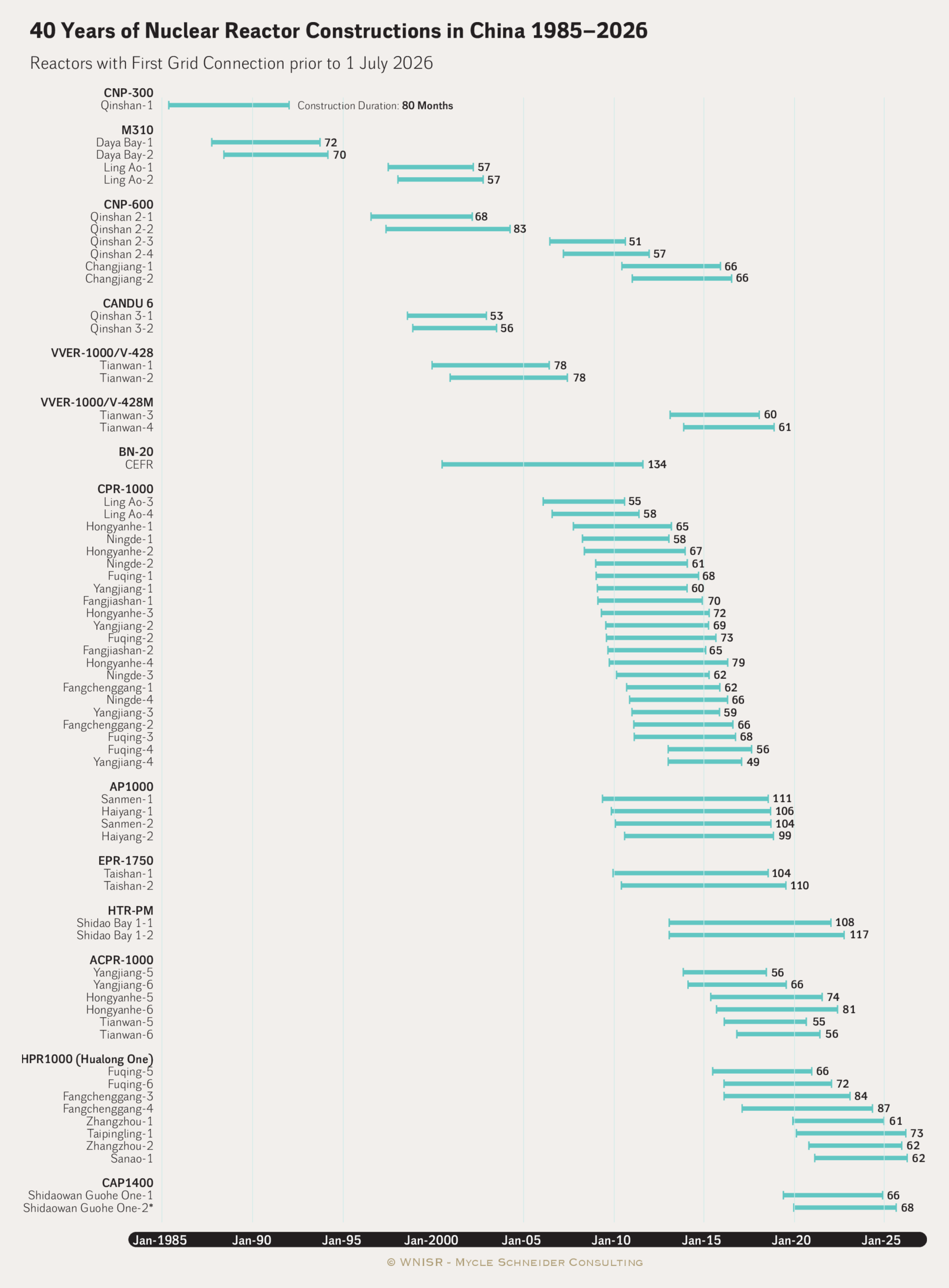
Sources: Various, compiled by WNISR with IAEA-PRIS (various years), 2026
Notes: See Table 25 in Annex 2 for construction and grid connection dates.
* Exact grid connection date for Shidaowan Guohe-2 unknown, provisionally set to August 2025.
Of the three latest reactors, all Hualong Ones, that have come online, Zhangzhou-2 and Sanao-1 (or San’ao-1) took around 62 months to build, while Taipingling-1 took over 73 months to complete, almost a year longer than the other two, with the COVID-19 pandemic impacting construction, says CGN.79 As of 1 July 2026, the construction time of Taipingling-2 had already exceeded 68 months.80
The two CAP1400 Shidaowan Guohe One units took between 66 and 68 months to build.
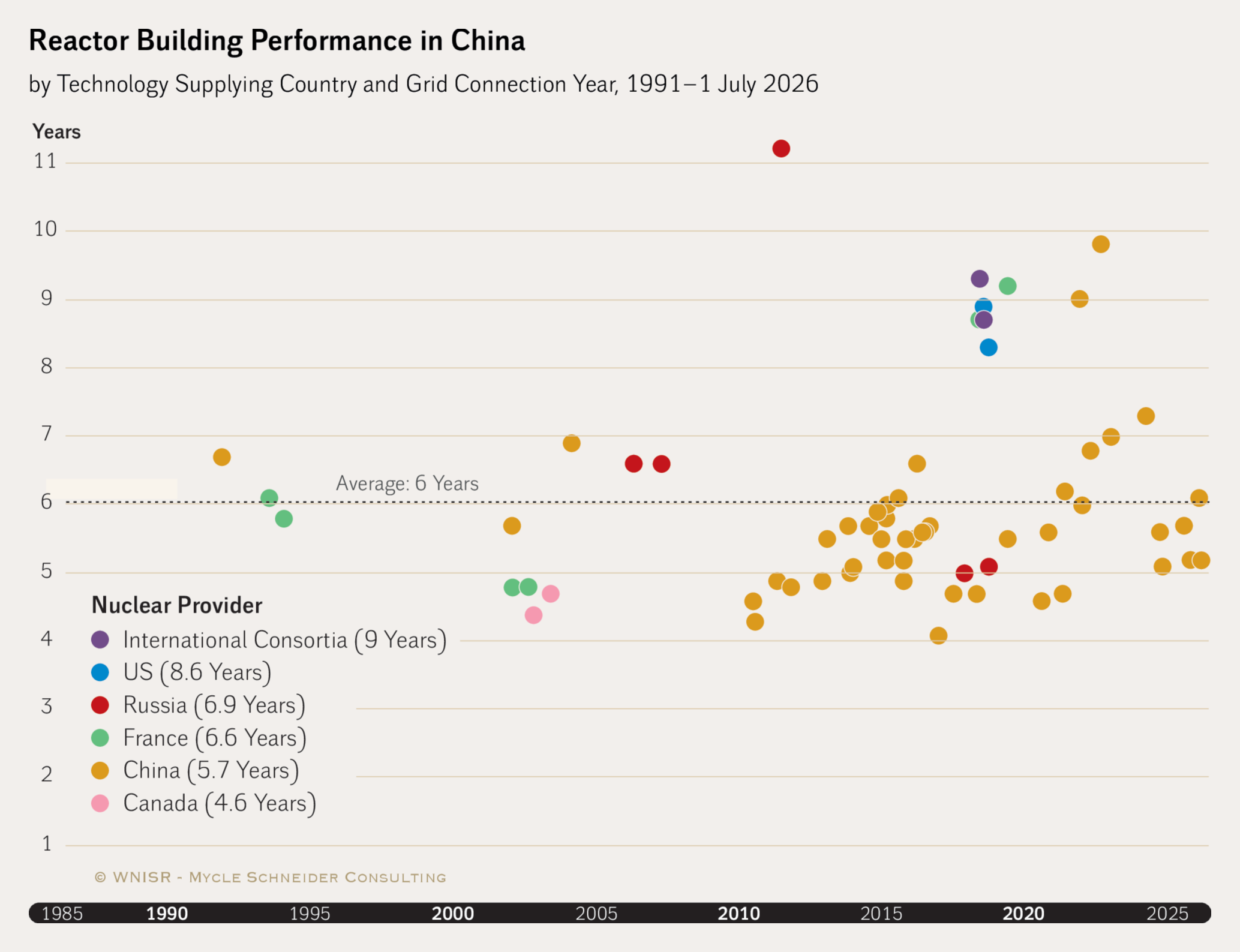
Sources: WNISR with IAEA-PRIS, 2026
China’s Growing Range of Nuclear Technologies
China’s growing dominance in nuclear technology is evident in its patent filings. A 2024-study by Teva Meyer from the Université de Haute-Alsace analyzed over 56,000 unique nuclear technology patents filed globally between 1946 and 2022.81 The findings reveal accelerated Chinese patent filings accounting for 48 percent of all nuclear-related patents filed worldwide over the past two decades, with a dramatic rise after 2004. The primary driver for patent filings appears to be China’s strategic push to develop indigenous nuclear designs and localize supply chains. This effort aims to reduce dependence on foreign intellectual property, particularly in cases where export controls could potentially weaponize technological dependencies.
An updated analysis of nuclear energy patents filed between January and October 2025 by data analytics company Mondaq found that China had filed 674 patent applications during the period—more than France, South Korea, and the United States combined and still accounting for 42 percent of the global total.82
Beyond patents, China has made progress in deploying so-called advanced nuclear technologies. On 13 July 2021, China poured first concrete for the Changjiang SMR-1, a demonstration commercial SMR, the ACP100 or “Linglong One”, located on Hainan Island.83
According to the builder, several milestones were achieved ahead of schedule, including the 30 November 2022 installation of nuclear island equipment, which began 75 days early.84 Subsequent milestones included the installation of the core reactor module in August 2023,85 completion of main structural work by February 2024,86 and installation of the main pump in April 2025.87 CNNC reported in October 2025 that the Linglong One had completed its primary circuit cold functional test but did not say when it would become operational.88 However, it is scheduled to be commissioned some time in 2026.
Non-Proliferation Concerns Around Plutonium Separation and Use
Certain nuclear developments in China have raised concerns amongst some non-proliferation experts. The two CFR-600, sodium-cooled fast breeder reactors (Xiapu-1 and -2) are particularly notable. Though their current operational status is unclear, they could theoretically produce significant quantities of weapons-grade plutonium of exceptional quality (with very high fissile isotope concentration).
The CFR-600 is a follow-up of the China Experimental Fast Reactor (CEFR), which the NNSA reported as an operational research reactor in 2025 but did not specify whether it generates power to the grid.89 The IAEA has deleted the CEFR file from its PRIS database. As long as there is no information on power generation, which determines the operational status, WNISR considers the CEFR in LTO.
While there has been no public confirmation of the CFR-600 units connecting to the grid,90 their progress has attracted international attention due to their potential military applications. The first CFR-600, construction of which began in 2017, was originally scheduled for grid connection in late 2023. Zhang Hui, a Senior Research Associate at Harvard University’s Belfer Center, reports that according to Chinese sources, the first unit has been operating at low capacity since mid-2023.91 Satellite imagery analysis by researchers from the Sasakawa Peace Foundation supports this assessment; a comparison of images from 23 December 2022 and 16 October 2023 revealed steam emissions from a ventilation stack in the later image, suggesting operational activity.92 The Washington D.C.-based Institute for Science and International Security reported in October 2025 that the first reactor’s cooling system could be seen on satellite images discharging water in August 2024, September 2024, and April 2025, but said that it could not be established “whether the water flow indicates reactor operation or prolonged testing of the cooling system.”93 As of mid-2026, the reactor’s operational and grid connection status remains unclear. The second unit is planned to be operational in 2026.
According to a 2018 bilateral agreement, Russia will supply fuel for the first unit’s entire lifetime.94 Moreover, highly enriched uranium fuel, delivered by Russia under a 2019 contract for the first seven years of operation, would be subject to peaceful use restrictions according to Russian export regulations and a China-Russia nuclear cooperation agreement.95 A 2019 Rosatom statement claims that the “CFR-600 will first use mixed [uranium-plutonium] oxide (MOX) fuel” and that “both the operating CEFR and the under-construction CFR-600 are designed to use MOX fuel that is not produced in China.”96 It remains unclear what kind of fuel has been or will be loaded into the CFR-600 and what the fuel management will look like in the longer term.
Further raising non-proliferation questions is China’s reprocessing infrastructure. Satellite images analyzed by Harvard’s Zhang Hui suggest that CNNC may have begun construction in 2023 of a third reprocessing plant, adjacent to two existing facilities, at its Nuclear Technology Industrial Park in Jinta, Gansu.97
China began construction of the first two reprocessing plants (each with 200 tons/year capacity)98 in 2015 and 2020, respectively. Zhang reported that based on satellite imagery, the first facility appears to have begun operation by mid-2025 or possibly as early as late-2024.99
The purpose of the potential third plant remains unclear due to limited public information. Zhang suggests it could either support the first two plants’ reprocessing activities or represent a modular expansion approach. Notably, these facilities are located at the same site as a demonstration MOX fuel fabrication line (20 tons/year capacity), expected to supply fuel for China’s second CFR-600, which according to Zhang’s satellite image analysis finished construction by November 2024 but whose operational status remains unclear.
The dual-use potential of the plutonium fuel system has drawn some international concern. US Defense reports have warned about possible military applications,100 while China’s transparency has decreased notably, e.g. it stopped reporting separated plutonium stocks to the IAEA in 2017.
The High-Temperature Reactor Program
The High-Temperature Reactor Pebble-bed Modules (HTR-PM) project at Shidao Bay represents the culmination of nearly four decades of research that the Tsinghua University’s Institute of Nuclear and New Energy Technology (INET) began with a 10-MWt test reactor in 1984.
The current demonstration plant—originally with a Reference Unit Power of 200 MWe, reduced for unknown reasons to 150 MWe—developed through collaboration between Tsinghua University, China Huaneng, and CNNC, features two reactor modules driving one common steam turbine. Construction began with first concrete poured on 9 December 2012, leading to grid connection of the first module on 20 December 2021 and of the second module in September 2022.101 This means that construction time was around 10 years, twice as long as planned at construction start. After a 168-hour demonstration run, the plant entered commercial operation on 6 December 2023.102
The Chinese technology promoters plan to address the challenges of the first HTR-PM through the HTR-PM600 project, designed to expand the modular concept to six 100-MW modules driving a single turbine. This demonstration project, to be paired with Hualong One reactors in Xuwei, Jiangsu Province, is planned to supply industrial steam to nearby petrochemical facilities in Lianyungang.103 First concrete was poured in January 2026.104
In 2025, wind and solar together reached 47 percent of the national power generating capacity, for the first time exceeding the share of fossil fuels. Wind and solar plants together generated a record 2,300 TWh of power, over five times as much as the nuclear fleet.105 It is however grid-connected stationary power storage systems, mainly lithium batteries, that at 85 percent have seen the most spectacular growth rate to reach an installed capacity of 145 GW, per the China Energy Storage Alliance (CNESA). Over the past five years, the annual added capacity volume has increased by a factor of 40, a breathtaking acceleration in deployment.106
In China, nuclear plants are located along the populous, coastal provinces, where they benefit from abundant cooling water and meet steady demand from electricity intensive sectors such as manufacturing or textiles. In contrast, large-scale wind and solar projects are more concentrated in remote inland areas like Inner Mongolia, Xinjiang, and the Gobi Desert, where space and resources are plentiful.107 This distribution reduces direct competition as nuclear delivers so-called baseload power to coastal cities, while wind and solar transmit power over long distances through ultra-high-voltage (UHV) lines to industrial centers.
However, distributed solar has been reaching a significant share of new solar energy additions, consistently over 40 percent since 2022, and at 48 percent for 2025.108 (See section on China in Nuclear Power vs. Renewable Energy Deployment).
China’s power grid follows a semi-regulated dispatch system that prioritizes low-carbon sources. Renewables have top priority due to policy mandates and negligible marginal costs, followed by nuclear power that operates as high-priority baseload with minimal flexibility. Hydropower is used for peak demand, while coal and gas act as buffer sources that ramp up or down as needed.
But given China’s enormous size, there are regions where nuclear competes with renewable energy for dispatch priority, for example, Guangdong, which hosts several nuclear facilities. Its nuclear fleet, dominated by large Generation II PWRs, was designed primarily for stable generation. These reactors typically operate at high load factors—close to 90 percent—and are not suited for flexible load-following, meaning they cannot easily ramp output up or down in response to fluctuations in electricity demand or renewable energy supply (see Challenges of Integrating Nuclear Power into the Energy System in WNISR2025).
The authors of a recent paper on the “dynamics of power curtailment in China” highlight “the necessity of mitigating grid congestion, enhancing inter-provincial transmission, and adopting market-driven pricing strategies to maintain the long-term cost-competitiveness of renewable energy.” And they stress the role of storage: “As the price of storage drops and its role in the system becomes more critical due to the rise of variable renewables, its deployment is projected to expand.”109
In 2025, China increased its installed capacity of new-type energy storage—grid-connected stationary storage systems (96 percent lithium batteries)—by over 66 GW (almost 190 GWh) or 85 percent to reach 145 GW.110 Beijing has set a target to reach 180 GW of installed capacity by the end of 2027, which would help store electricity generated from wind and solar power for deployment at peak usage times.111 The country is also preparing for broad adoption of sodium-ion batteries, a new technology that uses the abundant element as an alternative to lithium, with China’s Contemporary Amperex Technology Co. Limited (CATL) beginning mass production this year. CATL, the largest solid-state battery producer for vehicles and grids in the world, claims that the new sodium-ion batteries “offer abundant raw materials, faster cold-weather performance, and environmentally friendly production and recycling,” with ranges “projected to reach 500–600 km for pure-electric variants”.112

France’s nuclear power generation in 2025 saw its best performance in six years. Output increased by 3.1 percent to 373 TWh representing 68.1 percent of total French power generation in 2025.113 The national operator Électricité de France (EDF) estimates nuclear production will reach 350–370 TWh in 2026 and 2027, and 345–375 TWh in 2028, “with target generation potential of over 400 TWh”.114 French nuclear production of 400 TWh was the norm between 2005 and 2015, with a peak production of 430 TWh in 2005.
The European Pressurized Water Reactor (EPR) Flamanville-3 (FL3), having finally connected to the grid 18 years after construction start, was down for most of its first year on the grid, before reaching 100 percent of its capacity in December 2025. The unit is scheduled to go offline again in autumn 2026 for multiple repairs and major component replacements (including the vessel head).
In June 2023, the National Assembly passed legislation for the “acceleration of procedures for the construction of new nuclear facilities near existing nuclear sites and for the operation of existing facilities” (see France Focus in WNISR2023).115 In June 2026, the government presented several proposals for amendments to the legislation—including one that would allow certain construction work to start before obtaining the actual construction license—aimed at further accelerating the deployment of new nuclear facilities.116
Many perceive this as only the latest example of a systematic rollback of environmental legislative norms. In April 2026, the French Government issued a decree “regarding the simplification of litigation procedures in environmental matters and the acceleration of certain projects.” The decree does not mention the term “nuclear” once, but it clearly includes—if not specifically aims at—nuclear projects under various general denominations like “development of carbon-free energy sources” or “operations of national interest”.117 The publication of the decree created an outcry amongst legal and environmental professions. The French Lawyers’ Union together with some 30 organizations, including major legal, human rights, and environmental groups, on 19 June 2026 filed an emergency appeal and an appeal on the merits with the Council of State (Conseil d’État) to seek the immediate suspension and annulment of the decree. In a statement, the Lawyers’ Union said:
Environmental organizations and lawyers working in this field are well acquainted with the ongoing erosion of environmental law: for several years now, environmental law has been steadily weakened, burdened with exceptions, and subjected to so-called “simplification” measures aimed at speeding up the approval and development of projects, at the expense of the environment as a common good.118
While these measures can cut some red tape, and even seriously infringe on environmental legal standards, they are unlikely to significantly ease the phenomenal industrial challenges involved in France’s nuclear newbuild plans.
In February 2022, the French President announced a plan to build six units of a new design called EPR2, with first startup targeted for 2035. Moreover, he stated that the option of building eight additional units by 2050 should be studied.119
The EPR2 still does not exist on the drawing board; no detailed design is available yet. The government estimated in an October 2021 internal note that, if everything goes well, the first EPR2 could start up by 2039–2040. In case unexpected industrial difficulties occur—as they did in the past and currently do—it could take until 2043 to commission the first EPR2, the project review stated.120
It is only on 22 July 2024 that the beginning of development from basic to detailed design was accepted during a “Review Committee” meeting.121 On 18 December 2025, EDF published an updated cost assessment of the six-unit EPR2 program at €202072.8 billion or US$202083.1 billion (about €86 billion or US$100 billion in current terms); this represents an 8-percent increase in cost since 2024 and is 41 percent more than the 2021 estimate. EDF anticipates a Final Investment Decision (FID) at the end of 2026 and commissioning of the first EPR2 at Penly in 2038, “with the subsequent reactors scheduled to be commissioned at intervals of 12 to 18 months.”122
On 17 March 2025, President Macron chaired the fourth session of the Nuclear Policy Council (Conseil de Politique Nucléaire or CPN) that since 2022 “defines the broad guidelines for national nuclear policy.”123 Thus, in the self-understanding of the presidency, it is not the parliament, but the CPN chaired by the President of the Republic that provides orientation for a nuclear policy framework for the long term. On 12 March 2026, the fifth CPN meeting took place. The presidency’s media statement following the session contains the same wording on guidance for nuclear policy as the previous one and further states:
The Nuclear Policy Council also took note of the findings of the audit of the program to build six EPR2-type reactors, conducted in early 2026 by the Interministerial Delegation for New Nuclear Energy [Délégation interministérielle au nouveau nucléaire (DINN)]. EDF has committed to meeting the construction cost target of €72.8 billion (2020 prices) and adhering to the program schedule. The Council asked EDF to implement the identified recommendations by the end of 2026 and to report on them as part of the monitoring process conducted by the DINN.124
Regrettably, the DINN audit report has not been made public and the “identified recommendations” have not been specified. The statement goes on to say:
The Nuclear Policy Council also confirmed the key principles and parameters of the financing and regulatory framework for the EPR2 program. The government-subsidized loan granted to the EPR2 program, covering 60 percent of the program’s total cost, will be financed by the Caisse des Dépôts’ savings fund.
Finally, the Council confirmed the goal of ensuring that EDF’s Board of Directors makes the final investment decision by the end of 2026, with the first unit scheduled to come online by 2038.
The financing support scheme needs to be approved by the European Commission and is facing strong opposition within France. The Caisse des Dépôts manages savings accumulated by individual savers through the Livret A, which helps finance projects of public interest, particularly social housing. In May 2026, a large coalition of political parties, trade unions, environmental organizations, and other NGOs launched a public appeal for a democratic debate on the financing scheme. The appeal states:
For the organizations that have signed this appeal, this decision is unacceptable because it violates the rules of democracy and risks having negative consequences for the poorest households. (…)
This use of French citizens’ regulated savings to finance nuclear power would inevitably come at the expense of funding for public housing and home insulation—areas where public policies are already significantly behind schedule.125
Besides confirming the nuclear newbuild decisions, the CPN “took note” of advances concerning the Orano-led backend strategy at the La Hague site, including the construction of additional spent fuel and plutonium storage capacities and a new uranium-plutonium mixed oxide (MOX) fuel fabrication plant—all to be commissioned by 2040. Further, the CPN “confirmed the launch of an ambitious new program to close the nuclear fuel cycle, designed to bring together all stakeholders (contracting entities, research institutions, and emerging players).”126 The program is supposed to make France independent of natural uranium imports by the year 2100. A first milestone would be the construction start of a fast neutron reactor by 2030. As all design work on fast neutron reactors was halted years ago, there is no design, no site, no financing scheme; so the target date seems rather unrealistic. None of these decisions has undergone specific parliamentary scrutiny, but the overall backend plan is raising significant local opposition.127
Until the closure of the two oldest French units at Fessenheim in spring 2020, the French nuclear fleet had remained almost stable for 20 years, except for the closure of the 250-MW fast breeder Phénix in 2009 or two units in Long-Term Outage (LTO) between 2015 and 2017. Another unit was in LTO in the period 2021–2023 (see Figure 23). Penly-1, subject to the stress-corrosion cracking issue (see section on Stress Corrosion Cracking and Thermal Fatigue below, and past WNISR editions), was offline between 2 October 2021 and 13 July 2023.128
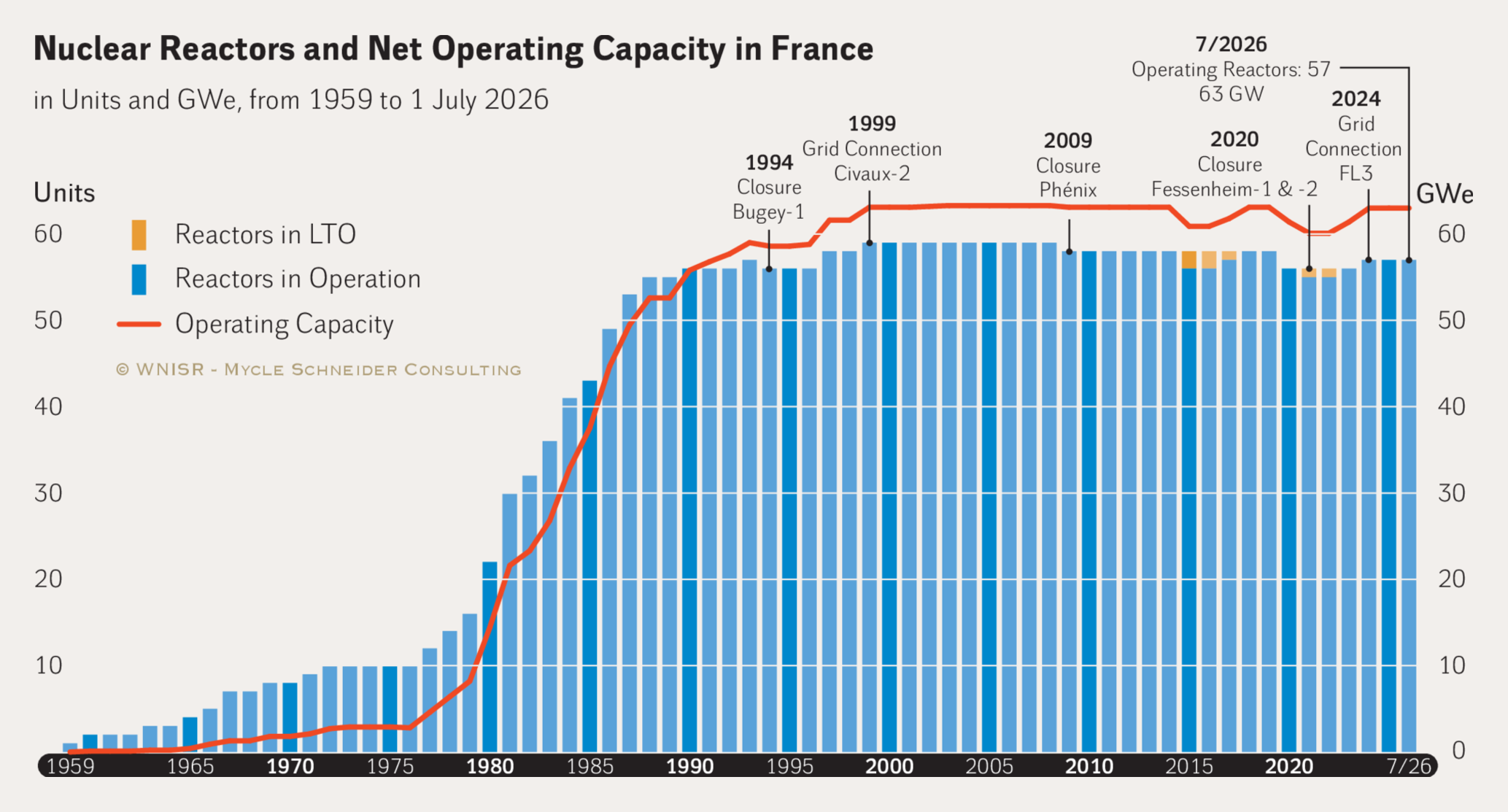
Sources: WNISR with IAEA-PRIS, 2026
Flamanville-3 was the first new reactor to start up since Civaux-2 was connected to the French grid 25 years earlier in December 1999.
The first and only Pressurized Water Reactor (PWR) closed prior to Fessenheim was the 300-MW Chooz-A reactor, which was retired in 1991. The other closures were those of eight first-generation natural-uranium gas-graphite reactors, two fast breeder reactors, and a small prototype heavy water reactor (see Figure 24).
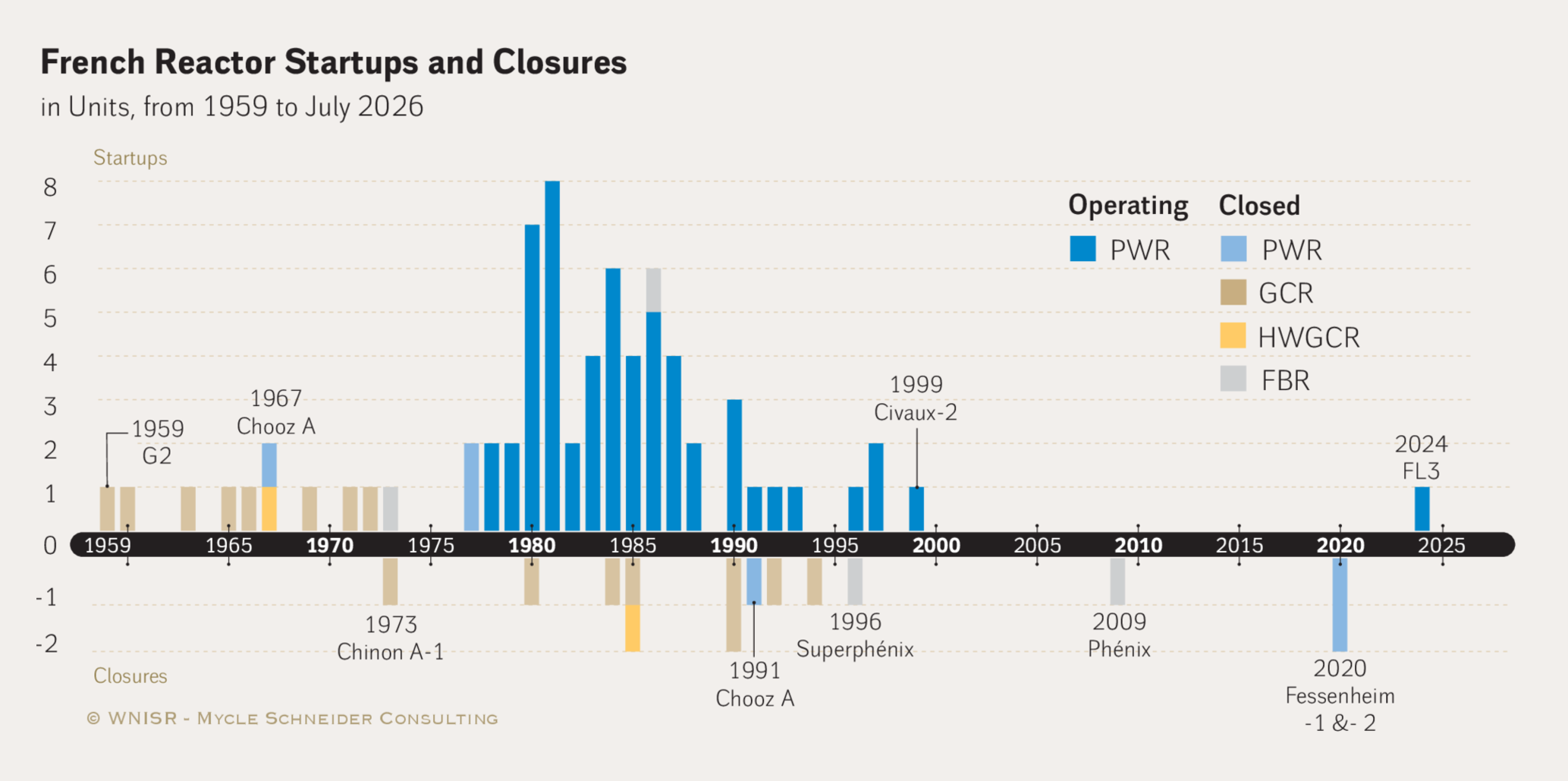
Sources: WNISR with IAEA-PRIS, 2026
Notes: PWR: Pressurized Water Reactor; GCR: Gas-Cooled Reactor; HWGCR: Heavy Water Gas-Cooled Reactor; FBR: Fast Breeder Reactor.
In 2025, the 57-reactor fleet129 produced 373 TWh, an increase of 11.3 TWh (+3.1 percent) over the previous year; the production remained at a level below that of pre-COVID-19-year 2019 and, for the tenth year in a row, below 400 TWh, which had been the norm in the previous decade.
In 2005, nuclear generation peaked at 430 TWh. After the construction program was completed in 1999, it took the fleet five years to build up to that maximum generation, and with a quasi-stable installed nuclear capacity between late 1999 and early 2020, performance plunged after 2015. EDF estimates nuclear production will reach 350–370 TWh in 2026 and 2027 and 345–375 TWh in 2028 (see Figure 25 and Figure 26).130
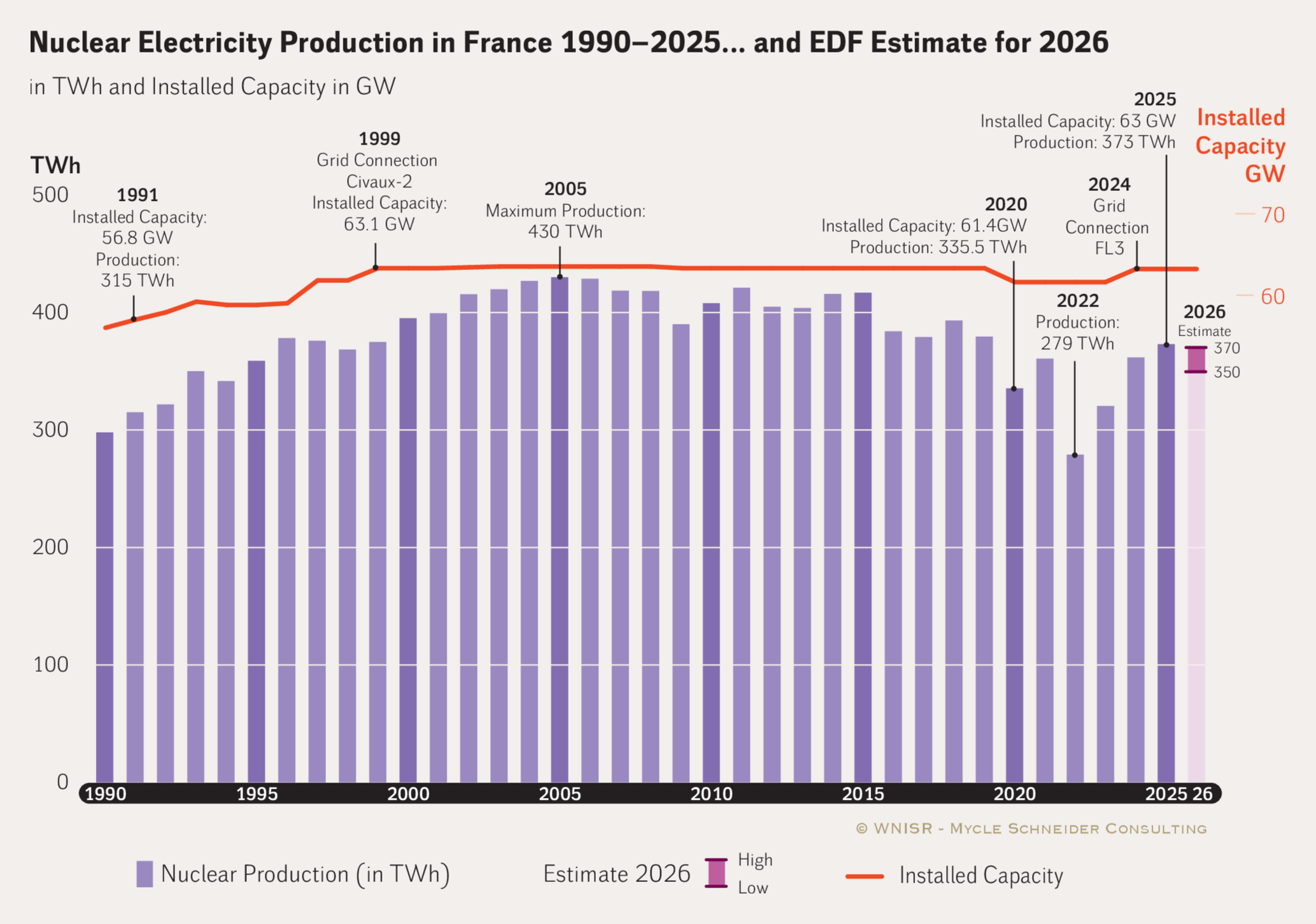
Sources: RTE, 2000–2026; and EDF, 2026
Note: In Figure 25, reactors in LTO are counted in the “installed capacity”.
In 2025, nuclear plants provided 68.1 percent (+1 percentage point) of the country’s electricity.131 The nuclear share peaked in 2005 at 78.3 percent (see Figure 26).
Solar newbuild had another record year with 2025 adding 5.9 GW of capacity—an increase of 24 percent following a record 26 percent jump in 2024—to reach a total of 30.4 GW. Solar generation surged by one third from 24.8 TWh in 2024 to 32.9 TWh in 2025, representing 6 percent of national generation, while wind and hydro, respectively, generated 49.6 TWh and 62.4 TWh, representing 9 percent and 11.4 percent of national generation. Meanwhile, the share of natural gas in national production is down to just 3 percent.132
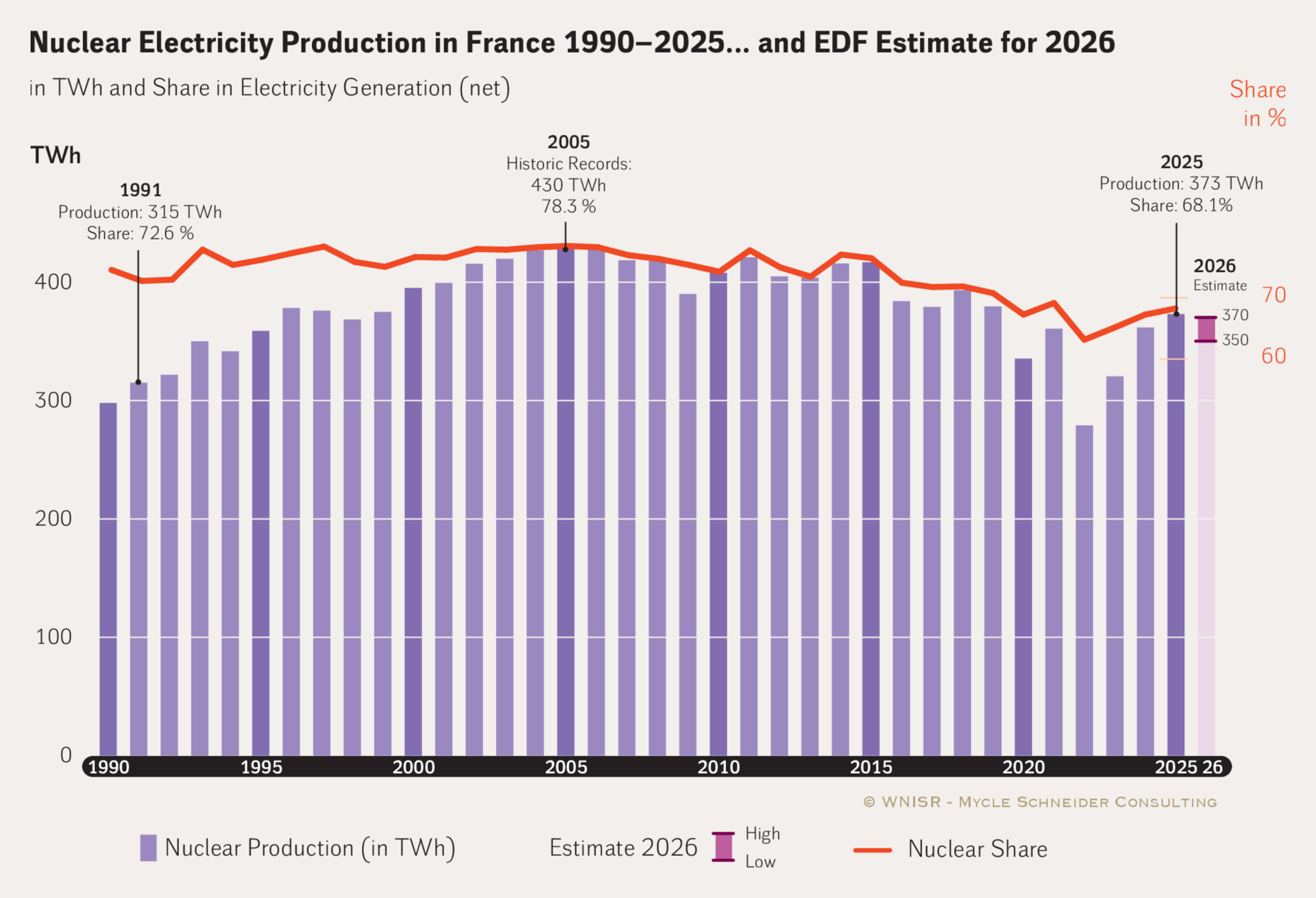
Sources: RTE, 2000–2026; and EDF, 2026
The solar boom continues, and in the first quarter of 2026, similar to the same period in 2025, another 1.5 GW were connected to the grid.133
Every year since 2020, monthly nuclear production in the first half-year—with the exception of June 2026—remained below the average level of the period 2012–2019. In 2024–2025, production improved significantly, especially in the crucial fourth quarter (see Figure 27).
Electricity represented 27 percent of final energy consumption in France in 2025. As nuclear plants provided 68.1 percent of electricity, they covered 18.4 percent of final energy (up 0.5 percentage points), with fossil fuels providing 55.9 percent of final energy (oil 38.9 percent, gas 17 percent, coal <1 percent).134
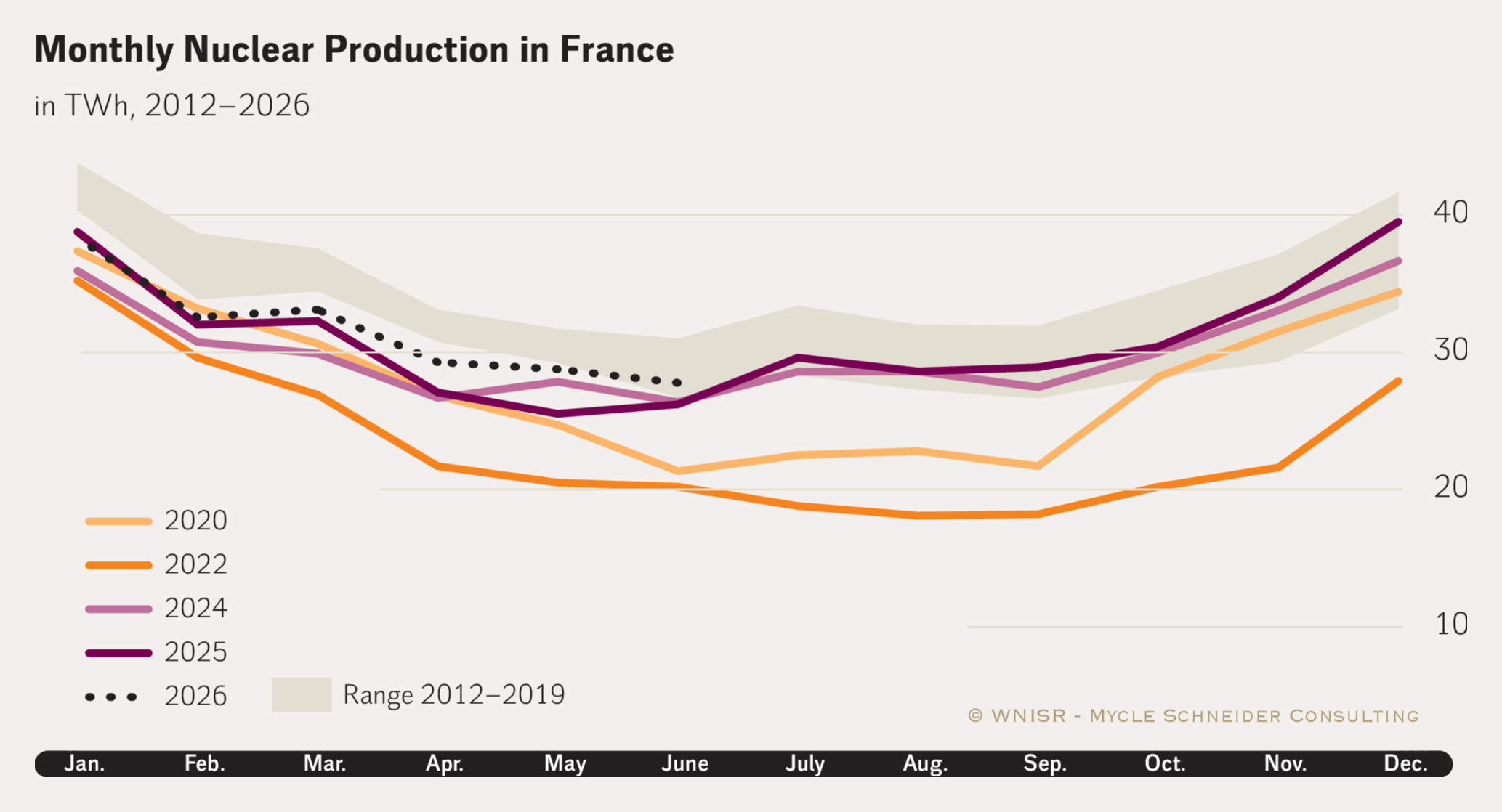
Sources: RTE and EDF, 2021–2026135
Nuclear Unavailability Review 2025
In 2025, the number of reactor-days with zero-production per reactor dropped to 5,155, the lowest in the past seven years, though still an average of three months or 90 days per reactor, slightly below the 96-day average of 2019 (i.e., pre-COVID-19).
All but one of the 57 reactors were subject to outages lasting from seven to 261 days (see Figure 28).
|
Declared Type of Unavailability |
||||
|
“Planned” |
Forced |
Total |
Average per Reactor |
|
|
2019 |
5,273 |
316 |
5,588 |
96 |
|
2020 |
6,179 |
286 |
6,465 |
115 |
|
2021 |
5,639 |
172 |
5,811 |
104 |
|
2022 |
8,287 |
278 |
8,515 |
152 |
|
2023 |
6,704 |
399 |
7,103 |
127 |
|
2024 |
5,197 |
342 |
5,539 |
99 |
|
2025 |
4,586 |
559 |
5,155 |
90 |
Sources: RTE and EDF REMIT Data, 2019–2026
Note: The year 2020 does not include Fessenheim-1 and -2 that were closed during the year, and the year 2024 does not include Flamanville-3 (FL3) that was briefly connected to the grid in December 2024. FL3 is however included in the year 2025.
Table 3 illustrates that while the declared “planned” outage-days dropped significantly since 2022, the number of declared “forced” outages remained high, peaking at 559 reactor-days in 2025, an increase of 63 percent year-on-year. The main contributor to this result is the FL3 EPR with repeated unplanned outages that cumulated to six months.
According to EDF’s classification of “planned” and “forced” unavailabilities, in 2025:
- One reactor operated year-round (Saint Alban-1).
- 12 reactors did not experience any “forced” outage.
- Five units experienced “forced” outages that lasted less than one day.
- 27 units cumulated “forced” outage durations of one to 10 days.
- 13 reactors cumulated “forced” outages between 10 and 180 days (FL3) over the year (see Figure 28).
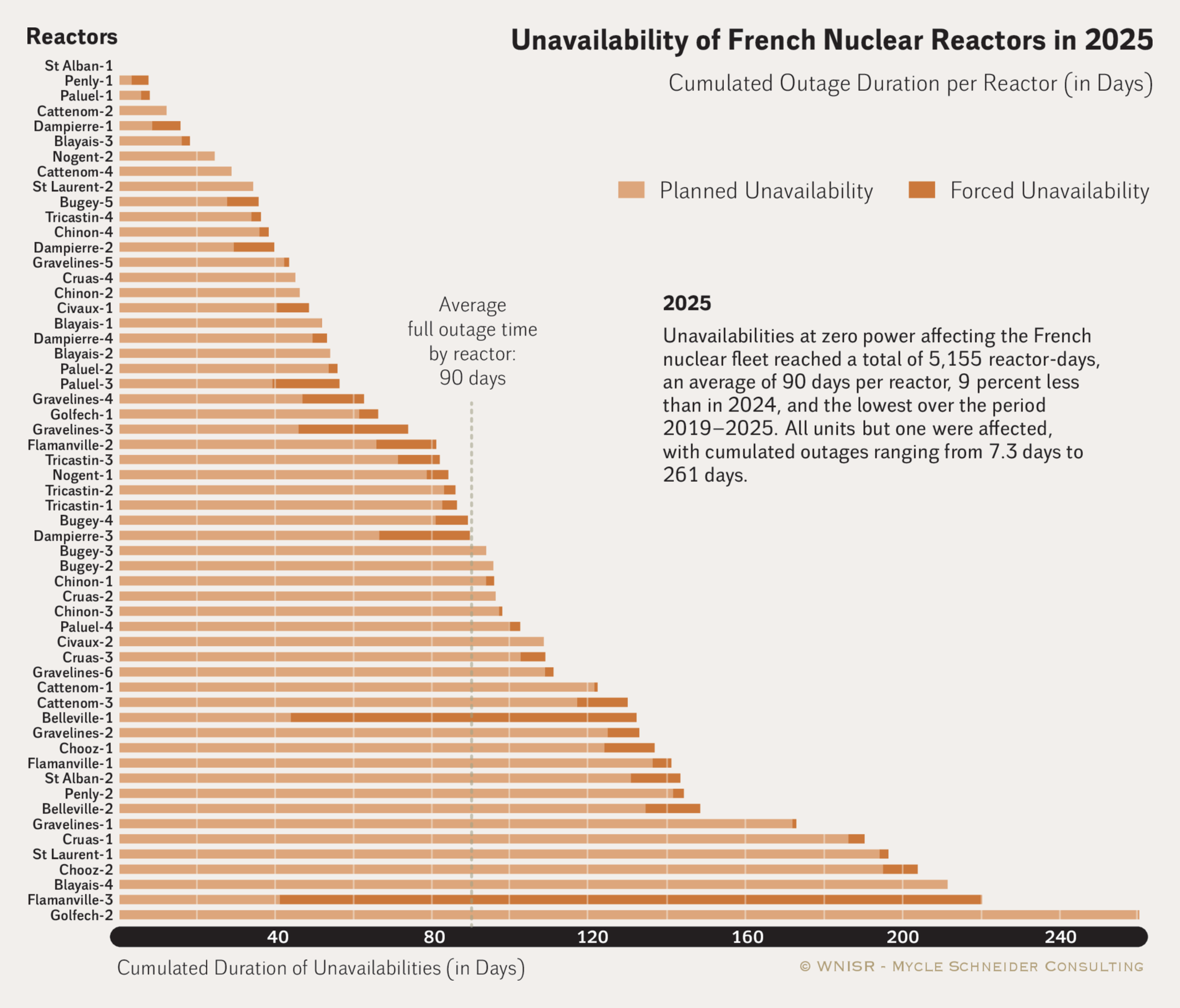
Sources: compiled by WNISR with RTE and EDF REMIT Data, 2021–2026
Notes
This graph only compiles outages at zero power, thus excluding all other operational periods with reduced capacity >0 MW. The impact of unavailabilities on power production is therefore significantly larger.
“Planned” and “Forced” unavailabilities are shown as declared by EDF.
However, EDF’s declaration of “planned” vs. “forced” outages is highly misleading. EDF considers an outage as “planned” if it was first declared as such, regardless of the number and duration of its extensions (or, in rare cases, reductions).
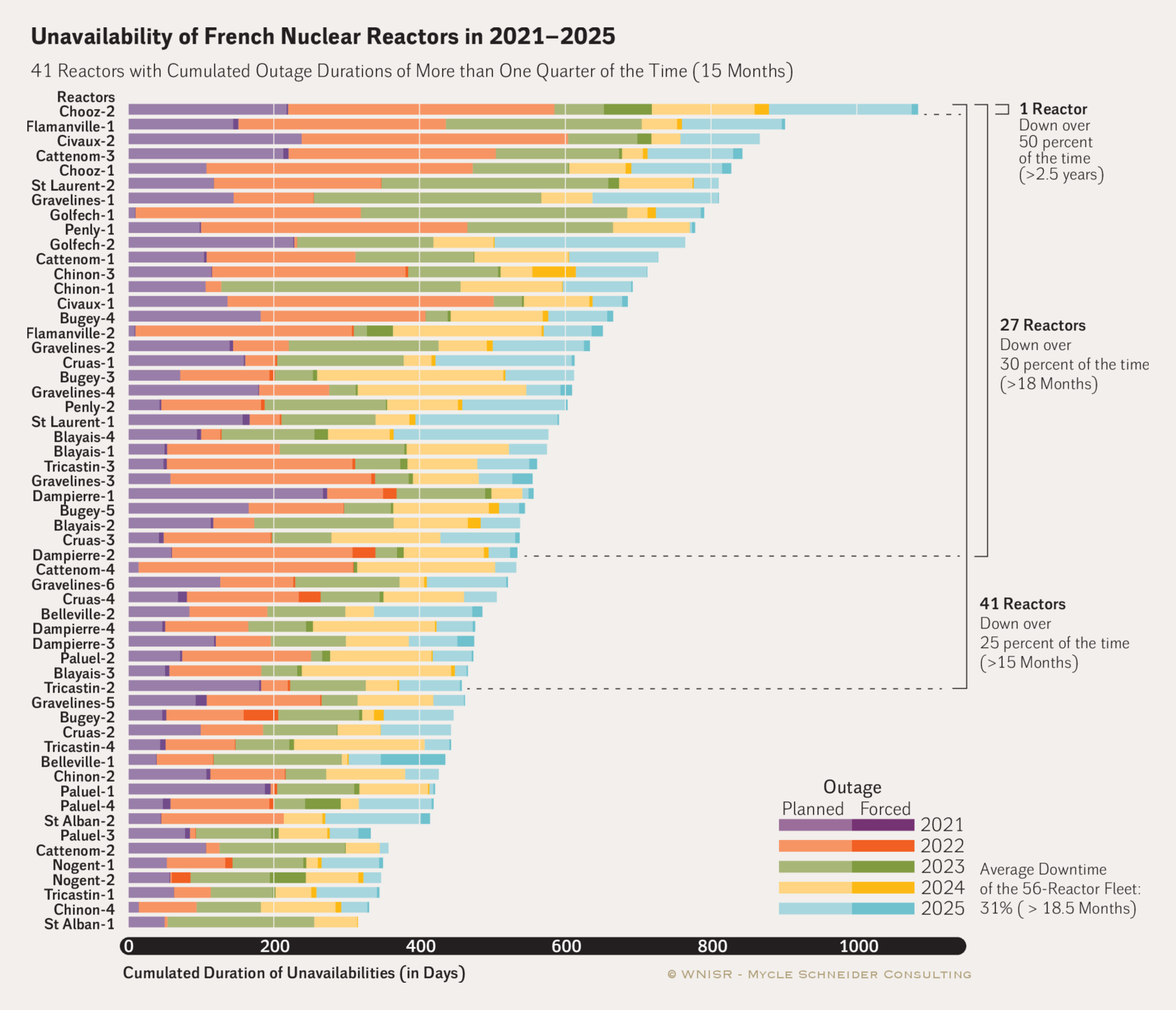
Sources: Compiled by WNISR with RTE and EDF REMIT Data, 2019–2026
Notes: The categorization as “planned” or “forced” outage follows EDF’s classification. However, it does not reflect reality, as EDF keeps a “planned” outage in that category even if it lasts much longer than initially “planned”.
Flamanville-3 is not included in this figure, as it was only connected to the grid at the end of 2024. However, the reactor was down for 221 days in 2025 or 60 percent of its first full operational year.
The cumulated outage analysis over the five years 2021–2025 reveals the following (see Figure 29):
- The average downtime per reactor of the 56-reactor fleet (not including FL3) over the five-year period 2021–2025 was 18.5 months or 31 percent of the time. This does not include load-following or other forms of output modulation that have sharply increased over the past two years.
- One reactor (Chooz-2) was down more than half of the time.
- 27 reactors were generating zero power for 30 percent of the time, that is 18 months or more.
- 41 reactors were off-grid for at least one quarter of the time, in other words, they did not generate any power for the equivalent of 15 months in five years.
Stress Corrosion Cracking and Thermal Fatigue
Severe Stress Corrosion Cracking (SCC) was first identified in late 2021 on the safety injection systems of the four at-the-time largest and latest French reactors at Chooz and Civaux.136 Later, additional impacted reactors were identified, and a program of preemptive replacement of particularly sensitive piping sections was selected for the “P’4” 1300-MW reactor series. While apparently rare so far, the phenomenon has been identified on other 1300-MW and some 900‑MW reactors. EDF decided to inspect its entire reactor fleet by the end of 2025 and claimed that, as of mid-2024, 50 of its 56 units had already been “controlled and treated”.137
The 2025 annual report of nuclear regulator ASNR (Autorité de Sûreté Nucléaire et de Radioprotection) points out that among the nearly 1,200 welds in safety injection systems (RIS) and reactor shutdown cooling systems (RRA) inspected since late 2021, a remarkable share showed significant cracks exceeding 2 mm of depth, “confirming the serious nature of this issue, which was previously thought not to be likely to affect these pipes.”138
ASNR sums up:
EDF’s inspections continued and have so far detected more than 80 significant cracks, some of which call into question the mechanical strength of the piping. ASNR currently considers the situation to be under control, as EDF has identified sensitive piping, and has at its disposal effective non-destructive testing capabilities, as well as, where necessary, techniques for replacement of the affected sections of piping. Against this backdrop, EDF has proposed a long-term monitoring strategy for the piping concerned, on which ASNR will state its position in 2026. ASNR considers that EDF must, in parallel, further improve its understanding of the conditions under which stress corrosion cracking occurs.139
In February 2023, an additional issue was identified during destructive examination at Penly-1. Close to a weld in a line of the safety injection system that had been repaired during the plant’s construction, a 15.5 cm long (about one quarter of the pipe’s circumference) and up to 2.3 cm deep crack (for a 2.7 cm thick tube) was identified. The origin has been determined as thermal fatigue rather than SCC. This discovery meant that an extensive inspection program of all repaired welds had to be added to the SCC investigations. According to the plan, 90 percent of the repaired welds in the safety injection and shutdown cooling systems of the entire reactor fleet were to be inspected by the end of 2024 and the remaining ones in 2025.140
According to an ASNR spokeswoman, EDF is not aiming to inspect all of the welds but rather a large sample of over half of the total, and the 90 percent is to be understood compared to the target level. She adds that,
the number of inspected welds is approximately 1,620 as of June 2026 representing a coverage rate of 55 percent of the welds on the RIS [safety injection] and RRA [shutdown cooling] lines that may be affected by thermal fatigue and stress corrosion cracking.
It should be noted that EDF also plans to implement an additional inspection program from 2026 to 2035, focusing on low-risk and non-sensitive pipelines, in order to improve inspection coverage for these pipelines (since sensitive pipelines have already undergone exhaustive inspections). This additional program will bring the overall inspection rate to approximately 75 percent by 2035.141
Meanwhile, the problem seems to be far from solved. Piping segment replacements after the identification of significant SCC and thermal fatigue were carried out with identical materials. The ASNR annual report states: “The discovery in 2025 of new SCC defects and fatigue damage in piping that had been replaced in 2022 underscores the need to continue investigations to understand these phenomena.”142
Decennial Inspections and Lifetime Extensions
By mid-2026, the average age of the 57 nuclear power reactors exceeded 40 years (see Figure 30); 52 operating units are now over 31 years old, of which 31 are over 41 years. Lifetime extension beyond 40 years requires significant additional upgrading. Also, relicensing is subject to public inquiries reactor by reactor.
EDF will likely seek lifetime extensions significantly beyond the 4th Decennial Safety Review or VD4 (4ème visite décennale) for most, if not all, of its remaining reactors. President Macron made it clear in his February 2022 programmatic speech that the government has no intention of closing reactors anymore. He stated: “While the first extensions beyond 40 years have been implemented successfully since 2017, I’m asking EDF to examine the conditions of the [lifetime] extensions beyond 50 years, in conjunction with the nuclear safety authority.”143
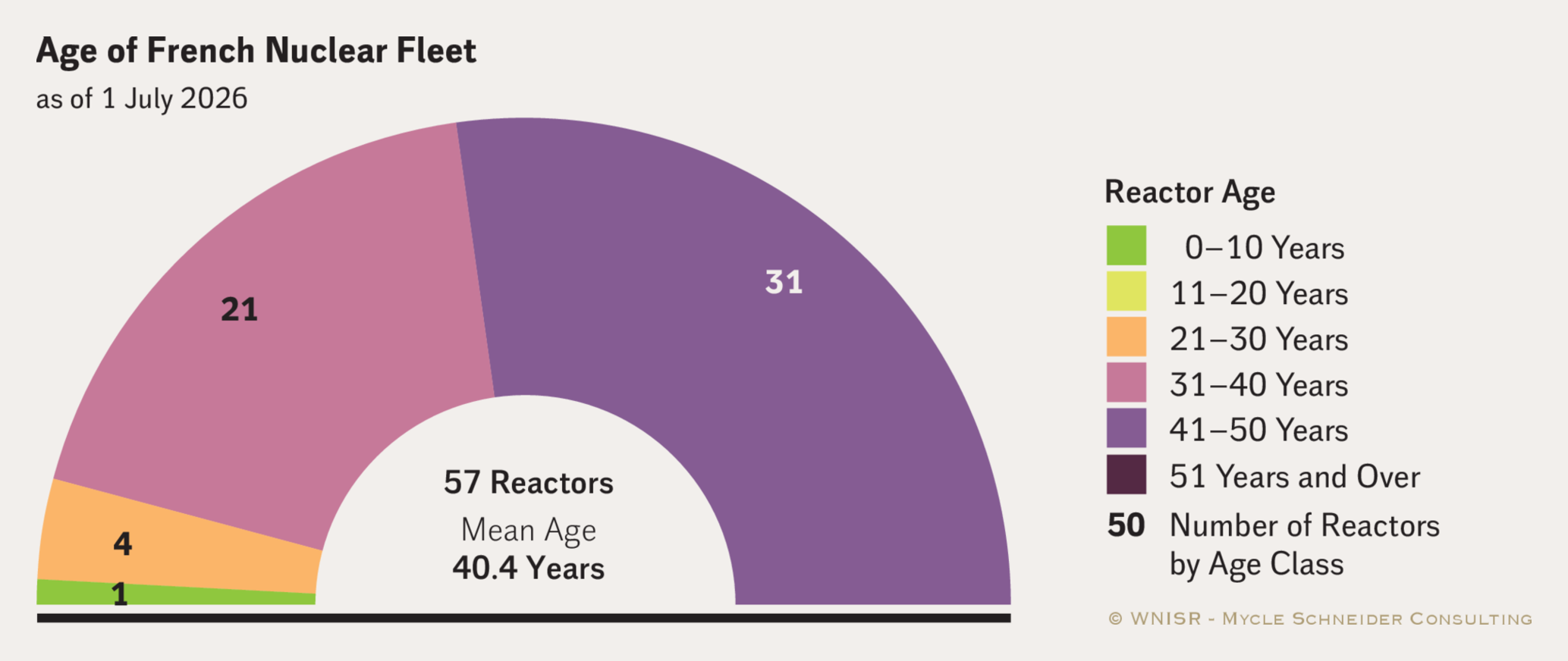
Sources: WNISR with IAEA-PRIS, 2026
The first reactor to undergo the VD4 was Tricastin-1 in 2019, followed by Bugey-2 and -4 in 2020, and Tricastin-2 in 2021. Dampierre-1, Bugey-5, and Gravelines-1 started in 2021, but the COVID-19 pandemic further disrupted the safety review schedule.144 Until 1 July 2026, 25 of the 32 units had undergone their VD4, and a further two were going through it (see Table 4).145 Of the completed outages, 19 were expanded beyond the initial estimate, and six were completed faster than anticipated. While the delays total an extra 1,482 unplanned outage days, the six earlier completions total only 86 saved outage days, resulting in a net cumulated unplanned loss of 1,396 production days.
In 2023, the Chief Technical Officer of EDF Group and CEO of EDF Research and Development (R&D), Bernard Salha, told the French Parliament that the work volume of a VD4 was five times larger than that of a VD3. He also said investments into the operating fleet had doubled over the previous decade.146 Moreover, the Court of Accounts reported in 2025 that EDF’s estimate for the VD4 was over five times more expensive than the VD3.147
|
Reactor |
Capacity |
Grid Connection |
VD4 Outage |
Expected Duration* |
Total Actual Duration |
|
Tricastin-1 |
915 |
31 May 1980 |
01/06/19 – 23/12/19 |
180 |
205 |
|
Bugey-2 |
910 |
10 May 1978 |
18/01/20 – 15/02/21 |
181 |
395 |
|
Bugey-4 |
880 |
8 March 1979 |
22/11/20 – 24/06/21 |
226 |
214 |
|
Dampierre-1 |
890 |
23 March 1980 |
19/06/21 – 05/02/22 |
170 |
231 |
|
Tricastin-2 |
915 |
7 August 1980 |
06/02/21 – 26/07/21 |
180 |
170 |
|
Bugey-5 |
880 |
31 July 1979 |
31/07/21 – 21/04/22 |
189 |
265 |
|
Gravelines-1 |
910 |
13 March 1980 |
14/08/21 – 11/04/22 |
188 |
240 |
|
Tricastin-3 |
915 |
10 February 1981 |
12/03/22 – 21/11/22 |
171 |
254 |
|
Gravelines-3 |
910 |
12 December 1980 |
23/03/22 – 22/12/22 |
191 |
275 |
|
Dampierre-2 |
890 |
10 December 1980 |
27/04/22 – 31/12/22 |
171 |
248 |
|
Blayais-1 |
910 |
12 June 1981 |
31/07/22 – 19/06/23 |
185 |
323 |
|
St-Laurent B-2 |
915 |
1 June 1981 |
20/01/23 – 20/11/23 |
223 |
304 |
|
Chinon B-1 |
905 |
30 November 1982 |
07/02/23 – 19/05/24 |
265 |
467 |
|
Gravelines-2 |
910 |
26 August 1980 |
10/06/23 – 07/03/24 |
197 |
272 |
|
Blayais-2 |
910 |
17 July 1982 |
24/06/23 – 31/03/24 |
182** |
281 |
|
Dampierre-3 |
890 |
30 January 1981 |
23/09/23 – 2/03/24 |
170 |
161 |
|
Bugey-3 |
910 |
21 September 1978 |
11/11/23 – 28/08/24 |
177 |
303 |
|
Tricastin-4 |
915 |
12 June 1981 |
19/01/24 – 16/07/24 |
194 |
179 |
|
Gravelines-4 |
910 |
14 June 1981 |
20/01/24 – 07/09/24 |
195 |
231 |
|
Blayais-3 |
910 |
17 August 1983 |
08/06/24 – 26/12/24 |
191 |
201 |
|
Dampierre-4 |
890 |
30 January 1981 |
12/07/24 – 21/12/24 |
188 |
162 |
|
Cruas-3 |
915 |
14 May 1984 |
04/08/24 – 10/03/25 |
232 |
218 |
|
St-Laurent B-1 |
915 |
21 January 1981 |
31/01/25 – 14/08/25 |
178 |
195 |
|
Blayais-4 |
910 |
16 May 1983 |
05/04/25 – 22/10/25 |
187 |
200 |
|
Cruas-1 |
915 |
29 April 1983 |
14/06/25 – 13/12/25 |
170 |
183 |
|
Cruas-4 |
880 |
27 October 1984 |
13/06/26 – 25/11/26 |
165 |
|
|
Gravelines-5 |
910 |
28 August 1984 |
19/06/26 – 08/12/26 |
172 |
|
|
Chinon-2 |
870 |
29 November 1983 |
16/07/26 – 05/01/27 |
173 |
Sources: compiled by WNISR with EDF REMIT-Data, 2019–2026148
Notes
The expected duration is based on outage dates in use as of outage start or within the few days after the reactor is disconnected from the grid.
For ongoing decennial visits, end of outage date is the date in use as of 3 August 2026.
* Expected duration as of outage start
** Original duration149
On 23 February 2021, ASNR’s predecessor ASN (Autorité de sûreté nucléaire) issued detailed generic requirements for plant life extension.150 The key aspects of ASN’s decision were the two annexes setting the technical conditions and the timetable for work to be carried out. The challenge for operator EDF remains high, as ASN outlined at the time:
Over the coming five years, the nuclear sector will have to cope with a significant increase in the volume of work that is absolutely essential to ensuring the safety of the facilities in operation.
Starting in 2021, four to five of EDF’s 900 Megawatts electric (MWe) reactors will undergo major work as a result of their fourth ten-yearly outages. (…)
All of this work will significantly increase the industrial workload of the sector, with particular attention required in certain segments that are under strain, such as mechanical and engineering, at both the licensees and the contractors.151
That was prior to the disruptive discovery of widespread stress corrosion cracking and thermal fatigue in late 2021.
The VD4 started and/or was completed for ten 900-MW reactors in 2024 and four in 2025. In January 2026, the first VD4 of a 1300-MW reactor (Paluel-1) started with a planned outage of about eight months. Between 2026 and 2028, four to five 10-year inspections are scheduled annually at 900-MW and 1300-MW units. Five inspections are scheduled in 2026 and four each in 2027 and 2028.
In 2029, a VD5 of a 900-MW unit is planned for the first time, alongside four VD4s of 1300‑MW reactors and the first VD3 of a 1450-MW unit. Between 2029 and 2034, each year six or seven VDs are scheduled.152
ASN has shown remarkable tolerance for extended timescales of refurbishments and upgrades in the past; many of the post-Fukushima measures have not yet been implemented 15 years after the events, for example. According to some estimates, the completion of the work program could take until 2039.153
Additionally, the implementation of work to be carried out as part of the lifetime extension beyond 40 years stretches over 15 years until 2036, when the last 900-MW reactor is supposed to be upgraded: Chinon B-4, connected to the grid in 1987, gets the 15-year delay to implement 15 of a total of 37 measures. By then, the unit will have operated for 49 years. This is just one example, and it is the newest of the operating 900-MW reactors. The ASN has accepted similar timescales for all 32 of the 900-MW units. The French nuclear safety authorities have proven flexible, and—considering the dire state of the reactor fleet—pressure for even more flexibility might increase in the future.
On 13 October 2023, EDF applied for permission to extend the deadlines for many of the required upgrades of the 32-unit fleet of 900-MW units by years, “given the difficulties of meeting them”.154 On 19 December 2023, ASN modified its generic requirements published in February 2021 and delayed target dates for at least one but up to 14 out of 36 upgrading work-packages for 31 of the 32 reactors.155
Under the VD4 program framework of legally required upgrades and associated documentation, EDF had to meet 107 deadlines in 2024156 and 105 in 2025.157 EDF claims having met all of them.
There are many more target dates coming up over the next two years with a sharp increase in 2027. In 2026, 82 prescribed deadlines are expected, 42 of them related to work on facilities and 40 related to documentary deliverables or modifications to the facility operating reference system. In 2027, a total of 152 deadlines are scheduled, 98 of them related to modifications at facilities, which is more than double the 2026 target.158
The increasing grid penetration of variable renewables like wind and solar leads to significant variations in available capacities throughout the day and between seasons. This has obvious effects on overall power generation capacity management and on the market. While EDF has been practicing load following—with output variations of a few percent—on over 40 reactors for many years, ramping up and down for half of the capacity or more has never been done on a large scale.
A 2024 report by trade analysts at Kpler noted that the French reactor fleet “continuously shows its ability to ramp down 12 GW in under a day, a 20[-percent] flexible output of its total operational capacity,” while individual reactors have occasionally ramped by three quarters of their nominal capacity. The Kpler analysts conclude: “Our analysis and case studies suggest that modulation is influenced not only by load but also by market price signals, which act as proxies for residual demand and cross-border flows.” 159
In February 2026, EDF published its first comprehensive report on modulation of its production and storage facilities, in particular its nuclear reactors. EDF summarizes the main results:
➜ Between 2019 and 2024, the volume of nuclear modulation doubled, increasing from about 15 TWh to more than 30 TWh. In 2025, the nuclear fleet modulated by 33 TWh.
➜ Historically, power reductions at nuclear reactors occurred mainly at night and on weekends. Today, modulation also occurs during the day, particularly during periods of high solar generation.
➜ More frequently, modulation can even lead to the shutdown of nuclear reactors.
➜ The cumulative operating time of pumped-storage hydropower plants was significantly higher in 2025 than in previous years.
➜ Over the same period, the number of shutdowns and restarts of the combined‑cycle gas plants in the thermal fleet doubled.
➜ Notably, the increased flexibility required of EDF’s generation assets is leading to higher maintenance costs for all these facilities.160
The EDF report points to various additional unwanted side effects of modulation. These include increased discharges and water consumption:
Increased maneuverability will lead to an increase in liquid and gaseous discharges and will require significant investment in water production and effluent treatment systems. (…)
Furthermore, a significant increase in the number of modulation shutdowns—which creates uncertainty regarding their duration and, consequently, the plant’s shutdown status—would pose an additional risk of higher water consumption. Thus, this constraint can be considered significant in light of the increase in modulation.161
These are particularly detrimental effects in the context of water scarcity caused by climate change.
Climate Resilience in Question162
The year 2026 has seen temperature records throughout the world, and Europe has experienced several severe heatwaves. France was no exception, and the nuclear power sector has been seriously impacted. As recently as April 2026, EDF stated:
With a constant fleet and without taking into account adaptation measures, EDF anticipates – due to climate change – an annual loss of generation (based on environmental criteria) of around 5.6 TWh in 2050, representing around 1.5% of EDF’s nuclear generation in 2050 (a factor of 3.6 compared to the average annual losses observed over 2000-2020).163
Four months later, on 11 August 2026, the threshold of 5.6 TWh anticipated for 2050 had already been passed. By 1 September 2026, the production loss had exceeded 9 TWh (see Figure 31), a factor of almost six above the average annual losses over the period 2000–2020 and 64 percent above the level expected in a quarter century. This is not the final number as two reactors (Chooz-B1 and -B2) with a combined capacity of 3 GW are expected to remain off-grid for the first two weeks of September 2026.
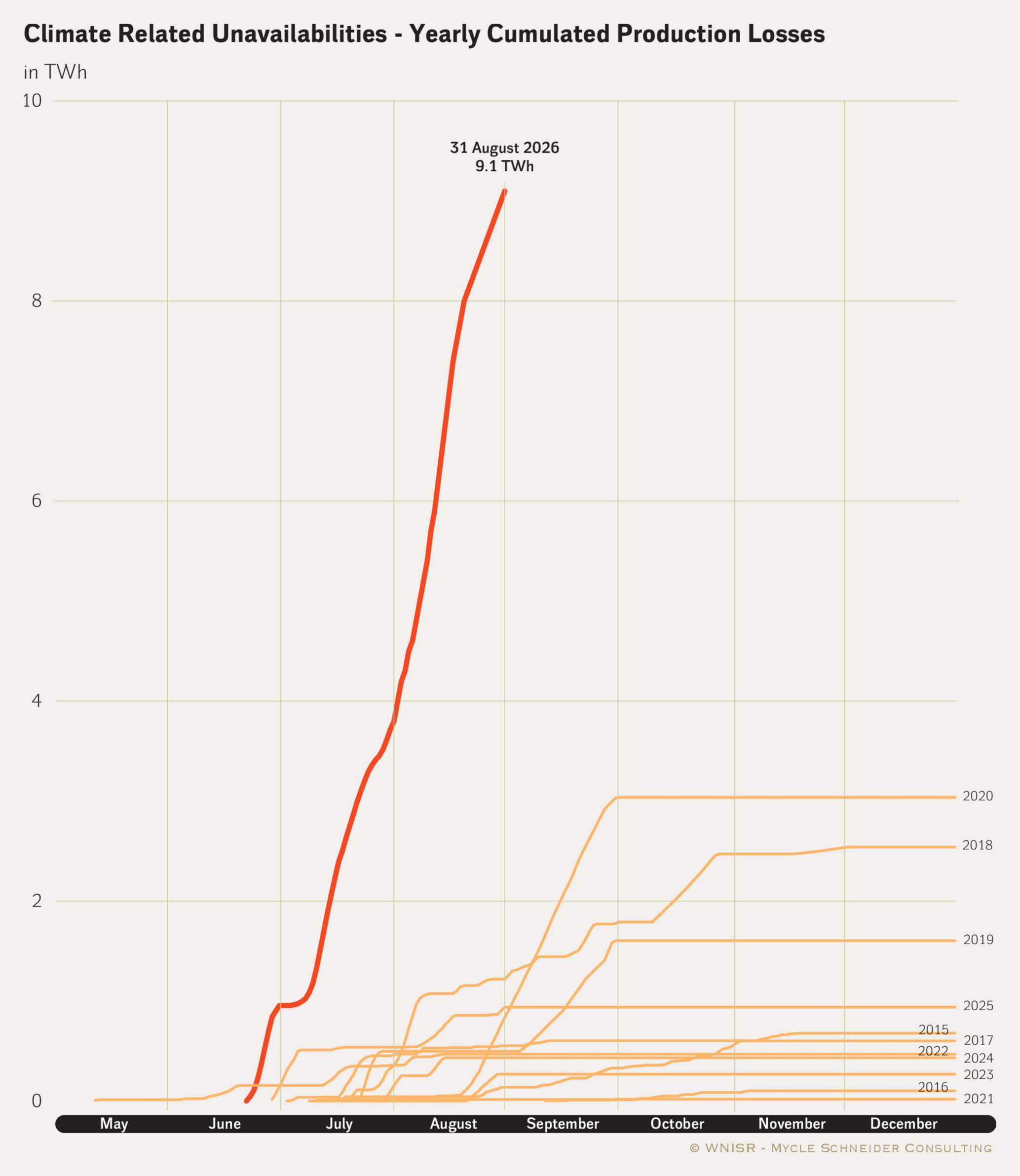
Source: Callendar, 2026164
While the steep increase in nuclear production losses compared to earlier years is remarkable—climate impact happens earlier in the year and is more pronounced—the most significant effect is the simultaneous loss of capacity. On 17 August 2026, climate analysts at Callendar, based on EDF data, identified capacity losses at 15 reactors, with nine units shut down and six with reduced output. They estimated and later confirmed that a loss of up to 13.4 GW—over 20 percent of the French nuclear capacity—at eight of France’s 18 nuclear plants was reached that day.165
Climate analysts at Callendar, based on EDF data, identified capacity losses at 15 reactors, with nine units shut down and six with reduced output.
In fact, current climate related outages do not adequately represent the potential impact as 13 reactors were down for other reasons like refueling, inspections, or maintenance, often at the same sites that are experiencing climate impact. As of 17 August 2026, at least five additional reactors at Bugey, Cattenom, Golfech, and Gravelines would have been impacted by climatic issues had they not been shut down at the same time for other reasons.
As illustrated in Figure 32, of the 57 operating light water reactors, 27 units have open cooling systems, of which 15 are on the seashore and 12 on rivers. The remaining 30 units have closed systems with cooling towers (all on rivers). The river-based open systems are the most sensitive to water temperature and scarcity. There are four such units at Blayais, two at Bugey, two at Saint-Alban, and four at Tricastin. But even reactors with cooling towers can be seriously impacted as full shutdowns at Cattenom, Chooz, and Golfech have illustrated. Locations at the seashore can be subject to additional climatic effects as seen in the case of Gravelines, France’s largest plant with six 900-MW reactors, where a massive influx of jellyfish into the seawater pumping stations forced EDF on 11 August 2026 to provisionally shut down three reactors and to reduce the output of a fourth unit by half. One unit was on a maintenance outage and only one unit operated normally.166
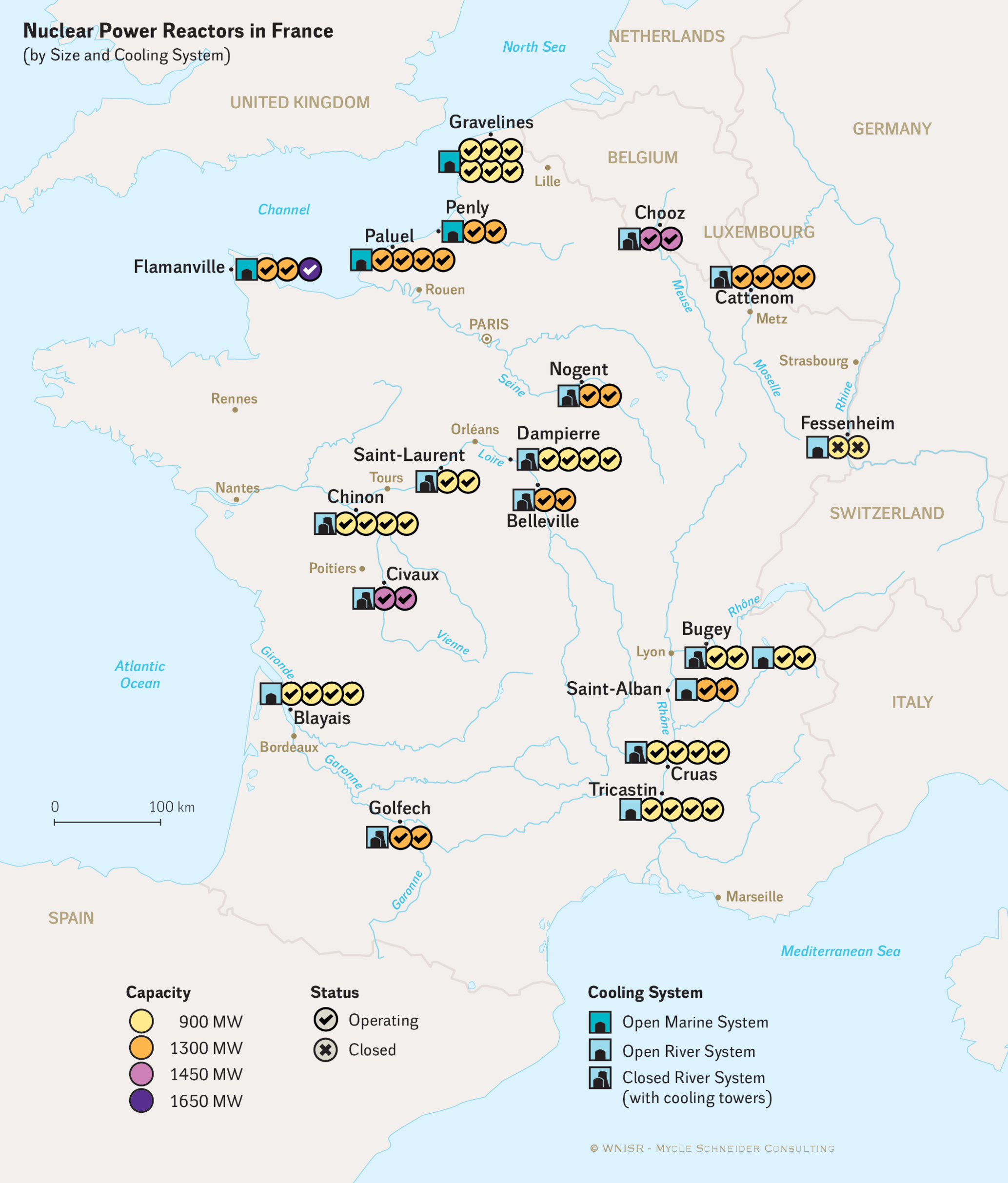
Sources: WNISR, based on EDF and RTE, 2026
Operating and maintenance costs of the aging fleet of reactors have significantly increased over the past decade167 (see also previous WNISR editions). Though there might be uncertainties over various cost estimates for refurbishments and upgrades needed for lifetime extensions, there is little doubt that these costs remain below any cost estimate for newbuild.
After reaching €64.5 billion (US$202267.9 billion) in 2022,168 EDF’s net financial debt decreased to €54.4 billion (US$202358.8 billion) in 2023,169 remained stable at €54.3 billion (US$202458.8 billion) in 2024, and decreased further to €51.5 billion (US$202558.2 billion) in 2025.170 As prices fell throughout EDF’s business regions, sales were down 15.7 percent in 2024 and another 5.6 percent in 2025.
Over the whole of 2025, there were 735 hours of negative or zero spot prices, compared to 560 hours in 2024.
Rapidly changing market situations leading to lower average prices and, increasingly often, to very low or even negative prices on the spot market, have a significant impact on the management of France’s nuclear fleet and on financial results. EDF’s 2026 half-year financial report states: “As in 2025, the first half of 2026 registered many hours of negative or zero spot prices in France at times when renewable energy output was high and demand was low against a background of expanding installed renewable energy capacities. Specifically, there were 476 hours of negative or zero spot prices in the first half of 2026, a very similar figure to the 483 hours of first-half 2025.”171 Over the whole of 2025, there were 735 hours of negative or zero spot prices, compared to 560 hours in 2024.172
Meanwhile, the national Energy Regulatory Commission (Commission de régulation de l’énergie or CRE) issued an important 219-page report reassessing the complete nuclear power generating costs for the periods 2026–2028 and 2029–2031.173 The CRE reports that EDF had submitted a cost evaluation of almost €79.6 per MWh (~US$92.5/MWh) for the first and €81.5 per MWh (US$94.7/MWh) for the second period. In need of financing for the aging existing nuclear fleet and significant investment for newbuild, EDF did not have any interest in downplaying its costs.
The CRE assessed drastically different costs: €60.3/MWh (US$70/MWh) for the first and €63.4/MWh (US$73.6/MWh) for the second period. EDF reviewed its cost estimates in light of CRE’s methodology and legal changes and came up with an amended estimate of €64.4/MWh for the first and €67.7/MWh for the second period (US$74.8 and US$78.6 per MWh, respectively). Explaining why the cost assessments differed and how they were adjusted is beyond the scope of this report, but it is remarkable that all the numbers remain well above the price level of annual contracts for next-year baseload deliveries (calendar years) whose price was €54.0/MWh (US$62.7/MWh) on average in the first half of 2026 (see next section).
Flamanville-3: Difficult Construction, Bumpy Road to Commissioning
The 2005 decision to build Flamanville-3 (FL3) was mainly motivated by the industry’s attempt to confront the serious problem of maintaining nuclear competence. In December 2007, EDF started construction on Flamanville-3 (FL3) with a scheduled startup date of 2012. The project has been plagued with design issues and quality-control problems, including basic concrete and welding difficulties similar to those at the Olkiluoto (OL3) project in Finland, which started construction two and a half years earlier and was connected to the grid only in March 2022 (see earlier WNISR editions). These problems never went away.
Following numerous revisions of the original €3.32007 billion (US$20074.5 billion) cost estimate, EDF’s latest estimate in November 2023 indicated overnight costs174 of €18.4 billion (US$20 billion) and a total, including financing and other costs, of €22.6 billion (US$24.4 billion). The French Court of Accounts later upped that number to €23.7 billion (US$25.6 billion), a staggering sixfold increase over the original cost estimate (inflated) of €4 billion (US$4.3 billion) (see Figure 33).175
The court regrets FL3’s “poor projected profitability”. To achieve a 4-percent real rate of return FL3’s power would need to sell at €2023138/MWh (US$2023149/MWh), provided the plant reaches a load factor of 75 percent. The court further states that “for sales prices below €202390/MWh [US$202397/MWh], it seems difficult to envisage a rate of return reaching 2 percent.”176 The average spot market price for baseload power in the first half of 2026 stood at €61.8/MWh (US$71.8/MWh) in France,177 a year-on-year drop of 7.3 percent from €66.70/MWh (US$202575.4/MWh) in 2025.178
Furthermore, much of EDF’s nuclear generation is sold through annual contracts for next-year baseload deliveries (calendar years) whose price averaged at €54.0/MWh (US$62.7/MWh) in the first half of 2026 (for calendar year 2027), a downturn of €10.6/MWh (US$12.3/MWh) compared to average prices in the first half of 2025 (for calendar year 2026).179 It seems obvious that under those market conditions, Flamanville-3 has a negative rate of return.
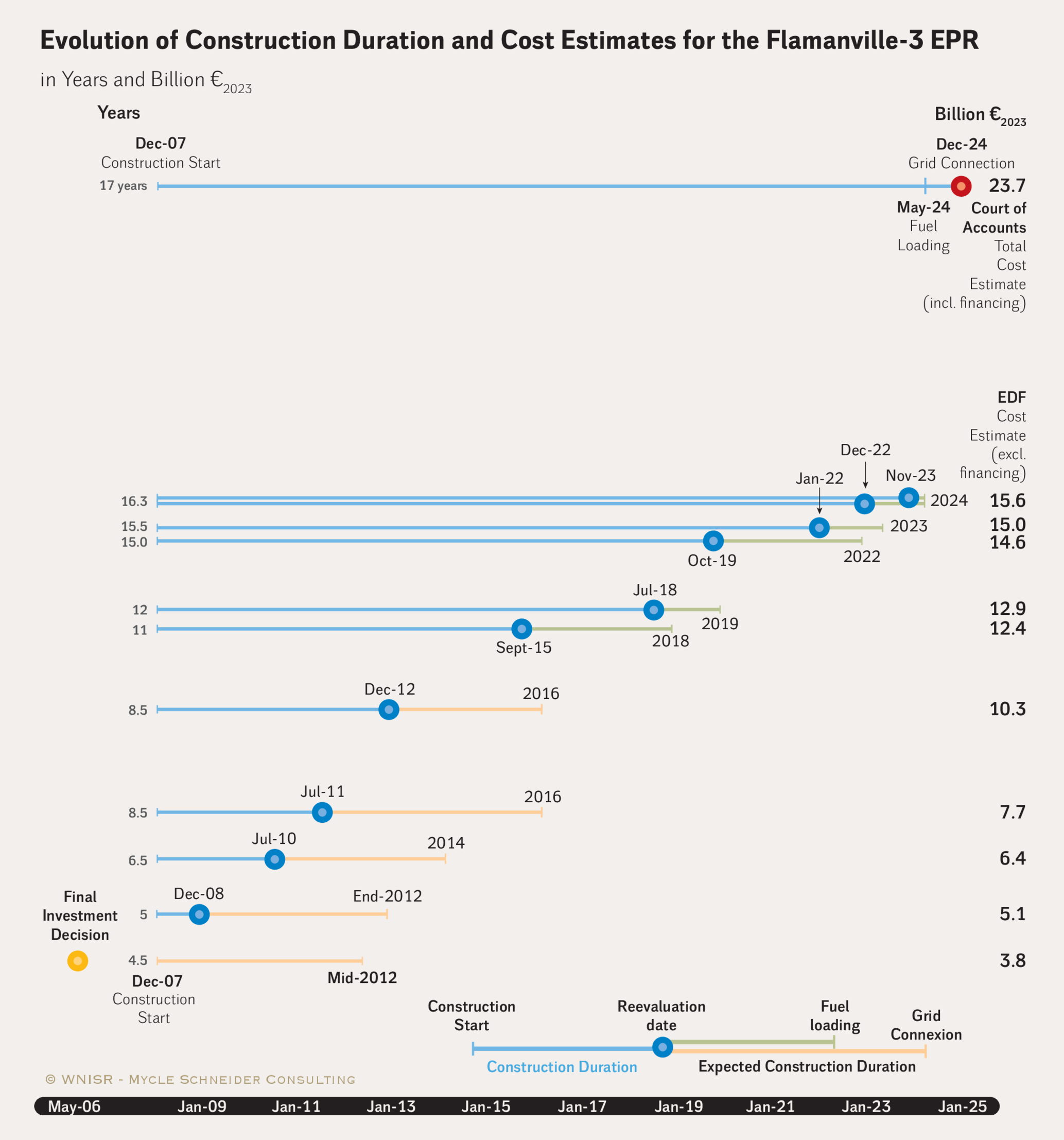
Source: Cour des comptes/Court of Accounts, 2025
FL3 reached first criticality on 3 September 2024, and it was finally connected to the grid a few months later on 21 December 2024, 17 years after construction start and 12 years later than planned.
During the startup phase, EDF reports that FL3 experienced several “unplanned outages” including:
➜ an outage from 15 February 2025 to 19 April 2025 to carry out work on several pieces of equipment, particularly the turbine;
➜ an outage from 19 June to 15 October 2025 in order to carry out work on the three protection valves in the primary circuit.180
In its first full calendar year of operation, FL3 produced 2.2 TWh net, a load factor of 15.4 percent.181 On 26 April 2026—a symbolic date, 40 years to the day after the Chornobyl disaster began—EDF called the end of start-up testing and “the facilities were considered commissioned for accounting purposes at that date and are to be depreciated over a maximum of 60 years.”182 However, this “first operating phase” will only continue until the unit’s first full inspection and replacement of its faulty vessel head that is scheduled to begin on 26 September 2026 and last almost one full year (350 days).183
In its first full calendar year of operation, FL3 produced 2.2 TWh net, a load factor of 15.4 percent.
As early as August 2023, EDF had applied for a building permit for the first pair of the “sixpack” of EPR2 units to be built at the Penly site according to the wishes of the President of the Republic. The ASN stated in its 2024 annual report that the application “is being examined and should reach a conclusion in 2027.” 184 Meanwhile, site preparation and the manufacturing of large components have begun nevertheless. EDF reported that in September 2025 Framatome started manufacturing the EPR2 Primary Motor Pump Unit (GMPP) and that “production of large components also continued at the Le Creusot, Saint Marcel and Jeumont plants.” 185
The other pre-selected sites for a pair of EPR2 units are Bugey and Gravelines, and EDF is in the course of filing the administrative applications to implement these projects. Public debates, part of the procedure, already took place for all three sites between October 2022 and May 2025.186
Michel Badré, former president of the Environmental Authority and of the Special National Commission for Public Debate (Commission nationale du débat public or CNDP), who was in charge of the public debate on the EPR2 projects in Penly, summed up his sobering conclusion from the procedure in an October 2024 presentation:187
Two criteria for assessing the usefulness of the debate:
➜ Did it provide the public with adequate information? To date, no.
➜ Did it allow the public to participate in the decision-making process? No.
The Court of Accounts warns in its already mentioned 2025 report that “the accumulation of risks and constraints could lead to the failure of the EPR2 program.” Therefore, it has issued two key recommendations:
➜ Postpone the final investment decision on the EPR2 program until financing has been secured and detailed design studies have progressed in line with the target schedule for the first nuclear concrete pour [the official construction start].
➜ Ensure that any new international project in the nuclear field generates quantifiable gains and does not delay the EPR2 program schedule in France.
The amounts of money invested into the EPR2 project prior to any construction start are quite extraordinary. The EPR2 Project Review Committee stated in its July 2024 report that has not been updated since (at least not in a public version): “It should be kept in mind that €3 billion [US$20243.3 billion] will already have been spent by EDF by the end of 2024, while an additional €2 billion [US$20242.2 billion] is planned for 2025 and €3 billion [US$20243.3 billion] for 2026, while the final investment decision (FID) cannot be taken before mid-2026 (…), in a timetable that remains optimistic.” 188 At the time, the FID was indeed expected by mid-2026. In the end, the board of directors approved a budget of €2.7 billion (US$3.1 billion) for the EPR2 program for 2026,189 and the FID is to be taken by the end of 2026. It is unclear how much was ultimately spent in 2025, likely less than the €2 billion planned. That still means that €7.2–7.7 billion or US$8.4–8.9 billion have been engaged prior to the FID.
EDF notes that “given its cost and duration, the EPR2 programme cannot be undertaken by EDF without public support measures.” 190 As of mid-2026, the French Government’s aid package remains under review by the European Commission.191
In February 2026, the French Government finally published the long-delayed third Multi-Year Energy Program (Programmation pluriannuelle de l’énergie – PPE3) 2030–2035.192 The PPE3 counts on the “optimization of the existing fleet” of 57 reactors and an annual nuclear production of 380–420 TWh for the period 2030–2035, more ambitious than earlier PPE3 draft versions. Operational lifetime of existing reactors is to be extended “to 50 or 60 years”. Planned expansions of non-hydro renewable energy sources have been scaled back but remain significant—even if uncertainty is high with particularly large ranges envisaged in 2035 scenarios. Solar production is to reach 59 TWh by 2030 and 67–98 TWh by 2035. Onshore wind is to provide 68 TWh by 2030 and 80–91 TWh by 2035. Offshore wind is planned to have the strongest surge with 14 TWh by 2030 and 59 TWh by 2035 compared to 5.7 TWh in 2025.193
The construction of six EPR2s is confirmed just as the objective to “be in a position to decide in 2026 on the launch of eight additional reactors”. The PPE3 also “proposes to support small modular reactors (SMR),” continue the spent fuel reprocessing policy and prepare for the renewal of the associated facilities. The action plan also includes the development of a new roadmap for “closing of the nuclear fuel cycle and establishing a fleet of fast neutron reactors in France.”194
While EDF “welcomes” the publication of the PPE3,195 the document received some harsh criticism. Independent energy and nuclear expert and spokesperson of the think tank NégaWatt, Yves Marignac, wrote in a stinging op-ed in Le Nouvel Obs:
The PPE shows little ambition in areas where it aims to be more operational, such as the development of renewable energy. (…)
Nuclear power, the cornerstone of this system, is in fact the only area where the PPE aims to be both ambitious and operational. This priority, [which] takes precedence over everything else (…)
The PPE3 plan calls for extending the operating life of all reactors to fifty years and then sixty years. However, this is neither a done deal nor reasonable. It is not a foregone conclusion because the French Nuclear Safety and Radiation Protection Authority (ASNR) has not yet ruled on this matter, and because, according to the Court of Accounts, EDF has so far only implemented one-third of the at least €100 billion [US$116 billion] investment required to extend the fleet’s lifespan to fifty years.196
Greenpeace published a note assessing the cost of all of the nuclear-related investments planned under the PPE combined, concluding that the bill could reach €380–650 billion (US$441–755 billion) by 2050, depending on lifetime extension costs and the final number of reactors and facilities built.197
Nuclear production has improved in 2024 and 2025 but remains far below the average level in the decade that ended in 2015. WNISR analysis shows that average outage time over the past five-year period was 18.5 months; in other words, on average every reactor of the 56-unit fleet (excluding Flamanville-3) was down one and a half year in five years. This seriously relativizes the industry claim and general perception that nuclear power is available 24/7.
While the average outage days per reactor in 2025 has been the lowest in the past seven years, the number of EDF-labeled “forced outages” has reached the highest level over the same period, twice the 2022 number. Researching and analyzing the root causes of this intriguing phenomenon would go beyond the scope of the WNISR.
The year 2026 added an unprecedented level of climate-related outages leaving at times 15 units impacted (including nine shut down and six with reduced output) and a loss of over 20 percent of the installed capacity in the country. At least another five units would have been impacted if they had not been down simultaneously for other reasons. The climate impact hit earlier in the year and more severely than in preceding events of the sort.
Flamanville-3, finally connected to the grid in December 2024, is experiencing a lengthy and costly commissioning process and is scheduled to be shut down again as of 26 September 2026 for close to a year.
Following the completion of Flamanville-3, there is now no reactor under active construction in France.
EDF updated its cost assessment of the six-unit EPR2 program to US$100 billion, and a final investment decision is expected before the end of 2026. The proposed financing scheme that suggested covering 60 percent of the investment through a savings fund fed by individual savers and managed by a public bank attracted broad opposition.
Site preparation continues at the Penly site, while the Flamanville-3 EPR successor EPR2 still does not even exist on paper and does not have an official investment decision.
Meanwhile, the renewables buildout is accelerating in spite of few encouraging signs from the government, especially with solar adding a record 5.9 GW in 2025.
After multiple delays, in February 2026 the government finally published the Multi-Year Energy Program (PPE3) 2030–2035 that is supposed to frame energy policy for the next decade. It was severely criticized for presenting nuclear power as a silver bullet to solve energy transition problems, setting unrealistic efficiency targets, underestimating the potential of renewables, and completely lacking an electricity storage implementation strategy.
The PPE3 essentially argues for the implementation of a full-blown plutonium economy characterized by a “closed fuel cycle” involving the renewal of spent fuel reprocessing and plutonium-fuel manufacturing facilities and the launch of a fleet of fast breeder reactors.
This argument could be part of a strategy paper written 50 years ago, when the French establishment dreamt of a nuclear power system dominated by fast breeder reactors:
CEA Chairman and soon to be named Minister of Industry André Giraud was more optimistic than ever and, at the December 1976 meeting of the American Nuclear Society in Washington D.C., [he] forecasted 540 commercial breeders in the world for the year 2000, of which 20 would be in France. By 2025, he projected the number of Superphénix-size fast breeder reactors units worldwide would reach exactly 2,766.
In fact, not a single Superphénix-size fast breeder reactor was in operation in the world in 2000.198
None is in operation in the world in 2026.

Hungary operates a single nuclear power plant at Paks, where four VVER-440/V-213 reactors generated 15.3 TWh net (16.1 TWh gross) electricity in 2025.199 This was only slightly higher (less than 0.1 TWh) than the previous year, yet it represents the second-highest production result in the plant’s history, after 15.47 TWh net (16.3 TWh gross) recorded in 2019.
At the same time, the share of nuclear power in Hungary’s total electricity generation declined to 40.1 percent in 2025, compared with 42.2 percent a year earlier. This continues a long-term downward trend observed since 2014, when nuclear energy reached its historical peak share of 53.2 percent in the national electricity mix.
Renewable energies have been increasing significantly over the past decade, driven by the expansion of solar PV that increased nearly 50-fold from just 172 MW in 2015 to 8.2 GW in 2025 and represents 89 percent of the country’s renewable power capacity.200 Consequentially, electricity production from solar has accelerated by a factor of three in just four years from 3.8 TWh (10.5 percent) in 2021 to 10.7 TWh (27.3 percent) in 2025.201
According to EMBER, as in 2024, Hungary maintained the highest share of solar power in the national electricity mix among EU countries—and indeed globally—in 2025, while ranking eighth among EU countries by absolute solar generation.202
After nuclear and solar, natural gas remained the third-largest source of electricity in Hungary. Its share in the power mix increased slightly in 2025 to 20.3 percent, up from 18.8 percent in the previous year.203 At the same time, Hungary remains the largest European buyer of Russian pipeline gas, paying Russia around €2.8 billion (US$20253.2 billion) in 2025 for these imports.204
As of mid-2026, Russia was the sole supplier for all of the fuel assemblies for Hungary’s nuclear reactors. Depending on the year and delivery schedule, Hungary imports between 50 and over 110 tons of nuclear fuel annually. According to Eurostat, Hungary imported 113.4 tons of nuclear fuel from Russia in 2025, valued at €172 million (US$2025194.4 million).205 (See Figure 59)
However, in late 2023, the Hungarian Parliament passed an amendment to the official nuclear policy that would allow Hungary to seek alternative nuclear fuel sources.206 In October 2024, the government signed a contract with Framatome for the long-term fuel supply of the four VVER-440 reactors, starting in 2027.207 By the end of 2025, Paks had accumulated sufficient Russian nuclear fuel reserves to continue operating until November 2028.208
On 22 October 2025, Hungary’s then-Minister of Foreign Affairs and Trade, Péter Szijjártó, stated that Hungary would begin negotiations to purchase nuclear fuel from the United States in order to diversify supplies, although abandoning Russian fuel was not planned.209 In November 2025, Westinghouse and MVM Group, operator of the Paks Nuclear Power Plant, signed a contract for the supply of nuclear fuel beginning in 2028.210 According to Hungary’s then-Minister of Energy, Csaba Lantos, after 2028, Paks will cover three-quarters of its fuel needs from Framatome—which plans to produce fuel under a Russian license at a European and Rosatom joint enterprise—and one-quarter from Westinghouse.211
For a detailed account and earlier developments of Hungarian dependence on Russian nuclear fuel, see past WNISR editions and Russia Nuclear Interdependencies.
Currently, Paks I is licensed for 50 years of operation following 20-year license extensions granted for each of the four reactors between 2012 and 2017. Under the current licenses, Units 1–4 may continue operating until 2032–2037, provided that periodic safety reviews conducted every ten years confirm that the required safety margins are maintained throughout the licensed operating period.
In December 2023, the government officially communicated to the European Commission its intention to extend the operational lifetime of the four reactors by another 20 years, enabling operation to 70 years, i.e., until the 2050s. A detailed implementation plan shall be provided by 2028. Costs for “revamping the electric and control systems” were estimated at around €1.5 billion (US$20231.4 billion).212
While according to previous planning, Paks I would have been decommissioned once Paks II (see below) was connected to the grid, now parallel operation of Paks I and Paks II is envisaged. This raises, amongst various issues, questions about the environmental impact on the Danube River. A limit of 30°C water temperature is imposed to protect wildlife. Due to this limit, Paks I already had to reduce power output on several days in previous years, and despite that, temperatures reportedly still exceeded the limit on several occasions.213 In summer 2024, the government passed a decree under which, when water temperatures reach or exceed the limit, the Ministry of Energy can allow the units to continue operating at full power, if it considers reduced output or shutdown to threaten energy security,214 and in 2025 an advisory body recommended to increase the temperature limit by 2°C.215 While such an increase might reduce the number of low-power operating days for Paks I, with a combined thermal capacity of roughly 6 GWt, it would be considerably more challenging for Paks I and Paks II together—with a combined thermal capacity of roughly 9.5 GWt—to operate within those limits.
Although full-scale cooling towers are a costly option and are not planned for the new units,216 Paks II incorporates a cooling design aimed at reducing thermal impacts on the Danube. The project relies on a deeper and wider cold-water intake, a new hot-water discharge line with improved mixing, and a peak-load cooling system with separate chillers for each block that is expected to transfer roughly 75 percent of the thermal load to the atmosphere rather than the river.217
For a decade and a half, government, parliament, and industry discussed the building of additional nuclear power plants. In March 2009, parliament approved a government decision-in-principle to build additional reactors,218 and a tender was prepared according to EU rules. In 2014, the Paks II project, consisting of two 1200-MW VVER-1200s (Paks-5 and -6), was suddenly awarded to Rosatom without reference to any public tender with Russia financing 80 percent of the project through loans.219 The original 2014 Russian-Hungarian bilateral financing agreement consisted of a €10 billion (US$201413.2 billion) loan to the Hungarian state. Hungary would have to invest 20 percent or up to €2.5 billion (US$20143.3 billion) into the project. In April 2021, the loan terms were revised to allow Hungary to start repaying the loan in 2031, five years later than originally agreed.220
The Paks II project remains the only nuclear construction project Rosatom is pursuing in the European Union. Although the project was never cancelled and Rosatom has not been directly affected by comprehensive EU sanctions, implementation has been repeatedly delayed, first by political and licensing issues, later by the wider fallout from Russia’s war against Ukraine, and finally by technical issues at the site.
The legal and state-aid dimension of the project has been a recurring source of uncertainty. In November 2016, the European Commission cleared the award of the contract to Rosatom of any infringement of its procurement rules,221 and in March 2017, it also approved the financial package for Paks II.222 In February 2018, the Austrian government filed a legal action challenging the validity of the decision.223 In November 2022, the European General Court sided with the Commission, notably arguing that because Hungary’s state aid for the Paks II project “concerns solely the costs of investment in two new reactors intended to replace the four old reactors […] and with no operating aid being foreseen, the effect on the energy market will only be limited.”224
The Austrian government subsequently filed an appeal. In February 2025, the European Court of Justices’ Advocate General proposed as legal solution that the court uphold the Austrian government’s appeal and set aside the earlier judgment from the General Court.225 On 11 September 2025, the Court of Justice of the European Union annulled the European Commission’s 2017 approval of Hungary’s state-aid scheme for Paks II, holding that the Commission should have considered not only state-aid issues but also whether the direct award of the Engineering, Procurement and Construction (EPC) contract complied with EU procurement rules.226 Following the ruling, the Commission indicated that it would reassess the measure, while Hungary and Rosatom said the project would proceed.227
The financial intergovernmental agreement and the EPC contract were subject to draft amendments in 2023. According to the government, the new amendments were approved by the European Commission in May 2023,228 allowing for the amended contracts to be signed and enforced in August 2023.229
Construction licensing and site preparation advanced gradually. Prior to the full-scale invasion of Ukraine, Rosatom had planned—as early as March 2021—to pour first concrete at Paks II in 2022.230 Although the construction license for the two new VVER-1200 reactors was issued in August 2022,231 only site preparation and limited component construction were possible, as several conditions remained unresolved, most notably the approval of the preliminary safety analysis report. The report was finally approved by the Hungarian Atomic Energy Authority in November 2024.232
On 5 February 2026, after several years of delays, first concrete was poured for Unit 5 at Paks II, marking the official start of construction.
On 30 January 2025, the partial collapse of a soil-retaining structure at the Unit 5 excavation site halted work in the affected area and caused additional construction delays. On 19 June 2025, Hungary’s Atomic Energy Authority authorized the resumption of site-preparation activities, although further work could proceed only after the remaining permit conditions and regulatory hold points had been satisfied.233 In early July 2025, the head of Rosatom reportedly announced “pouring of first concrete” for October/November 2025, “if everything goes as we plan.”234
In parallel with the licensing process for the start of construction, manufacturing of the main long-lead equipment had already begun. In August 2024, the core catcher for Unit 5 was delivered to the site after a 42-day waterborne shipment organized by an Austrian company.235 By April 2025, manufacturing of the reactor pressure vessels for Units 5 and 6 had started in Russia, and production of the Arabelle turbine for Unit 5 was underway in Belfort, France.236
On 5 February 2026, after several years of delays, first concrete was poured for Unit 5 at Paks II, marking the official start of construction. The ceremony was attended by the head of the IAEA.237 Foundation works were underway for Unit 5 by May 2026, while excavation for Unit 6 had passed the halfway point of the targeted level of the reactor pit by mid-2026.238
Sanctions and Siemens Supply Issues
At no stage were there direct EU sanctions targeting Russia’s civilian nuclear sector or the Paks II project itself, but sanctions packages did include specific carve-outs that left the project largely exempt. The 12th sanctions package, which entered into force on 18 December 2023, explicitly provided that the “exemptions and derogations in this Decision concerning civil nuclear projects are fully applicable to all goods and services needed for that project [Paks II].”239
Later, protection of the project became one of Hungary’s conditions for consenting to the EU’s 14th sanctions package in June 2024.240 Article 12h of the sanctions package was specifically dedicated to the Paks II project and effectively maintained a broad exemption from prohibitions and restrictions, requiring only prior notification for related activities.241
In June 2025, Hungary’s then-Minister of Foreign Affairs and Trade, Péter Szijjártó, said that the United States had eased sanctions that had affected financing and transactions related to Paks II.242 In practice, however, this was not a blanket lifting of sanctions on the project: the U.S. Department of the Treasury’s Office of Foreign Assets Control (OFAC) issued a limited general license authorizing certain transactions involving designated Russian banks and related entities only for civil nuclear projects initiated before 21 November 2024.243 That authorization was later extended twice, and as of late June 2026, it remains in force through 18 December 2026.244
Despite the absence of direct sanctions against the Paks II project from the EU and the United States, the project has nevertheless been affected by broader sanctions pressure on the Russian economy and financial system, as well as by disruptions in supply chains from several Western countries and companies. Summing up the results of 2025, Rosatom CEO Alexey Likhachev stated that both the Paks II project and the Akkuyu project in Türkiye faced the strongest sanctions pressure among Rosatom’s foreign projects and, in his words, found themselves in a “sanctions meat grinder”: “Siemens refused deliveries, [US]$2 billion in investments were frozen, and the payment system was disrupted.”245
As reported in previous WNISR editions, export grants for the Instrumentation and Control (I&C) System, to be provided by Siemens Energy with Framatome, were being withheld by the German government in early 2023.246 As retaliation, the Hungarian government threatened Siemens with the cancellation of other orders, e.g. for locomotives, and was seeking to focus on Framatome as a major European supplier for nuclear plant components.247
In May 2024, Péter Szijjártó said that Siemens Energy would indeed be delivering I&C equipment to the Paks II plant through its Hungarian subsidiary.248 In June 2025, it was announced that Siemens Energy was relocating its dedicated division to Budapest, in an apparent attempt to evade the need for German authorities’ consent.249
However, in February 2026, news agencies reported that Rosatom had terminated its contract with Siemens Energy at the end of 2025 for the supply of components for the Paks II project.250 According to Hungary Today, the termination of the contract suggests that this decision was either taken too late or that the legal barriers ultimately proved too significant.251 According to Rosatom, the contract was terminated because the German company was unable to fulfill its contractual obligations. Rosatom also clarified that Siemens Energy’s involvement was limited to certain elements of the control systems and accounted for less than 4 percent of the project’s total equipment volume. It is claimed that these components can be replaced with Russian or European alternatives.252
Siemens Energy, for its part, confirmed that Rosatom initiated the termination of the contract but did not confirm its withdrawal from the project.253 In response to media inquiries, the company stated that it was fulfilling its contractual obligations in accordance with all national and international laws. It was also noted that work related to control and instrumentation systems for the Paks II project is currently suspended, but the company remains in close contact with the customer on this issue.
Following Hungary’s national elections on 12 April 2026, the incoming government is expected to pursue a more pro-European course and reduce Russian influence in the energy sector, including through a more critical reassessment of the Paks II project. While maintaining support for nuclear power in Hungary’s energy mix, the new leadership has already launched a review of the project’s financing, costs, contracts, and overall implementation framework.254 Prime Minister Péter Magyar reportedly described Paks II as “incredibly overpriced”, claiming that estimated costs had risen from approximately €12 billion to €24 billion (~US$201416 to US$28 billion), and stated that project agreements would be reviewed, possibly renegotiated, or, if necessary, terminated.255 Reportedly, Rosatom subsequently said it was prepared to answer any questions from the new Hungarian Government regarding the project.256
Hungary’s updated National Energy and Climate Plan (NECP)257 from October 2024 defines a target of installing 12 GW solar PV (double the prior target of 6 GW) and tripling wind power capacity to a modest 1 GW by 2030. The solar PV target was already exceeded by 20 percent by the end of 2024. The plan aims at a higher overall renewables share of 30 percent in gross final energy consumption by 2030, up from 14 percent already achieved in 2021, and aims to reduce GHG emissions to 50 percent of the 1990 levels.
Deployment of renewables remains limited by grid constraints, with planned expansions reflecting grid upgrades. Legislation for wind has improved since planning, and the solar/wind ratio may shift. New measures include grid flexibility enhancements and energy storage promotion to support growth.
The plan assumes continued operation of all four reactors at Paks I, plus the commissioning of the planned Paks II reactors, amounting to a total 4.4 GW (gross) of nuclear capacity. Accordingly, it is expected that nuclear power will account for about 20 percent of power capacity by 2040 and 18 percent of the projected 2050 mix.258 However, Hungary is also looking into deploying Small Modular Reactors (SMRs), whose inclusion in official energy policies would affect the projected power mix.259
The new government led by Péter Magyar, elected in spring 2026 after the 16-year rule of the previous administration, is expected to follow a more pro-EU course. Its election program envisaged ending Hungary’s dependence on Russian fuels and energy imports by 2035, doubling the share of renewables in Hungary’s energy mix by 2040, and carrying out a full-scale review of the Paks II project.260

During Financial Year (FY) 2025, which runs from April 2025 to March 2026, the number of nuclear reactors considered “operable” increased from 14 to 15 with a net capacity of 14 GW.261 As no additional reactor has been declared for permanent closure during the past year, the total number of closed reactors remains unchanged at 27,262 including 22 units officially closed following the Fukushima accidents in 2011 (see Table 5 for details).
In January 2026, Tokyo Electric Power Company (TEPCO) began concrete operational preparations for restarting Unit 6 of the Kashiwazaki-Kariwa Nuclear Power Plant (Niigata Prefecture), marking the first time a TEPCO-owned nuclear reactor was allowed to resume operations since the 2011 Fukushima Daiichi nuclear accidents. However, due to a series of technical issues, grid connection took place only in February 2026.263 Commercial operation, which was scheduled for February, was delayed until April 2026.264
Total gross nuclear power generation increased by 7.7 percent (FY2024: 9.5 percent) going from 84.9 TWh in 2024 to 94.1 TWh in 2025 (see Figure 34). The share of nuclear in total power generation also increased from 8.4 percent in 2024 to 9.2 percent in 2025.265
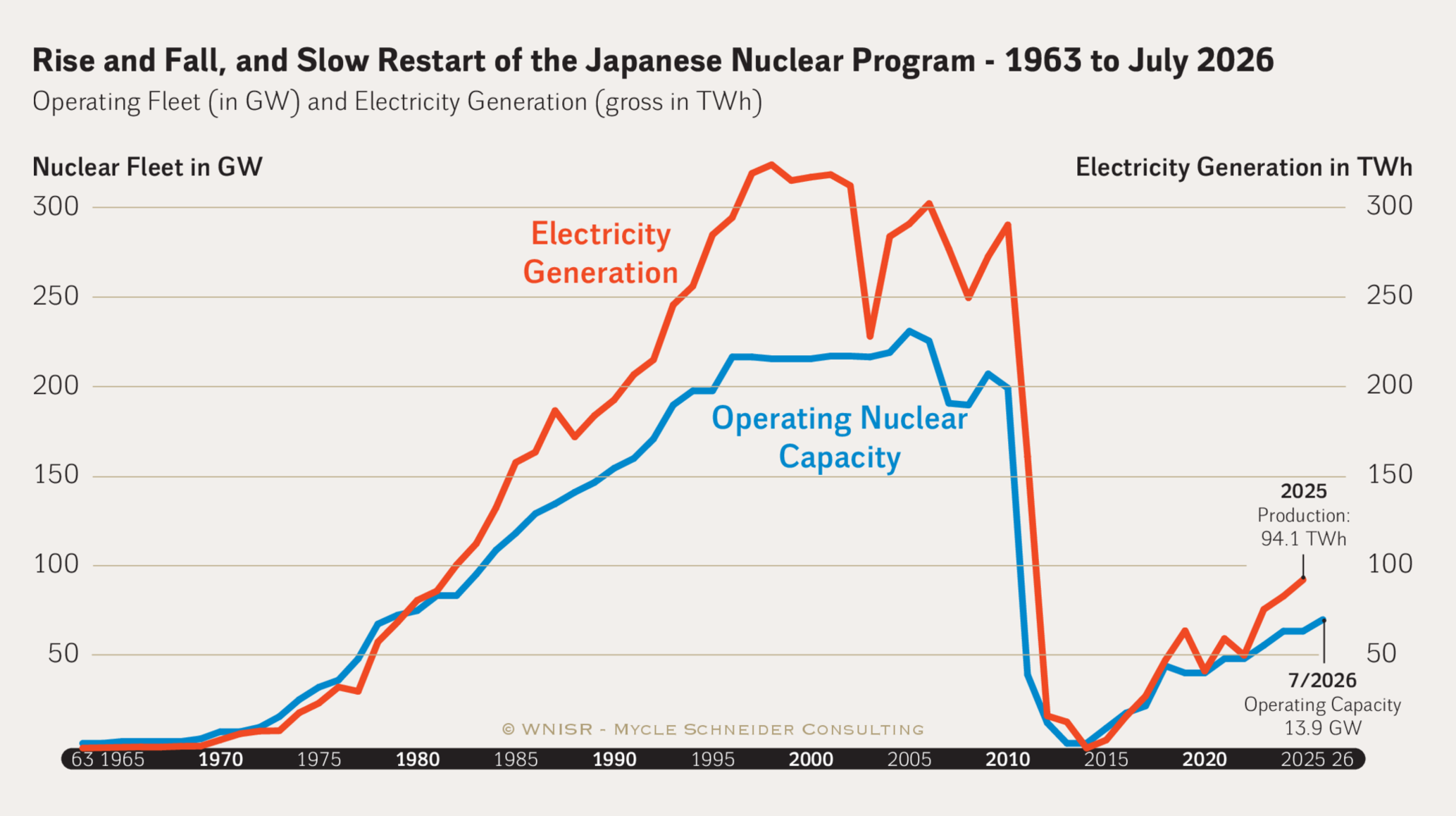
Sources: WNISR with Energy Institute and IAEA-PRIS, 2026
The current reactor fleet consists of 33 units (33.1 GW gross). Operating license applications have been submitted for 25 of these units (24.8 GW gross) under the new post-Fukushima regulations.266 Japan’s nuclear safety review process consists of three steps carried out simultaneously:267
1) Review of “changes in reactor installation” ➜ Permission
The new regulatory standards, which incorporate lessons learned from the Fukushima accidents, include stronger licensing criteria for seismic events, tsunamis, and other hazards. These new standards are applied retroactively by backfitting existing reactors. Moreover, in cases where an accident or natural disaster exceeds the assumptions outlined in the revised criteria, countermeasures are required to prevent core damage, prevent containment vessel failure, and suppress radioactive releases.
The review for changes to the installation permit evaluates the reactor facility’s location, structure, and equipment as well as the operator’s technical capabilities for compliance with these standards.
2) Review of “plan for construction works” ➜ Approval
This review verifies whether the detailed design of the nuclear reactor facility, as well as the methods of design and quality control during construction, are consistent with the installation permit and meet regulatory standards.
3) Review of “operational safety program” ➜ Approval
This review assesses whether the safety measures stipulated in the reactor’s safety regulations are adequate for preventing disasters involving nuclear fuel materials, objects contaminated by nuclear fuel materials, and power reactors.
Generally speaking, passing the review of “changes in reactor installation” is regarded as passing the Nuclear Regulation Authority (NRA) review in Japan. However, the other two reviews must also be passed before the reactor can be put into operation.
So far, 18 units have passed the “changes in reactor installation” and the “plan for construction works” reviews while seven applications remain under review.268 In July 2025, the NRA issued an approval for the restart of Tomari-3 of the Hokkai Electric Power Company which now expects to resume operation in 2027.269
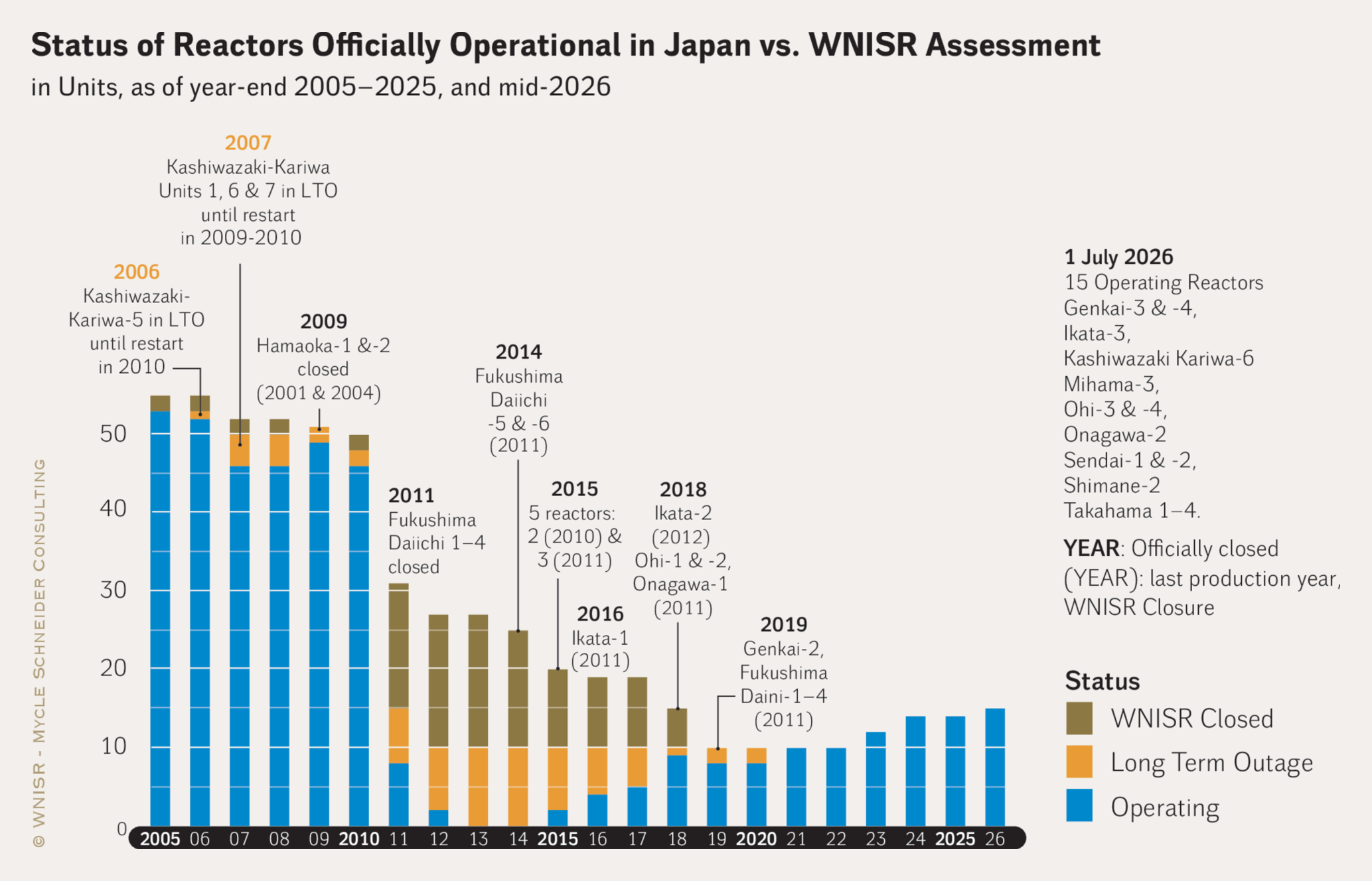
Sources: Various, compiled by WNISR, 2026
As of 1 July 2026, 11 of the operable 15 reactors were operating, while four were under periodic inspection or manually stopped.270
WNISR considers 18 units in Long-Term Outage (LTO). In 2022, the IAEA adopted a new category called “Suspended Operation”. In 2024, the Agency classified 19 reactors in Suspended Operation that WNISR then already considered in LTO. In other words, Japan and the IAEA have adopted an approach very similar to the LTO concept that WNISR introduced in 2014. (See Figure 35).
As of mid-2026, the Japanese nuclear fleet consisting of 33 units, including 18 in LTO, had reached a mean age of 35.5 years, with 25 units aged over 31 years, of which nine are over 41 years and two (Takahama-1 and -2) over 51 years old (see Figure 36).
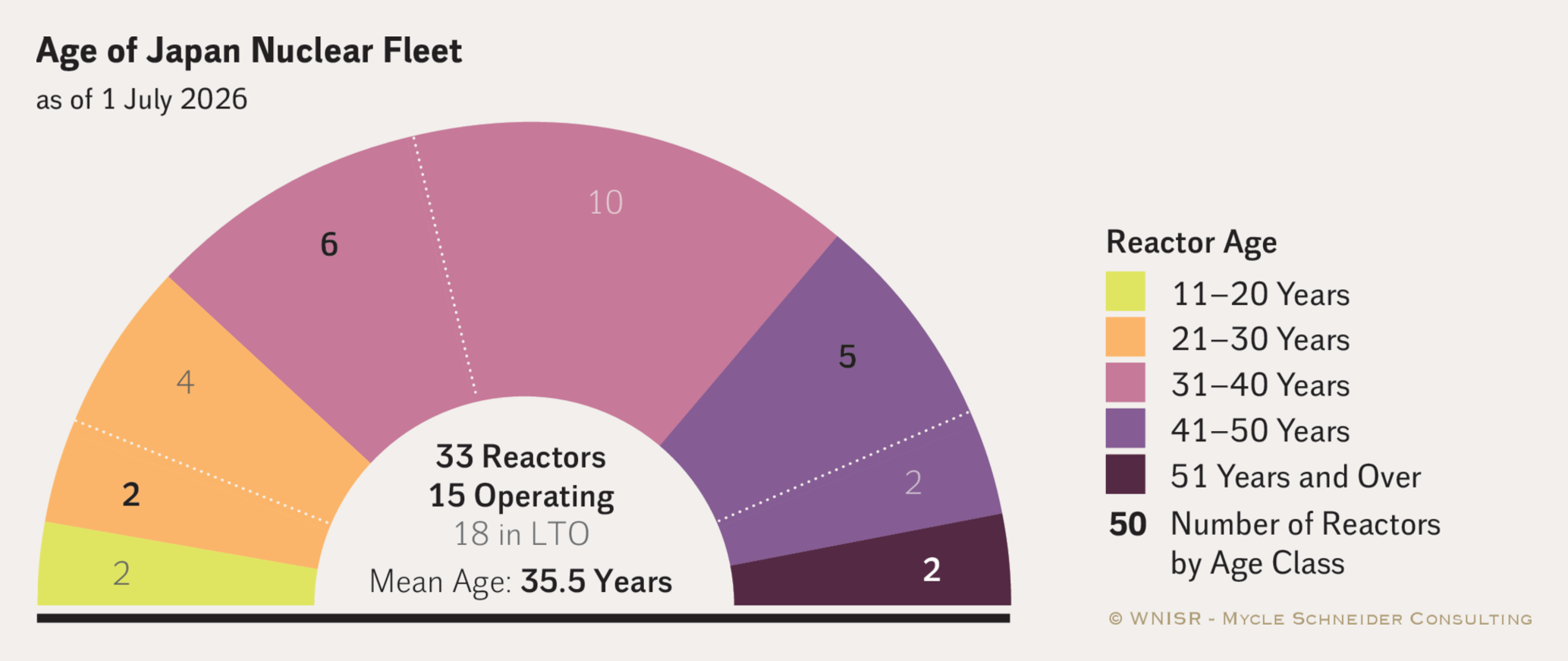
Sources: WNISR with IAEA-PRIS, 2026
Regulatory Measures—TEPCO Resumed Operation
The following overview summarizes events between mid-2025 and mid-2026.
Kashiwazaki Kariwa-6
On 21 January 2026, the NRA granted TEPCO permission for the “test use” of Unit 6 of the Kashiwazaki-Kariwa Nuclear Power Plant in Niigata Prefecture.271 This marked the first criticality of Unit 6 in 14 years since March 2012. It also represented the first time that a nuclear reactor owned by TEPCO underwent recommissioning operations following the Fukushima Daiichi nuclear accidents in 2011.
However, it took additional time before electricity production could start and commercial operation resumed. After reaching criticality on 21 January 2026, an alarm was triggered during the process of withdrawing control rods used to regulate the nuclear fission reaction, which prompted TEPCO to shut down the reactor temporarily on 22 January.272 After correcting the alarm settings, reactor restart operations resumed on 9 February273 and grid connection followed on 16 February.274 Subsequently, on 12 March, another alarm indicating electrical leakage from the generator was activated. Citing the need for a detailed investigation, TEPCO suspended power transmission on 13 March while keeping the reactor at 20 percent capacity.275 An internal investigation revealed damage to a component of the leakage detection device. The cause was identified as the accumulation of metal fatigue resulting from generator vibrations. TEPCO replaced the damaged component on 21 March and resumed grid connection on 22 March.276 The reactor reached 100 percent output on 27 March,277 and commercial operation resumed on 16 April.278
Kashiwazaki Kariwa-6 passed the NRA review of “changes in reactor installation” in 2017. However, a series of deficiencies in counterterrorism measures were identified at the Kashiwazaki-Kariwa site, leading the NRA to prohibit TEPCO from transferring nuclear fuel in 2021.279 This prohibition was lifted in 2023, after which TEPCO continued consultations with the governor of Niigata Prefecture to obtain approval for the reactor’s restart. On 21 November 2025, Niigata Governor Hideyo Hanazumi announced his intention to accept the restart of Kashiwazaki Kariwa-6 and -7.280 On 22 December 2025, the Niigata Prefectural Assembly endorsed the governor’s decision, thereby securing the required “local consent” for restarting the reactor.281
However, for Unit 7, construction of the Specified Severe Accident Management Facility, a counterterrorism measure, has been significantly delayed due to rising material costs and labor shortages. Although its completion was initially scheduled for March 2025, on 27 February 2025, TEPCO notified the NRA that the completion date for the facility at Unit 7 would be postponed to August 2029.282 Under the current regulatory framework, reactors cannot be operated if such facilities are not completed by the stipulated deadline; therefore, the commencement of operation of Unit 7 will be deferred until August 2029 or later.
The fact that TEPCO—the operator legally responsible for the compensation resulting from the Fukushima Daiichi nuclear disaster—has restarted a nuclear reactor reflects a symbolic shift in Japan’s energy policy. In February 2025, the Japanese Government approved its Seventh Strategic Energy Plan, which is updated approximately every three years and serves as the country’s principal guideline for energy policy. In this revision, the government changed its characterization of nuclear energy from a source on which dependence should be “reduced as much as possible” to one that should be “utilized to the maximum extent.”283 With the restart of Unit 6 at the Kashiwazaki-Kariwa site, a total of 15 reactors have now resumed operation since the Fukushima Daiichi events.
Chubu Electric Falsified Seismic Assumption Data for Hamaoka
In January 2026, during the NRA’s safety review for the restart of Units 3 and 4 of the Hamaoka Nuclear Power Plant (Shizuoka Prefecture), operator Chubu Electric Power Company (Chubu Electric hereafter) was revealed to have falsified data concerning seismic assumptions that serve as the basis for the reactor’s seismic design. This nuclear plant is located in the presumed epicenter area of the expected Tōkai Earthquake, which is one of the large-scale earthquakes anticipated along the Nankai Trough. It is expected to be a magnitude 8-class earthquake with a presumed source region extending from Suruga Bay to the inland areas of Shizuoka Prefecture.284
The Hamaoka Nuclear Power Plant comprises five reactor units. Chubu Electric decided in 2008 to decommission Units 1 and 2 that had ceased production in 2001 and 2004, respectively, and has since been seeking the restart of Units 3–5. Among these, the company prioritized Units 3 and 4, submitting safety review applications to the NRA in 2014 for Unit 4285 and in 2015 for Unit 3.286 Since then, regulatory reviews have been conducted, focusing primarily on seismic and tsunami hazard assumptions.
The seismic review process was based on seismic ground motion data submitted by Chubu Electric. The design basis seismic ground motion refers to the maximum level of ground motion anticipated for use as the basis of seismic design in critical facilities such as nuclear power plants. It is defined, based on active faults near the site and historical earthquake data, as the largest ground motion that can be scientifically envisaged, including earthquakes arising from unidentified faults. The company proposed a maximum of 1,200 gal287 for the area containing Units 3 and 4.288 In a review meeting held in September 2023, the NRA largely accepted these proposed design basis seismic ground motion values.
However, in February 2025, the NRA received an external whistleblower report alleging that Chubu Electric had intentionally manipulated data and provided inconsistent explanations during the review meetings. Between May and October 2025, the NRA requested additional information and evidence materials from Chubu Electric regarding matters related to the design basis seismic ground motion. As a result of this process, the data falsification was uncovered.
The NRA held a regular meeting on 7 January 2026, during which it discussed Chubu Electric’s falsification of seismic data. It was confirmed that information regarding the possibility of data fabrication had been provided by external whistleblower as early as February 2025, and that from May 2025, the NRA Secretariat had conducted multiple meetings with the company. Furthermore, it was confirmed that Chubu Electric had carried out an internal investigation into misconduct following NRA’s investigations.289 At its subsequent regular meeting on 14 January 2026, the NRA decided to suspend the review process for Units 3 and 4 of the Hamaoka plant.290
According to Chubu’s internal investigation report, Chubu Electric intentionally selected seismic ground motion data so that the magnitude of ground shaking would fall within a limited range, thereby leading to an underestimation of the design basis seismic ground motion. Of the instances of data irregularities, 225 cases of “earthquakes for evaluation” (representative waves), which are closely related to seismic assumptions, were selected, and irregularities were identified in 80 of these cases. Furthermore, it was disclosed that since 2018, concerns regarding such intentional data manipulation had been repeatedly raised within the relevant department of Chubu Electric; however, no corrective measures were implemented.291
The NRA has expressed its intention to consider amending the law to make falsification of reactor safety inspection applications subject to criminal penalties.292
KEPCO Resumes Preparatory Surveys for New Reactor Construction
On 22 July 2025, Kansai Electric Power Company (KEPCO) announced that starting in November 2025 it will resume onsite geological and related surveys within the premises of the Mihama Nuclear Power Plant in Fukui Prefecture, as preparatory work toward the construction of a new nuclear reactor. This is the first time since the 2011 Fukushima Daiichi nuclear accidents that plans for new nuclear reactor construction in Japan have begun to take shape. KEPCO is considering the deployment of an unspecified advanced light‑water reactor design.293
This is the first time since the 2011 Fukushima Daiichi nuclear accidents that plans for new nuclear reactor construction in Japan have begun to take shape.
At the Mihama plant, Units 1 and 2 were officially slated for decommissioning in 2015. Unit 3, the only one currently operational, in February 2026, reached 50 years of operation since grid connection.294 KEPCO initially launched site surveys in 2010 aimed at installing a successor to Unit 1 within the perimeter of the Mihama site; however, these activities were suspended in the aftermath of the Fukushima Daiichi accidents.295
A shift in Japanese Government policy has now revived momentum for such projects. In February 2025, the cabinet approved the Seventh Strategic Energy Plan, which reversed the previous stance by permitting the replacement of existing reactors. The revised policy allows not only the replacement of reactors at the same sites as decommissioned units, but also the construction of replacement reactors at other nuclear power plant sites owned by the same electric utility.296 In response to this policy change, KEPCO plans to proceed with additional investigations, including borehole surveys designed to comply with the NRA’s current regulatory standards, alongside the data collected in its earlier surveys.297
In the past, in Japan, the lead time for a nuclear power reactor—from geological investigations through construction to electricity generation—has been approximately 20 years. However, KEPCO President Nozomu Mori stated that the decision will be made after comprehensively considering not only the survey results—the preliminary survey were scheduled to be carried out between November 2025 and March 2027 with in-depth surveys to follow 2029~2030298—but also the status of technological development for innovative light-water reactors, regulatory policies, and the project’s viability, including whether the massive, multi-billion-dollar investment can be recouped.299
Tsuruga-2 Undergoing New Geological Survey
On 21 August 2025, Japan Atomic Power Company (JAPC) announced that it would conduct a geological survey over a two-year period in preparation for submitting a renewed application to the NRA for the restart of Unit 2 of the Tsuruga Nuclear Power Plant (Fukui Prefecture).300 In November 2024, Tsuruga-2 became the first reactor to be deemed noncompliant in a restart review conducted under the new regulatory standards established in 2012, when the NRA concluded its examination and denied approval. In that review, the NRA determined that it could not rule out the possibility that the so-called “K Fault,” located approximately 300 meters north of Unit 2, constitutes an active fault and that the reactor building of Unit 2 would be impacted if K Fault is active.301
Takahama-2 Obtains Lifetime Extension Approval Beyond 50 Years
On 4 November 2025, KEPCO announced that it had obtained NRA approval to continue operating Takahama-2 (Fukui Prefecture) for more than 50 years after the start of commercial operation.302 Under the amended Act on the Regulation of Nuclear Source Material, Nuclear Fuel Material and Reactors, which entered into force in June 2025, nuclear power plants that have been in operation for more than 30 years are required to obtain regulatory approval every 10 years in order to continue operation. This amendment is based on a new policy to extend the lifetime (license) of nuclear reactors to up to 60 years.303 Previously, the license expired at 40 years in principle with the possibility of an extension to 60 years in exceptional cases. With this approval, Takahama-2 will be permitted to operate until November 2035, marking 60 years since entering commercial operation. KEPCO stated that it “will continue to incorporate the latest domestic and international knowledge into plant design and equipment maintenance and will strive to further enhance the safety and reliability of [its] nuclear power plants.” 304
This approval marks the second instance in Japan in which a reactor has been authorized to operate for more than 50 years under the amended legislation, following the approval granted to Takahama-1.305
Tomari-3 Receives Governor’s Restart Approval
On 10 December 2025, Naomichi Suzuki, governor of Hokkaido, announced at a session of the Hokkaido Prefectural Assembly his consent for restarting Unit 3 of the Tomari Nuclear Power Plant operated by Hokkaido Electric Power Company.306 The NRA had officially granted permission to Tomari-3 for “changes to the reactor installation” in July 2025.307 The governor’s consent completed all the necessary approvals from the prefectural government and the host municipalities that are prerequisites for restarting reactors.
Hokkaido Electric Power Company had submitted its application for regulatory review of Tomari-3 to the NRA on 8 July 2013, the day when the new regulatory standards came into force. However, the review process was prolonged due to differences between the utility and the NRA over whether fault structures located within the site should be classified as active faults capable of triggering earthquakes. In addition, the NRA instructed the company to reassess its tsunami evaluations by assuming that offshore submarine faults near the Tomari plant were active faults, which led to a revision of the design-basis tsunami and further prolonged the lengthy review process.308 Ultimately, after a review spanning 12 years, permission for changes in reactor installation (restart) was finally granted.
Hokkaido Electric Power Company is proceeding with safety enhancement measures, including the construction of seawalls, and has stated its intention to restart Tomari-3 as early as possible in 2027.309
Ohma and Shimane-3—No Active Construction
There are no changes for Ohma Nuclear Power Plant and Shimane Nuclear Power Plant Unit 3 since the publication of WNISR2025.
J-Power, the Ohma project developer in Aomori Prefecture, postponed the start of safety work, which was scheduled to begin in the second half of 2024. According to the company, the overall progress rate for the nuclear plant’s construction is 37.6 percent, and this figure has not changed since 20 March 2011.310
At the Shimane plant, there is no active construction work, but Chugoku Electric Power Company still plans to make Shimane-3 operational by the end of FY2030. The unit is currently undergoing a safety review. Regarding future construction restart plans, the company stated, “Since safety measures are being implemented based on new regulatory standards, the future construction process has not yet been finalized, so we will inform you of the progress rate after the construction schedule is finalized.” 311
Thus, both projects remain in WNISR’s suspended/abandoned construction category.
NRA Mandates Installation of Drone Detection Equipment After Genkai Incident
At a regular press conference held on 18 March 2026, Shinsuke Yamanaka, chair of the NRA, announced a policy to mandate the installation of detection equipment for unmanned aerial vehicles (UAVs) including drones within the premises of nuclear power plants and related facilities. Taking into account recent technological advances and the widespread use of drones, the measure aims to further enhance the effectiveness of protection of nuclear facilities and materials.312 The requirement will apply to a total of 22 nuclear facilities, including all nuclear power plants as well as the nuclear fuel reprocessing facility in Rokkasho-mura, Aomori Prefecture.313 On 24 June 2026, the NRA officially mandated the installation of devices to detect UAVs at nuclear power plants and other nuclear facilities.314 This marks the first time in Japan that nuclear regulations specifically addressing drones are promulgated.
One of the triggers for this policy decision was an incident that occurred on 26 July 2025 at the Genkai Nuclear Power Plant operated by Kyushu Electric Power Company. At around 9:00 p.m., while Units 3 and 4 were in operation at Genkai, the NRA received a report of an event which it later qualified as the sighting of “three lights believed to be drones” in the airspace above the plant. The NRA classified the situation as an “information-gathering event” under the Initial Response Manual for Nuclear Disaster Countermeasures and issued an emergency information notice accordingly.315 Subsequently, the Saga prefectural police, which conducted the investigation, explained at a session of the Saga Prefectural Assembly in September 2025 that there was a high likelihood that plant security personnel had mistaken aircraft lights for drones.316 However, the true nature of the incident remains unclear.
Incidents in which UAVs, including drones, were believed to have entered the airspace over nuclear facilities have been reported in various countries since the 2010s. As drones have become more sophisticated, more powerful, and more effective, the nature of the threat has grown increasingly complex to define year after year, exemplified by scenarios in which multiple large UAVs appear simultaneously or conduct so-called “swarm flights” in coordinated formations.
In Japan, in response to the incident at the Genkai plant, the National Police Agency strengthened countermeasures in December 2025 by, among other actions, requesting that security personnel at nuclear power plants participate in training programs conducted by the police on methods for distinguishing drones from aircraft.317 NRA Chair Yamanaka emphasized that “drones are readily accessible to anyone and from a technological standpoint, they have advanced tremendously over the past 10 years,” underscoring the need to respond to this evolving situation. He further stated that “detection and response must be advanced in an integrated manner,” indicating an intention to deepen cooperation with the police. As the selection of appropriate detection equipment, its installation at nuclear facilities, and the associated NRA review procedures are expected to require a considerable amount of time, a grace period of approximately two years is given for the mandatory installation of such equipment.318
Deadline Extension for the Installation of Counterterrorism Facilities
On 1 April 2026, the NRA convened its regular meeting and decided to extend the deadline for the installation of so‑called “Specified Severe Accident Response Facilities”, which are designed to prepare nuclear power plants for potential terrorist attacks. Under the existing regulations, utilities are granted a five‑year grace period for installation, calculated from the date of approval of the facility’s design and construction plan for a given reactor. The NRA resolved to revise this rule by shifting the starting point of the five‑year period to the commencement of commercial operation after restart, thereby effectively extending the installation deadline.319
As a result of this extension, several reactors—including Tohoku Electric Power Company’s Onagawa-2 in Miyagi Prefecture—may avoid being forced to suspend operations. The NRA plans to amend the relevant regulations with the aim of bringing them into force before the end of the year 2026. The NRA held a regular meeting on 3 June 2026 and approved a proposed change to the deadline for conformity. Public comments were solicited until 3 July 2026,320 and, based on the results, the measure is scheduled to take effect during summer 2026.
The searched-for extension applies to nuclear power plants whose installation deadlines have not yet expired under the current regulations. For example, the current completion deadline for the specified safety facility (tokutei jiko taiō shisetsu) for Onagawa-2 is December 2026. However, Tohoku Electric Power has announced that it will be unable to complete the facility by this deadline and has set a new target completion date of August 2028. Under the existing rules, reactor operations were scheduled to be suspended until August 2028. Following the regulatory revision, the suspension could be avoided if the facility was completed by the new deadline of December 2029.321 Under the revised rule, the installation deadline would be set at five years from commercial operation following restart. Consequently, because Onagawa-2 began commercial operation in December 2024322 after restarting from LTO, it would be able to avoid reactor shutdown as long as the facility is completed by December 2029.
Similarly, for TEPCO’s Kashiwazaki Kariwa-6 in Niigata Prefecture, which resumed commercial operation on 16 April 2026323, the installation deadline will be extended from the previous date of September 2029 to April 2031. TEPCO had previously stated that it plans to complete the specified facility in September 2031, so the new policy will shorten the expected reactor shutdown period from approximately two years to five months.324 While this revision effectively constitutes a relaxation of regulatory requirements for electric utilities, NRA Chair Shinsuke Yamanaka stated that the decision was made “from the standpoint of enhancing the effectiveness of the regulations, based on an analysis of ten years of regulatory implementation, which showed that 11 of 12 reactors failed to meet the original installation deadlines.” He further emphasized that utilities would still be required to maintain the highest standards of safety and to ensure robust counterterrorism measures until the completion of the facilities, stressing that there would be no reduction in the level or quality of safety measures during the interim period.325
Legal Cases Against Reactor Restarts and Operation
Various legal cases against the operation of existing reactors continue. The following are four key decisions from the past year, all of which rejected the plaintiffs’ requests for injunctions.
Lawsuit Against KEPCO’s Nuclear Plants in Fukui Prefecture Rejected
On 25 December 2025, the Ōtsu District Court delivered its judgment in a lawsuit filed by residents of Shiga, Osaka, and other prefectures seeking an injunction against the operation of seven nuclear power reactors owned by KEPCO and located in Fukui Prefecture. The court rejected the request for an injunction and dismissed the plaintiffs’ claims.326
The plaintiffs, residents of Shiga, Kyoto, and Osaka Prefectures (adjacent to Fukui Prefecture), filed the lawsuit on 24 December 2013. Initially, they sought to halt the operation of 11 reactors. Subsequently, however, KEPCO decided to decommission Ohi-1 & -2 and Mihama-1 & -2. As a result, the scope of the injunction request was narrowed down to a total of seven reactors: Ohi-3 & -4, Takahama-1–4, and Mihama-3. Over a 12‑year period, the court held 43 sessions of oral arguments. The plaintiffs argued that Japan’s new regulatory standards, established by the national government to confirm whether nuclear power plants meet the minimum safety requirements for operation, contain fundamental flaws. They asserted in particular that the “design-basis ground motion,” which represents the maximum seismic shaking assumed in earthquake-resistant design, is underestimated and that the characteristics of unstable ground conditions are not adequately taken into account.327
In its judgment, the Ōtsu District Court stated that the new regulatory standards are reasonable and that there is no irrationality in the determination by the NRA that the reactors in question conform to those standards. The court further concluded that “the specific dangers alleged by the plaintiffs cannot be recognized on the basis of the evidence presented.”328
In response to the ruling, the plaintiffs’ legal team reportedly issued a statement describing the judgment as “an unacceptable decision tantamount to an abdication of the judiciary’s responsibility, as it fails to reflect the lessons of TEPCO’s 2011 Fukushima Daiichi nuclear accident.”329 On 8 January 2026, the plaintiffs appealed the verdict to the Osaka High Court.330
Genkai Nuclear Power Plant: Second-Instance Court Also Rejects Injunction
On 20 January 2026, the Fukuoka High Court rendered its appellate judgment in a lawsuit filed by approximately 300 citizens living near Units 3 and 4 of Genkai nuclear plant (Saga Prefecture) against the national government and the operator, Kyushu Electric Power Co. The plaintiffs sought an injunction against the operation of the reactors and the revocation of the NRA’s permission of “changes in reactor installation.” As in the judgment of the Saga District Court at first instance, the High Court dismissed all claims.331
The principal issue in the case concerned the method used to calculate the “design basis earthquake ground motion,” which represents the level of seismic shaking assumed in the plant’s seismic design. The residents argued that the assumed earthquake magnitude had been underestimated and that an appropriate assessment should have been conducted using alternative calculation formulas. The Fukuoka High Court noted that altering the calculation method “could result in a transformation of the standard methodological framework.” The court upheld that Kyushu Electric Power Co.’s approach to determining the design basis earthquake ground motion “cannot be regarded as unreasonable” and concluded that the ground motion had not been underestimated. The court further found that the NRA’s review and determination concerning the design basis earthquake ground motion could not be deemed to contain serious errors or omissions, thereby rejecting the plaintiffs’ arguments in this regard.332
Injunction Against Ikata Nuclear Plant Denied: Court Finds No “Concrete Risk”333
On 26 February 2026, the Iwakuni Branch of the Yamaguchi District Court rendered its judgment in a group lawsuit filed by 162 residents, including residents of Yamaguchi Prefecture located across the Seto Inland Sea, seeking an injunction against the operation of Unit 3 of Shikoku Electric Power Company’s Ikata nuclear plant (Ehime Prefecture) on the grounds of alleged safety concerns. The court dismissed the residents’ claims, holding that “it cannot be recognized that there exists a concrete risk to the plaintiffs’ lives or physical safety.” 334
The principal issues in the litigation concerned assumptions regarding seismic risk and the evaluation of volcanic eruption risk associated with Mount Aso (Kumamoto Prefecture), located approximately 130 kilometers from the nuclear power plant. With respect to the residents’ assertion that the fault zone running near the plant site may constitute an active fault, the Yamaguchi District Court pointed to the results of marine acoustic surveys conducted by Shikoku Electric Power Co., stating that the assessment concluding that no active fault exists in the vicinity of the site “cannot be regarded as unreasonable.” Regarding the residents’ argument that the scale of a potential large-scale eruption of Mount Aso had been underestimated, the court found that the magma beneath Mount Aso was not of a size indicative of an imminent large-scale eruption. The court therefore concluded that “a massive eruption is not in an impending state.” 335
Group lawsuits concerning Ikata-3 have been filed not only by residents of Ehime Prefecture, where the plant is located, but also by residents of neighboring prefectures. The Oita District Court dismissed similar claims in March 2024, followed by dismissals by the Hiroshima District Court and the Matsuyama District Court in March 2025. See past WNISR editions.
Dissatisfied with the judgment of the Yamaguchi District Court, the plaintiffs have filed an appeal.336
Utility Shareholders Seeking Injunction Against Operation of Shika-1 and -2
In a lawsuit filed pursuant to the Companies Act by six shareholders of Hokuriku Electric Power Company seeking an injunction against the operation of Units 1 and 2 of the Shika Nuclear Power Plant (Ishikawa Prefecture) and naming two representative directors, including the company’s president, as defendants, the Toyama District Court dismissed the plaintiffs’ claims on 4 March 2026.337
In the proceedings, the plaintiffs argued that investigations and evaluations of geological fault lines in the vicinity of the plant were insufficient. They further contended that, despite damage to plant equipment caused by the Noto Peninsula earthquake in January 2024, Hokuriku Electric Power Co. continued to pursue the restart of the reactors, which constituted a breach of the director’s duty of care. According to the plaintiffs, management decisions premised on reactor restarts violated the duty of care under the Companies Act and posed a risk of irreparable harm to the company. However, the Toyama District Court stated that “where safety has been examined by experts and a decision regarding the appropriateness of a restart is made in reliance on the results of such expert assessments, it cannot be said, absent special circumstances, that a violation has occurred.” The court concluded that the management’s decision to pursue reactor restarts could not be characterized as “markedly unreasonable.” 338 Dissatisfied with the ruling, the plaintiffs have filed an appeal.339
Shika-1 commenced commercial operation in 1993 and Shika-2 in 2006, but both units have remained shut down since March 2011. In 2014, Hokuriku Electric Power applied to the NRA for permission to restart Unit 2, and the regulatory review process remains ongoing.340 Shika-1 marked its 30th anniversary since operations began in July 2023. For nuclear plants older than 30 years, a long-term facility management plan must be formulated for each additional, maximum 10 years operational period, and approval from the regulatory authority. Therefore, Hokuriku Electric Power prioritizes restarting Unit 2.341 Separately, another lawsuit seeking an injunction against the operation of the Shika reactors is currently pending before the Kanazawa District Court.342
Spent Fuel Management: Aomori Prefecture Refuses Spent Fuel Shipments to Mutsu Interim Storage Facility
On 31 March 2026, Governor Sōichirō Miyashita announced that Aomori Prefecture would not approve receiving spent nuclear fuel shipments at the interim storage facility in Mutsu City during FY2026. He cited the absence of a clear outlook for the operation of the reprocessing plant in Rokkasho-mura, also located in Aomori Prefecture, stating that “It is inconceivable to accept the delivery of spent nuclear fuel without a designated [final] destination.” 343
Under the current framework, spent fuel is to be stored at the interim storage facility for up to 50 years before being transported to the Rokkasho reprocessing plant owned by Japan Nuclear Fuel Limited (JNFL). However, the operation of the reprocessing plant has been postponed many times, and there is no clear prospect for its commissioning. Governor Miyashita’s decision was made in light of this ongoing uncertainty.
The interim storage facility is operated by Recyclable-Fuel Storage Company (RFS), a joint venture funded by TEPCO and JAPC. The facility temporarily stores spent fuel from the two utilities’ activities until it is reprocessed. It was commissioned in November 2024, and as of April 2026, a total of 36 tons of spent nuclear fuel had been delivered to the site.344 For FY2026, RFS had scheduled the delivery of 60 tons of spent fuel from TEPCO’s Kashiwazaki Kariwa plant, but this plan may no longer be feasible.
Construction of the Rokkasho reprocessing plant began in 1993, and its completion has been postponed 27 times to date. Although JNFL now aims to complete the facility within FY2026345 and begin reprocessing in the second half of FY2027.346
High-Level Radioactive Waste Disposal Plans
Regarding the selection of the final disposal site for spent nuclear fuel, Ogasawara Village, Tokyo Metropolis, stated on 13 April 2026 that it would let the national government decide whether to implement a “literature survey” that would be the first stage of the survey on Minamitorishima, a remote island of the village.347 The island is located approximately 2,000 kilometers southeast of central Tokyo and is Japan’s easternmost territory. With an area of only about 1.5 square kilometers, the island is very small; and while personnel from the Japan Maritime Self-Defense Force and the Japan Meteorological Agency are stationed there, it has no permanent civilian residents.
The government first approached Ogasawara Village on 3 March 2026, requesting consent to conduct a literature survey.348 Ryosei Akazawa, Minister of Economy, Trade and Industry (METI), explained that Minamitorishima Island was selected because the government’s “Scientific Characteristics Map”, released in 2017 to classify potential candidate sites, categorizes it as an area “with a relatively high likelihood of possessing favorable geological characteristics.” He also cited the fact that the entire island is state-owned land and that the administration has implemented national policies for many years.349 In other words, the government is considered to have taken into account the absence of active faults capable of generating large earthquakes as well as the island’s status as national property, which reduces the likelihood of opposition from local residents.
In Japan, the Act on Final Disposal of Specified Radioactive Waste, enacted in 2000 and unamended since, stipulates that disposal facilities must be constructed more than 300 meters underground and that radioactive waste must be isolated from the human living environment for tens of thousands of years until its radioactivity sufficiently diminishes.350
The same law also stipulates the procedures for selecting a final disposal site. Investigations for site selection are conducted in three stages over a period of approximately 20 years. First, a “literature survey,” which examines volcanic activity, fault movements, and other factors based on academic papers and existing materials, is carried out over a period of about two years. This is followed by a “preliminary investigation,” lasting roughly four years, during which geological conditions and groundwater characteristics are examined through methods such as borehole drilling. Finally, a “detailed investigation,” conducted over approximately 14 years, involves constructing underground research facilities to determine whether the properties of the bedrock and groundwater are suitable for a disposal site.351
A literature survey is initiated either when a municipality responds to a public call for applications or when it accepts a proposal from the national government. From the preliminary investigation stage onward, consent is required not only from the head of the municipality concerned, but also from the prefectural governor.
With regard to the selection of a final disposal site, the scope of literature surveys—the first stage of investigation—has thus far been limited to three municipalities in the Hokkaido and Saga Prefectures. In Hokkaido, literature surveys conducted in the town of Suttsu and the village of Kamoenai resulted in the publication of draft reports in 2024, and both municipalities were identified as candidate sites for progression to the preliminary investigation stage.352 However, the governor of Hokkaido has expressed opposition to proceeding with the preliminary investigation.353
Closed Power Reactors in Japan
No additional reactors operating or in outage at the time of the Fukushima events, were formally declared for decommissioning in the year to 1 July 2026. The 22 Japanese reactors now confirmed to be closed as a consequence of the accidents total 15.5 GW or just under 35 percent of nuclear capacity prior to 3/11 (see Figure 34 and Table 5). In total, Japan has 27 closed reactors with 27.1 GW (see Japan in Decommissioning Status Report).
|
Operator |
Reactor (Type) |
Capacity |
Startup |
Closure |
Official |
Last Production |
Age(c) |
|
TEPCO |
Fukushima Daiichi-1 (BWR) |
439 |
1970 |
- |
19/04/12 |
2011 |
40 |
|
Fukushima Daiichi-2 (BWR) |
760 |
1973 |
- |
19/04/12 |
2011 |
37 |
|
|
Fukushima Daiichi-3 (BWR) |
760 |
1974 |
- |
19/04/12 |
2011 |
36 |
|
|
Fukushima Daiichi-4 (BWR) |
760 |
1978 |
- |
19/04/12 |
2011 |
33 |
|
|
Fukushima Daiichi-5 (BWR) |
760 |
1977 |
19/12/13 |
31/01/14 |
2011 |
34 |
|
|
Fukushima Daiichi-6 (BWR) |
1 067 |
1979 |
19/12/13 |
31/01/14 |
2011 |
32 |
|
|
Fukushima Daini-1 (BWR) |
1 067 |
1981 |
31/07/19 |
30/09/19 |
2011 |
30 |
|
|
Fukushima Daini-2 (BWR) |
1 067 |
1983 |
31/07/19 |
30/09/19 |
2011 |
28 |
|
|
Fukushima Daini-3 (BWR) |
1 067 |
1984 |
31/07/19 |
30/09/19 |
2011 |
26 |
|
|
Fukushima Daini-4 (BWR) |
1 067 |
1986 |
31/07/19 |
30/09/19 |
2011 |
24 |
|
|
KEPCO |
Mihama-1 (PWR) |
320 |
1970 |
17/03/15 |
27/04/15 |
2010 |
40 |
|
Mihama-2 (PWR) |
470 |
1972 |
17/03/15 |
27/04/15 |
2011 |
40 |
|
|
Ohi-1 (PWR) |
1 120 |
1977 |
22/12/17 |
01/03/18 |
2011 |
34 |
|
|
Ohi-2 (PWR) |
1 120 |
1978 |
22/12/17 |
01/03/18 |
2011 |
33 |
|
|
KYUSHU |
Genkai-1 (PWR) |
529 |
1975 |
18/03/15 |
27/04/15 |
2011 |
37 |
|
Genkai-2 (PWR) |
529 |
1980 |
13/02/19 |
13/02/13 |
2011 |
31 |
|
|
SHIKOKU |
Ikata-1 (PWR) |
538 |
1977 |
25/03/16 |
10/05/16 |
2011 |
35 |
|
Ikata- 2 (PWR) |
538 |
1981 |
27/03/18(d) |
27/03/18 |
2012 |
30 |
|
|
JAEA |
Monju (FBR) |
246 |
1995 |
12/2016(e) |
05/12/17 |
LTO(f) since 1995 |
- |
|
JAPC |
Tsuruga -1 (BWR) |
340 |
1969 |
17/03/15 |
27/04/15 |
2011 |
41 |
|
CHUGOKU |
Shimane-1 (PWR) |
439 |
1974 |
18/03/15 |
30/04/15 |
2010 |
37 |
|
TOHOKU |
Onagawa-1 (BWR) |
498 |
1983 |
25/10/18 |
21/12/18(g) |
2011 |
27 |
|
TOTAL: 22 Reactors /15.5 GWe |
|||||||
Sources: JAIF and JANSI, compiled by WNISR, 2026
Notes: This table only lists the 22 reactors closed after the Fukushima accidents, thus not including the Fugen Advanced Thermal Reactor (ATR), Japan Power Demonstration Reactor (JPDR), as well as Hamaoka-1 & -2 and Tokai-1.
BWR: Boiling Water Reactor; PWR: Pressurized Water Reactor; FBR: Fast Breeder Reactor; LTO: Long-Term Outage.
JAPC: Japan Atomic Power Company; JAEA: Japan Atomic Energy Commission; KEPCO: Kansai Electric Power Company; TEPCO: Tokyo Electric Power Company.
(a) – Unless otherwise specified, all announcement dates from JANSI, “Licensing Status for the Japanese Nuclear Facilities”, Japan Nuclear Safety Institute, 26 February 2020, see https://www.genanshin.jp/english/facility/map/, accessed 27 July 2020.
(b) – Unless otherwise specified, all closure dates from individual reactor’s page via JAIF, “NPPs in Japan”, Japan Atomic Industrial Forum,
see http://www.jaif.or.jp/en/npps-in-japan/, as of 27 July 2020.
(c) – Note that WNISR considers the age from first grid connection to last production day.
(d) – WNN, “Shikoku Decides to Retire Ikata 2”, World Nuclear News, 27 April 2018, see http://www.world-nuclear-news.org/C-Shikoku-decides-to-retire-Ikata-2-2703184.html, accessed 22 July 2018.
(e) – The Mainichi, “Japan Decides to Scrap Trouble-Plagued Monju Prototype Reactor”, 21 December 2016, see http://mainichi.jp/english/articles/20161221/p2g/00m/0dm/050000c, accessed 21 December 2016.
(f) – The Monju reactor was officially in Long-Term Shutdown or LTS (IAEA-Category Long Term Shutdown) since December 1995. Officially closed in 2017.
(g) – The decision to close the reactor was announced in October 2018.
Prospects for Nuclear Power vs. Renewable Energy Deployment
The Seventh Strategic Energy Plan, approved by the Japanese cabinet in February 2025, fundamentally revised the government’s positioning on nuclear energy, shifting from the previous policy of “reducing dependence on nuclear power to the extent possible” to a policy of “maximizing its utilization.”354 Prime Minister Sanae Takaichi, who assumed office in October 2025, has carried forward the Energy Plan and has clearly articulated a policy of promoting the use of nuclear energy.
In her inaugural policy speech before the Diet shortly after taking office, the Prime Minister declared that “The stable and inexpensive supply of energy is absolutely crucial in maintaining the daily lives of the Japanese people and nurturing our domestic industries.”355 The declared goals underpinning this policy include reducing reliance on imported fossil fuels and making active use of domestically developed technologies in which she considers Japan holding a competitive advantage at the international level.
In her policy speech, Takaichi indicated her intention to promote the utilization of nuclear energy and the deployment of domestically produced perovskite solar cells.356 It implied that Japan aims to not excessively rely on rare earth minerals or components sourced from abroad, positioning the use of domestic technologies as a central pillar of energy policy. Even before taking office, she made clear that government support for large-scale solar power projects (mega-solar projects), which largely depend on solar panels manufactured in foreign countries, would be brought to an end.357 Reflecting this policy direction, the METI officially announced on 19 March 2026 that subsidies for the deployment of large-scale solar power generation would be terminated from FY2027 onward.358
There is a widely held view that Takaichi’s energy policy prioritizing domestically developed technologies will, in practice, confer greater benefits to the nuclear power sector than to renewable energy. In September 2025, during the leadership elections of the Liberal Democratic Party (LDP), Japan’s core ruling party which she now chairs, Takaichi stated that she was “strongly opposed to further covering Japan’s beautiful national land with foreign-made solar panels.”359 By contrast, in her October 2025 policy speech, she emphasized the goal of “early practical adoption in society of next-generation advanced reactors and fusion energy.”360 Taken together, these statements have led to the perception that the government will pursue an energy policy that reduces the relative emphasis on renewable energy while placing greater weight on nuclear power development.
Public opinion, however, does not necessarily align with Takaichi’s energy policy. While in recent years support for the restart of nuclear power plants has routinely exceeded opposition, responses of “undecided” consistently account for nearly 30 percent of the public. For example, in a public opinion survey conducted by The Mainichi Shimbun in December 2025, 48 percent of respondents indicated support for the restart of nuclear power plants, while 21 percent were opposed. At the same time, 30 percent responded that they were “undecided,” suggesting that public confidence in the use of nuclear energy has not fully recovered.361
Previous WNISR editions already examined the history of Poland’s nuclear ambitions. They covered various past implementation attempts—the construction of two reactors abandoned in the 1980s—and traced how new plans evolved. From the 2018 draft Energy Policy of Poland until 2040 to the latest Polish Nuclear Power Program, released for public consultation in 2025362 and approved in June 2026,363 the target of deploying 6–9 GW of nuclear capacity has remained the official policy of successive administrations in recent years.
Ongoing and tracked activities can be divided into three main areas. The first is a project involving the construction of three Westinghouse AP1000 reactors with a total capacity of up to 3.75 GW at the Lubiatowo-Kopalino site in Pomerania by a Westinghouse-Bechtel consortium. The second is the planned construction of another large-scale nuclear power plant with two or three reactors, a vague project for which neither the site nor the project partner has been selected yet. Earlier plans had envisaged KHNP-supplied APR-1400 reactors. The third area consists of various private-sector-driven initiatives based on Small Modular Reactors (SMRs), including a BWRX-300 project by ORLEN Synthos Green Energy (OSGE) with GE Hitachi, as well as projects proposed by NuScale and Last Energy.
The Pomeranian Project (Lubiatowo-Kopalino)
On 2 November 2022, Poland’s Council of Ministers adopted a resolution selecting Westinghouse as the technology supplier for the country’s first planned nuclear power plant, a three-unit AP1000 project at the Lubiatowo-Kopalino site in Pomerania. At the time, the project cost was estimated at around US$20 billion with construction beginning in 2026 and the first unit being commissioned in 2033. The decision followed a selection process in which proposals from France’s EDF and South Korea’s KHNP were also considered.364
Westinghouse and the Polish state-owned project company, Polskie Elektrownie Jądrowe (PEJ),365 signed a cooperation agreement in December 2022.366 In February 2023, the companies signed a contract covering front-end engineering, early procurement work, and program development.367 In July 2023, the Ministry of Climate and Environment granted a “decision-in-principle” on the project, allowing further administrative applications to proceed.368 In September 2023, PEJ and the newly formed consortium Westinghouse-Bechtel369 signed an 18-month Engineering Services Contract (ESC) that was to provide the design documentation for the first nuclear plant.370
After the ESC expired at the end of March 2025, PEJ and the Westinghouse-Bechtel consortium signed an Engineering Development Agreement (EDA) in late April 2025.371 An amendment to the EDA, signed on 29 December 2025, allowed engineering, design, and field work to continue while negotiations on the Engineering, Procurement and Construction (EPC) contract were in progress.372
In December 2024, a three-year delay was confirmed for Poland’s first nuclear power plant,373 revising the earlier schedule of construction start in 2026 and electricity generation in 2033.374 According to Polish Secretary of State for Strategic Energy Infrastructure, Wojciech Wrochna, the pouring of first concrete was rescheduled for 2028, with the first unit entering commercial operation in 2036, followed by the second and third units in 2037 and 2038, respectively.375 The same timeline is also set out in the updated Polish Nuclear Power Program, approved in June 2026.376
After the amended EDA was signed in December 2025, PEJ said that preparatory site work would begin in the first half of 2026 and that procurement would continue for the first long lead items, i.e., equipment components of the power plant with an extended production time.377
In August 2025, the first phase of in-depth geological surveying (22 kilometers of boreholes, more than 10,000 soil samples, and 7,000 tests) was completed at the site.378 The second phase of geotechnical investigations continues in 2026, with 1,000 boreholes that make up 15 kilometer in total, and another 7,000 laboratory tests planned.379 At the end of August 2025, PEJ obtained a permit for preparatory works at the site. The first stage of preparatory works, planned to begin later that autumn, included staking out the work area; erecting a fence; removing trees, shrubs, and tree stumps; stripping the topsoil, including litter and humus layers; and levelling the area.380, 381
On 31 March 2026, PEJ submitted a construction permit application to the National Atomic Energy Agency (Państwowa Agencja Atomistyki or PAA), including a comprehensive Location Report with detailed analyses and measurements. Under the Atomic Energy Law, the PAA president must issue a decision within 24 months of the application submission.382
In May 2026, the PAA president determined that the Lubiatowo-Kopalino site was suitable for three AP1000 units after examining the preliminary site report,383 a first step towards a construction permit.
On the financial side, in April 2024, PEJ’s then-authorized representative Jan Chadam said that the project’s final cost was not confirmed and gave an indicative figure of PLN150 billion (~US$202438 billion),384 but by the end of 2024 new estimates of “total investment costs” ranged around PLN192 billion (US$202448.2 billion),385 more than double the November 2022 estimates.386
In December 2024, the European Commission opened an in-depth investigation into Poland’s state aid package for its first nuclear power plant with an electricity generation capacity of up to 3750 MW. The original proposal included an equity injection of approximately €14 billion (US$202415.2 billion) covering 30 percent of project costs, state guarantees covering 100 percent of PEJ’s project debt, and a two-way CfD designed to provide revenue stability over the plant’s entire 60-year design lifetime.387 In March 2025, then-Polish President Andrzej Duda signed into law a bill allocating PLN60.2 billion (US$202516 billion) from the 2025–2030 state budget to cover 30 percent of the project’s estimated costs.388
On 8 December 2025, the European Commission formally approved Poland’s state aid package, subject to some conditions, including shortening the two-way CfD period from 60 to 40 years and revising the remuneration and profit-sharing arrangements.389 On 30 December 2025, PEJ confirmed receipt of treasury bonds worth a nominal value of PLN4.6 billion (US$20251.2 billion) issued by the Ministry of Finance and Economy.390 The bonds were allocated to project financing under the law signed in March 2025. A further PLN11 billion, equivalent to around US$20253 billion, in state financing is planned for 2026, and a total of PLN44.6 billion (~US$202512 billion) between 2027 and 2030.391
Further financial aid would be provided by the US International Development Finance Corporation (DFC), which signed a letter of intent in November 2024 to provide PLN4 billion (US$20241 billion) for the plant.392 In December 2025, PEJ announced the completion of strategic consultations with “more than thirty of the largest financial institutions from Europe, including Poland, Asia, and North America.”393 It received 26 preliminary offers, complementing earlier letters of intent from 11 export credit agencies, which together indicated potential financing of nearly PLN100 billion (~US$27 billion). The project’s financing structure assumes that debt will cover 70 percent of the investment cost, with the remainder provided from the state budget.394
On 29 January 2026, PEJ and the Export-Import Bank of the United States (US EXIM) signed a loan agreement, marking the first direct financing deal between EXIM and a Polish entity. The agreement supports “preparatory and engineering works for projects carried out with the participation of US companies” and follows an earlier letter of intent by EXIM for up to US$17.8 billion.395
As of mid-2026, the project remains in a pre-construction phase without a signed EPC contract or a financial close.
A Second Nuclear Power Plant Project (Bełchatów or Konin-Pątnów)
In October 2022, a few days before Westinghouse was awarded the Lubiatowo-Kopalino project, two preliminary agreements were signed for the development of a nuclear power station based on Korean technology in Pątnów (near Konin), central Łódzkie Province. Polska Grupa Energetyczna (PGE), a 60.86-percent state-owned company,396 and local electricity producer ZE PAK signed a letter of intent with Korea Hydro & Nuclear Power (KHNP) to create a plan for the construction of the Pątnów plant, using Korea’s APR-1400 reactor technology, with a total capacity of 2.8 GW. Meanwhile Jacek Sasin, Poland’s then-State Assets Minister, and Lee Chang-yang, South Korea’s then-Minister of Trade, Industry and Energy, signed an agreement pledging cooperation in support of the project.397
In March 2023, ZE PAK and PGE created a 50-50 joint venture, PGE PAK Energia Jądrowa, to represent the Polish side in the planned Pątnów nuclear project, consisting of at least two KHNP-supplied APR-1400 reactors, expected to be connected to the grid by 2035.398 In November 2023, Poland’s Ministry of Climate and Environment granted a decision-in-principle for two APR-1400 reactors, the first step in the licensing process.399
As described in WNISR2025, the project made no tangible progress in 2024–2025 amid intellectual property disputes between KHNP and Westinghouse over the AP1000/APR‑1400 technology. Although KHNP opened a small office in Warsaw in 2024 and company representatives stated their readiness to sign an agreement for a feasibility study for the Pątnów project, no such agreement was ever concluded.400 In late May 2024, then-PGE President Dariusz Marzec said that the company was “very far away” from making an investment decision, given that the ongoing pre-feasibility studies would require several years to conclude, casting uncertainty on the project’s specifics as defined so far.401
In August 2025, KHNP confirmed its withdrawal from the planned nuclear project in Poland. KHNP President Whang Joo-ho attributed the decision to a change in Warsaw’s approach under the new government and stated that Poland had decided not to proceed with the state-owned enterprise-led project. Nuclear Engineering International linked the withdrawal to KHNP’s January 2025 settlement with Westinghouse over intellectual property rights, which reportedly restricts KHNP from pursuing nuclear projects in most EU member states, North America, the UK, Japan, and Ukraine, while requiring substantial royalty payments for reactor export projects. Upon questioning from the committee of the South Korean National Assembly before which he confirmed the withdrawal, Whang Joo-ho denied that the settlement was the cause of the renunciation. Poland became the fourth European market—following Sweden, Slovenia, and the Netherlands—KHNP exited since the settlement.402
The current Polish Nuclear Power Program403 confirms that the objective of developing a second large-scale nuclear power plant remains unchanged from the original 2014 program and its 2020 update. According to the plan, the second project is expected to involve minimal direct capital participation by the state treasury, with financing mobilized from private capital in the broad sense, including state-owned companies operating on market terms.
According to the program, PEJ will also coordinate the second nuclear project, focusing on financing and inter-institutional coordination. PGE shall carry out site assessments and preliminary feasibility studies with potential technology providers, while the final ownership structure would be determined after a technology partner is selected.
In October 2025, PGE completed the acquisition of ZE PAK’s 50-percent stake in the nuclear project company, making the project company a wholly owned PGE subsidiary. In February 2026, the company was renamed PGE Energia Jądrowa S.A.404
The project is still awaiting the selection of a technology, a general contractor, and a site, though Bełchatów and Konin-Pątnów are under consideration as potential sites. According to the preliminary schedule approved in June 2026, a partner and design are to be selected in 2027, and a final site established by 2028. The construction of the first unit is expected to start in 2032, and the two units are to enter commercial operation by 2040 and 2041, respectively. The program anticipates potential expansion of the plant but does not include three units from the onset as the previous version did.405
According to a May 2026 presentation by Paweł Gajda, Director of the Nuclear Energy Department at the Ministry of Energy, Poland had invited Canada, France, the Republic of Korea, and the US to join a dialogue meeting on the second nuclear power plant in July 2025406 and discussions are continuing in 2026.
Perspectives on SMR Deployment
SMRs are mentioned in the Polish Nuclear Power Program, but the document remains focused primarily on two large-scale nuclear power plants.407 SMRs are presented mainly as a potential private-sector solution, including possible applications in district heating. The government had also stated it was working on a dedicated SMR development roadmap, since at least early 2025, intended to outline “how the development of such projects can be supported by the government” and how it envisions “the potential process for selecting technologies that may be eligible for support in the form of a contract for difference or another form of support.”408 As of late May 2026, the roadmap was still expected to be published in summer 2026409 but as of mid-2026, the government indicated that it was delayed to the third quarter of the year.410
Interest in SMRs in Poland has developed in waves since 2013, with particularly high expectations and a surge of announcements in 2021–2023, when energy-intensive industrial companies like ORLEN, Synthos, Ciech, and KGHM announced plans to build more than 70 SMRs at dozens of locations across the country.411 By June 2026, these plans had been substantially revised. Orlen Synthos Green Energy (OSGE)’s BWRX-300 initiative is now the most advanced SMR project in Poland (see next section), while other initiatives involving NuScale, Rolls‑Royce SMR, and Last Energy have not progressed beyond preliminary discussions.
ORLEN Synthos Green Energy (BWRX-300)
In 2022, Polish oil refining company ORLEN and chemical company Synthos Green Energy established the joint venture ORLEN Synthos Green Energy (OSGE) to lead the deployment of GE Hitachi’s BWRX-300 SMRs in Poland. In April 2023, the US Export-Import Bank and the US International Development Finance Corporation signed letters of interest for potential loans of up to US$3 billion and US$1 billion, respectively, to support OSGE’s plans to build up to 20 SMRs. At the time, the startup of the first unit was ambitiously scheduled for 2029.412 In September 2023, OSGE was also selected to receive funds from the U.S. Department of State for “Coal-to-SMR” feasibility studies under the “Project Phoenix”.413
In 2023, OSGE’s BWRX-300 plans advanced through early regulatory steps: in May, the Polish National Atomic Energy Agency found the selected technical assumptions to be broadly consistent with national nuclear safety requirements,414 and in December, the Ministry of Climate and Environment issued approvals-in-principle for six sites, covering up to 24 reactors.415
Progress in Poland was also supported by the Darlington project in Canada, the first construction reference case for the BWRX-300. Construction authorization of the first unit by Canada’s regulator in April 2025,416 and the start of active construction on the project by spring 2026,417 strengthened the technology’s credibility for prospective deployments elsewhere.
In February 2026, OSGE and GE Vernova Hitachi Nuclear Energy signed a generic design agreement to develop a detailed Polish version of the BWRX-300, adapted to national regulations and site conditions, with Włocławek identified as the preferred first site.418
As of 1 July 2026, OSGE’s BWRX-300 program remains in the licensing and site-preparation phase, but it has also advanced further into pre-licensing and commercial structuring. In June 2026, the company sought general opinions from the PAA on fuel and safety software419 and requested a CfD support mechanism for 14 SMR units at three priority sites.420 The Preliminary Safety Analysis Report is being prepared by Laurentis—a subsidiary of Ontario Power Generation, which is building the SMR at Darlington—since November 2024 and was expected to be completed around mid-2026,421 while environmental scope decisions are now in place for three key sites: Włocławek, Ostrołęka, and Stawy Monowskie.422
KGHM (NuScale VOYGR)
In September 2021, Polish copper mining company KGHM and engineering firm Piela Business Engineering (PBE) signed an MoU with SMR VOYGR developer NuScale.423 In July 2023, the project was granted first approval by the Ministry of Climate and Environment, theoretically allowing the project to move to the next administrative steps, including siting decisions and building permits.424
Since then, however, there have been no reports indicating active development of the project. In March 2025, KGHM Vice-President Piotr Krzyżewski stated that the SMR project has the status of a “research and development initiative”.425 Since 2025, KGHM’s quarterly investor presentations have suggested that its SMR plans have been reduced to “monitoring mode” without mentioning a specific design or a partner. The company still assesses SMRs as a potential source of cheap power for its operations but states “there are no binding discussions underway in this regard.”426
ŚGP Industria (Rolls-Royce SMR)
The Rolls-Royce SMR project in Poland began taking shape when state-owned Świętokrzyska Grupa Przemysłowa Industria, commonly referred to as ŚGP Industria or Industria, announced a cooperation agreement in 2023,427 and in May 2024 Poland’s Ministry of Climate and Environment issued a decision-in-principle approving the concept of building a plant based on Rolls-Royce technology.428
By early 2025, then-President of Industria, Grzegorz Bednarski displayed a cautious approach to the project stating “we’re interested in undertaking ambitious projects, but ones that are also tailored to our needs and, above all, profitable.” He described promises from his predecessor as “building castles in the sand.”429 In June 2025, Industria and Enea Group signed a letter of intent for the joint development of SMR-projects, but at the time the cooperation with Rolls‑Royce was merely cited as proof of the company’s competence in the field.430 A few months later, the entire Management Board of Industria was fired,431 and no further announcements regarding the project’s implementation appear to have been made.
As of June 2026, the project still appears to be in the preparatory and permitting stage, with no public indication of significant progress.
Enea S.A., Katowice Special Economic Zone, and Last Energy (PWR-20)
In June 2022, Polish state-owned company Enea S.A. and US SMR developer Last Energy agreed to cooperate on the deployment of SMRs.432 In March 2023, after contracting power purchase agreements (totaling over US$4.3 billion in electricity sales and US$1 billion in infrastructure investments) with industrial partners of Poland’s Katowice Special Economic Zone and in the UK, Last Energy felt optimistic enough to announce the deployment of ten 20 MWe PWR-20 microreactors with “a targeted commissioning date of 2027.”433 But the reactor design is not licensed anywhere yet, and as of mid-2026, Last Energy remains at the prototype/commercial-development stage (see chapter on SMRs).
Poland’s power system remains dominated by fossil fuels, although the structure of generation is rapidly changing. The fossil fuel share in the power mix fell from 82 percent in 2021 to 66.7 percent in 2025, with coal still accounting for 51 percent of total production, down from 72.3 percent in 2021.434
This decline has been accompanied by rapid renewable deployment. In 2025, wind provided 13.4 percent of electricity generation and solar 13.2 percent, six times its 2021 share. Combined, wind and solar generation exceeded 26 percent in 2025, more than twice the 2021 level. See Figure 37.
Poland’s decarbonization strategy, as laid out in the updated draft of the national energy and climate plan, combines rapid growth in renewables with a long-term buildout of nuclear power, alongside grid modernization, energy efficiency, electrification, hydrogen development, and a gradual coal phaseout.435 By 2030, the plan targets renewables to supply about half of electricity generation, driven mainly by onshore wind, solar PV, offshore wind, biogas, and biomass, with indicative capacities of roughly 15.8 GW of onshore wind (10.6 GW in 2025), 29.3 GW of solar (25.4 GW in 2025), and 5.9 GW of offshore wind (0 GW in 2025).436 Nuclear energy is expected to become a cornerstone of system reliability in the 2030s, with total nuclear capacity projected to reach around 7.4 GW by 2040 and to increase further in the longer term.
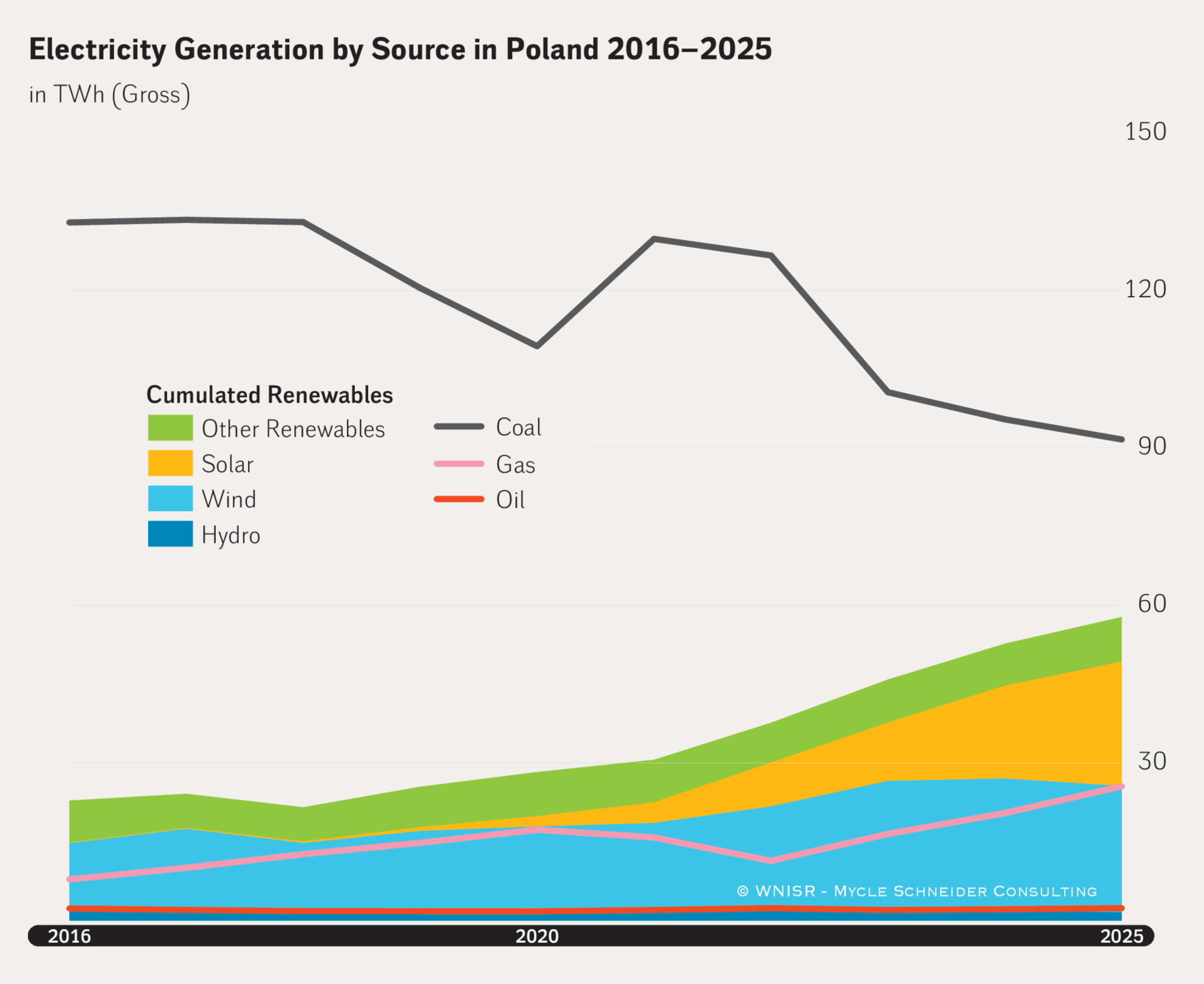
Source: Energy Institute, 2026

In 1954, the Soviet Union was the first country to produce nuclear electricity for the grid. Since then, Russia has significantly influenced the global industry and turned by far into the largest exporter of reactors. As of mid-2026, 20 of the 24 large units Russia is building437 are located outside the country, and one of four small modular reactors is also implemented abroad. Thus, Russia’s 28 projects represent 39 percent of the world’s total of 73 reactors under construction.438
Russia has the fourth largest operating nuclear power fleet, with a total net capacity of 28 GW and 34 operational reactors across several designs: seven pressure-tube Light Water Cooled Graphite Moderated Reactors (Chornobyl-type RBMKs), 25 PWRs (five VVER-440s, 13 VVER‑1000s, four VVER-1200s, one VVER-TOI, and two small KLT-40 “floating reactors”), and two Fast Breeder Reactors or FBRs (BN-600 and BN-800).439 Fourteen reactors at different Russian power plants are closed: eleven pressure-tube reactors (four RBMKs, four EGP-6, two AMBs, and one AM-1 reactor at Russia’s first plant in Obninsk) and three PWRs.440
In 2025, nuclear energy contributed 18.3 percent of the country’s power mix (up from 17.8 percent in 2024), generating 218.6 TWh gross of electricity,441 an increase of 1.3 percent compared to 2024. (see Figure 38).
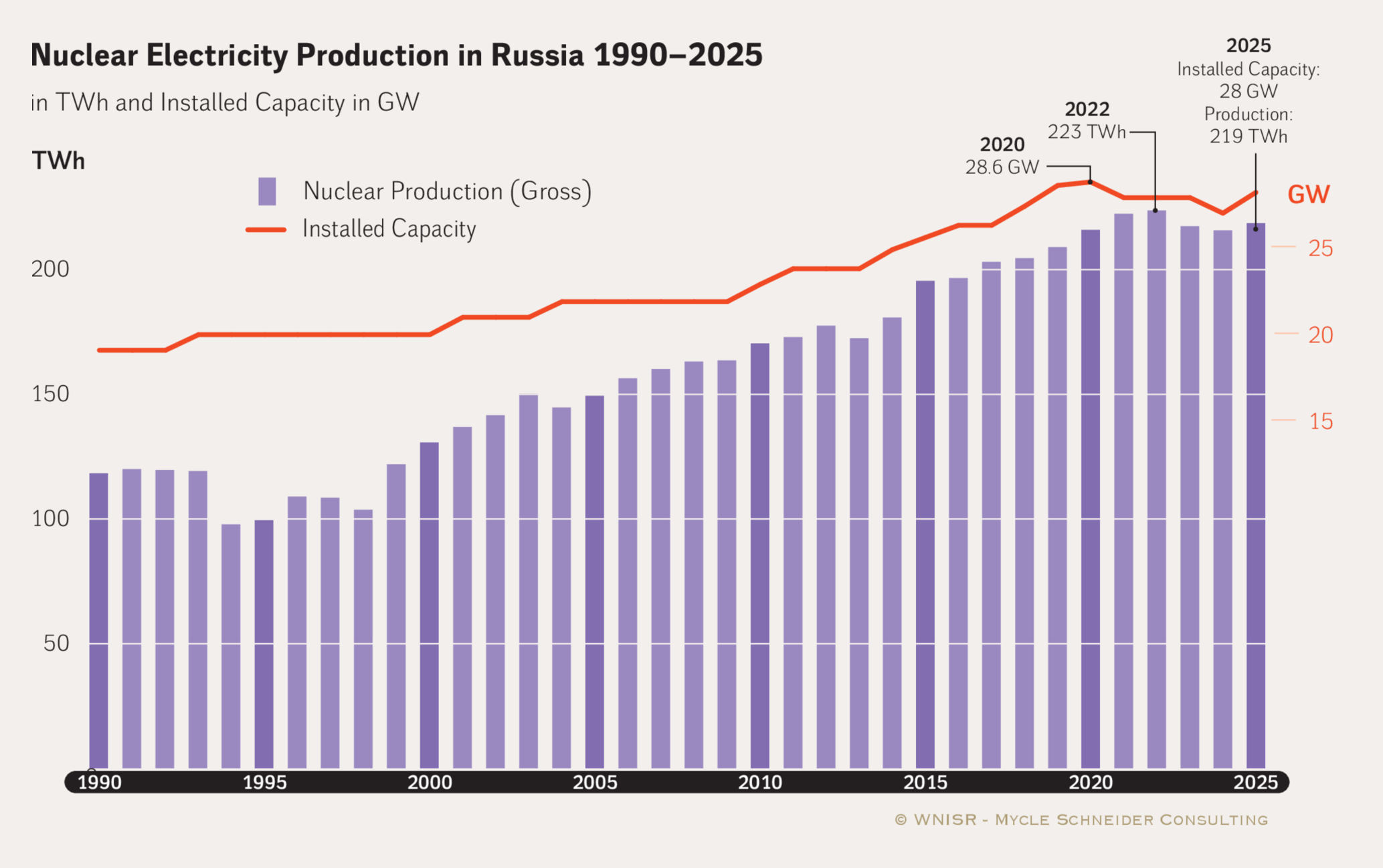
Sources: WNISR with IAEA-PRIS and Energy Institute, 2026
Note: Capacity as of year-end.
The decline in nuclear generation in 2022–2024 as seen in Figure 38 was largely driven by Russia’s aging nuclear fleet, with the gradual closure of end-of-lifetime units on one hand and delays in constructing replacement capacity on the other. Since 2018, Russia began decommissioning the first Soviet-era gigawatt-class reactors. As shown in Figure 39, four large first-generation RBMK units at the Leningrad and Kursk nuclear power plants—each with a service life of around 45 years—have already been closed in addition to the four small 10‑MW reactors at Bilibino. At these sites, two new VVER-1200 units at Leningrad II have so far replaced part of the lost capacity, but the construction of new units continues to lag behind the closure of old reactors by several years.
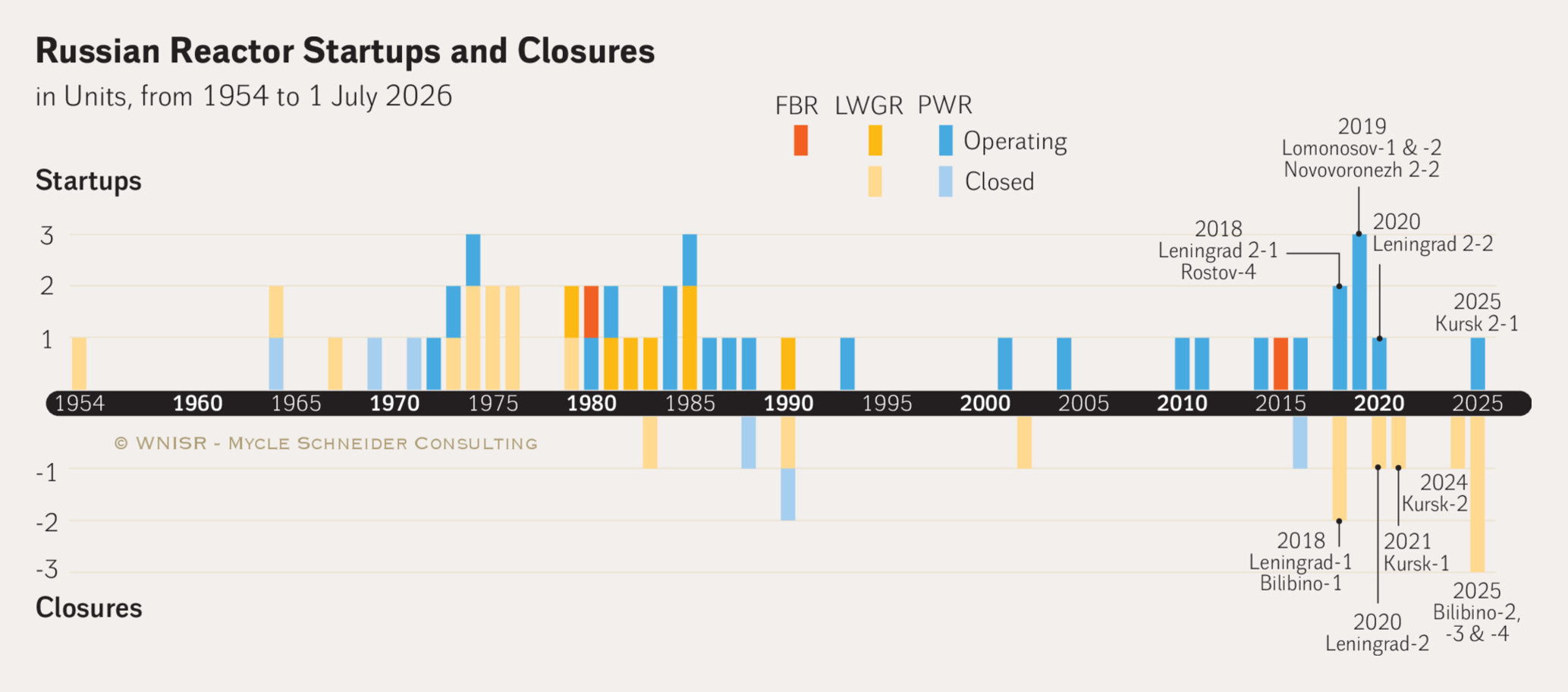
Sources: WNISR with IAEA-PRIS, 2026
However, following the grid connection of Kursk 2-1 in December 2025, nuclear generation could maintain the modest upward trend observed in 2025 into 2026, although underlying systemic constraints remain.
As of 1 July 2026, the average age of Russian nuclear power units is 30 years (see Figure 40), down from 31.5 years a year earlier. This decrease is due to the closure of three older reactors at the Bilibino plant and the grid connection of a new unit, Kursk 2-1, all of which occurred in December 2025.442
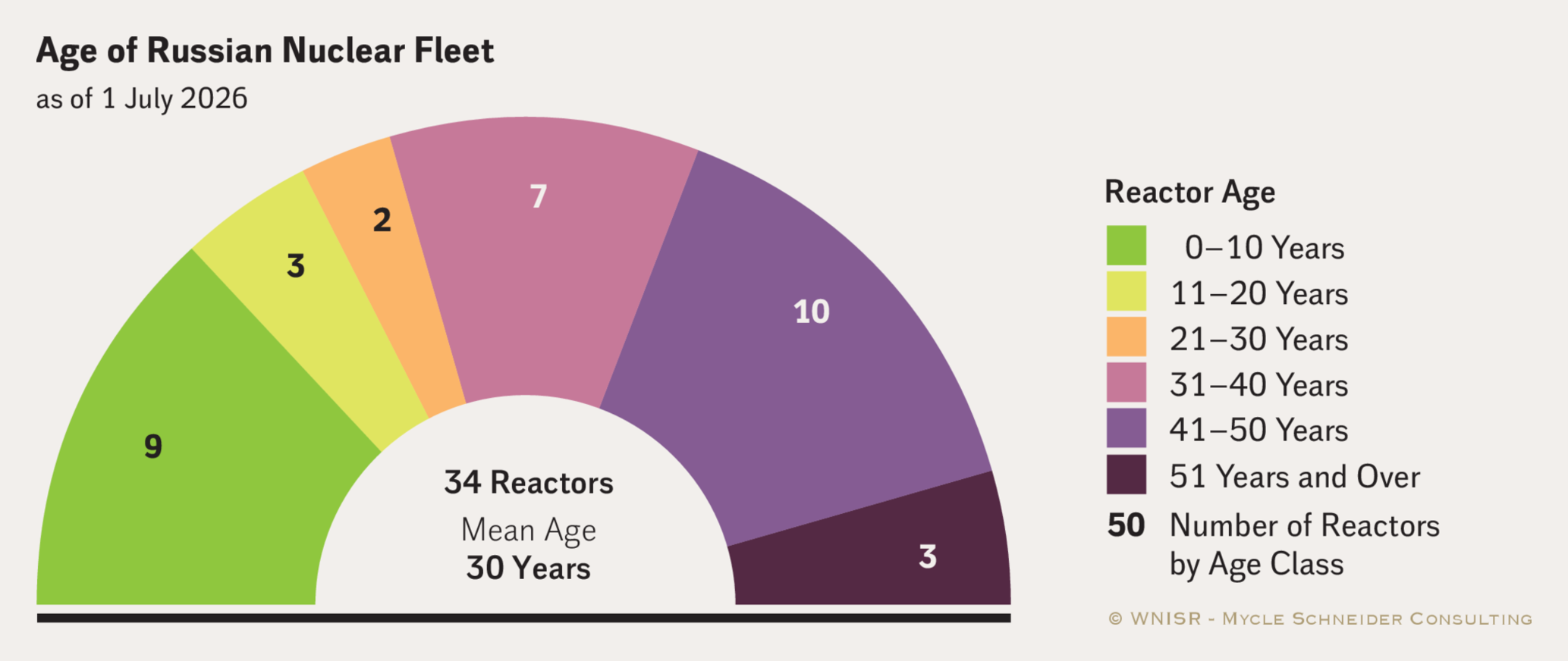
Sources: WNISR with IAEA-PRIS, 2026
The average age of Russian reactors is slightly below the global average. The Russian fleet’s intermediate age-position among the “Top 5 fleets”—between the younger fleets of China and South Korea and the older ones of the United States and France (see Figure 16)—reflects Russia’s historical development. Part of its nuclear fleet is relatively old, with reactors built in the 1970s and 1980s, similar to those in the West. At the same time, construction activities in recent decades have helped lower the fleet’s average age (see Figure 17).
Nevertheless, 59 percent of all operating Russian reactors, including all RBMKs, all VVER‑440s, one BN, and seven of 13 VVER-1000s, are running with extended lifetimes (beyond 30 years) (See Table 6). The oldest operating unit, Novovoronezh-4, a VVER-440, reached 53 years of service in 2025.
Due to technological challenges and economic impracticality, four first-generation RBMK reactors at Kursk and Leningrad, mentioned above, were denied lifetime extensions beyond 45 years and were closed upon reaching this limit between 2018 and 2024, and the last three EGP-6 units at Bilibino were closed by the end of 2025 after about 50 years of operation. Meanwhile, several VVER units have already received licenses to operate for up to 60 years.
|
Reactor Model/ Reactor |
Net Capacity (MW) |
Grid Connection |
Design Lifetime (in years) |
Closure Date/ License Expiration Date |
Age at Closure (End of License/ Planned Closure)(a) |
|
LGWR |
|||||
|
AM |
|||||
|
APS-1 Obninsk |
5 |
27/06/1954 |
n/a |
Closed on 29 April 2002 |
47.8 |
|
Beloyarsk-1 |
102 |
26/04/1964 |
n/a |
Closed on 1 January 1983(b) |
18.7 |
|
Beloyarsk-2 |
146 |
29/12/1967 |
n/a |
Closed on 1 January 1990(b) |
22 |
|
EGP 6 |
|||||
|
Bilibino-1 |
11 |
12/01/1974 |
30 |
Closed in March 2018(c) |
44.2 |
|
Bilibino-2 |
11 |
30/12/1974 |
30 |
Closed on 1 December 2025 |
51 |
|
Bilibino-3 |
11 |
22/12/1975 |
30 |
Closed on 19 December 2025 |
50 |
|
Bilibino-4 |
11 |
27/12/1976 |
30 |
Closed on 30 December 2025 |
49 |
|
RBMK(d) |
|||||
|
Kursk-1 |
925 |
19/12/1976 |
30 |
Closed on 19 December 2021 |
45 |
|
Kursk-2 |
925 |
28/01/1979 |
30 |
Closed on 31 January 2024 |
45 |
|
Leningrad-1 |
925 |
21/12/1973 |
30 |
Closed on 22 December 2018 |
45 |
|
Leningrad-2 |
925 |
11/07/1975 |
30 |
Closed on 22 November 2020 |
45.4 |
|
Kursk-3 |
925 |
17/10/1983 |
30 |
Licensed to 31 December 2028(1) |
(45/50) |
|
Kursk-4 |
925 |
02/12/1985 |
30 |
Licensed to 21 December 2030(1,2) |
(45/50) |
|
Leningrad-3 |
925 |
07/12/1979 |
30 |
Licensed to 2030(3) |
(50) |
|
Leningrad-4 |
925 |
09/02/1981 |
30 |
Licensed to 2030(4) |
(50) |
|
Smolensk-1 |
925 |
09/12/1982 |
30 |
Licensed to December 2027(5) |
(45/50) |
|
Smolensk-2 |
925 |
31/05/1985 |
30 |
Licensed to 2030(6) |
(45/50) |
|
Smolensk-3 |
925 |
17/01/1990 |
30 |
Licensed to December 2034(7) |
(45/50) |
|
PWR |
|||||
|
VVER V-120 |
|||||
|
Novovoronezh-1 |
197 |
30/09/1964 |
20 |
Closed on 16 February 1988 |
24 |
|
Novovoronezh-2 |
336 |
27/12/1969 |
20 |
Closed on 29 August 1990 |
21 |
|
VVER V-440 |
|||||
|
Novovoronezh-3 |
385 |
27/12/1971 |
30 |
Closed on 25 December 2016 |
45 |
|
Kola-1 |
411 |
29/06/1973 |
30 |
Licensed to 6 July 2033(7,8,9) |
(60) |
|
Kola-2 |
411 |
09/12/1974 |
30 |
Licensed to 20 December 2034(7,8,9) |
(60) |
|
Kola-3 |
411 |
24/03/1981 |
30 |
Licensed to 31 December 2026(10,8,9) |
(45) |
|
Kola-4 |
411 |
11/10/1984 |
30 |
Licensed to 7 December 2039(2,8,9) |
(55) |
|
Novovoronezh-4 |
385 |
28/12/1972 |
30 |
Licensed to 29 December 2032(7) |
(50) |
|
VVER-1000 |
|||||
|
Balakovo-1 |
950 |
28/12/1985 |
30 |
Licensed to 12 December 2045(2) |
(60) |
|
Balakovo-2 |
950 |
08/10/1987 |
30 |
Licensed to 13 October 2043(7) |
(56/60) |
|
Balakovo-3 |
950 |
25/12/1988 |
30 |
Licensed to 28 December 2048(7) |
(60) |
|
Balakovo-4 |
950 |
11/04/1993 |
30 |
Licensed to 2051(11) |
(58/60) |
|
Kalinin-1 |
950 |
09/05/1984 |
30 |
Licensed to 28 June 2044(12) |
(60) |
|
Kalinin-2 |
950 |
03/12/1986 |
30 |
Licensed to 30 November 2038(7) |
(56/60) |
|
Kalinin-3 |
950 |
16/12/2004 |
30 |
Licensed to 1 October 2034(7,8) |
(30/60) |
|
Kalinin-4 |
950 |
24/11/2011 |
30 |
Licensed to 20 October 2041(7,8) |
(30/60) |
|
Novovoronezh-5 |
950 |
31/05/1980 |
30 |
Licensed to 2036(13) |
(56) |
|
Rostov-1 |
989 |
30/03/2001 |
30 |
Licensed to 19 January 2031(7,8) |
(30/60) |
|
Rostov-2 |
950 |
18/03/2010 |
30 |
Licensed to 23 September 2039(7,8) |
(29/60) |
|
Rostov-3 |
950 |
27/12/2014 |
30 |
Licensed to 14 November 2044(7,14) |
(30/60) |
|
Rostov-4 |
979 |
02/02/2018 |
30 |
Licensed to 4 December 2057(7,8) |
(39/60) |
|
VVER-1200 |
|||||
|
Leningrad 2-1 |
1101 |
09/03/2018 |
60 |
Licensed to 4 December 2057(7,8) |
(39/60) |
|
Leningrad 2-2 |
1101 |
23/10/2020 |
60 |
Licensed to 17 July 2050(7,8) |
(30/60) |
|
Novovoronezh-2-1 |
1100 |
05/08/2016 |
60 |
Licensed to 22 March 2046(7,8) |
(30/60) |
|
Novovoronezh-2-2 |
1101 |
01/05/2019 |
60 |
Licensed to 18 February 2049(7,8) |
(30/60) |
|
VVER-TOI |
|||||
|
Kursk 2-1 |
1200 |
31/12/2025 |
60 |
? |
(60) |
|
KLT-40S “Floating” |
|||||
|
Akademik Lomonosov-1 |
32 |
19/12/2019 |
40(15) |
Licensed to 20 June 2029(8,15) |
(10/40) |
|
Akademik Lomonosov-2 |
32 |
19/12/2019 |
40 |
Licensed to 20 June 2029(8,15) |
(10/40) |
|
FBR |
|||||
|
BN-600 |
560 |
08/04/1980 |
30(16) |
Licensed to 2040(17) |
(60) |
|
BN-800 |
820 |
10/12/2015 |
40(16) |
Licensed to December 25, 2043(7,18) |
(28/60) |
Sources: Various, compiled by WNISR, 2026
Notes
FBR: Fast Breeder Reactor; LWGR: Light-Water Gas-cooled Reactors; PWR: Pressurized Water Reactor.
(a) – For operating reactors, age at the end of current valid license (as of 1 July 2026)/expected further extension.
(b) – No or scarce production data available for Beloyarsk-1 and -2 in IAEA-PRIS; official closure from IAEA-PRIS but does not reflect the actual production of those reactors.
(c) – Bilibino-1 was officially closed in January 2019, but according to IAEA-PRIS it was disconnected from the grid in March 2018;
see IAEA-PRIS, “Operating Experience with Nuclear Power Stations in Member States – 2019 Edition”, see https://www.iaea.org/publications/13575/operating-experience-with-nuclear-power-stations-in-member-states.
(d) – Planned extension to 50 years for the seven RBMKs.
Sources
(1) Rosenergoatom, “ОТЧЕТ по экологической безопасности за 2024 год”, Rosatom, 2025, see https://www.rosenergoatom.ru/upload/iblock/3ce/zimy1kcxqewvio5x2kcv6hcstlz3t2lb.pdf.
(2) Federal Environmental Industry and Nuclear Supervision Service and Rosatom, “The Seventh National Report of the Russian Federation on the Fulfillment of Commitments Resulting from the Convention on Nuclear Safety”, 2016, see https://www.iaea.org/sites/default/files/russia-national-report-7th-rm-cns_en.pdf.
(3) Rosenergoatom, “Ленинградская АЭС получила лицензию Ростехнадзора на эксплуатацию энергоблока №3 до 2030 года”, Press Release, 3 February 2025, see https://www.rosenergoatom.ru/zhurnalistam/news/47889/.
(4) Rosenergoatom, “Ленинградская АЭС получила две лицензии Ростехнадзора - на продление срока эксплуатации блока №4 РБМК-1000 и наработку на нём изотопной продукции до 2030 г.”, 15 January 2026, see https://www.rosenergoatom.ru/stations_projects/sayt-leningradskoy-aes/press-tsentr/novosti/49728/.
(5) AK&M, “Smolensk NPP Has Received a License from Rostechnadzor for the Operation of Power Unit No. 1 until 2027”, 27 December 2022, see https://www.akm.ru/eng/news/smolensk-npp-has-received-a-license-from-rostechnadzor-for-the-operation-of-power-unit-no-1-until-20/; and Rosatom, “ОТЧЕТ по экологической безопасности Смоленской АЭС за 2023 год”, 2024, see https://www.report.rosatom.ru/go/2023/eco/rea/%D0%A1%D0%BC%D0%BE%D0%BB%D0%B5%D0%BD%D1%81%D0%BA%D0%B0%D1%8F_%D0%90%D0%AD%D0%A1.pdf.
(6) Rosenergoatom, “Смоленская АЭС получила лицензию Ростехнадзора на безопасную эксплуатацию энергоблока №2 ещё на 5 лет - до 2030 года”, Press Release, 2 June 2025, see https://www.rosenergoatom.ru/zhurnalistam/news/48487/.
(7) Federal Environmental Industry and Nuclear Supervision Service and Rosatom, “The Ninth National Report of the Russian Federation on the Fulfillment of the Commitments Resulting From the Convention on Nuclear Safety to the Joint Eighth/Ninth Review Meeting of the Contracting Parties under the Convention on Nuclear Safety”, 2022, see https://www.iaea.org/sites/default/files/24/02/cns_8th_and_9th_rm_national_report_russian_federation.pdf.
(8) See list of all Rosenergoatom licenses at Выставить-счет.рф, “Проверка контрагента—АО ‘КОНЦЕРН РОСЭНЕРГОАТОМ’”, 2025, see https://выставить-счет.рф/vipiska-egrul/5087746119951/.
(9) Rosenergoatom, “Кольская АЭС–Отчет Об Экологической Безопасности За 2025 Год”, 2026, see https://www.rosenergoatom.ru/upload/iblock/3cb/t7rthb5qik9dai39rnq3v2alyed1r31g.pdf.
(10) Атомная энергия 2.0, “Кольская АЭС: Ростехнадзор выдал лицензию на эксплуатацию энергоблока №3 еще на 10 лет”, 11 February 2016, see https://www.atomic-energy.ru/news/2016/02/11/63277.
(11) Interfax, “Балаковская АЭС продлила на 28 лет лицензию на эксплуатацию энергоблока №4”, 22 December 2023,
see https://www.interfax.ru/russia/937618.
(12) Rosenergoatom, “Калининская АЭС получила лицензию Ростехнадзора на эксплуатацию энергоблока №1 в продленном сроке до 2044 года”, Press Release, 30 June 2025, see https://www.rosenergoatom.ru/zhurnalistam/news/48650/.
(13) Страна Росатом, “Не время отдыхать: пятый блок Нововоронежской АЭС будет работать до 2036 года”, Rosatom, 25 December 2025, see https://strana-rosatom.ru/2025/12/25/ne-vremya-otdyhat-pyatyj-blok-novovoro/.
(14) Rosenergoatom, “Ростовская АЭС. Отчет по экологической безопасности за 2016 год”, 2017, see https://www.rosenergoatom.ru/upload/iblock/034/034a3c3bfc22a08df1e0a3a2d1bbc922.pdf.
(15) Akademik Lomonosov Floating Nuclear Power Plant, “Floating Nuclear Power Plant Akademik Lomonosov Has Received an Operating License”, Rosatom, 28 June 2019, see https://fnpp.info/latest-news/floating-nuclear-power-plant-akademik-lomonosov-has-received-an-operating-license; and Akademik Lomonosov, “About”, as of 24 June 2026, see https://fnpp.info/about; also Rosatom, “Филиала АО «Концерн Росэнергоатом» «Плавучая атомная теплоэлектростанция» Отчет по экологической безопасности за 2023 год”, 2024, see https://www.rosenergoatom.ru/upload/iblock/121/3aoq46y5elbddyrh4idxh16q6ywumg8e.pdf.
(16) Ilia Pakhomov, “BN-600 and BN-800 Operating Experience”, Institute for Physics and Power Engineering, State Scientific Center of the Russian Federation, as presented at GEN IV International Forum, 19 December 2018, see https://www.gen-4.org/gif/upload/docs/application/pdf/2019-01/gifiv_webinar_pakhomov_19_dec_2018_final.pdf.
(17) Rosenergoatom, “Белоярская АЭС получила лицензию Ростехнадзора на продление эксплуатации энергоблока №3 до 2040 года”, Press Release, 1 April 2025, see https://www.rosenergoatom.ru/zhurnalistam/news/48170/.
(18) Белоярская АЭС, “Отчет По Экологической Безопасности За 2024 Год”, 2025, see https://www.rosenergoatom.ru/upload/iblock/394/8b5og08wo5g9nsrsf4bhjc0ka4uqj1is.pdf.
Since late 2022, Rosatom has explored new lifetime extensions, including extending some VVER-440 units beyond 60 years and second-generation RBMK units to 50 years. The first extended licenses for RBMK units were issued for Leningrad-3 in February 2025443 and for Leningrad-4 in January 2026.444 In 2025, the 45-year-old BN-600 at Beloyarsk-3—the oldest operating fast reactor worldwide—received a license to operate for up to 60 years.445
In its March 2021 strategic review, Rosatom stated that nuclear energy should supply 25 percent of the country’s electricity generation by 2045 in line with a target set by Russia’s president. At the time, Rosatom CEO Alexey Likhachev estimated that achieving this target would require the commissioning of 24 units, including at new sites and in new regions.446
At the end of December 2024, Rosatom formalized its specific proposals in the government-approved General Scheme for the Placement of Energy Facilities through 2042.447 According to the document, by 2042 Rosatom plans to have built 41 new nuclear reactors, including 15 SMRs, with a total capacity of around 28.2 GW. This would bring nuclear’s share in the Russian electricity mix to 24 percent by 2042.
As of mid-2026, Russia has seven reactors under construction simultaneously (see Table 7): five nuclear power units, with capacities ranging from 300 MW to 1200 MW (two VVER-TOI units at Kursk II, two VVER-1200 units at Leningrad II, and the BREST-OD-300 SMR in Seversk), as well as at least one barge with two SMR modules.448 Reached in 2025, this is the highest number of reactors simultaneously under construction in Russia in a decade. Over the past year, the total remained the same, but the composition changed: one unit entered operation, while another began construction at Kursk II.
Four VVER-TOI (V-510) units, with 1200 MW net capacity each, are planned at Kursk II. Construction of the first unit began in 2018 and was initially scheduled for completion in 2022–2023. It was connected to the grid for the first time on 31 December 2025 and commissioned for commercial operation on 29 April 2026.449 However, throughout 2025, Rosatom did not publicly comment on preparations for the unit’s commissioning, which was atypical for the corporation’s projects.450
Construction of the second unit began in 2019, and according to Russian Deputy Prime Minister Alexander Novak, as of late 2025, it was expected to be commissioned by 2027.451 This has apparently been delayed to 2028 (see Annex 5). Cost estimates for the two units reportedly almost doubled from RUB225 billion in 2016452 to RUB459 billion in 2022 (US$20226.7 billion).453
With the corresponding license issued in March 2025, first concrete at Unit 3 of Kursk II was planned for December 2025.454 But by the end of the year, Rosatom had released no information on the start of construction. In March 2026, IAEA-PRIS started displaying the reactor, indicating that first concrete had been poured on 31 January 2026.455, 456 However, according to independent thinktank Bellona’s assessment, first concrete was most likely poured as early as 24 December 2025.457 This conclusion is consistent with information published by Rosatom’s machine-building division.458 Such limited and sometimes contradictory information on the construction of Kursk II from Rosatom and Russia more broadly may be linked to the plant’s proximity to the combat zone in Ukraine.
Another two large VVER-1200 units, Leningrad 2-3 and 2-4, are under construction at Leningrad II; these units are also called Leningrad-7 and -8 (when counting existing reactors at the site). First concrete was poured in March 2024459 and March 2025460 and startups are planned in 2030 and 2032 for Unit 7 and 8, respectively.461
Near the Smolensk nuclear power plant, which operates Russia’s three most recent RBMKs, site preparations for two VVER-TOI units at Smolensk II began in 2024,462 with first concrete for the reactor building of Unit 1 planned for March 2027 and commissioning of the units set for 2033 and 2035.463 Preparations are also underway at the Beloyarsk plant for the construction of Unit 5, a BN-1200 sodium-cooled fast reactor. The construction license is expected to be issued in spring 2027, with first concrete scheduled before the end of the year.464
Construction of an innovative small (300 MW) fast reactor design, the BREST-OD-300, using liquid lead as a coolant and uranium-plutonium nitride fuel started in June 2021.465 By the end of 2025, about 70 percent of the reactor vessel was assembled. At the time, Ivan Babich, the project’s director, stated that final assembly of the vessel and formation of the lead-coolant circulation loop are scheduled for completion by the end of 2026.466 The latest official target is to start up the unit in 2028.467 As of 2021, the reactor’s cost was said to be RUB2021100 billion (US$20211.4 billion).468
Rosatom is involved in the construction of four small Floating Nuclear Power Plants (FNPP), each equipped with two RITM-200C reactors, to supply energy to mining projects in the Russian Arctic—specifically at Cape Nagloynyn in Chukotka. The first two “units” with two modules each are planned for commissioning by 2028, with the third and fourth to follow in 2029 and 2031, respectively.469 Information regarding this project has been erratic, and construction has apparently started on one barge only.
In 2021, Rosatom signed a US$226 million contract with China’s Wison Heavy Industry for two floating power plant hulls, with deliveries scheduled for October 2023 and February 2024.470 A keel-laying ceremony for the first barge was held in China in August 2022,471 and a third hull contract followed in 2024.472
As of May 2025, Rosatom reportedly stated that six RITM-200 reactors for floating nuclear power plants were under fabrication.473 In August 2025, the head of Rosatom reported that installation of nuclear equipment on the first two floating units was scheduled for early 2026.474 However, information that the hull of the first barge had been delivered to the Baltic Shipyard in Saint Petersburg emerged only in late March 2026.475 At the end of May 2026, Rosatom’s engineering division sent the first manufactured RITM-200 unit to the Baltic Shipyard.476
|
Plant |
Reactor Design |
Capacity Per Unit (MWe) |
Reactors (Barges) |
Capacity Per Site (MWe) |
Construction Start |
Planned Startup |
|
Kursk II |
VVER-TOI |
1 200 |
2 |
2 400 |
15/04/2019 20/12/2025(1) |
2027/31 |
|
/ |
2034 |
|||||
|
Leningrad II |
VVER-1200 |
1 150 |
2 |
2 300 |
14/03/2024 20/03/2025 |
2030/32 |
|
BREST ODEK |
BREST-OD-300 (fast reactor) |
300 |
1 |
300 |
08/06/2021 |
2028 |
|
Baimsky GOK (FNPP) at Cape Nagloynyn |
RITM-200C (2 per barge) |
106 |
2 (1) |
106 |
30/08/2022(2) |
2028 |
|
/ |
2028/29/31 |
|||||
|
Total under Construction |
7 (1) |
5 106 |
Sources: General Scheme for the Placement of Energy Facilities through 2042, with Rosatom and IAEA-PRIS, 2026
Notes
(1) - IAEA-PRIS, “Reactor Details–Kursk 2-3”, Updated 19 July 2026.
(2) - Keel laying of one barge designed to host two reactors, counted as two reactors under construction.
The General Scheme for the Placement of Energy Facilities through 2042 notes that several SMR projects, such as those in Chukotka, Norilsk, the second unit in Yakutsk as well as the Baimsky GOK, will only be confirmed after power purchase agreements are signed with end users.477 If such agreements are not secured, these projects may not move forward or may proceed only partially.
Nearly half of the new capacity planned over the next decade will be at existing sites in western Russia, and new sites are expected to be added in central and eastern regions starting in the 2030s. The focus remains on large VVER reactors (17 units), while the fast reactor fleet is projected to grow from two to about ten units by 2042. Most SMR projects are based on RITM reactors, already used on eight nuclear icebreakers.
Rosatom’s new large nuclear units are primarily constructed under the Capacity Supply Agreement (CSA) mechanism. After commissioning, the units receive increased capacity payments on the wholesale market to ensure accelerated return on investment. For earlier nuclear projects, contracts allowed for cost recovery over 20 years.478 In 2023, Russia’s Ministry of Energy proposed optimizing costs for new reactors by extending contracts to 25 years with a 10.5 percent return rate and a CAPEX cap of ~RUB184,000/kW (~US$20212,500/kW), matching the cost of the VVER-1200 units at Novovoronezh II and Kursk II (~RUB183,000/kW).479 According to Rosatom’s estimate, the full program (for 41 reactors) would require ~RUB17 trillion (~US$2025190 billion).480
Rosatom is the biggest nuclear power technology provider in the world; it is constructing 28 out of the 73 units under construction worldwide as of 1 July 2026. Of these 28 units, 21 are being built abroad in eight countries—not including Mochovce-4, a Russian design completed by a Czech-led consortium in Slovakia—and seven at home, including SMRs. As of mid-2026, Rosatom or one of its subsidiaries is involved as the main contractor or vendor in the following reactor projects abroad which are in various stages of active construction (see Annex 5 for further references):
- Rooppur, Bangladesh. Construction started on two VVER-1200 reactors at Rooppur in 2017 and 2018, and they were expected to begin operation in 2023 and 2024, respectively.481 The first fuel shipment was delivered in October 2023,482 but fuel loading at Unit 1 only began on 28 April 2026 after repeated delays.483 The project has been facing challenges in particular due to underdeveloped local grid infrastructure and accumulated debts resulting from US sanctions on Russia.484 See section on Bangladesh.
- Tianwan and Xudapu, China. Two VVER-1200s each at Tianwan and Xudapu (or Xudabao) are being built. Construction of Tianwan-7 and Xudapu-3 began in 2021, followed by Tianwan-8 and Xudapu-4 in 2022.485 By December 2025, Xudapu-3 had accomplished cold functional tests,486 while Tianwan-7 had completed hot functional tests.487 By early 2026, Rosatom had delivered fuel for the initial core loads488 and expected both units to reach first criticality by the end of the year.489 According to an announcement at construction start, commissioning of the units was scheduled for 2026–2027 (Tianwan) and 2027–2028 (Xudapu).490 China’s projects are the most localized among Rosatom’s constructions abroad; the company only designs and supplies core reactor island equipment, while Chinese partners handle all other aspects including project management. See China Focus.
- El Dabaa, Egypt. Four VVER-1200s are under construction at El Dabaa. Construction at the four units began between 2022 and 2024 and is scheduled to be completed by 2030. The cost was given as US$30 billion, facilitated by a US$25 billion loan from Russia.491 See section on Egypt.
- Paks II, Hungary. Following several years of delays, the first concrete ceremony for Unit 1 (a VVER-1200) of the Paks II plant took place on 5 February 2026. Despite complications caused by the war in Ukraine, sanctions pressure,492 and supplier issues,493 the project was granted exemptions from EU sanctions packages in mid-2024494 and benefited from eased US sanctions pressure in late 2025.495 At the same time, Hungary’s new Prime Minister, elected in April 2026, has announced a review of the project and ordered a “comprehensive and expedited investigation” into the activities of the PAKS II project company.496 See Hungary Focus.
- Kudankulam, India. Four VVER-1000s (Units 3 to 6) are under construction at Kudankulam. Construction started on the first pair in 2017 and the second pair in 2021. In December 2025, Rosatom shipped fuel for the initial core load of Unit 3.497As of June 2026, the “Expected Date of Commissioning” has moved to June 2027 and 2028 for Units 3 and 4, respectively, and June 2029 and March 2030 for the remaining two.498 The roadmap for nuclear cooperation between Russia and India, signed over a decade ago, envisaged the construction of up to 12 reactors in India, including up to six in Kudankulam.499 See section on India.
- Bushehr, Iran. Construction of Bushehr began in 1976 by Germany’s KWU-Siemens but was suspended in 1979. In 1995, Russia’s Atomstroyexport was contracted to complete Unit 1 with a VVER-1000 reactor, which was connected to the grid in 2011. In 2014, a US$10 billion contract was signed for two additional VVER-1000 units.500 New basemat concrete for Unit 2 was poured in 2019, and its commercial operation is expected in 2029. Concrete pouring for the third unit was expected in 2024,501 but no official updates have been reported. On 26 September 2025, Iran and Russia signed a US$25 billion agreement to build the four-unit Hormoz nuclear power plant in Hormozgan Province.502 However, the US-Israeli military operation against Iran in spring 2026 appears to have put the implementation of Russia-Iran nuclear cooperation on hold, with Rosatom reportedly evacuating personnel from the Bushehr site.503 Continued uncertainty over the course and outcome of the war is now casting doubt on the future of these projects. See section on Iran.
- Akkuyu, Türkiye. Four VVER-1200s are being built at Akkuyu. Construction started on them between 2018 and 2022. This is Rosatom’s first project being built under a BOO (Build-Own-Operate) scheme. The first unit was originally scheduled for commissioning in 2023 but has been repeatedly delayed due to technical and political factors, including US financial sanctions and post‑2022 obstacles to Western equipment deliveries. According to Rosatom’s head, the project ended up in a “sanctions meat grinder.”504 Nevertheless, Rosatom still expects the first unit to be commissioned by the end of 2026.505 See Türkiye Focus.
- Uzbekistan. In May 2024, Rosatom signed a contract with the state unitary enterprise “Directorate for the Construction of Nuclear Power Plants” under Uzatom, the Atomic Energy Agency Under the Cabinet of Ministers of the Republic of Uzbekistan, to build six 55-MW SMRs in Uzbekistan.506 However, in September 2025, the parties signed documents revising the project configuration to include two 1000-MW VVER-1000 units and two 55-MW RITM-200N units in so-called integrated nuclear power plants, replacing the earlier six-SMR concept.507 After Rosatom and Uzatom signed off on a project roadmap, preparatory concrete works began at the site in March 2026,508 and concrete was poured on 4 June 2026 for the foundation of the first small modular unit of Uzbekistan’s integrated nuclear power plant, officially starting construction.509 See section on Uzbekistan.
In addition, Rosatom is a subcontractor in Slovakia’s Mochovce-4 project, a Sovietera VVER unit, whose construction began in 1985 and grid connection has been repeatedly pushed back. As of mid-2026, the unit had still not been launched. Rosatom provided technical support, while the main equipment came from the Czech company Škoda JS. The twin unit, Mochovce-3, connected to the grid in 2023, became the EU’s 19th VVER unit based on Russian design.
In June 2025, Rosatom was also selected to lead an international consortium for the construction of Kazakhstan’s first nuclear power plant.510 In August 2025, initial work began on the Ulken project, including engineering surveys and preparation of design documentation.511 On 28 May 2026, Kazakhstan and Russia signed an intergovernmental cooperation agreement covering key areas of cooperation during the plant’s operation, including maintenance services and fuel supplies.512 According to Kazakh officials, active construction work is expected to begin in 2027,513 with the plant scheduled to come online in 2034.514 Earlier statements had also referred to first concrete around 2029.515 However, the contract has not yet been signed, and it remains unclear which other companies will join the consortium and how roles will be distributed among the partners. Meanwhile, it has been decided that the construction of Kazakhstan’s second nuclear power plant would be entrusted to China.516
In March 2026, Russia and Vietnam signed an intergovernmental agreement on the construction of the Ninh Thuan 1 nuclear power plant, establishing a legal framework for the project.517 The site is planned to host two Russian-designed VVER-1200 units totaling 2400 MW, with Leningrad II as the reference plant. Vietnam had previously pursued Russian-designed nuclear power technology under a 2010 agreement alongside separate plans with Japan for Ninh Thuan 2 but abandoned its nuclear program in 2016 for environmental and economic reasons before reviving it in late 2024.518
Nuclear Interdependencies and Sanctions
Since its full-scale invasion of Ukraine in February 2022, Russia has been facing sanctions from forty-five countries—mainly in Europe and North America but also from countries like Australia, Japan, New Zealand, and South Korea.519 As of mid-2026, further sanctions were under discussion. Ukraine is likely the only country that has sanctioned more than two hundred Rosatom-linked companies (from more than 400) and cut all ties with the corporation. Western countries have taken a more selective approach, targeting mostly military-linked entities and companies directly connected to Russia’s occupation of the Zaporizhzhia nuclear power plant, for example, the joint stock company “Operating organization of Zaporizhzhya NPP”, established by Rosenergoatom to manage the occupied nuclear power plant.520
By early 2025, nearly 70 Rosatom-related subsidiaries and individuals were under US sanctions,521 with some also sanctioned by the EU, the UK, Canada, and others. Looking back at the year 2025, Rosatom’s CEO acknowledged for the first time that sanctions have begun to significantly affect the corporation’s overseas projects. According to him, the heaviest pressure has been felt by projects in Türkiye and Hungary.522 These difficulties appear to be driven by a combination of financial-sector sanctions and disruptions to the supply of Western equipment for Rosatom’s overseas projects. See the dedicated chapter on Russia Nuclear Interdependencies for details.
Beyond delays at foreign construction sites, the clearest sign of Rosatom’s troubles was that, for the first time in many years, its foreign-sales revenue did not grow but declined; it dropped by 4.4 percent to US$17.2 billion in 2025,523 following a 10-percent hike in 2024.524
The European Union
Since 2022, and as of mid-2026, the European Union (EU) has adopted 20 sanctions packages against Russia, targeting finance, energy, technology, and trade.525
By 2026, EU sanctions have sharply reduced Russian oil and gas purchases by EU member states. Oil imports from Russia fell from 27 percent at the beginning of 2022 to just 2 percent in 2025, with almost all remaining flows going via the southern Druzhba pipeline to Hungary and Slovakia. According to the European Commission, gas imports dropped from about 45 percent of the EU’s gas demand in 2022 to 12 percent in 2025, and the EU has now legally committed to phasing out all Russian gas imports by 2027, leaving only limited exempted volumes during the transition.526
WNISR2025 contained a brief overview of how nuclear equipment and fuel remained largely exempt from EU sanctions due to concerns about fossil fuel resources and mutual nuclear business interests entailing political pressure from certain member states—notably France and Hungary527—with strong nuclear ties to Russia. For the time being, work on Paks II in Hungary apparently continues, and France remains committed to its nuclear cooperation with Russia, including on enriched uranium imports, joint projects with Rosatom like fuel fabrication in Germany, and sales of its Arabelle turbines for VVER reactors.
On 6 May 2025, the European Commission presented its Roadmap Towards Ending Russian Energy Imports,528 which included plans to reduce the EU’s reliance on Russian nuclear supplies. By the end of 2025, the Commission envisaged a step‑by‑step phaseout of Russian nuclear imports in cooperation with member states based on proposed measures such as economic incentives and tariffs to discourage purchases of Russian enriched uranium and a restriction on new contracts with Russian suppliers. However, already in June 2025, the EU had decided not to push for immediate bans in the nuclear sector and instead focused on phasing out Russian gas supplies.
Dan Jørgensen, European Commissioner for Energy, said at a press briefing, “The question about nuclear is, of course, complicated, because we need to be very sure that we are not putting countries in a situation where they do not have the security of supply. So we’re working as fast as we can to also make that a part of the proposal.”529 By mid-2026, no official plans or measures to cut Russian nuclear imports have been formally adopted on the EU level.
One of the EU’s main dependencies on Russia in the nuclear sector is the use of Russian nuclear fuel for 19 VVER reactors operating in five countries: Bulgaria, Czech Republic, Finland, Hungary, and Slovakia. As shown in WNISR2025, according to Eurostat data, purchases of such fuel nearly doubled in the first year (2023) after the start of the all-out war with Ukraine, as operators sought to stockpile supplies amid increasing uncertainty. See Figure 54.
However, these purchases continued to decline in both 2024 and 2025; they dropped from 635 tons (€718 million or US$2023776 million) in 2023 to 380 tons (€465 million or US$2025525 million) in 2025, although this still exceeds the pre-war level of around 300 tons per year.530 The 2023 total of 635 tons includes 62.3 tons supplied to Bulgaria according to Eurostat, but data on Bulgaria’s imports in other years is missing, suggesting the database may be incomplete.
By 2025, all five countries using Russian nuclear fuel had signed contracts with alternative suppliers (Westinghouse and/or Framatome), and in Bulgaria and Finland, non-Russian fuel was already being loaded into reactors in 2024.531 (See Russia Nuclear Interdependencies).
Overall, purchases of Russian nuclear fuel are declining in the Czech Republic and Finland, where its replacement by Westinghouse fuel is advancing. Slovakia and Hungary, however, are moving more slowly and prefer Framatome as an alternative supplier. Since Framatome does not yet produce VVER fuel independently and plans to assemble Russian-designed fuel under license with Rosatom in France and Germany,532 Rosatom may retain a partial presence in the European nuclear fuel market unless stricter EU restrictions are introduced.
Eurostat data indicate that EU imports of enriched uranium from Russia increased in 2025, reaching 644.5 tons (€312.2 million or US$2025353 million), compared to the 147.1 tons (€170.1 million or US$2024184 million) in 2024.533 Russia’s key nuclear partner in the EU remains France, both directly and through more complex logistics and technology chains involving Urenco, EDF contracts in the Netherlands, and Framatome’s facilities in Lingen, Germany. See Russia Nuclear Interdependencies for details.
The United States
For decades, the US has been one of the main buyers of Russian enriched uranium, sourcing up to a third of its needs from Russia.534 In 2023, amid ongoing uncertainty, purchases reached their highest level since 2013—over 700 tons worth US$1.2 billion.535
A new law banning the import of uranium from Russia was passed in May 2024 and came into effect on 11 August 2024.536 Given the significance of Russian supply, a caveat allows for waivers until the end of 2027 if the U.S. Department of Energy judges that no alternative supply is available. The legislation also unlocks US$2.7 billion in federal support for domestic enrichment.537
In response, in mid-November 2024, the Russian Government imposed a temporary ban on enriched uranium exports to the US until the end of 2025 and revoked existing export licenses. However, like the US ban, this restriction can be bypassed through special one-time licenses. As a result, enriched uranium deliveries from Russia to the US resumed in early 2025.538
Imports of Russian enriched uranium, after a significant decline in 2024 (334.9 tons worth US$624 million), rose again in 2025 to 400.3 tons, and their value increased substantially to over US$1 billion.539
Judging by a series of measures and executive orders issued by the Trump administration in 2025 and 2026 aimed at supporting the US nuclear industry, the current administration appears set to continue efforts to reduce dependence on Russian supplies.540 For further details on US policy, see United States Focus.

Introduction: From Long-term Nuclear Phaseout to Newbuild
In June 2017, then-President Moon Jae-in announced plans to halt the construction of new nuclear power plants and phase out aging ones during the ceremony marking the permanent shutdown of Kori-1, South Korea’s first nuclear power plant.541 This declaration, known as the “Nuclear Phaseout Declaration,” had a profound impact on South Korea’s nuclear industry. Since the 1990s, South Korea has continuously built new nuclear power plants, which also meant that the country’s nuclear industry has consistently secured construction projects in the domestic market.
The Moon administration suspended work on Shin-Kori-5 and -6 (later renamed Saeul-3 and -4), where official construction (concreting the base slab of the reactor building) at the first of those units had only begun in April 2017. It sought the public’s opinion on whether to resume construction through a “public deliberation” process. This marked the first instance in which the construction of a nuclear power plant, already in progress under government policy, was halted. Although construction work for Shin-Kori-5 and -6 resumed in October 2017 following the results of the public deliberation, the government decided to pursue a policy of long-term nuclear phaseout (see past WNISR editions for further detail on the policy and its implementation).542 Consequently, design work for two additional projects, Shin-Hanul-3 and -4, as well as the designation of new sites in Yeongdeok and Samcheok, were scrapped. This prompted an intensive petition campaign—led by conservative opposition parties, nuclear engineering professors, the KHNP labor union, and industry figures—calling for “an end to the nuclear phaseout and the resumption of construction on Shin Hanul-3 and -4,” which remained a major political issue throughout the Moon administration.543
The Yoon administration, which took office in 2022, completely revised the previous government’s energy policy. President Yoon Suk-yeol had pledged during his presidential campaign to “Reverse the Nuclear Phaseout Policy! Building the World’s Leading Nuclear Power Nation,”544 and as president-elect he reaffirmed that the construction of Shin-Hanul-3 and -4 would start quickly.545 As a result, work resumed on site and groundbreaking for both units began in September 2024.546 A groundbreaking ceremony was held in October 2024,547 where he pledged to establish a medium- and long-term roadmap for the development of the nuclear industry by 2050 and to pass the Special Act on Support for the Nuclear Industry, clearly demonstrating the government’s commitment to fostering the nuclear industry. However, the official construction start with the pouring of concrete for the foundations of the reactor buildings only took place on 20 May 2025 for Unit 3 and on 29 May 2026 for Unit 4 (see Table 8).548
The Yoon administration also moved forward with plans to build new nuclear power plants that the Moon administration had canceled; as a result, the 11th Basic Plan for Long-Term Electricity Supply and Demand (11th BPE), revised in March 2025, included plans for two large-scale nuclear power plants (1.4 GW × 2) and four SMRs (4 × 175 MW549).550 However, due to the unconstitutional declaration of martial law, President Yoon Suk-yeol was removed from office in April 2025, and as a result, ongoing work on the Special Act on Support for the Nuclear Industry and the site selection process for new nuclear power plants could not be carried out as scheduled.
Incoming President Lee Jae-myung took a cautious stance during a press conference on 11 September 2025 marking his 100th day in office. The Korea Electric Times (전기신문) reports:
President Lee Jae-myung said on the 11th, “Since it takes 15 years to build a nuclear power plant, we must significantly expand renewable energy,” adding, “Building additional nuclear power plants is not a realistic option.” (…)
“There is a flaw in the argument that we need to build more nuclear power plants because the artificial intelligence (AI) industry requires enormous amounts of electricity,” adding, “It takes at least 15 years to build a nuclear power plant.” Regarding small modular reactors (SMRs), he added, “The technology has not yet been developed.”
President Lee said, “We need a massive amount of power right now, and the system that can supply it most quickly is renewable energy, such as solar and wind power,” adding, “We must expand the renewable energy industry on a large scale by building infrastructure and power grids.”551
However, at the New Year’s press conference in January 2026, the Lee administration’s policy stance appeared to have shifted. On that occasion, President Lee Jae-myung emphasized the current massive demand for energy, stating, “The national plan has already been finalized; arbitrarily overturning policies simply because the administration has changed is not beneficial in terms of policy stability and continuity.” He made remarks indicating his intention to proceed with the plans for new nuclear power plant construction that had been finalized by the previous administration.552
President Lee Jae-myung’s remarks were followed by concrete action. Immediately after the New Year’s press conference, the Ministry of Climate, Energy and Environment held a briefing and announced that it would proceed as planned with the construction of new nuclear power plants included in the 11th BPE.553 According to this plan, four SMRs are scheduled to be built by 2035, and two large-scale nuclear power plants are set to be completed by 2038.554 Following, Korea Hydro & Nuclear Power (KHNP), South Korea’s state-owned nuclear power company, continued a site selection process targeting local governments hoping to host new nuclear power plants. A total of four local governments applied for the site selection, and in June, Yeongdeok County in North Gyeongsang Province and Gijang County in Busan Metropolitan City were ultimately selected as the sites for a large-scale nuclear power plant and an SMR, respectively.555 In the case of Yeongdeok County, the site selection had previously been revoked by the Moon administration. In Gijang County, KHNP originally selected a site for a nuclear power plant, but the plan was later changed, leaving the site unused.
The selection of the sites in Yeongdeok and Gijang marks the first designation of nuclear power plant sites in 15 years since KHNP selected new nuclear power plant sites in 2011.
The selection of the sites in Yeongdeok and Gijang marks the first designation of nuclear power plant sites in 15 years since KHNP selected new nuclear power plant sites in 2011. All currently operating nuclear power facilities are located on land selected before the democratization movement gained momentum in the 1980s or in areas adjacent to those sites.
Since the late 1980s, the South Korean Government has made repeated efforts to identify new sites for nuclear power plant deployment. Still, it has been unable to do so due to opposition from local residents. As a result, it has adopted a strategy of expanding existing sites by adding new facilities adjacent to them.
In 2011, the government had selected Samcheok and Yeongdeok as new sites, only to have both plans scrapped due to strong opposition from local residents. In particular, the referendums held in Samcheok and Yeongdeok in 2014 and 2015 respectively had a significant impact. Though these referendums were voluntarily organized by local governments and residents rather than the federal government, the high turnout had a major influence on government policy. However, with Yeongdeok once again selected in June 2026 as the site for a new nuclear power plant, all eyes are on whether construction will proceed.
|
Power Plant |
Moon Administration (2017–2022) |
Yoon Administration (2022–2025) |
Lee Administration |
|
Saeul Units 3 and 4 (2 × 1.4 GW gross) |
Public deliberation following construction and project suspension; Construction resumes (Unit 3) Construction starts (Unit 4) |
Under construction |
Under construction (Scheduled for completion in 2026 and 2027) |
|
Shin-Hanul Units 3 and 4 (2 × 1.4 GW gross) |
Plan canceled |
Project revived Construction (finally) starts (Unit 3) |
Construction starts (Unit 4)* Both units under construction |
|
Yeongdeok (2 × 1.4 GW gross) |
Plan canceled |
Plan formulated |
KHNP Site selection process completed |
Sources: Various, compiled by WNISR, 2026
Note: *Groundbreaking for the main building foundation had started in September 2024.
Controversy surrounding the construction of new nuclear power plants continues. In June 2026, the Lee administration, along with Samsung Electronics, SK hynix, and others, announced the “Three Major Megaprojects” plan. Centered on three sectors—semiconductors, physical AI, and AI data centers—this initiative, in which companies will invest a reported total of ~KRW4,750 trillion (US$3.2 trillion),556 is one of the Lee administration’s key projects. Under this plan, demand for an additional 27.7 GW of power is expected by 2040.557 It remains to be seen whether more nuclear power plants will be planned to address this expected rise in demand and whether such plans will be included in the 12th BPE to be established by the end of 2026.558
Three Major Megaprojects: Electricity Demand Driven by AI, Semiconductors, and Data Center Expansion
The semiconductor industry holds a dominant position in South Korea. Since first ranking number one in terms of export value in 1992, the semiconductor industry has consistently remained among the top sectors.559 Although export value declined somewhat in the mid-2000s due to a slump in the semiconductor industry, it has held the top spot in South Korea’s exports for 13 consecutive years since 2013. With the expansion of AI services driving recent growth in demand, semiconductors accounted for 24.4 percent of South Korea’s total exports in 2025.560
The semiconductor industry requires a significant amount of electricity. This is because semiconductor factories are equipped with extensive facilities, such as maintaining the entire factory as a cleanroom and purifying water to ensure it is free of contaminants. In 2025, SK hynix’s total electricity consumption was 13.7 TWh.561 This exceeds the total electricity consumption of Daejeon Metropolitan City—home to over 1.4 million people—which stood at 10.35 TWh (as of 2025).562
The Three Major Megaprojects plan, announced in June 2026, aims to accelerate existing plans and add further semiconductor factories and AI data centers. It calls for bringing forward the construction of 10 semiconductor factories—originally scheduled for completion by the mid-2040s—to 2040 and building four additional semiconductor factories in Gwangju. According to this plan, an additional 6.3 GW of power would be required by 2040. It also includes plans to build a total of 18.4 GW of additional AI data center capacity, including 8.4 GW by 2029 and an additional 10 GW by 2035.563 Combined, this brings the total power requirements, in addition to previously planned expansions, to 27.7 GW by 2040. The plan states:
All available power generation sources will be utilized to ensure that the “golden window” for investment in high-tech industries is not missed. While aiming to achieve 100 GW of renewable energy by 2030 ahead of schedule, nuclear power and SMRs will be actively utilized, and flexibility resources—such as energy storage systems—will be expanded.564
SMRs will however not be available by 2030. In February 2026, the Korean Nuclear Society stated at a press conference that the government should include additional nuclear power plants in the 12th BPE to meet the surging electricity demand of semiconductors and AI data centers. It stated that at least 20 large-scale nuclear power plants and 12 SMRs would be needed by 2050 and urged the government to officially announce long-term goals for expanding nuclear power and to secure sites for new nuclear power plants.565 Meanwhile, the Nuclear Safety and Security Commission (NSSC) announced in February 2026 that, “if budget and personnel allow” it would accelerate the establishment of an “SMR regulatory framework”, targeted for completion by 2030.566, 567
Given the three major megaprojects requiring significant amounts of electricity, the government clearly intends to explore various options, including the construction of new nuclear power plants. Ultimately, the scope of any newbuild plans is expected to take shape through the draft of the 12th BPE.
As of mid-2026, South Korea has a total of 23 reactors in operation and three in Long-Term Outage (LTO).568 These plants are located in the jurisdiction of five local governments—Gijang County in Busan Metropolitan City, Ulju County in Ulsan Metropolitan City, Gyeongju City and Uljin County in North Gyeongsang Province, and Yeonggwang County in Gwangju Special City—and have a total installed capacity of approximately 26 GW.
The government originally named nuclear power plants after their host regions, but in response to local governments arguing that the names harmed the regions’ reputations, the Yeonggwang Nuclear Power Plant, also spelt Yonggwang, was renamed “Hanbit” and the Uljin Nuclear Power Plant, also spelt Ulchin, was renamed “Hanul” in 2013.569 Additionally, in 2022, the names of Shin-Kori-3 to -6, located in Ulju County, Ulsan Metropolitan City, were changed to Saeul-1 to -4, respectively.570
Of the 26 nuclear reactors currently in operation or in LTO, 23 are Pressurized Water Reactors (PWRs), and the remaining three are Pressurized Heavy-Water Reactors (PHWRs) based on Canada’s CANDU technology.571 All three PHWRs (Wolsong 2–4) are in Gyeongju, North Gyeongsang Province.
South Korea’s nuclear power generation capacity temporarily decreased in 2017 and 2018 after Kori-1 closed in June 2017 and Wolsong-1 stopped producing electricity in May 2017—KHNP board of directors’ decided to shut down Wolsong-1 in June 2018, and it officially closed in December 2019. However, with Saeul-1 and -2 beginning operation in 2016 and 2019, and Shin-Hanul-1 and -2 connected to the grid in December 2022 and April 2024, installed nuclear power capacity as of 2025 had increased by approximately 20 percent (4.3 GW) compared to 2015. This growth rate is lower than that of coal-fired power (50.9 percent increase) or gas-fired power (40.2 percent increase) and far lower than that of new and renewable energy that grew by 422 percent or 31.3 GW from 2015 to 2025.572
The load factor of nuclear power plants has been increasing over the past five years, while that of coal-fired power plants continues to decline due to the expansion of renewable energy, the winter-time suspension of plant operations to reduce air pollution, and the adoption of decarbonization policies. In its FY2025 Investor Update, KHNP announced that the 2025 load factor reached 84.6 percent, the highest level since 2015 (see Table 9).573 KHNP reportedly set an 89-percent target for 2026.574
|
2015 |
2016 |
2017 |
2018 |
2019 |
2020 |
2021 |
2022 |
2023 |
2024 |
2025 |
|
|
Coal-fired |
90.1 |
78.2 |
75.0 |
74.7 |
70.4 |
60.3 |
60.2 |
57.8 |
54.0 |
47.3 |
47.9 |
|
Combined Cycle |
40.3 |
38.8 |
35.1 |
42.7 |
38.3 |
38.5 |
45.1 |
42.9 |
39.8 |
38.8 |
37.2 |
|
Nuclear |
85.3 |
79.7 |
71.2 |
65.9 |
71.6 |
78.4 |
77.6 |
81.6 |
81.8 |
81.8 |
84.6 |
|
Average of All Sources |
61.7 |
58.3 |
54.0 |
54.7 |
51.3 |
48.7 |
49.1 |
49.1 |
46.5 |
44.3 |
43.4 |
Source: KEPCO, 2026575
Meanwhile, nuclear power generation dipped slightly (−2.2 percent) from 188.8 TWh in 2024 to 184.7 TWh in 2025 representing 29.4 percent (−0.7 percentage points) of national electricity generation. Nuclear output increased 14 percent over the decade 2016–2025, while natural gas grew almost 35 percent, solar by close to a factor of 7, and wind by a modest factor of 2.2. Coal and gas together provided close to 59 percent and non-hydro renewables still less than 10 percent of total power generation in 2025 (see Figure 41).576 South Korea holds the fifth rank in nuclear power production in the world, behind the US, China, France, and Russia (see Figure 3).
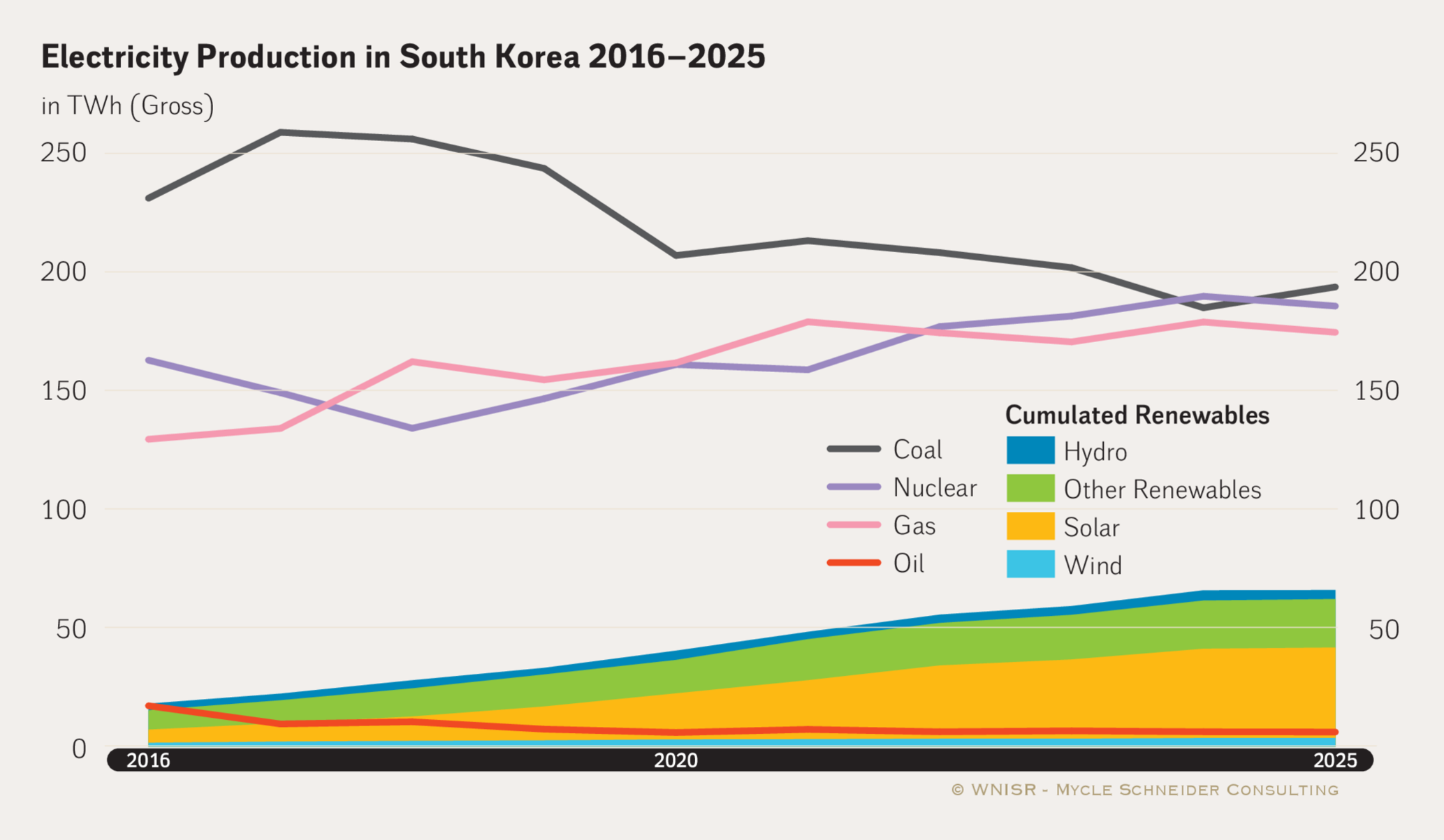
Source: Energy Institute, 2026
Increasingly Aging Power Plants
Since South Korea began operating its first nuclear power plant, Kori-1, in 1977, the country intensively built new nuclear power plants throughout the 1980s. The initial plants, Kori-1 and Wolsong-1, had a design operational lifetime of 30 years and their operating licenses expired in 2007 and 2012, respectively. Both plants received 10-year license extensions and continued operation, but their closures were ultimately confirmed in 2017 and 2019, respectively. Though the closure of Wolsong-1 was officially confirmed only in 2019, WNISR statistics consider it closed as of May 2017 when it ceased generating power (see past WNISR editions).
Kori-2, which began commercial operation in 1983, was shut down in April 2023 when its operating license expired and was therefore considered in LTO as of this date; however, following the NSSC’s approval of a 10-year operational lifetime extension (until April 2033) in November 2025,577 it resumed operation in April 2026,578 and thus left the LTO status. As of 1 July 2026, the average age of the South Korean fleet is 25.2 years, including the reactors in LTO (see Figure 42).
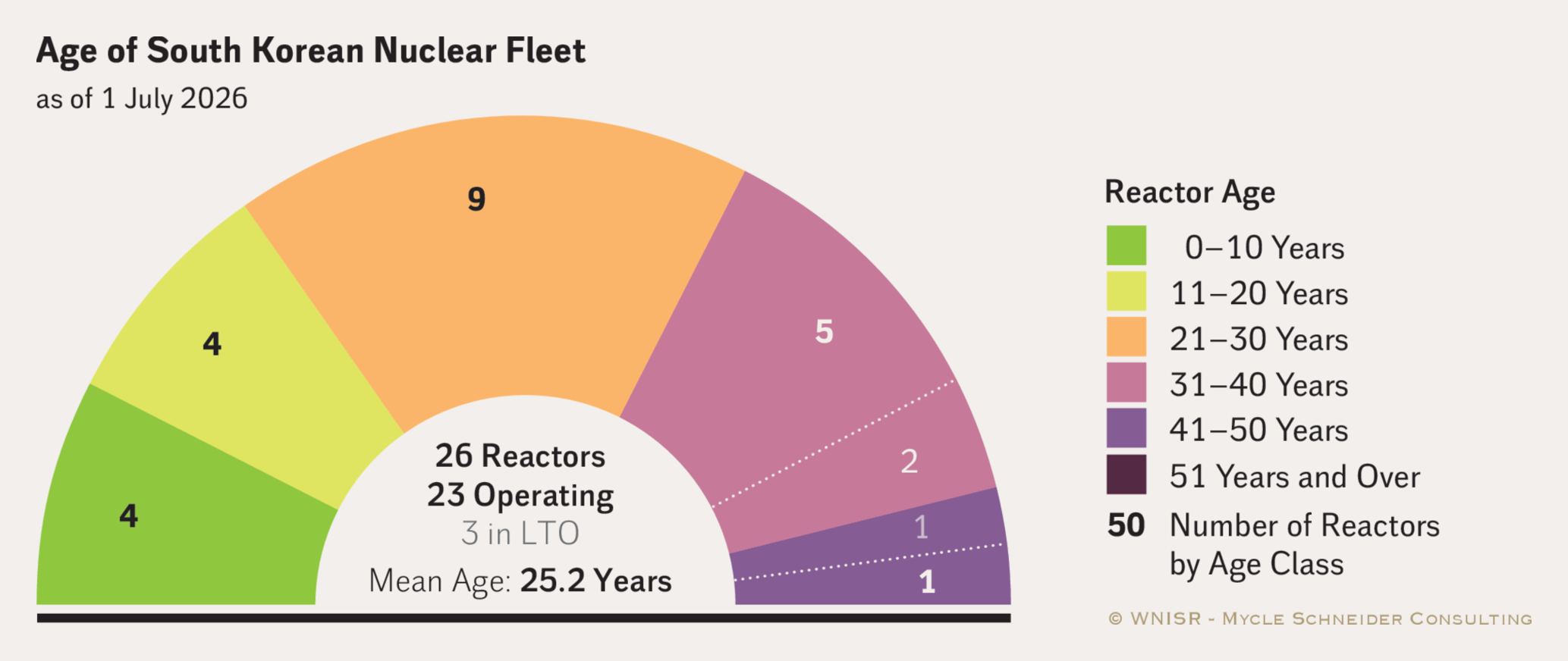
Sources: WNISR with IAEA-PRIS, 2026
As of mid-2026, Kori-3 and -4 and Hanbit-1 have ceased operations due to the expiration of their operating licenses, but as they are expected to restart, they are considered in LTO.579 Hanbit-2 is set to see its operating license expire in September 2026 and Wolsong-2 in November 2026. Subsequently, Hanul-1 and Wolsong-3 will reach the end of their operating licenses in 2027, followed by Hanul-2 in 2028 and Wolsong-4 in 2029. A total of nine reactors have either already seen or will see their present operating licenses expire by 2030, accounting for one third of the 26 units currently in operation or in LTO with expected restarts. See Table 10.
|
Reactor |
Net Capacity (MW)* |
Reactor Type |
Grid Connection** |
Commercial Operation Date |
Operating License |
|
Kori-3 |
996 |
PWR |
22 January 1985 |
30 September 1985 |
28 September 2024 |
|
Kori-4 |
1001 |
15 November 1985 |
29 April 1986 |
6 August 2025 |
|
|
Wolsong-2 |
571 |
PHWR (CANDU) |
1 April 1997 |
1 July 1997 |
1 November 2026 |
|
Wolsong-3 |
595 |
25 March 1998 |
1 July 1998 |
29 December 2027 |
|
|
Wolsong-4 |
569 |
21 May 1999 |
1 October 1999 |
7 February 2029 |
|
|
Hanbit-1 |
965 |
PWR |
5 March 1986 |
25 August 1986 |
22 December 2025 |
|
Hanbit-2 |
952 |
11 November 1986 |
10 June 1987 |
11 September 2026 |
|
|
Hanul-1 |
953 |
PWR |
7 April 1988 |
10 September 1988 |
22 December 2027 |
|
Hanul-2 |
957 |
4 April 1989 |
30 September 1989 |
28 December 2028 |
|
|
9 Units / 7.6 GW |
|||||
Source: Ministry of Climate, Energy and Environment, June 2026, with IAEA-PRIS580
Notes
* Reference Unit Power from IAEA-PRIS, as of 1 July 2026.
** From IAEA-PRIS, as of 1 July 2026, except for Kori-4 whose grid connection has been modified in PRIS with no explanation.
In 2022, the President promulgated an amendment to the Enforcement Decree of the Nuclear Safety Act that moved up the deadline for submitting the Periodic Safety Review (PSR)—a document essential for the review of operational lifetime extensions for aging nuclear power plants—from two to five years before the expiration of the existing operating license to five to ten years prior.581 The NSSC explained that the purpose of the amendment was to address the adverse effect of the existing system, where PSRs were often submitted at the last minute, causing delays in the review process and leading to temporary reactor shutdowns before review. Although the system change allows for earlier submission of PSRs, shutdowns continue due to the significant number of reactors awaiting review.
Reactors Under Construction and Planned
While no new reactor began operating in 2025, first grid connections are scheduled for 2026. In December 2025, the NSSC approved the operating license for Saeul-3.582 This is the reactor whose construction was suspended during the Moon administration; it received its operating license almost nine years after construction officially began with concrete pouring in April 2017. Following nuclear fuel loading and test operations, commercial operation is still announced for September 2026.583 Saeul-4 is reportedly targeting commercial operation in September 2027, following a review of its operating license in the second half of 2026.584
In 2023, equipment supply and construction contracts were signed for Shin-Hanul-3 and -4, projects that had been canceled under the Moon administration.585 A groundbreaking ceremony was held in October 2024, but concrete pouring only occurred in May 2025 and June 2026. Commercial operation is to start in 2032 and 2033, respectively.586
In January 2026, Kim Sungwhan, Minister of Climate, Energy and Environment, announced during a briefing that “We plan to finalize the new nuclear power plants included in the 11th Power Supply Plan at an early stage—through public opinion surveys and public forums—and incorporate them into the 12th Power Supply Plan.” 587
Subsequently, KHNP announced a public solicitation process for local governments to apply for sitings of two large-scale nuclear power plants and SMRs. The process required the heads of local governments wishing to host the facilities to submit documents such as letters of consent from their local councils and support plans. By the deadline at the end of March 2026, Yeongdeok County in North Gyeongsang Province and Ulju County in Ulsan had applied to host large-scale nuclear power plants, while Gijang County in Busan and Gyeongju City in North Gyeongsang Province had applied to host SMRs.588 Among the applicant regions, Yeongdeok County in North Gyeongsang Province was a site that KHNP had selected as a candidate for a new nuclear power plant in 2011 but later withdrew. The remaining regions are KHNP-owned sites that are adjacent to existing nuclear power plants.
Following the local governments’ applications, KHNP conducted site suitability assessments, onsite inspections, and public opinion surveys. Ultimately, KHNP selected Yeongdeok County as the final candidate site for a large-scale nuclear power plant and Gijang County as the final candidate site for an SMR.589 However, these sites have not yet been officially designated under the law. The Ministry of Climate, Energy and Environment plans to designate these sites as “Prearranged Area for Electric Power Development” by early 2027 after a strategic environmental impact assessment and consultation with relevant agencies. If everything did proceed as planned, construction on these power plants would begin in 2031, with the first two SMRs scheduled for grid connection in September and December 2034 and the second pair in March and June 2035, while the large-scale nuclear power plants are to be completed by 2037–2038.590
In 2009, a Korea Electric Power Corporation (KEPCO) consortium was awarded the contract to build four nuclear power reactors at the Barakah Nuclear Power Plant in the UAE. The initial contract was said to be worth around US$40 billion, including US$18.6 billion for design and construction plus an expected “approximately [US]$20 billion in additional [maintenance, replacement equipment and fuel supply] orders,” making it the largest single contract ever secured by South Korea at the time.591 The Barakah plant was constructed in phases, with Unit 1 generating first power in 2020 and all four units coming online by 2024.592
However, according to an analysis of KEPCO’s financial statements released in August 2025, the cumulative profit for “UAE nuclear power projects, etc.” turned into a deficit of KRW34.9 billion (US$202524.5 million), with a cumulative return on investment of −0.2 percent. The cumulative estimated profit for this project steadily declined from KRW435 billion (US$2023333 million; 2.0 percent) in 2023 to KRW72.2 billion (US$202453 million; 0.3 percent) in 2024, before turning into a deficit in 2025.593
The primary cause of the deficit was the increase in construction costs resulting from delays in the construction schedule compared to the original plan.594 Initially construction was to be completed on all four units by 2020, starting with the grid connection of Barakah Unit 1 in 2017.595 However, the project schedule was delayed by approximately four years, resulting in additional costs. See dedicated section in WNISR2025 and earlier WNISR editions.
A legal dispute also arose among South Korean state-owned enterprises over the settlement of additional costs incurred during the construction of the Barakah plant (see WNISR2025). In May 2025, KHNP filed for arbitration with the London Court of International Arbitration (LCIA), demanding an additional settlement of “around KRW1,569 billion [US$20251.1 billion]” from KEPCO, the main contractor and sole owner of KHNP.596
In the Barakah project, KEPCO served as the prime contractor, while KHNP was responsible for the Operational Support Services (OSS) related to commissioning. KHNP had been seeking cost adjustments since 2020, citing project delays and additional work orders attributable to KEPCO; however, after negotiations broke down, it opted for international arbitration. It is highly unusual for two state-owned enterprises to engage in a legal dispute, and a legal conflict between a parent company (KEPCO) and its wholly owned subsidiary (KHNP) is even more extraordinary.
As criticism mounted that KRW36.8 billion (US$24.5 million) in legal fees were being wasted in this process,597 the Ministry of Trade, Industry and Resources (MOTIR) recommended switching the arbitration body to the Korean Commercial Arbitration Board (KCAB), a domestic arbitration institution, and both parties withdrew their LCIA arbitration case.598 In May 2026, MOTIR announced a “comprehensive roadmap to streamline Korea’s nuclear export framework,” centered on a government-led consultative body and intended to prevent similar incidents in the future.599
In the past, KEPCO served as the prime contractor for the Barakah project in the UAE. In contrast, KHNP is the prime contractor for the Dukovany nuclear power plant project in the Czech Republic (see New Large Reactors at the Dukovany Site). At its first Nuclear Power Plant Export Strategy Council meeting in May 2026, MOTIR stated that, moving forward, the main contract for overseas projects will be awarded jointly, with roles clearly divided: KHNP will lead construction and operations, while KEPCO will “spearhead negotiations with partner countries and lead equity investments.” Additionally, the ministry plans to enact the tentatively-titled Nuclear Power Plant Export Promotion Act by the end of 2026 to strengthen export support provisions and establish a new government oversight authority, while also “evaluating the legal basis for a dedicated lead export agency responsible for the full project lifecycle—from feasibility studies and client negotiations to bidding and final contracting.” 600
Meanwhile, issues regarding mismanagement and deficits in overseas nuclear power plant projects continue to be a subject of controversy. According to KEPCO’s consolidated financial statements for 2025, KHNP’s “Provision for Construction Losses” in its overseas business segment totaled KRW1.4 trillion (~US$20251 billion) as of the end of 2025.601 “Provision for Construction Losses” is an accounting item that preemptively recognizes as a liability the loss that would occur if the total costs expected until project completion exceed total contract revenue. Although these are not confirmed losses, they represent the amount of loss projected at a given time.
Of the total provisions for construction losses, KRW1.2 trillion (US$2025844 million) stemmed from the El Dabaa nuclear power plant construction project in Egypt, which KHNP secured in 2022.602 Led by Atomstroyexport (ASE), a subsidiary of Russia’s Rosatom, this project is being constructed using VVER-1200 technology and therefore requires the procurement of equipment that complies with Russian standard specifications (GOST). However, KHNP’s lack of experience handling such equipment, combined with disruptions in procuring compliant materials due to the sanctions against Russia following the prolonged Russia-Ukraine war, has led to a sharp increase in costs. At the time of the contract award, the El Dabaa project in Egypt was promoted as the Yoon administration’s “first achievement in ‘nuclear power sales diplomacy’.”603 At the time, the President said in a Facebook post “I believe this contract will be a major boost in restoring the nuclear power ecosystem, which is currently facing difficulties.” 604
Another loss occurred in the Romanian Tritium Removal Facility (TRF) project, for which a contract was signed in 2023. Reportedly, due to Europe’s strict licensing procedures and changes in the client’s requirements, the project schedule was delayed by more than a year, resulting in a provision of KRW220 billion (US$2025155 million) in construction losses.605 An internal audit by KHNP revealed inadequate risk verification during the decision-making process for these projects, as the process consisted only of perfunctory meetings without the participation of external experts.606 In response, KHNP announced in May 2026 that it would establish a new department dedicated to managing overseas project risks and create a Risk Management Committee involving external experts.607
Launch of the High-Level Radioactive Waste Management Commission
In February 2025, the enactment of the “Radioactive Waste Management Act” provided the legal basis for establishing the “High-Level Radioactive Waste Management Commission,” an independent administrative body dedicated to high-level radioactive waste management policy. This committee, established under the prime minister, is responsible for overseeing site selection, support for host communities, and all aspects of facility construction and operation.608
|
Site/Units |
Reactor Type |
Spent Fuel Stored as of June 2026 (in Number of Fuel Assemblies) |
||
|
Pool Storage |
Dry Storage |
Total |
||
|
Kori 1–4 |
PWR |
5 260 |
5 260 |
|
|
Shin-Kori 1–2 |
PWR |
2 251 |
2 251 |
|
|
Saeul 1–3 |
PWR |
896 |
896 |
|
|
Hanbit 1–6 |
PWR |
7 758 |
7 758 |
|
|
Hanul 1–6 |
PWR |
6 437 |
6 437 |
|
|
Shin-Hanul 1–2 |
PWR |
1 307 |
1 307 |
|
|
Wolsong 1–4 |
PHWR (CANDU) |
106 172 |
420 240 |
526 412 |
|
Shin-Wolsong |
PWR |
1 068 |
||
|
Total |
131 149 |
420 240 |
551 389 |
|
Source: KHNP, Public Data Portal, Government of South Korea, July 2026609
Note: PWR: Pressurized Water Reactor; PHWR: Pressurized Heavy-Water Reactor; CANDU: CANadian Deuterium Uranium.
As of the end of June 2026, a total of over 551,000 spent nuclear fuel assemblies are stored in South Korea, and all of this spent nuclear fuel is stored on nuclear power plant sites. Due to the high fuel consumption characteristic of CANDU reactors, close to 96 percent of the total spent nuclear fuel (based on fuel assemblies) is stored at the Wolsong site. Except for the 420,240 fuel assemblies stored in the dry storage facility at the Wolsong site, all remaining spent nuclear fuel is stored in wet storage pools within the plant (see Table 11).610
As the operating periods of these plants extend, the wet storage pools at each plant are nearing capacity. In June 2026, KHNP announced plans to construct a dry storage facility at the Hanbit site that would store 4,810 fuel assemblies and is intended to commence operations in July 2030.611 KHNP also plans to install similar dry storage facilities at the Hanul and Kori sites in the future.
Meanwhile, in accordance with the Act, the High-Level Radioactive Waste Management Commission held its first meeting in February 2026 and began full-scale operations.612 According to the Act, interim storage facilities must begin operations by 2050, and disposal facilities must begin operations by 2060. To achieve these goals, the Management Commission announced that it will establish criteria for excluding unsuitable sites by the end of 2026 and begin the site selection process for local governments starting in 2027.
SMRs: Roadmap for R&D and Regulatory Framework Development
In South Korea, SMR Research and Development (R&D) is broadly divided into the Innovative Small Modular Reactor (i-SMR) currently being developed by the Innovative SMR Development Agency led by KHNP; non-light-water-reactor/special-purpose SMRs being developed by the Korea Atomic Energy Research Institute (KAERI); and other SMRs being pursued by universities and public corporations.
Among these, the i-SMR project is making the most rapid progress. This public-private project aims to develop a 170-MWe-class SMR through an initial 69-percent government contribution to a total of KRW399.2 billion (US$2023306 million) R&D budget over six years starting in 2023. The Innovative SMR Development Agency, launched in 2023, has set the goal of obtaining Standard Design Approval (SDA) from the NSSC by the end of 2028 and achieving commercialization and exports in the 2030s.613 To this end, the i-SMR Agency submitted its SDA application to the NSSC in February 2026.614
Separate from the SMR SDA, the 11th BPE, finalized in February 2025, had already incorporated a plan to complete four SMR modules between 2034 and 2035. It is highly unusual for the national power plan to include construction plans for a reactor model that has not yet received regulatory approval. In June 2026, Gijang County, was selected as the site for the first i-SMR, and licensing procedures, including a strategic environmental impact assessment, are scheduled to proceed thereafter.
SMART (System-integrated Modular Advanced ReactTor) is South Korea’s flagship SMR, developed before the i-SMR. Designed as a multipurpose integrated light-water reactor with a thermal output of 330 MWt, SMART received SDA from the NSSC in July 2012615 but never found a buyer. Designed to simultaneously generate electricity and desalinate seawater, following SDA, SMART was the subject of efforts to establish a joint venture for the construction of a demonstration reactor in Saudi Arabia; however, these efforts did not result in actual construction.616 Subsequently, KAERI and the Saudi Royal Commission for Nuclear and Renewable Energy developed “SMART100”, an upgraded version of the original SMART with an increased output of 365 MWt that received SDA from the NSSC in September 2024.617
|
Name |
Design Organization |
Capacity (in MWt/MWe) |
Coolant |
|
i-SMR |
i-SMR Development Agency |
520/x175 (per module) |
Light Water |
|
SMART100 |
KAERI |
365/110 |
Light Water |
|
SALUS-100 |
KAERI |
267/100 |
Liquid Sodium |
|
BANDI |
KEPCO E&C |
200/60 |
Light Water |
Sources: Various, compiled by WNISR, 2026
The sodium-cooled reactor Small Advanced Long-cycled and Ultimate Safe SFR [Sodium-cooled Fast Reactor] (SALUS), on which research began in 2021 with support from the Ministry of Science and ICT, is a design that adapts existing research-grade fast reactor technology for power generation.618 BANDI, currently under development by KEPCO E&C, is a ship-based or offshore SMR.619 Further designs are under development that either have specific uses like naval applications or are pure heat production reactors. Both families of designs are not covered by WNISR.
As such, SMR development in South Korea is being pursued through a public-private partnership led by the government and public enterprises, with participation from private companies, and a variety of reactor types are being developed (see Table 12).
In February 2026, the NSSC announced the SMR Safety Regulation Establishment Roadmap (2026–2030). Promoters of eight designs (including designs that WNISR does not cover) are expected to apply for licenses in the 2030s. The NSSC stated that it will enact the tentatively-titled Rules on Technical Standards for Small Modular Reactors by 2028 and will revise the existing regulatory framework—which has primarily focused on power generation and research/education—to accommodate diverse applications such as marine use, heat supply, and hydrogen production, with the goal of phasing in the SMR licensing system by 2030.620

Sweden’s nuclear fleet of six reactors generated 44.3 TWh in 2025, a 7.9 percent decrease compared to the previous year. Nuclear accounted for 27.4 percent of the country’s total gross electricity production, 2 percentage points down from 2024.621 The share of nuclear power in the country’s electricity mix peaked in 1996 at 52.8 percent when twelve reactors were operating, while the fleet reached its highest output of over 77.7 TWh in 2004 with eleven units still on the grid. Refer to Sweden Focus in WNISR2024 for details on the Swedish nuclear energy policy and past developments.
Lifetime Extensions for an Aging, Underperforming, Fleet?
The mean age of the Swedish fleet is 44 years, with all reactors over 41 years622 and operating on extended lifetimes (or “long-term operation”). The operators intend to go much further than the first prolongation to 60 years.
In June 2024, state-owned company Vattenfall, the majority-owner-operator of the three Boiling Water Reactors (BWRs) at Forsmark and the two Pressurized Water Reactors (PWRs) at Ringhals that were connected to the grid between 1980 and 1985, announced that it had “taken a directional decision to extend the operating lifetime of the plants’ reactors from 60 to 80 years,” and therefore was awaiting an “in-depth investigation”.623 This would push their closure dates into the 2060s. The “in-depth investigation” which “will include more detailed cost calculations and an analysis of identified risks in terms of expertise and suppliers, among other things,” is set to conclude this year, after which an investment decision will be taken. In a November 2025 announcement, Vattenfall said that—so far—no “showstoppers” had been identified that would hinder the technical feasibility of further lifetime extensions, but inspections of the reactor vessels at Forsmark-3 and Ringhals-3 were still ongoing.624 The final decision to follow through on operations beyond 60 years is pending a net positive investment review that is due after the technical investigation concludes. According to an article from TT News Agency (as published by Tidningen Näringslivet), damaged welds in the pressure vessel of Ringhals-3 could limit its lifetime extension. Further, the article noted that the final decision is—apparently—not expected before the end of 2027.625
In September 2024, the owners of Oskarshamn-3, Uniper and Fortum, declared the launch of a study to investigate the reactor’s operation beyond its current expected lifetime, 2045, “well into the mid-2060s.” 626 So far, there have been no public announcements of the investigation’s results.
Independent of the outcome of all these investigations and the decisions in principle to extend operating lifetimes, every reactor must pass decennial safety reviews by the Swedish Radiation Safety Authority (Strålsäkerhetsmyndigheten or SSM). Forsmark-3 passed its inspection in October 2025 and may operate until 2033, with SSM identifying “some shortcomings” but “no obstacles” to further operation.627 Additionally, a 100-MW power uprate at Forsmark-1, done in two 50-MW steps, was completed in December 2025, bringing the total electrical output to 1.12 GW.628
In recent years, the operations of Swedish nuclear power reactors have been plagued by a series of unplanned and extended outages. The operations at the Ringhals site experienced major challenges in 2022 that seemed to have been resolved.629 However, over the course of the first half of 2026, additional challenges have emerged. Ringhals-3 was taken off the grid for scheduled service and maintenance on 4 May and was initially planned to be restarted in mid‑July.630 In June, delays in replacing bolts in the reactor vessel and additional necessary work on the heat exchanger—especially the removal of rubber debris which had come lose from brittle valves—postponed the restart date to 30 August.631, 632
The detection of rubber residue in the cooling system at Ringhals-3 prompted Vattenfall to take the second operational reactor of the plant, Ringhals-4, completely off the grid on 30 June to further investigate the issue. The reactor is planned to resume operations after its scheduled maintenance period ends on 15 October.633 Ringhals-4 had been operating at half capacity since 23 May after a water leak was detected in one of the generators. At the time of the announcement, these repairs were expected to be completed by 7 August.634
The issues related to faulty valves at Forsmark-3 from 2024 through 2025 seem to have been resolved (see past WNISR editions).
On 28 March 2025, after achieving its longest run of consecutive days generating power, according to operator OKG, Oskarshamn-3 was taken off the grid for refueling and maintenance planned to last “just under three weeks.” 635 In April 2025, cracks were discovered in several critical pipes, leading to an extension of the outage until 15 June. By May, this had been further extended until mid-August,636 and on 26 June, restart was pushed to early September.637 With tests not going according to plan, restart was delayed yet again, first to mid-October638 and then to the end of the month,639 before the unit finally being reconnected to the grid on 2 November 2025.640 It was taken offline again for seven days in December.641 In February 2026, the unit was taken offline once more due to faulty seals at a number of valves. The Nord Pool power exchange announced that it would not restart before the end of its next planned annual outage which was scheduled to begin on 28 March 2026, meaning the reactor would remain offline until at least 22 May 2026.642 Since then, the projected restart date has been pushed back several times, and in June it was scheduled for 10 July 2026.643, 644
Swedish Nuclear Policy Reversal—Embracing Newbuild
In changing its 2040 electricity production target from “100% renewable” to “100% fossil-free” in June 2023, Sweden paved the way for nuclear newbuild in the country.645 New plans envisioned 2.5 GW of new nuclear on the grid by 2035 and the equivalent capacity of ten new large reactors by 2045,646 with most recent financing schemes aiming to support up to 5 GW of new capacity until 2037 (see below).647 The outgoing Swedish Government has taken the view that “new nuclear power is an investment in society that requires the state to assume a new role.” 648 This new role entails amending regulatory procedures to accelerate licensing processes and allow more potential sites, increasing public funding for nuclear, and actively participating in proposed newbuild projects as an investor or loan provider to share the investment risk. While elections in September 2026 might bring about a new policy shift; an overview of recent activities is provided below.
The outgoing Swedish Government has taken the view that “new nuclear power is an investment in society that requires the state to assume a new role.”
In January 2024, a “national nuclear new-build coordinator” was appointed, tasked with identifying necessary measures, removing regulatory hurdles, coordinating with all stakeholders, and promoting new nuclear development.649 The coordinator’s final report was initially scheduled for completion at the end of 2026, however in June 2026 his mandate was extended to December 2028.650 In the second interim report, published in January 2025, the coordinator lists several completed, ongoing, and planned promotional measures to support Swedish nuclear newbuild, for example, the potential financing of pilot and demonstration plants by the Swedish Energy Agency or the development of a financing model for new nuclear plants by the Ministry of Finance. The coordinator notes that from a regulatory perspective, the acceleration of the licensing process for up to 2.5 GW of new nuclear is necessary and is “the most challenging aspect.” The report elaborates that the newly proposed permitting process is estimated to take 10 years from application to grid connection but acknowledges that “there are some uncertainties about the efficiency of the process when it is used for the first few times.” The report concludes, therefore, that parallel expansion projects involving “at least two sites” is the strategy most likely to achieve the targeted 2.5 GW deployment by 2035.651
As of 1 July 2026, four additional interim reports had been published, bringing the total to six. The third report, published in November 2025, urges increased activities on defining a coherent national nuclear strategy, coordinated workforce planning, strengthened stakeholder engagement, and clarified waste management arrangements. Moreover, it highlights the necessity of continued government support for the nuclear plans to succeed.652
The fourth report, published in February 2026, discusses remaining regulatory and supply-chain risks in Sweden and recommends inter-agency coordination and the alignment of Swedish regulation to other “relevant nuclear power countries”, like the US, the UK, France, or Finland.653
The fifth report, published only ten days later, recommends the creation of a “Workforce Supply Council” to increase coordination in the fragmented nuclear workforce and develop a strategy for “skilled labor in the nuclear sector.” This strategy could involve the establishment of a new research reactor, developed jointly with the Nordic neighbors.654
The, sixth, and so far, last interim report was published in June 2026655 and refers to the selection of Rolls-Royce SMR design as the first Swedish SMR by Vattenfall subsidiary Videberg Kraft AB (see below) and notes that this selection should be used for strategic international collaboration with the UK and the Czech Republic. The report also suggests the government request a so-called “Construction Readiness Review” 656 with the IAEA “as a form of risk analysis, due diligence…prior to the implementation of state ownership, provided that the timing aligns with the intended process.”
Sweden’s nuclear expansion ambitions require building up a qualified workforce. This includes staff for regulator SSM but also for operating and maintaining the planned reactors. SSM Director General Michael Knochenhauer said in an interview in March 2025 that Sweden was “not quite ready to step it up,” and urged for increased funding for university and vocational training programs in nuclear engineering and radiation safety management to ensure sufficient well-trained staff for the operation of the planned new nuclear capacities in addition to the continued operation of the existing reactors.657 His concerns echo the findings of a report from the Swedish Energy Agency released in late 2024 (see section on Sweden in WNISR2025 for further detail).658
Since WNISR2025, the outgoing Swedish Government proposed several regulatory amendments. For example, the Environmental Code was amended to lift existing bans on new nuclear projects in certain coastal areas.659 In an attempt to “remov[e] regulatory barriers” that will “simplify permitting processes and enable more nuclear power to be generated in more locations,” the government and local municipalities may participate at earlier project stages than before, and binding preliminary decisions regarding “technical matters” can be obtained. Further, restarting closed reactors was proposed to be legally possible.660 In May and June 2026, amendments to the Environmental Code were approved by the Riksdag (Sweden’s parliament), as well as approvals of regulatory changes to permitting processes to “establish a more effective review of nuclear facilities” to provide “better conditions […] for market participants,” which also allows for the possibility of restarting closed reactors.661 Amendments to the Environmental Code also resulted in changes to the regulations for the extraction and processing of nuclear materials, meaning that “uranium will be treated in the same way as other metals and minerals within the framework of the overall licensing process” and that “the Environmental Code will no longer cover facilities for the extraction and processing of nuclear materials.” Furthermore, in a controversial move, local municipal veto rights were cut in the name of national interest.662
The amendments also introduce new pre-licensing “dialogues” for applicants in which they may inquire with SSM regarding necessary documents for licensing procedures to commence. Additionally, a preliminary ruling regarding the suitability of sites or reactor and plant designs shall be made by the “regulating authority” upon request by an applicant.663 This process seems to mirror the licensing approaches in other countries, such as the UK or Poland (see United Kingdom Focus and Poland Focus).
Furthermore, the changes also introduced a new approval process in which decisions-in-principle on the plant design, its emergency planning zones, and the location itself would be made by the Swedish Government. The local governments are to be included in the decision process and the respective County Administrative Boards must provide a “Facility Plan” (Anläggningsplan) based on which the strategic land-use decision, regarding water and land use, as well as necessary additional infrastructure development, would be made. This must be approved by the local municipality first, then by the Swedish Government. This process does not, however, constitute technical or environmental licensing procedures and is separate from an actual construction or operation license for which SSM remains responsible.664
In addition to regulatory changes, the state is beginning to financially support new projects. New legislation entered into force in August 2025. It allows the state to provide loans to projects to reduce financing costs. The state, however, may not provide all the necessary capital, but it may enter into power purchase agreements (so-called two-way CfDs) with prospective operators to provide guaranteed income.665 State ownership in project companies is also an option. The state hopes for these various support schemes to result in up to 5 GW of new nuclear projects.666
In December 2025, Vattenfall’s subsidiary project company Videberg Kraft was the first company to apply to the Swedish Government for “financing and risk-sharing” of its newly planned project near the existing Ringhals power station on the Värö Peninsula. With this application, negotiations began which will be subject to the European Commission’s approval regarding state aid.667 In June 2026, following parliamentary consent to the financial commitment (see below), Vattenfall and the outgoing Swedish Government announced they had come to an agreement: the government is to purchase a 60 percent share in the project company. The European Commission’s decision is expected for the second half of 2027, after which the ownership transfer is planned to take effect.668
This would leave Vattenfall with a 20-percent share in Videberg Kraft. In November 2025, Vattenfall and the consortium Industrikraft—consisting of the companies ABB, Alfa Laval, Boliden, Hitachi Energy, Höganäs, SSAB, Saab, Stora Enso, and the Volvo Group—had agreed on a 20-percent equity stake transfer of Videberg Kraft, worth SEK400 million (US$202540.7 million).669
As of 1 July 2026, three more companies have submitted applications for state aid: Nordic Baseload Power (NBP),670 which is aiming to build two large reactors totaling 2.5 GW at the existing Barsebäck site near Malmö,671 and Blykalla672 and Studsvik,673 which are both planning on building SMRs (see Sweden’s SMR Ambitions below for details).674 In its press release, NBP indicates it applied for both state aid and governmental approval in June 2026 for its project to build two Boiling Water Reactors-Nordic (BWR-N) provided by Nordic Nuclear Energy (NNE). It says it expects the first unit “could be operational well before 2035—considerably earlier than is realistic for SMR projects.” 675 NNE is currently in pre-licensing dialogues with SSM and the Finnish regulator regarding its reactor design. So far, the company has no experience in designing let alone building nuclear reactors. It seems noteworthy that Uniper, the owner of the Barsebäck site, does not seem remotely interested in granting access to NBP.676
The outgoing government’s ambitions are reflected in state spending. The 2025 budget allocated SEK132.5 million (US$202513.5 million) to regulatory and policy-related activities aiming to create favorable conditions for new nuclear.677 The 2026 budget, presented to the Riksdag in September 2025,678 and updated in April 2026,679 includes substantially higher spending plans and corresponding authorizations dedicated to newbuild projects. With the amendments approved by the Riksdag in June,680 the government is now authorized to acquire 60 percent of the shares of Videberg Kraft and invest up to SEK1.8 billion (US$193 million) in the form of capital injections. Until 2045, it may allocate a maximum value of SEK34.3 billion (US$3.7 billion) as further capital injections or acquisition of shares. While the government must retain a variable stake in the company between 51 and 65 percent, it was not disclosed whether it will have to sell its stake after the allocated funds are used up or the funding period ends. Note that Vattenfall is already a fully state-owned company. This means that Videberg Kraft would be 80 percent state-owned if the transfer occurs in late 2027 as planned. The proposed budget notes “Expenditures for capital injection and an increase or reduction of the state’s vote share and shareholding in Videberg Kraft are expected to be included in the central government budget starting in 2030. The calculations are associated with uncertainty, and the amount of funding needed may be higher.” 681
Furthermore, the government is authorized to provide loans to project companies up to a maximum total of SEK220 billion (US$23.6 billion) until 2045 for a maximum of 5 GW of new capacity. It allocated SEK50 million (US$5.4 million) each in 2026 and 2027 and SEK150 million (US$16.1 million) in 2028. Additionally, money is being set aside for expected future payments towards a CfD scheme that is allowed to cost a maximum of SEK400 billion (US$43 billion) from 2035 to 2085. The current annual provisions amount to SEK1 million (~US$107,000). Finally, the Spring Amendment sets aside targets for a risk sharing mechanism between the first project company and the government for the provision of funds for a new waste management scheme that is, as of 2026, to cost up to SEK122 billion (US$13 billion) from the year 2035 to the year 2159, excluding contingencies for cost increases of up to SEK61 billion (US$6.5 billion). The allocation of financing risk will be subject to future negotiations with respective project companies.682
In August 2025, majority-owner of Videberg Kraft, Vattenfall announced that two SMR designs had been shortlisted for its project on the Värö Peninsula, next to its Ringhals site. The project would either consist of five GEH BWRX-300 reactors or three Rolls-Royce SMRs.683 Both concepts are yet to be licensed in the EU or fully built anywhere in the world (see chapter on SMRs). Vattenfall had voiced reluctance to build “first-of-a-kind” projects in 2024.684 In June 2026, however, the company announced that Rolls-Royce had been selected to build three SMRs totaling 1.4 GW.685 Rolls-Royce said at the time that “the first unit in Sweden is expected to enter operation in the mid-2030s.”686, 687 As previously mentioned, shortly thereafter the government and Vattenfall revealed they had signed a shareholder agreement under which the state would acquire a 60-percent stake in Videberg Kraft, with targeted implementation in 2027, provided the mechanism receives approval from the European Commission.
As of mid-2026, two companies had applied for the new government-led decision-in-principle-process (see above) for their respective SMR newbuild projects. These processes do not constitute actual licensing activities that are necessary for a dedicated construction license. One company that has applied for the process is Studsvik, a Swedish provider of engineering and software services to the nuclear industry, via its subsidiary ReFirm Målma AB, which Studsvik partially owns through Kärnfull Next, a project developing company it acquired in March 2026.688 ReFirm Målma submitted its plan to build four to six SMRs in Valdemarsvik in May 2026.689 While the Ministry of Climate and Enterprise clarified at the time of submission that “the site proposed by the company in its application is located along a stretch of coastline where it is currently not possible to construct new nuclear facilities,”690 these restrictions were removed from the Environmental Code in June 2026, as mentioned above.691
Following this application, the responsibility for an initial assessment was transferred to the County Administrative Board of Östergötland, which must now draw up a “Facility Plan”, including environmental impact assessments, planning procedures, and implementation recommendations by the end of the year.692 With Sweden having no experience in licensing nuclear construction for some 45 years, and a local governments unlikely to have relevant planning experience, it remains to be seen whether this will go as planned.
In its application, ReFirm Målma proposed 1.2 to 1.6 GW of SMRs but did not mention potential reactor concepts.693 However, it still hopes to begin construction by 2030, despite having received no approval for the project from the government, the local municipality, or from SSM.694 On the one hand, Studsvik did sign an MoU with Rolls-Royce SMR in March 2026 “to explore further collaboration and broaden their relationship across Studsvik’s full range of services” that would support the SMR program, specifying that the preliminary agreement “covers several technical areas, including fuel qualification and testing, plant life management, hot cell technology, core design and operational modelling, and regulatory licensing support.” 695 On the other hand, with no additional information published, it remains to be seen, whether this indicates a move towards Rolls-Royce SMRs for the project in Valdemarsvik.
In May 2026, Studsvik submitted an additional application within the same process for a nuclear facility in the municipality of Nyköping.696 The process can proceed once the Södermanland County Administrative Board has completed a “Facility Plan”, which is expected for December 2026. This site plan would “provide guidance on how land and water areas are to be used in connection with the establishment of a nuclear facility.” As with the county of Östergötland and the related project in Valdemarsvik, this target seems ambitious given this Administrative Board’s lack of experience. The Nyköping facility is expected to house two to four SMRs with a total capacity of 600 MW to 1.4 GW.697
Studsvik applied for state aid in June 2026. This application covers both planned projects in Nyköpping and Valdemarsvik and is envisioned to result in up to 3 GW of installed SMR capacity.698 As of mid-July 2026, a specific reactor vendor was yet to be selected.
The second company to apply for a governmental approval under the new process is Blykalla AB, formally LeadCold, a Swedish company developing the Swedish Advanced Lead Reactor (SEALER).699 The reactor is designed with 55 MW electrical capacity (140 MW thermal).700 In 2022, a demonstration reactor with 80 MWth output was planned to go online by 2030, with the non-nuclear prototype SEALER-E operating until 2024,701 but so far, the projects are delayed. Construction of the SEALER-E prototype began at the Oskarshamn site in early 2025 with first tests planned to begin before the end of the year.702 As of 1 July 2026, no updates on the project had been published. Therefore, with no further announcements regarding SEALER-E or the SEALER-D demonstrator, the targets of commissioning a 140-MWth SEALEAR-55 reactor and “start[ing] serial production of SEALER-55s in the early 2030s” seems ambitious.703 Regardless, Blykalla aims to build six of these reactors in Norrsundet in the municipality of Gävle, totaling 330 MW of electrical capacity.704, 705 As mentioned above, Blykalla was the third company to apply for state aid under the new support scheme. The application is for the Gävle project.706
Sweden’s substantial renewable capacities, totaling 42.8 GW in 2025, consist of stable 16.3 GW of hydropower that provided about 40 percent of the country’s total electricity production in 2025. Onshore wind capacities grew by 562 MW year-on-year to 17.2 GW, while offshore capacities have been stagnating for at least a decade at around 200 MW.707 They are not expected to more than double until the end of the current decade.708 Wind energy generated 22.8 percent of the power mix, up from 10 percent in 2015. PV capacities increased by about 733 MW year-on-year, down from an installation of 847 MW in 2024 and a record of 1.5 GW installed in 2023.709 However, the total installed PV capacities of 5.5 GW provided only 2.6 percent of the country’s electricity. Bioenergy provided an additional 5.9 percent, while gas and “other fossil” contributed just 1.2 percent to Sweden’s power mix.710

On 17 May 2025, Taiwan entered a historic phase in its energy transition. Following the expiration of the operating license for Unit 2 of the Maanshan plant (the Third Nuclear Power Plant), the country ceased generating electricity from commercial nuclear reactors for the first time in more than four decades.711 The closure also marked a major policy milestone for the Democratic Progressive Party (DPP) administration, which had long identified the realization of a “nuclear-free homeland” as one of its core governing principles.
The closure of Maanshan-2 completed the progressive national nuclear phaseout plan that started on 31 December 2014 with the closure of the first of a fleet of six reactors at three sites (see Figure 44). The nuclear power option nevertheless remains on the table. Even before the last reactor was retired, opposition lawmakers from the Kuomintang (KMT) and the Taiwan People’s Party (TPP) had begun pursuing legislative initiatives to reshape Taiwan’s nuclear governance framework. Amendments to the Nuclear Reactor Facilities Regulation Act were introduced in late April 2025, passed by the legislature in mid-May, and promulgated by President Lai Ching-te (also known as William Lai) on 23 May 2025, less than a week after the Maanshan unit had ceased operation.712 The amendments created a legal pathway for renewing operating licenses of closed reactors.
While the previous regulatory framework had treated reactor retirement as effectively irreversible, the revised legislation transformed Taiwan’s nuclear phaseout from having a definitive endpoint into a contingent and potentially reversible process. At the same time, the opposition parties sought to revisit the issue through a referendum on the continued operation of the two Maanshan reactors. On 23 May 2025, the Central Election Commission confirmed the validity of the proposal. The referendum was subsequently held on 23 August 2025. Voters were asked: “Do you agree that the Third Nuclear Power Plant [Maanshan] should continue operating, provided that the competent authority confirms there are no safety concerns?” The question was misleading as it neglected the difference between continuing operation and restarting the nuclear reactor, the latter of which involves many technical and legal hurdles.
The results of the referendum revealed a striking contrast between voter preferences and the legal requirements for a binding outcome. Among those who cast ballots, support for restarting the plant was overwhelming: approximately 74 percent voted in favor of the proposal, while only 26 percent opposed it. However, because the number of affirmative votes did not exceed 25 percent of all eligible voters, the referendum failed to meet the legal threshold required to become binding.713 This outcome gave rise to competing interpretations. From a legal perspective, the referendum had failed. Politically, however, supporters of nuclear power interpreted the result as evidence that a substantial majority of citizens favored reconsidering the role of nuclear energy in Taiwan’s energy future. Rather than closing the debate, the referendum reopened it.
The paradox reflected a deeper tension between electoral participation and institutional legitimacy. Taiwan’s referendum mechanism requires both majority support and minimum turnout thresholds. Consequently, the referendum produced what may be termed a divergence between “voting majorities” and “institutional majorities”. While anti-nuclear advocates emphasized the legal failure of the referendum, proponents highlighted the substantial margin of support among participants.
Nuclear Restart Under Review with Conditions
President Lai Ching-te expressed openness in principle to restarting Taiwan’s nuclear power plants, arguing that nuclear energy could enhance the country’s resilience in the face of national security threats. At the same time, he emphasized that any restart must satisfy three conditions: compliance with stringent nuclear safety standards, acceptance by affected local communities, and a viable solution for nuclear waste storage and disposal.714 Meanwhile, economic and technology-related bureaucracies began initiating the administrative procedures necessary to prepare for potential reactor restarts, including feasibility assessments, self-implemented safety inspections, and regulatory reviews.715
While the KMT interpreted Lai’s positioning as signaling a policy reversal and the DPP administration’s acceptance of nuclear restarts,716 DPP politicians and government officials stressed the conditional nature of his position, reiterating that nuclear safety, local consent, and effective nuclear waste management remained indispensable prerequisites. In response, environmental NGOs and civic organizations mobilized collectively to protest the prospect of restarting the reactors.717 Following the referendum, the debate gradually shifted away from electoral mobilization and toward bureaucratic governance. The center of controversy moved from ballot boxes to regulatory institutions.
In late November 2025, the Ministry of Economic Affairs approved restart feasibility assessments for Taiwan’s retired reactors. According to these evaluations, the twin reactors at Chinshan (or Jinshan) were deemed unsuitable for restart, whereas the twin units at Kuosheng and those at Maanshan were considered technically feasible candidates for renewed operation.718
Taipower was subsequently instructed to initiate preliminary preparations, including self-implemented safety inspections and the drafting of restart plans. The utility estimated that comprehensive safety inspections would require approximately eighteen to twenty-four months. The process includes aging management assessments, seismic evaluations, equipment inspections, personnel reviews, and technical analyses involving cooperation with the original equipment manufacturer, Westinghouse Electric Company. This phase of preparations has represented a normalization of reconsidering nuclear through administrative procedures. Rather than debating whether nuclear power is inherently desirable or undesirable, policymakers have increasingly focused on whether restart conditions could satisfy regulatory requirements.719
Public remarks delivered by President Lai in March 2026 further accelerated this transition. Citing growing electricity demand associated with artificial intelligence industries, international decarbonization pressures, and geopolitical uncertainty, Lai argued that Taiwan had entered a “new situation”. He reiterated that any nuclear restart must satisfy the three conditions of nuclear safety, solutions to nuclear waste, and social consensus.720 Nevertheless, his comments signaled a remarkable evolution in the DPP’s energy discourse. Under previous administrations, nuclear phaseout had been framed primarily as an ethical and democratic commitment. Under Lai, nuclear energy has been increasingly framed as one option within a broader strategy of national resilience. Energy security concerns, especially amid geopolitical tensions and industrial competitiveness pressures, enabled the reinterpretation of nuclear energy from an ideological question to one of pragmatic governance.
On 10 March 2026, in response to a question from Taiwan People’s Party legislator Liu Shu-pin during a legislative hearing, Taiwan’s Minister of Economic Affairs, Kung Ming-hsin, stated that the earliest possible restart date for the Maanshan plant would be 2028, provided that all inspections, regulatory reviews, and equipment replacement work proceed as scheduled.721 On 22 March 2026, Wu Szu-yao, Secretary-General of the DPP Legislative Caucus, told reporters that the restart of nuclear power was in the early stages following the passage of the Nuclear Reactor Facilities Regulation Act at the Legislative Yuan, Taiwan’s Parliament. She emphasized that the current phase merely involves initiating the necessary independent safety inspections, describing the process as “just beginning”. She added that restarting nuclear power would be “not even close to being finalized,” and that the process would be measured in years722 Another DPP legislator, Su Chiao-hui, who is expected to run for mayor of New Taipei City, reiterated that the government must first wait for the results of the safety inspections. She also reaffirmed the DPP’s three principles for a nuclear restart.723
On 18 March 2026, the chairperson of the Nuclear Safety Commission (NSC) and officials from the Ministry of Economic Affairs (MOEA) briefed the Legislative Yuan on the progress of the restart plans for Kuosheng and Maanshan.724 The restart application for Maanshan would be submitted shortly, while that for Kuosheng was significantly delayed. The outdoor dry storage facility for spent fuel at Kuosheng had not yet become operational, thus spent nuclear fuel could not be unloaded from the storage pools, which in turn prevented the plant from conducting required onsite safety inspections. Consequently, the submission of the restart application for Kuosheng-2 is expected to be delayed by approximately one year. Even if the process did proceed smoothly thereafter, the earliest possible restart date would be 2029.725
On 27 March 2026, Taipower formally submitted its application to renew the operating license of the Maanshan plant.726 The application included a restart plan covering organizational arrangements, operational procedures, quality assurance mechanisms, personnel training, and implementation schedules.727
The NSC completed procedural review of the application on 8 April 2026, confirming that the submitted materials satisfied statutory requirements and allowing the case to proceed into substantive technical review.728 Importantly, this stage did not imply that safety concerns had been resolved; rather, it signified the beginning of an extended regulatory assessment process.
Subsequent developments reflected increasing institutionalization of the process. Preparatory meetings were convened. Local briefing sessions were organized. Inspection teams conducted onsite visits to examine critical facilities, including control rooms, containment structures, emergency diesel generators, seawater intake systems, and spent fuel pools.729 On 29 May 2026, the NSC held its first comprehensive joint review meeting concerning the restart proposal.730
Local Briefing as a Site of Contestation of Nuclear Restart731
The NSC’s local briefing session held on 28 April 2026 in Hengchun Township—where the Maanshan plant is located—became a highly visible arena in which supporters and opponents of restart articulated competing positions. The participants included local residents, township representatives, legislators, environmental organizations, academics, and officials from both the NSC and Taipower. Rather than producing consensus, the meeting revealed a clear rivalry between two camps that differed sharply in their assessments of nuclear risks, energy needs, and the future of the Hengchun Peninsula.732
Supporters, Neutrals…
Supporters of the Maanshan plant restart included local political leaders, some residents, local government representatives, and opposition politicians, particularly from the KMT. Although they acknowledged that nuclear safety should remain the highest priority, they generally viewed restart as a reasonable and necessary option under Taiwan’s changing energy circumstances.
The mayor of Hengchun Township adopted a cautious stance. He emphasized that nuclear energy “must be one hundred percent safe” and called on the NSC to ensure rigorous oversight and strict implementation of safety requirements. A representative from Checheng Township—bordering Hengchun to the north—explicitly supported restart on economic grounds. They argued that nuclear power provides stable electricity and low-carbon generation, both of which are crucial for sustaining Taiwan’s semiconductor and artificial intelligence industries. Furthermore, they highlighted the importance of the nuclear plant as a source of local employment, contractor opportunities, and municipal revenues through compensation mechanisms and community development funds. KMT legislator Su Ching-chuan similarly endorsed the restart proposal. He argued that support for nuclear energy should not be interpreted as opposition to environmental protection, nor should opposition to restart be portrayed as irrational. He framed nuclear power as one component of a broader strategy of national resilience and called for the comprehensive evaluation of all nuclear plants and emerging nuclear technologies.
Overall, supporters emphasized four major arguments: (1) stable electricity supply and energy security; (2) support for economic growth and industrial competitiveness; (3) local employment opportunities and financial compensation; and (4) confidence that rigorous safety inspections could adequately manage nuclear risks.
… and Opponents
Critics and opponents of restart consisted primarily of environmental NGOs, civic activists, academics, some local residents, and DPP legislators. Although their arguments varied, they generally questioned whether restarting an aging nuclear facility could satisfy the conditions of safety, waste disposal, and social consent. Many participants challenged the legitimacy of the restart process by referring to the 2025 referendum. They argued that because the referendum proposal failed to meet the legal threshold required under Taiwanese law, the government should not proceed with actions that appeared to contradict the outcome.
Another major concern involved nuclear waste. Local residents repeatedly asked where high-level radioactive waste would ultimately be disposed of and whether Hengchun would indefinitely continue to bear the burden of ‘interim storage’. Seismic safety constituted another prominent objection. Citing the geological conditions of southern Taiwan, speakers questioned whether the existing assessments adequately accounted for active fault lines, ground deformation, and earthquake hazards.
Professor Chiu Hua-mei of National Sun Yat-sen University raised concerns regarding procedural transparency and public participation. She noted that local communities had already been preparing for the decommissioning process when the prospect of restart suddenly emerged. DPP legislator Hsu Fu-kuei likewise expressed reservations about the restart proposal. He pointed to the plant’s historical record of operational incidents, concerns over geological conditions, and the absence of transparent estimates regarding restart expenditures.
Taken together, opponents emphasized four principal objections: (1) unresolved nuclear waste disposal; (2) concerns regarding seismic and operational safety; (3) insufficient transparency, participation, and public accountability; and (4) doubts about whether the economic and social benefits justified the potential risks and costs of restart.
Overall, between 2025 and 2026, Taiwan’s Maanshan plant went from being a retired facility representing the realization of the country’s “nuclear-free homeland” policy to being at the center of renewed political debate and regulatory review.
The Potential Restart of Maanshan
Overall, between 2025 and 2026, Taiwan’s Maanshan plant went from being a retired facility representing the realization of the country’s “nuclear-free homeland” policy to being at the center of renewed political debate and regulatory review. Following the amendment of the Nuclear Reactor Facilities Regulation Act, the failed referendum on extending the plant’s operation, and subsequent administrative actions by the MOEA, Taipower, and the NSC, the possibility of restarting the reactor formally entered Taiwan’s institutional agenda.
As of mid-2026, the Maanshan plant remained in the first round of substantive technical review, while Taipower continued self-implemented safety inspections and preparatory work required for license renewal. Whether the reactor will ultimately resume commercial operation remains subject to the completion of regulatory review, the results of technical assessments, and the decisions of the relevant authorities (see Table 13).
The total design capacity of the Maanshan spent fuel pools is 4,320 spent fuel assemblies. At present, Unit 1 stores 1,879 assemblies and Unit 2 1,906 assemblies, for a total of 3,785 assemblies. As a result, only about 535 storage positions are available.733 (See Table 14).
|
Date |
Events |
|
17 May 2025 |
Nuclear-free homeland day: Taipower closed Maanshan-2 marking Taiwan’s transition to a “nuclear-free homeland”. |
|
23 May 2025 |
Legal opening: The Legislative Yuan and the presidential office amended the Nuclear Reactor Facilities Regulation Act, permitting closed reactors to apply for renewed operation. |
|
23 August 2025 |
Referendum: Taiwanese voters supported the Maanshan referendum by 74% of valid votes, but the proposal failed to meet the 25% turnout threshold. |
|
October 2025 |
Regulatory framework: The Nuclear Safety Commission (NSC) issued regulations governing post-expiration reactor restarts and review procedures. |
|
27–28 November 2025 |
Feasibility confirmed: The Ministry of Economic Affairs (MOEA) approved Taipower’s feasibility assessments, finding the restart of the Kuosheng and Maanshan plants technically feasible. |
|
28 November 2025 |
Preparations begin: Taipower launched restart preparations, including self-implemented safety inspections and the development of restart plans. |
|
Late 2025 |
Technical partnership: Taipower and Westinghouse initiated technical cooperation on equipment aging assessments and peer reviews. |
|
21–22 March 2026 |
Presidential endorsement: President Lai Ching-te expressed conditional support for nuclear restarts, citing energy resilience, AI-driven demand, and geopolitical concerns. |
|
27 March 2026 |
Formal application: Taipower submitted the Maanshan license renewal application and restart plan to the NSC. |
|
1 April 2026 |
Review commences: The NSC initiated substantive review of Taipower’s application. |
|
8 April 2026 |
Procedural clearance: The NSC completed procedural review and formally accepted the application for technical assessment. |
|
28 April 2026 |
Hengchun briefing: The NSC held a local briefing with residents, officials, NGOs, and other stakeholders to discuss the restart proposal. |
|
26–27 May 2026 |
Onsite inspection: NSC review teams conducted inspections at the Maanshan plant. |
|
29 May 2026 |
First technical hearing: The NSC convened the first joint meeting for substantive technical review. |
|
June 2026–present |
Parallel review: Taipower continues self-implemented safety inspections while the NSC conducts regulatory review and oversight. |
|
Estimated 2026–2028 |
Self-implemented safety inspections: Taipower is expected to complete technical evaluations, inspections, and preparatory work. |
|
Estimated 2028–2029 |
Potential restart: Subject to NSC approval, Taipower could proceed with startup testing and possible commercial operation. |
Sources: Various, compiled by WNISR, 2026
Spent Fuel Management—Pools and Dry Storage
Taiwan’s transition into a “nuclear-free homeland” in May 2025 did not eliminate the challenges associated with nuclear waste. Although commercial nuclear generation ceased with the closure of Maanshan-2, thousands of spent-fuel assemblies remained in storage pools across the island’s nuclear facilities. Consequently, the management of existing nuclear waste emerged as one of the most immediate and pressing issues confronting Taiwan’s post-nuclear era.
While supporters of extending reactor operations emphasize the need for energy security and low-carbon electricity generation, opponents question how additional spent fuel could be accommodated when no permanent disposal solution existed.
Following the referendum, President Lai repeatedly emphasized that any future consideration of nuclear restart would require the availability of a viable nuclear waste solution. By explicitly identifying waste management as a prerequisite for restart, the administration elevated the issue from a technical back-end concern to a central component of energy policymaking.
Existing storage pools for spent fuel are practically saturated at all three plants, and as the Fukushima disaster illustrated, pools are also vulnerable to seismic events. Continued decommissioning of retired reactors therefore requires the gradual transfer of spent fuel into dry-cask facilities.734
Following years of political and administrative delays, over the past year spent fuel continued to be transferred from Chinshan storage pools into Taiwan’s first operational dry storage facility (see Table 14). This development marked the country’s first practical experience with dry cask storage and demonstrated that interim storage could move beyond planning and into implementation.735
|
Site/Unit |
Grid Connection/ Closure |
Spent Fuel at Taiwan’s Nuclear Sites as of June 2026 (in Number of Fuel Assemblies) |
|||
|
Reactor Core |
Spent-Fuel Pool Inventory (Storage Capacity)(a) |
Dry Storage Facility |
Total |
||
|
Chinshan-1 |
1977/2014 |
0 |
3,054 (3,083) |
672 |
6,874 |
|
Chinshan-2 |
1978/2017 |
154(b) |
2,994 (3,083) |
||
|
Kuosheng-1 |
1981/2021 |
624 |
4,808 (4,838) |
NA |
10,868 |
|
Kuosheng-2 |
1982/2023 |
624 |
4,812 (4,838) |
||
|
Maanshan-1 |
1984/2024 |
0 |
1,879 (2,160) |
NA |
3,785 |
|
Maanshan-2 |
1985/2025 |
0 |
1,906 (2,160) |
||
|
Total |
1,402 (6.6%) |
19,453 |
672 |
21,527 |
|
Sources: NSC, 2025 and 2026736
Notes
(a) – Storage Capacity as of December 2024 from Taiwan National Report to the Joint Convention on the Safety of Spent Fuel Management and on the Safety of Radioactive Waste Management.
(b) – As of mid-July 2026, the remaining 154 fuel assemblies had been unloaded from the from Chinshan-2 reactor core and 112 additional fuel assemblies were transferred to the dry storage facility. Thus, both units’ cores are now fully unloaded.
Meanwhile, the dry storage project at Kuosheng entered a new phase of construction and implementation. Reportedly, the MOEA expects the facility to receive the operating license by the end of the year.737 At Maanshan, Taipower only initiated planning for an onsite dry storage facility. Although the project remained in the preparatory stage and required additional local approvals, it reflected growing recognition that any discussion of restarting the reactor would inevitably depend upon the availability of spent fuel storage capacity.738
Final Disposal: Institutional Inertia
While Taiwan maintained an official strategy of deep geological disposal for the final destination of high-level radioactive nuclear waste, in 2025–2026 there is little to report in terms of siting, implementation, or institutional decision-making. The NSC’s respective webpage has not been updated since January 2025.739
By mid-2026, no candidate sites had been identified for final disposal, nor had authorities announced a timetable for future site selection. Although geological disposal continued to be cited as the preferred international practice, Taiwan had yet to advance beyond preliminary planning and policy formulation.
Between 2025 and 2026, Taiwan’s nuclear waste governance displayed contrasting trajectories in interim storage and final disposal (see Table 15).
|
Date |
Actors and Progress |
|
January 2025 |
Kuosheng dry storage: Taipower starts the construction of the facility. |
|
May 2025 |
The waste challenge reemerges: The closure of Maanshan-2 renews public attention to spent fuel management and final disposal. |
|
May–August 2025 |
Waste as a campaign issue: Nuclear waste emerges as a major issue during the Maanshan referendum campaign. |
|
August 2025 |
The three conditions: President Lai reiterates that any future reactor restart would require nuclear safety, solutions for nuclear waste, and social consensus. |
|
Late 2025 |
Dry storage as a priority: The Ministry of Economic Affairs (MOEA) and Taipower accelerate interim storage planning and implementation. |
|
Chinshan dry storage: Taiwan’s first operational dry storage facility continues transferring spent fuel from cooling pools into dry casks. As of mid-2026, about 10 percent of the spent fuel was transferred. |
|
|
Maanshan dry storage: Taipower initiates planning for onsite facility. |
|
|
Early 2026 |
Waste linked to restart: Dry storage capacity increasingly viewed as prerequisite for reactor restart. |
|
March 2026 |
Renewed scrutiny: President Lai’s remarks on restart revive public debate over nuclear waste. |
|
April 2026 |
Briefing in Hengchun: Residents and NGOs question whether restart should proceed without permanent disposal pathway. |
|
April–May 2026 |
Intergenerational concerns: Opponents argue that restart would generate additional waste without resolving existing disposal challenges. |
|
Mid-2026 |
Interim versus final disposal: Progress in interim storage contrasts sharply with the lack of progress in final disposal siting. |
|
Repository planning stagnates: Geological disposal remains official policy, but no candidate sites or timetables have been identified. |
Sources: Various, compiled by WNISR, 2026
Public Attitude: Less Support for Nuclear-Free Homeland Policy
A recurrent justification for restart efforts is the expected boom in the semiconductor and artificial intelligence industries. Taipower expects demand from these two sectors to exceed 5 GW by 2030.740 The KMT and the TPP use similar economic arguments. Another motivation for these political parties was probably to disrupt the DPP’s “nuclear-free homeland” policy and capitalize on its critique for bigger political gain.
A systematic poll conducted over the last six years shows that public opinion on the “nuclear-free homeland” policy has shifted.741 In 2019, approximately sixty percent of interviewees supported the policy. However, in the 2021 and 2022 surveys, the support rate gradually declined. By 2024, the number of opponents slightly exceeded the number of supporters, and this trend further intensified in 2025, with opponents approaching 53 percent. Analysis of those results confirms that political orientations still prevail; support for a “nuclear-free homeland” policy consistently exceeds 70 percent among DPP supporters, whereas it is below 40 percent among KMT and TPP supporters.
Another survey devoted to climate change and energy issues found that beyond party lines, the public is increasingly attentive to issues such as power supply stability, electricity price affordability, and energy security.742 While a relative lack of understanding can partly explain the declining support for the nuclear-free policy, the perceived threat of China significantly influences energy anxiety and policy preferences. The fear of possible aggressive policy moves from China within the next five years, potentially entailing a disruption of coal and gas imports, leads to high levels of power shortage anxiety.
Taiwan remains very dependent on fossil fuels (see Figure 43), most of which are imported. While the share of coal in power generation has been gradually decreasing—dropping from 52.8 percent in 2005 to 35.3 percent in 2025—the island has become more and more ‘addicted’ to Liquefied Natural Gas (LNG), whose share in power generation increased from 17.1 percent to 47.7 percent over the same period.743 In spite of efforts to develop offshore wind and solar farms, development of renewables has been slower than expected, partly due to technical problems, partly due to a lack of popular support (see Taiwan Focus in WNISR2025). In 2025, wind and solar together contributed just 10 percent of total electricity production. In January 2026, the first geothermal plant started operation, a technology with a potential estimated capacity of 40 GW, of which about 10 GW are considered realistically developable, but it will take time to develop and many hurdles will need to be overcome.744
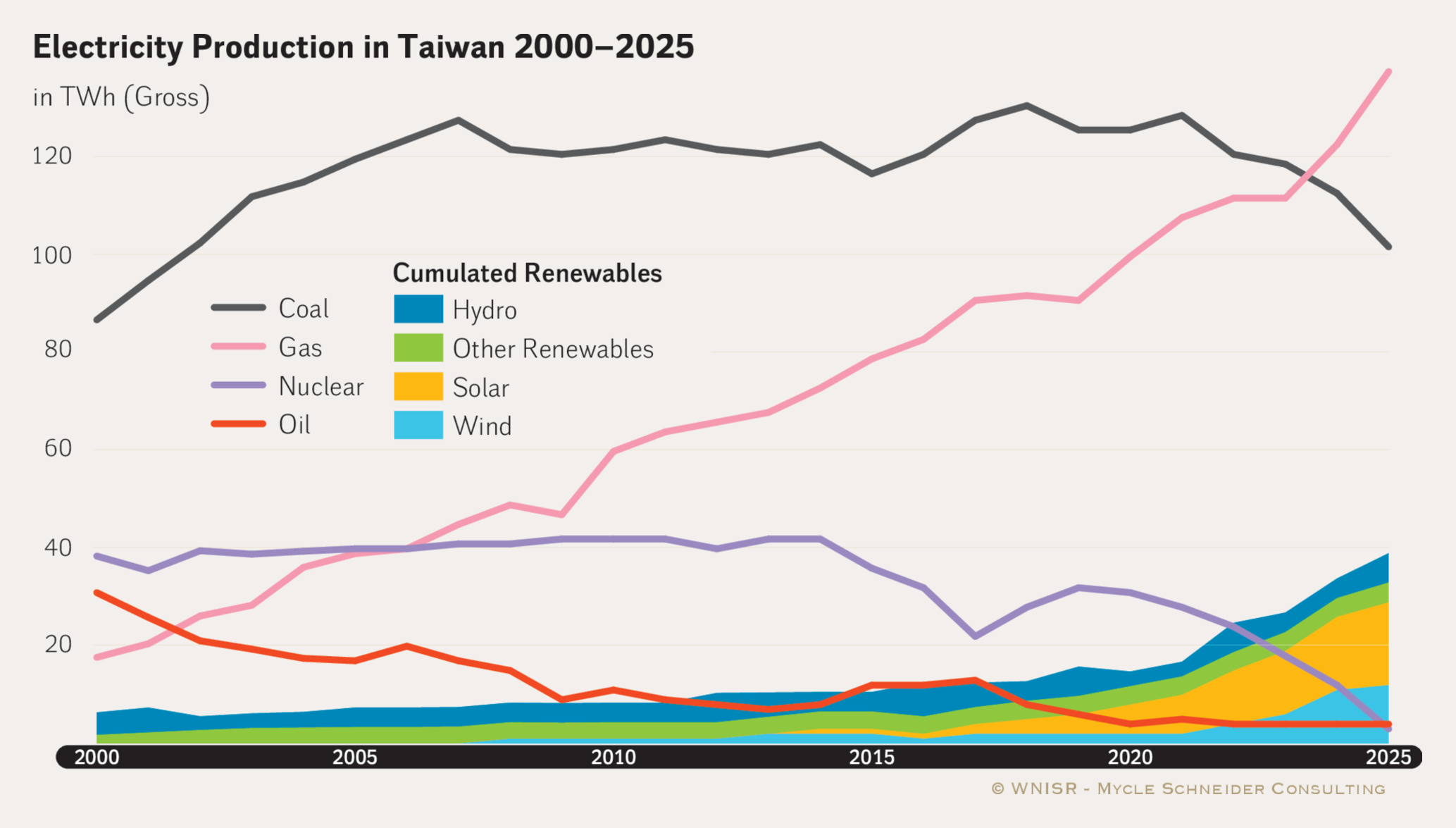
Sources: MOEA, Energy Handbook, Various Years
In the meantime, Taiwan’s current dependence on coal and LNG imports is a critical strategic vulnerability. Coal stocks are estimated to cover demand for about 40 days, while mandatory LNG reserves would last 11 days in winter and only about a week in summer (due to the consumption peak for air conditioning).745 A sustained blockade would thus quickly force difficult choices between powering civilian life and sustaining critical industries.746
Even without the extreme scenario of direct and explicit acts of war, there is a large range of hybrid tactics that China could use to disrupt Taiwan’s economic growth and political stability. Currently, harassment of Taiwanese military and coast guards is quasi-daily. This has become the ‘new normal’.747In this context, possible scenarios of energy supply disruption include harassment or interception of Taiwan bound coal and LNG carriers by the China Coast Guard or maritime militias.748
Consequently, the perceived threat of coal and gas supply disruptions has been another incentive for the DPP administration to depart from its nuclear-free homeland policy. However, Russia’s full-scale invasion of Ukraine has illustrated that nuclear power plants are highly vulnerable targets in armed conflicts. Wu Chin-chung, Taipower’s vice-president, stated that his company has built up fuel stocks beyond legal requirements and is implementing a more decentralized grid structure combined with the expansion of renewable energy and energy storage.749
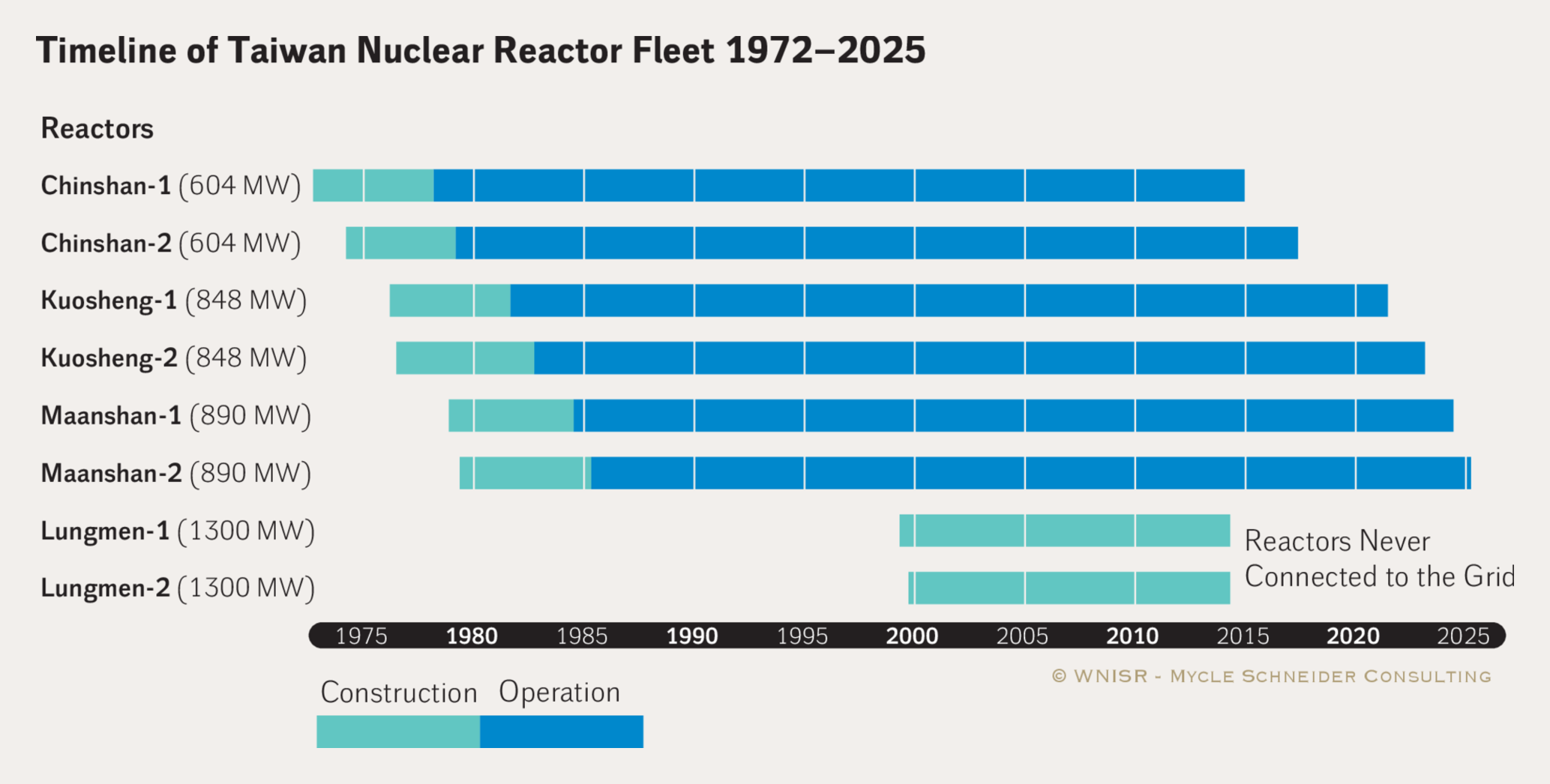
Sources: WNISR with IAEA-PRIS, 2026
Note: * Design Net Capacity from IAEA-PRIS, as of 1 July 2026.

The construction work at Türkiye’s first nuclear power plant continues as Unit 1 at the Akkuyu site has entered its ninth year of construction. As reported in previous editions of WNISR, the commissioning of Unit 1 has been delayed repeatedly. It was originally planned to commence operations in 2023, with construction having started on 3 April 2018.750 Last year President Recep Tayyip Erdoğan said that the plant’s trial operation would start in late 2025, but that did not happen, and Akkuyu’s start was delayed again.751 The Minister of Energy and Natural Resources, Alparslan Bayraktar, made a confident promise on the first day of the year by declaring that 2026 would be a nuclear year for Türkiye.752 Later on, he specified that the aim is to generate electricity from the first unit of Akkuyu on 29 October 2026, which is the Republic Day of Türkiye.753
Under the bilateral agreement signed between Russia and Türkiye in 2010, Unit 1 was required to begin commercial operation within seven years of the issuance of all necessary documents, permits, licenses, consents, and approvals.754 However, more than eight years have passed since construction began. According to the bilateral agreement, in the absence of force majeure as defined in the Power Purchase Agreement (PPA), the electricity price would be adjusted. Article 10, paragraph 11 of the agreement states:
If any of the units of the NPP shall be taken into operation after the programmed date stipulated in this Agreement, except for the force majeure situations envisaged in the PPA, the price of electricity to be sold will be adjusted according to the conditions of the PPA.755
While the Turkish Government has stated that the latest delays occurred due to equipment contracted with Siemens Energy but not supplied756—clearly not the only cause for delays—it has not clarified whether it considers this to be a force majeure event. The contents of the PPA are not being disclosed for confidentiality reasons.
Cash shortage is one of the known problems slowing down the construction of the nuclear power plant, since US banks blocked some of the money transfers—worth at least US$2 billion—to Türkiye.757 Refer to WNISR2025 and prior editions for detailed accounts of earlier developments. Russia, nevertheless, allocated more cash towards Akkuyu according to media reports. In September 2025, Kirill Komarov, First Deputy CEO of Corporate Development and International Business at Rosatom and CEO of Atomenergoprom, reportedly said that “these financial issues [the frozen US$2 billion in the US] have recently been successfully resolved, primarily with the support of the Russian government. As of today, the project is fully funded; we are increasing the number of staff on site once again and are continuing to work towards completing the construction of four power units by the end of 2028.”758 Interestingly, three months later, Türkiye’s Energy Ministry claimed that Russia provided an additional US$9 billion to the project.759 The funding issue is also said to have been resolved through a clearing mechanism linked to natural gas payments between Türkiye and Russia.760
While questions about the power station’s cash requirements remain unresolved, Russia is planning (again) to sell part of its stake in the power station to Turkish companies.761 During the past year, Anton Dedusenko, chairman of the board of directors at Akkuyu Nuclear, also said that enlarging the investor circle was subject to discussions with Turkish and foreign parties.762 Since the project’s early stages, the option of increasing the number of shareholders has been raised (see earlier WNISR editions). During his visit to Akkuyu in April 2026, Rosatom Director General Alexey Likhachev also alleged “strong interest” of “several Turkish companies” in purchasing shares in the project.763
Echoing the Turkish Energy Minister’s statement, unnamed ministry sources claimed that test production at Unit 1 would begin in September or October 2026, and it would last nine months following fuel loading.764 While visiting the Akkuyu site in April 2026, Rosatom’s Alexey Likhachev said that “preparations for a key event—hot and cold run-in with fuel dummies being loaded into the reactor—are nearing completion.”765 Rosatom reported that the dummy fuel assembly loading operation took place in June 2026.766
Construction work on the other three VVER-V509 units of Akkuyu nuclear power plant is also continuing. A permit was granted on 18 March 2026 to begin pre-commissioning works at Akkuyu-2,767 and a polar crane was installed at the unit on 25 March 2026.768 According to the agreement between Türkiye and Russia, Units 2, 3, and 4 shall become operational consecutively at one year intervals after Unit 1 starts commercial operation.769 That means the final completion date of the Akkuyu project would be set for 2029, provided the first unit starts commercial operation in 2026, which appears ambitious.
Away from Akkuyu (Büyükeceli neighborhood), a different kind of work is underway on staff housing. Rosatom Director General Alexey Likhachev visited the Burunucu neighborhood in the Taşucu District, approximately 50 kilometers away from the plant, where Turkish and Russian employees will live.770 As part of the first stage of the complex, 48 apartment buildings, a kindergarten, and a school are being built to eventually accommodate more than 8,000 people.771 By September 2025, 319 Turkish engineers were said to be working at the plant.772 In 2024, this number had been over 350.773 According to the government, as of February 2026, Akkuyu Nuclear had sent 458 Turkish students abroad, i.e. to Russia, to “pursue undergraduate and graduate degrees in the nuclear field.”774
Boris Arseev joined Akkuyu Nuclear JSC’s board of directors on 2 October 2025, bringing the number of board members to five again (see previous WNISR editions).775 Anton Dedusenko, Ekaterina Lyakhova, Boris Arseev, Ruslan Baychurin, and Henri Edouard Proglio—former president of French national utility EDF and the only non-Russian member—were selected to serve on the board until 15 September 2028.776 Anton Dedusenko and Ekaterina Lyakhova have been elected as chair and vice chair of the board, respectively.777
The September 2025 Komarov statement regarding the number of workers at the construction site, if compared with Ministry of Energy claims, also does not help clarify the situation. Responses to questions submitted by two members of parliament make it clear that the number of employees has decreased, not increased in recent months. In his reply to a written question from Haydar Altıntaş, Member of Parliament for İzmir, dated 27 June 2025, Energy Minister Alparslan Bayraktar stated that the current workforce stood at 20,000 but would fall to 4,000 once construction ends.778 In a response to another written question from Istanbul MP Sezgin Tanrıkulu, dated 11 March 2026, Alparslan Bayraktar stated that the number of employees at the site was 12,000.779 This suggests that 8,000 people were made redundant or left the site for various reasons between June 2025 and March 2026.
The Akkuyu nuclear project has been criticized for increasing Türkiye’s dependence on Russia for energy as well as creating implications for Türkiye’s strategic autonomy and NATO dynamics.780 Energy policy expert Necdet Pamir recently pointed out that Türkiye is dependent on Russia for 40–45 percent of its natural gas, 60 percent of its oil, and over half of its hard coal, and that the Akkuyu project would not only fail to secure energy independence but actually increase Türkiye’s energy dependence on Russia.781
The Akkuyu project would not only fail to secure energy independence but actually increase Türkiye’s energy dependence on Russia.
The project is also frequently criticized because of its cost to Türkiye. Cumhuriyet Halk Partisi (CHP) MP and Vice Chair, Deniz Yavuzyılmaz, who is in charge of public oversight and the fight against corruption, stated that based on reports from chartered accountants Russia’s profits over the project duration would amount to US$180 billion.782 Yavuzyılmaz previously announced that the government had granted a tax break worth nearly US$10 billion as part of the ‘investment incentive’ to Russia for the Akkuyu nuclear power plant project.783 Meanwhile, Rosatom calculates that Akkuyu will begin generating dividends from electricity sales after 2035.784 CHP also made it clear in its new party program that it would decide against constructing an additional nuclear power station as a way to increase the country’s electricity generation capacity.785
The 40th anniversary of the Chornobyl disaster was marked with an anti-nuclear rally in Sinop and several panel discussions in the Thrace region, including one near a proposed nuclear newbuild site in Kırklareli. The discussions were attended by mayors from the region.786
At the EU level, the European Commission in its Türkiye 2025 Report noted that its “recommendations from last year [on energy] were only partially implemented,” and thus “in the coming year, Türkiye should in particular (…) complete the legislative alignment with Euratom acquis, and address the recommendations from the stress tests on the Akkuyu nuclear power plant.”787 The same report also noted that Türkiye remains dependent on Russia in the energy sector.
Türkiye’s nuclear power ambitions are not limited to Akkuyu. In late 2025, Minister of Energy and Natural Resources Alparslan Bayraktar announced the country’s target of having twelve large reactors (including the four units under construction at Akkuyu) and 5 GW of small modular reactors to deliver “at least” 10–15 percent of the country’s electricity from nuclear power by 2050.788 The minister later specified that the target is, with a mix of large and small plants, to reach 20 GW of nuclear capacity by 2050.789
The other proposed locations for nuclear power plants are in Sinop and Kırklareli Provinces, where the plants are to host four large reactors each.790 The approximate location of the Kırklareli power plant (referred to as Kıyıköy NPP)791 was revealed when it was discovered that the planned site overlapped with that of a proposed wind power plant, resulting in permission for the wind project being denied.792 The Sinop project was initially awarded to French AREVA and Japanese Mitsubishi in 2013, but AREVA went technically bankrupt and was broken up in 2017, and Mitsubishi withdrew from the project in 2018. That was the end of that attempt as confirmed by the Turkish Government in 2020 (see WNISR2021).
Türkiye is discussing newbuild plans with Canada, China, France, Russia, and South Korea.793 According to Alparslan Bayraktar, Türkiye will choose the project based on competitiveness and contribution to localization.794
President Erdoğan’s visit to the White House in September 2025 clearly had an impact on Türkiye’s nuclear energy policies.795 During that visit, Türkiye and the US signed a Memorandum of Understanding (MoU) on Strategic Civil Nuclear Cooperation.796, 797 In 2023, Türkiye and the US had also signed a so-called “123 Agreement”.798 If it seems that Russia has lost the upper hand in the race for the Sinop location, Russian interest for the project remains high.799 Meanwhile, China, which had been named as a pre-selected vendor country for the Kırklareli location, now has rivals from the Western world.
Over the past year, Türkiye has signed several cooperation agreements and MoUs with foreign companies and countries. In November 2025, a Memorandum of Understanding on Nuclear Energy Cooperation was signed between Türkiye Nuclear Energy Inc. (TÜNAŞ) and Korea Electric Power Corporation (KEPCO).800
A few months later Minister Bayraktar told Bloomberg HT that Türkiye expects a binding offer from South Korea for Sinop.801 In March 2026, TÜNAŞ signed another MoU with Canadian AtkinsRéalis.802 Minister Bayraktar who attended the ceremony stated that, “One of the most important aspects of this agreement is the thorough evaluation of the feasibility of implementing Canada’s CANDU reactor technology, which is one of the world’s most advanced and proven technologies, in our country.”803 Later in the year, Bayraktar visited Romania’a Cernavod plant to get a closer look at the CANDU reactor technology.804
At the March 2026 international nuclear summit in France, Energy Minister Bayraktar reportedly mentioned that SMRs and other nuclear projects were among the topics discussed with French companies.805
There is also debate as to whether Türkiye’s decision to engage in talks with various suppliers, thereby avoiding reliance on a single country or company for nuclear energy, follows a clear strategy. Not least because arguably this move could complicate matters, given that each technology requires different equipment, engineering expertise, and regulatory competence.806
The 2026 Presidential Annual Program released in late October 2025 sets out the goal to conclude the international negotiations for a new nuclear power plant in 2026.807 The same program also defines three specific objectives. The first one is to complete 60 percent of three projects on designing technologies for next-generation nuclear reactors, small modular reactors, micro-reactors, and research reactors. The second objective is to complete 70 percent of the project on nuclear fusion technologies. The third objective is to prepare a work plan and roadmap for deploying a Small Modular Reactor (SMR) using domestic technologies and other capabilities.808
Later in 2025, the Ministry of Industry and Technology issued a call for proposals for the development of a domestic nuclear reactor and announced a support program offering a grant of up to 50 percent of the eligible expenditure over up to eight years.809 The purpose of the call is described as supporting Türkiye’s goals of ensuring energy security, reaching a net-zero emission target, and creating a new market by exporting a national reactor design.810 As of June 2026, the Ministry of Industry and Technology states that, with applications having ended on 31 March, the assessment process to select which companies to support is now ongoing.811 In late 2025, the Energy Minister reportedly announced that Baykar, a leading defense company, is working on a 40-MW SMR design.812 Baykar is known for unmanned armed aerial vehicles and drones.
It was also noted that calls for domestic nuclear technology in some cases referred to military nuclear applications. Far-right Milliyetçi Hareket Partisi’s (MHP) Deputy Chairman Semih Yalçın wrote in a long article that, “Possessing nuclear weapons has become a guarantee of a country’s existence and security;” in the same article he also claimed that the NATO concept had collapsed.813
Minister of Foreign Affairs Hakan Fidan has been the subject of considerable discussion in both domestic and international media following his reticence to answer the question of whether Türkiye should possess nuclear weapons during a television program.814 The minister’s ‘no comment’ response, sparked a debate about the potential militarization of Türkiye’s civilian nuclear energy program.815 Defense Minister Yaşar Güler’s response to a written parliamentary question from MP Ali Yüksel added to the debate, as the minister stated that Türkiye had commenced planning, design, and feasibility studies for a nuclear-powered submarine.816 Noting that there is a proposed timetable for the design of a nuclear-powered submarine, Güler stated that this objective forms part of the vision to enhance deterrence against regional threats in the Eastern Mediterranean and surrounding seas.817
Türkiye generated 43.4 percent of its electricity from renewable energy sources in 2025. The largest contributor was hydro with 16.03 percent, followed by wind energy with 11.1 percent, and solar energy with 10.5 percent.818 Coal and gas power plants generated 56 percent of Türkiye’s electricity.819 As of mid-2026, Türkiye’s installed capacity of solar and wind combined reached 42 GW.820
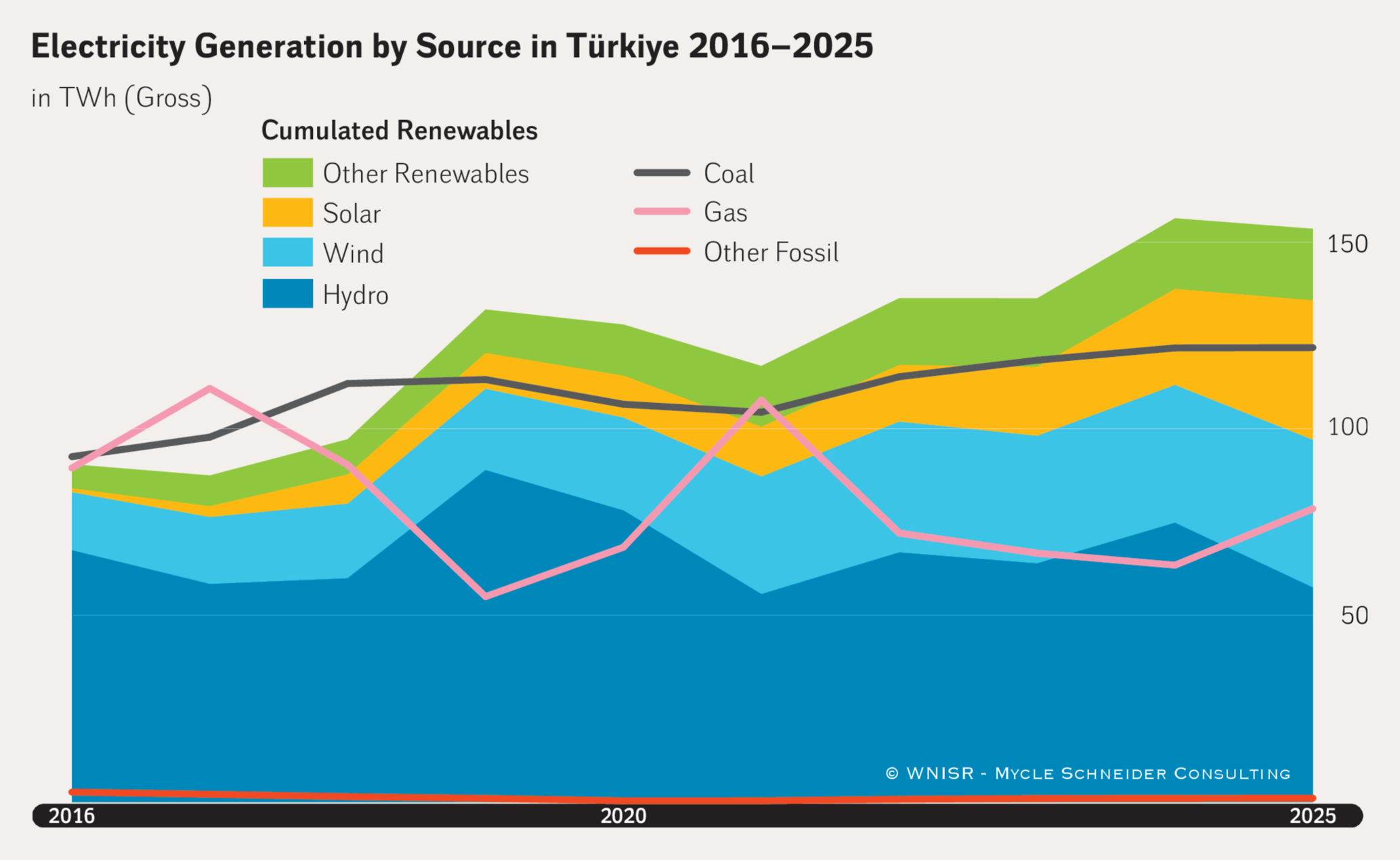
Source: EMBER, 2026
The Energy Transition–Renewable Energy 2035 roadmap, which was announced at the end of 2024, set out a very ambitious target of 120 GW of combined wind and solar installed capacity by 2035.821 That means approximately 80 GW of wind and solar power capacity should be added over the next nine years, bringing Türkiye’s total installed capacity to 244 GW even if no other additional energy sources were added to the grid. At the end of April, Türkiye’s installed capacity reached 125 GW, and the peak electricity demand was 60 GW in July 2025.822
According to the Turkish Electricity Transmission Corporation’s (TEİAŞ) demand forecast report covering the period between 2026 and 2035, the peak electricity demand is expected to reach 86 GW by 2035 based on the reference scenario. The same scenario sees Türkiye’s electricity consumption going from 360 TWh in 2025 to 506 TWh in 2035.823 Notably, the report published a year ago forecast demand for 2034 at 477 TWh, whereas the latest report has revised this figure upwards to 491 TWh.824
Looking at the demand forecasts and taking into account the new solar and wind energy target of the Energy Transition–Renewable Energy 2035 roadmap and the planned nuclear power plants and other power plants, Türkiye might head for a large overcapacity.
There are two issues here that raise questions. The first concerns the future role of coal-fired power plants. As Türkiye has not yet adopted a coal phaseout policy, it remains uncertain how long existing coal-fired capacity will continue to operate and remain connected to the grid. The second is the nature of the 33 GW of electricity storage capacity for which preliminary licenses have been granted.825
Amendments to the Electricity Market Licensing Regulation adopted in 2022 allow investors that commit to installing an electricity storage system alongside a generation facility to develop wind or solar power plants without participating in a competitive bidding process. However, the regulation also stipulates that the installed capacity of the electricity storage unit may not be less than that of the associated wind or solar power plant. In practice, this means that a storage system with an energy capacity equivalent to only one hour of the plant’s installed capacity (e.g. a 10-MW/10-MWh battery for a solar plant) is sufficient to qualify for a license.
While this approach facilitates the rapid deployment of renewable energy projects, it raises questions about the extent to which the planned 33 GW of storage capacity will contribute to power system flexibility. Short duration batteries provide only limited capability for shifting renewable generation to periods of peak demand or supporting longer term system balancing. In addition, excessively frequent cycling is likely to reduce battery lifetime and increase maintenance and replacement costs, potentially limiting the long-term effectiveness of these storage investments.
Nevertheless, Türkiye’s solar capacity itself has an impressive growth rate and, according to official figures, stood at 26 GW by the end of March 2026.826 More than 6 GW of that capacity was added to the grid in 2025.827 Türkiye was the 10th top solar market in the world by means of new capacity additions. Unlicensed solar plants built on the roofs of industrial estates and small businesses represented an estimated 84 percent of solar additions in 2025.828
Minister Alparslan Bayraktar said that Türkiye’s new long-term energy transition targets would be announced at the COP31 summit, which will be held in Antalya, Türkiye in November 2026.829
Türkiye’s total greenhouse gas emissions as CO2eq were up 5.3 percent year-on-year and reached 584.5 million tons at the end of 2024.830 With 71.8 percent, the energy sector has the biggest share in Türkiye’s GHG emissions. Türkiye’s new Nationally Determined Contribution (NDC) target for 2035 is to keep total emissions below 643 million tons of CO2 equivalent.831 Although the 2035 target still implies an emission increase from the 2012 base year, this figure is approximately 50 million tons lower than the previous NDC target.832

For the first time, a country with a major nuclear power sector has faced an all-out military attack and has remained at war for more than four years. Russia’s full-scale invasion of Ukraine in February 2022—the largest military conflict in Europe since World War II—has created fundamentally new challenges for the international nuclear safety and security system. Previously unthinkable scenarios have become routine: shelling of operating nuclear power plants and facilities, disruptions in power and water supply to nuclear reactors, and even the seizure and occupation of nuclear sites. Throughout the war, however, nuclear power plants have remained the backbone of Ukraine’s electricity system.
Previously unthinkable scenarios have become routine: shelling of operating nuclear power plants and facilities, disruptions in power and water supply to nuclear reactors, and even the seizure and occupation of nuclear sites.
Over the past 10 years—both before and after the 2022 invasion—nuclear power has consistently accounted for around 50 percent of Ukraine’s total electricity generation. However, due to partial destruction of the energy infrastructure and a decline in consumption, the country’s overall electricity output dropped by around 37 percent between 2021 and 2025.
In 2025, Ukrainian reactors reportedly produced 51.4 TWh (net), 1 TWh (2 percent) more than in the previous year. However, this is nearly 40 percent lower than the pre-war level of 81.9 TWh (net) in 2021.833 The decline in nuclear generation is primarily a result of the seizure and shutdown of the six reactors at the Zaporizhzhia Nuclear Power Plant.
Ukraine has 15 operable reactors (two VVER-440s and 13 VVER-1000s) with a total installed capacity of 13.1 GW. These include the six units at Zaporizhzhia that have been occupied by the Russian army, with technical assistance from Rosatom, since March 2022. The six reactors have been shut down since September 2022 and are considered in LTO. The country also has four closed RBMK reactors at the Chornobyl plant, including Unit 4, which underwent a disastrous accident in 1986.
As of mid-2026, the mean age of Ukraine’s reactor fleet, including reactors in LTO, is 37.4 years.834 Only two reactors are younger than their original operational design lifetime of 30 years. All others have been granted lifetime extensions for 10 or 20 years, as described in WNISR2024. In 2025, South Ukraine-2 was granted its second 10-year lifetime extension to 2035.835
In April 2023, the Cabinet of Ministers approved a new Energy Strategy for Ukraine until 2050.836 In December of the same year, at the COP28 conference, Ukraine presented a report titled Clean Energy Roadmap: From Reconstruction to Decarbonization in Ukraine.837 Linked to the goals of Ukraine’s energy strategy and developed with support from the United States, the report presented scenarios for developing a low-carbon energy system in Ukraine.
According to the Reference scenario, nuclear power remains the dominant source of electricity in 2050, supplying nearly 60 percent of generation, while renewables provide just over 25 percent. In the two Net Zero scenarios, electricity generation rises sharply—by about 2.5 to 5 times compared with 2020—mainly due to the expansion of renewables, especially wind, which reach around 65 percent of generation, while nuclear provides just over one-third. For total primary energy supply, the Reference scenario leaves fossil fuels as the dominating source in 2050 accounting for slightly more than half, while nuclear rises from around 20 percent to 35–40 percent. By contrast, in both Net Zero scenarios, primary energy supply is split almost evenly between renewables and nuclear.
In January 2024, Ukraine’s then-Minister of Energy German Galushchenko announced that the country would begin construction during the year of four nuclear units at Khmelnytskyi, where two reactors are already operating.838 As described in past WNISR editions, Ukraine has a long history of attempting to complete two abandoned VVER-1000 projects—Units 3 and 4 of the Khmelnytskyi plant—whose construction began nearly 40 years ago. These efforts were revived after the loss of a significant share of generating capacity following Russia’s full-scale invasion. According to Galushchenko, completing Khmelnytskyi is a strategic task for Ukraine.839 According to the Energoatom website, by the end of 2024 construction was 80 percent complete at Unit 3 and 25 percent complete at Unit 4.840
However, the feasibility of completing these units largely depends on the potential purchase of key equipment—primarily reactor vessels and steam generators—originally intended for Bulgaria’s unfinished Russian-designed Belene plant. The history of discussions on a possible deal for the purchase of this equipment between Ukraine and Bulgaria in 2023–2025 is described in detail in WNISR2025.
In April 2025, senior officials in the Bulgarian Government announced that the country would not proceed with the sale of Belene reactor equipment to Ukraine, contrary to prior reports.841 In July 2025, Ukraine’s then-Energy Minister, Svitlana Hrynchuk, stated that Ukraine would continue negotiations with Bulgaria.842 However, in October 2025, she reportedly said that Ukraine could complete Units 3 and 4 of the Khmelnytskyi plant without purchasing parts from Bulgaria and that it was considering various options with its partners.843
According to its August 2025 Draft Action Plan, the Ukrainian Government was to update the technical and economic feasibility for construction by 31 October 2025 and develop and submit to parliament a bill on the location, design, and construction of the power units by 31 December 2025.844 Both deadlines have passed, and their status is currently unclear, possibly due to the suspension of processes following the Energoatom corruption scandal in autumn 2025 (see Energoatom Corruption Scandal below).
IAEA-PRIS continues listing Khmelnytskyi-3 and -4 as under construction, but WNISR removed them from the construction list as no active work has been reported in some four decades despite all attempts to revive the project. The last time the government attempted to restart construction, the total cost of completing Khmelnytskyi Units 3 and 4 was estimated at UAH201772.3 billion (~US$20172.7 billion).845 But there has been no independent evaluation of the cost estimate.
During a visit to the Khmelnytskyi site in April 2026, Denys Shmyhal, First Deputy Prime Minister and Minister of Energy of Ukraine as of 14 January 2026, reaffirmed that “Ukraine requires new nuclear power units, including the completion of Units 3 and 4 at the Khmelnytskyi NPP [Nuclear Power Plant].” He stated that two options were being assessed to determine the optimal solution, while construction of protective structures continues at the site. He also confirmed plant management reports of “ongoing efforts to increase capacity and enhance safety and protection measures.” 846
The incoming Bulgarian Government formed after the April 2026 elections has set out a new position on Belene. According to Bulgarian Prime Minister Rumen Radv, at a meeting in Brussels in June 2026, Ukraine’s President Volodymyr Zelenskyy once again proposed buying the reactor parts from the Belene project. However, per Radev’s account of the meeting: “I suggested something else: let’s—you and us, together with European funding, because Europe is ready to help—build the Belene Nuclear Power Plant with these reactors and supply you with electricity via Romania.” 847 The Ukrainian side’s response is not yet known.
In June 2022, Energoatom and Westinghouse signed an agreement to construct up to nine AP1000 units in Ukraine.848 In January 2023, the Cabinet of Ministers approved the launch of a feasibility study for constructing two such reactors—Khmelnytskyi-5 and -6—by 2032, with the expectation that they would cost around US$5 billion each.849 This appears rather optimistic and significantly cheaper than the cost of constructing comparable reactors at the Vogtle plant in the United States, where two units cost far more than US$30 billion (see United States Focus: Reactor Construction in WNISR2024), or the Polish project involving three similar reactors, currently estimated at PLN192 billion (US$202448.2 billion) in total (see Poland Focus).
But similar to Units 3 and 4, work on Khmelnytskyi Units 5 and 6 remains effectively inactive with no formal feasibility study, safety report, or construction license. The symbolic construction-start ceremony held in April 2024 cannot be considered the actual beginning of construction, as it involved the concreting of a drainage channel rather than work on the foundation of the reactor building.850 Thus, by mid-2026, despite the stakeholders’ intentions and high-profile announcements, not a single new unit can be considered under active construction.
Furthermore, Energoatom has shown interest in deploying Small Modular Reactors (SMRs). Since 2021, it has entered cooperation agreements with various potential technology providers and partners, such as NuScale, Holtec International (up to 20 SMR-160),851 Westinghouse (AP300),852 Rolls-Royce, and Hyundai E&C.853
By mid-2025, Energoatom and Ukrenergo had identified twelve potential SMR host sites across Ukraine.854 The Chornobyl exclusion zone is also being considered as a potential site for SMRs.855 In October 2025, the government submitted to the Verkhovna Rada, the Parliament of Ukraine, Draft Law No. 14164 that would constitute a legal basis for SMR development.856 This legislation is also intended to create the conditions necessary for private investment and the commercial deployment of SMRs in the country,857 but as of July 2026 the law has not yet been adopted.
In November 2025, Ukraine’s anti-corruption authorities, the National Anti-Corruption Bureau of Ukraine (NABU) and the Specialized Anti-Corruption Prosecutor’s Office (SAPO), exposed a massive corruption scheme at Energoatom, following a 15-month—and at the time ongoing—investigation codenamed “Operation Midas”.858The scheme involved systematically extorting 10–15 percent kickbacks from Energoatom’s contractors. Investigators estimated that approximately US$100 million passed through the scheme’s laundering channel, including funds for contracts related to protective installations for energy infrastructure against Russian attacks.
Key figures in the investigation included former Minister of Energy, German Galushchenko, who had been appointed Minister of Justice in July 2025. He was dismissed from his position in November 2025, arrested in February 2026 while attempting to leave the country, and charged with money laundering for allegedly funneling more than US$10 million.859 The CEO and Chairman of the Board of Energoatom, Petro Kotin, was dismissed in August 2025 amid media reports of corruption before any official investigation was announced.860
Amid the scandal, the Cabinet of Ministers dissolved the Supervisory Board of Energoatom in November 2025.861 A new seven-member board was appointed in January 2026, consisting of three representatives of the Ukrainian Government and four international experts, including Rumina Velshi, former President and CEO of the Canadian Nuclear Safety Commission, who later became Chair of the Board;862 Patrick Fragman, former CEO of Westinghouse Electric Company; as well as Laura Garbenčiūtė-Bakienė and Brice Bohuon.863
At a meeting following a referral from NABU on 8 May 2026, the Supervisory Board of Energoatom adopted measures to strengthen “integrity, accountability and corporate governance at the company”.864 The Board launched an internal investigation, suspended several employees, and ordered organizational restructuring of security units. However, only a few days later, two board members (Patrick Fragman and Brice Bohuon) resigned, both reportedly due to operational workload exceeding initial expectations, with Fragman also citing a new full-time job offer.865
In December 2025, the High Anti-Corruption Court extended the pre-trial investigation on two individuals associated with the Energoatom case until 10 August 2026.866 In April 2026, Oleksandr Abakumov, head of a NABU detective unit, told a meeting of the Verkhovna Rada Anti-Corruption Committee that, under the law, they had one year to complete the investigation, meaning until November 2026, but that they planned to complete it by the end of the summer.867 As part of the corruption case, charges were brought against seven people in November 2025, and five people were arrested.
Ukraine is the VVER-reactor country that has advanced the furthest away from dependence on Russian nuclear technologies and supplies. At the same time, with 15 VVERs, Ukraine operates more Russian designed reactors than any other country (outside Russia). In 2001, Westinghouse began the development of VVER-1000 fuel manufacturing following a government agreement between Ukraine and the US on energy cooperation and safety. In 2008, Energoatom and Westinghouse signed the first contract for fuel delivery; in 2018, the contract was extended to 2025.868
By the time Russia invaded the country in 2022, Ukraine had already transitioned six of its VVER reactors at least partially to Westinghouse fuel, including four reactors at the Zaporizhzhia site. In June 2022, the contract with Westinghouse was expanded to cover all operational Ukrainian units, stipulating a full transition to Westinghouse fuel.869
In September 2023, the first VVER-440 fuel assemblies delivered by Westinghouse were loaded at the Rivne plant,870 and in March 2024, VVER-1000 fuel assemblies were delivered to Khmelnytskyi.871
In March 2025, the Ukrainian Government also approved the construction of a nuclear fuel assembly manufacturing plant based on Westinghouse technology near Pivdennoukrainsk in Mykolaiv Oblast.872 As early as 2019, Westinghouse began qualifying one of Energoatom’s divisions as a supplier of top and bottom nozzles for Westinghouse TVS-WR fuel assemblies for VVER-1000 reactors.
In 2025, Energoatom signed agreements with Westinghouse Electric Sweden AB on technology transfer and licensing for fuel assembly design and manufacturing, as well as on the procurement of equipment for producing fuel assemblies for VVER-1000 reactors. The facility is expected to have an annual production capacity of up to 570 fuel assemblies, roughly equivalent to the annual fuel requirements of Ukraine’s entire fleet of VVER-1000 reactors, including those at the Zaporizhzhia site. Energoatom says the first Ukrainian-made fuel assembly is expected to be loaded into a reactor as early as 2027.873
Following the termination of its contracts with Rosatom, Energoatom established a fully Western nuclear fuel supply chain, signing long-term agreements with Cameco for uranium supply and conversion services through 2035,874 and with Urenco and Orano for uranium enrichment services extending through 2035–2043.875
Ukraine has demonstrated that, even under wartime conditions, it is possible to transition from Russian supplies to Western sources while keeping 60 percent of its nuclear fleet operational. This experience appears highly relevant for other countries that are reliant on Russian nuclear supplies but are aiming to transition to other sources (see Russia Nuclear Interdependencies).
Power Sector Under War Conditions
Since the beginning of the full-scale Russian invasion, Ukraine’s electricity sector has faced major disruptions. According to a United Nations Development Programme (UNDP) report,876 in the early months of the invasion significant degradation was caused by the temporary occupation of parts of the country, the reduction in industrial activity, and the relocation of millions of people to safer regions or abroad. The situation worsened in October 2022, according to the report, when Russia began systematic missile and drone attacks on Ukraine’s energy infrastructure. These attacks left around 12 million people without electricity, disrupted water and heating supplies, and caused widespread hardship during sub-zero winter conditions.
According to the UNDP assessment, by April 2023 there was “not a single TPP [thermal power plant] or HPP [hydroelectric power plant] in Ukraine that had not been damaged to some extent due to military activities and missile attacks on energy infrastructure.” Due to the complete shutdown of Zaporizhzhia, operable nuclear capacity declined by 44 percent from 13.8 GW to 7.7 GW. Available hydro capacity dropped by 29 percent from 6.6 GW to 4.7 GW and renewable capacity decreased by 24 percent from 8.1 GW to 6.2 GW.877
According to a joint report titled Fourth Rapid Damage and Needs Assessment (RDNA4) by the World Bank, the Ukrainian Government, the European Commission, and the UN, as of 31 December 2024, the overall installed generation capacity available for use dropped to 15 GW, which is significantly lower than the 18–19 GW needed for peak demand, especially in winter.878 Total electricity generation in 2024 dropped to 101 TWh, less than two thirds of the 156.5 TWh produced in the pre-war year 2021.879
The damage to Ukraine’s energy sector continued to escalate in 2025. According to analysts at DiXi Group, between February 2022 and February 2026, Russia carried out at least 64 large-scale strikes targeting Ukraine’s energy infrastructure. The analysts noted that “The attacks occurred in waves and primarily coincided with autumn and winter periods, when system load is at its highest. Over four years of full-scale war, Russia has conducted at least four such campaigns.” The winter of 2025–2026 was reportedly the most intense period. “In 2022-2024, Russia used approximately 2,800 missiles and drones in such strikes. In 2025-early 2026, this number rose to around 12,800.”880
By mid-January 2026, according to Ukrainian President Volodymyr Zelenskyy, Ukraine’s energy system—damaged by Russian drone and missile strikes—was covering only about 60 percent of national electricity demand, with generation at 11 GW against a required 18 GW.881
According to the Fifth Rapid Damage and Needs Assessment (RDNA5),882 released in February 2026, the energy sector alone suffered a nearly 21-percent increase in damaged or destroyed infrastructure within a single year (2024–2025). According to the Security Service of Ukraine, Russia carried out more than 250 attacks on energy infrastructure between October 2025 and January 2026 alone.883 During the same period, according to Ukraine’s Minister of Economy, more than 8.5 GW of generating capacity was damaged, including thermal power plants, district heating plants, and hydroelectric power plants.884
Under these conditions, electricity imports from EU countries have become extremely important, especially for balancing the power system. Starting in 2023, Ukraine shifted from being a net exporter to a net importer of electricity. The growth in imports was also made possible by infrastructure repairs, which increased import capacity from 1.7 GW to 2.45 GW by 2026,885 though this was still insufficient to make up for the Ukrainian power deficit, with estimates for the 2024–2025 winter peak demand period ranging from 3–4 GW886 to almost 6 GW.887 The winter of 2025–2026 was the most difficult period for Ukraine’s power system, with an overall electricity deficit estimated at 5–6 GW and a historical maximum level of electricity imports from the EU reached by February 2026.888
Up to November 2024, the G7+ Ukraine Energy Coordination Group says it had “mobilized more than US$5 billion in support of Ukraine’s energy sector.”889 On 12 December 2025, G7+ partners reaffirmed their support for Ukraine’s energy sector and pledged to strengthen active and passive air defense for energy infrastructure facilities to protect them from Russian attacks.890 In January 2026, they promised to provide more than 6,000 units of energy equipment, including generators, transformers, and distribution equipment, for Ukraine’s energy sector.891
At the same time, according to estimates from a joint assessment by the World Bank, the Ukrainian Government, the European Commission, and the United Nations, as of the end of 2025, the funding needed to restore Ukraine’s energy sector had reached about US$90.6 billion.892
Russian Attacks on Nuclear Facilities
Previous WNISR editions outline the history of attacks on and risks to nuclear facilities in Ukraine since the very first days of the full-scale invasion.
The Chornobyl Nuclear Power Plant remained under Russian control between 24 February and 31 March 2022,893 and since 4 March 2022, Russian forces have occupied Zaporizhzhia, Europe’s largest nuclear power plant by nominal capacity.894 For more than four years now, the plant has been located directly on the frontlines, which run along the banks of the Kakhovka Reservoir that was destroyed in the summer of 2023. In September 2022, the remaining operating reactor units were placed into cold shutdown, where they remain to this day, significantly reducing the risk of accidents and incidents.895
WNISR2025 and previous editions provided a summary of nuclear safety risks at the occupied Zaporizhzhia site. One of the key concerns is the ongoing military activity around the plant, including deliberate attacks or accidental shelling affecting Zaporizhzhia and other nuclear sites. Russia has been actively fortifying the Zaporizhzhia site, mining its perimeter, digging trenches, and stationing troops both in and around the facility—effectively turning it into a fortified military position.896 The facility is also being used to shield Russian firing positions and to launch attacks on Ukrainian territory, as noted in a December 2024 McKenzie Intelligence Services (MIS) report commissioned by Greenpeace Ukraine.897 The intensity of hostilities and drone attacks around the plant and near the city of Enerhodar escalated in spring 2026 with the most serious incident being a drone strike on the turbine hall of Unit 6 on 30 May. According to the head of the IAEA, “This is the first time since April 2024 that military activity has directly impacted the ZNPP [Zaporizhzhia Nuclear Power Plant] site.”898
Since the occupation of the plant began, the crisis has become not only technical but also humanitarian. The mass exodus from the war zone has sharply reduced Enerhodar’s population and the plant workforce, creating a shortage of qualified personnel.899 Research by the Ukrainian NGO Truth Hounds documents cases of systematic detention, mistreatment, and torture of Enerhodar residents and plant workers, both as punishment for pro-Ukrainian positioning and as a means of coercing them to work for Russia and Rosatom.900
Another pressing risk remains losing power needed for the operation of active safety systems—primarily those required for cooling nuclear fuel in reactor cores and storage facilities—to prevent a meltdown. The plant has repeatedly lost external grid power and relied solely on backup diesel generators for several hours—even for an entire month on one occasion in September–October 2025.901 On 5 June 2026 the plant suffered its 18th offsite power outage that lasted 15 hours and was one of the longest since the war began.902
Several expert groups expressed concern that Russia might use the prolonged outage as cover to try to reconnect the plant to the Russian power grid, a goal that Russia and Rosatom have been voicing since 2023 as a necessary precondition for restarting the plant.903 In recent years, they have been preparing to address water supply issues904 and to build new power lines.905
It should be stressed that while the situation at Zaporizhzhia is exacerbated by the military occupation and the plant’s proximity to the frontlines, the other three operational nuclear power plants in Ukraine—comprising a total of nine reactors—are obviously also exposed to serious fundamental safety and security risks. In fact, the potential of a dangerous event at an operating reactor is significantly higher than at a unit in cold shutdown. In the case of a station blackout and subsequent failure of emergency backup diesel generators starting up, there is a serious core meltdown risk within about one hour (see Nuclear Power and War in WNISR2022).
Although these other plants have not come under direct attack during the war, they still face serious risks due to missile overflights and strikes on critical substations in the power grid. Such incidents have already forced reactors to reduce output, undergo emergency shutdowns, or disconnect entirely from the grid. Therefore, at Ukraine’s request, the IAEA deployed up to 14 staff members in Ukraine in 2025 and maintained its presence at Ukraine’s other nuclear power plants, including the Chornobyl Nuclear Power Plant, while expanding monitoring to more than 10 key substations essential for the operation of nuclear power plants, which have been periodically targeted by Russian attacks.906
In addition to the threats facing Ukrainian nuclear power plants, as mentioned above, ongoing hostilities and Russian attacks across Ukraine pose risks to other nuclear facilities:
- The Kharkiv research reactor has been subjected to repeated shelling leading to structural damage, loss of external power (last time in March 2026907), and serious concerns about the security of nuclear materials and the safety of the facility.908
- In February 2025, a Russian Shahed drone struck the New Safe Confinement structure over Chornobyl’s Unit 4, creating a 15-square-meter hole in the roof and sparking fires that burned for over two weeks. Although radiation levels remained stable, the incident caused serious structural damage, prompting the IAEA to call for major repairs and raising international concern over nuclear facility security.909
- On 7 June 2026, the Centralized Spent Nuclear Fuel Storage (CSNFS) facility in the Chornobyl Exclusion Zone was attacked, when a Russian Shahed drone struck the site, partially destroying the container receiving building and causing a fire. Although no spent nuclear fuel was stored in the damaged structure, the incident caused “significant structural damage to part of the fuel reception building, including to the IAEA safeguards office located there,” according to the Agency, and raised international concerns over nuclear facility’s security.910
Thus, while Russia is a long-standing, prominent, and proactive member of the IAEA and a leading player in the international nuclear market through its state corporation Rosatom, it is at the same time—often with Rosatom’s direct involvement—engaged in unprecedented hostile actions in Ukraine that pose serious threats to the civilian nuclear sector. These include the seizure of nuclear power plants, attacks on critical energy infrastructure, and challenges to the non-proliferation regime through the capture of large quantities of foreign nuclear materials.
Unfortunately, during 2025–2026, attacks targeting civilian nuclear infrastructure in armed conflicts have ceased to be exceptional. During the US–Iran conflict, a projectile struck the vicinity of Iran’s Bushehr Nuclear Power Plant in March 2026, prompting the near-complete evacuation of hundreds of Rosatom specialists involved in the construction of the plant’s second reactor unit.911 In May 2026, a drone attack on the UAE’s Barakah Nuclear Power Plant damaged an electrical generator outside the inner perimeter of the site and temporarily forced one reactor unit to rely on emergency diesel generators912 for an unspecified amount of time.

The last twelve months ought to have been a truly successful period for the British nuclear industry, at least concerning announcements of government funding, regulatory changes, and new projects. In September 2025, a Memorandum of Understanding (MoU) between the United Kingdom (UK) and the United States (US) on nuclear regulatory cooperation between the regulatory agencies, the British Office for Nuclear Regulation (ONR) and the U.S. Nuclear Regulatory Commission (NRC), in existence since 1975, was renewed.913 Then-Prime Minister Keir Starmer used the opportunity to state that “together with the US, we’re building a golden age of nuclear that puts both countries at the forefront of global innovation and investment.” The British Government said that it was “ending the no-nuclear status” of the country.914
As of mid-2026, however, the outlook for this golden age appears to be rather tarnished. The UK’s currently operational nuclear fleet is aging and—unless there are further lifetime extensions—will be reduced to only one operating reactor, Sizewell B, by the end of the decade. Ongoing and planned construction projects at Hinkley Point C and Sizewell C are delayed and costly, and Small Modular Reactor (SMR) development remains subject to uncertainty as the favored Rolls-Royce SMR is yet to be fully licensed anywhere in the world. This chapter describes developments in the UK since last year’s report while preserving relevant background information. For further details, refer to the respective United Kingdom Focus chapters in WNISR2025 and previous WNISR editions.
As of mid-2026, the United Kingdom operated just nine reactors at five power plants. The average age of the fleet is 39.1 years (see Figure 46), and all reactors have been operating for more than 30 years.915 The last reactors to close were the two units at Hinkley Point B on 6 July 2022 (B-2) and 1 August 2022 (B-1), respectively. This followed the closure of the two reactors at Hunterston in 2021 and 2022 and two units at Dungeness B that officially closed in 2021 (last power generation in 2018, see Figure 47 and Table 16).916 This means that a total of 36 nuclear reactors have been closed, including all 26 Magnox, the first-generation gas-cooled reactors, two fast breeders, one small Steam-Generating Heavy Water Reactor (SGHWR), and seven Advanced Gas-cooled Reactors (AGRs).917 There is now 5.9 GW of nuclear capacity in operation, with 7.8 GW awaiting or undergoing decommissioning. Refer to United Kingdom in Decommissioning Status Report for details on the closed fleet.
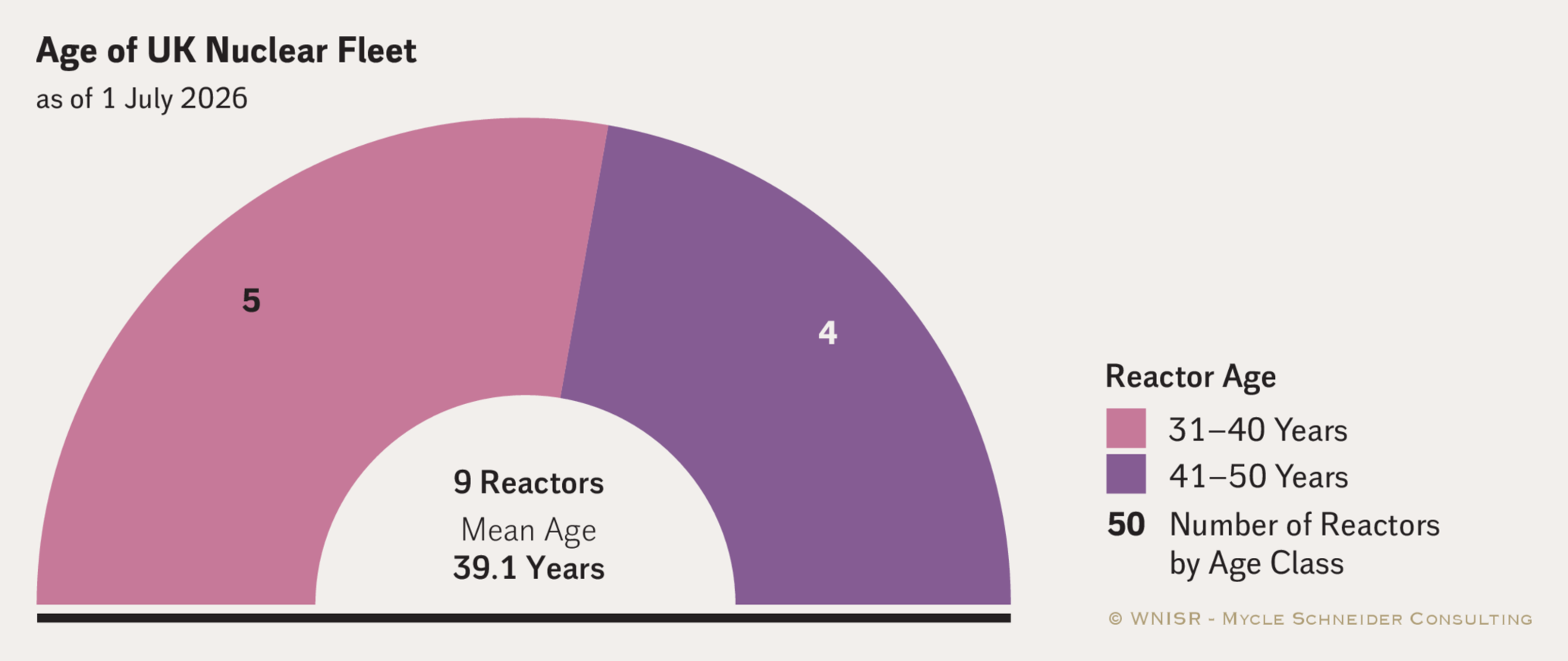
Sources: WNISR with IAEA-PRIS, 2026
The operational fleet consists of eight AGRs at four power stations and a single 1.2 GW PWR, Sizewell B, that was connected to the grid in 1995.918 EDF Energy is currently aiming to extend the operational lifetime of Sizewell B by 20 years to 2055.919 According to EDF Energy manager Mark Hartley, the company would, together with co-owner Centrica, invest up to £800 million (~US$1.1 billion) for this extension, provided the government offered some kind of “revenue certainty”. Currently, negotiations are ongoing on whether a Contracts-for-Difference (CfD) scheme, similar to that used to finance the Hinkley Point C construction project (see below), could be implemented.920
The remaining AGRs were connected to the grid between 1983 and 1989. This means that they have all significantly surpassed their 25-year design-life. The main challenge with old AGRs is graphite core aging as the bricks’ physical properties change due to radiation damage and chemical reactions with the reactor coolant. Aging can result in weight loss of the bricks which reduces their effectiveness as a moderator and alters their overall mechanical properties. It can also lead to cracks appearing in the blocks which can pose additional safety challenges. Cracks in the outer shielding blocks, unique to the design of the reactors at Torness and Heysham B, were detected at all four respective units in 2015. The reactors might be subject to further cracks, e.g., in the so-called seal-ring groove wall.921 Regardless, the twin reactors at Torness and those at Heysham B are expected to continue to operate until at least 2030. Having received one-year lifetime extensions in September 2025, the twin units at Hartlepool and those at Heysham A are scheduled to close in 2028.922 In late 2025, the government stated that “the retirement of [the AGR fleet] risks leaving a dangerous gap in Britain’s low-carbon energy supply.” 923
Whether the reactors will make it to their current closure dates is uncertain. For example, Hartlepool experienced substantial “operational challenges” throughout 2025924 that continued in 2026. The exact reasons for these challenges are not stated, but it seems that planned maintenance work in the summer of 2025 was extended beyond its initial schedule.925 Furthermore, an incident during which “two employees came into contact with pressurized hydraulic oil” led to a brief disconnect from the grid in November 2025 and to ONR issuing a so-called “improvement notice” to EDF Energy to improve health and safety measures at the site;926 the operator’s arrangements were deemed satisfactory in May 2026.927
In April 2025, Hartlepool had already been placed under “enhanced regulatory attention” by ONR after several areas requiring safety-related improvements had been identified.928 In March 2026, ONR increased its attention level to “significantly enhanced”. An ONR representative was quoted as saying that there had been an “increase in the number of serious events or near misses” at Hartlepool,929 but ONR claimed that the station “remain[ed] safe to operate.” 930 As of June 2026, Hartlepool A-1 had been unexpectedly taken off the grid after a steam pipe leakage.931 The recent performance of the station raises questions regarding its ability to operate until 2030 as planned.
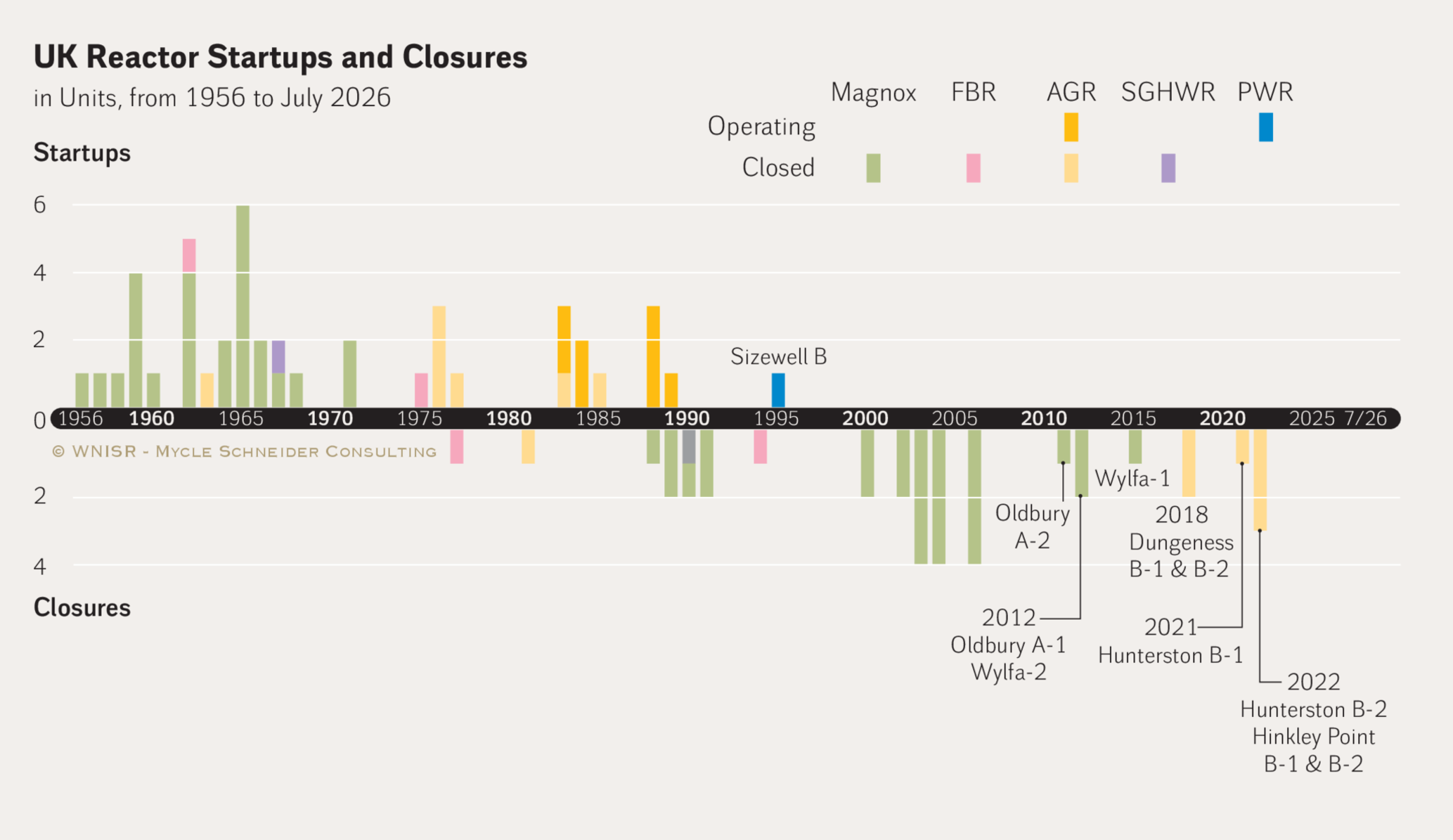
Sources: WNISR with IAEA-PRIS and EDF Energy, 2022–2026
Note: AGR: Advanced Gas Reactors; FBR: Fast Breeder Reactor; PWR: Pressurized Water Reactor; SGHWR: Steam-Generating Heavy Water Reactor.
|
Reactor |
Net Capacity (MW) |
Grid Connection |
Closure/ Expected Closure |
|
Dungeness B-1 Dungeness B-2 |
545 545 |
03/04/1983 29/12/1985 |
Closed June 2021 |
|
Hartlepool A-1 Hartlepool A-2 |
590 595 |
01/08/1983 31/10/1984 |
March 2028 |
|
Heysham A-1 Heysham A-2 |
485 575 |
09/07/1983 11/10/1984 |
March 2028 |
|
Heysham B-1 Heysham B-2 |
620 620 |
12/07/1988 11/11/1988 |
March 2030 |
|
Hinkley Point B-1 Hinkley Point B-2 |
485 480 |
30/10/1976 05/02/1976 |
Closed |
|
Hunterston B-1 Hunterston B-2 |
490 495 |
06/02/1976 31/03/1977 |
Closed November 2021 Closed January 2022 |
|
Torness-1 Torness-2 |
595 605 |
25/05/1988 03/02/1989 |
March 2030 |
Sources: WNISR and EDF, 2026932
UK Power Mix and Energy Policy
EDF Energy is primarily blaming the bad performance of the Hartlepool station for the significant reduction in nuclear energy production in 2025 compared to 2024.933 In 2025, 35.9 TWh (gross) of power came from nuclear plants, an 11.7-percent reduction year-on-year. This means that nuclear provided only 12.2 percent of the country’s power, down from a historic maximum of 28 percent in 1997.934
Renewable power production reached a new record high of 153 TWh (+5.9 percent compared to 2024), accounting for 52.1 percent of the country generation mix, wind power representing 29.4 percent (with a record production of 86.5 TWh), bioenergy 14 percent, solar PV 6.9 percent (with a production up 34 percent to 20.1 TWh), and hydro (1.8 percent). Fossil fuel generation reached 94.9 TWh (+4.1 percent), almost entirely covered by gas, and “remained at a historically low level, marking the first full year with no generation from coal.” Imports remain a vital part of electricity supply, with the UK importing a net balance of 29.7 TWh in 2025.935
Onshore wind capacities have been stagnating for the past few years due to a “de facto ban” on onshore wind energy in England.936 The incoming Labour government changed the legislation in 2024 and an Onshore Wind Taskforce concluded its work in July 2025, proposing a strategy to nearly double onshore capacities in Great Britain from currently 14.8 GW to 29 GW by 2030.937 In the whole UK, i.e., including Northern Ireland, installed onshore wind capacities were 16.4 GW in 2025.938 A decade ago, 30 GW of new capacities had been in various planning stages.939 CfD auction results announced in February 2026 awarded 28 projects or 1.3 GW of onshore capacity at an average clearing price of £202472.24 per MWh (US$202492.3/MWh).940
So far, most of the UK’s wind power is generated by the country’s substantial offshore capacities, i.e., 17 GW in 2025.941 While the auctions in 2023 failed to attract any bids below the government’s maximum set level, the 2024 auctions secured 5.3 GW of offshore capacity, including 400 MW of floating turbines, and an additional 990 MW of onshore wind (mostly in Scotland).942 A year later, the seventh auction awarded 8.4 GW of capacity at an average strike price of £202490.91 per MWh (US$2024116.2/MWh) for fixed bottom offshore.943 The current government targets aim for 43 to 51 GW of installed offshore capacity by 2030.944, 945 The government has also set up a roadmap to expand solar capacities from currently about 18 GW to 45–47 GW by 2030.946 The February CfD auction secured 4.9 GW of solar PV, spread over 157 projects, at an average clearing price of £202465.23 per MWh (US$202483.4/MWh).947
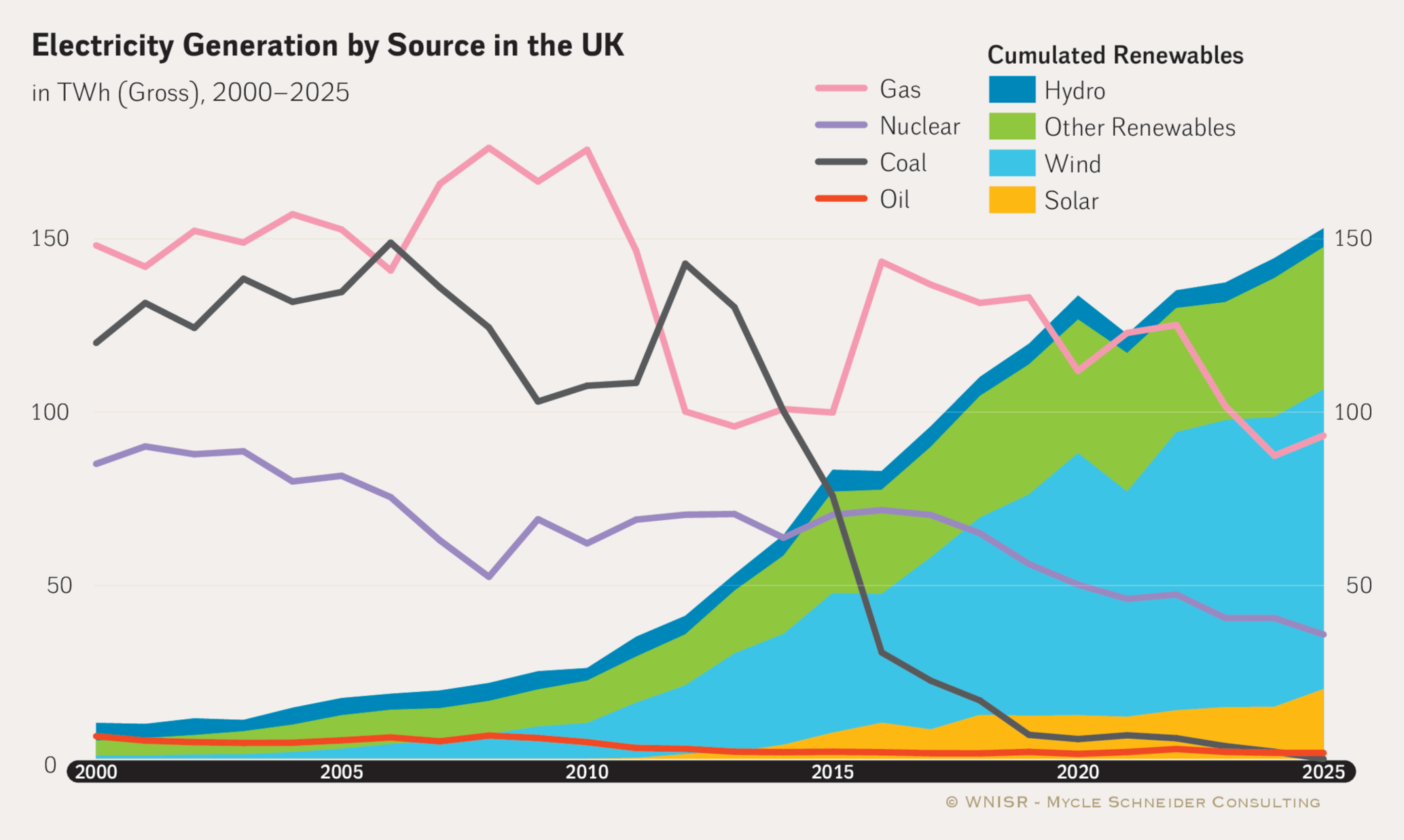
Source: UK Government, 2026948
The UK has set some of the world’s most ambitious greenhouse gas emission targets, committing to a 68-percent reduction from 1990 levels by 2030 and an 81-percent reduction by 2035.949 These developments are partially executed through the Labour government’s new implementation vehicle, “Great British Energy” or GBE, that is tasked with helping finance the energy transition. GBE was capitalized by the government with £20248.3 billion (US$202410.6 billion).950 It later transpired that this would also fund nuclear projects via its dedicated body “Great British Energy – Nuclear” or GBE-N.951
In December 2024, the government published a Clean Power 2030 Action Plan, which, if fully implemented, would see the power sector generate 95 percent from “clean sources” in a “typical weather year”, with some 35 GW of unabated gas in reserve capacity.952 On nuclear, the plan states
We are also committed to nuclear, including [expanding] the lifetimes of existing nuclear projects where possible and the development of emerging low-carbon and renewable technologies that will play an important role beyond 2030.
The government further stated that decisions regarding Sizewell C and the SMR program led by GBE-N will be taken at the Spending Review. The review took place in June 2025 (see following sections).953
The UK has one power station with two reactors under construction at Hinkley Point C, and one project at Sizewell C, also with two units, that received a Final Investment Decision (FID) in July 2025.954 Both projects are based on the Franco-German European Pressurized Water Reactor (EPR) design. In 2026, GBE-N signed a contract with Rolls-Royce SMR to allow for “site-specific design activity and preparations for the site build at Wylfa, as well as allowing Rolls-Royce SMR to order long lead-time equipment from the supply chain”955 for three reactors. Details on the projects are provided below.
Hinkley Point C
As has been documented in earlier editions of the WNISR, the construction of Hinkley Point C (HPC), instead of ushering in a bright new future for the nuclear industry, exemplifies the scale of problems plaguing the UK nuclear program. In 2016, it was estimated to cost £201618 billion (US$201624.3 billion).956 At the time, Vincent de Rivaz, then chief executive of EDF, said, “We have the expertise, the supply chains and the teams ready to build Hinkley Point C safely, on time and on budget.”957 Since then, the project’s costs have escalated dramatically to £48–49.4 billion (US$64–66 billion),958 doubling the original budget and fundamentally undermining the economic case for nuclear newbuild in the UK.
The rising construction cost is of concern to EDF, and it is seeking to find additional investors.959 In June 2025, the company announced that it had signed an agreement with Apollo to provide an additional £4.5 billion (US$6 billion) in financing to assist with, among other things, the completion of HPC. The bonds would be issued in three tranches, starting with £20251.5 billion (~US$20252 billion) in June 2025 and then an equal amount in the following two years.960
The project timeline has suffered significant setbacks. Scheduled at construction start for completion in 2025, the first unit is, as of June 2026, not expected to begin operations before 2030 with the second one following one year later. However, EDF already warned that this schedule could slip by one year.961 EDF has blamed the delays on multiple factors, including the complexity of civil engineering work, the construction conditions under COVID-19 restrictions, and the challenge of restarting nuclear construction in Britain after a 20-year hiatus.
In 2013, to prepare the project for the Final Investment Decision (FID), the government introduced a price guarantee for 35 years through a Contract for Difference (CfD). In this contract design, the supplier is guaranteed a certain price for delivered power. If wholesale prices are below that strike price, the difference is paid to the supplier in the form of a consumer-funded subsidy. If wholesale prices exceed the strike price, the difference is paid back to consumers.
The strike price depends on the number of units that are ultimately built.962 If only HPC were built, the strike price would be £201292.5 per MWh (US$2012146/MWh), but if Sizewell C were also built, the price for both would be £201289.5 per MWh (US$2012141/MWh).963 In 2025, following the FID for Sizewell C, the price for HPC was reduced accordingly, causing EDF to write off €20251.78 billion (US$20252.3 billion) after adjusting its expected future revenue. Total impairment of the HPC project in 2025 was €20253.5 billion (US$20254.6 billion), resulting from delays, higher cost, and other factors.964
The price for the CfD is not fixed;965 instead, the £201289.5 per MWh (US$2012141/MWh) shall rise in line with the Consumer Price Index (CPI), using November 2011 as the baseline and February of the completion year as the target. The price for each subsequent year is adjusted according to the CPI.966 Therefore, if the plant had operated in 2025, the price EDF would have received is £2025128.67 per MWh (US$2025169.4/MWh). Assuming an average annual inflation rate of 2 percent, the price by 2031 would be around £145 per MWh (US$2025190.9/MWh).967 Given that the CfD is expected to operate for 35 years, EDF can expect prices of about £284 per MWh (US$2025373.9/MWh) by 2065.
In comparison, the latest round of offshore wind CfD allocations (AR7) in January 2026 awarded contracts with strike prices at £202491.2 per MWh (~US$2024117/MWh), with two outlier floating wind turbine projects at £2024216.5 per MWh (~US$2024277/MWh).968 Furthermore, wholesale prices, which are currently predominantly set by the price of natural gas, are expected to fall as more renewable power sources are brought online.969 According to the Financial Times, consultancy Aurora Energy Research estimates wholesale electricity prices would be in the region of ~£78 per MWh (US$2025102.7/MWh) in the 2030s.970
Within the original agreement, if commercial operation started after November 2029, the CfD duration was to be reduced by one year for every year of delay until 2033. This is the “longstop date”, after which the contract could be cancelled if the project was not completed. On 29 November 2022, the longstop date was extended from 1 November 2033 to 1 November 2036.971
The delay in completion has had an impact not only on EDF but also on the broader power market, which was expected to have 3.2 GW of capacity available by now. An assessment from early 2024 by Aurora Energy Research looked at the market implications of a three-year delay at Hinkley. It concluded that the wholesale price of electricity would rise by £20245 per MWh (US$20246.4/MWh) in 2029, assuming that HPC’s capacity was replaced by a gas plant, and expected an increase of 6.2 Mt of CO2. However, they also concluded that the
cost of not paying for Hinkley C’s CfD is substantial, adding up to £1.62022 billion [US$20222 billion] over the three years we are considering here [2028–2030]. That offsets a bit less than half the cost of rising wholesale prices from the delay to Hinkley C.
The assessment concluded that
in short, the delay of Hinkley C is bad news for everyone, unless they happen to own an unabated gas plant or an interconnector, of course.972
Sizewell C
Initially, it was proposed that EDF and China General Nuclear Power Co. (CGN) would develop a follow-on to HPC, the Sizewell C or SZC project, a copy of HPC, with two 1.6-GW EPR units. Chinese investment was limited to 20 percent, leaving EDF with 80 percent of the company that would take the project to FID; neither party was obliged to take any share in the company that built, owned, and operated the plant. In 2022, EDF stated that it had planned to pre-finance the development of its share of the initial budget of up to £458 million (US$2022565 million), with no agreement to invest beyond that stage.973 On 24 June 2020, the UK Planning Inspectorate had accepted the application for development consent received the previous month.974 In July 2022, the government gave its development consent to build Sizewell C.975
EDF was optimistic that it could reduce construction costs, and in 2020—less than two years into the official construction of HPC—it estimated that Sizewell C would cost £18 billion (US$202023 billion).976 However, it was also hoping to reduce the financing costs of the project by shifting from the CfD mechanism to the Regulated Asset Base (RAB) model. EDF has suggested that with a better financing model and no “first-of-a-kind costs” (FOAK),977 the strike price could “peel away” by £36 per MWh (US$201256.9/MWh).978 In its 2020 planning documents, EDF confirmed construction cost estimates of “circa £20 billion” (US$202025.6 billion).979
Then in early 2025, the Financial Times reported that the cost of the project was expected to be around £40 billion (US$202552.7 billion), “double the £20bn [US$202025.6 billion] estimate given by developer EDF and the UK government for the project in 2020.”980 Meanwhile, the French state auditor had recommended that EDF not take an FID in Sizewell C until it has reduced its financial exposure to HPC.981
In March 2021, EDF’s financial report for 2020 said an FID was likely to be made in mid-2022 but used cautious language overall about the project, stating “to date, it is not clear whether the group will reach this target,”982 which it did not.
There are two companies involved in the implementation of the project. A development company that was to take the project to FID—Sizewell C Limited—and the company that will then own the project. The ownership structure of these two companies does not need to be the same. The UK Government has bit by bit bought into the project and invested in the development company and has said it will also take a significant share of ownership of Sizewell C. By April 2025, the government had spent or handed to the project company a total of £6.4 billion (a total of US$20258.4 billion) (refer to United Kingdom Focus in WNISR2025 for details).
In the 2025 Spending Review, the government announced a further £14.2 billion (~US$202519 billion) for Sizewell C between then and the financial year 2029–2030.983 By the end of the decade, the government therefore intends to have allocated £20.6 billion (US$202527 billion) for the construction of Sizewell C. Even without delays, construction would be in the early stages at that time and additional government funding can be expected to be needed.
Finally, in July 2025, the FID was taken, and contracts were finalized in November 2025.984 The project company estimates Sizewell C to be completed by July 2039 at a total cost of £202538.2 billion (US$202550.3 billion), not accounting for a £1.6 billion (US$2.1 billion) made at FID for “access to information from HPC, including confidential cost and progress information, know-how, and lessons learned.”985 The investing consortium now consists of the UK Government (44.9 percent), the Canadian pension fund La Caisse (20 percent), utility Centrica (15 percent), EDF (12.5 percent), the Nuclear Liabilities Fund (NLF), which is supposed to fund decommissioning of all eight AGRs, operational and closed, and Sizewell B, (4.6 percent), and International Public Partnerships Limited (3 percent). The last two are represented by Amber Infrastructure.986
According to Centrica, the investments of the private investors have been “significantly de-risked” through the RAB financing scheme.987
However, the project risk has not dissipated; instead, the burden of cost escalation and delays has been transferred from investors to taxpayers. In a critical report on the Sizewell C project, the National Audit Office(NAO) stated:988
➜ Over time, DESNZ [Department for Energy Security & Net Zero] realised that taxpayers and consumers would need to accept more of the development and construction risk if it were to attract investors for SZC. (…)
➜ SZC will also have a significant intergenerational impact: half the costs fall to consumers before 2051 and the modelled benefits only start to outweigh those costs after 2064. (…)
➜ Although SZC should cost less to build than HPC, consumers may still pay more for SZC’s electricity. (…)
➜ Investors still face the normal risks of running the business, but many of these are shared with consumers or have limits on how much investors can gain or lose. (…)
➜ The sharing of risk with the taxpayer and consumer appears to have reduced the cost of financing the project, but the rewards for investors still appear high, given their limited exposure to project risk. The extent to which investors will be incentivised to control project costs in the way DESNZ assumes is unclear.
In a 2025 report published by the think tank Policy Brief, energy policy analyst Stephen Thomas989 analyzes the RAB model in detail. He concludes that
the balance of risks is one-sided with the risks falling almost entirely on taxpayers and consumers, with minimal penalties and generous incentives offered to investors.990
Compared to the HPC financing model, in which EDF carries most of the burden (albeit at the expense of French taxpayers), Sizewell C will thus place substantial burden on future taxpayers and electricity consumers in the UK. Furthermore, the power purchase agreement is not a fixed price but is instead calculated based on the investors’ guaranteed income on their assets, a fair rate of return, set at 10.8 percent (real),991 and variable costs are directly paid by consumers. The price of power will therefore vary depending on plant output and operation costs.992 Financing costs are recovered from consumers as a surcharge on electricity bills from the day of investment, adding £1 (US$1.34) to every household’s electricity bill per month, more than 14 years before Sizewell C begins delivering power.993 Refer to Table 17 for a direct comparison of the two deals.
|
Hinkley Point C |
Sizewell C |
|
|
Forecast cost at FID |
£18bn (2015), £23.9bn (2024) |
£40.5bn (2024) |
|
Forecast time from FID to Commercial Operating Date |
9 years |
14 years |
|
Price of power |
Originally £92.5/MWh (2012); Reduced in 2025 to £89.5/MWh (2012), £108/MWh (2025); nominal value fixed for entire period. |
Unknown & varying unpredictably from year to year. |
|
Contract length |
35 years. |
60 years |
|
Who pays interest during construction? |
EDF - Only recovered from consumers if the plant meets its cost and time targets. |
Consumers. |
|
Source of finance |
Finance markets & investor equity. |
Some equity given to investors by consumers as part of the consumer surcharge, debt supplied by the UK Government at a low rate. |
|
Who is liable for cost overruns? |
EDF |
Shared up to £47.5bn, then 100% taxpayers/electricity consumers. |
|
Who finances the plant? |
EDF (66.5%), CGN (33.5%) up to £18bn, then 100% EDF |
Government (44.9%), La Caisse (20%), Centrica (15%), EDF (12.5%), Amber Infrastructure (7.6%) up to £47.7 bn, then 100% taxpayers. |
|
Control points |
If the plant is not complete by the longstop date (11/2033, revised in 2021 to 11/2036) government can cancel the power purchase contract. |
If the plant cost exceeds £47.7bn, investors can terminate additional finance with no penalty. If government wants to terminate the project, it must compensate private investors. |
|
Protection against low-probability high-consequence events |
Limited, e.g. compensation if the government takes a political decision to abandon the project. |
Comprehensive government support package provided at no cost to investors. |
Source: Stephen Thomas, Policy Brief, 2025994
Note: FID: Final Investment Decision.
Funding was not the only issue to be resolved, and in March 2024, a government standalone company995, Sizewell C Ltd., signed a deal with EDF to purchase the freehold of the land for the new power plant. This was followed in April 2024 by Framatome signing contracts “worth multi-billion euros” with Sizewell C Ltd. for the delivery of the nuclear steam supply systems, the safety instrumentation and control systems, long-term supply of nuclear fuel, and maintenance services.996 The land ownership question was one of the unresolved issues that had held up ONR’s issuing of a site license, which was finally granted in May 2024.997
The 2025 Spending Review, also stated that the government announced that it was “ending decades of delay on critical energy projects by giving the green light to Sizewell C, a Small Modular Reactor, and Carbon Capture, Usage and Storage programmes.” 998 Additional nuclear expenditures included:
- £2.5 billion (US$20253.3 billion) for the development of SMRs, with Rolls-Royce selected as the preferred bidder (see Small Modular Reactors below)
- £2.5 billion for nuclear fusion, to be split between research centers in Oxfordshire, West Burton, and Cumbria999
- £13.9 billion (US$202518.3 billion) for the Nuclear Decommissioning Authority (NDA)—which received less media attention—to continue decommissioning and waste management activities at the existing sites
Therefore, civil nuclear received £33.1 billion (US$202543.6 billion), over a quarter of the total economy-wide capital expenditure of £120 billion (US$2025158 billion) within the entire spending review. In 2026, the NDA budget was increased by £270.6 million (US$362.7 million), GBE-N received an additional £196 million (US$262.7 million), and the Defence Nuclear Enterprise Programme received an increase of £2.2 billion (US$2.9 billion).1000
Other Sites
Other sites have been proposed and developed to various degrees over the years. This includes Moorside in Cumbria being investigated at some point by Toshiba-Westinghouse—the site reverted to NDA ownership after Westinghouse went bankrupt in 2016—as well as GE-Hitachi-owned Wylfa Newydd on Anglesey and Oldbury on Severn in South Gloucestershire.
In March 2024, the previous government announced that it had, through GBE-N, purchased the nuclear sites in Wylfa and Oldbury and that the Wylfa site was the preferred option for a third large-scale nuclear project after Hinkley and Sizewell.1001 Wylfa and Oldbury both house closed Magnox reactors, owned by the NDA and waiting to be dismantled (see United Kingdom in Decommissioning Status Report).
In February 2025, in a gung-ho press release titled, “Government Rips up Rules to Fire-up Nuclear Power”, the government announced it was going to change the planning rules for nuclear. In particular, it was going to lift the restrictions currently limiting reactor construction in England and Wales to the siting of new reactors at eight of the existing sites, to include SMRs in planning rules, and to remove the expiry date of nuclear planning rules. The government hopes that these changes will “back the builders.” 1002
In November 2025, when the Wylfa SMR decision was announced (see below), the government revealed that it had asked GBE-N to identify potential sites for “a further large-scale reactor project” like Hinkley and Sizewell.1003 A list of suitable sites was expected to be presented to the government in the fall of 2026. Notably, Scottish sites were to be included, despite the Scottish Government opposing nuclear newbuild.1004 According to a source close to Energy Secretary Ed Miliband, cited by The Guardian, the government aims for future large reactors to be built at the Torness and Hunterston sites in Scotland.1005 However, in the Scottish Elections in May 2026, the Labour and Conservative Parties suffered crushing losses, leaving the Scottish National Party, the party that had introduced the ban on new nuclear, in power.1006 So, Torness and Hunterston are unlikely options in the short term.
The government has continued to promote SMRs as a means of meeting future energy security and decarbonization objectives. This has gone beyond talk, and the government has made significant funding pledges.
In November 2020, to support the development of a potential next generation of reactors, the government proposed to feed up to £385 million (~US$500 million) in an Advanced Nuclear Fund, with up to £215 million (US$2020276 million) going to Rolls-Royce’s SMR program.1007 This, in November 2021, led to Rolls-Royce announcing that it had received £210 million (US$2021289 million) in government funding, £195 million (US$2021268 million) in private funds,1008 and an additional £85 million (US$2021117 million) from the Qatar Investment Authority the following month.1009
Rolls-Royce is developing a reactor that is now planned to have 470 MW capacity—thus technically, it does not fall under the SMR definition with nominal capacities in the 30–300 MW range (see chapter on SMRs). In 2021, Rolls-Royce had hoped its technology would complete the Generic Design Assessment (GDA) process with UK regulators around September 2024 and deliver first power in the early 2030s.1010 But the company concluded Step 2 of the GDA only in July 20241011—out of three steps expected to take four years in total—and had already revised its expectations as of 2023, aiming for the conclusion of the final phase in August 2026.1012 The process is now to be completed not before December 2026, likely later.
Rolls-Royce has suggested that the nth-of-a-kind reactor (after ten have been built) would cost in the order of £1.8 billion (US$2.4 billion) per 470-MW unit1013 and would generate power at £201940–75 per MWh (US$201951–96/MWh).1014 In evidence submitted in 2017, Rolls-Royce told the House of Lords, that 7 GW would “be of sufficient scale to provide a commercial return on investment from a UK-developed SMR, but it would not be sufficient to create a long-term, sustainable business for UK plc.” The House of Lords concluded: “Therefore, any SMR manufacturer would have to look to export markets to make a return on their investment.” 1015
In May 2024, the Polish Government issued a decision-in-principle approving the concept of building a plant based on Rolls-Royce technology, although no timetable was made clear at the time nor since (see ŚGP Industria (Rolls-Royce SMR) in Poland Focus).1016 In June 2026, Swedish utility Vattenfall announced that it had selected Rolls-Royce SMR for an order of three modules to be built in Sweden (see section on Sweden’s SMR Ambitions in Sweden Focus).1017 In September 2024, the Czech Republic selected Rolls-Royce amongst seven designs to be taken forward for further review with the objective of building reactors near Temelín in the 2030s.1018 And in March 2025, CEZ Group became a shareholder in Rolls-Royce SMR, with a 20 percent stake of the company to date.1019 The stated target is to deploy up to 3 GW of SMR capacity in the Czech Republic.1020 See Small Modular Reactors in section on the Czech Republic.
In June 2025, the UK Spending Review allocated £2.5 billion (US$20253.3 billion) for SMRs and to Rolls-Royce, in particular, to identify a site later that year and connect projects to the grid by the mid-2030s. The funding would support the deployment of three SMR units. Simon Bowen, the then-interim chair of GBE-N1021 told the Financial Times that he would have liked to back more than one developer, but there was no more money.1022 Even this money was taken from Great British Energy, which was, when established in 2023 by the previous administration, not expected to fund nuclear projects.1023
In November 2025, the government announced that the Wylfa site near Anglesey in the north of Wales had been selected to house the three Rolls-Royce SMRs and that the region would “become a beacon in the ‘golden age’ of nuclear”.1024 In April 2026, GBE-N and Rolls-Royce signed a contract to begin “technology design activities” that include defining a site-specific design, engaging in regulatory assessments and planning procedures, and preparing all relevant data for the government to take an FID.1025 An FID is targeted by 2029.1026
Some progress is also being made on the licensing of other reactor designs. As of June 2026, there were several designs in various stages of the Generic Design Assessment (GDA) conducted by ONR.1027
- The Rolls-Royce SMR was in Step 3, reportedly expected to be completed in 2027.1028
- GE’s BWRX-300 reactor completed Step 1 in December 2024 and Step 2 a year later. As of June 2026, there were no plans for it to move along to Step 3.1029
- Holtec’s SMR-300 completed Step 2 in March 2026, but according to ONR, there are “currently no plans to continue to Step 3 of a GDA.”1030
- ONR began the assessment of TerraPower’s Natrium reactor with Step 1 in June 2026.1031
It is worth noting that completing Step 3 of the GDA does not equal a construction and operating license for a reactor design. Instead, the GDA is designed to identify design issues early on, reduce uncertainty, and avoid discovering fundamental safety or security problems only after a site-specific project has begun. In principle, the GDA asks whether a design can be licensed within the UK. For a project to go forward, additional licensing procedures, for example, covering site-specific issues, are necessary. It is a voluntary procedure.1032
Before participating in a GDA, reactor vendors may engage in another voluntary discussion with ONR, the “early regulatory engagement”. This three-tier process begins with a one-day engagement (Tier 1), a series of structured engagements in regulatory processes and technical aspects (Tier 2), and finally a Preliminary Design Review (PDR) (Tier 3), which consists of a “technical review of certain aspects of a reactor design, based on regulatory submissions provided by the applicant.”1033
So far, five companies have participated in this process since its introduction in 2024. Last Energy completed the PDR for its PWR-20 microreactor, and X-Energy’s Xe-100 high-temperature reactor is currently undergoing Tier 3. TerraPower completed Tier 2, but it is not indicated whether it will move on to Tier 3. Moltex Flex and Newcleo seem to have quit the process after completing Tier 1.1034 TerraPower began its GDA procedure in June 2026, and in the same month, X-energy submitted an application to start a GDA, indicating that it might have completed the PDR.1035 The other projects are yet to initiate a GDA.1036
As mentioned above, in September 2025, the UK and US signed a strategic agreement that would start a “golden age of nuclear that puts both countries at the forefront of global innovation and investment,” per then-UK Prime Minister Keir Starmer. US representatives emphasized the deal would “[strengthen] U.S. energy dominance” and “unleash the full power of American Energy Dominance.” In fact, several US SMR vendors announced project plans and the UK’s ONR and the U.S. NRC said they would collaborate on licensing procedures to “[avoid] duplicating work”. With this deal came the announcement of several “commercial deals” for SMR development in the UK.1037 These included
- X-Energy and Centrica planning to build up to 12 reactors (~960 MW) in Hartlepool, ultimately aiming for 6 GW of new nuclear power in follow-up programs;1038
- Holtec, EDF, and data center operator Tritax announcing plans to build 1GW of SMRs at the former Cottam coal power station to power data centers—a press release dated 23 June 2026 announces the signing of a “Heads of Terms” document between EDF and Holtec (without mentioning Tritax), planning to set up a joint venture to pursue up to four SMRs totaling 1.3 GW;1039
- Last Energy and shipping company DP World announcing plans to build a micro modular reactor at the London Gateway port;1040
- Urenco and Radiant signing a £4 million (US$20255.3 million) deal for High-Assay Low-Enriched Uranium (HALEU) fuel delivery to the US;1041
- and TerraPower and engineering service provider and developer KBR agreeing to evaluate potential UK sites for the Natrium reactor.1042
Whether the companies will follow through on these deals remains to be seen. Many SMR projects are announced with grandeur but have often been abandoned in the past. Refer to the chapter on SMRs and past WNISR editions for details.
It is worth noting that after the government announced the selection of Rolls-Royce SMR for the Wylfa project, US ambassador Warren Stephens said that the Trump administration was “extremely disappointed by [the] decision” and that “Britain should choose ‘a different path’ in Wales.”1043 In case future large reactor projects are pursued, the US might pressure the UK Government to select Westinghouse reactors instead of British smaller reactors or French EPRs (which would likely not be selected again anyway).1044
Nuclear Regulatory Taskforce
The UK-US deal from September 2025 also included closer collaboration between the two regulators Office for Nuclear Regulation (ONR) and U.S. Nuclear Regulatory Commission (NRC) in licensing processes. In its attempt to further “slash red tape” and “get Britain building,” the UK Government had in a February 2025 announcement declared it would be “[ripping] up rules to fire-up nuclear power” and set up a Nuclear Regulatory Taskforce that would “spearhead improvements to the regulations to help more companies build [in Britain].”1045
After being formally appointed at the end of May 2025, the taskforce worked surprisingly fast and already published its final report on 24 November 2025, entailing 47 recommendations that would “reduce regulatory complexity across the sector to achieve better outcomes.”1046 The taskforce comprised of five members with limited experience in the nuclear sector, and with no apparent skills in planning regulation, radiation health issues, or nuclear-specific economics, let alone voices critical of the sector.1047 Only two days later, then-Prime Minister Starmer announced a “strategic steer to the nuclear sector.”1048 It is worth noting that the report consists of 162 pages with many details, and it contains no evidence that regulation was to blame for the bad state of the British nuclear sector. Nonetheless, then-Prime Minister Starmer said that he “[accepted] the principle of all the recommendations [the report] has set out. We [the government] have committed to complete implementation within two years, subject to legislative timelines on elements requiring primary legislation.” In March 2026, this implementation target of the year 2027 was reaffirmed, and the government said that it planned
a move towards smarter regulation: proportionate, focused on real risk, rooted in evidence, and designed to effectively protect nature and biodiversity. This plan will support safe, cost-effective, and rapid delivery across the entire civil and defence nuclear enterprise. The plan is expected to reduce the cost and timeframe of delivering new civil and defence nuclear projects, without compromising safety and environmental protections.1049
Note that this statement implies that the previous regulatory approach was not evidence-based, and, implicitly, responsible for the delays of nuclear newbuild projects in the UK. While ONR, officially, “welcomed [the] findings” of the taskforce,1050 its independence and technology neutrality might be compromised if the government implemented the recommendations. Making ONR “consider strategic factors [,] national security, climate and economic growth”1051 would implicitly mean that ONR would promote nuclear. Internationally, however, there is consensus that regulatory independence from power production or project development is essential for nuclear safety.1052
Overall, it is unclear whether these regulatory changes will have any meaningful effect on British nuclear projects. According to an independent analysis,1053 and when considering the events chronicled in this and previous editions of the WNISR, it seems that the problems of Hinkley Point C and those expected for Sizewell C are not rooted in overburdening regulation but much more related to the incapability of the supplier of the EPR technology whose complexity had already been underestimated at all of the preceding sites, such as Flamanville-3 in France, Olkiluto-3 in Finland, as well as in Taishan in China, where two EPRs were built with substantial delay and much higher cost than anticipated.1054

With 94 commercial reactors operational, the United States still has the largest nuclear fleet in the world. Nuclear energy generation in 2025 increased slightly—+0.4 percent—to 785 TWh. The nuclear sector’s share of utility-scale electricity generation decreased to 17.7 percent,1055 down 0.4 percentage points from last year and the first time it has been that low since 1987.1056 When generation supplied by small-scale solar PV is included, nuclear power provided only 17.4 percent of total generation, 0.4 percentage points less than in 2022.1057
It has been two years since a new reactor was connected to the grid and the US fleet continues to age, with a mid-2026 average of 44.7 years, making it amongst the oldest in the world: 66 units have operated for 41 years or more (of which 30 for more than 51 years) and all but four for 31 years or more (see Figure 49).
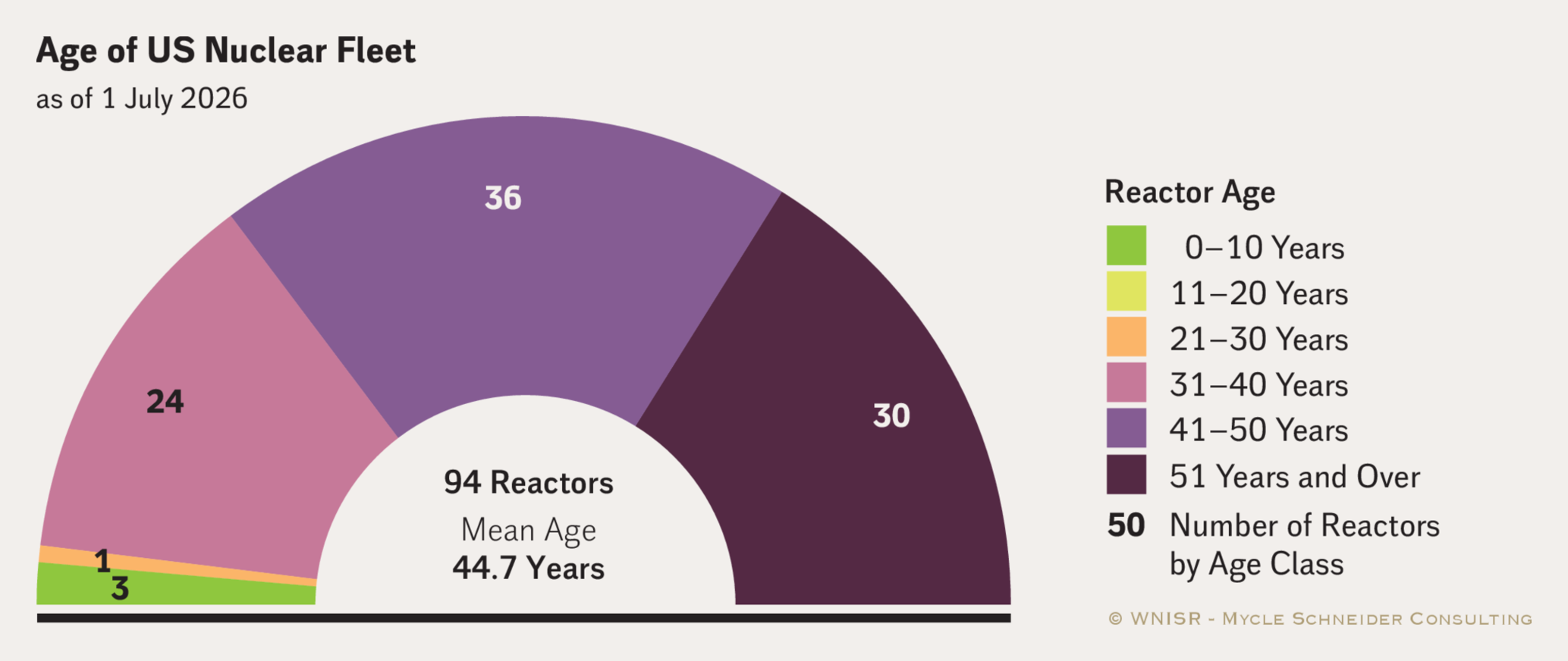
Sources: WNISR with IAEA-PRIS, 2026
Since the March 2024 grid connection of Vogtle-4 and as of mid-2026, there are no new reactors under construction in the US. The Nuclear Regulatory Commission (NRC) issued a construction permit for one reactor in March 2026, construction permits for two new commercial nuclear power plants are under review, and a combined construction permit and operating license application (COLA) for four more reactors has been partially submitted:
- TerraPower’s Kemmerer-1 reactor project received its construction permit in March 2026.1058 Site preparation activities are reportedly underway, but nuclear construction has yet to begin on the 340-MW Natrium sodium-cooled, fast reactor.
- Dow Chemical’s Construction Permit Application (CPA) for the 320-MW Long Mott Generating Station is under review.1059 The CPA for four 80-MW high-temperature, gas-cooled small modular reactors was submitted in March 2025. The reactors would provide power and process heat to Dow’s Seadrift chemical plant.
- The Tennessee Valley Authority’s (TVA) CPA for a GE-Hitachi BWRX-300 reactor at Clinch River was submitted in May 2025 and is under review.1060 TVA received an Early Site Permit (ESP) for the site in 2019.
- Fermi America is in the process of submitting a COLA for four Westinghouse AP1000 reactors,1061 which it has named the President Donald J. Trump Generating Plant. The project is part of Fermi America’s Project Matador, a proposed 11-GW power and data center development in Texas, on land adjacent to the Pantex nuclear weapons plant.
The U.S. Department of Energy (DOE) is sponsoring the Kemmerer-1, Long Mott Generating Station (LMGS), and Clinch River projects with nearly US$5 billion in awards under the department’s Advanced Reactor Demonstration Program. The Infrastructure Investment and Jobs Act of 2021 (IIJA, or Bipartisan Infrastructure Law (BIL)) provided up to US$2.5 billion in matching grant funds to TerraPower and X-energy.1062 A 2026 appropriations bill re-allocated from other DOE programs up to US$2.2 billion more for the TerraPower and X-energy/Dow awards and a US$400 million matching grant to TVA for the Clinch River project.1063 However, upon further review, DOE realized that US$270 million of those funds had already been expended for their original purposes, so it would have to adjust the allocations to the demonstration projects.1064
Since mid-2025, trends in the US identified in earlier WNISR editions have continued to develop: license extensions, contracts with data center developers, and efforts to restart retired reactors. However, no new capacity has been added, and no new commercial power reactors have begun construction.
Two proposed restarts of retired reactors have been postponed for different reasons. As detailed below, the matter of construction starts has been confused by announcements by some companies that they have initiated construction on reactors but later clarified that the activities do not meet the criteria for nuclear construction starts, i.e., first concrete for the foundations of reactor buildings.
Owners of existing reactors are planning a new wave of power uprates over the next several years, possibly adding a cumulated 2.4 GW to their generation capacity by 2032. That is less than half of the 5 GW of power uprate capacity that President Donald J. Trump called for in one of four executive orders he issued in May 2025 intended to expand the nuclear energy industry.1065
The most significant developments in the US are due to the Trump administration’s attempt to directly intervene in the expansion and regulation of the industry. Changes to the licensing and regulatory regime have been swift and dramatic. DOE has launched a new Reactor Pilot Program, through which it has selected ten companies to construct eleven first-of-a-kind reactors, while slashing over 750 pages of guidelines for reactor construction projects.1066 President Trump has reconstituted the body of NRC commissioners, through a firing, a resignation, and designating a new Chairman. And the NRC is in the process of a “wholesale revision” of its regulations, on pace to be completed in November 2026, as President Trump directed.1067
Nevertheless, thus far, there is little evidence that those measures intended to remove regulatory obstacles have resulted in any progress on the deployment milestones President Trump set forth, including: ten large reactors under construction and 5 GW of uprated capacity by 2030. DOE has reported that the directive to achieve initial criticalities in three reactors under the pilot program by 4 July 2026 was at least partially met:1068
- On 4 June 2026, DOE announced that Antares Nuclear “successfully completed a zero-power fueled criticality demonstration” of its Mark-0 reactor.1069 Idaho National Laboratory (INL) Director John Wagner subsequently clarified it means that fission “was sustained at essentially no measurable energy output. This is not electricity generation. It is not full-power operation. It is proof that the system works: the scientific and engineering validation that every subsequent step depends on.”1070
- On 18 June 2026, Valar Atomics also reportedly achieved zero-power criticality in a 100‑kWt version of its Ward 250 microreactor.1071
- On 1 July 2026, Deployable Energy announced it had achieved zero-power criticality in a version of its 1-MWe Unity reactor design. The company, founded in 2025, claims to have initiated criticality in “roughly 150 days” from the inception of the project, at a cost in the “single-digit million” dollar range.1072
So far, four large reactors have been proposed; the announced uprates would deliver only 2.4 GW by 2032; and restarts are facing delays and complications. Pairing of nuclear generation and data center operations is mostly taking the form of purchase power agreements or subsidy instruments from existing reactors, rather than deployments of new capacity.
Fermi America and its Project Matador data center and power generation development is a good example of how realities are at odds with projections. Four weeks after President Trump issued executive orders on nuclear energy, Fermi America made initial filings for a COLA;1073 publicly announced the 4.4-GW AP1000 project nine days later;1074 and went public in October 2025 through an initial public offering valued at US$19 billion.1075 But the company’s stock price has since fallen dramatically, losing over 75 percent of its value by mid-2026,1076 after failing to recruit a major tenant for its proposed data center, development work at the project site stalled, and the Board of Directors fired the politically connected Chief Executive Officer (CEO) and co-founder, Toby Neugebauer.1077 Despite meeting several of the goals President Trump set forth and availability of up to US$80 billion in financing for Westinghouse reactor projects through a deal with Japan,1078 the project’s prospects are increasingly uncertain.
Subsidies and Financing for Nuclear Power
There were four recent major developments involving subsidies and public finance for nuclear power. In January 2026, Congress enacted an appropriations law for Energy and Water programs,1079 which initially authorized an additional US$3.1 billion for DOE awards to projects under its Advanced Reactor Demonstration Program: an additional US$2.2 billion for the TerraPower’s Kemmerer-1 reactor and X-energy/Dow’s LMGS and TRISO-X projects; and US$900 million for light-water SMR demonstrations, which funded awards of US$400 million each to Holtec’s proposed Pioneer-1 & -2 project and TVA’s Clinch River reactor, leaving US$100 million for unspecified projects.
The funds do not involve increased government spending, but reallocations of unspent appropriations from other programs initially funded by the Infrastructure Investment and Jobs Act of 2021 (IIJA). It zeroes out the remaining amounts for the Civil Nuclear Credit program, for which the IIJA originally provided US$6 billion, but the only award issued was US$1.1 billion Diablo Canyon-1 & -2. Previous spending bills transferred US$2.7 billion to production of High-Assay Low-Enriched Uranium (HALEU) and US$900 million to other nuclear fuel production measures, and to DOE subsidies for commercial reactor development programs.1080
The 2026 appropriations law is the first time in recent years that DOE funds for renewable energy projects have been redirected to nuclear power, with US$394 million from projects under DOE’s Office of Energy Efficiency and Renewable Energy. The measure also took about US$3.5 billion in funds from carbon capture and sequestration, direct air capture demonstration projects, and a carbon dioxide transportation program.1081
Also in January 2026, the New York State Public Service Commission approved a more than 20-year extension of its Zero Emissions Credit (ZEC) subsidy program for four currently operating reactors.1082 Originally promulgated in 2016, the program was authorized for 12 years, from April 2017 to March 2029 to provide financial incentives for the continued operation of the four reactors FitzPatrick-1, Ginna-1, and Nine Mile Point-1 and -2.1083 The extension of the ZEC program would run from April 2029 to December 2049, an additional 20.75 years and cover the entire Subsequent License Renewal (SLR) periods for Ginna-1 and Nine Mile Point-1. The program’s ZEC pricing formula would continue to be based on the federal government’s Social Cost of Carbon (SCC) metric for estimating the environmental impacts of greenhouse gas emissions but without an adjustment for the emissions rate of the state’s power generation sector.1084 Under the annually escalating SCC price, the price of New York’s ZECs from 2029–2049 could exceed US$33 billion.1085
Figure 50 presents a historic timeline of 25 reactors for which “early retirement” had been announced between 2010 and 2020. (See past WNISR editions, notably WNISR2019 and WNISR2020) Thirteen were closed, and twelve continued operating due to bailouts. Almost all of those reactors, plus three that were closed, subsequently applied or announced their intention to apply for a License Renewal, either Initial License Renewals (Perry-1 and Diablo Canyon-1 & -2) or Subsequent License Renewals. See Figure 51 and section on Extended Reactor Licenses below.
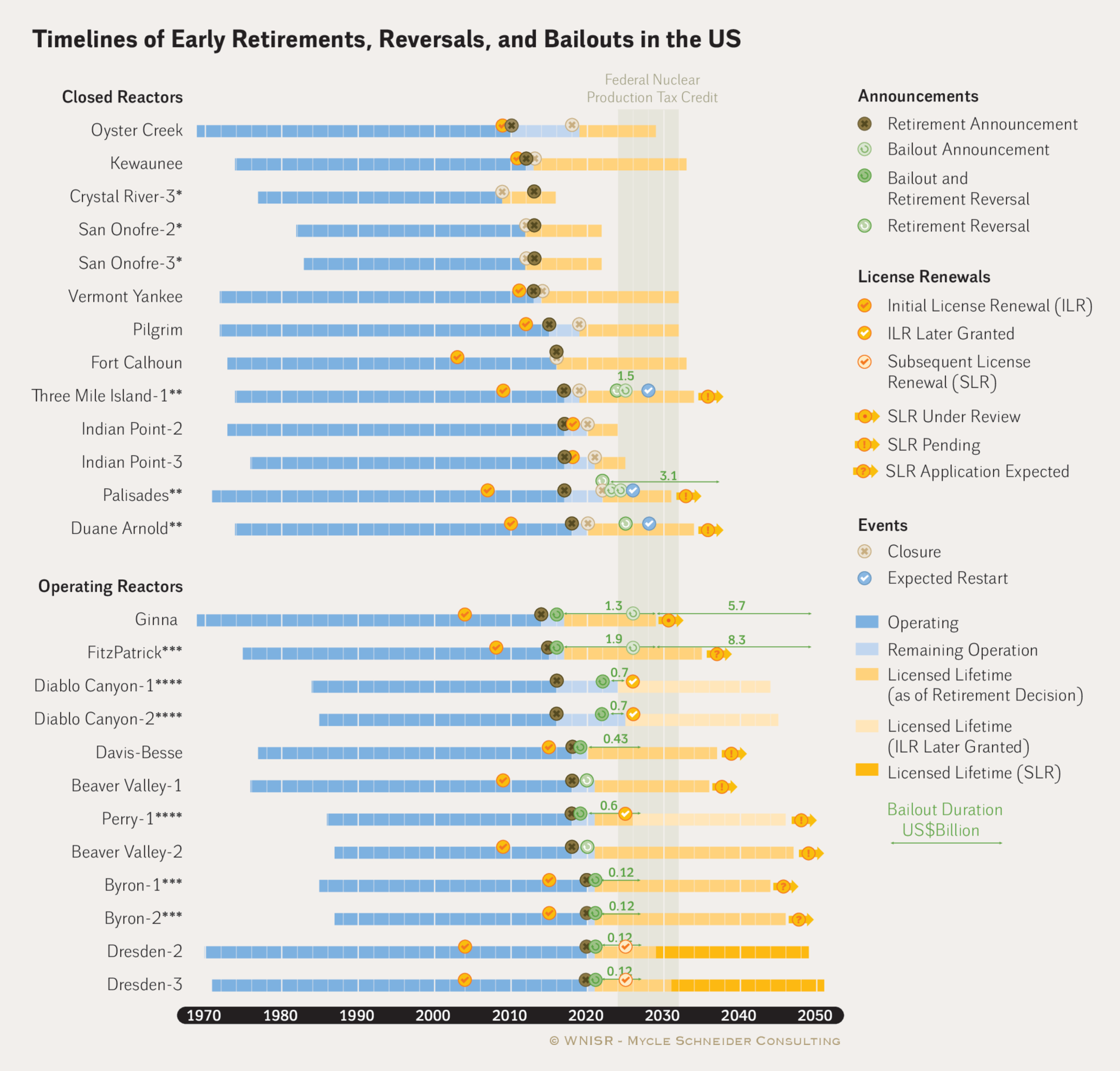
Sources: Various, compiled by WNISR, 2026
Notes
This figure shows the early Retirement Announcement, the operating period (Operating), the expected Remaining Operation compared to the Licensed Lifetime of each reactor as of the retirement announcement; this is followed by actual Closure*, or Bailout and/or decision of Retirement Reversal. It provides the Bailout Duration (when available) and the amounts in Billion of US$.
ILR Later Granted and SLR, for licenses granted after the reversal announcement are also displayed, as well as the additional Licensed Lifetime.
* Crystal River: No production after 2009 (Considered closed as of this date). Official closure announced in 2013. Renewal application submitted in 2008, withdrawn in 2013.
San Onofre-2 & -3: No production after 2012 (Considered closed as of this date). Official closure announced in June 2013.
For those three units, the “Retirement Announcement” comes after the “Closure” (last production) of the reactor.
** Potential restart from “Early Retirement”. SLR Pending: Future submittal of applications for SLR were expected in 2025 (Duane Arnolds), expected in 2028 (Palisades) and in 2029 (Three Mile Island-1).
*** FitzPatrick and Byron-1 & -2: SLR Application Expected – Five of the notices Constellation has provided to the NRC do not specify for which reactors the company intends to submit applications. It seems likely that they will or may involve those reactors amongst others.
**** Perry-1: ILR Applications withdrawn by the licensees in 2018. New applications submitted in 2023; ILR Later Granted (2025).
Diablo Canyon-1 & -2: ILR withdrawn by the licensees in 2018. New applications submitted in 2023; ILR Later Granted (2026).
However, Diablo Canyon currently has a planned retirement date of 2030 per law of California (not displayed on the chart) and any extension beyond that would require action by the state legislature.
For those three units, Licensed Lifetime as of Retirement Decision does not include those renewals, shown as ILR Later Granted.
In July 2025, the Trump administration announced a deal with Japan, through which Japan will provide up to US$550 billion of investment in the US.1086 The total includes US$100 billion in financing for nuclear energy projects, of which up to US$80 billion for construction of Westinghouse reactors.1087 The deal was followed in October 2025 by a new partnership between the US Government and Westinghouse owners Brookfield and Cameco, involving deployment of reactors, profit-sharing, and a possible corporate restructuring and equity stake in the company. Initially, the government would provide up to US$80 billion in financing for construction of Westinghouse reactors. After the company’s profits exceed US$17.5 billion, Westinghouse would provide the US Government with a 20-percent share of profits.1088 If Westinghouse’s valuation rises to US$30 billion or more, its owners Canadian holding Brookfield Asset Management and uranium company Cameco may be required to take Westinghouse public, with the US receiving a 20-percent equity stake.
In June 2026, the DOE announced that it would provide a total of US$17.5 billion in loan guarantees toward construction of ten large reactors (at five sites), and that the reactors would be co-owned by Westinghouse and a utility company.1089 Westinghouse and the respective utility would each contribute US$500 million in equity toward each project,1090 for a total of US$5 billion. DOE did not disclose the names of any utilities that have agreed to enter into such arrangements. In total, the financial terms in DOE’s announcement add up to US$22.5 billion in equity and financing for ten reactors, hardly more than the cost of building one Westinghouse AP1000 reactor, based on actual expenditures on Vogtle-3 and -4 (see United States Focus: Reactor Construction in WNISR2024), adjusted for inflation.1091
Notably, the US Government is not providing direct subsidies to the eleven projects under DOE’s Reactor Pilot Program: “Each company will be responsible for all costs associated with designing, manufacturing, constructing, operating, and decommissioning their test reactors.”1092 The agency claims that participation in the program “will help…unlock private funding” for the projects. This approach will reduce the risk to US taxpayers but runs counter to the structure of DOE’s Advanced Reactor Demonstration Program and the awards made to TerraPower, X-energy, and others to subsidize reactor design development and construction of commercial reactors.
Under the Atomic Energy Act (AEA) and NRC regulations, the NRC issues initial operating licenses for commercial power reactors for 40 years. Regulations provide for license extensions in increments of up to 20 additional years. Due to the advanced age of the US reactor fleet, reactor owners have begun applying for second license extensions, to permit operation out to as much as 80 years.
As shown on Figure 51, as of mid-2026, 90 of the 94 operating US units (95.7 percent) had already received 20-year Initial License Renewals (ILRs), which permit reactor operation beyond 40 and up to 60 years. Four reactors have been approved for ILR since 1 July 2025: Perry-1, Clinton-1, and Diablo Canyon-1 and -2.1093 After TVA submits its application for Watts Bar-1 (anticipated in late-2026), the remaining currently operating reactors will not be eligible to apply for ILR until 2035 (Watts Bar-2), 2043, and 2044 (Vogtle-3 and -4). The NRC previously approved ILRs of three currently retired reactors that are the subjects of proposed restarts (Duane Arnold-1, Palisades-1, and Three Mile Island-1).
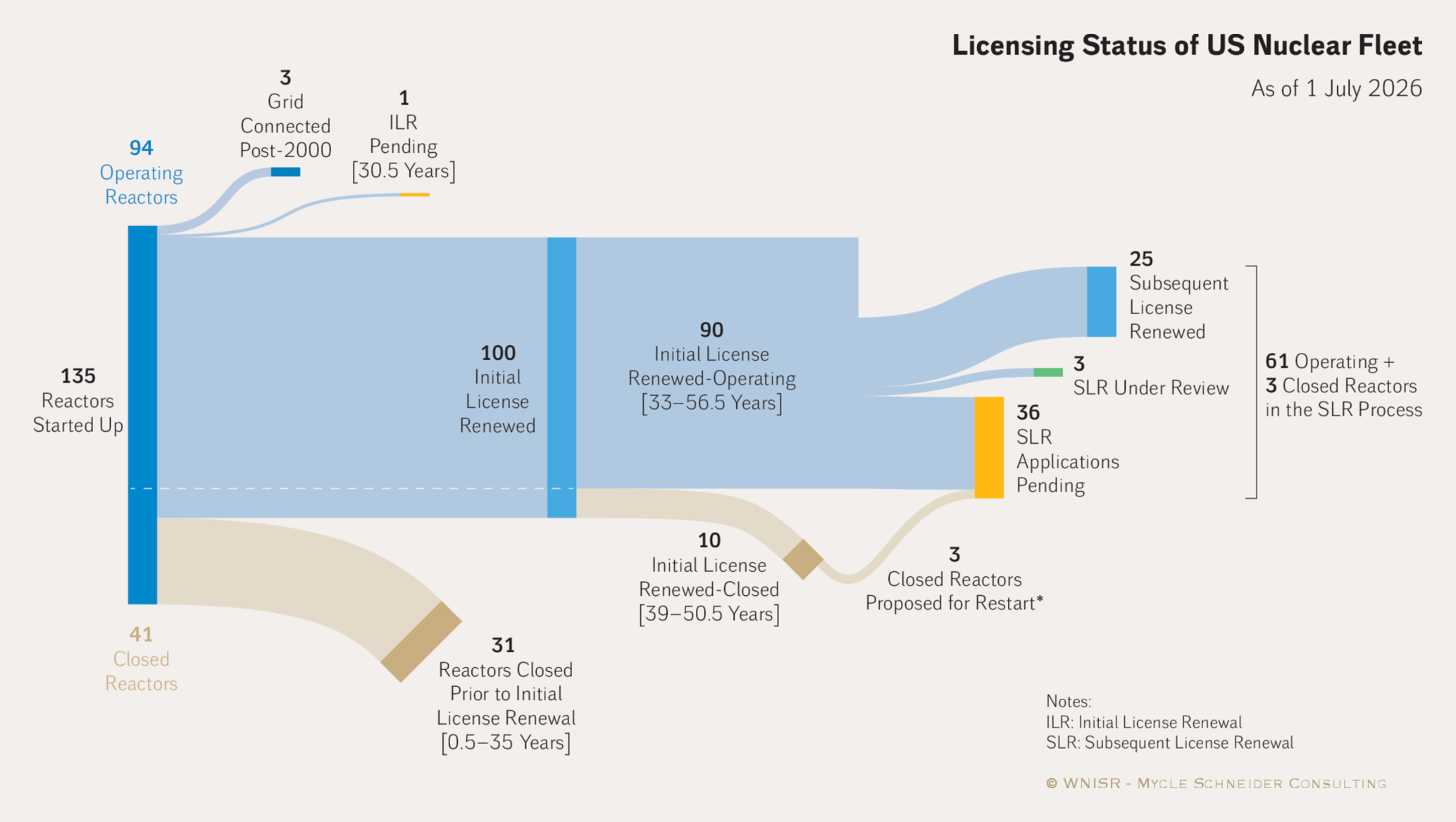
Sources: compiled by WNISR with NRC, 2026
Notes: ILR: Initial License Renewal; SLR: Subsequent License Renewal.
* Subsequent License Renewal applications expected for three closed reactors: 2025 (Duane Arnolds), 2028 (Palisades), 2029 (Three Mile Island-1).
As of mid-2026, the NRC had approved Subsequent License Renewals (SLRs) for twenty-five reactors, which would permit their operation from 60 to 80 years.1094 Applications for a further three reactors are under review, and owners have notified of their intentions to submit applications for a further thirty-six reactors between 2026 and 2034; of those pending applications, three are for currently retired reactors subject to proposed restarts (see Figure 51). Thus, owners are planning towards or have received second license extensions for 66 percent of currently operating reactors and those proposed for restart.1095
Two of the reactors proposed for restart have postponed submission of those applications: NextEra notified the NRC that it planned to file an application for Duane Arnold in late-20251096, but as of mid-2026, it had not yet done so; and Holtec has postponed its application for Palisades-1 from early-2026 by two years, to early-2028.1097 It is unclear how owners’ plans to submit SLR applications may change if the Nuclear Production Tax Credit (PTC) subsidy program created by the Inflation Reduction Act is not extended past its current expiration date of 2032.
Reactor Closures, Proposed Restarts, and Power Uprates
The average age of the seven reactors closed in the US over the five-year period 2018–2022—no unit has retired since—was 47.1 years (see Figure 52), significantly below their licensed lifetimes of 60 years.
The retirement of Palisades-1 in May 2022 marked the thirteenth closure in ten years, starting with the retirements of four reactors in the first half of 2013. With the approved ILRs for Diablo Canyon-1 and -2, there are no further anticipated closures before 2029, when the operating licenses of the oldest reactors in operation expire (Nine Mile Point-1 and Ginna-1). Constellation has filed SLR applications for Nine Mile Point-1 and Ginna-1,1098 moving forward on schedule following New York State’s 20.75-year extension of the ZEC subsidy program, which was scheduled to expire in March 2029 (see above). With the federal Nuclear PTC expiring in 2032, just three years into the reactors’ SLR periods, Constellation (per Exelon before it) had delayed submitting SLR applications until New York provided the ZEC extension.1099
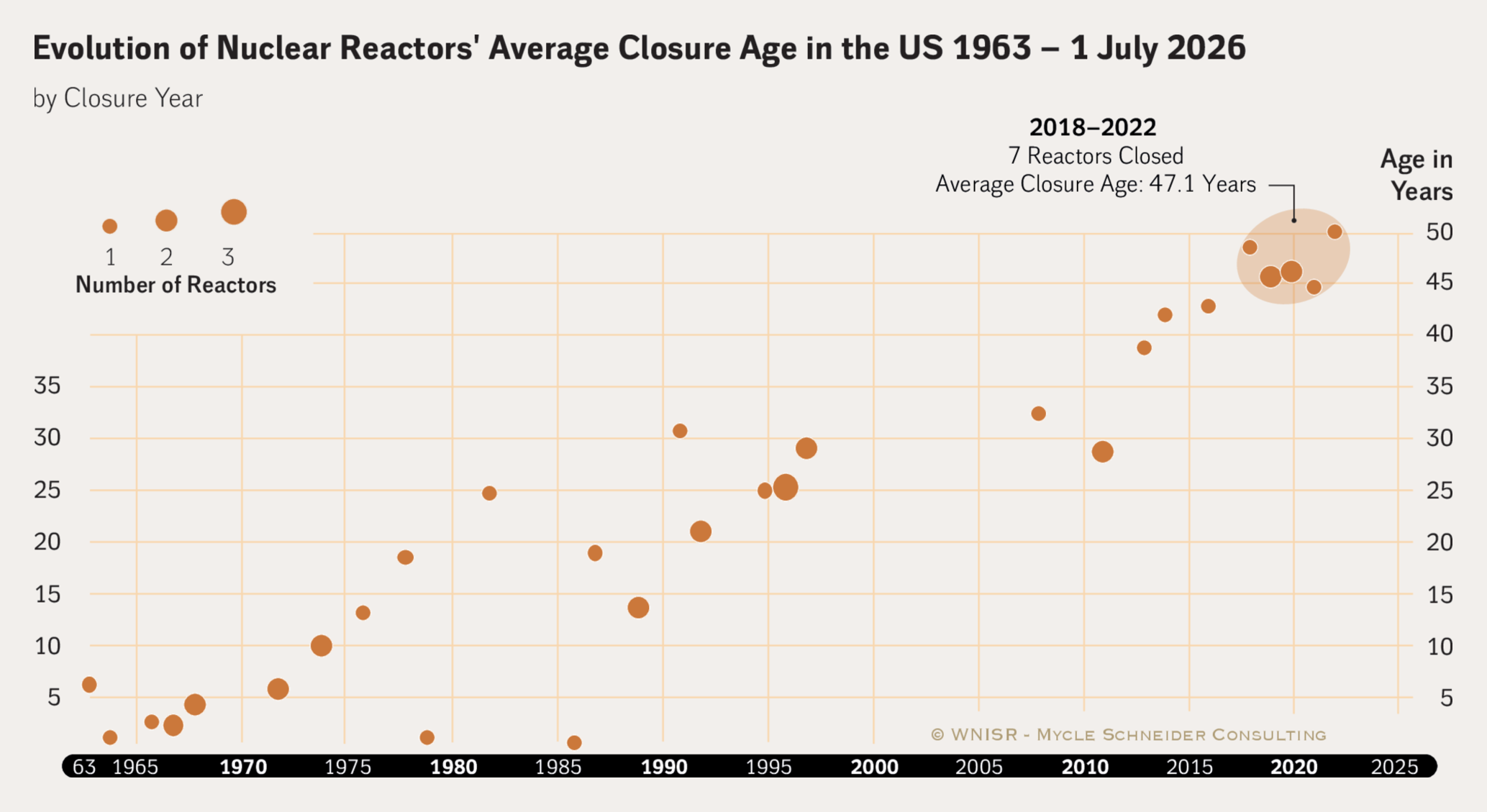
Sources: WNISR with IAEA-PRIS, 2026
Planned Restarts of Retired Reactors
Efforts to restart three reactors that were retired between 2019 and 2022 are proceeding. The first two—Palisades-1 and Three Mile Island-1—are facing delays. NextEra, the owner of Duane Arnold-1, is pursuing licensing and other approvals necessary for restart of the reactor in 2028 but did not start that initiative until January 2025, one and two years after Palisades-1 and Three Mile Island-1 (TMI-1), respectively. If all three restarts were successful, it would add 2.23 GW of generation capacity.1100
WNISR2025 reported that Holtec planned to restart Palisades-1 before the end of the year and that the NRC appeared to be on track to issue license amendments and other approvals necessary to do so. On 9 September 2025, the NRC re-listed Palisades on its daily Power Reactor Status Report.1101 Subsequently, a number of problems related to degraded components have come to light that have prevented restart of the reactor as scheduled. The NRC notes an additional ten matters requiring approval that arose since mid-2025,1102 including repairs to address leaks in reactor vessel head penetrations for control rod nozzles, a vent line, pressurizer, shutdown cooling, and safety injection nozzles. There have also been operational mishaps, as in October 2025, when a worker fell into a reactor cavity and ingested radioactive water.1103 Other repairs that have delayed fuel installation and restart include “[r]eassembly of the main turbine generator” and receipt and installation of two fully refurbished primary coolant pump motors.1104
Other problems related to the condition of the reactor have delayed the restart further, and it is not clear when or how they will be resolved. In February, Holtec disclosed to the NRC that it had lost the records identifying metals used to repair the damaged reactor vessel head nozzles, making it impossible to verify their safety.1105 Holtec submitted an exemption request to provide testing data, reportedly, on “comparable materials of the same age from other parts of the plant, or from other nuclear plants.” On 30 October 2025, the NRC issued a license amendment authorizing Holtec’s plan to reinforce over 1,000 cracked tubes with metal sleeves,1106 but subsequent developments may require the NRC to revisit the decision. Holtec submitted a report to the NRC on 19 March 2026, with a revised assessment of the condition of steam generator tubes, which states that the risk of a tube rupture would increase exponentially after 14.5 months of operation:
As a result of these excessive growth rates and number of flaws projected to initiate, the probability of burst (POB) exponentially increases with longer run time for Cycle 29. (…)
This illustrates that the Probability of Burst exponentially increases as the run time for Cycle 29 increases as well. Operation beyond 1.2 EFPY [effective full-power years] cannot be justified with the current model under the conservative assumption that chemical cleaning provides no mitigating effect for growth rate or initiation. Additionally, even considering a generous 35% reduction in growth rate from chemical cleaning, a Cycle 29 run time of 1.5 EFPY is not achievable.1107
The mentioned 1.2 EFPY correspond to 14.5 months, less than the 18-month refueling schedule (1.5 EFPY) on which Palisades operated historically, so the report would appear to provide evidence that Palisades-1 could not operate safely through cycle 29, contrary to the conclusion in the NRC’s 30 October order. Holtec notified NRC that the revised assessment was underway in a conference call on 14 October 2025, prior to NRC’s issuance of the license amendment.1108 Holtec received the report from its contractor, Framatome, on 2 December 2025—97 days before Holtec transmitted it to the NRC.
As of mid-2026, Holtec claimed it has completed major maintenance projects necessary for the restart, including the reactor vessel head and steam generator repairs, but it had neither loaded fuel into the reactor nor announced a new restart date.1109
Three Mile Island-1 (TMI-1)/Crane Clean Energy Center1110
Constellation has reported that it is ahead of its originally proposed schedule for restoring TMI-1 to operational status in 2028. It is now projecting that it would have NRC approvals and be able to restart the reactor by the end of 2027.1111 However, the company received notice from the Regional Transmission system Operator (RTO), PJM Interconnection, that transmission system projects necessary for connecting the reactor to the grid may not be completed until 2031.1112 The matter has cast uncertainty on the plans for restart, as the announcement of Constellation’s Power Purchase Agreement (PPA) with Microsoft to provide power for data centers anticipated a 2028 date.1113 As reported in previous WNISR editions, the deal was conditioned on PJM granting TMI-1 priority to interconnect before previously scheduled resources in order to achieve grid connection in 2028.
Constellation has petitioned the Federal Energy Regulatory Commission (FERC), which oversees PJM and transmission operators throughout the country, to intervene. It proposed transferring the capacity rights from a gas power plant it owns in the Philadelphia area, over 100 miles away.1114 Constellation had planned to retire the 800-MW gas plant, but the Trump administration intervened in 2025 and directed FERC to require it to remain operational.1115 PJM has since stated that transfer of the capacity rights may not address the need for transmission system modifications to accommodate TMI-1’s interconnection, and the RTO’s Independent Market Monitor argued to FERC that Constellation’s request does not meet the requirements for such a waiver.1116 On 1 June 2026, FERC approved the request, authorizing the transfer of interconnection rights from the gas plant to TMI-1, but PJM has not stated how that will affect the interconnection schedule, which is to be announced near the end of 2026.1117
Power Uprates of Operating Reactors
From 1977 to 2021, reactors in the US increased their generating capacity by approximately 8 GWe (24 GWt) from their originally licensed configurations through implementing power uprates.1118 In total, there have been 172 individual power uprates. The NRC characterizes the means by which power uprates are achieved in three categories:1119
- Measurement Uncertainty Recapture (MUR): relatively small increases in capacity (less than 2 percent of originally licensed capacity) achieved by “implementing enhanced techniques for calculating reactor power.”
- Stretch Power Uprates (SPU): increases of capacity by up to 7 percent. Stretch uprates do not require significant changes to the plant, usually involving “changes to instrumentation setpoints.” The NRC notes that the “stretch limit” is specific to the reactor’s design.
- Extended Power Uprates (EPU): capacity increases up to 20 percent, requiring major modifications to a reactor’s equipment and configuration, such as pumps, turbines, and transformers. In some cases, EPUs have involved increasing the fuel enrichment rate and the number of fuel assemblies in the reactor.1120
Approximately 90 percent of the uprate capacity was implemented between 1992 and 2017. More than half of the total uprate capacity was achieved through 34 EPUs within that timeframe. The economic justification for EPUs came into question after 2010 because of their high costs1121 and, in some cases, operational problems that appeared to be related to the uprates.1122
Because the power uprate program produced about as much new generation capacity as construction of new reactors from 1992 to 2021, it is still viewed as a potentially more viable growth area for the industry than building new reactors. Power uprates are also eligible for federal production and investment tax credits enacted under the Inflation Reduction Act of 2022, potentially mitigating the financial risks of cost overruns on major reactor modifications in implementing EPUs. The NRC has limited power uprates to a maximum of 20 percent greater than the reactor’s Originally Licensed Thermal Power (OLTP) capacity.1123 In recent years, it has taken steps both to prepare for another wave of uprate applications and to issue EPUs in excess of 20 percent. In addition to readying the agency internally,1124 The NRC has approved production of fuel for light water reactors with up to 8 percent enrichment in uranium-2351125 in “accident-tolerant fuels.” 1126
In an executive order issued on 23 May 2025, President Trump directed the DOE and NRC to implement 5 GW of power uprates by 2030.1127 Though the industry was slow to propose any new power uprates after the Inflation Reduction Act made the projects eligible for federal tax credit subsidies, the industry has notified the NRC of plans to submit 32 uprate applications by 2032. If implemented, the NRC projects they would add 2.4 GW of generation capacity,1128 more than the total of the three reactors proposed for restart, but less than half of the President’s power uprate goal for 2030 under the executive order.
New Reactors: Proposals, Planning, and Policy Developments
After a 20-year pause, three reactors were connected to the grid between 2016 and 2024 (see Figure 53). Since the completion of Vogtle-3 and -4, there are no new commercial power reactors under construction in the US for the first time since work on Watts Bar-2 was restarted in 2007 (see Figure 54).
There have been at least three announcements by reactor developers in the past two years of “construction start”, when, in fact, they were only doing work onsite preliminary to nuclear construction, or unrelated to reactor construction entirely.
The status of nuclear construction starts has become a matter of confusion in the US recently. As WNISR has always emphasized, there is a specific definition of “nuclear construction” in the industry, which defines the point at which reactor construction starts as the first pouring of “nuclear concrete,” i.e., for the base slab of the reactor building. Yet, there have been at least three announcements by reactor developers in the past two years of “construction start”, when, in fact, they were only doing work onsite preliminary to nuclear construction, or unrelated to reactor construction entirely.
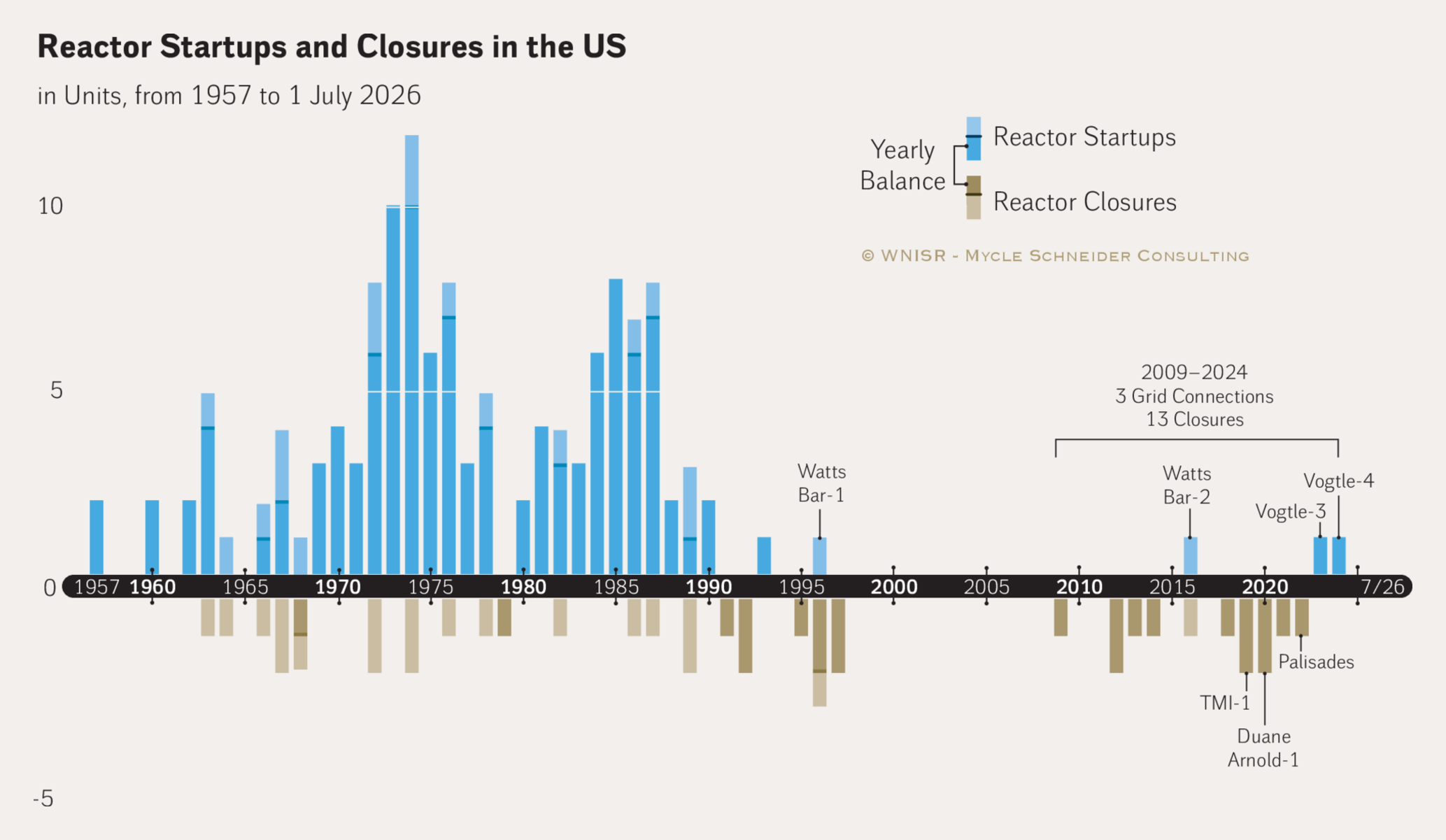
Sources: WNISR with IAEA-PRIS, 2026
- In June 2024, it was widely reported that TerraPower had begun construction at Kemmerer-1, less than three months after submitting its construction permit application and before the NRC had made meaningful progress in reviewing it. In fact, the company had received no approvals to begin nuclear construction and had merely broken ground on a “test and fill facility” for the reactor’s sodium coolant/moderator.1129
- In December 2025, Deep Fission announced that it had begun construction of its Gravity reactor at a site in Parsons, Kansas, towards completing construction and reaching initial criticality by 4 July 2026.1130 Three months later, the company clarified that it had only begun drilling test holes for its plan to install 15-MW reactors 1.6 kilometer underground, then reportedly saying “the group is committed to drilling data acquisition wells in Parsons,” and that it may never build a reactor at the Parsons site.1131 Deep Fission began pre-application engagement with the NRC in 2024,1132 but it has not submitted a construction permit, design certification, or license application yet. The announcement of the Parsons project was made under the auspices of DOE’s recently launched Reactor Pilot Program, under which the agency, in August 2025, selected ten companies to build commercial demonstration reactors of eleven different designs without going through NRC permitting and licensing.1133
- In April 2026, after the NRC issued the construction permit for Kemmerer-1 in March, TerraPower announced that it had begun construction.1134 But upon a WNISR inquiry to TerraPower, the company clarified that it had started site preparation work (e.g., grading and scraping) for the construction site,1135 two years after having announced ground-breaking (see WNISR2025).
Other reactor developers have taken actions that suggest further progress toward building their first reactors than evidence would suggest. For instance, in December 2025 Holtec has submitted to the NRC a request for Limited Work Authorization (LWA) for its proposed Pioneer-1 and -2 project to build two units of its SMR-300 design at the Palisades-1 site.1136 LWAs are intended to permit certain types of pre-construction work, such as foundation digging and site preparation, prior to issuance of a construction permit. Normally, applicants request LWAs while a Construction Permit (CP) or COLA is under review, i.e., after the design of the reactor is at a level of completeness that the company is able to apply for a CP. Yet Holtec has submitted the LWA request before submitting its planned CP application.
Also, in January 2026, microreactor designer Valar Atomics, another participant in DOE’s Reactor Pilot Program, had the U.S. Air Force transport components of its reactor design from California to Utah in three C-17 heavy cargo planes.1137 In some cases, media outlets reported it as though Valar had transported a complete reactor in a single flight, rather than some components in three planes.1138 A Wall Street Journal article reported it both ways in the span of the first two sentences.1139 The transport was attended by DOE and Defense Department officials, and generated much publicity for Valar and the Trump administration’s efforts to speed reactor construction, but critical analysis pointed out that the event overstated the state of that progress,1140 as well as the credibility of the company.1141
In terms of actual progress toward construction of new reactors, things are little changed from the status reported as of mid-2025. The most significant development is the NRC’s issuance of the construction permit for Kemmerer-1,1142 but, as noted above, TerraPower has not yet moved to official construction start:
- TerraPower’s Kemmerer-1 project in Wyoming would be a 345-MW Natrium sodium-cooled fast neutron reactor, based on General Electric’s PRISM design. The facility design includes a molten salt thermal storage loop scaled to generate an additional 150-MW for up to six hours. See TerraPower’s Natrium in chapter on SMRs.
The NRC is currently reviewing two construction permit applications, and Holtec’s LWA application; and it has docketed materials for Fermi America’s partially submitted COLA for four Westinghouse AP1000 reactors.1143 The NRC reviews include:
- Dow Chemical’s Long Mott Generating Station (LMGS), a 320-MW plant comprising four X-energy Xe-100 high-temperature gas-cooled, graphite-moderated reactors. LMGS would be located at Dow’s UCC Seadrift petrochemical plant in Texas. The reactors would have a nominal electricity generating capacity of 320 MW and could produce up to 800 MWt of steam process heat. Dow submitted the Construction Permit Application (CPA) in March 2025.1144 The NRC projected that it would complete review of the application by November 2026. The results are then subject to a public hearing, followed by the Commission’s decision. Dow projects a five-year construction schedule, with completion in 2033.1145
- TVA’s Clinch River SMR project, to construct a 300-MW GE-Hitachi BWRX-300 reactor. In 2019, TVA received an Early Site Permit (ESP) to construct a then-unspecified SMR at the Clinch River Site, where US DOE canceled construction of a demonstration breeder reactor in 1983. TVA completed submission of the CPA in May 2025, and the NRC projects completing its review in November 2026.1146
The only nuclear reactor construction projects currently underway are three prototypes of commercial reactors and the U.S. Department of Defense’s Project Pele, a 5-MW mobile microreactor demonstration project from BWXT Advanced Technologies.1147 These projects are:
- In May 2025, Kairos began nuclear construction of its Hermes non-power test reactor (35 MWt), at Oak Ridge National Laboratory in Tennessee, a molten-fluoride-salt design.1148
- In November 2024, Kairos received a construction permit for the two-unit Hermes 2 non-power test reactors (2 × 35 MWt), at Oak Ridge National Laboratory,1149 and, in April 2026, announced it had broken ground on the project1150.
- In September 2024, the NRC issued the construction permit for the Natura molten salt research reactor at Abilene Christian University (1 MWt).1151 In 2023, the university announced the opening of the research laboratory where the reactor would be housed, but, as of mid-2026, had not announced the start of nuclear construction. Natura issued a press release in October 2025 with photos showing the finished construction of the laboratory building where the reactor will be installed, but no firm construction start date—only stating, “we are on track for deployment of our MSR-1 reactor in 2026.”1152
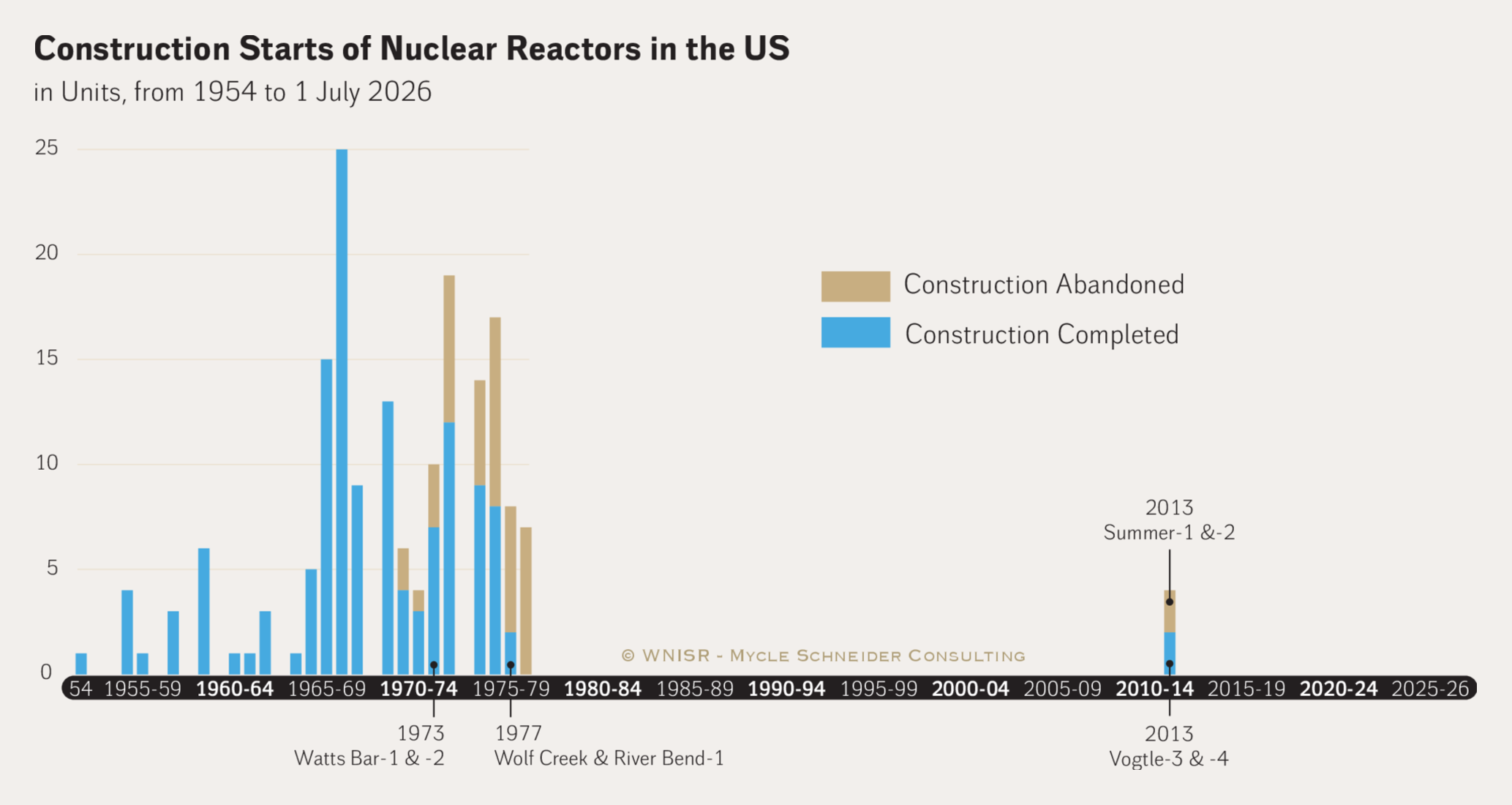
Sources: WNISR with IAEA-PRIS, various dates
Note: Construction-start years refer to dates initially indicated in IAEA-PRIS database, subject to later modifications.
The vast majority were either for future or prospective Power Purchase Agreements (PPAs), many with no firm commitments either for provision of any power at all or no commitment to the electricity being generated by nuclear reactors.
Industry Restructuring and Emerging Business Models
Since 2023, WNISR has detailed intersecting trends related to ownership changes and business strategies within the US nuclear industry. WNISR2025 provided a thorough analysis of the status and trends of agreements involving agreements between nuclear power companies and data center developers. Despite the proliferation of such deals, involving firms ranging from the smallest to the largest in both the nuclear power and tech sectors, relatively little actual nuclear-generated electricity is being purchased for data center operations. As of mid-2026, out of deals claiming that a total of roughly 35 GW of nuclear capacity would be powering data center operations, the vast majority were either for future or prospective Power Purchase Agreements (PPAs), many with no firm commitments either for provision of any power at all or no commitment to the electricity being generated by nuclear reactors. Only about 1 GW of documented transactions involved current purchases of nuclear-generated electricity to data center operations: 480 MW from Talen’s Susquehanna-1 and -2 reactors for onsite data centers owned by Amazon; and 265 MW from the Beaver Valley-1 and -2 and Perry reactors, purchased by two smaller data center operators in Ohio and Pennsylvania.
Though two more large announcements were made in early-2026, the trends identified in WNISR2025 have little changed. Of the tech majors, Amazon appears to be the only one that is currently interested in sourcing nuclear-generated electricity to power its data center operations.1153 In September 2025, Vistra announced an agreement with a then-unspecified customer (which was later revealed to be Amazon) for 1.2 GW of electricity from the Comanche Peak-1 and -2 reactors in Texas, with power offtake to begin in late-2027 and “ramp to full capacity by 2032.”1154 In February 2026, Amazon disclosed that half of that capacity would power a 600-MW data center that Amazon plans to build adjacent to the reactor site;1155 the other half would be for other Amazon data centers in Texas.
Meta made an announcement in January 2026 that attracted greater attention but possesses less substance. The Facebook parent company had struck deals with three nuclear companies—Vistra, TerraPower, and Oklo—for a reported 6.6 GW of nuclear capacity.1156 In fact, Meta will be purchasing no nuclear-generated electricity for its data center operations from any of the companies, at least not in the foreseeable future. The Vistra announcement states that Meta will purchase 2,176 MW worth of “energy and capacity” from the Davis-Besse-1 and Perry-1 reactors in Ohio, beginning in late-2026.1157 But it also states, “the electricity generated at the plants will continue to go to the grid for all electricity users.” Because Vistra already sells capacity from its reactors in the PJM capacity market, and the electricity the reactors generate cannot simultaneously be “for all electricity users” and for Meta’s data centers, the announcement suggests the arrangement is actually an arrangement by which Meta can claim the “rights” to the nuclear-generated electricity.
Similar to Meta’s deal with Constellation, announced in June 2025, to purchase 1,121 MW of Zero-Emissions Credits (ZECs) from the Clinton-1 reactor, beginning in June 2027,1158 the Vistra deal amounts to the purchase of an uncertified, unregulated instrument to subsidize the reactors’ operations, not the purchase of electricity. In this case, Ohio has never had a ZEC program, which was never established after a provision to do so was repealed, following federal criminal indictments of lobbyists and elected officials involved in a US$61 million corruption scheme to enact the authorizing law (House Bill 6 (HB6), see Criminal Investigations of Nuclear Power Corporations in WNISR2025 and previous WNISR editions). The deal provides for an additional 433 MW from power uprates of the Ohio reactors and Beaver Valley-1 and -2, which Vistra plans to implement between 2031 and 2034.1159
Meta’s deal with TerraPower would entail up to 4 GW to be provided by eight Natrium units, each comprised of a 345-MW reactor and a 150-MW, six-hour thermal storage generator, “with delivery of initial units as early as 2032.”1160 It is unclear how the 2032 date would be met, since TerraPower’s Kemmerer-1 demonstration of the Natrium design is not projected to be completed until 2031, eleven years after it was initially proposed, 25 years after Bill Gates founded the company. TerraPower’s press release clarified that the actual commitment to developing all eight reactors is less than certain, perhaps only extending so far as identifying a site for an initial two-reactor project:
This agreement supports the early development activities for two new Natrium units with rights for energy provided to Meta for up to six additional Natrium units… The companies will target identification of a specific site for the initial dual reactor unit in the coming months.1161
One must expect that the decision to move forward on those units will depend on the success of Kemmerer-1. If that is the case, it could be much later than 2032 before the first Natrium reactor would be available to provide power to Meta’s data centers.
In addition, Meta announced an agreement with Oklo to provide 1.2 GW of power from a 206‑acre site secured from DOE, with the first phase which “may come online as early as 2030” 1162 and “to deliver up to the full target of 1.2 GW by 2034.” According to the announcement, the deal “provides a mechanism for Meta to prepay for power and provide funding to advance project certainty for Oklo’s Aurora powerhouse deployment.” It is not clear what the arrangement entails, but it implies that Meta will pay Oklo in advance for electricity that will be generated at a later date—and that “Oklo will use the funds to secure nuclear fuel and advance Phase 1 of the project—supporting the development of clean, reliable power… that can scale up to 1.2 GW.” 1163
As reported in WNISR2025, while Oklo previously announced up to 14 GW of deals with data center developers and other customers, those deals do not require it to provide nuclear-generated electricity and, in fact, Oklo informed its shareholders that it planned to serve its customers with electricity provided by a third-party company, Rpower, with gas generation. Given the vagaries and anomalous terms described in the announcement, it seems possible that the Meta deal could entail a similar arrangement. In July 2025, Oklo secured a similar agreement with Liberty Energy, the gas company which invested US$10 million in Oklo in 2023 and was formerly helmed by now-U.S. Energy Secretary Chris Wright (who is also a former Oklo board member).1164 According to POWER Magazine:1165
On July 23, Oklo and Liberty said they would jointly pursue large, high-demand customers—including data centers, industrials, and utilities—through an integrated deployment strategy that will seek to address the immediate energy bottleneck facing growth-constrained generation facilities. The approach echoes a “hybrid-model” partnership Oklo launched in January with Texas-based prime and backup solutions company RPower, but it suggests a strategic evolution from Oklo’s RPower memorandum of understanding, which was limited to data center applications.
In August 2025, under Chris Wright’s leadership, DOE selected Oklo to participate in its Reactor Pilot Program by demonstrating two of its reactor designs: the 75-MW Aurora Powerhouse SMR, to be built at the Idaho National Laboratory; and the Atomic Alchemy isotope production reactor, at a site in Texas.1166 Presumably, Oklo will have to apply to the NRC for construction permits to begin deploying the 16 Aurora reactors necessary to provide Meta with 1.2 GW of capacity, but it is not clear when the demonstration reactor will be completed, and Oklo does not appear to have begun engaging on that aspect with the NRC.
Criminal Investigations of Nuclear Power Corporations
Since 2017, the US Justice Department opened three separate investigations against utility and builder corporations over criminal activities related to nuclear power. The cases resulted in indictments of corporate executives, lobbyists, and state officials. The cases have been accompanied by additional lawsuits and state-level investigatory proceedings, and they have had political ramifications which appear to have had further impacts on the industry, economically, as well as legally and politically. For detailed background and earlier development on these cases see WNISR2023, WNISR2024 and WNISR2025.
As reported in WNISR2025, the final matters involving fraud by executives of Westinghouse and South Carolina Electric & Gas in the construction of the Summer-2 and -3 reactors have been resolved, with the sentencing to a jail term of former Westinghouse Vice President Jeffrey Benjamin in 2024.
There have been significant developments in the two other cases, in recent months:
Exelon-Commonwealth Edison (ComEd) Corruption Case. The final suspect to be indicted in the corruption case involving nuclear bailout and utility legislation in Illinois was former Speaker of the state House of Representatives Michael Madigan. He was convicted on 10 of 23 counts in 2025 and is currently serving a 7.5-year sentence in a federal prison in West Virginia.1167 Madigan appealed his conviction, arguing that there would be no proof of a quid pro quo agreement by Madigan to pass the legislation favored by Exelon and its utility subsidiary Commonwealth Edison.
On 27 April 2026, the panel of judges in the case rejected the appeal and, according to media reports, affirmed the basis for the conviction, finding Madigan “repeatedly facilitated changes to state law impacting countless energy consumers in northern Illinois, all because ComEd funneled money to the right people. Madigan insists that this was run-of-the-mill politics. But a jury of twelve Illinois residents saw the evidence differently. So do we.”1168 However, less than two weeks prior to that ruling, an appeals court ordered two other people who had been convicted and sentenced in the corruption case released from jail and granted them a new trial.1169 Former ComEd CEO Anne Pramaggiore and Madigan associate Michael McClain were convicted along with two other people in 2023, separately from Madigan’s prosecution. The court did not determine that Pramaggiore and McClain were innocent of the charges, rather that the “prosecution was flawed” based on a related court precedent.1170 While the court vacated the conviction, it noted that the prosecution could bring a new trial based on the record of evidence.
FirstEnergy Corruption Case. Former Speaker of the Ohio House of Representatives, Larry Householder, and four lobbyists were indicted for their roles in a bribery and corruption scandal that unfolded between 2017 and 2019 (see WNISR2023 for a detailed account and subsequent WNISR editions for later developments). FirstEnergy gave Householder, his associates, and his political action committee, Generation Now, close to US$61 million to pass HB 6, a bill that would have provided a US$1.05 billion “taxpayer-funded bailout” to two reactors that FirstEnergy owned at the time. Two of the lobbyists, Juan Cespedes and Jeffrey Longstreth, took plea agreements and cooperated with prosecutors; they have yet to be sentenced.1171 A third lobbyist, Neil Clark, committed suicide before his case went to trial. After losing an appeal of their convictions before the 6th US Circuit Court of Appeals in May 2025,1172 Householder and the fourth lobbyist and former Ohio Republican Party Chairman, co-conspirator Matt Borges, appealed their conviction to the US Supreme Court. On 27 April 2026, the court denied the appeal, declining to hear the case.1173 Householder’s attorney stated he intends to request a pardon or commutation of his sentence by President Trump.1174 Borges was released from prison in October 2025.
In February 2024, Ohio Attorney General Dave Yost filed charges against three other alleged participants in the HB 6 corruption scheme: two former FirstEnergy executives, Charles “Chuck” Jones and Michael Dowling, respectively CEO and Vice-President at the time of the crimes; and former chair of the Public Utility Commission of Ohio (PUCO) Sam Randazzo.1175 In April 2024, Randazzo committed suicide1176—the second suspect indicted in the case who had taken his own life before going to trial, following the death of lobbyist Neil Clark in 2021 subsequent to his indictment. Jones and Dowling went to trial on 27 January 2026, but the court declared a mistrial on 1 April 2026 because the jury was unable to reach a verdict.1177 The judge scheduled a new trial to begin on 28 September 2026.1178 However, prosecutors decided to pursue new indictments against the men. In early June 2026, then-Attorney General Yost and the Summit County District Attorney filed indictments of Jones and Dowling on 22 counts,1179 with the trial scheduled for 4 January 2027.1180 Both defendants pleaded not guilty. In a separate matter, on 29 June 2026, a federal court judge threw out fraud charges by the Securities and Exchange Commission against Jones.1181
While annual nuclear generation again increased slightly in 2025, the first full year of operation for Vogtle‑4, nuclear energy’s share of total national electricity generation fell to the lowest level since 1987. Despite the startup of both new Vogtle units in 2023–2024, the average age of the US reactor fleet continues to advance, reaching 44.7 years as of mid-2026. Efforts to restart retired reactors have encountered delays. Palisades-1 was projected to start up in late 2025, but it remains delayed due to the condition of aging equipment, most notably steam generator tubes that may not be able to operate safely for more than 14.5 months. The proposed restart of Three Mile Island-1 may be delayed more than three years, until 2031, due to transmission infrastructure projects that PJM Interconnection says are necessary for the reactor’s grid connection. License extensions for existing reactors have continued at a brisk pace, with Perry-1, Clinton-1, and Diablo Canyon-1 and -2 receiving initial license renewals, twelve more reactors receiving Subsequent License Renewals (SLRs, from 60 years of operation out to 80 years), three SLR applications under review, and owners are planning to seek SLRs for 36 reactors. All told, the owners of 64 reactors have received, applied for, or are intending to apply for SLRs by 2034.
There remain no commercial power reactors under construction in the US since completion of Vogtle-4 in 2024. There have been a number of cases in which reactor developers have issued misleading statements announcing construction starts or have taken steps to make it seem as though they are closer to beginning nuclear construction than objective evidence indicates. The matter is somewhat complicated by a lack of access to information created by measures the Trump administration has taken to expedite deployment of new reactors and the U.S. Department of Energy’s initiation of a Reactor Pilot Program under which it has authorized construction of commercial reactor demonstrations outside of the formal licensing procedures of the Nuclear Regulatory Commission.
Two more major technology firms, Amazon and Meta, have announced deals with nuclear power companies: Amazon, for 1.2 GW of power from Vistra’s Comanche Peak-1 and -2 reactors; and Meta, in a trio of deals with Vistra, TerraPower, and Oklo. These deals largely conform with the trends identified in WNISR2025. Electricity sales under the Amazon-Vistra deal will not begin until late 2027 and may partially be contingent on Amazon’s construction of a 600‑MW data center adjacent to the Comanche Peak reactors. And none of the new deals Meta announced may entail purchases of electricity from nuclear reactors for several years, if ever. Its agreement with Vistra appears to be for procurement of credit-like instruments, rather than electricity; and its agreements with TerraPower and Oklo are contingent on the success of the nuclear companies’ demonstration projects.
Corruption and fraud investigations involving subsidies for operating reactors continued. Former Illinois House Speaker Michael Madigan’s conviction on ten corruption charges for accepting bribes from Exelon was upheld on appeal, while the convictions of a former Exelon executive and a Madigan associate involved in the matter are headed for retrials. In the US$61 million FirstEnergy bribery case, the trial of former FirstEnergy CEO Chuck Jones and ex-VP Michael Dowling ended in a mistrial; both men were re-indicted, and a new trial is scheduled to begin in January 2027. The US Supreme Court denied the appeals of former Ohio House Speaker Larry Householder and Matt Borges. Householder is now seeking a pardon or commutation of sentence from President Trump.
Overview of Onsite and Offsite Challenges
As Japan marks the fifteenth year after the meltdowns at the Fukushima Daiichi nuclear power plant, the attention of operator Tokyo Electric Power Company (TEPCO) has turned to the massive task of removing the estimated 880 tons of highly radioactive fuel debris from the damaged reactor units. TEPCO has called this the “biggest challenge going forward” and set aside an additional ¥903 billion (US$5.7 billion) to cover it.1182 Work over the past year has revolved around attempts to better understand the condition of the reactor vessels, hone scenarios for taking the debris out at scale, and shore up infrastructure in preparation. But with only 25 years remaining until the stated deadline for completion of decommissioning, observers are increasingly skeptical that TEPCO can meet that goal.
Offsite, the Japanese Government formally approved a five-year roadmap for the disposal of the radioactive soil that has been removed from contaminated areas, largely in Fukushima Prefecture. Now it faces the challenge of implementing that plan in the face of significant resistance from the public to the idea of radioactively contaminated substances in their neighborhoods. Meanwhile, WNISR looked at health issues a decade and a half after the start of the disaster, finding significant concern over mental health and physical ailments associated with the massive evacuation in Fukushima, as well as continuing controversy over thyroid cancer cases and the effects of low doses of radiation over time.
Removing Highly Radioactive Nuclear Fuel Debris
The biggest challenge for decommissioning the Fukushima Daiichi nuclear plant lies in dealing with an estimated 880 tons of highly radioactive fuel debris—nuclear fuel mixed with metal and other substances—that remains somewhere inside the stricken Units 1–3 (see Removing Highly Radioactive Nuclear Fuel Debris in WNISR2025 for a discussion of debris and how it is formed).1183 TEPCO has highlighted the difficulties in its latest business plan and increased its expected losses as a result (see Legal Cases, Compensation).1184
The debris is hazardous and the source of continuing radioactive contamination that creeps out of the damaged units via water, dust, and air. It must be kept cool by a continuous injection of water to prevent any chance that the radioactive mix will overheat or start a thermal runaway reaction.
Over the past year since mid-2025, the temperature at the bottom of the pressure vessels of all three of the damaged units has remained below 40°C,1185 well under the regulatory maximum of 80°C.1186 TEPCO also injects nitrogen into the pressure and containment vessels of the damaged units to prevent the buildup and combustion of hydrogen, which caused explosions in the days after the meltdowns.
The debris will remain a danger unless it is permanently sequestered from the outside world. Although some researchers argue that removing all the debris by the stated deadline is not feasible, and maybe not practical at all,1187 TEPCO and the Japanese Government have said they are committed to taking it all out and cleaning up the site.
The first pilot removals of fuel debris took place in 2024 and 2025, with the extraction of less than a gram total from the containment vessel of Unit 2, using equipment that resembled a massive fishing rod (see Removing Highly Radioactive Nuclear Fuel Debris in WNISR2025). That sampling process is continuing in 2026 with the substitution of a bigger and easier-to-manipulate robotic arm for the fishing-rod apparatus. TEPCO started installing the arm in the reactor building of Unit 2 in April 2026 and plans to start extracting samples of debris during the third or fourth quarters of FY2026 (October 2026–March 2027).1188
Even with the bigger arm, however, TEPCO can only extract a relatively small amount of debris each attempt. One group of researchers estimated such an arm could take out at most 20–50 kg of debris at a time, meaning it could take between 70 and 170 years to remove the whole 880 tons that way.1189
TEPCO is working on other ways to remove the fuel debris at scale and much more quickly. To do that it must figure out where exactly the debris is, and what the conditions are like inside the reactors.
Peering Inside the Damaged Reactors
When the nuclear fuel assemblies in Units 1–3 overheated and melted down in March 2011, the molten matter bored through the surrounding steel reactor pressure vessels, dripped down through scaffolding and equipment, and ate into the steel-and-concrete foundations of the containment vessels below. The reactor units and their buildings were also rocked by hydrogen explosions in Units 1 and 3.1190 Images from inside the reactor units taken by robots have shown toppled equipment, holes in walls, and heavy layers of sediment.1191
It is unclear where exactly in that mess the fuel debris is, and what obstacles are in the way of taking it out. But radiation levels inside the pressure and containment vessels of the damaged units are much too high for humans to enter and take a look. Even parts of the reactor buildings have radiation levels so elevated that workers cannot stay for extended periods.
In preparation for removing the fuel debris, TEPCO is stepping up efforts to investigate the inside of the reactors remotely, deploying drones and other devices sent in through preexisting service channels and pipes. TEPCO must fight hard for every bit of data, as its investigations over the past several months illustrate.
In April 2026, for instance, TEPCO for the first time captured images and radiation readings from the inside of a damaged reactor pressure vessel.1192 The company threaded a fiber-optic scope and radiation sensor through a narrow pipe normally used to insert water-level measuring equipment, which runs inside the pressure vessel but outside the steel shroud that surrounds the fuel assemblies in Unit 2. TEPCO had to make a special guide pipe as well as take steps to prevent the high levels of radiation inside the pressure vessel from leaking out to the workers feeding in the fiberscope.
Inside the pressure vessel, the instrument logged radiation as high as 4.7 Grays per hour, a broadly lethal dose.1193, 1194 TEPCO said it was hard to guess where the fuel debris was, but the location where radiation readings were highest as the fiberscope was pushed down the length of the pressure vessel was different from where it would normally be. The company also said it did not detect any significant damage to the shroud.
Between December 2025 and March 2026, TEPCO sent miniature drones into heavily contaminated parts of the reactor buildings of Units 1 and 3 to check on equipment.1195
For Unit 3, TEPCO wanted to examine valves on pipes leading from instrument racks to the containment vessel.1196 The purpose was to determine whether TEPCO could use the valves to seal off the reactor building from the higher radiation levels of the containment vessel if the racks were removed in preparation for debris extraction. TEPCO also wanted to check what physical obstacles might be in the way. The examination did not reveal damage to the valves, but it did show obstacles along the access route.
TEPCO sent other miniature drones into the containment vessel of Unit 3 to scope out conditions around and inside the ring-shaped pedestal that supports the pressure vessel.1197 Work for that investigation was already underway in the summer of 2025, starting with training the drone pilots to navigate in a dark, cluttered space. TEPCO had to lower the water level in the reactor unit to clear out a submerged service pipe it planned to use to send in the drones, as well as remove some monitoring equipment that was in the pipe already.
TEPCO hit a roadblock at the end of 2025 when it found that something was blocking its robotic drone-launch platform from getting through the pipe. The company made a mock-up of the pipe and the launch platform offsite to figure out what was wrong. Eventually, it fixed the problem by adding more wheels to the platform, and finally sent the drones in, four months later than initially planned.
The investigation found severe damage under the pressure vessel, including what looked like a big hole in the bottom of the vessel that was spilling broken control-rod guide tubes, structures that are normally inside the pressure vessel.1198
Removing Spent Fuel from Reactor Pools
Before starting large-scale debris removal, TEPCO must first remove spent-fuel assemblies from the pools where they are being stored atop Units 1 and 2. The company started removing the 615 spent-fuel assemblies left at Unit 2 in June 2026 and plans to begin on the 392 assemblies at Unit 1 in FY2027–28.1199 TEPCO takes the assemblies to a common pool on site, then progressively transfers them to dry storage in a temporary cask custody area.1200 As of 1 July 2026, the common pool was 94.5 percent full, all of the site’s 65 dry storage casks were full, and TEPCO was constructing space for 30 more casks.1201 TEPCO is also evaluating storage technologies for an improved dry storage facility, likely to be built on higher ground to protect against tsunami risk.1202
There are also fuel assemblies—both spent and new—stored at Units 5 and 6, reactors that are located slightly apart from the other units, and which were not operating at the time the tsunami hit in 2011. TEPCO started taking the 1,380-odd assemblies out of Unit 5 in July 2025, although it has paused removal and is adjusting the schedule in order to prioritize removal from Units 1 and 2. The company finished taking out the spent fuel assemblies from Unit 6 in 2025,1203 and only 398 new fuel assemblies were left there as of early June 2026.1204 TEPCO started shipping some assemblies back to their manufacturer’s factory in the US in September 2025 and completed the shipments in January 2026.1205
The company has completed spent-fuel removal from Units 3 and 4 and aims to have all the reactors’ spent fuel removed by the end of 2031.
Preparing for Large-Scale Debris Removal
Because the spent fuel is already out of Unit 3, TEPCO is planning to start full-scale debris removal there. The company’s plan, set out in July 2025 in consultation with the Nuclear Damage Compensation and Decommissioning Facilitation Corporation (NDF), focuses on a retrieval method in which the containment vessel and the walls around it act as the main radiation shield, and any openings to the outside are kept as small as possible.1206 One plan is to grind the debris into small pieces and suck it out through feeds on the sides of the containment vessel in a continuous process.
Much of the debris in Unit 3 is thought to be on the bottom of the containment vessel. To remove the smaller amount of debris that is believed to be in the pressure vessel, TEPCO is considering inserting a long pipe with a machining head through a small opening at the top of the reactor. It would then lower the processed debris to the bottom of the containment vessel, through the hole that already exists in the pressure vessel, where it could be vacuumed out with the rest.1207
TEPCO expects it will take 12–15 years just to make the preparations needed for that debris extraction, pushing the start of large-scale debris removal back to FY2037 for the side feeds and FY2040 for the additional top-mounted processing.1208 Equivalent planning has not yet started for Units 1 and 2, so large-scale debris extraction from those reactors would presumably begin substantially later than that.
Meeting that deadline is “without a doubt, impossible.”
As the immense difficulty of the decommissioning tasks ahead becomes clearer, more experts are expressing skepticism that everything will be done by the Japanese Government’s goal of 2051. Meeting that deadline was “without a doubt, impossible,” Toyoshi Fuketa, head of decommissioning at the NDF, told reporters at a 2025 meeting in Fukushima.1209
In March 2026, a group of researchers affiliated with Waseda University released a paper arguing that the Japanese Government should reconsider the 2051 deadline as well as the feasibility of removing all the fuel debris from the damaged reactors and come up with a more realistic scenario for handling the risks of the Fukushima Daiichi plant.1210
TEPCO is continuing to inch along in its struggle to reduce the amount of contaminated water generated and stored at Fukushima Daiichi. In FY2025, TEPCO released to the sea more than twice the amount of treated water in storage as the site generated in newly contaminated water according to WNISR calculations. That is freeing up some space onsite, which TEPCO is planning to shift from holding contaminated water to storing radioactive debris.
Contamination occurs when rain, groundwater, or water that is injected to cool the reactors leaks into the basements of the reactor buildings and turns into an accumulation of highly radioactive water.1211 TEPCO has fought to keep fresh water out of the basements by surrounding the damaged units with an underground wall of ice, lowering groundwater levels with pumps, and covering land near the reactors with asphalt.
These steps have lowered the amount of contaminated water generated onsite to an average 60 m3 per day in FY2025, down from 70 m3 in FY2024 and 540 m3 in May 2014.1212
TEPCO filters the contaminated water to remove radioactive elements besides tritium, a radioactive isotope of hydrogen, then stores the treated water in tanks onsite. It may take several filtration cycles to lower non-tritium radiation to legal limits for discharge. The amount of treated water in tanks was growing until August 2023, when TEPCO began the controversial step of releasing the treated water into the ocean. See past WNISR editions.
Now the volume of contaminated water kept at Fukushima Daiichi is declining, but very slowly. In FY2025, TEPCO estimated that 23,000 m3 of contaminated water was generated1213 at the site, while about 55,000 m3 of treated water was released,1214 a slightly greater reduction than the previous year.
Since releases started in 2023, TEPCO has reduced the amount of treated water in storage by 7 percent as of mid-2026.1215 Between 2018 and April 2026, the company has dismantled around 82 tanks.1216 But that still left way more than 1.2 million m3 of treated and contaminated water as well as concentrated liquid waste on site, sitting in more than 1,070 tanks, most holding 1,000 tons or more.1217 According to WNISR calculations, at the pace of reduction TEPCO has achieved so far, bringing that total to zero could take around 40 years, well past the decommissioning deadline of 2051.
For FY2026, TEPCO plans to increase the amount released by around 13 percent, to 62,400 m3 of water, representing roughly 11.2 trillion becquerels (Bq)1218 of tritium—less tritium than the previous year.1219
There is still a large backlog of contaminated water that needs to be repurified with the water-treatment system, the Advanced Liquid Processing Systems (ALPS). Only around one third of the roughly 1.25 million m3 of the water it had processed as of March 2026 satisfied regulatory standards; little had changed from the previous year. The rest needs to be retreated.1220 TEPCO says the large amount of water that needs to be reprocessed resulted from some equipment failures early on, as well as an emphasis at the time on filtering as much water as possible, quickly, in order to lower radiation levels at the site, rather than on getting the water to a treatment level where it could be discharged. TEPCO changed that policy in 2019 to focus on processing water to regulatory standards for discharge.1221
In 2025, TEPCO changed the way it was measuring and reporting the contamination levels of its ALPS treated water. The company began sampling water from the storage tanks, rather than at the output of the ALPS system as it had in the past. And it started to include in its tally water that had been in tanks that once stored heavily contaminated water before ALPS filtration and had been repurposed to hold treated water. The changes resulted to an increase in the amount of ALPS treated water that TEPCO was reporting, as well as an increase in the amount of water with relatively low contamination levels of five times regulatory limits or less. But the percentage of treated water that meets discharge levels has not changed much during the past year (see Figure 55). And overall, the amount of contaminated water onsite is still decreasing slowly.
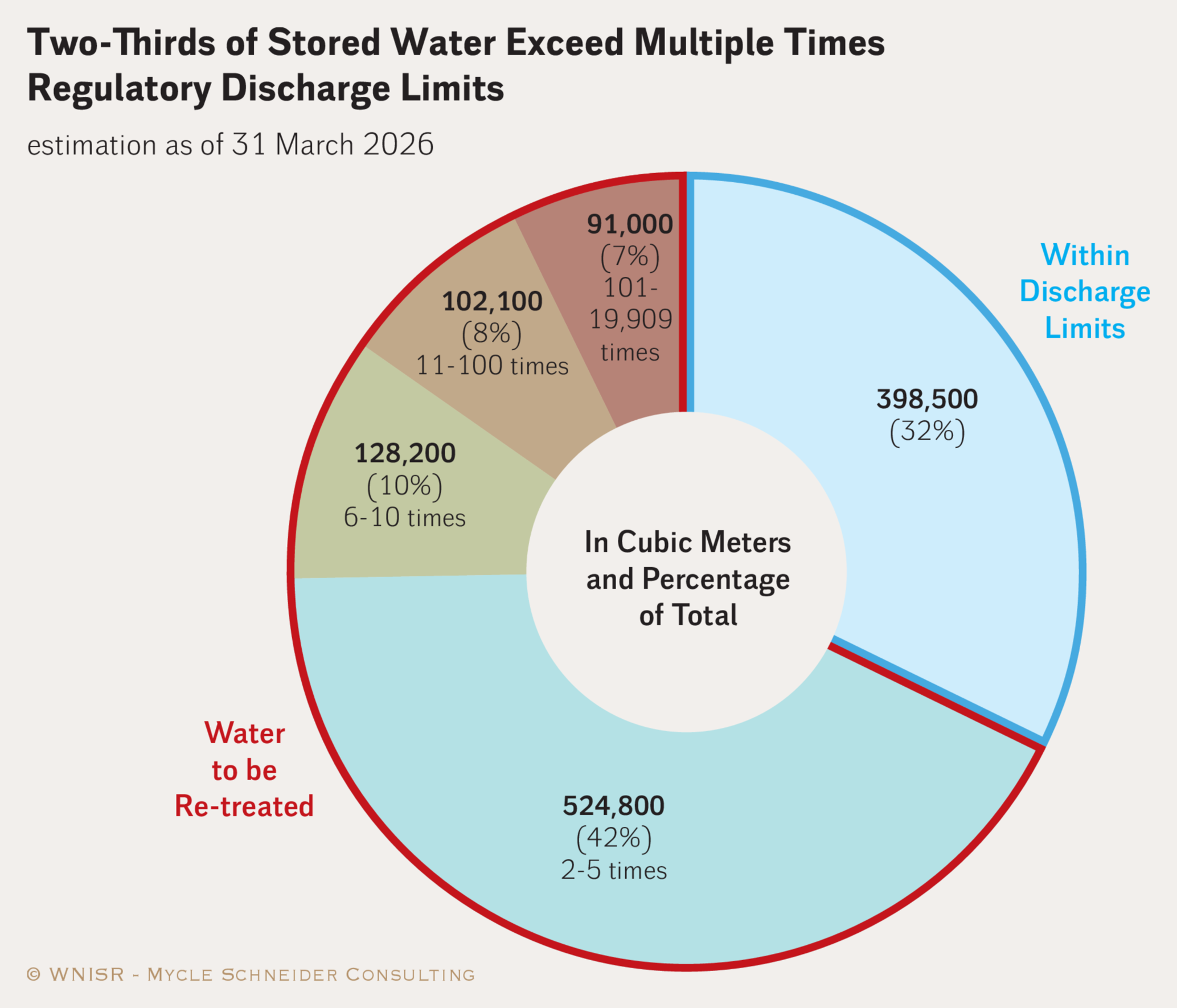
Source: TEPCO Treated Water Portal Site, as of March 20261222
Between TEPCO employees, workers from partner companies, and site laborers, thousands of people work at Fukushima Daiichi. TEPCO’s staffing needs fluctuated between 3,600 and 5,100 people per day during the two years to May 2026.1223
Worker radiation exposure remains reportedly low overall, with an average exposure of 1.75 millisieverts (mSv)1224 per person for FY20251225—well below the regulatory limit of 100 mSv over a five-year period and 50 mSv annually, as well as TEPCO’s own annual limit of 20 mSv.1226 However, subcontractors were on average receiving more than three times the radiation exposure of TEPCO workers, with an average exposure of 1.91 mSv versus 0.51 mSv. TEPCO’s annual worker survey, conducted between August and September 2025, showed a big drop in concern over radiation compared to 2024, when workers had likely been anxious over a radioactive leak incident in 2023 (see Worker Safety in WNISR2025).1227
TEPCO has been focusing on decreasing accidents and incidents of heat stroke at the site. Eleven people were injured in workplace accidents at Fukushima Daiichi in FY2025, four less than the previous year, with no serious injuries. Nine workers suffered heat-related illnesses, one more than in FY2024.1228
The company has been recording 7–10 cases of heat illness per year for the past five years, a serious problem when many workers are wearing multiple layers of protective clothing and full-face masks in stuffy environments, even during hot weather. The company is planning to roll out more measures to combat heat stress, ranging from distributing salt tablets to wearable devices that can send out health alerts. It has started sending workers who do not feel well to the compound’s Emergency Room (ER) quickly, resulting in a doubling of ER visits between June and September of 2025 versus the same period in 2024. TEPCO said this has resulted in catching problems before they get more serious.1229
Outside of Fukushima Daiichi, the Japanese Government and Fukushima Prefecture, having largely dealt with the most acute and pressing problems, are grappling with long-term environmental and social repercussions of radioactive contamination.
Dealing with Contaminated Soil
The core meltdowns at Fukushima Daiichi coupled with subsequent hydrogen explosions spread radioactive particles over a wide area of Fukushima Prefecture. Around 12 percent of the prefecture was declared an evacuation zone, leading to the exodus of around 165,000 people.
After 15 years of clearing away radioactive soil and other materials from affected towns and villages, that evacuation zone had shrunk to around 2.2 percent of the prefecture as of 25 March 2026, unchanged from the previous year.1230 Such areas are designated “Difficult-to-Return Zones”—that is, areas considered hazardous to live in because their radiation dosage levels are higher than 50 mSv per year and are likely to remain above 20 mSv per year for the five years following designation.1231
As of 1 February 2026, Fukushima Prefecture still officially recorded 23,410 evacuees, around 14 percent of the initial number and roughly 1,200 less than the previous year; about 19,000 of them were living outside Fukushima.1232 The total number of people who have returned to former evacuation zones is uncertain and varies widely between locations.
The government has been funding a multitude of projects aimed at bringing residents and businesses back to Fukushima; it budgeted ¥449.2 billion (US$2.8 billion) for reconstruction in FY2026.1233
The clean-up process involved the removal of contaminated soil, leaves, timber, and other waste, which was temporarily stored at around 1,400 sites, mostly in Fukushima Prefecture, with the number of sites peaking in 2016. That process has slowed, and most of the contaminated soil has been moved to interim facilities in two towns bordering the Fukushima Daiichi plant, with only 10 temporary sites still holding material as of May 2026.1234 Around 14.4 million m3 of contaminated material had been shipped to the interim facilities as of the end of June 2026,1235 enough to fill 5,600 Olympic swimming pools, even though much of the heavily forested prefecture remains untouched. (See Decontamination and Contaminated Soil in WNISR2024 for a discussion of the effectiveness of decontamination in Fukushima Prefecture.)
The government is legally mandated to move that contaminated soil and waste out of Fukushima Prefecture by 2045. It has decided that soil with radiation levels below 8,000 Bq per kilogram is safe to use in applications like fill below construction sites or gardens. Around three-quarters of the contaminated soil and waste falls into that category. The government is studying ways to store the rest permanently outside of Fukushima Prefecture.1236
The government committee overseeing the reuse and disposal of that contaminated soil released a five-year roadmap in August 2025 that sports a list of demonstration projects, starting with one at the Prime Minister’s residence and continuing with applications under flower beds at government ministries. By 2030, the roadmap calls for the creation of a process to select candidate sites and reuse scenarios so that selection of the candidate sites can start.1237
However, many communities have protested plans to use the contaminated soil in pilot projects around the country. Both the Japanese Government and outside experts agree that getting public buy-in for use and disposal of contaminated materials nearby will be tough. One 5,257-person survey on public acceptance of the plan to reuse contaminated soil found that 82.5 percent of the respondents had concerns, ranging from health effects to reputational damage if the soil was used in their neighborhoods.1238 (See also Fukushima Status Report in WNISR2025).
The Japanese Government’s decision to release tens of thousands of tons of ALPS-treated water into the ocean every year starting in 2023 sparked a wave of concern over safety implications. TEPCO filters the water until radioactive elements besides tritium are below regulatory limits, then dilutes the treated water to lower the tritium concentrations in its releases as well.1239 It also conducts regular radionuclide monitoring of the sea where the treated water is released and samples fish and seaweed to test for tritium.1240 So far, the company has not reported the detection of tritium levels exceeding those in the releases.1241
Still, a handful of countries raised health and safety objections to the releases. As of November 2025, Russia, Hong Kong, and Macao were banning seafood or marine products from all or some prefectures of Japan because of the treated-water releases.1242 China, which also raised strenuous objections to the releases and halted seafood imports, restarted purchases in early November 2025 but effectively stopped them again about a week later amid political tensions with Japan.1243 Those states and territories, with the addition of South Korea, also impose other restrictions on some Japanese food imports, citing fears of broader radioactive contamination.1244
Japan is continuing the food-supply monitoring it has had in place since soon after the nuclear meltdowns, a process that appears to have kept radioactive contamination largely out of farmed products. But each year plant and animal samples from foraging and hunting show levels of radioactivity exceeding regulatory limits, a testament to the long persistence of nuclear contamination in wild areas of northeast Japan, which cannot easily be cleaned and is thus not envisaged.
Figures published by Japan’s Ministry of Health, Labor and Welfare showed that in FY2025 food-contamination testing found radiation readings exceeding limits for 89 items—all in the category where feeding and cultivation was designated “difficult to manage,” essentially wild animals, plants, and fish.1245 That figure is less than half the number published by the ministry for FY2024, but those figures need to be interpreted with caution, due to the inconsistencies and quirks of Japan’s food-testing regime, a WNISR investigation found (see Food Contamination Monitoring in WNISR2025).
What impact has the nuclear disaster at Fukushima Daiichi had on human health? That question has attracted intense interest, but it is also highly sensitive and controversial. The Fukushima prefectural government has conducted health monitoring for hundreds of thousands of people over the years since the meltdowns.
The establishment consensus after a decade-and-a-half of research is that the clearest effects have been indirect: psychological and physiological ailments accompanying the stress of evacuation, life disruption, and anxiety over radiation. Studies and surveys have shown plant workers, evacuees, and residents of the affected areas suffering from everything from depression to diabetes and liver dysfunction.
In contrast, there is a good deal of controversy over the direct health effects of the radiation released by the disaster. The United Nations body assessing radiation exposure has said that so far, no deaths or illnesses have been scientifically proven to result from Fukushima Daiichi’s radiation releases, and that there probably will not be discernible health effects for the public in the future, given established dose levels outside the plant site. Many experts concur.1246 Other experts disagree. Independent consultant Ian Fairlie for example has pointed out that the high collective effective doses1247 received by the Japanese population would likely lead to several thousand cancer deaths spread out among the Japanese population. The established high collective thyroid dose to the Japanese population from the accident would be expected to result in a significant number of thyroid cancer cases.1248 (See discussion hereunder).
But much uncertainty exists on the radiation exposures of workers and residents following the accident, as well as how to understand chronic exposure to low doses of radiation. Fukushima evacuees who were children at the time of the meltdowns are experiencing indeed much-higher-than-normal rates of thyroid cancer, and there is disagreement over how to interpret that. A group of those thyroid cancer patients is suing TEPCO. Meanwhile, the Japanese Government has approved workers’ compensation claims for 17 workers at Fukushima Daiichi who developed illnesses associated with radiation exposure.
Radiation, Evacuation1249
The massive earthquake and tsunami of 11 March 2011 precipitated the nuclear meltdowns at Fukushima Daiichi, which spread contamination far outside the plant as TEPCO vented gas from the stricken reactor vessels to relieve pressure, and hydrogen explosions blew large amounts of radioactive iodine and cesium into the atmosphere. An estimated 80 percent of the radioactive matter drifted eastward over the Pacific Ocean. The rest dispersed over the Japanese mainland, primarily to the northwest of the plant, where it fell to the ground, often mixed in rainwater or snow. Ultimately, an estimated 100–500 petabecquerels (PBq)1250 of iodine-131 and 6–20 PBq of cesium-137 were released into the air—around 10 percent and 20 percent, respectively, of what was released by the 1986 Chornobyl nuclear accident.
The Fukushima Daiichi disaster also resulted in large amounts of radionuclides flowing into the ocean from contaminated-water leaks and releases during the early days of the accident as well as radioactive elements falling into the water from the air.
The Japanese Government initially responded by declaring an evacuation zone within a two-kilometer radius of the plant, expanding to 3 km, then 10 km and 20 km as the severity of the situation became clearer.1251 By 15 March 2011, the government had evacuated around 78,000 residents from that 20 km radius. Another 62,000 people who lived in a 20–30 km radius were ordered to shelter in place. In April 2011, when the government realized that radiation levels were particularly high northwest of the plant, it ordered around 10,000 more people from that area to evacuate.
Some residents were told they could leave if the government found radioactive hot spots near their homes; many others left on their own.1252 Ultimately, Fukushima Prefecture estimates nearly 165,000 people had left their homes by May 2012, either because of government orders or voluntarily.1253
To protect citizens from internal exposure, the Japanese Government in mid-March slapped radiation limits on food produced in the country and started testing for radionuclides.1254
Health Monitoring1255
In June 2011,1256 the Fukushima government established a massive health-monitoring survey, the Fukushima Health Management Survey (FHMS), to “estimate external exposure doses of the people in Fukushima Prefecture and to ascertain their health status” over the long-term. Conducted by Fukushima Medical University, the FHMS is divided into five surveys, a radiation exposure survey and four others targeted at thyroid health, physical and mental health of evacuees, and pregnancy/childbirth-related issues. Those surveys are the source of the data for much of the research on post-disaster health issues.
The exposure survey, or Basic Survey, is open to all the roughly 2 million people in Fukushima Prefecture who were registered residents or physically present in the prefecture between 11 March 2011 (when the Fukushima Daiichi disaster started) and 1 July 2011. The aim is to calculate the external radiation exposures of the respondents from the estimated dose rates of the places they were located. Because so much of the population was moving around at the time, the survey asked respondents to provide a detailed record of their whereabouts and what they were doing during those first four months—hourly for the first few weeks—then simplified to a list of home, work, or school locations as well as estimated time spent outdoors. In 2012, the prefecture also produced a simpler version of the questionnaire in an attempt to increase the response rate. Just under 570,000 people, or 27.7 percent of those eligible, had responded as of 31 March 2025 (FY2024).1257
Because of the elevated incidence of thyroid cancer in young people following the Chornobyl accident, Fukushima also started a Thyroid Ultrasound Examination for the roughly 381,000 residents who were 18 or under in March 2011. The survey consists of a baseline ultrasound examination, then follow-ups every two years until age 20, and every five years thereafter, with more detailed exams if something of concern is detected.
The FHMS has two surveys aimed at assessing and improving the physical and mental health of residents from the 13 municipalities1258 where there were official evacuation zones: an annual basic health exam (the Comprehensive Health Check) and an annual mental-health questionnaire (the Mental Health and Lifestyle Survey). As of the FY2025 FHMS report, around 210,000 people were eligible for those surveys.1259
Finally, the FHMS tracks the physical and mental health of new mothers in the prefecture with the Pregnancy and Birth Survey, a questionnaire administered about a year after a woman registers for pregnancy services, with follow-ups at four and eight years after childbirth.
Some critics have raised issues with the FHMS and the way it is administered. The research is funded by Japan’s Environment Ministry via the Fukushima prefectural government. Yet the data it collects is not all publicly available, despite many pleas by researchers for access, said Hisako Sakiyama, a medical doctor, cancer researcher, and member of the Japanese Diet’s Fukushima Nuclear Accident Independent Investigation Commission. That makes it difficult for researchers outside of Fukushima Medical University to fully verify the findings in papers published by the university or to publish their own research, she said.1260
Because so much of the research on health effects following the disaster is published by Fukushima Medical University researchers, organizations like the United Nations Scientific Committee on the Effects of Atomic Radiation (UNSCEAR) rely heavily on them for their reports and conclusions, she said. Fukushima Medical University in turn cites heavily from those UNSCEAR reports, creating a kind of echo chamber, Sakiyama stated.1261
With regard to FHMS’s thyroid cancer screenings, the patient-advocacy group chaired by Sakiyama, the 3.11 Fund for Children with Thyroid Cancer, says the survey procedures have let people slip through the cracks. The group identified problems in the examination process that led to undercounting of cases (see Health Effects of the Fukushima Daiichi Nuclear Power Plant Disaster in WNISR2021).
Health tracking and radiation protection for workers at Fukushima Daiichi have largely been handled by TEPCO, which publishes monthly exposure statistics as well as annual workplace surveys. TEPCO and its subcontractors are also required by Japan’s Health Ministry to provide all Fukushima Daiichi workers regular health checks and follow-up treatment as necessary, at least while they are still employed at the site.1262
In addition, the Health Ministry in 2014 established a framework for epidemiological research on long-term health effects for the roughly 20,000 workers at Fukushima Daiichi during the acute phase of the accident—between 14 March 2011 and 16 December 2011—when the dose limit for emergency workers had been raised to 250 mSv from 100 mSv.1263
The resulting Nuclear Emergency Workers Study (NEWS)1264 is currently under the aegis of the National Institute of Occupational Safety and Health, Japan (JNIOSH), an independent governmental agency. It hosts a set of studies, including an overall health examination, studies on mortality and cancer incidence, and specialized research on thyroid cancer, leukemia, cataracts, and psychological effects of the accident, among other subjects.1265 But participation in most of the studies is voluntary, and only a portion of those eligible have agreed to participate or taken exams and screenings. For the overall health exam, for instance, 42.5 percent of those eligible had in principle agreed to participate by January 2026, but only 38 percent of those invited to take the exam in FY2025 were registered to do so.1266
Indirect Health Effects: Stress, Evacuation, Mental-Health Challenges
International institutions, the Japanese Government, and many experts have said indirect or secondary health effects from the Fukushima Daiichi disaster likely outweigh the direct effects of radiation releases. “The results of this HRA [Health Risk Assessment] indicate that the health effects of radiation exposure resulting from the Fukushima Daiichi NPP [Nuclear Power Plant] accident inside and outside Japan are likely to be less ominous than the socioeconomic impact,” the World Health Organization (WHO) concluded in a 2013 report. “This particularly applies to residents of Fukushima prefecture.”1267
Researchers have catalogued a long list of ways that nuclear disasters such as Chornobyl or Fukushima Daiichi indirectly affect health. The dangerous circumstances stress emergency workers and residents; populations experience persistent fear, anxiety, and sometimes discrimination over the effects of radiation; evacuations and environmental contamination disrupt lives, livelihoods, services and communities, and can lead to depression, inactivity and a host of accompanying physical ailments.1268
Disaster-Related Deaths
One way to quantify the impact of those indirect health effects has been through Japan’s disaster-compensation system, in which deaths from injuries or illnesses indirectly caused by the earthquake, tsunami, or nuclear catastrophe of 2011 were certified as “disaster-related” by local municipalities. Among the contributing factors recognized by the town of Minamisōma near Fukushima Daiichi were “deterioration or cessation of functions of medical institutions and nursing facilities, disruptions to lifelines, worsening of transportation conditions, evacuation life, stress and other changes in living conditions.” 1269
Although Fukushima Prefecture suffered far fewer deaths directly attributed to the earthquake and tsunami than its neighbors to the north—Miyagi Prefecture, for instance, recorded around six times as many directly caused deaths as Fukushima did—that trend reverses for indirectly caused deaths.1270 By 31 December 2025, Fukushima municipalities had certified 2,350 deaths as disaster-related,1271 a number thought to largely reflect deaths indirectly caused by the nuclear disaster. Fukushima’s disaster-related death toll is far greater than that of other areas in northeast Japan, and it outnumbered deaths directly caused by the earthquake or tsunami within the prefecture by a ratio of three to two. In the neighboring prefectures of Iwate and Miyagi, which were relatively removed from the aftereffects of Fukushima Daiichi accidents, disaster-related deaths were around one-tenth of those from direct causes. In Fukushima, the number of disaster-related deaths, which include suicides, continued to rise for years, even as they leveled off in the other two prefectures, suggesting long-term health consequences of the nuclear disaster.1272
Studies of suicide rates in Fukushima have also pointed to lingering psychological effects of the nuclear disaster. Research on disaster-related suicides showed that suicide rates in Fukushima remained high years later until 2017, even as the rates largely declined in neighboring prefectures.1273 Another study of people from evacuated municipalities showed that suicide rates among men increased after every lifting of evacuation orders between 2014 and 2017 and again a year later. The lifting of those orders meant evacuees lost temporary housing, community, support for medical expenses, and compensation for psychological burdens—all of which the authors suggest may have contributed to the rise in suicides.1274
Many studies have pointed to the aftereffects of the evacuations—which were sometimes poorly managed, particularly during the first few days of the nuclear disaster—as a major cause of indirect health problems. In the months after the disaster started, over 20 percent of the fleeing residents were forced to relocate more than six times due to expanding evacuation zones and a lack of planning.1275 Some 50 patients of hospitals or nursing homes within the 20-km zone were reported to have died during or soon after they were rushed from their institutions—often without medical personnel—then transported long distances or forced to wait in poor conditions while beds were located for them.1276 The confusion extended to the distribution of iodine tablets used to counteract the effects of radioactive iodine, as the tablets were handed out to evacuees in an inconsistent manner.1277
In the towns of Minamisōma and neighboring Soma, disaster-related deaths spiked in the month after the Fukushima Daiichi meltdowns, suggesting evacuations played a big role. Residents of Minamisōma nursing homes who were forced to evacuate died at a 2.7 times higher rate after the disaster started than before; their mortality risk was 1.82 times higher than that of residents who did not evacuate in neighboring Soma.1278
Physical and Mental-Health Impacts
Longer-term, the lifestyle changes that accompanied evacuation—for instance, moving around less, eating more, or delays in getting medical services—also took a toll on physical health. Researchers sifting through data from the FHMS found that evacuees reported increased rates of a raft of lifestyle diseases in the first two years of the nuclear disaster, including obesity, high blood pressure, diabetes, and liver problems. One study found residents living in areas neighboring the evacuated zones also saw increases, although generally not as much as evacuees.1279
Similarly, researchers who looked at FHMS mental health-related data for evacuees during the two years after the disaster started found “severe mental health problems” and nearly as large a percentage of people with high Post-Traumatic Stress Disorder (PTSD) scores as was found in US rescue and cleanup workers following the World Trade Center attacks in 2001. Nearly 40 percent of the evacuees surveyed in FY2012 were living apart from some family member they had lived with before and more than half had changed work. They were also very anxious over radiation, with around 40 percent saying it was likely or very likely they would experience delayed health effects.1280
Farmers, many of whom were in their 60s and 70s, were under immense stress post-disaster. Those in evacuation zones had to abandon lands and animals, while those farther from the heavily contaminated areas still had to deal with radioactive contamination and widespread consumer reluctance to buy their products. Articles and case studies have described Fukushima farmers struggling with alcoholism and depression in the early days, and difficulties rebuilding communities, farmland, and businesses years later.1281
Elderly evacuees were another group facing significant psychological stress after they were forced to leave familiar communities and routines. Many who wanted to return were prevented from doing so by a lack of medical or social services in slowly repopulating towns.1282
Many physical and mental-health indicators have improved in subsequent years, the FHMS surveys show, although response rates have dropped dramatically compared to early years. The percentage of surveyed evacuees age 16 or older who were at high risk of depression or anxiety disorders had fallen from 14.6 percent in FY2011 to 5.4 percent in FY2023, although that was still higher than the national average of 3 percent.1283 But anxiety over radiation effects remains stubbornly high amid all the uncertainties over radiation doses and effects: nearly a third of FHMS respondents still thought it was likely they would experience delayed health effects from radiation in 2019.1284
The FHMS only covers the physical and mental health of people from municipalities that had official evacuation zones, and not those who left home voluntarily or Fukushima residents overall. The mental fallout from the nuclear disaster was much broader. One study on mothers in Fukushima City, 62 kilometers northwest of Fukushima Daiichi, for instance, showed they were experiencing greater levels of psychological symptoms, depression, anxiety, and desire to protect their children from radiation than mothers in other parts of Japan, as late as 2022.1285
Direct Health Effects: Cancer and Controversy
The Japanese Government has approved workers’ compensation claims by several Fukushima Daiichi workers for illnesses associated with radiation exposure. But many international organizations and experts still claim that, unlike the extensively documented indirect health effects of Fukushima Daiichi, there is no statistically verifiable evidence so far of direct impacts to human health from the plant’s radiation releases, particularly for the general public.
Risks to the General Public
In its last standalone report on Fukushima Daiichi, for 2020/2021, the United Nations body in charge of assessing and reporting on radiation exposure issues—the United Nations Scientific Committee on the Effects of Atomic Radiation (UNSCEAR)—concluded that “No adverse health effects among Fukushima residents have been documented that are directly attributable to radiation exposure from the FDNPS [Fukushima Daiichi Nuclear Power Station] accident,” and that radiation-dose estimates are so low that “future radiation-associated health effects are unlikely to be discernible.”1286 In other words: in the absence of radiation levels that past research has shown to cause health effects, there is no way to prove that any illnesses that do occur were due to radionuclide exposure.
The report did note that just because it could not prove an increased risk of disease did not mean there was not such a risk, or that there were no individual cases of radiation-caused disease—it just could not be demonstrated scientifically. The WHO came to a similar conclusion in its 2013 assessment.1287
UNSCEAR and other radiation experts separate health effects into two categories: deterministic, where high levels of radiation—100 mSv or more—over established dose limits cause organ or tissue damage like burns, cataracts, or hair loss, often shortly after exposure; and stochastic, where radiation damage cannot be seen directly but is instead inferred by rising rates of diseases like cancer or genetic effects after exposure.1288
Cancer risk is generally understood to increase in proportion to the radiation dose, no matter how low. But organizations such as UNSCEAR or the International Commission on Radiological Protection (ICRP), an unofficial group of experts that give recommendations on protecting people from radiation, had long held that while such cancer risk was present, there was little epidemiological proof for radiation doses below 100 mSv. The ICRP’s 2007 guidelines stated that there is “general agreement that epidemiological methods used for the estimation of cancer risk do not have the power to directly reveal cancer risks in the dose range up to around 100 mSv.” 1289
But studies are increasingly producing data on those lower-dose risks, and the ICRP’s 2020 guidance on cancer risk was starting to acknowledge that, stating “large uncertainties remain about health effects associated with low-dose and low-dose-rate radiation exposure, but the epidemiological evidence of a dose–risk relationship below 100 mSv is increasing, notably from large studies.” 1290
Estimates based on the FHMS exposure survey results published in the FY2025 report indicated that 99.8 percent of the respondents in the general public had dose rates below 5 mSv—94 percent of them below 2 mSv—for the first four months after the disaster started. Sufficiently below the 100-mSv level, those dose rates were “unlikely to cause adverse effects on health,” the annual report on the FHMS concluded, although it noted the doses estimated were only external, not internal.1291
The UNSCEAR 2020/2021 report, which did estimate internal exposure doses as well as doses to specific organs, calculated that adult evacuees received an average dose of less than 6 mSv in the first year following the start of the disaster, while non-evacuated adults received less than 4 mSv. It calculated a lifetime effective dose for adults of up to 15 mSv. UNSCEAR also estimated doses to the thyroid for evacuee children.1292
Some scientists have challenged UNSCEAR’s calculations, claiming they are underestimates. In 2014, the International Physicians for the Prevention of Nuclear War published a critique of the first version of the UNSCEAR report, from 2013, saying that UNSCEAR had relied on flawed assumptions from WHO, used a low-ball estimate of the initial radiation release from a Japanese government agency known to be close to the nuclear industry, ignored releases of many radioactive isotopes including strontium as well as continuing radiation releases from Fukushima Daiichi, and questioned the reliability of the data used to assess food contamination as well as plant-worker exposures among other criticisms.1293 UNSCEAR defended its results in a 2015 White Paper.1294 (See also critiques in section on Thyroid Cancer.)
Other scientists point to UNSCEAR’s own results in its 2020/2021 report on Fukushima1295 showing that the whole-body lifetime collective effective dose from the accident was estimated at 44,000 person-Sv. Putting that into perspective, UNSCEAR states: “The collective effective dose to the population of Japan due to a lifetime exposure following the FDNPS [Fukushima Daiichi Nuclear Power Station] accident is approximately 10–15% of the corresponding value for European populations exposed to radiation following the Chernobyl accident.”1296 That is a very substantial number. Keeping in mind that cancer risk is generally understood to be directly proportional to dose, the linear dose-effect relationship, one of the lowest estimates of cancer mortality induced by the Chornobyl disaster, from a 1996 study cited in a WHO report for the Chernobyl Forum, put the death toll at around 9,000 in the most affected countries Belarus, Russia, and Ukraine.1297 Other studies put the estimated long-term fatalities much higher, in the tens of thousands, including effects in large parts of Europe with much lower exposure but much larger population sizes.1298
UN human rights special rapporteurs have also expressed concerns to the Japanese Government about repatriation plans for some of the evacuated areas around the Fukushima Daiichi plant, observing in a 2018 letter that:
…we are deeply concerned that the decision to lift evacuation orders in areas where radiation levels remain high, and withdrawing housing support previously provided to a large number of households, create significant pressures for internally displaced persons to return to their previous homes, where their life, safety or health would be at risk from exposure to hazardous levels of radiation
and that
…scientific evidence suggests serious health risks, including development of cancer, for persons exposed to low-dose radiation, including in the range of 1 to 5 mSv/y.1299
Workers at Fukushima Daiichi
The UNSCEAR and WHO reports are more cautious about plant workers, 174 of whom had documented exposure levels of 100 mSv of radiation or more within the first year of the disaster; one worker received a reported effective dose of 679 mSv. Thirteen workers were also found to have received high doses of radiation to the thyroid. UNSCEAR estimated the average effective dose for all 20,000-plus emergency workers was 13 mSv for the first year of the disaster but acknowledged there were many problems with measurements in the first weeks, when laborers were often forced to share dosimeters because of equipment shortages.1300 Many workers were brought in quickly, with no experience working in radioactive environments and minimal training. Some were not even aware that they would be working at Fukushima Daiichi.1301
UNSCEAR acknowledged that the group of heavily-exposed workers, especially those with high doses of radiation to the thyroid, face a “small increased risk of cancer” during their lifetimes. But it again said the number of expected cases would be too small to definitively show the cancers were caused by the Fukushima Daiichi disaster.1302
Many scientists note increasing evidence of the effects of long-term exposure to relatively low doses of radiation.1303 A 2023 long-term study of mortality in nearly 310,000 nuclear workers from France, the UK, and US, for instance, showed that rates of death from cancer rose in a linear relationship to the workers’ cumulative exposures in lower-dose ranges below 100 mGy (equivalent to 100 mSv for whole-body exposure to gamma and beta radiation)1304 and even below 50 mGy—in other words, well below Japan’s nuclear-worker dose limit of 100 mSv per five years and 50 mSv for any single year. The study also suggested there might even be a larger risk of solid cancer per unit of radiation dose for that lower range.1305
Meanwhile, a Japanese government medical review panel has been approving worker’s compensation for cases of cancer following exposure to radiation at Fukushima Daiichi; 17 such cases had been approved as of October 2025.1306 One of those workers died of lung cancer.1307, 1308
Most of the epidemiological research on Fukushima Daiichi workers is still in a preliminary stage.1309 A 2014 study of thyroid-screening results found that the prevalence of thyroid nodules was “not significantly associated” with the preliminary estimated equivalent thyroid dose.1310
The most fraught debate over the direct impact of radiation from Fukushima Daiichi on residents’ health has involved thyroid cancer (see also Health Effects of the Fukushima Daiichi Nuclear Power Plant Disaster in WNISR2021). As of 12 May 2026, screenings under the FHMS have found 367 suspected cases of thyroid cancer among the roughly 381,000 young Fukushima residents eligible to be tested.1311 Patient-advocacy groups say that many cases were missed and that the true number is closer to 415.1312 Researchers have pointed out there are likely even more cases, since thousands of eligible residents have not been tested.1313 Those totals are many tens of times higher than the handful of cases that would be expected given the normal rate of diagnosing pediatric thyroid cancer cases, cited as one or two per million people each year.1314
UNSCEAR’s 2020/2021 report claimed the extremely high incidence probably was not due to radiation exposure, saying such elevated rates would not be expected given the estimated radiation doses to the population and that most researchers had not found a correlation between the estimated exposure dose and cancer incidence, among other reasons. UNSCEAR said the high incidence “most likely” resulted from aggressive screening with ultrasensitive instruments,1315 which can find latent cancers earlier than they would have been detected under normal conditions or those that might have remained undetected because they do not cause symptoms.
UNSCEAR’s conclusion was echoed by the oversight subcommittee established by Fukushima Prefecture to assess the results of FHMS’s thyroid screening program, which said that long-term examinations were important, but that they should be accompanied by a “careful explanation of the disadvantages” of taking the examination.1316 Accordingly, since 2020, the prefecture has sent a booklet on the advantages and disadvantages of thyroid cancer screening when notifying those eligible about the test.1317 Among the disadvantages listed in the 2026 booklet are 1) patients might end up treating cancers that would not cause symptoms or be fatal in the future; 2) early diagnosis of cancers or possible cancerous lesions could lengthen the period of treatment or observation, increasing psychological stress and causing social or economic disadvantages and; 3) exams could identify nodules or cysts that do not need treatment; even if a nodule is benign, doctors could recommend follow-up testing or cytology, which could be physically taxing for patients and cause anxiety for them and their families.1318 Some members of the FHMS oversight committee have proposed a reduction or elimination of the thyroid screenings in schools to combat “overdiagnosis”.1319
Those steps have angered patient-advocacy groups, who argue that there is already intense stigma associated with thyroid cancer and radiation-related ailments in Japan, and that talking openly about thyroid cancer is seen as hindering reconstruction in Fukushima. They say it is particularly important not to discourage young people from screening, since it generally takes many years after exposure for cancers to show up.1320
Advocacy groups and some physicians, including one of the principal thyroid surgeons at Fukushima Medical University, have pushed back against the label of overdiagnosis, pointing out that most of the cancers operated on had metastasized or moved outside of the thyroid.1321 Some medical experts have called for a similar large-scale screening to be done elsewhere or among Fukushima children born after the accident who would not have had exposure to radioactive iodine, to see whether it really produces large numbers of latent thyroid cancer cases, but the government has not agreed to do so.1322
“They are using low estimated doses to negate facts.”
The 3.11 Fund for Children with Thyroid Cancer and some researchers have debated the finding that cancer incidence has not corresponded with exposure doses, noting that there was a relationship until Fukushima Medical University changed the exposure zones. A number of researchers have also taken issue with UNSCEAR’s calculations for how much radiation Fukushima residents were exposed to, saying they are gross underestimates and providing alternate estimates.1323
The 3.11 Fund’s Sakiyama points out that although all the proposed exposure doses to childrens’ thyroids are estimates, since nobody was taking measurements at the time, the high rate of thyroid cancer incidence that has been found among Fukushima youngsters is incontrovertible. “They are using low estimated doses to negate facts,” Sakiyama said.1324
Meanwhile, seven thyroid cancer patients from Fukushima have filed a lawsuit against TEPCO, seeking to hold it responsible for their illnesses.1325 TEPCO has been insisting there is no cause-effect relationship.
“At Chornobyl, cases of pediatric thyroid cancer began to increase three or four years after the accident, but it took global organizations like IAEA and UNSCEAR 10 years to recognize the relationship with the nuclear disaster,” said Motomi Ushiyama, a doctor of internal medicine and co-head of a thyroid cancer patient support group, at a March 2026 press conference in Tokyo. “Historically, health effects from radiation have been underestimated at the beginning.” 1326
Independent consultant Ian Fairlie stresses that the 2020/2021 UNSCEAR report itself stated that the collective thyroid dose to the Japanese population from the accidents was 44,000 person Gy over the first 10 years. Again, he states, “this is a high figure and would be expected to result in a significant number of thyroid cancer cases.” 1327
Final Thoughts on Health Impacts
The argument that it is likely impossible to discern a cause-and-effect relationship between radioactive exposure from the Fukushima Daiichi disaster and illnesses in workers or the general public has some weaknesses. One is that it relies on the assumption that most exposure doses were low. Another is that much new epidemiological evidence clearly shows increased cancer risks at such low exposure levels. But uncertainties remain on what the exposure doses actually were. Various groups and researchers have proposed different numbers based on their own modeling. And some direct exposure measurements, such as early dosimeter readings for Fukushima Daiichi workers, are unreliable.
Another issue is that despite the increased epidemiological evidence of cancer risk from low exposure doses, assessments such as the UNSCEAR’s 2020/2021 report fail to reflect this evidence.
What is inarguable, however, is that the nuclear crisis at Fukushima Daiichi has had a serious and long-lasting impact on residents’ health through disruptions of their lives and livelihoods, with effects ranging from psychological distress and physical deterioration to destruction of communities and families.
Some Key Organizations
UNSCEAR (United Nations Scientific Committee on the Effects of Atomic Radiation): UN organization established in 1955 in response to global concern over the effects of ionizing radiation, in the wake of the atomic bombing of Hiroshima and Nagasaki as well as nuclear-weapons tests. Its goal is to provide scientific assessments of those effects as well as their sources and exposure levels. Liaises with the WHO and IAEA, among other UN organizations.
IAEA (International Atomic Energy Agency): UN organization established in 1957 to promote the peaceful use of nuclear energy. Among its functions are encouraging and assisting in research and use of nuclear energy as well as establishing and applying safeguards to ensure nuclear materials and equipment are not used for military purposes in non-nuclear-weapon states signatories of the Non-Proliferation Treaty.
WHO (World Health Organization): UN organization established in 1948 to promote global health. In 1959, it concluded an agreement with the IAEA that “they will act in close co-operation with each other and will consult each other regularly in regard to matters of common interest.” 1328 Critics have pointed out that this could result in conflicting interests in matters related to health and radiation exposure, since the IAEA is dedicated to promoting nuclear development.
ICRP (International Commission on Radiological Protection): Independent non-profit established in 1928 by an international group of radiologists, initially to deal with concerns over the effects of radiation in the medical field. Currently its mission is to advance research and provide guidance on protection against radiation. Many representatives have held positions in the IAEA, UNSCEAR or WHO as well, sometimes concurrently.
FHMS (The Fukushima Health Management Survey): A set of health surveys launched in 2011 by Fukushima Prefecture in order to estimate external exposure doses and track the health of residents in the wake of the Fukushima Daiichi disaster. The surveys are conducted by Fukushima Medical University, a public university based in Fukushima City, which established the Radiation Medical Science Center to implement them.
3.11 Fund for Children with Thyroid Cancer: Japanese non-profit established in 2016 to help support children diagnosed with thyroid cancer following the Fukushima Daiichi disaster. Chaired by Hisako Sakiyama, a medical doctor and cancer researcher who was on the Japanese Diet’s independent commission to investigate the Fukushima Daiichi accident.
Japanese courts continued to hold the Japanese Government blameless in lawsuits filed by Fukushima residents forced to evacuate after the nuclear meltdowns, while ruling that TEPCO needed to pay compensation.
On 22 January 2026, Japan’s Supreme Court rejected the final appeal by nine groups of evacuees from Fukushima to various prefectures, who were seeking compensation from both the Japanese Government and TEPCO. The court upheld lower court rulings that awarded compensation from TEPCO but not from the government, following similar judgements in past cases.1329 (See also past WNISR editions and Judicial Decisions on Damages and Criminal Liability for the Fukushima Nuclear Accidents in WNISR2021.)
In July 2025, the Tokyo District Court delivered a ruling in a 10-year lawsuit brought by Katsutaka Idogawa, the former mayor of Futaba, one of the two towns that hosts the Fukushima Daiichi plant, where roughly 85 percent of the land was still classified as a “Difficult-to-Return Zone” in late 2023, and only 193 of the 7,100 residents before the disaster have returned as of February 2026.1330 The court ordered TEPCO to pay ¥100 million (~US$2025668,200) for hardships associated with the evacuation, but dismissed claims against the Japanese Government. Idogawa had asked for ¥755.6 million (US$20156.2 million) in compensation from the government and TEPCO, saying the evacuation order was delayed and that he had been exposed to excessive amounts of radiation. He also asked for compensation for locating an interim facility to hold contaminated soil in Futaba. The judge ruled that Idogawa had showed no evidence that radiation exposure had caused his illnesses or that the government’s handling of the accident affected the evacuation.1331
TEPCO released its Fifth Comprehensive Special Business Plan in January 2026, which described fuel-debris removal as the “biggest challenge going forward” in decommissioning.1332 The company had previously set aside ¥350 billion (US$2.2 billion) in loss reserves for decommissioning; the latest business plan boosts that amount by an additional ¥903 billion (US$5.7 billion), in light of the expenses it expects to incur from the preparatory phase of debris retrieval, which involves investigating reactor interiors and clearing out obstacles.1333 TEPCO said it may adjust that loss estimate further in the next year or two, as it continues engineering work for the removal process.
The additional expected loss brings TEPCO’s estimate for how much it has already spent or expects to spend on decommissioning Fukushima Daiichi to ¥5.4 trillion (US$34 billion), two-thirds of the government’s total forecast decommissioning budget of ¥8 trillion (US$50.2 billion). However, TEPCO said there were no changes to the official government estimate for the amount of funds needed to cover the total cost of compensation, decontamination, the interim storage facility for contaminated soil and waste, and decommissioning, which has been ¥23.4 trillion (US$147 billion) since 2023.1334
Other organizations have estimated far higher costs. See Estimated Costs of Fukushima Disaster: Official and Independent Assessments in WNISR2021 for various cost estimates.
As of end of June 2026, TEPCO had paid out ¥11.73 trillion (US$73.6 billion) of the roughly ¥13.7 trillion (US$85.9 billion) in compensation it expected to pay.1335
In April 2026, TEPCO and the Nuclear Damage Compensation and Decommissioning Facilitation Corporation (NDF) released their latest annual plan for the reserve fund from which decommissioning expenses are paid, budgeting a total of ¥257.9 billion for FY2026 (US$1.6 billion), a bit less than the previous fiscal year. That includes around ¥28 billion (US$176 million) for contaminated water management, ¥11 billion (US$69 million) on removing spent fuel, ¥13.3 billion (US$83 million) for the program to retrieve fuel debris, and ¥41 billion (US$257 million) on tackling waste. They are budgeting some increases over the following two years, including as much as a 79.7 percent increase for fuel debris removal in FY2028 compared to FY2026.1336
|
Fuel Remaining in Spent Fuel Pools (number of fuel assemblies) |
Contaminated Water Generated |
Debris Removal (cumulated) |
Number of Evacuees |
Estimated Total Funding Cost (¥ Trillion) |
|||||
|
Unit 1 |
Unit 2 |
Unit 3 |
Unit 4 |
Total |
|||||
|
2011 |
392 |
615 |
566 |
1,535 |
3,108 |
900 |
0 |
159,168 |
5.7 |
|
2015 |
392 |
615 |
566 |
Removal Completed in 2014 |
1,573 |
540 |
0 |
120,300 |
11.6 |
|
2020 |
392 |
615 |
Removal Completed in 2021 |
0 |
1,007 |
140 |
0 |
41,099 |
21.5 |
|
2025 |
392 |
615 |
0 |
0 |
1,007 |
70 (FY2024) |
0.9 grams |
24,644 |
23.4 |
|
2026 |
392 |
601 |
0 |
0 |
1,007 |
60 (FY2025) |
0.9 grams |
23,410 |
23.4 |
Sources: Compiled by WNISR with TEPCO and METI, various years
Introduction
In mid-2026, 224 nuclear power reactors were closed, corresponding to about 111 GW of permanently retired capacity worldwide. This compares with 411 reactors in operation and 30 in Long-Term Outage (LTO). Thus, 34 percent of the reactors connected to the grid in the past 71 years have been retired.
Decommissioning nuclear power plants is an important, and often overlooked, element of the nuclear electricity system. Defueling, deconstruction, and dismantling—summarized by the term decommissioning—are the final steps in the operational cycle of a nuclear power plant (excluding waste management and disposal). The process is technically complex and poses major challenges in terms of long-term planning, implementation, and financing. In the first decades of the nuclear age, decommissioning was hardly considered in reactor design. The costs for decommissioning at the end of a reactor’s lifetime were usually discounted away, and thus largely ignored. However, with a large number of power reactors already closed, and many more to follow in the coming years, the challenges of reactor decommissioning are increasingly attracting stakeholder and public attention.
Elements of National Decommissioning Policies
When analyzing decommissioning policies, one must distinguish between the decommissioning process and its financing. To provide a general and globally applicable overview of the progress of nuclear decommissioning, WNISR has been classifying technical decommissioning into three main stages since WNISR2018. This is necessary due to the heterogeneous nature of decommissioning regulations around the world.1337 The three stages are defined as follows:
- The warm-up stage comprises the post-operational stage and the dismantling of systems that are not needed for the decommissioning process. In addition, the dismantling of system parts with higher contamination begins, including the defueling of the reactor, which is crucial for any further undertakings and means removing the spent fuel from the reactor core and the spent-fuel pools.
- The hot-zone stage comprises the dismantling activities in the hot zone, i.e., the dismantling of highly contaminated or activated parts, e.g., the reactor pressure vessel (RPV) and its internals (RVI) and the biological shield.
- The ease-off stage comprises the removal of operating systems as well as the decontamination of the buildings. This stage concludes with the end of physical demolition work.
After physical demolition is completed—as far as reported by the owner or the licensing authorities—WNISR classifies decommissioning as “completed”. This does not necessarily reflect the license termination of the site. Generally, a site can qualify as a “brownfield” site and retain some infrastructure for further nuclear or other industrial use, or it can be released from regulatory oversight as a “greenfield” site for unrestricted use. Different countries require different end-states for complete license termination.1338 WNISR classifies sites that have been partially released from regulatory oversight but still operate nuclear facilities on site, e.g., interim spent-fuel and waste-storage infrastructure, as brownfield sites.
The technical procedure of physically dismantling nuclear reactors, following the three stages described above, can begin after varying amounts of time following nuclear power plant closure. This depends on the decommissioning strategy the operator chooses:
- immediate dismantling, which is characterized by a seamless transition to decommissioning activities after reactor closure
- deferred dismantling, where reactors are placed into Long-Term Enclosure (LTE) for several years to decades to allow for radiation levels to decline before decommissioning begins
- entombment, which involves LTE (50 years or more) that can sometimes become permanent (e.g., Chornobyl Unit 4)
Most countries have adopted variations of these strategies, although some, like France and Germany, have placed restrictions on which strategy may be applied.1339
With respect to financing reactor decommissioning, five main approaches are observable: public budget, external segregated fund, internal non-segregated fund, internal segregated fund, and surety methods such as guarantees or insurances (for more details, see WNISR2018).1340
The goal of this chapter is to provide a global overview of the current state of nuclear decommissioning. However, information on the status and progress at individual sites can be inaccessible, and available data can change over time. This may lead to simplifications in classifying individual sites and reactors into different stages of the decommissioning process. WNISR aims to provide full access to the basis of its assessments. It has in the past, when uncertainty arose, communicated individual classification decisions and potential statistical changes and will continue to do so.
As of 1 July 2026, a global total of 224 reactors, corresponding to about 111 GW of capacity, were closed. Since the reporting period covered in WNISR2025, five additional reactors have been closed: Doel-2 (445 MW) and Tihange-2 (870 MW) in Belgium, and Units 2, 3, and 4 (11 MW each) of the Bilibino plant in Russia.
Of the closed units, 62 percent are located in Europe (109 in Western Europe and 29 in Central and Eastern Europe), 22 percent in North America (49), and 17 percent in Asia (37).
More than three quarters or 173 reactors used one of these three technologies:
- Pressurized Water Reactors (PWRs) with 74 units or 33 percent,
- Boiling Water Reactors (BWRs) with 55 units or 25 percent, and
- Gas-Cooled Reactors (GCRs) with 44 units or 20 percent, the majority (33 units) of which are located in the UK.
Table 19 provides an overview of the closed reactors worldwide. The table also includes the number of defueled reactors and those that are released from regulatory supervision either as ‘full’ greenfield sites or as brownfield. The Decommissioning Status Report, as the WNISR in general, exclusively covers reactors that generated electricity and were connected to the grid. Thus, it does not cover research reactors that were never connected to the grid.
Decommissioning plays an important and increasing role in nuclear politics, due to both the timing and production process, and the financing of the operations. The number of facilities that will be potential candidates for decommissioning will increase significantly in the coming years: assuming a 40-year lifetime, a further 65 reactors would close by 2030 (reactors connected to the grid between 1986 and 1990), and an additional 165 would close by 2066 (reactors connected 1991–2026). This does not account for the 181 reactors that have already been operating for more than 40 years (connected to the grid before 1986), an additional 30 reactors in Long-Term Outage (LTO), and the 73 reactors under construction as of mid-2026. It should be noted, however, that the current general trend is to extend operational lifetimes beyond 40 years, often with the aim of 60 years and in some cases 80 years of operation.
|
Country |
Closed Reactor |
Decommissioning Status |
||||||
|
Warm-up |
Hot Zone |
Ease-off |
LTE |
Completed (of which released as greenfield sites(a)) |
Completed Share of Total Closed (share of total closed released as greenfield sites(a)) |
|||
|
US |
41 |
4(b) |
(4) |
5 |
6 |
9 |
17 (5) |
41% (12%) |
|
Germany |
36 |
8 |
(3) |
9 |
14 |
1 |
4 (3) |
11% (8%) |
|
UK |
36 |
19 |
(15) |
11 |
0 |
6 |
0 |
0 % |
|
Japan |
27 |
24 |
(4) |
2 |
0 |
0 |
1 (1) |
4% (4%) |
|
France |
14 |
3 |
(2) |
3 |
0 |
8 |
0 |
0% |
|
Russia |
14 |
9 |
(5) |
0 |
0 |
5 |
0 |
0% |
|
Canada |
8 |
3 |
(1) |
0 |
0 |
5 |
0 |
0% |
|
Sweden |
7 |
2 |
(2) |
0 |
4 |
0 |
1 (0) |
14% (0%) |
|
Belgium |
6 |
5 |
(1) |
0 |
1 |
0 |
0 |
0% |
|
Taiwan |
6 |
6 |
0 |
0 |
0 |
0 |
0% |
|
|
Bulgaria |
4 |
3 |
(3) |
1 |
0 |
0 |
0 |
0% |
|
Italy |
4 |
3 |
(3) |
1 |
0 |
0 |
0 |
0% |
|
Ukraine |
4 |
0 |
(0) |
0 |
0 |
4 |
0 |
0% |
|
Slovakia |
3 |
1 |
(1) |
0 |
2 |
0 |
0 |
0% |
|
Spain |
3 |
1 |
(0) |
0 |
0 |
1 |
1 (0) |
33% (0%) |
|
Switzerland |
2(c) |
0 |
(0) |
1 |
0 |
0 |
1 (1) |
50% (50%) |
|
Lithuania |
2 |
2 |
(2) |
0 |
0 |
0 |
0 |
0% |
|
South Korea |
2 |
2 |
(0) |
0 |
0 |
0 |
0 |
0% |
|
Armenia |
1 |
0 |
(0) |
0 |
0 |
1 |
0 |
0% |
|
India |
1 |
1 |
(1) |
0 |
0 |
0 |
0 |
0% |
|
Kazakhstan |
1 |
0 |
(0) |
0 |
0 |
1 |
0 |
0% |
|
Netherlands |
1 |
0 |
(0) |
0 |
0 |
1 |
0 |
0% |
|
Pakistan |
1 |
1 |
(1)(d) |
0 |
0 |
0 |
0 |
0% |
|
Total |
224 |
97 |
(48) |
33 |
27 |
42 |
25 (10) |
11% (4%) |
Sources: Various, compiled by WNISR, 2026
Notes
LTE: Long-Term Enclosure.
(a) – Since WNISR2024, the “released” category only contains “greenfield released” reactors, whereas it also contained “brownfield released” reactors in previous editions (see definitions in the introduction of the chapter).
(b) – Three reactors in the US are currently undergoing preparations or are being considered for a restart. These are Palisades, Three Mile Island-1 (now called Christopher M. Crane Clean Energy Center or CCEC), and Duane Arnold-1. Until the reactors are restarted and this is officially confirmed, WNISR classifies them in their respective last known decommissioning phases (warm-up for Palisades and LTE for the others).
(c) – The Lucens reactor—considered a research reactor—initially was not taken into account in the WNISR Database. However, as it was once connected to the grid, WNSIR decided to reintroduce this experimental reactor in its database.
(d) – The Karachi Nuclear Power Plant-1 (KANUPP-1) reactor in Pakistan has been defueled since 2023 which had not been identified by WNISR until this year.
Overview of Reactors with Completed Decommissioning
As of mid-2026, 199 units globally are awaiting or are in various stages of decommissioning, five more than in WNISR2025. This number includes three units in the US that are subject to restart efforts.
Of the 25 decommissioned reactors, 21 have been released from regulatory oversight, including ten as greenfield sites (see Figure 56). All other sites were released as brownfield sites, and all except the Shoreham reactor in the US currently host interim waste storage facilities.
The average duration of the decommissioning process, independent of the chosen strategy, is 22 years, with a very high variance: the minimum was six years for the 22-MW Elk River plant in the US and the maximum 51 years for the 10-MW reactor at Ågesta, Sweden.
Since WNISR2025, two reactors have been added to the list of completed decommissioning projects. The first is the Swedish 10-MW PHWR Ågesta reactor that completed technical decommissioning steps in December 2025 and is awaiting regulatory clearance by the Swedish authorities as a brownfield site.1341 The reactor was closed in 1974 after only ten years of operation, and its load factor never exceeded 50 percent. After defueling and removal of heavy water, the site was used as a training site until 2020, when active dismantling began.1342
The second reactor to be added is the Swiss experimental reactor Lucens. The 6-MW Heavy Water Gas-Cooled Reactor (HWGCR) was connected to the grid in January 1968 and closed one year later after a serious accident. Technical decommissioning was completed 26 years later in February 1995 with partial regulatory release in April of the same year. The site was fully released as a greenfield site in December 2004 after the remaining nuclear waste containers had been transferred to the Swiss interim storage facility ZWILAG in 2003. The site now serves as storage for the museums, libraries, and archives of the Canton of Vaud (Waadt) which included taxidermized animals.1343
Thus, so far, only six countries amongst the 24 with closed power reactors have completed the technical decommissioning process of at least one reactor: the US (17 units), Germany (4), Japan (1), Spain (1), Switzerland (1), and since December 2025, Sweden (1).
Figure 56 provides the timelines of the 25 reactors that have completed the decommissioning process.
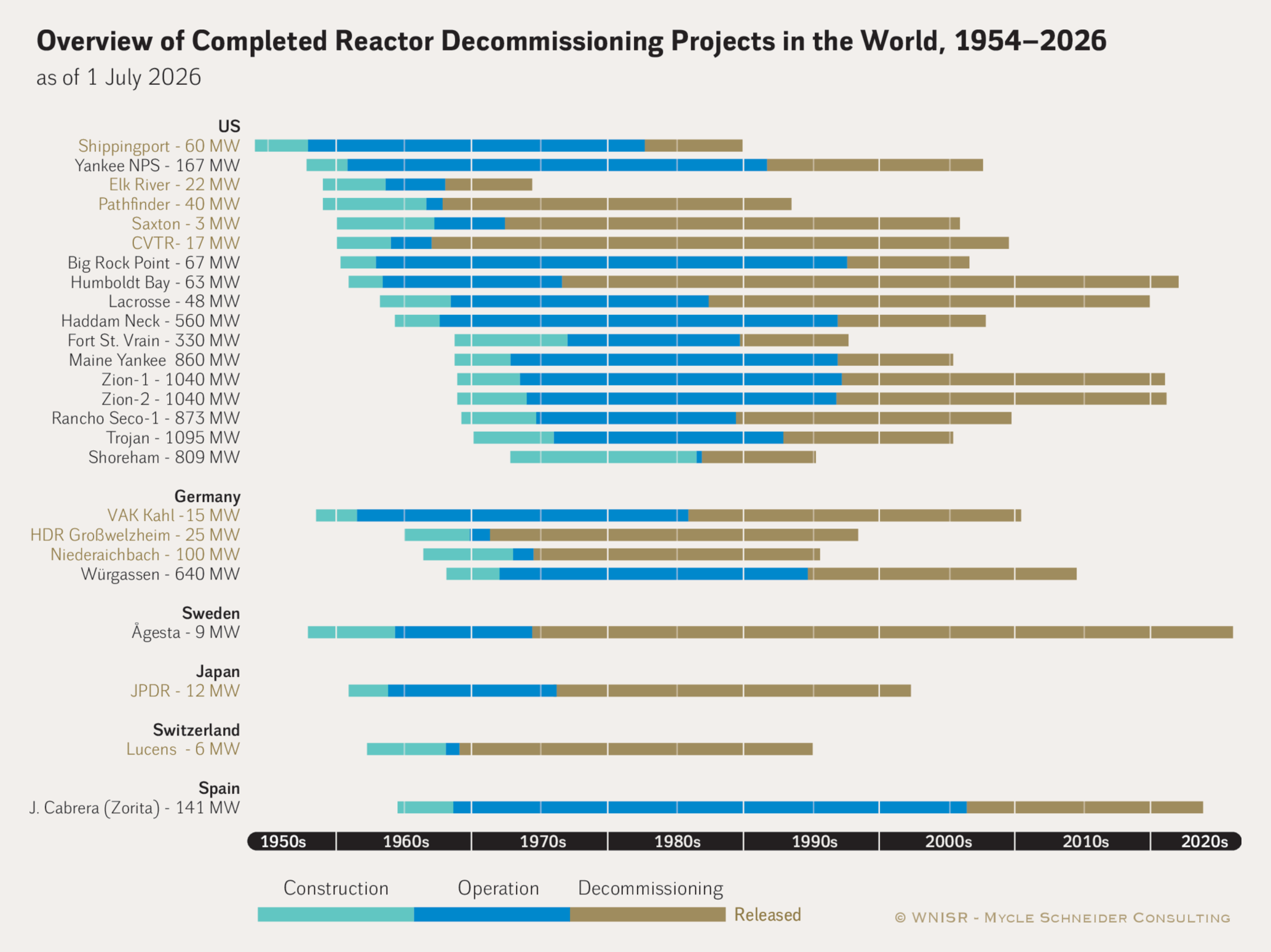
Sources: Various, compiled by WNISR, 2026
Note: Since WNISR2024, the “released” category only mentions “greenfield released” reactors, whereas it also contained “brownfield released” reactors in previous editions (see definitions in the introduction of the chapter). The LaCrosse and Shoreham reactors had in previous WNISR editions been classified as “greenfield released”. However, since the LaCrosse site still contains an interim spent-fuel storage facility, it is reclassified as a brownfield site, and the Shoreham reactor, though released from regulatory oversight, was never entirely dismantled and most of its buildings have remained intact. The Lucens reactor in Switzerland—considered a research reactor—initially was not taken into account in the WNISR Database. However, as it was once connected to the grid, WNSIR decided to reintroduce this experimental reactor in its database.
Overview of Ongoing Reactor Decommissioning
Armenia
Following a partnership agreement with the European Union that entered into force in 2021, the Armenian Metsamor (also referred to as Medzamor) nuclear power plant is to be completely closed as soon as possible because it “cannot be upgraded to fully meet internationally accepted safety standards.” 1344 Both units were closed in 1989 after an earthquake, but Unit 2 was restarted in November 1995 and still operates to this day, with ongoing lifetime extension activities aiming for it to run until 2036 (see section on Armenia).1345 Unit 1 seems to have remained in an LTE status since its closure. While the Armenian Government adopted a decommissioning strategy for the plant in November 2007, at the time aiming for a deferred dismantling strategy to conclude in 2048 based on the assumption that Unit 2 would cease operating in 2016,1346 and an EU-funded project “to support the Decommissioning Planning and Licensing for general decommissioning activities” ran from 2013 to 2018,1347 there still seems to be no clear implementation plan. Data published by the International Atomic Energy Agency (IAEA) shows the decommissioning strategy as “other” as of December 2024.1348 An updated country report published by the IAEA in 2025 indicates that “additional progress will mostly depend on the ANPP [Armenian Nuclear Power Plant] Decommissioning Plan.”1349 It remains unclear, when actual dismantling will begin. Since the decommissioning plan is yet to be formalized, Unit 1 might be dismantled only once Unit 2 has also been closed. Until further information arises, WNISR considers Unit 1 to be in LTE.
In Belgium, the prototype 10-MW BR-3 reactor in Mol, which was closed in 1987, is currently undergoing decommissioning. The reactor is in the ease-off stage, and since the dismantling of the biological shield in late 2024,1350 no further milestone completion has been reported. Despite dismantling being characterized as “almost complete”, there is no publicly communicated target date for project completion.1351
The year 2025 was noteworthy for the Belgian nuclear fleet as three reactors were closed: Doel‑1 and -2 in February and November, respectively, and Tihange-2 in September. This means that only two reactors remain operational in Belgium. The operating licenses for Doel-4 and Tihange-3 were extended to 2035 (see section on Belgium in Annex 1 for details).1352
In Belgium, closed reactors undergo so-called “post-operational” activities, mostly defueling activities, immediately after their closure. Meanwhile the operators apply for an official decommissioning license which must be granted by royal decree. This phase takes about five years to complete. Then, actual dismantling can begin, which the regulator—the Federal Agency for Nuclear Control (FANC)—estimates lasts “fifteen years or so.”1353
At Doel, three of four units are now closed. Doel-3 was closed in 2022, and the reactor is defueled. It remains in the warm-up stage until further decommissioning licenses are obtained.1354 Doel-1 was closed in February 2025, followed by its “Siamese twin” Doel-2 on 30 November 2025. Decommissioning at these reactors will happen in parallel given shared controls and components. Fuel will remain in cooling ponds for up to three years.1355 All three closed reactors at Doel are in the warm-up stage, and given FANC’s estimates, decommissioning is expected to be completed in the mid-2040s at the earliest.1356
The Tihange plant consists of three reactors, two of which are now closed. Tihange-2 was closed in January 2023 and Tihange-1 followed in September 2025. Spent fuel has been moved from the reactor core of Tihange-2 to the onsite cooling pool. The pool itself is expected to be emptied by mid-2027.1357 The Tihange site also houses a common pool that can store the spent fuel removed from the reactor pools.
The most recent closures of Belgian reactors sparked substantial political resistance from the federal government. Despite operator Engie agreeing to lifetime extensions at the two newest reactors, Doel-4 and Tihange-3, the De Wever government was hoping to restart at least Tihange-1 but was met with strong resistance from Engie who considers reopening the reactor “unthinkable”.1358 At Tihange-2, chemical cleaning of the primary circuit was carried out in 2024 that renders restart highly unlikely as the aggressive chemicals attack the steel.1359
At the end of 2025, Engie received the permit from the local Walloon authorities to demolish both closed reactors’ cooling towers, with planned implementation starting in September 2026.1360 However, in early February, the permit was temporarily frozen after “at least six parties, including WePlanet Belgium and its European umbrella group, the municipality of Huy (where the Tihange plant is located), the citizens’ group 100TWh, and two individuals,” filed an appeal, according to The Brussels Times.1361 As the timeline and outcome of these proceedings remain uncertain, WNISR assumes both reactors to be in the warm-up stage until further notice.1362 While the political situation has changed, as of 1 July 2026, no legal action has been reported that would call the permit’s validity into question. But in May 2026, François Desquesnes, Walloon Minister of Territorial Affairs, Infrastructure, Mobility, and Local Government, delivered a modified permit to demolish the cooling towers of both Tihange units that is suspensive to a final, enforceable decision by the federal government to definitely close or decommission the reactors.1363
This followed a surprise announcement by the federal government and Engie on 30 April 2026 that they had entered negotiations for a potential state takeover of the entire fleet of reactors, including all assets and liabilities like decommissioning and waste management. Negotiations are scheduled to conclude in October 2026; until then, all dismantling activities are supposedly halted.1364 See section on Belgium in Annex 1 for more details.
Decommissioning of all four closed reactors at the Bulgarian Kozloduy plant is partly funded by the Kozloduy International Decommissioning Support Fund managed by the European Bank for Reconstruction and Development (EBRD). The fund had raised more than €1.2 billion (US$20231.3 billion) by the end of 2023 and supports the plan to decommission all four units to a brownfield state by 2030.1365 In its program review, the European Commission states that “the timely achievement of the objectives for 2021-2027 are still at risk” and “that the schedule had less than 1 percent probability of success.” As of 1 July 2026, the project website indicates that the current completion target will likely be extended by two years to the end of 2032.1366
Dismantling continues regardless, with reactor components of Unit 2, such as the lid, having already been dismantled in 2024. According to the most recent planning document drawing on information from early 2025, the dismantling of reactor internals of Units 1, 3, and 4 was supposed to begin in 2025.1367 However, an “invitation for pre-qualification” was announced by EBRD on 18 June 2026 for services related to the “dismantling and fragmentation, characterization and packaging of reactor internals, reactor pressure vessels and annular tanks” for Units 1–4.1368 This indicates that internals dismantling is yet to begin at Units 1, 3, and 4. Since hot-zone tasks have begun at Unit 2, it is classified as being in the hot-zone; the other three reactors remain in the warm-up stage until further information becomes available.
The European Commission conducted a monitoring mission in March 2026, but as of mid-2026, no report had been published.1369 In April 2026, a waste storage facility for low and intermediate level waste was commissioned near the Kozloduy site, removing a critical bottleneck for decommissioning waste disposal. It is planned to operate for 60 years.1370
Canada
As of mid-2026, the Canadian closed reactor fleet consisted of seven CANDU (Canada Deuterium Uranium) and one Heavy-Water Moderated Boiling Light-Water Reactor (HW BLWR), corresponding to a net electrical capacity of 3.17 GW. So far, no commercial reactor has been fully decommissioned.
The 250-MW Gentilly-1 prototype HW BLWR was closed in 1977 after only 183 full‑power equivalent days of operation. It was subsequently defueled in 1984 and placed into LTE in 1986, where it has remained since. The current license will terminate on 31 December 2034.1371 In 2024, operator Canadian Nuclear Laboratories (CNL) applied for a license amendment to begin dismantling the reactor. A public hearing was scheduled for July 2026, after which a final decision was expected that same summer. According to the current plan, a brownfield end-state might be achieved by 2035.1372
The prototype CANDU reactor at Douglas Point was closed in 1984 and has been undergoing active dismantling since 2021.1373 In May 2026, operator CNL announced the completion of non-nuclear building demolition, including the turbine building. The next step in the project is acquiring necessary permits to continue with hot-zone tasks that are scheduled to begin after 2030.1374 Project completion remains targeted for 2070.1375 The Rolphton Nuclear Power Demonstration (NPD) CANDU prototype’s LTE state remains unchanged. The reactor has been in LTE since the early 1990s and is planned to be placed into a permanent “in-situ” state with regulatory oversight for at least 100 years. The project is advancing slowly with the last update published in July 2025.1376 See the section on Canada of the Decommissioning Status Report in WNISR2024 for details.
The other six closed reactors are former commercially operated CANDU reactors. Gentilly-2 was closed in 2012 and defueled in 2013. It was subsequently placed into LTE with dismantling planned to begin in 2057. The site is expected to be remediated by 2064, while an environmental follow-up is scheduled to conclude by 2074.1377 In June 2026, operator Hydro-Québec announced that the site’s decommissioning license had been renewed for the next twenty years, i.e., until 2046. Individual non-contaminated buildings that are “no longer required for decommissioning” are planned to be dismantled within this licensing period.1378
Units 2 and 3 at Pickering-A, closed in 1997 and already defueled, are in LTE. Units 1 and 4 were closed in September and December 2024, respectively,1379 and have been in a so-called “Stabilization Phase” since then, which WNISR classifies as warm-up stage. This phase is scheduled for completion in late 2027. The reactors will be transferred to LTE from 2028 onwards. All four units at Pickering-A will begin active dismantling after 2090. In the meantime, auxiliary buildings will be demolished beginning in 2034, pending “subsequent detailed decommissioning plan […] updates.” 1380
France
The closed reactor fleet in France is diverse compared to the largely standardized operational Pressurized Water Reactors (PWRs). In total, 14 reactors (8 GCRs, 3 PWRs, 1 HWGCR, and 2 FBRs), corresponding to approximately 5.5 GW, have been closed.1381 Decommissioning progress in France is slow (see previous WNISR editions).
WNISR considers all Gas-Cooled Reactors (GCRs) to be in LTE. This includes the six UNGG (Uranium Naturel Graphite Gaz) reactors, Bugey-1, Chinon A-1, A-2, A-3, and St. Laurent A-1 & A-2, as well as the reactors G-2 and G-3 at Marcoule.1382
For its six UNGG-GCR reactors, Électricité de France (EDF) initially adopted an immediate dismantling strategy in 2001, which involved flooding the reactor vessel with water, followed by plans to perform decommissioning procedures underwater.1383 Following a regulatory amendment, this strategy was changed to in-air dismantling in 2016, prompting the need for new decommissioning licenses for each reactor. The license applications were submitted in December 2022, updated in February 2024, and are expected to be reviewed by the Permanent Expert Group of the regulator ASNR (Autorité de sûreté nucléaire et de radioprotection) in 2026.1384 Based on the revised plans, the first dismantling work of reactor internals and graphite blocks will begin at Chinon A-2 in 2044 after the first opening of the reactor casing in 2034. All other UNGG reactors will remain in LTE until at least 2056. Completion of decommissioning is planned “between 2063 and 2093, depending on the reactors.”1385
In August 2025, regulator ASNR conducted a three-day inspection of EDF’s strategy implementation at Chinon A-2, where a remotely operated mechanical arm was manufactured in 2025 but is still subject to testing.1386 Overall, ASNR assumes EDF to be capable of dismantling Chinon A-2 and deploying lessons-learned to the other UNGG reactors. However, ASNR notes that, given the long timeline of the projects, EDF should improve its procedures, especially on knowledge management, decision traceability, and risk management documentation, amongst other aspects.1387 Preparatory dismantling activities around the reactor caissons continued in 2025. For example, at Bugey-1, 27 percent of necessary decontamination tasks before the planned transfer into “safe storage configuration” have been completed; at Chinon A-3, the heat exchangers were fully dismantled after 12 years of work; and at St. Laurent A-2, activities to dismantle the former fuel storage pool buildings are ongoing.1388
The EL-4 reactor at Brennilis (Monts d’Arrée) was closed in 1985 and has been in the hot-zone stage since November 2024. In December 2025, the reactor building was cut open to allow access to reactor internals for dismantling to continue. Site remediation to a brownfield state is expected for 2041.1389 In 2025, decommissioning cost estimates were increased by €90 million (US$2025102 million) to a total of €1.3 billion (US$20251.5 billion).1390 This latest estimate must be compared with provisions of a maximum of €30 million (US$199932 million) until 1999 and a revised 2002 cost estimate of €482 million (US$2002456 million), which, respectively, amount to €46.2 million (US$52 million) or over €704 million (~US$800 million) in 2025 terms.1391
The 305-MW PWR reactor at Chooz-A was closed in 1991 and has been undergoing decommissioning work since 2007. The reactor pressure vessel was successfully removed from its casing in March 2025. However, after a total of six inspections, one of which focused on radiation protection measures for workers and yielded unsatisfactory results,1392 regulator ASNR decided to place the site under “enhanced supervision”.1393 According to media reports, EDF was ordered to conduct a two-week awareness campaign for local workers on radioprotection measures.1394
The two PWRs at Fessenheim were closed in 2020. Both reactors were completely defueled by June 2023 and remain in the warm-up stage as component dismantling and building conversion work continues, e.g., with transforming the former turbine hall into a waste handling building.1395 As of January 2026, according to a news report, dismantling of the steam generators was to begin in May 2026.1396 However, the necessary regulatory approvals were published only on 3 May.1397 EDF nevertheless plans to begin dismantling the three steam generators, as well as to remove the fuel element holding cells from the spent-fuel pond of Unit 1 this year, with Unit 2 following suit. EDF plans to complete the decommissioning in 2048.1398
The Fast Breeder Reactor (FBR) Superphénix at Creys-Malville, closed in 1996, has been undergoing decommissioning since 2006. Currently, reactor vessel internals are being dismantled, with the neutron shield support (the first part of the vessel internals) having been removed in 2024 and dismantling continuing in the reactor pit.1399 All three sodium storage tanks were successfully dismantled in March 2026 as work continues.1400 In its most recent annual report, EDF did not publish a target date for project completion. Earlier editions aimed for 2034 (see previous WNISR editions), and ASNR’s 2025 annual report says it will be completed “in about 20 years”.1401
In 2026, decommissioning at the FBR Phénix at Marcoule is continuing with defueling activities and preparations for sodium transfer to the to-be-finalized storage facility at the NOAH1402 sodium treatment plant,1403 scheduled to become operational in 2028. Decommissioning is envisaged to end in “more than 50 years” from now.1404
Since 2020, there have been no publicly announced updates regarding dismantling progress at the remaining GCR plants, G-2 and G-3, formerly operated by the Commissariat à l’Énergie Atomique et aux Énergies Alternatives (CEA)—French Alternative Energies and Atomic Energy Commission—at Marcoule.1405 Thus, WNISR considers these reactors to be in LTE. The dismantling of these reactors is not prioritized by CEA, which is also actively involved in other dismantling projects, such as the UP1 plutonium extraction plant. In 2025, ASNR announced “widespread delays and slippages on the most fundamental commitments” and noted that it expects “very significant increase in decommissioning times” for all of CEA’s dismantling projects, in particular due to a lack of resources.1406
 Germany
 closed its last power reactors in April 2023. Despite advancing decommissioning activities and most reactors having completed their full system decontamination (refer to WNISR2025 for details), individual conservative politicians and the far-right party Alternative für Deutschland (AfD) continue to advocate and submit motions for restarting selected German reactors.1407 All former operators have, however, stated their opposition to restarts and their determination to continue dismantling the German fleet—and German Chancellor Friedrich Merz stated in March 2026: “The decision is irreversible. I regret that, but that’s the way it is.” 1408
Against these politicized debates, dismantling activities are advancing. The German fleet consists of 36 reactors with a total capacity of 26.4 GW.1409 So far, Germany has fully dismantled four reactors, and active decommissioning is underway at 31. As of mid-2026, the 31 reactors were in the following stages of decommissioning:
- Eight reactors in the warm-up stage: Biblis-A (defueled), Brokdorf (defueled), Grohnde, Gundremmingen-B (defueled) and -C, Emsland, Isar-2, and Neckarwestheim-2.
- Nine reactors in the hot-zone stage: AVR Jülich, Biblis-B, Brunsbüttel, Krümmel, Lingen, Mülheim-Kärlich, Neckarwestheim-1, and Philippsburg-1 and -2.
- Fourteen reactors in the ease-off stage: Grafenrheinfeld, Greifswald-1 to 5, Gundremmingen-A, Isar-1, Kompakte Natriumgekühlte Kernreaktoranlage II (KNK II), Mehrzweckforschungsreaktor (MZFR), Obrigheim, Rheinsberg, Stade, and Unterweser.
The prototype pebble-bed high-temperature reactor THTR-300 in Hamm-Uentrop is the only reactor remaining in LTE and was to begin active dismantling in 2030. In October 2025, however, its operator, a subsidiary of utility RWE that is co-owned by several municipal utilities (“Stadtwerke”), filed for insolvency due to its inability to cope with the upcoming decommissioning costs. With these funding uncertainties, the state might have to take over liabilities.1410
The high-temperature reactor AVR in Jülich was closed in 1988. After initial decommissioning activities aiming for deferred dismantling, active decommissioning began in 2003 aiming for a greenfield state. The most recent work has been focused on the removal of structural components in the reactor building that had been scheduled for completion by mid-2024. As of 1 July 2026, however, there had been no publicly available updates.1411 The reactor is thus considered to be in the hot-zone stage.
Work is continuing at Biblis, where both reactors remain in their respective classifications. The last of the four cooling towers was successfully demolished in January 2026.1412 Per the latest available information, reactor internals dismantling is underway at Biblis-B, thus it is considered in the hot-zone stage, while preparatory work is ongoing at Biblis-A, placing this reactor into the warm-up stage. The whole project is expected to be finalized in the mid-2030s.1413
The 1.4 GW PWR at Brokdorf was defueled in February 2026.1414 In June 2026, the last four containers with German reprocessing waste were placed into the site’s interim storage facility after their return from Sellafield, UK.1415 According to media reports, the continuation of dismantling activities depends on the availability of a newly built storage site for low and intermediate level wastes that shall be operated until the Konrad repository becomes available. Operator PreussenElektra says that the site must be operational by April 2027 to avoid delays in decommissioning, but necessary permits are still lacking. The company is accusing the regulator of delaying the procedure. The regulator was reportedly assuring the permit would be issued in time, “as long as the operator cooperates well”. Apparently, the submitted documents had been of insufficient quality.1416 As of 1 July 2026, there had been no officially announced updates regarding the permit.1417 PreussenElektra hopes to have all buildings dismantled by the year 2039.1418
At the 771-MW Boiling Water Reactor (BWR) Brunsbüttel, closed in 2011, dismantling of the reactor pressure vessel is scheduled to begin in 2026 after necessary licenses were obtained in December 2025.1419
The 1.3-GW PWR at Grafenrheinfeld has moved to the ease-off stage as steam generators have been removed from the reactor building. They remain onsite until their shipment to Sweden in spring 2027, where EDF’s subsidiary Cyclife plans to fully dismantle and process them in a melting facility.1420 Resulting radioactive wastes will be sent back to Germany.1421
The reactor in Grohnde was closed in 2021 and defueled in April 2026.1422 It remains in the warm-up stage until the dismantling of reactor internals begins. After receiving the final regulatory approval in May 2026, operator PreussenElektra is confident that internals dismantling will begin in early 2027. This process is expected to be completed by 2028.1423
The Gundremmingen plant consists of three reactors. Gundremmingen-A was closed in 1977 following two accidents, one in 1975 and one in 1977.1424 It is being dismantled since 1983 and is in the ease-off stage. The current target is to complete decommissioning by the early 2040s.1425 Gundremmingen-B and -C were closed in 2017 and 2021, respectively. While Unit B was defueled in September 2022, Unit C is expected to achieve this milestone by the end of 2026.1426 In October 2025, both cooling towers were demolished.1427 Decommissioning is scheduled for completion in the 2030s.1428 At the site, operator RWE has broken ground for the deployment of a battery facility with a total electrical storage capacity of 700 MWh, which would be Germany’s largest power storage project to date.1429
At the Isar power plant, also referred to as Ohu and consisting of two reactors, dismantling activities are continuing with the closure of the 878-MW BWR (Isar-1) in 2011 and that of the 1.4-GW PWR (Isar-2) in 2023. While ongoing building decontamination activities at Unit 1 place it in the ease-off stage,1430 Unit 2 is yet to be defueled. Initial dismantling activities are ongoing. The dismantling of steam generators was scheduled to begin in 2026, followed by the dismantling of the reactor pressure vessel from 2028 onwards. This is contingent on the successful removal of remaining fuel elements, which is planned to happen between August 2027 and August 2028.1431
At the FBR prototype KNK II (Kompakte Natriumgekühlte Kernreaktoranlage II), dismantling of the biological shield was completed in 2025. With the completion of reactor internals dismantling, the reactor has moved to the ease-off stage.1432 The project is planned to be completed by 2035.1433
The Krümmel reactor was closed in 2009 but received its decommissioning permit only in 2024. While conducting preparatory work was permitted beforehand, actual dismantling only began after the license was obtained. Since then, reactor internals dismantling has been underway.1434 The reactor therefore moved into the hot-zone stage.
There are two reactors at the site in Lingen. The first reactor is a 183-MW BWR that was closed in 1977 and subsequently placed into LTE. Active dismantling began in 2015, and current work is focused on dismantling reactor internals, placing the reactor in the hot-zone stage.1435 Decommissioning shall be finalized by the mid-2030s.1436 The second reactor, a 1.3-GW PWR also known as Emsland, was one of the last three German reactors, and it was closed in April 2023. Full system decontamination was completed in 2024, and the reactor is scheduled to be completely defueled by the end of 2027. In the meantime, systems surrounding the reactor internals are being dismantled before hot-zone tasks can begin.1437
The reactor at Mülheim-Kärlich was closed after just over two years of operation in 1988. Active decommissioning has been ongoing since 2004, and current activities are related to reactor internals dismantling. Most recent estimates place the project completion into the mid-2030s.1438
At the MZFR (Mehrzweckforschungsreaktor) prototype in Karlsruhe, hot-zone tasks have been completed for several years.1439 Currently, the operator is reevaluating the final decontamination strategy which is subject to regulatory approval. The necessary documents were expected to have been filed in early 2026 but there has been no update as of mid-2026. The regulator expects that all remaining formerly contaminated buildings will be demolished by 2030.1440
At the Neckarwestheim site, two reactors are being decommissioned. Unit 1, a 785-MW PWR, was closed in 2011. Most recently reported activities included the final dismantling of the biological shield in 2024.1441 WNISR considers Unit 1 in the hot-zone until further information becomes available. Unit 2 was closed in April 2023. Warm-up stage activities seem to be ongoing, including full system decontamination and the dismantling of cooling components. The reactor is yet to be defueled.1442
Final building decontamination is ongoing at Obrigheim, where decommissioning is scheduled to conclude in the early 2030s. The reactor was closed in 2005.1443
The Philippsburg plant houses two closed reactors. At Unit 1, the reactor pressure vessel was fully dismantled in late 2024. Hot-zone tasks continue.1444 Unit 2 was closed in 2019. It was defueled in 2023, and reactor internals are currently being dismantled. Decommissioning at both units is targeted to be finalized in the mid-2030s.1445
The reactor in Stade was closed in 2003. The project is in the ease-off stage. With the demolition of the reactor building starting in April 2026, the decommissioning project is nearing completion according to operator PreussenElektra. In the most recent announcement, the operator states its target to complete all activities and have the site released from regulatory oversight by the autumn of 2027.1446
At Unterweser, which was closed in 2011, hot-zone tasks were completed at the end of 2024 with the final dismantling of the biological shield. The steam generators were extracted from the reactor building and sent to Sweden for dismantling and melting (see Grafenrheinfeld above).1447 The reactor is scheduled for regulatory release in the mid-2030s.1448
At Würgassen, dismantling of contaminated buildings was completed in 2014 and subsequent activities centered on conventional demolition. In 2017, most of the site was released from regulatory oversight. However, several buildings remain licensed under nuclear law because they serve as interim storage sites for low and intermediate level wastes. Since 2020, these storage sites are operated by BGZ (Gesellschaft für Zwischenlagerung mbH), the federal company for interim storage.1449 Currently, preparations are underway to transfer the remaining waste to the—still to be finalized—Konrad repository, which is expected to happen before the end of 2030.1450 After this transfer, the whole site is planned to be released from regulatory oversight and remaining buildings demolished by the mid-2030s.1451
The former East German power plants in Greifswald and Rheinsberg are being decommissioned by the state-owned company EWN (Entsorgungswerke für Nuklearanlagen GmbH). The activities are completely funded by German taxpayers. All six reactors are in the ease-off stage and were taken off the grid in 1990 (or not restarted) after the German unification. The completion of the dismantling of the five 408-MW Soviet-designed VVERs at the Greifswald plant is estimated for the mid-2040s, and latest costs estimates are reported to amount to €10 billion (US$202511.3 billion).1452 The 62-MW reactor in Rheinsberg is facing delays due to regulatory issues (alongside technical challenges). Current estimates reportedly aim for full site remediation by the mid-2040s for a total cost of €1.5 billion (US$20251.7 billion).1453
India
Rajasthan-1 in India—in LTO (Long-Term Outage) status since 2004 and considered as closed by WNISR since 2014—has not moved beyond complete defueling and is reportedly “maintained under dry preservation.”1454 WNISR considers this PHWR to be in the warm-up phase.
 Italy
Since 1988, Italian nuclear power plants have not produced any electricity, and the last two reactors were officially closed in 1990. Since then, decommissioning has been underway at all four facilities. The work is being conducted by Italian company Società Gestione Impianti Nucleari SpA (Sogin).
The smallest reactor, Garigliano, a 150-MW BWR, was officially closed in 1982 and is considered in the hot-zone stage.1455 According to the 2024 Italian Report to the Joint Convention on the Safety of Spent Fuel Management and on the Safety of Radioactive Waste Management, brownfield status is to be achieved in 2028 and greenfield in 2042;1456 however, the Italian project website claims a target year of 2031 for the completion of reactor internals dismantling only.1457
At the Enrico Fermi (Trino) plant, decommissioning work has been ongoing since 1999. Tenders for dismantling nuclear island components are being prepared.1458 Official reports note that most of the work at Trino in 2024 consisted of preliminary activities to the actual dismantling, such as the design, commissioning, and licensing preparations for the project, and that, “no dismantling operations with significant impacts were carried out,”1459 which stands in contrast to a February 2024 news report that claimed that reactor internals dismantling had begun.1460 As of mid-2026, Sogin’s official website does not document that;1461 but the nearing completion of a new interim storage facility for low and intermediate level waste, e.g., from dismantling activities,1462 might lead to an acceleration of decommissioning at the site in coming years. The storage facility is planned to be commissioned in 2027, and a second one will be upgraded to modern safety standards subsequently.1463 Until more information becomes available, WNISR classifies Trino as in the warm-up stage. According to an article published by La Voce, activities have been minimal for several years since contracts seem to have still not been awarded to any potential dismantling company.1464
At Italy’s largest reactor, the 860-MW BWR Caorso, Sogin reported in November 2024 that it had begun dismantling external components of the reactor building1465 which the regional government said was ongoing as of April 2026.1466 There are no indications on Sogin’s project website that hot-zone tasks have begun as claimed.1467 However, here too, interim storage facilities are being refurbished.1468 Current refurbishments are planned to finish in 2028.1469 This unavailability might lead to further delays in decommissioning the reactor.
The Latina GCR is awaiting the operation of Italy’s planned waste repository for reactor dismantling to begin, currently envisioned for 2039.1470 Until then, auxiliary buildings are being demolished during the so-called “Phase 1” of decommissioning. This includes the planned removal of steam generators by 2027.1471 In April 2026, Sogin and Japan Atomic Power Company (JAPC) signed a non-binding Memorandum of Understanding to “launch a joint study on the methods for decommissioning graphite-moderated nuclear reactors.”1472 JAPC has been decommissioning the Tokai-1 reactor since its closure in 1999 (see below). In January, Sogin had signed an agreement with Italian company GraphiCore, which supposedly specializes in handling irradiated graphite, to develop and test equipment “for the extraction and handling of irradiated graphite from reactors.” 1473
The year 2026 marks the 15th anniversary of the beginning of the Fukushima catastrophe (see Fukushima Status Report), which resulted in the disconnection of all Japanese reactors from the grid by 2014. Of these reactors, 15 have been restarted (see Japan Focus) and 21 remain permanently closed. This brings the total number of closed reactors in the country to 27, corresponding to 17.1 GW, as of mid-2026.1474 Of these, the only completed decommissioning project is the small 12-MW research reactor, Japan Power Demonstration Reactor (JPDR), which was released as a greenfield site in October 2002.1475
The country, one of the early adopters of nuclear power, has not completed the decommissioning of a single commercial reactor. At the Fukushima Daiichi plant, comprising six reactors, of which four were heavily damaged during the events of March 2011, clean-up is advancing slowly. There is remaining uncertainty regarding the internal state of Unit 3. At Unit 2, two small samples (less than 1 gram combined) of fuel debris were removed for the first time in November 2024 and again in April 2025 (see Fukushima Status Report: Removing Highly Radioactive Nuclear Fuel Debris in WNISR2025).1476 Continued probing is planned for 2026.1477 Spent fuel removal from the pool of Unit 2 began in June 2026. The spent fuel pool at Unit 4 has been entirely emptied.1478
Units 5 and 6 were both shut down in January 2014 and are yet to begin active dismantling. As of June 2026, the website of the operator Tokyo Electric Power Company (TEPCO) notes that the reactors’ “possible use for verification testing in research and development or other projects will be studied.”1479 Meanwhile, the removal of spent fuel from the pool at Unit 5 began in July 2025. As of March 2026, however, fuel removal seems to have been “suspended due to limitations in dry storage capacity.” 1480
TEPCO completed spent fuel removal from the pool at Unit 6 in 2025,1481 and only 398 fresh fuel assemblies were left there as of early June 2026.1482 TEPCO hopes to complete fuel removal from all spent fuel pools by 2031 and fully complete decommissioning activities at the site by 2051.1483 Refer to the Fukushima Status Report for details.
At the other plant in the Fukushima Prefecture, Fukushima Daini, preparations to defuel all four BWRs are underway, with spent-fuel removal scheduled to begin in 2027.1484 Decommissioning is scheduled to conclude in FY2064.1485
In January 2025, Kyushu Electric Power Co., operator of the two-unit Genkai plant, submitted an amended decommissioning plan to the authorities. According to this new plan, warm-up stage activities would continue until 2041 when reactor internals dismantling activities would begin. These would conclude in FY2047, and the whole site would be fully decommissioned by FY2054.1486 Approval was granted in January 2026.1487 Both reactors are yet to be defueled. In April 2026, Kyushu Electric Power announced that they would begin Phase 2 of the decommissioning project. This involves the dismantling and removal of equipment in auxiliary buildings. This stage is expected to last until 2040 after which the reactor internals are scheduled to be dismantled within a period of seven years.1488
Hamaoka-1 is Japan’s second commercial BWR to enter the hot-zone stage after Hamaoka-2 did so in March 2025.1489 The reactor pressure vessel lid was removed in October 2025.1490 Decommissioning shall conclude by 2042.1491
In earlier versions of the Decommissioning Status Report, the GCR Tokai-1, closed in 1998, had been erroneously listed as still housing spent fuel. In fact, the reactor itself was defueled in March 2001, and all fuel was removed from the site in June that year and sent to the UK for reprocessing.1492 When decommissioning will be completed is subject to conflicting information, with operator Japan Atomic Power Company (JAPC) targeting FY2035 according to their website1493 and the Japan Atomic Industry Forum (JAIF) listing FY2030 as projected completion year.1494 Thus, WNISR will continue to closely monitor developments at the site.
At all other closed reactors, no significant progress has been reported since the Decommissioning Status Report: Japan in WNISR2024. According to JAIF, as of April 2026, decommissioning completion dates for all Japanese reactors range from FY2030 (Tokai-1) to FY2064 (Fukushima Daini 1–4), with most planned in the late 2040s and early 2050s.1495
Kazakhstan
Decommissioning has been underway at Aktau BN-350, a sodium-cooled fast reactor, since 1998. The reactor is currently being transferred into LTE status, where it will remain for 50 years, after which dismantling shall begin.1496 As discussed in WNISR2025, the project might be facing financial constraints that could interfere with the current schedule.1497 Since then, there seem to have been no meaningful technical developments. An overview article on the site and ongoing or planned dismantling activities at the site published by the Kazakh state-owned research agency, the Institute of Atomic Energy of the National Nuclear Center, also outlines challenges such as sodium removal from the reactor.1498 Furthermore, according to a news report, the site is accumulating liquid radioactive wastes for which an alternative storage site is yet to be identified. Apparently, Kazakhstan is seeking financial support of up to KZT21 billion (US$44 million) from the European Bank for Reconstruction and Development (EBRD).1499
 Lithuania
In Lithuania, the two Soviet-designed Chornobyl-type RBMK units at Ignalina, with 1185 MW capacity each, were closed in 2004 and 2009, respectively. Both reactors and their spent-fuel pools have been emptied. Dismantling activities continued in 2025, with 45.7 percent of the total planned structures having been dismantled, but reactor internals dismantling is still pending. Currently, the completion of hot-zone tasks for both units is scheduled for 2043. All decommissioning activities shall end by 2050.1500 The project is being supported by funds from the European Union. In the 2021–2027 budget, €552 million (~US$2021650 million) had been allocated,1501 and another €678 million (~US$788 million) is proposed within the 2028–2034 budget.1502 The total estimated cost for decommissioning, as per the most recent assessment report published in 2024, is €3.345 billion (US$20243.6 billion), of which 60.5 percent will be covered by EU funds.1503 On the European Commission’s website, as of April 2026, this figure is capped at 86 percent. All dismantling activities monitored by the Commission are listed as being “on track.”1504 Contrary to the figures mentioned above, the Lithuanian regulator VATESI expects decommissioning at Ignalina to be completed by 2038.1505 Earlier reports have described a brownfield site target for that year.1506 WNISR will thus continue to closely monitor the developments at Ignalina. (See WNISR2019 for details on decommissioning in Lithuania.)
In the Netherlands, the 55-MW reactor Dodewaard was defueled in 2003 and placed into LTE in 2005 to begin actual dismantling activities from around 2045 onwards, with the objective to return the site to greenfield status by about 2055.1507 With the former operator Gemeenschappelijke Kernenergiecentrale Nederland (GKN), owned by Nederlands Elektriciteit Administratiekantoor (NEA), having mismanaged dedicated decommissioning funds (see earlier WNISR editions), the ownership of the plant was transferred to the Dutch state-owned radioactive waste management company COVRA for the symbolic fee of €1 in December 2024.1508 Since then, no further activities have been reported. However, the local municipality of Neder-Betuwe and the Dutch province of Gelderland launched a feasibility study on the construction of SMRs on the site in April 2026.1509 Refer to SMR Related Activities in section on the Netherlands in Annex 1 for details.
Pakistan
Pakistan closed its first reactor Karachi Nuclear Power Plant-1 (KANUPP-1) in 2021, with a decommissioning license granted in 2022, marking the beginning of preparatory work to place the reactor into LTE for 20 to 30 years, after which dismantling to a brownfield status is planned.1510 According to a paper published in the proceedings of a conference on nuclear decommissioning organized by the IAEA in 2023, the reactor was defueled within the first year of closure.1511 Consequently, the reactor is from now on considered as defueled by WNISR. With LTE preparations ongoing—expected to last about 15 years—and no other published changes or updates since last year’s edition, WNISR considers the reactor to remain in the warm-up stage, to be later transferred to an LTE status.
Russia
As of mid-2026, Russia accounts for 14 closed reactors with a combined capacity of 4.9 GW, consisting of two different reactor types: eleven first-generation Light-Water Gas-cooled Reactors (LWGRs)—among them four RBMK Chornobyl-type reactors and the four unique EGP6 reactors at Bilibino—as well as three Soviet-designed Pressurized Water Reactors (PWRs).1512
While Unit 1 of Bilibino had already been closed in 2018, the remaining three reactors, with an electrical capacity of 11 MW each, were closed in December 2025.1513 Spent fuel will be removed from the reactor cores of Units 2, 3, and 4 over the course of the next two and a half years, after which the reactors are to be placed in LTE. Fuel removal from the storage ponds is scheduled to occur within two decades, contingent on the availability of the Baimsky Mining and Processing Plant in Murmansk. Reactor dismantling is set to happen around 2047, and site remediation is planned for 2054–2055.1514 Unit 1 is already considered in LTE by WNISR, and the remaining units will be listed as being in the warm-up stage until LTE status is achieved.
Kursk-1 and -2 and Leningrad-1 and -2 are the four closed RBMK reactors that pose substantial challenges for decommissioning because of the large volume of irradiated graphite stacks. While robotic dismantling techniques were being tested before Russia invaded Ukraine, the research progress remains uncertain.1515 The two closed reactors at the Leningrad plant shall be developed into pilot sites for RBMK dismantling.1516 After both reactors were defueled in December 2024,1517 the decommissioning license for Leningrad-1 was approved in December 2025.1518 With the strategy of “immediate dismantling” applied, the reactor is scheduled to conclude decommissioning activities by 2055. Kursk-2 was the last of these four RBMKs to close and is currently undergoing defueling activities. The status of licensing at both closed Kursk reactors and Leningrad-2 remains uncertain. WNISR considers all four reactors to be in the warm-up stage.
At the Novovoronezh plant, the initial deferred dismantling strategy was changed to an immediate dismantling approach in 2017 for Units 1 and 2 as a pilot project for Soviet/Russian PWR dismantling.1519 In 2024, the project apparently moved on to active dismantling and decontamination of material and components; WNISR thus considers the units to be in the warm-up stage.1520
Considering the lengthy estimated decommissioning duration of 50 years,1521 WNISR considers all other Russian reactors to be in LTE as long as there is no documented evidence of decommissioning progress.
Slovakia’s decommissioning efforts are advancing, with both 408-MW VVER-230 reactors, Bohunice-1 and -2, also known as Bohunice V1, in the ease-off stage. In the summer of 2025, the European Bank for Reconstruction and Development (EBRD), which had supported the project with funds totaling €658 million (US$2023711 million) as of 2023,1522 announced that the project had been completed on time.1523 However, the websites of both the operator Jadrová a vyraďovacia spoločnosť (JAVYS) and of the European Commission, which also oversees and funds the project, have not mentioned the cessation of decommissioning activities as of mid‑2026.1524 Further, contractor Westinghouse still lists the project as “ongoing”.1525 A press release by JAVYS from August 2025 clarifies the actual status at the V1 reactor: steam generators were removed, and hot-zone tasks have been completed. But building decontamination and other ease-off-stage activities will continue until (at least) 2029.1526 The European Commission’s website further notes that as of end-2025, only 26 percent of metals from reactor buildings and components had been dismantled, and that this “deserved attention.” 1527
Bohunice A1, a 93-MW heavy water GCR-type reactor, began decommissioning in 1999. All fuel has been removed from the site since 2009.1528 As for the latest state of information, the reactor is in the fourth of five decommissioning phases, and this phase was planned to conclude in 2024.1529 Decommissioning was to continue with the dismantling of reactor internals in the fifth phase. As of mid-2026, there have been no official updates on the completion of the fourth phase,1530 and the licensing process for the fifth stage is yet to be completed. The whole project is expected to be completed by 2033.1531
South Korea
As of mid-2026, two commercial reactors were closed in South Korea. The first reactor, the country’s oldest unit, Kori-1, a 576-MW PWR, was closed in 2017. At the time, defueling was envisioned for end-2025 and the completion of plant decommissioning by 2032.1532 With the decommissioning license granted in mid-2025,1533 operator Korea Hydro & Nuclear Power (KHNP) signed a contract for the dismantling of external, non-contaminated buildings and components with Doosan Enerbility in November 2025. These activities are planned to go on until 2028.1534 The new completion target date seems to have been set to 2037.1535
Wolsong-1, a 661-MW Pressurized Heavy-Water Reactor (PHWR), ceased generating power in May 2017 and was officially closed in December 2019.1536 KHNP is awaiting final approval of the decommissioning license by the end of 2026 at the earliest.1537 Until then, preparatory work is underway, with the latest reported schedule aiming for site remediation in 2034.1538 Originally, work was scheduled to begin in 2026.1539 As of April 2026, KHNP’s parent company Korea Electric Power Corporation still says Wolsong-1 “is being prepared for decommissioning.” 1540
Spain
According to current Spanish legislation, all seven units that are still operating would close by 2035. In February 2025, a non-binding proposal to extend reactor lifetimes passed the Spanish Congress,1541 and the Iberian blackout in late April 2025 has rekindled the debate on the Spanish phaseout (see section on Spain in Annex 1).1542 Regardless, decommissioning at the three closed reactors is continuing.
Since WNISR2024, the José Cabrera (Zorita) reactor, which was closed in 2006, is considered fully decommissioned. Final remediation work is underway with the site reportedly planned to be released as a greenfield site by “the end of 2027 or early 2028.”1543
The GCR Vandellós-1 is scheduled to remain in LTE until 2030, after which reactor internals dismantling is planned to begin. An interim storage facility shall be built to house nuclear wastes, in particular from spent fuel reprocessing at the, now closed, Marcoule plant in France, scheduled for return to Spain before 2030.1544 Contractually, Spain committed itself to take back all of the reprocessing wastes by 2017 but failed to build and commission a storage facility on time.1545 In May 2026, the regulator granted approval for onsite works and ensuing construction of the interim storage facility to proceed.1546 The targeted completion year of 2027 seems unlikely.1547
In July 2024, authorities indicated that the last phase of dismantling of Vandellós-1 would take about 15 years, and the site would be released from regulatory oversight after a maximum of ten years following the end of dismantling activities, meaning around 2055 at the latest.1548
The 446-MW BWR Santa Maria de Garoña (Garoña-1) last produced electricity in 2012, suspended operations in 2013, and was officially closed in 2017. According to a news report from November 2024, the first decommissioning phase, including defueling and first component dismantling, was delayed by two years.1549 Defueling is now scheduled to be completed by 2028 according to national radioactive waste management agency Empresa Nacional de Residuos Radiactivos (Enresa)’s Director of Operations, Manuel Rodríguez Silva.1550 It remains unclear whether this delay will impact the target of site remediation by 2033, as Enresa’s website has not been updated accordingly. (See WNISR2019 for details on the Spanish decommissioning process.)
Sweden
In Sweden, the closed reactor fleet comprises seven reactors, corresponding to 4.1 GW. It consists of five Boiling Water Reactors (BWRs), one Pressurized Water Reactor (PWR), and one Pressurized Heavy-Water Reactor (PHWR). At the 10-MWÅgesta PHWR, operator Vattenfall announced the completion of decommissioning activities in December 2025.1551 As of June 2026, the site had not yet been released from regulatory oversight. The site is planned to be released as a brownfield site.1552 The completion of technical decommissioning at Ågesta makes Sweden the sixth country to complete the decommissioning of at least one nuclear power reactor.
Reactors at Barsebäck and Oskarshamn (two BWRs each) have been undergoing final dismantling work within the ease-off stage since December 2024.1553 According to operator Uniper, all “radiological dismantling” at the four reactors is expected to conclude by 2028.1554 The plan is to release both plants as brownfield sites.1555 Ringhals-1 and -2 were closed in 2020 and 2019, respectively. Defueling was completed in May 2022, when all spent fuel was transported to the Swedish central interim storage facility for spent nuclear fuel CLAB (Centralt mellanlager för använt kärnbränsle).1556 Warm-up stage activities, conducted by Nuvia, continued in 2025. Since the removal of three steam generators in June 2025,1557 no updates have been published as of mid-2026.1558 According to Vattenfall, the reactors are in “pre-decommissioning planning”.1559
Switzerland has some decommissioning experience having completed technical decommissioning of the Lucens reactor in 2004.1560 The 6-MW HWGCR—that suffered a partial meltdown in 19691561—was considered a research reactor and had not been taken into account in the WNISR Database in previous editions. However, it was connected to the grid for a few months, which is why WNSIR decided to integrate the reactor in its database.
Decommissioning of the only closed commercial reactor in Switzerland at Mühleberg began shortly after its closure in 2019. Since 2024, reactor internals are being dismantled, placing the site into the hot-zone.1562 In June 2025, operator BKW reportedly stated that the procedure had reached the “halfway mark” with 6,700 of the total “13,000 tonnes of metal structures” having been removed from the site.1563 Whether this is a useful indicator of progress is uncertain given the heterogeneity of radiological contamination between different components and structures within nuclear power plants. BKW remains committed to the 2034 target for full site release “for further use”.1564
Taiwan
Since May 2025, all six commercial nuclear reactors have been closed. This closed fleet therefore consists of four Boiling Water Reactors (BWRs), two each at Chinshan and Kuosheng, and two Pressurized Water Reactors (PWRs) at the Maanshan site, totaling 5.1 GW.1565 Refer to the Decommissioning Status Report in WNISR2025 for a detailed overview of decommissioning activities in Taiwan.
Just before the closure of Maanshan-2 in May 2025, the Taiwanese Parliament had voted to overturn the previous nuclear energy policy to allow for reactor operations up to 60 instead of 40 years. In March 2026, the government announced plans to restart both reactors at Maanshan and one reactor at Kuosheng.1566 In May 2026, operator Taipower submitted a first set of responses to questions by the Nuclear Safety Commission. With several safety inspections in progress and regulatory approval pending, the plants might return to the grid by 2028 at the earliest.1567 One of the Kuosheng reactors could start one year later.1568 Here, defueling has been halted for several years due to delayed availability of onsite dry storage facilities. With spent-fuel pools at full capacities, the reactor cores cannot be unloaded.1569 At construction start in 2024, the storage facility was planned to be operational by 2027,1570 but no additional updates have become available. At Maanshan, the cores of both units have been unloaded, and all the spent fuel is stored in pools.1571 See also Taiwan Focus.
At Chinshan, decommissioning activities are underway. The core of Unit 1 was unloaded by August 2025, and fuel removal began at Unit 2 in October 2025 and is planned to be completed by the end of 2026. Spent fuel is stored in pools as well as in an onsite interim dry storage facility.1572 Storage systems and casks for Chinshan and Kuosheng are supplied by the US company Holtec that is aiming to restart closed reactors in the US (see Planned Restarts of Retired Reactors in United States Focus).1573
Ukraine
In Ukraine, decommissioning of the Chornobyl site has been severely impacted since the Russian invasion. The three reactors Chornobyl 1–3 completed defueling activities in 2016,1574 and following the chosen deferred dismantling strategy, they are to be placed into LTE from approximately 2028 to 2045. They shall then be dismantled for regulatory release in 2065.1575 The Russian invasion has led to substantial delays in onsite activities. For example, at the damaged Unit 4, the so-called “New Safe Confinement” was completed in 2016.1576 In December 2023, the dismantling license to stabilize critical parts of the original 1986 sarcophagus—“whose collapse probability is very high”—and to subsequently demolish it was extended for another six years to 2029. The original plan had been to complete these tasks by 2023.1577 On 14 February 2025, the outer wall of the confinement was hit by a drone strike, resulting in fires breaking out.1578 Urgent repair works to ensure the confinement’s functionality for the remainder of the century (and beyond) are expected to cost “at least €500 million [US$580 million]” and are partially funded by the EBRD.1579 These necessary repairs are expected to substantially delay the dismantling of critical parts of the original sarcophagus.1580
In the United Kingdom (UK), 36 reactors, corresponding to 7.8 GW, are awaiting decommissioning.1581 Over the past few years, the organization of nuclear decommissioning has been reintegrated into the responsibility of the Nuclear Decommissioning Authority (NDA), which will decommission all British reactors, apart from the PWRs Sizewell B and Hinkley Point C (under construction), via its various so-called “Site License Companies.”1582 The 36 reactors were in the following stages as of mid-2026:
- Nineteen reactors were in the warm-up stage, with 15 defueled: Berkeley-1 and -2 (both defueled), Chapelcross-1 to -4 (all defueled), Dounreay DFR (Dounreay Fast Reactor) and PFR (Prototype Fast Reactor), Dungeness A-1 and -2 (both defueled), Dungeness B-1 and -2, Hinkley Point B-1 and -2 (both defueled), Hunterston B-1 and -2 (both defueled), Windscale AGR, and Wylfa-1 and -2 (both defueled).
- Eleven reactors were in the hot-zone stage: Hinkley Point A-1 and -2, Hunterston A-1 and -2, Oldbury A-1 and -2, Sizewell A-1 and -2, Trawsfynydd-1 and -2, and Winfrith SGHWR.
- Six reactors remained in LTE: Bradwell-1 and -2, as well as Calder Hall-1 to -4.
The UK is facing the challenge of decommissioning its so-called legacy fleet, consisting mostly of Magnox GCRs, whose decommissioning had been neglected for decades. Refer to earlier WNISR editions for more details. The following paragraphs only provide the current status and ongoing work at selected sites.
The British Advanced Gas-cooled Reactors (AGRs) are operated by EDF Energy, a subsidiary of French state-owned utility Électricité de France (EDF). Eight AGRs remain operational but are expected to close by 2030 (see Table 16). After defueling, all AGRs will be transferred to NDA stewardship for further dismantling.1583 Three AGR plants are currently undergoing defueling. At Dungeness B, where two reactors ceased operation in 2018, defueling began in 2021, but no completion date is publicly available.1584 A scoping report from March 2026 confirms that defueling is still ongoing. Furthermore, it seems that the decommissioning strategy is yet to be selected with both immediate and deferred dismantling on the table. Depending on the proposed strategy, decommissioning of Dungeness B could take up to 40 or even 90 years.1585
Defueling at Hunterston B, where two reactors were closed in 2021 and 2022, respectively, was completed in April 2025.1586 This first ownership transfer from EDF Energy to the NDA happened in April 2026,1587 and the site is set to be transferred into an LTE state for 85 years according to the Office for Nuclear Regulation.1588 At Hinkley Point B, which houses two reactors that were both closed in 2022, the formal handover to the NDA is expected for October 2026,1589 after which an equally 85-year lasting LTE period shall begin in 2039.1590 The site was declared free of nuclear fuel in January 2026.1591
Decommissioning of the 26-unit Magnox fleet is advancing slowly. With only the four Calder Hall units and both reactors at Bradwell remaining in LTE, most sites have moved on to active dismantling, and physical demolition target dates range from 2050 to sometime in the 2080s.1592 However, the NDA’s current five-year strategy, published in 2026, plans for all buildings to be decommissioned, demolished, or reused by 2089.1593
Only the two 195‑MW reactors at Trawsfynydd are making noticeable advancements, having moved from the warm-up to the hot-zone stage since WNISR2025. Dismantling of the fast breeders PFR and DFR at Dounreay is expected to begin in the coming years; both sites are yet to be defueled. The Winfrith prototype AGR is expected to be fully decommissioned by 2036.1594
Since the restructuring of nuclear decommissioning in the UK, organizational improvements have been acknowledged by the government’s watchdog agency, the National Audit Office (NAO). However, inefficiencies remain, especially at Sellafield—one of the most complex nuclear sites in Europe—where disorganization has led to a 6–13-year delay of the clean-up of legacy ponds and silos, and the NDA is still failing to provide “value for money”, according to a report to parliament from October 2024.1595
United States
The United States (US) has not only the largest fleet of operating and closed reactors, but also the highest number of fully decommissioned units, representing nearly three-quarters of the global total. In the US, 41 reactors (20 GW) were closed as of mid-2026.1596 Of these, 17 units or 7.1 GW have been fully decommissioned. Currently, decommissioning work is ongoing at 15 units:
- Four units are in the warm-up stage: Indian Point-1, Kewaunee, Three Mile Island-2, and Palisades (all defueled).
- Five are in the hot-zone stage: Indian Point-2 and -3, Oyster Creek, Pilgrim-1, and San Onofre-2.
- Six are the ease-off stage: Crystal River-3, Fort Calhoun-1, GE Vallecitos, San Onofre-1 and -3, and Vermont Yankee.
- Nine remain in LTE.
Refer to previous WNISR editions for more details on individual decommissioning projects and the organization of decommissioning in the US.
At Crystal River-3, site remediation activities are ongoing. Work is being done by Accelerated Decommissioning Partners (ADP) who submitted a request to the Nuclear Regulatory Commission (NRC) for approval of a so-called “License Termination Plan” (LTP). A revised request was submitted in February 2026.1597 Project completion remains targeted for 2037. The Oak Ridge Institute for Science and Education has started conducting radiological services at the site to confirm ADP’s LTP. The surveys were scheduled to conclude in May 2026, but as of mid-2026, no updates on the outcomes had been published.1598
The 200-MW BWR Dresden-1 was not restarted after a 1978 routine inspection because post-TMI (partial meltdown at the Three Mile Island-2 in 1979) safety upgrades were deemed too costly.1599 The reactor has been in LTE since 2007. According to US regulations, decommissioning must be completed within 60 years of reactor closure, i.e., 2038 for Dresden-1. A request submitted by operator Constellation to extend this deadline by 20 years to allow parallel decommissioning of Dresden-1 with the still operational reactors Dresden-2 and -3, scheduled to close in 2049 and 2051, respectively, was approved by the NRC in February 2026.1600
At the Peach Bottom-1 High Temperature Gas-Cooled Reactor (HTGR), closed since 1974 and in LTE since 1978, Constellation applied for a similar extension in 2023 to dismantle the reactor jointly with the still operational Units 2 and 3. Here, too, additional lifetime extensions have been granted, potentially extending operations beyond 2050.1601 The application for Peach Bottom-1 was approved in June 2024.1602 The current dismantling target year is 2074.1603
The 482-MW PWR at Fort Calhoun was closed in 2016 and is apparently nearing completion of dismantling activities. Currently, remaining external buildings are being demolished, and the target of greenfield decommissioning is envisioned to be reached before the end of 2026.1604
The 24-MW BWR GE Vallecitos (VBWR) was closed in 1963 and was subsequently placed into LTE. No major dismantling activities were carried out before 2008.1605 In 2023, it was announced that private decommissioning company NorthStar would acquire ownership of the plant pending regulatory approval.1606 The license for the VBWR was transferred to NorthStar in March 2025.1607 With this ownership change came the subsequent combination of individual licenses of VBWR with other research reactors on site, such as the General Electric Test Reactor (GETR), to a single license for the “Vallecitos Nuclear Center”, owned and operated by NorthStar. VBWR’s license was officially terminated during this process, but there are still buildings and components on site that require regulatory oversight.1608 WNISR therefore considers VBWR in the ease-off stage until the whole site is released as brownfield or greenfield, potentially in 2030.1609
The 566-MW PWR at Kewaunee closed in 2013 and was subsequently defueled in 2018. The project is being conducted by EnergySolutions that plans to complete dismantling by 2055 while maintaining the onsite Independent Spent Fuel Storage Installation (ISFSI). The reactor remains in the warm-up stage. An exemption to funding regulations, granted in 2024, allows EnergySolutions to withdraw funds from the site’s decommissioning trust fund without prior NRC notification.1610 In January 2026, EnergySolutions announced that it planned to build new nuclear reactors at the site and had submitted a “Notice of Intent” to the NRC.1611 This follows newly introduced tax exemptions for nuclear newbuild in Wisconsin (albeit still pending Senate approval). EnergySolutions plans on utilizing “unused land” on the existing site to build “the next generation of nuclear power”, without disclosing details or responding to questions from the press. Dismantling of the existing reactor is reportedly not affected by these plans.1612
The Oyster Creek reactor was closed in 2018 and is being decommissioned by Holtec with the goal of remediating the site, apart from an ISFSI, by 2035. The NRC is currently reviewing Holtec’s License Termination Plan that aims for partial regulatory release of the site by 2029.1613 Until further notice of completed reactor internals dismantling, WNISR considers the reactor as being in the hot-zone stage.
At the Pilgrim-1 reactor, also being decommissioned by Holtec, disputes continue between the company and local and state authorities regarding the discharge of radioactive wastewater into Cape Cod Bay, Massachusetts.1614 According to Holtec, the dispute and its regulatory fallout have delayed decommissioning by years and are prolonging the process.1615 A Pilgrim Watch report dated February 2025 claims that decommissioning cost “estimates are far too low and are based on many unsupportable assumptions.” As a consequence, “Holtec-Pilgrim decided to reduce expenditures and withdrawals from the DTF [Decommissioning Trust Fund] so that the fund would have a better chance to grow as the market improved.”1616
At the San Onofre power plant, dismantling of Units 2 and 3 is advancing. Both gigawatt-size PWRs were closed in 2012 and have been undergoing decommissioning since. At Unit 2, both steam generators have been removed, and currently, the reactor pressure vessel is being segmented. Unit 3 has moved to the ease-off stage, as work aimed at demolishing the reactor building containment domes is planned to conclude in early 2027.1617 The NRC website lists the targeted completion year as 2028 for both units.1618 Site remediation for Unit 1, a 436-MW PWR closed in 1992, is targeted for 2032, with remaining buildings and structures currently being demolished. The area formerly occupied by parts of Unit 1 now houses the site’s ISFSI1619 that is expected to operate until at least 2051.1620
Decommissioning at Vermont Yankee, a 605-MW BWR closed since 2014, is apparently proceeding as planned with the target date for the end of dismantling work still set for 2030.1621 After that, an ISFSI is planned to operate on the site until at least 2052.1622
In the US, several closed reactors are being considered for restart. The 601-MW BWR Duane Arnold-1 was closed in 2020 after equipment, including the cooling towers, was damaged by a derecho, a type of severe thunderstorm event.1623 The reactor was moved into LTE and was scheduled to be decommissioned by 2080.1624 In March 2025, however, licensee NextEra Energy engaged in talks with the NRC regarding a potential restart of the reactor by 20281625 and announced in October 2025 that it had signed a 25-year agreement with Google to supply electricity “by the first quarter of 2029.”1626 In a public hearing in April 2026,1627 NextEra quoted a 2025 study according to which the “economic impact” of the backfitting and restart investment would generate over US$2.7 billion in revenue for the US, of which US$466 million would be generated in the state of Iowa through direct and indirect job creation. Additional revenue for the county and state via taxes over the envisaged 25-year operational period was estimated at US$9.1 billion. According to this study, direct investment in the “recommissioning” of the site would be “at least US$1 billion”.1628 There have been no other publicly announced cost estimates for the restart and details of the contract with Google remain unknown. The NRC continues to review the license applications and issued so-called “Acceptance Reviews” in late 2025, indicating that the documents were considered complete.1629 A final NRC decision remains pending, though.1630 Until the reactor is restarted, WNISR considers it to be in the warm-up stage.
Units 2 and 3 of the Indian Point nuclear power plant close to New York City were closed in 2020 and 2021 due to unfavorable economics as well as environmental and safety concerns. With electricity prices surging due to increased use of gas power plants and lack of renewables expansion, calls for reopening the reactor emerged in 2025.1631 Current owner-operator Holtec says the plant could be restarted within five years for a total cost of US$10 billion, most of which would have to be covered by state and federal governments. Necessary replacements supposedly include new reactor pressure vessels. The restart has emerged as a controversial topic across party lines in the State of New York as legislation proposed by the local Republican Party remains to be voted upon.1632
Unit 1 at Three Mile Island (TMI) was closed in 2019. In September 2024, operator Constellation signed a 20-year PPA with Microsoft to restart the 819-MW PWR.1633 The reactor’s name was officially changed to Christopher M. Crane Clean Energy Center (CCEC) in May 2025.1634 A US$1 billion loan was provided by the Trump administration in November 2025 to restart the reactor by 2027, contingent on an accelerated, yet pending, review process from grid operator PJM1635 and an NRC restart license.1636 Delays in transmission grid extension projects might postpone the full grid connection of CCEC to “at least the end of 2030”, according to Constellation.1637
In early 2023, Holtec announced its plans to restart the 805-MW PWR at Palisades (closed since May 2022) and received substantial financial support from the US Department of Energy and the State of Michigan. The project has faced a few delays, but in August 2025, the reactor moved from a status of “decommissioning” to “operation” within NRC nomenclature.1638 However, the reactor remains far from grid connection with ongoing restoration work, including “steam generator tube repairs, pressure boundary weld restorations [and] […] cleaning of [the] primary system.” 1639
The NRC further lists many remaining inspections and exercises related to, e.g., radiological protection and emergency preparedness, which are scheduled over the course of 2026.1640 A legal challenge of NRC rulings related to the restart put to the US District Court of the Western District of Michigan by opponents of the restart was dismissed in June 2026. The court said the challenge should be submitted to the US Court of Appeals.1641 As of mid-2026, Holtec had not announced a target date for restart. Previous targets aiming for restart by the end of 2025 or early 2026 have been retracted.1642 Until a reactor is officially restarted, WNISR considers it to be in its respective decommissioning stage (see Planned Restarts of Retired Reactors: Palisades in United States Focus for further details).
Conclusion on Reactor Decommissioning
The general trend now is to extend operational lifetimes beyond 40 years, often with the aim of 60-year, and in some cases 80-year, licenses. As shown in previous WNISR editions, the financial and technical challenges of reactor decommissioning are generally underestimated. With more and more reactors reaching the end of their lifetimes—despite announced extensions—this underestimation will likely bring onerous consequences.
Between 1 July 2025 and 1 July 2026, five reactors were closed in the world: Tihange-1 and Doel‑2 in Belgium, and Bilibino-2, -3- and -4 in Russia.
Worldwide, as of mid-2026, 224 nuclear power reactors were closed in total, corresponding to 111 GW of retired capacity. Only 25 of these have been fully decommissioned, although some are still awaiting release from regulatory control, and only ten have been returned to greenfield conditions, meaning the sites are available for unrestricted use. A total of 157 reactors are in some state of decommissioning, while 42 reactors are in a long-term enclosure (LTE) state. In several countries, such as Belgium, Taiwan, and the US, decommissioning activities have been halted at some plants and some of these are being considered for restart.
In Europe, the 138 closed reactors (of which 80 are located in the European Union) represent 62 percent of the world’s total, and decommissioning efforts are advancing sporadically. Germany, having closed its last three operating nuclear power plants in April 2023, faces the unprecedented parallel decommissioning of 31 reactors, with one additional reactor remaining in LTE. The UK is still implementing its new “lead-and-learn strategy” to its legacy fleet and is facing potential financial shortfalls for the decommissioning of its AGR fleet. In France, with the exception of GCRs, decommissioning is advancing to some extent, although completion dates for ongoing projects are gradually pushed back each year, and cost projections rise continuously with their total amount remaining uncertain.
The only countries to have fully decommissioned any commercial power reactors remain the US (17), Germany (4), Japan (1), Spain (1), Sweden (1) and Switzerland (1). The latest addition to the list is the Swedish 10-MWÅgesta PHWR that completed technical decommissioning in December 2025 after closing in 1974. The site is awaiting its release from regulatory oversight following greenfield remediation. WNISR2026 also for the first time includes the Swiss experimental reactor Lucens because it had been connected to the grid during its short operating lifetime from 1968 to 1969. The reactor was technically dismantled in 1995 and released as a greenfield site in 2004. Most of these decommissioned reactors are of low power capacity, many of them first-generation designs, with an average capacity of 322 MW. Decommissioning operations of completed projects lasted almost 22 years on average, sometimes years longer than operation.
The five reactors closed over the year since mid-2025 have entered the warm-up stage. In the UK, 19 reactors are currently in the warm-up stage, trumped only by 24 reactors in Japan; in total, 97 reactors are in this stage.
Four reactors moved from the warm-up to the hot-zone stage: Kozloduy-2 in Bulgaria, Krümmel and Lingen in Germany, and Hamaoka-1 in Japan. Thus, 33 reactors, located in the UK (11), Germany (9), the US (5), France (3), Japan (2), Bulgaria (1), Italy (1), and Switzerland (1), are currently in the hot-zone stage.
Four reactors have advanced to the ease-off stage. Three of these are located in Germany, namely KNK II, Grafenrheinfeld, and Unterweser. The fourth plant is the San Onofre-3 plant in the US. This places a total of 27 reactors in the ease-off stage. Germany leads in this category with a total of 14 reactors, followed by the US (6), Sweden (4), Slovakia (2), and Belgium (1).
As no additional reactor has been placed into LTE since WNISR2024, the number of reactors in LTE has dropped from 45 in 2024 to 42 in 2025 and 2026.
This chapter provides an overview of the countries that have started building their first nuclear power plant and of some of the countries that have engaged in a process aimed at the introduction of nuclear power. There are only four countries—one more than in WNISR2025—that do not yet operate nuclear power reactors but have invited a foreign technology provider to build them: Bangladesh, Egypt, Türkiye, and Uzbekistan. In all four cases, the Russian state-company Rosatom is implementing the projects.
There are many other countries that have made declarations about ideas, intentions, strategies, plans, or even policy decisions to introduce nuclear energy. Most of them are too far from implementation to be covered in an annual report about the industry. The last section provides seven examples with a wide range of progress towards national nuclear power programs. This does not represent a comprehensive coverage and there are other countries that have made noteworthy progress towards the introduction of a nuclear power program that would have justified coverage in this section. The limited selection here is also a consequence of budgetary constraints for this edition.
Potential Newcomer Countries with Active Reactor Construction

Russia’s Rosatom has been building two VVER-1200 nuclear reactors at Rooppur in Bangladesh since November 2017 and July 2018, respectively.1643 The site is located along the banks of the Padma River in Pabna District.
Fuel loading at the first unit began in late April 2026.1644 Anwar Hossain, secretary of Bangladesh’s Ministry of Science and Technology, told The Daily Star: “If the commissioning progresses smoothly, we expect to add a minimum of 300 megawatts by late July or early August to the national grid. Production will then gradually increase by 10 to 15 percent, reaching the ceiling of 1,200 megawatts by late 2026 or early 2027.” 1645 Rosatom has received its license for commissioning the first unit.1646 Its “operational lifespan is projected to be 60 years, with the potential for an additional 20-30 years through technical upgrades and maintenance.” 1647
Initially proposed in 1961, the site was selected in 1962 from a shortlist of 12 locations.1648 After land was acquired in Rooppur, “the project was cancelled by the then Pakistani government.” The initiative was revived following the independence of Bangladesh (1971).1649
In 1996, the country’s national energy policy identified nuclear power as a potential alternative energy source.1650 More than a decade later, in 2009 the Bangladesh Atomic Energy Commission (BAEC) and Rosatom signed a Memorandum of Understanding for the peaceful use of nuclear energy.1651 In 2011, an inter-governmental agreement was signed between Bangladesh and Russia for the construction of two VVER-1200 reactors at Rooppur.1652 According to the website of the Rooppur nuclear power plant, the project is the largest infrastructure project in Bangladesh’s history.1653
According to a December 2017 news release by Rosatom announcing construction start at the Rooppur nuclear power plant, the first unit was to be completed by 2023 while the second was scheduled for completion in 2024.1654
Uncertainties over the completion date remain. In June 2026, addressing a conference on nuclear energy in Rooppur, Posts, Telecommunications and Information Technology Minister Faqir Mahbub Anam said grid connection was expected by the end of August 2026 and that over 1000 MW of electricity from Unit 1 would be generated by December 2026.1655 In the same month, Rosatom officials reportedly indicated during a meeting in Moscow that Unit 2 of the Rooppur plant would be operational by the summer of 2027.1656 According to The Daily Star, at the conference in Rooppur, Minister Anam had also said, “We are hopeful that more than 10 percent of the country’s electricity demand will be met by the two units of the Rooppur Nuclear Power Plant by the end of 2027 or January 2028.” 1657
Bangladeshi media reported that officials working on the Rooppur project attributed delays to “the Covid-19 pandemic, the Russia–Ukraine war, complications in financial transactions, logistical challenges in importing equipment, visa issues for experts, and foreign currency shortages.”1658
Cost Estimates and Financial Issues
Given these developments, the project is three years behind schedule already. The delay has not come cheap with Bangladesh requested to pay additional interest of BDT10–12 crore (US$0.8–1 million) per day to Rosatom. Shafiqul Islam, Professor at the Department of Nuclear Engineering of the University of Dhaka and Former Visiting Professor at MIT’s Department of Nuclear Science and Engineering, retorted in a op-ed “if construction is not completed within the timeframe specified in the contract, it is natural to ask why Bangladesh should bear the burden of additional interest due to the delay.” 1659
Going back to 2016, Bangladesh’s Executive Committee of the National Economic Council (ECNEC), a body under the country’s Planning Commission, approved the construction of two nuclear reactors at Rooppur at an estimated cost of BDT113,092 crore (US$201614.4 billion).1660
The Bangladesh Atomic Energy Regulatory Authority stated in its report to the Seventh Review Meeting of the Convention on Nuclear Safety in 2017:
On 26th July 2016 Bangladesh and Russian governments formally signed the Intergovernmental Credit Agreement (IGCA) amounting to US$11.38 billion for the construction of the two units of Rooppur NPPs against the total cost of US$12.65 billion that fixed the level of state credit at 90%. The Bangladesh Government will generate funds for the rest of the 10% of the contract as well as necessary infrastructure costs for all future phases of Rooppur NPP project.1661
As per the Economic Relations Division of Bangladesh, the payment is to be made within 30 years including a 10-year grace period “starting from utilization.” 1662
In January 2026, The Daily Star reported that the ECNEC, chaired by Chief Advisor Muhammad Yunus, approved a proposal to increase the cost estimate of the Rooppur nuclear power plant construction project for Bangladesh by BDT25,592 crore (about US$2.1 billion) to a total of BDT138,685 crore (US$11.3 billion). The cost hike was approved by the interim government headed by Yunus just before the national elections of February 2026.1663 Citing Planning Commission documents, The Daily Star reported that the cost escalation is driven mainly by “higher allocation for parts of the project, inclusion of 10 new components, and the depreciation of the taka against the US dollar.” 1664 Kabir Hossain, Project Director for the construction of the Rooppur nuclear power plant said, “The dollar exchange rate was Tk80 when the project began in 2016; it has now reached Tk 122.40. This shift is the primary driver behind the cost increase.” 1665 Planning Advisor to the former interim government, Wahiduddin Mahmud, reportedly said that the hike has not increased the price of the project in dollar terms.1666 In fact, the current cost estimate in US dollars at the current exchange rate, not adjusted for inflation, is indeed almost the same as the 2017 estimate.
According to the Economic Relations Division Annual Report 2024-2025, “about US$8 billion has been disbursed for implementing the project so far.” 1667
The agreement between the Bangladesh Atomic Energy Commission and JSC Atomstroyexport of Russia, signed on 25 December 2015, reportedly “requires semiannual payments of the loan, due on 15 March and 15 September. Each year, [US]$379.33 million is to be paid towards the principal amount, with [US]$189.66 million per instalment.” 1668
The principal repayment was initially scheduled to begin in March 2027. However, Bangladesh was required to make regular interest payments to Russia in the meantime.1669
Bangladesh is said to have paid about US$1 billion as “repayment on interest and advance payments” until economic sanctions were imposed on Russia in 2022 for its war in Ukraine.1670 According to The Business Standard, Bangladesh interrupted its debt service between 15 March 2022 and 15 September 2024.1671 As the sanctions took hold, major Russian banks including VEB, which was handling payments for the Rooppur project, were banned from using the Society for Worldwide Interbank Financial Telecommunication (SWIFT) system for international payments.1672
In June 2025, it was reported that Bangladesh “owes around [US]$700 million in interest arrears, which remain unpaid due to sanctions-related complications.” 1673
In August 2025, according to The Daily Star, Bangladesh attempted to get a temporary waiver from the US Office of Foreign Assets Control (OFAC) to clear stalled payments to Russia. Officials with the Economic Relations Division reportedly said that clearance was not confirmed and depended on approval of the payment mechanism from both Washington and Moscow.1674
Finding an alternative way to receive payments, Rosatom’s Atomstroyexport “opened a US dollar escrow account with Sonali Bank in Bangladesh and appointed the Spanish firm, Roin World, as its agent to collect the instalment money from the Bangladeshi bank and transfer it to a Russian bank.” The arrangement has been successfully tested, The Business Standard reported in October 2025, with payments being deposited as per the repayment schedule.1675
However, according to the Russian state-owned news agency TASS, by the end of 2025, Bangladesh had become Russia’s largest state debtor (US$7.8 billion).1676 As reported in earlier WNISR editions, the Bangladesh Government had already been seeking a two-year extension on loan repayments to Russia for Rooppur for some time.1677 In December 2025, Russian Ambassador to Bangladesh Alexander Khozin announced that the Intergovernmental Credit Agreement had been amended whereby the start of the “main debt repayment” has been postponed by 1.5 years. The first installment is slated for 15 September 2028.1678 The semi-annual installments are to be disbursed over a 20-year period in order to repay the entirety of the loan.1679
The loan utilization period for the Rooppur project has also been “extended by three years, as about US$3.38 billion of the Russian credit remained unspent after the original deadline expired in December 2024,” The Daily Star reported.1680 According to the original agreement signed in 2016, the loan amount of US$11.38 billion, had to be “fully utilized” by December 2024. However, only about US$8 billion had been disbursed by 2024–2025 according to the Economic Relations Division of the Bangladesh Government.1681
Months later, in February 2026, the Russian State Duma formalized the changes by ratifying “amendments to four Russian-Bangladesh intergovernmental loan agreements.”1682 Deputy Finance Minister Vladimir Kolychev said during the Duma session, “The protocols were signed to overcome difficulties with settlements in unfriendly currencies for government loans previously provided to Bangladesh.” On 20 February 2026, Russian President Vladimir Putin signed the Federal Law on the Ratification of Russian-Bangladeshi Intergovernmental Protocols to Loan Agreements.1683
Earlier in 2025, the Russia Government is said to have waived “a [US]$164 million penalty for delayed instalments on a [US]$500 million loan” for the feasibility study of the Rooppur project. The loan taken by Bangladesh in 2013 for the feasibility study is separate from the loan for the plant’s construction.1684
Corruption Charges
The high cost of Rooppur has also led to accusations of corruption and graft.1685 In December 2024, in a series of corruption accusations against former Prime Minister Sheikh Hasina and members of her family, including Tulip Siddiq, her niece and then-British Treasury Minister, the Anti-Corruption Commission (ACC) of Bangladesh “alleged that there were financial irregularities worth about [US]$5 billion” in the Rooppur project alone. This prompted the ACC to launch an investigation.1686
In May 2026, Prime Minister Tarique Rahman spoke of alleged corruption in a number of large-scale projects across Bangladesh including the Rooppur nuclear power project. Based on the Comptroller and Auditor General’s findings, Rahman cited as an example alleged excessive costs of furnishing residential facilities for foreign personnel at the project.1687 A high court bench has also ordered an investigation into suspected “irregularities, corruption, fraud, and nepotism in recruitment.” 1688
Shafiqul Islam noted in his op-ed1689 that
for quite some time it has been observed that various allegations regarding recruitment, training, seniority, experience, and international training opportunities in the human resource management of the Rooppur Nuclear Power Plant have been appearing in the media.
There have even been instances where many young and experienced engineers and scientific officers working there were dismissed without any explanation. (…)
As a result, an atmosphere of frustration and distrust has developed within the project, which is in no way desirable for a nuclear facility. Many have already resigned voluntarily or moved abroad, while others are actively seeking opportunities to leave the country.
If the officials for whom thousands of crores of taka were spent on training in Russia leave one by one, an important question arises: what will happen to the sustainable human resource structure of the Rooppur project?
In further findings of the Comptroller and Auditor General of Bangladesh (CAG) reported by Prothom Alo, irregularities were found in the purchase of electrical substation equipment and generators for 11 residential buildings in the project’s “Green City” housing complex. “The audit found that the government paid nearly eight times the official price for the procurement. Equipment officially valued at around Tk 270 million [US$2.2 million] was billed at Tk 2.1 billion [US$16.9 million].” 1690
According to the CAG, the government suffered significant financial losses because items were purchased at higher prices compared to those set by the government and official cost estimates. The highly inflated cost of pillows—termed the ‘pillow scandal’—for residential facilities at the project, which came to light in 2019, had created a public outcry over the extent of corruption and financial irregularities.1691
Increasing Coal Share in the Power Mix
Bangladesh’s economic challenges, including the effects of corruption and upcoming large loan repayments on the nuclear project, are taking a toll on investments in other low-carbon technologies. Renewable energy generation, nevertheless, increased by 31 percent to reach 1.7 TWh in 2025. This was almost exclusively led by solar contributing 1.6 TWh,1692 a marginal 1.5 percent share of total electricity generation.
In fact, almost 98 percent of the electricity in the country is fossil fuel based, with a counterintuitive increasing share of coal in the mix that quadrupled its contribution since 2020 to over one fifth of total power generation, according to EMBER.1693

Egypt is building its first nuclear power plant at El Dabaa, involving four VVER-1200 reactors. These reactors have been under construction since July 2022 (Unit 1), November 2022 (Unit 2), May 2023 (Unit 3), and January 2024 (Unit 4).1694 The overall cost of the project was estimated at US$30 billion and it is being implemented by Russia’s state-owned company Rosatom and its subsidiaries.1695 Financing of the project is largely through a US$25-billion loan from Russia—covering about 85 percent of the estimated costs—and Egypt is to repay this over 22 years with a 3-percent interest rate, starting in October 2029.1696
As discussed in previous WNISR editions, the long history of Egypt’s nuclear ambitions stems back to the mid-1950, and the El Dabaa site was already selected in the early 1980s.1697 Back in 2006, then-energy minister Hassan Younes was paraphrased in media reports as saying that a “[nuclear] plant will be constructed at El-Dabaa…within the next 10 years.”1698 Five years later, in January 2011, Hassan Younes, who was still energy minister, announced that Egypt would be issuing a tender and pick a winning bid by summer of 2012.1699 Russia and Egypt signed an agreement on the construction of El Dabaa only in November 2015, and at that time the Egyptian Prime Minister announced that the first unit would start generating electricity in 2024.1700
By the time the notices to proceed were signed in December 2017, the date had been pushed back to 2026.1701 This was further delayed by May 2022, when the head of the Nuclear Power Plants Authority announced that the first two units would start operating in 2028 and 2029 respectively, and full operation of the plant would occur in 2030.1702 In May 2026, when Rosatom delivered several key components of the reactors, the schedule still envisioned the first unit beginning operations in 2028, and the whole plant being completed by 2030.1703, 1704
Russia also has a separate contract to provide specialized containers and build storage for spent nuclear fuel.1705
Electricity in Egypt is generated mostly from natural gas (76 percent in 2025), followed by oil (10 percent), hydro power (6.1 percent), and wind and solar (8 percent).1706 Egypt’s renewable energy capacity has continued to grow, from 3.7 GW in 2015 to 7.7 GW in 2024 and 9.3 GW in 2025.1707 Wind energy constitutes 3.0 GW capacity and solar energy 3.3 GW, which has grown dramatically from 36 MW in 2015.
Türkiye
See Focus Countries – Türkiye Focus.

Uzbekistan is the fourth potential newcomer country—in addition to Bangladesh, Egypt, and Türkiye—that is actively building a first nuclear power plant. Construction started in June 2026 on a 55-MW SMR at the Jizzakh site. The country is also the world’s fifth-largest producer and supplier of natural uranium, surpassing Niger in 2018.1708
Electricity production in Uzbekistan is heavily dependent on fossil fuels, with the main source natural gas accounting for over 72 percent of all electricity generation according to EMBER. This share has only begun to decline over the past four years, driven by the growth of renewable energy generation.1709
As of early 2025, the government expected total electricity generation to increase by 1.7 times by 2035, with the share of renewables exceeding 50 percent by 2030.1710 The share of renewables in net electricity generation increased from 16 percent in 2024 to 19.5 percent in 2025, out of which solar accounted for 8.6 percent, hydro for 7.3 percent, and wind for 3.6 percent. Combined solar and wind generation doubled year-on-year.1711
In 2017, Uzbekistan entered into a framework agreement on nuclear cooperation with Russia. This was followed in September 2018 by a more specific agreement for Rosatom to construct two VVER-1200 reactors “before 2028”.1712
In an April 2019 interview with Nuclear Engineering International (NEI), Jurabek Mirzamakhmudov, then-Director General of Uzatom—the state-controlled Atomic Energy Agency of Uzbekistan—announced plans to conduct site analysis at three potential locations. Mirzamakhmudov stated that the project would be partially financed through a soft loan from Russia. While the reactors are intended primarily to supply power for domestic use, some of the electricity could also be exported to neighboring countries, such as Afghanistan.1713 It was reported at the time that the goal was to select and license a site by September 2020;1714 however, this timeline was not met.
In May 2022, Mirzamakhmudov announced that a site had been selected in the Farish District of the Jizzakh Region, near Lake Tuzkan, to host two Rosatom supplied VVER-1200 reactors. He noted in an interview that while the financing package was still under negotiation, sanctions imposed on Russia due to the war in Ukraine would not affect the project.1715
Nevertheless, in May 2024, Uzbekistan apparently moved away from the idea to build large nuclear reactors and signed an agreement with Russia’s Rosatom to build six 55-MW Small Modular Reactors (SMRs) in the eastern Jizzakh Region.1716 The design to be implemented is the RITM-200N, an adaptation for land-based applications of the RITM-200 design that is used on the Russian icebreaker fleet.1717 This would be the first development outside Russia.
In April 2025, per Rosatom “on-site work began to set up a construction yard that will accommodate production facilities (particularly prefabrication workshops), administrative buildings, and warehouses” to support the construction of the RITM-200 cluster in the Jizzakh Region.1718 Additionally, Rosatom began the production of the reactor pressure vessel for the first unit of the cluster.1719 In April 2025, the head of Rosatom was quoted by Russian news agency TASS as saying that licensing and first concrete would be “implemented in a year or maybe earlier.” 1720
In April 2025, Shanghai Electric was named as potential manufacturer for the turbines of the reactor following a meeting between Uzatom, Rosatom, and Shanghai Electric at the office of China National Nuclear Corporation (CNNC).1721
In June 2025, Deputy Prime Minister of the Russian Federation, Alexander Novak, reportedly stated that “Today, specific economic parameters are being discussed. Two units of 1000 MW each and two units of 55 MW each.” 1722 The next day, Rosatom announced that an agreement with Uzatom had been officialized “to study the possibilities of implementing a project to construct a large nuclear power plant in the Republic of Uzbekistan” which “specifies the main terms and conditions for the potential implementation of the construction of two VVER-1000 power units with possible upgrade to four units.” 1723 Rosatom had reportedly already signaled in April 2025, that “it is not a question of if, but when the leadership of Uzbekistan returns to the topic of a large nuclear power plant, we will have proposals ready.” 1724
In September 2025, Uzatom and Rosatom signed an addendum to the agreement from 20 June 2025, finalizing the configuration of Uzbekistan’s integrated nuclear power plant: two large VVER-1000 Generation III+ reactors and two RITM-200N small reactors (55-MW each), with a total capacity exceeding 2.1 GW.1725
On 6 October 2025, Abdijamil Kalmuratov, Director of the Nuclear Power Plant Construction Directorate, reportedly stated that a contract for the construction of large-capacity units is expected to be signed by the end of March 2026.1726 A few days later, excavation work began at the Jizzakh site for the reactor pit of an RITM-200N unit.1727
On 24 March 2026, a “roadmap for cooperation in nuclear and related fields” was signed in Tashkent between Rosatom and Uzatom, along with a supplementary agreement to the construction contract. At the same time, initial works started at the Jizzakh construction site,1728 and first concrete for the reactor building’s base slab—the official construction start—followed on 4 June 2026 marked by a ceremony attended by the IAEA’s Director General, Rafael Mariano Grossi, and attended virtually by the presidents of Russia and Uzbekistan.1729
Potential Nuclear Newcomer Countries in Africa
African countries have some of the highest population growth rates in the world. This, coupled with substantive economic growth and a burgeoning middle class, has resulted in dramatically higher electricity demand and associated acute power supply disruptions.1730 Interventions that show promise of alleviating the electricity shortfalls enjoy political and public interest and support.
As a result, initiatives to build nuclear power plants have been common in many African countries over the past decades.1731 Importantly, besides South Africa and Egypt—that already operate or are building nuclear plants—only four countries that have considered nuclear power (Algeria, Libya, Morocco, and Nigeria) have an operational capacity exceeding 10,000 MW on the grid. As a rule of thumb, the largest power unit on the grid should not exceed 10 percent of total operating capacity. These are therefore the only countries in which building a typical 1000-MW nuclear reactor would not exceed the 10 percent threshold. See Africa Focus in WNISR2024 for details and references.
WNISR2024 describes Russia’s long-term geopolitical strategy to cement relations with African nations by negotiating agreements on nuclear cooperation, usually involving the option for later nuclear builds, which, if ever implemented, would make such countries acutely dependent on Russia for several decades. Consequently, Russia’s nuclear agency Rosatom has been very visible and engaged in Africa, especially since it opened a South Africa office focused on African cooperation in 2012.1732 During the reporting period this strategy has been more restricted than in the past, with agreements in 2025 mostly confined to countries in the Sahel region (Mali, Burkina Faso, and Niger) that already have strong links to Russia.1733 Most of these countries have insufficiently large electricity systems to justify large nuclear plants, and some of them are experiencing serious internal security threats,1734 severely compromising any major construction project. Given the extraordinary financial demands of building large reactors, Rosatom has also been positioning itself, for a number of years, as a Small Modular Reactor (SMR) developer.1735
In the past year, perhaps the most significant development in Russia’s quest for new nuclear partnerships in Africa was its engagement with Ethiopia.1736 While details of the plans are not being publicized, and it appears they may develop in future engagement meetings, Ethiopia has previously considered two 1200-MW reactors that it, unrealistically, hoped would come on line 2033–2035.1737
Given that large nuclear plants exceed the required capacity shortfall of most countries and are expensive to build, SMRs are now being marketed as ideal entry-level reactors for the African market.1738 In addition to Rosatom, potential developers from other countries, including the US, are also suggesting SMR builds.1739 This approach, favoring SMRs, is being adopted by Rwanda in particular.1740
WNISR2025 reported China’s increased presence in Africa, in particular with regard to programs addressing electricity shortfalls. While this included drives towards nuclear energy partnerships, the main thrust was in renewable energy technologies, in particular those related to solar power. Imports of Chinese panels into Africa had seen a significant upswing in 2025,1741 a trend again apparent in 2026 and heightened by the current global fuel crisis, leading to record solar panel imports including in many countries that have been exploring the option of nuclear energy.1742
Zambia is a good example of a country that had indicated its commitment to a nuclear program1743 and, while not ruling out nuclear in the long term, has shifted priorities to a massive short-term expansion of solar generation, rooftop as well as large plants.1744
Ghana has long explored a move to nuclear energy and has already established associated governance structures, institutions, and processes. It has a Nuclear Regulatory Authority,1745 the Ghana Atomic Energy Commission with its Nuclear Power Institute,1746 and a company, Nuclear Power Ghana, set up in 2018 to develop and operate the country’s proposed first nuclear plant.1747 It also runs a small research reactor. In August 2022, Ghana announced its official decision to include nuclear energy in the planning for the future national electricity mix.1748
In February 2025, Ghana hosted an IAEA Site and External Events Design Review Service (SEED) mission to review the nuclear site selection process, interpreted as an indication that Ghana was moving towards a construction start.1749 The Ghanaian authorities are, however, still not disclosing details on the identified site, the design and scale of the plant, and the preferred developer. The responsible minister disclosed that a large-scale build and a smaller project were planned.1750 This would be consistent with a previously suggested Chinese 1.2-GW plant and a series of US-Japanese SMRs, with NuScale mentioned as the preferred provider (see also WNISR2025).1751 The larger project may be located at the Nsuban site that was announced as the preferred site about three years ago.1752
Apart from having to secure and implement a suitable funding mechanism for any nuclear build it may want to initiate, it has been pointed out that Ghana would first have to initiate some critical legislative steps related to liabilities as well as nuclear-waste and spent-fuel management.1753
While talk of a nuclear plant in Kenya has gone on for decades, and the country has instituted supporting steps such as setting up a Nuclear Power Energy Agency (NuPEA), there have been few concrete moves to steer a project towards realization. In 2025, the Kenyan Government introduced major instability in its nuclear administrative framework when it first appeared to dissolve NuPEA1754 and then relocated nuclear administration elsewhere in the government.1755
Despite this, Kenya continued pushing for its first nuclear plant’s construction. Last year there were announcements of a forthcoming 1-GW nuclear build at Uyombo on the Indian Ocean coast, which resulted in local opposition.1756
Then there was a sudden announcement that the Kenyan Government intends to start construction of a nuclear plant in Siaya County on the shores of Lake Victoria.1757 The plant is planned to have 2 GW capacity1758 (or 3 GW),1759 with the possibility of scaling up to 6 GW later.1760 According to the Kenyan Government, construction will start on 1 March 2027,1761 with a planned start of electricity production in 2034.1762 In late 2025, Kenya Electricity Generating Company PLC (KenGen) was officially named as the future owner and operator of the plant, which it is to develop together with NuPEA.1763 The schedule remains highly unrealistic. In addition, there are already signs of local opposition to the choice of this new site.1764
Oddly, for a projected construction start only a year away, there is no indication of the plant type, individual unit capacity, or who would build the plant. The figure given for the cost of the initial 2–3-GW project, 500 billion Kenyan shilling,1765 which equaled just under US$4 billion as of June 2026, is far below the known cost of recent nuclear builds on that scale. For example, the initial cost quoted for the 2.4-GW Rooppur plant still under construction in Bangladesh was US$12.65 billion.
Beyond the proposed Siaya plant, some reports suggest Kenya’s plans for further units that would increase the total nuclear capacity to 20 GW by 2040.1766
Unlike in many other African nations where public debate is more restricted, open discussion is happening in Kenya on the consequences of taking the nuclear route.1767 There is also an established network of non-governmental work and pressure groups, including some that are campaigning against nuclear power.1768
The past year has once again not seen any substantial progress in the development of new nuclear power plants in Nigeria. Past plans for large-scale plants at Geregu and Akwa Ibom seem to have stalled following a May 2025 announcement by the Power Minister stating that he favored nuclear power generation using SMRs.1769
The 2024 Nigeria Integrated Resource Plan, the country’s official roadmap for electricity generation, did not include any nuclear power in its projections leading all the way to 2045.1770 Potential greater nuclear power cooperation with China reported on in WNISR2025 does not appear to have led to substantial developments during the current reporting period.
Nigeria has instead witnessed a substantial growth in solar power generation. In 2025, it overtook Egypt to become the African country with the second-most Chinese solar panel imports after South Africa.1771
WNISR2024 reported on Uganda’s vague and unrealistic ambitions to develop 24 GW of nuclear power. The target was reaffirmed in September 2025, and it is believed that the country’s first nuclear plant, envisaged to have about 2 GW capacity and proposed to be completed by 2033, would be instrumental in reaching the targeted total generation capacity of about 52.5 GW by 2040.1772 Despite these government announcements, the World Nuclear Association is projecting the startup of the first unit by 2035 and the 24 GW only being implemented by 2050.1773
The Ugandan authorities have now also announced the sites and sizes of the remaining plants that the government proposes would make up the 24 GW total: Buyende (8.4 GW), Nakasongola (7.2 GW), Kiruhura (4.8 GW), and Lamwo (4.0 GW).1774
At this stage, despite the grossly unrealistic 14-year time left to achieve the stipulated 2040 targets, the only steps that seem to have been initiated relate to a 26-month site evaluation commenced in May 2025 by Korean Hydro and Nuclear Power (KHNP).1775 The haphazardness of the process was highlighted when the government attempted to set aside initial funding to purchase land for the various proposed nuclear sites and had to concede that feasibility studies for the nuclear program had not been concluded.1776 There are also signs of developing opposition from local communities of some of the proposed sites.1777
Major shortcomings have also been exposed in the Strategic Environmental and Social Assessment of Uganda’s proposed nuclear energy program.1778 It also does not appear as though any realistic determination of the program’s cost has been performed, something that the abovementioned feasibility study might cover. One therefore concludes that the building of any nuclear plant in Uganda is not going to start any time soon.
Jordan’s government established the Jordan Atomic Energy Commission (JAEC) in 2008.1779 Since then, JAEC has announced plans to import diverse nuclear reactors. The most advanced of these plans was a 2015 agreement with Russia to build two 1000-MW nuclear reactors.1780 But this was ultimately canceled in 2018.1781 Since then JAEC has expressed interest in a wide variety of Small Modular Reactor (SMR) designs developed by companies based in different countries. Indeed, by 2024, the JAEC webpage was announcing—and still does as of mid-2026—that “since 2008, more than 15 nuclear cooperation agreements have been signed.”1782 In February 2025, JAEC signed a “memorandum of mutual understanding on cooperation in the field of peaceful use of nuclear energy” with Kazakhstan’s Energy Ministry.1783 The envisaged cooperation likely mainly relates to uranium mining and exploration in Jordan, as an MoU with Kazatomprom to that extent was signed at the time,1784 and Kazakhstan has no reactor design to offer.
Jordan has not made any progress in the necessary steps to build an actual nuclear power plant, small or large. At the 69th IAEA General Conference held in Vienna in September 2025, after Jordan was elected to the IAEA Board of Governors for 2025–2027, the JAEC Chairman only talked about ongoing feasibility studies and could not announce any projects.1785 In November 2025, a JAEC representative concluded a presentation to an IAEA conference by saying:
SMRs present unique licensing challenges; their smaller size does not mean a simpler regulatory process. (…)
Key selection factors in Jordan include a proven design certificate and licensability in the country of origin.1786
In contrast to its nuclear plans, Jordan has been expanding renewable energy: capacity has been growing continuously, from 200 MW in 2015 to 2.8 GW in 2025, which consisted mostly of solar energy (2.2 GW), followed by wind power (0.6 GW).1787 Although the electricity mix is still heavily dominated by fossil fuels, their share has fallen from almost 100 percent in 2014 to 76 percent in 2024; during the same period, solar and wind grew from virtually zero to 16.6 percent and 7.4 percent respectively, per EMBER.1788 Jordan’s Energy Minister announced in April 2026 a new 10-year Energy Sector Strategy 2025–2035 that sees the renewable energy share grow to between 40 and 55 percent by 2035, depending on the scenario. An Energy Ministry’s 32-page power point presentation of the strategy does not feature the term nuclear.1789

Kazakhstan is one of five countries in the world—the others being Germany, Italy, Lithuania, and Taiwan—to have abandoned commercial nuclear power generation, though it is currently contemplating restarting a program.
Located in the city of Aktau (formerly Shevchenko) on the Caspian Sea shore, Kazakhstan’s only nuclear power plant, the fast breeder reactor BN-350 (350 MWe), operated from 1973 to 1998.1790 The BN-350 was the world’s first industrial sodium-cooled fast reactor. The Soviet Union launched it as a civil-military dual-purpose reactor; in addition to producing electricity, heat, and desalinated water, it was designed for breeding weapons-grade plutonium.1791
Kazakhstan has the world’s second-largest uranium reserves after Australia and has been the global leader in uranium production since 2009 (surpassing Canada).1792 In 2025, Kazakhstan accounted for 40 percent of all uranium mined worldwide.1793 At the same time, nearly all major uranium mining companies from Russia, China, Canada, and France have assets in Kazakhstan in the form of stakes in joint ventures with the state-owned company Kazatomprom,1794 and these account for approximately half of the country’s total uranium production.1795
Kazakhstan has a fuel fabrication facility at Ulba-FA LLP—a joint venture with Chinese CGNPC—that uses Framatome technology and produces fuel for China.1796 The plant has reached its design capacity of 200 tU/year since 2024 and reportedly increased annual fuel assembly output to 300 tons with a new automated inspection line.1797 In 2008 Kazatomprom and Cameco established Ulba Conversion LLP to develop a uranium hexafluoride conversion facility in Kazakhstan,1798 but as of mid-2026, the project is still listed as under development.1799
At the end of 2025, Kazakhstan also amended its legislation and subsoil use regulations, strengthening the role of Kazatomprom and presenting foreign partners with a choice: when renewing uranium mining licenses, they will now either have to increase Kazatomprom’s stake in joint ventures to 90 percent, or transfer higher value-added technologies—namely uranium conversion and enrichment—to Kazatomprom or to joint ventures with its participation.1800
Thus, Kazakhstan is deliberately and consistently strengthening its presence across all stages of the nuclear fuel chain.
Electricity generation in Kazakhstan remains heavily dependent on coal, which accounted for more than 58 percent of electricity output in 2025, though this represents a decline as coal exceeded 70 percent as recently as 2018 and 2019. The relative decline in coal’s share of the electricity mix is mainly due to increased use of natural gas, whose share of the electricity mix stayed below 20 percent until 2020, but had increased to 27 percent by 2025.1801 According to Zhaslan Kasenov, Director of the Department of Renewable Energy Sources at the Ministry of Energy of the Republic of Kazakhstan, wind and solar accounted for around 6.5 percent in 2024, exceeding the 6-percent target.1802 According to Energy Institute’s data, their combined share was 5.3 and 5.8 percent in 2024 and 2025 respectively.1803
In 2012, Kazakhstan adopted the Kazakhstan 2050 Strategy, setting out long-term reforms aimed at joining the world’s top 30 economies, with a strong focus on green energy development. In 2013, the Green Economy Concept set “the ambitious target of 50% electricity generation from sources other than coal or oil, including gas, nuclear and renewable energy, by 2050.” 1804 The Ministry of Energy continues to follow the same targets set more than a decade ago. This was confirmed, for example, in October 2025 by Kazakhstan’s Vice-Minister of Energy, Sanzhar Zharkeshov, who noted that the country plans to commission at least 8.4 GW of additional renewable energy capacity by 2035.1805 If implemented, this would raise Kazakhstan’s total renewable energy capacity from around 6.1 GW in 2025—including 2.8 GW of hydropower, 1.9 GW of wind power, and 1.3 GW of solar PV1806—to about 14.5 GW by 2035, more than doubling the current level.
Even before the closure of BN-350, from the late 1990s, Russia and Kazakhstan began discussing the prospects of building a new nuclear power plant in Kazakhstan. In 2014, Russia and Kazakhstan signed a Memorandum of Understanding on cooperation in the construction of a nuclear power plant.1807 Three years later, picking up on earlier plans, the Ministry of Energy contemplated the idea of two reactor projects, one employing a Russian design for a site in the city of Kurchatov, and one Generation III design from Westinghouse/Toshiba, AREVA/Mitsubishi, or Hitachi/GE for a site in Ülken.1808
In April 2019, during a visit by Kazakhstan’s then-acting President Kassym-Jomart Tokayev to Moscow, Vladimir Putin raised the possibility of constructing a new nuclear power plant in Kazakhstan with the support of Russia’s State Atomic Energy Corporation Rosatom. Government sources reportedly commented that while no decision had been made, a site had been chosen.1809 However, later that same year, shortly after his election as president, Tokayev reportedly denied any immediate plans for building a new nuclear plant in Kazakhstan, while stating that if such a project were to proceed, a referendum would be held.1810
In February 2022, the government presented its “Green with NPP” scenario, which would focus on “green energy sources, gas and nuclear generation” to commission 17.5 GW of new capacity by 2035.1811 At the time, it was reported that the government had been considering six suppliers for SMRs or large reactors as part of its ongoing feasibility studies: Korea Hydro & Nuclear Power (KHNP), NuScale, GE Hitachi, China National Nuclear Corporation (CNNC), Rosatom, and Électricité de France (EDF). But in June 2022, NuScale and GE Hitachi were excluded from the process as their proposed technologies had not been implemented anywhere yet.1812
In September 2023, Kazakhstan’s President Kassym-Jomart Tokayev suggested holding a national referendum in 2024 on the question of building nuclear power reactors. But according to media reports, in May 2024, Kazakh Ambassador to Russia stated that the referendum had been delayed “over fears that the Kazakh population could vote against the plant’s construction.” 1813 Ahead of the referendum, the government had indeed strongly advocated in favor of the nuclear program, leaving little to no room for alternatives: “As world practice shows, construction of a nuclear power plant seems to be the only true solution to replace retiring capacities and ensure energy independence of Kazakhstan. At the present stage, there is no alternative to nuclear power plants.” 1814
The referendum was held on 7 October 2024 with over 71 percent of the votes backing the use of nuclear energy and the construction of nuclear power plants in Kazakhstan.1815 Following the referendum, President Tokayev approved the establishment of the Atomic Energy Agency that would directly report to him. He announced plans not only to accelerate the construction of the first plant, but also to build not one but three nuclear power plants, creating an entire nuclear cluster.1816
In February 2025, by decree, the site of the first nuclear power plant was officially narrowed down to the Zhambyl District of the Almaty region.1817 More specifically, Ülken, a small settlement at the southern edge of Lake Balkhash, has been mentioned as the preferred location for the plant.1818 Although the village was not officially named in the decree, activist Alnur Ilyashev challenged the chosen location in court, citing its proximity—just 22 kilometers—to the Sary Shagan missile test site. He argued that this raises safety concerns and may conflict with IAEA recommendations on sufficient distance from sensitive facilities.1819 However, in September 2025, the Astana City Court rejected Ilyashev’s complaint.1820
Finally, on 14 June 2025, Kazakhstan’s Atomic Energy Agency announced that Rosatom had been selected to lead an international consortium for the construction of the country’s first nuclear power plant. The cost of the project was not disclosed, but it was reported that work had begun on securing state-backed export financing from Russia.1821 Almasadam Satqaliev, chairman of the Atomic Energy Agency, assured however that “the station will be completely Kazakhstani. The owner, operator, and manufacturer of uranium raw materials will be the Republic of Kazakhstan.”1822 He also added that “the risks of dependence on Russia in nuclear technologies are minimal—practically nonexistent. All of this is stipulated in the contract.” 1823
On 20 June 2025, both parties agreed on an “Indicative Road Map (…) envisaging the stages of project preparation and implementation, including surveying, conclusion of an EPC (Engineering, Procurement and Construction) contract and development of project documentation,” while Atomstroyexport and Kazakhstan Nuclear Power Plants concluded a framework agreement.1824
The day Rosatom’s selection for the construction of the first plant was announced, Almasadam Satkaliyev stated that Kazakhstan would like to build a second plant based on a Chinese design, as China’s proposal had apparently also been very strong. He added that relevant negotiations with the Chinese side would commence (without specifying the timeframe).1825 According to then-First Deputy Prime Minister Roman Sklyar, a final decision on the second project was expected by the autumn of 2025.1826 On 31 July 2025, Sklyar also stated that China would build a third nuclear power plant in Kazakhstan.1827
Meanwhile, on 8 August 2025, “initial work” on the nuclear power plant project began in the village of Ülken, consisting of “engineering surveys to determine the optimal site and prepare design documentation.”1828 The plant is planned as a two-unit station with VVER‑1200 reactors. The surveys are expected to take 18 months according to Kazakhstan’s Atomic Energy Agency.1829 On 17 November 2025, the agency announced the name “Balkhash Nuclear Power Plant” for the first nuclear power plant following a nationwide contest with over 27,000 participants.1830
In November 2025, the head of Kazakhstan’s Atomic Energy Agency, Almasadam Satqaliev, said that concrete pouring for the foundation of the first reactor could begin in 2029.1831 Later, in May 2026, representatives of the agency added that active construction work could start as early as 2027.1832
In January 2026, the government approved by decree the decision to build a second nuclear power plant and officially designated the Zhambyl District of the Almaty region as chosen site.1833
According to Kazakhstan’s Atomic Energy Agency annual review in March 2026, the main priorities for the year include reaching an intergovernmental agreement with Russia on the construction of the Balkhash Nuclear Power Plant and signing an EPC contract.1834
On 15 April 2026, President Kassym-Jomart Tokayev approved the Strategy for the Development of the Nuclear Industry until 2050. The document outlines long-term goals including deploying nuclear power to ensure energy security, leveraging domestic uranium resources, developing nuclear science, and managing waste, while aiming for at least three nuclear power plants by 2050—with potential for a fourth to meet growing demand.1835
Poland
See Focus Countries – Poland Focus.
Saudi Arabia established The King Abdullah City for Atomic and Renewable Energy (KA‑CARE) in 2010.1836 Progress in the past decade and a half has been slow at best and mostly involved officials reiterating plans to build nuclear plants. For example, in November 2025, the head of Nuclear Energy Technology Development and Innovation Sector at KA-CARE reportedly stated that “the project to establish the Kingdom’s first large-scale nuclear power plant is making tangible progress, with technical specifications finalized in accordance with the highest international standards” but could not point to any actual construction timing or even signed contracts.1837
The process of choosing potential builders of Saudi Arabia’s first nuclear plant does not seem to have reached any conclusions. Back in 2022, KA-CARE invited bids from China, France, Russia, and South Korea to construct two nuclear reactors.1838 The following year, Nuclear Intelligence Weekly reported that Saudi Arabia had received bids from Korea Electric Power Company (KEPCO), China National Nuclear Corporation (CNNC), Russia’s state-owned Rosatom, and France’s Électricité de France (EDF).1839
Then, in May 2025 KEPCO reportedly claimed to have held talks with Saudi Arabia and that it was “pushing to submit bids to six different energy projects in the region, including a nuclear power plant construction project and a combined heat and power plant project in Saudi Arabia, this year.”1840 In October 2025, Korean media reported that the US Government was pressuring the Korean Government to adopt the Westinghouse AP1000 design in its bid to Saudi Arabia.1841
In December 2025, Russian Deputy Prime Minister Alexander Novak announced that Rosatom was preparing a tender for a nuclear power plant in Saudi Arabia.1842 The Korean and Russian 2025 statements suggest that neither KEPCO nor Rosatom have put in formal bids so far.
In April 2025, US Secretary of Energy Chris Wright reportedly declared that his government “has revived talks with Saudi officials over a deal that would give Saudi Arabia access to US nuclear technology and potentially allow it to enrich uranium” that is meant to “enable the kingdom to develop a commercial nuclear power industry.”1843 These talks seemed to have fructified as in February 2026, Reuters reported that a US-Saudi 123 agreement had been negotiated and sent to Congress for a 90-day review, and this agreement will ultimately allow Saudi domestic uranium enrichment.1844, 1845
In the meanwhile, total renewable energy capacity in Saudi Arabia has grown from 24 MW (solar only) in 2015 to 6.6 GW in 2024 to 12.3 GW in 2025, almost doubling in one year and a 500‑fold increase over a decade.1846 The bulk of this renewable capacity is solar energy (11.9 GW), most of which is solar photovoltaics. Wind energy capacity has been stagnant at 400 MW since 2022. Production of electricity from solar and wind power plants in 2025 amounted to only 18.2 TWh and 1.6 TWh respectively, only 4.2 percent of the total amount electricity generated, the rest being covered by natural gas (over 63 percent) and oil (32 percent).1847
Russia Nuclear Interdependencies
Russia is not only the dominant international reactor vendor, but also a major global supplier of nuclear fuel services, including uranium mining, conversion, enrichment, and fuel assembly fabrication for Soviet-designed VVER (Vodo-Vodianoï Energuetitcheski Reaktor) pressurized water reactors, of which there are 19 in the EU and 15 in Ukraine. Since Russia’s full-scale invasion of Ukraine in February 2022, EU member states and others in the region have discussed and taken measures to deprive Russia of the considerable revenue streams provided by such businesses and reduce the inherent risk of the region’s dependence on Russia. But compared to Russian fossil fuel supplies to Europe, the nuclear sector has received less attention. While the US banned imports of Russian uranium products in May 2024 (albeit allowing for conditional waivers until 2028), the EU has still not established any sanctions in the nuclear sector—a strong indicator of its dependency on Russia.
However, as this chapter highlights, the dependency is multifaceted; Russia also depends on the West for European companies’ cutting-edge technology used in its reactors, and these companies’ business interests have certainly contributed to preventing or delaying sanctions.
This chapter provides an updated overview of these interdependencies, with a focus on the supply of VVER fuel elements in the EU, which in the past have been exclusively provided by Russia. In recent years, all EU and Ukrainian operators of VVER reactors have signed contracts with alternative fuel suppliers from Western countries, where the Russian government-controlled company, Rosatom, is still partially involved.
In May 2025, the EU announced a Roadmap Towards Ending Russian Energy Imports, though this had not resulted in any concrete measures in the nuclear sector by mid-2026. On the other hand, Western companies have taken first steps to expand their uranium enrichment capacities to accelerate the end of Russian dominance in this area.
Russia’s Role in the Global Nuclear Fuel Supply Chain
As of 2022, Russia held an estimated 20 percent of the world’s primary uranium conversion capacities1848 and 44 percent of enrichment capacities.1849 Russia, therefore, clearly dominates uranium enrichment services globally. This situation will change over the coming decade as Western companies have announced substantial extensions of their capacities that will enable them to substitute for much or all of Russian enrichment services. In 2024, Russia also contributed 4.6 percent to the world’s natural uranium production, while close allies Kazakhstan and Uzbekistan provided 38.7 percent and an estimated 6.6 percent, respectively.1850
Enriched Uranium Trade: Russia–China–United States
In 2025, the US imported 400 tons of Low Enriched Uranium (LEU) from Russia (valued at over US$1 billion), up from 335 tons (US$624 million) in 2024 but below the 702 tons (US$1.2 billion) in 2023—the highest volume since 2013—and 588 tons (US$830 million) in 2022. Thus, the quantity of LEU imported by the US last year was nearly 20 percent more than in 2024 but still 43 percent less than in 2023, when Russia was the US’s number one LEU provider. In 2025, Russia was the US’s second-largest LEU supplier after the UK.1851
In May 2024, the US introduced a ban on the import of Russian uranium products into the US starting in August 2024, but it allows for a waiver process through 1 January 2028.1852 In a “tit-for-tat” response, Russia banned enriched uranium exports to the US in November 2024.1853 However, a Kremlin spokesperson also stated that “in cases where it serves our interests, Russia’s Federal Service for Technical and Export Control may decide to exclude certain items from this list of bans.” 1854 In other words, the Russian ban is supposed to work exactly as the US one: if in the national interest, a waiver may be granted. Whether the 2024 and 2025 levels of US imports and Russian exports of enriched uranium reflect an effect of these mutual sanctions or not remains unclear.
On the other hand, an analysis of Chinese trade data from 2019 to 2025 shows that China’s annual imports of Russian LEU, which varied significantly between 2019 and 2022, have massively increased since then, going up by 2.4 times between 2023 and 2025 to reach 1,120 tons (US$1.19 billion).1855
Over the same time period (2019–2025), US LEU imports from China increased from almost none in the years 2019–2022 to nearly 300 tons in 2023 before dropping to 124 tons in 2024 and 73 tons in 2025.1856
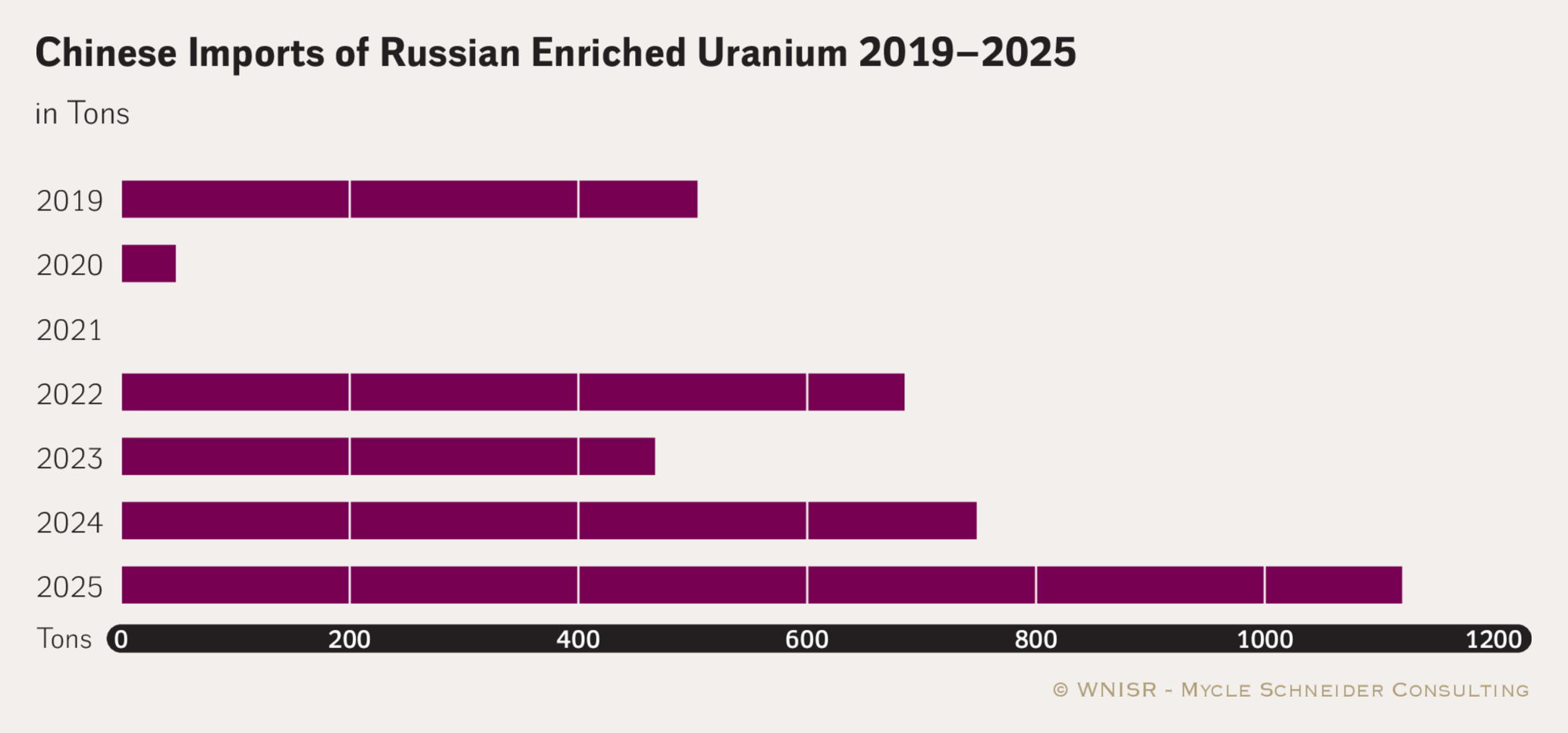
Sources: WITS and Chinese Customs Statistics, 2026
In January 2026, the U.S. Department of Energy awarded “[US]$2.7 billion to strengthen domestic enrichment services over the next ten years,” US$1.8 billion of which were awarded to two U.S companies to create enrichment capacities for High-Assay Low-Enriched Uranium (HALEU) which would be needed if some of the SMR designs became a reality.1857 One of the companies, Centrus Energy, announced that this will involve producing additional quantities of LEU “to serve the commercial market”, i.e. for conventional nuclear reactors.1858 US$900 million were awarded to Orano Federal Services, a 100-percent subsidiary of the French company Orano, through Orano US.1859 The funds are earmarked to support the building of a uranium enrichment facility in the US The total cost of the project is estimated at nearly US$5 billion with a final investment decision expected in 2027.1860 According to Orano’s application in March 2026, the enrichment capacity of the planned facility will be 7,400 tSWU (thousand Separative Work Units).1861
European company Urenco runs the only major uranium enrichment facility in the US which is located in Eunice, New Mexico. The facility has a capacity of 4,300 tSWU, and it shall be expanded to 5,000 tSWU by 2027.1862 In June 2026, Urenco announced the further expansion of its capacities by 2,100 tSWU between 2032 and 2036 to 7,100 tSWU in total.1863
The Orano/Urenco expansion plans would increase US-based enrichment capacities by 10,200 tSWU to a total of 14,500 tSWU.
Fuel Supply Services to the European Union
Figure 58 shows the origin of natural uranium, conversion services, and enrichment services supplied to the EU based on data provided by the Euratom Supply Agency (ESA). After a spike in all three categories in 2023, Rosatom’s share decreased in 2024 and slightly increased again in 2025. Rosatom still accounted for a 16–24.5 percent share of the respective services in 2025 compared to a 23.5–38 percent share in 2023. Russia’s share of uranium supplies and conversion services to the EU is roughly back to the levels before the Ukraine war. However, its share of uranium enrichment services in the EU dropped by nearly a quarter, from 31 percent in 2021 to 22.5 percent in 2025, even as it continues to dominate uranium enrichment globally.
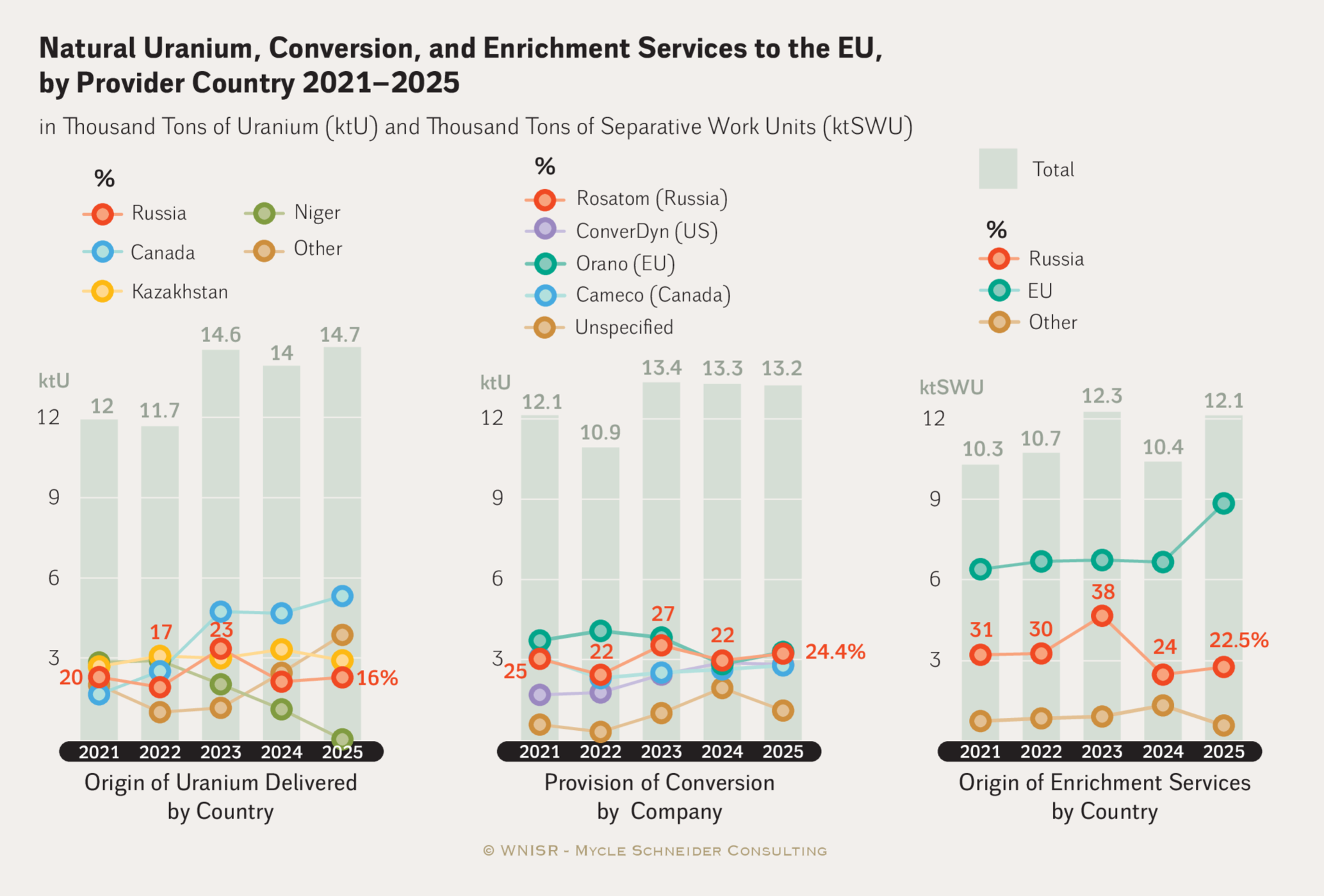
Source: ESA, 2023–20261864
Note: Total uranium delivered to EU utilities in 2021 also includes 196 t (1.6 percent) of re-enriched uranium, not represented.
Conclusions drawn from the ESA’s data are corroborated by planned capacity extensions in Europe. According to their respective 2025 annual reports, French company Orano is expanding enrichment capacities by 2,500 tSWU in France (with around €1.7 billion [~US$2 billion] investment starting in 2024, and first production scheduled for 2028),1865 and Urenco is expanding capacities by 1,800 tSWU in the Netherlands and Germany combined.1866 This would add 4,300 tSWU to Europe’s total enrichment capacity.
According to ESA statements in early 2023, the current nameplate capacity of uranium conversion and enrichment plants in the EU would be “sufficient for the EU to be self-dependent,” but the “Global West” would be missing 3,500 to 8,000 tSWU of enrichment capacity.1867 Orano and Urenco’s planned capacity expansions of 4,300 tSWU in the EU and the above mentioned 10,200 tSWU in the US would amount to 14,500 tSWU in total. This is almost double the upper target of 8,000 tSWU estimated by ESA. The “Global West”—a term repeatedly used by ESA but undefined—therefore, would decisively reduce its dependency on Russia for enrichment capacity over the next decade.
Fuel Manufacturing for Russian Designed Reactors in the EU
The EU’s fuel assembly imports from Russia for the 19 Soviet-designed VVERs (Vodo-Vodianoï Energuetitcheski Reaktor, pressurized water reactors) have further declined to 379 tons in 2025, from 438 tons in 2024, and down from a peak of 573 tons in 2023, but they are still significantly above the pre-Ukraine war volume of 279 tons in 2021 (see Figure 59). The high volumes in 2023 and 2024 most likely reflect stockpiling, given political uncertainties and anticipated sanctions due to Russia’s war in Ukraine, until alternative fuel supplies became available.
Looking at specific countries, the Czech Republic and Finland’s imports in 2025 were significantly below the volumes in 2021, while Slovakia more than tripled and Hungary more than doubled the volumes of their imports compared to 2021. The latter two countries accounted for 81 percent of the EU’s nuclear fuel imports in 2025 (not including Bulgaria). In financial terms, the total deliveries of nuclear fuel to the EU from 2023 to 2025—the period of significantly increased volumes for stockpiling due to the Ukraine war—amounted to €1.71 billion (€1.62 billion without Bulgaria for which data is only provided for the year 2023), i.e. US$20251.9 billion (US$20251.8 billion without Bulgaria). In the preceding three-year period from 2020 to 2022, the EU paid close to €754 million (~US$2022794 million) to Russia. Thus, from 2023 to 2025, while the EU targeted Russia’s non-nuclear energy sector with heavy sanctions, its payments to Russia for nuclear fuel increased by a factor of 2.3 (2.2 without Bulgaria) compared to the pre-war period.1868
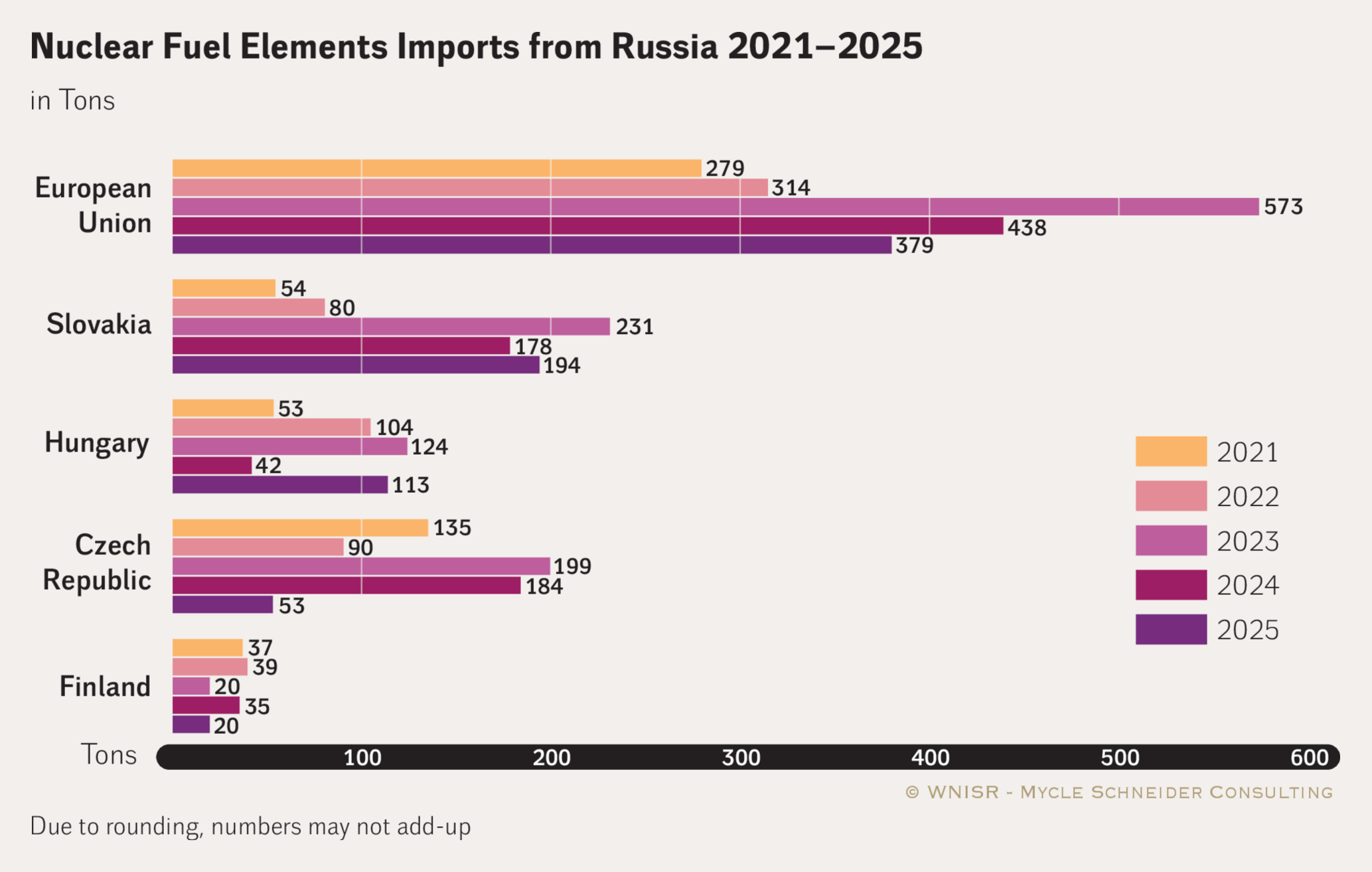
Source: Eurostat Database, 20261869
Note: EU Total does not count imports to Bulgaria (data not available).
While the EU’s sanctions against Russia—the 20th package of which was approved on 23 April 2026—have excluded the nuclear sector thus far, on 6 May 2025 the EU announced a Roadmap Towards Ending Russian Energy Imports, which included nuclear supplies. The roadmap proposed the following measures:
- trade measures to make the purchase of Russian enriched uranium less attractive
- a ban on new contracts with Russian suppliers through the Euratom Supply Agency
- development of a step-by-step phaseout plan for Russian nuclear imports in cooperation with member states by the end of 2025
However, as of mid-2026, the proposed measures have not resulted in any concrete actions. In May 2026, the UK Parliament adopted a sanctions amendment that prohibits the “import of uranium consigned from Russia and Russian-origin uranium to the UK,” as well as “the acquisition of Russian-origin uranium or uranium located in Russia; the supply or delivery of uranium from Russia to a third country; and the provision of relevant ancillary services (technical assistance, financial services and brokering services).”1870 However, the legislation exempted uranium supplies required for the continued operation of nuclear facilities that began operating before 20 May 2026. Uranium purchased and exported from Russia before the sanctions took effect is also exempt.
Five EU countries—Bulgaria, the Czech Republic, Finland, Hungary, and Slovakia—operate 19 Soviet-designed VVER reactors, 15 of which are VVER-440s and four are VVER-1000s. These countries depend on the supply of specific fuel and, in parallel, have electricity mixes with particularly high shares of nuclear power, ranging from around 38 percent to 65 percent (see Table 20). From the start of their reactors’ operations, these countries have almost exclusively received fuel assemblies from TVEL, a 100-percent subsidiary of Rosatom.
Moreover, the fleet of VVER reactors in the EU is growing. In February 2026, first concrete was poured for the first of two VVER-1200 reactors at the Paks II nuclear power plant in Hungary, which had been in planning since 2014 and is being built by Rosatom. The official construction start was delayed by four years due to various difficulties including Western sanctions. Shortly after its election in April 2026, the new Hungarian Government ordered a review of the Paks II project-company’s activities.1871 It remains to be seen whether the review will lead to revisions to Hungary’s strategic dependence on Russia in the nuclear sector (see Hungary Focus for details).
Table 20 provides an overview of publicly available information on fuel supply agreements for the VVERs in the European Union.1872 Details of the multiple diversification initiatives aimed at phasing out Russian fuel deliveries are described in the respective country sections. As of mid-2026, alternative fuel supply agreements exist in all VVER-operating countries in the EU, including Hungary which signed agreements with Framatome in October 2024 and with Westinghouse in November 2025. According to a December 2025 statement by Hungary’s then-Energy Minister Csaba Lantos, quoted in Russian state-run publication TASS, “after 2028, the Paks NPP will use three-quarters French fuel elements manufactured under Russian licenses, and one-quarter American ones.” 1873 In November 2024, Slovakia extended its supply contract with TVEL until 2030. Therefore, it appears that two EU countries, Hungary and Slovakia, will continue buying nuclear fuel from Russia, while the others aim at switching entirely to Westinghouse and Framatome, though the latter still involves Russia, as explained below.
|
Country |
Nuclear Share 2025(a) |
Unit |
Type |
TVEL (Russia)(b) |
Westinghouse (US/Canada) |
Framatome (France) |
|
Bulgaria |
38.2% |
Kozloduy-5 |
VVER-1000 |
- Contract until end-2025 - “Final deliveries” from March–April 2025, serving as a reserve |
- 10-year supply contract (Dec. 2022) - Mixed core with 50% Westinghouse fuel as of April 2026 |
– |
|
Kozloduy-6 |
VVER-1000 |
- Contract for licensing, executing a Lead Test Assemblies Licensing Program (Dec. 2024) - Lead Test Assemblies “will be loaded” (Apr. 2026) |
- Preliminary Agreement for 10-year supply (Dec. 2022) - Supply contract for 2025–2034 (2023) |
|||
|
Czech Republic |
42.1% |
Dukovany-1–4 |
VVER-440 |
- Deliveries continued in 2025 - Contract until 2028 |
- 7-year supply contract starting 2024 (Apr. 2023) - First delivery (June 2025) |
- Development contract for Framatome VVER-440 fuel design (Apr. 2026) |
|
Temelín-1–2 |
VVER-1000 |
- Supply since 2010 - Contract until 2023 - Last delivery in 2024, no further deliveries planned - Fuel reload completed (June 2024) |
- Supply 2000–2010 - 6 lead test assemblies loaded in 2019 - 10+-year contract (June 2022) - Two deliveries in 2025 |
- 10+-year contract (June 2022), supply was to begin in 2024; as of April 2026, delivery expected in 2026 - MoU on development of Framatome own-design VVER-1000 fuel program (Oct. 2024) |
||
|
Finland |
39.5% |
Loviisa-1 |
VVER-440 |
Contract until end 2027 |
- Supply 2001–2007 - Supply contract (Nov. 2022) - Lead test assembly loaded: 2023 - First reload (Sept. 2024), “performing as expected” |
Development contract for Framatome VVER-440 fuel design (Apr. 2026) |
|
Loviisa-2 |
VVER-440 |
Contract until end 2030 |
||||
|
Hungary |
40.9% |
Paks-1–4 |
VVER-440 |
- “Lifetime” supply contract |
- Supply contract for delivery starting 2028 (Nov. 2025) |
- MoU, incl. fuel supply (Sept. 2023) - Supply contract for delivery starting 2027 (Oct. 2024) - Development contract for Framatome VVER-440 fuel design (Apr. 2026) |
|
Slovakia |
65.2% |
Bohunice-3–4 |
VVER-440 |
- Supply contract 2022–2026, with option until 2030 (June 2019) - Supply contract extended to 2030 (Nov. 2024) |
- Supply contract (Aug. 2023) - First delivery planned in 2026, first load 2027 (Nov. 2024) |
- MoU, incl. fuel supply (May 2023) - Supply contract for delivery starting 2027 (July 2024) - Development contract for Framatome VVER-440 fuel design (Apr. 2026) |
|
Mochovce-1–3 |
VVER-440 |
|||||
|
Ukraine |
54.8% |
Rivne-1–2 |
VVER-440 |
Supply contract for 8 reactors (Dec. 2018) |
- Since 2010, fuel supplied to 6 VVER-1000s - Supply contract for all Ukrainian reactors (June 2022) - First load Rivne (Sept. 2023) - First delivery Khmelnitskyi (March 2024) |
|
|
Khmelnitskyi-1–2 |
VVER-1000 |
|||||
|
Rivne-3-4 |
VVER-1000 |
|||||
|
South Ukraine-1–3 |
VVER-1000 |
|||||
|
Zaporizhzhia-1–6 |
VVER-1000 |
Sources: Various, compiled by WNISR, 2026; all available in Annex 3.
Notes
(a) – Based on gross production from Energy Institute, “Statistical Review of World Energy—Consolidated Dataset”, June 2026, see https://www.energyinst.org/__data/assets/file/0005/1827617/Statistical-Review-of-World-Energy-Narrow-format.xlsx, accessed 30 June 2026.
(b) – Compare with the EU imports of Russian nuclear fuel elements in Figure 59. The information covered in this column is partial as all deliveries related to the imports mentioned in the Figure have been publicly reported on. For example, in 2025 Finland imported 19.5 tons of nuclear fuel from Russia, but there have been no reports about their delivery.
Diversifying fuel supply for these reactors is complex. Westinghouse started manufacturing VVER-1000 fuel assemblies in 1998 and supplied Czech reactors at Temelín in their first decade of operation, starting in 2000.1874 Westinghouse has since become the sole supplier of VVER‑1000 fuel assemblies to Ukraine and, starting in 2023, also provided first loads to VVER-440 reactors in the Czech Republic, Finland, and Ukraine.1875
Development of Westinghouse fuel for VVER-440 reactors was supported by a Euratom funded project named APIS (Accelerated Program for Implementation of secure VVER fuel Supply) that ran from 2023 to 31 December 2025.1876 Westinghouse considers that the program achieved its goals and “by the end of the project in 2025, a fully operational Russia-independent supply chain for VVER fuel is established,”1877 apparently resulting in the planned and actual deliveries as documented in Table 20. A new pellet facility under construction at the Westinghouse nuclear fuel factory in Västerås, Sweden shall lead to a 50-percent capacity increase by 2028.1878
In 2023, Ukrainian energy company Energoatom announced its intention to manufacture nuclear fuel for its reactors in cooperation with Westinghouse.1879 In May 2025, Energoatom received a license from Westinghouse for manufacturing fuel assembly components and announced that the first Ukrainian fuel assembly from its production line will be loaded into a reactor core in 2027.1880 In July 2025, Westinghouse and Energoatom confirmed “the intention to establish an assembly line for VVER-1000 fuel elements at the facilities of Energoatom’s affiliate AtomEnergoMash” with a final agreement to be signed “in the near future”.1881 Energoatom announced in May 2026 to have launched domestic production of Westinghouse fuel components, i.e. bottom nozzles for VVER-1000 fuel assemblies.1882 In the long term, Energoatom plans to manufacture half of Ukraine’s nuclear fuel consumption and source the other half from Westinghouse.1883
In addition to Westinghouse, Framatome is expected to join the ranks of VVER fuel manufacturers, following a dual track approach for short-term and long-term solutions. In the short-term, Framatome intends to manufacture the existing Russian VVER fuel design under TVEL license. To this end, Framatome established a joint venture with TVEL in 2019 for manufacturing VVER-1000 fuel at its plant in Lingen, Germany. This plan drew widespread criticism and has not been approved by the German administration as of mid-2026 (see the following section for details). If the government rejects the plan, Framatome will not be able to fulfill its supply contracts, for example, the contract with the Czech Republic which should have started already in 2024 but is now expected for 2026, and the one with Bulgaria which should have started in 2025, as can be seen from Table 20. In addition, Framatome plans on manufacturing VVER-440 fuel under TVEL license at its factory in Romans-sur-Isère in France, with first deliveries planned at the end of 2027 (see following section for details).
Framatome has been progressing on its own long-term VVER fuel design since 2018. It was reported in March 2024 that the company hoped to begin fabricating the first lead-test assemblies in 2026 and that Framatome’s head of Fuel Business anticipated the technology to be available in the early 2030s.1884 That target date was confirmed by a Framatome representative at a meeting on 26 May 2026.1885 Meanwhile, according to a media report, Framatome claimed in December 2025 that it will be able to supply all 15 VVERs in the EU with its own fuel by 2035.1886
Framatome is also leading Euratom’s project SAVE (Safe and Alternative VVER European Project), with seventeen partners from seven EU member states as well as Ukraine, to develop the new European VVER fuel design. The project started in June 2024 and will run until 30 June 2028.1887
In April 2026, referring to the SAVE project, Framatome announced a contract with four utilities, ČEZ (Czech Republic), Fortum (Finland), MVM Paks NPP (Hungary), and Slovenské elektrárne (Slovakia), to “further advance the development of Framatome’s 100% sovereign European VVER 440 fuel design.” 1888
The Russia dependencies of European operators of VVER reactors are, however, not limited to nuclear fuel because these reactors also need maintenance and continuous upgrades that were previously provided by Russia. Materials and spare parts needed for maintenance may be affected by EU sanctions against Russia. For instance, component failures following the replacement of Russian equipment sets with Bulgarian ones at Bulgaria’s Kozloduy plant reportedly led to unplanned outages of Unit 6 between December 2025 and March 2026.1889 On 25 March 2026, the Bulgarian Council of Ministers, therefore, allowed the Kozloduy operator to derogate from certain provisions of EU Council Regulation No. 833/2014 of 31 July 2014 and to conclude procurement contracts with Russian companies.1890 On the other hand, Czech nuclear operator ČEZ denied problems, Slovakian nuclear operator Slovenské elektrárne pointed to a systematic approach to address such issues, and Ukrainian state company Energoatom said it produces “a large share of spare parts needed” or sources them from Western companies.1891
Framatome and VVER Fuel Manufacturing in Lingen and Romans-sur-Isère1892
In contrast to Westinghouse, Framatome has been completely absent from the VVER fuel market so far. However, on 2 December 2021, twelve weeks before Russia invaded Ukraine, Framatome announced that it had signed a long-term strategic agreement with Rosatom aimed at “further expanding the companies’ efforts to develop fuel fabrication and instrumentation and control (I&C) technologies.”1893 In 2019, Framatome and TVEL had already founded a joint company in France called Framatome Newco to collaborate on “efforts to develop fuel fabrication”. The company was later renamed to “European Hexagonal Fuel SAS”.1894 In March 2022, Framatome’s subsidiary Advanced Nuclear Fuels (ANF) filed an application with the environment ministry in Lower Saxony, Germany, seeking permission to modify ANF’s facilities in Lingen to enable the licensed manufacturing of VVER fuel assemblies.1895
Following German atomic law, ANF’s request was subject to a public inquiry in early 2024 resulting in more than 11,000 comments.1896 To consider these comments, the Lower Saxony Government held a public hearing in Lingen in November 2024. The main objections concerned TVEL’s role in the manufacturing, raising issues of potential espionage risks and threats to national and energy security.1897 As of mid-2026, the Lower Saxony Government had not issued a decision on the matter. The environment minister, a Green Party member, is opposed to the project,1898 but he can only examine the application based on his mandate under federal atomic law and does not have a veto right.
According to media reports in February 2026, Germany’s federal environment ministry submitted a statement to the Lower Saxony Government in which ANF’s application would be approved under certain conditions.1899 On the other hand, in response to parliamentary questions, the German Government pointed out in March 2026 that the final decision rests with the Lower Saxony Government.1900 Thus, the German Government appears to be avoiding openly positioning itself in an insoluble conflict between respecting French interests and depriving Russia of influence and business revenues. Reportedly, the German Chancellor and the French President had previously discussed ANF’s application.1901 In December 2025, the German Parliament turned down an application requesting the German Government to prohibit “Russian nuclear business in Germany” with a large majority.1902, 1903
Reportedly, due to “the administrative and regulatory problems in Germany”, Framatome had already decided in mid-2024 to manufacture VVER fuel in France also.1904 Framatome claims that it will start manufacturing in Romans-sur-Isère at the end of 2027, but doubts have been raised about this target because, as of March 2026, no request for authorization to build and operate such a manufacturing line had been submitted to the French regulator ASNR (Autorité de Sûreté Nucléaire et de Radioprotection).1905 In fact, Framatome stated in May 2026 that it aims to submit the request only at the end of the year.1906 It is noted that manufacturing must begin by the end of 2027 at the latest to meet the delivery contracts for VVER-440 reactors in Hungary and Slovakia (see Table 20).
Russia’s Dependencies and Potential Sanctions
The long-standing business relations between Framatome, its partner Siemens Energy, and Rosatom create a mutual dependency, including significant Russian dependence on the West which may get increasingly relevant when further sanctions are considered. Instrumentation and Control (I&C) technology is “the brain and central nervous system” of a power plant, in Framatome’s words.1907 For decades Russia has received Framatome and Siemens Energy I&C technology not only for the initial construction, but also for the modernization and servicing of existing reactors, committing the companies long into the future. The most recent reported case involves a Framatome I&C system for the newbuild Kursk II nuclear power plant (two units),1908 with Unit 1 connected to the grid in December 20251909 and Unit 2 still under construction.
Framatome and Siemens Energy contracted their I&C systems to Rosatom’s Paks II project in Hungary where first concrete was poured in February 2026. However, shortly after that event, Rosatom confirmed having previously dropped Siemens Energy as partner in the Paks II project, reportedly stating that the “contract with the company was terminated at the end of last year due to its inability to fulfill its contractual obligations.”1910 In response to a parliamentary question, the German Government indeed stated in January 2026 that Siemens Energy had not been granted permission to export an I&C system for the Paks II project.1911 Months earlier, in June 2025, the Hungarian Government had announced the relocation of the “Nuclear Control Technology Division” of Siemens Energy to Budapest, apparently to overcome or circumvent German export restrictions.1912
Rosatom further stated that Siemens’ “equipment can be replaced with both Russian and European counterparts, and Rosatom is already considering a number of alternative solutions.”1913 However, according to a 2023 Siemens Energy statement to Hungary Today, “Siemens Energy is the only supplier with a system that can prove qualification and certification according to European norms and standards as well as according to the International Electrotechnical Commission (IEC).”1914 Replacing the Siemens equipment with parts from a Russian or other alternative supplier would therefore require qualification and certification of alternative systems according to European norms and standards, which would likely lead to further complications and delays, in addition to the incoming Hungarian Government’s in-depth review of the entire project (see Hungary Focus).1915
Over the past three decades, Framatome and Siemens Energy have contracted their respective I&C systems to Rosatom for a range of Russian reactor projects around the world; within Russia this includes, for example, the newbuild projects Novovoronezh 2-1 and 2-2, Leningrad 2-1 and 2-2, and the modernization of Kola-3 and -4 that were carried out between 2009 and 2016 together with Framatome’s predecessor AREVA NP.1916 According to a report by Gesellschaft für Anlagen- und Reaktorsicherheit (GRS, Society for Reactor Safety), Germany’s central nuclear expert organization, the newbuild projects Novovoronezh and Leningrad (as well as the Belarusian plant) employed the Technological Process Control System (TPTS), an I&C system that was being developed by Rosatom’s subsidiary VNIIA in cooperation with Siemens since 2011.1917 According to VNIIA, this “system was created on the platform of the leading technologies obtained by VNIIA under the license of Siemens.”1918
The Framatome and Siemens Energy I&C systems are therefore deeply engrained into the operation of Rosatom nuclear reactors which, together with their continuous service and modernization needs, creates a strong, long-lasting Russian dependency on its Western partners. Siemens Energy, other than Framatome, terminated new business options with Russia after the start of the Ukraine war.1919
Nevertheless, Siemens Energy’s operations in Moscow are apparently continued by the company Energy Management LLC, which is run by former Siemens manager Oleg Titov1920 and claims on its website to “continue the traditions of Siemens.”1921
In the past decade, Russia turned into the world’s dominant international reactor technology supplier. With the exception of one Chinese project in Pakistan, two construction starts in South Korea and one in India, as well as the SMR at Darlington in Canada, the Russian industry implemented all 17 construction starts in the world outside China between December 20191922 and mid-2026 (see Overview of Current Newbuild).
A major participant in Rosatom’s reactor projects is Arabelle Solutions (formerly known as GEAST, for GE-Alstom), the Arabelle turbine manufacturer in France. In 2024, Framatome’s majority owner, EDF, acquired GEAST from GE1923 after a lengthy process of over two years.1924 The company produces turbines for nuclear power plants and is highly dependent on the international niche market virtually entirely controlled by the Russian nuclear industry over the past six and a half years. Arabelle Solutions’ orderbook with Rosatom amounted to €1.18 billion (US$20241.3 billion) in 2024,1925 with contracts implemented through Turbine Technologies AAEM LLC (a joint venture with Rosatom in Russia), which supplies turbine islands for Rosatom reactor projects.1926 Meanwhile, Arabelle Solutions seems to have reduced its dependency on Rosatom, for example, by successfully bidding for a new Westinghouse project in Poland.1927
WNISR2025 described Small Modular Reactors (SMRs) as a Potemkin village: “an impressive, superficial facade constructed to hide an undesirable reality.” One year later, the chasm between the image of SMRs presented to the public by the nuclear industry, enthusiastically adopted by national governments, international bodies, and the media is no less wide. The claims made are at best untested and at worst demonstrably wrong.
In 2025, the Nuclear Energy Agency (NEA) estimated there were 127 SMR designs.1928 The International Atomic Energy Agency (IAEA) defines the size range of SMRs1929 as 30–300 MW,1930 with smaller reactors categorized as micro-reactors. However, most SMR designs that have seen significant design development are larger than 300 MW (see section on Size below). They also embody most of the general large reactor design principles ever proposed. So, any general statement on the characteristics of SMRs, except that they are smaller than the large reactor designs on offer, is hard to justify.
To make sense of the designs on offer, it is useful to divide them into two main categories: Light Water Reactors (LWRs) and Advanced Modular Reactors (AMRs). LWRs include Pressurized and Boiling Water Reactors (PWRs and BWRs), the two designs that account for 347 (84 percent) of the 411 reactors in operation worldwide as of 1 July 2026.1931 AMRs include reactor designs that have either only been built as prototype or demonstration plants—some dating back more than 60 years, for example, Sodium-cooled Fast Reactors (SFRs)—or have never been built as power reactors despite being talked about for 60 or more years, for example, Molten Salt Reactors (MSRs).
Previous WNISR editions have evaluated some of the claimed advantages of SMRs, so the following section just summarizes the main points.
The claim is that because the reactors are smaller, they will be cheaper, quicker, and easier to build than large (≥1000 MWe) reactors. They will also be less prone to cost increases and delays making them a safer investment and, therefore, easier to finance. The claim about cost is difficult to reconcile with an industry that for the previous 50 years has increased the reactor size with every new design in search of scale economies. It is clear there are scale economies—e.g., all things being equal, a 1000-MW reactor vessel will cost less than five 200-MW reactor vessels—so the lost scale economies must be more than compensated for by other savings from building smaller. Most of the SMR designs commercially offered by OECD-based vendors (EDF, GE Vernova, Holtec, TerraPower, Westinghouse) are 300 MW or larger, while one of the original SMR designs NuScale’s VOYGR started as 35 MW and increased in four steps to 77 MW yet remained uneconomic (see NuScale’s VOYGR below and past WNISR editions).
Intuitively, it might be expected that a smaller reactor will be quicker and easier to build than a large reactor, but if the key issues causing long delays with large reactors include design complexity and quality-control, there would be no reason for a smaller reactor to be less complex than a large one.
Until SMRs have been built in significant numbers to time and cost, many financiers and utilities will see SMRs as a risky investment. The scale of per-unit funding needed might be less, but most projects foresee several units at the same site with a similar amount of capacity as a large reactor. For example, the Wylfa project in the UK comprises three Rolls-Royce SMRs with a total capacity of 1400 MW, but the claimed scope for five further reactors will make the site capacity 3.8 GW, more than the largest UK nuclear newbuild projects, Hinkley Point C and Sizewell C, which are 3.3 GW each.1932
Modular Designs with Components Built on Production Lines
The image many members of the public might have for SMRs is of a rolling production line producing large numbers of modules that can be loaded on to a truck and taken to the site, where little more than bolting together the modules would be required. However, the reactors are large enough to require major site excavation and preparation, especially if, as is proposed for some designs, the reactor is built partially or entirely underground. Production lines can save money but only if they are fully loaded so that the fixed cost of setting them up can be recovered, and there are no design changes requiring retooling of the production lines. So, they are best suited for high volume products with a predictable market, not something nuclear power has ever offered.
Phrases such as “meltdown proof”1933 and “walk-away safe”1934 are frequently used to describe SMR designs; one vendor even claims: “This design is engineered to withstand extreme temperatures, ensuring the fuel remains stable and is physically incapable of melting under any scenario.”1935 Plant safety depends on the reactor type—each design has its own issues—and the specific safety features incorporated. The claim of improved safety is based on several possible approaches. Most designs claim to rely on ‘passive’ safety, that is, in an accident situation, the reactor does not rely on an engineered system to be activated for it to be brought back under control. Some models, such as the Holtec SMR-300, are designed to be built underground.1936 However, relying on passive safety features is not particular to SMRs, and the two most recent large reactor designs offered by Westinghouse and General Electric, the AP1000 (Advanced Passive)1937 and the ESBWR (Economic Simplified),1938 respectively, both incorporate passive safety features.
The cocktail of waste products generated depends on the type of reactor, with, for example, a Sodium-cooled Fast Reactor (SFR) producing a very different inventory of radioactive material than a PWR. However, all things being equal, the small size of SMRs means the reactor components will be more heavily irradiated and produce more waste than a large reactor. A study co-authored by Allison MacFarlane, former Chair of the U.S. Nuclear Regulatory Commission (NRC) concluded: “Results reveal that water-, molten salt-, and sodium-cooled SMR designs will increase the volume of nuclear waste in need of management and disposal by factors of 2 to 30.”1939
The idea that siting SMRs will be easy because they are physically small is belied by the fact that most projects involve multiple reactors each larger than 300 MW. A reactor’s physical footprint is determined by the detailed design, but Rolls-Royce claims a single reactor would have a footprint of two football pitches.1940 The three main projects in the UK (Wylfa, Cottam, and Hartlepool) are expected to have a site capacity of 1–1.4 GW, with the Wylfa SMR station potentially expanding to become the UK’s largest nuclear site with up to eight reactors (3.8 GW).1941
This chapter focuses on the designs that appear closest to being offered commercially. It includes only designs that are being offered for sale, that have a prospective customer with a named site, and that have had significant assessment by a credible and transparent OECD regulatory body. All designs included are said to have a design life of 60 years or more. The chapter focuses particularly on the US, UK, and Canada because their governments have committed significant amounts of public money to building SMRs. All three countries have some form of preliminary design review meant to identify significant design issues prior to any actual regulatory process. In the US, it is the pre-application activities process,1942 in Canada the Vendor Design Review,1943 and in the UK the Preliminary Design Review process.1944 These processes do not commit the regulator to licensing the design; they alert the vendor to potential design issues and educate them on what the process of licensing will entail. The processes are voluntary and cost little to nothing, so there is an incentive for vendors to engage in them. These pre-licensing activities also allow vendors to showcase their respective designs to potential private investors.
China and Russia both have two or more designs in operation, being built or proposed. However, designs originating from these two countries are unlikely to be politically acceptable in OECD countries, so any customers are more likely to be in so-called “developing countries”, who will need finance and expertise that Russia and China offer. In addition, the US has blacklisted China’s key nuclear developers China National Nuclear Corporation (CNNC) and China General Nuclear Power (CGN), and Russian state-controlled company Rosatom is facing geopolitical challenges due to its proactive involvement in the Ukraine war, in particular the occupation of the Zaporizhzhia plant (see Ukraine Focus).
There are a few micro-reactors, such as Last Energy’s 20-MW PWR1945 and the Finnish Steady Energy LDR-50 district heating reactor (50 MWt), but the market for them appears small. They are highly unlikely to be built in sufficient numbers to have an impact on electricity supply, and WNISR does not consider reactor designs that are not meant to generate power, so they are not covered.
The Light Water Reactor (LWR) designs are likely the first to be built because Pressurized Water Reactors (PWRs) and Boiling Water Reactors (BWRs) have been in operation for a long time compared to the Advanced Modular Reactors (AMRs) for which there is minimal or no experience. Large LWRs provide a reference point against which the economics of LWR SMRs can be judged. LWRs also have the advantage of requiring a type of fuel that is already being used and for which there is a well-established supply chain. The use of water as the coolant and moderator limits the output temperature to about 350°C, too low for some industrial applications. By contrast, AMRs will need new types of fuels, such as High-Assay Low-Enrichment Uranium (HALEU) fuels, with supply chains yet to be established, and the outlet temperature will depend on the reactor type but could be 650°C or more. (See Table 21)
GE Vernova’s BWRX-300 is a scaled-down version of its ~1600-MW ESBWR. The advantage of developing the design from an existing one that completed a full design assessment by the NRC is that the cost would be reduced. However, given that the ESBWR was chosen for five US projects around 2010, and none proceeded with cost being a significant issue, it is hard to see how a scaled-down version, losing scale economies, would be competitive. Nevertheless, the design has received serious attention in Canada, US, and the UK.
In Canada, it completed the first two of three phases of the Canadian Nuclear Safety Commission’s (CNSC) Vendor Design Review in March 2023.1946 In April 2025, the CNSC granted a construction license for one reactor at the Ontario Power Generation’s Darlington site with potential for three further reactors to be built there.1947 Construction began in April 2026, if defined by the laying of the base slab into the reactor-building shaft serving as the foundation of the building.1948 Usually, reactor construction officially begins with the pouring of first structural concrete. This is the first time that a base slab is put in place in one piece. See GE Vernova/Darlington below and the section on Canada in Annex 1.
In the UK, in October 2023, Great British Nuclear accepted the design as one of six designs considered in the UK’s SMR competition.1949 The design made it to the final three, but the Rolls-Royce design was chosen. In January 2024, the first of three stages of the Generic Design Assessment (GDA) process led by the UK Office for Nuclear Regulation (ONR)1950 was started, paid for using a grant of £33.6 million (US$202443 million) from the UK Government,1951 and the second was successfully completed in December 2025.1952 The second stage identified important design issues,1953 which the third stage would attempt to resolve. The stages completed so far do not commit the ONR to anything. GE Vernova has not said whether it intends to apply for the third stage to be carried out but “any future regulatory assessment of the BWRX-300 design [is] assumed to be undertaken as part of a site-specific project.”1954 However, by mid‑2026, no concrete UK projects had been announced and unless some emerge, there may be little incentive for GE Vernova to incur the cost of further regulatory assessments.1955
In the US, the design has been undergoing the NRC’s pre-application review since December 2019, but has yet to begin a Design Certification process that would, if successful, essentially allow the design to be built at any US site.1956 It is proposed for the Tennessee Valley Authority’s (TVA) Clinch River site where a construction permit was applied for in April 2025 (see GE Vernova/Clinch River below and United States Focus).1957 The project is backed by a US$400 million grant from the U.S. Department of Energy (DOE).1958 GE Vernova is also investigating other potential markets, such as Hungary and Poland, but these appear a long way from any construction.
The Holtec design dates back more than two decades. For most of this period, it was known as the SMR-160. However, in 2023, the design’s nominal thermal output was doubled, and it was renamed SMR-300. Holtec did not announce this change or provide any rationale. The SMR‑160 design had been undergoing the NRC’s pre-application review for nearly a decade by 2023, when it was suspended,1959 and work began on the SMR-300.
In December 2025, the NRC received a Limited Work Application to build two SMR-300s, named Pioneer-1 and -2, at Holtec’s Palisades site utilizing a grant of US$400 million from the U.S. DOE.1960 See New Reactors: Proposals, Planning, and Policy Developments and Subsidies and Financing for Nuclear Power in United States Focus.
In late May 2026, Holtec announced that the SMR-300 will play a “pivotal role” in the Green River Advanced Nuclear Project in Utah. While the wording remains vague, it suggests that the design has been chosen for deployment in the state.
In the UK, the design was accepted by Great British Nuclear in October 2023 as one of six designs to be considered in the country’s SMR competition.1961 The design also made it to the final three, but the Rolls-Royce design was chosen. In January 2024, the first two of three stages of the ONR’s Generic Design Assessment (GDA) were started, paid for by a UK Government grant of £30 million (US$202337 million),1962 and the second stage was successfully completed in March 2026.1963 Holtec has yet to confirm whether it will apply to complete Stage 3, but if the Cottam project proceeds (see below and United Kingdom Focus), it would seem logical to do this. Alternatively, it could apply for a site license, but given that this would also require resolving the issues identified in Stage 2, it could benefit from completing the GDA, so that other potential projects using the design in the UK could proceed more quickly.
In September 2025, Holtec announced plans for up to four SMR-300s to be built at the Cottam site, in collaboration with EDF which owns the site.1964 Details of the project are at an early stage, and there is no information on who would own the plant, who would finance it, and how the power would be sold. Cottam formerly housed a large coal-fired plant that closed in 2019, and it has not previously been considered as a nuclear site. It would be the first new reactor site chosen in the UK in nearly 50 years. See Holtec/Cottam below and United Kingdom Focus.
In Canada, the SMR-160 completed Stage 1 of the Vendor Design Review in August 2020,1965 but the SMR-300 has not been reviewed, and there appear to be no well-established projects for this design.
The Rolls-Royce SMR was announced in 2017 when it was expected to be either 220 MW or 440 MW. Ultimately, 440 MW was chosen, and in May 2021 it was uprated to 470 MW.1966 Rolls-Royce makes a virtue of the design not being innovative. Rolls-Royce SMR’s then-CEO, Tom Samson, told a UK parliamentary select committee in 2022, “We do not need a prototype. This is a standard pressurised water reactor… There is no innovation in the nuclear technology part.”1967
In the UK, the design was accepted by Great British Nuclear in October 2023 as one of six designs to be considered in the UK’s SMR competition.1968 The design made it to the final four1969 and won a deal to build three reactors at Wylfa with Final Investment Decision (FID) expected in 2029. In April 2022, the ONR’s Generic Design Assessment (GDA) was started, and Stage 2 was successfully completed in July 2024 when Stage 3 commenced.1970 At the time, Stage 3 was set to be completed in December 2026,1971 but completion appears to be up to a year late.1972 See Rolls-Royce SMR/Wylfa below and United Kingdom Focus.
Rolls-Royce received a grant of £210 million (US$2021289 million) from the UK Government in 2021 to develop the design and take it through the regulatory process in the UK.1973
In September 2024, the Czech Government announced it had selected the Rolls-Royce SMR over the six other SMR designs it had been considering. The reactors would be built at the Temelín site.1974 Czech government ministers promised that the Czech Republic would profit by supplying equipment for the reactors not only domestically but also for other markets.1975 See Rolls-Royce SMR/Temelín below and Small Modular Reactors in section on the Czech Republic.
Rolls-Royce began pre-application review activities in the US in April 2025.1976
In June 2026, Rolls-Royce announced it had been chosen by the Videberg Kraft subsidiary of the state-owned electric utility Vattenfall to supply three SMRs for construction at the Ringhals site in Sweden.1977 While the project appears to be moving rapidly, there are several important steps that need to be taken before a Final Investment Decision. These include reaching agreement on the cost estimate of the reactors; establishing the stakeholders in the company that will be set up to own the plant; state-finance and a power purchase agreement will be needed to finalize the deal as well as the European Commission’s approval of the State Aid.1978 The design will also need to be approved at some point by the Swedish nuclear regulatory body, Strålsäkerhetsmyndigheten (SSM). A firm order is likely to follow the order for the Wylfa reactors forecasted to take place in 2029. See Rolls-Royce SMR/Ringhals below and Sweden’s SMR Ambitions in Sweden Focus.
One of the earliest SMR designs to emerge was the NuScale SMR, dating back more than two decades. Originally it was designed to produce 35 MW, but the output has grown in four steps to the current size of 77 MW. The earlier designs were meant to be built in clusters of 12, but with the latest power increase, taking the site output of such a cluster to close to 1 GW, NuScale began to offer it in clusters of four and six as well as 12.
NuScale seemed to be ahead of the game in 2015, when it signed a deal with the Utah Associated Municipal Power Systems (UAMPS), an organization comprising about 50 small publicly owned power companies, to build 12 NuScale reactors, then rated at 50 MW each, at a site owned by the U.S. DOE in Idaho. In parallel, the NRC carried out a Design Certification process for the 12 × 50 MW version, starting in 2016 and completing successfully in 2020, by which time the reactor output had been increased, rendering the approval of academic interest.1979 A new application was submitted for the 4 × 77 MW version in 2022 and was successfully completed in 2025.1980 However, by this time, the UAMPS project had collapsed (in November 2023) because of sharply rising cost estimates and despite being awarded US$1.4 billion over ten years in 2020 by the U.S. DOE.1981 See past WNISR editions.
In September 2025, ENTRA1 Energy and the Tennessee Valley Authority (TVA) reached an agreement to build up to 6 GW of VOYGR capacity spread over several locations.1982 ENTRA1 Energy was established in 2023 to be NuScale’s exclusive global strategic partner commercializing the NuScale SMR technology. In 2026, shareholder lawsuits were filed against NuScale for allegedly misrepresenting ENTRA1’s experience and capabilities. It was claimed that ENTRA1 had never built, financed, or operated any significant project, and that it had been “organized primarily to support the work of one individual, its principal Wadie Habboush, an investor and entrepreneur.”1983 By 1 July 2026, the action had not been heard.
In the UK, it was one of six designs chosen to contest the UK’s SMR competition but it was not chosen as one of the final four (including Westinghouse that decided to withdraw).1984 In Canada, it applied to carry out two stages of the CNSC’s preliminary design review in 2020, but there is no evidence it completed the process. It is not listed as ongoing or completed on the CNSCs Vendor Design Review page.1985 There appear to be no firm prospects for NuScale in Canada.
NuScale’s main option now appears to be in Romania, where Romanian operator Nuclearelectrica and the Energy Ministry reported in February 2026 that an FID had been taken to build 6 × 77 MW modules at the site of an old coal-fired plant in Doicești.1986 The US EXIM Bank has offered some support for the project.1987 Surprisingly, NuScale did not communicate the decision, while the Romanian Prime Minister was reported as saying: “The investment will be made once a funding formula will be found. Given the very large amount of money, the complexity of such projects and the technology being in early days, I estimate we will not see the investment immediately.” 1988 The Prime Minister’s remarks and the history of the Cernavodă project—which began in 1978 with the goal to have four to five Canadian CANDU reactors but has only completed two reactors and has not secured funds for the other two nearly 40 years later—suggest this is not a firm order yet. See Doiceşti SMR Project in section on Romania.
|
Vendor/Design |
Gross Capacity (in MWe) |
Design Features |
Projects |
Regulatory Stages |
|
Rolls-Royce Rolls-Royce SMR, PWR |
470 |
Conventional PWR |
Wylfa (UK) Temelín (Czech Republic) |
UK Completed Stage 2 of 3 of GDA process 2024. US pre-application activities started 2025. |
|
Holtec SMR-300, PWR |
320 |
Integral design. Core is deep underground. Reliant on passive safety. |
Cottam (UK) Pioneer (US) |
UK Completed Stage 2 of 3 of GDA process in 2026. US phased construction permit applied for. |
|
GE Vernova BWRX-300, BWR |
316 |
Based on ESBWR (1600 MW). Reliant on passive safety. |
Darlington (Canada) Clinch River (US) |
Canada Construction license granted/work started UK Completed Stage 2 of 3 of GDA process in 2025. US pre-application activities started in 2019. Clinch River construction permit applied for. |
|
NuScale VOYGR, PWR |
77 |
Integral design submerged in water, below ground. Designed as packs of 4, 6, or 12 reactors |
Doicești (Romania) |
US Design received design approval by the NRC in 2025. |
Sources: Various, compiled by WNISR, 2026
Note: ESBWR: Economic Simplified Boiling Water Reactor; PWR: Pressurized Water Reactor; BWR: Boiling Water Reactor.
Three other LWR SMRs have seen significant publicity, the Westinghouse AP300, the Électricité de France (EDF) NUWARD, and the Korea Atomic Energy Research Institute (KAERI) SMART designs. However, for various reasons, these are not likely to win orders in the next few years.
The Westinghouse AP300 was a latecomer, announced in May 2023. In the US, pre-application for design certification only started in May 2023 and no specific US projects for the design have been announced.1989 In the UK, Westinghouse applied for a GDA in February 2024, and in August 2024, the government instructed ONR to carry out the first two stages of a GDA. Unlike the GDAs for the Holtec and GE-Hitachi designs, no mention was made of a government contribution to the costs of a GDA, and start of the review is indefinitely suspended.
The only identified project is in the UK: the Community Nuclear Power project in Teesside, North East England. Announced in February 2024, the project has little apparent substance to it and is being led by a new private consortium, which was only established in September 2022, remained a dormant company until September 2024, and still listed a capital of £125 (US$2025165) (no typo) in September 2025. 1990 Little or nothing has been heard about the project, for four AP300s, since.1991 No review is underway in Canada. There appears to be little attempt by Westinghouse to promote the design, and the company seems to be focusing on selling its large reactor design, AP1000.
The EDF NUWARD nuclear power plant, as announced in 2019, would have comprised two reactors of 300–400 MW.1992 The two reactors, later specified to be of 170 MW each, would be housed in a single building sharing some equipment, and the reactor would be submerged in a pool filled with water. By the end of 2022, the design was still in the conceptual phase, with the basic design work to be carried out between 2023 and 2025. In 2023, EDF created a new wholly-owned subsidiary, NUWARD, to develop the design.1993
In July 2024, the design was effectively abandoned, and a new, much less radical design approach was adopted. The new design is a 400-MW reactor with scope for providing process heat, but it is a long way from availability as a commercial design despite an agreement being signed between NUWARD and seven Italian companies aimed at supporting the development of the design.1994 A similar agreement was signed in 2023 for development of the abandoned design.1995 Details of the new design are still scarce, but the statement that it “builds on the proven technology of the GEN III+ Pressurised Water Reactor (PWR)” suggests it may be based on the 1600-MW EPR design.1996
KAERI has been developing the SMART (System-integrated Modular Advanced ReacTor), a 100-MW PWR design, since 1997.1997 In 2014, it was transferred to a new company, SMART Power Co. Ltd., and in 2015, a Memorandum of Understanding (MoU) was signed with the Saudi Arabian King Abdullah City for Atomic and Renewable Energy (KA-CARE) with a view to constructing the first SMART reactors in Saudi Arabia.1998 The design received standard design approval from the Korean regulator in mid-20121999 but no firm orders were forthcoming.2000 The Korean Nuclear Safety and Security Commission (NSSC) began its review of an advanced version of the original design in August 2021 and announced it had granted standard design approval for the reactor—SMART100—in September 2024.2001
The i-SMR (Innovative Small Modular Reactor), a new, 170-MW PWR design, under development since 2020,2002 was submitted to the Korean nuclear regulatory agency in February 2026.2003 It is unclear at this point whether it will be any more successful than its predecessors in winning firm orders. See South Korea Focus.
Chinese LWR-SMRs
The China National Nuclear Corporation (CNNC) has been developing its ACP100 PWR (125 MW) design—also called Linglong One—for nearly 20 years. A demonstration plant, Changjiang SMR-1, started construction in July 2021 and was reportedly in the final stages of testing in January 2026 with no additional information available as of mid-2026.2004 However, there appear to be no firm customers for the design beyond the demonstration plant. See China Focus.
Russian LWR-SMRs
Russia completed two small reactors, Akademik Lomonosov (32 MW each), in 2020 after 13 years of construction. These reactors are mounted on barges using the KLT40S design built to provide heat and power to remote communities on the Northern Siberian coastline.2005 The PRIS database shows the lifetime load factors to the end of 2025 for the two modules as 33 and 29 percent respectively.2006 It is hard to tell the extent to which their underperformance stems from poor reliability versus low year-round need for their electrical output.
Rosatom has made several announcements about further orders for barge-mounted reactors, but details are scarce. It has claimed four small Floating Nuclear Power Plants (FNPP), each equipped with two RITM-200C reactors, are underway to supply energy to mining projects in the Russian Arctic at Cape Nagloynyn in Chukotka with commissioning planned for 2028–31. Apparently, only the first barge is under construction, and none of these reactors are recorded yet in the IAEA’s PRIS database.
Another Russian SMR design, the RITM-200N (55 MW), is under construction in Uzbekistan.2007 The design was developed from nuclear-powered icebreakers’ technology. The project was reported in May 2024 as being for six RITM-200N.2008 On 4 June 2026, Rosatom announced the official construction start of the first module, Jizzakh-1.2009
In March 2026, the overall nuclear ambitions had apparently shifted into being for two 1000-MW reactors using the standard Rosatom VVER-1000 design and two RITM-200N reactors.2010 There appears to be little interest in the RITM-200N design elsewhere. See section on Uzbekistan and Russia Focus for context.
Advanced Modular Reactor (AMR) Designs
The range of possible AMR designs is wide but the lack of commercial experience with any of them means they will inevitably be slower to reach the market than the LWRs. The two designs that appear closest to market are the TerraPower Natrium, a Sodium-cooled Fast Reactor (SFR), and the X-energy Xe-100, a High Temperature Gas-cooled Reactor (HTGR) that is cooled by helium gas and moderated by graphite. The fact that these two reactor concepts have been built as a small number of prototype or demonstration reactors is likely to somewhat help their progress. A third design, the Kairos Hermes-2, a molten salt high temperature reactor, an untested concept, is being backed by the US Government, and a prototype plant is under construction.
As with the LWRs, there are Chinese and Russian designs that are in operation or under construction, but which seem unlikely to have an export market. The TerraPower, X-energy, and Kairos designs would use HALEU fuel with enrichment levels of 15–20 percent. See Table 22.
TerraPower was founded in 2006 by Bill Gates. The Natrium design, which is based on GE’s Power Reactor Innovative Small Module (PRISM) design is expected to provide 345 MW of capacity with output flexibility provided by a non-nuclear molten salt system which can store heat not immediately needed for power generation and produce an additional 100 MW of power for a few hours.2011
The design has been under review by the US in pre-application activities since 2020.2012 In March 2024, TerraPower applied for a construction permit for the Kemmerer project (Wyoming); the permit was approved in March 2026, and completion was forecasted for 2030.2013 The plant is being built via a public-private partnership with the U.S. DOE’s Advanced Reactor Demonstration Program (ARDP). According to TerraPower, “This program authorizes a 50/50 cost share and authorizes up to US$2 billion for the Natrium project. TerraPower and partners will match this investment dollar for dollar.”2014 See TerraPower/Kemmerer below and New Reactors: Proposals, Planning, and Policy Developments in United States Focus for further details.
In the UK, TerraPower applied to enter the GDA program in April 2025.2015 It passed the government’s “readiness assessment” in February 2026, when the government instructed the ONR to begin the GDA process. In June 2026, the ONR announced that the GDA had actually started.2016 The ONR states it will be a three step GDA.2017 No estimated timeline to completion is given.2018 In its announcement TerraPower reported the creation of a new company, TerraPower UK, to be the base for its UK activities. No specific project proposals for this technology have been announced in the UK.
There have been a handful of prototype and demonstration SFRs, but most used plutonium-uranium mixed oxide fuels and were described as “breeder reactors” because additional plutonium would be produced in depleted uranium “blanket” elements around the core which could, in theory, be recovered. Such a system would, in theory, at some point create more fuel than it used. While Highly Enriched Uranium (HEU) has been previously employed in breeders (especially in Russia), HALEU with uranium content enriched to 5–20 percent2019 has never been used in any SFR according to WNISR record.
There have been various designs of High Temperature Gas-cooled Reactors (HTGRs), but in recent years attention has focused on a design in which the fuel is contained in “pebbles” which also contain the graphite moderator. The pebbles are added to the top of a reactor column and removed from the bottom to either be used again or disposed of. The history of the pebble design goes back to the 1960s with the German 15-MW AVR Jülich prototype. A demonstration plant, the 300-MW Thorium High Temperature Reactor (THTR-300) operated for only a couple of years in the late 1980s before being abandoned. However, this led to the HTR-MODUL design (80 MW) jointly developed by Siemens and ABB (HTR GmbH), which was not built but was licensed to South Africa and China. South Africa spent 20 years trying to develop a commercial design but abandoned the technology in 2010.2020 China, on the other hand, has built a twin-reactor station, Shidao Bay, completed in 2023 (see Chinese AMRs below).
X-energy was founded in 2010, and while its Xe-100 (80-MW) appears not to be licensed from HTR, the reactor size and the presence of one of the main South African developers, Eben Mulder, as X-energy’s Chief Scientist (also co-founder and Senior Vice President) suggests that the HTR design which was pursued in South Africa is a major influence on the X-energy design.2021 The reactor is expected to be built in “packs” of four to 12 reactors on a given site and is expected to use HALEU fuel enriched to 15 percent.2022
It has been undergoing pre-application activities with the NRC in the US since 2018.2023 In March 2025, X-energy applied for a construction permit for the Long Mott site (Texas) where four reactors of 80 MW each are proposed.2024 This project is supported by Dow Chemicals and the U.S. DOE’s ARDP with up to US$1.1 billion to be matched by the developers.2025 See X-energy/Long Mott Generating Station below and United States Focus.
In the UK, X-energy applied to the government for entry into the GDA in 2023 but failed the ‘readiness’ assessment.2026 It re-applied in June 2026 claiming that the process could be complete “by the end of 2029,” substantially faster than any design has completed the process before.2027 Prior to this, in September 2025, the company announced a project in collaboration with the UK energy company Centrica to build 12 Xe-100 reactors at the Hartlepool site in North East England, where an Advanced Gas-cooled Reactor (AGR) station is in operation.2028 No details have been announced as to how the plant would be financed, who the owners would be, and what power purchase agreements are proposed. See X-energy/Hartlepool below and United Kingdom Focus.
X-energy completed the first two phases of the Vendor Design Review in Canada, but no concrete projects have been announced.2029
Kairos Power was founded in 2016 to develop molten-salt cooled high-temperature reactors. Like the X-energy design, it would use fuel pebbles (HALEU) with the graphite moderator incorporated in the pebbles but with molten salt rather than helium as coolant.2030 The reactor outlet temperature is expected to be 650°C, at the lower end of the range expected for HTGRs. It is expected to use HALEU fuel enriched to 19.75 percent.2031
The design is novel, and Kairos Power is taking design development in steps, starting with a 35 MWt demonstration plant, Hermes-1, with no power circuit. This is to be followed by Hermes-2, 50 MWe, to culminate in a commercial design, Hermes-3, comprising two 75-MWe reactors.2032 Despite this stepwise approach, there have been delays. Kairos Power received a permit for the construction of Hermes-1 at Oak Ridge, Tennessee, in December 2023. It started construction the following July and was required to complete the reactor by December 2026.2033 However, Kairos Power was forced to seek and obtain an extension to this date by 28 months (to 30 April 2029) due to “developmental delays associated with the first of a kind nature of the Hermes Test Reactor facility design and construction.”2034 In 2023, Kairos Power applied for a construction permit for the Hermes-2 project, also at Oak Ridge, comprising two reactors of 35 MWt each but coupled to a power generation circuit producing 50 MWe. In April 2026, Kairos Power broke ground at the site.2035 See Kairos Power/Oak Ridge below and United States Focus for further details.
|
Vendor/Design |
Gross Capacity (in MWe) |
Design Features |
Projects |
Regulatory Stages |
|
TerraPower Natrium, SFR |
345 |
Includes molten salt heat storage allowing an extra 100 MW of power. Uses HALEU. |
Kemmerer (US) |
UK 2 out of 3 tiers of preliminary design review completed. Begin of GDA in June 2026. US Kemmerer construction permit applied for. |
|
Newcleo |
200 |
– |
– |
UK chose not to carry out the GDA. US began first stages of design review in 2026. |
|
X-energy Xe-100, HTGR |
80 |
Designed to be built as 4–12 units. Uses HALEU. Enrichment up to 15.5% (weight). |
Hartlepool (UK) Long Mott (US) |
UK 2 out of 3 tiers of preliminary design review completed. Applied for GDA 2023 but failed ‘readiness’ assessment. Re-applied for GDA in 2026. US pre-application activities started 2018. |
|
Kairos Power Fluoride salt-cooled High-temperature Reactors (KP-FHRs) |
75 |
Designed to be built in pairs of reactors. Uses HALEU. |
– |
– |
Sources: Various, compiled by WNISR, 2026
Note: HALEU: High-Assay Low-Enriched Uranium; HTGR: High Temperature Gas-Cooled Reactor; GDA: Generic Design Assessment; SFR: Sodium-cooled Fast Reactor.
Newcleo
Newcleo is a company based in France, originally with an exclusively Italian management team that has been internationalized more recently. It is developing lead-cooled fast reactors2036 and applied to undergo a GDA in the UK in 2023 with a 60-MW design but failed the UK Government’s readiness test.2037 In 2024, it applied again for a GDA, this time with a 200‑MW design, and successfully passed the readiness assessment,2038 but Newcleo chose not to go ahead with the GDA. The company said there was a lack of UK Government support for AMR designs.2039 Newcleo relocated its headquarters from the UK to France in 2024.2040 However, in May 2026, it became clear that Newcleo would not be included in the list of designs selected for the second round of the government’s France 2030 support program.2041 In March 2026, Newcleo began the first stages of a design review with the NRC in the US.2042 It plans to list on Nasdaq in 2026 following a merger with a Special Purpose Acquisition Company, NewHold Investment Corp. III. Since its creation, Newcleo has accumulated losses of US$324 million with US$140 million in 2025.2043
Even the French trade union Confédération Générale du Travail (CGT), normally a strong supporter of nuclear power, was critical of the technology partly because it considers that nuclear technology should be under public control and partly because of security concerns around the plutonium-based fuel.2044
Other Designs
There are several other designs that have received publicity but do not appear close to receiving a firm order. MoltexFLEX is developing a 60-MWt molten salt technology.2045 In Canada, this completed Phase 1 of 3 of the Vendor Design Review in 2021,2046 and in the UK, it completed Tier 1 of 3 of the Preliminary Design Review in 2023.2047 As of mid-2026, the MoltexFLEX website’s news section had not been updated since early 2024.2048
Other designs that have generated some interest include Terrestrial Energy’s IMSR400, a 400‑MWt Molten Salt Reactor,2049 and ARC Clean Technology’s 100-MW SFR.2050
In September 2022, China completed a 200-MW station, Shidao Bay, comprising two 100-MW reactors feeding into one turbine using their HTR-PM design developed from the HTR-MODUL design licensed from HTR GmbH in 1989. A 10-MWt prototype was completed in 2003. Things proceeded slowly from there, and it was not until 2012 that construction on the 200-MW plant started. Apparently, hopes for a large number of follow-on orders have not been fulfilled, and export orders do not appear to be in prospect. Since the design is licensed from companies now owned by Westinghouse (ABB) and Framatome (Siemens), there might be issues with getting their approval to export the design.
In January 2026, construction started on Xuwei-1, the first of two Hualong Ones (or HPR1000s) planned for the site in Jiangsu Province. These reactors are designed to use only part of the 1208-MW gross capacity (729 MW net) to provide power for the grid, while the remaining capacity shall supply industrial steam to nearby petrochemical facilities in Lianyungang.2051 Two Hualong Ones are to be combined with presumably six 100-MW HTR-PM modules. Steam from the two large reactors is to be “superheated by main steam from the high-temperature gas-cooled reactors, resulting in the production of high-quality industrial steam.” 2052
The performance of the Shidao Bay HTR-PMs in 2024, the first year of commercial operation, was extremely poor. The station, which actually consists of two reactors that are not counted separately in official data, had been downrated from 200 MW to 150 MW, and its load factor2053 in 2024 was only 20.8 percent using the amended rating and 15.6 percent using the design rating. In 2025, performance was somewhat better with a load factor of 51.9 percent, but it was still operating at only 150 MW.2054, 2055 In 2024, while the plant was online for more than 70 percent of the year, it appears to have been operating at about 40 MW. No public information is available on the issues causing this, but these figures do suggest serious technical problems. See China Focus.
Russian AMRs
In 2021, Russia started building a 300-MW demonstration Lead-cooled Fast Reactor (LFR) using the Brest-OD-300 design with grid connection then planned for 20262056 and now expected by 2028/2029. It is designed to use a breeder fuel chain and be associated with a reprocessing plant. If successful, the design is planned to scale up to 1200 MW, so it is probably not appropriate to categorize Brest-OD-300 as an SMR, as it is not intended to be built in series.2057
Project Developments by Country
This section looks at the developments since the start of 2025 by country, covering exclusively projects that have a site and technology chosen.
Canada was one of the first countries to declare, at government level, an ambition to be a world leader in SMR technology, publishing a roadmap in 2018.2058 As is often the case with nuclear forecasts, the timescale was unrealistic, and the claim that “one or more demonstration SMRs [would be] constructed and operating in Canada by 2026” did not materialize. A number of uses ranging from grid supplies to power for isolated communities and industries were targeted with a number of reactor types and sizes. However, since the beginning of 2025, most progress has been made with a project for grid supplies at the existing Darlington site in Ontario, the center of nuclear deployment to date.2059
The project is often described as four GE-Vernova BWRX-300 reactors, but when an order was placed in early 2025, it was for only one reactor. This unit received a construction permit from the CNSC in April 2025,2060 and in April 2026, the owner, the provincially owned Ontario Power Generation (OPG), announced the start of construction with the laying of the prefabricated basemat.2061
Other projects have made little progress since the start of 2025. These include two advanced reactor designs, the ARC100 SFR and the Moltex MSR, that New Brunswick planned to build and that appear to be on hold. See past WNISR editions and section on Canada in Annex 1.
The US Government has begun to put large amounts of public money into SMR projects, for example through its Advanced Reactor Demonstration Program (ARDP), a public-private partnership. Four projects have made significant progress since early 2025: Clinch River, Kemmerer, Long Mott, and Oak Ridge. (See United States Focus for details.)
The Tennessee Valley Authority (TVA), a federally own utility, has long had plans to build reactors at its Clinch River site, none of which have come to fruition so far. In May 2025, TVA applied to the NRC for a construction permit for a single BWRX-300 SMR at that site.2062 In December 2025, the U.S. DOE awarded a US$400 million grant to TVA for the project,2063 which is targeted for construction start in April 2029 and commercial operation in December 2033.2064 See GE Vernova’s BWRX-300 above and United States Focus.
TerraPower applied for a construction permit in March 2024 for the Kemmerer SFR plant to house a single 345-MW Natrium reactor with the associated molten salt energy storage facility to add an additional 100 MW. The permit was issued in March 2026,2065 and TerraPower claimed “the official start of construction” in April 2026.2066 However, when asked whether concreting of the reactor building’s foundation had begun—the internationally used marker for construction start—a spokeswoman replied to WNISR: “No concrete pour.” 2067 Accordingly, WNISR does not consider the reactor to be under construction. Kemmerer is being developed through the U.S. DOE’s ARDP.2068 See TerraPower’s Natrium above and United States Focus.
X-energy/Long Mott Generating Station
The Long Mott project for four 80-MW Xe-100 HTGRs applied for a construction permit in March 2025.2069 It completed the Environmental Assessment in May 2026,2070 and X-energy forecasts that a construction permit will be issued in Q1 of 2027.2071 Like the Kemmerer project, Long Mott is supported by the U.S. DOE’s ARDP. Forecast completion is in 2033.2072 See X-energy’s Xe-100 above and United States Focus.
The Hermes-1 project for a 35-MWt reactor with no power circuit started construction in July 2024 and should have been completed in 2026. However, in 2026, the owners were forced to apply for an extension of 28 months due to delays.2073 Ground was broken in April 2026 for the second project—Hermes-2—comprising two reactors with a total capacity of 50 MWe.2074 There appears to be no firm projects for the Hermes-3 commercial version of the plant yet. See section on Kairos Power’s Hermes above and United States Focus.
In association with President Trump’s visit to the UK in September 2025, three projects, in addition to the Wylfa project, utilizing US technology were announced. One, the London Gateway project, was for a 20-MWe Last Energy micro-reactor, and no site had been chosen so this appears to be on hold.
In June 2025, the UK Government announced that Rolls-Royce had won its SMR competition ahead of the GE Vernova BWRX-300 and Holtec SMR-300 designs.2075 The competition was handled by Great British Energy – Nuclear (GBE-N), a publicly owned company created in 2023.2076 It had been expected that two designs would be chosen and two reactors for each would be ordered, but only Rolls-Royce was chosen with three reactors to be built at the Wylfa site in North Wales.2077 The government allocated £2.6 billion (US$3.5 billion) to take the project to a Final Investment Decision expected in 2029. In April 2026, the UK Government offered loans of up to £599 million (US$803 billion) from its National Wealth Fund, and by April 2026, GBE-N had awarded more than £350 million (US$469 billion) of contracts.2078 See Rolls-Royce SMR above and United Kingdom Focus.
On 15 September 2025, the project for Holtec SMRs deployment in the UK was announced.2079 It is for up to four SMR-300s to be built at the site of a former coal-fired power station in the UK Midlands. The project was initiated by three companies, Holtec, EDF (owner of the site), and Tritax Management (a real estate company).2080 No details were given on the role of the three partners, the ownership of the plant, the financing of the project, the sale of power, or the implementation timelines. The site has never been considered for use for a nuclear power plant, so it would require a full evaluation for its suitability. The Holtec design completed Stage 2 of the ONR’s GDA process in March 2026,2081 but Holtec has yet to announce whether it will apply to complete Stage 3. If the project is to go ahead, this would be the logical next step, as it would mean the design could be built at other UK sites with little further design review. The alternative of applying for a site license would probably take as long but would not clear the design for construction elsewhere. On 23 June 2026, Holtec and EDF submitted a financing proposal for the Cottam project to the UK Government.2082 The project therefore remains a long way from being confirmed, but it seems likely to only go ahead with significant government involvement through finance, an equity stake, and brokering a power purchase agreement. See Holtec’s SMR-300 above and United Kingdom Focus.
This project was announced at the same time as Cottam and is for twelve 80-MW HTGRs to be built at the site of an operating nuclear power plant, the Hartlepool AGR station. The project is led by X-energy and the UK energy company, Centrica, which is a minority owner of the Hartlepool AGR site. As with Cottam, none of the essential project characteristics were announced. While the site has been used for a nuclear power plant, this was sited 60 years ago, so it would need in-depth evaluation. X-energy submitted its design to the UK Government for entry into the GDA process, but it failed the readiness assessment and re-applied in 2026.2083 In the past, the GDA process has always taken at least four years. The project appears to be significantly behind the Cottam one and still faces all the hurdles Cottam does. See X-energy’s Xe-100 above and United Kingdom Focus.
In October 2024, Rolls-Royce and the Czech national utility, CEZ, signed an agreement for CEZ to take a 20-percent stake in Rolls-Royce SMR and build Rolls-Royce SMRs at the Temelín site,2084 which has been gradually implemented in 2025. There was ambitious talk about a program of 3 GW with early works for the first unit commencing in 2025. It appears contracts would be for one reactor initially.2085 Given that the GDA process in the UK is not likely to be complete before 2027 and the order for the Wylfa SMRs is not expected before 2029, it would be surprising if the Czech Republic went ahead before the Wylfa order is placed and forecasts of the construction cost based on the regulatory requirements and the detailed design are known. There have been tensions between Rolls-Royce and the Czech authorities about the location of component factories.2086 The project therefore appears still quite a distance from a final investment decision. See Small Modular Reactors in section on the Czech Republic.
In June 2026, Videberg Kraft, a subsidiary of the state-owned electric utility Vattenfall, announced it had selected the Rolls-Royce SMR for deployment of three 470-MW reactors next to the Ringhals site where four large reactors are located—two permanently closed and two still operating.2087 In June 2026, Vattenfall announced it would sell a majority stake (60 percent) in the project to the Swedish state.2088 As with the Czech project, it is likely to follow on after the UK Wylfa project with first power targeted at the “earliest in the mid-2030s.” 2089
European Industrial Alliance on SMRs
In February 2024, the European Commission launched the European Industrial Alliance on SMRs, “aiming to accelerate the development, demonstration and deployment” of SMRs in Europe “by the early 2030s. (…) The key objective of the Alliance is to reinforce the nuclear supply chain in Europe by leveraging its manufacturing and innovation capacity and strengthening EU cooperation.” 2090
In October 2024, it announced nine projects that would benefit from the setting up of Project Working Groups (PWGs), one of which did not go forward (Last Energy).2091 By 2026, the most advanced of these, the Rolls-Royce project in the Czech Republic was at least three years from a final investment decision being taken. Thus, despite the Commission publishing a strategy to bring Europe’s first SMRs online by the early 2030s,2092 the objective of deploying SMRs by then does not seem feasible. A second call for projects was announced in June 20262093 and published in early July 2026.2094
It remains to be seen how effective these PWGs are in helping SMR projects, but it seems likely the main factors determining whether SMR projects go ahead will be finding investors, obtaining finance, and negotiating power purchase agreements that remove any exposure of the reactors to the wholesale electricity market.
Some headway in the deployment of SMRs has been made in the past year, such as the start of construction of the Darlington plant in Canada, firming of a handful of orders in the US, and progress in the regulatory review process in the UK and the US. However, the gap between the nuclear industry’s portrayal of the status of SMR technology and reality is as wide as ever. Expressions of interest are reported as if they were firm orders; symbolic ground-breaking ceremonies are presented as formal construction starts. There appears to be no memory that 25 years ago, a Nuclear Renaissance was being forecast with even more ambitious cost and time targets for the Gen III+ than are now being claimed for SMRs—construction times of three to four years and construction cost of no more than US$1500/kW. Twenty-five years ago, the customers were large electric utilities, and when the huge gap between these forecasts and the reality became clear, the “Renaissance” collapsed.
The three OECD countries that seem to have made most progress in pursuing SMR technology remain Canada, the US, and the UK. In previous years, Canada seemed to be pursuing several technology options with projects planned in several locations, but in the past year or two, only the Darlington project in Ontario has moved forward. By contrast, the US and UK Governments are committing large amounts of public money to the pursuit of SMRs. The US has committed several billion dollars to the Kemmerer, Clinch River, and Long Mott projects, while the UK Government has committed £2.6 billion (US$3.5 billion) to the Wylfa project. Whether these large sums of public money will be sufficient to demonstrate the commercial viability of SMR technology remains to be seen. If, as two decades ago, the government-led projects fail, the new “Renaissance” is likely to collapse as the previous one did.
Nuclear Power vs. Renewable Energy Deployment
The year 2025 was a year of many records. While numerous countries and regions registered countless maximum achievements in renewables investments, newbuild, power generation, and storage additions, nuclear power generation reached a new maximum, entirely due to growth in China. In fact, outside China, electricity production by nuclear reactors slightly declined compared to the previous year.
In 2025, for the first time ever, solar panels generated more power than nuclear reactors in the world.
While nuclear power made headlines with countries passing legislation to support it and industry representatives shouting victory, the renewable energy sector saw actual industrial buildout and huge growth rates in power production. Solar and battery deployment, in particular, accelerated at breathtaking pace in many countries and regions.
WNISR2025 featured a special chapter on the systemic aspects of the power sector (see Challenges of Integrating Nuclear Power into the Energy System). This year, the present chapter, in the tradition of past editions, examines the dimensions and staggering acceleration of new energy technology deployment, including the rollout of ever more affordable storage devices, versus a stagnating nuclear sector with little development on the ground.
In 2021, solar and wind combined generated more electricity than nuclear. In 2025, for the first time ever, solar panels generated more power than nuclear reactors in the world. And drawing very close, the power output of wind turbines came within 16 TWh of nuclear production. Solar and wind combined generated more than twice the amount of electricity produced by nuclear plants (see Figure 64).
Since October 2021, solar and wind together have outpaced nuclear generation every single month. In March 2025, wind power alone exceeded monthly electricity generation by nuclear reactors. In April 2025, for the first time ever on a global scale, monthly solar output exceeded nuclear power production. Between March 2025 and June 2026, in every month either solar or wind individually exceeded nuclear production. In March, April, and May 2026, solar and wind both outpaced nuclear individually.
Figure 60 illustrates the remarkable seasonal complementarity between solar and wind over the year, with solar peaking in the summer but falling in the winter, and wind strong in the winter but feeble in the summer.
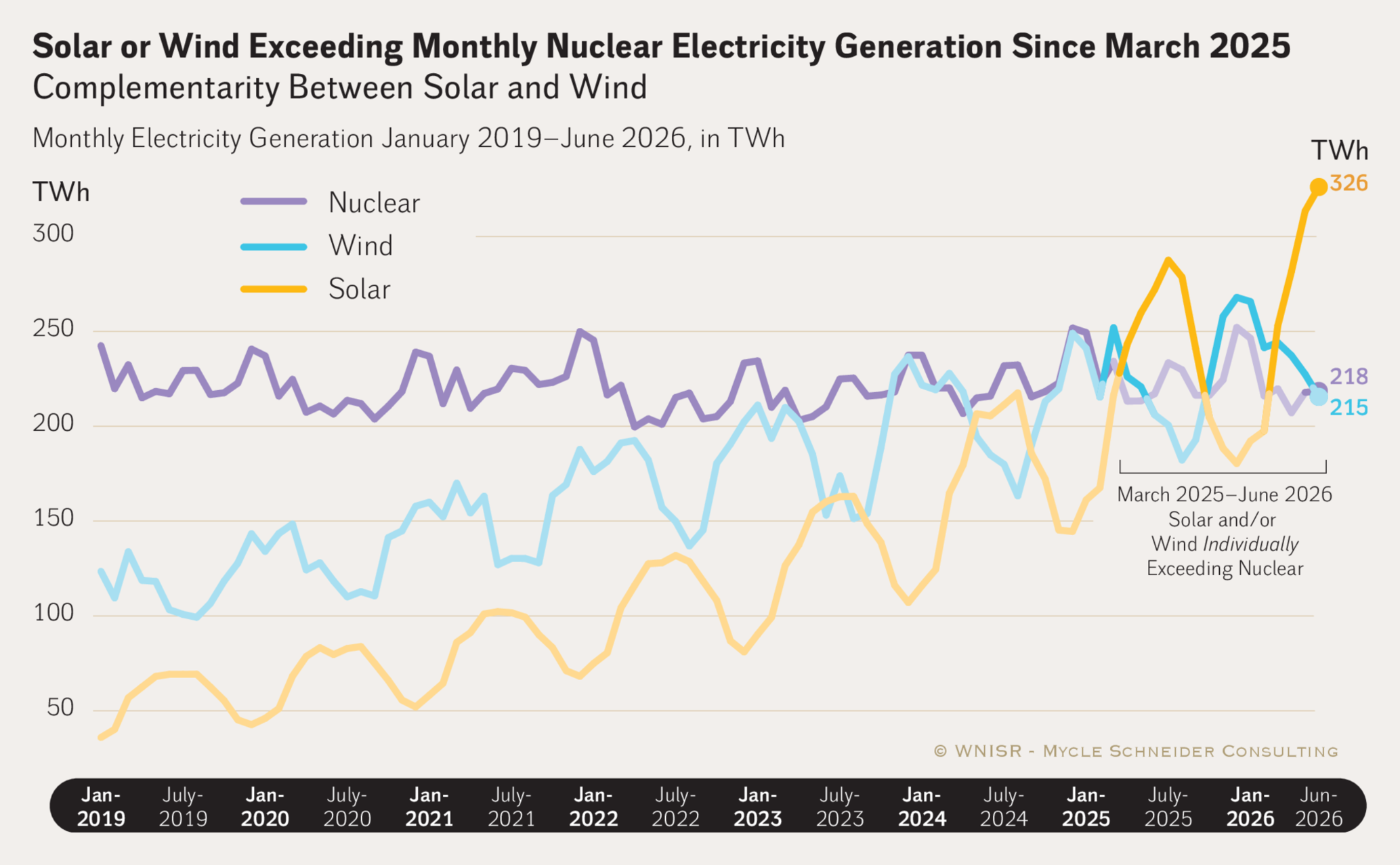
Source: EMBER, Monthly Electricity Data, July 2026
Batteries are playing an increasingly important role in the power system. In more and more electricity markets, the rapidly growing share of wind and solar-photovoltaic power, whose output depends on fluctuating natural phenomena, requires much more flexibility in the system—flexible consumption, storage, or complementary generation. The cost of this flexibility may be challenging to calculate since it may be associated with changes in consumer habits, industrial processes, or more sophisticated management of upgraded grids, and it may take time to implement such flexibility. Flexibility capacities on the other hand provide many options for profitable, sellable services. More straightforward to calculate is the cost of electricity storage in batteries, and this has declined by about two thirds over 2024–2025 alone.
Consequently, the acceleration of the battery rollout, especially large grid-connected systems, has been breathtaking. GridStatus.io is monitoring records within the North American grids in real time.2095 Batteries have been doubling power injection records to the Electric Reliability Council of Texas (ERCOT) grid between summer 2025 and summer 2026 from 6 GW to 12 GW. In California’s CAISO grid, discharges of up to 13 GW now cover up to over 40 percent of the state’s load in the early evening. Moving excess solar power into the evening is also helping reduce gas burning.
Key quantitative data for 2025 underline the overwhelming significance of photovoltaics:
- Global installed solar capacity has grown by 27.2 percent.2096 Solar electricity generation has increased by about 30 percent.2097
- Wind energy deployment has added 14 percent capacity, little over half the solar growth rate.2098 Just as in 2024, wind electricity generation in 2025 increased by close to 8 percent.2099
- Battery Energy Storage Systems (BESS) are characterized by two metrics: power capacity (GW) and energy capacity (GWh). Globally, according to the Volta Foundation, grid-scale BESS power capacity grew by 104 GW or 79 percent in 2025, exceeding the 75-percent average Compound Annual Growth Rate (CAGR) during 2020–2025 and bringing the total power capacity from less than 17 GW to just over 263 GW. BESS power capacity made up more than one tenth of all electricity generating capacity added in 2025. BESS energy capacity has grown by 257 GWh or 71 percent to reach 610 GWh. Average storage time has increased 37 percent since 2020 to about 2.5 hours for new projects.2100
- Between nuclear reactor startups and closures in 2025, nuclear added 1.5 GW net, but operational capacity shrank by 0.5 GW,2101 and electricity output grew by a marginal 0.4 percent.2102
Gross electricity generation of non-hydro renewables grew by 861 TWh or 15.9 percent in 2025 and for the first time ever entirely covered the increase—855 TWh—in global electricity production.2103
Interesting Facts from Around the Globe
In addition to the developments analyzed in this chapter, the year 2025 and the first half of 2026 have seen countless records and other remarkable events related to renewables and storage. Nuclear power, on the other hand, has been the subject of countless remarkable announcements with limited signs of a major trend shift on the ground. Here are some examples from around the globe:2104
- In France, in June 2026, solar power generation with 12 percent of total power generation exceeded hydro’s 10 percent.2105
- In Germany, in October 2025, Next2Sun commissioned a 2.8-km long installation at Frankfurt Airport of 37,000 vertical solar modules—bifacial panels oriented east-west rather than south—designed to generate up to 17.4 GWh per year.2106
- In Germany, in June 2026, solar generated 35.5 percent of total electricity, more than all fossil fuels combined (30.8 percent).
- In Hungary, in 2025, solar had a 27.3-percent share in the national electricity mix—the largest in the world. The country is building the only new nuclear power plant in the European Union.2107 Meanwhile, its Paks nuclear power plant faced operational restrictions in 2026 due to low water levels in the Danube River.
- In India, the 2025 renewable energy production growth was double the previous 2022 record.
- In the UAE, a mega solar project “is set to redefine baseload power” (dixit Wood Mackenzie). A 5.2-GW solar project, which broke ground in October 2025, will be paired with 19 GWh of battery storage in Abu Dhabi. The hybrid facility is designed to provide 1 GW of power 24/7.2108
- In the US, renewables generated over 30 percent of power in the first half of 2026. Solar had the largest growth rates year-on-year with 21.6 percent for utility-scale facilities and 13 percent for roof-top solar.2109
- In the US, in May 2026, solar overtook coal in monthly power generation for the first time.
- In California, solar’s share of total power generation went from virtually zero in 2012 to 51-percent in May 2026.
- In Texas, wind and solar met all of the 30-percent increase in power consumption between 2015 and 2025.
- In the EU, in June 2026, solar power’s share in total electricity generation exceeded 25 percent for the first time.
- Globally, in the first half of 2026, there were eight reactor construction starts, including in two nuclear countries that had not been building in decades (Canada, Hungary) and one newcomer country (Uzbekistan).
- On a global level, the IEA projects that “electricity generation from renewables is set to overtake coal-fired output in 2026.” 2110
- Global residential energy storage system (battery) shipments reached 39 GWh in the first half of 2026, up 138 percent year-on-year.2111
Statistics describing the development of electricity generation include three consecutive types of indicators—investment sums (US$ per year), generation capacities (GW added per year), and electricity generated (TWh per year)—that represent distinct steps on the path to energy transition goals. Each indicator comes with its own interpretation difficulties. Investments are an early indicator of the system’s evolution. They translate into building generation capacities. Investing in the right technology is crucial; relative costs, technological and political risks, construction times, and cost development trends can make a big difference in the selection. Investment decisions can shape infrastructure for many decades depending on the technology. Generation capacities, then, reflect past investment decisions and determine future electricity generation. Gigawatt indications per technology are not directly comparable the way dollars and euros are, since full-load hours differ between technologies, technology generations, and locations. Terawatt-hours, measuring the electricity generated, are easier to compare, but their value depends on the regularity or frequency with which they are produced.
For two decades, investments in renewable power generation globally have exceeded those in nuclear energy—which hardly changed over the past decade (see Figure 61). The majority of nuclear expenditures go into refurbishment, upgrading, and subsidizing uneconomic aging reactors (see United States Focus in particular).
According to BloombergNEF data, for the first time since 2013, investments in renewables dropped by 9.5 percent to US$690 billion in 2025. BloombergNEF notes that “dragged down by market reforms in China,” investments in solar decreased by 12 percent to US$436 billion and those in onshore wind dropped by 17 percent to US$168 billion. However, since nuclear investments also retracted by 5.8 percent to US$35.6 billion, renewables investments remain almost 20 times higher in comparison.2112
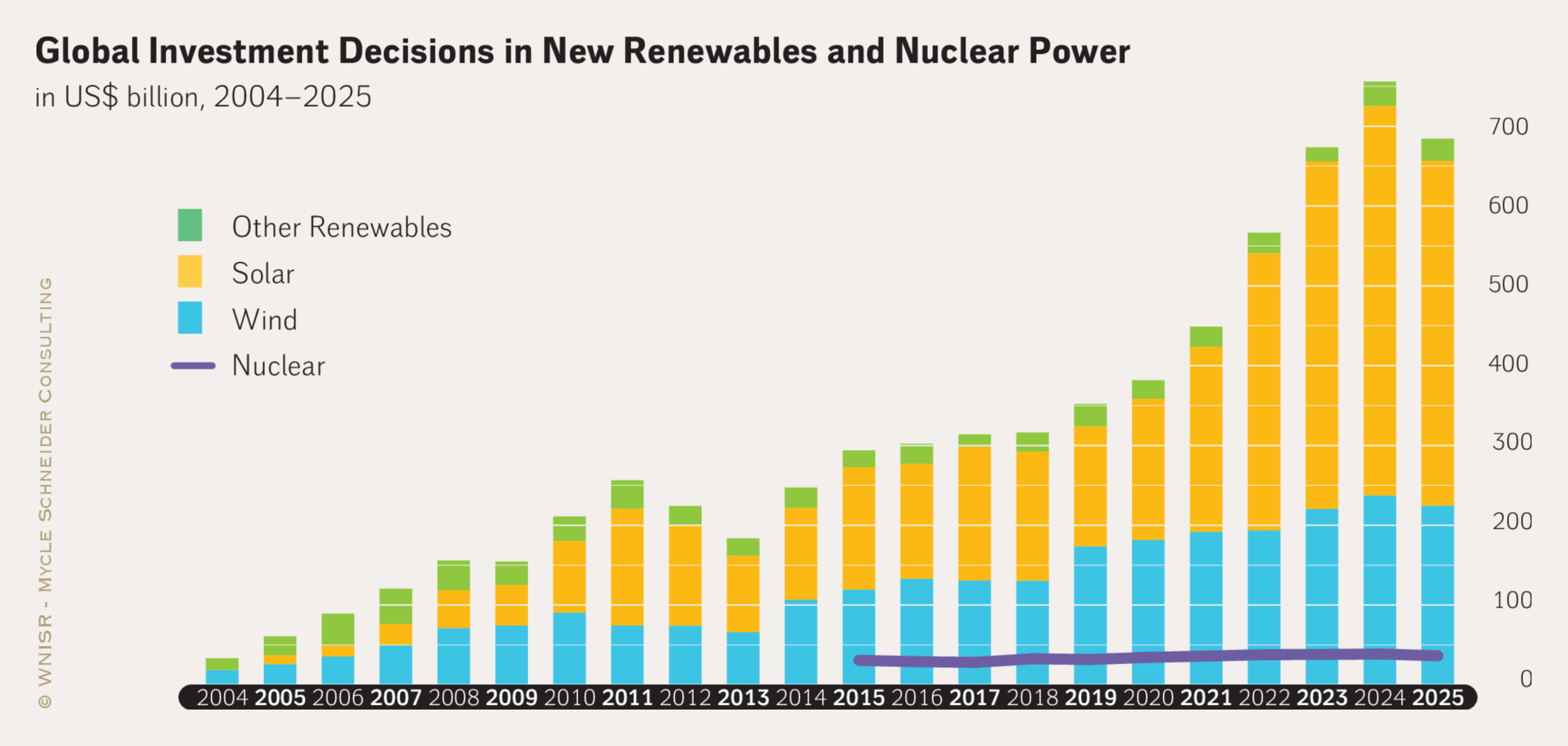
Source: BloombergNEF, 2026
Notes
- As of the 2025 edition, WNISR is using BloombergNEF for data on nuclear as well as renewables investments and is thus abandoning its own estimates of nuclear investments.
- The BloombergNEF nuclear investment data series is only available from 2015 onwards.
- BloombergNEF nuclear power investment data covers reactors under construction and major refurbishment in Canada. But it excludes capex investment during refueling outages and costs associated with restart attempts of retired reactors, such as those in Japan and the US. Whereas WNISR’s nuclear investment numbers were based on the total estimated investment sum and allocated to the construction-start year, BNEF has opted to equally spread the expenditure over the entire construction period. As shown in WNISR2024, when cumulated over several years, BloombergNEF and WNISR analyses were in the same order of magnitude.
Electricity Generation Cost Development
Lazard’s annual Levelized Cost of Energy (LCOE) analysis provides one of the most referenced analyses of electricity costs by different technologies, although it primarily relies on US data. As Figure 62 shows, solar and onshore wind keep delivering far more competitive electricity than gas and coal, not to mention nuclear, whose costs are about three times higher.
The newest edition, released in mid-2026, shows that average electricity costs from all sources have increased to varying degrees in 2025—utility solar by 19 percent, onshore wind by 11.5 percent, gas by 15.4 percent, coal by 2.5 percent, and nuclear by 19.4 percent.
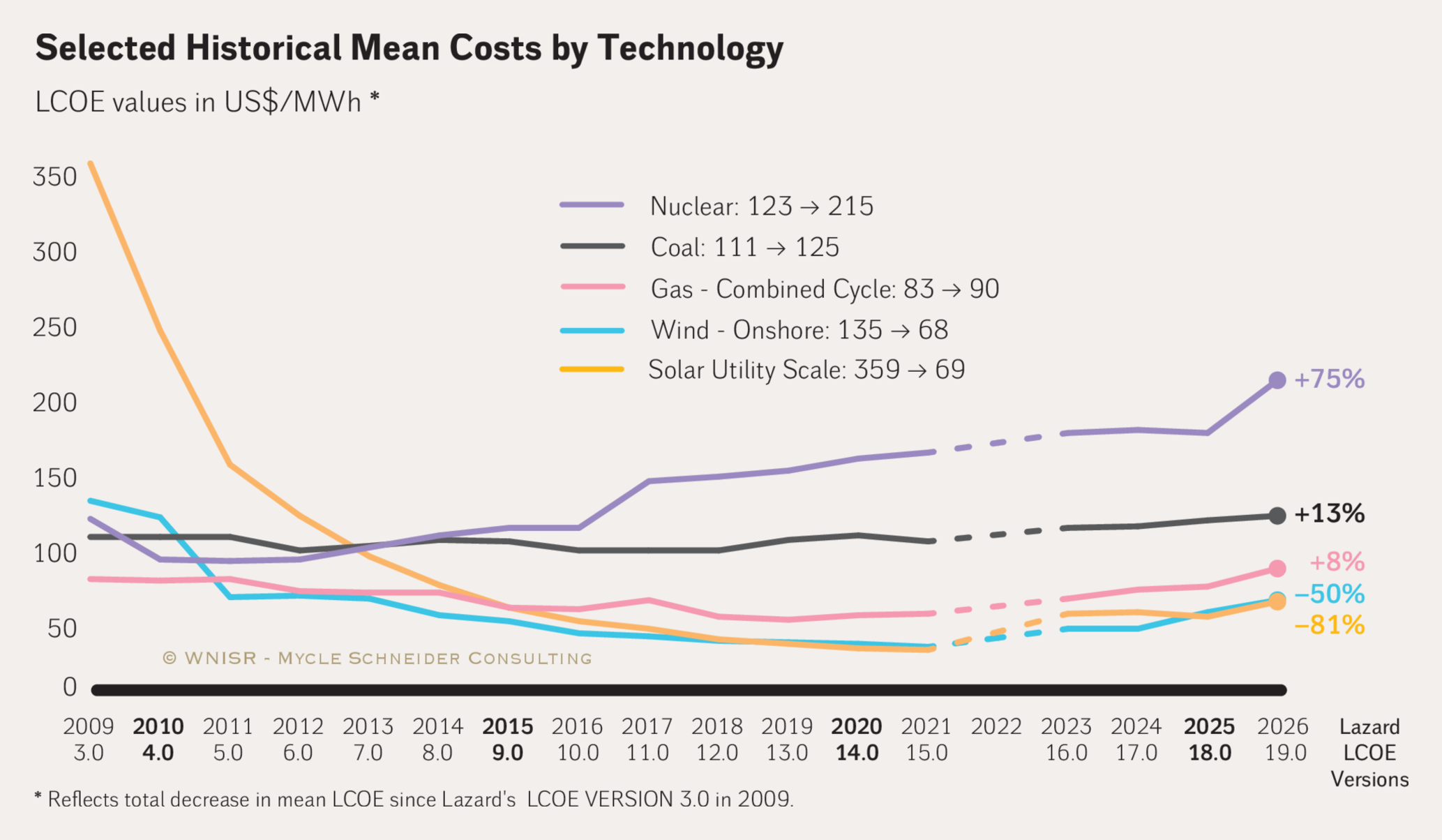
Source: Lazard Estimates, 2026
Notes: LCOE: Levelized Cost of Energy
*This graph reflects the average unsubsidized LCOE values in current dollars (not adjusted for inflation) for a given version of LCOE study. It primarily relates to the North American energy landscape but reflects broader, global cost developments.
While Lazard’s reporting is based on US markets where import tariffs for Chinese manufacturers affected local prices more than elsewhere, other sources based on other markets report either the stabilization or an ongoing decline in the costs of solar PV and wind. IRENA, for example, reports solar stabilizing at an average LCOE of US$44/MWh, onshore wind falling to US$33/MWh—significantly below the Lazard estimates, and offshore wind declining to US$78/MWh.2113
Various authors have developed different methods to calculate “integration costs” or “firming costs” for variable2114 energy sources that are not dispatchable. They are usually not taken into account for technologies that are deemed dispatchable (e.g., nuclear power)2115 but have their own level of intermittency. The problem is that such costs depend on the specific conditions of the grid in which these sources are to be integrated—specifically, the temporal structure of electricity demand (which can vary widely due to building characteristics, peak-shifting technologies or behaviors, etc.) and the costs of flexibility required from other sources/sinks. Moreover, the yield of a solar or wind plant depends on its specific location. Therefore, measures such as the VALCOE—where VA stands for Value Adjusted—of the U.S. Energy Information Administration (EIA) vary across different countries and change over time (see Challenges of Integrating Nuclear Power into the Energy System in WNISR2025).
The storage (or equivalent flexibility) required by a specific generation profile to deliver a constant output for a defined fraction of the year is a more useful benchmark, as it does not depend on the specifics of the grid. The disruptive battery cost decline in 2024 (20 percent) and 2025 (45 percent), according to BloombergNEF, represents a return to the longer-term price curve, after the lithium supply chain finally adapted to the rapid growth in demand that had led to a temporary shortage and price increase in 2022 (see Figure 63).2116
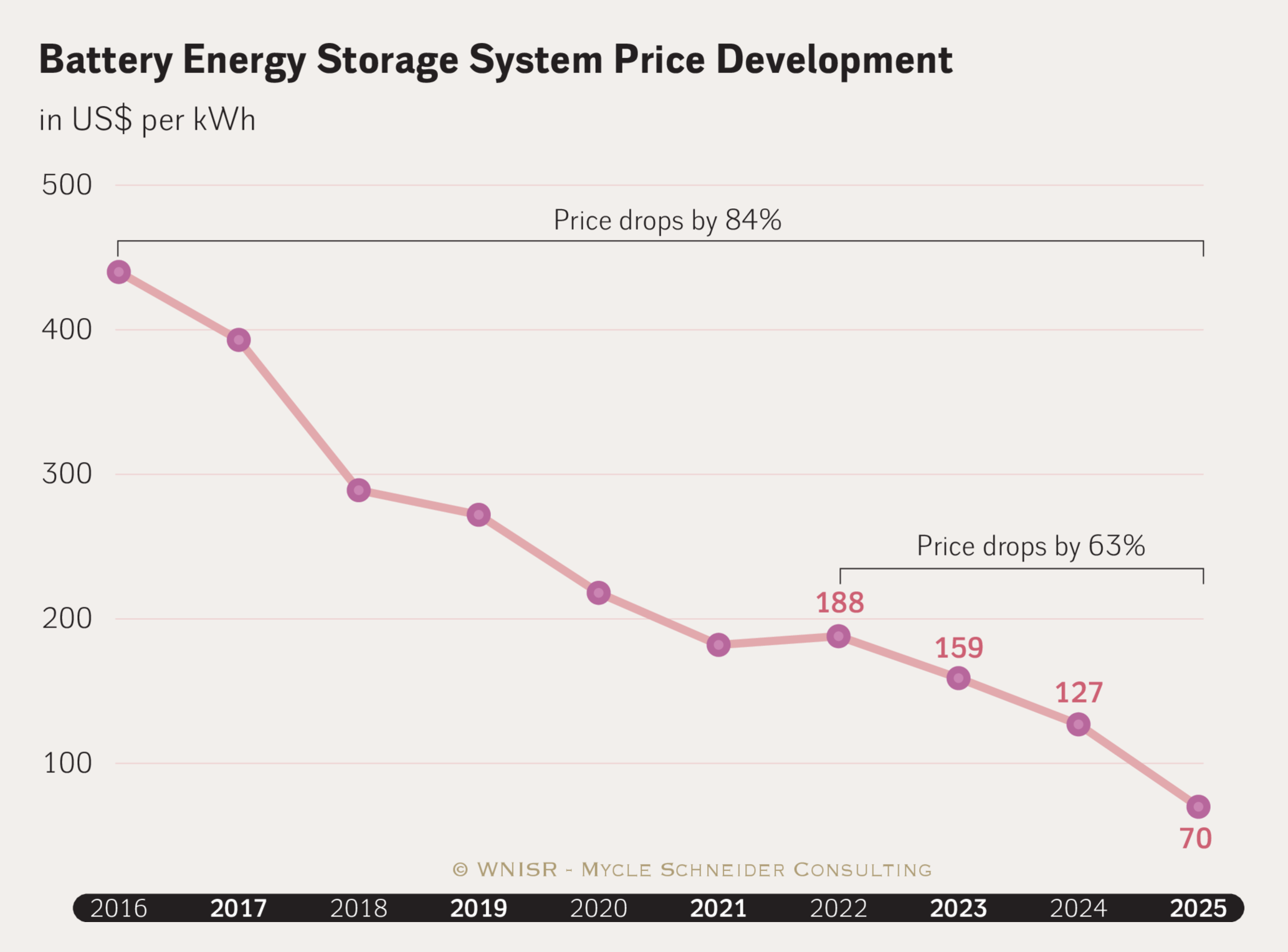
Source: BloombergNEF, 20252117
With upcoming new technologies and increasing production—still mainly driven by the growth of electric vehicle markets—battery costs are expected to further decrease for many years to come. As in the past, the battery learning curve will most probably be steeper than that of photovoltaics, resulting in an accelerated cost decline of round-the-clock solar power. This will affect not only utility-scale installations but also small-scale installations behind the meter.
Installed Capacity and Electricity Generation
In 2025, installed global electricity generation capacities increased by a slightly smaller percentage than the record increase of the year before. Nuclear power stagnated, and its operating capacity even showed a slight decline, but its renewable competitors2118 did much better:
- Solar power capacity increased by 510 GW to 2,383 GW, a 27-percent rise year-on-year, lower than the 32-percent growth rate of 2024 but in line with the average annual growth for 2014–2024.
- Wind power capacity jumped by a record 159 GW to 1,291 GW, a 14-percent increase year-on-year and better than the 2014–2024 average annual growth of 12 percent per year; installed global wind capacity doubled in just six years.
- Operating nuclear power capacity marginally declined by 0.5 GW to 368.6 GW in 2025, while installed capacity—including reactors in long-term outage—increased by a marginal 1.5 GW, a 0.4 percent increase over the year, to 399.5 GW. (See General Overview Worldwide)
- Grid-scale battery power capacity grew by 104 GW—for the first time by more than 100 GW in a single year—to reach 279 GW.
Generation capacities of these different technologies cannot be simply compared or added because their load factors (percentage of time they are running on full capacity) are different. One must therefore look at the electricity generated for understanding the proportions. Figure 64 shows the long-term dynamics of both. The different growth curves reflect the exponential growth of wind and solar—with wind starting first and solar catching up with a higher growth rate—in contrast to nuclear, which has essentially remained constant for much more than this quarter of a century.
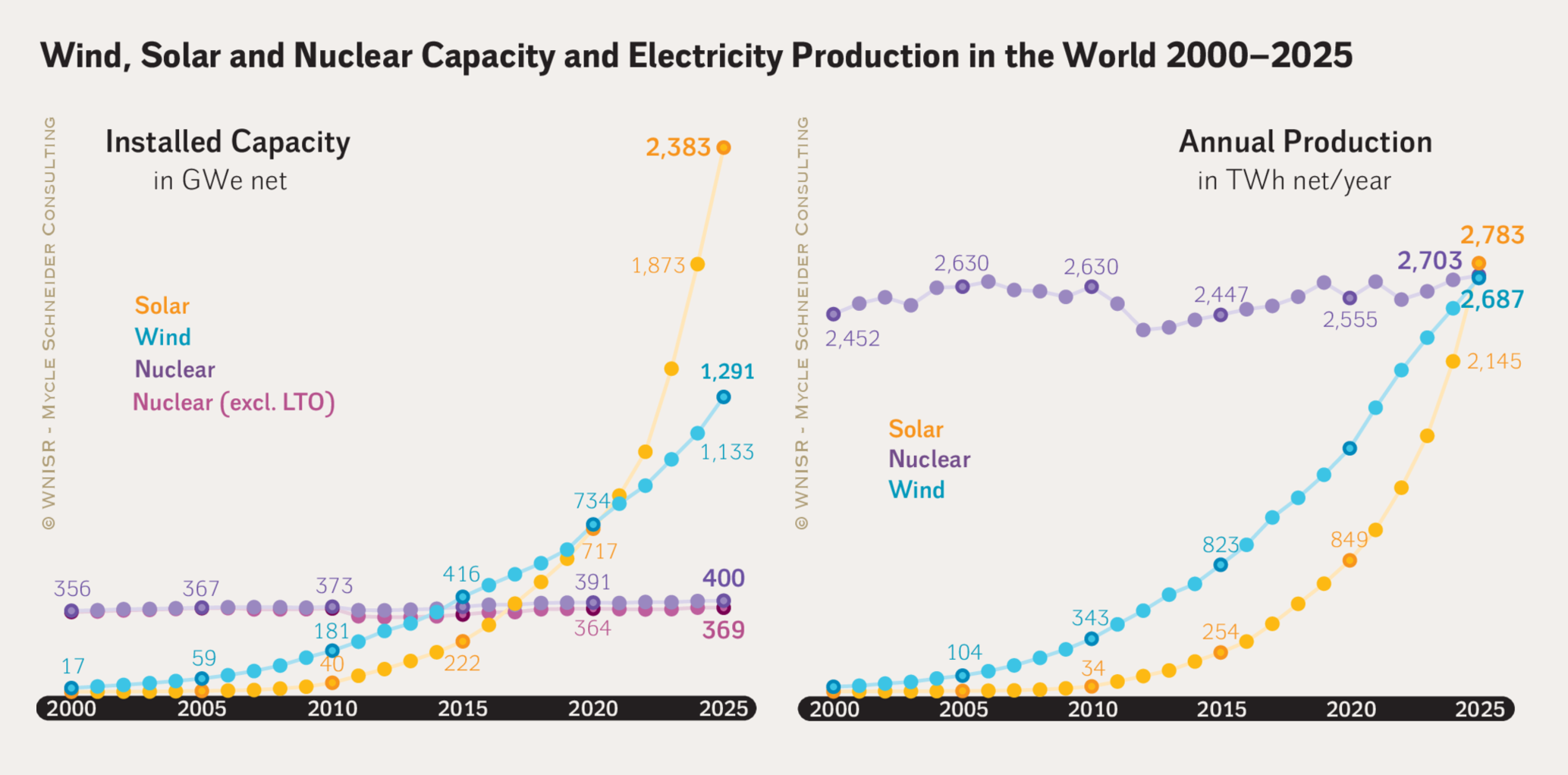
Sources: WNISR with IAEA-PRIS, IRENA, Energy Institute, 2026
Notes pertaining to figures comparing renewable and nuclear capacities and production (Figure 64, Figure 65, Figure 66, Figure 67, Figure 70, Figure 71, Figure 72, Figure 73, Figure 75 and Figure 76)
Unless otherwise indicated:
- production data for renewables and nuclear are in net TWh, from Energy Institute, “Statistical Review of World Energy 2026 – Consolidated Dataset”;
- gross production numbers from Energy Institute are used for comparisons with fossil fuels (for which net data are not available);
- shares in total generation are based on gross data;
- numbers for installed capacity for renewables are from IRENA, and
- nuclear operating capacity (i.e. excluding reactors in LTO or Long-term Outage) and installed capacity (including reactors in LTO) are compiled by WNISR based on IAEA-PRIS.
Over the past decade, non-hydro renewables—mainly wind, solar, and biomass—have increased their power generation by 245 percent while nuclear output gained less than 9 percent (see Figure 65).
Charting the evolution of the various sources’ relative shares in world gross electricity generation since 2000, Figure 66 shows that coal’s part peaked in 2007 at 41 percent and declined to 32.6 percent in 2025, while the share of renewables (including hydro) increased from 19.4 percent in 2010 to 33.4 percent—outpacing coal for the first time—in 2025. Over the same 15-year period, the nuclear share fell by 4 percentage points from 12.8 percent to 8.8 percent (see Figure 66), the lowest level in four and a half decades.
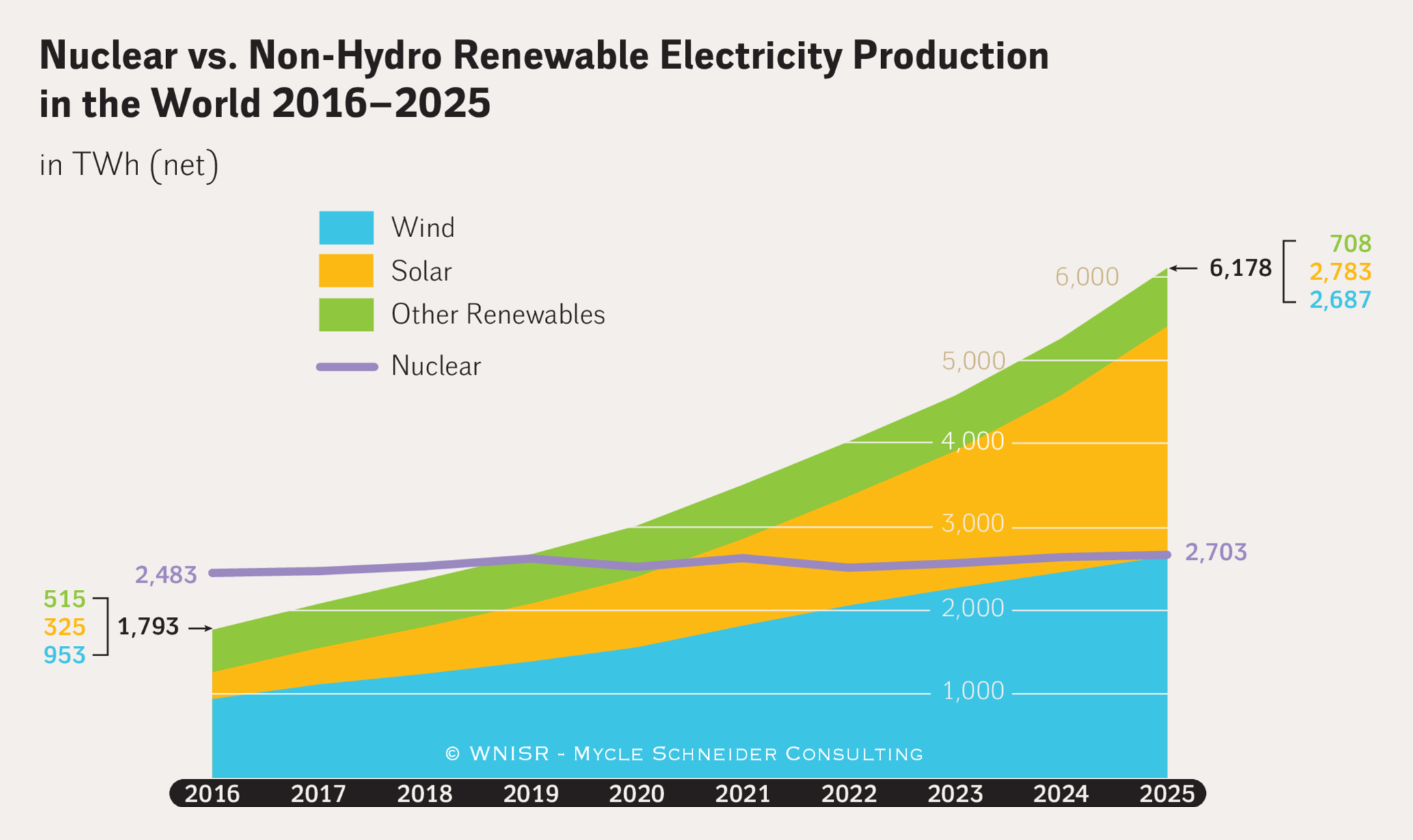
Sources: WNISR with IAEA-PRIS, IRENA, Energy Institute, 2026
See note under Figure 64.
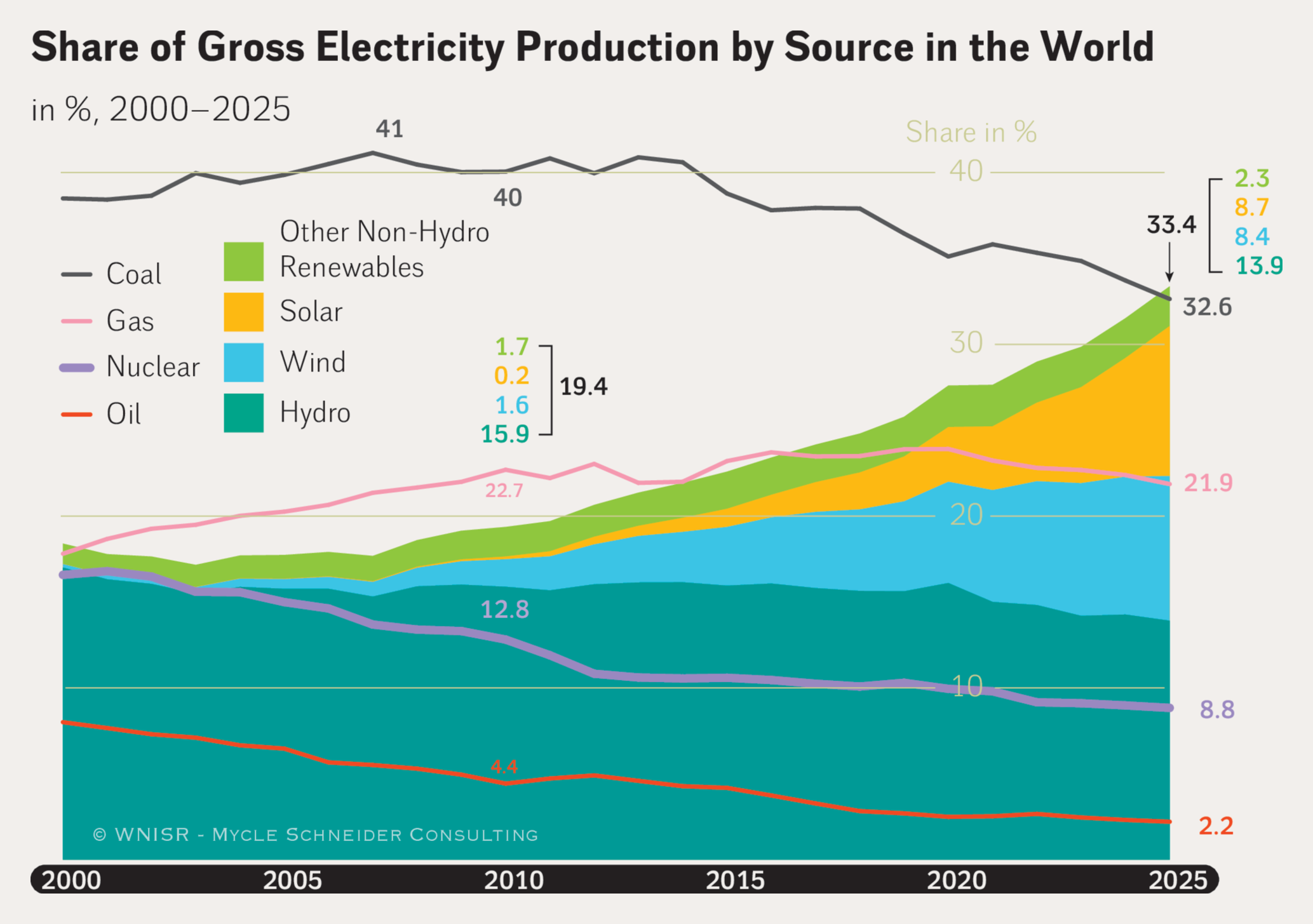
Source: Energy Institute, 2026
See note under Figure 64.
In 2025, global electricity generation evolved as follows:2119
- Solar power generation increased by 29.7 percent or 638 TWh, reaching 2,783 TWh net or 8.7 percent of total gross generation. This is the first time that solar generation exceeds wind as well as nuclear output on a net annual basis.
- Wind power generation grew by 7.9 percent or 197 TWh, reaching 2,687 TWh net or 7.9 percent of total gross.
- Non-hydro renewables generated 6,270 TWh gross (6,178 TWh net), an increase of 861 TWh gross or 15.9 percent, and for the first time, renewables including hydro contributed one third of the total global generation.
- Hydro power generation was stable at 4,479 TWh gross (4,434 TWh net) contributing 13.9 percent to the total.
- Nuclear reactors increased production by 30 TWh gross or 1.1 percent and generated 2,845 TWh gross (2,703 TWh net).
- Notably, fossil fuel power generation—from oil, gas, and coal plants combined—fell remarkably by a total of 51 TWh, but it still cumulated 18,263 TWh or 56.7 percent of the electricity production in the world.
- Total global gross electricity generation increased by 2.7 percent or 855 TWh to 32,202 TWh.
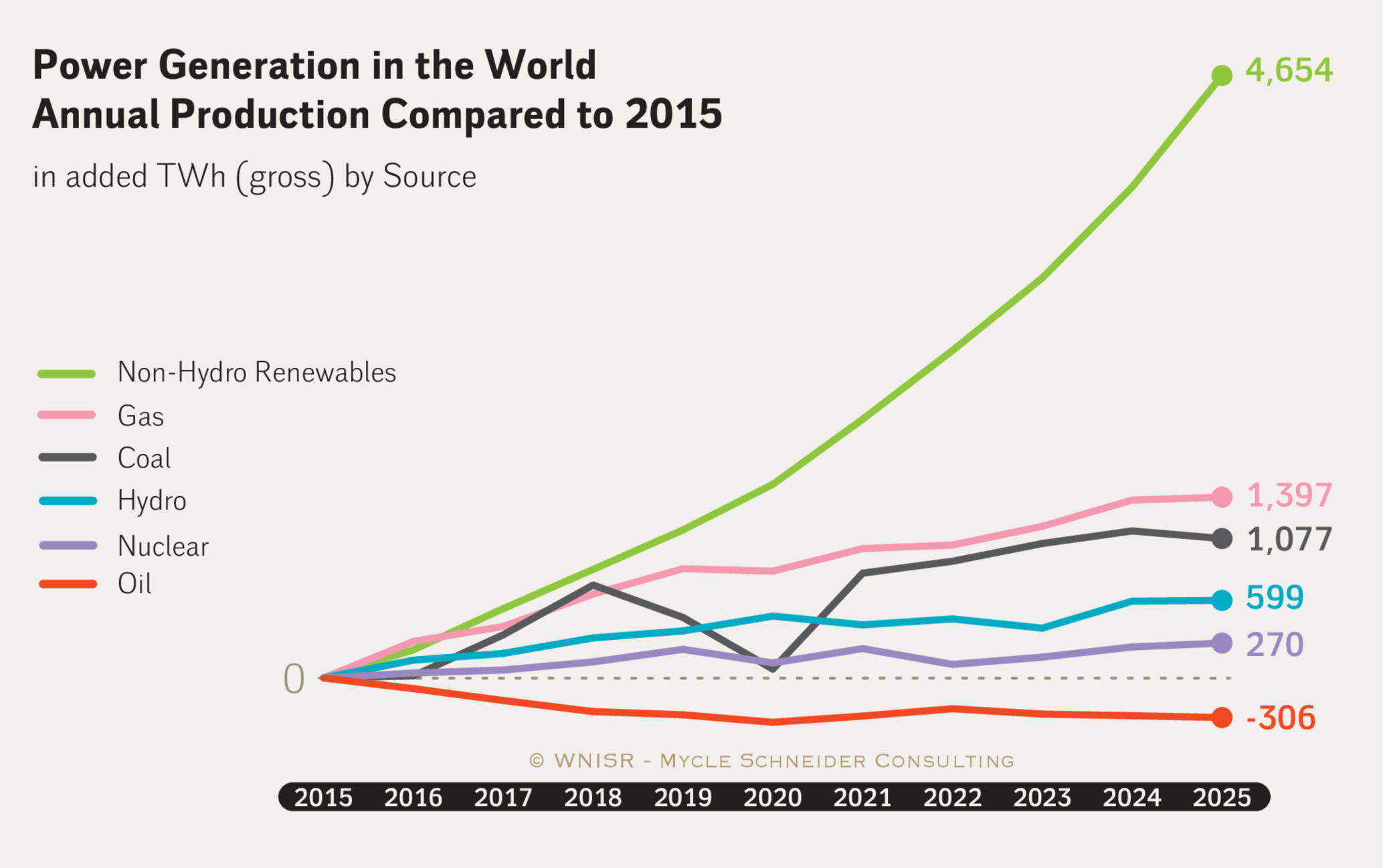
Source: Energy Institute, 2026
See note under Figure 64.
This means that in 2025, for the first time ever, the additional non-hydro renewable electricity generation, 861 TWh in absolute terms, entirely covered the growth in total global gross electricity production, which amounted to 855 TWh. Over the past decade (2015–2025), non-hydro renewables increased annual production by 4,654 TWh, covering almost 60 percent of a total net increase of 7,876 TWh, reflected in Figure 67.
Photovoltaics and Batteries—The Game Changer Association
The recent solar boom noticeably cooled in the first half of 2026 with global additions estimated at 169–187 GW compared to 312 GW in the first half of 2025. The drop is mainly attributable to China, where “the change in remuneration terms brought into effect by the Chinese government in mid-2025 is expected to lead to significantly lower additions of new solar capacity across all market segments in 2026,” according to SMA Solar Technology’s half-year report.2120
Widespread expectations that the expansion of renewables, especially solar, will slow down over the longer term are rooted in the fact that many grids still struggle to provide sufficient flexibility for high shares of renewables. The number of hours with negative or close to zero power prices have increased significantly in many countries, especially all over Europe. Negative power prices indicate a temporary overproduction, which cannot be avoided at all times. However, if they last for too many hours, they indicate a system’s difficulties in coping with fluctuating renewables, and they reduce the income of solar installations in particular. Lawmakers and grid operators in various markets have responded very differently to these challenges. Those reluctant to embrace change call for a slowdown in the growth of renewables and are slow to pave the way for additional flexibility; France is a typical example (see France Focus). Others adapt market and connection rules to allow potential flexibility sources, such as storage, to participate in electricity markets and in other ways encourage grids to catch up with the fixed-price, nearly-zero-operating-cost renewable supplies that need to be matched with customers. Batteries offer lucrative opportunities to buy negative-cost or cheap renewable power, sell it on-peak at high prices, and meanwhile sell valuable ancillary services such as frequency and voltage stabilization. Certain US states like Texas and California are good examples of surging deployment of batteries and their increasing role in the grid.
The rapid decline in battery prices (see Figure 63) increasingly looks like a game changer that will remove hurdles for a sustained rapid growth of PV. Starting at negligible levels six years ago, the deployment of stationary Battery Energy Storage Systems (BESS) has increased significantly since then (see Figure 68).
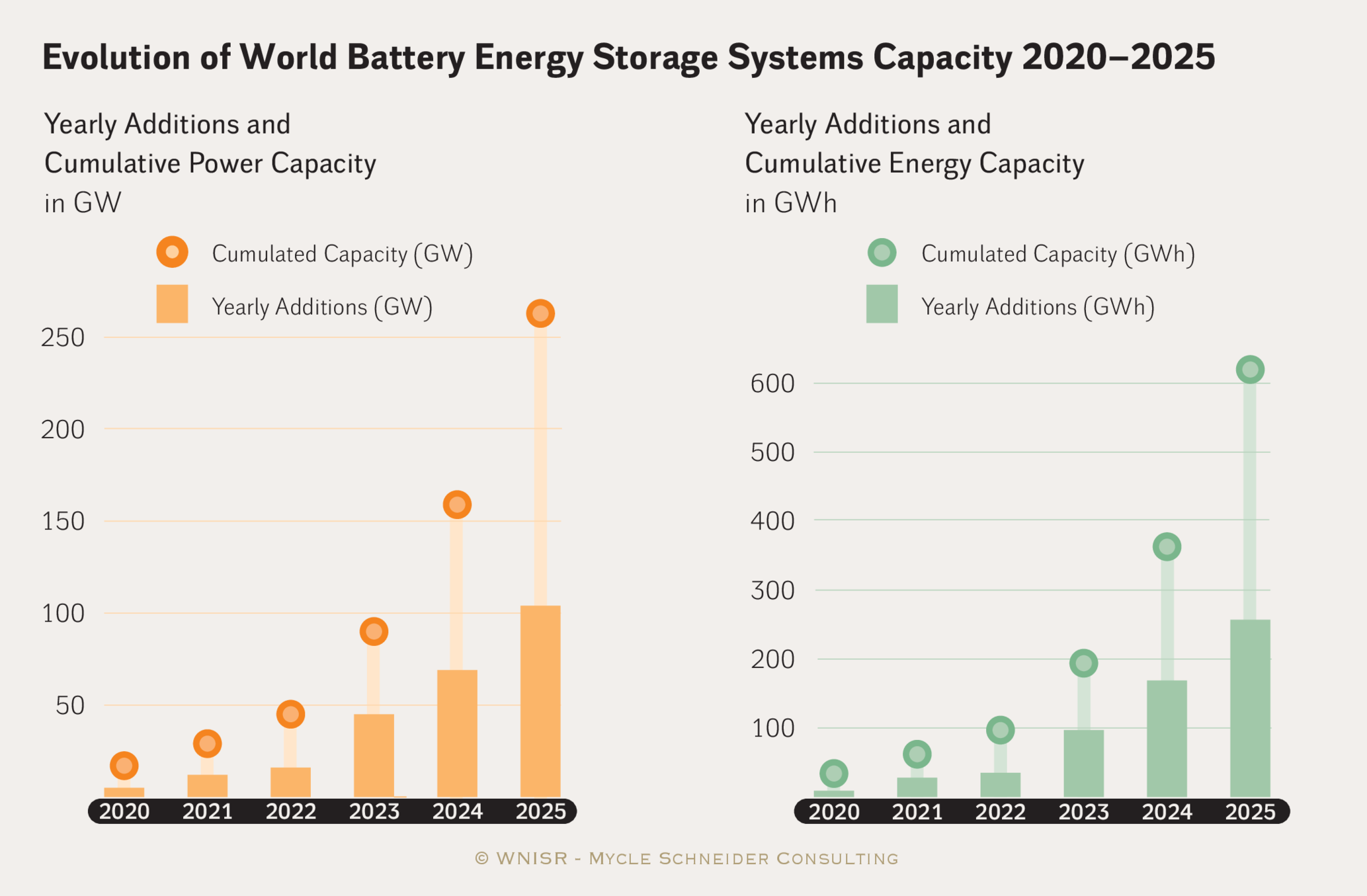
Sources: Wood Mackenzie, BloombergNEF, IEA, based on Graphic by PowerSwitch/Volta Foundation, 20262121
The acceleration of grid-scale BESS installations is impressive. Over 78 percent of the overall BESS capacity has been added in the three years 2023–2025. In 2025 alone 104 GW of capacity and 257 GWh of BESS energy were connected to the grid.
In the first half of 2026, global BESS shipments increased by 71 percent compared to the first half of 2025 to reach over 461 GWh. China’s share of the market has been declining from just over half to about 44 percent, deploying still impressive 202.5 GWh in the first six months of 2026, 49 percent more than over the same period in 2025.2122
This overall picture, however, conceals a more complex dynamic across different markets. Large grid-scale batteries in 2025 made up over four-fifths of the world market, while smaller batteries in the commercial, industrial, and residential sectors—often behind the meter, appealing to other customers and impacting the system differently—were less than one-fifth.2123 Both the overall adoption of batteries and the proportion of those in front and behind the meter differ strongly between regions.
While globally, current storage capacity makes up for only a fraction of average daily solar power production, in some regions, batteries are already starting to have a considerable impact. As mentioned above, the public grids in California and Texas, with the assistance of BESS, have successfully shifted solar electricity generated around noon into the evening hours.
BESS refers to stationary systems only. Yet about one fourth of all car sales in the world in the first half of 2026 were electric, rapidly expanding what will soon be an immense resource of batteries-on-wheels.2124 Most new electric vehicles (cars, trucks, buses, etc.) are designed for smart power exchanges with the grid, charging when power is cheap and abundant, then selling back electricity (and other services) when that’s profitable and the vehicle is parked. Many new business models and institutional structures are rapidly emerging to exploit this potential. There may soon be a flood of batteries that could reshape grid operations and economics before a new reactor could even be built. Meanwhile, similar forces are at work with stationary storage in buildings, which use over half the world’s electricity and close to three-fourths of the electricity in the US.
While cost-effective utility-scale storage may remove barriers for the further growth of PV in many electricity markets, small-scale storage behind the meter may become even more important on a global scale.
Recent massive cost reductions for batteries and energy management systems have been game-changers. They enable much higher rates of self-consumption, making prosumers more independent of public policies governing feed-in tariffs and of grid companies that are late to adapt to renewable energies. There are first signs that this could lead to a surge in PV, even where governments and incumbent utilities are reluctant to embrace new renewables technologies.
Cumulative PV installations behind the meter never seemed to be of interest, but they are starting to get more attention with the prospect of self-consumption rates rising massively with the help of batteries. IEA’s PV observatory PVPS estimates that about 55 percent of all PV capacity additions in 2025 were decentralized while around 43 percent were utility-scale.2125
However, all these figures need to be taken with a grain of salt. Statistics concerning rooftop installations and, more so, those concerning electricity generation and self-consumption are not equally reliable in all countries.
A prominent example of misinterpretations is the case of Pakistan, where a mysterious drop in power consumption despite economic growth was later explained by analyzing import statistics: private, non-registered PV installations had allowed for considerable self-consumption that did not pass through the public grid. With growing shares of photovoltaics behind the meter, statistics that reflect only what happens on the public grid increasingly reveal only one part of the story, making forecasts more difficult.
According to EMBER, between the beginning of 2017 and mid-2026, Pakistan has imported a cumulated total of more than 58 GW of solar panels from China—40 GW (69 percent) of that in the two and a half years from 2024 to mid-20262126—and has turned into the second largest single country import market behind the Netherlands, which acts as a hub for Europe.2127 How many of these panels were installed in what segment of the market cannot be determined with certainty, but there is no doubt that a large majority ended up in roof-top installations that are not connected to the grid.
Figure 69 illustrates how fast the deployment has advanced; the first picture from May 2022 does not show any panels whereas most roofs have a PV installation in September 2025. Solar power production achieved an 85-percent annual growth rate to reach an estimated 36.3 TWh net in 2025. Solar generation outpaced nuclear’s net output of 22.5 TWh by 61 percent and became the country’s largest power source contributing an estimated 21.6 percent to total gross electricity generation.2128
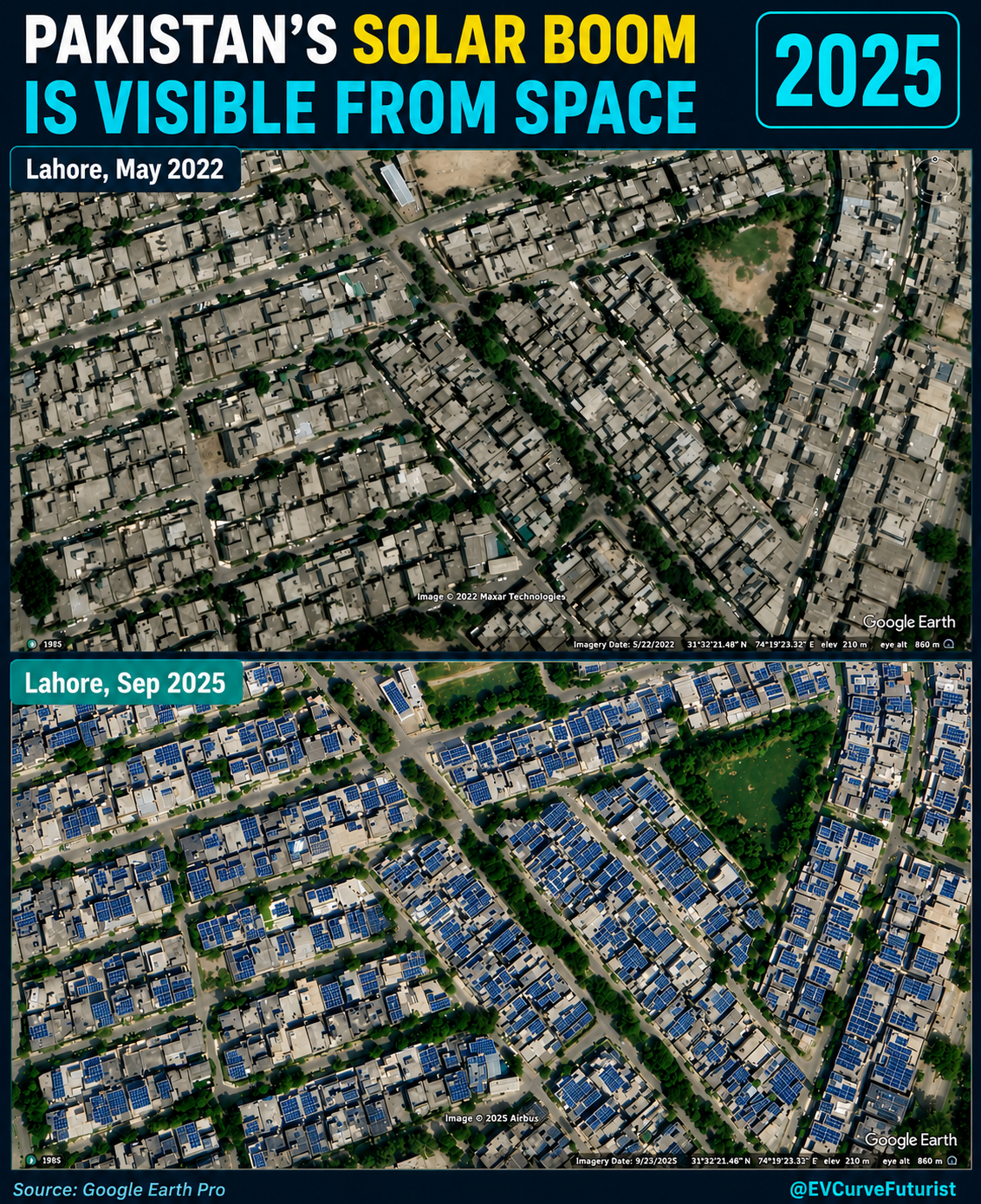
Source: Courtesy of Chris Meder, via Google Earth Pro, 2026
Status and Trends in China, the European Union, India, and the United States
China dominates the world of solar and wind power in a double sense: It dominates the value chains for producing solar and wind power equipment on the global markets, and it dominates the deployment of solar and wind power with outstanding numbers at home.
Solar and wind together generated about five times more electricity than China’s nuclear fleet.
In 2025, China alone accounted for 60 percent of global solar capacity additions, similar to the 59 percent in 2024,2129 and its estimated 314 GW (+35 percent) of new capacity brought the total to some 1,200 GW. Solar power generation outpaced wind output for the first time and by a big margin. While wind turbines generated 130 TWh more electricity than in the previous year to provide 1,117 TWh, solar output soared by a breathtaking 40 percent from 831 TWh to 1,162 TWh. In contrast, China’s nuclear reactors produced 461 TWh, up 33 TWh (7.6 percent). Thus, solar and wind together generated about five times more electricity than China’s nuclear fleet. See Figure 70.
In the first half of 2026, solar capacity additions dropped by around two-thirds to 72 GW compared to 212 GW in the first half of 2025. The main reason is that regulations changed in June 2025 from fixed price feed-in tariffs to market-based price calculations leading to a rush of projects before the reform took effect.2130
Since 2010, the output of solar increased by a factor of over 1,000, wind by a factor of 23, and nuclear by a factor of 6.5. (see Figure 71).
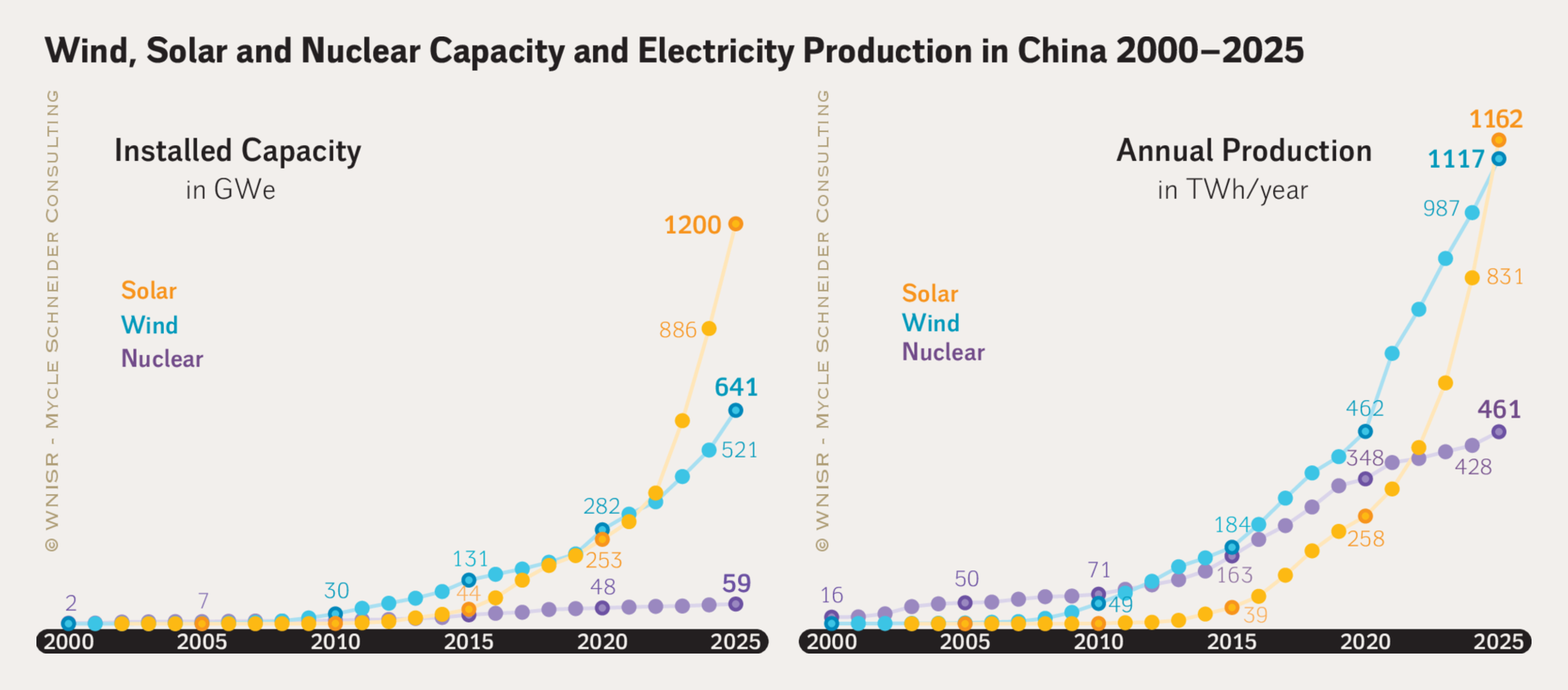
Sources: WNISR with IAEA-PRIS, IRENA, Energy Institute, 2026
See note under Figure 64.
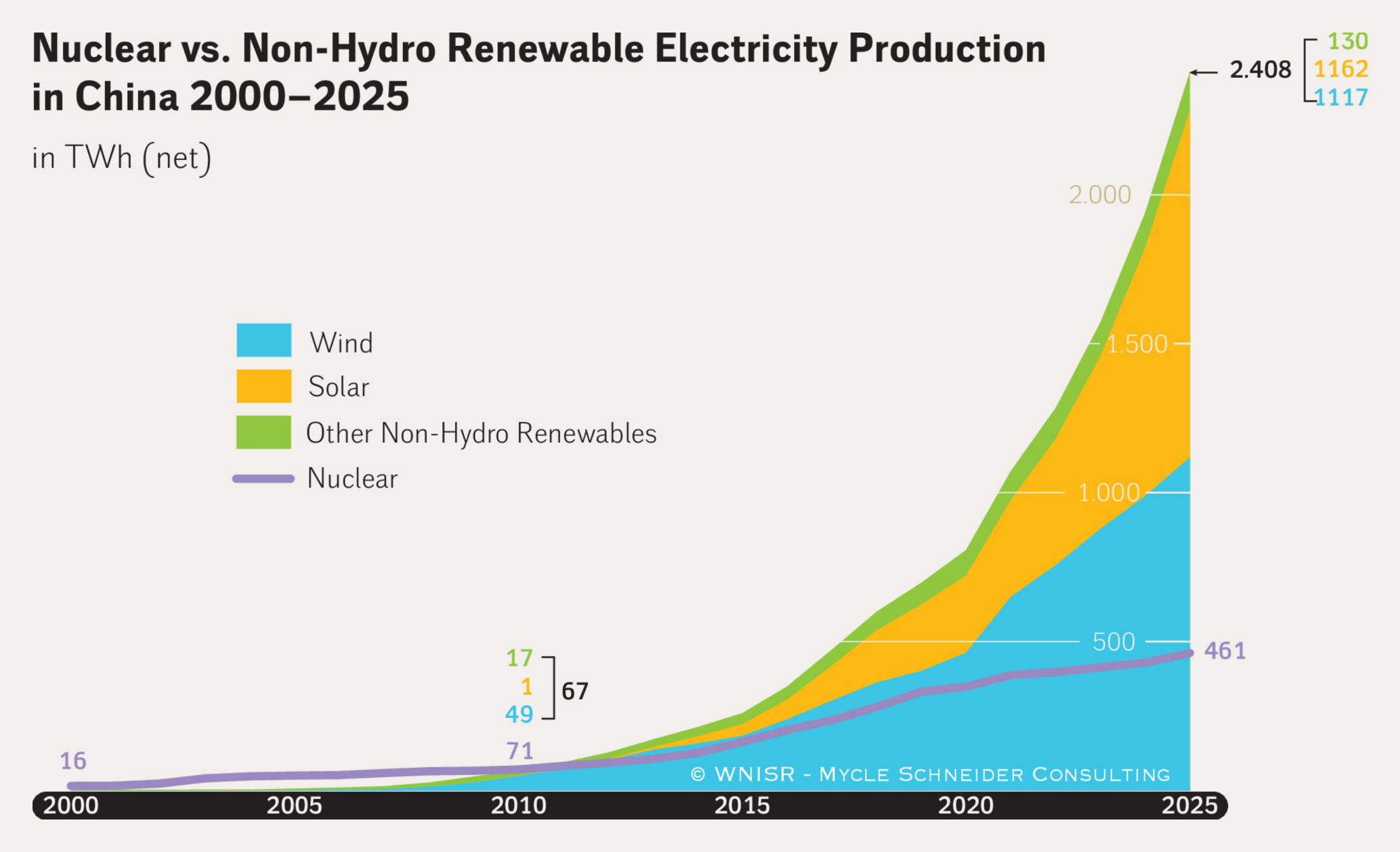
Source: Energy Institute, 2026
See note under Figure 64.
As Figure 72 illustrates, compared to overall electricity generation, the share of nuclear power has even declined in recent years. After reaching its apex in 2021 with 4.8 percent—about half of the global value—the share of nuclear power dropped by 0.1 percentage points per year to 4.5 percent in 2024 before regaining 0.1 percentage points in 2025. It is also remarkable that the share of coal—while still excessively high—has declined by more than 25 percentage points, from over 80 percent in 2007 to less than 55 percent in 2025.
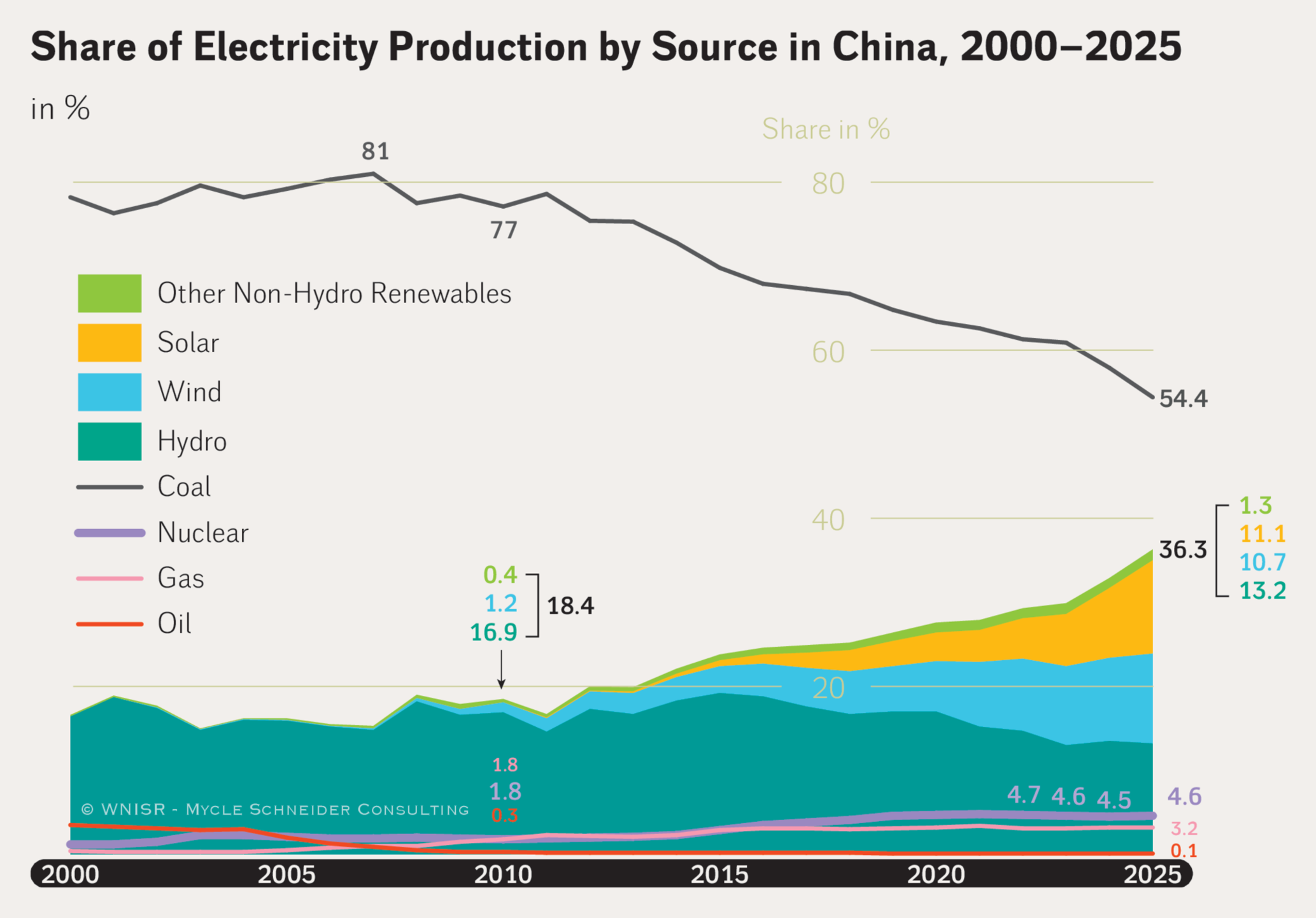
Source: Energy Institute, 2026
See note under Figure 64.
For more than a decade now, China has made considerable efforts to also lead in the battery space, first by electrifying two-wheelers, then by deploying electric buses and cars, and more recently by entering the stationary electricity storage business. Volta Foundation’s Battery Report 2025 bluntly states: “Chinese battery enterprises control the complete industry chain from materials to batteries, with obvious cost and technology advantages.”2131 Chinese BESS overseas sales in the first half of 2026 are estimated to have increased by over 83 percent year-on-year while domestic additions have been down by 18 percent.2132 The decline in the domestic market is compensated multifold by sales on the international market. Batteries will likely further boost the adoption of solar power globally.
As Figure 73 illustrates, in comparison with the corresponding graphs for China, India, and the US, renewable energies took off much earlier in the EU than in other continents. However, growth has not been nearly as steep as in China.
The year 2025 was mediocre for wind whose output slightly dropped over the previous year but still contributed 17 percent to the overall electricity generation, while solar contributed 13 percent gaining two percentage points. Nuclear power still outpaced both solar and wind individually with a stable 23 percent share, of which 60 percent was generated in one country, France. The wind plus solar contribution of 30 percent to the total electricity production, however, not only outcompetes the nuclear share in the EU, but is also much higher than in China (22 percent), the US (18 percent), or the global average (17 percent). Figure 74 shows how the growth of renewables is bringing down the consumption of fossil fuels. For the second year in a row, solar and wind generated more power in the EU than all fossil fuels combined.
The EU’s nuclear power generation increased by a marginal 1.5 TWh or 0.2 percent. As France’s nuclear output increased by 9.1 TWh,2133 nuclear production declined by around 7 TWh in the rest of the EU, following a drop of almost 12 TWh in 2024.
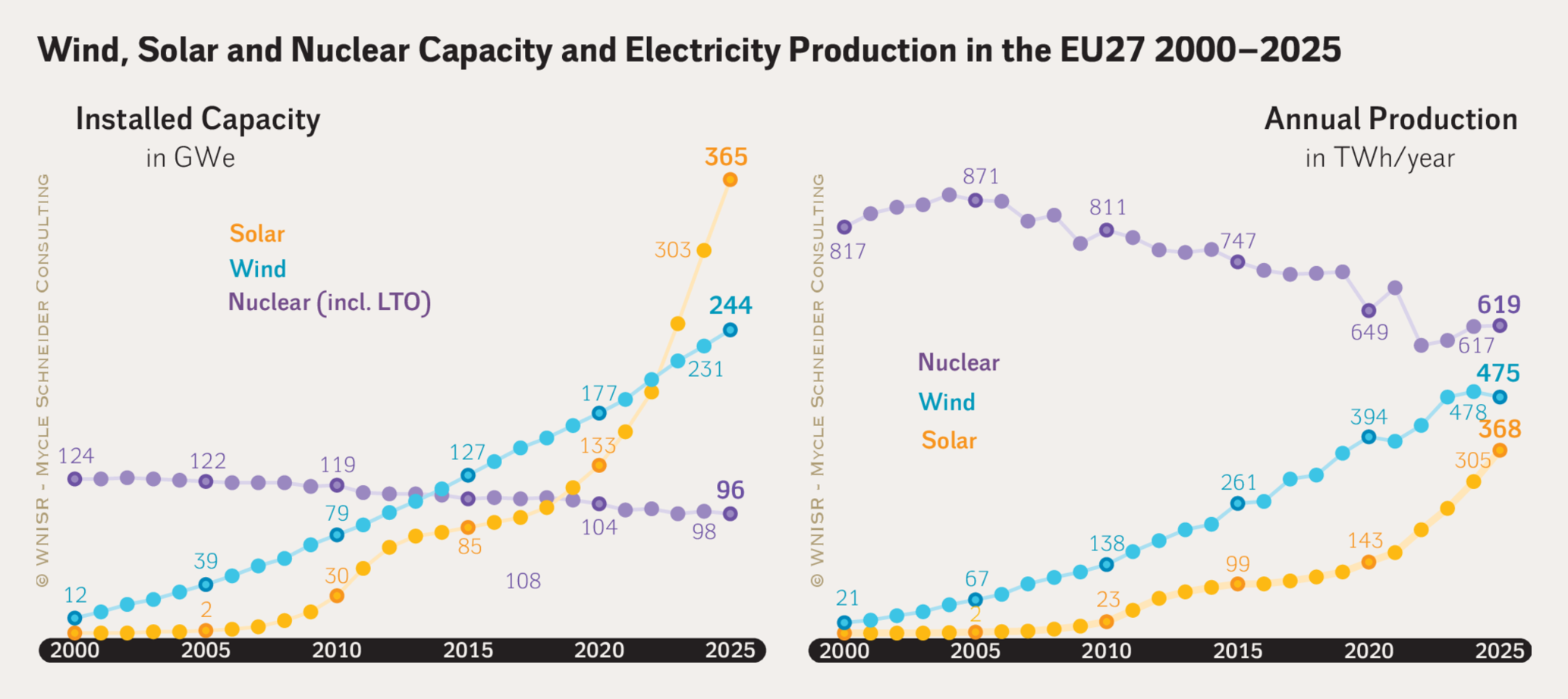
Sources: WNISR with Energy Institute, IRENA, IAEA-PRIS, 2026
See note under Figure 64.
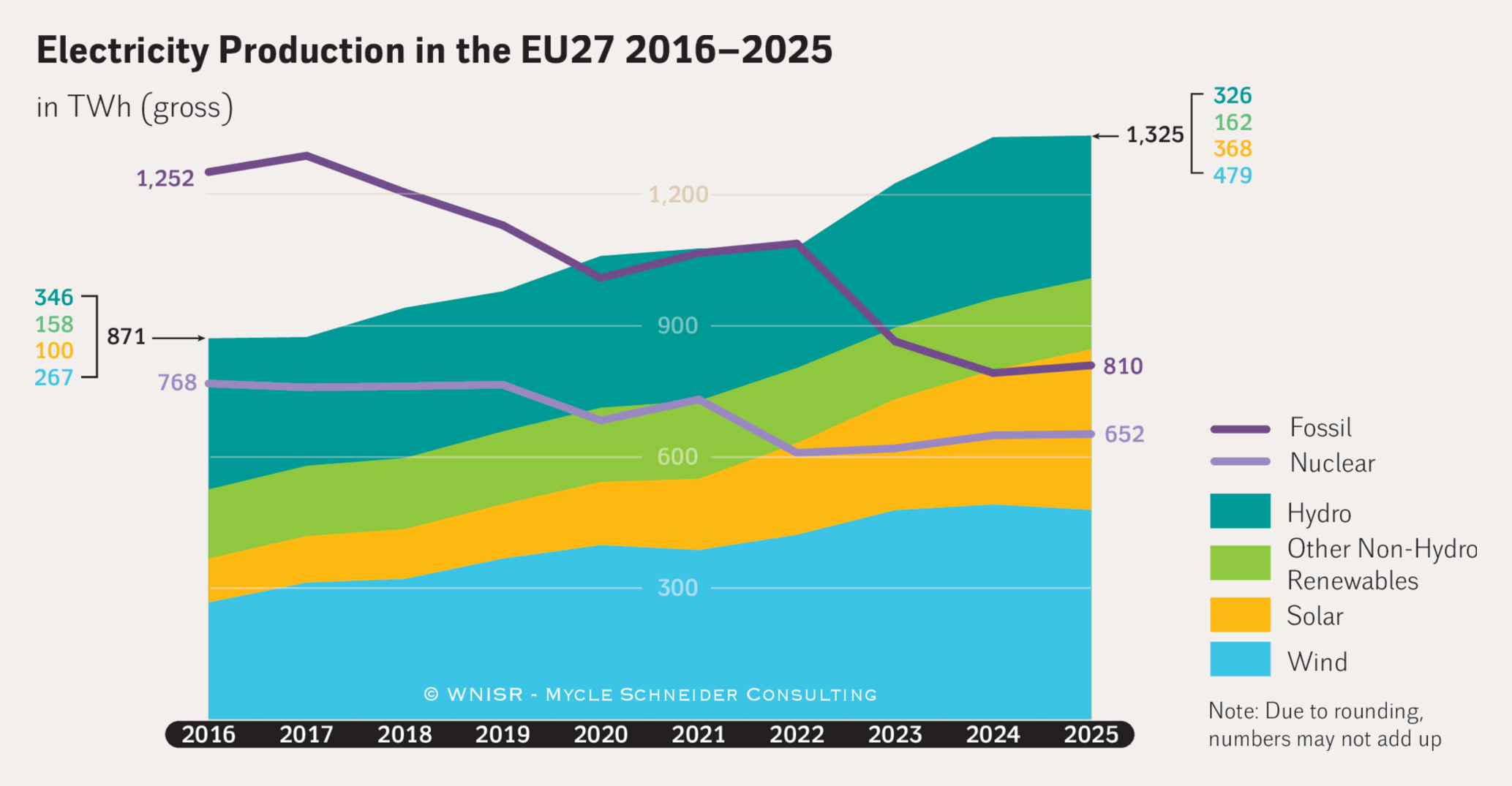
Source: EMBER, 2026
However, these overall numbers for the EU27 conceal considerable differences within Europe. The two largest EU economies, Germany and France, have followed very different strategies.
In 2025, nuclear power accounted for 68 percent of electricity generation in France. In Germany, it was zero. In Germany, wind (28.5 percent) and solar (15.5 percent) made up 44 percent of net power generation, while in France they accounted for 15 percent.2134
In Europe, following Russia’s full-scale invasion of Ukraine and the subsequent energy crisis, energy-supply security is gaining importance, perhaps more so than on other continents. While climate concerns, therefore, might have lost some of their priority, renewables and the energy transition are increasingly being considered as essential tools for gaining energy-supply security.2135 The extreme heat and drought wave over Europe in the spring and summer of 2026 had a severe impact on thermal power plants. Especially nuclear availability was severely restricted. Several European countries including France, Hungary, and Romania had to limit the operation of their nuclear plants. In France, this impacted at times 15 reactors, with nine shut down entirely and six with reduced output (see Climate Resilience in Question in France Focus for details). Renewables, solar power in particular, became all the more crucial ingredients for a stable European grid.
As Figure 75 shows, renewable capacities have continued their growth path. While annual wind generation stagnated in 2024—caused not by missing capacity growth but, like in Europe, by weaker-than-usual winds—it soared in 2025 to 103 TWh. Nuclear output was slightly down from 52 TWh in 2024 to 51 TWh in 2025, half of the wind power generation.
The 37-GW PV capacity growth (+38 percent) illustrates a further deployment acceleration. In just five years India has increased available solar capacity by a factor of 3.5 to 135 GW, while its output grew by a factor of 2.8 to 167 TWh.2136 Nuclear, on the other hand, has seen a limited 21-percent generation increase over the past five years. In 2025, the combined solar and wind power generation outpaced nuclear by a factor of 5.3, similar to the situation in China but on a much smaller level.
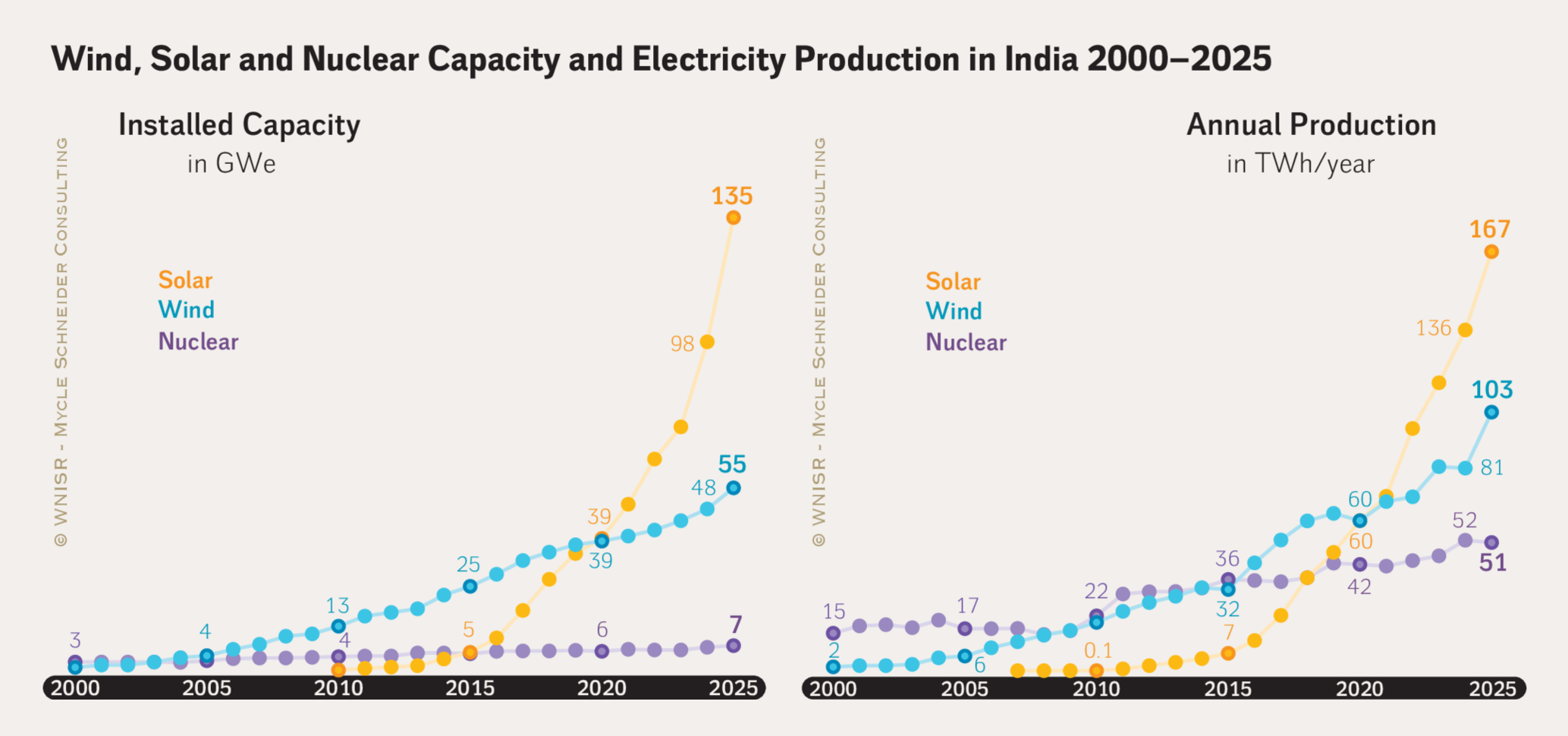
Sources: WNISR with Energy Institute, IRENA, IAEA-PRIS, 2026
See note under Figure 64.
Unlike in China, the EU, and India, and unlike the worldwide average, wind plus solar electricity production in the US is still lower than the output of nuclear reactors. Nuclear power capacity and generation have been relatively stable over the past twenty years. In 2024–2025, output grew slightly but remained below the level achieved in the years 2013–2020 (see Figure 76).
Wind and solar in 2025 have grown, respectively, by 4 percent and 19 percent in capacity and by 2.8 percent and 28 percent in electricity generation. This compares to a marginal increase of 0.4 percent in nuclear production. For the first time, wind and solar combined generated more power than nuclear reactors.
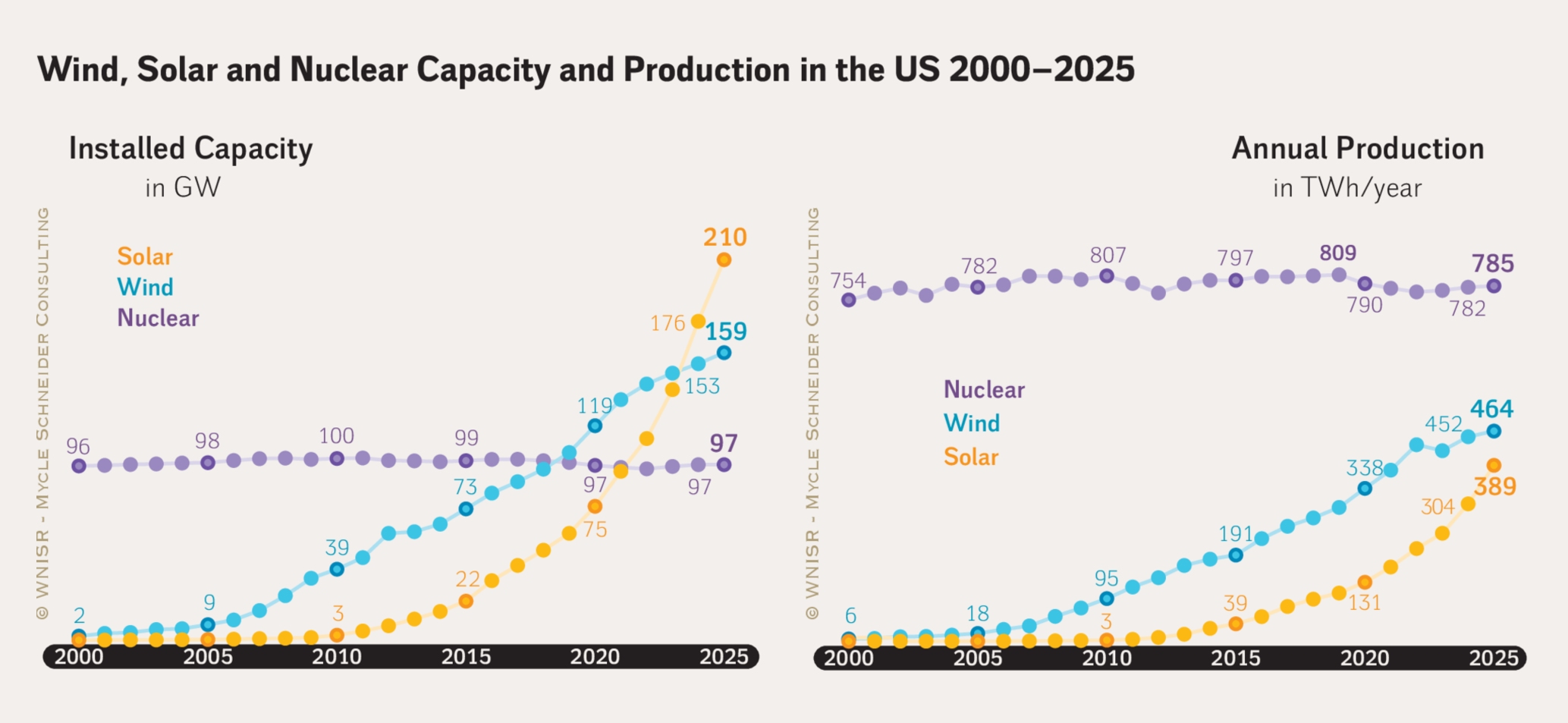
Sources: WNISR with Energy Institute, IRENA, IAEA-PRIS, 2026
See note under Figure 64.
Within the US, there are significant differences between states. Unlike in Europe, there is no nation-wide electricity market. The rules of electricity markets differ considerably, and so do the shares of renewables and nuclear, as well as their developments.
Most notable developments in California and especially Texas, traditionally a conservative oil state governed by Republicans, where traditional proponents of strong support schemes for renewables would not have expected a boom in wind, solar, and now batteries. However, a deregulated energy-only market with nodal pricing, authorities that ensure no monopolies can cripple free competition, streamlined permitting processes, and a reluctance toward state subsidies have led to a surge in solar.
In California, during daytime, solar regularly provides over 23 GW, covering over 60 percent of the load, ten times more than the two nuclear reactors. On 29 March 2026, between 9 a.m. and 3 p.m., solar covered over 70 percent of the load. In the evening battery discharge peaked at 44 percent of the load, injecting enough to cover more than 20 percent of the load for close to four hours (between 5:50 p.m. and 9:35 p.m.).2137
In recent years, Texas has become the epicenter of BESS growth. By the end of 2025, Texas had an installed capacity of 17 GW of grid-connected batteries, up from 5 GW in 2023 and expected to reach 27 GW by the end of 2026. Only three years earlier, in 2022, battery capacity stood at 2.8 GW. At the same time, fossil-fueled plants have been retired, notably 7.3 GW of coal and gas closed between 2018 and 2025.2138
Under the Trump administration, however, this economically driven success story risks slowing down. In a political climate that opposes renewables and favors fossil fuels, local politicians try to pass legislation to prioritize fossil fuels.2139 Meanwhile, renewables resist well with solar and wind providing 43.5 percent of the power in Texas in the first half of 2026—outpacing gas at 36.6 percent—with wind providing 27.3 percent and solar 16.2 percent. Coal added 11.7 percent, so the renewable contribution is closing in on the fossil fuel share of 48.3 percent.2140
The struggle in Texas reflects an overall trend in the US. The Trump administration is attempting to reverse the efforts of the Biden administration to accelerate the energy transition through a wide range of initiatives. In 2024, the Biden administration’s initiatives, especially with the so-called Inflation Reduction Act or IRA signed into law in 2022, were unfolding. But with the election of Trump and his first executive orders starting 20 January 2025, the wind changed. While a number of local Republican officials are defending the positive effects of the Biden legislation on their local economies, essential institutions and programs are being severely damaged. See also United States Focus for details.
The main point to take home from the overview in this chapter is the phenomenal acceleration in solar and battery deployment around the world. There have been many remarkable first-time-ever achievements, dominated by developments in the solar sector, including:
- Additional non-hydro renewable electricity generation in 2025 for the first time covered entirely the annual growth in total global gross electricity production.
- Coal’s share in global power generation declined to 32.6 percent in 2025, while the renewables’ share (including hydro) increased to 33.4 percent outpacing coal for the first time.
- In April 2025, for the first time, solar panels generated more power on a monthly basis than nuclear reactors. By the end of the year, for the first time solar had generated more electricity than nuclear plants in the world on an annual basis.
- For the second year in a row, in 2025 solar and wind combined generated more power in the EU than all fossil fuels combined.
- In May 2026, for the first time solar overtook coal in monthly power generation in the US.
- In China, solar power generation rose 40 percent in 2025 and outpaced wind output for the first time.
- Grid-scale battery storage systems in the world grew by 104 GW—exceeding the 100 GW mark for the first time—or 79 percent in 2025, more than the 75-percent average growth rate during 2020–2025, bringing the total power capacity from less than 17 GW to just over 279 GW.
Between nuclear reactor startups and closures in 2025, nuclear added 1.5 GW net—irrelevant in the market—and operational capacity even shrank by 0.5 GW. Nuclear’s electricity output grew by a marginal 1.1 percent, while its share in the global power mix continues a slow but steady erosion from 17.5 percent in 1996 to 8.8 percent in 2025.
It remains difficult to see how the nuclear industry will be able to cope with an increasingly competitive market situation exacerbated by the solar-plus-storage dream team eating into both base- and peak-load hours every day. The financial investment decision to build a nuclear power plant at uncertain final costs that will begin providing income at an uncertain moment more than a decade into the future is becoming an increasingly risky gamble. That future not only holds financial but also environmental risks as nuclear power’s reliability is increasingly falling victim to a phenomenon it is meant to help ease: climate change.
Annex 1 – Overview by Region and Country

South Africa hosts the only commercial nuclear power plant on the African continent, consisting of two 900-MW reactors located at Koeberg, near Cape Town. Both reactors started operating in the mid-1980s and were granted a 40-year operating license that expired in 2024. A 20-year extension to this license was since granted upon completion of extensive upgrading work. The plant is owned and run by South Africa’s national power utility Eskom.
During the past decade South Africa had been experiencing persistent power cuts and record electricity shortfalls that at times exceeded 6 GW.2141 The crisis had peaked in 2023, but this was followed by an unexpected and remarkable turnaround, with no further rolling blackouts since May 20252142. The improved power supply may be attributed to more effective maintenance of South Africa’s large fleet of coal power plants as well as lower electricity demand from the national electricity utility Eskom. The latter is due to much increased adoption of on-site alternative electricity supply, mostly in the form of solar rooftop generation.2143
South Africa’s electricity supply remains dominated by electricity generated from coal plants (with a nominal total capacity of 41 GW), which in 2025 accounted for 79 percent of the country’s total power production.2144 A revised national electricity generation roadmap was adopted in late 2025 that targets the closing down between 50–75 percent of the coal power generating capacity before 2050, in line with international decarbonization efforts and associated incentives. The roadmap, referred to as the Integrated Resource Plan for Electricity (IRP), envisages meeting the resulting electricity shortfall through the development of new wind, solar, and gas power generating facilities, but also through the construction of new nuclear plants contributing an extra 5.2 GW by 2039, with a further 4.8 GW completed after that.2145
Developments Related to Koeberg’s Lifetime Extension
To secure a 20-year extension to its operating license beyond the 2024 expiry of its original 40-year license Eskom needed to perform significant upgrading work to both Koeberg units, the largest part of which was the replacement of the original steam generators. This entire exercise, originally projected to be performed over 10 months2146 was eventually completed more than two years after it commenced (see past editions of WNISR for more details). Cracks in the containment structure of both reactors had been reported in 2021,2147 and stress tests were subsequently performed for both units during their first refueling and maintenance outages after completion of the new steam generator installations.2148 Koeberg-1 had been shut down for this purpose in February 2025, and the unit was expected to be operational again by July 2025.2149 The outage however lasted until 29 October 2025.2150 The corresponding refueling and maintenance outage of Koeberg-2, which had provisionally been scheduled for 8 September 2025 to 27 March 2026,2151 was eventually initiated only on 26 April 2026.2152 During the period July 2025–June 2026 the Koeberg site therefore operated at full capacity for only half of the time and at roughly 50 percent capacity for the remaining days.
As of June 2026, with the upgrading work finished and the life extension granted, Eskom has still not provided a final total figure for the Koeberg upgrade costs. These had in 2010 been estimated at ZAR20 billion (US$20102.7 billion),2153 but the actual costs are believed to be significantly higher,2154 especially considering that the ZAR-US Dollar exchange rate changed from about ZAR7.32 to US$ in 2010 to about ZAR17.89 to US$ in 2025.2155
In 2024, the operating license for Koeberg-1 had already been renewed for 20 years to 21 July 2044.2156 The 20-year extension of Koeberg-2 was in turn granted in November 2025 and will expire on 9 November 2045.2157 This follows the granting of a previous extension on the original 40-year license to 9 November 2025.2158
Koeberg’s contribution to electricity generation had been 7.8 TWh (net) in 2024, which was only 57 percent of the energy supplied five years earlier (13.6 TWh), with Unit 2 being online for only 33 hours in 2024.2159 In 2025, with both units operational simultaneously for about three months, annual output increased to 10.2 TWh (net), corresponding to 5.1 percent of Eskom’s generated total2160 or 4.6 percent of the country’s total electricity generation.2161
Developments Related to Potential Newbuild
In December 2024, a draft new Integrated Resource Plan for Electricity (IRP 2025) had been distributed to selected stakeholders for consideration. That draft had suggested the construction of two new nuclear generating units of 1250 MW each to come online in 2036 and 2037 respectively, with two further 1350-MW units becoming operational in 2038 and 2039 respectively.2162 Following some deliberations and cabinet endorsement, the IRP was then gazetted on 28 October 20252163, retaining the total 5200 MW of nuclear and the timeline as proposed in the draft. The IRP further envisages additional 4.8 GW of nuclear capacity becoming available after 2040, implying a total of 10 GW of additional nuclear capacity in the coming few decades.
These projections recall repeated failures of similar plans over the past decades (see past WNISR editions).
While the IRP makes mention of SMRs, these are recognized as untested and as having significantly higher uncertainties in terms of cost. While this is not stated explicitly in the plan, the retention of the plan for two 1250 MW plus two 1350 MW reactors indicates that conventional large-scale reactors currently represent the preferred option.
The IRP also recognizes that, as one of the more expensive electricity generation options, nuclear developments require a more sophisticated implementation strategy, and the IRP and government are placing a considerable emphasis on the early development of a credible and financially feasible Nuclear Industrialization Plan.2164
In a bid to initiate the lengthy process to complete the construction of new nuclear plants according to the 2036–2039 schedule indicated in the IRP, Eskom has already indicated that it was considering sites that had been identified during the previously proposed 9.6 GW nuclear newbuild program that was aborted in 2017 and that had already undergone environmental impact assessments. It is preferring Thyspunt2165, a site with good grid connections over the alternative Bantamsklip.
While the government seems determined to realize its nuclear plans,2166 opposition to newbuild is starting to grow2167, with organizations who led efforts to halt the nuclear build in 2017 now again objecting and challenging the process.2168 Opponents have identified what they consider serious flaws in the process, which could form the basis of future legal challenges.2169
Note that the IRP should merely be seen as a statement of intent, and many proposed developments listed in past IRPs have failed to materialize due to financial, technological, and/or other reasons.
The push for new nuclear power developments includes initiatives that seek to develop SMRs. In particular, there is now a concerted drive to revive the aborted Pebble Bed Modular Reactor (PBMR) program,2170 which had been terminated by government in 2009 due to rising insufficient progress despite large financial investments (see South Africa Focus in WNISR2023).2171 The South African Nuclear Energy Corporation (NECSA), the entity tasked with radioactive waste management, production of medical isotopes, and nuclear research, has very recently more actively positioned itself as a potential lead player in SMR development.2172 In July 2025, a local company published a proposal to build a privately-owned 35-MW SMR near the boundary of South Africa’s urban and most populous Gauteng province.2173 No further developments have since been reported in relation to this project.
While now recognized as a comparatively expensive option, the main argument currently advanced for nuclear newbuild is that it would be an essential component to achieving the reduction of coal dependence while maintaining regular electricity supply. This is the scenario adopted by the IRP, which also projects a 2 percent per annum growth in electricity demand.
In the period July 2025–June 2026 South Africa continued its run of steady electricity supply and experienced no power cuts. Over the entire year 2025, coal again contributed almost four fifth of South Africa’s total electricity generation. Wind marginally increased from 4.7 percent to 4.9 percent, while the solar fraction grew from 7.4 to 8 percent.2174
Importantly, despite diminished power cuts, Eskom’s electricity distribution, which had decreased from 222 TWh in 2019 to 206 TWh in 2024, decreased further to 202 TWh in 2025.2175 This declining demand runs counter to the 2 percent annual growth assumed in IRP 2025. This has a major effect on Eskom’s profitability and makes it more difficult for them to initiate mega-scale new projects such as nuclear newbuilds.
The declining demand also increases the likelihood that the projected new solar, wind, and gas power generating facilities envisaged by the IRP might be sufficient to cover shortfalls precipitated by coal plant closures. Such a scenario is furthermore corroborated by the heightened rate at which renewable projects are initiated, completed and growing in size in South Africa,2176 showing that the annual additions to utility-scale wind and solar electricity generation, projected to amount to about 4–5 GW per annum in the IRP 2025, can be exceeded.
Imports of Chinese-built solar panels entering South Africa, a recognized indicator of overall solar system installations given that China is the dominant source of these components, had trebled to 4.1 GW in 2023 compared to 2022, with slightly lower amounts recorded in 2024 (3.7 GW) and 2025 (3.6 GW) respectively.2177
Another indicator of the growth in wind and solar capacity is the list of projects approved and registered by the National Energy Regulator of South Africa (NERSA). On 1 March 2026, these stood at 13.4 GW of solar PV and 5.4 GW of wind.2178 These NERSA project registration figures, as reported by the South African Photovoltaic Industry Association (SAPVIA), do not include facilities already operating or under construction before 2022. They also do not include small-scale (<100 kW) solar roof-top installations, currently clearly the dominating expansion mode.

Argentina’s nuclear fleet consists of three reactors: Atucha-1 with 335 MWe, Atucha-2 with 688 MWe, and Embalse with 608 MWe net. Atucha-1 was connected to the grid in 1974, Atucha-2 in 2014, and Embalse in 1983.
Atucha-1 was shut down in September 2024 for major refurbishment. As of mid-2026, it reached Long-Term Outage (LTO) status, and restart is not expected before 2027. In 2025, the two operating reactors produced 10.2 TWh of electricity (10.8 TWh gross), a 7 percent share of overall electricity generation and a slight increase from 9.9 TWh in 2024.2179 At its highest in 1990–1991, nuclear power’s share was about 14.4 percent (even 19.8 percent according to PRIS data) with just 70 percent of the current nuclear capacity available, which reflects the substantial growth of non-nuclear electricity generation in Argentina (see previous editions of WNISR). Overall electricity generation almost tripled between 1991 and 2025, with natural gas providing four times more power and non-hydro renewables 270 times more, going from 0.1 TWh to 27 TWh.2180
Atucha-1 was built by Siemens-KWU, while the construction of Atucha-2 was initiated by Siemens-KWU, then abandoned, and later completed by the operator Nucleoeléctrica Argentina S.A. (NA-SA) with the support of external contractors. Apart from a demonstration plant in Germany, the Atucha units’ Pressurized Heavy Water Reactor (PHWR) design, natural uranium fueled and heavy-water cooled and moderated, was built only in Argentina. The CANDU (Canadian Deuterium Uranium) reactor at Embalse was built by Atomic Energy of Canada Limited (AECL).
Atucha‑1 was designed for a 32‑year operational lifetime that ended in 2018 with plans to extend operation by 20 years. The operator Nucleoeléctrica divided the extension into two phases. Phase A simply extended the original license to September 2024. After that, the reactor went into a planned outage to complete an overhaul needed for 20 additional years of operation. The outage is scheduled to last 30 months, and then, the so-called Phase B would last into the mid‑2040s.2181
The refurbishment work at Atucha-1 involves key upgrades including a new “second heat sink” cooling system.2182 By March 2026, about 52 percent of the lifetime extension work, with an estimated total investment of around US$700 million, was reported complete.2183 Reportedly, Atucha-1 will not return to service until August or September 2027, though initially it was expected to be back online earlier in 2027.2184 The delay stems from “various reasons”, including reported changes in NA-SA procurement policy. A January 2026 report said that the centralization and grouping of purchases and longer payment timelines had delayed the receipt of components and slowed task execution.2185 Atucha-2 was ordered from Siemens-KWU in 1979 as a larger version of Atucha-1.
As a consequence of the 1982 Falklands War, the construction was delayed because Siemens-KWU lost access to licensed technology for use in Argentina and was forced to develop substitute technology. Construction came to a complete halt in the 1990s following a major economic crisis in Argentina. By the time Argentina was ready to restart construction work, Siemens-KWU ceased to exist as a company, and Framatome, the successor that took over much of its nuclear activities, had no intention of finishing the construction. Nucleoeléctrica decided to complete the construction on its own. Grid connection finally occurred on 27 June 2014, but it took until 26 May 2016 to reach commercial operation.2186
In January 2026, the regulator ARN (Autoridad Regulatoria Nuclear) approved Atucha‑2 to return to 100-percent power (745 MW gross) for the first time after several years of limitations and after corrections to previous issues.2187 A scheduled outage began in mid-March 2026 for the annual planned maintenance and inspection. The plant was offline for around nine weeks and reconnected to the grid on 12 May 2026.2188 The reactor’s operating license, originally due to expire at the end of May 2026, was extended by ARN until May 2036.2189
Meanwhile, Nucleoeléctrica progressed the ASECG II (Almacenamiento en Seco de Elementos Combustibles Gastados II) dry storage project at Atucha-2. By spring 2026, the central gantry crane used to handle the spent fuel assemblies had been verticalized. This new dry cask storage is planned to allow continued operation beyond December 2027 when pool capacity is expected to be saturated.2190
Embalse, a CANDU reactor that started operating in 1983, was shut down at the end of 2015 for major overhaul, including replacing hundreds of pressure tubes, to enable up to 30 more years of operation until 2049. It eventually returned to service in May 2019, with the refurbishment project estimated to have cost US$2.15 billion. Like Atucha-1, in addition to the extensive lifetime extension program, Embalse must undergo a major Periodic Safety Review (PSR) every ten years to continue operation.2191 In August 2019, the ARN renewed the reactor’s operating license for ten years to 2029, when the next PSR is due.2192 Embalse ran continuously at near-full power through 2025, delivering a historical high of 5.35 TWh net electricity production in 2025.2193
Energy Policy, New Nuclear Agenda, and International Collaborations
Argentina’s current government is pursuing an expanded nuclear agenda. President Javier Milei’s administration launched the ambitious Plan Nuclear Argentino in December 2024, envisioning Small Modular Reactors (SMRs) at Atucha and other projects.2194 In practice, this has meant high-level reorganizations such as creating a Nuclear Affairs Secretariat under the Economy Ministry in December 20252195 and policy shifts with respect to the Atucha-3, CAREM-25, and ACR-300 projects.
The domestically designed SMR CAREM‑25—the 32-MW prototype at Atucha site under construction between 2014 and 2024—has been effectively de-prioritized. The end of the construction project had already been announced in 2024 (see WNISR2025).2196 Argentina’s 2025 national report under the Convention on Nuclear Safety indicated that “due to budget revision and government decisions,” construction tasks were to be “deferred” in 2025 while the existing engineering was reviewed.2197 By early 2026, the National Atomic Energy Commission (CNEA) reduced CAREM’s project status and budget, and the media noted that construction was on hold while it was said to be 63-percent complete at the end of 2024.2198
The move has become controversial. Sources cited by the EconoJournal warned that minimal preservation, budget shortages, and reduced staffing were exposing CAREM buildings, equipment, and civil works to deterioration, including water ingress, and creating difficulties in inspecting equipment. At the same time, the government is seemingly trying to redirect part of the CAREM-related industrial capability toward export-oriented nuclear supply chain business.2199 Secretary of Nuclear Affairs Ramos Napoli stated that CAREM’s value now lies in developing expertise for supplying services and components abroad for other SMR designs and that this was the context for a CNEA–IMPSA agreement to manufacture and export pressure vessels for SMRs.2200
Instead of completing CAREM as originally envisaged, the Milei administration is pursuing the in-house ACR‑300, a 300-MW pressurized water reactor patented by the Argentinian company INVAP. In late May 2025, then-president of Nucleoeléctrica Demian Reidel announced plans to build four ACR‑300 modules at Atucha (freeing the site by scrapping Atucha-3) with the goal of licensing and exporting them.2201 This SMR push is also intended to “nearly double” Argentina’s nuclear capacity.2202 These expansion claims appear highly aspirational. Reports critical of the policy direction described the ACR-300 as only around 1 percent developed as of early 2026 and quoted Adriana Serquis, former CNEA President and now MP for the opposition coalition, calling the claim that four SMRs could be built in five years “fiction”.2203 Per media coverage from May 2026, the “conceptual feasibility of the design” is in the process of validation.2204
CNEA also signaled moves to reactivate the entire nuclear fuel chain. In mid-2025, CNEA announced plans to restart uranium mining (in Sierra Pintada, Mendoza, Chubut, and begin exploring in Cerro Solo), resume uranium enrichment, and to resume heavy-water production at Neuquén.2205 Argentina is developing indigenous uranium enrichment (HALEU 5–20 percent) via new centrifuge facilities. A Memorandum of Understanding (MoU) signed with Canada’s Candu Energy in May 2025 aims to collaborate on the refurbishment of the Neuquén heavy-water plant and resume domestic heavy-water production. And in August 2025, CNEA, the province of Neuquén, and Empresa Neuquina de Servicios de Ingeniería S.E. (ENSI) reached a separate agreement to advance the reactivation of the industrial heavy-water plant, whose operation is handled by ENSI.2206
Milei’s nuclear plan is mostly funded through state budgets and partnerships, however, the push for private investment is clear. The partial privatization of NA-SA was formalized in September 2025, when the government authorized the sale of 44 percent of the company through a national and international tender, reserved up to 5 percent for an employee ownership program, and retained 51 percent under state control. The official rationale was to attract private capital while financing projects such as the Atucha-1 lifetime extension and the ASECG II dry spent-fuel storage facility. The process was legally authorized by Decree 695/2025 and formally launched by Economy Ministry Resolution 1751/2025. The sale remains controversial because critics warn that a 44-percent private investor could gain substantial influence despite the state’s formal majority.2207
Opposition to the broader strategy has also grown, as worker and union groups protested against plans to partially privatize Nucleoeléctrica in late 2025,2208 and expressed concerns over the future of CNEA.2209 The financing of the ACR‑300 SMRs’ design and construction was announced to be private, and Demian Reidel, then NA-SA president and chief adviser to Milei, met with potential US and European partners.2210 In July 2025, he left his presidential advisory,2211 and in February 2026, less than a year after assuming the position, he resigned from NA-SA following internal complaints over alleged overpricing and irregular contract awards.2212 In May 2026, prosecutors reportedly opened a separate investigation into the use of NA-SA corporate credit cards for alleged non-institutional expenses while Reidel denied wrongdoing.2213
Internationally, Argentina expanded its role in nuclear activities. In December 2025, Argentina took over the rotating presidency of the Nuclear Suppliers Group (NSG).2214 In late 2025, it signed its third Country Programme Framework (CPF) with the International Atomic Energy Agency (IAEA) for the period covering 2025–2031.2215 And nuclear relations with the US have intensified since Argentina aims to position itself as a uranium and fuel supplier to the US.2216

Brazil’s only two functioning commercial nuclear reactors, Angra-1 and Angra-2, are operated by Eletronuclear at the Central Nuclear Almirante Álvaro Alberto (CNAAA) site. Eletronuclear remains state-controlled through Empresa Brasileira de Participações em Energia Nuclear e Binacional S.A. (ENBPar), which holds the majority of its common stock.2217
In 2025, the two reactors supplied 14.5 TWh net to the grid, equivalent to about 2.2 percent of national electricity generation.2218 Construction of a third reactor, Angra-3, resumed in late 2022 but was halted again in 2023, and its future remains uncertain. Eletronuclear’s reporting in 2025 put the project’s physical construction progress at around two-thirds—66 percent in company press releases and 67.56 percent in the 2025 Annual Report.2219 The former parent company of Eletronuclear, Eletrobras—renamed AXIA Energia in October 2025—has withdrawn from further investment commitments.2220 Following a National Energy Policy Council (CNPE) request for updated studies, Eletronuclear submitted to the Ministry of Mines and Energy (MME) in November 2025 an updated economic-financial study by National Bank for Economic and Social Development (BNDES), while BNDES had also carried out technical due diligence on the project.2221 However, a final government decision on whether to complete or abandon Angra-3 was still pending as of mid-2026.
The first contract for Angra-1 was awarded to Westinghouse in 1970. The 609-MW PWR was connected to the grid in 1982 and began commercial operation in 1985. In November 2024, the regulator CNEN (Comissão Nacional de Energia Nuclear) authorized a 20-year lifetime extension, allowing operation until December 2044.2222 Eletronuclear estimated total investment for lifetime-extension works at about BRL3.2 billion (~US$2024594 million).2223
Angra-2 is a German-designed PWR with a net capacity of 1275 MW. It was connected to the grid in July 2000, 24 years after construction began. Its current CNEN authorization for permanent operation expires in June 2041.2224 In its audit of Angra-1 for long-term operation, the Federal Court of Accounts (TCU)’s notes that lifetime extension experience from Angra-1 may become relevant for Angra-2 in the medium term, but no formal Angra-2 request for license extension has been reported yet.2225 Eletronuclear notes that “activities related to extending the service life of Angra 2 remain in the preliminary phase.” 2226
The Angra-3 saga remains one of the most chaotic and disorderly nuclear construction projects in modern energy history (see past editions of WNISR for detailed accounts). Preparatory work for the 1340-MW PWR designed by Siemens/KWU started in the early 1980s, with construction suspended in 1986, restarted in June 2010, and subsequently interrupted or stalled several times. The Bolsonaro administration (2019–2023) renewed efforts to complete the project, but the Lula administration has been left with the formal decision on whether, and under what conditions, the decades-old project should proceed. In September 2024, Brazil’s National Bank for Economic and Social Development had submitted an initial assessment to Eletronuclear and the Ministry of Mines and Energy.2227
The National Energy Policy Council (CNPE), chaired by the Minister of Mines and Energy, repeatedly failed to reach a final decision. After discussions in December 2024 and February 2025, the CNPE again deferred its conclusions in October 2025, instead approving Resolution No. 12/2025, which ordered Eletronuclear and BNDES to update and complement the economic-financial model.2228
The new update was required to examine at least three options: first, a scenario maintaining the framework of the investment agreement between AXIA Energia (then-Eletrobras) and ENBPar that included possible private participation; second, completing Angra-3 with public resources; or third, abandoning the project after detailing the full costs and impacts including environmental and post-operational safety costs.
Apparently weary of the possibility of new delays and cost-overruns, and well-aware of tariff raises that come with each renewed attempt at resuming the project, the Federal Court of Accounts in early 2025 consistently reissued the recommendation that “new inefficiencies or other delays in the work can no longer be incorporated into the price to be approved, making the respective costs a risk for the concessionaire, and no longer costs to be covered by consumers.” 2229
Eletronuclear submitted an updated BNDES study to the Ministry of Mines and Energy in early November 2025. According to Eletronuclear, the update reaffirmed broad conclusions of the initial assessment that completing the plant would require BRL23.9 billion (US$20254.3 billion) and that abandoning it could cost BRL21.9–25.97 (US$20253.9–4.6 billion), with a proposed tariff of BRL778.86/MWh (US$2025139.4/MWh) in the most favorable scenario and commercial operation expected in 2033.2230
According to Eletronuclear, CNPE had already considered the issue three times since late 2024, with the Energy Minister voting in favor but other members requesting further review each time.2231 A later extraordinary CNPE meeting scheduled for June 2026, whose agenda included Angra-3-related debt issues, was cancelled by the Ministry of Energy.2232
An additional complication arose from the settlement between Eletrobras/AXIA Energia and the federal government. Under the 2022 investment agreement between Eletrobras/AXIA Energia and ENBPar, among other things, the financing of Angra-3 was to be suspended immediately and terminated if competent authorities decided to resume construction. Eletrobras/Axia Energia would have no remaining obligation to make new contributions or grant new guarantees for Eletronuclear. However, guarantees already provided before Eletrobras’ privatization remain unaffected; these cover existing BNDES and Caixa financing for the Angra-3 project, reportedly amounting to BRL6.1 billion (US$20251.1 billion).2233 Eletrobras/AXIA Energia also committed BRL2.4 billion (US$2025430 million) in debentures to be issued by Eletronuclear for the lifetime extension of Angra-1.2234 The divestment process also advanced: in October 2025, Eletrobras/AXIA Energia signed an agreement to sell its entire stake in Eletronuclear to private conglomerate J&F S.A. The buyer would assume Eletrobras’ existing guarantees and the BRL2.4 billion debenture obligation, subject to closing conditions.2235
The delay itself has become a major financial burden. In 2025, Eletronuclear’s president Raul Lycurgo told lawmakers that keeping the project alive cost close to BRL1 billion per year (~US$2025180 million), mainly allocated to debt service and equipment preservation. By 2026, the company was still seeking relief on Angra-3-related debt: press reports indicated negotiations to suspend payments on a BRL3.8 billion (US$749 million) Caixa loan until late 2026 or January 2027, but the CNPE meeting expected to address the issue was cancelled in June 2026.2236
Eletronuclear has solicited a financial waiver to defer certain debts (suspended loan payments to December 2026) to ease cash flow while decisions are pending.2237 As of 1 July 2026, the CNPE had not decided on Angra-3’s fate. The TCU audit in February 2026 reviewed the preparatory documentation and reference budget for contracting the remaining Angra-3 works under an EPC contract; it flagged inconsistencies in the bidding budget and lack of a tariff decision and recommended revising the cost estimates before tendering the EPC contract.2238 Eletronuclear conducted a public consultation on the EPC contract in late 2024, but no bidding process has been reported yet.
Energy Planning, Institutional Developments, and SMRs
Despite the uncertainty cast by Angra-3 over the industry’s medium term prospects, further newbuild initiatives continue to be discussed sporadically, including the possibility of deploying Small Modular Reactors (SMRs).2239 The National Energy Plan 2050 (PNE2050), released under the previous administration, had included SMRs as a potential component of Brazil’s energy mix starting “after 2030”. Cooperation with Russia on SMR deployment has been raised at high political level.2240 In 2025, Brazil’s Minister of Mines and Energy stated that Rosatom would begin engagement with the Brazilian Government on the issue, while earlier Russian statements had referred to Brazilian interest in floating SMRs and to a bilateral working group on nuclear cooperation.
The country has also embarked on the development of its own 3–5-MW “microreactor”. In June 2025, the Ministry of Science, Technology and Innovation signed a contract with the Brazilian Funding Authority for Studies and Projects providing BRL30 million (US$20255.4 million) in public funding for the development and testing of critical technologies. The broader project totals BRL50 million (US$20258.9 million), including private funding from the participating companies—Diamante Geração de Energia, Indústrias Nucleares do Brasil (INB), and a startup, Terminus Pesquisa e Desenvolvimento em Energia—and remains at an early Research & Development (R&D) stage.2241
However, the latest approved Ten-Year Energy Expansion Plan, PDE 2035, sees no nuclear capacity additions over the period up to 2034, except for Angra-3, whose commercial operation—if completed—is expected for 2033.2242
Under the Bolsonaro government, a new regulatory agency, the Autoridade Nacional de Segurança Nuclear (ANSN), was created by Law 14.222/2021 and assigned CNEN’s former responsibilities to monitor, regulate, and inspect nuclear safety and radiological protection. CNEN remains responsible for research, planning, and broader nuclear-policy functions.2243 However, since its creation in 2021, ANSN has struggled to become operational. In March 2025, the Federal Court of Accounts warned of serious risks in the agency’s structuring, including lack of budget provision for 2024 and 2025, insufficient personnel, and difficulties in separating staff, assets, contracts, and IT systems from CNEN. TCU gave the government 120 days to present an action plan to ensure the proper functioning of ANSN and CNEN.2244 By late 2025, ANSN reported progress in the separation process, including work on systems, budgetary separation, assets, staffing and contracts. ANSN/CNEN had also submitted a joint technical note seeking changes to the 2026 budget proposal. However, the same presentation still identified the lack of specific ANSN budget provision in the 2026 draft budget as a problem.2245 In 2026, ANSN announced further institutional steps including regulatory activities and the approval of its first regulatory agenda for 2026–2027. However, no TCU follow-up decision on whether the 120-day action plan had been implemented or whether the structural risks identified had been resolved could be identified.
As reported in previous WNISR editions, Brazil is expanding its uranium enrichment capacities and expects to service the entire fuel supply requirements of its potentially three power reactors by 2037.
Energy Policy Trends
In 2025, renewables (including hydro) represented 86.9 percent of Brazil’s electricity mix. Solar generation reached 88 TWh, a 25-percent increase over the previous year, while wind generation reached 115.8 TWh, an increase of 7.6 percent. Together, wind and solar accounted for 26.4 percent of total electricity generation. Hydropower generation decreased by 5.7 percent, still representing over half of the electricity mix. Generation from natural gas increased by 24.3 percent. The share of fossil fuels remains around 11 percent, and that of nuclear at 2 percent.2246
In November 2024, during COP29, Brazil submitted a new Nationally Determined Contribution committing to reduce net greenhouse gas emissions by 59–67 percent by 2035, compared to 2005 levels.2247 Brazil hosted COP30 in Belém in November 2025. The conference did not deliver a formal COP decision on a fossil fuel phaseout roadmap, but the Brazilian COP30 presidency announced voluntary roadmaps on transitioning away from fossil fuels and halting and reversing deforestation.2248
In December 2025, the government approved the new Climate Plan, intended to guide implementation of Brazil’s Paris Agreement target. It includes a dedicated energy-sector track under the Plano Clima, covering both mitigation and adaptation.2249
Brazil continues efforts to regain its position in climate leadership after the Bolsonaro years, but its energy and climate policy remains marked by contradictions, including continued support for oil and gas development. With Angra-3 still unresolved and no other nuclear capacity foreseen in official short- to medium-term planning, nuclear expansion will not play any significant role in Brazil’s decarbonization strategy in the coming decade.

Canada has 17 operating CANDU reactors with a total net capacity of 12.7 GW.2250 Two reactors that were in Long-Term Outage for refurbishment were reconnected to the grid. One GE Hitachi BWRX-300 small modular reactor is officially under construction as of April 2026.2251 This marks the start of the first SMR construction in North America. According to Ontario Power Generation (OPG), there will be four such reactors at this site, but the license application reviewed and approved by the Canadian Nuclear Safety Commission (CNSC) entailed the construction of only one reactor. Construction of the reactor is supported by more than CAD4.025 billion (US$20252.9 billion) in public funding.2252 In May 2025, the Government of Ontario approved OPG’s plan to spend CAD7.7 billion (US$20255.5 billion) to construct the first BWRX-300 unit, which includes CAD6.1 billion (US$20254.4 billion) for the actual unit and an additional CAD1.6 billion (US$20251.1 billion) “on common infrastructure such as administrative buildings and cooling water tunnels the new reactor will share with three additional BWRX-300s to be built later.”2253 The budget covering “site preparation, engineering and design work to date, as well as the construction of all four small modular reactors” was quoted as CAD20.9 billion (~US$202515 billion).
According to Statistics Canada, nuclear reactors supplied 81.57 TWh in 2025, slightly lower than the 81.74 TWh produced in 2024.2254 In 2025, nuclear energy constituted 12.8 percent of the total electricity generated in Canada, a minor decline from 13.2 percent in 2024.2255
The nuclear reactor fleet in Canada is almost entirely located in the province of Ontario, where nuclear power contributed 48.2 percent of the electricity generated in 2025, below the 50.9 percent share in 2024, and much below the 61 percent share in 2016.2256 This is the first time since the late 1980s that the nuclear share in the annual provincial power generation drops below the 50-percent mark.
The only nuclear power plant outside of Ontario is the single unit Point Lepreau station in New Brunswick, which has encountered numerous problems in recent years, and could manage load factors of only 30.7 percent and 55.5 percent in 2024 and 2025 respectively.2257
An external review of NB Power, the owner of Point Lepreau, commissioned by the provincial government, pointed out that the company’s debt levels were very high largely because of its nuclear reactor, and recommended that Point Lepreau “be operationally separated from the other NB Power assets.”2258 But independent analysts have criticized this recommendation because such a separation would only impose higher costs on New Brunswick rate payers.2259 After critiquing the operational practices of other utilities, the review also recommended that “the Government of New Brunswick consider initiating the planning assessment phase for an additional large scale, proven technology nuclear plant to be sited alongside the Point Lepreau facility,” adding that “This is not a recommendation to build another unit but more to conduct the necessary approval and assessment stages.” 2260
Refurbishment
Canada is in the process of refurbishing several of its aging CANDU reactors, which “involves replacing core reactor components” such as “fuel channels, feeder pipes, calandria tubes and end fittings.”2261 During the past year, Darlington-4 and Bruce-3 returned to service, in March 2026 and June 2026 respectively, following extensive refurbishment work.2262 Government and utility officials have claimed that these projects were completed ahead of time and at a lower cost than projected.2263 However, there seem to be still some repairs that need to be completed for safe operations; if these are completed and the cost included, then the final timeline and budget for the refurbishment would be in excess of the initial projections. In the case of the Darlington refurbishment, independent analysts suggest that the final budget might well be 25 percent over the official budget of CAD12.8 billion (US$20169.6 billion).2264
By June 2026, only one reactor (Bruce-4) was going through this process. As of March 2026, Bruce-4 was scheduled to be returned to service on 21 December 2027.2265 See Table 23.
Four units (5–8) at Pickering are due to undergo refurbishment. This decision was announced by the Ontario Government in January 2024.2266 The project is currently estimated to cost CAD26.8 billion (US$202519.1 billion) and run from “early 2027” to the “mid-2030s”; the plant’s current license expires in 2028.2267 The CNSC has scheduled hearings in June and October 2026 “to consider an application from Ontario Power Generation (OPG) to renew the power reactor operating license of the Pickering Nuclear Generating Station” and “the proposed refurbishment of PNGS [Pickering Nuclear Generating Station] Units 5 to 8.” 2268
|
Reactor |
Operator |
Grid Connection |
Refurbishment(a) |
Planned Closure |
Licensed to(c) |
|
Bruce-1 |
Bruce Power |
1977 |
Restarted in 2012 |
2064 |
2028 |
|
Bruce-2 |
1976 |
Restarted in 2012 |
|||
|
Bruce-3 |
1977 |
01/03/23–03/06/26(d) |
|||
|
Bruce-4 |
1978 |
31/01/2025–21/12/27 (01/01/25–31/12/27) |
|||
|
Bruce-5 |
1984 |
01/10/26–05/09/29 |
|||
|
Bruce-6 |
1984 |
16/01/20–08/09/23(e) |
|||
|
Bruce-7 |
1986 |
01/10/28–06/09/31 (01/07/28–30/06/31) |
|||
|
Bruce-8 |
1987 |
01/10/30–05/09/33 |
|||
|
Darlington-1 |
OPG |
1990 |
14/02/22–02/12/24 |
2055 |
30/11/2045 |
|
Darlington-2 |
1990 |
10/16–06/20(f) |
|||
|
Darlington-3 |
1992 |
30/07/20–17/07/23(g) |
|||
|
Darlington-4 |
1993 |
19/07/23–13/03/26(i) |
|||
|
Pickering-5 |
OPG |
1982 |
30/09/26–01/05/31 (30/09/26–01/12/30)(j) |
Expected Lifetime Extension for up to 30 years (k) |
2028(l) |
|
Pickering-6 |
1983 |
30/09/26–01/07/32 (30/09/26–01/06/32)(j) |
|||
|
Pickering-7 |
1984 |
30/09/26–17/04/33 (30/09/26–17/07/33)(j) |
|||
|
Pickering-8 |
1986 |
30/09/26–31/07/34 (30/09/26–31/08/34)(j) |
|||
|
Point Lepreau |
NB Power |
1982 |
03/2008–03/2012 |
2044–2045(m) |
June 2032 |
Sources: compiled by WNISR with IESO, Operators and CNSC, 2026
Notes and references
OPG : Ontario Power Generation.
(a) – Unless otherwise mentioned, IESO, “Annual Planning Outlook - Ontario’s Electricity System Needs: 2027-2050”, March 2026, see https://www.ieso.ca/-/media/Files/IESO/Document-Library/planning-forecasts/apo/2026/2026-Annual-Planning-Outlook.pdf, accessed 21 July 2026.
(b) – IESO, “Annual Planning Outlook - A View of Ontario’s Electricity System Needs”, January 2020, see http://www.ieso.ca/-/media/Files/IESO/Document-Library/planning-forecasts/apo/Annual-Planning-Outlook-Jan2020.pdf?la=en, accessed 1 August 2020.
(c) – As listed on Canadian Nuclear Safety Commission’s (CNSC) website for each station, as of 21 July 2026.
Bruce: https://www.cnsc-ccsn.gc.ca/eng/reactors/power-plants/bruce-nuclear-generating-station/;
Darlington: https://www.cnsc-ccsn.gc.ca/eng/reactors/power-plants/darlington-nuclear-generating-station/;
Pickering: https://www.cnsc-ccsn.gc.ca/eng/reactors/power-plants/pickering-nuclear-generating-station/;
Point Lepreau: https://www.cnsc-ccsn.gc.ca/eng/reactors/power-plants/point-lepreau-nuclear-generating-station/.
(d) – Bruce-3 was reconnected to the grid in June 2026; see Bruce Power, “Renewed Unit 3 Returns to Service Ahead of Schedule as Bruce Power’s Strong Performance to Deliver Approximately $150 Million Back to Ontario Ratepayers”, 8 June 2026, see https://www.brucepower.com/2026/06/08/renewed-unit-3-returns-to-service-ahead-of-schedule-as-bruce-powers-strong-performance-to-deliver-approximately-150-million-back-to-ontario-ratepayers/, accessed 21 July 2026.
(e) – Refurbishment of Bruce-6 was completed in September 2023; see Bruce Power, “Bruce Power’s Unit 6 Connected to Ontario’s Electricity Grid Following Major Component Replacement Outage”, 8 September 2023, see https://www.brucepower.com/2023/09/08/bruce-powers-unit-6-connected-to-ontarios-electricity-grid-following-major-component-replacement-outage/, accessed 26 June 2024.
(f) – Refurbishment of Darlington-2 was completed in June 2020, with the reactor being reconnected to the grid on 2 June 2020; see OPG, “Darlington Unit 2 Powers on—Refurbishment Now Complete on First Unit”, 4 June 2020, see https://www.opg.com/news/darlington-unit-2-powers-on/, accessed 28 July 2020.
(g) – IESO2025 used 01/09/20–05/09/23. Darlington-3 was taken offline in July 2020, with refurbishment starting in September 2020; see OPG, “Refurbishment of Darlington Nuclear’s Unit 3 Now Underway”, 3 September 2020, see https://www.opg.com/news/refurbishment-of-darlington-nuclears-unit-3-now-underway/, accessed 23 June 2025. The reactor was reconnected to the grid on 17 July 2023; see OPG, “OPG Celebrates the Early Completion of Darlington Unit 3”, Press Release, 18 July 2023, see https://www.opg.com/media_releases/opg-celebrates-the-early-completion-of-darlington-unit-3/, accessed 19 July 2023.
(h) – In the December 2020 issue of the IESO outlook the dates were changed to 30/07/2020–02/01/2024.
See IESO, “Annual Planning Outlook - Ontario’s Electricity System Needs: 2022-2040”, December 2020, see https://www.ieso.ca/-/media/Files/IESO/Document-Library/planning-forecasts/apo/Annual-Planning-Outlook-Dec2020.ashx, accessed 12 June 2021.
(i) – Darlington-4 was reconnected to the grid in March 2026; see OPG, “Darlington Nuclear Returns Unit 4 to Service, Marking Completion of Refurbishment Project”, 13 March 2026, see https://www.opg.com/news-resources/newsroom/our-stories/story/darlington-nuclears-unit-4-returns-to-service-marking-completion-of-refurbishment-project/, accessed 16 March 2026.
(j) – Provisional schedule, as presented in IESO, “Annual Planning Outlook - Ontario’s Electricity System Needs: 2026-2050”, April 2025.
(k) – Pickering 5–8 are planned to be taken offline in September 2026 to undergo refurbishment for an expected further lifetime extension for up to 30 years; see Government of Ontario, “Ontario Advancing Plan to Refurbish Pickering Nuclear Generating Station”, Press Release, 23 January 2025, see https://news.ontario.ca/en/release/1005620/ontario-advancing-plan-to-refurbish-pickering-nuclear-generating-station, accessed 23 June 2025.
(l) – OPG holds a 10-year operating license for the Pickering nuclear station, which expires on 31 August 2028. OPG is authorized to operate Units 5–8 until 31 December 2026.
(m) – In 2021, NB Power applied for a 25-year operating license renewal, which was granted for 10 years. Retirement is scheduled for 2044/45; see NB Power, “2023 Integrated Resource Plan: Pathways to a Net-Zero Electricity System”, 2023, see http://www.nbpower.com/en/about-us/our-energy/integrated-resource-plan/, accessed 3 August 2026.
Proposed Large Reactor Newbuild
As described in WNISR2025, the federal and provincial governments in Canada have been pushing a number of large nuclear reactor projects.
When viewed in terms of planning, the most advanced among these proposals is to build four large nuclear reactors with a capacity of 4.8 GW at the Bruce site, which already hosts eight reactors. In July 2023, the provincial government of Ontario announced the start of pre-development work on Bruce-C.2269 The following year the federal government offered CAD50 million (US$202436.5 million) for preliminary work.2270
In May 2026, the provincial government of Ontario directed the Independent Electricity System Operator (IESO) to enter into a cost-sharing agreement with Bruce Power to carry out “First Nations and community engagement, workforce planning, and pre-construction and site preparation planning,” which is estimated to cost CAD300 million (US$216 million) and be completed by 2030; Bruce Power is also working on obtaining a federal Impact Assessment and CNSC license for site preparation work.2271 The following month, Bruce Power offered CAD1 million (~US$722,000) to local municipalities, ostensibly to help them building infrastructure and services, but perhaps also to favor their support.2272 And separately it offered CAD2 million (US$ 1.4 million) over four years to the town of Saugeen Shores.2273 According to the initial project description submitted to the Impact Assessment Agency of Canada (IAAC), Bruce Power anticipates completing the assessment by 2027/28, finishing site preparation by 2031, and constructing and commissioning the reactors by 2045.2274
The province of Ontario is also proposing another project with large reactors, called the Wesleyville project, at a site in Port Hope that has no other nuclear reactors. However, Port Hope was where uranium and radium were refined for over five decades, and there has been a very expensive clean-up program in an attempt to manage radioactive contamination in the area.2275 The timeline for the Wesleyville project, according to OPG, envisions site preparation and construction beginning in the early 2030s and the units entering service in the “early to mid 2040s.”2276 In January 2026, OPG submitted the initial project description to the Impact Assessment Agency of Canada.2277 During the comment period, there were over 1,300 comments, many of them opposed to the project being considered, let alone built.2278
A third project involving large reactors is in the Peace River area of Northern Alberta and is being proposed by a private company called Energy Alberta. This company in 2009 had proposed a nuclear power plant for the same region but then sold the proposal to Bruce Power—which eventually cancelled the project in 2011.2279 This time around, Energy Alberta proposes a nuclear generating station with up to 4.8 GW of capacity and has submitted an Initial Project Description to the IAAC.2280 In April 2026, the agency announced that it had “commenced an impact assessment…for the Peace River Nuclear Power Project.” 2281 Energy Alberta envisions commissioning the first of four large reactors by 2035, with subsequent units starting operations in 2038, 2040, and 2043.2282
None of these proposals have selected any specific reactor design. But these proposals are presumably why companies like Westinghouse are signing agreements with Canadian organizations. Thus, Westinghouse signed a Memorandum of Understanding (MoU) with Energy Alberta (to evaluate the potential deployment of AP1000 reactors) in late 2025 and with Tetra Tech Canada in early 2026 to explore AP1000 and AP300 reactor development activities.2283 Besides the AP1000, Energy Alberta also lists the Candu Monark design on its project webpage.2284
Electricity Mix
Total renewable energy capacity in Canada as of the end of 2025 amounted to 110.5 GW, up from 109.4 GW in 2024, and 97 GW in 2016.2285 The bulk of renewable capacity is hydropower which constituted 84.3 GW; wind energy constitutes 17.7 GW in 2025 (up from 17.4 GW in 2024), and on-grid solar energy capacity contributes 5.9 GW (up from 5.8 GW in 2024 and 2.3 GW a decade ago). Wind turbines generated 50.49 TWh in 2025, and solar power plants contributed 5.96 TWh.2286 Hydropower contributed 343 TWh in 2025, or 55 percent of total electricity generated. According to the Energy Institute, modern renewables contributed 10.8 percent of electricity supplied to the grid, and nuclear 12.8 percent.2287
Most of the rest of the electricity—129.4 TWh (or nearly 20 percent)—comes from natural gas. Electricity from natural gas has been consistently increasing since 2017, when it contributed 58.8 TWh, less than half of what was generated in 2025.2288 The period after 2017 also marks an increased government focus on small modular nuclear reactors, with the release of the SMR roadmap in 2018.2289

Mexico’s nuclear policy remains focused on the Laguna Verde nuclear power plant (LVNPP), located in Alto Lucero de Gutiérrez Barrios, in the southeastern state of Veracruz. The state utility Comisión Federal de Electricidad (Federal Electricity Commission), commonly referred to as CFE, owns and operates two Mark II General Electric (GE) Boiling Water Reactors (BWRs). In 2025, LVNPP generated 9.6 TWh, an almost 18 percent decrease from 11.7 TWh in 2024.2290 It contributed 2.6 percent, down from 3.2 percent, of the country’s electricity.
Mexico decided in the mid-1960s to build a nuclear power plant. In 1966, CFE and the National Commission for Nuclear Energy (CNEN) began initial studies, but construction of the first reactor began only in 1976 and the second one in 1977.2291 After delays, the first unit was connected to the grid in 1989 and the second one in 1994, each with an original design capacity of 654 MW net, a 20-year operating license, and an estimated 40-year lifespan.
Capacity uprates (by five percent) were authorized for Unit 2 in 1999 and Unit 1 in 2004. A further ~US$600 million upgrading project, completed in 2011, brought the plant’s net capacity to 1.5 GW.2292 The Ministry of Energy (commonly known as Sener), granted a license renewal in 2020 allowing the operation of Unit 1 until 2050.2293 In 2022, Sener also extended the license for Unit 2—initially set to expire in 2025—allowing the reactor to run until 2055 for a total of 60 years.2294
Reactor operations remain subject to periodic safety reviews. Nonetheless, this lifetime extension of 30 years initiated by CFE in 2015 is uncommon because even though countries have diverse procedures, most countries practice lifetime extensions of either 10-year periods (e.g., Belgium or France) or 20-year periods (e.g., US). In March 2019, the IAEA completed a Safety Aspects of Long-Term Operation (SALTO) review at the plant and made recommendations as part of the process to prepare for lifetime extension.2295 The SALTO team identified areas for improvement related to long-term operation, including periodic safety reviews, equipment qualification, aging management, maintenance planning, and obsolescence management. A 2022 IAEA follow-up review identified the remaining necessary improvements.2296
Since commissioning, the Laguna Verde plant has faced numerous technical issues that have impacted its performance. These include radioactive steam leaks, contaminated water discharges, and unplanned shutdowns (scrams). Therefore, the plant’s output has varied greatly over the years, with 2025 load factors at a modest 71.4 percent for Unit 1 and 73.3 percent for Unit 2 and lifetime load factors as of year-end below 80 percent and just above 81 percent for Unit 1 and 2, respectively.2297
Energy Policy
Mexico’s electricity mix is highly dependent on fossil fuels, which represented over 75 percent of gross production in 2025 (70 percent gas, 3.3 percent coal, and 2.4 percent oil). Renewables accounted for 21.6 percent of the electricity mix (7 percent solar, 7.5 percent hydro, 5.6 percent wind, and 1.5 percent geothermal and others). Nuclear represented 2.6 percent of the total gross generation.2298
This situation is partially due to the administration of former President Andrés Manuel López Obrador (2018–2024), whose policies favored fossil fuels. His successor and protégée, President Claudia Sheinbaum, took office with the promise to provide more support for renewables and energy storage.
Under President Sheinbaum, the government has partially reversed the 2013 energy reform that opened up the market to private investment. The counter-reform has reestablished the hegemony of public companies, has imposed new rules for private participation, and has put the regulators, until recently independent, under governmental control. Therefore, the state is judge and player at the same time, since state-controlled regulators will oversee companies like Pemex and CFE.2299
Under the Sheinbaum administration, nuclear newbuild appears out of the picture. President Sheinbaum is an environmental scientist and energy expert, a former researcher at the Institute of Engineering at UNAM, and a contributor to the Intergovernmental Panel on Climate Change (IPCC). She became a politician in the early 2000s, when she served as Mexico City’s Secretary of Environment under Mayor López Obrador, before acting as the metropolis’ mayor herself between 2018 and 2023.2300 A few days into her presidency, in October 2024, Sheinbaum dismissed any plans for nuclear newbuild.2301 Even though the previous National Electric System’s Development Program 2024–2038 (PRODESEN) accounted for 2.35 GW of new nuclear capacity to be deployed in the period 2028 to 2038,2302 a new Plan de Desarrollo del Sector Eléctrico 2025–2039 (PLADESE) has been published, which includes nuclear within a broader clean-energy category but does not identify any official nuclear newbuild program.2303
Recent CFE and Government of Mexico planning documents for 2025–2030 emphasize new generation, transmission, and distribution investments excluding nuclear. A revised “Plan for Strengthening and Expanding the National Electric System” published in April 2026 includes combined-cycle, photovoltaic power plants as well as hydroelectric projects, while the newer PLADESE plan is now the main long-term electricity-planning instrument. The 2025 Annual Financing Plan indicates that CFE supports solar, wind, and geothermal projects for 2025—not nuclear.2304
President Sheinbaum’s energy policy remains marked by tension between state-led fossil-fuel development and higher climate ambition. On the one hand, her support for Pemex and CFE has reinforced the role of state-owned energy companies, while the expansion of gas-fired generation and related infrastructure continues to deepen Mexico’s reliance on US natural gas. On the other hand, Mexico has raised its climate-policy ambition. In November 2025, Mexico submitted its Nationally Determined Contribution (NDC3.0) to the UNFCCC.2305 The new NDC confirms the objective of reaching net-zero emissions by mid-century and, for the first time, expresses Mexico’s mitigation target for 2035 in absolute net-emissions terms. The unconditional target is to reach 364–404 MtCO₂e by 2035; with international finance, technology transfer, and capacity-building, the conditional target is 332–363 MtCO₂e. The NDC also maintains the 2030 objective of reducing GHG emissions by 35 percent relative to the business-as-usual scenario and states that Mexico’s 2035 target covers all greenhouse gases and all sectors of the economy.
The relations between the US and Mexico have become a renewed source of uncertainty under President Donald Trump’s second administration. Compared with his first term, President Trump has escalated pressure on Mexico over migration, drug-trafficking policy, security cooperation, and bilateral trade, including through tariff threats.2306 While the Trump administration is pushing for nuclear newbuild at home, no comments have been reported regarding the deployment of nuclear technology in Mexico. The main bilateral framework remains the US-Mexico civil nuclear cooperation agreement signed in 2018 during Trump’s first term.2307 The agreement entered into force in November 2022 and allows for the transfer of nuclear technology and related information.2308
United States
See Focus Countries – United States Focus.
China
See Focus Countries – China Focus.

India has 23 operating nuclear reactors with a total net generating capacity of 7.7 GW.2309
As of mid-2026, the IAEA-PRIS database lists two reactors under the “suspended operation” category: Rajasthan-1 (RAPS-1) and Madras-1.2310 However, RAPS-1 has not generated power since 2004 and is considered permanently closed in WNISR statistics.
Tarapur-1 and -2, in Long-Term Outage (LTO) since 2020 when they were shut down and taken into “project mode” for “extensive inspection and repair of reactor recirculation line piping welds” 2311 and “aging management”,2312 were reconnected to the grid in the first half of 2026.2313 The Atomic Energy Regulatory Board approved the restart and, in May 2026, authorized Tarapur-2 to continue operations for 10 more years.2314 In June 2026, operator Nuclear Power Corporation of India Limited (NPCIL) announced via social media that “Tarapur Atomic Power Station (TAPS) Units 1 & 2 are delivering power to the nation together, with TAPS-2 successfully synchronized to the National Grid.”2315 At 57.2 years since first grid connection, the Tarapur reactors regained their status of oldest operating power reactors in the world.
Madras-1, which has not generated power since 2018, continues to be shut down in project mode for aging management and refurbishment,2316 and therefore remains in LTO.
Reactors in India generated 53.8 TWh (51. TWh net) or 2.6 percent of the national power mix in 2025 compared to 54.7 TWh (52 TWh) or 2.7 percent of the power mix in 2024.2317
Newbuild
According to the WNISR Database as of end of June 2026, seven reactors are under construction in the country. This includes four Russian-designed 1000-MW VVER-1000s at Kudankulam, two 630-MW Pressurized Heavy Water Reactors (PHWRs) Rajashthan-8 and Kaiga-5, and the 500-MW Prototype Fast Breeder Reactor (PFBR).2318
The Minister for Science and Technology claimed in a March 2026 written statement to the Indian Parliament that 10 nuclear reactors were under construction. His list included three additional 630-MW PHWRs: Kaiga-6 in Karnataka and Gorakhpur-1 and -2 (GHAVP-1 and -2) in Haryana.2319 In August 2025, a Department of Atomic Energy (DAE) representative told parliament that GHAVP-1 and -2 were under construction and expected to be completed by 2031–32.2320 However, as of mid-2026, based on public reports, none of these three cases have met the usual definition of construction start, namely, the start of concreting of the reactor building base slab.
PFBR Went Critical, 22 Years After Construction Start
The much hyped 500-MWe (470-MW net) Prototype Fast Breeder Reactor (PFBR) attained first criticality on 6 April 2026,2321 about 16 years behind schedule. Construction started in October 20042322 with a projected commissioning date of September 2010.2323 Some of the reported and potential causes for the delay have been discussed in past editions (see India Focus in WNISR2021).
Construction Delays, Uncertain Work Progress, Big Plans
Construction of Units 3 and 4 at Kudankulam started in June and October 2017, respectively, and that of Units 5 and 6 in June and December 2021 (see previous WNISR editions). Kudankulam-3 and -4 are scheduled for completion by 2027–2028, and Kudankulam-5 and -6 are to follow in June 2029–March 2030.2324 In April 2022, officials had projected the completion of Unit 3 for March 2023 and Unit 4 for November 2023.2325
Rajasthan-8 has been under construction since September 20112326 and was originally scheduled to start up in 2016. The reactor is now expected to be commissioned later in 2026.2327
Excavation work at the site of Kaiga-5 and -6 started in April 2022.2328 The first concrete pour for Kaiga-5 began on 1 March 2026. According to a DAE press release, Kaiga-5 “is expected to achieve criticality in about 60 months from FPC [First Pour of Concrete],” that is, approximately March 2031.2329
Eight further units—GHAVP-3 and -4, Chutka-1 and -2, Mahi Banswara-1 to -4—are “under pre-project activities”.2330 The four-unit Mahi Banswara Rajasthan Atomic Power Project received siting approval from India’s Atomic Energy Regulatory Board in May 2025.2331 Prime Minister Narendra Modi laid the foundation stone in September 2025.2332 But construction has not started, as is the case with GHAVP-3 and -4 and Chutka-1 and -2.2333
In March 2018, the Nuclear Power Corporation of India Limited (NPCIL) announced that excavation work at the site of GHAVP-1 and -2 (Gorakhpur Haryana Anu Vidyut Pariyojana) had commenced and that the project “is scheduled to be completed in about six years.” 2334 Had that project schedule been met, the reactor would have been generating power by now. In June 2025, the Minister of Power reportedly stated that the first two units of the GHAVP are “expected to be commissioned by 2031” and “the remaining two by 2032”.2335 The explanation provided for the delays was that geotechnical investigations had indicated “localized weak zones in the soil strata.” According to the government, a consultant “carried out comprehensive investigations and submitted recommendations” which, as of August 2025, were then being reviewed by the regulatory authority. The process delayed the construction start, a DAE representative said.2336
Previous records show the government providing specific deadlines for the expected completion of most of these reactors. In July 2014, a government spokesperson informed the parliament that GHAVP-1 and -2 were planned for completion in September 2020 and March 2021, respectively, Chutka-1 and -2 were to be completed in December 2020 and June 2021, respectively, and Mahi Banswara-1 and -2 in December 2021 and June 2022, respectively.2337 None of these projects have come to fruition yet.
Cost Estimates Up
Cost estimates have also gone up (rounded figures hereafter). In March 2026, a parliamentary body stated that the anticipated completion cost of the PFBR was INR81 billion (INR8,181 crore).2338,2339 This is more than double the initial projected cost of INR34.92 billion, which had already been revised to INR77 billion in May 2024.2340 The total cost for Kakrapar-3 and -4, was more recently estimated at INR225 billion, up from INR115 billion, and that of Rajasthan-7 and -8 was INR229 billion as of December 2024, up from the initially estimated INR123 billion. Likewise, Kudankulam-3 and -4 were initially projected to cost INR399 billion, but the official estimate has increased to INR689 billion.2341, 2342
Stalled Reactor Imports from US, France—Future for SMRs?
Nothing has materialized, so far, from the plans to import reactors from France and the US. These plans have been in the news since the US-India nuclear deal was under negotiation in 2005–2008.2343 In 2008, Anil Kakodkar, then-chairman of India’s Atomic Energy Commission, had envisioned importing 40 GW of light water reactors by 2020.2344
The proposal to build six Westinghouse AP1000 units at Kovvada in Andhra Pradesh remains dormant. In February 2025, a joint statement issued by Prime Minister Modi and US President Trump did not even mention this project explicitly. However, the statement did mention their “commitment to fully realize the U.S.-India 123 Civil Nuclear Agreement by moving forward with plans to work together to build U.S.-designed nuclear reactors in India through large scale localization and possible technology transfer.” 2345 Two months later, when questioned in parliament about the status of the project, the Indian Government pointed to land acquisition for the reactors and explained that Westinghouse had submitted a “Techno-Commercial Offer” (TCO) as early as 2016. However, DAE explained that after Westinghouse filed for bankruptcy protection in 2017 and was subsequently taken over by Canadian holding Brookfield Business Partners, “the earlier TCO submitted was no longer valid” and that DAE was waiting for a revised TCO.2346
In December 2025, responding to a parliamentary question on the follow-up of the US-India nuclear deal, the government simply stated that “discussions to arrive at viable project proposals with technology partners from USA for Kovvada, Andhra Pradesh (6 × 1208 MW) and France for Jaitapur, Maharashtra (6 × 1730 MW) projects are in progress.” 2347
In 2024, India’s Foreign Secretary announced that NPCIL and France’s EDF were discussing details like financing mechanisms and localization components.2348 Électricité de France (EDF)’s dedicated website merely states that a key milestone was reached in April 2021, when EDF’s “techno-commercial binding offer [was] submitted” and that “NPCIL and EDF [would] work alongside in order to reach a General Framework Agreement in the coming months.” 2349 That web-statement has remained unchanged for years.
In October 2025, French Ambassador to India, Thierry Mathou, told The Print that the deal “was very much on the table” but also admitted it was a “very complicated dossier” demanding “time, legal amendments and industrial coordination.” 2350
Meanwhile, state-owned National Thermal Power Corporation Ltd. (NTPC) signed a non-binding MoU with EDF to explore opportunities in India’s nuclear power sector. The two state-owned entities would seek to establish a framework to:
jointly assess the feasibility and approach for collaboration including understanding EDF’s EPR technology and its suitability for Indian requirements, exploring opportunities to maximize localization for large-scale deployment, examining economic and tariff aspects, developing human resource capabilities through training programmes, evaluating potential project sites, and providing technical support as mutually agreed.2351
Despite lengthy delays in ongoing projects, the government continues to set ambitious goals—a practice that dates back to the 1950s when DAE announced impressive sounding targets but failed to deliver.2352 The government’s latest ambition, announced in 2025–2026, is expanding nuclear capacity to at least 100 GW by 2047 and developing “at least 5 indigenously developed SMRs… by 2033.” 2353
SMRs are a key part of the targeted expansion; in 2025 the Nuclear Energy Mission was allocated INR200 billion (US$20252.3 billion) for their design, development, and deployment.2354 The government also plans to encourage commercial and industrial players to use nuclear energy (see next section).2355
Russian President Vladimir Putin met with Prime Minister Narendra Modi during a state visit to India in December 2025. Both sides agreed to broaden cooperation in nuclear energy among other issues. A formal statement released by the Indian Ministry of External Affairs said: “The Sides noted the importance of further discussion on the second site in India for [a] nuclear power plant; the Indian Side will strive to finalize formal allotment of the second site in accordance with earlier signed agreements.” 2356
Privatization Efforts
A concomitant development has been the passage of the Sustainable Harnessing and Advancement of Nuclear Energy for Transforming India (SHANTI) Act in December 2025 which allows private sector involvement in the country’s nuclear energy sector. It enables private companies to:
undertake plant operations, power generation, equipment manufacturing, and select activities such as the fabrication of nuclear fuel including conversion, refining and enrichment of uranium-235 up to such threshold value, or production, use, processing or disposal of other prescribed substances.2357
Even before the SHANTI Act was promulgated in December 2025, private companies had been admitted to the nuclear power sector.2358 The Atomic Energy Act of 1962, as well as its 1987 amendment, only specifies that “not less than fifty-one per cent of the paid up share capital” of companies operating in the nuclear sector must be held by the central government. But the private sector demonstrated no interest in nuclear business.2359
In recent times, the government has been proactive in seeking private investors. For example, in November 2022, the minister responsible for atomic energy invited private sector companies to participate in building SMRs.2360 In July 2024, Tata Power, part of a large industrial conglomerate in India, announced that it will “explore participation in Small Modular Nuclear Reactors, once the Government gives necessary permissions…” 2361 Reportedly, as of mid-2025, the Department of Atomic Energy expected Public-Private Partnerships (PPP) to account for around 50 percent of the 100 GW target.2362
On 11 February 2026, the Adani Group incorporated the wholly owned subsidiary Adani Atomic Energy Limited (AAEL) “to generate, transmit, and distribute electric power derived from nuclear and/or atomic energy.” 2363 The Adani group is one of India’s largest multinational conglomerates with interests in energy, infrastructure and logistics, and a range of other sectors. This is the first time a major private company is taking such an initiative since the promulgation of the SHANTI Act.2364
The SHANTI Act establishes a graded liability framework for operators. Limits on operator liability will vary according to the type and characteristics of the nuclear installation. The operator’s liability is capped between INR1 billion (US$10.5 million) for small plants and INR30 billion (~US$313 million) for the largest plants. The total liability for an accident, including the central government’s liability, is capped at 300 million Special Drawing Rights which is about INR39 billion (US$407 million).2365
The Act also removes the statutory right of recourse for operators against suppliers. For over a decade American and French reactor companies have been demanding that the Indian Government remove supplier liability as a condition for selling reactors to India.2366
Electricity Sector Developments
With a total capacity of about 250 GW, India ranked third globally in installed renewable energy capacity behind China and the US as of December 2025, according to IRENA statistics.2367 The country added 38 GW of solar, 6.3 GW of wind, 4 GW of hydropower, and 0.6 GW of nuclear power in 2025. In April 2026, India’s Renewable Energy Minister, Pralhad Joshi, reiterated the government’s goal of achieving 500 GW of installed electricity capacity from non-fossil sources by 2030.2368
For 2025, the Energy Institute reports the combined output of modern renewables (excluding large hydropower) in India as 298.3 TWh gross—up from 241.7 TWh in 2024 (+23.4 percent)—representing 14.5 percent of national electricity generation.2369 Of this, wind energy contributed 104 TWh and solar energy 168.6 TWh. Together, wind and solar produced five times the amount of electricity produced by nuclear reactors, which contributed 53.8 TWh. However, fossil fuels together produced 1,524 TWh, 74 percent of all electricity generated in 2025, almost exclusively from coal (71 percent of total).
Japan
See Focus Countries – Japan Focus.

Pakistan operates six nuclear reactors with a combined (net) capacity of 3.3 GW. Nuclear electricity production has increased from 21.7 TWh net in 2024 to a new all-time high of 22.5 TWh in 2025. On the other hand, for the first time, solar power generation exceeded nuclear output—and by far—with 36.3 TWh.2370 In addition, while the Energy Institute’s annual Statistical Review of World Energy for the first time contains estimates of “behind the meter” solar generation, it remains possible that solar production is still underestimated.
All six operating reactors were built by the China National Nuclear Corporation (CNNC), including two Hualong One reactors KANUPP-2 (K-2) and KANUPP-3 (K-3) outside the city of Karachi and four CNP-300 units in Chashma. According to the Pakistan Economic Survey 2025–2026, the country’s “share of debt repayment is notable in the total cost of electricity generation based on nuclear energy.” This debt is mainly associated with the newly constructed K-2 and K-3 reactors commissioned in 2022 and 2023, respectively. According to the survey, the debt repayment period of 12 years “is only 20 percent” of the reactors’ estimated economic lifetime of 60 years.2371
The KANUPP site also houses a 90-MW CANDU (K1) reactor that was closed in 2021 after 50 years of operation.
The Chasnupp or Chashma Nuclear Power Generating Station (CNPGS) comprises four operating reactors (C-l–C-4) with a total capacity of 1230 MW. CNNC is also building another 1000-MW Hualong One reactor at the Chasnupp site (C-5). The agreement to build this reactor dates back to 2017,2372 but it took over seven years to progress to formal construction start, with the first pour of concrete for the base slab of the reactor building occurring on 30 December 2024.2373 Pakistan’s Minister for Planning, Development, and Special Initiatives had then said that construction “reflected the strength of Pakistan-China cooperation.” 2374
C-5 is China’s only ongoing nuclear newbuild project abroad, and one of just two—besides Shin-Hanul-3 in South Korea—non-Russian construction starts anywhere in the world outside China in the six years 2020–2025. C-5 is expected to be operational by 2030.2375
In March 2026, according to the Pakistani Foreign Office, the IAEA approved an agreement with Pakistan for the application of safeguards at the C-5.2376 Safeguards are implemented in three countries that are not party to the Non-Proliferation Treaty (NPT), namely India, Pakistan, and Israel. These countries have signed item-specific agreements with the IAEA under which “the IAEA applies safeguards to ensure that nuclear material, facilities, and other items specified under the safeguards agreement are not used for the manufacture of any nuclear weapon or to further any military purpose”.2377
In January 2025, the National Electric Power Regulatory Authority (NEPRA) published an estimated overnight cost of PKR966 billion (US$20253.4 billion) for the C-5 project and a total cost (including financing and other costs) of PKR1,125 billion (US$20254 billion).2378 The majority of the cost is planned to be covered by credit from China.2379 The project’s high cost of power and the shelving of renewable energy projects to make way for it have drawn criticism.2380 (See also section on Pakistan in WNISR2025).
Pakistan’s Solar Revolution
Pakistan’s solar energy capacity, as reported by various sources, likely does not reflect the full deployment of the technology in the country. In 2025, there were reports that Pakistan had imported 22 GW of solar panels from foreign suppliers in the single year 2024.2381 By early 2026, the country had imported a total of about 51.5 GW of solar panels according to a researcher of Pakistan-based think tank Renewables First.2382 Pakistan installed in five years about twice as much solar capacity as France did in a decade.
In 2025, China’s top customer for solar panels was Pakistan.2383 By summer 2025, solar became Pakistan’s single largest source of electricity.
Power cuts, or load shedding, are routine in Pakistan. While previously this was blamed on “capacity shortages”, the country is now facing overcapacity; in 2024, the average utilization rate of the installed power generating capacity in the nation was just 34 percent.2384
Expensive imported fuel increased the costs of electricity generation. Besides, contracts with private producers ensured capacity payments even when plants were not being operated and sat idle. Since public utilities did not manage to recover enough to match their expenditures, they began to ration power.2385
Electricity consumers also face increasing electricity tariffs. Oxford Professor Jan Rosenow reports in an analysis of the Pakistan case: “The average effective tariff roughly tripled in a decade, from about PKR12.5 [US$20150.12] per unit in 2015 to over PKR34 [US$20250.12] in 2025.”2386 With large numbers of consumers leaving the grid and running their solar systems behind the meter, fewer remaining customers have to foot the bill of fixed costs in the grid.
Non-hydro renewable energy sources produced about 40 TWh net in 2025—more than a five-fold increase in five years—and hydro generating about the same amount, both individually exceeding nuclear generation by some 80 percent.2387
South Korea
See Focus Countries – South Korea Focus.

Iran operates one nuclear power reactor, Bushehr-1, which has a net capacity of 915 MW and was connected to the grid in September 2011. According to IAEA’s PRIS database, this reactor produced 5.1 TWh (net) in 2025, down from 6.4 TWh during the previous year.2388 Per the Energy Institute, with 5.4 TWh gross, the share of nuclear in the total electricity generated in the country declined slightly to 1.4 percent.2389
A second unit with a net capacity of 974 MW, also a Pressurized Water Reactor from Rosatom, had been on the IAEA’s list as under construction for almost 20 years before vanishing in 2005. Currently, the PRIS database lists the reactor as under construction since September 2019. However, the first pour of concrete for the foundations of the reactor building, the traditional marker for official start of construction, only happened in November 2019 according to the Atomic Energy Organization of Iran (AEOI).2390
Bushehr-2 was to be part of a two-unit project, if one goes by the agreement signed in November 2014 by the Nuclear Power Production and Development Company of Iran and Rosatom’s subsidiary Atomstroyexport JSC.2391 These two units were to be added ‘in the short-term’; in 2019, following the US further tightening sanctions against Iran, Russian officials reiterated their commitment to building these reactors, and projected that Bushehr-2 and -3 were “to be completed in 2024 and 2026, respectively.” 2392
But as of January 2026, even Bushehr-2’s containment structure had not been fully built.2393 The progress of building Unit 2 suffered in 2026 because of military attacks on Iran by the United States and Israel, with construction being temporarily suspended following the withdrawal of Russian personnel from site.2394 According to an official Iranian Government letter to the IAEA, on 4 April 2026, “aerial and missile attack targeting the vicinity” of the operational Unit 1, leaving one security agent dead and wounding several others”.2395 But by May 2026, Rosatom claimed the construction had resumed.2396 The official estimate, announced in 2024, for “physical start-up” of Bushehr-2 is 2029.2397 The same announcement also envisioned first pour of concrete for Bushehr-3 in 2024, but that has not happened so far.
Iran has ambitious goals, and plans to expand nuclear capacity to 20 GW by 2040.2398 Back in 2014, Rosatom announced that two more reactors would be built at Bushehr “in the medium-term”, and that it would develop “an entirely new nuclear power plant in the country with four VVER reactors” at a location that was “yet to be announced by the Iranian nuclear authorities.” 2399 That location is now known to be Hormozgan province, and the combined power capacity is to be 5 GW that consists of four 1250-MW reactors “valued at 25 billion [US] dollars.” 2400 Russia is supposed to provide the funding for these projects.2401
Also, in September 2025, AEOI signed a “Memorandum of Understanding on cooperation in construction of Small Modular Reactors (SMRs)” with Rosatom in Moscow.2402
In 2024, AEOI announced that it is building a domestically designed 300-MW reactor, at the Darkhovin site in Khuzestan province.2403 In December 2025, an AEOI official confirmed its construction.2404 However, the IAEA’s PRIS database does not list the reactor as being under construction, and no official construction start (concreting base slab of reactor building) has been reported. AEOI has also identified Shiraz as another potential location for a nuclear power plant.2405
Iran is highly reliant on fossil fuels for electricity generation—mainly gas, which in 2025 accounted for 73.3 percent of the total gross production—with renewable energy, including hydro, accounting for only 3.9 percent, down from 6.5 percent in 2023 and 5.3 percent in 2024.2406 Iran’s total renewable energy capacity has grown only gradually from 10.8 GW in 2016 to just under 14 GW in 2025.2407 The majority of this renewable energy capacity is hydropower (12.8 GW), which remains the dominant source within the country’s renewable energy mix. Wind (0.38 GW) and solar energy (1.8 GW) remain modest despite falling prices around the world. The government plans to promote renewable energy and it was reported in May 2026 that “more than 600 renewable energy projects are currently under development” and these “are expected to become operational by late September 2026.”2408

The United Arab Emirates (UAE) operates four South Korean APR-1400 reactors at the Barakah nuclear project with a total (net) capacity of 5.3 GW. The four units were connected to the grid consecutively in 2020, 2021, 2022, and 2024. The last of these reactors entered into commercial operation on 5 September 2024.2409 The corresponding dates for the earlier three units are 1 April 2021, 22 March 2022, and 24 February 2023 respectively.2410 Each of these was about four years delayed compared to the timeline projected by the Emirates Nuclear Energy Corporation (ENEC) in 2014.2411 In July 2025, ENEC signed a fuel supply agreement with Framatome “for the supply of nuclear fuel assemblies and engineering services” for Barakah.2412
As reported in past WNISR editions, ENEC is considering building more nuclear reactors, and launched the so-called ADVANCE program in late 2023 to “evaluate Small Modular Reactors (SMRs) and so-called Advanced Reactor technologies for both domestic and international investment and development.” 2413 Since then it has signed multiple memoranda of understanding, including one with GE Vernova Hitachi to “evaluate the deployment of the BWRX-300 Small Modular Reactor (SMR)” in 2025,2414 and one with Canada’s Saskatchewan Research Council and the Global Institute for Energy, Minerals and Society in 2026.2415 Rosatom’s head, Alexey Likhachev. told reporters in January 2026, that the corporation has submitted proposals “for large and small NPPs [Nuclear Power Plants], land-based and floating options.” 2416
In February 2026, a holding company called EHC, which also holds gas companies like Al Fanar Gas Group, signed an MoU with Nano Nuclear to explore the deployment of micro modular reactors and the development of nuclear supply chains in the UAE.2417 In its quarterly financial statement, Nano Nuclear reported “cash, cash equivalents, and short-term investments” of just US$568.7 millions as of 31 March 2026, hardly the kind of balance needed to finance the building of a nuclear reactor, even a small one.2418
In May 2026, a drone launch from Iraqi soil struck the Barakah nuclear site. An electrical generator was set on fire outside the inner perimeter of the plant with Unit 3 losing all offsite power supply and temporarily depending on emergency diesel generators. The IAEA’s Director General, Rafael Grossi, declared in a statement to the UN’s Security Council:
I want to make it absolutely and completely clear: In case of an attack on the Barakah Nuclear Power Plant a direct hit could result in a very high release of radioactivity to the environment.
A hit that disabled the lines supplying electrical power to the plant could increase the likelihood of its reactors’ cores melting, which could result in a high release of radioactivity. In their worst cases, both scenarios would necessitate protective actions, such as evacuations and sheltering of the population or the need to take stable iodine, with the reach extending to distances from a few to several hundred kilometres. Radiation monitoring would need to cover distances of several hundred kilometres and food restrictions may need to be implemented.2419
On 31 May 2026, close to 80 countries said in a joint statement:
We condemn in the strongest terms the drone attack of 17 May 2026 launched by armed factions in Iraq (…).
This attack constitutes a flagrant violation of international law, including the Charter of the United Nations, and threatens regional and international peace and security.
The attack posed significant risks for civilian lives and objects and of potential severe transboundary radiological, environmental, and human health consequences.2420
In 2025, nuclear reactors contributed 37.1 TWh (net) of electricity to the UAE’s grid, or 21.2 percent of the total electricity generation (gross), a slight decrease from 21.8 percent in 2024 with identical nuclear power generation. Natural gas remains the main source of electricity generation in the country, contributing around 68 percent of the total.2421 Renewables contributed 19 TWh net, or 10.4 percent of all electricity supplied to the UAE’s grid.
Installed capacity of renewables has grown rapidly over the last decade from 136 MW in 2016 to 7.9 GW in 2025, with a jump of nearly 1.1 GW just in the last year. With an installed capacity of 7.5 GW, solar energy continues to dominate the renewable energy landscape, with photovoltaics constituting 6.7 GW and concentrated solar power the remaining 0.8 GW.2422 With the achievement of 10.4 percent in 2025, the UAE seems well on its way to meeting the official target set in 2023, of tripling its renewable energy share from 4.5 percent 2022-level by 2030.2423

The EU27 member states have gone through three nuclear startup waves (see Figure 77)—two small ones in the 1960s and the 1970s and a larger one in the 1980s (mainly in France). Over the past 30 years, 1996–2025, only 13 reactors were connected to the grid in current EU27 Member States, six of them in Western Europe—five in France and one in Finland—and seven in Eastern and Central Europe—three in Slovakia, and two each in the Czech Republic and Romania.2424 Only four reactors started up in the past 20 years, 2006–2025,: after Cernavoda-2 was connected to the grid in Romania in 2007, it took another 15 years, until the following reactor, Olkiluto-3 in Finland, produced its first kilowatt-hours in March 2022; Mochovce-3 in Slovakia, where construction first started in 1985, was finally connected to the grid in January 2023; and Flamanville-3 in France started up in December 2024.
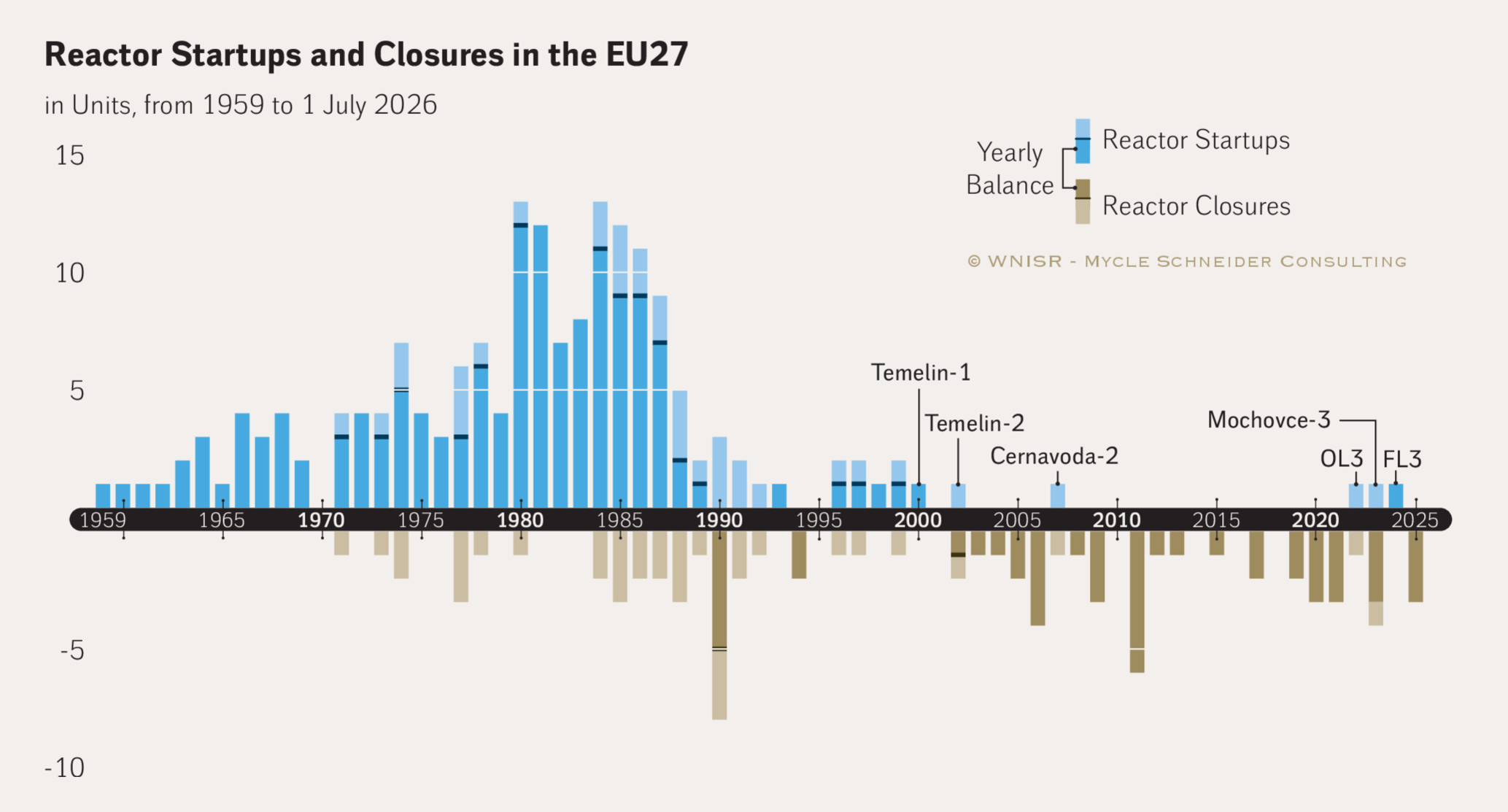
Sources: WNISR with IAEA-PRIS, 2026
As Figure 78 shows, 98 reactors are operating in the EU27 as of mid-2026, 38 less than the historic maximum in 1989, a drop by over one quarter. Eighty percent of the operating plants are located in six of the western countries—with 57 units in France alone—and only 20 in six newer member states.
The closures in 2025 of Doel-1 & -2 and Tihange-1, all in Belgium, brought the number of permanently closed reactors in the EU27 to 80 (71 in Western Europe, over half of which in Germany). Thirty-six units were closed over the past 20 years from 2006 to end-2025.
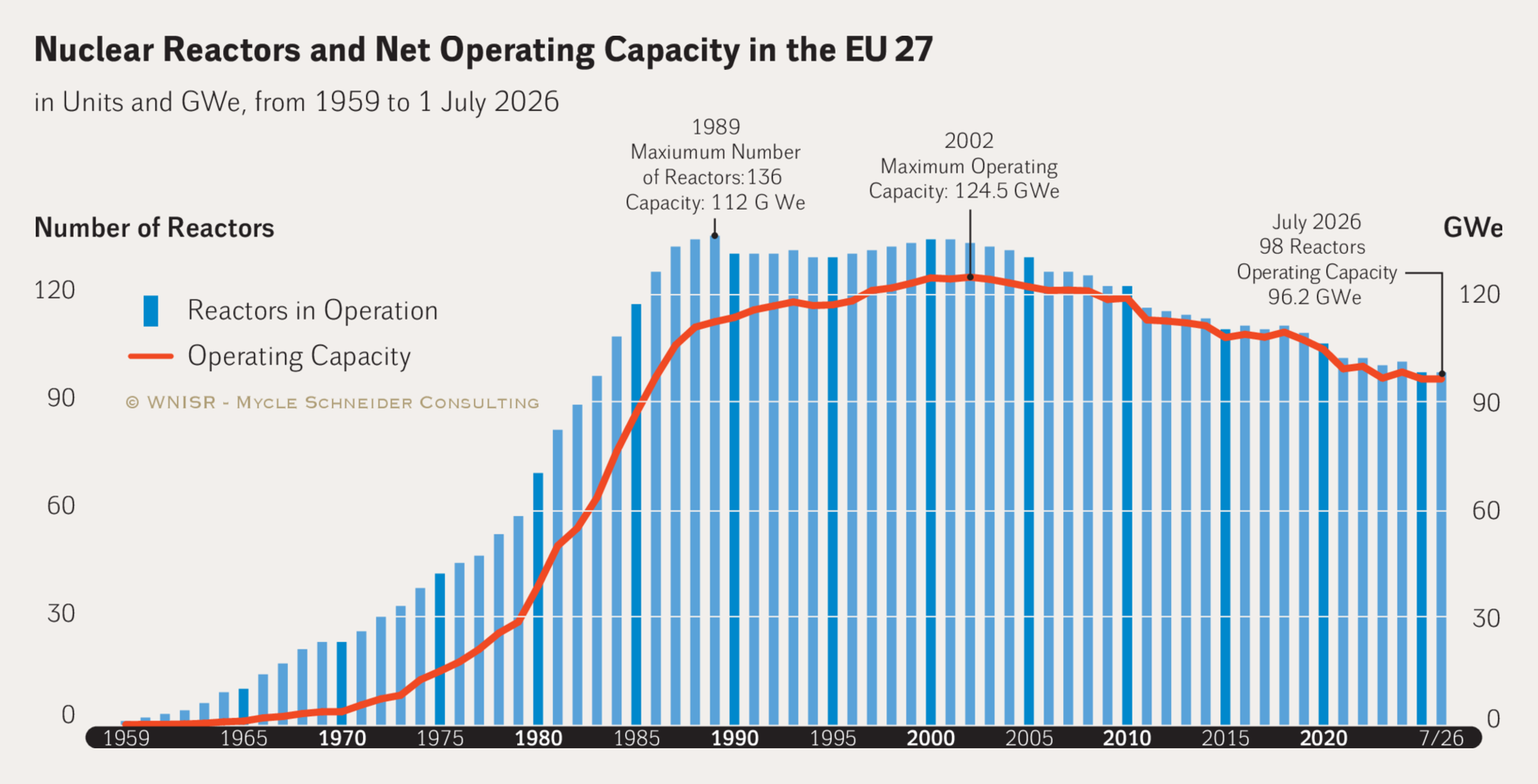
Sources: WNISR with IAEA-PRIS, 2026
In 2025, nuclear plants generated 618.5 TWh net in the EU27, slightly up from 617 TWh in 2024. In 2024, production had increased by almost 5 percent compared to the previous year, and by almost 2 percent in 2023, following a plunge of 17 percent in 2022. Consequently, the nuclear share in gross power generation had dropped to 21.7 percent in 2022, then slightly increased to 22.6 percent and 23.2 percent in 2023 and 2024 respectively before decreasing again by 0.4 percentage points to 22.8 percent in 2025.
In the absence of any significant delivering newbuild program (see Figure 79), the average age of nuclear power plants has increased since the mid-80s and at mid-2026 is 39.5 years (see Figure 80 and Figure 81).
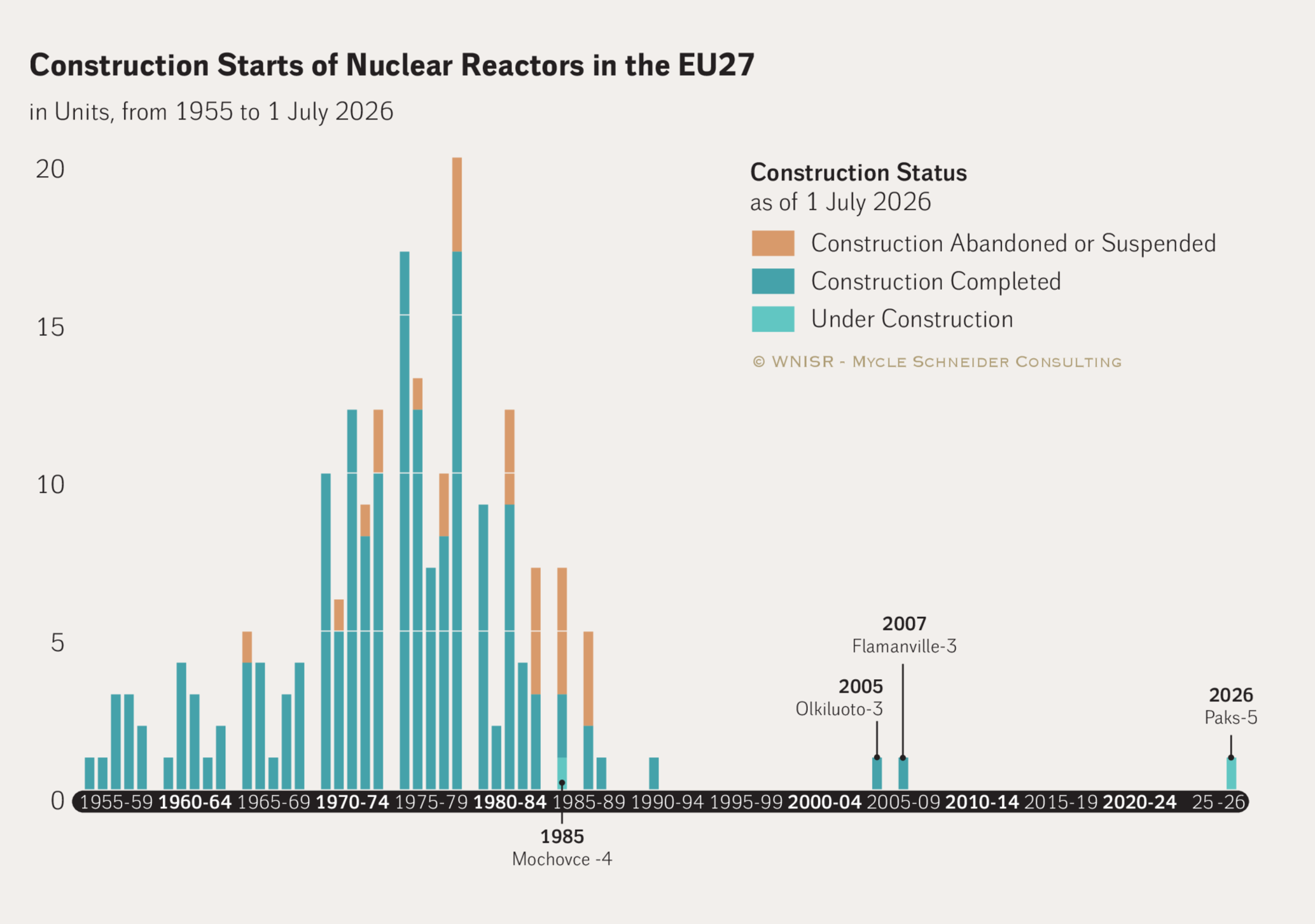
Sources: WNISR with IAEA-PRIS, 2026
Note: Construction start of Mochovce-3 and -4 was first introduced as of 1985 in IAEA-PRIS, “Nuclear Power Reactors in the World – April 1986 Edition”, April 1986. Their construction was later suspended. See section on Slovakia.
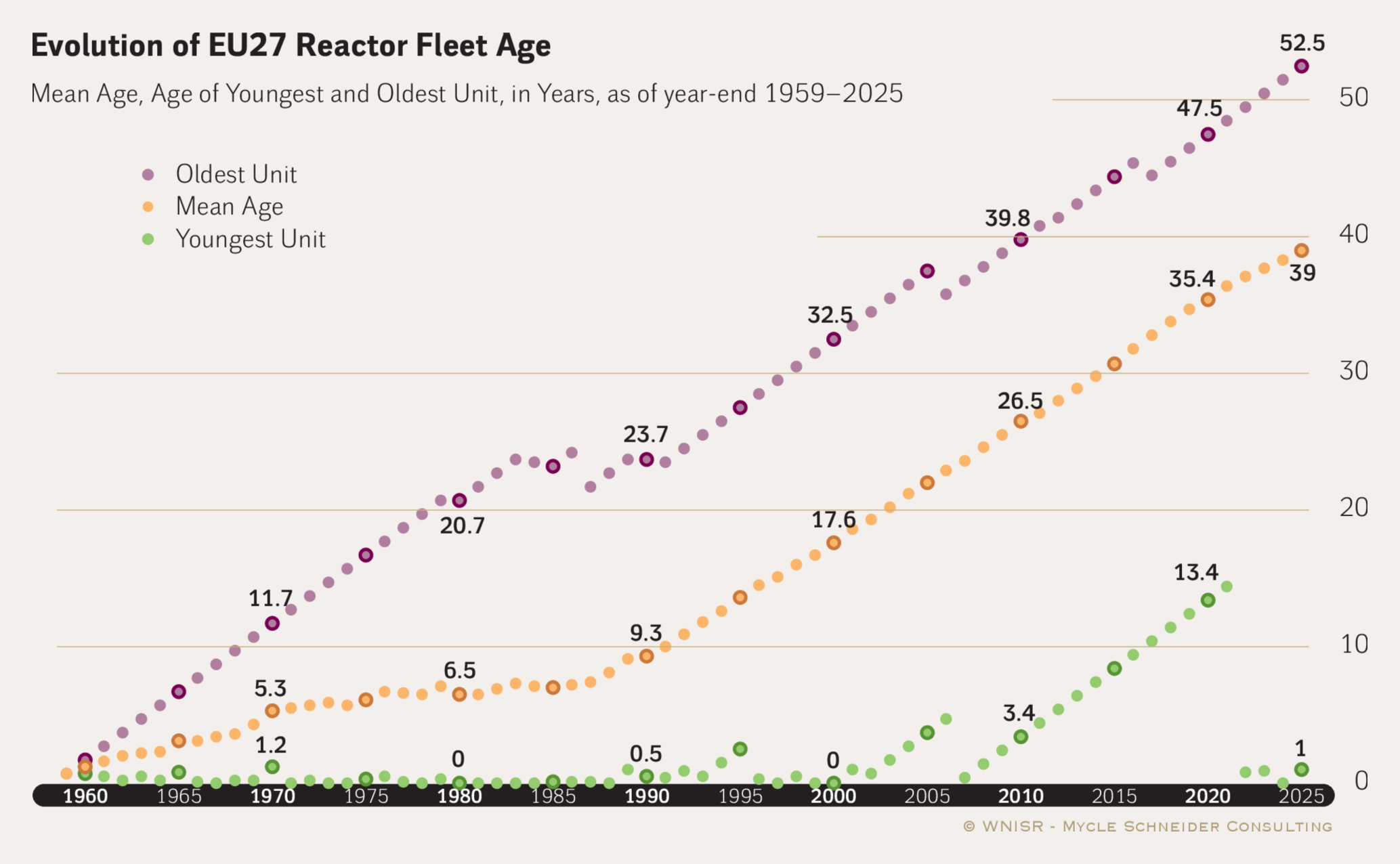
Sources: WNISR with IAEA-PRIS, 2026
The age distribution shows that now almost nine in ten (85) of the EU’s operating nuclear reactors have been in operation for 31 years and beyond of which 53 have been on the grid for 41 years and more. One reactor, Borssele in the Netherlands, the oldest in the EU, reached 52 years of operation in July 2025. The then-second oldest reactor, Doel-1, was closed after just over 50 years of operation in early 2025, followed by Tihange-1 (50.6) in September 2025, and Doel-2 (50.3) in November 2025.
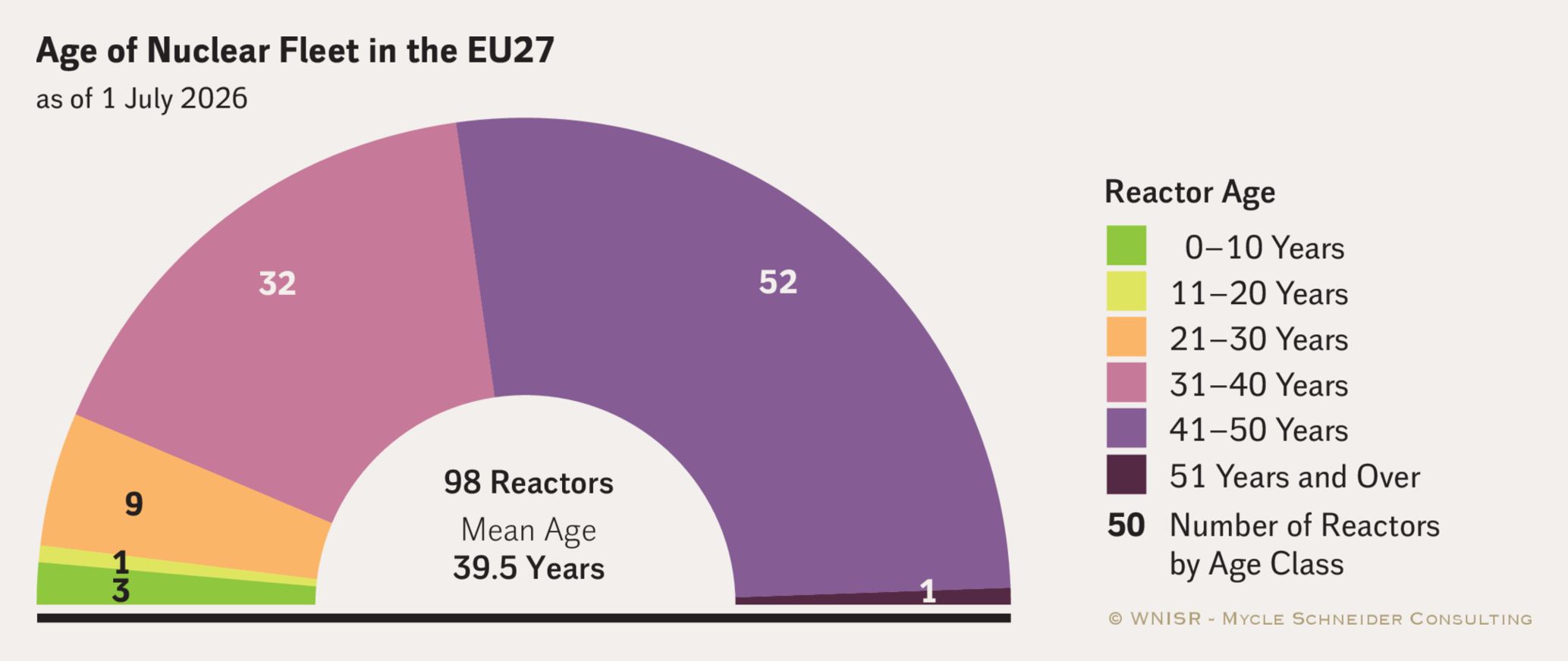
Sources: WNISR with IAEA-PRIS, 2026
As of mid-2026, 91 nuclear power reactors operated in Western Europe (western EU Member States plus UK and Switzerland), 69 fewer units than in the peak years 1988 and 1989, a 42-percent decline. In 2025, three reactors were closed in this region, Doel-1 & -2, and Tihange-1, all in Belgium.
With Switzerland operating two reactors for over 50 years—Beznau-1 at 57, and Beznau-2 at almost 55)—the average age of operating reactors in Western Europe reaches 41.1 years (see Figure 82).
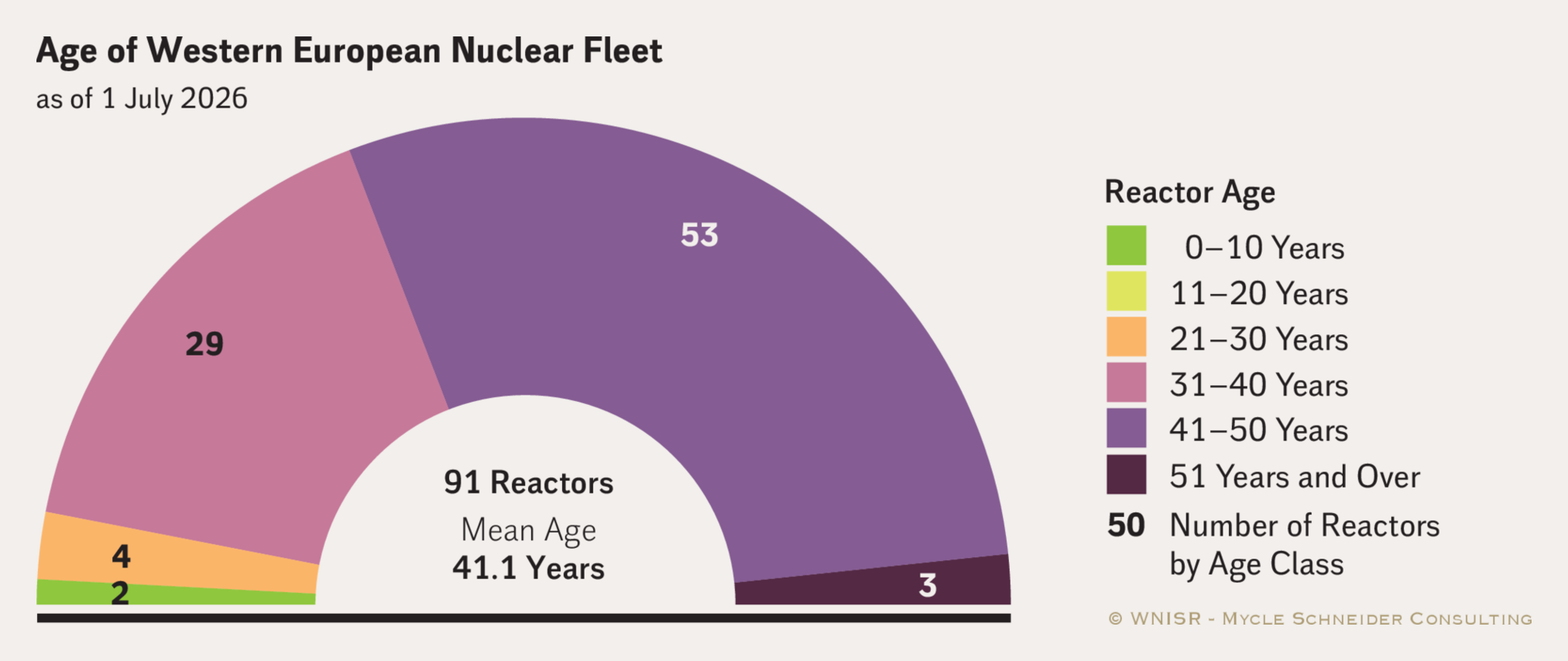
Sources: WNISR with IAEA-PRIS, 2026
The only remaining active construction project in Western Europe is implemented by French utility EDF at Hinkley Point in the UK, where two European Pressurized Water Reactors (EPR), Hinkley Point C-1 and C-2, have been under construction since 2018 and 2019, respectively. As previous EPR projects in Finland and France, both units are billions over budget, years behind schedule, and are currently not expected to be commissioned before around 2030 or later (see United Kingdom Focus).
The mean-age evolution of the nuclear reactor fleet in Western Europe follows the same pattern as the EU27, constantly increasing since the middle of the 1980s. The eventual startup of the two reactors currently under construction will have little impact on the aging aspect of an otherwise shrinking fleet.

Belgian nuclear energy policy has been undergoing a substantial shift since the Russian invasion of Ukraine in 2022 and the election of the “Arizona coalition” government with Flemish nationalist Bart De Wever as prime minister in February 2025.2425 First, the legislated closure of all Belgian nuclear plants by 2025 was scrapped. Then, the lifetimes of the two remaining operational reactors, Doel-4 and Tihange-3, were extended by ten years to 2035, bringing their planned lifetimes to 50 years each. Furthermore, the so-called “Phoenix” deal with owner-operator Engie was finalized in spring 2025. It included the transfer of all nuclear waste responsibilities to the Belgian state and the risk sharing of continued operations by the state and Engie via the implementation of a joint venture—BE-NUC—to operate these reactors.2426 Refer to Belgium in WNISR2025 for details on the deal. Finally, rather surprisingly, Engie and the government announced that negotiations for the full nationalization of the Belgian nuclear industry had begun and are planned to be finalized in October 2026.2427
Following the initial 2025 deal, Doel-4 and Tihange-3 were taken off the grid for so-called “LTO [Long Term Operation] reviews”, during which Belgium’s nuclear regulator, the Federal Agency for Nuclear Control (FANC), conducted safety inspections.2428 Tihange-3 was offline from 5 April to 10 July 2025, while Doel-4 was inspected from 30 June to 8 October 2025.2429 Both reactors were deemed capable of operating an additional ten years to 2035 after the respective inspections concluded.2430
In a July 2025 press release, FANC noted the time pressure, due to “late political decisions”, under which these inspections had been conducted. It also advocated for “clarity during this legislature on a possible extension of the operation of Doel 4 and Tihange 3 beyond 2035” to allow for “the necessary safety analyses and preparatory steps to be started in time”,2431 should there be further lifetime extensions to 2045.
Therefore, as of mid-2026, Belgium had only two operational reactors, Doel-4 and Tihange-3, corresponding to 2.1 GW and six closed reactors (3.9 GW) in various stages of decommissioning (see section on Belgium in Decommissioning Status Report). The two operating reactors, both 41 years old,2432 were taken off the grid in April 2026 and are planned to remain offline until November 2026 for additional refurbishment work.2433 According to Belgian transmission grid operator Elia, this is expected to ease seasonal overcapacity in 2026 but regarding the return to the grid of the two reactors combined with increasing renewables (mainly solar) Elia considers “flexibility shortages are expected to become worse in the coming years.” 2434
With the closure of three reactors between February and November, the 2025 annual nuclear power generation of 22.5 TWh (a reduction of 24 percent year-on-year) was the lowest in the past quarter century compared to a historic maximum of 47.8 TWh in 2021. This coincides with a general continuous decline of nuclear in the electricity mix from a historic maximum of 67.1 percent already reached in 1986, and 58 percent in 2001, down to 32.5 percent in 2025 which still represents a substantial share (see Figure 83).2435
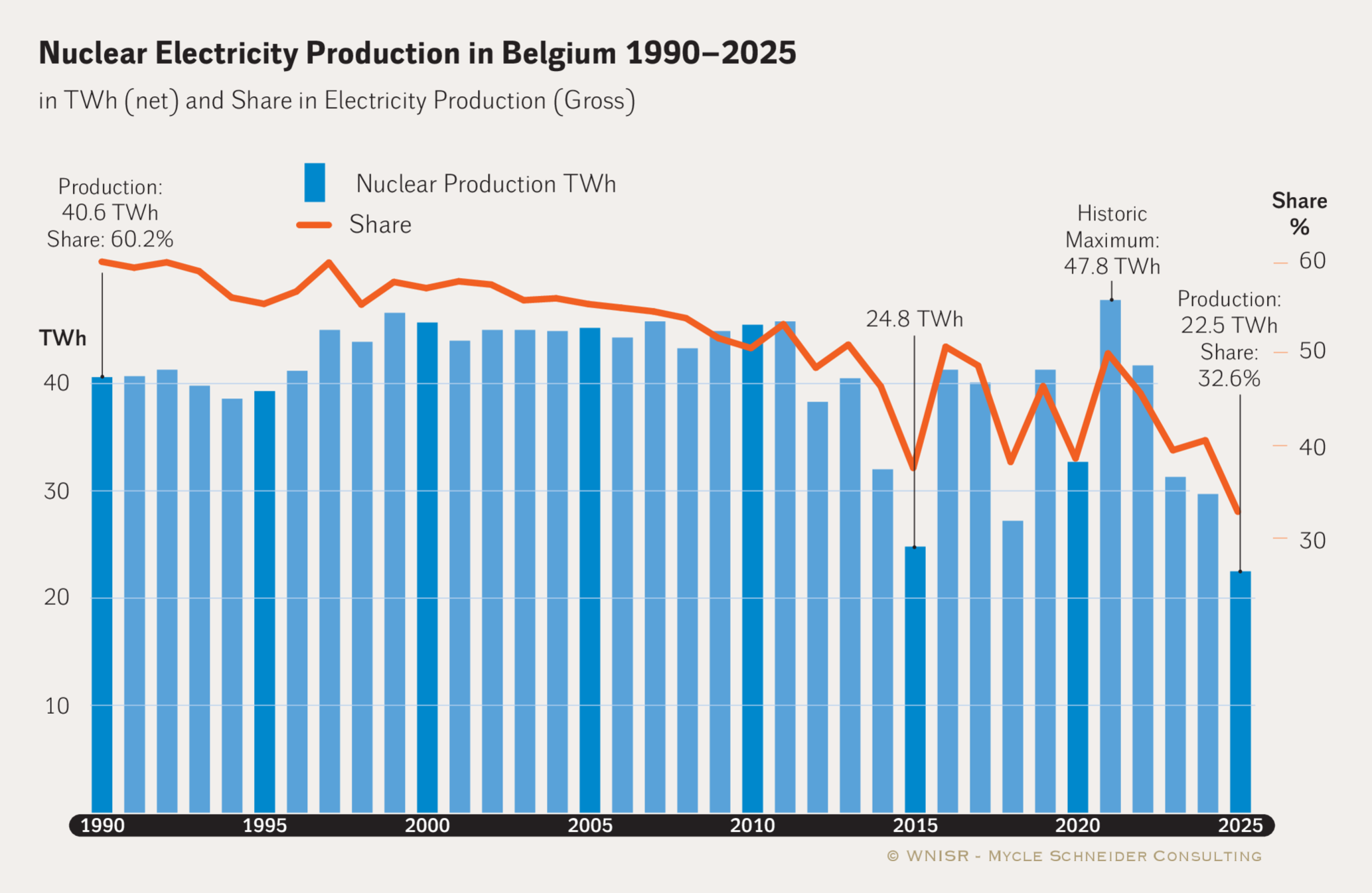
Source: Energy Institute, 2026
Over the four decades from 1980 to 2020, the operating nuclear capacity remained basically stable, while production became erratic starting in 2012 due to an aging reactor fleet (see Figure 84).
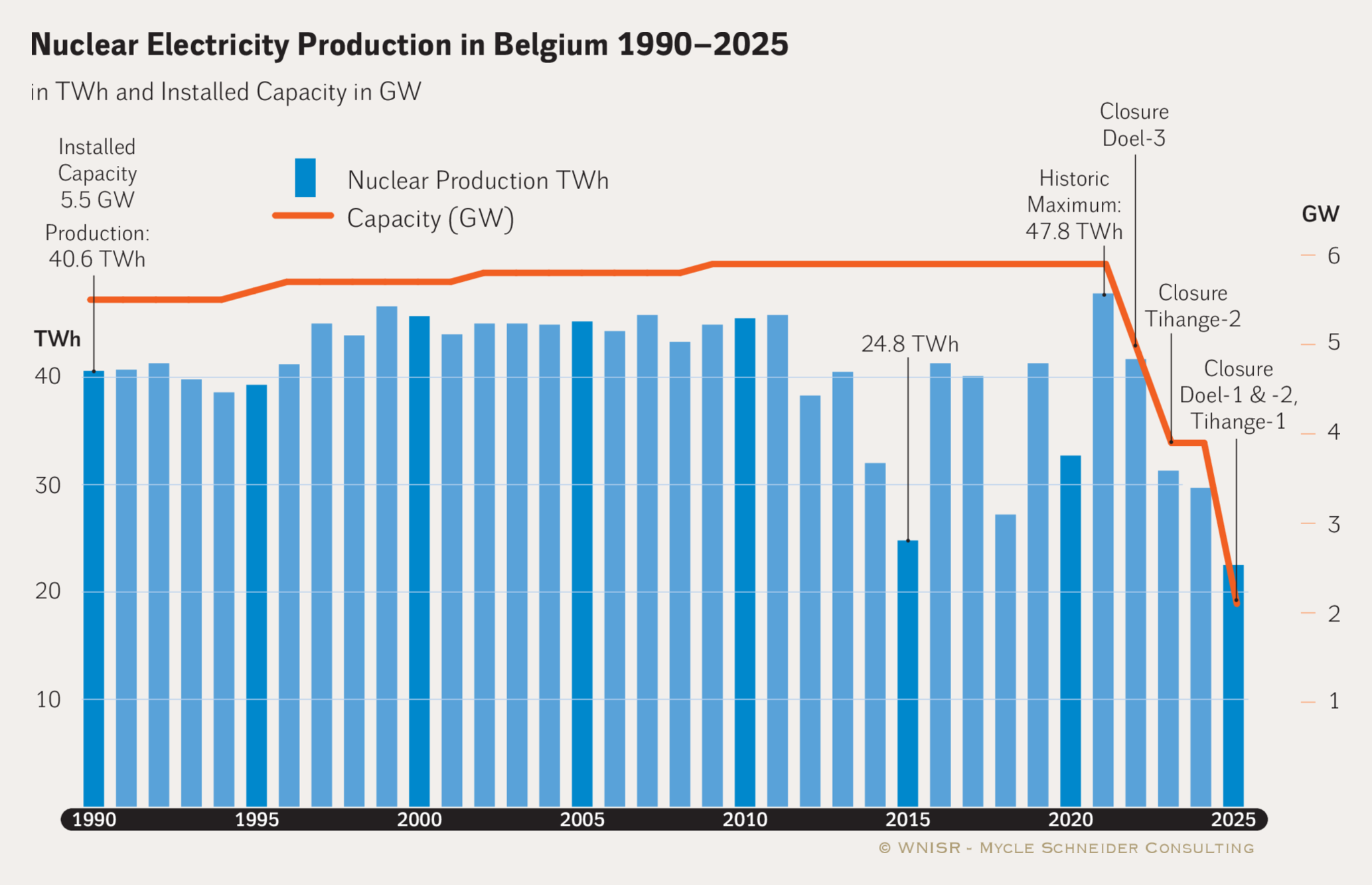
Source: Energy Institute, 2026
Nationalization of the Belgian Nuclear Fleet
The Arizona coalition seems determined to stick to its plans announced in the 2025 coalition agreement and retain 4 GW of nuclear capacity on the grid by continuously evaluating options for both lifetime extension for existing reactors and newbuild.2436 This target is long-term, extending beyond the legislative period that ends in 2029. Thus, the latest update of the National Energy and Climate Plan, published in October 2025, expects only 2 GW of nuclear on the grid in 2030.2437
Engie and the Belgian Government negotiated the lifetime extensions of Doel-4 and Tihange-3 in 2023. The reactors were to be operated in partnership for an additional ten years, and the full financial responsibility for nuclear waste management was to be transferred to the state for a lump-sum payment totaling €202215 billion (US$202215.8 billion). The payment was made in two installments: a €12.2 billion (US$202513.8 billion) payment in March 2025 for high-level waste, to-be-stored in a future deep geological repository, and a €3.6 billion (US$20254.1 billion) payment for low- and intermediate-level waste in October 2025 after the restart of Doel-4. With this, the ownership of the two reactors was transferred to BE-NUC, the dedicated entity equally owned by the Belgian state and Engie.2438
Following these payments, Engie and the De Wever government announced the signing of a letter of intent to hold negotiations for the Belgian state to take over the full ownership of all seven Belgian reactors, operational and closed. According to the joint press release issued by the Government of Belgium, ENGIE, and Electrabel on 30 April 2026, the proposal aims for the state to assume responsibility for “the full scope of the nuclear activities currently owned and operated by ENGIE and Electrabel and their affiliates, including the complete nuclear fleet of seven reactors, the associated personnel, all nuclear subsidiaries, as well as all associated assets and liabilities, including decommissioning and dismantling obligations.” 2439 The negotiations shall conclude by 1 October 2026. It seems that the takeover’s price will be a substantial part of the negotiations given earlier unresolved differences between Engie and the state regarding the costs of decommissioning.2440
In December 2022, Engie raised concerns regarding the provisions to be set aside for decommissioning and waste management when the Belgian Commission for Nuclear Provisions announced that another €20222.9 billion (~US$20223 billion) were required.2441 Instead, Engie proposed provisions which entailed a decrease of about €1 billion in 2025 due to “technical optimizations, a downward assessment of the overall risk level, and an increase in the discount rate.” This reduction was rejected by the Commission in December 2025, but in January 2026 Engie filed a formal complaint to the Commission. So far, the issue remains unresolved.2442
The state takeover might lead to the attempted restart of several of the closed reactors—pending regulatory approval. Engie has made it clear that it is not interested in further investing in nuclear power. Engie-Belgium’s CEO, Vincent Verbeke, stated, “Apart from our existing agreements with the Belgian government, we do not plan to invest in nuclear power”, and “a plan to restart Tihange-1 is unthinkable.” 2443
With the announcement of these new negotiations, all dismantling and decommissioning activities—many already well-advanced—at the Belgian reactors have been halted.2444 Given Engie’s prior warning that reopening the reactors would be costly or even impossible, and with all liabilities regarding waste management already transferred to the state, the state’s offer to Engie remains to be seen.2445 Whatever this may be—further transfers of liabilities or direct payments—all parties agreed that the transaction “should not unduly affect , neither adversely nor positively, the overall financial position of [Engie] and Electrabel.” 2446
SMRs? Maybe.
In addition to the federal government’s plans, the local governments in Flanders and Wallonia are proposing the development of Small Modular Reactors (SMRs) in Belgium. Flanders is hoping to identify up to four potential sites for SMR development.2447 In October 2025, Flemish Prime Minister Matthias Diependaele launched the “Flemish SMR Alliance” consisting of non-disclosed companies, research institutions, and government agencies. In March 2026, the Flemish Department of Work, Economy, Science, Innovation and Social Economy presented an SMR roadmap which has not been made public.2448 In Wallonia, activities are more prudent. In 2025, the region’s investment agency, Wallonie Entreprendre, was granted €250 million (US$2025282.5 million) in its €2.5 billion (US$20252.8 billion) budget to invest into energy infrastructure projects, explicitly including both battery storage and SMRs, until 2029.2449 According to a report by French website “Team France Export”, several sites had been shortlisted, but apart from a site named Chertal, the locations remain undisclosed.2450
Final decisions on nuclear power developments, however, are made by the federal government that, while not having indicated any concrete plans yet, clearly follows a very proactive nuclear strategy (see also section on Belgium in WNISR2025). In April 2026, for example, Energy Minister Mathieu Bihet inaugurated a taskforce on SMR developments in Belgium within the so-called “MAKE 2025-2030” scheme, which aims to develop Belgian industry and energy infrastructure. The taskforce consists of local and federal political representatives, industry actors, and regulators.2451 A clear target has not been communicated, and it remains to be seen whether actual SMR plans emerge from Walloon, Flemish, or federal government ambitions. The Belgian Nuclear Research Centre (SCK CEN) aims to demonstrate its lead-cooled small modular fast reactor, LEANDRA, by the mid-2030s.2452
Renewables? Certainly.
In parallel, renewable energy production has been continuously expanding. The 2025 shares of wind power and solar PV were 18 percent and 14 percent, respectively. The remainder of the Belgian electricity demand was covered by natural gas (21.3 percent, up from 17.7 percent in 2024), bioenergy (5.6 percent), hydropower (0.7 percent), and “other fossils” (0.3 percent).2453 According to IRENA, over the past decade, solar PV capacities have more than tripled from 3.3 GW in 2016 to 10.4 GW in 2025, onshore wind power has grown from 1.6 GW to 3.6 GW, and offshore wind has tripled from 712 MW to 2.3 GW.2454 Up to 3.5 GW additional offshore wind power capacity is planned in the so-called Princess Elizabeth Zone, of which 700 MW might be tendered no sooner than 2027 according to observers.2455 The tender has been postponed several times, most recently by Energy Minister Bihet in July 2025, though the new date announced at the time has since passed.2456 In recent years, conflicting regulations, delayed permitting decisions, and fragmented rulings regarding on- and offshore wind power have slowed down capacity expansions. Expansion targets, however, remain ambitious, and there seems to be political will to expand wind in addition to nuclear.2457

Nuclear reactors supplied 31.2 TWh (net) of electricity in Finland in 2025, up 0.6 percent from 2024. This represented a 39.5-percent share of the gross electricity production, compared to the historical maximum of 42.1 percent reached in 2023.2458
Finland has adopted different nuclear technologies from various suppliers. Two of its operating reactors are modified VVER-V-213 units (507 MW each) built by Russian contractors at Loviisa and two others are AAIII BWR‑2500 models (890 MW each) built by Asea Brown Boveri (ABB) at Olkiluoto. These four units were built in the 1970s.2459
With the deployment of the 1575-MW European Pressurized Water Reactor (EPR) Olkiluoto-3 (OL3), a third generation (Gen III) technology was added to the fleet. The project was completed with a 13-year delay by French-German consortium AREVA-Siemens in 2022 and provided electricity at nominal capacity for the first time on 16 April 2023, 17.5 years after construction began.2460 The full operational transfer, and with it the cessation of joint liabilities between operator Teollisuuden Voima Oyj (TVO) and AREVA-Siemens, was completed in June 2025.2461 Refer to previous WNISR editions for detailed accounts of the OL3 construction project. With a load factor of 75.2 percent in 2025, OL3’s performance remains disappointing. The low load factor of OL3 likely results at least partially from the Finnish transmission grid’s incapability to absorb the full output of the reactor. If output exceeds 1.3 GW, transmission system operator Fingrid applies so-called “protection measures”, i.e., demand-side management activities, to ensure stable grid operations. The responsibility of these measures and their cost allocation are subject to an ongoing dispute before the Supreme Administrative Court of Finland.2462
As reported in WNISR2025, Olkiluoto-2’s operating performance was also affected in 2024–2025. A leak in the generator—caused by a faulty rotor—was further aggravated by the unavailability of spare parts. As a result, the unit has been operating at reduced capacity (735 MW) since May 2025. TVO announced that the limitation will be enforced until OL2’s 2027 annual outage when a “technically improved rotor” is to be installed.2463, 2464 It previously expected to return the unit to full capacity after the annual outage in May–June 2026 (see Finland in WNISR2025).
Long-term Operations for Finnish Reactors
As of mid-2026, the mean operational age of the whole fleet is 38.7 years; 47.3 years without OL3. TVO is preparing the extension of the lifetime of OL1 and OL2 by another 10 to 20 years. The reactors had in the past received several power uprates from their individual design capacities of 660 MW to 890 MW today.2465 They are currently licensed to operate until 2038.2466 The environmental impact assessment report for the lifetime extensions was completed in December 2024,2467 and in April 2025, the Government concluded that the report fulfilled the relevant legislative requirements.2468 While, as of mid-2026, no final decision on the extensions has been publicized, TVO has already secured loans to pay for the necessary overhauls at both reactors: in April 2025, it secured a €75 million (US$202585 million) loan from the Nordic Investment Bank2469 and in October 2025, TVO and the European Investment Bank agreed on a €90 million (US$2025102 million) loan for the same purpose. According to TVO, “the investment project will involve the modernization of automation and control systems as well as the replacement of steam separators” at the two aging reactors.2470 In their statement regarding the conducted environmental impact assessment, the Austrian Federal Environment Agency noted their confusion as to why such assessments were already being conducted given that the final decision on lifetime extensions was expected to be made more than a decade from now, necessitating updated assessments anyway.2471 WNISR will continue to monitor these developments.
The two reactors at Loviisa are licensed to operate until 2050.2472 This would mean that the reactors will operate for 73 and 70 years, respectively. The necessary investment amounts to an estimated €1 billion (~US$1.2 billion) until 2050 according to operator Fortum.2473 After the Russian invasion of Ukraine in 2022, Fortum began diversifying its fuel supply away from Russian suppliers. In 2024, the first batch of newly developed Westinghouse fuel was loaded into Unit 2, and more was loaded in 2025. At both units, annual outages were delayed for various reasons, by nine and twelve days, respectively.2474
Among more recent initiatives for diversification, in March 2026, Fortum signed a cooperation agreement with French fuel manufacturer Framatome—as did operators ČEZ (Czech Republic), MVM Paks (Hungary), and Slovenské elektrárne (Slovakia)—to develop a European supply chain for VVER fuel. The plan is to begin fuel deliveries by 2030 (see also Russia Nuclear Interdependencies).2475
Newbuild Ambitions
The current Finnish Government is determined to build new nuclear power plants, with a particular focus on SMRs, stating that nuclear is required to cover projected electricity demand increases and will keep prices stable, all while ensuring that Finland complies with its climate targets.2476 These ambitions prompted the government to submit a draft revision of the Finnish Nuclear Energy Act for public consultation in June 2025. According to the Minister of Climate and Environment, the proposed changes shall establish “preconditions that accelerate and streamline the preparation and implementation of [nuclear] projects.” 2477
Among other revisions, the amendments allow the government to make a decision-in-principle on specific projects—or the Ministry of Economic Affairs and Employment in the case of SMR projects—without prior parliamentary approval. The parliament would now only be notified in the form of a report. Whereas the current legislation requires a preliminary safety assessment to be carried out by the Radiation and Nuclear Safety Authority and an environmental impact assessment report to be submitted before a governmental decision-in-principle is taken, most of these aspects would now be addressed at a later permitting stage. The amendments were presented to parliament in March 2026,2478 and adopted in June 2026.2479 The changes will come into force on 1 January 2027.
In a report published in March 2026, consulting firm AFRY assessed the potential options for new nuclear, more specifically high-capacity Light Water Reactors and SMRs, as well as lifetime extensions of existing reactors.2480 A press release by the Ministry of Economic Affairs and Employment, that had commissioned the report, states:
According to current assumptions, new large-scale nuclear power projects are not profitable on market terms. Implementing such projects would require substantial state aid. A cost-benefit analysis shows that the direct benefits of subsidising new nuclear power capacity exceed the costs only if the price of electricity is high.
On the other hand, extending the service life of existing nuclear power capacity will generate a significant net benefit in all the scenarios examined, as it will lower electricity prices but will not require state aid. Safeguarding the current capacity for as long as possible is therefore justified from the cost-benefit perspective, the report states.
SMR solutions that produce heat are expected to meet the conditions for market-based implementation better, but even they involve significant project and implementation risks.2481
The AFRY report supposes that power generating SMRs could be commissioned by 2040. Finnish actors, mainly Fortum, have been actively exploring potential SMR projects for years, resulting in a succession of non-binding MoUs (see past WNISR editions).
One project of note seems to be that of Finnish vendor Steady Energy, which signed a letter of intent with Helsinki-based utility Helen in October 2023 to work towards a multipurpose agreement, ultimately enabling the commissioning of up to ten SMRs.2482 Steady Energy’s reactor concept, however, which aims for district heat production only, remains at an early conceptual stage, and thus far from completing any licensing procedures in Finland.2483 Regardless, Helen launched its Nuclear Energy Program in September 2024 to evaluate potential partners, suppliers, sites, and SMR designs for heat and power generation.2484 The company hopes to operate its first SMR in Helsinki, targeting either cogeneration or only district heat production, depending on the site.2485 Together with the City of Helsinki, Helen began investigating three identified potential sites for such a project.2486 In 2026, a dedicated subsidiary project company called Helen Ydinvoima Oy (Helen Nuclear Power Ltd.) was founded.2487 A target year for reactor operations was not published.
In March 2025, the results of Fortum’s two-year feasibility study on new nuclear in Finland and Sweden—the company co-owns four Swedish reactors—were presented.2488 Based on the results, the company does not expect new nuclear to deliver any power in Finland before the second half of the 2030s. Notably, Fortum concludes that for an effective project execution, they must select a “proven technology”, build “more than one reactor”, and “rely on competent owners with nuclear experience.”2489 As a result, Fortum said it would “deepen collaboration” with three potential vendors: Westinghouse, EDF, and GE-Hitachi (GEH). Over the course of 2025, Fortum signed so-called “early works agreements” with all three potential vendors which include collaborative work on pre-licensing and engineering activities.2490 Whether SMR ambitions can be met is strongly dependent on the availability of these technologies (see also chapter on SMRs).
Electricity Landscape in Finland
According to energy think tank EMBER, Finland produced 82.3 TWh (gross) of electricity in 2025. Nuclear power had the highest share at 39.9 percent, followed by wind (27.4 percent), hydro (15.1 percent), biomass (12.6 percent), and solar at 1.2 percent with all fossil fuels combined at 3.6 percent.2491 Finnish renewable capacities have grown substantially—although this growth is driven mainly by onshore wind which increased from 601 MW in 2014 to over 9.3 GW in 2025 following a 12.3-percent growth year-on-year. Offshore wind capacities, however, have been stagnating at only 32 MW for more than a decade. Solar PV capacities surpassed a still very modest 1.5 GW in 2025.2492
In August 2024, the Ministry for Economic Affairs and Employment published a 17-point action plan to promote the expansion of offshore wind power capacities. The report notes that there were inquiries for offshore grid connections adding up to 90 GW (albeit with a partial overlap), and that Fingrid identified five potential connection areas for wind farms off the Finnish coast with up to 1.3 GW grid capacity each.2493 In 2025, a new law regulating tenders and harmonizing licensing procedures in the Finnish Exclusive Economic Zone in the Baltic Sea was created. While tenders were planned to be conducted before the end of 2025,2494 an April 2026 media report suggests that they are now scheduled for 20262495, but, as of mid-year, no actual date or volume has been announced yet.
France
See Focus Countries – France Focus.

The Netherlands operates only the over 50-year-old 482-MW PWR at Borssele—the oldest in the EU—that provided 3.8 TWh (net) of electricity in 2025, a 12-percent increase compared to 2024. The reactor is scheduled to close in 2033, but efforts are ongoing to further extend its lifetime. In 2025, nuclear production made up 3 percent of the country’s electricity generation compared to the historic maximum of 6.3 percent in 1986, when the country also operated a 60‑MW BWR at Dodewaard.2496 This reactor operated from 1968 to 1997; by April 2003 all its spent fuel had been removed, and in June 2005 the site entered a 40-year “safe enclosure period”, after which the plant is to be dismantled (see section on the Netherlands in Decommissioning Status Report).2497
Successive Dutch governments have increased the efforts to build new nuclear power plants. Refer to Netherlands Focus in WNISR2024 and dedicated section in WNISR2025 for a detailed description of the changes in the Dutch nuclear power policy in recent years.
After the 2023 election, the incoming right-wing government spelled out in its coalition agreement (2024) the target to build four new reactors2498—as did a motion passed by Parliament in February 2024—and pledged a total of €14 billion (~US$16 billion) to the nuclear program until 2035.2499 These funds were set aside in the 2026 Climate Fund Plan but have been deemed “likely insufficient” to build all four reactors.2500 Answering a written parliamentary question in February 2025, then-Minister of Climate Policy and Green Growth Sophie Hermans of the center-right People’s Party for Freedom and Democracy (VVD) said that the plan to select a series of potentially suitable locations for newbuild, including the Borssele site, by 2025 would not be possible and concluded that “it does not seem realistic anymore to have the first plant in operation by 2035.” 2501
The remainder of 2025 turned out to be a rather turbulent year for Dutch politics. In May, far-right coalition member Geert Wilders’ party withdrew from the government after the other members had not agreed to a ten-point amendment of the coalition agreement that would have included the immediate closure of Dutch borders to asylum seekers, amongst other populist demands. The government officially collapsed on 3 June, and elections were called for 29 October. The right-wing government lasted for only 337 days.
Government Efforts for Nuclear Newbuild
The October 2025 election resulted in an even more fractured Dutch parliament with a minority liberal-conservative government under Rob Jetten of the Democrats 66 (D66) party, which is ten seats short of a majority in the Tweede Kamer, the main legislative body in Dutch politics.2502 The new cabinet was sworn in on 23 February 2026.2503 The new Minister for Energy Infrastructure and Nuclear Affairs is the Christian Democratic Alliance’s (CDA) Jo-Annes de Bat, whose official government profile announces that “by building new nuclear power plants, [the Netherlands] can generate more clean energy […]” and that he is “looking forward to getting started on all these challenges – and fast.” 2504
Meanwhile, nuclear expansion plans have proceeded despite these political changes. Preparations until a final decision is taken are conducted following a three-step process.2505 The first step was the announcement of the plans to build new nuclear power plants in the Netherlands, after which a public consultation process began. These consultations were incorporated within the second step, the so-called “research plan”, which is aimed at defining a selection of potential sites. In October 2025, then-Energy Minister Hermans presented a progress report to the Tweede Kamer in which she reported on the findings of a preliminary environmental assessment report as well as a system cost analysis of nuclear energy.2506 The latter concluded that in certain high-electricity demand scenarios up to the year 2050, nuclear new build could be beneficial from an economic perspective, but the analysis included rather optimistic cost assumptions for new nuclear when compared to recent European construction projects.2507
In its coalition agreement, published in January 2026, the new government remains committed to building “at least four new nuclear power plants”, either high-capacity—referred to as conventional—or Small Modular Reactors (SMRs).2508 Shortly after this announcement, the Final Research Plan for the to-be-conducted Environmental Impact Assessment (EIA) was released. The research plan sets out the necessary steps and procedures to conduct an assessment that would provide the government with critical information for selecting a single site to house two new reactors (up to 3.2 GW) of the four planned. Several potential locations were preemptively selected, including areas around Sloe—potentially at the current Borssele site—and Terneuzen, both in the southern province of Zeeland; Maasvlakte, near the port of Rotterdam; and Eemshaven in the northern province of Groningen.2509
In a letter to the Tweede Kamer, dated 19 June 2026, the two incoming cabinet members, Jo-Annes de Bat, Minister for Energy Infrastructure and Nuclear Affairs, and Stientje van Veldhoven-van der Meer, Minister of Climate and Green Growth, announced that only three potential sites were selected for further analysis, namely two locations in Eemshaven, and one in Terneuzen. Notably, a potential co-location with the existing Borssele plant was rejected because of limited space, potential grid constraints, and “safety risks [that] remain due to gas and future hydrogen transport.” 2510 These assessments were based on an EIA commissioned in February 2026.2511 A final site selection, based on a more extensive EIA, is expected to be announced in the first half of 2027. According to the ministers’ letter, if multiple locations were found to be suitable, a location in Zeeland (which would be Terneuzen) would be prioritized.2512
Also noteworthy in the letter are the first details of a roadmap for Dutch nuclear newbuild, aiming for a total of 7 GW of installed nuclear capacity by 2050, including two large-scale reactors at a single location. Most of this section of the letter is concerned with grid integration challenges, raised by transmission grid operator TenneT, that would arise even for a plant with 2.2 GW capacity, simulated to be operational by the year 2040. In addition, there are other remaining challenges to be overcome, including purchasing suitable land, financing, and selecting a technology.2513
In a separate letter published on the same day, Energy Minister de Bat presented the roadmap in detail. He outlined four tracks to support the goal of 7 GW by 2050. The first track is concerned with the first two new large reactors (2.2 to 3.2 GW) to be completed in the “late 2030s at the earliest” and the further lifetime extension of Borssele, while the second track aims to commit to additional capacities (up to 3.2 GW), with large-scale reactors and/or SMRs. The third track shall define mechanisms on how to involve “private SMR initiatives”, while the fourth track shall “stimulate promising innovations in the Netherlands”, including technologies that would “[reduce] nuclear waste”.2514 An illustrative overview of the roadmap was published with the letter.2515
Additionally, in February 2026, a dedicated state-owned project company was founded. Nucleaire Energie Organisatie Nederland (NEO NL) is tasked with organizing the construction of two reactors at a single site, with at least 1 GW of capacity each. It is in sole ownership of the government, represented by the Ministry for Climate and Green Growth.2516
In late 2025, the European Commission had approved the state aid mechanisms for the execution of “preparatory activities for the eventual development of new nuclear plants,” thereby allowing the Dutch government to allocate €45 million (US$52 million) in equity contribution to the company’s capital and the issuance of a €127-million (US$147 million) loan.2517
Already in March 2024, the former Dutch Government had announced an SMR program aimed at identifying the “potential of SMRs” and their “possible integration” into the Dutch energy system.2518 Building on this, the outgoing government announced its “National Strategy on the Development of SMRs” in October 2025.2519 After a review of international projects, the previous government opted to focus on the preparation of regulations, on the building of expertise for later industrial applications and development, and to support “nth-of-a-kind” projects. Upon the release of a study addressing the spatial integration of SMRs, then-Climate Minister Hermans concluded in a letter submitted to the Tweede Kamer in February 2026 that the government should “provide clarity on spatial planning requirements” and “further explore risk-sharing mechanisms [for] private initiatives [to] flourish.” 2520
Within the SMR strategy, a total budget of €20 million (US$202522.6 million) was allocated for the “preparatory phase” before a private company would submit a license to the regulator.2521 In April 2026, the Ministry of Economic Affairs and Climate launched a call for private companies to participate in a market consultation to provide input on “opportunities and challenges in the financing of SMR projects”, recommendations regarding “the need for and design of financial support during the preparatory phase”, and “suggestions for minimizing potential obstacles in later project phases”.2522 Furthermore, the Dutch regulator ANVS joined the Joint Early Review for the French NUWARD SMR (currently being redeveloped, see LWR: Other Designs in chapter on SMRs).2523
So far, only one private actor has been publicly announcing plans to build SMRs: ULC‑Energy which operates as a “project developer of the Rolls-Royce SMR” and is headquartered in the Netherlands where it intends to deploy the technology.2524 So far, the company has signed cooperation agreements with several companies, including Mammoet, a construction company involved in supplying transportation and lifting services to nuclear construction and decommissioning projects;2525 Fugro, a Dutch geoscience and surveying company;2526 and Orano, a French state-owned nuclear fuel and services company.2527 Furthermore, utility Eneco has agreed to enter into negotiations for a potential power-purchase agreement from the year 2035 onwards.2528
In addition to the Dutch Government’s efforts, the province of Gelderland had announced its “SMR Action Plan” in 2024, aiming to have the first SMR operating within its borders between 2035 and 2040.2529 Commissioned by the province, in March 2025 NRG Pallas, the operator of a medical isotope facility at Petten, conducted a preliminary study on the integration of SMRs that identified “four areas” as “potentially suitable for the construction of an SMR.” 2530 Reportedly, representatives of the province said that they were going to “do follow-up research and enter into discussions to make the arrival of an SMR even more concrete.” 2531
The follow-up research study, conducted by consulting firm Haskoning, was finalized on 8 May 2026,2532 but it was only publicly advertised by the provincial government on 23 June 2026.2533 While Gelderland representatives conclude that SMRs could be widely applicable in Gelderland in the future, the authoring firm, Haskoning, is more cautious. The firm points towards remaining uncertainties regarding SMRs, including the low technological maturity and availability, high costs, at least for first-of-a-kind-projects, as well as grid constraints in the province, complemented by the lack of energy demand for heat-producing SMRs. The study also mentions the possible implementation of “micro-reactors”, whose first deployment is not expected before 2045, according to the study.2534
While the ambition remains to designate two locations by 2027,2535 the provincial government and Neder-Betuwe, the municipality housing the closed Dodewaard reactor, reported in April 2026 to have launched an initial feasibility study on the development of an SMR at the site with expected completion by the end of the year.2536 In June 2026, the provincial government announced the launch of another feasibility study aiming to assess the implementation of SMRs in the municipality of Duiven, located less than twenty kilometers from the border with Germany. The study is scheduled to be finalized in the first quarter of 2027.2537
Lifetime Extension Plans and Current Power Mix
Finally, lifetime extension plans for the Borssele plant for up to twenty years beyond 2033, potentially allowing the reactor to operate for 80 years, have advanced (for further detail on related activities since 2022, see past WNISR editions). In October 2025, the outgoing government submitted an amendment to the Nuclear Energy Act to allow for the extended operation of the reactor.2538 In November 2025, the amendment was introduced in the Tweede Kamer which approved it in June 2026.2539 It is yet to be adopted by the Eerste Kamer (Dutch Senate).2540
According to the draft Basis Document commissioned by EPZ for the Periodic Safety Review in the framework of the subsequent lifetime extension, as of September 2025, the license is expected to be applied for by July 2027.2541 But the final decision whether to go ahead lies with its shareholders. These are German utility RWE and Dutch publicly owned utility Zeeuwse Energie Houdstermaatschappij (ZEH). The final investment decision is scheduled to be taken in October 2029.
Note that the former government already mentioned that “clarity regarding the shareholder structure” was necessary before a final decision could be made,2542 that clarity is expected for 2026. Background being that early during the formal consultations—launched in 2022—both shareholders had signaled reluctance to go ahead with the extension unless substantial state guarantees were provided. By May 2024, ZEH notified the government of its willingness to launch negotiations for a government take-over of its shares in EPZ. As a result, in July 2025, the previous administration informed of its decision to submit a non-binding offer for ZEH’s 70-percent stake.2543 As of March 2026, the stated goal was for the issuance of a binding offer by 1 July 2026.2544 As of mid-2026, nothing suggests that this has occurred. Nevertheless, early consultations had begun with the regulator in August 2025, who expects to issue a final permit in 2028 based on the aforementioned timeline.2545
In late 2025, the previous government had also identified the outcome of the shareholder discussions as a determining factor to decide whether to proceed with the termination or amendment of the so-called Borssele Covenant, which in turn is necessary for the implementation of the additional lifetime extension. The Covenant was signed in 2006 by the government, EPZ and its shareholders, and stipulates that the reactor is to close “no later than 31 December 2033”.2546
The new coalition remains dedicated “to invest in achieving 40GW of offshore wind capacity through Contracts for Difference,” to the removal of grid congestions, as well as to widespread electrification of the Dutch energy and industrial systems.2547 According to IRENA, Dutch onshore wind capacities surpassed 7 GW in 2025 and were complemented by 4.7 GW of offshore wind. Solar PV capacities have experienced staggering growth over the past decade, increasing more than twelve-fold from 2.1 GW in 2016 to 25.9 GW in 2025, with 1.1 GW added year-on-year since 2024.2548 However, gas turbines remain the single dominant electricity generating technology, supplying 36.6 percent to the power mix in 2025. Non-hydro renewables provided 48.7 percent, of which wind accounted for 24.2 percent and solar 18.9 percent. Coal provided 9.3 percent, other fossil fuels 2.4 percent, and nuclear contributed 3 percent.2549

As of 1 July 2026, Spain operates seven reactors with a combined capacity of 7.1 GW2550 that provided 54.2 TWh gross (51.5 TWh net) in 2025, representing a 0.9 percent decrease year-on-year and 18 percent of the country’s electricity generation2551—less than half of the historic maximum of 38.2 percent in 1989. The Spanish reactors have a mean operating age of 41.4 years as of mid-2026.2552
Spanish nuclear ownership is concentrated with the utilities Iberdrola and Endesa. Both utilities share ownership of Ascó-2, Vandellós-2, Almaraz-1 and -2 with Naturgy. Trillo is in shared ownership with Naturgy and EDP. Endesa is the sole owner of Ascó-1, and Iberdrola fully owns Cofrentes.2553
In January 2019, Spain’s coalition government agreed on a nuclear phaseout plan with utilities Endesa, Iberdrola, and Naturgy as part of the overall Integrated National Energy and Climate Plan (INECP).2554 All of Spain’s reactors are scheduled to be closed by 2035. For several years, there have been attempts to reverse this phaseout plan (refer to Spain in WNISR2025 for details). The Iberian blackout that occurred in April 2025 sparked further calls for the removal of the phaseout plan even as renewable energies were wrongly blamed for the grid disruptions.2555 In fact, according to the March-2026 final, detailed report on the incident, published by the European Network of Transmission System Operators for Electricity (ENTSO-E), the association of European transmission system operators, the blackout was caused by a “combination of many interacting factors, including oscillations, gaps in voltage and reactive power control, differences in voltage regulation practices, rapid output reductions and generator disconnections in Spain, and uneven stabilisation capabilities,” 2556 referred to as a “perfect storm of multiple factors” by one of the authors.2557 A set of immediate measures to improve grid stability, flexibility and (international) transmission capacities was enacted in response to the 2025-event.2558 As of 1 July 2026, the final closure target year of 2035 for the Spanish nuclear fleet remains in practice.
However, current policy allows all reactors to apply for lifetime extensions beyond 40 years, in contrast to the previously governing Socialist Party’s (PSOE) policy allowing for a limited seven-year deferral of the plants’ closures initially scheduled for 2024–2028.2559
|
Reactor |
Net Capacity (MW)(a) |
Grid Connection |
License Expiration(b) |
Expected Closure(c) |
|
Almaraz-1 |
1 011 |
01/05/1981 |
November 2027 |
November 2027(d) |
|
Almaraz-2 |
1 006 |
08/10/1983 |
October 2028 |
October 2028(d) |
|
Ascó-1 |
995 |
13/08/1983 |
October 2030 |
October 2030 |
|
Cofrentes |
1 064 |
14/10/1984 |
November 2030 |
November 2030 |
|
Ascó-2 |
997 |
23/10/1985 |
October 2031 |
September 2032 |
|
Vandellós-2 |
1 047 |
12/12/1987 |
July 2030 |
February 2035 |
|
Trillo-1 |
1 003 |
23/05/1988 |
November 2034 |
May 2035 |
Sources: Various, compiled by WNISR, 2026
Notes
(a) – Reference Unit Power from IAEA-PRIS as of 1 July 2026.
(b) – Individual reactor pages on Spanish Nuclear Safety Council’s website.2560
(c) – Nuclear Safety Council, Eighth and Ninth Report to the Convention on Nuclear Safety.2561
(d) – Both Almaraz reactors are likely to receive lifetime extensions to June 2030. As of 1 July 2026, a final ministerial decision had not been announced.2562
Operating licenses were extended beyond 40 years for all the Spanish reactors within the past six years (see previous WNISR editions). As shown in Table 24, Almaraz-1 and -2 are the next reactors to close in November 2027 and October 2028, respectively. As the current operating licenses for Ascó-2, Vandellós-2, and Trillo expire prior to their planned delayed closure, they will have to be extended if the reactors are to operate according to the latest schedule.
In late October 2025, the three companies which own the Almaraz plant—Iberdrola, Endesa and Naturgy—requested a lifetime extension allowing for operation until end of June 2030.2563 A few weeks later, the Ministry for the Environment (Ministerio para la Transición Ecológica y el Reto Demográfico or MITECO) tasked the regulator Consejo de Seguridad Nuclear (CSN) to undertake a technical assessment.2564 CSN requested additional documentation from the operators in December 20252565 who submitted the required documents in February 2026.2566
MITECO, which bears the ultimate responsibility, had set out three prerequisites for a license extension approval. These are the continued radiological safety during operations, security of supply, i.e., reliable continued operation of a given reactor, and no additional costs for consumers, relating to decommissioning and waste management as well as potential refurbishment costs being passed on to electricity consumers.2567 Media coverage from June 2026 indicated that the government intended to allow the lifetime extension to 2030, if the technical report by CSN positively evaluates the safety of the Almaraz plant.2568, 2569 A final ministerial decision had not been published as of 1 July 2026.2570 The chairman of Iberdrola, Ignacio Sánchez Galán said in February 2026 that the company was planning on extending the operation of additional reactors, such as the Cofrentes unit, beyond their currently licensed lifetimes.2571
Spanish nuclear operators and the lobby group Foro Nuclear criticize a “disproportionate tax burden” on nuclear, which, they claim, increased operating costs and forced the plants to shut down temporarily for economic reasons.2572 Indeed, the levy for nuclear waste management and decommissioning activities was raised from €7.98/MWh to €10.36/MWh (US$9.3 to US$12/MWh) in June 2024 due to “rising storage and disposal costs”, estimated at €20.2 billion (US$202321.8 billion) in the latest General Plan for Nuclear Waste Management approved in December 2023. This tax increase is subject to a legal challenge submitted to the Supreme Court by Foro Nuclear, which has been lamenting the tax burden weighing on nuclear operators for years (see past WNISR editions).2573 Iberdrola and Endesa have both filed appeals contesting the General Plan and the derived fee revision, arguing it constitutes a breach of the 2019 phaseout protocol, and claim a combined €778 million (US$904 million) in compensation.2574 In June 2026, the Supreme Court of Spain ordered the government to provide the calculation methodology which lead to the tax increases by documenting the assumptions it is based on.2575
On a sidenote, Spanish fuel manufacturer ENUSA signed an agreement with Polish project developer SGE to develop and potentially supply fuel to a potential BWRX-300 SMR project in Poland. Together, the companies intend to “work on developing a roadmap toward a fuel material procurement model.” 2576
Overall, the Spanish government remains committed to its target of becoming climate neutral by 2050 and reaching 81 percent of renewable electricity share by 2030.2577 In 2025, 10.2 GW of renewable capacity was added to the grid, of which 1.1 GW were onshore wind and 9 GW solar PV. This means that as of end 2025, Spain had a total of 98.6 GW of renewable grid connected capacities, including hydro, biomass and others.2578 The electricity generation mix (gross) in 2025 comprised 54.6 percent renewables including 21.4 percent solar PV, 19.9 percent wind, 11.2 percent hydro, and 2.1 percent bioenergy. The remainder was covered at 20.9 percent by natural gas, followed by 18 percent nuclear and negligible 0.6 percent coal.2579
Sweden
See Focus Countries – Sweden Focus.

Swiss nuclear power production declined by 20 percent year-on-year to 17.5 TWh (18.4 TWh gross) in 2025. This corresponded to 27.2 percent of total gross national power production, which declined substantially to 67.7 TWh from a record year in 2024 during which 81.1 TWh of electricity were produced, then fueled mainly by a high hydro output.2580 The historic maximum nuclear share of 43.6 percent was achieved in 1996.
With an average reactor age of 50.3 years (see Figure 85), Switzerland operates the second oldest nuclear fleet in the world (behind the Netherlands that operates only one 53-year-old unit), of which Beznau-1, age 57, is the third oldest commercially operating reactor in the world (after Tarapur-1 and -2, India). Beznau-2 is almost 55 years old.2581 The reactor at Mühleberg was closed in 2019 and is being decommissioned (see Switzerland in Decommissioning Status Report).
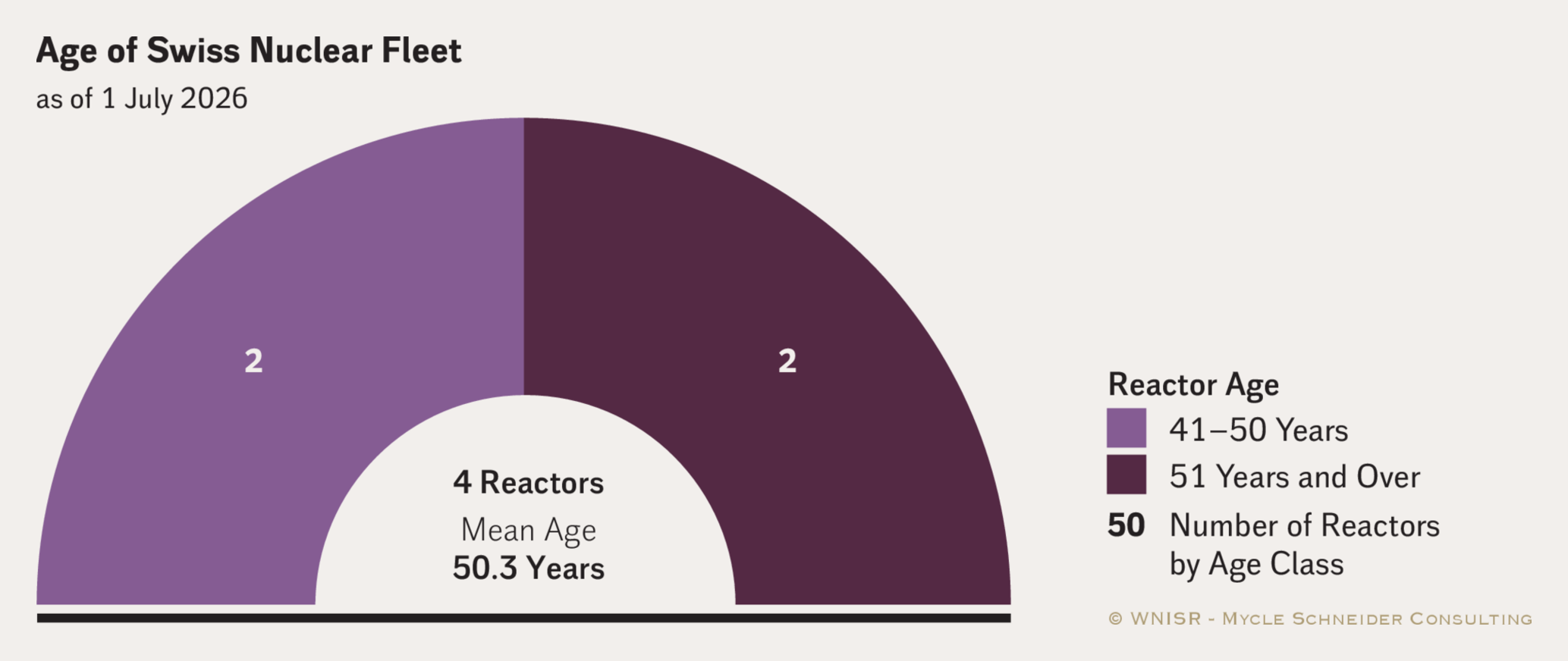
Sources: WNISR with IAEA-PRIS, 2026
Lifetime Extensions
Swiss nuclear licenses are granted for an indefinite period. The regulator ENSI (short for Eidgenössisches Nuklearsicherheitsinspektorat) can revoke a license if a facility is deemed unsafe.2582 Currently, the operators of all still-running power plants are planning to operate the plants for at least 60 years,2583 despite controversial past reports regarding the operating safety at Beznau-1 and Leibstadt (see previous editions of the WNISR for details).
In September 2023, Thierry Burkart, then the leader of the liberal Free Democratic Party (FDP) which is part of the governing coalition, submitted a proposal to the Council of States asking the Federal Council, i.e., the Swiss Government, to conduct a feasibility study on the operation of Gösgen and Leibstadt for up to 80 years. The study was to also include economic and regulatory considerations. In May 2026, the report, conducted by consulting firm Frontiers Economics and engineering services provider Siempelkamp NIS,2584 was published jointly with a summary report by the Council of States. The summary concludes that operating both reactors for 80 years is “technically possible and economically beneficial in most cases.” 2585
It is worth noting that every considered scenario, i.e., closing the reactors after 60 years, extending their operations to 80 years or building a new reactor by 2050 (in addition to lifetime extensions), results in Switzerland being a net exporter of electricity over the whole year; however, also in every scenario, Switzerland might have to import electricity from its neighbors in the winter months.2586 According to the operators, technical and safety-related upgrades would require “best estimate” investments of CHF20231.15 billion (US$20231.3 billion) for Gösgen and CHF2023721 million (US$2023802 million) for Leibstadt. Notably, these calculations assume that both reactors pass their decennial Periodic Safety Review (PSR), conducted by regulator ENSI, and no substantial other upgrades are identified as necessary. Furthermore, according to the report, major replacements within the nuclear island would not be required for 80 years of operation or are deemed impossible, e.g., pressure vessel replacement. The implications of this report will be considered in the upcoming Energy Strategy 2060, scheduled for publication towards the end of 2027.2587
These findings stand in contrast to the recent operating experience of the Gösgen reactor with a load factor below 40 percent in 2025. On 25 May 2025, the reactor was disconnected from the grid for its annual maintenance and for refueling work. During the outage, faulty valves in the feedwater piping system were detected, and the entailing repair work kept the reactor offline until 23 March 2026. Gösgen therefore produced only 3.4 TWh in 2025, down from close to 8 TWh in 2024.2588
The operator Kernkraftwerk Gösgen-Däniken AG (KKG) had detected the faulty valves as early as March 2025 and had communicated a “suspected design weakness” to ENSI but opted not to immediately shut down the reactor. ENSI, in September 2025 reported:
The investigations showed that, in the “feedwater pipe rupture” load case, significant overloads can occur at some of the shock absorbers of the feedwater system inside the reactor building in the unclassified area outside the reactor building. This suspected design weakness constitutes a reportable event, which the Gösgen Nuclear Power Plant reported to ENSI in March 2025.2589
Whether this potential design flaw can be mitigated for the extended operation of Gösgen for 60 years, i.e., until 2039, remains uncertain. The next decennial PSR is scheduled for 2027.2590
In 2016, ENSI updated its regulatory approach for safety evaluations of seismic activities that might affect nuclear power plants and mandated the operators to demonstrate the safety of their reactors in the case of earthquakes (refer to previous WNISR editions for details). In January 2025, Gösgen was the last reactor to pass the evaluation in principle, especially for a very severe but unlikely seismic event (once in 10,000 years). However, operator KKG was tasked with revising its assessments of radiation releases in the event of a less severe but more probable earthquake (once in 1,000 years) by mid-2026.2591 As of mid-July 2026, these updates had not been published.
The Leibstadt reactor operated with a 88.6-percent load factor in 2025, producing 9.6 TWh (net), only 0.8 percent less than in 2024. The reactor is planned to operate for at least 60 years, too, i.e., until 2045. Leibstadt passed its last PSR in 2022.2592
The Beznau power station, consisting of two 356-MW PWRs that connected to the grid in 1969 and 1971, respectively, shall operate until 2033. Operator Axpo is planning to invest CHF350 million (US$2025421 million) in necessary upgrades.2593 The unsteady operational performance, especially of Beznau-1, seems to have improved in 2025, with the reactor operating with a 92.2-percent load factor, up from 76 percent in 2024.2594 The plant, however, has been experiencing unplanned outages due to high water temperatures at the Aare river, both in 20252595 and 2026.2596 Refer to previous WNISR editions for details on Beznau’s past performance.
In February 2025, Axpo announced that it had successfully contracted its “fuel supply”—not specified, but certainly including natural uranium as well as uranium conversion and enrichment services—for Beznau and Leibstadt away from Russian providers as a reaction to the Russian invasion of Ukraine in 2022.2597
However, according to a report released by Greenpeace in May 2026, Beznau will continue operating with Russian uranium via the Framatome fuel assembly manufacturing facility in Lingen, Germany.2598 Fuel for Leibstadt will be partially produced from uranium sourced from Kazakhstan, where many Russian firms are active. How exactly Russian companies remain involved in the supply chain for Swiss reactor fuel remains unclear as Axpo has not disclosed details from its contracts. Gösgen is also supplied by Framatome,2599 but so far, there have been no indications that the uranium is of Russian origin.2600
Political Nuclear Newbuild Initiatives
In 2018, the Swiss Energy Strategy 2050 entered into force after being adopted by referendum in 2017. With this came the ban on building new nuclear power plants in Switzerland.2601 Since the Russian invasion of Ukraine, concerns over energy supply security have resurfaced, and with these, calls for lifting the ban on nuclear newbuild have intensified, too. This culminated in the submission of an initiative (so-called Volksinitiative or Initiative Populaire that can be brought to referendum by citizens) called “Electricity for all at all times (stop the blackout)” that had gathered the necessary number of at least 100,000 signatures in February 2024.2602 In August 2024, the Federal Council formally declined the “Stop the Blackout” initiative to hold a referendum, but signaled its intent to issue a counter-proposal instead, which would include legislative steps designed to deliver on the main demands of the initiative.2603
In March 2026, the Council of States, one of the two chambers of the Swiss Parliament, voted with a majority of 26 to 12 votes to decline the “Stop the Blackout” initiative but approved the counter-proposal that would repeal the ban on new nuclear power plants in Switzerland.2604 With a much closer vote, 13 to 12, the Committee for the Environment, Spatial Planning and Energy of the National Council (the lower house of parliament) approved the same initiative to revoke the ban within the Swiss atomic energy law. During the same hearing, the Commission postponed any decisions on a potential financing mechanism, but it supported the Council of States’s addition to the counter-proposal that a future newbuild project should have a robust and secured funding scheme in place, i.e., be privately funded, before being pursued.2605 The National Council voted on the issue twice in a few days, initially rejecting the proposal without a funding scheme in place and referring it back to the Council of States, but eventually accepting it during the same week of June.2606 A coalition of political parties and various organizations already launched a new referendum initiative to bar the legislative changes.2607
Power Mix
Meanwhile, the rapid expansion of domestic renewable capacities was approved by referendum in June 2024.2608 Refer to previous WNISR editions for more details on Swiss Energy Policy. Currently, Swiss gross electricity production is dominated by hydro (including pumped hydro), which supplied 37.5 TWh or 55.5 percent of the country’s electricity in 2025, down from 48.3 TWh or 59.6 percent in 2024. Nuclear power supplied 18.4 TWh in 2025, which corresponded to 27.2 percent. Solar PV output increased from 6 TWh (7.3 percent) in 2024 to 7.9 TWh (11.8 percent) in 2025. Biomass provided 1.6 percent, and fossil fuels 2 percent.2609
Wind energy produced only 0.2 percent of the country’s electricity. Wind capacities are increasing very slowly, surpassing 100 MW in 2024 and reaching 111 MW in 2025.2610 Achieving the government’s target of 2.3 TWh of electricity produced from wind by 2030 would mean a hundredfold increase in today’s production,2611 or about 200 turbines.2612 Solar capacities have been increasing at a record pace, averaging 1.4 GW of annual new grid connections from 2022 to 2025, resulting in 9.1 GW total installed PV capacity as of 2025.2613 Solar production in 2025 already exceeded the target seen in the high scenario of the government’s 2013 Energy Perspectives 2050.2614
United Kingdom
See Focus Countries – United Kingdom Focus.

Bulgaria has only one operating nuclear power plant, Kozloduy, with two Soviet-designed VVER-1000 reactors and a total installed capacity of just over 2 GW. This plant generated 14.6 TWh (net) of electricity in 2025, down from 15.0 TWh in 2024, with a share in electricity production declining from 40.9 percent to 38.2 percent.2615 According to EMBER, the share of electricity provided by nuclear power was 39.1 percent in 2025, with the remainder generated from coal (22.5 percent), solar PV (18.2 percent), hydropower (6.7 percent), natural gas (4.9 percent), bioenergy (4.5 percent), and wind power (3.5 percent).2616
The Bulgarian energy sector has historically been heavily dependent on Russian imports, including both fossil fuels and nuclear fuel. However, following Russia’s invasion of Ukraine, this dependence has been significantly reduced. Prior to the war, over 90 percent of Bulgaria’s natural gas supply came from Russia, but this supply has been completely halted by Russia.2617
Since 2023, Bulgaria has met its natural gas demand through liquefied natural gas (LNG) terminals in Greece and Türkiye. Additionally, Bulgaria has signed long-term agreements with the Turkish company BOTAŞ, securing access to its LNG terminals and pipeline infrastructure.2618
Despite terminating direct imports of Russian natural gas for its own consumption, Bulgaria continues to serve as a gateway and transit country for Russian gas to Europe via the Balkan Stream pipeline. Operational since January 2021, Balkan Stream is an extension of the TurkStream project and serves as a key conduit for Russian gas exports to southeastern and central Europe, including countries such as Hungary, Serbia, and Romania. However, the project has brought Bulgaria minimal financial benefits, as transit tariffs are heavily subsidized, and the bulk of profits are captured by Russia’s Gazprom and intermediaries in other countries.2619
In September 2025, then-Prime Minister Rosen Zhelyazkov said Bulgaria would “join the EU’s decision to suspend, in the short term, in 2026, contracts for the use or transit of Russian natural gas,” with a full phaseout targeted for 2028.2620 After the April 2026 elections, the new government led by Rumen Radev has not reversed the previous course but has instead focused on preserving Bulgaria’s role as a transit country, maintaining gas flows from Türkiye, and reinforcing the country’s position as a regional gas hub for the EU.2621 Meanwhile, Russian gas supplies to Europe through Bulgaria reached a historic high in early 2026.2622
Fuel Supply Diversification and Dependence on Russia
Bulgaria has historically depended on supplies of Russian nuclear fuel. The most recent fuel supply contract was signed in 2019 and remained in force through the end of 2025.2623 The agreement covered not only fuel fabrication but the entire upstream fuel chain, including uranium mining, conversion, and enrichment. In spring 2025, 82 fuel assemblies from Russia’s JSC TVEL were delivered to the Kozloduy site. According to the plant’s annual report, these deliveries accounted for 12 percent of the plant’s annual expenses.2624
Since late 2016, Unit 6 at Kozloduy NPP has been operating with the new-generation TVSA-12 fuel assembly design. Thanks to its higher contents or uranium and enrichment levels, this fuel enabled a gradual transition—following a series of qualification tests—to operation at an uprated power level of 104 percent starting in 2018.2625
For reasons that remain unclear, Eurostat statistics for the past several decades record only a single nuclear fuel shipment from Russia to Bulgaria: a delivery in 2023 amounting to 62.3 tons and valued at €83.4 million (US$202392.8 million).2626 However, such a volume broadly corresponds to the fuel requirements of the two VVER-1000 reactors at Kozloduy for approximately one and a half years of operation.
In November 2022, Bulgaria’s Parliament instructed the government to implement specific measures to reduce dependence on Russian supply.2627 To align with the EU’s energy security strategy, Kozloduy’s operator signed a ten-year contract with Westinghouse in December 2022 to supply fuel for Unit 5 starting in 2024.2628 The first Westinghouse fuel arrived in April 2024.2629 The following month, Unit 5 was partially refueled with 43 Westinghouse-manufactured assemblies,2630 and in May 2025, another 42 assemblies were loaded.2631 In May 2026, during a scheduled maintenance outage, the third batch of US-supplied nuclear fuel was loaded into the reactor. The complete transition of the unit to Westinghouse fuel is expected in 2027.2632
Additionally, in December 2024, Kozloduy signed a contract for a safety analysis to license the Westinghouse fuel assembly design for Unit 6.2633
Besides the Westinghouse deal, the Kozloduy operator also signed in March 2023 a 10-year supply contract (2025–2034) with Framatome for Unit 6.2634
Beyond fuel dependence, the Kozloduy plant also faces critical dependency on Russian-supplied components. In December 2025–February 2026, Unit 6 experienced three unplanned shutdowns due to failures of rupture disks in the turbine moisture separator reheater.2635 The substitution of original Russian equipment with Bulgarian-manufactured components supplied by Atomenergoremont AD—produced using European steel with mechanical and material properties deviating from the original Russian design specifications—was identified as a contributing factor. The original contract with Russian supplier Energeticheskoye Oborudovaniye LLC was terminated in August 2025 after the supplier requested a seven-month delivery extension and 14-percent price increase citing EU sanctions and inflation. According to statements before parliament from the Executive Director of the Kozloduy plant, the unit’s outages had resulted in estimated lost revenue of approximately BGN18 million (US$202510.6 million)2636 by mid-February 2026.2637 On 3 March 2026, Unit 6 was again shut down for two days to replace rupture disks of the turbine moisture separator reheater with ones equivalent to the original.2638 On 25 March 2026, Bulgaria’s Council of Ministers granted Kozloduy sanctions derogation for ten procurement procedures to import original Russian components, preventing recurrence.2639 According to the Ministry of Energy, a derogation had already been granted in May 2025, but at the time “it was already too late to fulfil the order.” 2640 (See Russia Nuclear Independencies)
Lifetime Extensions
The Kozloduy plant originally operated six reactors. The oldest four units (VVER-440/V-230), connected to the grid between 1974 and 1982, were slated for closure as a condition of Bulgaria’s accession to the European Union, following the 1992 G7 Summit declaration calling for the early shutdown of older Soviet-designed reactors. The European Commission concluded that these units could not be upgraded to meet modern safety standards at a reasonable cost. In 1999, Bulgaria signed a memorandum with the EU Commission committing to their closure. Units 1 and 2 were shut down in the final days of 2002, while Units 3 and 4 ceased operation in the final days of 2006.2641 All four units are currently undergoing decommissioning (see section on Bulgaria in Decommissioning Status Report).
The two operational VVER‑1000 reactors (Units 5 and 6), commissioned in 1987 and 1991, are undergoing a refurbishment program to extend their lifetimes to 60 years, compared to their original 30-year licenses.2642 Regulations initially limited renewed operational licenses to 10 years,2643 so Unit 5 received a new license in 2017 to operate until 2027, and Unit 6 was relicensed in 2019 to operate until 2029.2644
However, following amendments to the Act on the Safe Use of Nuclear Energy, licenses for both units were revised in mid-2024 and are now indefinite.2645 Periodic safety reviews are still to be carried out at least every ten years, the results of which are to be approved by the regulator who specifies that “in the event that the results submitted do not show the necessary compliance with the safety requirements, the Chairman shall reasonably refuse to issue an order for approval, which shall constitute grounds for revoking the license concerned.” 2646
Newbuild Projects
Efforts to expand nuclear capacity on an “accelerated schedule” continued in recent years despite the volatile political situation (see past WNISR editions for further details and earlier developments). In March 2023, state-owned Kozloduy NPP-Newbuild signed an MoU with vendor Westinghouse to plan one or two AP1000 reactors at the site.2647 The MoU was formalized in June 2023 through a Front-End Engineering and Design (FEED) contract,2648 which was extended in October 2024.2649
An invitation for expressions of interest in the “engineering, construction, procurement and commissioning of new nuclear power plant on the approved site in Kozloduy with AP1000® technology” was issued in January 2024,2650 and by February, five companies from China, South Korea and the US had expressed interest.2651 Russian bidders had been barred from the process.
The same month, only Hyundai was preselected,2652 and the three parties—Westinghouse Electric Company, Hyundai Engineering & Construction, and Kozloduy NPP-Newbuild—finally signed an Engineering Services Contract in November 2024, making the project “irreversible” per then-caretaker Energy Minister Vladimir Malinov.2653 The contract covers site planning, licensing, permitting, project management, and operations and maintenance development for two AP1000 reactors at Kozloduy. In April 2026, it was extended by 14 months as work continues on refining project cost and schedule details.2654
Negotiations pertaining to the project’s financing began in 2024.2655 Discussions with the US Export-Import (EXIM) Bank led to issuance of a US$8.6 billion Letter of Interest finalized in February 2025.2656 The Export-Import Bank of Korea was also expected to prepare an offer; it had committed to submitting it by September 2024, but as of mid-2026, no such submission appears to have been made.2657 In July 2025, Bulgaria chose US Citi Bank to lead financing for the expansion of the Kozloduy nuclear plant.2658
The parliamentary deadline established in December 2023 required the financing to be secured by 30 July 2025 and the Final Investment Decision (FID) by 31 August 2025, but both targets were missed.2659
In February 2024, then-Bulgarian Energy Minister Ruman Radev had stated that the costs “should not exceed 14 billion” (he did not specify the currency at the time).2660 Reportedly, he further said that the cost of electricity generated by the new units would be capped at €65/MWh (US$75.5/MWh), and that the indicative price was to be announced in a report by Westinghouse, due in March 2024.2661 In January 2025, Patrick Fragman, then-CEO of Westinghouse said in an interview “We should have much more narrow estimates about the project cost around the end of 2025,” or in other words “in 2026 we will have a cost estimate for the new units of Kozloduy.” 2662 As of mid-2026, no such estimate has been publicly released.
In February 2025, Energy Minister Stankov stated the FID would be made “by the end of the year” with financing secured allowing to finalize the Engineering, Procurement and Construction (EPC) contract.2663 According to NucNet, in December 2025, Alex Nestor, then-chairman of the board of Kozloduy NPP-New Build EAD—he was dismissed from the position in June 20262664—stated that Bulgaria expects the FID in the second half of 2026.2665 Nestor had also reported on progress on the financing package with interest confirmed from export credit agencies in the US, South Korea, and Canada. Bulgaria would likely have to provide state guarantees covering 20–30 percent of the investment. He also noted parallel negotiations with the European Commission on a contract-for-difference scheme for the operational phase, similar to Poland’s planned support mechanism for its AP1000 projects.2666
The parliamentary timeline, adopted in late 2023, provides for the first unit to be commissioned by 31 December 2034.2667 In November 2024, Vladimir Malinov, then-Bulgarian Minister of Energy, also expressed his belief that “in less than 10 years we will have a working project.” 2668 In August 2025, Bulgaria’s then-Minister of Energy, Zhecho Stankov, maintained that the new units were to be launched in 2034 and 2035.2669 A joint-press release put out in May 2026 by Kozloduy NPP – New Build mentions “The project managers clearly stated that there is no delay in completing the planned activities and the project is progressing.”2670 Yet, as of mid-2026, the project website indicates that commissioning of both units is now expected in 2036–2038.2671 It is not clear however when the revision occurred.
The Belene Saga
Construction of a nuclear power plant at Belene in northern Bulgaria with two VVER-1000 reactors began in 1987 but was halted in 1990 and suspended in 1991. Construction resumed in 2008 but was abandoned again in 2012. In October 2023, the Bulgarian Government officially terminated the latest attempt to revive the project.2672
A few months earlier, parliament had authorized the government to enter negotiations to potentially sell key equipment from Belene to Ukraine for the planned resumption of construction of Units 3 and 4 at the Khmelnytskyi nuclear plant.2673 Political uncertainty over a joint EU stance on financial aid to Ukraine briefly disrupted proceedings in January 2024.2674 Nevertheless, in May 2024, a Ukrainian delegation, joined by US nuclear experts, inspected the equipment at the Belene site.2675
Although the Bulgarian Parliament discussed in late 2023 the allocation of funds from the equipment’s sale to the Kozloduy construction project,2676 completed the verification of the suitability and storage of the equipment in June 20242677, and extended the negotiation deadline by 180 days in September 20242678, the sale—approved by the Ukrainian parliament in 20252679—was canceled by Bulgaria’s minority government in April 2025.2680 However, then-Bulgarian Prime Minister Rossen Jeliazkov commented that only the National Assembly could decide on the matter,2681 and in June 2025 then-Ukrainian Energy Minister German Galushchenko stated that “the issue is not closed, we have no official refusal from Bulgaria to continue negotiations.” 2682
Some Bulgarian politicians and analysts have proposed building AI data centers in partnership with the US, powered by nuclear energy from Belene, hinting at a potential revival of the project.2683 However, this remains entirely speculative with no official government proposal, funding, or timeline.
The new Bulgarian Government, formed after the April 2026 elections and represented by Prime Minister Rumen Radev, has set out a new position. According to Prime Minister Radev, at a meeting in Brussels in June 2026, Ukraine’s President Volodymyr Zelenskyy once again proposed buying the reactor parts from the Belene project. However, per Radev’s account of the meeting: “I suggested something else: let’s—you and us, together with European funding, because Europe is ready to help—build the Belene Nuclear Power Plant with these reactors and supply you with electricity via Romania.” 2684 The Ukrainian side’s response is not yet known.
Energy Policy
Bulgaria’s energy planning is guided by two key documents: the Energy Strategy for 2023 to 2053 and the updated Integrated National Energy and Climate Plan (INECP) updated in 2024 and released in January 2025.2685 The Energy Strategy, announced in January 2023 by then-acting Energy Minister Rossen Hristov, outlines long-term goals, including the elimination of coal by 2038 with reductions starting in 2030, while maintaining Bulgaria’s role as a regional electricity exporter.2686
It envisions the installation of 7 GW of solar and 2 GW of wind power by 2030, increasing to 12 GW and 4 GW, respectively, by 2050, alongside investments in battery storage, electric vehicle charging stations, and additional hydropower. In 2025, Bulgaria’s total installed solar photovoltaic capacity increased to 5.9 GW from 4.6 GW in 2024, while wind capacity has remained largely unchanged at around 700 MW over the past decade.2687
Nuclear energy is a cornerstone of the Energy Strategy that planned for 4 GW of additional nuclear capacity, including 2 GW of capacity at the Belene site by 2035–2040 and an additional 2 GW at Kozloduy by 2045.2688 In comparison, the INECP specifies that total nuclear capacity is to reach 3.27 GW by 2035 and 4.53 GW in 2040 (when projections end).2689
Complementing this, the updated INECP mentions a 35-percent share of renewable energy in gross final energy consumption by 2030 and 49 percent in gross final electricity consumption. It also emphasizes hydrogen infrastructure development, including cross-border transport with Greece and Romania as well as energy efficiency measures like renovating buildings and constructing nearly zero-energy buildings.2690 Together, these plans aim to balance energy security, environmental sustainability, and economic growth while transitioning Bulgaria to a low-carbon economy.

In 2025, nuclear generation in Czech Republic reached a record 30.5 TWh net,2691 up 8 percent from 2024—which the operator explains by the implementation of longer fuel cycles2692—and accounted for 42.4 percent of total electricity generation, according to EMBER.2693 However, due to planned refueling outages, output is expected to be slightly lower (−1 percent) in 2026.2694 In 2025, for the third consecutive year nuclear power was the largest source of electricity in the Czech Republic, exceeding coal generation, whose share declined to around 35 percent. Wind and solar together exceeded 6 percent of total electricity generation in 2025 for the first time.2695
The Czech Republic operates six Russian-designed reactors at two sites: four VVER-440/V-213 units at Dukovany (grid connection 1985–1987) and two VVER-1000/V-320 units at Temelín (connected to the grid in 2000 and 2002, respectively). Both plants hold unlimited operating licenses subject to mandatory ten-year safety reviews. In 2018, an internal technical and economic study of ČEZ, the largest Czech utility, “confirm[ed] the feasibility of the long-term operation of the source [at Temelín] by 2060 for Unit 1 and 2062 for Unit 2.” Periodic safety reviews are ongoing.2696 In parallel, ČEZ is upgrading Dukovany to support long-term operation, with investments aimed at keeping the four VVER-440 units running for at least 60 years and possibly up to 80 years. The company has budgeted CZK4.4 billion (US$210 million) for upgrades in 2026 alone.2697, 2698
In late 2024, the Czech Republic issued an update of its National Energy and Climate Plan (NECP).2699 According to the plan, by 2030, the nuclear share in electricity generation is to reach 44 percent, with a 2040-target to rise to a potential maximum of 68 percent, before decreasing again to 46 percent in 2050. Nuclear power is projected to account for 22 percent of primary energy consumption in 2030, 42 percent in 2040, and 38 percent in 2050.2700
The NECP indicates three areas impacting nuclear capacity:
- The confirmation of the indefinite extension of the operating licenses of all existing units with an obligation to undergo an in-depth periodic safety review every ten years.
- The construction of two to four new large units at Dukovany, and possibly Temelín, with the first new unit planned to start up in 2036.
- The deployment of small and medium-sized modular reactors at up to three locations with a total capacity of up to 3 GW by 2050 and a first unit operating by the mid-2030s.
Nuclear Fuel—Reducing Russia Dependencies
As reported in previous issues of WNISR, the Czech Republic is looking to reduce its dependency on Russian natural uranium and fuel services including enrichment, conversion, and fuel-assembly fabrication. Further steps toward this goal were taken over the past year. Temelín and Dukovany are expanding their fresh fuel storage capacities. Management expects stocks to cover around two years of operation at Temelín and at least three years at Dukovany. In 2023, Dukovany added 416 storage places, extending reserves for all four units from three to five years.2701 A fuel delivery contract for Russian fuel for Temelín ended in 2024, and no more Russian fuel deliveries are expected.
According to Eurostat data,2702 in 2025 the Czech Republic imported 52.8 tons of fresh nuclear fuel worth €104.8 million (US$2025118 million) from Russia. This was several times lower than purchases in 2023–2024, which reached 180–200 tons, and even below the pre-war 2020–2021 levels of around 120–130 tons per year.
In May 2025, the first batches of Westinghouse fuel for VVER-1000 reactors arrived at Temelín, with loading in Unit 1 expected in autumn 2026.2703 In June 2025, the first batch of Westinghouse VVER-440 fuel was delivered to Dukovany.2704
In October 2024, Framatome and ČEZ signed a Memorandum of Understanding (MoU) regarding “Framatome’s own-design VVER-1000 fuel development program”.2705 Earlier, in 2022, ČEZ had contracted Framatome for the supply of fuel assemblies for Temelín starting in 2024.2706 This would in principle give access to another potential non-Russian fuel supplier besides Westinghouse, however, Framatome is planning to fabricate the fuel under a Russian license agreement in Lingen, Germany. The project still needs a permit from the relevant German authorities, which means that this option is taking significantly more time than envisaged. See Framatome and VVER Fuel Manufacturing in Lingen and Romans-sur-Isère.
The two companies have been negotiating a further agreement for fuel supply of Dukovany for a few years.2707 (See Russia Nuclear Interdependencies.) In April 2026, Framatome entered into a multi-utility “long-term cooperation agreement” for “100% sovereign European” fuel for VVER-440 reactors named VERA-440, “aim[ing] at manufacturing its first own-design lead fuel assemblies starting from 2028.” 2708
In November 2024, the signing of a 10-year contract with Urenco on enrichment services for the Dukovany and Temelín units “well into the 2030s” was announced, without the mention of exact dates or volumes involved.2709
In April 2025, ČEZ signed a contract with Kazakhstan’s National Atomic Company Kazatomprom JSC for the supply of natural uranium concentrates, which is planned to cover approximately one-third of Temelín’s uranium needs for Westinghouse-manufactured fuel assemblies over the following seven years.2710
New Large Reactors at the Dukovany Site
As reported in previous WNISR editions, the Czech Republic started planning for new reactors over two decades ago. Originally, new units were planned to replace the capacity lost due to decommissioning of the existing units at the Dukovany site. During a long planning and tender process, led by CEZ Group’s Elektrárna Dukovany II (EDU II), finally three bids, provided by US-Canadian Westinghouse, French Electricité de France (EDF), and Korea Hydro and Nuclear Power (KHNP), were received. Chinese and Russian vendors had been barred from the process (see past WNISR editions).
In June 2024, ČEZ announced KHNP—offering its APR-1000 design, derived from the System 80 design by Westinghouse, and a never-built, downsized version of KHNP’s APR-1400 design—as its preferred bidder.2711 The following month, the government confirmed the selection of the Korean supplier for the construction of two units at Dukovany.2712
While the original tender was just for one unit, EDF and KHNP had been asked to submit updated binding offers by April 2024 covering the construction of up to four reactors in the hope of reducing per unit costs.2713 KHNP’s winning offer was announced to be “around CZK200 billion [US$20248.6 billion] per unit.” 2714
Following the decision, Westinghouse as well as EDF filed appeals with the Czech Office for the Protection of Competition, contesting the legality of several decisions along the procurement process.2715 In a first decision, the complaints were largely dismissed in October 2024;2716 later EDF’s claims were rejected in a second and final decision.2717
In November 2024, Westinghouse, KHNP, and KHNP’s parent company Korea Electric Power Corporation (KEPCO) sealed a direct final settlement agreement of a long-standing legal conflict between the two companies.2718 But while it was published that an agreement had been reached, the terms of the deal were kept secret.
In May 2025, the European Commission sent a non-binding request to the Czech Republic, asking it to suspend the signing of the contract with KHNP until an investigation on whether KHNP received improper state subsidies related to the tender was concluded.2719 A leaked version of the letter laid out that there were “significant indications” that KHNP may have received “foreign subsidies that are liable to distort the internal market” in violation of EU regulations and signaled that the Commission was “in the process of preparing a decision initiating an in-depth investigation.” 2720 On 5 June 2026, the Commission informed KHNP of its decision to drop the investigation.2721
ČEZ has no further financing obligations for the Dukovany project and will participate only through expert support.
On 4 June 2025, then-Prime Minister Fiala and representatives of ČEZ announced the signing of the engineering, procurement, and construction (EPC) contract for the EDU II project.2722 The agreement comprises the construction of two APR-1000 reactors at the Dukovany site (Units 5 and 6) for CZK400 billion (~US$202518 billion).2723 Construction is expected to begin in 2029, with Unit 5 and Unit 6 scheduled for commissioning in 2036 and 2037, respectively, and commercial operation in 2037 and 2038. Both units are expected to operate for 60 years.2724
The project implementation will be challenging. Besides many technical construction issues, the prescriptive Czech regulatory system is tailored toward Russian VVER reactors, the only nuclear technology operational in the country.
Meanwhile, in April 2025, the Czech Government acquired 80 percent of ČEZ’s project company Elektrárna Dukovany II (EDU II)2725 for about CZK20253.6 billion (US$2025164 million), roughly matching its share of project costs incurred to date. As a result, ČEZ has no further financing obligations for the Dukovany project and will participate only through expert support.2726 The government aims for 60 percent national content of the work commissioned in the framework of the project.2727
In October 2025, the Czech Republic sought the European Commission’s approval for state support of two new Dukovany units (Units 5 and 6). In April 2024, the Commission had approved a financing package for only one unit. The new package includes a €23–30 billion (US$26.7–35 billion) low-interest loan, a 40-year two-way Contract for Difference (CfD), and policy protection for EDU II (80 percent state-owned).2728 In December 2025, the EU Commission opened an in-depth state aid investigation, and on 27 May 2026, it invited comments on its preliminary findings on the aid package for both units.2729 The Commission voiced doubts on the following elements of the compatibility assessment:
- “the appropriateness (…) of the components of the aid package;
- the limitations of the distortion of competition on the market and more specifically on the design of the CfD; and whether the negative market effects will be kept to the minimum.
- the compliance with other provisions of EU law(compliance of the CfD with the design principles set out in Article 19d(2) of the Electricity Regulation).”
CEZ Group’s SMR strategy advanced in October 2024, when Rolls-Royce—whose technology had previously been selected as the preferred design—announced a strategic partnership with ČEZ for the deployment of up to 3 GW of SMRs in the Czech Republic. The arrangement envisaged ČEZ gradually acquiring an equity stake of approximately 20 percent in Rolls-Royce SMR.2730 The acquisition was approved by the European Commission in February 2025.2731 By the third quarter of 2025, the stake had gradually increased to 20.25 percent, with ČEZ’s total investment in the acquisition in 2025 amounting to CZK7.24 billion (US$2025331 million).2732
The Rolls-Royce SMR is a 470-MWe pressurized water reactor with a 60-year design life.2733 In November 2025, Wylfa Newydd in North Wales was confirmed as the site for the UK’s first SMR power station, planned to host an initial three Rolls-Royce SMR units, backed by over £2.5 billion (US$20253.3 billion) in government funding and with potential for further expansion.2734 United Kingdom Focus and Rolls-Royce/Wylfa in the chapter on SMRs. ČEZ’s planned SMR at Temelín would therefore follow the initial UK deployment of this technology.
On 14 July 2025, the UK and Czech Governments signed a five-year MoU on civil nuclear cooperation to accelerate SMR deployment, supply chain localization, fleet programs, and lifecycle support, including exploration of financing models and Great British Energy-Nuclear funding opportunities for Rolls-Royce SMR projects.2735
In April 2025, ČEZ contracted the company Amentum’s Brno-based branch to prepare an Environmental Impact Assessment for two sites, one being Temelín, the other Tušimice, where a coal-fired power station was due for decommissioning.2736
On 22 December 2025, the Ministry of the Environment of the Czech Republic released the conclusions of the screening procedure for the proposed construction of up to six SMRs at Tušimice.2737 The screening was carried out in parallel with a transboundary consultation under the Espoo Convention, with neighboring countries notified in May 20252738 and their comments collected through mid-July 2025.2739 The conclusions now define the scope and issues to be addressed in the EIA documentation, taking into account the feedback received.
A parallel SMR project at Temelín is at a comparable stage, with the screening procedure initiated in November 2024 and the screening conclusions published on 7 July 2025.2740 The Temelín SMR project advanced further in April 2026, when ČEZ signed an engineering Early Works Contract with Rolls-Royce SMR to initiate preparatory documentation for licensing and permitting at the Temelín SMR site, following 2025 geological studies, including environmental impact assessment materials, nuclear/construction licensing documents, and site-specific design work.2741 ČEZ also signed a Memorandum of Understanding with the Czech Ministry of Industry and Trade to establish a working group addressing investor models, financing, EU notification, regulatory support, and UK-Czech intergovernmental cooperation.2742
Hungary
See Focus Countries – Hungary Focus.

Romania has one nuclear power plant, Cernavodă, where two Canadian-designed CANDU heavy-water reactors are in operation, each with a capacity of 650 MWe. Unit 1 was connected to the grid in 1996 and Unit 2 in 2007. In 2025, they generated 10.5 TWh net, less than 1 percent higher than the previous year, and accounted for 21.4 percent of the country’s gross electricity generation.2743
The Romanian electricity mix is dominated by renewables, with hydro supplying 24.1 percent of the country’s power in 2025, while wind and solar represented respectively 11.8 percent and 8.9 percent. Fossil fuels accounted for 33.8 percent.2744
According to data from the Romanian Photovoltaic Industry Association (RPIA), Romania added over 2 GW of solar capacity in 2025 (against 1.7 GW in 2024), to reach more than 7 GW.2745 This is complemented by a substantial rollout of battery storage, which RPIA currently forecasts will increase from 0.5 GW in 2025 to up to 2 GW by the end of 20262746 and to around 4 GW by the end of the decade.2747
Romania’s final National Energy and Climate Plan envisions a total of 8.2 GW of solar PV, 7.3 GW of wind, and 6.9 GW of hydro capacities by 2030, bringing the share of renewables in the electricity mix to 75 percent. The country is also planning a coal phaseout by 2032. Moreover, the plan envisions the expansion of nuclear capacities, including 1.4 GW from the slightly uprated existing reactors, 462 MW from Small Modular Reactors (SMRs) scheduled to be commissioned by the mid-2030s, and another 1.4 GW from two additional 700-MW units to start up at Cernavodă in 2031 and 2032, respectively. Total operating nuclear capacity would thus rise to 3.2 GW by 2035.2748 Considering the long lead times for any new nuclear project, these objectives do not seem realistic.
Cernavodă-1 Refurbishment Project
The two operational Romanian PHWRS are the only CANDU reactors operating in Europe. Construction started between 1982 and 1987 on five units. Following years-long construction interruptions, Unit 1 was completed in 1996 and Unit 2 started up in 2007, respectively 14 and 24 years after construction originally started. Both were partly funded by the Canadian Export Development Corporation, and Unit 2 was also partly funded by the Euratom Loan Facility. Construction of the remaining three units was interrupted and, so far, has not resumed.
As with other aging CANDU reactors, major refurbishment will be needed to ensure continued operation past the initially envisaged 30-year lifetime. In 2017, the plan to upgrade Unit 1 to allow for a 30-year lifetime extension was initiated.2749 In December 2024, an Engineering, Procurement and Construction (EPC) contract was signed between operator S.N. Nuclearelectrica S.A.—commonly referred to as Nuclearelectrica or SNN—and an international consortium consisting of the Canadian company AtkinsRéalis, Italian Ansaldo Nucleare, the Canadian Commercial Corporation, and Korea Hydro & Nuclear Power (KHNP).2750 The contract, valued at €1.9 billion (US$20242 billion),2751 was approved by the shareholders of state-owned Nuclearelectrica in January 2025,2752 and by the Canadian government in March 2025.2753
In September 2025, the project moved to implementation, with infrastructure and civil works launched onsite and a €540 million (~US$2025610 million) financing package signed.2754 Total revised refurbishment cost of Unit 1 is estimated at €3.5 billion (US$20254 billion).2755 The project timeline envisions a temporary shutdown of the Unit 1 from the end of 2027 to 20302756 to allow for refurbishment work and refueling, after which it is expected to resume operations for 30 years.
On 14 April 2026, the European Commission opened an in-depth investigation into Romania’s state-aid package for the refurbishment of Cernavodă-1. While acknowledging the project’s economic necessity, the Commission questioned whether the €600 million (US$697 million) grant, loan guarantees, and 30-year CfD are proportionate and compatible with EU state-aid rules. The investigation is expected to take at least 12 months.2757
Further, the company signaled that a future refurbishment program at Unit 2 is already on the books.2758
Completion of Cernavodă-3 and -4
Construction of Units 3–5 at Cernavodă began in the 1980s under a Romania-Canada deal for five CANDU-6 reactors but was suspended in 1992 due to the financial crisis.2759 In the past, civil works at Unit 3 were reportedly ~52 percent complete and ~30 percent at Unit 4, while “total completion” was considered to stand respectively at 15 percent and 14 percent.2760 Revival attempts included a 2008–2011 European consortium (ArcelorMittal, CEZ, RWE, Iberdrola, Enel, GDF Suez) that withdrew amid the financial crisis, and a 2013–2020 China General Nuclear (CGN) effort canceled over geopolitical concerns.2761 See past WNISR editions.
Amidst the latest attempt, in October 2024, the Romanian Energy Minister Sebastian Burduja said that the government was “putting this strategic project onto a path of no return, and in 2031-2032 [Romania] will have two new nuclear reactors at Cernavodă.”2762 The EPC Management (EPCM) contract valued at €3.2 billion (US$20243.5 billion), was signed in November 2024 by Nuclearelectrica’s subsidiary EnergoNuclear with a joint venture consisting of Fluor, AtkinsRéalis, Ansaldo Nucleare, and Sargent & Lundy.2763 The EPCM contract was expected to run for 108 months (or 9 years) and planned to be implemented in two stages. First, the Limited Notice to Proceed (LNTP) phase was announced to be planned to last 24–30 months. Second, the Final Notice to Proceed (FNTP) phase is expected to take 80–84 months and would begin only after commercial terms have been further defined and a Final Investment Decision has been made in accordance with the Support Agreement between the Romanian state and SNN.
According to the official project page on Nuclearelectrica’s website, as of 1 July 2026, Units 3 and 4 are expected to be commissioned in 2030 and 2031, respectively.2764 However, this timeline does not appear realistic, given the stated duration of the EPCM contract, signed in November 2024, which would rather point to completion around November 2033.
Nuclearelectrica reports an estimated cost of €7 billion (US$8 billion) for completion of Cernavodă-3 and -4, with financial support from the United States, Canada, and Italy.2765 In September 2023, US Export-Import (EXIM) Bank approved a direct loan of “more than [US]$57 million to EnergoNuclear S.A. to support pre-construction engineering and feasibility studies.”2766 It had previously issued a letter of interest to that extent. At the time, in November 2022, it also signaled it would consider financing up to US$3 billion for “engineering and project management services” covered in the future completion contract.2767 In 2023, Canada offered CAD3 billion (US$2.1 billion) in export financing for the project.2768 Italy’s contribution would amount to a total of up to €2 billion (US$2.3 billion) for both refurbishment works and completion of Units 3 and 4, based on an MoU signed in early 2024 with Italy’s export credit agency and Ansaldo Nucleare.2769
The financing is to be covered by a complete loan guarantee by the Romanian Government.2770 In September 2025, €80 million (US$202590.4 million) of a €620-million (US$2025700‑million) financing package from a J.P. Morgan-led syndicate was allocated to the Limited Notice to Proceed phase for Cernavodă Units 3 and 4, while the remaining €540 million (US$2025610 million) were earmarked for the refurbishment of Unit 1.2771
According to Nuclearelectrica, in July 2024 the European Commission’s Directorate General for Energy provided a “positive opinion” after assessing “the technical and nuclear safety aspects of the project”.2772
As of 1 July 2026, Nuclearelectrica’s website still listed the estimated cost at €7 billion (US$8 billion),2773 up from €6.45 billion (US$20207.4 billion) in the company’s 2020–2025 investment strategy.2774
In February 2026, Prime Minister Ilie Bolojan confirmed Cernavodă Units 3 and 4 as the priority over the Doicești SMR project (see below), which received FID but awaits full financing.2775
Romania’s plans to potentially become the first European country to deploy SMRs date back to March 2019, when NuScale and Nuclearelectrica (Romania’s state-owned nuclear energy company) signed an MoU to explore the deployment of NuScale SMR technology in Romania.2776 RoPower Nuclear—co-owned by Nuclearelectrica and the private company Nova Power & Gas—was established in 2022 to develop 462-MW of SMR capacity, comprising six 77-MW NuScale modules, at the site of the former Doiceşti coal-fired power plant, with Front-End Engineering and Design (FEED) studies launched subsequently.2777 Early US support included letters of interest from EXIM Bank and the International Development Finance Corporation (DFC) for up to US$4 billion in financing in May 2023.2778
Formal approval to proceed to FEED Phase 2 was granted in late 2023,2779 and Fluor Corporation was contracted in July 2024 to carry out related work expected to last 15 months.2780 Building on early US support signals for the project, US EXIM Bank committed a US$98-million loan in late 2024 for Phase 2 of the FEED studies.2781
On 12 February 2026, Nuclearelectrica shareholders approved the FID for the Doicești SMR project, advancing it to the next development stage. This followed the completion Phase 2 of the FEED studies in December 2025 and a positive IAEA site assessment, according to the company.2782 At the time, RoPower Nuclear planned to complete preparatory work for Stage 3 (Pre Engineering, Procurement and Construction or Pre-EPC) by May 2026. This includes site investigations, progress on licensing, negotiations on the Pre-EPC contract, preparation for long-lead equipment orders, supply-chain planning, and setting up the organization needed for the next Pre-EPC and EPC phases. Stage 3 itself is expected to last 15 months.
At the time of the 2019 MoU between Nuclearelectrica and NuScale, the two companies planned for completion in 2027/2028,2783 by June 2025, according to Nuclearelectrica’s investment strategy, all six Doicești SMR modules were to be “operational” by 2031.2784 Ahead of the FID in February 2026, the timeline shifted to commercial operation of the first module in July 2033 and of the entire plant by December 2034.2785

There are two nuclear power plants operating in Slovakia, Bohunice and Mochovce, with five active reactors: Bohunice-3 and -4, which were connected to the grid in 1984 and 1985, and Mochovce-1, -2, and -3, which were commissioned in 1998, 2000, and 2023, respectively. All units are equipped with Soviet/Russian-designed VVER-440/V-213 reactors with a reference electrical output of approximately 440–470 MW.2786
Since the establishment of the independent Slovak Republic in 1993, the share of nuclear energy in the country’s electricity generation has consistently remained above 40 percent. Since 2000, after the grid connection of the first two units at Mochovce in 1998 and 1999, this share has exceeded 50 percent. Following the grid connection of Mochovce-3 in 2023, nuclear reactors have contributed more than 60 percent of total electricity generation in the country.
In 2025, both the absolute level of nuclear generation—18.3 TWh net (19.3 TWh gross)—and its share in the electricity mix—65.2 percent—reached historic heights, exceeding the previous year’s output by almost 6 percent.2787 These records were made even though Slovakia’s total installed nuclear capacity (2.3 GW), remains below the historical maximum of 1999–2005, when it exceeded 2.4 GW.
The two other major energy sources in the country are hydropower and gas, each accounting for approximately 10 percent of electricity generation in 2025. The contribution of solar energy is around 2.8 percent.
Operational Nuclear Fleet
Slovenské elektrárne (SE), the operator of Slovakia’s Bohunice and Mochovce nuclear plants, is majority-owned through Slovak Power Holding B.V. (SPH), while the Slovak state retains a 34 percent stake through the Ministry of Economy. SPH was originally set up as a 50:50 venture between Czech energy group EPH (Energetický a průmyslový holding) and Italian group Enel. The ownership structure was reshaped after 2015, when Enel decided to sell its stake to EPH.2788 The process, which started in 2016, was completed in two stages and finalized in 2025, when EPH acquired all of Enel’s shares, gaining full control of SPH and a majority 66-percent stake in SE.2789
The operating Units 3 and 4 of the Bohunice plant (commonly known as Bohunice V2), which have been in commercial operation since 1985, underwent an extensive modernization and life-extension program between 2000 and 2010. The total cost of the program was €500 million (US$2010663 million).2790 This program included capacity uprates, increasing the reactors’ output from 440 MWe to 505 MWe (gross). Similarly, the capacities of Units 1 and 2 at the Mochovce plant were uprated from 440 MWe to 470 MWe and eventually 500 MWe (gross).2791 To date, SE plans to operate Bohunice Units 3 and 4 until 2044 and 2045, respectively (corresponding to a 60-year operating lifetime), and Mochovce Units 1 and 2 until at least 2058 and 2060, respectively; however it has signaled that it is “working to confirm that the NPPs [Nuclear Power Plants] can remain operational for up to 80 years.”2792 The current licenses are granted for an unlimited period, but the plants must undergo a Periodic Safety Review (PSR) every ten years. The next PSRs for Mochovce Units 1 and 2 and Bohunice Units 3 and 4 are expected to be completed in 2026.2793
The country also has three closed reactors at the Bohunice site. The first is the A-1 reactor, a small 93-MW unit that began operation in 1972 but was closed in 1977 following a series of accidents. The other two are VVER-440/V-230 reactors, which were closed in 2006 and 2008, respectively, as part of the conditions for Slovakia’s accession to the European Union in 2004 (for more information see section on Slovakia in Decommissioning Status Report).2794
Russia Dependencies
Among the five EU countries operating VVER reactors and still using Russian nuclear fuel, Slovakia has maintained a leading position in terms of import volumes in recent years, accounting for more than one third of all such supplies within the EU over the past five years. In 2025, fuel element procurement increased to 193.5 tons—worth €158.2 million (US$2025178.8 million)—from 178 tons in 2024, but below the record level of 230 tons in 2023.2795 See Figure 59.
In August 2023, SE signed a contract with Westinghouse Electric Company for the licensing and supply of fuel.2796 In February 2024, SE Chairman Branislav Strýček said at Westinghouse’s 5th Annual VVER Forum that he expected the licensing process to be completed by 2026–2027.2797
In May 2023, SE signed an MoU with France’s Framatome to cooperate on providing “100% European” fuel for VVER reactors.2798 By July 2024, a contract was signed for Framatome to supply fuel to Bohunice and Mochovce starting in 2027.2799 However, later communications from Framatome in April 2026 suggest that deliveries of “sovereign”, own-design lead fuel assemblies are unlikely to begin before 2028.2800
At the same time, in July 2025, SE signed a contract with the Urenco Group for uranium enrichment services for the Bohunice and Mochovce plants until the mid-2030s.2801 Later, in September 2025, SE signed contracts with Canada’s Cameco for natural uranium supply and conversion services, which, according to Slovenské elektrárne, will meet “a significant portion of the needs” of Slovak nuclear power plants from 2028 to 2036.2802
However, the existing contract between SE and fuel supplier TVEL, subsidiary of Rosatom—signed in 2019 and originally due to expire in 2026—was extended in November 2024 for an additional five years to 2030.2803 See Russia Nuclear Interdependencies.
In addition, Slovakia remains dependent on Russia for the supply of spare parts. In March 2025, in the country’s updated Integrated National Energy and Climate Plan 2021–2030, the government noted:
Only some spare parts from alternative suppliers are available on the market, such as several firms in Slovakia, the Czech Republic. Most spare parts are from the Russian Federation. SE, a.s. currently only uses spare parts and maintenance services from suppliers from the Russian Federation, which are critical for the safe operation of their nuclear facilities.2804
The slow pace of diversification is compounded by the pro-Russian stance of Prime Minister Robert Fico’s administration, which has prioritized economic gains over energy supply independence. This approach undermines EU sanctions on Russia and complicates the EU’s goal of reducing reliance on Russian energy, including ending all Russian gas and oil imports by the end of 2027.2805 Additionally, the Fico government has shifted Slovakia’s foreign policy, halting military aid to Ukraine and aligning with the former Hungarian administration of Victor Orban in blocking EU initiatives, further highlighting the political implications of its energy supply dependency.2806
In addition to Slovakia’s 100-percent dependence on Russian nuclear fuel, as of 2023, 60 percent of its natural gas and 95 percent of its oil were also sourced from Russia.2807 By 2026, that picture had begun to shift only partially. Reuters reported in March 2026 that Slovakia was still seeking to increase Russian gas imports ahead of the EU ban, while also facing a phaseout deadline for Russian pipeline gas in late 2027.2808 In terms of oil supplies, Slovakia still remains dependent on imports from Russia via the Druzhba pipeline, despite the fact that deliveries through it were suspended from January to April 2026 due to infrastructure damage in Ukraine.2809 This dependency has financial and political consequences, including strained relations with Ukraine over energy disputes and reduced profits for state-owned energy companies.
The Mochovce-3 and -4 Construction
Work on Units 3 and 4 at Mochovce began in 1985, implemented by Soviet contractors, but work ground to a halt in the early 1990s because of a lack of funds.2810 Past WNISR editions have provided detailed accounts of the erratic history of the multiple completion attempts of the project.
In April 2006, the Italian utility Enel acquired a 66-percent stake in SE and committed to investing €2 billion (US$20062.5 billion) between 2006 and 2013.2811 This included funding the completion of Mochovce 3 and 4. The original schedule aimed to bring Unit 3 online in 2012 and Unit 4 in 2013.2812
The Mochovce-3 and -4 project saw repeated cost escalations, from an initial completion budget of around €2.8 billion (US$20084.1 billion)2813 in the mid-2000s to €4.6 billion (US20146.1 billion) in 2014 and €6.6 billion (US$20257.5 billion) in SE’s later reporting at the end of 2025.2814 See section on Slovakia in WNISR2023 for a detailed account of the construction and financing history.2815
In 2009, SE signed contracts with the main contractors: ŠKODA JS (Czech Republic), Atomstroyexport (Russia), Enel Ingegneria & Innovazione (Italy), as well as three Slovak companies, VUJE, Enseco and Inžinierske stavby Košice.2816
Mochovce-3 finally achieved first criticality on 22 October 2022, was connected to the grid on 31 January 2023, and reached full capacity on 22 September 2023. Following a 114-hour test run, on 17 October 2023 SE announced that it considered the reactor’s commissioning complete.2817
In October 2024, SE confirmed the successful testing of active and passive emergency systems at Mochovce-4.2818 Cold hydrostatic testing began in December 2024,2819 followed by hot hydrostatic testing in March 2025.2820 These tests verify the safety, pressure resistance, and leak tightness of the primary circuit and related components. Active testing with nuclear fuel is planned next, pending approval from the Slovak nuclear regulatory authority ÚJD SR (Úrad jadrového dozoru Slovenskej republiky). On 29 June 2026, SE started fuel loading.2821
Newbuild Plans for Bohunice
The Jaslovské Bohunice site has long been considered for new nuclear projects. In 2009, the Nuclear Energy Company of Slovakia (Jadrová energetická spoločnosť Slovenska or JESS), a joint venture by state company Jadrová a vyraďovacia spoločnosť (JAVYS, 51 percent) and ČEZ, was established for the so-called NJZ (Nový jadrový zdroj) project, which envisioned the construction of a Generation III PWR with a capacity of up to 1700 MW (net).2822 In February 2023, JESS requested a siting permit for a new reactor2823 and received a permit in May 2024 for a new generation PWR with an electrical output of up to 1200 MW (gross).2824
In July 2023, JAVYS signed an MoU with Westinghouse to explore deploying both its AP1000 and AP300 SMR in Slovakia.2825 In May 2024, Prime Minister Fico, who took office for a fourth (non-consecutive) term in October 2023, announced plans for a 1200-MW state-owned reactor at the Bohunice site.2826
The Minister of Economy Denisa Saková stated during a press conference in November 2024 that “initial construction work” should start by April 2032, the first fuel loading in early 2038, and “full-scale operations” by 2040.” 2827 An important procedural step came the same month, when the government adopted Resolution No. 719/2024 of 20 November 2024 on the draft procedure for the preparation and construction of the new nuclear power plant at the Jaslovské Bohunice site.2828 A tender was expected to be launched in 2027.2829 Reportedly, the project was then expected to cost €10 billion (US$202410.8 billion);2830 as of June 2025, a significantly inflated figure of €13–15 billion (US$202514.8–17 billion) was circulating in media reports.2831
In May 2025, Prime Minister Fico negotiated with representatives of Westinghouse in Bratislava to expand cooperation in the nuclear field including through the potential construction of an AP1000.2832
In January 2026, US Secretary of Energy Chris Wright and Slovak Prime Minister Robert Fico signed an intergovernmental agreement on civil nuclear cooperation, formally moving the Bohunice newbuild project into a US-backed framework. The agreement covers cooperation on reactor technology, supply chains, safety, workforce development, and project planning, and it explicitly refers to “one new reactor with installed capacity of up to 1,200 megawatts [MW] at the Jaslovske Bohunice site.” 2833
A week before the signing, Prime Minister Fico was quoted as saying: “In cooperation with American partners, we want to build a new large unit in full state ownership on the site of the existing nuclear power plant in Jaslovské Bohunice.” 2834 He reportedly later added that the United States was the only realistic option for this partnership, as South Korea was unavailable and France does not offer the appropriate reactor type, while Westinghouse provides a suitable 1200-MW design with a final contract signature realistic by 2027. Concerning Russia, he stated:
Cooperation with the Russians was always very fair and very professional. The nuclear power plants are very successful, but under the given circumstances I simply cannot imagine the European environment allowing us to continue such cooperation with the Russian Federation. I would happily continue, but the world is crazy with hatred towards the Russian Federation. I don’t harbor such hatred, but I am a realist.2835
However, Alexey Likhachev, the head of Rosatom, does not seem to have lost hope for the project. In May 2026, following a meeting between Prime Minister Fico and President Putin in Moscow, Likhachev reportedly stated that Rosatom is ready to participate in any format if Slovakia chooses the Russian offer.2836
SMR Projects
In September 2023, SE received a US$2 million grant from the US Government’s Project Phoenix—a subprogram of the Foundational Infrastructure for the Responsible Use of Small Modular Reactor Technology (FIRST) program—alongside Poland and the Czech Republic, to explore converting coal-fired power plants to Small Modular Reactor (SMR) nuclear energy.2837 In October 2024, Slovakia received an additional US$5 million under the US-led Nuclear Expediting the Energy Transition (NEXT) Project (within the FIRST program) to support SMR deployment. The funding covers technical and regulatory consulting, cooperation with universities and nuclear facilities, and preparation of SMR introduction strategies.2838 In September 2025, SE also became part of the US-launched SMR Pan-Regional Interest Nuclear Group (SPRING) initiative for the deployment of advanced nuclear energy technologies in Europe.2839
The Project Phoenix feasibility study, presented in January 2026, concluded that Slovakia has viable sites for SMR deployment, identifying Bohunice, Mochovce, Vojany, and U.S. Steel Košice as suitable candidates according to criteria based on IAEA recommendations.2840 On that occasion, SE stated that SMRs could generate power in the country “within the next 10 to 15 years”. Slovakia’s indicative SMR roadmap from 2024, anticipated design and licensing in 2026–2029 and targeted deployment in 2035.2841
Westinghouse was one of the earliest foreign partners to engage with Slovakia in SMR development, signing MoUs with JAVYS in 2023 on possible deployment of AP300s (along with AP1000s).2842
In August 2023, Electricité de France (EDF) and JAVYS signed a framework cooperation agreement covering new nuclear in Slovakia, including both large nuclear power plants (EPR1200) and small modular reactors (NUWARD).2843
In January 2025, Newcleo and JAVYS signed framework agreements for up to four LFR‑AS-200 lead-cooled fast reactors at Bohunice,2844 and in June 2025, both companies established a joint venture—Centre for the Development of Spent Nuclear Fuel Utilisation—and related agreements for the development of advanced reactors and spent fuel reprocessing.2845
In August 2025, SE and Poland’s company Synthos Green Energy signed an MoU to assess potential construction of BWRX-300 SMRs, designed by GE Vernova, in Slovakia, the Czech Republic and other countries.2846
Energy Policy Outlook
As previously indicated, Slovakia is highly dependent on nuclear energy for electricity generation, which reached a record 65.2 percent of the electricity mix in 2025, with fossil fuels at only around 15 percent. Renewables accounted for 17.1 percent (down from 23.5 percent in 2024), with hydropower contributing around 10 percent (down from 16 percent in 2024), bioenergy 4.5 percent, and solar energy approximately 2.8 percent (less than 1 TWh). Wind energy so far hardly exists in the mix.2847
In April 2025, the final version of the Integrated National Energy and Climate Plan 2021–2030 was submitted to the European Commission.2848 According to the plan, wind capacity is expected to increase to 750 MW by 2030, generating an estimated 1.5 TWh annually. However, according to IRENA, wind capacity maintained its level of the past decade, remaining unchanged in 2025 at only 4 MW. Slovak solar PV capacity has increased from 533 MW in 2016 to 1 GW in 2025.2849 Wind and solar capacities remain remarkably underdeveloped in the country.
Ján Karaba, the executive director of SAPI (Slovak Sustainable Energy Association), noted in SAPI’s Market Outlook for Renewables 2026 that “while barriers like high grid costs and lengthy permitting remain, a few legislative reforms and National Recovery and Resilience Plan funding offer new opportunities to accelerate our transition.” 2850 Meanwhile, the head of the Slovak Regulatory Office for Network Industries, Jozef Holjenčík, has been a long-time critic of renewables, warning in 2026 against the “uncoordinated development of renewable energy sources” and arguing that the EU power market would be dysfunctional.2851
Such attitudes and delays make it more difficult for Slovakia to set more ambitious targets than the 23-percent renewable energy share outlined in the national plan—and already achieved in 2024—especially given that this target is significantly below the EU-wide goal of 42.5 percent.2852

In 2025, nuclear power remained Slovenia’s largest source of electricity physically generated in the country. Slovenia’s net nuclear generation in 2025 was 5.5 TWh net, the same as in 2024, accounting for 37 percent of the country’s domestic electricity mix.2853 According to EMBER, over the past 20 years, nuclear has generally supplied 35–40 percent of generation compared with 22–37 percent supplied by hydropower or coal—coal has fallen from levels above 30 percent until 2013 to 14.7 percent in 2025. Solar generation rose sharply to 10.4 percent of total generation in 2025, up from 7.6 percent in 2024 and 1.7 percent in 2016.2854
However, these generation figures require qualification because Slovenia’s only nuclear power plant, Krško, is co-owned with Croatia. The 688-MW Westinghouse Pressurized Water Reactor (PWR), known as JEK (Jedrska elektrarna Krško) in Slovenia and NEK (Nuklearna elektrarna Krško) in Croatia, is jointly owned on a 50:50 basis by Slovenia’s GEN energija and Croatia’s Hrvatska elektroprivreda (HEP), with output shared equally between the two countries. According to NEK’s website, its annual electricity generation covers approximately 20 percent of the demand in Slovenia and 16 percent in Croatia.2855
The reactor was first connected to the grid in 1981 and entered commercial operation in 1983, with an initial operational lifetime expectancy of 40 years. In 2012, the regulator reviewed and approved the Krško Safety Upgrade Programme (SUP); based on the updated Aging Managing Program (AMP), it also “issued a decision which allows the Krško NPP to extend its life span beyond 2023 if the given conditions are met.” 2856 In 2015, the Interstate Commission “confirmed the decision of the NPP owners to extend the operation of the plant until 2043.” 2857
In 2023, Slovenian authorities issued the “environmental consent” required for the extension of the plant’s operating period to 2043.2858 The IAEA had previously carried out a pre-SALTO mission (Safety Aspects of Long Term Operation) in 20212859 and conducted a SALTO mission in 2025.2860 After the latest mission, the team recommended that the operator further develop a systematic approach for overseeing the long-term operation program; adequately document the methodology and results for identifying relevant Systems, Structures, and Components (SSCs) for aging management; and fully document the aging management of electrical and Instrumentation and Control Systems, Structures, and Components (I&C SSCs).2861 In December 2023, the Slovenian Nuclear Safety Administration confirmed the Third Periodic Safety Review, allowing continued operation, while requiring the improvement plan to be completed by early December 2028 with biannual progress reports.2862
JEK2
In 2006, the Slovenian Government proposed adding a new plant at the Krško site,2863 with GEN energija beginning feasibility studies for two 1100-MW reactors,2864 initially estimated at €2 billion (US$20062.5 billion).2865 By 2010, plans shifted to a single 1100–1600-MW reactor with grid connection aimed for 2025.2866 However, by 2015, limited progress had delayed the scheduled connection date to 2030,2867 which is now also out of reach.
Slovenia’s Long-Term Climate Strategy Until 2050, adopted in 2021, set a 43-percent renewables target by 2030—increased to 55 percent in the 2025 NECP update2868—and called for a decision on new nuclear development by 2027, including Small Modular Reactors (SMRs) as an option.2869 This led the Ministry of Infrastructure to issue an “energy permit” for JEK2 shortly after in 2021.2870
In 2022, then-Prime Minister Golob pledged a referendum on the newbuild project, once a technology was selected, aiming for broad national consensus.2871 By July 2023, GEN energija still planned a final decision by late 2027, having updated its JEK2 application in June 2023 to accommodate a larger capacity of up to 2400 MW, which it hoped would “expand the range of potential suppliers.” 2872
In May 2024 a parliamentary resolution on the “long-term peaceful use of nuclear energy in Slovenia” was adopted. The resolution emphasizes the supposed necessity of the JEK2 project and the deployment of SMRs for the decarbonization of the Slovenian power system.2873
The same month, the Slovenian Parliament voted to hold a referendum with rare bipartisan support (71 votes for, 6 against). Critics, including the Levica (“Left”) party, reportedly argued that the referendum amounted to a “blank cheque for a potentially unviable project.” 2874
However, the majority of parliamentary parties, including the governing Freedom Movement and the opposition party, Slovenian Democratic Party (which initially tabled the proposal), in October 2024 decided to revoke the consultative referendum initiative.2875 They attributed this decision to a loss of public trust due to controversies, legal challenges, and criticism raised by environmental groups and experts over the legality of the process and the formulation of the question put to referendum, and they identified the need for more comprehensive public information, as emphasized by President Nataša Pirc Musar.2876
Following the referendum’s cancellation, GEN energija announced it was continuing work on the JEK2 project while exploring the potential use of SMR technology in Slovenia.2877
In May 2024, GEN energija presented a study suggesting that a 1300-MW reactor would be the optimal size. Estimated overnight construction costs ranged from €9.3 billion (US$202410.1 billion) for a 1000‑MW reactor to €15.4 billion (US$202416.7 billion) for a 1650-MW reactor. At that time, GEN energija was aiming for a final investment decision on JEK2 by 2028, construction start in 2032, and grid connection by 2039.2878
Meanwhile the JEK2 project is moving forward with two remaining potential technology vendors, EDF and Westinghouse, following KHNP’s withdrawal from the bidding competition in January 2025.2879
In August 2025, the remaining two vendors presented feasibility studies for the JEK2 project to GEN energija; EDF presented the EPR design with Flamanville-3 as reference plant and Westinghouse used the AP1000 design with Vogtle-4 as reference plant. Public summaries claim both reactors as technically feasible for the Krško site after addressing local seismic, flooding, and cooling requirements.2880
As of April 2026, GEN energija was implementing additional technical studies, including on cumulative impacts, seismicity, and environmental factors, targeted for completion by end-2026 to support the National Spatial Plan (NSP) process.2881
On 1 July 2025, the Ministry of Natural Resources and Spatial Planning announced its intention to draft an NSP for the construction of a new nuclear power plant in Krško.2882 In February 2026, following the 2025 public consultation, the government issued its Implementing Decision on the preparation of the NSP for JEK2; it requires the NSP, incorporating an environmental impact assessment and transboundary procedure, to be published in 2027 and adopted in 2028.2883 A consultative referendum on the project is expected to be held in late 2027 or early 2028. “We will know where the block will be located, under what conditions it will be built, who the supplier will be, and what its final price will be,” then-Prime Minister Robert Golob declared in February 2026.2884
As of mid-2026, GEN energija had updated the JEK2 timeline to reflect a Final Investment Decision (FID) target for the turn of the year 2028/2029, construction start by the turn of the year 2032/2033, and commercial operation by the first quarter of 2041.2885 At the same time, in autumn 2025, the Climate Council at Slovenia’s Ministry of the Environment, Climate and Energy called the JEK2 planning initiative premature, arguing that it did not show how the project would help reduce cumulative greenhouse gas emissions by 2045 and lacked a robust comparison with alternative energy scenarios.2886
Following the election and parliamentary approval of the new government in early June 2026,2887 incoming Energy Minister Jernej Vrtovec, has treated JEK2 as a strategic priority and sought to accelerate the project’s permitting and planning process.2888 In a major interview with news channel N1 on 13 June 2026,2889 he also did not rule out that the cost of the JEK2 could be at least €15 billion (US$17.4 billion) and expressed doubts about the need to hold a referendum in 2028 on the unit’s construction, saying that the government’s coalition agreement does not provide for one. Vrtovec had previously held the same post from 2020 to 2022 in an earlier cabinet led by Janez Janša, who has now been reappointed as prime minister for a fourth time.
Slovenia’s Dependency on Coal
Slovenia is targeting to phase out coal entirely by 2033, with significant reductions in coal use by 2030, particularly through scaling down operations at the Šoštanj thermal power plant.2890 This transition scenario is based on the expansion of renewable energy sources, optimistic performance of nuclear energy, and the establishment of 500 MW of gas-based capacity that can later transition to renewable fuels like hydrogen. While a 100-percent renewable energy scenario has been modeled for 2050, its characteristics remain somewhat obscure in the NECP outline.2891
In 2025, Slovenia’s coal generation had fallen to 14.7 percent of the electricity mix, compared with around 26 percent five years earlier, while solar rose to 10.4 percent (1.5 TWh), up from only about 2–3 percent in 2020–2021. The share of natural gas also increased from 3.4 percent in 2020 (0.6 TWh) to 6.5 percent (with less than 1 TWh).2892
Slovenia’s updated NECP, submitted in 2025, aims at climate neutrality by 2050, with a 55 percent reduction in GHG emissions by 2033 (compared to 2005), aligning with the EU’s Fit for 55 package. It sets specific renewable energy goals, including a 33 percent share in end-use energy, 55 percent in electricity production, 45 percent in heating and cooling, and 26 percent in transport by 2030.2893
The coalition agreement of the new government, approved in June 2026, prioritizes the development of nuclear, hydropower, and geothermal energy, and explicitly rules out wind energy development.2894 The new Minister of Infrastructure and Energy, Jernej Vrtovec, appears to be skeptical about the development of solar and wind power. On coal phaseout, he intends to ask the European Commission for an exemption from the obligation to purchase carbon dioxide emission allowances—as also laid out in the coalition agreement—which make coal-fired generation economically unviable. This policy has been criticized by some members of parliament, who have warned that such actions could prompt the European Commission to block the allocation of €260 million (US$302 million) to Slovenia for the just energy transition.2895

Armenia has practically no fossil fuel resources, especially when compared to its neighbors Azerbaijan and Iran.2896 Yet, in 2025, natural gas—around 85 percent imported from Russia—was the largest source of electricity and accounted for about 40 percent of total production.2897 The second largest source of electricity was nuclear. In 2025, it provided about 31 percent of national electricity. Just over 30 percent of Armenia’s electricity was produced from renewable sources, primarily hydropower that accounted for around 22 percent, with solar representing 8.5 percent and wind production was quasi nonexistent, per EMBER.2898
Armenia still operates a single reactor, in operation since 1980, at the Metsamor nuclear power plant (also known as the Armenian Nuclear Power Plant, or ANPP) located approximately 30 kilometers from the capital, Yerevan. In 2025, according to EMBER, the reactor generated 2.68 TWh of gross electricity, about 2 percent more than in 2024 and the highest level in 25 years.2899
The Metsamor reactor, a first-generation Soviet-designed VVER-440/v-270, is considered to have the least adequate safety systems among operating VVER designs. Similar reactors from that era in other countries have since been closed. Following a major earthquake in December 1988, Armenia closed its two reactors in March 1989. However, severe power shortages during the early 1990s, caused by a post-Soviet energy blockade amid the First Nagorno-Karabakh War, led to the decision to reopen Unit 2 in 1993. The unit resumed operation in 1995.2900
Operational Lifetime Extension
The closure of Metsamor has been repeatedly delayed due to stalled plans for a replacement (see past WNISR editions). In 2011, the Armenian Nuclear Regulatory Authority extended the reactor’s license to 2021 and required annual safety checks starting in 2016.2901 In 2012, the government announced plans to operate it until 2026.2902 Upgrades completed in 2021 extended its lifespan and increased its capacity from 407.5 MW to 448 MW (gross).2903 In March 2023, the Armenian Government started the process of extending the operating lifetime of the reactor beyond September 2026.2904
In Armenia’s 2020 Energy Sector Development Strategic Program to 2040, the first phase of the lifetime extension project was estimated to cost US$330 million and was expected to extend the plant’s service life until 2026. The same program said that if safe operation beyond 2026 were confirmed, an additional US$150 million would be required to keep the unit operating until at least 2036.2905
In 2023, Armenia and Russia signed a contract on modernizing and extending the lifespan of Armenia’s only reactor until 2036. Some of the work is to be carried out by Rosatom subsidiary Rusatom Service JSC and will reportedly cost the Armenian Government US$65 million.2906 However, Rosatom has complained that much of the work is allocated to European companies. Rosatom’s press office stated to Nucleonics Week: “With a significant portion of the work having been or to be assigned to third-party organizations, Rosatom cannot guarantee the quality of work carried out without its involvement.” 2907 The June 2026 reelection of pro-European Armenian Prime Minister Nikol Pashinyan is likely not a good sign for the future role of Russian nuclear companies in the country.
In February 2026, Nikol Pashinyan reportedly said the Metsamor reactor’s service life might be extended by another 10 years until 2046.2908
As of 1 April 2026, the plant was shut down for an expected period of five months for maintenance and modernization as part of the lifetime extension program.2909 In addition, in May 2026, Armenia’s regulator approved a 2026 investment program worth about US$11.4 million, covering further modernization and safety-related works at the plant.2910
Newbuild Plans
In June 2023, the Armenian Government established a working group to explore various options for nuclear newbuild.2911 In January the following year, the government confirmed its interest in a new nuclear power plant.2912 Both Small Modular Reactors (SMRs) and a large 1200-MWe unit had been reported to be under consideration, with potential technologies from France, Russia, US, and South Korea.2913
On 1 August 2024,2914 the Armenian Government established a closed joint-stock company for the construction of a new nuclear power plant, allocating around AMD200 million (~US$2025517,000) in initial capital from the state budget.2915 In February 2026, Armenia took a preliminary decision that its new nuclear power plant would be modular (SMR), although the final choice of size, design, and supplier remains under consideration. According to Minister Davit Khudatyan, a final decision is expected in 2026–2027, with proposals from Russia, US, China, South Korea, and France under review.2916
Competition over the new nuclear project in Armenia has further intensified an already tense situation in a country long embroiled in regional geopolitical challenges. The collapse of the Soviet Union triggered the Nagorno-Karabakh conflict with Azerbaijan, leading to two wars. Historically, Armenia has been geopolitically dependent on Russia but is now “pursuing deeper ties with the European Union, strengthening cooperation with the United States, and seeking normalization with Turkey.” 2917 In March 2025, a bill to launch the process of accession to the EU was officially signed into law.2918
The construction of a new reactor is also fraught with geopolitical tensions. Russia is keen to maintain and expand its nuclear relationship with Armenia. Building on prior discussions and agreements, in 2023, Rosatom submitted a proposal to Armenia for the construction of a 1200-MW VVER unit.2919 Later, as Armenia began considering small modular reactors, Russian Ambassador Sergey Kopyrkin stated in May 2025 that Rosatom was ready to offer reactor designs of various capacities with enhanced safety and economic efficiency.2920 By the end of 2025, Kopyrkin confirmed that a full package of proposals had been submitted to Armenia.2921
At the same time, the US is pushing Armenia for a shift away from Russian influence. In January 2025, the US, still led by the Biden administration, and the Armenian Government extended their ties by signing a Charter on Strategic Partnership.2922 Negotiations were initiated towards a so-called “123 Agreement” to enable cooperation in the field of civil nuclear energy.2923
On 9 February 2026, Armenian Prime Minister Nikol Pashinyan and US Vice President J.D. Vance signed a joint statement announcing the conclusion of negotiations on the Agreement for Cooperation between Armenia and the United States concerning the peaceful uses of nuclear energy (a “123 Agreement”). According to J.D. Vance, “that means up to [US]$5 billion in initial U.S. exports, plus an additional [US]$4 billion in long-term support through fuel and maintenance contracts.”2924
Nuclear energy is named as a “key pillar of its [Armenia’s] low-emission energy strategy” in Armenia’s Nationally Determined Contribution (NDC 3.0), submitted to the United Nations Framework Convention on Climate Change (UNFCCC) Secretariat in December 2025.2925 At the same time, as part of its plans to reduce dependence on imported fossil fuels, Armenia is placing emphasis on the development of renewable energy.
According to Armenia’s 2021 Energy Strategy to 2040, the share of solar energy in the electricity mix was planned to increase at least to 15 percent by 2030, and solar capacity was planned to reach 1 GW by the same year.2926 According to numbers reported by UNECE, both targets had already been surpassed at the end of 2025.2927
In 2023, the government revised its renewable energy targets, aiming to reach a total of about 2 GW by 2040, driven almost entirely by the expansion of solar power. Under the updated strategy, renewable sources are expected to account for 50 percent of electricity produced and consumed by 2030, increasing to 60 percent by 2040.2928 Armenia’s NDC 3.0, adopted in 2025, specified that solar PV capacity should reach 1.2 GW under the unconditional scenario and 1.4 GW under the conditional scenario by 2035, while wind capacity should reach 200 MW under the conditional scenario.2929 With a total installed solar capacity of 1.1 GW as of end-of-2025—including 449 MW grid-level commercial and 640 MW decentralized installations—the 2035 solar target appears unrealistically unambitious.2930

Belarus, along with the United Arab Emirates, is one of only two newcomer countries to connect its first nuclear power plant to the grid in the past 15 years since Iran started up its first commercial reactor in 2011.
Russia’s Atomstroyexport was contracted in 2011 to build the two VVER-1200 units at the Belarusian Nuclear Power Plant—also known as Ostrovets after the nearby town.2931 Two years later, first concrete was poured for Unit 1 in November 2013. Construction of Unit 2 began about six months later, in May 2014.2932 The original plan envisioned commissioning the units in 2018 and 2020, but they were delayed by about two and three years, respectively. The two units were connected to the grid in November 2020 and May 2023 and entered commercial operation in June 2021 and November 2023.2933
Before the Belarusian plant’s first unit was launched, around 97–98 percent of Belarus’s electricity was generated by gas-fired power plants over the decade between 2010 and 2019. This production declined in absolute terms by 13.9 TWh—from 39.2 TWh in 2019 to 25.3 TWh in 2025—to reach 55.1 percent of the total electricity generation. In 2019, total electricity generation stood at around 40.5 TWh and reached 45.8 TWh in 2025 per EMBER.2934 The commissioning of the first reactor primed a continuous growth of nuclear in the electricity mix.
With 16.2 TWh net production in 2025, nuclear power generation was up by about 8 percent year-on-year (+1.24 TWh) and accounted for around 38.8 percent of the country’s total gross electricity generation. Renewable energy sources (including hydro) account for about 3.1 percent.2935
In 2011, Russia agreed to lend Belarus up to US$10 billion for 25 years to cover 90 percent of its first plant’s expected costs. The remaining 10 percent was to be financed by Belarus. According to the agreement, funds from the Russian loan were to be used exclusively to pay for goods, works, and services of Russian origin used in the construction of the nuclear power plant.2936 In 2020, citing construction delays, Belarusian President Lukashenko negotiated easier loan terms; the start of debt repayments was postponed by two years from 2021 to 2023,2937 and the average loan interest rate was reportedly reduced from 4.11 percent to 3.3 percent.2938 In 2023, Belarus secured another loan revision, extending disbursements through 2023 and delaying start of repayments to April 2024. Initially, repayments under the loan could be made in either US dollars or Russian rubles. However, following the signing of the supplementary agreement in 2023, all settlements were switched to Russian rubles only.2939
The total investment remains unclear, especially given the fluctuations in exchange rates and commercial confidentiality regarding actual payments. In 2019, President Lukashenko said that the actual price of the nuclear plant would be below US$7 billion. However, he declined to name the exact figure, citing commercial confidentiality.2940 Speaking about the possibility of building a second nuclear power plant in the country, President Lukashenko also repeatedly said that it could be partially financed using saved credit funds.2941
In 2023, the Russian Ministry of Finance stated in an explanatory note to the new loan agreement that the total amount of credit used would be around US$5.36 billion2942 and total budget revenues from the loan would be US$6.65 billion, likely accounting for interest.2943 In August 2024, President Lukashenko was also quoted as saying that only US$5.36 billion from the loan had actually been used.2944
Spent Fuel Management
Russia and Belarus have signed several agreements on managing radioactive waste and spent nuclear fuel. In 2019, Belarus adopted a national strategy that identified reprocessing in Russia with the return of reprocessing waste as the preferred spent fuel management option. The total cost of this approach was estimated at the time at US$2.5–3.5 billion over the plant’s lifetime (up to 100 years).2945 A 2022 bilateral agreement formalized this scenario,2946 and in 2023 Rosatom subsidiary TVEL agreed2947 to help Belarus develop infrastructure for final waste disposal.
In September 2025, the Rosatom subsidiary AO Techsnabexport and the Belarusian plant signed a contract to cover the “balanced nuclear fuel cycle” at the plant.2948 The contract covers the plant’s entire design lifetime and includes obligations for Russian entities to take spent nuclear fuel back for reprocessing as well as obligations for Belarusian entities to accept the waste generated from such reprocessing.
New Construction Plans
Even before the second unit of the nuclear power plant was completed, senior Belarusian officials—including President Lukashenko—began discussing the possibility of building a third unit at the existing site2949 or constructing a second plant at a different location.2950
In a November 2025 meeting on the Ostrovets plant’s performance that year, the cabinet formally decided in favor of a second development phase involving the construction of a third unit at the plant. At the same time, authorities approved site assessments in the Mogilev region for the future construction of an additional nuclear power plant.2951 President Lukashenko confirmed a few days later, “We decided that we would build the third unit and continue discussions on the construction of a second nuclear power plant,” in eastern Belarus.2952 At the end of December 2025, Belarusian Minister of Energy Denis Moroz reportedly stated that “the commissioning of the third unit is being considered for the period 2035–2038.” 2953
The Belarusian Ministry of Energy and Rosatom established a joint working group in late 2025 to develop a framework agreement outlining the technical and economic parameters of the project for the third unit at Ostrovets. According to Minister Moroz, in 2026, the focus is on finalizing the agreement, preparing for contract signing, and concluding an intergovernmental agreement on construction. Minister Moroz expects the third unit of the Belarusian plant to be a 1200-MW reactor, likely replicating the design of the existing units.2954
The Ostrovets plant became Rosatom’s first export project featuring VVER-1200 reactors, following the construction of four such units in Russia. The reference design was the first pair of VVER-1200/V-491 units at Leningrad II that were connected to the grid between 2018 and 2020.2955
During the plant’s construction, Lithuania raised concerns under the Espoo Convention, whose parties in 2019 concluded that Belarus provided adequate technical data but failed to justify the site choice.2956 Lithuania, supported by several EU countries,2957 has consistently demanded improvements to the plant’s quality and safety in recent years; it has sent letters to Belarus, the IAEA, and the EU, calling for plant operations to be suspended until all issues are resolved.2958 The prospect of a third unit being built at the site has intensified these concerns. In March 2026, Lithuania stated that “the information announced last year by Belarusian officials about a potential expansion of the project by building the third nuclear reactor there has only deepened these [longstanding environmental and safety related] concerns [regarding the Belarusian Nuclear Power Plant in Ostrovets],” and it further urged the European Commission to “utilize all available international instruments to prevent any further expansion of the project and the construction new facilities until all questions raised by EU experts and neighboring countries are fully addressed.” 2959
In its 2025 national report to the 10th Review Meeting of the Convention on Nuclear Safety,2960 Belarus declared all prior international safety challenges closed, citing the structural reform of its regulator, Gosatomnadzor, and the establishment of a National Commission for the Safe Use of Atomic Energy. However, contesting Belarus’ claims of regulatory maturity, Lithuania continues to report operational disruptions and unresolved safety concerns at the facility.2961
Moreover, the Belarusian regime does not provide access to information on complex and high-risk matters such as nuclear projects, which in turn does not foster trust. The EU has “imposed a series of sanctions against Belarus in response to the country’s fraudulent elections of 2020, its human rights abuses, and its complicity with Russia’s military aggression against Ukraine.” These sanctions are directed against individuals and specific sectors, primarily related to financial transactions and the import-export of certain products, including coal and crude oil.2962 In February 2026, the European Union extended sanctions against Belarus for another year; the sanctions package includes more than 300 individuals and dozens of legal entities as of mid-2026.2963
However, moving towards isolating Belarus is not a strategy universally adopted in the European Union. In April 2023, Hungary and Belarus signed a nuclear cooperation memorandum,2964 followed by a roadmap for 2025–2027,2965 as Hungary sought Belarus’ support for completing Rosatom’s Paks II project. This cooperation extends to workforce integration: Belarusian specialists are engaged across several of Rosatom’s international projects,2966 including at Paks II,2967 while Belarusian companies are involved in nuclear plant construction in Egypt2968 and their participation is proposed for the project in Uzbekistan.2969 The appointment of Vitaly Polyanin—formerly responsible in Rosatom for the construction of Ostrovets—as Paks II director in November 2023 further underscores this integration.2970 Considering the recent change in the Hungarian administration, the consequences for the Paks II plant remain to be seen (see Hungary Focus).
The potential involvement of Belarusian specialists in nuclear power plant construction within Russia is also under consideration.2971
Development of a Joint Electricity Market with Russia?
In response to the war in Ukraine, electricity imports from Russia into EU member states have come under scrutiny, and in May 2022, the power exchange Nord Pool decided to stop trading Russian electricity.2972 Further Baltic grid synchronization with the rest of Europe physically excludes the import of electricity from Belarus. In February 2025, Estonia, Latvia, and Lithuania successfully connected to continental European electricity grids.2973 The loss of access to the Western European power market is significant, as higher revenues from the sale of electricity to the West improved the profitability of Ostrovets.
In December 2024, seeking to develop a joint electricity market, Russian President Putin and Belarusian President Lukashenko signed a treaty agreeing to establish the legal framework for operating and regulating a common market.2974
By early 2026, the first phase of market development—establishing the legal and institutional framework—had been completed: the law on the joint electricity market was ratified in Belarus,2975 while Russian ratification apparently has not been reported. Both countries designated authorized operators for transactions: Belenergo2976 and Inter RAO. However, media reports from March 2026 noted that there was “no urgent need” for such trade yet, meaning that regular, large-scale trading under the new rules had not started.2977 Moreover, Belarus is not mentioned among the notable partners in Russia’s electricity exports or imports for the first quarter of 2026.2978 The second stage of the Belarus–Russia electricity market unification is scheduled for 2027 and shall involve deeper integration, including harmonization of market models and pricing mechanisms.2979
Russia
See Focus Countries – Russia Focus.
Ukraine
See Focus Countries – Ukraine Focus.
Annex 2 – Chinese Nuclear Reactor Fleet
|
Reactor |
Model |
Net Capacity |
Construction |
Grid Connection |
Commercial |
|
Changjiang-1 |
CNP-600 |
601 |
25/04/2010 |
07/11/2015 |
25/12/2015 |
|
Changjiang-2 |
CNP-600 |
601 |
21/11/2010 |
20/06/2016 |
12/08/2016 |
|
Daya Bay-1 |
M310 |
986 |
07/08/1987 |
31/08/1993 |
01/02/1994 |
|
Daya Bay-2 |
M310 |
986 |
07/04/1988 |
07/02/1994 |
06/05/1994 |
|
Fangchenggang-1 |
CPR-1000 |
1000 |
30/07/2010 |
25/10/2015 |
01/01/2016 |
|
Fangchenggang-2 |
CPR-1000 |
1000 |
23/12/2010 |
15/07/2016 |
01/10/2016 |
|
Fangchenggang-3 |
HPR1000(1) |
1000 |
24/12/2015 |
10/01/2023 |
25/03/2023 |
|
Fangchenggang-4 |
HPR1000 |
1000 |
23/12/2016 |
09/04/2024 |
25/05/2024 |
|
Fangjiashan-1 |
CPR-1000 |
1012 |
26/12/2008 |
04/11/2014 |
15/12/2014 |
|
Fangjiashan-2 |
CPR-1000 |
1012 |
17/07/2009 |
12/01/2015 |
12/02/2015 |
|
Fuqing-1 |
CPR-1000* |
1000 |
21/11/2008 |
20/08/2014 |
22/11/2014 |
|
Fuqing-2 |
CPR-1000* |
1000 |
17/06/2009 |
06/08/2015 |
16/10/2015 |
|
Fuqing-3 |
CPR-1000* |
1000 |
31/12/2010 |
07/09/2016 |
24/10/2016 |
|
Fuqing-4 |
CPR-1000* |
1000 |
17/11/2012 |
29/07/2017 |
17/09/2017 |
|
Fuqing-5 |
HPR1000 |
1075 |
07/05/2015 |
27/11/2020 |
30/01/2021 |
|
Fuqing-6 |
HPR1000 |
1075 |
22/12/2015 |
01/01/2022 |
25/03/2022 |
|
Haiyang-1 |
AP1000 |
1170 |
24/09/2009 |
17/08/2018 |
22/10/2018 |
|
Haiyang-2 |
AP1000 |
1170 |
20/06/2010 |
13/10/2018 |
09/01/2019 |
|
Hongyanhe-1 |
CPR-1000 |
1061 |
18/08/2007 |
17/02/2013 |
06/06/2013 |
|
Hongyanhe-2 |
CPR-1000 |
1061 |
28/03/2008 |
23/11/2013 |
13/05/2014 |
|
Hongyanhe-3 |
CPR-1000 |
1061 |
07/03/2009 |
23/03/2015 |
16/08/2015 |
|
Hongyanhe-4 |
CPR-1000 |
1061 |
15/08/2009 |
01/04/2016 |
08/06/2016 |
|
Hongyanhe-5 |
ACPR-1000 |
1061 |
29/03/2015 |
25/06/2021 |
31/07/2021 |
|
Hongyanhe-6 |
ACPR-1000 |
1061 |
24/07/2015 |
02/05/2022 |
23/06/2022 |
|
Ling Ao-1 |
M310 |
950 |
15/05/1997 |
26/02/2002 |
28/05/2002 |
|
Ling Ao-2 |
M310 |
950 |
28/11/1997 |
14/09/2002 |
08/01/2003 |
|
Ling Ao-3 |
CPR-1000 |
1007 |
15/12/2005 |
15/07/2010 |
15/09/2010 |
|
Ling Ao-4 |
CPR-1000 |
1007 |
15/06/2006 |
03/05/2011 |
07/08/2011 |
|
Ningde-1 |
CPR-1000 |
1018 |
18/02/2008 |
28/12/2012 |
15/04/2013 |
|
Ningde-2 |
CPR-1000 |
1018 |
12/11/2008 |
04/01/2014 |
04/05/2014 |
|
Ningde-3 |
CPR-1000 |
1018 |
08/01/2010 |
21/03/2015 |
10/06/2015 |
|
Ningde-4 |
CPR-1000 |
1018 |
29/09/2010 |
29/03/2016 |
21/07/2016 |
|
Qinshan-1 |
CNP-300 |
326 |
20/03/1985 |
15/12/1991 |
01/04/1994 |
|
Qinshan 2-1 |
CNP-600 |
623 |
02/06/1996 |
06/02/2002 |
15/04/2002 |
|
Qinshan 2-2 |
CNP-600 |
623 |
01/04/1997 |
11/03/2004 |
03/05/2004 |
|
Qinshan 2-3 |
CNP-600 |
623 |
28/04/2006 |
01/08/2010 |
05/10/2010 |
|
Qinshan 2-4 |
CNP-600 |
623 |
28/01/2007 |
25/11/2011 |
30/12/2011 |
|
Qinshan 3-1 |
CANDU 6 |
677 |
08/06/1998 |
19/11/2002 |
31/12/2002 |
|
Qinshan 3-2 |
CANDU 6 |
677 |
25/09/1998 |
12/06/2003 |
24/07/2003 |
|
Sanao-1 |
HPR1000 |
1117 |
31/12/2020 |
12/03/2026 |
|
|
Sanmen-1 |
AP1000 |
1157 |
29/03/2009(2) |
30/06/2018 |
21/09/2018 |
|
Sanmen-2 |
AP1000 |
1157 |
15/12/2009 |
24/08/2018 |
05/11/2018 |
|
Shidao Bay 1-1(3) |
HTR-PM |
75(3) |
09/12/2012 |
20/12/2021 |
06/12/2023 |
|
Shidao Bay 1-2(3) |
HTR-PM |
75(3) |
09/12/2012 |
09/2022(4) |
06/12/2023 |
|
Shidaowan Guohe One-1(5) |
CAP1400 |
1400 |
06/04/2019(5) |
20/09/2024(5) |
16/12/2024(5) |
|
Shidaowan Guohe One-2(5) |
CAP1400 |
1400 |
02/11/2019(5) |
Summer 2025(6) |
? |
|
Taipingling-1(7) |
HPR1000 |
1116 |
26/12/2019 |
13/02/2026 |
19/04/2026 |
|
Taishan-1 |
EPR-1750 |
1660 |
28/10/2009(8) |
29/06/2018 |
13/12/2018 |
|
Taishan-2 |
EPR-1750 |
1660 |
15/04/2010 |
23/06/2019 |
07/09/2019 |
|
Tianwan-1 |
VVER V-428 |
1000 |
20/10/1999 |
12/05/2006 |
17/05/2007 |
|
Tianwan-2 |
VVER V-428 |
1000 |
20/10/2000(9) |
14/05/2007 |
16/08/2007 |
|
Tianwan-3 |
VVER V-428M |
1060 |
27/12/2012 |
30/12/2017 |
14/02/2018 |
|
Tianwan-4 |
VVER V-428M |
1060 |
27/09/2013 |
27/10/2018 |
22/12/2018 |
|
Tianwan-5 |
ACPR-1000* |
1060 |
27/12/2015 |
08/08/2020 |
08/09/2020 |
|
Tianwan-6 |
ACPR-1000* |
1060 |
07/09/2016 |
11/05/2021 |
02/06/2021 |
|
Yangjiang-1 |
CPR-1000 |
1000 |
16/12/2008 |
31/12/2013 |
25/03/2014 |
|
Yangjiang-2 |
CPR-1000 |
1000 |
04/06/2009 |
10/03/2015 |
05/06/2015 |
|
Yangjiang-3 |
CPR-1000 |
1000 |
15/11/2010 |
18/10/2015 |
01/01/2016 |
|
Yangjiang-4 |
CPR-1000 |
1000 |
17/11/2012 |
08/01/2017 |
15/03/2017 |
|
Yangjiang-5 |
ACPR-1000 |
1000 |
18/09/2013 |
23/05/2018 |
12/07/2018 |
|
Yangjiang-6 |
ACPR-1000 |
1000 |
23/12/2013 |
29/06/2019 |
24/07/2019 |
|
Zhangzhou-1 |
HPR1000 |
1126 |
16/10/2019 |
28/11/2024 |
01/01/2025 |
|
Zhangzhou-2 |
HPR1000 |
1126 |
04/09/2020 |
22/11/2025 |
01/01/2026 |
|
Total Reactors in Operation: 63 Reactors / 61.5 GWe |
|||||
Sources: Various, compiled by WNISR, mainly based on IAEA-PRIS, with WNA, 2026
Notes
- All information on this table from IAEA-PRIS database as of 1 July 2026, unless otherwise referenced.
- Net capacity refers to the Reference Unit Power (net) as of 1 July 2026 when available.
- *According to the World Nuclear Association (WNA).
References
(1) - HPR1000 or Hualong One.
(2) - Original construction start date from Chinas’ Fifth Report to the Convention on Nuclear Safety; see Government of China, “The Fifth National Report Under the Convention on Nuclear Safety”, May 2010, see https://www.iaea.org/sites/default/files/china_5th-national-report-china.pdf, accessed 14 July 2025. Confirmed by other sources. Later revised to 19 April 2009.
(3) - The IAEA considers the two 100-MW modules as one reactor as they drive a single 200-MW turbine. WNISR counts each module as a separate reactor. Since 2023, the announced reference unit power for both is 150-MW and has been arbitrarily allocated as half to each of the reactors.
Grid connection of the first unit of the twin reactors officially took place on 20 December 2021.
(4) - IAEA, “Approaches to and Preparation for the Operation of Small Modular Reactors”, December 2025, Table 8, see https://www-pub.iaea.org/MTCD/Publications/PDF/TE-2110web.pdf, accessed 21 April 2026.
(5) - Not listed in PRIS. They usually appear under the name “State Nuclear Power Demonstration Project” in Chinese documents.
Dates from Government of China, “The Tenth National Report for the Convention on Nuclear Safety (2022-2024)”, August 2025, see https://www.iaea.org/sites/default/files/the-tenth-national-report-for-the-convention-on-nuclear-safety-2022-2024-en_cn2.pdf, accessed 28 July 2026.
(6) - According to official sources, the reactor has been providing electricity since the summer of 2025, although its grid connection was never announced. Fuel loading was approved in May 2025; see NNSA, “运行核电机组 – 更新日期:2025年08月31日”, National Nuclear Safety Administration, as of 17 September 2025, see https://nnsa.mee.gov.cn/ztzl/jgdxsjk/hdc/yxhdjz/, accessed 17 September 2025.
(7) - Also referred to as “Huizhou”.
(8) - According to EDF, first concrete at Taishan-1 was poured in October 2009; see for example EDF, “EDF in the UK–Investor Workshop”, 17 December 2010, see https://www.edf.fr/sites/groupe/files/contrib/groupe-edf/espaces-dedies/espace-finance-en/financial-data/investors-analysts/events/investor-day-workshops/investorworkshop_edfuk20101210_2_0.pdf, accessed 29 August 2025.
(9) - Original construction start date from China’s Third Report to the Convention on Nuclear Safety; see Government of China, “The Third National Report Under the Convention on Nuclear Safety”, August 2014, see https://www.iaea.org/sites/default/files/china_3rd-national-report-china.pdf, accessed 14 July 2025.
Later revised to 20 September 2000.
|
Reactor |
Model |
Net Capacity (MWe) |
Construction Start |
Grid Connection |
Commercial Operation |
|
CEFR |
BN-20 |
20 |
10/05/2000 |
21/07/2011 |
Source: IAEA-PRIS, 2022
Note: The China Experimental Fast Reactor (CEFR) is not primarily a power generating reactor. However, as it was connected to the grid in 2011 at about 40 percent power and achieved full power for 72 hours starting 18 December 2014,2980 it is included in the WNISR. The IAEA has deleted the CEFR file from its PRIS database. Its current operational status is uncertain. The NNSA reported it as an operational research reactor in 2025 but did not specify whether it generates power to the grid.2981 As long as there is no information on power generation, which determines the operational status, WNISR considers the CEFR in LTO (as of May 2023).
Annex 3 – Russia Nuclear Interdependencies
|
Country |
Nuclear Share 20251 |
Unit |
Type |
TVEL (Russia)2 |
Westinghouse (US/Canada) |
Framatome (France) |
|
Bulgaria |
38.2% |
Kozloduy-5 |
VVER-1000 |
- Contract until end-20253 - “Final deliveries” from March–April 2025, serving as a reserve4 |
- 10-year supply contract (Dec. 2022)5 - Mixed core with 50% Westinghouse fuel as of April 20266 |
|
|
Kozloduy-6 |
VVER-1000 |
- Contract for licensing, executing a Lead Test Assemblies Licensing Program (Dec. 2024)7 - Lead Test Assemblies “will be loaded” (April 2026)8 |
- Preliminary Agreement for 10-year supply (Dec. 2022)9 - Supply contract for 2025–2034 |
|||
|
Czech Republic |
42.1% |
Dukovany-1–4 |
VVER-440 |
- Deliveries continued in 202511 - Contract until 202812 |
- 7-year supply contract starting 2024 (Apr. 2023)13 - First delivery (June 2025)14 |
- Development contract for Framatome VVER-440 fuel design (April 2026)15 |
|
Temelín-1–2 |
VVER-1000 |
- Supply since 201016 - Contract until 202317 - Last delivery in 2024, no further deliveries planned18 - Fuel reload completed (June 2024)19 |
- Supply 2000–201020 - 6 lead test assemblies loaded in 201921 - 10+-year contract (June 2022)22 - Two deliveries in 202523 |
- 10+-year contract (June 2022), supply was to begin in 202424; as of April 2026, delivery expected in 202625 - MoU on development of Framatome own-design VVER-1000 fuel program (Oct. 2024)26 |
||
|
Finland |
39.5% |
Loviisa-1 |
VVER-440 |
Contract until end 202727 |
- Supply 2001–200728 - Supply contract (Nov. 2022)29 - Lead test assembly loaded: 202330 |
Development contract for Framatome VVER-440 fuel design (Apr. 2026) |
|
Loviisa-2 |
VVER-440 |
Contract until end 203033 |
||||
|
Hungary |
40.9% |
Paks-1–4 |
VVER-440 |
- “Lifetime” supply contract34 |
- Supply contract for delivery starting 2028 (Nov. 2025)35 |
- MoU, incl. fuel supply (Sept. 2023)36 - Supply contract for delivery starting 2027 (Oct. 2024)37 - Development contract for Framatome VVER-440 fuel design (Apr. 2026)38 |
|
Slovakia |
65.2% |
Bohunice-3–4 |
VVER-440 |
- Supply contract 2022–2026, with option until 2030 (June 2019)39 - Supply contract extended to 2030 (Nov. 2024)40 |
- Supply contract (Aug. 2023)41 - First delivery planned in 2026, first load 2027 (Nov. 2024)42 |
- MoU, incl. fuel supply (May 2023)43 - Supply contract for delivery starting 2027 (July 2024)44 - Development contract for Framatome VVER-440 fuel design (Apr. 2026) |
|
Mochovce-1–3 |
VVER-440 |
|||||
|
Ukraine |
54.8% |
Rivne-1–2 |
VVER-440 |
Supply contract for 8 reactors, 2021–2025 |
- Since 2010, fuel supplied to 6 VVER-1000s46 - Supply contract for all Ukrainian reactors - First load Rivne - First delivery Khmelnitskyi |
|
|
Khmelnitskyi-1–2 |
VVER-1000 |
|||||
|
Rivne-3-4 |
VVER-1000 |
|||||
|
South Ukraine-1–3 |
VVER-1000 |
|||||
|
Zaporizhzhia-1–6 |
VVER-1000 |
Sources: Various, compiled by WNISR, 2026
1 - Based on gross production from Energy Institute, “Statistical Review of World Energy—Consolidated Dataset”, June 2026, see https://www.energyinst.org/__data/assets/file/0005/1827617/Statistical-Review-of-World-Energy-Narrow-format.xlsx, accessed 30 June 2026.
2 - Compare with the EU imports of Russian nuclear fuel elements in Figure 59. The information in this column is partial because not all deliveries related to the imports mentioned in the Figure have been publicly reported on. For example, in 2025 Finland imported 19.5 tons of nuclear fuel from Russia, but there have been no reports about their delivery.
3 - TVEL, “TVEL and Kozloduy NPP Have Contracted Supplies of Russian Nuclear Fuel to Bulgaria through 2025”, 19 December 2019, see https://www.tvel.ru/en/press-center/news/?ELEMENT_ID=8140, accessed 19 July 2023.
4 - NEI Magazine, “Kozloduy Receives Final Delivery of Russian Fuel”, Nuclear Engineering International, 8 April 2025, see https://www.neimagazine.com/news/kozloduy-receives-final-delivery-of-russian-fuel/, accessed 2 September 2025; and Kozloduy NPP, “Annual Separate Management Report—Corporate Governance Statement—Independent Auditors’ Report—Annual Separate Financial Statements”, 2026, see https://www.kznpp.org/upload/38811/Financial_Report_2025.pdf, accessed 9 August 2026.
5 - Westinghouse, “Westinghouse’s VVER-1000 Nuclear Fuel Fabrication Agreement Helps Cement Bulgaria’s Energy Security”, Press Release, 22 December 2022, see https://info.westinghousenuclear.com/news/westinghouse-vver-1000-nuclear-fuel-fabrication-agreement-helps-cement-bulgarias-energy, accessed 7 July 2024.
6 - Westinghouse, “Westinghouse Hosts Annual VVER Fuel Forum with Customers”, Press Release, 8 April 2026, see https://info.westinghousenuclear.com/news/westinghouse-hosts-annual-vver-fuel-forum-with-customers, accessed 16 June 2026.
7 - Westinghouse, “Westinghouse and Kozloduy NPP Sign New Contract for Safety Analysis to License Alternative Nuclear Fuel Design for Unit 6”, Press Release, 20 December 2024, see https://info.westinghousenuclear.com/news/westinghouse-and-kozloduy-npp-sign-new-contract-for-safety-analysis-to-license-alternative-nuclear-fuel-design-for-unit-6, accessed 1 May 2025.
8 - Westinghouse, “Westinghouse Hosts Annual VVER Fuel Forum with Customers”, Press Release, 8 April 2026, op. cit.
9 - Ministry of Energy, “Министър Христов: С подписаното споразумение с Фраматом завършва процесът по диверсификация на доставките за българската ядрена централа”, Government of Bulgaria, 30 December 2022, see https://www.me.government.bg/bg/news/ministar-hristov-s-podpisanoto-sporazumenie-s-framatom-zavarshva-procesat-po-diversifikaciya-na-dostavkite-za-balgarskata-yadrena-centrala-3128.html, accessed 13 August 2025; and WNN, “Kozloduy and Framatome Sign Nuclear Fuel Agreement”, World Nuclear News, 4 January 2023, see https://www.world-nuclear-news.org/Articles/Kozloduy-and-Framatome-sign-nuclear-fuel-agreement, accessed 4 January 2023.
10 - Various inconsistent dates have been communicated; see Council of Ministers, “Bulgaria and France Explore Opportunities for Cooperation in Power and Defense Sectors”, Government of Bulgaria, 12 October 2023, see https://www.gov.bg/special/en/Press-center/News/Bulgaria-and-France-explore-opportunities-for-cooperation-in-power-and-defense-sectors; and Framatome, “Framatome and Bulgarian Technical University to Collaborate on Education and Training”, Press Release, 2 May 2024, see https://www.framatome.com/medias/framatome-and-bulgarian-technical-university-to-collaborate-on-education-and-training/; both accessed 31 July 2024; also Council of Ministers, “First 43 Cassettes with Alternative Type of Fuel Produced by American Westinghouse Are Loaded at Kozloduy NPP”, Government of Bulgaria, 29 May 2024, see https://www.gov.bg/en/Press-center/News/First-43-cassettes-with-alternative-type-of-fuel-produced-by-American-Westinghouse-are-loaded-at-Kozloduy-NPP, accessed 20 July 2025.
11 - CEZ Group, “2025 Annual Financial Report”, April 2026, p. 67, see https://www.cez.cz/webpublic/file/edee/ospol/fileexport/investori/vz-2025/cez-group-annual-financial-report-2025.pdf, accessed 1 June 2026.
12 - CitiGroup and Deutsche Bank, “Base Prospectus—ČEZ, a. s.—€8,000,000,000 Euro Medium Term Note Programme”, ČEZ, April 2025, see https://www.cez.cz/webpublic/file/edee/2025/04/cez-emtn-base-prospectus-_16-april-2025.pdf, accessed 13 July 2025; and Denisa Funtíková, “Slovensko využilo možnosť odobrať ruské jadrové palivo, ktoré vystačí až do roku 2030. Česi ho začnú brať už tento rok radšej od Američanov”, Denník E, 14 November 2024, see https://e.dennikn.sk/4306174/slovensko-vyuzilo-moznost-odobrat-ruske-jadrove-palivo-ktore-vystaci-az-do-roku-2030-cesi-ho-zacnu-brat-uz-tento-rok-radsej-od-americanov/, accessed 1 July 2025.
13 - Westinghouse, “Westinghouse Reinforces its Commitment to Energy Security in Czech Republic”, Press Release, 29 March 2023, see https://info.westinghousenuclear.com/news/westinghouse-reinforces-its-commitment-to-energy-security-in-czech-republic, accessed 26 June 2024.
14 - CEZ Group, “First Westinghouse Nuclear Fuel Arrives in Dukovany”, 16 June 2025, see http://www.cez.cz/en/media/press-releases/first-westinghouse-nuclear-fuel-arrives-in-dukovany-1-222263, accessed 27 June 2025; and Westinghouse, “Westinghouse Completes First VVER Fuel Deliveries to Temelín and Dukovany Nuclear Power Plants”, Press Release, 16 June 2025, see https://info.westinghousenuclear.com/news/westinghouse-completes-first-vver-fuel-deliveries-to-temelín-and-dukovany-nuclear-power-plants, accessed 19 June 2025; also CEZ Group, “2025 Annual Financial Report”, April 2026, p. 67, op. cit.
15 - Framatome, “Framatome Contracts with Four VVER 440 European Nuclear Utilities to Further Advance the Development of Its 100% Sovereign European Fuel”, Press Release, 9 April 2026, see https://www.framatome.com/medias/framatome-contracts-with-four-vver-440-european-nuclear-utilities/, accessed 9 April 2026.
16 - ČEZ, “Temelin Will Buy Fissionable Fuel from the Russion TVEL”, Press Release, 17 May 2006, see https://www.cez.cz/en/media/press-releases/temelin-will-buy-fissionable-fuel-from-the-russion-tvel-70158, accessed 8 July 2024.
17 - ČEZ, “Refueling Will Start at Temelín. Six Fuel Assemblies Made by Westinghouse Electric Sweden Will Be Tested”, Press Release, 4 April 2019,
see https://www.cez.cz/en/media/press-releases/refueling-will-start-at-temelin.-six-fuel-assemblies-made-by-westinghouse-electric-sweden-will-be-tested-69837, accessed 8 July 2024.
18 - CEZ Group, “2025 Annual Financial Report”, April 2026, p. 67, op. cit.
19 - CEZ Group, “The First Temelín Unit Produces Electricity Again. It Has Been Shut Down for Two Months to Inspect and Replace Fuel Assemblies”, Press Release, 12 June 2024, see http://www.cez.cz/en/media/press-releases/the-first-temelin-unit-produces-electricity-again.-it-has-been-shut-down-for-two-months-to-inspect-and-replace-fuel-assemblies-192183, accessed 8 July 2024.
20 - Daniel Ernst and Lukáš Milisdörfer, “10 Years of Experience with Westinghouse Fuel at NPP Temelín”, ČEZ, as presented at the VVER 2010 Conference, 1–3 November 2010, see https://inis.iaea.org/collection/NCLCollectionStore/_Public/42/016/42016135.pdf, accessed 2 August 2023.
21 - Jan Höglund and Ulf Benjaminsson, “New Fuel for Temelín 1”, Technical Lead for Fuel Engineering, and Fuel Marketing Manager, Westinghouse, published in Nuclear Engineering International, 3 October 2019, see https://www.neimagazine.com/analysis/new-fuel-temelin-1-7436970/, accessed 29 June 2024; and ČEZ, “Temelín’s Unit 1 Restored The Electricity Production”, Press Release, 29 April 2019, see https://www.cez.cz/en/media/press-releases/temelins-unit-1-restored-the-electricity-production-69835, accessed 8 July 2024.
22 - ČEZ, “We Are Strengthening the Energy Security of the Czech Republic: We Have Signed Contracts for the Supply of Fuel Assemblies with Westinghouse and Framatome”, Press Release, 28 June 2022, see https://www.cez.cz/en/media/press-releases/we-are-strengthening-the-energy-security-of-the-czech-republic-we-have-signed-contracts-for-the-supply-of-fuel-assemblies-with-westinghouse-and-framatome-160156, accessed 26 July 2023; and Westinghouse, “Westinghouse Advances Energy Security in Czech Republic”, 28 June 2022, see https://info.westinghousenuclear.com/news/westinghouse-advances-energy-security-in-cz, accessed 26 June 2024.
23 - Westinghouse, “Westinghouse Completes First VVER Fuel Deliveries to Temelín and Dukovany Nuclear Power Plants”, Press Release, 16 June 2025,
see https://info.westinghousenuclear.com/news/westinghouse-completes-first-vver-fuel-deliveries-to-temelín-and-dukovany-nuclear-power-plants, accessed 19 June 2025; and CEZ Group, “2025 Annual Financial Report”, April 2026, p. 67, op. cit.
24 - ČEZ, “We Are Strengthening the Energy Security of the Czech Republic: We Have Signed Contracts for the Supply of Fuel Assemblies with Westinghouse and Framatome”, 28 June 2022, op. cit.
25 - CEZ Group, “2025 Annual Financial Report”, April 2026, see https://www.cez.cz/webpublic/file/edee/ospol/fileexport/investori/vz-2025/cez-group-annual-financial-report-2025.pdf, accessed 1 June 2026.
26 - Framatome, “Framatome Signs Memorandum of Understanding with ČEZ on Framatome Own Design VVER-1000 Fuel Program”, Press Release, 1 October 2024, see https://www.framatome.com/medias/framatome-signs-memorandum-of-understanding-with-cez-on-framatome-own-design-vver-1000-fuel-program/, accessed 5 May 2025.
27 - Fortum, “Sustainability 2023”, 13 March 2024, see https://www.fortum.com/files/fortum-sustainability-2023, accessed 9 August 2026.
28 - Mark Dye, Jan Höglund and Ulf Benjaminsson, “Diversification of the VVER Fuel Market”, Nuclear Engineering International, September 2015, see https://westinghousenuclear.com/media/i5pjkvtk/westinghouse-reprint-vver-fuel-nei.pdf, accessed 29 June 2024.
29 - Westinghouse, “Helping Finland to Secure Its Energy Future”, Press Release, 22 November 2022, see https://info.westinghousenuclear.com/news/helping-finland-secure-energy-future, accessed 26 June 2024.
30 - Fortum, “Fortum’s Loviisa Nuclear Power Plant Generated 8.09 Terawatt-Hours of Carbon-Free Electricity in 2023”, Press Release, 4 January 2024, see https://www.fortum.com/media/2024/01/fortums-loviisa-nuclear-power-plant-generated-809-terawatt-hours-carbon-free-electricity-2023, accessed 4 June 2024.
31 - Westinghouse, “Westinghouse Completes First VVER-440 Fuel Reload at Finland’s Loviisa Nuclear Power Plant”, Press Release, 2 September 2024,
see https://info.westinghousenuclear.com/news/westinghouse-completes-first-vver-440-fuel-reload-at-finlands-loviisa-nuclear-power-plant, accessed 1 May 2025.
32 - Westinghouse, “Westinghouse Hosts Annual VVER Fuel Forum with Customers”, Press Release, 8 April 2026, op. cit.
33 - Fortum, “Sustainability 2023”, 13 March 2024, op. cit.
34 - Rosatom, “TVEL Fuel Company of Rosatom Will Develop a Unique Modification of Nuclear Fuel for Paks NPP (Hungary)”, 13 November 2017,
see https://www.rusatom-energy.ru/en/media/rosatom-news/tvel-fuel-company-of-rosatom-will-develop-a-unique-modification-of-nuclear-fuel-for-paks-npp-hungary/, accessed 8 July 2024.
35 - Westinghouse, “Westinghouse and Hungary Establish Landmark Nuclear Fuel Partnership”, 8 November 2025, see https://info.westinghousenuclear.com/news/westinghouse-and-hungary-establish-landmark-nuclear-fuel-partnership, accessed 8 November 2025; and Nucleonics Week, “US, Hungary Agree on Small Modular Reactor, Nuclear Fuel Supply Deals”, Vol. 66, Issue 46, 12 November 2025.
36 - Framatome, “Framatome signs Memorandum of Understanding with Hungary to Extend Long-Term Cooperation in Nuclear Power”, Press Release, 12 September 2023, see https://www.framatome.com/medias/framatome-signs-memorandum-of-understanding-with-hungary-to-extend-long-term-cooperation-in-nuclear-power/, accessed 25 June 2024.
37 - Framatome, “Framatome to Supply Fuel to Hungarian VVER Reactors”, Press Release, 25 October 2024, see https://www.framatome.com/medias/framatome-to-supply-fuel-to-hungarian-vver-reactors/?lang=en, accessed 30 April 2025.
38 - Framatome, “Framatome Contracts with Four VVER 440 European Nuclear Utilities to Further Advance the Development of Its 100% Sovereign European Fuel”, Press Release, 9 April 2026, op. cit.
39 - SE, “Palivo pre jadrové elektrárne na Slovensku dodá spoločnosť TVEL”, Press Release, Slovenské elektrárne, 5 June 2019, see https://www.seas.sk/tlacove-spravy/palivo-pre-jadrove-elektrarne-na-slovensku-doda-spolocnost-tvel/, accessed 26 June 2024.
40 - Denisa Funtíková, “Slovensko využilo možnosť odobrať ruské jadrové palivo, ktoré vystačí až do roku 2030. Česi ho začnú brať už tento rok radšej od Američanov”, Denník E, 14 November 2024, op. cit.
41 - Westinghouse, “Westinghouse Strengthens Energy Security in Slovakia”, Press Release, 25 August 2023, see https://info.westinghousenuclear.com/news/westinghouse-strengthens-energy-security-in-slovakia, accessed 26 June 2024.
42 - Denisa Funtíková, “Slovensko využilo možnosť odobrať ruské jadrové palivo, ktoré vystačí až do roku 2030. Česi ho začnú brať už tento rok radšej od Američanov”, Denník E, 14 November 2024, op. cit.
43 - Framatome, “Framatome Signs Memorandum of Understanding with Slovenské Elektrárne to Extend Long-Term Partnership”, Press Release, 31 May 2023, see https://www.framatome.com/medias/framatome-signs-memorandum-of-understanding-with-slovenske-elektrarne-to-extend-long-term-partnership/, accessed 25 June 2024.
44 - Framatome, “Framatome to Supply Fuel to VVER Reactors in Slovakia”, Press Release, 23 July 2024, see https://www.framatome.com/medias/framatome-to-supply-fuel-to-vver-reactors-in-slovakia/, accessed 30 April 2025.
45 - WNA, “Nuclear Power in Ukraine”, World Nuclear Association, Updated 25 March 2024, see https://world-nuclear.org/Information-Library/Country-Profiles/Countries-T-Z/Ukraine, accessed 28 June 2024.
46 - Ibidem.
47 - Westinghouse, “Energoatom and Westinghouse Reaffirm Clean Energy Partnership, Announce Expanded Cooperation on Westinghouse-supplied VVER Fuel and AP1000® Plants to be Built in Ukraine”, 3 June 2022, see https://info.westinghousenuclear.com/news/energoatom-and-westinghouse-reaffirm-clean-energy-partnership, accessed 9 July 2024.
48 - Westinghouse, “Westinghouse Delivers First VVER-440 Fuel Assemblies to Energoatom”, Press Release, 12 September 2023, see https://info.westinghousenuclear.com/news/westinghouse-delivers-first-vver-440-fuel-assemblies-to-energoatom, accessed 17 November 2023.
49 - Energoatom, “The First Batches of Westinghouse Nuclear Fuel Delivered to Khmelnytsky NPP”, 8 March 2024, see https://energoatom.com.ua/en/news/na-hmelnicku-aes-zavezli-pershi-partiyi-yadernogo-paliva-westinghouse, accessed 15 August 2025.
Annex 4 – Status of Nuclear Power in the World
|
Country |
Nuclear Fleet |
Power |
Energy |
||||
|
Operating |
LTO |
Mean Age(a) |
Under Construction |
Share of Commercial Electricity(b) (2025) |
Share of Commercial Primary Energy(b) (2025) |
||
|
Units |
Capacity (MW) |
Units |
Years |
Units |
|||
|
Argentina |
2 |
1 296 |
1 |
35.8/27.6 |
7% (=) |
3.7% (=) |
|
|
Armenia |
1 |
416 |
46.5 |
30.6% (=) |
N/A |
||
|
Bangladesh |
- |
- |
- |
2 |
|||
|
Belarus |
2 |
2 220 |
4.4 |
38.8% (+) |
16.4% (+) |
||
|
Belgium |
2 |
2 056 |
41.1 |
32.6% (–) |
11.8% (–) |
||
|
Brazil |
2 |
1 884 |
35.1 |
2.1% (=) |
1.5% (=) |
||
|
Bulgaria |
2 |
2 006 |
36.8 |
38.2% (–) |
24% (–) |
||
|
Canada |
17 |
12 714 |
41.7 |
1 |
12.8% (=) |
7.7% (=) |
|
|
China |
63 |
61 521 |
1 |
11.3 |
37 |
4.6% (=) |
3.3% (=) |
|
Czech Republic |
6 |
3 972 |
35 |
42.1% (+) |
23.1% (+) |
||
|
Egypt |
4 |
||||||
|
Finland |
5 |
4 369 |
38.7 |
39.5% (=) |
33.5% (=) |
||
|
France |
57 |
63 000 |
40.4 |
68.2% (=) |
47.1% (=) |
||
|
Hungary |
4 |
1 916 |
41 |
1 |
40.9% (–) |
19.2% (=) |
|
|
India |
23 |
7 730 |
1 |
26/25.3 |
7 |
2.6% (=) |
1.5% (=) |
|
Iran |
1 |
915 |
14.8 |
1 |
1.4% (=) |
0.4% (=) |
|
|
Japan |
15 |
13 946 |
18 |
35.5/39.1 |
9.2% (=) |
6.2% (=) |
|
|
Mexico |
2 |
1 552 |
34.4 |
2.6% (=) |
1.4% (=) |
||
|
Netherlands |
1 |
482 |
53 |
3% (=) |
1.4% (=) |
||
|
Pakistan |
6 |
3 262 |
11.6 |
1 |
13.9% (–) |
8.3% (=) |
|
|
Romania |
2 |
1 300 |
24.5 |
21.2% (=) |
10.5% (=) |
||
|
Russia |
34 |
27 969 |
30 |
7 |
18.3% (=) |
7.6% (=) |
|
|
Slovakia |
5 |
2 306 |
28.1 |
1 |
65.2% (+) |
32.5% (+) |
|
|
Slovenia |
1 |
696 |
44.7 |
38.8% (+) |
25.7% (=) |
||
|
South Africa |
2 |
1 854 |
41.6 |
4.6% (+) |
2.3% (=) |
||
|
South Korea |
23 |
22 647 |
3 |
25.2/23.2 |
4 |
29.4% (=) |
15.5% (=) |
|
Spain |
7 |
7 123 |
41.4 |
18% (=) |
11.4% (=) |
||
|
Sweden |
6 |
7 012 |
44 |
27.4% (–) |
30.8% (–) |
||
|
Switzerland |
4 |
2 973 |
50.3 |
27.1% (–) |
22.8% (–) |
||
|
Taiwan |
1.1% (–) |
0.8% (–) |
|||||
|
Türkiye |
- |
- |
- |
4 |
|||
|
UAE |
4 |
5 348 |
4.2 |
21.2% (=) |
8.1% (=) |
||
|
UK |
9 |
5 883 |
39.1 |
2 |
12.3% (–) |
6.2% (=) |
|
|
Ukraine |
9 |
7 407 |
6 |
37.4/37 |
54.8% (+) |
24.8% (=) |
|
|
US |
94 |
96 952 |
44.7 |
17.3% (=) |
9.6% (=) |
||
|
Uzbekistan |
1 |
||||||
|
EU27 |
98 |
96 238 |
39.5 |
2 |
22.8 (=) |
13.6% (=) |
|
|
World |
411 |
374 727 |
30 |
33/32.9 |
73 |
8.8% (=) |
5.2% (=) |
Sources: WNISR with Energy Institute and IAEA-PRIS, 2026
Notes: LTO: Long-Term Outage.
(a) – Including reactors in LTO/Excluding reactors in LTO.
(b) – Shares considered stable (=), if variations up (+) or down (-) are below 1 percentage point. All shares for 2025, from Energy Institute, “Statistical Review of World Energy–Consolidated Dataset”, 2026, except Armenia (IAEA-PRIS data). Primary Energy share based on Energy Institute’s Total Energy Supply (TES).
Annex 5 – Nuclear Reactors in the World “Under Construction”
|
Country / Reactors |
Qty |
Capacity MW net1 |
Model |
Initial Construction Start |
Scheduled Startup at Construction Start2 |
Scheduled Startup as of mid-20263 |
Delayed4 |
|
Bangladesh |
2 |
2 160 |
|||||
|
Rooppur-1 |
1 080 |
VVER V-523 |
30/11/2017 |
20235 |
20266 |
Further delayed |
|
|
Rooppur-2 |
1 080 |
VVER V-523 |
14/07/2018 |
20247 |
20278 |
Delayed several times |
|
|
Canada |
1 |
300 |
|||||
|
Darlington SMR |
300 |
BWRX-300 |
22/04/2026 |
20309 |
2030 |
||
|
China |
37 |
39 592 |
|||||
|
Bailong-1 |
1 160 |
CAP1000 |
23/12/2025 |
203010 |
2030 |
||
|
Changjiang SMR-111 |
100 |
ACP10012 |
13/07/2021 |
202613 |
202614 |
First Delay |
|
|
Changjiang-3 |
1 000 |
HPR100015 |
31/03/2021 |
202616 |
Connected on 01/08/202617 |
First Delay |
|
|
Changjiang-4 |
1 000 |
HPR1000 |
28/12/2021 |
202618 |
202619 |
Delayed? |
|
|
Haiyang-3 |
1 161 |
CAP1000 |
07/072022 |
202720 |
2027 |
||
|
Haiyang-4 |
1 161 |
CAP1000 |
22/04/2023 |
202721 |
2027 |
||
|
Jinqimen-1 |
1 145 |
HPR1000 |
10/08/2025 |
203022 |
2030 |
||
|
Jinqimen-2 |
1 145 |
HPR1000 |
04/04/2026 |
203123 |
2031 |
||
|
Lianjiang-1 |
1 224 |
CAP1000 |
29/09/2023 |
202824 |
2028 |
||
|
Lianjiang-2 |
1 224 |
CAP1000 |
26/04/2024 |
2028?25 |
2028? |
||
|
Lufeng-1 |
1 250 |
CAP1000 |
24/02/2025 |
203026 |
2030 |
||
|
Lufeng-2 |
1 250 |
CAP1000 |
22/12/2025 |
203027 |
2030 |
||
|
Lufeng-5 |
1 116 |
HPR1000 |
08/09/2022 |
202728 |
2027 |
||
|
Lufeng-6 |
1 116 |
HPR1000 |
26/08/2023 |
202829 |
2028 |
||
|
Ningde-5 |
1 200 |
HPR1000 |
28/07/2024 |
202930 |
2029 |
||
|
Ningde-6 |
1 117 |
HPR1000 |
16/12/2025 |
203031 |
2030 |
||
|
Sanao-232 |
1 117 |
HPR1000 |
30/12/2021 |
202733 |
2027 |
||
|
Sanao-3 |
1 208 |
HPR1000 |
19/11/2025 |
203034 |
2030 |
||
|
Sanmen-3 |
1 163 |
CAP1000 |
28/06/2022 |
202735 |
2027 |
||
|
Sanmen-4 |
1 163 |
CAP1000 |
22/03/2023 |
202736 |
2027 |
||
|
Shidaowan-1 |
1 134 |
HPR1000 |
28/07/2024 |
202937 |
2029 |
||
|
Shidaowan-2 |
1 134 |
HPR1000 |
07/05/2025 |
203038 |
2030 |
||
|
Taipingling-239 |
1 116 |
HPR1000 |
15/10/2020 |
202640 |
Connected on 03/07/202641 |
First Delay |
|
|
Taipingling-3 |
1 209 |
HPR1000 |
10/06/2025 |
203042 |
2030 |
||
|
Taipingling-4 |
1 209 |
HPR1000 |
10/05/2026 |
203143 |
2031 |
||
|
Tianwan-7 |
1 171 |
VVER V-491 |
19/05/2021 |
202644 |
202645 |
||
|
Tianwan-8 |
1 171 |
VVER V-491 |
25/02/2022 |
202746 |
2027 |
||
|
Xiapu-1 |
642 |
CFR-600 |
29/12/2017 |
202347 |
202?48 |
Delayed? |
|
|
Xiapu-2 |
642 |
CFR-600 |
27/12/2020 |
2026?49 |
2026 |
Delayed? |
|
|
Xudapu-150 |
1 000 |
CAP1000 |
15/11/2023 |
202851 |
2028 |
||
|
Xudapu-2 |
1 000 |
CAP1400 |
17/07/2024 |
202952 |
2029 |
||
|
Xudapu-3 |
1 200 |
VVER V-491 |
28/07/202153 |
202754 |
202755 |
||
|
Xudapu-4 |
1 200 |
VVER V-491 |
19/05/2022 |
202856 |
202857 |
||
|
Xuwei-1 |
729 |
HPR1000 |
16/01/2026 |
2031?58 |
2031 |
||
|
Zhangzhou-3 |
1 129 |
HPR1000 |
22/02/2024 |
2028/202959 |
2028/2029 |
||
|
Zhangzhou-4 |
1 129 |
HPR1000 |
27/09/2024 |
202960 |
2029 |
||
|
Zhaoyuan-1 |
1 117 |
HPR1000 |
18/11/2025 |
203161 |
2031 |
||
|
Egypt |
4 |
4 400 |
|||||
|
El Dabaa-1 |
1 100 |
VVER V-529 |
20/07/2022 |
202862 |
202863 |
||
|
El Dabaa-2 |
1 100 |
VVER V-529 |
19/11/2022 |
202964 |
2029 |
||
|
El Dabaa-3 |
1 100 |
VVER V-529 |
03/05/2023 |
203065 |
2030 |
||
|
El Dabaa-4 |
1 100 |
VVER V-529 |
23/01/2024 |
203166 |
203167 |
||
|
Hungary |
1 |
1 185 |
|||||
|
Paks-5 |
1 185 |
VVER V-527 |
05/02/2026 |
203168 |
2031 |
||
|
India |
769 |
5 398 |
|||||
|
Kaiga-5 |
630 |
PHWR-700 |
01/03/2026 |
203170 |
2031 |
||
|
Kudankulam-3 |
917 |
VVER V-412 |
29/06/2017 |
202371 |
202772 |
Further Delayed |
|
|
Kudankulam-4 |
917 |
VVER V-412 |
23/10/2017 |
202373 |
202874 |
Further Delayed |
|
|
Kudankulam-5 |
917 |
VVER V-412 |
29/06/2021 |
202675 |
202976 |
Further Delayed |
|
|
Kudankulam-6 |
917 |
VVER V-412 |
20/12/2021 |
202777 |
203078 |
Further Delayed |
|
|
PFBR |
470 |
FBR |
23/10/2004 |
201079 |
202680 |
Delayed several times |
|
|
Rajasthan-8 |
630 |
PHWR |
30/09/2011 |
201681 |
202682 |
Further Delayed |
|
|
Iran |
1 |
974 |
|||||
|
Bushehr-2 |
974 |
VVER V-446 |
02/197683 |
? |
202984 |
Delayed several times |
|
|
Pakistan |
1 |
1 117 |
|||||
|
Chasnupp-585 |
1 117 |
HPR1000 |
30/12/2024 |
203086 |
2030 |
||
|
Russia |
7 |
5 106 |
|||||
|
BREST-OD-300 |
300 |
FBR |
08/06/2021 |
2026?87 |
202888 |
Delayed |
|
|
Cape Nagloynyn 1-189 |
53 |
RITM-200S |
30/08/2022 |
202790 |
202891 |
Delayed |
|
|
Cape Nagloynyn 1-2 |
53 |
RITM-200S |
30/08/2022 |
202792 |
202893 |
Delayed |
|
|
Kursk 2-2 |
1 200 |
VVER V-510 |
15/04/2019 |
202394 |
202895 |
Further Delayed |
|
|
Kursk 2-3 |
1 200 |
VVER V-510 |
20/12/202596 |
203197 |
04/2031 |
||
|
Leningrad 2-398 |
1 150 |
VVER V-491 |
14/03/2024 |
01/203099 |
3/2030100 |
||
|
Leningrad 2-4101 |
1 150 |
VVER V-491 |
20/03/2025 |
2032102 |
06/2032103 |
||
|
Slovakia |
1 |
440 |
|||||
|
Mochovce-4 |
440 |
VVER V-213 |
01/01/1985104 |
1992105 |
2026106 |
Further delayed |
|
|
South Korea |
4 |
5 360 |
|||||
|
Saeul-3107 |
1 340 |
APR-1400 |
03/04/2017108 |
10/2021109 (commercial operation) |
09/2026110 |
Further delayed |
|
|
Saeul-4 |
1 340 |
APR-1400 |
19/09/2018111 |
03/2023112 (commercial operation) |
09/2027113 |
Further delayed |
|
|
Shin-Hanul-3 |
1 340 |
APR-1400 |
20/05/2025 |
10/2032114 (commercial operation) |
2032 |
||
|
Shin-Hanul-4 |
1340 |
APR-1400 |
29/05/2026 |
10/2033115 (commercial operation) |
2033 |
||
|
Türkiye |
4 |
4 456 |
|||||
|
Akkuyu-1 |
1 114 |
VVER V-509 |
03/04/2018 |
2023116 |
2026117 |
Delayed several times |
|
|
Akkuyu-2 |
1 114 |
VVER V-509 |
08/04/2020 |
2024118 |
2027119 |
Delayed several times |
|
|
Akkuyu-3 |
1 114 |
VVER V-509 |
10/03/2021 |
2025120 |
2028121 |
Delayed several times |
|
|
Akkuyu-4 |
1 114 |
VVER V-509 |
21/07/2022 |
2026122 |
2029123 |
Delayed several times |
|
|
UK |
2 |
3 260 |
|||||
|
Hinkley Point C-1 |
1 630 |
EPR-1750 |
11/12/2018124 |
2025125 |
2030126 |
Delayed several times |
|
|
Hinkley Point C-2 |
1 630 |
EPR-1750 |
10-12/12/2019127 |
2026 |
2031128 |
Delayed several times |
|
|
Uzbekistan |
1 |
55 |
|||||
|
Jizzakh-1 |
55 |
RITM-200N |
04/06/2026129 |
2029130 |
2029 |
||
|
World |
73 |
74 163 |
1976–2026 |
2026–2033 |
25– 28 |
1 - As declared in the IAEA-PRIS database, unless otherwise indicated.
2 - This scheduled startup date is the date provided or in use at construction start when available, i.e. NOT projected date at any stage prior to construction start; when possible, this refers to grid connection, alternatively to commercial operation, completion, or commissioning information or is based on expected construction duration or WNISR estimates from authoritative sources (as referenced).
3 - Expected grid connection date or other “startup date” based on official announcements or WNISR estimates from authoritative sources (as referenced), as of 1 July 2026.
4 - “Further delayed” indicates that a construction is delayed (startup pushed back) compared to the date indicated in WNISR2025.
5 - Rosatom, “First Concrete Poured at the Constructed Rooppur NPP Site (Bangladesh)”, Press Release, 30 November 2017, see http://www.rusatom-overseas.com/media/news/first-concrete-poured-at-the-site-constructed-npp-rooppur-bangladesh.html, accessed 17 August 2020.
6 - As of WNISR2025, grid Connection of Rooppur-1 was presented as a high priority for 2025. However, this did not happen. Fuel loading took place in April 2026, with grid connection expected by late July or early August.
See Rosatom, “Rosatom Has Started Up the First Nuclear Power Plant in Bangladesh”, 28 April 2026, see https://rosatom.ru/en/press-centre/news/rosatom-has-started-up-the-first-nuclear-power-plant-in-bangladesh/, accessed 28 April 2026; and Ahmed Humayun Kabir Topu and Asifur Rahman, “Bangladesh Enters Nuclear Energy Era”, The Daily Star, 28 April 2026, see https://www.thedailystar.net/news/bangladesh/news/bangladesh-enters-nuclear-energy-era-4162461, accessed 3 June 2026.
7 - Rosatom, “Main Construction of the 2nd Unit of Rooppur NPP Begins with the ‘First Concrete’ Ceremony”, Press Release, 14 July 2018, see http://rosatom.ru/en/press-centre/news/main-construction-of-the-2nd-unit-of-rooppur-npp-begins-with-the-first-concrete-ceremony/, accessed 15 July 2018.
8 - In 2024, commercial operation was pushed back to 2026.
See The Business Standard, “PM Hasina Wants Russian Rosatom to Build Another Nuclear Power Plant at Rooppur”, 2 April 2024, see https://www.tbsnews.net/bangladesh/energy/pm-hasina-wants-russian-rosatom-build-another-nuclear-power-plant-rooppur-821276, accessed 3 May 2024.
Shortly after, the project’s deadline was extended by two years to end of 2027.
See Ahmed Humayun Kabir Topu, “Rooppur Nuclear Power Plant: First Unit to Start Production in December”, The Daily Star, 27 April 2024, see https://www.thedailystar.net/news/bangladesh/news/rooppur-nuclear-power-plant-first-unit-start-production-december-3596116, accessed 3 May 2024.
In June 2026, the Prime Minister of Bangladesh was quoted as saying that fuel loading at Unit 2 was expected to begin in April 2027, and the project to be completed by December 2027.
See Sharier Khan, “PM May Inaugurate Commercial Operations of Rooppur Nuclear Plant in August: Minister Anam”, The Business Standard, 12 June 2026, see https://www.tbsnews.net/bangladesh/energy/pm-may-inaugurate-commercial-operations-rooppur-nuclear-plant-aug-minister-anam, accessed 10 August 2026.
9 - OPG, “Laying the Ground for G7’s First Small Modular Reactor”, Ontario Power Generation, Undated, see https://www.opg.com/projects-services/projects/nuclear/smr/darlington-smr/, accessed 29 July 2026.
10 - Construction duration expected to last 56 months.
See WNN, “China Begins Construction of Two New Nuclear Power Units”, World Nuclear News, 5 January 2026, see https://www.world-nuclear-news.org/articles/china-begins-construction-of-two-new-nuclear-power-units, accessed 23 April 2026, and SPIC, “国家电力投资集团有限公司二〇二四年度第 97 批集中招标(广西核电广西白龙核电项目 1、2 号机组工程主体工程施工监理服务项目)—招标公告`”, 28 November 2024, see https://ebid.espic.com.cn/bidprocurement/datacenter-cebpubserver/cebpubserver/dataCeboubServerCommonController/openFileById?fileType=2&id=7ab181785d8348cebbee42d7d5d1a9e1&page=1, accessed 10 August 2026.
11 - The Changjiang SMR is listed as Linglong-1 (Hainan Changjiang SMR) in IAEA-PRIS statistics.
12 - The ACP100 also goes by the name Linglong One.
13 - Construction time expected to be 58 months, with grid connection expected in 2026.
See WNN, “China Starts Construction of Demonstration SMR”, 13 July 2021, see https://www.world-nuclear-news.org/Articles/China-starts-construction-of-demonstration-SMR, accessed 16 July 2021; and CNNC, “中国小堆,向世界出发”, 14 July 2021, see https://www.cnnc.com.cn/cnnc/resource/cms/article/1119819/1157064/2021111513584331479.pdf, accessed 13 August 2026.
14 - At the end of 2025, the Linglong One reactor completed various tests, including non-nuclear steam start up test prior to fuel loading. In December 2025, Reuters reported that commercial operation was expected in the first half of 2026. As of July 2026, there are no indications of fuel loading of the reactor.
See Colleen Howe, “China to Start Commercial Operation of First Small Modular Nuclear Reactor in 2026”, Reuters, 11 December 2025, see https://www.reuters.com/business/energy/china-start-commercial-operation-first-small-modular-nuclear-reactor-2026-2025-12-11/, accessed 1 August 2026.
15 - The HPR1000 also goes by the name Hualong One.
16 - Construction period was declared to be 60 months at construction start.
See NEI Magazine, “First Concrete Poured for China’s Changjiang 3”, Nuclear Engineering International, 1 April 2021, see https://www.neimagazine.com/news/newsfirst-concrete-poured-for-chinas-changjiang-3-8644649, accessed 2 April 2021; and China Huaneng Group Co., “我们的历史 - 中国华能集团有限公司 - 2021”, n.d., see https://www.chng.com.cn/us-history.html, accessed 14 August 2026.
17 - Changjiang-3 reached first criticality in July 2026 and was connected to the grid in August 2026.
See China Huaneng Group Co., Ltd, “能昌江核电二期项目3号机组并网发电”, 3 August 2026, see https://www.chng.com.cn/detail_jtyw/-/article/ccgb60va5Gwc/v/1319914.html, accessed 10 August 2026.
18 - Construction period was declared to be 60 months at construction start.
See WNN, “Construction Begins at Second Changjiang Hualong One”, 29 December 2021, see https://world-nuclear-news.org/Articles/Construction-begins-at-second-Changjiang-Hualong-O, accessed 30 December 2021; and China Huaneng Group Co., “我们的历史 - 中国华能集团有限公司 - 2021”, op. cit.
19 - Delayed to 2027? While the reactor was originally scheduled to become fully operational in 2026, with a construction period of 60 months the date appears to have been progressively pushed back to 2027 with no specific information on a grid connection date.
See WNN, “Outer Dome Installed at Changjiang Unit 4”, 15 April 2026, see https://world-nuclear-news.org/articles/outer-dome-installed-at-changjiang-unit-4, accessed 4 May 2026.
20 - No official startup date provided at construction start. WNISR used 2027, confirmed at construction start of Haiyang-4. See following note.
21 - According to Shanghai Nuclear Engineering Research and Design Institute (SNERDI), construction time of Haiyang-3 and -4 is expected to be 56 months, with both units to be in operation in 2027.
See SNERDI, “海阳核电4号机组顺利实现FCD”, Press Release, Shanghai Nuclear Engineering Research & Design Institute Co, LTD., 22 April 2023,
see https://www.snerdi.com.cn/newsdetail?id=9277, accessed 28 April 2023.
22 - CNNC, “Construction of Unit 2 at Zhejiang Jinqimen Nuclear Power Plant Makes Progress”, China National Nuclear Corporation, 17 April 2026, see https://en.cnnc.com.cn/2026-04/17/c_1176543.htm, accessed 4 June 2026.
23 - Ibidem.
24 - According to Shanghai Nuclear Engineering Research and Design Institute (SNERDI), construction time of Lianjiang-1 and -2 is expected to be 56 months, from concrete pouring to commercial operation.
See Shanghai Nuclear Engineering Research & Design Institute Co, Ltd., “广东廉江核电厂 1、2 号机组环境影响报告书”, State Nuclear Zhanjiang Nuclear Power Company Ltd, June 2022, see https://www.mee.gov.cn/ywdt/gsgg/gongshi/wqgs_1/202210/W020230110587145294082.pdf, accessed 28 August 2025; and CNNP, “国家电投广东廉江核电一期工程开工”, 8 October 2023, see https://www.cnnpn.cn/article/39053.html, accessed 29 August 2025.
25 - No specific date provided at construction start, but as of 2022, SNERDI expected Commercial Operation of Lianjiang-2 in December 2028, with concrete pouring to take place in April 2024.
See Shanghai Nuclear Engineering Research & Design Institute Co, Ltd., “广东廉江核电厂 1、2 号机组环境影响报告书”, State Nuclear Zhanjiang Nuclear Power Company Ltd, June 2022, op. cit.
26 - CGN Power, “Inside Information Operation Briefings for the First Quarter of 2025”, April 2025, see http://en.cgnp.com.cn/encgnp/c2025/2025-04/09/16088034f34047849e456267869683c2/files/4200560372aa4e73b931c5b30f6343ee.pdf, accessed 11 April 2025.
27 - CGN Power, “Inside Information—Operation Briefings for the Fourth Quarter of 2025”, 8 January 2026, see https://www.hkexnews.hk/listedco/listconews/sehk/2026/0108/2026010800540.pdf, accessed 23 April 2026.
28 - CGN Power, “Inside Information—Operation Briefings for the Fourth Quarter of 2022”, 9 January 2023, see http://en.cgnp.com.cn/encgnp/c22122503/2023-01/09/5dea667175824ede9c0ff34882623bec/files/2537af48e9584a85bdd4130e23b7c749.pdf, accessed 11 January 2023.
29 - CGN Power, “2023 Annual Report”, April 2024, see http://en.cgnp.com.cn/encgnp/c100882/2024-04/11/cb76379ce6e04b15829f4f8686032e0e/files/e0670ca0ee664b9a977afc238c6e47f4.pdf, accessed 13 May 2024.
30 - CGN Power, “2024 Interim Report”, August 2024, see http://en.cgnp.com.cn/encgnp/c100882/2024-08/26/2ac413a6c41e49909d0e738b8ed46956/files/d83c3e5adf8944b4baa997471836e494.pdf.
31 - CGN Power, “Inside Information—Operation Briefings for the Fourth Quarter of 2025”, 2026, op. cit.
32 - Also known as “Cangnan” or “San’ao”.
33 - CGN Power, “2021 Annual Report”, April 2022, see http://en.cgnp.com.cn/encgnp/c100882/2022-04/07/c458fe3cfd6e4e93950b586f499ce402/files/8787336618b24d2090d0ea5e9e1554d6.pdf, accessed 7 April 2022.
34 - CGN Power, “Inside Information—Operation Briefings for the Fourth Quarter of 2025”, 2026, op. cit.
35 - The expected 56-month construction period of Sanmen-3 and -4 was confirmed by SNERDI just prior to construction start of Sanmen-3.
See SNERDI, “新闻动态-上海核工院”, 23 April 2022, see https://www.snerdi.com.cn/newsdetail?id=8127, accessed 29 August 2026.
36 - No official information on expected startup date at construction start. WNISR uses the 56-month construction period previously announced (see previous note).
37 - Xinhua, “华能首个完全自主建设的大型压水堆核电项目开工-新华网”, 29 July 2024, see https://www.xinhuanet.com/power/2024-07/29/c_1212384418.htm, accessed 1 August 2026.
38 - No official startup date provided at construction start. WNISR uses the same construction duration as Unit 1.
39 - Also known as “Huizhou”.
40 - CGN Power, “2020 Annual Report”, April 2021, see http://en.cgnp.com.cn/encgnp/c100882/2021-04/08/c95f2296e95a4aab8a1d7b749996bb43/files/72fd1f144fa44cefba5496fb45eaaab6.pdf, accessed 29 August 2025.
41 - In December 2025, expected date of commencement of operation for Taiplingling-2 has “been adjusted” from first half of 2026 to “the second half of 2026”.
See CGN Power, “Inside Information Construction Progress of Huizhou Unit 1 and Unit 2”, 22 December 2025, see http://en.cgnp.com.cn/encgnp/c2025/2025-12/22/0c9326a8df3f486cbad8cb5b6b5a9e18/files/5f59a19aba094bce8441133c2c7fff36.pdf, accessed 21 April 2026.
Fuel loading took place in May 2026, the reactor was connected to the grid on 3 July 2026 and commercial operation was achieved on 3 August 2026.
See CGN Power, “Unit 2 of CGN’s Taipingling Nuclear Power Project Achieves First Grid Connection and Power Generation”, see http://en.cgnp.com.cn/encgnp/c100866/2026-07/21/content_93d6aa8f1e8e4ca998e475535358dc7a.shtml, accessed 21 July 2026.
42 - CGN Power, “Inside Information—Operation Briefings for the Second Quarter of 2025”, 7 July 2025, see http://en.cgnp.com.cn/encgnp/c2025/2025-07/07/64d180dd90f74dde9e608cf61aa26d77/files/4251705d6cb5475788eb167d9593d775.pdf, accessed 10 July 2025.
43 - CGN Power, “Inside Information—Operation Briefings for the Second Quarter of 2026”, 10 July 2026, see https://oss.valueonline.cn/cloud-irh-bucket/public/HK/20260710/1224092839b.PDF&announcementTitle=INSIDEINFORMATION-OPERATIONBRIEFINGSFORTHESECONDQUARTEROF2026.pdf, accessed 14 July 2026.
44 - Rosatom, “Start of New Unit Construction at China’s Tianwan and Xudapu Nuclear Power Plants”, Press Release, 19 May 2021, see https://rosatom.ru/en/press-centre/news/start-of-new-unit-construction-at-china-s-tianwan-and-xudapu-nuclear-power-plants, accessed 14 June 2021.
45 - CNNC, “Tianwan Nuclear Power Unit 7 Completes Hot Functional Test”, 13 January 2026, see https://en.cnnc.com.cn/2026-01/13/c_1154431.htm, accessed 4 May 2026.
46 - ASE Rosatom, “The First Concrete Has Been Laid at Tianwan NPP Power Unit 8 in China”, 28 February 2022, see https://ase-ec.ru/en/for-journalists/news/2022/feb/the-first-concrete-has-been-laid-at-tianwan-npp-power-unit-8-in-china/, accessed 28 February 2022.
47 - Commercial operation at construction start was expected in 2023.
See WNN, “China Begins Building Pilot Fast Reactor”, 29 December 2017, see http://www.world-nuclear-news.org/NN-China-begins-building-pilot-fast-reactor-2912174.html, accessed 30 December 2017.
48 - Operating? Grid connection delayed? According to Chinese sources, reported by IPFM, as of mid-2023, the CFR-600 was operating at low power but no information on electricity production or grid connection had been provided.
See Hui Zhang, “China started operation of its first CFR-600 breeder reactor”, IPFM Blog, 15 December 2023, see https://fissilematerials.org/blog/2023/12/china_started_operation_o.html, accessed 3 May 2024. There has been no official information released on the status of the reactors as of mid-2026.
49 - No official information about expected grid connection. WNISR uses 2026 (same originally expected duration as Xiapu-1).
50 - Also known as Xudabu or Xudabao.
51 - CAEA, “助力东北全面振兴 辽宁徐大堡核电站1号机组核岛开工”, China Atomic Energy Authority, 17 November 2023, see https://www.caea.gov.cn/n6760338/n6760342/c10418193/content.html, accessed 23 April 2026.
52 - CNNC, “刚刚,中核又一台核电机组开工!”, 17 July 2024, see https://www.cnnc.com.cn/cnnc/xwzx65/zhyw0/1442392/index.html, accessed 30 August 2025.
53 - In May 2021, concrete pouring of Xudapu-3 was announced alongside that of Tianwan-7.
See WNN, “Work Starts on New Tianwan and Xudabao Units”, 19 May 2021, see https://www.world-nuclear-news.org/Articles/First-concrete-poured-for-new-Tianwan-and-Xudabao, accessed 21 May 2021; and ASE Rosatom, “Start of New Unit Construction at China’s Tianwan and Xudapu Nuclear Power Plants”, 19 May 2021, see https://ase-ec.ru/en/for-journalists/news/2021/may/start-of-new-unit-construction-at-china-s-tianwan-and-xudapu-nuclear-power-plants/, accessed 25 April 2026.
However, this date was later revised to July 2021, but not implemented in WNISR.
54 - ASE Rosatom, “Start of New Unit Construction at China’s Tianwan and Xudapu Nuclear Power Plants”, 19 May 2021, op. cit.
55 - In April 2026, Rosatom announced that it had “supplied the initial nuclear fuel loading for the VVER-1200 reactor at Unit 3 of the Xudapu NPP.” See Rosatom, “Rosatom Provides First Nuclear Fuel Shipment to China’s Xudapu NPP”, Press Release, Atom Media, 6 April 2026, see https://atommedia.online/en/press-releases/, accessed 21 April 2026.
56 - According to Rosatom at construction start of Unit 4, commissioning of Xudabu-3 and -4 is scheduled for 2027–2028.
See ASE-Rosatom, “First Concrete Laid at Xudapu NPP Power Unit 4 in China”, Press Release, 19 May 2022, see https://ase-ec.ru/en/for-journalists/news/2009/may/first-concrete-laid-at-xudapu-npp-power-unit-4-in-china/, accessed 19 May 2022.
57 - Rosatom, “Rosatom Provides First Nuclear Fuel Shipment to China’s Xudapu NPP”, Press Release, 6 April 2026, op. cit.
58 - No official startup date at construction start. Construction duration of Hualong One design is given as 60 months.
59 - No official startup date at construction start. Construction duration of Hualong One design is given as 60 months. However, China Global Television Network (CGTN) then quoted 2028 for commencement of operation.
See CGTN, “Construction on New Unit of Zhangzhou Nuclear Power Plant Underway in Fujian”, 23 February 2024, see https://news.cgtn.com/news/2024-02-23/Construction-on-new-unit-of-Zhangzhou-nuclear-power-plant-underway-1rqt4dAP1Li/p.html, accessed 10 May 2024.
60 - No official startup date at construction start. Construction duration of Hualong One design is given as 60 months.
61 - CGN Power, “Inside Information—Operation Briefings for the Fourth Quarter of 2025”, 2026, op. cit.
62 - EgyptToday, “Egypt’s Nuclear Plants Authority, Rosatom Committed to Dabaa Plant Construction Schedule: Official”, 9 May 2022, see https://www.egypttoday.com/Article/3/115597/Egypt’s-Nuclear-Plants-Authority-Rosatom-committed-to-Dabaa-plant-construction, accessed 17 July 2022.
63 - State Information Services, “Installation Ceremony for the Unit 2 Reactor Pressure Vessel at El Dabaa Nuclear Power Plant”, Government of Egypt, 9 July 2026, see https://sis.gov.eg//en/media-center/events/installation-ceremony-for-the-unit-2-reactor-pressure-vessel-at-el-dabaa-nuclear-power-plant/, accessed 17 July 2026.
64 - No official specific startup date for El Dabaa-2 as of construction start. WNISR uses 2029 as previously indicated.
See EgyptToday, “Egypt’s Nuclear Plants Authority, Rosatom Committed to Dabaa Plant Construction Schedule: Official”, 9 May 2022, op. cit. (WNA uses 2030 for El Dabaa 2–4).
65 - No official specific startup date for El Dabaa-3 as of construction start; however, according to the Ministry of Electricity as of June 2023, all four units are to be completed by 2030 or 2031.
See Daily News Egypt, “Dabaa Nuclear Plant Project Progresses According to Schedule: Minister of Electricity”, 14 June 2023, see https://www.dailynewsegypt.com/2023/06/14/dabaa-nuclear-plant-project-progresses-according-to-schedule-minister-of-electricity/, accessed 22 August 2023. WNISR uses 2030 (WNA uses 2030 for El Dabaa 2–4).
66 - No official specific startup date for El Dabaa-4 as of construction date. As all four units are expected online by 2030 or 2031 (see previous note), WNISR uses 2031.
67 - While Rosatom officials stress that completion of all four units is expected in 2030, WNISR keeps a grid connection date of 2031 for El Dabaa-4.
See TASS, “Rosatom Plans to Begin Physical Start-up Procedures at Egypt’s El Dabaa NPP in 2027”, as published by Pravda Egypt, 18 February 2025, see https://egypt.news-pravda.com/en/world/2025/02/18/1689.html, accessed 27 June 2025; and State Information Services, “Installation Ceremony for the Unit 2 Reactor Pressure Vessel at El Dabaa Nuclear Power Plant”, Government of Egypt, 9 July 2026, op. cit.
68 - No clear startup date provided at construction start. According to Hungarian Minister of Foreign Affairs and Trade Peter Szijjarto “the two power units of Hungary’s Paks-2 Nuclear Power Plant (NPP), being built under a Rosatom design, are expected to be connected to Hungary’s power grid in 2031-2032.”
See TASS, “Paks-2 NPP to Be Connected to Hungary’s Grid in 2031-2032 — Szijjarto”, 9 February 2026, see https://tass.com/world/2084087, accessed 12 August 2026.
69 - As of 1 July 2026, WNISR does not consider Kaiga-6 under construction, NPCIL’s press release explicitly mentions Unit 5 but not Unit 6: “Project construction commenced with the ‘First Pour of Concrete’ (Unit-5 Nuclear Building) on March 1, 2026.”
See NPCIL, “Kaiga Atomic Power Project Units-5&6 (Kaiga-5&6, 2x700 MW PHWRs)”, Nuclear Power Corporation of India Limited, see https://www.npcil.nic.in/writereaddata/CMS/202603170449172769922Kaiga_5_6_English.pdf, accessed 25 April 2026.
70 - No expected startup date provided at construction start, but the Department of Atomic Energy (DAE) stated: “The first unit of Kaiga Units-5&6 project is expected to achieve criticality in about 60 months from FPC.”
See Department of Atomic Energy, “NPCIL Commences Construction of Kaiga Units-5&6 with First Pour of Concrete”, as released by Press Information Bureau, Government of India, 1 March 2026, see https://www.pib.gov.in/PressReleasePage.aspx?PRID=2234316®=3&lang=2, accessed 2 March 2026.
71 - Department of Atomic Energy, “Rajya Sabha: Unstarred Question No. 2723—Commissioning of Unit-3 of Kudankulam NPP–Answered on 10.08.2017”, August 2017, Government of India, see http://dae.nic.in/writereaddata/parl/monsoon2017/rsus2723.pdf, accessed 6 November 2017. Fuel delivery started in December 2025.
72 - Whereas in February 2026, Union Minister Dr. Jitendra Singh reaffirmed that “Units 3 and 4 are targeted for completion by 2026–27”, as of June 2026, the “Expected Date of Commissioning” had moved to “June-2027/June-2028”.
See Department of Atomic Energy, “In Rajya Sabha, Union Minister Dr. Jitendra Singh Affirms Fast-Track Nuclear Expansion; Capacity Set to Triple by 2031–32”, Press Release, Government of India, 12 February 2026, see https://www.pib.gov.in/Pressreleaseshare.aspx?PRID=2227041, accessed 12 May 2026; and Department of Atomic Energy, “Parliament Question: Nuclear Power Generation Capacity”, Press Release, 29 July 2026, see https://www.pib.gov.in/Pressreleaseshare.aspx?PRID=2291078, accessed 31 July 2026.
73 - Department of Atomic Energy, “Lok Sabha: Unstarred Question No. 4226–Issues Concerning Installation of New NPPs–Answered on 21.03.2018”, March 2018, Government of India, see http://dae.nic.in/writereaddata/parl/budget2018/lsus4226.pdf, accessed 15 May 2018. Other sources also used 2024.
74 - See note on Kudankulam-3.
75 - Expected construction duration of Kudankulam-5 given as 66 months.
See Government of India “Lok Sabha: Unstarred Question No. 2756–Kudankulam Nuclear Power Plant–Answered on 10.03.2021”, Government of India, March 2021, see https://dae.gov.in/writereaddata/lsusq%202756.pdf, accessed 30 June 2021.
76 - Department of Atomic Energy, “Parliament Question: Nuclear Power Generation Capacity”, Press Release, 29 July 2026, op. cit.
77 - Department of Atomic Energy, “Rajya Sabha: Unstarred Question No. 3203–Status of Under Construction and Planned Nuclear Power Plants–Answered on 31.03.2022”, Government of India, March 2022, see http://dae.gov.in/writereaddata/rsusq3203.pdf, accessed 6 April 2022.
78 - Department of Atomic Energy, “In Rajya Sabha, Union Minister Dr. Jitendra Singh Affirms Fast-Track Nuclear Expansion; Capacity Set to Triple by 2031–32”, Press Release, 12 February 2026, op. cit. and Department of Atomic Energy, “Parliament Question: Nuclear Power Generation Capacity”, Press Release, 29 July 2026, op. cit.
79 - MoSPI, “Project Implementation on Central Sector Projects (Costing Rs.20 Crores & Above) October-December, 2004”, Ministry of Statistics and Programme Implementation, Government of India, 2004, see http://www.cspm.gov.in/english/qr/oct-dec-04.pdf, accessed 24 August 2025.
80 - Fuel loading started in March 2024, with grid connection expected by the end of 2024. In 2025, startup was pushed back to the end of 2026. PFRB reached first criticality in April 2026.
See Department of Atomic Energy, “Prototype Fast Breeder Reactor at Kalpakkam, Tamil Nadu attains First Criticality”, Government of India, 7 April 2026, see https://dae.gov.in/prototype-fast-breeder-reactor-at-kalpakkam-tamil-nadu-attains-first-criticality/, accessed 7 April 2026.
81 - NPCIL, “Plants Under Construction - Rajasthan”, Nuclear Power Corporation of India Limited, as of 3 April 2013, see http://www.npcil.nic.in/main/ConstructionDetail.aspx?ReactorID=87, accessed 3 April 2013.
82 - Startup of Rajasthan-8 is still “expected to be operational in 2026” but missed its June 2026 deadline.
See Department of Atomic Energy, “Parliament Question: Nuclear Power Generation Capacity”, Press Release, 29 July 2026, op. cit.; and Sudheer Pal Singh, “Rajasthan Nuclear Power Project Delays Expose Gaps in Vendor Ecosystem”, The Business Standard, 14 July 2026, see https://www.business-standard.com/industry/news/rajasthan-nuclear-power-project-delays-expose-gaps-in-vendor-ecosystem-126071401466_1.html, accessed 31 July 2026.
83 - Original construction of Bushehr-2 had started in February 1976 before it was halted in 1978. The reactor was listed as “under construction” in IAEA, “Nuclear Power Reactors in the World”, from 1986 to 2004. Currently, IAEA-PRIS indicates September 2019 as construction start, when construction work resumed, and a new concrete slab was poured.
See WNISR, “Iran: Construction Restart of Busheer-2”, 14 November 2019, see https://www.worldnuclearreport.org/Iran-Construction-Restart-of-Busheer-2.html, accessed 18 May 2020.
84 - The 2024 startup date announced when construction resumed in 2019 was pushed back several times since. The latest announced date is currently 2029 for “commercial operation”.
See Judith Perera, “Iran’s Nuclear Development”, NEI Magazine, 9 January 2025, see https://www.neimagazine.com/analysis/irans-nuclear-development/, accessed 8 April 2025.
85 - Also known as Chashma Unit 5 or C-5.
86 - David Dalton, “Construction Begins of China-Supplied Hualong One Nuclear Plant At Chasnupp”, NucNet, 20 June 2023, see https://www.nucnet.org/news/construction-begins-of-china-supplied-hualong-one-nuclear-plant-at-chasnupp-7-1-2023, accessed 24 August 2025; and Raja Ali Raza Anwar, “National Statement of Pakistan”, Chairman, Pakistan Atomic Energy Commission, 16 September 2024, delivered at 68th Regular Session of the General Conference of the International Atomic Energy Agency, 16–18 September 2024, as released by the IAEA, see https://www.iaea.org/sites/default/files/24/09/pakistan-gc68.pdf, accessed 1 May 2025.
87 - As of construction start, BREST-OD was to start operating in 2026, and shortly after, in 2027.
See Rosatom, “ROSATOM Starts Construction of Unique Power Unit with BREST-OD-300 Fast Neutron Reactor”, Press Release, 8 June 2021, see https://rosatom-europe.com/press-centre/news/rosatom-starts-construction-of-unique-power-unit-with-brest-od-300-fast-neutron-reactor/, accessed 19 August 2022; and Rosatom, “Proryv: Breaking Through”, Newsletter #247, November 2021, see https://rosatomnewsletter.com/2021/12/01/proryv-breaking-through/, accessed 8 August 2024.
88 - While there is no official information on a further delay, start-up of BREST-OD300 might not take place before 2029.
See TASS, “Росатом в 2028 году может выйти на физический пуск реактора БРЕСТ в Северске”, 21 May 2025, see https://tass.ru/ekonomika/24003849, accessed 21 May 2025; and Judith Perera, “The Brest Fast Reactor”, NEI Magazine, 13 November 2025, see https://www.neimagazine.com/analysis/the-brest-fast-reactor/ , accessed 17 November 2025.
89 - Status of the project unclear. In August 2022, Rosatom announced the keel-laying ceremony in China of the first Arctic-type Nuclear Floating Power Unit (NFPU) to be equipped with two RITM-200C reactors and to be deployed in Russia. As there is no official name yet for the reactors, those units are provisionally named Cape Nagloynyn 1-1 and 1-2 according to the overall project name Cape Nagloynyn.
See Rosatom, “Keel-Laying Ceremony for the First Arctic-Type Floating Power Unit with RITM-200 Transport Reactor Vessels”, Press Release, 30 August 2022, see https://rosatom-mena.com/press-centre/news/keel-laying-ceremony-for-the-first-arctic-type-floating-power-unit-with-ritm-200-transport-reactor-v/, accessed 5 October 2022; and WNN, “Construction Starts on Russia’s Next Floating Nuclear Power Plant”, 31 August 2022, see https://www.world-nuclear-news.org/Articles/Construction-starts-on-Russia-s-next-floating-nucl, accessed 20 September 2022.
90 - Rosatom, “Performance of the of State Atomic Energy Corporation ROSATOM in 2022”, 2023, see https://report.rosatom.ru/go_eng/go_rosatom_eng_2022/rosatom_2022_eng.pdf accessed 16 August 2026.
91 - Government of Russia, “РАСПОРЯЖЕНИЕ от 30 декабря 2024 г. № 4153-р”, 30 December 2024, see http://static.government.ru/media/files/Rwf9Akjf5FwAnustDEL2m7PEvZ26i7k3.pdf, accessed 24 April 2025.
92 - See previous notes.
93 - See previous notes.
94 - In the 2020 edition of IAEA’s “Nuclear Power Reactors in the World”, Kursk 2-2 is the only ‘Construction Start During 2019’ to have a grid connection date, set to December 2023.
95 - IAEA-PRIS, “Reactor Detail—Kursk 2-2”, Power Reactor Information System, see https://pris-stats.iaea.org/reactor/1008, accessed 14 August 2026.
96 - No official announcement of construction start (see Russia Focus). IAEA-PRIS, “Reactor Detail—Kursk 2-3”, Power Reactor Information System, Updated 31 July 2026, see https://pris-stats.iaea.org/reactor/1009, accessed 31 July 2026.
97 - Ibidem.
98 - Also known as Leningrad-7.
99 - According to PRIS database at construction start, startup date was January 2030 (for both grid connection and commercial operation).
See IAEA, “Reactor Basic Information–Leningrad 2-3”, PRIS Database, Updated 5 April 2024; and WNN, “First Concrete Poured at Leningrad 7”, 14 March 2024, see https://www.world-nuclear-news.org/Articles/First-concrete-poured-at-Leningrad-7, accessed 14 March 2024.
100 - As of July 2026, grid connection date has been reset from December (as of July 2025) to March 2030.
See IAEA-PRIS, “Reactor Detail—Leningrad 2-3”, Power Reactor Information System, see https://pris-stats.iaea.org/reactor/902, accessed 31 July 2026.
101 - Also known as Leningrad-8.
102 - Government of Russia, “РАСПОРЯЖЕНИЕ от 30 декабря 2024 г. № 4153-р”, 30 December 2024, op. cit.; and WNN, “First Concrete Poured for Leningrad’s Eighth Unit”, 20 March 2025, see https://world-nuclear-news.org/articles/first-concrete-poured-for-leningrads-eighth-unit, accessed 20 March 2025.
103 - IAEA-PRIS, “Reactor Detail—Leningrad 2-4”, Updated 31 July 2026, see https://pris-stats.iaea.org/reactor/970, accessed 31 July 2026.
104 - Mochovce-4 was listed as “under construction” in IAEA “Nuclear Power Reactors in the World” until the 2004 edition, with a construction start date of 1985 (or January 1985); it was then retrieved and reintroduced in the 2020 edition with a new construction start date (1987).
105 - IAEA “Nuclear Power Reactors in the World–1986 Edition”, International Atomic Energy Agency, 1986, see https://inis.iaea.org/records/z79q8-tze60, accessed 6 September 2025.
106 - The Slovak Nuclear Regulatory Authority approved operation of Mochovce-4 at the end of May 2026, and fuel loading took place at the end of June 2026.
See UJD SR, “Commissioning of Unit 4 of the Mochovce 34 NPP Has Begun”, Úrad jadrového dozoru Slovenskej republiky/Nuclear Regulatory Authority of the Slovak Republic, 29 June 2026, see https://www.ujd.gov.sk/commissioning-of-unit-4-of-the-mochovce-34-npp-has-begun/?lang=en, accessed 29 June 2026.
107 - In late 2022, two reactors under construction, Shin-Kori Unit 5 and 6, were renamed Saeul-3 and -4.
See KHNP, “Saeul NPP Renames as Saeul Units 1, 2, 3 and 4”, Press Release, Korea Hydro & Nuclear Power, 1 November 2022, see https://cms.khnp.co.kr/eng/selectBbsNttView.do;WCN_KHNPHOME=3oyVBQtmOX8ttEV0H9XY011xjJSy2XlO2nT0Y1Bfoo61D01j_Acf!-1320158464?key=565&bbsNo=84&nttNo=46397&searchCtgry=&searchCnd=all&searchKrwd=&integrDeptCode=&pageIndex=1, accessed 3 November 2022.
108 - Construction officially started in April 2017, was suspended in July and resumed in October of the same year. Construction start date in the PRIS Database slightly different (1 April 2017).
See KHNP, “Nuclear Power Construction – Saeul #3,4”, various dates, see https://cms.khnp.co.kr/eng/contents.do?key=525, last accessed 30 July 2026.
109 - KHNP, “Nuclear Power Construction - Shin-Kori #5,6”, Updated as of 30 September 2017, see http://cms.khnp.co.kr/eng/content/548/main.do?mnCd=EN03020304, accessed 18 October 2017.
110 - Commercial operation pushed back to September 2026 (compared to February 2026 in WNISR2025). The operation license was granted in December 2025, followed by fuel loading in January 2026. First criticality was achieved in April 2026.
See NSSC, “NSSC Approved Operating License for Saeul NPP Unit 3”, Nuclear Safety and Security Commission, 30 December 2025, https://www.nssc.go.kr/en/cms/FR_BBS_CON/BoardView.do?MENU_ID=90&CONTENTS_NO=1&SITE_NO=3&BOARD_SEQ=1&BBS_SEQ=46462, accessed 29 January 2026; and KHNP, “호기별 건설현황 새울 3,4호기”, as of June 2026, see https://npp.khnp.co.kr/ON004004005001002, last accessed 14 August 2026; also KHNP, “새울3호기 ‘첫 시동’ 성공”, Press Release, 13 April 2026, see https://www.khnp.co.kr/main/selectBbsNttView.do?key=2289&bbsNo=71&nttNo=73563, accessed 13 April 2026.
111 - According to KHNP data, the first concrete was poured on 19 September 2018, whereas PRIS indicates 20 September 2018.
See KHNP, “Nuclear Power Construction – Saeul #3,4”, various dates, see https://cms.khnp.co.kr/eng/contents.do?key=525.
112 - Commercial operation. KHNP, “Nuclear Power Construction - Shin-Kori #5,6”, Updated 31 October 2018.
113 - As of July 2026, Commercial Operation date has been pushed back to September 2027 (compared to November 2026 in WNISR2025) with fuel loading to take place in February 2027.
See KHNP, “호기별 건설현황 새울 3,4호기”, as of June 2026, see https://npp.khnp.co.kr/ON004004005001002, accessed 14 August 2026.
114 - KHNP, “Nuclear Power Construction - Shin-Hanul #3,4”, as of 30 May 2025, see https://cms.khnp.co.kr/eng/contents.do?key=3447, accessed 30 May 2025.
115 - KHNP, “한국수력원자력, 신한울4호기 원자로건물 공사 착수”, Press Release, 29 May 2026, see https://www.khnp.co.kr/hanul/selectBbsNttView.do?key=1761&bbsNo=120&nttNo=74904, accessed 30 May 2026.
116 - Rosatom, “Presidents of Russia and Turkey Vladimir Putin and Recep Tayyip Erdoğan Kicked Off Large-Scale Construction of Akkuyu NPP”, Press Release, 4 April 2018, see http://rosatom.ru/en/press-centre/news/presidents-of-russia-and-turkey-vladimir-putin-and-recep-tayyip-erdo-an-kicked-off-large-scale-const/, accessed 4 April 2018.
117 - Commissioning of Akkuyu-1 has been pushed back several times. As of early 2025, it was presented as one of the “priorities for Rosatom” for 2025, before it was pushed back to 2026. As of mid-2026, first grid connection is expected in October 2026. See Murat Temizer, Başak Erkalan et al., “Enerji ve Tabii Kaynaklar Bakanı Bayraktar: Türkiye’nin enerji arz güvenliğinde bir sorun bulunmuyor”, Anadolu Agency, 25 March 2026, see https://www.aa.com.tr/tr/ekonomi/enerji-ve-tabii-kaynaklar-bakani-bayraktar-turkiyenin-enerji-arz-guvenliginde-bir-sorun-bulunmuyor/3878125, accessed 11 May 2026.
118 - Shortly after construction start, Türkiye’s Minister of Energy and Natural Resources indicated 2024 as a startup date for Akkuyu-2.
See Daily Sabah, “Construction Starts on 2nd Unit of Turkey’s 1st Nuclear Power Plant Akkuyu”, 28 June 2020, see https://www.dailysabah.com/business/energy/construction-starts-on-2nd-unit-of-turkeys-1st-nuclear-power-plant-akkuyu, accessed 28 June 2020.
119 - A permit to begin pre-commissioning of Akkuyu-2 was granted in March 2026.
120 - WNN, “Akkuyu Construction to Be Completed by 2026, Says Project CEO”, 10 February 2021, see https://www.world-nuclear-news.org/Articles/Akkuyu-fully-operational-by-2026,-says-project?feed=feed, accessed 10 April 2021.
121 - While startup of Unit 1 has been pushed back several times, there is no specific information on the impact for the other units. According to the agreement between Türkiye and Russia, Units 2, 3, and 4 shall become operational consecutively at one year intervals after Unit 1 starts commercial operation. WNISR keeps the one-per-year frequency.
See NDK, “Nükleer Tesislerin Yetkilendirilmesi—Akkuyu Nükleer Santrali”, Nükleer Düzenleme Kurumu/Turkish Nuclear Regulatory Authority, 16 May 2026, see https://www.ndk.org.tr/akkuyu-nukleer-santrali, accessed 16 May 2026; and Government of Türkiye and Government of Russia, “Agreement Between the Government of the Republic of Turkey and the Government of the Russian Federation on Cooperation in Relation to the Construction and Operation of a Nuclear Power Plant at the Akkuyu Site in the Republic of Turkey”, signed 12 May 2010, see https://akkuyu.com/upload/iga-en.pdf, accessed 29 June 2024
122 - While they were no announcement on expected startup at construction start, the date of 2026 was still often quoted as a reference to the one-per-year schedule. However, Rosatom had already indirectly pushed back the whole schedule, intended to start in 2023. It wrote in its 2022 sustainability report: “Under the Intergovernmental Agreement between Russia and Turkey, the first power unit is to be commissioned within seven years after all required permits have been obtained. Given that the licence for the construction of power unit No. 1 was obtained in April 2018, power unit No. 1 is to be commissioned in 2025. Subsequent power units are to be commissioned at one-year intervals.
See Rosatom, “Sustainability Report 2022”, 2023, see https://report.rosatom.ru/go_eng/go_rosatom_eng_2022/rosatom_esg_2022_eng.pdf, accessed 16 August 2026.
123 - See previous notes.
124 - WNISR, “The Oddly Discreet Construction Start of Hinkley Point C”, 29 December 2018, see https://www.worldnuclearreport.org/The-Oddly-Discreet-Construction-Start-of-Hinkley-Point-C.html, accessed 24 August 2019.
125 - EDF, “Clarifications on Hinkley Point C Project”, Electricité de France, 3 July 2017, see https://www.edf.fr/en/the-edf-group/dedicated-sections/journalists/all-press-releases/clarifications-on-hinkley-point-c-project, accessed 7 May 2018; and EDF, “Reference Document 2018 including the Annual Financial Report”, 2019, see https://www.edf.fr/sites/groupe/files/contrib/groupe-edf/espaces-dedies/espace-finance-en/financial-information/regulated-information/reference-document/edf-ddr-2018-en.pdf, accessed 7 April 2025.
126 - On 23 January 2024, EDF presented three scenarios for the startup of Unit 1. The first would see startup in 2029, the second in 2030 (“base case”), and the third in 2031. In 2026, it “adjusted” the scheduled date of 2030 for HPC-1.
See EDF, “2025 Annual Results - Presentation”, 20 February 2026, see https://www.edf.fr/sites/groupe/files/2026-02/annual-results-edf-2025-presentation-2026-02-20.pdf , accessed 1 April 2026.
127 - WNISR, “Strangely Belated Announcement of Hinkley Point C-2 Construction Start”, 18 March 2020, see https://www.worldnuclearreport.org/Strangely-Belated-Announcement-of-Hinkley-Point-C-2-Construction-Start.html, accessed 21 May 2020.
128 - As of April 2026, commissioning of Unit 2 is “targeted 12 months after Unit 1.”
See EDF, “2025 Annual Results - Presentation”, Electricité de France, 20 February 2026, see https://www.edf.fr/sites/groupe/files/2026-02/annual-results-edf-2025-presentation-2026-02-20.pdf, accessed 1 April 2026.
129 - Rosatom, “Presidents of Russia and Uzbekistan Mark Launch of Construction of Uzbekistan’s First NPP”, Press Release, Atom Media, 4 June 2026, see https://atommedia.online/en/press-releases/prezidenty-rossii-i-uzbekistana-dali-start-stroitelstvu-pervoy-aes-v-uzbekistane/ , accessed 5 June 2026.
130 - Monika Shifotoka, “IAEA Director General Marks Milestone in Uzbekistan’s Nuclear Power Programme”, International Atomic Energy Agency, 5 June 2026, see http://www.iaea.org/newscenter/news/iaea-director-general-marks-milestone-in-uzbekistans-nuclear-power-programme, accessed 7 June 2026.
Electrical and Other Units
|
KW |
kilowatt (unit of installed electric power capacity) |
|
kWh |
kilowatt hour (unit of electricity production or consumption) |
|
MW |
megawatt (106 watts) |
|
MWe |
megawatt electric |
|
MWt |
megawatt thermal |
|
GW |
gigawatt (109 watts) |
|
GWe |
gigawatt electric |
|
TWh |
terawatt hour (1012 watt-hours) |
|
Bq |
Becquerel |
|
PBq |
Petabecquerel (1015 becquerels) |
|
mSv |
millisievert |
|
Sv |
Sievert |
|
Sv/h |
Sievert per hour |
Acronyms
|
ACPR-1000 |
Advanced Chinese Pressurized Reactor (Reactor design) |
|
AEOI |
Atomic Energy Organization of Iran |
|
AGR |
Advanced Gas-cooled Reactor (Reactor design) |
|
ALPS |
Advanced Liquid Processing Systems |
|
ANF |
Advanced Nuclear Fuels (Framatome subsidiary, Germany) |
|
AP1000 |
Advanced Passive (Reactor design, Westinghouse) |
|
ARN |
Autoridad Regulatoria Nuclear – Nuclear Regulatory Authority (Argentina) |
|
ASN |
Autorité de Sûreté Nucléaire – former Nuclear Safety Authority (France) |
|
ASNR |
Autorité de Sûreté Nucléaire et de Radioprotection– Nuclear Safety and Radiation Protection Authority (France) |
|
BESS |
Battery Energy Storage System |
|
BNDES |
Banco Nacional de Desenvolvimento Econômico e Social – Brazilian Development Bank |
|
BPE |
Basic Plan for Long-term Electricity Supply and Demand (South Korea) |
|
BREST-OD |
Bystryy reaktor so svintsovym teplonositelem — opytno-demonstratsionnyy (Experimental and demonstration reactor design, Russia) |
|
BRL |
Brazilian real (Currency) |
|
BWR |
Boiling Water Reactor (Reactor type) |
|
CAD |
Canadian dollar (Currency) |
|
CANDU |
CANadian Deuterium Uranium (Reactor design, Canada) |
|
CAP1400 |
Chinese Advanced Passive (Reactor design, China) |
|
CAPEX |
Capital Expenditure |
|
CAREM |
Central Argentina de Elementos Modulares – Small Modular PWR Design (abandoned construction project in/by Argentina) |
|
CEFR |
China Experimental Fast Reactor |
|
ČEZ |
České Energetické Závody (Conglomerate, Czech Republic) |
|
CfD |
Contract for Difference |
|
CFE |
Comisión Federal de Electricidad – Federal Electricity Commission (Mexico) |
|
CFR-600 |
China Fast Reactor (Reactor design, China) |
|
CGN |
China General Nuclear Power Corporation |
|
CNEA |
Comisión Nacional de Energía Atómica – National Atomic Energy Commission (Argentina) |
|
CNEN |
Comissão Nacional de Energia Nuclear – Federal Commission on Nuclear Energy (Brazil) |
|
CNNC |
China National Nuclear Corporation |
|
CNPE |
Conselho Nacional de Politica Energética – National Energy Policy Council (Brazil) |
|
CNSC |
Canadian Nuclear Safety Commission |
|
CNY |
Chinese yuan renminbi (Currency) |
|
COP |
Conference of the Parties (of the United Nations Framework Convention on Climate Change) |
|
COLA |
Combined Construction Permit and Operating License Application (United States) |
|
CP |
Construction Permit |
|
CPA |
Construction Permit Application (United States) |
|
CPN |
Conseil de Politique Nucléaire – Nuclear Policy Council (France) |
|
CPR-1000 |
Chinese Pressurized Water Reactor (Reactor design, China) |
|
CRE |
Commission de régulation de l’énergie – Energy Regulatory Commission (France) |
|
CZK |
Czech Koruna (Currency) |
|
[U.S.] DOE |
Department of Energy (United States) |
|
DAE |
Department of Atomic Energy (India) |
|
DPP |
Democratic Progressive Party (Taiwan) |
|
EBRD |
European Bank for Reconstruction and Development |
|
EDF |
Électricité de France (Power utility, France) |
|
EGP-6 |
Energeticheskiy Geterogennyy Petlevoy (Reactor design, Russia) |
|
EIA |
Environmental Impact Assessment |
|
ENEC |
Emirates Nuclear Energy Corporation (United Arab Emirates) |
|
Enresa |
Empresa Nacional de Residuos Radiactivos S.A. – Radioactive Waste Management Agency (Spain) |
|
EPC |
Engineering, Procurement and Construction |
|
EPR |
European Pressurized Water Reactor or Evolutionary Power Reactor (Reactor Design) |
|
EU |
European Union |
|
EXIM |
Export Import Bank |
|
FANC |
Federal Agency for Nuclear Control (Belgium) |
|
FBR |
Fast Breeder Reactor (Reactor type) |
|
FHMS |
Fukushima Health Management Survey |
|
FID |
Final Investment Decision |
|
FL3 |
Flamanville-3 (Reactor, France) |
|
FNPP |
Floating Nuclear Power Plant |
|
FY |
Financial Year |
|
G7 |
Group of Seven (Canada, France, Germany, Italy, Japan, the United Kingdom and United States) |
|
GBE |
Great British Energy (State-owned company, United Kingdom) |
|
GBE-N |
Great British Energy – Nuclear (State-owned company, United Kingdom) |
|
GCR |
Gas-Cooled Reactor |
|
GDA |
Generic Design Assessment |
|
GEN III |
Generation III – “Advanced” Nuclear Power Reactor designs |
|
GHAVP |
Gorakhpur Haryana Anu Vidyut Pariyojana (Nuclear plant, India) |
|
GHG |
Greenhouse Gas |
|
HALEU |
High-Assay Low-Enriched Uranium |
|
HB |
House Bill (United States) |
|
HPC |
Hinkley Point C (Nuclear power plant construction project, United Kingdom) |
|
HPR1000 |
Hualong Pressurized Reactor (Reactor design, China) |
|
HTGR |
High Temperature Gas-cooled Reactor (Reactor type) |
|
HTR |
High Temperature (Gas-Cooled) Reactor or High Temperature Reactor |
|
HTR-PM |
High-Temperature gas-cooled Reactor Pebble-bed Module (Reactor design, China) |
|
I&C |
Instrumentation and Control |
|
IAEA |
International Atomic Energy Agency |
|
ICRP |
International Commission on Radiological Protection |
|
ILR |
Initial License Renewal (operating license extension beyond 40 years, U.S. Nuclear Regulatory Commission) |
|
IRENA |
International Renewable Energy Agency |
|
IRP |
Integrated Resource Plan for Electricity (South Africa) |
|
JAIF |
Japan Atomic Industrial Forum |
|
JAPC |
Japan Atomic Power Company |
|
JAVYS |
Jadrová a vyraďovacia spoločnosť (Nuclear decommissioning company, Slovakia) |
|
JEK |
Jedrska elektrarna Krško |
|
JPDR |
Japan Power Demonstration Reactor |
|
KAERI |
Korea Atomic Energy Research Institute |
|
KANUPP |
Karachi Nuclear Power Plant (Pakistan) |
|
KEPCO |
Kansai Electric Power Company (Japan) |
|
KGHM |
Kombinat Górniczo-Hutniczy-Polska Miedź (Polish company, former name) |
|
KHNP |
Korea Hydro & Nuclear Power (operator, subsidiary of Korea Electric Power Corporation, South Korea) |
|
KMT |
Kuomintang (Political party, Taiwan) |
|
KRW |
Korean won (Currency) |
|
LCOE |
Levelized Cost of Energy |
|
LEU |
Low Enriched Uranium |
|
LNG |
Liquefied Natural Gas |
|
LTE |
Long-Term Enclosure (Reactor status, decommissioning phase) |
|
LTO |
Long-Term Outage (WNISR reactor status category), or Long-Term Operation |
|
LWA |
Limited Works Authorization (U.S. Nuclear Regulatory Commission) |
|
LWR |
Light Water Reactor (Reactor type) |
|
METI |
Ministry of Economy, Trade and Industry (Japan) |
|
MOEA |
Ministry of Economic Affairs (Taiwan) |
|
MoU |
Memorandum of Understanding |
|
MOX |
Uranium-plutonium Mixed-OXide |
|
MP |
Member of Parliament |
|
NATO |
North Atlantic Treaty Organization |
|
NDA |
Nuclear Decommissioning Authority (United Kingdom) |
|
NDC |
Nationally Determined Contribution |
|
NEA |
Nuclear Energy Agency (of the Organisation for Economic Co-operation and Development) |
|
NECP |
National Energy and Climate Plan (European Union) |
|
NGO |
Non-Governmental Organization |
|
NNSA |
National Nuclear Safety Administration (China) |
|
NPCIL |
Nuclear Power Corporation of India Limited (India) |
|
NPP |
Nuclear Power Plant |
|
NRA |
Nuclear Regulation Authority (Japan) |
|
[U.S.] NRC |
U.S. Nuclear Regulatory Commission (United States) |
|
NSC |
Nuclear Safety Commission (Taiwan) |
|
NSSC |
Nuclear Safety and Security Commission (South Korea) |
|
OECD |
Organisation for Economic Co-operation and Development |
|
OL3 |
Olkiluoto-3 (Reactor, Finland) |
|
ONR |
Office for Nuclear Regulation (United Kingdom) |
|
OPG |
Ontario Power Generation (Company, Canada) |
|
PAA |
Państwowa Agencja Atomistyki – National Atomic Energy Agency (Poland) |
|
PEJ |
Polskie Elektrownie Jądrowe – State-owned Polish company (former PGE EJ1) |
|
PGE |
Polska Grupa Energetyczn – Polish Energy Group (Company, Poland) |
|
PHWR |
Pressurized Heavy-Water Reactors (Reactor type) |
|
PLEX |
Plant Life Extension |
|
PLN |
Polish złoty (Currency) |
|
PPA |
Power Purchase Agreement |
|
PPE3 |
Programmation pluriannuelle de l’énergie – Third Multi-Year Energy Program (French policy) |
|
PRIS |
Power Reactor Information System (of the International Atomic Energy Agency) |
|
PSR |
Period Safety Review |
|
PV |
Photovoltaics |
|
PWR |
Pressurized Water Reactor (Reactor type) |
|
R&D |
Research and Development |
|
RBMK |
Reaktor Bolshoy Moshchnosti Kanalnyi (Soviet reactor design) |
|
REMIT |
European Regulation on Wholesale Energy Market Integrity and Transparency |
|
RITM |
Russian reactor design (Generation III+) |
|
RTE |
Réseau de Transport d’Électricité – Transmission System Operator (France) |
|
RUB |
Russian Ruble (Currency) |
|
RWE |
Rheinisch-Westfälisches Elektrizitätswerk – Rhine-Westphalia Power Utility (Germany) |
|
SB |
Senate Bill (United States) |
|
SDA |
Standard Design Approval |
|
SEK |
Swedish Krona (Currency) |
|
SLR |
Subsequent License Renewal (operating license extension beyond 60 years, U.S. Nuclear Regulatory Commission) |
|
SMART |
System-integrated Modular Advanced Reactor (Reactor design, South Korea) |
|
SMR |
Small Modular Reactor |
|
Sogin |
Societa Gestione Impianti Nucleari SpA – state-owned Decommissioning Company (Italy) |
|
SSM |
Strålsäkerhetsmyndigheten – Radiation Safety Authority (Sweden) |
|
TEPCO |
Tokyo Electric Power Company (Japan) |
|
TMI |
Three Mile Island (Nuclear Power Plant and nuclear accident at the plant, 1979, United States) |
|
TVA |
Tennessee Valley Authority (Company, United States) |
|
TVEL |
Teplovydelyayushchiy element (Nuclear fuel subsidiary of Rosatom, Russia) |
|
TPP |
Taiwan People’s Party |
|
UAE |
United Arab Emirates |
|
UAH |
Ukraine Hryvnia (Currency) |
|
UK |
United Kingdom |
|
UNGG |
Uranium Naturel Graphite Gaz (Reactor design, France) |
|
UNSCEAR |
United Nations Scientific Committee on the Effects of Atomic Radiation |
|
US |
United States of America |
|
US$ |
US dollar (Currency) |
|
VD |
Visite Décennale – Decennial Safety Review (France) |
|
VVER |
Vodo-Vodianoï Energuetitcheski Reaktor (Russian Pressurized Water Reactor design) |
|
WHO |
World Health Organization |
|
WIP |
Fachgebiet Wirtschafts- und Infrastrukturpolitik – Workgroup for Economic and Infrastructure Policy (of the Technische Universität Berlin, Germany) |
|
WNA |
World Nuclear Association |
|
WNISR |
World Nuclear Industry Status Report |
|
WNN |
World Nuclear News (publication of the World Nuclear Association) |
|
ZAR |
South African rand (Currency) |
|
ZEC |
Zero Emissions Credit |
Maahin Ahmed is a copyeditor based in Calgary, Canada. This is her third year working on the WNISR. Her editing work focuses on academic and technical writing, and her academic background is in international relations with a focus on historical memory and oral histories. Previously, she has been a copyeditor apprentice with the 1947 Partition Archive and contributed to two reports published by the International Union for Conservation of Nature’s (IUCN) Commission on Ecosystem Management.
Kristin Dietrich is a Research Associate at the Workgroup for Economic and Infrastructure Policy (WIP) and Managing Director at the Service Center Industrial Engineering and Management, both at the Berlin University of Technology (TU Berlin). Before joining WIP, she worked as a consultant in the energy sector for various entities and as an Assistant Professor and Director of Master in Renewable Energies, Universidad Internacional de Valencia (VIU), Spain. She holds a MSc in Energy Systems from Comillas Pontifical University, Madrid (Spain) and a MSc in Industrial Engineering and Management (Wirtschaftsingenieurwesen) from TU Dresden (Germany) and a PhD in Electrical Energy from Comillas Pontifical University. Her current research focuses on Sustainable Energy System Planning, Modelling and Optimization of Energy Systems and Universal Access to Energy and Just Transition.
Eva Dou is an independent journalist and researcher based in Washington, D.C., US. She spent a decade as a foreign correspondent based in Taipei, Beijing, and Seoul for The Wall Street Journal and The Washington Post, researching and writing about economics and geopolitics. Much of her work has focused on China’s industrial policy, including her book “House of Huawei: The Secret History of China’s Most Powerful Company”, which recounts the nation’s economic development through the example of the Chinese high-tech giant Huawei Technologies. She is a recent contributor to a variety of publications including Bloomberg Businessweek.
Phred Dvorak is an independent journalist based in the Washington, D.C. area in the US. She previously worked as a reporter and editor for the Wall Street Journal, mostly in Asia. She got a crash course in all things nuclear when she was assigned to cover the disasters at the Fukushima Daiichi nuclear power plant as they unfolded. More recently, she has been writing about energy and climate change, in the U.S. and globally. She is fluent in Japanese.
Dmitry Gorchakov, born in 1983 in Yekaterinburg, Russia. In 2006, he graduated from the Faculty of Physics and Technology at Ural State University (Russia), specializing in Nuclear Reactors and Power Plants, and later completed postgraduate studies at the Ural Branch of the Russian Academy of Sciences in the field of Environmental Protection. He conducted research in radioecology at the Russian Academy of Sciences, developed technologies for radioactive waste management and environmental monitoring in private companies, and worked as an independent consultant and analyst in the field of nuclear energy. He has published frequently in Russian media, has given lectures on nuclear energy, and has written for both scientific and popular publications. As a journalist and expert, he has visited dozens of nuclear facilities in Russia and other countries. After condemning Russia’s invasion of Ukraine, he left the country in 2022, relocated to Lithuania, and joined the Norwegian Environmental NGO Bellona Foundation as a nuclear adviser. As part of the nuclear team, he has since co-authored several reports and dozens of publications on nuclear risks related to Russia’s war in Ukraine and the global nuclear industry’s dependence on Russian technologies and supplies.
Özgür Gürbüz is a columnist, researcher and independent consultant working in Türkiye and abroad. Gürbüz has been writing on environmental, economic, and energy issues since 1994 and is known for his work in various civil society organizations. He is co-founder of the Ekosfer Association, which specializes in climate change and energy. He has published a book on climate change entitled “Energy and Cows” and has contributed to several other books and articles on journalism, energy, and the environment.
Julie Hazemann, based in Paris, France, is the Director of EnerWebWatch, an international documentation monitoring service, specializing in energy and climate issues, launched in 2004. As an information engineer and researcher, she has maintained, since 1992, a world nuclear reactor database and undertakes data-modelling and data-visualization work for the World Nuclear Industry Status Report (WNISR). Active in information and documentation project-management, she has a strong tropism for information structuration, dataviz and development of electronic information products. She also undertakes specialized translation and research activities for specific projects. She is a member of négaWatt (France) and develops EnerWebWatch in the framework of the Coopaname Coop.
Paul Jobin is Associate Research Fellow at the Institute of Sociology, Academia Sinica, Taiwan, and adjunct Associate Professor at the International College of Innovation, National Chengchi University. He has conducted extensive research on industrial risks and environmental justice issues in Taiwan and Japan, and more recently on geopolitical risks in the context of Taiwan and East Asia. Among his publications are Environmental Movements and Politics of the Asian Anthropocene (co-edited with Ming-sho Ho and Hsin-huang Michael Hsiao, 2021) and War Frames: Insights from Eastern Europe and East Asia (co-edited with Horng-luen Wang and Olga Kutsenko, 2026).
Timothy Judson is an independent consultant who provides industrial and policy analysis, with over 25 years of experience in the United States. He has published several reports on the nuclear energy industry and energy and climate policy, including “Nuclear Power and Climate Change: An Assessment for the Future” and “Too Big to Bail Out: The Cost of a National Nuclear Energy Subsidy.” Since 2014, he has served as the Executive Director of Nuclear Information and Resource Service, a non-profit environmental organization based in the United States. He lives in Syracuse, New York.
Yuki Kobayashi is a senior research fellow in the Security Studies Program of the Sasakawa Peace Foundation. His research focuses on nuclear energy and nuclear non-proliferation. He received a master’s degree in international relations from Sciences Po Strasbourg in 2013, and a master’s degree in public policy from Sciences Po Rennes, France, in 2014. He enrolled in the doctoral course at Mines ParisTech in 2015, earning his Ph.D. in 2019 with his thesis on “The Relationship between Politics and Science in the Crisis Response to the Accident at Fukushima Daiichi Nuclear Power Plant.”
KONO Taro, 63, is an eleventh-term Member of the House of Representatives of Japan. Among positions he has held in the past are Foreign Minister; Defense Minister; Minister in charge of COVID-19 Vaccine Roll-out; Digital Minister; Minister for Cyber Security; Minister for Administrative Affairs; Chairman of the National Public Safety Commission, or Minister in charge of the National Police Organization; Minister for Regulatory Reform; Minister for Administrative Reform; Minister for Civil Service Reform; Minister for Consumer Affairs and Food Safety; Minister for Disaster Management; and Chairman of the Standing Committee on Foreign Affairs of the House of Representatives. He is a graduate of the School of Foreign Service, Georgetown University.
Heonseok Lee is a policy advisor at Energy Justice Actions. He majored in electrical engineering at Korea University and has led solidarity movements with residents living near nuclear power plants in South Korea since 1998. He served as the representative of Energy Justice Actions for 10 years. Additionally, he has worked as a policy advisor to a National Assembly member and as the head of the climate and energy policy division for the Justice Party, a progressive party. Beyond the issue of nuclear power plants, he has long addressed matters concerning nuclear waste, power transmission lines, and electricity policy; he is also interested in green industries and the “Just Transition” from the perspective of climate justice. He has worked extensively with various labor unions at South Korea’s state-owned power generation companies and has co-authored several books on energy democracy and electricity policy.
Arnaud Martin, web designer and full-stack developer, initiated the development of the CMS SPIP in 2000, and launched the social network Seenthis.net in 2009. His work can be seen on 23FORWARD.
Friedhelm Meinaß, born in 1948, is a visual artist and painter based in the Frankfurt area, Germany. His characteristic pieces including his cover art for Nina Hagen, are on display in the German History Museum in Berlin, and his work is internationally acclaimed. Some of his works are part of the Mathildenhöhe UNESCO World Heritage Site in Darmstadt, Germany. Among many others, Meinaß has cooperated with Leonard Bernstein, The Byrds, Johnny Cash, Vladimir Horowitz, and Billy Joel. Meinaß held a professorship at the University of Design in Darmstadt, Germany, in the early 1970s.
M.V. Ramana is the Simons Chair in Disarmament, Global and Human Security and Professor at the School of Public Policy and Global Affairs, University of British Columbia, Vancouver, Canada. He received his Ph.D. in theoretical physics from Boston University. Ramana is the author of “The Power of Promise: Examining Nuclear Energy in India” (Penguin Books, 2012), “Nuclear is not the Solution: The Folly of Atomic Power in the Age of Climate Change” (Verso Books, 2024), and co-editor of “Prisoners of the Nuclear Dream” (Orient Longman, 2003). He is a member of the International Panel on Fissile Materials (IPFM), the International Nuclear Risk Assessment Group (INRAG) and the Canadian Pugwash Group. He is the recipient of a Guggenheim Fellowship, a Leo Szilard Award from the American Physical Society, and the 2026 Alliance for Nuclear Accountability DC Days award.
Urvashi Sarkar is an independent journalist based in Mumbai, India. She writes on international affairs, nuclear power, and rural India. She also writes on gender, culture, and mental health. She has been a fellow with the Bulletin of the Atomic Scientists, the UN Reham-al-Farra Memorial Journalism Program and the People’s Archive of Rural India. Her work has won the SCARF media award for mental health reporting, ICRC-PII award for humanitarian reporting, and the Laadli Media award for gender sensitivity. Her work has been published in Al Jazeera, BBC, France 24, Middle East Eye, Frontline Magazine, Caravan Magazine, The Hindu, People’s Archive of Rural India, and other publications. She also teaches journalism, geopolitics, and public policy as visiting faculty. She is currently working on her first book. Her work can be viewed at urvashisarkar.com.
Mycle Schneider is an independent international analyst on energy and nuclear policy based in Paris. He is the Coordinator and Publisher of the World Nuclear Industry Status Reports (WNISR). He is a founding board member of the International Energy Advisory Council (IEAC) and served as the Coordinator of the Seoul International Energy Advisory Council (SIEAC). He is a member of the International Panel on Fissile Materials (IPFM), based at Princeton University, the International Nuclear Security Forum (INSF), both in the US, and the International Nuclear Risk Assessment Group (INRAG), Austria. He provided information and consulting services, amongst others, to the Austrian Ministry for Climate Action, Environment, Energy, the Belgian Energy Minister, the French and German Environment Ministries, the U.S. Agency for International Development, the International Atomic Energy Agency (IAEA), the European Commission, and the French Institute for Radiation Protection and Nuclear Safety (IRSN). Schneider has given evidence and held briefings at national Parliaments in 16 countries and at the European Parliament. He has given lectures at over 20 universities and engineering schools around the globe.
Nina Schneider is a freelance proofreader and translator with Coopaname, Paris, France. Her involvement with the World Nuclear Industry Status Report dates back to 2014 and has been evolving ever since, adding fact checking, background research, and various production tasks to her responsibilities.
Agnès Stienne is a freelance artist, cartographer and graphic designer. She worked for over ten years as a cartographer for the French newspaper Le Monde Diplomatique. For several years now, she has been leading a research project focusing on agricultural practices, “land grabbing” and other fundamental issues related to agriculture and food. This work takes the form of “geo‑poetic” narratives published on the cartographic experimentation website Visioncarto.net. Among these, she produced a series of paintings based on satellite images from Google Earth as a continuation of “Géographie du palmier à huile” exhibited in Le Mans (France) in 2020 and 2021. In 2023, she published “Bouts de bois - Des objets aux forêts”, a free and sensitive essay with Éditions La Découverte, Zones collection.
Sebastian Stier is a retired European patent attorney who worked for the Munich-based law firm Betten&Resch from 2012 to 2025. He represented clients before the European Patent Office (EPO) in patent prosecution, opposition, and appeal proceedings. His clients included large international tech firms mainly from the telecom, computer, and electronics industries. He has a diploma in physics from the University of Heidelberg (1985) and obtained a PhD in artificial intelligence from the University of Hamburg (1990). At corporate research of Siemens AG in Munich, he worked as a research engineer and held various positions in technology and innovation management. In the Mobile Phones Division, he was responsible for the integration of a newly acquired mobile phone company in Aalborg/Denmark. In 2005, he joined a patent law firm and qualified as European patent attorney in 2009.
Tatsujiro Suzuki is President of the Japanese non-profit organization “Peace Depot” since April 2025, and a Visiting Professor at the Research Center for Nuclear Weapons Abolition at Nagasaki University (RECNA), Japan. Before joining RECNA, he was a Vice Chairman of Japan Atomic Energy Commission (JAEC) of the Cabinet Office from January 2010 to March 2014. Until then, he was Associate Vice President of the Central Research Institute of Electric Power Industry (CRIEPI) in Japan (1996–2009) and Visiting Professor at the Graduate School of Public Policy, University of Tokyo (2005–2009), an Associate Director of MIT’s International Program on Enhanced Nuclear Power Safety from 1988–1993 and a Research Associate at MIT’s Center for International Studies (1993–1995). He is a member of the Advisory Board of Parliament’s Special Committee on Nuclear Energy since June 2017. He is also a Council Member of Pugwash Conferences on Science and World Affairs (2007–2009 and from 2014~), Co-Chair of the International Panel on Fissile Materials (IPFM) and a Board member of Asia Pacific Leadership Network for Nuclear Non-Proliferation and Disarmament (APLN). Dr. Suzuki has a PhD in nuclear engineering from Tokyo University (1988).
Stephen Thomas, Emeritus Professor, was an Energy Policy Researcher at Science Policy Research Unit, University of Sussex (1979–2000) and then at Public Services International Research Unit, University of Greenwich until his retirement in 2015. In recent years his work has focused on nuclear power policy issues, especially economics, and the potential contribution of nuclear power to meeting climate change goals. He has also researched extensively on EU energy and climate change policy and on the policies of the large European energy utilities. He is Editor-in-Chief of the journal Energy Policy.
Yun-Chung Ting is an assistant professor at the Section of Liberal Arts, Center for General Education, Taipei Medical University, Taiwan. He received his Ph.D. in Sociology from Washington State University. His research interests span environmental sociology, political sociology, development studies, and the social studies of science and technology. His recent work focuses on comparative studies of energy transition, nuclear energy governance, environmental movements, and the development of community renewable-energy initiatives such as energy cooperatives in Taiwan.
Alexander Wimmers is a research associate in the AT-OM research group at the Workgroup for Economic and Infrastructure Policy (WIP) at the Berlin University of Technology (TU Berlin), and guest researcher at the German Institute for Economic Research (DIW Berlin), Germany. Before joining WIP, he worked as a consultant for renewable energy markets at a renowned energy consulting firm in Berlin. He holds an MSc in Business Administration and Engineering (Wirtschaftsingenieurwesen) from RWTH Aachen University and a PhD in economics from TU Berlin. His current research focuses on the political economy of nuclear power, from new build, operation, decommissioning to nuclear waste management.
Hartmut Winkler is a Professor in the Department of Physics of the University of Johannesburg in South Africa. After completing his PhD in Astronomy at the University of Cape Town, he joined the Soweto Campus of the former Vista University, where he started engaging in air quality research, which led to an interest in solar irradiance studies, solar energy potential and later energy studies in the broader sense. After a stint in the University administration as Dean of Science, he returned to scientific work after joining the new University of Johannesburg. In recent years, he has been one of South Africa’s most visible television and radio commentators on the country’s electricity crisis. His contributions include numerous media articles on various nuclear energy issues in South Africa.
1 - Member of the House of Representatives, Former Minister for Foreign Affairs, Japan
2 - Agency for Natural Resources and Energy, “令和6年度エネルギーに関する年次報告(エネルギー白書2025)—第1部 エネルギーを巡る状況と主な対策 第2章 グリーントランスフォーメーション(GX)・2050年カーボンニュートラルの実現に向けた日本の取組 第1節 日本を取り巻く近年の環境変化”, Ministry of Economy, Trade and Industry, Government of Japan, Updated 18 August 2025, see https://www.enecho.meti.go.jp/about/whitepaper/2025/html/1-2-1.html, accessed 1 September 2026.
3 - Renewable Energy Institute, “Middle East Crisis Highlights Japan’s Energy Risk: Now Is the Time to Accelerate the Transition from Fossil Fuels”, April 2026, see https://www.renewable-ei.org/pdfdownload/activities/REI_Japan_Energy_Transition_Policy_Proposals_2604_EN.pdf, accessed 1 September 2026.
4 - Balance since WNISR2025: +5 startups +6 grid reconnections (after LTO) −3 new LTOs −5 closures = +3
5 - Numbers based on Energy Institute statistics for international comparison reasons. They differ from Chinese sources.
6 - As of end of August 2026, another two new units were connected to the grid in China.
7 - WNISR accounts for closures in the respective years of last electricity generation and adjusts statistics retroactively if units have not generated power in the year they are officially declared closed.
8 - See Annex 5 for a detailed overview of the 73 reactors under construction in the world as of mid-2026.
9 - In addition, two units are under construction in Bangladesh and one each in Hungary, Iran, Uzbekistan, and Slovakia, where a Czech-led consortium is completing a Russian-designed reactor (Mochovce-4).
10 - When excluding Mochovce-3 with 38.1 years, the average construction time of the remaining 15 projects is 9.1 years, not dramatically different from the 10-year average of 9.5 years.
11 - Note: For certain indicators, for the sake of coherence in comparisons, WNISR switched from IAEA-PRIS to the Energy Institute’s data series. This leads to some differences with the numbers reported in earlier WNISR editions and creates some issue with national data for certain countries.
12 - Solar Europe, “EU Solar Market Update – 2026 Mid-Year Analysis”, 8 September 2026, see https://www.solarpowereurope.org/insights/outlooks/eu-solar-market-update-2026-mid-year-analysis, accessed 9 September 2026.
13 - Holtec International, “Palisades Begins the Process for Loading Fuel in its Reactor Vessel, Embarking on a Meticulous Progression to Restart: Holtec’s Finest Hour”, 30 August 2026, see https://holtecinternational.com/hh-47-17/, accessed 10 September 2026.
14 - Note that the status of radioactive waste management is not part of this analysis.
15 - As of the 2026 edition, the WNISR includes the Swiss experimental reactor because it had been connected to the grid for a short period in 1968–1969 prior to experiencing a major accident. It has been fully decommissioned and released as greenfield site in December 2024.
16 - The project was finally greenlighted by the German authorities in July 2026.
17 - Italy and Kazhakstan are considering restarting a nuclear program, and Taiwan is assessing the restart of two closed reactors.
18 - Unless noted otherwise, all nuclear capacity and load factor figures throughout the report are based on the International Atomic Energy Agency’s (IAEA) Power Reactor Information System (PRIS) online database; see https://pris-stats.iaea.org/, and production figures are net from Energy Institute; see Energy Institute, “Statistical Review of World Energy 2026–Data” and “Statistical Review of World Energy 2026–Consolidated Dataset”, June 2026, see https://www.energyinst.org/__data/assets/file/0005/1827617/Statistical-Review-of-World-Energy-Narrow-format.xlsx.
19 - Ricardo Pinto et al., “The Rise and Stall of World Electricity Efficiency:1900–2017, Results and Insights for the Renewables Transition”, Energy, 15 April 2023.
20 -Based on Physical Energy Content method, now used by the Energy Institute. With the “old methodology” (fossil-fuel equivalent), the share of nuclear in primary energy in 2024 represented 4 percent and that of non-hydro renewables 8.9 percent. With the new methodology, their respective share in 2024 is 5.2 percent and 5.4 percent; see “Primary Consumption by Fuel (Old methodology)”, in Energy Institute, “Statistical Review of World Energy 2025—Data”, June 2025, see https://www.energyinst.org/__data/assets/excel_doc/0008/1656215/EI-Stats-Review-ALL-data.xlsx, accessed 27 June 2025.
21 - Energy Institute, “Statistical Review of World Energy 2026–Consolidated Dataset”, 2026, op. cit.
22 - WNISR considers closure from the moment of grid disconnection—i.e., not from the moment of the industrial, political, or economic decision—and in WNISR statistics, they are closed in the year of their last power generation.
23 - Two additional reactors were connected to the grid in China in July and August 2026.
24 - Balance since WNISR2025: +5 startups +6 restarts −3 new LTOs −5 closures = +3
25 - WNISR, “The WNISR Interactive Dataviz—Long-Term Outage”, as of 25 August 2026, see https://dv.worldnuclearreport.org/#world/fleet/list/filters=status:LTO, accessed 4 September 2026.
26 - Increasing the capacity of nuclear reactors by equipment upgrades, e.g., more powerful steam generators or turbines.
27 - U.S. NRC, “Approved Applications for Power Uprates”, United States Nuclear Regulatory Commission, Updated 20 May 2025, see http://www.nrc.gov/reactors/operating/licensing/power-uprates/status-power-apps/approved-applications.html, last accessed 3 September 2026.
28 - This is a definition introduced with WNISR2026.
29 - Kashiwazaki Kariwa 1–5, then Tomari 1–3, then Hamaoka 3–5, followed by Tsuruga-2.
30 - IAEA-PRIS, “Glossary of Terms in PRIS Reports”, Power Reactor Information System, International Atomic Energy Agency, 2023, see https://pris.iaea.org/PRIS/Glossary.aspx, accessed 30 August 2026.
31 - Higashi Dori-1, Onagawa-3 and Shika-1 & -2.
32 - CEFR was considered in LTO in WNISR statistics from 2017 to 2020, until it was reconnected to the grid in February 2021; see WNN, “Chinese Fast Reactor Begins High-Power Operation”, World Nuclear News, 19 February 2021, see https://www.world-nuclear-news.org/Articles/Chinese-fast-reactor-begins-high-power-operation, accessed 8 November 2023.
33 - Generally, a reactor is considered under construction with the beginning of the concreting of the base slab of the reactor building. Site preparation work, excavation and other infrastructure developments are not included.
35 - WNISR, “The WNISR Interactive Dataviz—Construction—Grid Connection—2025”, as of 25 August 2026, see https://dv.worldnuclearreport.org/#world/construction/list/filters=startup:2025-2025, accessed 4 September 2026.
36 - As of end of August 2026, an additional two reactors were connected to the grid in China (Taipingling-2 and Changjiang-3).
37 - CEA, “Elecnuc—Nuclear Power Plants in the World”, Commissariat à l’énergie atomique et aux énergies alternatives/French Alternative Energies and Atomic Energy Commission, 2002. The section “cancelled orders” has disappeared after the 2002 edition.
38 - WNISR calculates reactor age from grid connection to final disconnection from the grid. In WNISR statistics, “startup” is synonymous with grid connection and “closure” with withdrawal from the grid. In order to have a better image of the fleet and ease calculations, the age of a reactor is considered to be 1 between the first and second grid connection anniversaries. For some calculations, we also use operating years: the reactor is in its first operating year until the first grid connection anniversary, when it enters the second operating year.
39 - U.S. NRC, “Status of License Renewal Applications and Industry Activities”, United States Nuclear Regulatory Commission, Updated 3 April 2026, see https://www.nrc.gov/reactors/operating/licensing/renewal/applications#completed, accessed 3 July 2026.
40 - U.S. NRC, “Status of Subsequent License Renewal Applications”, Updated 1 July 2026, see https://www.nrc.gov/reactors/operating/licensing/renewal/subsequent-license-renewal, accessed 3 July 2026.
41 - As of 15 August 2026, two of these, Taipingling-2 and Changjiang-3, had started up leaving 35 under construction.
42 - 66.2 GW gross. CNEA, “全国核电运行情况(2026年1-6月”, China Nuclear Energy Association, as published by the National Nuclear Safety Commission, 11 August 2026, see https://www.china-nea.cn/site/content/53856.html, accessed 15 September 2026.
43 - As of 15 August 2026, with two more units having started up (see footnote 41), the total reached 65 operating reactors.
44 - National Bureau of Statistics of China, “Statistical Communiqué of the People’s Republic of China on the 2025 National Economic and Social Development”, 28 February 2026, see https://www.stats.gov.cn/english/PressRelease/202602/t20260228_1962661.html, accessed 14 September 2026.
45 - CNNC, “Hualong One +1! CNNC’s Zhangzhou Nuclear Power Unit 2 Connects to the Grid”, China National Nuclear Corporation, 28 November 2025, see https://en.cnnc.com.cn/2025-11/28/c_1144163.htm, accessed 28 November 2025.
46 - NEA, “2025年全社会用电量同比增长5.0%”, National Energy Administration, Government of China, 17 January 2026, see https://www.nea.gov.cn/20260121/715f79826488476a9162da7c8bd77c80/c.html, accessed 6 May 2026.
47 - National Bureau of Statistics of China, “Statistical Communiqué of the People’s Republic of China on the 2025 National Economic and Social Development”, 28 February 2026, op. cit.; and Energy Institute, “Statistical Review of World Energy–Consolidated Dataset”, 2026. op. cit.
48 - NEA, “2025年可再生能源并网运行情况---国家能源局”, 12 February 2026, see https://www.nea.gov.cn/20260212/742b8c6a078347b0b39de676c05c5d58/c.html, accessed 2 June 2026; and Colleen Howe and Sam Li, “China’s Coal Power on the Rise Again in 2026, Reversing First-In-A-Decade Decline”, Reuters, 24 June 2026, see https://www.reuters.com/business/energy/chinas-coal-power-rise-again-2026-reversing-first-in-a-decade-decline-2026-06-24/, accessed 6 July 2026.
49 - CNEA, “全国核电运行情况 (2025年1-12月)”, as published by the National Nuclear Safety Commission, 6 February 2026, see https://nnsa.mee.gov.cn/ywdt/hyzx/202602/t20260206_1143783.html, accessed 2 June 2026.
50 - NEA, “‘十四五’现代能源体系规划”, 2022, see https://www.nea.gov.cn/1310524241_16479412513081n.pdf, accessed 10 June 2026.
51 - NDRC, “第十五个五年规划纲要”, National Development and Reform Commission, Government of China, March 2026, see https://www.ndrc.gov.cn/fggz/fzzlgh/gjfzgh/202603/U020260317369114704096.pdf, accessed 5 May 2026.
52 - CNEA, “全国核电运行情况 (2025年1-12月)”, 6 February 2026, op. cit.; and CNEA, “全国核电运行情况(2024年1-12月)”, as published by National Nuclear Safety Administration, 6 February 2025, see https://nnsa.mee.gov.cn/ywdt/hyzx/202502/t20250206_1101794.html, accessed 28 May 2025.
53 - For comparison, the load factor of the French nuclear fleet with an operating capacity almost identical to the operating Chinese fleet, was 68 percent in 2025.
54 - NNSA, “2025年我国核与辐射安全监管工作成效_国家核安全局”, National Nuclear Safety Administration, 7 January 2026, see https://nnsa.mee.gov.cn/tpxw/202601/t20260107_1140062.html, accessed 2 June 2026.
55 - CNEA, “全国核电运行情况 (2025年1-12月)”, 6 February 2026, op. cit.; and CNEA, “全国核电运行情况(2024年1-12月)”, February 2025, op. cit. Note: the 2025 CNEA annual industry report reported a load factor of 52 percent for “Unit 0”; for 2024, CNEA had reported a load factor of 20.66 percent for “Unit 1”. The reports did not explain the change in notation.
56 - Several requests by email and phone to NNSA and CNNC for information on load factors by module remained without response.
57 - Taishan Nuclear Power Joint Venture Co, “台山核电合营有限公司—2025—五月”, and “台山核电合营有限公司—2026—五月”, Undated, see https://www.tnpjvc.com.cn/tnpjvc/yxsj/xxaq_yxsj.shtml, accessed 10 June 2026.
58 - WNISR, “The WNISR Interactive Dataviz—Events—2025—Construction Start—China”, as of 9 June 2026, see https://dv.worldnuclearreport.org/#events/filters=year:2025,event:Construction%20Start,country:CHN, accessed 12 June 2026.
59 - Ibidem.
60 - Ministry of Foreign Affairs, “International Atomic Energy Agency (IAEA) Board of Governors Approves Safeguards Agreement for Chashma Unit 5 (C-5)”, Press Release, 4 March 2026, see https://mofa.gov.pk/press-releases/international-atomic-energy-agency-iaea-board-of-governors-approves-safeguards-agreement-for-chashma-unit-5-c-5, accessed 10 August 2026.
61 - 朱学蕊, “国常会核准!5个核电项目,合计11台机组”, 中国能源报, as published by China Nuclear Energy Agency, 20 August 2024, see https://www.china-nea.cn/site/content/46849.html, accessed 24 June 2025.
62 - 朱学蕊, “国常会再核准!5大核电项目10台机组”, 中国能源网/CNEEnergyNews.cn, 27 April 2025, see https://www.cnenergynews.cn/hangye/2025/04/27/detail_news_20250427210962.html, accessed 29 April 2025; and 杨漾, “核电开闸!国常会核准10台新机组,拉动超2000亿投资,新项目花落谁家?”, 澎湃新闻/The Paper, 27 April 2025, see https://m.thepaper.cn/newsDetail_forward_30730887, accessed 2 May 2025.
63 - WNISR, “Fourth—and Last?—Westinghouse AP1000 Connected to Chinese Grid”, 16 October 2018, see https://www.worldnuclearreport.org/Fourth-and-Last-Westinghouse-AP1000-Connected-to-Chinese-Grid, accessed 13 June 2026.
64 - WNISR, “The WNISR Interactive Dataviz—2020–2026—Grid Connection—China”, as of 9 June 2026, see https://dv.worldnuclearreport.org/#events/filters=year:2026,year:2025,year:2024,year:2023,year:2022,year:2021,year:2020,event:Grid%20Connection,country:CHN/search=hualong%20one, accessed 13 June 2026.
65 - CNNC, “中国核能电力股份有限公司2025年年度报告”, April 2026,
see https://static.cninfo.com.cn/finalpage/2026-04-30/1225257670.PDF, accessed 2 June 2026.
66 - CGN Power, “Inside Information Operation Briefings for the Fourth Quarter of 2025”, 8 January 2026, see https://www.hkexnews.hk/listedco/listconews/sehk/2026/0108/2026010800540.pdf, accessed 23 April 2026.
67 - CGN Power, “Annual Results Announcement for the Year Ended December 31, 2025”, March 2026, see https://pdf.valueonline.cn/web/viewer.html?v=20200509&file=https://oss.valueonline.cn/cloud-irh-bucket/public/HK/20260325/12066837458b.PDF&announcementTitle=ANNUALRESULTSANNOUNCEMENT%0AFORTHEYEARENDEDDECEMBER31%2C2025.pdf, accessed 21 April 2026.
68 - The Entity List corresponds in practice to blacklisting of designated companies making it virtually impossible for US. trading partners to keep engaging in business with them.
69 - Bureau of Industry and Security, “Addition of Certain Entities to the Entity List, Revision of Entries on the Entity List, and Removal of Entities from the Entity List”, Department of Commerce, United States Government, Federal Register, Vol. 84, No. 157, August 2019, see https://www.federalregister.gov/documents/2019/08/14/2019-17409/addition-of-certain-entities-to-the-entity-list-revision-of-entries-on-the-entity-list-and-removal, accessed 5 May 2025.
70 - Bureau of Industry and Security, “Export Administration Regulations—Control Policy: End-User and End-Use Based—Supplement No. 4 to Part 744 – Entity List”, U.S. Department of Commerce, US Government, 10 February 2023.
71 - Shangwei Liu, Gang He et al., “China Reins in the Spiralling Construction Costs of Nuclear Power —What Can Other Countries Learn?”, Nature, 28 July 2025.
72 - CNNC, “中国核电2022年四季度投资者沟通情况通报”, July 2022, see https://pdf.dfcfw.com/pdf/H2_AN202301131581970800_1.pdf?1673630096000.pdf, accessed 15 April 2025.
73 - Lazard, “LCOE+—Levelized Cost of Energy+”, June 2025, see https://www.lazard.com/media/uounhon4/lazards-lcoeplus-june-2025.pdf, accessed 22 June 2025.
74 - 左前明 and 李春驰, “清洁高效基荷电源,核能迎来快速发展机遇期”, Cinda Securities, 24 September 2024, see https://pdf.dfcfw.com/pdf/H3_AP202409241640004023_1.pdf?1727195645000.pdf, accessed 14 April 2025.
75 - 王帅, “‘华龙一号’加速批量化建设,核电领域投资展现新空间-”, China Reform Consulting, 14 May 2025, see https://www.crhcc.com/hydj/2024/5/403c321e2d164838bf80cbb84c03eef4.htm, accessed 14 April 2025.
76 - NEI Magazine, “More Delays for China’s First AP1000”, Nuclear Engineering International, 11 March 2016, see https://www.neimagazine.com/news/more-delays-for-chinas-first-ap1000-4836943/, accessed 25 June 2026.
77 - For a detailed account of the project history see David Fishman, “How Does China Build Nuclear So Fast? Can You Do it Too?”, Lantau Group, on Linkedin, 4 December 2024, see https://www.linkedin.com/pulse/how-does-china-build-nuclear-so-fast-can-you-do-too-david-fishman-l3jvc, accessed 28 May 2025.
78 - CGN Power, “Inside Information—Construction Progress of Fangchenggang Units 3 and 4”, 26 January 2022, see http://en.cgnp.com.cn/encgnp/c211222/2022-01/26/4197b03727be4723a8240db19375c3fc/files/cd02f04566144542ab87ed85fa32f35d.pdf, accessed 31 January 2022.
79 - CCTV, “China Speeds up Resumption of Main Projects”, as released by Xinde Marine News, 19 March 2020, see https://www.xindemarinenews.com/m/view.php?aid=19114, accessed 18 June 2026.
80 - Taipingling-2 was connected to the grid on 2 July 2026 after 68.6 months construction time, Changjiang-3 followed on 1 August 2026 with 64 months construction time.
81 - Teva Meyer, “Patents for Power: Intellectual Property and the Geopolitics of Nuclear Energy Technologies”, Université de Haute-Alsace, Nuclear Engineering and Technology, Vol. 57, Issue 7, July 2025, published online 10 January 2025, see https://www.sciencedirect.com/science/article/pii/S1738573325000385, accessed 11 April 2025.
82 - Bovey Zheng, “Nuclear IP 2025 Trends: Continuing Chinese Dominance, US & South Korea Emerge”, Mondaq, see https://www.mondaq.com/uk/patent/1711872/nuclear-ip-2025-trends-continuing-chinese-dominance-us-south-korea-emerge, accessed 2 June 2026.
83 - CNNC, “World’s First Commercial Linglong One Onshore Small Reactor Starts Construction”, 14 July 2021,
see https://en.cnnc.com.cn/2021-07/14/c_1023245.htm, accessed 29 April 2026.
84 - 徐诗航, “提前75天!‘玲龙一号’ 全球首个小型堆核岛安装工程开工”, China Nuclear Industry Fifth Construction Co., Ltd., 4 December 2022, see https://www.cnec5.com/cnec5/xwzx27/jcdt38/58839/index.html, accessed 15 April 2025.
85 - CNNC, “World’s First! The Heart of Linglong One Is in Place”, as published by China Atomic Energy Authority, 10 August 2023, see https://www.caea.gov.cn/english/n6759361/n6759362/c10087720/content.html, accessed 5 August 2025.
86 - CNNC, “The Linglong One Completes External Dome Installation”, 7 February 2024,
see https://en.cnnc.com.cn/2024-02/07/c_1023370.htm, accessed 5 August 2025.
87 - CNNC, “Main Pump Installed on Linglong One Unit of Changjiang Nuclear Power Plant”, 27 April 2025,
see https://en.cnnc.com.cn/2025-04/27/c_1089207.htm, accessed 5 August 2025.
88 - CNNC, “Linglong One Completes Cold Functional Test”, 24 October 2025, see https://en.cnnc.com.cn/2025-10/24/c_1134890.htm, accessed 26 April 2026.
89 - NNSA, “中华人民共和国国家核安全局 2025年报”, June 2026, see https://nnsa.mee.gov.cn/ztzl/haqbg/haqnb_1/202606/P020260610354595119054.pdf, accessed 18 June 2026.
90 - Several requests by email and phone to CNNC and the China Institute of Atomic Energy provided no results.
91 - Zhang Hui, “China Started Operation of its First CFR-600 Breeder Reactor”, IPFM Blog, International Panel on Fissile Materials, 15 December 2023, see https://fissilematerials.org/blog/2023/12/china_started_operation_o.html, accessed 3 May 2024.
92 - Yuki Kobayashi, “China’s Fast Breeder Reactor Operating? Possibility of Accelerating Nuclear Arms Race”, The Sasakawa Peace Foundation, SPF China Observer, 30 November 2023, see https://www.spf.org/spf-china-observer/en/eisei/eisei-detail006.html, accessed 19 April 2025.
93 - David Albright, Sarah Burkhard et al., “China’s Plutonium Production for Nuclear Weapons”, 9 October 2025, see https://isis-online.org/isis-reports/chinas-plutonium-production-for-nuclear-weapons, accessed 13 June 2026.
94 - Government of Russia and Government of China, “Официальное опубликование правовых актов—Соглашение между Правительством Российской Федерации и Правительством Китайской Народной Республики о сотрудничестве в сооружении на территории Китайской Народной Республики демонстрационного реактора на быстрых нейтронах от 8 июня 2018 года (вступило в силу 8 октября 2018 года)”, 8 June 2018, see http://publication.pravo.gov.ru/document/0001201810260025, accessed 19 April 2025.
95 - IPFM, “Russian Laws Prohibit Military Use of HEU Supplied to China”, International Panel on Fissile Materials, 15 May 2024, see https://fissilematerials.org/blog/2024/05/russian_export_laws_prohi.html, accessed 5 August 2025.
96 - Rosatom, “Fuel for China”, Newsletter #220, August 2019, see https://rosatomnewsletter.com/2019/08/23/fuel-for-china/, accessed 7 August 2025.
97 - Zhang Hui, “China Starts Construction of a Third Demonstration Reprocessing Plant”, IPFM Blog, 24 December 2024,
see https://fissilematerials.org/blog/2024/12/china_starts_construction_2.html, accessed 7 April 2025.
98 - Metric tons of heavy metal.
99 - Hui Zhang, “China Has Started Operation of Its Demonstration Reprocessing Plant”, IPFM Blog, 13 May 2026,
see https://fissilematerials.org/blog/2026/05/china_has_started_operati.html, accessed 2 June 2026.
100 - U.S. Department of Defense, “2025 Annual Report to Congress: Military and Security Developments Involving the People’s Republic of China”, US Government, December 2025, see https://media.defense.gov/2025/dec/23/2003849070/-1/-1/1/annual-report-to-congress-military-and-security-developments-involving-the-peoples-republic-of-china-2025.pdf, accessed 17 June 2026.
101 - IAEA, “Approaches to and Preparation for the Operation of Small Modular Reactors”, International Atomic Energy Agency, December 2025, Table 8, see https://www-pub.iaea.org/MTCD/Publications/PDF/TE-2110web.pdf, accessed 21 April 2026.
102 - Zuoyi Zhang, Yujie Dong et al., “Loss-of-Cooling Tests to Verify Inherent Safety Feature in the World’s First HTR-PM Nuclear Power Plant”, Institute of Nuclear and New Energy Technology, Key Laboratory of Advanced Reactor Engineering and Safety of Ministry of Education, Tsinghua University, Joule, Vol 8, Issue 7, 17 July 2024, see https://www.sciencedirect.com/science/article/pii/S2542435124002903, accessed 12 April 2025.
103 - CNNPN, “中国高温气冷堆装机容量十年内将增长十倍”, 15 October 2025, see https://www.cnnpn.cn/article/49402.html, accessed 2 June 2026; and CNNC, “Nuclear Power Heating Plant Approved to Be Built in Jiangsu”, 23 August 2024, see https://en.cnnc.com.cn/2024-08/23/c_1023406.htm, accessed 25 June 2025; also Alina Constantin, “Advances in HTGR Development and IAEA Activities to Support Member States on HTGR Technology Development”, Project Officer for HTGR Technology Development, Nuclear Power Technology Development Section, Division of Nuclear Power, IAEA, presented at “Technical Meeting on the Management of Spent Fuel (Pebbles and Compacts) from High Temperature Reactors”, July 2025, see https://conferences.iaea.org/event/414/attachments/20592/34683/Hadid%20Subki%20-%20IAEA-(NPTDS).pdf, accessed 5 August 2025.
104 - SASAC, “Xuwei Nuclear Power and Heating Plant Begins Construction”, State-owned Assets Supervision and Administration Commission of the State Council, 27 January 2026, see http://en.sasac.gov.cn/2026/01/27/c_20346.htm, accessed 25 April 2026.
105 - National Bureau of Statistics of China, “Statistical Communiqué of the People’s Republic of China on the 2025 National Economic and Social Development”, 28 February 2026, op. cit.
106 - CNESA, “An Additional 66.43GW/189.48GWh Added! CNESA DataLink 2025 Annual Energy Storage Data Release”, China Energy Storage Alliance, 23 January 2026, see http://en.cnesa.org/latest-news/2026/1/23/an-additional-6643gw18948gwh-added-cnesa-datalink-2025-annual-energy-storage-data-release, accessed 5 May 2026.
107 - Baker Institute for Public Policy, “Baker Institute China Energy Map”, Rice University, Undated, see https://www.bakerinstitute.org/map-chinas-energy-infrastructure, last accessed 31 August 2026.
108 - NEA, “2025年全社会用电量同比增长5.0%”, 17 January 2026, op. cit.
109 - Hongli Zhao, Chen Cui and Zibin Zhang, “Assessing the Dynamics of Power Curtailment in China: Market Insights from Wind, Solar, and Nuclear Energy Integration”, School of Economics and Management, Beijing Institute of Petrochemical Technology, and Central South University, International Journal of Hydrogen Energy, 10 April 2025, see https://www.sciencedirect.com/science/article/abs/pii/S0360319925012741, accessed 5 May 2025.
110 - CNESA, “An Additional 66.43GW/189.48GWh Added! – CNESA DataLink – 2025 Annual Energy Storage Data Release”, January 2026, op. cit.
111 - National Energy Administration, “国家能源局有关负责同志就《新型储能规模化建设专项行动方案(2025—2027年)》答记者问”, as released by the National Development and Reform Commission, 12 September 2025, see https://www.ndrc.gov.cn/xxgk/jd/jd/202509/t20250912_1400432.html, accessed 19 June 2026.
112 - CATL, “CATL and CHANGAN Launch World’s First Mass-Production Sodium-Ion Passenger Vehicle”, Contemporary Amperex Technology Co. Limited, 5 February 2025, see https://www.catl.com/en/news/6720.html, accessed 19 June 2026.
113 - EDF, “2025 Annual Results”, Press Release, Électricité de France, 20 February 2026, see https://www.edf.fr/sites/groupe/files/2026-02/PR%202025%20annual%20results.pdf, accessed 9 August 2026; and RTE, “Bilan électrique 2025”, Réseau de transport d’électricité/France’s transmission system operator, March 2026, see https://analysesetdonnees.rte-france.com/bilan-electrique-2025/production#Nucleaire, accessed 22 July 2026.
114 - EDF, “2026 Half-Year Results”, Press Release, 31 July 2026, see https://www.edf.fr/en/the-edf-group/dedicated-sections/journalists/all-press-releases/2026-half-year-results, accessed 10 August 2026.
115 - Government of France, “LOI no 2023-491 du 22 juin 2023 relative à l’accélération des procédures liées à la construction de nouvelles installations nucléaires à proximité de sites nucléaires existants et au fonctionnement des installations existantes”, Journal Officiel de la République Française, promulgated 23 June 2023, see https://www.legifrance.gouv.fr/download/pdf?id=32HzSNCPyz8WL0K-WsqAqoiX_erjixoTD_Jy3AVXRFk=, accessed 3 November 2023.
116 - Ministry of the Economy, Finance, and Industrial, Energy, and Digital Sovereignty, “Projet de loi portant diverses dispositions relatives au secteur nucléaire”, Government of France, as released by Contexte, June 2026.
117 - Ministry for the Ecological Transition, Biodiversity and International Climate and Nature Negotiations, “Décret n° 2026-302 du 21 avril 2026 relatif à la simplification de la procédure contentieuse en matière environnementale et à l’accélération de certains projets”, Journal Officiel de la République Française, No. 0095, 22 April 2026, see https://www.legifrance.gouv.fr/jorf/id/JORFTEXT000053925515, accessed 10 August 2026.
118 - Syndicat des Avocat.e.s de France, “Soutenues par le Syndicat des Avocat.e.s de France, 30 organisations attaquent le décret de simplification du droit de l’environnement”, Press Release, French Lawyers Union, 22 June 2026, see https://lesaf.org/soutenues-par-le-syndicat-des-avocat-e-s-de-france-30-organisations-attaquent-le-decret-de-simplification-du-droit-de-lenvironnement/, accessed 10 August 2026.
119 - Presidency of France, “Reprendre en main notre destin énergétique !”, Speech by Emmanuel Macron, 10 February 2022, see https://www.elysee.fr/emmanuel-macron/2022/02/10/reprendre-en-main-notre-destin-energetique, accessed 30 August 2022.
120 - Government of France, “Travaux relatifs au nouveau nucléaire—PPE 2019-2028”, as released by Contexte, October 2021, see https://www.contexte.com/article/energie/info-contexte-nucleaire-pas-encore-lances-les-futurs-epr-deja-en-retard-et-plus-chers_140631.html, accessed 30 August 2022.
121 - Cour des comptes, “La filière EPR : Une dynamique nouvelle, des risques persistants—Rapport de suites”, Court of Accounts, January 2025, see https://www.ccomptes.fr/sites/default/files/2025-01/20250114-La-filiere-EPR%20-une-dynamique-nouvelle-des-risques-persistants_0.pdf, accessed 22 August 2025.
122 - EDF, “EDF Shares its Forecasted Cost Estimate of the EPR2 Programme For €72.8bn”, Press Release, 18 December 2025, see https://www.edf.fr/en/the-edf-group/dedicated-sections/journalists/all-press-releases/edf-shares-its-forecasted-cost-estimate-of-the-epr2-programme-for-eu728bn, accessed 18 December 2025.
123 - Presidency of France, “Réunion du 4ème Conseil de politique nucléaire.”, Press Release, Elysée, 17 March 2025, see https://www.elysee.fr/emmanuel-macron/2025/03/17/reunion-du-4eme-conseil-de-politique-nucleaire, accessed 17 March 2025.
124 - Presidency of France, “Cinquième conseil de politique nucléaire.”, Press Release, 12 March 2026, see https://www.elysee.fr/emmanuel-macron/2026/03/12/cinquieme-conseil-de-politique-nucleaire, accessed 13 March 2026.
125 - Action des Citoyens pour le Désarmement Nucléaires, L’APRÈS et al., “Appel à un débat démocratique sur l’utilisation du Livret A et sur le mix énergétique”, as released by Attac France, 12 May 2026, see https://france.attac.org/actus-et-medias/le-flux/article/appel-a-un-debat-democratique-sur-l-utilisation-du-livret-a-et-sur-le-mix, accessed 19 August 2026.
126 - Presidency of France, “Cinquième conseil de politique nucléaire.”, 12 March 2026, op. cit.
127 - E.g., Mathilde Damecour, “Haro sur Orano !”, Réseau Sortir du nucléaire, 13 October 2025, see https://www.sortirdunucleaire.org/HARO-SUR-ORANO, accessed 10 August 2026.
128 - EDF, “Les deux unités de production de la centrale nucléaire de Penly connectées au réseau électrique national”, 13 July 2023, see https://www.edf.fr/la-centrale-nucleaire-de-penly/les-actualites-de-la-centrale-nucleaire-de-penly/les-deux-unites-de-production-de-la-centrale-nucleaire-de-penly-connectees-au-reseau-electrique-national, accessed 1 November 2023.
129 - All Pressurized Water Reactors (PWRs), 32 × 900 MW, 20 × 1300 MW, 4 × 1400 MW, and 1 × 1650 MW.
130 - EDF, “2026 Half-Year Results”, Press Release, 31 July 2026, op. cit.; and EDF Group, “Half-Year Financial Report at 30 June 2026”, July 2026, see https://www.edf.fr/en/the-edf-group/dedicated-sections/journalists/all-press-releases/2026-half-year-results, accessed 16 August 2026.
131 - RTE, “Bilan électrique 2025”, March 2026, op. cit.
132 - Ibidem; and RTE, “Bilan électrique 2024 - Chiffres clés de la production d’électricité française en 2024”, March 2025, see https://assets.rte-france.com/analyse-et-donnees/2025-03/BE2024%20-%20Fiche%20Production.pdf; also RTE, “Bilan électrique 2024 - Chiffres clés du parc de production d’électricité français en 2024”, March 2025, see https://assets.rte-france.com/analyse-et-donnees/2025-03/BE2024%20-%20Fiche%20Parc%20de%20Production.pdf; both accessed 28 March 2025.
133 - SDES, “Tableau de bord : solaire photovoltaïque Premier trimestre 2026”, Service des données et études statistiques/Statistical Data and Studies Department, Government of France, May 2026, see https://www.statistiques.developpement-durable.gouv.fr/publicationweb/823, accessed 24 August 2026.
134 - SDES, “Tableaux de synthèse du bilan énergétique provisoire de la France en 2025”, Preliminary Data, 22 April 2026,
see https://www.statistiques.developpement-durable.gouv.fr/media/9282/download?inline, accessed 10 August 2026.
135 - RTE, “Données Mensuelles”, 2026, see https://analysesetdonnees.rte-france.com/production/nucleaire; and EDF, “Financial and Extra-Financial Performance—Operational Performance”, Undated, see https://www.edf.fr/en/the-edf-group/dedicated-sections/investors/financial-and-extra-financial-performance/operational-performance/nuclear-generation, both last accessed 10 August 2026.
136 - ASN, “Phénomène de corrosion sous contrainte détecté sur les réacteurs 1 et 2 de Civaux, B2 de Chooz et 1 de Penly”, Information Notice, 31 January 2022, see https://www.asn.fr/l-asn-informe/actualites/phenomene-de-corrosion-sous-contrainte-detecte-sur-certains-reacteurs, accessed 13 November 2023
137 - EDF, “EDF Group Half-Year Financial Report at 30 June 2024”, approved 25 July 2024, see https://www.edf.fr/sites/groupe/files/2024-10/2024-10-24-half-year-results-financial-report-30-june-2024.pdf, accessed 22 August 2025.
138 - ASNR, “Rapport de l’ASNR sur l’état de la sûreté nucléaire et de la radioprotection en France en 2025”, May 2026,
see https://www.asnr.fr/sites/asnr/files/2026-05/Rapport-ASNR-sur-l-etat-de-la-surete-nucleaire-et-de-la-radioprotection-en-France-en-2025.pdf, accessed 1 June 2026.
139 - ASNR, “Abstracts of ASNR Report on the State of Nuclear Safety and Radiation Protection in France in 2025”, June 2026, see https://regulation-oversight.asnr.fr/publications/2026/annual-report-2025-abstracts/index.html, accessed 10 August 2026.
140 - EDF, “Le phénomène de corrosion sous contrainte sur les circuits auxiliaires du CPP – État des lieux actualisé”, presented 4 July 2023, see https://www.anccli.org/wp-content/uploads/2023/07/Webinaire-CSC_2023-07-04_01-Etat-des-lieux_EDF.pdf, accessed 2 November 2023.
141 - Véronique Leroyer, Spokesperson, ASNR, personal communication by email, 14 August 2026.
142 - ASNR, “Rapport de l’ASNR sur l’état de la sûreté nucléaire et de la radioprotection en France en 2025”, May 2026, op. cit.
143 - Presidency of France, “Reprendre en main notre destin énergétique !”, 2022, op. cit.
144 - EDF, “4èmes Visites Décennales des Réacteurs du Palier 900 MW—Rapport annuel sur la mise en oeuvre des presriptions du 4ème réexamen périodique des réacteurs 900 MWe—2022”, 2023, see https://www.edf.fr/sites/groupe/files/2023-07/RP4-2023-v6.pdf, accessed 28 August 2024.
145 - EDF, “Rapport annuel sur la mise en oeuvre des prescriptions du 4e réexamen périodique des réacteurs de 900 et 1300 MWe - 2025”, June 2026, see https://www.edf.fr/sites/groupe/files/2026-06/EDF_Reexamen%20periodique%202025_HD.pdf, accessed 13 August 2026.
146 - Bernard Salha, Oral Evidence before the Parliamentary Office for the Evaluation of Scientific and Technological Choices (OPECST), 16 February 2023; see OPECST, “Comptes Rendus de l’Office Parlementaire d’Evaluation des Choix Scientifiques et Technologiques—Nouvelle organisation du contrôle et de la recherche en sûreté nucléaire et en radioprotection”, French Parliament, 16 February 2023, see https://www.senat.fr/travaux-parlementaires/office-et-delegations/office-parlementaire-devaluation-des-choix-scientifiques-et-technologiques.html, accessed 14 November 2023.
147 - Cour des comptes, “La Maintenance du parc électronucleaire d’EDF en France”, Court of Accounts, November 2025,
see https://www.ccomptes.fr/sites/default/files/2025-11/20251117-NAR-OD-Maintenance-Parc--Vdef.pdf, accessed 22 November 2025.
148 - EDF, “List of Outages”, see https://www.edf.fr/en/the-edf-group/who-we-are/activities/optimisation-and-trading/list-of-outages-and-messages/list-of-outages, last accessed 3 August 2026.
149 - Original expected duration at outage start; later cancelled and replaced. see https://www.edf.fr/groupe-edf/ambition-neutralite-co2-pour-edf-a-l-horizon-2050/optimisation-et-trading/listes-des-indisponibilites-et-des-messages/liste-des-indisponibilites?mrid=05470-edf-t-00047355
150 - ASN, “L’ASN prend position sur les conditions de la poursuite de fonctionnement des réacteurs de 900 MWe au-delà de 40 ans”, Information Notice, 25 February 2021, see https://www.asn.fr/Informer/Actualites/La-poursuite-de-fonctionnement-des-reacteurs-de-900-MWe-au-dela-de-40-ans, accessed 25 February 2021.
151 - ASN, “Abstracts ASN Report on the state of nuclear safety and radiation protection in France in 2020”, 2021, see http://www.french-nuclear-safety.fr/Information/Publications/ASN-s-annual-reports/ASN-Report-on-the-state-of-nuclear-safety-and-radiation-protection-in-France-in-2020, accessed 27 July 2021.
152 - EDF, “2026 Half-year Results”, 31 July 2026, see https://www.edf.fr/sites/groupe/files/2026-07/2026-07-31-edf-half-year-results-presentation.pdf, accessed 24 August 2026.
153 - Manon Besnard and Yves Marignac, “Les mesures de renforcement du parc nucléaire français, dix ans après Fukushima”, Institut négaWatt, 5 March 2021, see https://cdn.greenpeace.fr/site/uploads/2021/03/Institut-n%C3%A9gaWatt-Les-mesures-de-renforcement-du-parc-nucl%C3%A9aire-fran%C3%A7ais-10-ans-apr%C3%A8s-Fukushima-rapport-mars-2021-1.pdf, accessed 30 August 2022.
154 - ASN, “Évolutions de certaines prescriptions du 4e réexamen périodique des réacteurs de 900 MWe”, 9 August 2024,
see https://www.asn.fr/l-asn-reglemente/consultations-du-public/evolutions-de-certaines-prescriptions-du-4e-reexamen-periodique-des-reacteurs-de-900-mwe, accessed 30 August 2024.
155 - ASN, “Décision n° 2023-DC-0774 de l’ASN du 19 décembre 2023”, 21 December 2023, see https://www.asn.fr/reglementation/bulletin-officiel-de-l-asnr/installations-nucleaires/decisions-individuelles/decision-n-2023-dc-0774-de-l-asn-du-19-decembre-2023, accessed 22 August 2025.
156 - EDF, “4èmes visites décennales des réacteurs du palier 900 MWe—Rapport annuel sur la mise en œuvre des prescriptions du 4ème réexamen périodique des réacteurs 900 MWe—2024”, 2025, see https://www.edf.fr/sites/groupe/files/2025-07/Rapport%20annuel_RP4_2025%20portant%20sur%20ann%C3%A9e%202024_0.pdf, accessed 24 August 2026.
157 - EDF, “Rapport annuel sur la mise en oeuvre des prescriptions du 4e réexamen périodique des réacteurs de 900 et 1300 MWe - 2025”, June 2026, op. cit.
158 - Ibidem.
159 - Emeric de Vigan and Alessandro Armenia, “Is Nuclear a Flexible Resource for the Power Mix?”, Kpler, October 2024,
see https://www.kpler.com/is-nuclear-a-flexible-resource-for-the-power-mix, accessed 13 August 2026.
160 - EDF, “Le groupe EDF partage les principaux enseignements de son rapport sur la modulation de son parc de production”, Press Release, 16 February 2026, see https://www.edf.fr/groupe-edf/espaces-dedies/journalistes/tous-les-communiques-de-presse/le-groupe-edf-partage-les-principaux-enseignements-de-son-rapport-sur-la-modulation-de-son-parc-de-production, accessed 16 February 2026.
161 - EDF, “Etude sur la modulation - Impacts industriels, organisationnels et sociaux”, February 2026, see https://www.edf.fr/sites/groupe/files/2026-02/2026_02_16_ETUDE_MODULATION.pdf, accessed 15 August 2026.
162 - While the WNISR generally includes data up to 1 July, this section has been updated to the latest practicable moment (end of August) to reflect ongoing essential developments.
163 - EDF, “Universal Registration Document 2025 Including the Annual Financial Report”, April 2026, see https://www.edf.fr/sites/groupe/files/2026-04/2026-04-02-urd-edf-2025-en.pdf, accessed 18 June 2026.
164 - Callendar, “La météo du nucléaire”, as of 31 August 2026, see https://nucleaire.climint.com/, accessed 31 August 2026.
165 - Thibault Laconde, Personal communication, Callendar, email dated 8 September 2026. As of 11 September 2026, the production loss had exceeded 10 TWh. See real-time dashboard Callendar, “La météo du nucléaire”, 2026, see https://nucleaire.climint.com/.
166 - Le Monde, “Jellyfish Force Shutdown of Three Reactors at French Nuclear Plant”, with Agence France-Presse, 11 August 2026, see https://www.lemonde.fr/en/france/article/2026/08/11/jellyfish-force-shutdown-of-three-reactors-at-french-nuclear-plant_6756372_7.html, accessed 17 August 2026; and EDF, “Actualités des unités de production—Actualité mise en ligne le 11 août 2026”, Updated 18 August 2026, see https://www.edf.fr/actualites-des-unites-de-production, accessed 24 August 2026.
167 - Cour des comptes, “La maintenance du parc électronucleaire d’EDF en France”, November 2025, op. cit.
168 - EDF, “Consolidated Financial Statements at 31 December 2022”, 17 February 2023, see https://www.edf.fr/sites/groupe/files/2023-02/annual-results-2021-consolidated-financial-statements-2023-02-17.pdf, accessed 22 June 2023.
169 - EDF, “Universal Registration Document 2023 Including the Annual Financial Report”, 4 April 2024, see https://www.edf.fr/sites/groupe/files/2024-04/edf-urd-annual-financial-report-2023-en-updated-2024-04-11.pdf, accessed 29 August 2024.
170 - EDF, “Universal Registration Document 2025 Including the Annual Financial Report”, April 2026, op. cit.
171 - EDF Group, “Half-Year Financial Report at 30 June 2026”, July 2026, op. cit.
172 - EDF, “Universal Registration Document 2025 Including the Annual Financial Report”, April 2026, op. cit.
173 - CRE, “Evaluation des coûts complets de production de l’électricité au moyen des centrales électronucléaires historiques pour la période 2026-2028”, Commission de régulation de l’énergie/French Energy Regulatory Commission, September 2025, see https://www.cre.fr/documents/rapports-et-etudes/evaluation-des-couts-complets-de-production-de-lelectricite-au-moyen-des-centrales-electronucleaires-historiques-pour-la-periode-2026-2028.html, accessed 18 August 2026.
174 - All numbers from the report and their translation to US$ in 2023 currency value.
175 - Cour des comptes, “La filière EPR : Une dynamique nouvelle, des risques persistants—Rapport de suites”, Court of Accounts, January 2025, op. cit.
176 - Ibidem.
177 - EDF group, “Half-Year Financial Report at 30 June 2026”, July 2026, op. cit.
178 - EDF, “2025 Half-Year Financial Report at 30 June 2025”, 24 July 2025, see https://www.edf.fr/sites/groupe/files/2025-07/2025-07-24-edf-half-year-results-financial-report.pdf, accessed 23 August 2025.
179 - EDF group, “Half-Year Financial Report at 30 June 2026”, July 2026, op. cit.
180 - EDF, “Universal Registration Document 2025 Including the Annual Financial Report”, April 2026, op. cit.
181 - EDF, “Flamanville 2025—Rapport annuel d’information du public relatif aux installations nucléaires de base de Flamanville”, June 2026, see https://www.edf.fr/sites/groupe/files/2026-06/EDF_RAPPORT_Flamanville_2025_BD.pdf, accessed 8 July 2026.
182 - EDF group, “Half-Year Financial Report at 30 June 2026”, July 2026, op. cit.
183 - Ibidem; and EDF, “Universal Registration Document 2025 including the annual financial report”, April 2026, op. cit.
184 - ASN, “Rapport de l’ASN sur l’état de la sûreté nucléaire et de la radioprotection en France en 2024”, 22 May 2025,
see https://reglementation-controle.asnr.fr/annual_report/2024fr/index.html, accessed 24 August 2026.
185 - EDF, “Universal Registration Document 2025 Including the Annual Financial Report”, April 2026, op. cit.
186 - CNDP, “Nouveaux réacteurs nucléaires et projet Penly”, Commission nationale du débat public/National Commission for Public Debate, Undated, see https://www.debatpublic.fr/nouveaux-reacteurs-nucleaires-et-projet-penly; CNDP, “Construction d’une paire de réacteurs EPR2 sur le site du Bugey”, Updated 19 January 2026, see https://www.debatpublic.fr/construction-dune-paire-de-reacteurs-epr2-sur-le-site-du-bugey-5849; also CNDP, “Construction d’une paire de réacteurs EPR2 sur le site de Gravelines”, Updated 13 March 2026, see https://www.debatpublic.fr/construction-dune-paire-de-reacteurs-epr2-sur-le-site-de-gravelines-5105; all accessed 31 August 2026.
187 - Michel Badré, “Retour sur le débat public EPR2 – Penly”, before the High Committee for Transparency and Information on Nuclear Safety (HCTISN), 15 October 2024, see http://www.hctisn.fr/IMG/pdf/5_241015_hctisn_presentation_mb.pdf, accessed 23 August 2025.
188 - Comité de Revue du Projet EPR2, “Rapport au président directeur général d’EDF—Revye de maturité du programme EPR2”, as released by Contexte, Review Committee of the EPR2 Project, July 2024.
189 - EDF, “Universal Registration Document 2025 Including the Annual Financial Report”, April 2026, op. cit.
190 - Ibidem; and EDF, “Universal Registration Document 2024 Including the Annual Financial Report”, April 2025,
see https://www.edf.fr/sites/groupe/files/2025-04/2025-04-24-edf-urd-2024-en.pdf, accessed 13 May 2025.
191 - European Commission, “Commission Opens Formal State Aid Assessment of French Support to New Nuclear Programme”, 31 March 2026, see https://ec.europa.eu/commission/presscorner/detail/en/ip_26_744, accessed 31 March 2026.
192 - Government of France, “PPE 3 : programmation pluriannuelle de l’énergie”, 13 February 2026,
see https://www.economie.gouv.fr/ppe-3-programmation-pluriannuelle-de-lenergie, accessed 18 August 2026.
193 - RTE, “Bilan électrique 2025”, March 2026, op. cit.
194 - Government of France, “Programmation Pluriannuel de l’Énergie”, 13 February 2026, see https://presse.economie.gouv.fr/download?n=375%20-%20DP%20-%20Le%20Gouvernement%20publie%20la%20troisi%C3%A8me%20Programmation%20pluriannuelle%20de%20l%E2%80%99%C3%A9nergie,%20une%20strat%C3%A9gie%20pour%20la%20souverainet%C3%A9%20%C3%A9nerg%C3%A9tique%20de%20la%20France-pdf&id=170933, accessed 17 August 2026.
195 - EDF, “EDF salue la publication de la nouvelle programmation pluriannuelle de l’énergie”, Press Release, 12 February 2026, see https://www.edf.fr/groupe-edf/espaces-dedies/journalistes/tous-les-communiques-de-presse/edf-salue-la-publication-de-la-nouvelle-programmation-pluriannuelle-de-l-energie, accessed 13 February 2026.
196 - Yves Marignac, “Le gouvernement s’enferme dans la préservation à tout prix de l’héritage nucléaire avec cette PPE”, Spokesperson, negawatt, Le Nouvel Obs, 13 February 2026, see https://www.nouvelobs.com/opinions/20260213.OBS112351/le-gouvernement-s-enferme-dans-la-preservation-a-tout-prix-de-l-heritage-nucleaire-avec-cette-ppe.html, accessed 14 February 2026.
197 - Greenpeace, “380 à 650 milliards d’euros - le coût vertigineux de la relance du nucléaire en France”, 11 March 2026, see https://www.greenpeace.fr/espace-presse/analyse-de-380-a-650-milliards-deuros-le-reel-cout-de-la-relance-du-nucleaire, accessed 18 August 2026.
198 - Thomas B. Cochran, Harold A. Feiveson et al., “Fast Breeder Reactor Programs: History and Status”, International Panel on Fissile Materials, February 2010, see https://fissilematerials.org/blog/2010/02/history_and_status_of_fas.html, accessed 19 August 2026.
199 - Energy Institute, “Statistical Review of World Energy 2026—Consolidated Dataset”, June 2026, see https://www.energyinst.org/__data/assets/file/0005/1827617/Statistical-Review-of-World-Energy-Narrow-format.xlsx, accessed 30 June 2026; and MVM Paks, “Négy sikeresen végrehajtott főjavítás mellett is rekordközeli termelés a Paksi Atomerőműben”, Press Release, 30 January 2026, see https://atomeromu.mvm.hu/hu-HU/Rolunk/Hirek/20260130_kozlemeny, accessed 24 June 2026.
200 - IRENA, “Renewable Energy Statistics 2025”, International Renewable Energy Agency, July 2025, see https://www.irena.org/-/media/Files/IRENA/Agency/Publication/2025/Jul/IRENA_DAT_RE_Statistics_2025.pdf, accessed 31 July 2025; and IRENA, “Renewable Capacity Statistics 2026”, March 2026, see https://www.irena.org/-/media/Files/IRENA/Agency/Publication/2026/Mar/IRENA_DAT_RE_capacity_statistics_2026.pdf, accessed 2 April 2026.
201 - Energy Institute, “Statistical Review of World Energy 2026—Consolidated Dataset”.
202 - Beatrice Petrovich, “Europeau Electricity Review 2026”, EMBER, January 2026, see https://ember-energy.org/app/uploads/2026/01/EMBER-Report-European-Electricity-Review-2026.pdf, accessed 13 May 2026.
203 - EMBER, “Electricity Data Explorer—Hungary”, 2026, see https://ember-energy.org/data/electricity-data-explorer/?metric=absolute&entity=Hungary&fuel=nuclear, accessed 24 June 2026.
204 - TASS, “Hungary’s Purchases of Russian Pipeline Gas Gain 8% in 2025”, 13 February 2026, see https://tass.com/economy/2086579, accessed 13 July 2026.
205 - Research by products “Fuel elements ‘cartridges’, non-irradiated (…)”, on Eurostat Database, Updated 16 June 2026,
see https://ec.europa.eu/eurostat/databrowser/view/ds-045409__custom_16755586/default/table, accessed 22 June 2026.
206 - Hungarian National Assembly, “H/6078—A kiégett üzemanyag és a radioaktív hulladék kezelésének nemzeti politikájáról szóló 21/2015. (V. 4.) OGY határozat módosításáról”, promulgated 14 December 2023, see https://magyarkozlony.hu/dokumentumok/e7f59a2f1d69403f98627395c1ffd048976c5d75/letoltes, accessed 24 June 2026; and Magyar Közlöny, “Az Országgyűlés 30/2023. (XII. 14.) OGY határozata a kiégett üzemanyag és a radioaktív hulladék kezelésének nemzeti politikájáról szóló 21/2015. (V. 4.) OGY határozat módosításáról**”, 14 December 2023, see https://magyarkozlony.hu/dokumentumok/e7f59a2f1d69403f98627395c1ffd048976c5d75/megtekintes, accessed 30 July 2025.
207 - Framatome, “Framatome to Supply Fuel To Hungarian VVER Reactors”, Press Release, 25 October 2024,
see https://www.framatome.com/medias/framatome-to-supply-fuel-to-hungarian-vver-reactors/, accessed 24 April 2025.
208 - Péter Szijjártó, Facebook Post, Minister of Foreign Affairs and Trade, Government of Hungary, 7 December 2025, see https://www.facebook.com/szijjarto.peter.official/posts/pfbid02b1pQxnA6DBcjTDe2x5ny9eWYgsvh9Kw5b9sDhegJuwa1DRfZ17svpkGTFUmbRHLMl, accessed 25 May 2026; and Bellona, “Bellona Nuclear Digest December 2025”, December 2025, see https://network.bellona.org/content/uploads/sites/4/2026/02/2025_nuclear_digest_december_eng.pdf, accessed 17 February 2026.
209 - Anita Komuves, “Hungary to Start Talks on Buying Nuclear Fuel from United States”, Reuters, 22 October 2025,
see https://www.reuters.com/business/finance/hungary-start-talks-buying-nuclear-fuel-united-states-2025-10-22/, accessed 23 May 2026.
210 - Westinghouse, “Westinghouse and Hungary Establish Landmark Nuclear Fuel Partnership”, 8 November 2025,
see https://info.westinghousenuclear.com/news/westinghouse-and-hungary-establish-landmark-nuclear-fuel-partnership, accessed 8 November 2025.
211 - TASS, “Венгрия намерена использовать на АЭС в Пакше ядерное топливо США после 2028 года”, 16 December 2025, see https://tass.ru/ekonomika/25931285; and Infostart, “Napenergia: 2,5 millió forint akkumulátorra – itt vannak a részletek. Lantos Csaba, Inforádió, Aréna”, as released on Youtube, 11 December 2025, see https://www.youtube.com/watch?v=OXglyoLRBcc, accessed 23 May 2026.
212 - WNN, “Hungary Aims To Extend Life Of Paks Nuclear Plant By 20 Years”, World Nuclear News, 7 December 2023,
see https://www.world-nuclear-news.org/Articles/Hungary-aims-to-extend-life-of-Paks-nuclear-plant, accessed 29 May 2024; and MVM Paksi Atomerőmű Zrt, “Sajtóközlemény: Bejelentették az Európai Unió számára az üzemidő további meghosszabbítását”, Press Release, 5 December 2023, see https://atomeromu.mvm.hu/Rolunk/Hirek/20231205_sajtobejaras; also Origo, “20 évvel hosszabbodhat meg a Paksi Atomerőmű üzemideje”, 5 December 2023, see https://www.origo.hu/gazdasag/2023/12/paks-atomeromu-uzemido-beruhazas-mvm-csoport; both accessed 30 July 2025.
213 - Orsolya Fülöp, “According to Hidden Data, the Paks NPP Has Repeatedly Heated the Danube Above Environmental Limits”, Atlatszo, 17 December 2024, see https://english.atlatszo.hu/2024/12/17/according-to-hidden-data-the-paks-npp-has-repeatedly-heated-the-danube-above-environmental-limits/, accessed 30 July 2025.
214 - Reuters, “Hungary to Allow Nuclear Plant to Exceed Danube Water Temperature Limit”, 27 July 2024,
see https://www.reuters.com/business/energy/hungary-allow-nuclear-plant-exceed-danube-water-temperature-limit-2024-07-27/, accessed 30 July 2025; and Nemzeti Jogszabálytár, “15/2001. (VI. 6.) KöM rendelet az atomenergia alkalmazása során a levegőbe és vízbe történő radioaktív kibocsátásokról és azok ellenőrzéséről”, Ministry of Justice, Government of Hungary, 16 August 2024, see https://njt.hu/jogszabaly/2001-15-20-66.8, accessed 1 August 2025.
215 - About Hungary, “Advisory Body Recommends Temperature Threshold for Paks Discharge along Danube Stretch”, Cabinet Office of the Prime Minister, Government of Hungary, 20 May 2025, see https://abouthungary.hu//news-in-brief/advisory-body-recommends-temperature-threshold-for-paks-discharge-along-danube-stretch, accessed 30 July 2025.
216 - MVM Paks II, “Implementation of New Nuclear Power Plant Units at the Paks Site—Environmental Impact Study—Volume I”, June 2014, see https://www.umweltbundesamt.at/fileadmin/site/themen/energie/kernenergie/verfahren/ungarn/uvp_paksii/uve/02_paks%202_npp_eia_report_eng/paks2_npp_eia_report_1_8_en.pdf, accessed 23 May 2026.
217 - Magyar Építők, “Great Care Has Been Taken to Design the Cooling of the New Units”, Building Connections, 19 October 2023, see https://buildingconnections.eu/en/aktualis/2023/10/19/nagy-gondossaggal-terveztek-meg-az-uj-blokkok-huteset/, accessed 23 May 2026.
218 - Nemzeti Jogszabálytár, “25/2009. (IV. 2.) OGY határozat”, promulgated 2 April 2009, see https://njt.hu/jogszabaly/2009-25-30-41, accessed 30 July 2025.
219 - Csaba Tóth, “Hungary, Russia Sign Paks II Implementation Agreements”, The Budapest Beacon, 9 December 2014,
see https://budapestbeacon.com/hungary-russia-sign-3-implementation-agreements-paks-ii/, accessed 27 July 2023.
220 - Marton Dunai, “CORRECTED-Hungary Gets 5-Year Payment Delay on Russian-Led Nuclear Plant Project”, Reuters, 29 April 2021, see https://www.reuters.com/article/hungary-nuclearpower-russia-financing-idINL8N2MM8SW, accessed 27 July 2023.
221 - Philip Blenkinsop, “EU Drops Part of Reservation to Hungary’s Paks Nuclear Project”, Reuters, 18 November 2016,
see https://www.reuters.com/article/us-hungary-nuclearpower-eu-idUSKBN13D0QN, accessed 27 July 2023.
222 - European Commission, “Commission Decision (EU) 2017/2112 of 6 March 2017 on the Measure/Aid Scheme/State Aid SA.38454—2015/C (ex 2015/N) which Hungary Is Planning to Implement for Supporting the Development of Two New Nuclear Reactors at Paks II Nuclear Power Station”, L 317/45, Official Journal of the European Union, 6 March 2017, see https://eur-lex.europa.eu/legal-content/EN/TXT/?uri=CELEX%3A32017D2112, accessed 27 July 2023.
223 - Official Journal of the European Union, “Case T-101/18—Action Brought on 21 February 2018 — Austria v Commission”, published 30 April 2018, C152/40, see https://eur-lex.europa.eu/legal-content/EN/TXT/?uri=CELEX%3A62018TN0101&qid=1717880757515, accessed 8 June 2024.
224 - General Court, “Report of Cases—Judgment of the General Court (Third Chamber)—Judgment of 30.11.2022 Case T-101/18 [Extracts]—Austria v Commission”, ECLI:EU:T:2022:728, Court of Justice of the European Union, 30 November 2022,
see https://eur-lex.europa.eu/legal-content/EN/TXT/PDF/?uri=CELEX:62018TJ0101&qid=1717881256039, accessed 8 June 2024.
225 - Court of Justice of the European Union, “Advocate General Medina Proposes to Set Aside the Judgment of the General Court That Upheld the Commission’s Decision to Approve Aid from Hungary for Two New Nuclear Reactors at Paks”, Press Release No 24/25, 27 February 2025, see https://curia.europa.eu/jcms/upload/docs/application/pdf/2025-02/cp250024en.pdf, accessed 27 February 2025; and Court of Justice of the European Union, “Opinion of Advocate General Medina delivered on 27 February 2025—Case C‑59/23 P - Republic of Austria vs European Commission”, InfoCuria, 27 February 2025, see https://curia.europa.eu/juris/document/document.jsf?docid=295863&doclang=EN, accessed 20 May 2025.
226 - Court of Justice of the European Union, “Judgment of 11. 9. 2025 – Case C-59/23 P—Austria v. Commission (Paks II Nuclear Power Plant)”, as released to the European Court Reports, 11 September 2025, see https://eur-lex.europa.eu/legal-content/EN/TXT/PDF/?uri=CELEX:62023CJ0059, accessed 24 June 2026.
227 - Enerdata, “EU Court Annuls Approval of Hungary’s Aid to 2.4 GW Rosatom Nuclear Project”, 12 September 2025,
see https://www.enerdata.net/publications/daily-energy-news/eu-court-annuls-approval-hungarys-aid-24-gw-rosatom-nuclear-project.html; and Bart Meijer, “EU’s Top Court Rules Against Hungary’s Nuclear State Aid”, Reuters, 11 September 2025,
see https://www.reuters.com/business/energy/eus-top-court-rules-against-hungarys-nuclear-state-aid-2025-09-11/; also Vice-Presidency of the European Commission, “Answer Given by Executive Vice-President Ribera on behalf of the European Commission”, Answer to Parliamentary Question P-003652/2025(ASW), submitted to European Parliament, 30 October 2025,
see https://www.europarl.europa.eu/doceo/document/P-10-2025-003652_EN.html; all accessed 23 May 2026.
228 - David Dalton, “European Commission Has Approved Changes to Paks 2 Nuclear Contracts with Russia, Says Foreign Minister”, NucNet, 26 May 2023, see https://www.nucnet.org/news/european-commission-has-approved-changes-to-paks-2-nuclear-contracts-with-russia-says-foreign-minister-5-5-2023; and WNN, “EC Outlines Approval Grounds for Paks II Contract Amendments”, 30 May 2024, see https://world-nuclear-news.org/Articles/EC-outlines-approval-grounds-for-Paks-II-contract; both accessed 9 June 2024.
229 - Paks II Ltd, “The Amendment of the EPC Contract Has Been Signed”, 18 August 2023, see https://www.paks2.hu/web/paks-2-en/w/the-amendment-of-the-epc-contract-has-been-signed, accessed 28 August 2023.
230 - TASS, “В Росатоме заявили, что пандемия не повлияла на график строительства АЭС ‘Аккую’”, 10 March 2021, see https://tass.ru/ekonomika/10874139, accessed 23 May 2026.
231 - HAEA, “The HAEA Issued the Construction License to Paks II. Ltd.”, Press Release, Hungarian Atomic Energy Authority, 26 August 2022, see https://www.haea.hu/web/v3/HAEAportal.nsf/web?OpenAgent&article=news&uid=273E525123362584C12588AA002F9FE1, accessed 9 June 2024.
232 - HAEA, “Hatósági döntés az új atomerőművi blokkokra vonatkozó létesítési engedélyben meghatározott visszatartási pont feloldásáról”, 29 November 2024, see https://www.haea.gov.hu/web/v3/OAHPortal.nsf/web?OpenAgent&article=news&uid=2BF22B4C22DF1874C1258BE4004E29AB, accessed 31 July 2025; and PAKS II, “Péter Szijjártó: We Have Received the Most Important Approval for the First Concrete Pouring of Paks II”, 29 November 2024, see https://paks2.hu/web/paks-2-en/w/peter-szijjarto-we-have-received-the-most-important-approval-for-the-first-concrete-pouring-of-paks-ii, accessed 18 August 2025.
233 - HAEA, “Paks II Project—Cracks in the Wall of the Working Pit of the Nuclear Island of Unit 5 and the Detachment of the Corners of the Southern Lower Part”, Nuclear Safety Bulletin, June 2025, see https://www.haea.gov.hu/web/v3/HAEAportal.nsf/626175C2CD6EE667C1258CC0003662AD/$File/bulletin%20eng_2025_1.pdf; and HAEA, “The HAEA Has Authorised the Continuation of Certain Construction Activities in the Entire Area of the Unit 5 Working Pit of The Paks Nuclear Power Plant”, 19 June 2025, see https://www.haea.gov.hu/web/v3/HAEAportal.nsf/web?OpenAgent&article=news&uid=00CD0A04B2AE310CC1258CC000211B28; both accessed 31 July 2025.
234 - TASS, “First Concrete Pouring at Paks-2 NPP in Hungary Planned in October-November 2025”, 3 July 2025,
see https://tass.com/economy/1984855, accessed 25 July 2025.
235 - Paks II, “The Core-Catcher Has Arrived in Paks”, 1 August 2024, see https://www.paks2.hu/web/paks-2-en/w/the-core-catcher-has-arrived-in-paks, accessed 24 October 2024.
236 - Paks II, “Production of Important Large-Scale Equipment Has Begun”, 8 April 2025, see www.paks2.hu/en/web/paks-2-en/w/production-of-important-large-scale-equipment-has-begun, accessed 31 July 2025.
237 - Paks II, “The Foundation Work of Unit 5 Has Started”, 5 February 2026, see https://www.paks2.hu/web/paks-2-en/w/the-foundation-work-of-unit-5-has-started, accessed 23 May 2026.
238 - Paks II, “Parallel Work Is Progressing at the Sites of Both Units”, 4 May 2026, see https://www.paks2.hu/web/paks-2-en/w/parallel-work-is-progressing-at-the-sites-of-both-units, accessed 23 May 2026.
239 - Council of the European Union, “Council Decision (CFSP) 2023/2874 of 18 December 2023 Amending Decision 2014/512/CFSP Concerning Restrictive Measures in View of Russia’s Actions Destabilising the Situation in Ukraine”, 2023, see http://data.europa.eu/eli/dec/2023/2874/oj, accessed 23 May 2026.
240 - Anita Zimmermann, Camille Gijs, Victor Jack and Koen Verhelst, “EU Approves First-Ever Sanctions on Russian Gas”, Politico, 20 June 2024, see https://www.politico.eu/article/eu-approves-first-ever-sanctions-russian-gas-lng-vladimir-putin-ukraine-invasion/, accessed 30 June 2024.
241 - Council of the European Union, “Russia’s War of Aggression Against Ukraine: Comprehensive EU’s 14th Package of Sanctions Cracks down on Circumvention and Adopts Energy Measures”, Press Release, 24 June 2024, see https://www.consilium.europa.eu/en/press/press-releases/2024/06/24/russia-s-war-of-aggression-against-ukraine-comprehensive-eu-s-14th-package-of-sanctions-cracks-down-on-circumvention-and-adopts-energy-measures/; Council of the European Union, “Council Regulation (EU) 2024/1745 of 24 June 2024 Amending Regulation (EU) No 833/2014 Concerning Restrictive Measures in View of Russia’s Actions Destabilising the Situation in Ukraine”, 2024, see http://data.europa.eu/eli/reg/2024/1745/oj; also About Hungary, “FM: Paks Has Received a Full Exemption from EU Sanctions”, Cabinet Office of the Prime Minister, Government of Hungary, 25 June 2024, see https://abouthungary.hu//news-in-brief/fm-paks-has-received-a-full-exemption-from-eu-sanctions; all accessed 23 May 2026.
242 - Magyar Távirati Iroda, “Az amerikai kormányzat feloldotta a paksi bővítéssel kapcsolatos szankciókat”, as published by the Government of Hungary, 29 June 2025, see https://kormany.hu/hirek/az-amerikai-kormanyzat-feloldotta-a-paksi-bovitessel-kapcsolatos-szankciokat, accessed 31 July 2025.
243 - Office of Foreign Assets Control, “Russian Harmful Foreign Activities Sanctions Regulations 31 CFR part 587. General License No. 115B—Authorizing Certain Transaction Related to Civil Nuclear Energy”, Department of the Treasury, US Government, 27 June 2025, see https://ofac.treasury.gov/media/934396/download?inline, accessed 23 May 2026.
244 - Office of Foreign Assets Control, “Russian Harmful Foreign Activities Sanctions Regulations 31 CFR Part 587—General License No. 115C—Authorizing Certain Transactions Related to Civil Nuclear Energy”, Department of the Treasury, US Government, 17 December 2025, see https://ofac.treasury.gov/media/934851/download?inline, accessed 23 May 2026; and Office of Foreign Assets Control, “Russian Harmful Foreign Activities Sanctions Regulations 31 CFR part 587 General License No. 115D Authorizing Certain Transactions Related to Civil Nuclear Energy”, 11 June 2026, see https://ofac.treasury.gov/media/935701/download?inline, accessed 24 June 2026.
245 - Rosatom, “Итоговое интервью главы «Росатома» Алексея Лихачева телеканалу «Россия 24» (3.01.2026)”, Press Release, Atom Media, 4 January 2026, see https://atommedia.online/press-releases/intervyu-glavy-rosatoma-alekseya-likhacheva-telekanalu-rossiya-24-3-01-2026/, accessed 23 May 2026.
246 - Portfolio, “Harmadszorra is beleszállt a német kormányba Szijjártó Péter és belengette a még szorosabb orosz együttműködést”, 22 February 2023, see https://www.portfolio.hu/gazdasag/20230222/harmadszorra-is-beleszallt-a-nemet-kormanyba-szijjarto-peter-es-belengette-a-meg-szorosabb-orosz-egyuttmukodest-598634, accessed 1 March 2023; and Krisztina Than, “UPDATE 1-Germany ‘Blocking’ Equipment for Paks Reactors, Hungarian Minister Says “, Reuters, 14 February 2023, see https://www.reuters.com/article/hungary-nuclear-siemens-idINL1N34U1M2, accessed 28 July 2023.
247 - Hungary Today, “Government to Restrict Business Relations with Siemens”, 15 May 2023, see https://hungarytoday.hu/government-to-restrict-business-relations-with-siemens/, accessed 5 June 2023; and Paks II, “Szijjártó: We Will Further Increase the French Involvement in the Paks NPP Expansion Project”, Press Release, 13 March 2023, see https://www.paks2.hu/web/paks-2-en/w/szijjarto-we-will-further-increase-the-french-involvement-in-the-paks-npp-expansion-project, accessed 10 June 2024.
248 - Rainer Ackermann, “Dual und in Paks dabei”, The Budapest Times, 25 May 2024, see https://www.budapester.hu/?p=70917, accessed 30 May 2024.
249 - Paks II Ltd, “Siemens Energy, the Supplier of Control Engineering Has Received the Green Light”, 3 June 2025, see https://www.paks2.hu/web/paks-2-en/w/siemens-energy-the-supplier-of-control-engineering-has-received-the-green-light, accessed 30 July 2025.
250 - Anastasia Lyrchikova, Tom Käckenhoff, and Philipp Krach, “Rosatom beendet Vertrag mit Siemens Energy für ungarisches Atomkraftwerk”, Reuters, 17 February 2026, see https://www.reuters.com/de/firma/rosatom-beendet-vertrag-mit-siemens-energy-fr-ungarisches-atomkraftwerk-2026-02-17/, accessed 23 May 2026.
251 - Hungary Today, “Rosatom Terminates Siemens Energy’s Role in Paks II Project”, 12 February 2026, see https://hungarytoday.hu/rosatom-terminates-siemens-energys-role-in-paks-ii-project/, accessed 23 May 2026.
252 - TASS, “Rosatom Confirms Dropping Siemens as Partner in Paks II Project”, 18 February 2026,
see https://tass.com/economy/2088467, accessed 13 July 2026.
253 - Orsolya Fülöp, “Minister Péter Szijjártó lost in the Rosatom-Siemens Energy-Framatome Bermuda Triangle”, Atlatszo, 12 March 2026, see https://english.atlatszo.hu/2026/03/12/minister-peter-szijjarto-lost-in-the-rosatom-siemens-energy-framatome-bermuda-triangle/, accessed 23 May 2026.
254 - Prime Minister of Hungary, “A Kormány 1155/2026. (V. 18.) Korm. határozata az MVM Paksi Atomerőmű Zártkörűen Működő Részvénytársasággal és a Paks II. Atomerőmű Zártkörűen Működő Részvénytársasággal kapcsolatos egyes kérdésekről”, 18 May 2026, see https://magyarkozlony.hu/hivatalos-lapok/TMgaOs4jplnZaE5HEDVD6a0703cd13ebd/dokumentumok/dab28193742cf6d322023b0618b4af35febe916c/letoltes, accessed 20 May 2026.
255 - TASS, “Hungary to Review Contracts for Paks II NPP Construction Project by Rosatom — Magyar”, 20 April 2026,
see https://tass.com/economy/2119875, accessed 24 June 2026; and Nucleonics Week, “Russia Fears for Paks II as New Hungarian Government Says It Will Review Project”, Vol. 67, Issue 16, 22 April 2026; also Gergely Szakacs and Anita Komuves, “Hungary to Review Paks Nuclear Plant Expansion, Ministerial Nominee Says”, Reuters, 11 May 2026, see https://www.reuters.com/world/hungary-review-paks-nuclear-plant-expansion-ministerial-nominee-says-2026-05-11/, accessed 13 July 2026.
256 - TASS, “Readiness for Paks-2 ‘Exam,’ Kiev Hits Zaporozhye Nuke: Likhachev’s Comments”, 14 April 2026,
see https://tass.com/economy/2117007, accessed 24 June 2026.
257 - Government of Hungary, “National Energy and Climate Plan—2024 Update”, filed with European Commission, 16 October 2024, see https://commission.europa.eu/publications/hungary-final-updated-necp-2021-2030-submitted-2024_en, accessed 30 July 2025.
258 - Ibidem.
259 -Rolls-Royce SMR, “Hungary Looks to Rolls-Royce SMR to Answer Its Future Energy Needs”, Press Release, 20 June 2025, see https://www.rolls-royce-smr.com/press/hungary-looks-to-rolls-royce-smr-to-answer-its-future-energy-needs; and U.S. Embassy in Hungary, “Polish and Hungarian Firms Sign Landmark Commercial Arrangement for U.S. Small Modular Reactor Deployments in Hungary”, 30 July 2025, see https://hu.usembassy.gov/news-small-modular-reactor-deployments-in-hungary/, accessed 18 August 2025.
260 - Tisztelet és Szabadság Párt, “A működő és emberséges Magyarország alapjai”, Tisza Party, February 2026, see https://cdn.tisza.work/A%20m%C5%B1k%C3%B6d%C5%91%20%C3%A9s%20embers%C3%A9ges%20Magyarorsz%C3%A1g%20alapjai.pdf, accessed 24 June 2026; and Gergely Szakacs, “Hungary’s Opposition Tisza Party Sets Out Policy Plans Ahead of April Election”, Reuters, 10 February 2026, see https://www.reuters.com/world/hungarys-opposition-tisza-party-sets-out-policy-plans-ahead-april-election-2026-02-10/, accessed 15 July 2026.
261 - 13.9 GW net using IAEA-PRIS “Reference Unit Power” for individual reactors; see IAEA-PRIS, “Country Statistics—Japan”, Updated 21 June 2026, see https://pris.iaea.org/PRIS/CountryStatistics/CountryDetails.aspx?current=JP, accessed 22 June 2026.
Unless indicated otherwise, reference used for Japanese fleet status throughout from Japan Atomic Industrial Forum (JAIF); see JAIF, “Current Status of Nuclear Power Plants in Japan”, as of 8 June 2026, see https://www.jaif.or.jp/cms_admin/wp-content/uploads/2026/06/jp-npps-operation20260608_en.pdf, accessed 30 June 2026.
262 - Ibidem; and WNISR, “The WNISR Interactive Dataviz—Japan”, as of 4 July 2026, see https://dv.worldnuclearreport.org/#country/summary/filters=country:JPN/search=Japan, accessed 1 August 2026.
263 - JAIF, “Kashiwazaki Kariwa-6 Begins Power Generation: JAIF Chairman Mimura ‘Wholeheartedly Welcomes’ Development”, Japan Atomic Industrial Forum, 17 February 2026, see https://www.jaif.or.jp/en/news/npps/7756, accessed 17 February 2026.
264 - TEPCO, “柏崎刈羽原子力発電所6号機及び7号機の使用前確認変更申請の実施について”, Press Release, Tokyo Electric Power Company, 6 February 2026, see https://www.tepco.co.jp/press/release/2026/pdf1/26x0501.pdf, accessed 6 February 2026; and TEPCO, “(Comment) Commercial Operation of Kashiwazaki-Kariwa Nuclear Power Station Unit 6”, Press Release, 16 April 2026,
see https://www.tepco.co.jp/en/hd/newsroom/press/archives/2026/pdf/260416e0101.pdf, accessed 16 April 2026.
265 - Energy Institute, “Statistical Review of World Energy 2026—Consolidated Dataset”, June 2026, see https://www.energyinst.org/__data/assets/file/0005/1827617/Statistical-Review-of-World-Energy-Narrow-format.xlsx, accessed 30 June 2026.
266 - JAIF, “Current Status of Nuclear Power Plants in Japan”, as of 8 June 2026, op. cit.
267 - NRA, “The Flow of Review and Inspection for Checking Conformity to New Regulatory Requirements”, Nuclear Regulation Authority of Japan, Undated, see https://www.nra.go.jp/english/regulatory/20150826.html, accessed 15 July 2025.
268 - JAIF, “Current Status of Nuclear Power Plants in Japan”, as of 8 July 2026, see https://www.jaif.or.jp/cms_admin/wp-content/uploads/2026/07/jp-npps-operation20260708_en.pdf, accessed 16 July 2026.
269 - NRA, “北海道電力(株)に泊発電所3号炉の設置変更を許可”, 30 July 2025, see https://www.da.nra.go.jp/detail/NRA100012212, accessed 28 June 2026.
270 - JAIF, “Current Status of Nuclear Power Plants in Japan”, as of 8 July 2026, op. cit.
271 - TEPCO, “Reactor Startup of Kashiwazaki-Kariwa Nuclear Power Station Unit 6”, Press Release, 21 January 2026,
see https://www.tepco.co.jp/en/hd/newsroom/announcements/archives/2026/pdf/260121e0101.pdf, accessed 18 March 2026.
272 - TEPCO, “柏崎刈羽原子力発電所 6 号機の計画停止について”, 22 January 2026, see https://www.tepco.co.jp/niigata_hq/data/press/pdf/2025/2026012201p.pdf, accessed 1 April 2026.
273 - TEPCO, “柏崎刈羽原子力発電所6号機の起動状況”, 9 February 2026, see https://www.tepco.co.jp/niigata_hq/kk-np/kk-info/daily_report/pdf/nippou260209.pdf, accessed 1 April 2026.
274 - TEPCO, “柏崎刈羽原子力発電所 2月臨時記者説明会”, 19 February 2026, see https://www.tepco.co.jp/niigata_hq/data/press_conference/kk-np/pdf/2025/20260219kaiken.pdf, accessed 22 June 2026.
275 - TEPCO, “柏崎刈羽原子力発電所 6 号機における発電機の送電系統からの切り離しについて”, Press Release, 13 March 2026,
see https://www.tepco.co.jp/press/release/2026/pdf1/26x1101.pdf, accessed 1 April 2026.
276 - TEPCO, “柏崎刈羽原子力発電所 6 号機の起動状況について”, Press Release, 22 March 2026,
see https://www.tepco.co.jp/niigata_hq/data/info/pdf/2025/20260322.pdf, accessed 22 June 2026.
277 - TEPCO, “柏崎刈羽原子力発電所6号機の起動状況”, 28 March 2026, see https://www.tepco.co.jp/niigata_hq/kk-np/kk-info/daily_report/pdf/nippou260328.pdf, accessed 1 April 2026.
278 - TEPCO, “(Comment) Commercial Operation of Kashiwazaki-Kariwa Nuclear Power Station Unit 6”, Press Release, 16 April 2026, op. cit.
279 - NRA, “原規放発第 2103312 号”, 31 March 2021, see https://www.da.nra.go.jp/view/NRA077007074?contents=NRA077007074-002-001#pdf=NRA077007074-002-001, accessed 1 April 2026.
280 - Niigata Prefecture, “新潟県知事臨時記者会見 柏崎刈羽原発の再稼働について”, 21 November 2025,
see https://www.pref.niigata.lg.jp/sec/kouhou/chijikaiken20251121.html#2, accessed 1 April 2026.
281 - Niigata Prefecture, “柏崎刈羽原子力発電所6号及び7号炉の再稼働の方針への理解要請について了解しました”, 23 December 2025, see https://www.pref.niigata.lg.jp/site/bosai/rikaiyousei-press.html, accessed 22 June 2026.
282 - TEPCO, “柏崎刈羽原子力発電所 特定重大事故等対処施設の「発電用原子炉設置許可に係る工事計画変更届出」の提出について”, Press Release, 27 February 2025, see https://www.tepco.co.jp/press/release/2025/pdf1/250227j0101.pdf, accessed 22 June 2026.
283 - METI, “第7次エネルギー基本計画”, Ministry of Economy, Trade and Industry, Government of Japan, February 2026,
see https://www.enecho.meti.go.jp/category/others/basic_plan/pdf/20250218_01.pdf, accessed 1 April 2026.
284 - Japan Meteorological Agency, “東海地震とは”, see https://www.jma.go.jp/jma/kishou/know/jishin/nteq/tokaieq.html, accessed 22 June 2026.
285 - Chubu Electric Power Company, “中部電力株式会社から核原料物質、核燃料物質及び原子炉の規制に関する法律に基づき浜岡原子力発電所第4号機の設置変更許可申請書等を受理しましたので公表します”, submitted to NRA, 14 February 2014, see https://www.da.nra.go.jp/view/NRA078400042?contents=NRA078400042-002-001#pdf=NRA078400042-002-001, accessed 23 June 2026.
286 - NRA, “中部電力(株)から浜岡原子力発電所3号機の設置変更許可申請書を受理 発電用原子炉設置変更許可申請書(1)”, 16 June 2015, see https://www.da.nra.go.jp/view/NRA078200058?contents=NRA078200058-002-001#pdf=NRA078200058-002-001, accessed 23 June 2026.
287 - A Gal is a unit of acceleration equal to 1 centimeter per second squared (1 cm/s²), used to measure how strongly the ground accelerates during an earthquake.
288 - Chubu Electric, “基準地震動の策定について”, Undated, see https://www.chuden.co.jp/energy/nuclear/hamaoka/anzen/shinkisei/shinsajokyo/kijunjishindou20231101/, accessed 22 June 2026.
289 - NRA, “中部電力株式会社浜岡原子力発電所の新規制基準適合性審査における基準地震動策定に係る不正行為”, 7 January 2026, see https://www.da.nra.go.jp/view/NRA100015154?contents=NRA100015154-004-002#pdf=NRA100015154-004-002, accessed 22 June 2026; and Chubu Electric, “Inappropriate Matters in the Formulation of Standard Seismic Motion for the New Regulatory Requirements Compliance Review of the Hamaoka Nuclear Power Station”, 5 January 2026, see https://www.chuden.co.jp/english/ir/eir_disclosureinformation/__icsFiles/afieldfile/2026/01/05/2_1.pdf, accessed 18 June 2026.
290 - NRA, “中部電力株式会社の不正行為に対する今後の対応”, 14 January 2026, see https://www.da.nra.go.jp/view/NRA100015153?contents=NRA100015153-004-002#pdf=NRA100015153-004-002, accessed 10 April 2025; and Chubu Electric Power Company, “Inappropriate Matters in the Formulation of Standard Seismic Motion for the New Regulatory Requirements Compliance Review of the Hamaoka Nuclear Power Station”, 5 January 2026, see https://www.chuden.co.jp/english/ir/eir_disclosureinformation/__icsFiles/afieldfile/2026/01/05/2_1.pdf; also Chubu Electric Power Co., “浜岡原子力発電所の新規制基準適合性審査における基準地震動策定に係る不適切事案に関する経済産業大臣および原子力規制委員会からの報告徴収への報告”, Press Release, 31 March 2026, see https://www.chuden.co.jp/publicity/press/1217589_3273.html; both accessed 18 June 2026.
291 - Chubu Electric Power Co., “浜岡原子力発電所の新規制基準適合性審査における基準地震動策定に係る不適切事案に関する報告書”, 31 March 2026, see https://www.chuden.co.jp/publicity/press/__icsFiles/afieldfile/2026/03/31/20260331_2.pdf, accessed 10 April 2025.
292 - NRA, “原子力規制委員会委員長定例会見”, 27 May 2026, see https://www.da.nra.go.jp/view/NRA100018350?contents=NRA100018350-001-001#pdf=NRA100018350-001-001, accessed 22 June 2026.
293 - KEPCO, “美浜発電所後継機の自主的な現地調査の実施に向けた対応”, Press Release, Kansai Electric Power Co., 22 July 2025, see https://www.kepco.co.jp/corporate/pr/2025/pdf/20250722_1j.pdf, accessed 6 April 2026.
294 - WNISR, “The Interactive Dataviz—Mihama—Mihama-3”, as of 9 June 2026, see https://dv.worldnuclearreport.org/#world/age/list/search=Mihama/card=JP%20-14, accessed 18 June 2026.
295 - KEPCO, “美浜発電所後継機の自主的な現地調査の実施に向けた対応”, 22 July 2025, op. cit.
296 - METI, “第7次エネルギー基本計画”, February 2026, p. 41, see https://www.enecho.meti.go.jp/category/others/basic_plan/pdf/20250218_01.pdf, accessed 6 April 2026.
297 - KEPCO, “美浜発電所後継機の自主的な現地調査の開始”, Press Release, 5 November 2025, see https://www.kepco.co.jp/corporate/pr/2025/pdf/20251105_1j.pdf, accessed 18 June 2026.
298 - KEPCO, “美浜発電所後継機の自主的な現地調査計画の策定”, 17 September 2025, see https://www.kepco.co.jp/corporate/pr/2025/pdf/20250917_1j.pdf, accessed 18 June 2026.
299 - The Nikkan Kogyo Shimbun, “関電、美浜での原発新設を表明 現地調査再開”, 22 July 2025, see https://www.nikkan.co.jp/articles/view/00755451, accessed 6 April 2026.
300 - JAPC, “敦賀発電所2号機の新規制基準への適合性確認審査の申請に向けた取り組みについて”, Press Release, Japan Atomic Power Company, 21 August 2025, see https://www.japc.co.jp/news/press/2025/pdf/20250821_1.pdf, accessed 20 April 2026.
301 - NRA, “日本原子力発電株式会社敦賀発電所の発電用原子炉設置変更許可申請書(2号発電用原子炉施設の変更)に対する処分”, 13 November 2024, pp. 1–3, see https://www.da.nra.go.jp/view/NRA100006314?contents=NRA100006314-004-007#pdf=NRA100006314-004-007, accessed 10 June 2025.
302 - KEPCO, “高浜発電所2号機の50年以降運転における長期施設管理計画の認可”, Press Release, 4 November 2025,
see https://www.kepco.co.jp/corporate/pr/2025/pdf/20251104_3j.pdf, accessed 20 April 2026.
303 - The Agency for Natural Resources and Energy specifies that “however, it was also established that periods during which operations were suspended due to exogenous factors beyond the control of operators may, on a limited basis, be excluded from the calculation of the 60-year operational period”; see Agency for Natural Resources and Energy, “原子力発電事業の運転延長認可制度について|資源エネルギー庁”, 5 September 2025, see https://www.enecho.meti.go.jp/category/electricity_and_gas/electric/summary/operational_period/index.html, accessed 30 June 2026.
304 - KEPCO, “高浜発電所2号機の50年以降運転における長期施設管理計画の認可”, Press Release, 4 November 2025, op. cit.
305 - KEPCO, “高浜発電所1号機の50年以降運転における長期施設管理計画の認可”, Press Release, 27 March 2025,
see https://www.kepco.co.jp/corporate/pr/2025/pdf/20250327_3j.pdf, accessed 9 August 2026.
306 - Hokkaido Prefecture, “泊発電所3号機の再稼働に関する知事の同意表明について”, 10 December 2025, see https://www.pref.hokkaido.lg.jp/kz/kke/242895.html, accessed 10 April 2026.
307 - NRA, “北海道電力株式会社泊発電所の発電用原子炉設置変更許可”, 30 July 2025, see https://www.da.nra.go.jp/view/NRA100015960?contents=NRA100015960-004-009#pdf=NRA100015960-004-009, accessed 10 April 2025.
308 - The Asahi Shimbun, “(社説)長引く原発審査 事故を忘れず理念貫け”, 2 May 2025, see https://www.asahi.com/articles/DA3S16205915.html, accessed 10 April 2026.
309 - Hokkaido Electric Power Company, “Overview of the FY2027 HEPCO Group Management Plan”, Investor Presentation, 28 April 2026, see https://www.hepco.co.jp/english/ir/pdf/management_plan_fy2027.pdf, accessed 18 June 2026.
310 - J Power, “大間原子力発電所建設工事状況”, June 2026, see https://www.jpower.co.jp/bs/nuclear/construction/pdf/schedule2606.pdf, accessed 23 June 2026.
311 - Chugoku Electric Power Co., “建設状況 島根原子力発電所3号機”, Updated June 2026, see https://www.energia.co.jp/atom/atom13-07.html, accessed 23 June 2026.
312 - NRA, “原子力規制委員会委員長定例会見 令和8年03月18日 速記録”, 18 March 2026, see https://www.da.nra.go.jp/view/NRA100016898?contents=NRA100016898-001-001#pdf=NRA100016898-001-001, accessed 10 April 2026.
313 - 中西康之助, “規制委 ドローン等の検知機器の設置義務化へ”, Genshiryoku Sangyo Shimbun, JAIF, 23 March 2026,
see https://www.jaif.or.jp/journal/japan/32851.html, accessed 22 June 2026.
314 - TBS News, “原発など22の原子力施設にドローン検知器設置を義務化へ”, 24 June 2026, see https://newsdig.tbs.co.jp/articles/-/2754167?display=1, accessed 24 June 2026.
315 - NRA, “緊急情報 異常の有無確認中 (第1報) 核物質防護に係る事案について”, 26 July 2025, see https://kinkyu.nra.go.jp/kinkyu/2025/07/post-109.html, accessed 10 April 2026; and NRA, “緊急情報 異常なし(追報2 一部訂正) 核物質防護情報に係る通報について”, 27 July 2025, see https://kinkyu.nra.go.jp/kinkyu/2025/07/post-112.html, accessed 18 June 2026.
316 - Saga TV News, “玄海原発ドローンと思われる3つの光問題 佐賀県警「航空機の可能性が高い” 18 September 2025,
see https://www.youtube.com/watch?v=6CHfDGBTRfQ, accessed 10 April 2026.
317 - Study Group on Measures Against Illegal Drone Flights, “技術の進展に伴う危険なドローン飛 行 へ の 対 策 に 関 す る 報 告 書”, National Police Agency, December 2025, see https://www.npa.go.jp/bureau/security/kogatamujinki/council/kaighishiryou/houkokusyohonbun.pdf, accessed 10 April 2026.
318 - NRA, “原子力規制委員会委員長定例会見 令和8年03月18日 速記録”, 18 March 2026, op. cit.
319 - NRA, “原子力規制委員会委員長定例会見 令和8年04月01日 速記録”, 1 April 2026, see https://www.da.nra.go.jp/view/NRA100017253?contents=NRA100017253-001-001#pdf=NRA100017253-001-001, accessed 3 April 2026.
320 - NRA, “実用発電用原子炉及びその附属施設の位置、構造及び設備の基準に関する規則及び実用発電用原子炉及びその附属施設の技術基準に関する規則の改正案及び意見公募の実施”, 3 June 2026, see https://www.da.nra.go.jp/view/NRA100018551?contents=NRA100018551-004-002#pdf=NRA100018551-004-002, accessed 22 June 2026.
321 - Tohoku Electric Power Co.,“女川原子力発電所2号機における「特定重大事故等対処施設」および「所内常設直流電源設備(3系統目)」に係る工事完了時期の見直しについて”, 17 October 2025, see https://www.tohoku-epco.co.jp/news/atom/1247642_2549.html, accessed 3 April 2026.
322 - Tohoku Electric Power Co., Inc., “Onagawa Nuclear Power Station Unit 2 Starts Commercial Operation”, Press Release, 26 December 2026, see https://www.tohoku-epco.co.jp/english/press/__icsFiles/afieldfile/2024/12/26/1246004.pdf, accessed 18 June 2026.
323 - TEPCO, “(Comment) Commercial Operation of Kashiwazaki-Kariwa Nuclear Power Station Unit 6”, Press Release, 16 April 2026, op. cit.
324 - TEPCO, “柏崎刈羽原子力発電所 特定重大事故等対処施設の「発電用原子炉設置許可に係る工事計画変更届出」の提出について”, 27 February 2025, see https://www.tepco.co.jp/niigata_hq/data/press_conference/kk-np/pdf/2024/20250227kaiken.pdf, accessed 3 April 2026.
325 - NRA, “原子力規制委員会委員長定例会見 令和8年04月01日 速記録”, 1 April 2026, op. cit.
326 - Otsu District Court, “第696号 原発運転差し止め請求事件 判決”, 25 December 2025, see https://www.datsugenpatsu.org/bengodan/wp-content/uploads/2025/12/%E5%88%A4%E6%B1%BA%E6%9B%B8-NXPowerLite-Copy.pdf, accessed 15 April 2026.
327 - Ibidem.
328 - Ibidem.
329 - 真常法彦, “関電原発の運転差し止め認めず 住民らの請求を棄却 大津地裁判決”, The Asahi Shimbun, 25 December 2025,
see https://www.asahi.com/articles/ASTDT0C5KTDTPTJB00FM.html, accessed 15 April 2026.
330 - 真常法彦, “関電原発差し止め訴訟、原告側控訴”, The Asahi Shimbun, 8 January 2026,
see https://www.asahi.com/articles/ASV182W8WV18PTJB00KM.html, accessed 23 June 2026.
331 - Fukuoka High Court, “第15号 玄海原子力発電所3号機、4号機運転停止命令義務付け請求控訴事件 判決”, 20 January 2026, see https://www.datsugenpatsu.org/bengodan/wp-content/uploads/2026/01/20260120%E7%8E%84%E6%B5%B7%E8%A1%8C%E8%A8%B4%E5%88%A4%E6%B1%BA%E6%9C%AC%E6%96%87%E3%81%AE%E3%81%BF.pdf, accessed 20 April 2026.
332 - Ibidem.
333 - Unless indicated otherwise, the information throughout this section is drawn from Jiji Press, “Court Rejects Bid to Halt Western Japan N-Reactor”, 26 February 2026, see https://sp.m.jiji.com/english/show/46030, accessed 9 August 2026.
334 - Yamaguchi District Court, “第112号 伊方原子力発電所運転差止請求事件 判決”, 26 February 2026, see https://www.datsugenpatsu.org/bengodan/wp-content/uploads/2026/02/2026.2.26%E5%88%A4%E6%B1%BA%EF%BC%88%E7%9B%AE%E9%8C%B2%E7%95%A5%EF%BC%89-NXPowerLite-Copy.pdf, accessed 20 April 2026.
335 - Ibidem.
336 - TBS News Dig, “伊方原発運転差し止め訴訟住民側が控訴山口”, 11 March 2026, see https://newsdig.tbs.co.jp/articles/-/2524288, accessed 20 April 2026.
337 - Toyama District Court, “第172号、181号 違法行為差止請求事件 判決”, 4 March 2026,
see https://shika-hairo.com/wp-content/uploads/2026/03/955ebdbcd491e638e31e0ea9336d64dc.pdf, accessed 20 April 2026.
338 - Ibidem.
339 - The Toyama Shimbun, “志賀原発訴訟で原告が控訴”, 17 March 2026,
see https://www.hokkoku.co.jp/articles/tym/2048257, accessed 20 April 2026.
340 - Hokuriku Electric Power Co., “志賀原子力発電所2号機の申請・審査状況”, Undated,
see https://www.rikuden.co.jp/genshiryoku/anzentaisaku.html, accessed 20 April 2026.
341 - The Nikkei Shimbun, “北陸電力、志賀原発の原子炉施設保安規定 規制委から変更認可”, 3 June 2025,
see https://www.nikkei.com/article/DGXZQOCC039570T00C25A6000000/, accessed 24 June 2026.
342 - The Nikkei Shimbun, “志賀原発の運転差し止め認めず 富山地裁判決、株主側の請求棄却”, 4 March 2026,
see https://www.nikkei.com/article/DGXZQOUF282W00Y6A220C2000000/, accessed 24 June 2026.
343 - NHK, “青森県宮下知事 2026年度の使用済み核燃料の搬入 容認せず”, 31 March 2026,
see https://news.web.nhk/newsweb/na/na-k10015089171000, accessed 20 April 2026.
344 - RFS, “リサイクル燃料備蓄センターに係る定期報告書”, Recyclable-Fuel Storage Co., 29 May 2026,
see https://www.rfsco.co.jp/ssl/quality_act/geppou/sougyoujoukyou/2026/202604.pdf, accessed 18 June 2026.
345 - Japan Nuclear Fuel Limited, “Our Business—Reprocessing”, as of 31 May 2026,
see https://www.jnfl.co.jp/en/business/reprocessing/, accessed 18 June 2026.
346 - Japan Nuclear Fuel Limited, “Provisional Operation Plans for Rokkasho Reprocessing Plant and MOX Fuel Fabrication Plant (Possible Annual Quantities of Reprocessing and Plutonium for MOX Fuel Fabrication)”, Press Release, 28 January 2026,
see https://www.jnfl.co.jp/en/release/press/2025/detail/20260128-1.html, accessed 18 June 2026.
347 - Mayor of Ogasawara Village, “【南鳥島】文献調査申し入れに対する村長見解について”, 13 April 2026, see https://www.vill.ogasawara.tokyo.jp/wp-content/uploads/sites/2/2026/04/84592dfdb9afae94cb4c3e4e6efefb77.pdf, accessed 15 April 2026.
348 - METI, “赤澤経済産業大臣の閣議後記者会見の概要”, March 2026, see https://www.meti.go.jp/speeches/kaiken/2025/20260303001.html, accessed 3 April 2026; and METI, “Press Conference by Minister Akazawa (Excerpt)”, 3 March 2026,
see https://www.meti.go.jp/english/speeches/press_conferences/2026/0303001.html, accessed 18 June 2026.
349 - METI, “原子力発電環境整備機構による文献調査の実施についての御理解と御協力について”, 3 March 2026, see https://www.meti.go.jp/press/2025/03/20260303003/20260303003-1.pdf, accessed 3 April 2026.
350 - Government of Japan, “平成十二年法律第百十七号—特定放射性廃棄物の最終処分に関する法律”, 2026, see https://laws.e-gov.go.jp/law/412AC0000000117/, accessed 3 April 2026.
351 - Ibidem.
352 - 原子力産業新聞, “地層処分地選定 NUMOが文献調査報告”, JAIF, 26 November 2024, see https://www.jaif.or.jp/journal/japan/25741.html, 3 April 2025.
353 - Hokkaido Prefecture, “知事定例記者会見(令和6年11月22日)”, 22 November 2024, see https://www.pref.hokkaido.lg.jp/ss/tkk/hodo/pressconference/r6/199324.html, 3 April 2025.
354 - METI, “Cabinet Decision on the Seventh Strategic Energy Plan”, 18 February 2025, see https://www.meti.go.jp/english/press/2025/0218_001.html, accessed 25 April 2026.
355 - Prime Minister’s Office of Japan, “Policy Speech by Prime Minister TAKAICHI Sanae to the 219th Session of the Diet”, 24 October 2025, see https://japan.kantei.go.jp/104/statement/202510/24shoshinhyomei.html#06, accessed 23 June 2026.
356 - Prime Minister of Japan, “第219回国会における高市内閣総理大臣所信表明演説”, 24 October 2025, see https://www.kantei.go.jp/jp/104/statement/2025/1024shoshinhyomei.html, accessed 25 April 2026; and Prime Minister of Japan, “Policy Speech by Prime Minister Takaichi Sanae to the 219th Session of the Diet”, 24 October 2025, see https://japan.kantei.go.jp/104/statement/202510/24shoshinhyomei.html, accessed 18 June 2026.
357 - The Yomiuri Shimbun, “新規メガソーラー、電力買い取り価格上乗せ廃止へ”, 14 December 2025, see https://www.yomiuri.co.jp/politics/20251213-GYT1T00351/, accessed 24 June 2026.
358 - METI, “再生可能エネルギーのFIT制度・FIP制度における2026年度以降の買取価格等と2026年度の賦課金単価を設定します”, Press Release, 19 March 2026, see https://www.meti.go.jp/press/2025/03/20260319004/20260319004.html, accessed 25 April 2026.
359 - Bloomberg, “高市氏は原発推進派、再エネ業界にはマイナス影響も-識者が指摘”, 6 October 2025, see https://www.bloomberg.com/jp/news/articles/2025-10-06/T3OOWOGOYMTC00#gsc.tab=0, accessed 25 April 2026.
360 - Prime Minister’s Office of Japan, “第219回国会における高市内閣総理大臣所信表明演説”, 24 October 2025, op. cit.; and Prime Minister of Japan, “Policy Speech by Prime Minister Takaichi Sanae to the 219th Session of the Diet”, 24 October 2025, op. cit.
361 - The Mainichi, “原発の再稼働「賛成」が48%、「反対」を大きく上回る 世論調査”, 26 December 2026,
see https://mainichi.jp/articles/20251225/k00/00m/010/065000c, accessed 25 April 2026.
362 - Ministry of Industry, “Program polskiej energetyki jądrowej”, Government of Poland, June 2025,
see https://www.gov.pl/attachment/ccb8eee8-43e5-4d3b-ad71-f5a111822f8a, accessed 19 July 2025.
363 - Ministry of Energy, “Program polskiej energetyki jądrowej”, 24 June 2026, see https://www.gov.pl/web/energia/program-polskiej-energetyki-jadrowej, accessed 15 July 2026.
364 - Ministry of Climate and Environment, “Rząd potwierdza strategiczne partnerstwo z USA przy budowie pierwszej elektrowni jądrowej w Polsce”, Press Release, 2 November 2022, see https://www.gov.pl/web/klimat/rzad-potwierdza-strategiczne-partnerstwo-z-usa-przy-budowie-pierwszej-elektrowni-jadrowej-w-polsce, accessed 24 June 2026; and Nuclear Intelligence Weekly, “Poland: AP1000 Selected for First Nuclear Plant”, 4 November 2022.
365 - PEJ, “Key information”, Polskie Elektrownie Jądrowe, Undated, see https://pej.pl/en/the-project/key-information/, accessed 10 July 2025.
366 - PEJ, “Polskie Elektrownie Jądrowe and Westinghouse Electric Company Have Signed an Agreement Defining Principles of Cooperation in the Preparation of the Construction Process of the First Nuclear Power Plant in Poland”, 15 December 2022, see https://ppej.pl/en/news/polskie-elektrownie-jadrowe-and-westinghouse-electric-company-have-signed-an-agreement-defining-principles-of-cooperation-in-the-preparation-of-the, accessed 10 June 2024.
367 - Westinghouse, “Westinghouse and Polskie Elektrownie Jądrowe Advance Poland’s Nuclear Energy Program with Contract Signing”, Press Release, 22 February 2023, see https://info.westinghousenuclear.com/news/wec-pej-poland-contract-signing, accessed 1 August 2023.
368 - PEJ, “The Polskie Elektrownie Jądrowe Company with a Decision-In-Principle for the First Nuclear Power Plant in Poland”, Press Release, 12 July 2023, see https://pej.pl/en/press-center/news/the-polskie-elektrownie-jadrowe-company-with-a-decision-in-principle-for-the-first-nuclear-power-plant-in-poland/, accessed 26 August 2026.
369 - Westinghouse, “Westinghouse and Bechtel Sign Consortium Agreement for First Nuclear Power Plant in Poland”, Press Release, 21 September 2023, see https://info.westinghousenuclear.com/news/westinghouse-and-bechtel-sign-consortium-agreement-for-first-nuclear-power-plant-in-poland, accessed 18 July 2025.
370 - Westinghouse, “Historic Contract Paves the Way for Site Work on Poland’s First Nuclear Power Plant”, Press Release, 27 September 2023, see https://info.westinghousenuclear.com/news/historic-contract-paves-the-way-for-site-work-on-polands-first-nuclear-power-plant, accessed 19 January 2024.
371 - PEJ, “We Have Agreed on the Terms and Conditions of the Engineering Development Agreement (EDA)”, Press Release, 1 April 2025, see https://pej.pl/en/press-center/news/we-have-agreed-on-the-terms-and-conditions-of-the-engineering-development-agreement-eda/, accessed 10 June 2025; and Westinghouse, “Poland’s First Nuclear Plant Moves Forward with Westinghouse-Bechtel, PEJ Agreement”, Press Release, 30 April 2025, see https://info.westinghousenuclear.com/news/polands-first-nuclear-plant-moves-forward-with-westinghouse-bechtel-pej-agreement, accessed 1 May 2025.
372 - PEJ, “Polskie Elektrownie Jądrowe and Westinghouse-Bechtel Consortium Conclude Amendment to EDA”, Press Release, 29 December 2025, see https://pej.pl/en/press-center/news/polskie-elektrownie-jadrowe-and-westinghouse-bechtel-consortium-conclude-amendment-to-eda/, accessed 10 January 2026.
373 - Kamen Kraev, “Poland / New Schedule Sees Three-Year Delay for First Nuclear Power Plant”, NucNet, 12 December 2024, see https://www.nucnet.org/news/new-schedule-sees-three-year-delay-for-first-nuclear-power-plant-12-4-2024, accessed 16 December 2024.
374 - Sonal Patel, “Westinghouse, Bechtel Form Consortium to Design and Build Poland’s First Nuclear Plant”, POWER Magazine, 25 May 2023, see https://www.powermag.com/westinghouse-bechtel-form-consortium-to-design-and-build-polands-first-nuclear-plant/, accessed 6 June 2023.
375 - Kamen Kraev, “Poland / New Schedule Sees Three-Year Delay for First Nuclear Power Plant”, NucNet, 12 December 2024, op. cit.; and Ministry of Industry, “Wiceminister Przemysłu i Pełnomocnik Rządu ds. Strategicznej Infrastruktury Energetycznej Wojciech Wrochna o aktualizacji PPEJ na spotkaniu prasowym”, 12 December 2024, see https://www.gov.pl/web/przemysl/wiceminister-przemyslu-i-pelnomocnik-rzadu-ds-strategicznej-infrastruktury-energetycznej-wojciech-wrochna-o-aktualizacji-ppej-na-spotkaniu-prasowym, accessed 18 July 2025.
376 - Ministry of Industry, “Program polskiej energetyki jądrowej”, June 2025, op. cit.; and Ministry of Energy, “Program polskiej energetyki jądrowej”, June 2026, op. cit.
377 - PEJ, “Polskie Elektrownie Jądrowe and Westinghouse-Bechtel Consortium Conclude Amendment to EDA”, 29 December 2025, op. cit.
378 - PEJ, “Za nami pierwszy etap pogłębionych badań geologicznych pod budowę elektrowni jądrowej”, 6 August 2025, see https://pej.pl/dla-mediow/aktualnosc/za-nami-pierwszy-etap-poglebionych-badan-geologicznych-pod-budowe-elektrowni-jadrowej/, accessed 24 June 2026.
379 - PEJ, “Polskie Elektrownie Jądrowe and Westinghouse-Bechtel Consortium Conclude Amendment to EDA”, 29 December 2025, op. cit.
380 - PEJ, “Polskie Elektrownie Jądrowe Obtained a Permit for Preparatory Works. They Will Start in Autumn”, Press Release, 29 August 2025, see https://pej.pl/en/press-center/news/polskie-elektrownie-jadrowe-obtained-a-permit-for-preparatory-works-they-will-start-in-autumn/, accessed 14 July 2026.
381 - In early August 2026, PEJ “handed” the site to Betchtel which took over the execution and supervision of onsite work; see PEJ, “Site Handed Over to Bethel by PEJ. Start of Earthworks.”, Press Release, 6 August 2026, see https://pej.pl/en/press-center/news/site-handed-over-to-bethel-by-pej-start-of-earthworks/, accessed 26 August 2026.
382 - PAA, “The President of the National Atomic Energy Agency Has Received an Application for the License to Construct Nuclear Power Plant at the Lubiatowo-Kopalino Location”, Państwowa Agencja Atomistyki/National Atomic Energy Agency, 31 March 2026, see https://www.gov.pl/web/paa-en/the-president-of-the-national-atomic-energy-agency-has-received-an-application-for-the-license-to-construct-nuclear-power-plant-at-the-lubiatowo-kopalino-location, accessed 25 June 2026; and PEJ, “Polskie Elektrownie Jądrowe Applied for a Construction License to Build a Nuclear Power Plant in Pomerania”, Press Release, 31 March 2026, see https://pej.pl/en/press-center/news/polskie-elektrownie-jadrowe-applied-for-a-construction-license-to-build-a-nuclear-power-plant-in-pomerania/, accessed 4 April 2026.
383 - PEJ, “Polskie Elektrownie Jądrowe Receives PAA President’s Opinion on the Nuclear Safety of the Power Plant Site”, 8 May 2026, see https://pej.pl/en/press-center/news/polskie-elektrownie-jadrowe-receives-paa-presidents-opinion-on-the-nuclear-safety-of-the-power-plant-site/, accessed 18 June 2026.
384 - Polska Agencja Prasowa, “Poland’s First Nuclear Plant to Cost Approx. PLN 150 bln”, 18 April 2024, see https://biznes.pap.pl/en/news/all/info/3578950,poland-s-first-nuclear-plant-to-cost-approx--pln-150-bln, accessed 30 May 2024.
385 - European Commission, “Commission Opens In-depth State Aid Investigation into Polish Support for Nuclear Power Plant”, Press Release, 18 December 2024, see https://ec.europa.eu/commission/presscorner/api/files/document/print/en/ip_24_6437/IP_24_6437_EN.pdf, accessed 18 June 2026.
386 - Alan Charlish, Anna Wlodarczak-Semczuk, Anna Koper and Marek Strzelecki, “Poland’s First Nuclear Power Plant to Cost Around $20 Bln - PM”, Reuters, 2 November 2022, see https://www.reuters.com/business/energy/polands-first-nuclear-power-station-cost-around-20-bln-says-pm-2022-11-02/, accessed 6 June 2023.
387 - European Commission, “Commission Opens In-depth State Aid Investigation into Polish Support for Nuclear Power Plant”, 18 December 2024, op. cit.
388 - Government of Poland, “Poz. 393—Ustawa z dnia 20 lutego 2025 r. o zmianie ustawy o przygotowaniu i realizacji inwestycji w zakresie obiektów energetyki jądrowej oraz inwestycji towarzyszących oraz ustawy o wpłatach z zysku przez jednoosobowe spółki Skarbu Państwa”, Dziennik Ustaw Rzeczypospolitej Polskiej, promulgated 27 March 2025, see https://isap.sejm.gov.pl/isap.nsf/download.xsp/WDU20250000393/O/D20250393.pdf, accessed 29 April 2025.
389 - European Commission, “Commission Approves State Aid for the Construction and Operation of Poland’s First Nuclear Power Plant”, Press Release, 9 December 2025, see https://ec.europa.eu/commission/presscorner/detail/en/ip_25_2963, accessed 25 June 2026.
390 - PEJ, “PEJ’s Budget for Further Implementation of Nuclear Project Is Secured”, Press Release, 30 December 2025, see https://pej.pl/en/press-center/news/pejs-budget-for-further-implementation-of-nuclear-project-is-secured/, accessed 14 July 2026.
391 - Government of Poland, “Poz. 393—Ustawa z dnia 20 lutego 2025 r. o zmianie ustawy o przygotowaniu i realizacji inwestycji w zakresie obiektów energetyki jądrowej oraz inwestycji towarzyszących oraz ustawy o wpłatach z zysku przez jednoosobowe spółki Skarbu Państwa”, Dziennik Ustaw Rzeczypospolitej Polskiej, 27 March 2025, op. cit.
392 - PEJ, “PEJ Receives Interest in Financing for the First Polish Nuclear Power Plant”, Press Release, 13 November 2024, see https://pej.pl/en/press-center/news/pej-receives-interest-in-financing-for-the-first-polish-nuclear-power-plant/, accessed 29 April 2025.
393 - PEJ, “We Have Completed Strategic Consultations with Banks”, Press Release, 10 December 2025, see https://pej.pl/en/press-center/news/we-have-completed-strategic-consultations-with-banks/, accessed 14 July 2026.
394 - Ibidem; and PEJ, “PEJ Secures Further Funding and Plans to Enter the Commercial Financial Market”, Press Release, 12 June 2025, see https://pej.pl/en/press-center/news/__trashed-2/, accessed 18 June 2025.
395 - US EXIM Bank, “EXIM Powers American Nuclear Exports to Poland, Supporting U.S. Jobs and Energy Dominance”, Press Release, Export-Import Bank of the United States, 30 January 2026, see https://www.exim.gov/news/exim-powers-american-nuclear-exports-poland-supporting-jobs-and-energy-dominance; and PEJ, “PEJ Signed Its First Loan Agreement with US EXIM”, Press Release, 30 January 2026, see https://pej.pl/en/press-center/news/pej-signed-its-first-loan-agreement-with-us-exim/; both accessed 30 January 2026.
396 - PGE Systemy S.A, “Shareholders”, Undated, see https://www.gkpge.pl/en/for-investors/shares/shareholders, accessed 14 July 2026.
397 - ZE PAK, “ZE PAK, PGE and KHNP Signed a Letter of Intent”, Press Release, 31 October 2022, see https://zepak.com.pl/en/about-us/press-office/news/14036-ze-pak-pge-and-khnp-signed-a-letter-of-intent.html, accessed 18 June 2026.
398 - ZE PAK, “PGE and ZE PAK Will Establish a Company to Implement a Nuclear Power Plant Construction Project”, Press Release, 8 March 2023, see https://www.zepak.com.pl/en/about-us/press-office/news/14521-pge-and-ze-pak-will-establish-a-company-to-implement-a-nuclear-power-plant-construction-project.html, accessed 6 June 2023; and ZE PAK, “Establishment of PGE PAK Energia Jądrowa – Construction of a Nuclear Power Plant in Konin/Pątnów in the Greater Poland Region”, 13 April 2023, see https://www.zepak.com.pl/en/about-us/press-office/news/14646-establishment-of-pge-pak-energia-jadrowa-construction-of-a-nuclear-power-plant-in-koninpatnow-in-the-greater-poland-region.html; and WNN, “Approval Sought for Second Large Polish Nuclear Power Plant”, 17 August 2023, see https://world-nuclear-news.org/Articles/Approval-sought-for-second-large-Polish-nuclear-po; both accessed 11 June 2024.
399 - Ministry of State Assets, “Minister Jacek Sasin: Przygotowaliśmy dobry program energetyki jądrowej, który powinny kontynuować kolejne rządy”, Government of Poland, 27 November 2023, see https://www.gov.pl/web/aktywa-panstwowe/minister-jacek-sasin-przygotowalismy-dobry-program-energetyki-jadrowej-ktory-powinny-kontynuowac-kolejne-rzady, accessed 12 June 2024; and WNN, “Second Large Polish Nuclear Plant Gets Approval”, 27 November 2023, see https://www.world-nuclear-news.org/Articles/Second-large-Polish-nuclear-plant-gets-approval, accessed 14 December 2023.
400 - Polska Agencja Prasowa, “Koreański dostawca reaktorów urządza się w Polsce. Otworzył biuro w Warszawie”, as released on Business Insider, 18 January 2024, see https://businessinsider.com.pl/biznes/koreanski-dostawca-reaktorow-urzadza-sie-w-polsce-otworzyl-biuro-w-warszawie/2wg0sql, accessed 30 May 2024.
401 - Robert Kędzierski, “Prezes PGE o elektrowni jądrowej: Decyzja o budowie z Koreańczykami jeszcze długo nie zapadnie”,
Money.pl, 28 May 2024, see https://www.money.pl/gospodarka/prezes-pge-o-elektrowni-jadrowej-decyzja-o-budowie-z-koreanczykami-jeszcze-dlugo-nie-zapadnie-7032465122233024a.html, accessed 31 May 2024.
402 - NEI Magazine, “KHNP Withdraws from Polish Nuclear Project”, Nuclear Engineering International, 21 August 2025, see https://www.neimagazine.com/news/khnp-withdraws-from-polish-nuclear-project/, accessed 19 June 2026; and National Assembly of South Korea, “제22대국회 제428회 (임시회) 제2차 산업통상자원중소벤처기업위원회(2025.08.19.)— 산업통상자원중소벤처기업위원회회의록”, Transcript, 19 August 2025, see https://record.assembly.go.kr/assembly/viewer/minutes/xml.do?id=55150&type=view&spksort=176&temsort=-1&&schwrd=%ED%99%A9%EC%A3%BC%ED%98%B8, accessed 26 August 2026.
403 - Ministry of Energy, “Program polskiej energetyki jądrowej”, June 2026, op. cit.
404 - PGE, “Management Board’s Report on Activities of PGE Polska Grupa Energetyczna S.A. and PGE Capital Group for Year Ended December 31, 2025”, 2026, see https://www.gkpge.pl/en/content/download/1c17c9bb500a8cc7ea488bc573451f3e/file/pge_sz_2025_en.pdf, accessed 25 June 2026; and PGE, “Consolidated Financial Statements of the PGE Polska Grupa Energetyczna S.A. Capital Group for the year ended December 31, 2025”, 2026, see https://www.gkpge.pl/en/content/download/b27b8e69a804749c5ee7071daf1a3772/file/pge_ssf2025_en.pdf, accessed 26 August 2026.
405 - Ministry of Energy, “Program polskiej energetyki jądrowej”, 24 June 2026, op. cit.
406 - Paweł Gajda, “Polish Nuclear Power Programme”, Director, Nuclear Energy Department, Ministry of Energy, Government of Poland, as presented at “Perspectives of Nuclear Energy Development International Conference, Vilnius”, Webcast, 14 May 2026, see https://nuclear.lt/conference2026, accessed 19 June 2026.
407 - Ministry of Energy, “Program polskiej energetyki jądrowej”, 24 June 2026, op. cit.
408 - Committee on Energy, Climate, and State-Owned Assets, “Podkomisji stałej do spraw transformacji energetycznej, odnawialnych źródeł energii i energetyki jądrowej (nr 14) z dnia 23 stycznia 2025 r.— Pełny Zapis Przebiegu Posiedzenia”, Sejm, Parliament of Poland, 23 January 2025, see https://sejm.gov.pl/sejm10.nsf/biuletyn.xsp?documentId=E9E77469ACE21B20C1258C3E0029F2E2, accessed 26 August 2025.
409 - PAP, “Wiceminister energii zapowiada aktualizację programu jądrowego i mapy drogowej dla SMR”, 28 May 2026,
see https://www.pap.pl/aktualnosci/wiceminister-energii-zapowiada-aktualizacje-programu-jadrowego-i-mapy-drogowej-dla-smr, accessed 19 June 2026.
410 - Government of Poland, “P30 - Ramy rozwoju energetyki jądrowej w Polsce”, as of 30 June 2026,
see https://www.gov.pl/web/priorytety/p30, accessed 26 August 2026.
411 - Kamen Kraev, “Poland / Energy Company Reveals Ambitious Plans for Up to 76 SMRs at 26 Locations”, NucNet, 6 February 2023, see https://www.nucnet.org/news/energy-company-reveals-ambitious-plans-for-up-to-76-smrs-at-26-locations-2-1-2023, accessed 19 June 2026.
412 - Monika Scislowska, “US Ready to Lend Poland $4 Billion for Nuclear Energy Plan”, The Associated Press, 17 April 2023, see https://apnews.com/article/nuclear-energy-us-poland-221e7fcbe13bba60bd872929a9c822aa; and EXIM, “Export-Import Bank of the United States Issues a $3B Letter of Interest for U.S. Nuclear Exports to Poland”, Press Release, Export-Import Bank of the United States, 17 April 2023, see https://www.exim.gov/news/export-import-bank-united-states-issues-3b-letter-interest-for-nuclear-exports-poland; also OSGE, “US Government Financial Institutions Indicate Willingness to Support ORLEN Synthos Green Energy with its GE Hitachi BWRX-300 Small Modular Reactor Deployment Program in Poland”, ORLEN Synthos Green Energy, Press Release, 17 April 2023, see https://osge.com/en/us-government-financial-institutions-indicate-willingness-to-support-osge/; all accessed 11 June 2024.
413 - U.S. Department of State, “Special Presidential Envoy for Climate Kerry Announces Project Phoenix Participants and the Nuclear Expediting the Energy Transition (NEXT) Program”, Press Release, 7 September 2023, see https://www.state.gov/special-presidential-envoy-for-climate-kerry-announces-project-phoenix-participants-and-the-nuclear-expediting-the-energy-transition-next-program/; and OSGE, “OSGE Selected to the Project Phoenix by the U.S. Department of State”, 9 November 2023, see https://osge.com/en/osge-selected-to-the-project-phoenix-by-the-u-s-department-of-state/; both accessed 12 June 2024.
414 - National Atomic Energy Agency, “General Opinion of the President of the PAA on BWRX-300”, 23 May 2023,
see https://www.gov.pl/web/paa-en/general-opinion-of-the-president-of-the-paa-on-bwrx-300, accessed 29 May 2023.
415 - Alan Charlish, “Poland Approves Construction of SMR Nuclear Units at Six Sites”, Reuters, 7 December 2023,
see https://www.reuters.com/sustainability/climate-energy/poland-approves-construction-smr-nuclear-units-six-sites-2023-12-07/, accessed 30 May 2024; and OSGE, “OSGE Obtained Six Decisions-in-Principle”, 7 December 2023, see https://osge.com/en/osge-obtained-six-decisions-in-principle/, accessed 11 June 2024.
416 - CNSC, “Commission Authorizes Ontario Power Generation Inc. to Construct 1 BWRX-300 Reactor at the Darlington New Nuclear Project site”, Canadian Nuclear Safety Commission, Updated 4 April 2025, see https://www.canada.ca/en/nuclear-safety-commission/news/2025/04/commission-authorizes-ontario-power-generation-inc-to-construct-1-bwrx-300-reactor-at-the-darlington-new-nuclear-project-site.html, accessed 11 July 2025.
417 - OPG, “Laying the Foundation for the G7’s First Small Modular Reactor”, Ontario Power Generation, 1 May 2026,
see https://www.opg.com/news-resources/newsroom/our-stories/story/laying-the-foundation-for-the-g7s-first-small-modular-reactor, accessed 1 May 2026.
418 - OSGE, “Deployment of BWRX-300 Small Modular Reactor in Poland Takes Major Step Forward with Design Development”, Orlen Synthos Green Energy, 25 February 2026, see https://osge.com/en/deployment-of-bwrx-300-small-modular-reactor-in-poland-takes-major-step-forward-with-design-development/; and Ministry of Energy, “Polska przyspiesza z małymi reaktorami jądrowymi. Umowa na projekt BWRX-300 podpisana w USA”, 25 February 2026, see https://www.gov.pl/web/energia/polska-przyspiesza-z-malymi-reaktorami-jadrowymi-umowa-na-projekt-bwrx-300-podpisana-w-usa; both accessed 19 June 2026.
419 - OSGE, “OSGE Requests for General Opinions to the PAA”, 19 June 2026, see https://osge.com/en/osge-requests-for-general-opinions-to-the-paa/, accessed 14 July 2026.
420 - OSGE, “OSGE Applies for the First Contract for Difference for Small Modular Reactors in the EU”, 29 June 2026,
see https://osge.com/en/osge-applies-for-the-first-contract-for-difference-for-small-modular-reactors-in-the-eu/, accessed 26 August 2026; and ISBnews, “OSGE zabiega o kontrakt różnicowy dla 14 bloków SMR w trzech lokalizacjach”, 30 June 2026.
421 - OSGE, “OSGE Podpisuje Umowę Z Laurentis Na Przygotowanie Wstępnego Raportu Bezpieczeństwa Dla BWRX-300”, 14 November 2024, see https://osge.com/osge-podpisuje-umowe-z-laurentis-na-przygotowanie-wstepnego-raportu-bezpieczenstwa-dla-bwrx-300/, accessed 11 July 2025; and Laurentis Energy Partners, “Laurentis Signs Agreement With OSGE to Support Preliminary Work for SMR Development in Poland”, 14 November 2024, see https://laurentisenergy.com/releases/laurentis-signs-agreement-with-osge-to-support-preliminary-work-for-smr-development-in-poland/, accessed 15 May 2025.
422 - GDEP, “Zawiadomienie Generalnego Dyrektora Ochrony Środowiska z 1 lutego 2024 r., znak: DOOŚ-WDŚZOO.420.23.2023.AKA.24”, General Directorate for Environmental Protection, 1 February 2024, see https://www.gov.pl/web/gdos/zawiadomienie-generalnego-dyrektora-ochrony-srodowiska-z-1-lutego-2024-r-znak-doos-wdszoo420232023aka24, accessed 11 June 2024; and OSGE, “OSGE z zakresem raportów środowiskowych dla Włocławka i Ostrołęki”, 6 February 2025, see https://osge.com/osge-z-zakresem-raportow-srodowiskowych-dla-wloclawka-i-ostroleki/, accessed 19 July 2025; also OSGE, “Three Enviromnental Proceedings in Progress”, 1 September 2023, see https://osge.com/en/three-enviromnental-proceedings-in-progress/, accessed 11 June 2024; and OSGE, “OSGE with the Scope of the Environmental Report for the First SMR Project”, 2 February 2024, see https://osge.com/en/osge-with-the-scope-of-the-environmental-report-for-the-first-smr-project/, accessed 12 June 2024.
423 - NuScale, “NuScale Power Signs Memorandum of Understanding with KGHM and PBE to Explore SMR Deployment in Poland”, Press Release, 23 September 2021, see https://www.nuscalepower.com/press-releases/2021/nuscale-signs-mou-with-kghm-and-pbe, accessed 24 July 2024.
424 - KGHM, “KGHM Has Received the Basic Decision Regarding the Construction of a Small Modular Reactor (SMR) Power Plant”, Press Release, 13 July 2023, see https://media.kghm.com/en/news-and-press-releases/kghm-has-received-the-basic-decision-regarding-the-construction-of-a-small-modular-reactor-smr-power-plant, accessed 24 July 2024.
425 - KGHM, “Investor Chat of KGHM Polska Miedź S.A.”, Q&A with Piotr Krzyżewski, Vice President, Management Board, KGHM, 28 March 2025, see https://kghm.com/sites/default/files/KGHM%20Investor%20chat_28%20March%202025.pdf, accessed 19 July 2025.
426 - KGHM, “Investor presentation May 2026”, May 2026, see https://kghm.com/sites/default/files/2026-05/KGHM_investor%20presentation_May_2026.pdf, accessed 19 June 2026.
427 - Rolls-Royce SMR, “Industria Selects Rolls-Royce SMR for Use in Polish Green Energy Projects”, Press Release, 8 February 2023, see https://www.rolls-royce-smr.com/press/industria-selects-rolls-royce-smr-for-use-in-polish-green-energy-projects, accessed 26 August 2026.
428 - Ministry of Climate and Environment, “Decyzja zasadnicza MKiŚ dot. budowy elektrowni jądrowej z zastosowaniem reaktorów modułowych typu SMR”, 13 May 2024, see https://www.gov.pl/web/klimat/decyzja-zasadnicza-mkis-dot-budowy-elektrowni-jadrowej-z-zastosowaniem-reaktorow-modulowych-typu-smr, accessed 12 June 2024.
429 - Grzegorz Walczak, “Industria miała być jak Orlen. ‘Projekty na miliard złotych i zero na nie pieniędzy’”, Gazeta Wyborcza & Wyborcza, 25 February 2026.
430 - Industria, “Enea and ŚGP Industria Join Forces to Develop Nuclear Technologies”, Świętokrzyska Grupa Przemysłowa Industria, June 2025, see https://industria.eu/z-zycia-firmy/enea-i-sgp-industria-lacza-sily-na-rzecz-rozwoju-technologii-jadrowych/, accessed 26 August 2026.
431 - Industria, “Announcement of the Supervisory Board on the dismissal of the Management Board – 23/10/25”, 23 October 2025, see https://industria.eu/informacje/komunikat-rady-nadzorczej-o-odwolaniu-zarzadu-23-10-25/, accessed 26 August 2026.
432 - Last Energy, “Last Energy, Enea Group to Develop Small Modular Nuclear Reactors, As Polish Government Prioritizes Energy Security and Net-Zero Goals”, Press Release, as published on GlobeNewswire, 23 June 2022, see https://www.globenewswire.com/news-release/2022/06/23/2468500/0/en/Last-Energy-Enea-Group-to-Develop-Small-Modular-Nuclear-Reactors-As-Polish-Government-Prioritizes-Energy-Security-and-Net-Zero-Goals.html, accessed 11 June 2024.
433 - Last Energy, “Last Energy Agrees to Develop 10 of its 20 Mwe Micro Nuclear Power Plants in KSSE”, Undated,
see https://www.lastenergy.com/case-studies/ksse, last 26 August 2026.
434 - Energy Institute, “Statistical Review of World Energy 2026—Consolidated Dataset”, June 2026, see https://www.energyinst.org/__data/assets/file/0005/1827617/Statistical-Review-of-World-Energy-Narrow-format.xlsx, accessed 30 June 2026.
435 - Government of Poland, “Poland National Plan in the field of Energy and Climate by 2030 (2019 Update of NECPs)—Preliminary Version”, Draft, Updated 29 February 2024, see https://webgate.ec.europa.eu/circabc-ewpp/d/d/workspace/SpacesStore/6d3ac289-21b3-419e-bdb6-d45991ae44c6/details, accessed 19 June 2026.
436 - Ibidem; and IRENA, “Renewable Capacity Statistics 2026”, International Renewable Energy Agency, March 2026, see https://www.irena.org/-/media/Files/IRENA/Agency/Publication/2026/Mar/IRENA_DAT_RE_capacity_statistics_2026.pdf, accessed 2 April 2026.
437 - In addition, Rosatom is also the technology provider and subcontractor of Slovakia’s Mochovce-4 project. Large units: >300 MWe.
438 - WNISR, “The WNISR Interactive Dataviz—Under Construction—Provider: Russia”, as of 4 July 2026, see https://dv.worldnuclearreport.org/#world/provider/list/filters=status:C,providercountry:Russia/sort=country; and WNISR, “The WNISR Interactive Dataviz—Under Construction”, as of 4 July 2026, see https://dv.worldnuclearreport.org/#world/provider/map/filters=status:C/sort=country; both accessed 8 July 2026.
439 - WNISR, “The WNISR Interactive Dataviz—Russia”, as of 4 July 2026, see https://dv.worldnuclearreport.org/#country/summary/filters=country:RUS and https://dv.worldnuclearreport.org/#world/fleet/list/filters=status:O,country:RUS/sort=model; both accessed 10 July 2026.
440 - WNISR, “The WNISR Interactive Dataviz—Russia—Fleet—Closed”, as of 4 July 2026, see https://dv.worldnuclearreport.org/#world/fleet/list/filters=status:PS,country:RUS/sort=model, accessed 10 July 2026.
441 - Energy Institute, “Statistical Review of World Energy 2026 - Consolidated Dataset”, June 2026, see https://www.energyinst.org/__data/assets/file/0005/1827617/Statistical-Review-of-World-Energy-Narrow-format.xlsx, accessed 30 June 2026.
442 - WNISR, “The Interactive Dataviz—Country—Russia”, as of 4 July 2026, see https://dv.worldnuclearreport.org/#country/summary/filters=country:RUS/sort=reactor, accessed 8 July 2026.
443 - Rosenergoatom, “Ленинградская АЭС получила лицензию Ростехнадзора на эксплуатацию энергоблока №3 до 2030 года”, Press Release, 3 February 2025, see https://www.rosenergoatom.ru/zhurnalistam/news/47889/, accessed 8 June 2025.
444 - Rosenergoatom, “Ленинградская АЭС получила две лицензии Ростехнадзора - на продление срока эксплуатации блока №4 РБМК-1000 и наработку на нём изотопной продукции до 2030 г.”, Press Release, 15 January 2026, see https://www.rosenergoatom.ru/stations_projects/sayt-leningradskoy-aes/press-tsentr/novosti/49728/, accessed 2 May 2026.
445 - Rosenergoatom, “Белоярская АЭС получила лицензию Ростехнадзора на продление эксплуатации энергоблока №3 до 2040 года”, Press Release, 1 April 2025, see https://www.rosenergoatom.ru/zhurnalistam/news/48170/, accessed 8 June 2025.
446 - Евгений Погонин, “К 2045 году доля атомной энергетики в энергобалансе России должна достичь 25 %”, Страна РОСАТОМ, Rosatom, 9 March 2021, see https://strana-rosatom.ru/2021/03/09/k-2045-godu-dolya-atomnoj-energetiki-v-ener/, accessed 9 June 2025.
447 - Government of Russia, “Распоряжение от 30 декабря 2024 г. № 4153-р”, 30 December 2024, op. cit.
448 - WNISR, “The WNISR Interactive Dataviz—World—Fleet—Under Construction—Russia”, as of 4 July 2026,
see https://dv.worldnuclearreport.org/#world/fleet/list/filters=status:C,country:RUS/sort=-model, accessed 8 July 2026.
449 - Rosenergoatom, “Russia’s Most Powerful Power Unit Enters Commercial Operation – First VVER-TOI at Kursk NPP-2”, Press Release, 29 April 2026, see https://www.rosenergoatom.ru/en/for-journalists/highlights/50333/, accessed 15 June 2026.
450 - Dmitry Gorchakov, “The Curious, Secretive Case of the Kursk II Nuclear Power Plant’s Weird Data”, Bellona, 30 April 2026, see https://etc.bellona.org/2026/04/30/weird-kursk-ii/, accessed 4 May 2026.
451 - РИА Новости, “Первые два блока новой Курской АЭС-2 заработают до 2027 года”, 11 September 2025,
see https://ria.ru/20250911/rossiya-2041213943.html, accessed 4 May 2026.
452 - РИА Новости, “Эксплуатацию первой очереди Курской АЭС-2 планируют начать в 2022 году”, 31 March 2016, Updated 2 March 2020, see https://ria.ru/20160331/1400720355.html, accessed 20 May 2025.
453 - Polina Smertina, “Нынче дорог каждый атом”, Kommersant, 23 August 2022, see https://www.kommersant.ru/doc/5524836, accessed 25 May 2025.
454 - Rosenergoatom, “«Росэнергоатом» получил лицензию Ростехнадзора на размещение ядерной установки энергоблока № 3 с реактором ВВЭР-ТОИ Курской АЭС-2”, Press Release, 4 March 2025,
see https://www.rosenergoatom.ru/zhurnalistam/news/48031/, accessed 8 June 2025.
455 - IAEA-PRIS, “Reactor Details—Kursk 2-3”, Updated 17 March 2026, see https://pris.iaea.org/PRIS/CountryStatistics/ReactorDetails.aspx?current=1009, accessed 18 March 2026.
456 - In mid-July 2026, IAEA-PRIS changed the construction start to 20 December 2025; see IAEA-PRIS, “Reactor Detail—Kursk 2-3”, Updated 19 July 2026, see https://pris.iaea.org/pris/CountryStatistics/ReactorDetails.aspx?current=1009, accessed 20 July 2026.
457 - Dmitry Gorchakov, “The Curious, Secretive Case of the Kursk II Nuclear Power Plant’s Weird Data”, Bellona, 30 April 2026, op. cit.
458 - Mechanical Engineering Division, “Металлурги «Росатома» начали изготовление новейшего реактора ВВЭР-ТОИ для третьего энергоблока Курской АЭС-2”, Rosatom, 26 March 2026, see https://rosatommd.ru/mediacenter/news/metallurgi-%C2%ABrosatoma%C2%BB-nachali-izgotovlenie-novejshego-reaktora-vver-toi-dlya-tretego-energobloka-kurskoj-aes-2.html, accessed 4 May 2026.
459 - Rosatom, “Main Construction Stage Started at Leningrad NPP Unit 7”, Press Release, 15 March 2024, see https://www.rosatom.ru/en/press-centre/news/-main-construction-stage-started-at-leningrad-npp-unit-7/, accessed 19 March 2024
460 - Rosatom, “First Concrete Poured for the Foundation of the Reactor Building of Unit 4 at Leningrad NPP-2”, Press Release, 20 March 2025, see https://www.rosatom.ru/en/press-centre/news/first-concrete-poured-for-the-foundation-of-the-reactor-building-of-unit-4-at-leningrad-npp-2/?sphrase_id=6678050, accessed 20 May 2025.
461 - Rosatom, “Глава «Росатома» Алексей Лихачёв посетил стройплощадку Ленинградской АЭС”, Press Release, Atom Media, 22 January 2025, see https://atommedia.online/press-releases/glava-rosatoma-aleksey-likhachyev-posetil-stroyploshchadku-leningradskoy-aes/, accessed 31 August 2026.
462 - TITAN-2, “TITAN-2 Holding Started Site Grading at the Site of New Power Units of the Smolensk NPP-2”, 21 August 2024, see https://www.titan2.ru/en/media-press/lenta-novostej/46-projects-news/2617-titan-2-holding-started-site-grading-at-the-site-of-new-power-units-of-the-smolensk-npp-2;.
463 - Rosenergoatom, “Смоленская АЭС-2 включена в генеральную схему размещения объектов электроэнергетики до 2042 года”, Press Release, 20 January 2025, see https://www.rosenergoatom.ru/zhurnalistam/news/47822/, accessed 9 June 2025 ; and Rosenergoatom, “Смоленская АЭС-2 получила разрешение на возведение обеспечивающих объектов строительно-монтажной базы для новых энергоблоков”, Press Release, 31 January 2025, see https://www.rosenergoatom.ru/stations_projects/sayt-smolenskoy-aes/press-tsentr/novosti/47882/, accessed 14 August 2025; also Атомная энергия 2.0, “«ТИТАН-2» в марте 2027 года планирует заливку «первого бетона» на первом энергоблоке «ВВЭР-оптим» Смоленской АЭС-2”, with Rosenergoatom, 13 March 2026, see https://www.atomic-energy.ru/news/2026/03/13/164270, accessed 4 May 2026.
464 - Rosatom, “Генеральный директор «Росэнергоатома» Александр Шутиков побывал с рабочим визитом на Белоярской АЭС”, Press Release, Atom Media, 9 June 2026, see https://atommedia.online/press-releases/generalnyy-direktor-rosenergoatoma-aleksandr-shutikov-pobyval-s-rabochim-vizitom-na-beloyarskoy-aes/, accessed 16 June 2026.
465 - TVEL “Rosatom Starts Construction of Unique Power Unit with BREST-OD-300 Fast Neutron Reactor”, Press Release, Rosatom, 8 June 2021, see https://www.tvel.ru/en/press-center/news/?ELEMENT_ID=8787, accessed 10 July 2021.
466 - Rosatom, “Выполнен монтаж последней оболочки периферийной полости инновационного реактора на быстрых нейтронах БРЕСТ-ОД-300”, Press Release, Atom Media, 30 December 2025, see https://atommedia.online/press-releases/vypolnen-montazh-posledney-obolochki-periferiynoy-polosti-innovatsionnogo-reaktora-na-bystrykh-neytr/, accessed 15 June 2026.
467 - Government of Russia, “Распоряжение от 30 декабря 2024 г. № 4153-р”, 30 December 2024,
see http://static.government.ru/media/files/Rwf9Akjf5FwAnustDEL2m7PEvZ26i7k3.pdf, accessed 24 April 2025.
468 - TASS, “Cost of BREST Fast Reactor Construction Estimated at $1.3 Bln, Says Rosatom”, 8 June 2021,
see https://tass.com/economy/1300401, accessed 16 June 2026.
469 - Interfax, “Корпус третьего энергоблока плавучей АЭС для Баимского ГОКа также изготовят в”, 7 June 2024, see https://www.interfax.ru/spief2024/965563, accessed 21 May 2025.
470 - Xu Yihe and Vladimir Afanasiev, “Wison to Build Nuclear Power Floaters for Russia”, Upstream, 16 September 2021,
see https://www.upstreamonline.com/rigs-and-vessels/wison-to-build-nuclear-power-floaters-for-russia/2-1-1068362, accessed 21 May 2025.
471 - Rosatom, “Keel-Laying Ceremony for the First Arctic-Type Floating Power Unit with RITM-200 Transport Reactor Vessels”, Press Release, 30 August 2022, see https://rosatom-mena.com/press-centre/news/keel-laying-ceremony-for-the-first-arctic-type-floating-power-unit-with-ritm-200-transport-reactor-v/, accessed 20 May 2025.
472 - Interfax, “Корпус третьего энергоблока плавучей АЭС для Баимского ГОКа также изготовят в Китае”, 7 June 2024, see https://www.interfax.ru/spief2024/965563, accessed 21 May 2025.
473 - TASS, “Росатом в настоящий момент одновременно изготавливает 10 реакторов серии РИТМ”, 20 May 2025, see https://tass.ru/ekonomika/23994309, accessed 24 May 2025.
474 - TASS, “Росатом начнет монтаж оборудования на блоках плавучей АЭС для Баимского проекта”, 21 August 2025, see https://tass.ru/ekonomika/24836417, accessed 4 May 2026.
475 - Seldon.News, “На «Балтийский завод» доставили корпус плавучего атомного энергоблока”, as retrieved via Wayback Machine, 30 March 2026, see https://web.archive.org/web/20260405002606/https://myseldon.com/ru/news/index/343815953?requestId=9a760f1d-cbb4-413e-b961-06f1addc3248, accessed 4 May 2026.
476 - Rosatom, “First RITM for Floating NPP Manufactured by Rosatom Machine Builders Shipped to Dockyard”, Press Release, Atom Media, 27 May 2026, see https://atommedia.online/en/press-releases/mashinostroiteli-rosatoma-izgotovili-pervyy-ritm-dlya-plavuchey-aes/, accessed 16 June 2026.
477 - Government of Russia, “Распоряжение от 30 декабря 2024 г. № 4153-р”, 30 December 2024, op. cit.
478 - Polina Smertina and Tatyana Dyatel, “Курской АЭС-2 включают господдержку”, Kommersant, 18 January 2021,
see https://www.kommersant.ru/doc/4652962, accessed 25 May 2025.
479 - Polina Smertina, “Атом делится на 25 лет”, Kommersant, 4 April 2023, see https://www.kommersant.ru/doc/5913490, accessed 25 May 2025; and Polina Smertina, “Нынче дорог каждый атом”, Kommersant, 23 August 2022, op. cit.
480 - TASS, “Росатому потребуется около 17 трлн рублей для строительства 38 атомных энергоблоков”, 19 June 2025, see https://tass.ru/ekonomika/24285769, accessed 16 June 2026.
481 - Rosatom, “First Concrete Poured at the Constructed Rooppur NPP Site (Bangladesh)”, Press Release, 30 November 2017, see https://rosatomafrica.com/en/press-centre/news/first-concrete-poured-at-the-constructed-rooppur-npp-site-bangladesh/, accessed 29 July 2023; and Rosatom, “Main Construction of the 2nd Unit of Rooppur NPP begins with the ‘First Concrete’ Ceremony”, Press Release, 14 July 2018, see https://rosatom-mena.com/press-centre/news/main-construction-of-the-2nd-unit-of-rooppur-nuclear-power-project-begins-with-the-first-concrete-ce/, accessed 1 August 2024.
482 - Rosatom, “The First Batch of Nuclear Fuel Has Been Delivered to Rooppur NPP”, Press Release, 5 October 2023, see https://www.rosatom.ru/en/press-centre/news/the-first-batch-of-nuclear-fuel-has-been-delivered-to-rooppur-npp/, accessed 8 August 2024.
483 - Rosatom, “Rosatom Has Started up the First Nuclear Power Plant in Bangladesh”, Press Release, 28 April 2026, see https://rosatom.ru/en/press-centre/news/rosatom-has-started-up-the-first-nuclear-power-plant-in-bangladesh/, accessed 4 May 2026; and The Daily Star, “Rooppur Nuclear Plant Delayed as Fuel Loading Awaits Clearance”, 1 April 2026, see https://www.thedailystar.net/news/environment/natural-resources/energy/news/rooppur-nuclear-plant-delayed-fuel-loading-awaits-clearance-4140771, accessed 4 May 2026.
484 - Alexander Nikitin and Dmitry Gorchakov, “Rosatom in the War Years of 2023 and 2024—Main Events, Projects, Decisions, Facts and Problems”, Bellona, 18 December 2024, see https://etc.bellona.org/publication/rosatom-in-the-war-years/, accessed 25 May 2025.
485 - Rosatom MENA, “Start of New Unit Construction at China’s Tianwan and Xudapu Nuclear Power Plants”, Rosatom, 19 May 2021, see https://www.rosatom-mena.com/press-centre/news/start-of-new-unit-construction-at-china-s-tianwan-and-xudapu-nuclear-power-plants/; WNISR, “Russian Nuclear Industry Starts Nuclear Reactor Construction in China—Anyways”, 26 February 2022, see https://www.worldnuclearreport.org/Russian-Nuclear-Industry-Starts-Nuclear-Reactor-Construction-in-China-Anyways.html; and WNISR, “Second Russian Nuclear Reactor Construction Start in China This Year—Anyways 2”, 20 May 2022,
see https://www.worldnuclearreport.org/Second-Russian-Nuclear-Reactor-Construction-Start-in-China-This-Year-Anyways-2.html; all accessed 8 August 2024.
486 - CNNC, “Unit 3 of Xudapu Nuclear Power Plant Completes Cold Functional Test”, 26 December 2025,
see https://en.cnnc.com.cn/2025-12/26/c_1150790.htm, accessed 4 May 2026.
487 - CNNC, “Tianwan Nuclear Power Unit 7 Completes Hot Functional Test”, 13 January 2026,
see https://en.cnnc.com.cn/2026-01/13/c_1154431.htm, accessed 4 May 2026.
488 - Rosatom, “Rosatom Provides First Nuclear Fuel Shipment to China’s Xudapu NPP”, Press Release, Atom Media, 6 April 2026, see https://atommedia.online/en/press-releases/rosatom-vpervye-postavil-yadernoe-toplivo-dlya-kitayskoy-aes-syuydapu/; and Rosatom, “Rosatom Supplies the Initial Load of Nuclear Fuel for the New Power Unit of China’s Tianwan NPP”, Press Release, Atom Media, 21 January 2026, see https://atommedia.online/en/press-releases/rosatom-postavil-startovuyu-zagruzku-yadernogo-topliva-dlya-novogo-energobloka-kitayskoy-aes-tyanvan/; both accessed 4 May 2026.
489 - Страна Росатом, “Решить нерешаемые проблемы в целом удалось: Алексей Лихачев — об итогах 2025 года”, Rosatom, 15 January 2026, see https://strana-rosatom.ru/2026/01/15/reshit-nereshaemye-problemy-v-celom-ud/, accessed 21 February 2026.
490 - ASE, “Start of New Unit Construction at China’s Tianwan and Xudapu Nuclear Power Plants”, Atomstroyexport, 19 May 2021, see http://ase-ec.ru/en/for-journalists/news/2021/may/start-of-new-unit-construction-at-china-s-tianwan-and-xudapu-nuclear-power-plants/, accessed 25 June 2026.
491 - Daily News Egypt, “Dabaa Nuclear Plant Project Progresses According to Schedule: Minister of Electricity”, 14 June 2023, see https://www.dailynewsegypt.com/2023/06/14/dabaa-nuclear-plant-project-progresses-according-to-schedule-minister-of-electricity/, accessed 22 August 2023; and Asma Alsharif, “Russia to Lend Egypt $25 Billion to Build Nuclear Power Plant”, Reuters, 19 May 2016, see https://www.reuters.com/article/us-egypt-russia-nuclear/russia-to-lend-egypt-25-billion-to-build-nuclear-power-plant-idUSKCN0YA1G5/, accessed 8 August 2024.
492 - Bellona, “Bellona Nuclear Digest.—January 2026”, March 2026, op. cit.
493 - Orsolya Fülöp, “Minister Péter Szijjártó Lost in the Rosatom-Siemens Energy-Framatome Bermuda Triangle”, Atlatszo, 12 March 2026, see https://english.atlatszo.hu/2026/03/12/minister-peter-szijjarto-lost-in-the-rosatom-siemens-energy-framatome-bermuda-triangle/, accessed 6 May 2026.
494 - About Hungary, “FM: Paks Has Received a Full Exemption from EU Sanctions”, Cabinet Office of the Prime Minister of Hungary, 25 June 2024, see https://abouthungary.hu//news-in-brief/fm-paks-has-received-a-full-exemption-from-eu-sanctions, accessed 23 May 2025.
495 - Nucleonics Week, “Lifting of Gazprombank Sanctions May Clear Way for Hungarian Reactor Construction”, Vol. 66, Issue 28, 9 July 2025; and MTI, “Az amerikai kormányzat feloldotta a paksi bővítéssel kapcsolatos szankciókat”, as published by Government of Hungary, 29 June 2025, see https://kormany.hu/hirek/az-amerikai-kormanyzat-feloldotta-a-paksi-bovitessel-kapcsolatos-szankciokat, accessed 31 July 2025; also Office of Foreign Assets Control and Department of the Treasury, US Government, “Russian Harmful Foreign Activities Sanctions Regulations 31 CFR Part 587—General License No. 132—Authorizing Certain Transactions Involving Paks II Civil Nuclear Power Plant”, 21 November 2025, see https://ofac.treasury.gov/media/934776/download?inline, accessed 6 April 2026.
496 - Prime Minister of Hungary, “A Kormány 1155/2026. (V. 18.) Korm. határozata az MVM Paksi Atomerőmű Zártkörűen Működő Részvénytársasággal és a Paks II. Atomerőmű Zártkörűen Működő Részvénytársasággal kapcsolatos egyes kérdésekről”, 18 May 2026, see https://magyarkozlony.hu/hivatalos-lapok/TMgaOs4jplnZaE5HEDVD6a0703cd13ebd/dokumentumok/dab28193742cf6d322023b0618b4af35febe916c/letoltes, accessed 20 May 2026.
497 - Rosatom, “«Росатом» поставил в Индию ядерное топливо для стартовой загрузки энергоблока № 3 АЭС «Куданкулам»”, Press Release, Atom Media, 29 December 2025, see https://atommedia.online/press-releases/rosatom-postavil-v-indiyu-yadernoe-toplivo-dlya-startovoy-zagruzki-energobloka-3-aes-kudankulam-indi/, accessed 5 May 2026.
498 - Department of Atomic Energy, “Parliament Question: Nuclear Power Generation Capacity”, Press Release, 29 July 2026, see https://www.pib.gov.in/Pressreleaseshare.aspx?PRID=2291078, accessed 31 July 2026.
499 - John Chalmers, “Russia Agrees with India to Construct 12 Nuclear Reactors”, Reuters, 11 December 2014, see https://www.reuters.com/article/markets/commodities/russia-agrees-with-india-to-construct-12-nuclear-reactors-idUSL3N0TV2PH/; and NEI Magazine, “India and Russia Strengthen Nuclear Co-Operation by Exploring New Projects and Advanced Technologies”, 12 July 2024, see https://www.neimagazine.com/news/india-and-russia-strengthen-nuclear-co-operation-by-exploring-new-projects-and-advanced-technologies/; both accessed 22 May 2025.
500 - TASS, “Что известно об атомных проектах России за рубежом”, 25 March 2024, see https://tass.ru/info/18916163, accessed 22 May 2025; and Rosatom, “New Reactor Units for Iran”, Newsletter #142, August 2016, see https://rosatomnewsletter.com/2016/08/26/new-reactor-units-for-iran/, accessed 9 June 2025.
501 - Judith Perera, “Iran’s Nuclear Development”, NEI Magazine, 9 January 2025, see https://www.neimagazine.com/analysis/irans-nuclear-development/, accessed 4 July 2025.
502 - IRNA, “موافقتنامه 25 میلیارد دلاری برای ساخت چهار نیروگاه اتمی جدید در ایران امضا شد”, Islamic Republic News Agency, 26 September 2021, see https://www.irna.ir/news/85949922/موافقت-نامه-25-میلیارد-دلاری-برای-ساخت-چهار-نیروگاه-اتمی-جدیدv, accessed 5 May 2026.
503 - Elena Teslova, “Russia Completes Evacuation of Over 600 Employees from Iran’s Bushehr Nuclear Plant”, Anadolu, 20 April 2026, see https://www.aa.com.tr/en/eurasia/russia-completes-evacuation-of-over-600-employees-from-irans-bushehr-nuclear-plant/3912529, accessed 5 May 2026.
504 - Bellona, “Bellona Nuclear Digest.—January 2026”, 13 March 2026, see https://etc.bellona.org/2026/03/13/bellona-nuclear-digest-january-2026/, accessed 5 May 2026.
505 - Коммерсантъ, “Лихачев анонсировал запуск первого блока АЭС «Аккую» в Турции к декабрю”, 12 March 2026, see https://www.kommersant.ru/doc/8499561; and TASS, “First Unit of Akkuyu Power Plant to Be Launched in 2026 — Rosatom”, 25 December 2025, see https://tass.com/economy/2064679; both accessed 5 May 2026.
506 - Rosatom, “The Russian Federation and Uzbekistan Sign an Agreement on the Construction of a Small Nuclear Power Plant”, Press Release, 27 May 2024, see https://www.rosatom.ru/en/press-centre/news/-the-russian-federation-and-uzbekistan-sign-an-agreement-on-the-construction-of-a-small-nuclear-powe/, accessed 1 June 2024.
507 - Rosatom, “First Nuclear Plant: A New Configuration”, Newsletter #294, October 2025, see https://rosatomnewsletter.com/2025/10/28/first-nuclear-plant-a-new-configuration/, accessed 6 May 2026.
508 - Rosatom, “Concrete for Uzbek NPP”, Newsletter #300, April 2026, see https://rosatomnewsletter.com/2026/04/20/concrete-bedding-begins-for-uzbek-nuclear-plant/, accessed 6 May 2026.
509 - Rosatom, “Presidents of Russia and Uzbekistan Mark Launch of Construction of Uzbekistan’s First NPP”, Press Release, 5 June 2026, see https://rosatom.ru/en/press-centre/news/presidents-of-russia-and-uzbekistan-mark-launch-of-construction-of-uzbekistan-s-first-npp/, accessed 25 June 2026.
510 - Atomic Energy Agency of Kazakhstan, “Выбран лидер международного консорциума для строительства первой АЭС в Казахстане”, Government of Kazakhstan, 14 June 2025, see https://betaegov.kz/memleket/entities/atom-energiyasy/press/news/details/1017485, accessed 14 July 2025; and Rosatom, “Rosatom and Agency for Atomic Energy of the Republic of Kazakhstan Approved Roadmap for NPP Construction in Kazakhstan”, Press Release, 20 June 2025, see https://rosatom.ru/en/press-centre/news/rosatom-and-agency-for-atomic-energy-of-the-republic-of-kazakhstan-approved-roadmap-for-npp-construc/, accessed 23 June 2025.
511 - Rosatom, “Kazakhstan and Russia Begin Work on Construction of High-Capacity Nuclear Power Plant”, Press Release, 8 August 2025, see https://rosatom.ru/en/press-centre/news/kazakhstan-and-russia-begin-work-on-construction-of-high-capacity-nuclear-power-plant/, accessed 6 May 2026.
512 - Rosatom, “Россия и Казахстан подписали межправительственное соглашение о строительстве АЭС «Балхаш»”, Press Release, 28 May 2026, see https://rosatom.ru/press_center/news/rossiya-i-kazakhstan-podpisali-mezhpravitelstvennoe-soglashenie-o-stroitelstve-aes-balkhash/; and Government of Russia and Government of Kazakhstan, “Соглашение Между Правительством Российской Федерации И Правительством Республики Казахстан Об Основных Принципах И Условиях Сотрудничества По Проекту Строительства Атомной Электростанции На Территории Республики Казахстан”, as released by the Ministry of Foreign Affairs, Government of Russia, 28 May 2026, see https://mid.ru/ru/foreign_policy/international_contracts/international_contracts/2_contract/63375/; both accessed 10 July 2026.
513 - Arailym Temirgaliyeva, “Active Construction of Balkhash Nuclear Power Plant to Begin in 2027”, Qazinform, 27 May 2026, see https://qazinform.com/news/active-construction-of-balkhash-nuclear-power-plant-to-begin-in-2027-a8a0db, accessed 10 July 2026.
514 - Тотал Казахстан, “Казахстан и Россия подписали соглашение об АЭС: стоимость строительства увеличилась”, 28 May 2026, see https://total.kz/ru/news/ekonomika_sobitiya/kazahstan_i_rossiya_podpisali_soglashenie_ob_aes_stoimost_stroitelstva_uvelichilas_date_2026_05_28_17_27_51, accessed 10 July 2026.
515 - Zhanbolat Mamyshev, “Construction of Kazakhstan’s First NPP Could Begin in 2029”, Kursiv Media Kazakhstan, 21 November 2025, see https://kz.kursiv.media/en/2025-11-21/engk-nknk-construction-of-kazakhstans-first-npp-could-begin-in-2029/, accessed 10 July 2026.
516 - Atomic Energy Agency of Kazakhstan, “Китайская СNNC станет лидером консорциума по строительству еще одной АЭС в Казахстане”, Government of Kazakhstan, 14 June 2025, see https://betaegov.kz/memleket/entities/atom-energiyasy/press/news/details/1017542, accessed 17 July 2025.
517 - Ministry of Industry and Trade, “Vietnam and Russia Officially Commit to Nuclear Power Development”, Government of Vietnam, 24 March 2026, see https://moit.gov.vn/en/news/vietnam-and-russia-officially-commit-to-nuclear-power-development.html, accessed 16 June 2026; and Rosatom, “Russia and Vietnam Signed Intergovernmental Agreement on Construction of Ninh Thuan 1 NPP”, Press Release, Atom Media, 23 March 2026, see https://atommedia.online/en/press-releases/rossiya-i-vetnam-podpisali-mezhpravitelstvennoe-soglashenie-o-stroitelstve-aes-nintkhuan-1/, accessed 6 May 2026.
518 - Agence France-Presse, “Vietnam Looks to Restart Nuclear Power Projects”, as released on Nuclear Power Daily, 13 November 2024, see https://www.nuclearpowerdaily.com/reports/Vietnam_looks_to_restart_nuclear_power_projects_999.html, accessed 6 May 2026; and Ведомости, “«Росатом» актуализирует проект строительства АЭС «Ниньтхуан-1» во Вьетнаме”, 15 January 2025, see https://www.vedomosti.ru/business/news/2025/01/15/1086282-rosatom-aktualiziruet-proekt-aes-ninthuan-1-vo-vetname, accessed 6 May 2026.
519 - Peter Piatetsky, “What Are Countries Doing to Counter Russia’s War ?”, Castellum.AI, Undated, see https://www.castellum.ai/insights/which-countries-are-taking-action-on-ukraine, accessed 14 July 2024.
520 - Office of Foreign Assets Control, “Russia-related Designations and Designations Updates; Belarus Designations; Publication of Russia-related Determination; Issuance of Russia-related General Licenses and Associated Frequently Asked Questions”, Press Release, U.S. Department of the Treasury, 24 February 2023, see https://ofac.treasury.gov/recent-actions/20230224, accessed 4 July 2025.
521 - U.S. Department of State, “Sanctions to Degrade Russia’s Energy Sector”, Press Release, United States Government, 10 January 2025, see https://2021-2025.state.gov/office-of-the-spokesperson/releases/2025/01/sanctions-to-degrade-russias-energy-sector/, accessed 26 May 2025.
522 - Rosatom, “Итоговое интервью главы «Росатома» Алексея Лихачева телеканалу «Россия 24» (3.01.2026)”, Press Release, Atom Media, 4 January 2026, see https://atommedia.online/press-releases/intervyu-glavy-rosatoma-alekseya-likhacheva-telekanalu-rossiya-24-3-01-2026/, accessed 6 May 2026; and Bellona, “Bellona Nuclear Digest. February 2026”, 14 April 2026, see https://etc.bellona.org/2026/04/14/bellona-nuclear-digest-february-2026/, accessed 16 April 2026.
523 - Interfax, “Rosatom Plans to Sign New Contracts in 2026, $200 Bln Book of Orders Works Well for Company - CEO”, 19 March 2026, see https://www.interfax.com/newsroom/top-stories/116705/; and TASS, “Rosatom’s Foreign Revenue in 2024 Totals Almost $18 Bln in 2024 — Company”, 8 September 2025, see https://tass.com/economy/2014065; both accessed 6 May 2026.
524 - Nucleonics Week, “Russia’s Rosatom Expects Revenue Hike Through 2030 to $59.5 Billion”, Vol. 66, Issue 38, 17 September 2025.
525 - Council of the European Union, “Russia’s War Against Ukraine: EU Sanctions”, Updated 15 June 2026, see https://www.consilium.europa.eu/en/policies/sanctions-against-russia/, accessed 16 June 2026; and European Council of the European Union, “Russia’s War of Aggression Against Ukraine: 20th Round of Stern EU Sanctions Hits Energy Revenues, Military-Industrial Complex, Trade and Financial Services, Including Crypto”, Press Release, 23 April 2026, see https://www.consilium.europa.eu/en/press/press-releases/2026/04/23/russia-s-war-of-aggression-against-ukraine-20th-round-of-stern-eu-sanctions-hits-energy-military-industrial-complex-trade-and-financial-services-including-crypto/, accessed 6 May 2026.
526 - European Commission, “REPowerEU - 4 Years on”, 6 May 2026, see https://energy.ec.europa.eu/strategy/repowereu-phase-out-russian-energy-imports/repowereu-4-years_en, accessed 6 May 2026.
527 - Victor Jack, “French-Russian Nuclear Relations Turn Radioactive”, Politico, 20 April 2023, see https://www.politico.eu/article/french-russian-nuclear-relations-radioactive-rosatom-sanctions/, accessed 21 July 2024; and Henry Foy, “Why Hungary Is Again Blocking the Latest Round of Russia Sanctions”, The Financial Times, 15 February 2024, see https://www.ft.com/content/53f2e696-5ff2-4be9-bcf0-f6a144fbdbff, accessed 29 May 2024; and Anna Hubert, “Enquête - Comment la France essaie d’éviter l’interdiction totale des importations nucléaires russes”, Contexte, 22 January 2026, see https://www.contexte.com/fr/article/energie/comment-la-france-essaie-deviter-linterdiction-totale-des-importations-nucleaires-russes_250603, accessed 1 February 2026.
528 - European Commission, “Roadmap Towards Ending Russian Energy Imports”, Communication to the European Parliament, the Council, the European Economic and Social Committee and the Committee of the Regions Roadmap, 12 May 2025, see https://eur-lex.europa.eu/legal-content/EN/TXT/?uri=CELEX%3A52025DC0440R%2801%29&qid=1747125158211, accessed 24 May 2025.
529 - Kate Abnett, “EU Pushes Back Proposals to Curb Reliance on Russian Nuclear Fuel”, Reuters, 16 June 2025, see https://www.reuters.com/sustainability/climate-energy/eu-pushes-back-proposals-curb-reliance-russian-nuclear-fuel-2025-06-16/, accessed 16 June 2026.
530 - Alexander Nikitin and Dmitry Gorchakov, “Rosatom in the War Years of 2023 and 2024—Main Events, Projects, Decisions, Facts and Problems”, December 2024, Bellona, op. cit.; and Eurostat, “EU Trade Since 1988 by HS2-4-6 and CN8”, Updated 15 June 2026, see https://ec.europa.eu/eurostat/databrowser/view/ds-045409__custom_21489014/default/table, accessed 19 July 2026.
531 - Dmitry Gorchakov, “This German Town Could Decide the Future of EU Reliance on Russian Nuclear Fuel”, The Moscow Times, 30 December 2024, see https://www.themoscowtimes.com/2024/12/30/this-german-town-could-decide-the-future-of-eu-reliance-on-russian-nuclear-fuel-a87489, accessed 25 May 2025.
532 - Ibidem.
533 - Eurostat, “EU Trade Since 1988 by HS2-4-6 and CN8”, Updated 15 June 2026, see https://ec.europa.eu/eurostat/databrowser/view/ds-045409__custom_22083713/default/table, accessed 10 July 2026.
534 - Dmitry Gorchakov, “This German Town Could Decide the Future of EU Reliance on Russian Nuclear Fuel”, The Moscow Times, 30 December 2024, op. cit.
535 - Comtrade, “Trade Data”, United Nations, 2025, see https://comtradeplus.un.org/TradeFlow, last accessed 9 June 2025.
536 - US Government, “Public Law 118–62—Prohibiting Russian Uranium Imports Act—An Act to Prohibit the Importation into the United States of Unirradiated Low-Enriched Uranium That Is Produced in the Russian Federation, and for Other Purposes.”, 13 May 2024, see https://www.congress.gov/118/plaws/publ62/PLAW-118publ62.pdf, accessed 8 August 2024.
537 - Jennifer T. Gordon, “The US is Banning the Import of Russian Nuclear Fuel. Here’s Why That Matters.”, Atlantic Council, 16 May 2024, see https://www.atlanticcouncil.org/blogs/new-atlanticist/the-us-is-banning-the-import-of-russian-nuclear-fuel-heres-why-that-matters/, accessed 16 July 2024.
538 - Dmitry Gorchakov, “Enriched Uranium Fuels Russia’s War Machine. But the U.S. Still Imports It”, The Moscow Times, 13 March 2025, see https://www.themoscowtimes.com/2025/03/13/enriched-uranium-fuels-russias-war-machine-but-the-us-still-imports-it-a88274, accessed 25 May 2025.
539 - U.S. Census Bureau, “Homepage—USA Trade Online”, Undated, see https://usatradeonline.census.gov/home, accessed 6 May 2026.
540 - The White House, “Reinvigorating the Nuclear Industrial Base”, Executive Order, U.S. Presidency, 23 May 2025, see https://www.whitehouse.gov/presidential-actions/2025/05/reinvigorating-the-nuclear-industrial-base/, accessed 9 June 2025; and U.S. DOE, “U.S. Department of Energy Awards $2.7 Billion to Restore American Uranium Enrichment”, Department of Energy, United States Government, 5 January 2026, see https://www.energy.gov/articles/us-department-energy-awards-27-billion-restore-american-uranium-enrichment, accessed 6 May 2026.
541 - Kim Han-sol, “President Moon Declares Nuclear Phase-Out—‘Will Open an Age of Nuclear Phase-Out and Future Energy’”, 경향신문, 20 June 2017, see https://www.khan.co.kr/en/article/201706201731097, accessed 29 July 2026.
542 - 김승욱, “정부, 신고리 5·6호기 건설 재개 확정…후속조치 신속 추진(종합)”, Yonhap News Agency, 24 October 2017,
see https://www.yna.co.kr/view/AKR20171024124651001, accessed 27 July 2026.
543 - National Petition Campaign Opposing the Phase-out of Nuclear Power and Calling for the Resumption of Construction of Shin Hanul Units 3 and 4, “대한민국 희망에너지 원자력!”, Undated, see https://www.okatom.org, accessed 29 July 2026; and 정현진, “‘탈원전 반대 및 신한울 3, 4호기 건설 재개를 위한 범국민 서명운동’ 10만명 돌파”, 전기신문, 23 December 2018, https://www.electimes.com/news/articleView.html?idxno=171058, accessed 12 August 2026.
544 - 한지훈, “윤석열 ‘탈원전 백지화…원전 최강국 건설’ 한줄 공약”, Yonhap News Agency, 25 January 2022,
see https://www.yna.co.kr/view/AKR20220125165300001, accessed 27 July 2026.
545 - 조의준, “윤석열 ‘신한울 3·4호기 공사, 새정부 출범하면 속도 내겠다’”, The Chosun Daily, 15 March 2022,
see https://www.chosun.com/politics/assembly/2022/03/15/OCDYVX3GEBA2HD37NG444ZUSXE/, accessed 27 July 2026.
546 - KHNP, “호기별 건설현황 – 신한울 3,4호기”, as of end of June 2026, see https://npp.khnp.co.kr/ON004004005001002002, accessed 12 August 2026.
547 - Government of South Korea, “신한울 1·2호기 종합준공 및 신한울 3·4호기 착공식 축사”, Speech by President Yoon, 30 October 2024, see https://www.korea.kr/briefing/speechView.do?newsId=132037165, accessed 20 August 2026.
548 - KHNP, “[보도] 한국수력원자력, 신한울3호기 최초 콘크리트 타설”, Press Release, 20 May 2025, see https://www.khnp.co.kr/main/selectBbsNttView.do?key=2289&bbsNo=71&nttNo=65538&searchCtgry=&searchCnd=all&searchKrwd=&integrDeptCode=&pageIndex=2, accessed 2 June 2025; and KHNP, “한국수력원자력, 신한울4호기 원자로건물 공사 착수”, Press Release, 29 May 2026, see https://www.khnp.co.kr/hanul/selectBbsNttView.do?key=1761&bbsNo=120&nttNo=74904, accessed 30 May 2026.
549 - Although the government and Korea Hydro & Nuclear Power (KHNP) refer to four 0.175 GW modules as “Unit 1” the plan calls for the construction of four reactor modules, with the first two scheduled for completion by 2034 and two in 2035.
550 - 신보훈, “2038년 신규 대형원전 2기 건설…SMR 첫 반영 - 대한경제”, 대한경제, 24 February 2025, see https://www.dnews.co.kr/uhtml/view.jsp?idxno=202502240659150760640, accessed 29 July 2026; and MOTIE, “제11차 전력수급기본계획(2024~2038) 수정 공고”, Ministry of Trade, Industry and Energy, Government of South Korea, 13 March 2025, see https://www.motie.go.kr/kor/article/ATCLc01b2801b/70152/view, accessed 20 May 2025.
551 - 정세영, “李대통령 ‘원자력발전소 짓는 데만 15년…재생E 키워야’”, 전기신문, 11 September 2025, see https://www.electimes.com/news/articleView.html?idxno=359717, accessed 27 July 2026.
552 - 임형섭 and 오규진, “李대통령 ‘신규 원전, 열어놓고 판단…이념전쟁 도구되면 안 돼’”, Yonhap News Agency, 21 January 2026,
see https://www.yna.co.kr/view/AKR20260121107100001, accessed 27 July 2026.
553 - Government of South Korea, “‘신규 원전 건설’ 계획대로 추진…2037·2038년 준공”, 26 January 2026, see https://www.korea.kr/news/policyNewsView.do?newsId=148958563, accessed 27 July 2026; and Ministry of Climate, Energy and Environment, “New Nuclear Power Plant Construction Under the 11th Basic Plan to Proceed as Planned”, Press Release, 26 January 2026, see https://eng.me.go.kr/eng/web/board/read.do%3Bjsessionid%3Dz5TnD1lHUAHkRwbpeXBAQcmnOorqac54CjUtV22Q.mehome1?boardId=1837790&boardMasterId=522&menuId=461, accessed 29 July 2026.
554 - Ministry of Climate, Energy and Environment, “제11차 전기본 상의 신규원전 건설 계획대로 추진”, 27 January 2026, see https://www.korea.kr/briefing/policyBriefingView.do?newsId=156741515, accessed 31 July 2026; and Ministry of Climate, Energy and Environment, “제11차 전기본 상의 신규원전 건설 계획대로 추진”, Press Release, 26 January 2026, see https://mcee.go.kr/home/web/board/read.do;jsessionid=6caobjn-znH_dzEAo1MMZ2UnPBwMP0L_ILhRcY_k.mehome1?pagerOffset=190&maxPageItems=10&maxIndexPages=10&searchKey=&searchValue=&menuId=10598&orgCd=&boardMasterId=939&boardCategoryId=&boardId=1837310&decorator=, accessed 28 July 2026.
555 - KHNP, “부지선정평가위원회, 신규원전 후보부지 선정결과 발표”, Press Release, 17 June 2026, see https://www.khnp.co.kr/main/selectBbsNttView.do?key=2289&bbsNo=71&nttNo=75193, accessed 18 June 2026; and배시진, “신규 대형원전 부지 경북 영덕…SMR은 부산 기장”, Yonhap News Agency, 17 June 2026, see https://www.yna.co.kr/view/MYH20260617019500038, accessed 27 July 2026.
556 - Samsung Semiconductor, “삼성, 미래 성장 위해 2,655조원 투자 - 삼성전자 반도체 뉴스룸”, Press Release, 29 June 2026, see https://news.samsungsemiconductor.com/kr/%ec%82%bc%ec%84%b1-%eb%af%b8%eb%9e%98-%ec%84%b1%ec%9e%a5-%ec%9c%84%ed%95%b4-2655%ec%a1%b0%ec%9b%90-%ed%88%ac%ec%9e%90/; and SK hynix, “SK, 전국 AI 인프라 구축 본격화… ‘AI 소비국서 수출국으로’”, Press Release, 29 June 2026, see https://news.skhynix.co.kr/sk-ai-infra-build/; both accessed 29 July 2026; also 오현석 and 안효성, “4700조짜리 ‘AI 코리아’ 청사진”, The JoongAng, 30 June 2026, see https://www.joongang.co.kr/article/25440962, accessed 12 August 2026.
557 - 최인준 and 안별, “메가 프로젝트, 원전 20기 전력 든다”, The Chosun Daily, 1 July 2026, see https://www.chosun.com/economy/tech_it/2026/07/01/QAXJS2NW2BDD5AY7DTR34UI2YU/, accessed 27 July 2026.
558 - The Minister of Climate, Energy and Environment Kim Seong-hwan announced in July 2026 at the National Fiscal Strategy Meeting that a decision on whether to introduce new nuclear power plants and including SMRs would be made as part of the 12th BPE; see 손우성, “정부, 추가 원전·SMR 건설 공식화…‘공론화 후 12차 전기본 반영’”, 경향신문, 13 July 2026, see https://www.khan.co.kr/article/202607131707001, accessed 27 July 2026.
559 - 이현승, “[경제 포커스] 내년 잠재성장률 1.5% 미만 전망… ‘반도체 착시에 빠져선 안돼’”, The Chosun Ilbo, 10 June 2026,
see https://biz.chosun.com/policy/policy_sub/2026/06/10/32ER7SFMGBHEJAYZNQQ56Y6ZIE/, accessed 27 July 2026.
560 - 한국무역신문, “2025년 수출 7079억 달러로 역대 최대... 반도체 비중 24.4%”, as released by Korea International Trade Association, 1 January 2026, see https://kita.net/board/totalTradeNews/totalTradeNewsDetail.do?no=97932, accessed 30 July 2026.
561 - SK Hynix, “SK Hynix Sustainability Report 2026”, 25 June 2026, see https://mis-prod-koce-homepage-cdn-01-blob-ep.azureedge.net/web/attach/24402697031577397.pdf, accessed 30 July 2026.
562 - Daejon Metropolitan City, “2025년 하반기 한눈에 보는 대전(시정주요통계)”, 19 February 2026, see https://www.daejeon.go.kr/sta/board/boardNormalView.do?boardId=normal_1063&menuSeq=&ntatcSeq=1507251094&pageIndex=1; and Daejon Metropolitan City, “인구 및 세대증감현황”, 5 January 2026, see https://www.daejeon.go.kr/sta/StaStatisticsFldView.do?boardId=normal_0009&colmn1Cont=&colmn2Cont=&menuSeq=&ntatcSeq=1504798173#; both accessed 20 August 2026.
563 - 나연준, “8.4GW AIDC에 550조 투자…제조데이터로 ‘피지컬AI 1강’ 승부수”, 뉴스1, 14 July 2026, https://www.news1.kr/it-science/general-science/6226584, accessed 12 August 2026.
564 - Ministry of Trade, Industry and Resources, “(참고자료)‘대한민국 대도약 3대 메가프로젝트 국민보고회’ 개최” and “(참고자료, 엠바고 별도공지)산업정책과, 대한민국 대도약 3대 메가프로젝트 국민보고회 개최”, Government of South Korea, 29 June 2026, see https://www.motir.go.kr/kor/article/ATCL3f49a5a8c/171974/view, accessed 30 July 2026.
565 - 김사무엘, “원자력학회 ‘2050년까지 대형원전 최소 20기 더 늘려야’”, 머니투데이, 5 February 2026, see https://www.mt.co.kr/economy/2026/02/05/2026020509440429068, accessed 27 July 2026.
566 - NSSC, “The Starting Point of a Paradigm Shift in Nuclear Safety Regulation Roadmap for Establishing SMR Regulatory System Was Announced”, Press Release, Nuclear Safety and Security Commission, 12 February 2026, see https://www.nssc.go.kr/en/cms/FR_BBS_CON/BoardView.do?pageNo=7&pagePerCnt=10&MENU_ID=90&CONTENTS_NO=&SITE_NO=3&BOARD_SEQ=1&BBS_SEQ=46470&USER_NAME=&TEL_NO=&WRITER_DI=&_csrf=&SEARCH_FLD=&SEARCH=, accessed 30 July 2026.
567 - Additionally, the ruling party and the government agreed not to rule out the construction of new nuclear power plants when formulating the 12th BPE; see 김자현, “당정 ‘신규 원전 배제 안해…3대 메가프로젝트 연내 입법’”, 동아일보, 13 July 2026,
see https://www.donga.com/news/Politics/article/all/20260713/134288600/1, accessed 27 July 2026.
568 - WNISR, “The WNISR Interactive Database—South Korea”, as of 4 July 2026, see https://dv.worldnuclearreport.org/#country/summary/filters=country:KOR, accessed 30 July 2026.
569 - 이용호, “울진원전 명칭, 한울원전으로 변경-지역ㅣ한국일보”, The Hankook Ilbo, 8 May 2013, see https://www.hankookilbo.com/news/article/201305080984769493; and KHNP, “[보도] 한수원, 지역상생경영 실천 위해 원전 ‘명칭 변경’”, Press Release, 8 May 2013, see https://www.khnp.co.kr/main/selectBbsNttView.do?key=2289&bbsNo=71&nttNo=24538&searchCtgry=&searchCnd=all&searchKrwd=&integrDeptCode=&pageIndex=277; both accessed 30 July 2026.
570 - KHNP, “Saeul NPP Renamed as Saeul Units 1, 2, 3, and 4”, Press Release, 1 November 2022, see https://www.khnp.co.kr/eng/selectBbsNttView.do?key=565&bbsNo=84&nttNo=46397&searchCtgry=&searchCnd=all&searchKrwd=&integrDeptCode=&pageIndex=9, accessed 30 July 2026.
571 - WNISR, “The WNISR Interactive Dataviz—South Korea—Fleet—Operating and Long-Term Outage”, as of 4 July 2026, see https://dv.worldnuclearreport.org/#world/fleet/list/filters=status:O,status:LTO,country:KOR/sort=type, accessed 30 July 2026.
572 - Ministry of Climate, Energy and Environment, “ 기후 에너지 환경 백서2025 - Climate, Energy and Environment White Paper”, 30 June 2026, p. 301, see https://mcee.go.kr/home/web/policy_data/read.do;jsessionid=px9SQGv-itttXJjkc-T69yAWf5SYZLvTDNH4v2Bk.mehome2?pagerOffset=0&maxPageItems=10&maxIndexPages=10&searchKey=&searchValue=&menuId=10260&orgCd=&condition.toInpYmd=null&condition.code=A1&condition.fromInpYmd=null&condition.deleteYn=N&condition.deptNm=null&seq=8642, accessed 14 August 2026.
573 - KHNP, “FY 2025 KHNP Investor Update”, 2 April 2026, see https://www.khnp.co.kr/eng/selectBbsNttView.do?key=460&bbsNo=79&nttNo=73200&searchCtgry=&searchCnd=all&searchKrwd=&integrDeptCode=&pageIndex=1, accessed 30 July 2026.
574 - 이재영, “올해 원전이용률 15년만 최고 수준으로…에너지고속도 조기 구축”, Yonhap News Agency, 13 January 2026, see https://www.yna.co.kr/view/AKR20260113047800530, accessed 30 July 2026; and Ministry of Climate, Energy and Environment, “에너지분야 공공기관 업무보고”, as released by Korea Development Institute, 12 January 2026, see https://eiec.kdi.re.kr/policy/materialView.do?num=275874&pg=&pp=&topic=P, accessed 20 August 2026.
575 - KEPCO and National Statistics, “한국전력통계—Statistics of Electric Power in Korea”, Various Editions, see https://www.kepco.co.kr/home/customer/library/electricity-statistics/kepco-stats/boardView.do, accessed on various dates.
576 - Energy Institute, “Statistical Review of World Energy 2026—Consolidated Dataset”, June 2026, see https://www.energyinst.org/__data/assets/file/0005/1827617/Statistical-Review-of-World-Energy-Narrow-format.xlsx, accessed 30 June 2026.
577 - NSSC, “NSSC Approved Continued Operation for Kori Unit 2”, Press Release, 13 November 2025, see https://www.nssc.go.kr/en/cms/FR_BBS_CON/BoardView.do?MENU_ID=90&CONTENTS_NO=1&SITE_NO=3&BOARD_SEQ=1&BBS_SEQ=46445, accessed 27 November 2025.
578 - KHNP, “Kori Unit 2 Enters Continued Operation”, Press Release, 4 April 2026, see https://www.khnp.co.kr/eng/selectBbsNttView.do?key=565&bbsNo=84&nttNo=73303, accessed 7 April 2026.
579 - In case the operating license expires, a reactor is considered in LTO as of last production, provided the license is expected to be renewed.
580 - Ministry of Climate, Energy and Environment, “기후에너지환경 백서 2025”, 30 June 2026, p. 299, see https://mcee.go.kr/home/web/policy_data/read.do;jsessionid=px9SQGv-itttXJjkc-T69yAWf5SYZLvTDNH4v2Bk.mehome2?pagerOffset=0&maxPageItems=10&maxIndexPages=10&searchKey=&searchValue=&menuId=10260&orgCd=&condition.toInpYmd=null&condition.code=A1&condition.fromInpYmd=null&condition.deleteYn=N&condition.deptNm=null&seq=8642, accessed 14 August 2026.
581 - 김정수, “원안위, 원전 수명연장 위한 안전성보고서 제출시기 5년 앞당겨”, The Hankyoreh, 15 September 2022, see https://www.hani.co.kr/arti/society/environment/1058801.html, accessed 30 July 2026; and Korean Law Information Center, “원자력안전법 시행령”, Presidential Decree 33193, promulgated 30 December 2022, Ministry of Government Legislation, see https://law.go.kr/LSW/lsRvsDocListP.do?chrClsCd=010102&lsId=011484; and NSSC, “입법예고—원자력안전법 시행령 일부개정령안 재입법예고”, as released by Ministry of Government Legislation, 16 November 2026, see https://www.moleg.go.kr/lawinfo/makingInfo.mo?cptOfiOrgCd=¤tPage=1&edYdFmt=&keyField=&keyWord=&lawCd=0&lawSeq=70813&lawType=TYPE5&lsClsCd=&mid=a10104010000&stYdFmt=; all accessed 30 July 2026.
582 - NSSC, “NSSC Approved Operating License for Saeul NPP Unit 3”, 30 December 2025, see https://www.nssc.go.kr/en/cms/FR_BBS_CON/BoardView.do?MENU_ID=90&CONTENTS_NO=1&SITE_NO=3&BOARD_SEQ=1&BBS_SEQ=46462, accessed 29 January 2026.
583 - KHNP, “새울3호기 ‘첫 시동’ 성공”, Press Release, 13 April 2026, see https://www.khnp.co.kr/main/selectBbsNttView.do?key=2289&bbsNo=71&nttNo=73563, accessed 13 April 2026; and KHNP, “호기별 건설현황 새울 3,4호기”, as of June 2026, see https://npp.khnp.co.kr/ON004004005001002, last accessed on 31 July 2026
584 - 홍아름, “새울 4호기 건설 공정률 97.9%… 내년 3월 상업운전 ‘카운트다운’”, The Chosun Ilbo, 20 May 2026, see https://biz.chosun.com/science-chosun/science/2026/05/20/IFPWS3Q37FFK7JZECTW4AAGLJ4/, accessed 30 July 2026.
585 - Doosan Enerbility, “Doosan Enerbility Signs Supplier Agreement for Shin Hanul Units 3 & 4”, Press Release, 29 March 2023, see https://www.doosanenerbility.com/en/about/news_board_view?id=21000570&page=0&pageSize=9, accessed 10 August 2024.
586 - KHNP, “호기별 건설현황 – 신한울 3,4호기”, as of June 2026, op. cit.
587 - Ministry of Climate, Energy and Environment, “New Nuclear Power Plant Construction Under the 11th Basic Plan to Proceed as Planned”, Press Release, 26 January 2026, op. cit.; and Ministry of Climate, Energy and Environment, “제11차 전기본 상의 신규원전 건설 계획대로 추진”, 27 January 2026, op. cit.
588 - KHNP, “부지선정평가위원회, 신규원전 후보부지 선정결과 발표”, Press Release, 17 June 2026, op. cit.
589 - Ibidem.
590 - Ministry of Climate, Energy and Environment, “제11차 전기본 상의 신규원전 건설 계획대로 추진”, Press Release, 26 January 2026, op. cit.
591 - Government of South Korea, “400억 달러 UAE 원전 수주 ‘쾌거’”, 28 December 2009, see https://www.korea.kr/news/policyNewsView.do?newsId=148685401, accessed 28 July 2026; and KEPCO, “Form 20-F—Annual Report for the Fiscal Year ended December 31, 2025”, as filed with the US Securities and Exchange Commission, April 2026, see https://www.kepco.co.kr/eng/investor-relations/ir-information/u.s.filing/boardList.do, accessed 30 July 2026.
592 - WNISR, “The WNISR Interactive Dataviz—United Arab Emirates” and “The WNISR Interactive Dataviz—Barakah-1”, as of 4 July 2026, see https://dv.worldnuclearreport.org/#events/filters=country:ARE/card=AE%20-01 and https://dv.worldnuclearreport.org/#events/filters=country:ARE; accessed 30 July 2026.
593 - 차대운, “‘1호 수출’ UAE원전 수익률, 적자 전환…공기 지연 따른 비용 증가 탓”, Yonhap News Agency, 19 August 2025, see https://www.yna.co.kr/view/AKR20250818105200003, accessed 28 July 2026.
594 - Ibidem.
595 - Government of South Korea, “400억 달러 UAE 원전 수주 ‘쾌거’”, 28 December 2009, op. cit.
596 - KEPCO, “Form 6-K—Report on Legal Proceedings”, as filed with the US Securities and Exchange Commission, 7 May 2025, see https://www.sec.gov/Archives/edgar/data/887225/000119312525114525/d880274d6k.htm, accessed 27 July 2025; and 김대훈 and 김리안, “한수원, 한전과 UAE 원전 공사비 분쟁 ‘런던중재소 중재 신청’”, 한국경제, 7 May 2025, see https://www.hankyung.com/article/202505077395i, accessed 30 July 2026.
597 - 전준범 and 박정훈, “[단독] ‘무료로 해결할 수 있었는데’… 한전·한수원, 혈세 368억 들여 집안싸움”, The Chosun Ilbo, 2 March 2026, see https://www.chosun.com/economy/industry-company/2026/03/03/U3ZFVTGZWZHBJFOEUY6JKZT4O4/, accessed 28 July 2026.
598 - 손차민, “한전·한수원, 1.6조 분쟁 ’英 중재 취하’…국내선 봉합될까”, 뉴시스, 24 June 2026, see https://www.newsis.com/view/NISX20260623_0003680544, accessed 30 July 2026; Ministry of Trade, Industry and Resource, “MOTIR Realigns K-Nuclear Export Framework for Global Nuclear Renaissance”, Press Release, 14 May 2026, see https://english.motir.go.kr/eng/article/EATCLdfa319ada/2609/view, accessed 31 July 2026; also Ministry of Trade, Industry and Resources, “글로벌 원전 르네상스 선점을 위한 ‘K-원전 원팀 체제 정비’”, Press Release, 14 May 2026, see https://www.motir.go.kr/kor/article/ATCL3f49a5a8c/171832/view, accessed 28 July 2026.
599 - Ministry of Trade, Industry and Resources, “글로벌 원전 르네상스 선점을 위한 ‘K-원전 원팀 체제 정비’”, 14 May 2026, op. cit.; and Ministry of Trade, Industry and Resource, “MOTIR Realigns K-Nuclear Export Framework for Global Nuclear Renaissance”, Press Release, 14 May 2026, op. cit.
600 - Ibidem.
601 - KEPCO, “Korea Electric Power Corporation and Its Subsidiaries Consolidated Financial Statements—December 31, 2025 (with Independent Auditor’s Report Thereon)”, 21 May 2026, see https://www.kepco.co.kr/eng/investor-relations/financial-information/financial-statements-audit-report/separate/boardList.do; and KHNP, “Korea Hydro & Nuclear Power Co., Ltd. and its Subsidiaries—Consolidated Financial Statements December 31, 2025 (with Independent Auditors’ Report)”, March 2026, see https://khnp.co.kr/eng/contents.do?key=467; both accessed 30 July 2026; also 신창용, “한수원, 해외사업서 ‘조 단위’ 적자 예상…전기료 인상압박 가중”, Yonhap News Agency, 29 March 2026, see https://www.yna.co.kr/view/AKR20260328052300003, accessed 28 July 2026.
602 - Ibidem.
603 - 김지현, “이집트 3조 원전 수주… 대통령실 “13년 만의 성과””, The Hankook Ilbo, 25 August 2022, see https://www.hankookilbo.com/news/article/A2022082515400004815, accessed 31 July 2026.
604 - Yoon Suk-yeol, Post, as released on Facebook, 25 August 2022, see https://www.facebook.com/sukyeol.yoon/posts/pfbid02KQULB3aW9J5FVzwiSANDJ2t2ZKQoo191MK9FJoGdGmSBUoo9nfxht9Rh76eV6suAl, accessed 14 August 2026.
605 - 신창용, “한수원, 해외사업서 ‘조 단위’ 적자 예상…전기료 인상압박 가중”, Yonhap News Agency, 29 March 2026, op. cit.
606 - 오지혜, “사외위원 한 명 없었다… 예상 손실 1.2조 우려, 한수원 리스크 검증 부실-경제ㅣ한국일보”, The Hankook Ilbo, 30 March 2026, see https://www.hankookilbo.com/news/article/A2026032911410003667, accessed 28 July 2026.
607 - KHNP, “한국수력원자력, 안전 최우선·책임경영 기반 ‘조직혁신’ 단행”, Press Release, 28 May 2026, see https://www.khnp.co.kr/main/selectBbsNttView.do?key=2289&bbsNo=71&nttNo=74861&searchCtgry=&searchCnd=all&searchKrwd=&integrDeptCode=&pageIndex=6, accessed 31 July 2026.
608 - Ministry of Climate, Energy and Environment, “기후에너지환경 백서 2025”, 30 June 2026, op. cit.
609 - KHNP, “한국수력원자력(주)_원자력발전소별 사용후핵연료 저장현황”, as released on Public Data Portal, Government of South Korea, as of 30 June 2026, see https://tinyurl.com/59xwyatb, accessed 12 August 2026.
610 - Ibidem.
611 - 정세영, “2030년 포화 앞둔 한빛원전…건식저장도 시간과의 싸움”, 전기신문, 30 June 2026, see https://www.electimes.com/news/articleView.html?idxno=369672, accessed 31 July 2026.
612 - Government of South Korea, “고준위방사성폐기물관리, “국가적 책임과 신뢰, 안전을 위한 첫걸음 떼다””, Press Release, 22 February 2026, see https://www.korea.kr/briefing/pressReleaseView.do?call_from=rsslink&newsId=156745350, accessed 21 August 2026; and 이재영, “고준위방사성폐기물관리위 첫 회의…연내 처분장 입지 사전조사”, Yonhap News Agency, 22 February 2026, see https://www.yna.co.kr/view/AKR20260222025300530, accessed 31 July 2026.
613 - 정세영, “혁신형 SMR 사업단 공식 출범…26개 민간기업 참여”, 전기신문, 10 July 2023, see https://www.electimes.com/news/articleView.html?idxno=322826, accessed 28 July 2026; and Ministry of Trade, Industry and Energy, “글로벌 소형모듈원자로(SMR) 시장 선점을 위한 초석을 놓다”, Press Release, 10 July 2023, see https://www.motir.go.kr/kor/article/ATCL3f49a5a8c/167523/view; also Innovative Small Modular Reactor Development Agency, “About Us-Milestone” and “About Us—Introduction, Undated, see https://ismr.or.kr/eng/sub/milestone and https://ismr.or.kr/eng/sub/introduction; all accessed 31 July 2026.
614 - SMR, “South Korea’s i-SMR Project Steps Forward with Standard Design Approval Application”, Press Release, 27 February 2026, see https://i-smrkr.com/bbs/download.php?bo_table=news&wr_id=37&no=0&nonce=ae59933efa0f0bc5d465|1776104489|871e04d243bdeacb7d615bd185a0aefd3a8e68ca, accessed 13 April 2026.
615 - KAERI, “중소형 원전 SMART 표준설계인가(SDA) 획득”, Press Release, Korea Atomic Energy Research Institute, 5 July 2012, see https://www.kaeri.re.kr/eng/board/view/?pageNum=60&rowCnt=10&no1=272&linkId=5811&menuId=MENU00326, accessed 31 July 2026.
616 - 신선미, “다목적 원자로 ‘스마트’ 건설 전담 ‘한-사우디 합작사’ 설립”, Yonhap News Agency, 3 January 2020,
see https://www.yna.co.kr/view/AKR20200103039900017, accessed 31 July 2026.
617 - NSSC, “제 201회 원자력안전위원회—SMART100 표준설계인가(안)”, September 2024, see https://www.nssc.go.kr/attach/namo/files/000002/20241018212116996_MNGQS6MU.pdf; and KAERI, “Korea’s SMART100 Achieves Standard Design Approval, Paving the Way for Global SMR Deployment”, 27 September 2024, see https://www.kaeri.re.kr/board/view?linkId=12113&menuId=MENU00718; both accessed 31 July 2026.
618 - 이현경, “‘궁극의 원전’ 찾아 4세대로 눈 돌린다…韓 100MW ‘살루스’ 연구 시작”, DongA Science, 11 June 2021,
see https://www.dongascience.com/ko/news/47187, accessed 31 July 2026.
619 - 정세영, “한전기술 50년 갈고닦은 발전설계 기술…해상풍력·SMR로”, 전기신문, 20 November 2025, see https://www.electimes.com/news/articleView.html?idxno=362037, accessed 28 July 2026.
620 - NSSC, “The Starting Point of a Paradigm Shift in Nuclear Safety Regulation Roadmap for Establishing SMR Regulatory System Was Announced”, Press Release, 12 February 2026, op. cit.; and NSSC, “제2026-2회 원자력안전위원회—「소형모듈원자로(SMR) 규제체계 구축 로드맵(안) 」”, 12 February 2026, see https://www.nssc.go.kr/attach/namo/files/000004/20260212161520218_CQGGLJJO.pdf, accessed 31 July 2026.
621 - Energy Institute, “Statistical Review of World Energy 2026–Consolidated Dataset”, June 2026, see https://www.energyinst.org/__data/assets/file/0005/1827617/Statistical-Review-of-World-Energy-Narrow-format.xlsx, accessed 30 June 2026.
622 - WNISR, “The WNISR Interactive Dataviz—Sweden”, as of 9 June 2026, see https://dv.worldnuclearreport.org/#country/summary/filters=country:SWE and https://dv.worldnuclearreport.org/#world/age/list/filters=status:O,country:SWE; last accessed 3 July 2026.
623 - Vattenfall, “Forsmark and Ringhals Nuclear Power Plants Aim for 80 Years of Operation of Existing Reactors”, Press Release, 17 June 2024, see https://group.vattenfall.com/press-and-media/pressreleases/2024/forsmark-and-ringhals-nuclear-power-plants-aim-for-80-years-of-operation-of-existing-reactors, accessed 17 June 2024.
624 - Vattenfall, “Framtidstro i förstudien om drifttidsförlängning av Vattenfalls kärnkraftsreaktorer”, Press Release, 21 November 2025, see https://group.vattenfall.com/se/nyheter-och-press/nyheter/2025/framtidstro-i-forstudien-om-drifttidsforlangning-av-vattenfalls-karnkraftsreaktorer, accessed 19 May 2026.
625 - Olle Lindström, “Strålskada kan stoppa Ringhalsreaktor i ”förtid””, TT News Agency, as released by Tidningen Näringslivet, Updated 28 October 2025, see https://www.tn.se/inrikes/45143/stralskada-kan-stoppa-ringhalsreaktor-i-fortid/, accessed 11 July 2026.
626 - Fortum, “Owners of Oskarshamn Nuclear Power Plant in Sweden Investigate Lifetime Extension”, 18 September 2024, see https://www.fortum.com/media/2024/09/owners-oskarshamn-nuclear-power-plant-sweden-investigate-lifetime-extension; and Uniper, “80 blir det nya 60 – för kärnkraften”, 24 September 2024, see https://www.uniper.energy/sverige/nyheter/80-blir-det-nya-60-for-karnkraften/; both accessed 7 August 2025.
627 - SSM, “Systematisk helhetsbedömning av säkerheten på Forsmark 3 genomförd”, Strålsäkerhetsmyndigheten/Swedish Radiation Safety Authority, 24 October 2025, see https://www.stralsakerhetsmyndigheten.se/aktuellt/nyheter/2025/systematisk-helhetsbedomning-av-sakerheten-pa-forsmark-3-genomford/, accessed 19 May 2026.
628 - Vattenfall, “En efterlängtad milstolpe – effekthöjning i hamn på Forsmark 1”, Press Release, 16 December 2025, see https://group.vattenfall.com/se/nyheter-och-press/pressmeddelanden/2025/en-efterlangtad-milstolpe--effekthojning-i-hamn-pa-forsmark-1, accessed 19 May 2026.
629 - Nora Buli, Anna Ringstrom and Anne Kauranen, “Sweden’s Ringhals 4 Nuclear Outage Extends into Winter Months”, Reuters, 13 September 2022, see https://www.reuters.com/business/energy/swedens-ringhals-4-nuclear-outage-extends-into-winter-months-2022-09-13/, accessed 13 June 2023.
630 - Vattenfall, “Ringhals 3 tar paus för omfattande uppgraderingar”, 27 April 2026, see https://group.vattenfall.com/se/nyheter-och-press/nyheter/2026/ringhals-3-tar-paus-for-omfattande-uppgraderingar, accessed 1 July 2026.
631 - Vattenfall, “6 veckor in – så går revisionsarbetet på Ringhals 3”, 18 June 2026, see https://group.vattenfall.com/se/nyheter-och-press/nyheter/2026/6-veckor-in--sa-gar-revisionsarbetet-pa-ringhals-3, accessed 1 July 2026.
632 - But in early July 2026, it was announced that the necessary decontamination works—to remove rubber residue from degraded valves detected in the reactor’s cooling system—were expected to extend the reactor’s shutdown by two additional months to 31 October 2026; see Vattenfall, “Uppdaterat: Ringhals 3 återstartar 31 oktober”, 8 July 2026, see https://group.vattenfall.com/se/nyheter-och-press/nyheter/2026/forlangt-underhallsarbete-pa-ringhals-3, accessed 15 July 2026.
633 - Vattenfall, “Ringhals 4 avställd för åtgärder till oktober”, 25 June 2026, see https://group.vattenfall.com/se/nyheter-och-press/nyheter/2026/planerade-atgarder-pa-ringhals-4-flyttas-fram, accessed 1 July 2026.
634 - Vattenfall, “Ringhals 4 producerar med halverad kapacitet”, 11 June 2026, see https://group.vattenfall.com/se/nyheter-och-press/nyheter/2026/ringhals-4-producerar-med-halverad-kapacitet, accessed 1 July 2026.
635 - OKG, “Efter 325 dagar – nu pausas O3 för revision”, Press Release, 28 March 2025, see https://www.mynewsdesk.com/se/okg/pressreleases/efter-325-dagar-nu-pausas-o3-foer-revision-3378063, accessed 17 June 2025.
636 - Linn Kolar, “40 år och stopp – Sveriges största reaktor pausas”, Dagens PS, 6 May 2025, see https://www.dagensps.se/teknik/energi/40-ar-och-stopp-sveriges-storsta-reaktor-pausas/, accessed 17 June 2025.
637 - OKG Aktiebolag, “Unavailability of Electricity Facilities : Production—Oskarshamn 3 – G3”, UMM Platform, Nord Pool, 26 June 2025, see https://umm.nordpoolgroup.com/#/messages/6e67cd67-66eb-4525-8473-eac8114e55bf/7, accessed 8 August 2025.
638 - OKG, “Nya tester för att ta Oskarshamn 3 i drift”, Press Release, 29 August 2026, see https://www.mynewsdesk.com/se/okg/pressreleases/nya-tester-foer-att-ta-oskarshamn-3-i-drift-3401278, accessed 1 July 2026; and Internationales Wirtschaftsforum Regenerative Energien,, “AKW-Störfall der Kategorie 1: Größtes schwedisches Atomkraftwerk Oskarshamn 3 bleibt über Monate abgeschaltet”, 1 September 2025, see https://www.iwr.de/news.php?id=39305, accessed 19 May 2026.
639 - OKG, “Oskarshamn 3 – ny tidpunkt för återstart”, Press Release, 3 October 2025, see https://www.mynewsdesk.com/se/okg/pressreleases/oskarshamn-3-ny-tidpunkt-foer-aaterstart-3408366, accessed 19 May 2026.
640 - OKG, “Oskarshamn 3 åter i drift”, Press Release, 3 November 2025, see https://www.mynewsdesk.com/se/okg/pressreleases/oskarshamn-3-aater-i-drift-3414022, accessed 19 May 2026.
641 - OKG, “Oskarshamn 3 stoppas tillfälligt”, Press Release, 9 December 2025, see https://www.mynewsdesk.com/se/okg/news/oskarshamn-3-stoppas-tillfaelligt-504127; and OKG, “Oskarshamn 3 tillbaka på nät tidigare än planerat”, Press Release, 18 December 2025, see https://www.mynewsdesk.com/se/okg/news/oskarshamn-3-tillbaka-paa-naet-tidigare-aen-planerat-504500; both accessed 19 May 2026.
642 - OKG, “Oskarshamn 3 stoppas för ventilåtgärder”, see https://www.mynewsdesk.com/se/okg/news/oskarshamn-3-stoppas-foer-ventilaatgaerder-506444, accessed 1 July 2026; and Göran Eklund, “Elpriset stiger efter oväntat stopp i reaktor”, SVT Nyheter, 23 February 2026, see https://www.svt.se/nyheter/lokalt/smaland/ovantat-fel-karnkraftsreaktor-ur-drift, accessed 19 May 2026.
643 - OKG, “Uppdaterad tidplan för återstart av Oskarshamn 3”, Press Release, 16 June 2026, see https://www.mynewsdesk.com/se/okg/news/uppdaterad-tidplan-foer-aaterstart-av-oskarshamn-3-510515, accessed 3 July 2026; and Urgent Market Messaging Platform, “Unavailability of Electricity Facilities: Production—Oskarshamn 3 - G3”, Nord Pool, 16 June 2026, see https://umm.nordpoolgroup.com/#/messages/9f30e270-1c50-4076-a42e-827bbff2f09a/6, accessed 26 August 2026.
644 - Restart and ramp-up activities, expected to reach full power after seven days, began on schedule, but were halted only three days later. As of 13 July 2026, ramp-up resumed after ten hours of “additional work” related to “testing”; full power was expected to be reached on 20 July 2026; see Urgent Market Messaging Platform, “Unavailability of electricity facilities : Production—Oskarshamn 3”, Nord Pool, 13 July 2026, see https://umm.nordpoolgroup.com/#/messages/f1f9352f-0f17-4b4d-9c1f-bfb529ac4218/2, accessed 14 July 2026.
645 - Simon Johnson, “Swedish Parliament Passes New Energy Target, Easing Way for New Nuclear Power”, Reuters, 20 June 2023, see https://www.reuters.com/sustainability/climate-energy/swedish-parliament-passes-new-energy-target-easing-way-new-nuclear-power-2023-06-20/, accessed 8 September 2023.
646 - Ministry of Climate and Enterprise, “Sweden’s Updated National Energy and Climate Plan 2021-2030”, Government Offices of Sweden, June 2024, see https://commission.europa.eu/document/download/26d2c93e-641d-489f-a160-a7052fde58bb_en?filename=SE_FINAL%20UPDATED%20NECP%202021-2030%20%28English%29.pdf, accessed 2 July 2024.
647 - Government of Sweden, “Long-Term Investments in Nuclear Power for Swedish Electricity Supply”, 28 October 2025, see https://www.government.se/press-releases/2025/10/long-term-investments-in-nuclear-power-for-swedish-electricity-supply/, accessed 2 July 2026.
648 - Ministry of Climate and Enterprise, and Ministry of Finance, “New Nuclear Power Is an Investment in Society That Requires the State to Assume a New Role”, Press Release, 28 May 2026, see https://www.government.se/press-releases/2026/05/new-nuclear-power-is-an-investment-in-society-that-requires-the-state-to-assume-a-new-role/, accessed 1 July 2026; and Ministry of Climate and Enterprise and Ministry of Finance, “Ny kärnkraft är en samhällsinvestering som förutsätter en ny roll för staten”, Press Release, 10 April 2026, see https://www.regeringen.se/pressmeddelanden/2026/04/ny-karnkraft-ar-en-samhallsinvestering-som-forutsatter-en-ny-roll-for-staten/, accessed 25 May 2026.
649 - Government of Sweden, “Carl Berglöf utses till nationell kärnkraftssamordnare”, Press Release, 4 January 2024, see https://www.regeringen.se/pressmeddelanden/2024/01/carl-berglof-utses-till-nationell-karnkraftssamordnare/, accessed 28 July 2024; and David Dalton, “Sweden / Gov’t Appoints Nuclear Coordinator As Plans to Deploy New Reactors Gather Pace”, NucNet, 5 January 2024, see https://www.nucnet.org/news/gov-t-appoints-nuclear-coordinator-as-plans-to-deploy-new-reactors-gather-pace-1-5-2024, accessed 10 June 2024.
650 - Ministry of Climate and Enterprise, “Kärnkraftssamordnarens uppdrag förlängs”, Press Release, 18 June 2026,
see https://regeringen.se/pressmeddelanden/2026/06/karnkraftssamordnarens-uppdrag-forlangs/, accessed 27 August 2026.
651 - Carl Berglöf, “Interim Report 2: Report on the National Nuclear New-Build Coordinator’s Mission Regarding the Expansion of Nuclear Power in Sweden”, National Nuclear New-build Coordinator, Government of Sweden, January 2025, see https://www.government.se/contentassets/980730753890483c8f7323af6d2b5dce/interim-report-2-report-on-the-national-nuclear-new-build-coordinators-mission-regarding-the-expansion-of-nuclear-power-in-sweden--january-2025/, accessed 17 June 2025.
652 - National Nuclear New-build Coordinator, “Interim Report 3: Report on the National Nuclear New-Build Coordinator’s Mission Regarding the Expansion of Nuclear Power in Sweden – November 2025”, 5 December 2025, see https://karnkraftssamordningen.se/wp-content/uploads/2025/12/Interim-Report-03-Eng.pdf, accessed 10 June 2026.
653 - National Nuclear New-build Coordinator, “Delrapport 4: Rekommendationer avseende fördjupade analyser för statliga myndigheter och Business Sweden”, 12 February 2026, see https://karnkraftssamordningen.se/wp-content/uploads/2026/02/Karnkraftssamordnarens-delrapport-04.pdf, accessed 10 June 2026.
654 - National Nuclear New-build Coordinator, “Delrapport 5: Rekommendationer avseende kompetensförsörj- ning för ny kärnkraft”, 23 February 2026, see https://karnkraftssamordningen.se/wp-content/uploads/2026/02/Karnkraftssamordnarens-delrapport-05.pdf, accessed 10 June 2026.
655 - National Nuclear New-build Coordinator, “Delrapport 6: Rekommendationer efter ett första leverantörsval i det svenska kärnkraftsprogrammet”, 22 June 2026, see https://karnkraftssamordningen.se/wp-content/uploads/2026/06/Karnkraftssamordnarens-delrapport-06.pdf, accessed 10 July 2026.
656 - IAEA, “Construction Readiness Review (CORR)”, International Atomic Energy Agency, Undated, see http://www.iaea.org/services/review-missions/construction-readiness-review-corr, accessed 11 July 2026.
657 - Karin Myrén, “Larmet: Brist på kompetens hotar svensk kärnkraft – ‘Behövs större fokus’”, Tidningen Näringslivet, 13 May 2025, see https://www.tn.se/arbetsmarknad/47818/larmet-brist-pa-kompetens-hotar-svensk-karnkraft-behovs-storre-fokus/, accessed 25 May 2026.
658 - Swedish Energy Agency, “Kompetens för samhällets elektrifiering—Slutrapportering av regeringsuppdrag att samordna en nationell kraftsamling”, November 2024, see https://www.energimyndigheten.se/4ad6b4/globalassets/nyheter/2024/slutrapport-kompetens-for-samhallets-elektrifiering.pdf, accessed 17 June 2025.
659 - Ministry of Climate and Enterprise, “Ny kärnkraft i Sverige—fler möjliga platser vid kusten”, Government Bill 2025/26:160, 10 March 2026, see https://www.regeringen.se/rattsliga-dokument/proposition/2026/03/prop.-202526160, accessed 25 May 2026; and Sveriges Riksdag, “Betänkande 2025/26:NU24—Ny kärnkraft i Sverige – fler möjliga platser vid kusten”, Parliament of Sweden, adopted 15 June 2026, see https://www.riksdagen.se/sv/dokument-och-lagar/dokument/betankande/ny-karnkraft-i-sverige-fler-mojliga-platser-vid_hd01nu24/#beslut, accessed 1 July 2026.
660 - Ministry of Finance and Ministry of Climate and Enterprise, “Regeringen gör det enklare att etablera ny kärnkraft”, Press Release, 5 March 2026, see https://www.regeringen.se/pressmeddelanden/2026/03/regeringen-gor-det-enklare-att-etablera-ny-karnkraft/, accessed 25 May 2026.
661 - Sveriges Riksdag, “Dokument & lagar—Betänkande 2025/26:NU24—Ny kärnkraft i Sverige – fler möjliga platser vid kusten”, adopted 15 June 2026, op. cit. and Sveriges Riksdag, “Dokument & lagar—Betänkande 2025/26:NU19—En mer ändamålsenlig prövning av kärntekniska anläggningar”, adopted 6 May 2026, see https://www.riksdagen.se/sv/dokument-och-lagar/dokument/betankande/en-mer-andamalsenlig-provning-av-karntekniska_hd01nu19/, accessed 15 July 2026.
662 - Sveriges Riksdag, “Dokument & lagar—Betänkande 2025/26:NU27—Ändamålsenliga säkerhets- och strålskyddskrav för utvinning och bearbetning av kärnämnen”, adopted 15 June 2026, see https://www.riksdagen.se/sv/dokument-och-lagar/dokument/betankande/andamalsenliga-sakerhets-och-stralskyddskrav-for_hd01nu27/, accessed 15 July 2026.
663 - Government of Sweden, “Regeringens proposition 2025/26:171—En mer ändamålsenlig prövning av kärntekniska anläggningar”, submitted 5 March 2026, see https://www.regeringen.se/contentassets/0823748845a24f63aabf2972df2be40c/en-mer-andamalsenlig-provning-av-karntekniska-anlaggningar-prop.-202526171.pdf, accessed 13 July 2026.
664 - Sveriges Riksdag, “Lag (2026:585) om regeringens godkännande av kärntekniska anläggningar”, 13 May 2026, see https://www.riksdagen.se/sv/dokument-och-lagar/dokument/svensk-forfattningssamling/lag-2026585-om-regeringens-godkannande-av_sfs-2026-585/, accessed 16 July 2026.
665 - Ministry of Finance, “Green Light for a New Model for Financing and Risk Sharing for Investments in New Nuclear Power”, Press Release, 21 May 2025, see https://www.government.se/press-releases/2025/05/green-light-for-a-new-model-for-financing-and-risk-sharing-for-investments-in-new-nuclear-power/, accessed 24 May 2025.
666 - Government of Sweden, “Government Bill 2024/25:150—Financing and Risk-Sharing for Investments in New Nuclear Power”, submitted 27 March 2025, see https://www.government.se/globalassets/government/dokument/finansdepartementet/nuclear-financing-temasida/financing-and-risk-sharing-for-investments-in-new-nuclear-power.pdf, accessed 2 July 2026; and Government of Sweden, “How the Support Model for Financing New Nuclear Energy Works”, 21 May 2025, see https://www.government.se/government-policy/nuclear-financing/how-the-support-model-for-financing-new-nuclear-energy-works/, accessed 24 May 2025.
667 - Vattenfall, “Videberg Kraft Applies for State Aid for Investment in New Nuclear Power”, Press Release, 23 December 2025, see https://group.vattenfall.com/press-and-media/newsroom/2025/vattenfall-videberg-kraft-applies-for-state-aid-for-investment-in-new-nuclear-power/, accessed 25 May 2026.
668 - Government of Sweden, “Sweden Takes Next Major Step Towards New Nuclear Power”, 26 June 2026, see https://www.government.se/press-releases/2026/06/sweden-takes-next-major-step-towards-new-nuclear-power/; and Vattenfall, “Vattenfall Sells Majority Stake in Videberg Kraft to the Swedish State”, Press Release, 25 June 2026, see https://group.vattenfall.com/press-and-media/pressreleases/2026/vattenfall-sells-majority-stake-in-videberg-kraft-to-the-swedish-state/; both accessed 1 July 2026.
669 - Vattenfall, “Vattenfall and Industrikraft Sign Agreement for New Nuclear Power in Sweden”, 10 November 2025,
see https://group.vattenfall.com/press-and-media/newsroom/2025/vattenfall-and-industrikraft-sign-agreement-for-new-nuclear-power-in-sweden, accessed 10 November 2025.
670 - Ministry of Finance, “Government Receives State Aid Application for Nuclear Power Project Outside Malmö”, Press Release, 22 June 2026, see https://www.government.se/press-releases/2026/06/government-receives-state-aid-application-for-nuclear-power-project-outside-malmo/, accessed 1 July 2026.
671 - Ministry of Finance, “Government Receives State Aid Application for Nuclear Power Project Outside Malmö”, Press Release, 22 June 2026, see https://www.government.se/press-releases/2026/06/government-receives-state-aid-application-for-nuclear-power-project-outside-malmo/, accessed 1 July 2026.
672 - Ministry of Finance, “State Aid Application for Nuclear Power Project Outside Gävle”, Press Release, 10 June 2026, see https://www.government.se/press-releases/2026/06/state-aid-application-for-nuclear-power-project-outside-gavle/, accessed 1 July 2026.
673 - Ministry of Finance, “Government Receives New State Aid Application for Nuclear Power”, Press Release, 17 June 2026, see https://www.government.se/press-releases/2026/06/government-receives-new-state-aid-application-for-nuclear-power/, accessed 1 July 2026.
674 - In late August 2026, a fifth company joined their ranks when Fortum announced that its subsidiary NuCore Energi had filed for state aid to “initiate discussions with the Swedish state” regarding the construction of new nuclear capacity at Oskarshamn ranging 1.2–3.4 GW. Both large reactors and SMRs appear to be under consideration; see Fortum, “Fortum-owned Project Company Nucore Energi AB Initiates Discussions on the Framework for New Nuclear in Sweden”, Press Release, 27 August 2026, see https://www.fortum.com/media/2026/08/fortum-owned-project-company-nucore-energi-ab-initiates-discussions-framework-new-nuclear-sweden, accessed 27 August 2026.
675 - Nordic Baseload Power, “Nordic Baseload Power ansöker om regeringens godkännande och statligt stöd för ny kärnkraft”, Press Release, as released on VIA TT News Agency, 16 June 2026, see https://via.tt.se/pressmeddelande/4438207/nordic-baseload-power-ansoker-om-regeringens-godkannande-och-statligt-stod-for-ny-karnkraft?publisherId=3239178&lang=sv, accessed 29 August 2026.
676 - The Sweden Herald, “Barsebäck Owner Says No to New Reactors”, 16 June 2026, see https://swedenherald.com/article/nordic-baseload-power-submits-application-to-build-two-fullscale-boiling-water-reactors-in-barseback, accessed 14 July 2026.
677 - WNN, “Sweden Budgets for Nuclear New Build”, 11 September 2024, see https://world-nuclear-news.org/articles/sweden-budgets-for-nuclear-new-build, accessed 17 June 2025; and Government of Sweden, “Satsningar på elektrifiering och grön omställning”, Press Release, 9 September 2024, see https://www.regeringen.se/pressmeddelanden/2024/09/satsningar-pa-elektrifiering-och-gron-omstallning, accessed 7 August 2025.
678 - Government of Sweden, “Excerpt from the Budget Bill for 2026, Expenditure Area 21 ‘Energy’”, September 2025,
see https://www.government.se/contentassets/be3486d2b2cb4e9e84743b61b45e5693/excerpt-from-the-budget-bill-for-2026-nuclear-financing.pdf, accessed 2 July 2026.
679 - Government of Sweden, “Regeringens proposition 2025/26:99 Vårändringsbudget för 2026.”, submitted 9 April 2026, see https://www.regeringen.se/contentassets/a94fe51795cc4496a7b5a3e3655552af/varandringsbudget-for-2026-prop.-20252699.pdf, accessed 13 July 2026.
680 - Parliament of Sweden, “Betänkande 2025/26:FiU21—Vårändringsbudget för 2026”, adopted 9 June 2026, see https://www.riksdagen.se/sv/dokument-och-lagar/dokument/betankande/varandringsbudget-for-2026_hd01fiu21/, accessed 27 August 2026; and Government of Sweden, “Sweden Takes Next Major Step Towards New Nuclear Power”, 26 June 2026, op. cit.
681 - Ibidem; and Government of Sweden, “Regeringens proposition 2025/26:99 Vårändringsbudget för 2026.”, 9 April 2026, op. cit.; also, Government of Sweden, “Government Bill 2025/26:99—1:17 Capital Injections in State-owned Enterprises – Videberg Kraft AB”, 2025, see https://www.government.se/globalassets/government/dokument/finansdepartementet/nuclear-financing-temasida/excerpt-from-government-bill-2025_26_99.pdf, accessed 29 August 2026.
682 - Ibidem; and Finance Committee, “Finansutskottets betänkande 2025/26:FiU21—Vårändringsbudget för 2026”, Parliament of Sweden, adopted 9 June 2026, see https://data.riksdagen.se/fil/AA9077AF-E683-41B2-AE22-628886B0892E, accessed 27 August 2026; also Government of Sweden, “Excerpt from the Budget Bill for 2026, Expenditure Area 21 ‘Energy’”, September 2025, op. cit.; also Government of Sweden, “Sweden Takes Next Major Step Towards New Nuclear Power”, 26 June 2026, op. cit.
683 - Vattenfall, “Vattenfall Moves Forward with Nuclear Power Suppliers GE Vernova and Rolls-Royce SMR and Invites to a Q&A-Session”, Press Release, 21 August 2025, see https://group.vattenfall.com/press-and-media/pressreleases/2025/vattenfall-moves-forward-with-nuclear-power-suppliers-ge-vernova-and-rolls-royce-smr-and-invites-to-a-qa-session/, accessed 25 March 2026; and Vattenfall, “Vattenfall Selects Suppliers on the Journey Towards New Nuclear Power”, 21 August 2025, see https://group.vattenfall.com/press-and-media/newsroom/2025/vattenfall-selects-suppliers-on-the-journey-towards-new-nuclear-power/, accessed 2 July 2026.
684 - Vattenfall, “Status of Vattenfall’s Initiative for New Nuclear”, 19 February 2024, see https://group.vattenfall.com/se/nyheter-och-press/nyheter/2024/vattenfall-presenterar-nasta-steg-for-ny-karnkraft, accessed 10 June 2024.
685 - Vattenfall, “Videberg Kraft Selects Rolls-Royce SMR as Supplier for New Nuclear Power in Sweden”, Press Release, 15 June 2026, see https://group.vattenfall.com/press-and-media/pressreleases/2026/videberg-kraft-selects-rolls-royce-smr-as-supplier-for-new-nuclear-power-in-sweden/, accessed 20 June 2026.
686 - Rolls Royce SMR, “Sweden Selects Rolls-Royce SMR for Its Nuclear Future”, 15 June 2026, see https://www.rolls-royce-smr.com/press/sweden-selects-rolls-royce-smr-for-its-nuclear-future, accessed 14 July 2026.
687 - However, in August 2026, Montel quoted Rolls Royce Sweden Executive Robert Bergqvist as saying:”Videberg Kraft has been very clear with us that they do not want to be first”, meaning they would wait for the completion of the UK and Czech projects; see Montel, Post, as released on LinkedIn, 21 August 2026, see https://www.linkedin.com/posts/swedens-videberg-kraft-does-not-want-to-share-7496510562152022016-9A8V/, accessed 25 August 2026.
688 - Kärnfull Next “Presentation infomöte”, May 2026, see https://www.malmasmr.se/_files/ugd/bc3171_71ce0dd39e084169882675e61c5bc4f0.pdf, accessed 25 May 2026; and ReFirm Målma AB and Kärnfull Next, “Ansökan Om Regeringens Godkännande Av Kärnteknisk Anläggning”, March 2026, see https://www.malmasmr.se/_files/ugd/bc3171_21ab963365b642179a0e8234828b70d3.pdf, accessed 25 May 2026.
689 - Municipality of Valdemarsvik, “Kärnkraft”, 18 May 2026, see https://www.valdemarsvik.se/karnkraft/, accessed 14 July 2026.
690 - Ministry of Climate and Enterprise, “Regeringen har tagit emot ansökan om etablering av ny kärnkraft”, Press Release, 25 March 2026, see https://www.regeringen.se/artiklar/2026/03/regeringen-har-tagit-emot-ansokan-om-etablering-av-ny-karnkraft/; and Kärnfull Next, “Sweden Receives First SMR Application Under New Law – Valdemarsvik Project Leads the Way—First SMR Application Under New Legislation Submitted”, Press Release, 23 March 2026, see https://www.knxt.se/vvk; both accessed 25 March 2026.
691 - Sveriges Riksdag, “Dokument & lagar—Betänkande 2025/26:NU24—Ny kärnkraft i Sverige – fler möjliga platser vid kusten”, adopted 15 June 2026, op. cit.
692 - Ministry of Climate and Enterprise and Ministry of Finance, “Regeringen ger kärnkraftsuppdrag till länsstyrelser”, Press Release, 8 May 2026, see https://www.regeringen.se/pressmeddelanden/2026/05/regeringen-ger-karnkraftsuppdrag-till-lansstyrelser/, accessed 25 May 2026.
693 - ReFirm Målma AB and Kärnfull Next, “Ansökan Om Regeringens Godkännande Av Kärnteknisk Anläggning”, March 2026, op. cit.
694 - Kärnfull Next, “Presentation infomöte”, May 2026, op. cit.
695 - Studsvik, “Rolls-Royce SMR Strengthens Global Supply Chain with Studsvik Partnership”, Press Release, 25 March 2026, see https://news.cision.com/studsvik-ab/r/rolls-royce-smr-strengthens-global-supply-chain-with-studsvik-partnership,c4325788, accessed 2 July 2026.
696 - Studsvik, “Studsvik Takes the Next Step Toward New Nuclear Power in Sweden”, 25 May 2026, see https://www.studsvik.com/news/studsvik-takes-the-next-step-toward-new-nuclear-power-in-sweden/, accessed 27 August 2026.
697 - Ministry of Finance and Ministry of Climate and Enterprise, “Uppdrag om anläggningsplan för ny kärnkraft vid Studsvik”, Press Release, 9 June 2026, see https://www.regeringen.se/pressmeddelanden/2026/06/uppdrag-om-anlaggningsplan-for-ny-karnkraft-vid-studsvik/, accessed 14 July 2026.
698 - Ministry of Finance, “Government Receives New State Aid Application for Nuclear Power”, Press Release, 17 June 2026, op. cit.
699 - Blykalla, “Blykalla Submits First Ever Commercial Application for Advanced Nuclear Reactor Park in Sweden”, Press Release, 18 May 2026, see https://www.blykalla.com/post/blykalla-submits-first-ever-commercial-application-for-advanced-nuclear-reactor-park-in-sweden, accessed 2 July 2026.
700 - Janne Wallenius et al., “Sealer-UK: A 55 MW(e) Lead Cooled Reactor for Commercial power Production”, Royal Institute of Technology, in “Benefits and Challenges of Small Modular Fact Reactors”, Proceedings of a Technical Meeting, IAEA, September 2019, released August 2021, see https://www-pub.iaea.org/MTCD/Publications/PDF/TE-1972web.pdf, accessed 14 July 2026.
701 - Johann Svenningsson, “The Competitiveness and Necessity of SMRs—The Diversified NextGen Nuclear Power”, Chairman, Uniper Sweden, and CEO, Sydkraft Nuclear Power AB, as presented at “Converging Energy Technologies Conference”, 21 September 2022, see https://cet2022.org/wp-content/uploads/Day-1_Johan-Svenningsson_Uniper.pdf, accessed 14 July 2026.
702 - Blykalla, “Blykalla Breaks Ground on Advanced Reactor Testing Facility in Oskarshamn”, Press Release, 3 February 2025, see https://www.blykalla.com/post/blykalla-breaks-ground-on-advanced-reactor-testing-facility-in-oskarshamn, accessed 2 July 2026.
703 - Blykalla, “Blykalla and newcleo to Partner on R&D for Lead-cooled SMRs”, Press Release, 20 February 2025, see https://www.blykalla.com/post/blykalla-and-newcleo-to-partner-on-r-d-for-lead-cooled-smrs, accessed 2 July 2026; and Blykalla, “Blykalla Advances Planning for SMR Park in Gävle”, Press Release, 19 March 2026, see https://www.blykalla.com/post/blykalla-advances-planning-for-smr-park-in-gavle, accessed 25 March 2026.
704 - Blykalla, “Blykalla Submits First Ever Commercial Application for Advanced Nuclear Reactor Park in Sweden”, Press Release, 18 May 2026, see https://www.blykalla.com/post/blykalla-submits-first-ever-commercial-application-for-advanced-nuclear-reactor-park-in-sweden, accessed 2 July 2026.
705 - In late August 2026, Blykalla submitted a second application for governmental approval. This time for up to eight lead-cooled reactors (440 MW) to be built at Untra in the Municipality of Tierp, Uppsala County; see Blykalla, “Blykalla Submits Application for Second Advanced Nuclear Reactor Park in Sweden, with up to 440 MW of Capacity”, Press Release, 25 August 2026, see https://www.blykalla.com/post/blykalla-submits-application-for-second-advanced-nuclear-reactor-park-in-sweden-with-up-to-440-mw-of-capacity, accessed 29 August 2026.
706 - Ministry of Finance, “State Aid Application for Nuclear Power Project Outside Gävle”, Press Release, 10 June 2026, op. cit.
707 - IRENA, “Renewable Capacity Statistics 2026”, International Renewable Energy Agency, March 2026, see https://www.irena.org/-/media/Files/IRENA/Agency/Publication/2026/Mar/IRENA_DAT_RE_capacity_statistics_2026.pdf, accessed 2 April 2026; and EMBER, “Electricity Data Explorer—Sweden”, 2026, see https://ember-energy.org/data/electricity-data-explorer/?entity=Sweden&metric=pct_share, accessed 21 July 2026.
708 - Giuseppe Costanzo and Guy Brindley, “Wind Energy in Europe—2025 Statistics and the Outlook for 2026-2030”, WindEurope, February 2026, see https://windeurope.org/data/products/wind-energy-in-europe-2025-statistics-and-the-outlook-for-2026-2030/, accessed 2 July 2026.
709 - Swedish Energy Agency, “Database for Energy Related Statistics—Grid-Connected Solar Installations, Number and Installed Power, from 2016 -”, Official Statistics of Sweden, Undated, see https://pxexternal.energimyndigheten.se/pxweb/en/Energimyndighetens_statistikdatabas/Energimyndighetens_statistikdatabas__Officiell_energistatistik__Natanslutna_solcellsanlaggningar/EN0123_1.px/table/tableViewLayout2/, accessed 14 July 2026.
710 - IRENA, “Renewable Capacity Statistics 2026”, International Renewable Energy Agency, March 2026, op. cit.; and EMBER, “Electricity Data Explorer—Sweden”, 2026, op. cit.
711 - Taipower, “Taipower’s Maanshan Nuclear Power Plant Unit 2 Ceases Operation as 40-Year License Expires Diversified Dispatch with Gas and Renewables to Secure Stable Supply”, Taiwan Power Company, 17 May 2025, see https://www.taipower.com.tw/2764/2804/2805/63562/normalPost, accessed 12 June 2026.
712 - NSC, “立法院三讀通過核子反應器設施管制法第六條修正草案,核安會將審視修法衝擊,並本於職責嚴格執行核電廠安全管制”, Nuclear Safety Commission, 13 May 2025, see https://www.nusc.gov.tw/newsdetail/headline/7368.html, accessed 11 June 2026.
713 - Central Election Commission, “全國性公民投票案第21案投票結果”, Press Release, 23 August 2025, see https://web.cec.gov.tw/central/article/61264, accessed 27 June 2026.
714 - Executive Yuan, “核安會預告修正核管法子法 政府堅持核安「兩必須」、「三原則」”, 1 August 2025, see https://www.ey.gov.tw/Page/9277F759E41CCD91/011e9582-ee3d-464f-8e42-370b4aaf8ccb; and President of Taiwan, “總統接見環團代表提出四大方向 盼攜手打造永續、繁榮、美麗臺灣”, 21 April 2026, see https://www.president.gov.tw/News/39989; both accessed 27 June 2026.
715 - Ministry of Economic Affairs, “「我國核電廠再運轉之規劃及推動現況」專題報告”, Government of Taiwan, 18 March 2026,
see https://ppg.ly.gov.tw/ppg/SittingAttachment/download/2026031399/46060160201420318002.pdf, accessed 27 June 2026.
716 - KMT Caucus, “立法院第 11 屆第 5 會期第 5 次會議議案關係文書—討 5—議案編號:212110203260000”, Kuomintang Caucus, Legislative Yuan, Parliament of Taiwan, 27 March 2026, see https://ppg.ly.gov.tw/ppg/download/agenda1/02/pdf/11/05/05/LCEWA01_110505_00244.pdf, accessed 27 June 2026.
717 - 陳昭宏, “非核家園一週年湧現返核聲浪 學者:錯假訊息正重塑能源民意”, Environmental Information Center, 18 May 2026,
see https://www.e-info.org.tw/node/243438, accessed 27 June 2026.
718 - Ministry of Economic Affairs, “經濟部核定台電核電廠現況評估報告 核二核三依法正式啟動自主安全檢查”, 28 November 2025, see https://www.moea.gov.tw/Mns/populace/news/News.aspx?kind=1&menu_id=40&news_id=121210, accessed 27 March 2026.
719 - Taipower, “Plan to Resume Operation of No. 3 Nuclear Plant Delivered to Nuclear Safety Commission for Review Taipower Will Complete Relevant Preparations in Accordance with Law”, as released by Ministry of Economic Affairs, 27 March 2026, see https://www.moea.gov.tw/MNS/english/news/News.aspx?kind=6&menu_id=176&news_id=122448, accessed 13 July 2026; and State-owned Enterprises Commission, “經濟部核定台電核電廠現況評估報告 核二核三依法正式啟動自主安全檢查”, Ministry of Economic Affairs, 28 November 2025, see https://www.moea.gov.tw/Mns/populace/news/News.aspx?kind=1&menu_id=40&news_id=121210, accessed 27 March 2026.
720 - President of Taiwan, “總統出席磐石會會長交接典禮 強調政府會積極應對國際變局 期勉國人保持信心並共同合作繼續前進”, 21 March 2026, see https://www.president.gov.tw/NEWS/39906, accessed 27 June 2026.
721 - 林敬殷, “核三廠最快2028年重啟 經長:若汰換設備不多可縮短”, Central News Agency, 10 March 2026,
see https://www.cna.com.tw/news/aipl/202603100217.aspx, accessed 19 July 2026.
722 - 黃政嘉, “核二核三廠重啟計畫送審 吳思瑤:八字都沒一撇”,自由時報/The Liberty Times, 22 March 2026,
see https://news.ltn.com.tw/news/politics/breakingnews/5378787, accessed 19 July 2026.
723 - 黃政嘉, “賴清德鬆口評估重啟核二核三 蘇巧慧:等檢測報告出來才能接續討論”, The Liberty Times, 22 March 2026,
see https://news.ltn.com.tw/news/politics/breakingnews/5378575, accessed 19 July 2026.
724 - Ministry of Economic Affairs, “「我國核電廠再運轉之規劃及推動現況」專題報告”, 18 March 2026, see https://ppg.ly.gov.tw/ppg/SittingAttachment/download/2026031399/46060160201420318002.pdf, accessed 27 June 2026.
725 - 林菁樺, “年底移出燃料棒 核二最快2029年重啟”, The Liberty Times, 22 March 2026, see https://ec.ltn.com.tw/article/paper/1747806, accessed 22 March 2026; and 陳昭宏, “台電3月底提核三再運轉計畫 立委關注審查腳步、核二重啟進度”, Environmental Information Center, 19 March 2026, see https://e-info.org.tw/node/243199, accessed 19 July 2026.
726 - NSC, “核安會於3月27日收到台電公司提出核三廠運轉執照換照之申請,將依程序進行審查作業”, Nuclear Safety Commission, 27 March 2026, see https://www.nusc.gov.tw/newsdetail/headline/7552.html, accessed 27 March 2026.
727 - Taipower, “核三廠再運轉計畫今送核安會審查 台電依法進行相關整備作業”, 27 March 2026, see https://www.taipower.com.tw/2289/2323/2324/67079/, accessed 27 March 2026.
728 - NSC, “核安會於今(8)日完成核三廠運轉執照換照申請案之程序審查,開始進行實質審查作業”, Updated 8 April 2026,
see https://www.nusc.gov.tw/newsdetail/headline/7558.html, accessed 27 June 2026.
729 - NSC, “核安會舉辦核三廠再運轉計畫審查委員現場勘查”, 27 May 2026, see https://www.nusc.gov.tw/newsdetail/activity/7582.html, accessed 27 June 2026.
730 - NSC, “核安會召開核三廠再運轉計畫第一回合綜合審查聯席會議”, May 2026, see https://www.nusc.gov.tw/newsdetail/activity/7587.html, accessed 13 July 2026.
731 - Unless otherwise indicated, information in this section is drawn from NSC, “核安會審查運轉執照換發案地方說明會會議紀錄”, April 2026, see https://www.nusc.gov.tw/share/file/regulation/Mj2phoDXHkPIDR667iFpQQ__.pdf, accessed 27 June 2026.
732 - Ibidem; and NSC, “核安會於今(28)日假屏東縣恆春鎮公所舉辦「核三廠運轉執照換發案」地方說明會”, 28 April 2026,
see https://www.nusc.gov.tw/newsdetail/activity/7567.html, accessed 27 June 2026.
733 - NSC, “Spent Fuel Storage Status”, as of June 2026 and July 2026see https://www.nusc.gov.tw/english/Fuel-Cycle-and-Materials-Regulation/Spent-Fuel-Storage-Status-175.html, accessed 2 July and 16 July 2026.
734 - NSC, “乾式貯存的安全管制”, Updated 21 May 2026, see https://www.nusc.gov.tw/%E7%89%A9%E6%96%99%E7%AE%A1%E5%88%B6/%E4%B9%BE%E5%BC%8F%E8%B2%AF%E5%AD%98%E7%AE%A1%E5%88%B6/%E4%B9%BE%E5%BC%8F%E8%B2%AF%E5%AD%98%E7%9A%84%E5%AE%89%E5%85%A8%E7%AE%A1%E5%88%B6--6_5206_5071.html, accessed 13 July 2026.
735 - Ibidem.
736 - NSC, “Spent Fuel Storage Status”, see https://www.nusc.gov.tw/english/Fuel-Cycle-and-Materials-Regulation/Spent-Fuel-Storage-Status-175.html, as of June 2026 (accessed 2 July 2026) and as of July 2026 (accessed 16 July 2026), and NSC, “Taiwan National Report as referred to by the Joint Convention on the Safety of Spent Fuel Management and on the Safety of Radioactive Waste Management”, December 2024, see https://www.nusc.gov.tw/share/file/e_fcma/~0oFX44LBapl~4ep5V~DiQ__.pdf, accessed 3 July 2026.
737 - 林菁樺, “年底移出燃料棒 核二最快2029年重啟”, The Liberty Times, 22 March 2026, see https://ec.ltn.com.tw/article/paper/1747806, accessed 22 March 2026.
738 - Ibidem.
739 - NSC, “High Level Radioactive Waste Final Disposal”, Updated 16 January 2025, see https://www.nusc.gov.tw/english/Fuel-Cycle-and-Materials-Regulation/High-level-radioactive-waste-final-disposal-162.html, accessed 2 July 2026.
740 - Romain Blachier, “Taiwan’s Geothermal Problem Is Above Ground”, The Taipei Times, 16 June 2026, see https://www.taipeitimes.com/News/feat/archives/2026/06/16/2003859166, accessed 21 June 2026.
741 - 蕭新煌, 許耿銘 and 林宗弘, “跨越政黨分歧的能源迷思:從數據看能源政策的務實轉型”, The Liberty Times, 13 April 2026, see https://talk.ltn.com.tw/amp/article/paper/1750669, accessed 21 June 2026.
742 - Taiwan Climate Action Network, “2025 十二月能源轉型新訊”, 5 January 2026, see https://tcan2050.org.tw/2025123103-2/, accessed 21 June 2026.
743 - Energy Administration, “Energy Statistics Handbook 2025”, Ministry of Economic Affairs, Government of Taiwan, 2026, see https://ea01.moeaea.gov.tw/a0303/02/attachments/handbook/2025/ebook/2025EnergyStaHandBook.pdf, accessed 3 July 2026.
744 - Romain Blachier, “Taiwan’s Geothermal Problem Is Above Ground”, The Taipei Times, 16 June 2026, op. cit.
745 - Stella Robertson, “How Long Taiwan Can Keep Its Lights On”, Domino Theory, 10 November 2025, see https://dominotheory.com/how-long-taiwan-can-keep-its-lights-on/, accessed 24 June 2026.
746 - Adrien Simorre, “Taiwan’s Energy Supply: The Achilles Heel of National Security”, Asie.Visions, n°142, French Institute of International Relations, 22 October 2024, see https://www.ifri.org/en/papers/taiwans-energy-supply-achilles-heel-national-security, accessed 27 July 2026.
747 - Ben Blanchard, Ryan Woo and William Mallard, “Taiwan Says Large-Scale Chinese Military Flights Return After Unusual Absence”, Reuters, 15 March 2026, see https://www.reuters.com/business/aerospace-defense/taiwan-says-large-scale-chinese-military-flights-return-after-unusual-absence-2026-03-15/, accessed 22 July 2026.
748 - Amanda Hsiao & Bonnie S. Glaser, “Taiwan’s Push for Societal Resilience”, German Marshall Fund, February 2026,
see https://www.gmfus.org/news/taiwans-push-societal-resilience, accessed 27 July 2026.
749 - DSET, “DSET 2026 Forum Energy Panel Taiwan Energy Resilience Dialogue: Examining U.S.-Japan-Taiwan Energy Security Cooperation through Taiwan Strait Wargames and the Ukraine Experience”, Research Institute for Democracy, Society and Emerging Technology, 10 June 2026, see https://dset.tw/en/event-news-en/605-2/, accessed 27 June 2026.
750 - WNISR, “The WNISR Interactive Dataviz—Türkiye—Akkuyu-1”, as of 9 June 2026, see https://dv.worldnuclearreport.org/#world/fleet/map/search=akkuyu/card=TR%20-1, accessed 20 June 2026.
751 - Presidency of Türkiye, “Erdoğan: Akkuyu Nükleer Enerji Santralinin birinci reaktörünün yapımı yakında tamamlanacak (Rusya)”, 2 May 2025, see https://www.iletisim.gov.tr/turkce/dis_basinda_turkiye/detay/erdogan-akkuyu-nukleer-enerji-santralinin-birinci-reaktorunun-yapimi-yakinda-tamamlanacak-rusya/, accessed 25 May 2025.
752 - TRT Haber, “Bakan Bayraktar: 2026 nükleer yılı olacak”, 1 January 2026, see https://www.trthaber.com/haber/ekonomi/bakan-bayraktar-2026-nukleer-yili-olacak-930304.html, accessed 24 May 2026.
753 - Murat Temizer, Başak Erkalan et al., “Enerji ve Tabii Kaynaklar Bakanı Bayraktar: Türkiye’nin enerji arz güvenliğinde bir sorun bulunmuyor”, Anadolu Ajansı, 25 March 2026, see https://www.aa.com.tr/tr/ekonomi/enerji-ve-tabii-kaynaklar-bakani-bayraktar-turkiyenin-enerji-arz-guvenliginde-bir-sorun-bulunmuyor/3878125, accessed 11 May 2026.
754 - Government of Türkiye and Government of Russia, “Başbakanlık Mevzuatı Geliştirme ve Yayın Genel Müdürlüğü—Türkiye Cumhuriyeti Hükümeti İle Rusya Federasyonu Hükümeti Arasinda Türkiye Cumhuriyetinde Akkuyu Sahasi’nda Bir Nükleer Güç Santralinin Tesisine Ve İşletimine Dair İşbirliğine İlişkin Anlaşma Giriş”, as published in Resmî Gazete, 6 October 2010, signed 12 May 2010, see https://www.resmigazete.gov.tr/eskiler/2010/10/20101006-6.htm, accessed 5 July 2024; and Government of Türkiye and Government of Russia, “Agreement Between the Government of the Republic of Turkey and the Government of the Russian Federation on Cooperation in Relation to the Construction and Operation of a Nuclear Power Plant at the Akkuyu Site in the Republic of Turkey”, signed 12 May 2010, see https://akkuyu.com/upload/iga-en.pdf, accessed 29 June 2024.
755 - Ibidem.
756 - Türkiye Nükleer Enerji A.Ş, “Enerji Bakanı Bayraktar Açıkladı: Akkuyu Nükleer’de Alman Siemens Devre Dışı, Çinli Firma Devrede”, 12 September 2024, see https://www.tunas.gov.tr/tr/haber-detay/enerji-bakani-bayraktar-acikladi-akkuyu-nukleerde-alman-siemens-devre-disi-cinli-firma-devrede, accessed 26 May 2025.
757 - Nucleonics Week, “Akkuyu Nuclear Plant Construction in Turkey Is Under Sanction Pressure: Rosatom”, Vol. 65, Issue 28, 10 July 2024.
758 - Anadolu Agency, “Akkuyu’da kriz bitti! 2 milyar dolarlık kriz çözüldü”, as released on Bigpara, 28 September 2025, see https://bigpara.hurriyet.com.tr/haberler/genel-haberler/rosatomdan-akkuyu-aciklamasi-2-milyar-dolarlik-kriz-cozuldu_ID1618517/, accessed 12 May 2026.
759 - Can Sezer and Tuvan Gumrukcu, “Turkey Says Russia Gave It $9 Billion in New Financing for Akkuyu Nuclear Plant”, Reuters, 26 December 2025, see https://www.reuters.com/business/energy/turkey-says-russia-gave-it-9-billion-new-financing-akkuyu-nuclear-plant-2025-12-26/, accessed 6 January 2026.
760 - Hürriyet Daily News, “Akkuyu Plans to Start Testing Phase in September”, 17 April 2026, see https://www.hurriyetdailynews.com/akkuyu-plans-to-start-testing-phase-in-september-221162, accessed 13 May 2026.
761 - Anastasia Lyrchikova and Anna Peverieri, “Russia’s Rosatom in Talks with Turkish Firms on Akkuyu Nuclear Plant Stakes”, Reuters, 21 April 2026, see https://www.reuters.com/business/energy/russias-rosatom-talks-with-turkish-firms-akkuyu-nuclear-plant-stakes-2026-04-21/, accessed 16 May 2026.
762 - Bloomberg HT, “Rusya, Akkuyu Nükleer Güç Santrali hisselerini satmayı değerlendiriyor”, 1 July 2025, see https://www.bloomberght.com/rusya-akkuyu-nukleer-guc-santrali-hisselerini-satmayi-degerlendiriyor-3751823, accessed 13 May 2026.
763 - Akkuyu Nuclear, “Working Visit of the Head of Rosatom to Akkuyu NPP Construction Region”, Rosatom, 22 April 2026, see https://akkuyu.com/en/news/working-visit-of-the-head-of-rosatom-to-akkuyu-npp-construction-region; accessed 16 May 2026.
764 - Hürriyet Daily News, “Akkuyu Plans to Start Testing Phase in September”, 17 April 2026, op. cit.
765 - Akkuyu Nuclear, “Working Visit of the Head of Rosatom to Akkuyu NPP Construction Region”, Rosatom, 22 April 2026, op. cit.
766 - Akkuyu Nuclear, “Dummy Fuel Assemblies Loading Operation Completed at Akkuyu NPP Unit 1”, Rosatom, 9 June 2026, see https://akkuyu.com/en/news/dummy-fuel-assemblies-loading-operation-completed-at-akkuyu-npp-unit-1, accessed 19 June 2026.
767 - Akkuyu Nuclear, “Akkuyu Nuclear Received a Permit to Begin the Pre-Commissioning Stage Works at Akkuyu NPP Unit 2”, Rosatom, 25 March 2026, see https://akkuyu.com/en/news/akkuyu-nuclear-received-a-permit-to-begin-the-pre-commissioning-stage-works-at-akkuyu-npp-unit-2; and NDK, “Nükleer Tesislerin Yetkilendirilmesi—Akkuyu Nükleer Santrali”, Nükleer Düzenleme Kurumu/Turkish Nuclear Regulatory Authority, 16 May 2026, see https://www.ndk.org.tr/akkuyu-nukleer-santrali; both accessed 16 May 2026.
768 - Akkuyu Nuclear, “Polar Crane Installed at Akkuyu NPP Unit 2”, Rosatom, 25 March 2026, see https://akkuyu.com/en/news/polar-crane-installed-at-akkuyu-npp-unit-2, accessed 16 May 2026.
769 - Government of Türkiye and Government of Russia, “Başbakanlık Mevzuatı Geliştirme ve Yayın Genel Müdürlüğü—Türkiye Cumhuriyeti Hükümeti İle Rusya Federasyonu Hükümeti Arasinda Türkiye Cumhuriyetinde Akkuyu Sahasi’nda Bir Nükleer Güç Santralinin Tesisine Ve İşletimine Dair İşbirliğine İlişkin Anlaşma Giriş”, as published in Resmî Gazete, 6 October 2010, op. cit.; and Government of Türkiye and Government of Russia, “Agreement Between the Government of the Republic of Turkey and the Government of the Russian Federation on Cooperation in Relation to the Construction and Operation of a Nuclear Power Plant at the Akkuyu Site in the Republic of Turkey”, signed 12 May 2010, op. cit.
770 - Akkuyu Nuclear, “Working Visit of the Head of Rosatom to Akkuyu NPP Construction Region”, Rosatom, 25 March 2026, see https://akkuyu.com/en/news/working-visit-of-the-head-of-rosatom-to-akkuyu-npp-construction-region, accessed 16 May 2026.
771 - Akkuyu Nuclear, “Working Visit of the Head of Rosatom to Akkuyu NPP Construction Region”, 22 April 2026, op. cit.; and Özaltin, “Akkuyu Nükleer Güç Santrali Silifke Konut Kompleksi”, 16 May 2026, see https://www.ozaltin.com/tr/tum-projeler/uestyap%C4%B1-projeleri/akkuyu-nuclear-power-plant-silifke-residential-complex/, accessed 16 May 2026.
772 - TRT Haber, “Akkuyu NGS’de 319 Türk mühendis: Hedef Türkiye’yi nükleer enerji yarışına dahil etmek”, 25 September 2025, see https://www.trthaber.com/haber/ekonomi/akkuyu-ngsde-319-turk-muhendis-hedef-turkiyeyi-nukleer-enerji-yarisina-dahil-etmek-920873.html, accessed 16 May 2026.
773 - Hürriyet Daily News, “Over 350 Turkish Engineers Now Working at Akkuyu Plant”, 20 December 2024, see https://www.hurriyetdailynews.com/over-350-turkish-engineers-now-working-at-akkuyu-plant-203815, accessed 28 June 2026.
774 - Alparslan Bayraktar, “İstanbul Milletvekili Sayın Nimet Özdemir’in Yazılı Soru Önergesine İlişkin Cevaplar—Esas No 7/37859”, Answer to Written Parliamentary Question 7/37859, Minister of Energy and Mineral Resources, Government of Türkiye, answered 23 February 2026, see https://cdn.tbmm.gov.tr/KKBSPublicFile/D28/Y4/T7/WebOnergeMetni/af98a6c6-2c2e-4244-977e-033a2f6981e0.pdf, accessed 9 May 2026.
775 - Türkiye Ticaret Sicili Gazetesi, “T.C. Ankara Ticaret Sicili Müdürlüğü’nden—Akkuyu Nükleer Anonim Şirketi— Ticaret Sicil/Dosya No 516756”, Issue 11428, p. 65, 2 October 2025.
776 - Ibidem.
777 - Türkiye Ticaret Sicili Gazetesi, “T.C. Ankara Ticaret Sicili Müdürlüğü’nden—Akkuyu Nükleer Anonim Şirketi—Ticaret Sicil/Dosya No 289100”, Issue No. 11514, p. 1244, 3 February 2026.
778 - Alparslan Bayraktar, “İzmir Milletvekili Sayın Haydar Altıntaş’ın Yazılı Soru Önergesine İlişkin Cevaplar—Esas No 7/28435”, Answer to Written Parliamentary Question No. 7/28435, Minister of Energy and Natural Resources, answered 27 June 2025, see https://cdn.tbmm.gov.tr/KKBSPublicFile/D28/Y3/T7/WebOnergeMetni/dbb9dc73-001b-41f7-83f5-29b445a1c83a.pdf, accessed 9 May 2026.
779 - Alparslan Bayraktar, “7/34463 Esas Numaralı Önerge Cevabı—Diyarbakır Milletvekili Sayın M. Sezgin Tanrıkulu’nun Yazılı Soru Önergesine Ilişkin Cevaplar”, Answer to Written Parliamentary Question No. 7/34463, Minister of Energy and Natural Resources, 11 March 2026, see https://cdn.tbmm.gov.tr/KKBSPublicFile/D28/Y3/T7/WebOnergeMetni/cb178efa-3ba9-44ae-9dda-ca5cbd65bf5f.pdf, accessed 9 May 2026.
780 - Kirsten Harrod, “Strategic Dependence and Regional Risk: Türkiye’s Akkuyu Nuclear Project”, Geopolitical Monitor, 23 April 2026, see https://www.geopoliticalmonitor.com/strategic-dependence-and-regional-risk-turkiyes-akkuyu-nuclear-project/, accessed 16 May 2026.
781 - Pelin Ünker, “İran savaşı: Nükleer enerji Türkiye için çözüm mü risk mi?”, Deutsche Welle, 13 March 2026, see https://www.dw.com/tr/i%CC%87ran-sava%C5%9F%C4%B1-n%C3%BCkleer-enerji-t%C3%BCrkiye-i%C3%A7in-%C3%A7%C3%B6z%C3%BCm-m%C3%BC-risk-mi/a-76336534, accessed 16 May 2026.
782 - Deniz Yavuzyılmaz, Post on X (formerly Twitter), 11 March 2026, see https://x.com/yavuzyilmazd/status/2031846179022258560; and Cumhuriyet, “CHP’s Deniz Yavuzyılmaz Revealed: Here’s the Profit Russia Will Make from the Akkuyu Power Plant...”, 28 January 2026, see https://www.youtube.com/watch?v=fO0SM3X_F6E; also Feyaz Çanak, “CHP Genel Başkan Yardımcısı Deniz Yavuzyılmaz: Rusya’nın işletme süresi boyunca Akkuyu Güç Santrali’nden elde edeceği kar 207 milyar dolar”, Anka Haber Ajansi, 27 January 2026, see https://ankahaber.net/haber/detay/chp_genel_baskan_yardimcisi_deniz_yavuzyilmaz__rusyanin_isletme_suresi_boyunca_akkuyu_guc_santralinden_elde_edecegi_kar_207_milyar_dolar_288800; all accessed 16 May 2026.
783 - Sözcü, “İktidar, Rusya’ya Akkuyu Nükleer Güç Santrali işinde 9 milyar 819 milyon dolar vergi indirimi yaptı”, 23 January 2026, see https://www.sozcu.com.tr/amp/iktidar-rusya-ya-akkuyu-nukleer-guc-santrali-isinde-9-milyar-819-milyon-dolar-vergi-indirimi-yapti-p286690, accessed 16 May 2026.
784 - Interfax, “Akkuyu NPP Expected to Start Generating Dividends After 2035 - Rosatom Energy International”, 9 April 2026, see https://interfax.com/newsroom/top-stories/117025/, accessed 9 April 2026.
785 - CHP, “Parti Programi - 2025”, Cumhuriyet Halk Partisi/Republican People’s Party of Türkiye.
786 - Sendika, “Kırklareli Vize’de ‘Nükleere hayır’ paneli: ‘Ne Akkuyu’da ne Sinop’ta ne de Trakya’da nükleer santral istemiyoruz!’”, 18 April 2026, see https://sendika.org/2026/04/kirklareli-vizede-nukleere-hayir-paneli-ne-akkuyuda-ne-sinopta-ne-de-trakyada-nukleer-santral-istemiyoruz-746263; and Cengiz Demirel, “Çernobil felaketinin 40’ıncı yılı… Sinop bir kez daha ‘nükleere hayır’ dedi”, Cumhuriyet, 25 April 2026, see https://www.cumhuriyet.com.tr/turkiye/cernobil-felaketinin-40-yili-sinop-bir-kez-daha-nukleere-hayir-dedi-2498427; both accessed 24 May 2026.
787 - European Commission, “Türkiye 2025 Report—Accompanying the Document Communication from the Commission to the European Parliament, the Council, the European Economic and Social Committee and the Committee of the Regions—2025 Communication on EU Enlargement Policy”, 4 November 2025, see https://enlargement.ec.europa.eu/document/download/4bb4ddd1-4f20-4ee0-92db-926996ec8dd1_en?filename=t%C3%BCrkiye-report-2025.pdf, accessed 24 May 2026.
788 - Ministry of Energy and Natural Resources, “Minister Bayraktar Announced Türkiye’s 2050 Target at ISO”, Government of Türkiye, 26 November 2025, see https://enerji.gov.tr/news-detail?id=31649, accessed 20 June 2026.
789 - Ministry of Energy and Natural Resources, “Türkiye Will Be Very Active in Both Onshore and Offshore Libya”, 24 January 2026, see https://enerji.gov.tr/news-detail?id=31722, accessed 18 May 2026.
790 - John Dyer, “Turkey Unveils Plan for 8 Nuclear Reactors in Major Energy Expansion”, SightLine, 20 March 2026, see https://sightlineu3o8.com/2026/03/turkey-unveils-plan-for-8-nuclear-reactors-in-major-energy-expansion/, accessed 18 May 2026.
791 - NDK, “2024 Yili Faaliyet Raporu”, Nükleer Düzenleme Kurumu/Nuclear Regulatory Authority, 2025, see https://www.ndk.org.tr/duyurular/2025-yili-faaliyet-raporu, accessed 20 June 2026.
792 - Özgür Gürbüz, “Istrancaların kalbine nükleer santral”, BirGün, 16 November 2025, see https://www.birgun.net/makale/istrancalarin-kalbine-nukleer-santral-669144, accessed 18 May 2026.
793 - Türkiye Today, “Türkiye Seeks Proposals from S. Korea, France on Nuclear Projects”, 14 March 2026,
see https://www.turkiyetoday.com/business/turkiye-seeks-proposals-from-s-korea-france-on-nuclear-projects-3216196; and Ezgi Erkoyun, “Turkey in Nuclear Power Talks with South Korea, Canada, China, Russia, Minister Says”, Reuters, 18 March 2026, see https://www.reuters.com/business/energy/turkey-nuclear-power-talks-with-south-korea-canada-china-russia-minister-says-2026-03-18/; both accessed 18 May 2026.
794 - Ezgi Erkoyun, “Turkey in Nuclear Power Talks with South Korea, Canada, China, Russia, Minister Says”, Reuters, March 2026, op. cit.
795 - Pınar Dost, “How Energy and Trade Are Redefining US–Turkey Regional Cooperation”, Atlantic Council, 9 October 2025, see https://www.atlanticcouncil.org/blogs/turkeysource/how-energy-and-trade-are-redefining-us-turkey-regional-cooperation/, accessed 18 May 2026.
796 - Ibidem.
797 - Also, under the omnibus bill, approved by the Turkish Parliament’s Planning and Budget Committee, corporate tax, value-added tax and stamp duty relief has been provided until 2045 to support investment in nuclear power stations; see Ekonomim, “Nükleer enerjiye 20 yıllık destek”, 16 July 2026, see https://www.ekonomim.com/ekonomi/nukleer-enerjiye-20-yillik-destek-haberi-906308, accessed 30 July 2026.
798 - National Nuclear Security Administration, “123 Agreements for Peaceful Cooperation”, Department of Energy, United States Government, 11 July 2025, see https://www.energy.gov/nnsa/123-agreements-peaceful-cooperation, accessed 28 June 2026.
799 - TASS, “Turkey Has No Problems with Russia in Akkuyu Project Implementation — Energy Minister”, 29 April 2026,
see https://tass.com/economy/2124381, accessed 28 June 2026.
800 - Ministry of Energy and Natural Resources, “Cooperation with South Korea on Nuclear Energy”, 24 November 2025,
see https://enerji.gov.tr/news-detail?id=31646, accessed 23 May 2026.
801 - Bloomberg HT, “Bloomberg: Türkiye 2. nükleerde G. Kore’den teklif bekliyor”, 13 March 2026, see https://www.bloomberght.com/bloomberg-turkiye-2-nukleerde-g-koreden-teklif-bekliyor-3771854, accessed 23 May 2026.
802 - Bloomberg HT, “Türkiye ile Kanada arasında nükleer işbirliği”, 3 March 2026, see https://www.bloomberght.com/turkiye-ile-kanada-arasinda-nukleer-isbirligi-3770840, accessed 25 May 2025.
803 - Ministry of Energy and Natural Resources, “Kanada İle Nükleer Enerjide İş Birliği Anlaşması”, 3 March 2026, see https://enerji.gov.tr/haber-detay?id=31757, accessed 23 May 2026; and AtkinsRéalis, “AtkinsRéalis Pursues Market Expansion Into Turkey for Its CANDU Nuclear Technology”, Press Release, 2 March 2026, see https://www.atkinsrealis.com/en/media/trade-releases/2026/2026-03-03-a, accessed 20 June 2026.
804 - Ministry of Energy and Natural Resources, “Minister Bayraktar Makes Important Visit to Romania Regarding Nuclear Technology”, 17 June 2026, see https://enerji.gov.tr/news-detail?id=31857, accessed 31 July 2026.
805 - Türkiye Today, “Türkiye Seeks Proposals from S. Korea, France on Nuclear Projects”, 14 March 2026, see https://www.turkiyetoday.com/business/turkiye-seeks-proposals-from-s-korea-france-on-nuclear-projects-3216196, accessed 23 May 2026.
806 - Güney Yıldız, “Turkey Nuclear Diversification: KEPCO, EDF and the Risks”, Forbes, 16 March 2026, see https://www.forbes.com/sites/guneyyildiz/2026/03/16/turkeys-nuclear-calculus-brilliant-strategy-or-regulatory-nightmare/, accessed 23 May 2026.
807 - Presidency of Türkiye, “2026 Yili Cumhurbaşkanliği Yillik Programi”, 30 October 2025, see https://www.sbb.gov.tr/wp-content/uploads/2025/10/2026-Yili-Cumhurbaskanligi-Yillik-Programi.pdf, accessed 20 June 2026.
808 - Ibidem.
809 - Zeynep Duyar and Bilgin Arda Yakuphanoğullarından, “Türkiye, yerli nükleer reaktör geliştirme çağrısı başlattı”, Anadolu Agency, 14 September 2025, see https://www.aa.com.tr/tr/bilim-teknoloji/turkiye-yerli-nukleer-reaktor-gelistirme-cagrisi-baslatti/3687010, accessed 19 May 2026.
810 - NTV, “Türkiye, Yerli Nükleer Reaktör İçin İlk Adımı Attı | NTV”, as released on Youtube, 14 September 2025,
see https://www.youtube.com/watch?v=DMV3WgpV29k, accessed 19 May 2026.
811 - Ministry of Industry and Technology, Answer to question filed via T.C. Cumhurbaşkanlığı İletişim Merkezi (CIMER), Government of Türkiye, answered 1 June 2026.
812 - Hümeyra Kaya, “Bakan Bayraktar açıkladı: Baykar, 40 megavat kapasiteli küçük modüler reaktör prototipi üzerinde çalışıyor”, TV5 Haber, 4 December 2025, see https://www.tv5.com.tr/bakan-bayraktar-acikladi-baykar-40-megavat-kapasiteli-kucuk-moduler-reaktor-prototipi-uzerinde-calisiyor, accessed 19 May 2026.
813 - BirGün, “MHP’den dikkat çeken çıkış: ‘Topyekûn savaş tehlikesi yakın; Türkiye kendi nükleer programını başlatmalı’”, 9 January 2026, see https://www.birgun.net/haber/mhpden-dikkat-ceken-cikis-topyekun-savas-tehlikesi-yakin-turkiye-kendi-nukleer-programini-baslatmali-682910, accessed 23 May 2026.
814 - Medyascope TV, as posted on Youtube, 10 February 2026, see https://www.youtube.com/shorts/gLE-4WxNT_c, accessed 23 May 2026.
815 - Karol Wasilewski, “Turkey and Nuclear Weapons: Playing a Game of Strategic Ambiguity”, Centre for Eastern Studies, 2 March 2026, see https://www.osw.waw.pl/en/publikacje/analyses/2026-03-02/turkey-and-nuclear-weapons-playing-a-game-strategic-ambiguity, accessed 23 May 2026.
816 - Turkish Minute, “Turkey’s Nuclear-Powered Submarine Plan Part of ‘Global Power’ Vision: Defense Minister”, 29 April 2026, see https://www.turkishminute.com/2026/04/29/turkeys-nuclear-powered-submarine-plan-part-of-global-power-vision-defense-minister/, accessed 23 May 2026; and Yaşar Güler, “İlgi : 30.03.2026 tarihli ve E-43452547-120.07.04-1826790 sayılı yazınız.”, Minister of National Defense, Government of Türkiye, Answer to Written Parliamentary Question No. 7/41967, filed 22 April 2026, see https://tbmm.gov.tr/Denetim/Yazili-Soru-Onergesi-Detay/1b13212a-48a1-41a4-b00f-019cdce4e4f1, accessed 14 August 2026.
817 - Ibidem.
818 - TEİAŞ, “Yük Tevzi Bilgi Sistemi Yıllık Işletme Neticeleri 2025—Yıllık Türkiye Puant Raporu”, Türkiye Elektrik İletim A.Ş./Turkish Electricity Transmission Corporation, 2026.
819 - Ibidem.
820 - Ibidem.
821 - Ministry of Energy and Natural Resources, “Yenilenebilir Enerjide 2035 Yol Haritası”, 21 October 2024,
see https://enerji.gov.tr/Media/Dizin/BHIM/tr/Duyurular//Yenilenebilir%20Enerjide%202035%20Yol%20Haritas%C4%B1%20Lansman%20Sunumu_202410221014.pdf, accessed 20 July 2025.
822 - TEİAŞ, “Yük Tevzi Bilgi Sistemi Yıllık Işletme Neticeleri 2025—Yıllık Türkiye Puant Raporu”, 2026, op. cit.
823 - TEİAŞ, “10 Yıllık Talep Talep Tahminleri Raporu (2026-2035)”, December 2025, see https://webim.teias.gov.tr/file/6acc1da8-1797-4c5f-b05f-5044993138e5?download, accessed 21 June 2026; and Ministry of Energy and Natural Resources, “Elektrik Üretim ve Tüketiminde Rekor”, 21 January 2026, see https://enerji.gov.tr/haber-detay?id=31716, accessed 24 May 2026.
824 - TEİAŞ, “10 Yıllık Talep Tahminleri Raporu (2025-2034)”, December 2024, see https://webim.teias.gov.tr/file/78d82946-c07e-438c-beb8-971d6d40c1d2?download, accessed 20 July 2025; and TEİAŞ, “10 Yıllık Talep Talep Tahminleri Raporu (2026-2035)”, December 2025, op. cit.
825 - Rebecca Ann Hughes, “Türkiye dev ‘güneş tarlası’ ile yenilenebilir enerjide Avrupa’da lider”, euronews, 4 May 2025, see https://tr.euronews.com/2026/05/04/rekor-kiran-gunes-tarlasiyla-turkiye-avrupada-yenilenebilir-enerjide-liderlige-yukseldi, accessed 24 May 2026; and Beyond Fossil Fuels, “Europe’s Coal Exit—Overview of National Coal Phase Out Commitments”, 30 March 2026, see https://beyondfossilfuels.org/europes-coal-exit/, accessed 28 June 2026; also Anadolu Agency, “EPDK, depolamalı elektrik üretimine yönelik 33,1 gigavat kurulu güç için ön lisans verdi”, 26 March 2025, see https://www.aa.com.tr/tr/enerjiterminali/elektrik/epdk-depolamali-elektrik-uretimine-yonelik-33-1-gigavat-kurulu-guc-icin-on-lisans-verdi/48204, accessed 30 July 2026.
826 - Ministry of Energy and Natural Resources, “Türkiye’nin Elektrik Kurulu Gücü 125 Bin Megavatı Aştı”, 22 April 2026,
see https://enerji.gov.tr/haber-detay?id=31809, accessed 28 June 2026.
827 - BloombergNEF, “Turkey Transition Factbook—2026”, June 2026.
828 - Ibidem.
829 - Yeşil Ekonomi, “Yenilenebilirde yeni hedefler COP31’de açıklanacak”, 22 March 2026,
see https://yesilekonomi.com/yenilenebilirde-yeni-hedefler-cop31de-aciklanacak/, accessed 24 May 2026.
830 - TUİK, “Data Portal—Greenhouse Gas Emissions Statistics - 1990-2024”, Press Release No. 58000, Türkiye İstatistik Kurumu/Turkish Statistical Institute, 27 March 2026, see https://veriportali.tuik.gov.tr/en/press/58000, accessed 24 May 2026.
831 - Government of Türkiye, “The Second Nationally Determined Contribution (NDC 3.0)”, November 2025, see https://unfccc.int/sites/default/files/2025-11/The%20Second%20NDC%20of%20T%C3%BCrkiye.pdf, accessed 24 May 2026.
832 - Republic of Türkiye, “Republic of Türkiye—Updated First Nationally Determined Contribution”, Nationally Determined Contributions Registry—United Nations Climate Change, April 2023, see https://unfccc.int/sites/default/files/NDC/2023-04/T%C3%9CRK%C4%B0YE_UPDATED%201st%20NDC_EN.pdf, accessed 15 May 2026.
833 - Energy Institute, “Statistical Review of World Energy 2026—Consolidated Dataset”, June 2026, see https://www.energyinst.org/__data/assets/excel_doc/0008/1656215/EI-Stats-Review-ALL-data.xlsx, accessed 30 June 2026.
834 - WNISR, “The WNISR Interactive Database—Age—Ukraine”, as of 9 June 2026, see https://dv.worldnuclearreport.org/#world/age/list/filters=status:O,status:LTO,country:UKR/sort=age/search=ukraine, accessed 29 June 2026.
835 - SNRIU, “The SNRIU Has Extended the Lifetime of Power Unit No. 2 at the South Ukraine Nuclear Power Plant by Ten Years.”, State Nuclear Regulatory Inspectorate of Ukraine, 29 December 2025, see https://snriu.gov.ua/en/news/the-snriu-has-extended-the-lifetime-of-power-unit-no-2-at-the-south-ukraine-nuclear-power-plant-by-ten-years, accessed 18 March 2026.
836 - Cabinet of Ministers, “Розпорядження від 21 квітня 2023 р. № 373-р—Про схвалення Енергетичної стратегії України на період до 2050 року”, Government of Ukraine, 21 April 2023, see https://www.kmu.gov.ua/npas/pro-skhvalennia-enerhetychnoi-stratehii-ukrainy-na-period-do-2050-roku-373r-210423, accessed 26 April 2024.
837 - Nazar Kholod, Oleksandr Diachuk et al., “Clean Energy Roadmap: From Reconstruction to Decarbonization in Ukraine—Report for COP28”, Pacific Northwest National Laboratory, Institute for Economics and Forecasting, National Academy of Sciences of Ukraine, Argonne National Laboratory, DiXi Group, Lawrence Berkeley National Laboratory, National Renewable Energy Laboratory, commissioned by the Ministry of Energy, Government of Ukraine, December 2023, see https://www.researchgate.net/publication/383263587_Clean_Energy_Roadmap_From_Reconstruction_to_Decarbonization_in_Ukraine, accessed 15 July 2025.
838 - Ministry of Energy, “Після будівництва нових блоків Хмельницька АЕС стане найпотужнішою в Європі – Герман Галущенко”, Government of Ukraine, 29 January 2024, see https://mev.gov.ua/novyna/pislya-budivnytstva-novykh-blokiv-khmelnytska-aes-stane-naypotuzhnishoyu-v-yevropi-herman, accessed 14 August 2025.
839 - Ministry of Energy, “Міненерго вітає рішення Парламенту щодо першого кроку в добудові Хмельницької АЕС”, Government of Ukraine, 11 February 2025, see https://www.mev.gov.ua/novyna/minenerho-vitaye-rishennya-parlamentu-shchodo-pershoho-kroku-v-dobudovi-khmelnytskoyi-aes, accessed 12 June 2025.
840 - Energoatom, “Completion of Khmelnytskyi NPP Power Units Will Strengthen a Key Sector of National Security”, 4 December 2024, see https://energoatom.com.ua/en/news/dobudova-energoblokiv-haes-posilit-klyuchovij-sektor-nacionalnoyi-bezpeki, accessed 9 June 2026.
841 - Olena Hrazhdan, “Bulgaria Decides Against Selling Nuclear Reactors to Ukraine”, Kyiv Post, 15 April 2025,
see https://www.kyivpost.com/post/50845, accessed 26 May 2025.
842 - Ярослав Конощук, “Будет ли Украина покупать ‘российские’ реакторы для Хмельницкой АЭС: ответ Минэнерго”, УНИАН/Unian.net, 29 July 2025, see https://www.unian.net/economics/energetics/hmelnickaya-aes-budet-li-ukraina-pokupat-rossiyskie-reaktory-13081635.html, accessed 9 June 2026.
843 - Andrii Muravskyi, “Ukraine Can Complete Power Units for Khmelnytskyi Nuclear Power Plant without Bulgaria”, Ukrainska Pravda, 7 October 2025, see https://www.pravda.com.ua/eng/news/2025/10/07/8001654/, accessed 9 June 2026.
844 - Андрій Муравський, “Два энергоблока Хмельницкой АЭС планируют начать достраивать уже в следующем году”, Экономическая правда, 18 August 2025, see https://epravda.com.ua/rus/biznes/energobloki-hmelnickoy-aes-planiruyut-nachat-dostraivat-uzhe-v-sleduyushchem-godu-810553/, accessed 9 June 2026.
845 - Cabinet of Ministers, “Про схвалення техніко-економічного обґрунтування ‘Будівництво енергоблоків №№ 3, 4 Хмельницької АЕС’ (м. Нетішин, вул. Енергетиків) (Коригування)’”, Document 579-2018-p, Parliament of Ukraine, 26 July 2018, as amended 18 December 2024, see https://zakon.rada.gov.ua/go/579-2018-%D1%80, accessed 12 June 2025.
846 - Ministry of Energy, “Denys Shmyhal: Nuclear Generation Will Form the Foundation of Ukraine’s New Energy Architecture”, Government of Ukraine, 7 April 2026, see https://mev.gov.ua/en/news/denys-shmyhal-nuclear-generation-will-form-foundation-ukraines-new-energy-architecture, accessed 9 June 2026.
847 - Parliament of Bulgaria, “Петдесет И Второ Народно Събрание, Двадесет И Седмо Заседание, София, петък, 3 юли 2026 г. Открито в 9,03 ч”, Transcript, 3 July 2026, see https://www.parliament.bg/bg/plenaryst/ns/52/ID/11147, accessed 14 August 2026.
848 - Westinghouse, “Energoatom and Westinghouse Reaffirm Clean Energy Partnership, Announce Expanded Cooperation on Westinghouse-supplied VVER Fuel and AP1000® Plants to be Built in Ukraine”, Press Release, 3 June 2024, see https://info.westinghousenuclear.com/news/energoatom-and-westinghouse-reaffirm-clean-energy-partnership, accessed 1 July 2024.
849 - Ukrainian Energy, “The Government Makes a Decision to Build Two AP1000 Power Units at Khmelnytskyi NPP”, 20 January 2023, see https://ua-energy.org/en/posts/20-01-2023-fcb4edf0-01a2-4c5a-8c1a-6b66691d742f, accessed 1 July 2024; and Ministry of Energy, “На Хмельницькій АЕС побудують нові енергоблоки за американською технологією АР1000®️, - Герман Галущенко”, Government of Ukraine, 20 January 2023, see https://www.kmu.gov.ua/news/na-khmelnytskii-aes-pobuduiut-novi-enerhobloky-za-amerykanskoiu-tekhnolohiieiu-ap1000-herman-halushchenko; also Cabinet of Ministers of Ukraine, “Про організаційні заходи щодо будівництва енергоблоків Хмельницької АЕС”, Order N°52-p, 20 January 2023,
see https://zakon.rada.gov.ua/laws/show/52-2023-%D1%80/ed20230120#Text; both accessed 12 June 2025.
850 - Energoatom, “At the Khmelnytsky NPP, a Project on the Construction of Units 5 and 6 Using the American Westinghouse Technology Started”, 15 April 2024, see https://energoatom.com.ua/en/news/na-hmelnickij-aes-startuvav-proyekt-z-budivnictva-energoblokiv-5-6-za-amerikanskoyu-tehnologiyeyu-westinghouse, accessed 9 June 2026.
851 - Holtec, “Ukraine’s Energoatom and Holtec International Sign Cooperation Agreement to Deploy SMR-160 Reactors in Ukraine”, 21 April 2023, see https://holtecinternational.com/ukraines-energoatom-and-holtec-international-sign-cooperation-agreement-to-deploy-smr-160-reactors-in-ukraine/, accessed 9 June 2026.
852 - Westinghouse, “Westinghouse and Ukraine’s Energoatom Pursuing Deployment of AP300TM Small Modular Reactor to Meet Climate, Energy Security Goals”, Press Release, 12 September 2023, see https://info.westinghousenuclear.com/news/westinghouse-and-ukraines-energoatom-pursuing-deployment-of-ap300-small-modular-reactor-to-meet-climate-energy-security-goals, accessed 9 June 2026.
853 - Petro Kotin, “Energoatom Is Deploying Small Modular Reactor Technologies in Ukraine”, CEO of Energoatom, 22 November 2024, see https://energoatom.com.ua/en/news/energoatom-rozgortaye-tehnologiyi-malih-modulnih-reaktoriv-v-ukrayini; and Hyundai E&C, “Hyundai E&C to Expand Cooperation in the Nuclear Power Plant Project with Energoatom”, Press Release, 5 December 2023, see https://en.hdec.kr/en/company/press_view.aspx?CompanyPressSeq=362; both accessed 13 June 2025.
854 - Viktor Volokita, “Small Modular Reactors May Be Deployed in Chornobyl Exclusion Zone”, Ukrainska Pravda, 19 May 2025, see https://www.pravda.com.ua/eng/news/2025/05/19/7512949/, accessed 9 June 2026.
855 - Interfax Ukraine, “У Чорнобильській зоні відчуження планують розміщення ММР – голова ДАЗВ”, 19 May 2025, see https://interfax.com.ua/news/general/1072946.html, accessed 6 July 2026.
856 - Verkhnovna Rada, “Проєкт Закону про внесення змін до деяких законодавчих актів України щодо засад впровадження малих модульних реакторів в Україні”, submitted 30 October 2025, see https://itd.rada.gov.ua/billinfo/Bills/Card/58613, accessed 29 June 2026.
857 - Александр Пикало, “В Раде на следующей неделе зарегистрируют законопроект о малых модульных реакторах – Герус”, Forbes Ukraine, 24 October 2025, see https://forbes.ua/ru/news/nastupnogo-tizhnya-v-radi-zareestruyut-zakonoproekt-pro-mali-modulni-atomni-reaktori-nardep-24102025-33610, accessed 9 June 2026.
858 - NABU, “Operation ‘Midas’: High-Level Criminal Organisation Operating in Energy Sector Exposed (PHOTOS)”, National Anti-corruption Bureau of Ukraine, 11 November 2025, see https://nabu.gov.ua/en/news/operatciia-midas-vykryto-vysokorivnevu-zlochynnu-organizatciiu-shcho-diiala-u-sferi-energetyky/; and Andrew Carey, “Energy Scandal Spells Trouble for Zelensky as Ukrainians Face Another Winter of Power Cuts”, CNN, 13 November 2025, see https://www.cnn.com/2025/11/13/europe/ukraine-zelensky-energy-corruption-scandal-intl; both accessed 8 June 2026.
859 - Sasha Vakulina, “Ukraine’s Justice and Energy Ministers Resign Amid Corruption Probe”, Euronews, 12 November 2025, see https://www.euronews.com/2025/11/12/ukraines-justice-minister-suspended-amid-major-corruption-investigation, accessed 8 June 2026.
860 - NEI Magazine, “Energoatom Chairman Dismissed Amid Corruption Allegations”, 27 August 2025, see https://www.neimagazine.com/news/energoatom-dismisses-chairman-amid-corruption-allegations/, accessed 8 June 2026.
861 - Cabinet of Ministers, “РОЗПОРЯДЖЕННЯ від 11 листопада 2025 р. № 1218-р Київ—Деякі питання діяльності наглядової ради акціонерного товариства “Національна атомна енергогенеруюча компанія ‘Енергоатом’”, Order No. 1218-p, Government of Ukraine, 11 November 2025, see https://zakon.rada.gov.ua/laws/show/1218-2025-%D1%80#Text, accessed 29 June 2026.
862 - Александр Пикало, “Наблюдательный совет «Энергоатома» возглавила Румина Велши, заместителем стал Патрик Фрагман”, Forbes Ukraine, 27 February 2026, see https://forbes.ua/ru/news/naglyadovu-radu-energoatoma-ocholila-rumina-velshi-zastupnikom-stav-patrik-fragman-27022026-36705, accessed 8 June 2026.
863 - Energoatom, “Full Composition of Energoatom Supervisory Board Approved”, 29 January 2026, see https://energoatom.com.ua/en/news/zatverdzeno-povnii-sklad-nagliadovoyi-radi-energoatoma, accessed 29 June 2026.
864 - Energoatom, “Energoatom Supervisory Board Launches Integrity Measures and Governance Reform”, 13 May 2026, see https://energoatom.com.ua/en/news/nagliadova-rada-energoatoma-vzivaje-zaxodiv-dlia-zmicnennia-dobrocesnosti-ta-reformi-upravlinnia, accessed 15 June 2026.
865 - Energoatom, “Energoatom’s Supervisory Board Announces the Early Termination of the Mandate of Independent Supervisory Board Member Patrick Fragman”, 15 May 2026, see https://energoatom.com.ua/en/news/nagliadova-rada-energoatoma-povidomliaje-pro-dostrokove-pripinennia-povnovazen-nezaleznogo-clena-nagliadovoyi-radi-patrika-fragmana; and Delo.ua, “Кадровые изменения в ‘Энергоатоме’: еще один независимый член наблюдательного совета подал в отставку”, 22 May 2026, see https://delo.ua/ru/news/kadrovye-izmeneniya-v-energoatome-eshhe-odin-nezavisimyi-clen-nablyudatelnogo-soveta-podal-v-otstavku-466114/; both accessed 8 June 2026; also Energoatom, “Supervisory Board of JSC ‘NNEGC Energoatom’ Announces Early Termination of Powers of Independent Member Brice Bohuon”, 22 May 2026, see https://energoatom.com.ua/en/news/nagliadova-rada-at-naek-energoatom-povidomliaje-pro-dostrokove-pripinennia-povnovazen-nezaleznogo-clena-nagliadovoyi-radi-brisa-boiuona, accessed 15 June 2026.
866 - Interfax-Ukraine, “High Anti-Corruption Court Extends Pretrial Investigation in Energoatom Case Until Aug 10, 2026”, 26 December 2025, see https://en.interfax.com.ua/news/general/1131624.html, accessed 8 June 2026; and High Anti-Corruption Court of Ukraine, “ВАКС продовжив строк досудового розслідування у справі НАЕК «Енергоатом»”, Press Release, 26 December 2025, see https://hcac.court.gov.ua/hcac/pres-centr/news/1943801/, accessed 29 June 2026.
867 - Иван Носальский, “Когда НАБУ завершит расследование в деле ‘Мидас’: в бюро назвали планы”, РБК-Україна, 26 February 2026, see https://www.rbc.ua/ukr/news/koli-nabu-zavershit-rozsliduvannya-spravi-1772127780.html; and TASS, “В деле о коррупции в энергетике Украины задержали пять человек”, as released by Новости Mail, 11 November 2025, see https://news.mail.ru/society/68667911/; both accessed 7 July 2026.
868 - Bellona, “The Russian Nuclear Industry During Wartime, 2022 And Early 2023”, 2023, see https://network.bellona.org/content/uploads/sites/4/2024/04/The-Russian-nuclear-industry-during-wartime-2022-and-early-2023.pdf, accessed 24 April 2025.
869 - Westinghouse, “Energoatom and Westinghouse Reaffirm Clean Energy Partnership, Announce Expanded Cooperation on Westinghouse-supplied VVER Fuel and AP1000® Plants to be Built in Ukraine”, Press Release, 3 June 2024, see https://info.westinghousenuclear.com/news/energoatom-and-westinghouse-reaffirm-clean-energy-partnership, accessed 1 July 2024.
870 - Westinghouse, “Westinghouse Delivers First VVER-440 Fuel Assemblies to Energoatom”, Press Release, 12 September 2023, see https://info.westinghousenuclear.com/news/westinghouse-delivers-first-vver-440-fuel-assemblies-to-energoatom, accessed 17 November 2023.
871 - Energoatom, “The First Batches of Westinghouse Nuclear Fuel Delivered to Khmelnytsky NPP”, 8 March 2024, see https://energoatom.com.ua/en/news/na-hmelnicku-aes-zavezli-pershi-partiyi-yadernogo-paliva-westinghouse, accessed 4 September 2024.
872 - Energoatom, “Ukraine to Develop Domestic Nuclear Fuel Production”, 31 March 2026, see https://energoatom.com.ua/en/news/ukrayina-rozvivatime-vlasne-virobnictvo-iadernogo-paliva, accessed 9 June 2026.
873 - Bellona, “Bellona Nuclear Digest. March 2026”, 6 May 2026, see https://etc.bellona.org/2026/05/06/bellona-nuclear-digest-march-2026/; and NEI Magazine, “Ukraine Fuel Fab Approved”, 2 April 2026, see https://www.neimagazine.com/news/ukraine-fuel-fab-approved/; both accessed 9 June 2026.
874 - Cameco, “CCO and Energoatom Agree on Commercial Terms to Supply Ukraine’s Full Natural UF6 Needs through 2035”, Press Release, 8 February 2023, see https://www.cameco.com/media/news/cco-and-energoatom-agree-on-commercial-terms-to-supply-ukraines-full-natural-uf6-needs, accessed 27 May 2025.
875 - Energoatom, “Energoatom and Urenco Continue Cooperation in the Field of Nuclear Fuel”, 23 July 2024, see https://energoatom.com.ua/en/news/energoatom-ta-urenco-prodovzhuyut-spivpracyu-u-galuzi-yadernogo-paliva, accessed 13 June 2025; and Orano, “Enrichment: Orano and Energoatom Sign an Agreement to Supply Enrichment Services to Ukraine’s Nuclear Power Plants”, 6 March 2025, see https://www.orano.group/en/news/news-group/2025/march/enrichment-orano-and-energoatom-sign-an-agreement-to-supply-enrichment-services-to-ukraine-s-nuclear-power-plants, accessed 27 May 2025.
876 - UNDP, “Towards a Green Transition of the Energy Sector in Ukraine—Update on the Energy Damage Assessment”, United Nations Development Programme, June 2023, see https://www.undp.org/sites/g/files/zskgke326/files/2023-06/undp-ua-energy-damage-assessment.pdf, accessed 28 May 2025.
877 - Ibidem.
878 - World Bank Group, Government of Ukraine, European Commission and United Nations, “Ukraine - Fourth Rapid Damage and Needs Assessment (RDNA4)—February 2022 – December 2024”, as release by the United Nations Development Programme, 25 February 2025, see https://www.undp.org/ukraine/publications/ukraine-fourth-rapid-damage-and-needs-assessment-rdna4-february-2022-december-2024-english, accessed 28 May 2025.
879 - Energy Institute, “Statistical Review of World Energy 2025—Consolidated Dataset”, June 2025, see https://www.energyinst.org/__data/assets/excel_doc/0008/1656215/EI-Stats-Review-ALL-data.xlsx, accessed 27 June 2025.
880 - Energy Map, “Over Four Years of Full-Scale War, Russia Has Launched More Than 60 Massive Attacks on Ukraine’s Energy Sector”, Dixi Group, 24 February 2026, see https://dixigroup.org/en/over-four-years-of-full-scale-war-russia-has-launched-more-than-60-massive-attacks-on-ukraines-energy-sector/, accessed 10 June 2026.
881 - Max Hunder and Pavel Polityuk, “Ukraine Able to Meet Only 60% of Electricity Need After Russian Attacks”, Reuters, 16 January 2026, see https://www.reuters.com/business/energy/ukraine-has-fuel-reserves-more-than-20-days-energy-minister-says-2026-01-16/, accessed 10 June 2026.
882 - World Bank, “Updated Ukraine Recovery and Reconstruction Needs Assessment Released”, Press Release, 23 February 2026, see https://www.worldbank.org/en/news/press-release/2026/02/23/updated-ukraine-recovery-and-reconstruction-needs-assessment-released, accessed 10 June 2026; and World Bank Group, Government of Ukraine, European Union and United Nations, “Ukraine Fifth Rapid Damage and Needs Assessment RDNA5—February 2022 – December 2025—Main Report”, February 2026, see https://documents1.worldbank.org/curated/en/099022026094036395/pdf/P514499-22f93f3a-4278-42bc-b907-db9553d12069.pdf, accessed 29 June 2026.
883 - Security Service of Ukraine, Post, Telegram, 15 January 2026, see https://t.me/SBUkr/16549, accessed 14 August 2026; and Юлия Рябовил, “256 воздушных атак. Удары РФ по объектам энергетики направлены на уничтожение украинского народа, это преступления против человечности — СБУ”, NV, 15 January 2026, see https://nv.ua/ukraine/events/rossiya-nanesla-256-udarov-po-energetike-s-nachala-zimy-chtoby-unichtozhit-ukrainu-dannye-sbu-50575842.html, accessed 7 July 2026.
884 - Слово і Діло, “Стало известно, сколько энергомощностей потеряла Украина в результате обстрелов рф”, 20 January 2026, see https://ru.slovoidilo.ua/2026/01/20/novost/bezopasnost/stalo-izvestno-skolko-energomoshhnostej-poteryala-ukraina-rezultate-obstrelov-rf, accessed 7 July 2026.
885 - Ксения Капустинская, “Украина прошла самую сложную зиму: Шмыгаль раскрыл, сколько энергетических мощностей повредила Россия”, OBOZ.UA, 5 March 2026, see https://www.obozrevatel.com/ekonomika-glavnaya/communalka/ukraina-proshla-samuyu-slozhnuyu-zimu-shmyigal-raskryil-skolko-energeticheskih-moschnostej-povredila-rossiya.htm, accessed 10 June 2026.
886 - Александр Белоус, “МВФ оценил дефицит электроэнергии в Украине зимой: кого будут отключать меньше”, РБК-Україна, 5 November 2024, see https://www.rbc.ua/ukr/news/mvf-otsiniv-defitsit-elektroenergiyi-ukrayini-1730795662.html, accessed 7 July 2026.
887 - IEA, “Ukraine’s Energy Security and the Coming Winter—An Energy Action Plan for Ukraine and Its Partners”, International Energy Agency, September 2024, see https://www.iea.org/reports/ukraines-energy-security-and-the-coming-winter, accessed 13 June 2025.
888 - Ксения Капустинская, “Украина прошла самую сложную зиму: Шмыгаль раскрыл, сколько энергетических мощностей повредила Россия”, OBOZ.UA, 5 March 2026, op. cit.; and Shcherbak Iryna, “The Last Month of Winter Became a Record for Electricity Imports to Ukraine”, DiXi Group, 3 March 2026, see https://dixigroup.org/en/the-last-month-of-winter-became-a-record-for-electricity-imports-to-ukraine/, accessed 10 June 2026.
889 - Directorate-General for Energy, “Statement of the G7+ Ukraine Energy Coordination Group and the Government of Ukraine Promoting Sustainable Green Recovery of Ukraine’s Energy System”, European Commission, 15 November 2024, see https://energy.ec.europa.eu/news/statement-g7-ukraine-energy-coordination-group-and-government-ukraine-promoting-sustainable-green-2024-11-15_en, accessed 28 May 2025.
890 - EEAS, “G7+: Statement of the Co-Chairs of the G7+ Ukraine Energy Coordination Group Ministerial Meeting”, European Union External Action Service, 12 December 2025, see https://www.eeas.europa.eu/eeas/g7-statement-co-chairs-g7-ukraine-energy-coordination-group-ministerial-meeting_en, accessed 10 June 2026.
891 - The Odessa Journal, “Yulia Svyrydenko: International Partners Will Provide Ukraine with Over 6,000 Units of Energy Equipment”, 23 January 2026, see https://odessa-journal.com/yulia-svyrydenko-international-partners-will-provide-ukraine-with-over-6000-units-of-energy-equipment, accessed 7 July 2026.
892 - World Bank Group, Government of Ukraine, European Union and United Nations, “Ukraine Fifth Rapid Damage and Needs Assessment RDNA5—February 2022 – December 2025—Main Report”, February 2026, see https://documents1.worldbank.org/curated/en/099022026094036395/pdf/P514499-22f93f3a-4278-42bc-b907-db9553d12069.pdf, accessed 29 June 2026.
893 - Charles Digges, “Rosatom’s Role in the War in Ukraine”, Bellona, 2023, see https://network.bellona.org/content/uploads/sites/4/2024/04/Rosatoms-role-in-the-war-in-Ukraine-1.pdf, accessed 29 May 2025.
894 - Deutsche Welle, “Russia Seizes Ukraine Nuclear Plant”, 3 April 2022, see https://www.dw.com/en/ukraine-nuclear-plant-fire-extinguished-russia-seizes-site/a-61008531, accessed 29 May 2025.
895 - Dmitry Gorchakov, “The Radiation Risks of Seizing the Zaporizhzhia Nuclear Power Plant”, Bellona, 2024,
see https://etc.bellona.org/publication/znnp-seising-radiation-risks/, accessed 10 June 2026.
896 - Bellona, “Bellona’s Nuclear Digest, August 2023”, 26 September 2023, see https://bellona.org/news/nuclear-issues/2023-09-bellonas-nuclear-digest-august-2023, accessed 15 July 2025.
897 - Greenpeace Ukraine, “Russian Military Escalates Operations at Zaporizhzhia Nuclear Plant, Heightening Nuclear Risks”, 10 December 2024, see https://www.greenpeace.org/ukraine/en/news/3122/russian-military-escalates-operations-at-zaporizhzhia-nuclear-plant-heightening-nuclear-risks/, accessed 29 May 2025.
898 - IAEA, “Update 353 – IAEA Director General Statement on Ukraine”, Press Release 42/2026, 9 June 2026,
see http://www.iaea.org/newscenter/pressreleases/update-353-iaea-director-general-statement-on-ukraine, accessed 10 June 2026.
899 - IAEA, “Update 227 – IAEA Director General Statement on Situation in Ukraine”, Press Release 45/2024, 9 May 2024,
see https://www.iaea.org/newscenter/pressreleases/update-227-iaea-director-general-statement-on-situation-in-ukraine, accessed 27 July 2024.
900 - Truth Hounds, “Seizing Power: Rosatom’s Complicity in Occupation, Torture, and Nuclear Safety Breaches at the Zaporizhzhia NPP”, 24 September 2025, see https://truth-hounds.org/en/cases/seizing-power/, accessed 8 July 2026.
901 - IAEA, “Update 323 – IAEA Director General Statement on Situation in Ukraine”, Press Release 109/2025, 23 October 2025, see http://www.iaea.org/newscenter/pressreleases/update-323-iaea-director-general-statement-on-situation-in-ukraine, accessed 10 June 2026.
902 - IAEA, “Update 353 – IAEA Director General Statement on Ukraine”, Press Release 42/2026, 9 June 2026, op. cit.
903 - Лилия Ржеутская, “Запорожская АЭС - на генераторах. Насколько это опасно?”, Deutsche Welle, 2 October 2025, see https://www.dw.com/ru/zaporozskaa-aes-na-generatorah-bolse-nedeli-naskolko-eto-opasno/a-74215982; and Dmitry Gorchakov, “Is the Zaporizhzhia Nuclear Plant’s Longest Blackout a Scheme for Russia to Siphon Off Its Power?”, Bellona, 2 October 2025, see https://etc.bellona.org/2025/10/02/zaporizhzhia-blackout/; both accessed 8 July 2026.
904 - IAEA, “Information Circular—INFCIRC/1295—Communication from the Permanent Mission of the Russian Federation to the Agency”, submitted to the Board of Governors, 3 June 2025, see https://www.iaea.org/sites/default/files/publications/documents/infcircs/2025/infcirc1295.pdf, accessed 8 July 2026.
905 - Greenpeace Ukraine, “Location of Illegal Russian Construction of New Electricity Line for Zaporizhzhia Nuclear Plant – As Rosatom Chief Tells Russian Politicians He Is ‘Living the Dream of Restart’”, 27 May 2025, see https://www.greenpeace.org/ukraine/en/news/3658/location-of-illegal-russian-construction-of-new-electricity-line-for-zaporizhzhia-nuclear-plant-as-rosatom-chief-tells-russian-politicians-he-is-living-the-dream-of-restart/, accessed 29 May 2025.
906 - IAEA, “Nuclear Safety, Security and Safeguards in Ukraine—Report by the IAEA Director General for Board of Governors”, GOV/2025/54, 1 September 2025, see https://www.iaea.org/sites/default/files/documents/gov2025-54.pdf, accessed 10 June 2026; and IAEA, “GOV/2026/32—Nuclear Safety, Security and Safeguards in Ukraine—Report by the Director General”, submitted to the Board of Governors, 3 June 2026, op. cit.
907 - IAEA, “GOV/2026/32—Nuclear Safety, Security and Safeguards in Ukraine—Report by the Director General”, submitted to the Board of Governors, 3 June 2026, op. cit.
908 - The Associated Press, “Staff at Ukraine’s Experimental Nuclear Site Pick Up Pieces from Russian Strikes”, 30 May 2023, see https://apnews.com/article/ukraine-kharkiv-nuclear-research-lab-damaged-e41e7e8d84a7062d1184d92df1680cd0, accessed 29 May 2025.
909 - Dan Sabbagh and Julia Kochetova, “Russian Drone Strike Caused Tens of Millions Worth of Damage to Chornobyl”, The Guardian, 7 May 2025, see https://www.theguardian.com/world/2025/may/07/russian-drone-strike-caused-tens-of-millions-worth-of-damage-to-chornobyl, accessed 29 May 2025; and IAEA, “Update 331 – IAEA Director General Statement on Situation in Ukraine”, Press Release 125/2025, 5 December 2025, see https://www.iaea.org/newscenter/pressreleases/update-331-iaea-director-general-statement-on-situation-in-ukraine, accessed 30 June 2026.
910 - IAEA, Post, X (formerly Twitter), 7 June 2026, see https://x.com/iaeaorg/status/2063677102210113825, accessed 30 June 2026; and Vladyslava Kovalenko, “Strike Reported at Nuclear Fuel Storage Facility in Chornobyl”, RBC-Ukraine, 7 June 2026,
see https://newsukraine.rbc.ua/news/strike-reported-at-nuclear-fuel-storage-facility-1780818880.html, accessed 10 June 2026.
911 - Dmitry Gorchakov, “Another Russia-Linked Nuclear Power Plant Is at Risk from War. This Time, in Iran.”, The Moscow Times, 2 April 2026, see https://www.themoscowtimes.com/2026/04/02/another-russia-linked-nuclear-power-plant-is-at-risk-from-war-this-time-in-iran-a92414, accessed 10 June 2026.
912 - Ella Kipling, “UAE Reports Strike Near Abu Dhabi Nuclear Power Plant”, BBC, 17 May 2026, see https://www.bbc.com/news/articles/cwy27pkj1l1o, accessed 10 June 2026.
913 - U.S. NRC, “U.S., U.K. Nuclear Regulators Renew, Expand Cooperation to Speed Advanced Reactor Technical Reviews”, Press Release No. 25-056, United States Nuclear Regulatory Commission, 18 September 2025, see https://www.nrc.gov/sites/default/files/cdn/doc-collection-news/2025/25-056.pdf, accessed 4 June 2026.
914 - Department for Energy Security and Net Zero, and UK Prime Minister, “Golden Age of Nuclear Delivers UK-US Deal on Energy Security”, Press Release, UK Government, 15 September 2025, see https://www.gov.uk/government/news/golden-age-of-nuclear-delivers-uk-us-deal-on-energy-security, accessed 2 June 2026.
915 - WNISR, “The WNISR Interactive Dataviz—United Kingdom”, as of 4 July 2026, see https://dv.worldnuclearreport.org/#country/summary/filters=country:GBR and https://dv.worldnuclearreport.org/#world/age/list/filters=status:O,country:GBR, accessed 4 July 2026.
916 - WNISR, “The WNISR Interactive Dataviz—Events—United Kingdom—Closure”, as of 4 July 2026,
see https://dv.worldnuclearreport.org/#events/filters=event:Closure,country:GBR, accessed 4 July 2026.
917 - WNISR, “The WNISR Interactive Dataviz—Fleet—United Kingdom—Closed”, as of 4 July 2026, see https://dv.worldnuclearreport.org/#world/fleet/list/filters=status:PS,country:GBR/sort=model, accessed 4 July 2026/
918 - WNISR, “The WNISR Interactive Dataviz—Fleet—United Kingdom—Operating”, as of 4 July 2026,
see https://dv.worldnuclearreport.org/#world/fleet/list/filters=status:O,country:GBR/sort=model, accessed 4 July 2026/
919 - EDF, “EDF UK Nuclear Fleet Stakeholder Update—£1.2billion Investment Across 2026-28 to Help Boost Reliability and Output”, 21 January 2026, see https://www.edfenergy.com/media-centre/2025-fleet-update, accessed 22 January 2026.
920 - Emily Gosden, “EDF Hopes to Extend Life of Sizewell B Nuclear Plant by 20 Years”, The Times, 21 January 2026, see https://www.thetimes.com/business/energy/article/edf-hopes-to-extend-life-of-sizewell-b-nuclear-plant-by-20-years-6rmkm5pdk, accessed 2 June 2026; and EDF, “EDF Backing an Electric Britain with £15bn Investment Planned for 2026-28”, 20 February 2026, see https://www.edfenergy.com/media-centre/edf-backing-electric-britain-ps15bn-investment-planned-2026, accessed 21 February 2026.
921 - ONR, “Graphite Core Ageing”, Office for Nuclear Regulation, 25 February 2026, see https://www.onr.org.uk/our-work/what-we-regulate/operational-power-stations/current-issues/graphite-core-ageing, accessed 2 June 2026.
922 - EDF, “Two UK Nuclear Plants to Generate for Longer Supporting Energy Security”, 2 September 2025, see https://www.edfenergy.com/media-centre/two-uk-nuclear-plants-generate-longer-supporting-energy-security, accessed 2 September 2025; and Julia Kollewe, “EDF Extends Lifespan of Two UK Nuclear Plants, Securing 1,000 Jobs for Longer”, The Guardian, 2 September 2025, see https://www.theguardian.com/business/2025/sep/02/uk-nuclear-plants-edf-centrica-heysham-1-teesside, accessed 2 June 2026.
923 - Department for Energy Security & Net Zero and UK Prime Minister, “Prime Minister’s Strategic Steer to the Nuclear Sector Following the 2025 Nuclear Regulatory Taskforce’s Review”, Policy Paper, 26 November 2025, see https://www.gov.uk/government/publications/prime-ministers-strategic-steer-to-the-nuclear-sector/prime-ministers-strategic-steer-to-the-nuclear-sector-following-the-2025-nuclear-regulatory-taskforces-review, accessed 2 June 2026.
924 - EDF Energy, “UK Nuclear Fleet Stakeholder Update—Powering an Electric Britain”, January 2026, see https://www.edfenergy.com/sites/default/files/2026-01/FM11758-UK-Nuclear-Fleet-Strategy-Update-2026.pdf, accessed 2 June 2026.
925 - EDF, “Universal Registration Document 2025 Including the Annual Financial Report”, April 2026, see https://www.edf.fr/sites/groupe/files/2026-04/2026-04-02-urd-edf-2025-en.pdf, accessed 18 June 2026.
926 - ONR, “ONR Serves Improvement Notice on EDF Following Incident at Hartlepool Site”, Press Release, 30 January 2026, see https://www.onr.org.uk/news/all-news/2026/01/onr-serves-improvement-notice-on-edf-following-incident-at-hartlepool-site, accessed 2 June 2026.
927 - ONR, “EDF Complies with Improvement Notice Following Pressurised Hydraulic Oil Incident at Hartlepool Site”, Press Release, 22 May 2026, see https://www.onr.org.uk/news/all-news/2026/05/edf-complies-with-improvement-notice-following-pressurised-hydraulic-oil-incident-at-hartlepool-site, accessed 2 June 2026.
928 - ONR, “Nuclear Site Moved into Enhanced Regulatory Attention”, Press Release, 7 April 2025, see https://www.onr.org.uk/news/all-news/2025/04/nuclear-site-moved-into-enhanced-regulatory-attention, accessed 7 April 2025.
929 - Tom Burgess, “Hartlepool Nuclear Plant Told to Improve Safety After Near Misses”, BBC, 24 March 2026,
see https://www.bbc.com/news/articles/cx24l9epwkdo, accessed 4 July 2026.
930 - ONR, “Nuclear Site Moved into Significantly-Enhanced Regulatory Attention”, Press Release, 24 March 2026, see https://www.onr.org.uk/news/all-news/2026/03/nuclear-site-moved-into-significantly-enhanced-regulatory-attention, accessed 2 June 2026.
931 - EDF Energy, “Nuclear Plant Status”, Undated, see https://www.edfenergy.com/energy/power-station/daily-statuses, accessed 2 June 2026.
932 - EDF, “Universal Registration Document 2025 Including the Annual Financial Report”, April 2026, op. cit.
933 - Ibidem; and EDF, “EDF UK Nuclear Fleet Stakeholder Update—£1.2billion Investment Across 2026-28 to Help Boost Reliability and Output”, 21 January 2026, op. cit.
934 - DESNZ, “DUKES 2026 - Chapter 5: Electricity - Key Headlines”, July 2026, see https://assets.publishing.service.gov.uk/media/6a6a35c50ddb7e4831c629ed/DUKES_2026_Chapter_5.pdf, accessed 2 September 2026.
935 - Ibidem; and Department for Energy Security and Net Zero, “Electricity Statistics—Fuel Used in Electricity Generation and Electricity Supplied”, Updated 26 June 2026, see https://assets.publishing.service.gov.uk/media/6a423b723413112faed80da5/ET_5.1_JUN_26.xlsx, accessed 17 July 2026.
936 - The legislation put into place by the previous government had led to a halt in new onshore wind projects being permitted because it “has often been interpreted to mean that any opposition means the proposal cannot be considered acceptable”; see Ministry of Housing, Communities & Local Government, HM Treasury, Department for Energy Security and Net Zero, and Department for Levelling Up, Housing and Communities, “Policy Statement on Onshore Wind”, Policy Paper, 8 July 2024, see https://www.gov.uk/government/publications/policy-statement-on-onshore-wind/policy-statement-on-onshore-wind, accessed 2 June 2026.
937 - Department for Energy Security and Net Zero, “Onshore Wind Taskforce Strategy”, Policy Paper, 4 July 2025, see https://www.gov.uk/government/publications/onshore-wind-strategy/onshore-wind-taskforce-strategy-accessible-webpage, accessed 2 June 2026.
938 - IRENA, “Renewable Capacity Statistics 2026”, International Renewable Energy Agency, March 2026, see https://www.irena.org/-/media/Files/IRENA/Agency/Publication/2026/Mar/IRENA_DAT_RE_capacity_statistics_2026.pdf, accessed 2 April 2026
939 - Department for Energy Security and Net Zero, “Onshore Wind Taskforce Strategy”, Policy Paper, 4 July 2025, see https://www.gov.uk/government/publications/onshore-wind-strategy/onshore-wind-taskforce-strategy-accessible-webpage, accessed 2 June 2026.
940 - Department for Energy Security and Net Zero, and Secretary of State for Energy Security and Net Zero, “New Auction Delivers Unprecedented Clean, Homegrown Power”, Press Release, 10 February 2026, see https://www.gov.uk/government/news/new-auction-delivers-unprecedented-clean-homegrown-power, accessed 5 June 2026.
941 - IRENA, “Renewable Capacity Statistics 2026”, March 2026, op. cit.
942 - WindEurope, “UK Awards 5.3 GW of New Offshore Wind and 990 MW of New Onshore Wind”, 3 September 2024, see https://windeurope.org/news/uk-awards-5-3-gw-of-new-offshore-wind-and-990-mw-of-new-onshore-wind/, accessed 2 June 2026.
943 - Department for Energy Security and Net Zero and Secretary of State for Energy Security and Net Zero, “Record Breaking Auction for Offshore Wind Secured to Take Back Control of Britain’s Energy”, Press Release, 14 January 2026, see https://www.gov.uk/government/news/record-breaking-auction-for-offshore-wind-secured-to-take-back-control-of-britains-energy, accessed 2 June 2026.
944 - OEUK, “Offshore Wind Insight 2025”, Offshore Energies UK, 2025, see https://oeuk.org.uk/wp-content/uploads/woocommerce_uploads/2025/05/Offshore-Wind-Insight-2025-OEUK-xnzns8.pdf, accessed 2 June 2026.
945 - Note that these targets do not substantially differ from the previous Conservative government’s targets, aiming for 50 GW of offshore wind by 2030, see DESNZ, “Powering Up Britain: Net Zero Growth Plan”, Policy Paper, April 2023, see https://www.gov.uk/government/publications/powering-up-britain/powering-up-britain-net-zero-growth-plan, accessed 18 July 2026.
946 - Department for Energy Security and Net Zero, “Solar Roadmap: United Kingdom Powered by Solar (Accessible Webpage)”, June 2025, see https://www.gov.uk/government/publications/solar-roadmap/solar-roadmap-united-kingdom-powered-by-solar-accessible-webpage, accessed 2 June 2026.
947 - Department for Energy Security and Net Zero and Secretary of State for Energy Security and Net Zero, “New Auction Delivers Unprecedented Clean, Homegrown Power”, 10 February 2026, op. cit.
948 - Department for Energy Security and Net Zero, “Electricity Statistics—Fuel Used in Electricity Generation And Electricity Supplied”, 2026, op. cit.
949 - Department for Energy Security and Net Zero, “UK’s 2035 Nationally Determined Contribution (NDC) Emissions Reduction Target Under the Paris Agreement”, 30 January 2025, see https://www.gov.uk/government/publications/uks-2035-nationally-determined-contribution-ndc-emissions-reduction-target-under-the-paris-agreement, accessed 15 June 2025; and UK Parliament, “The UK’s Plans and Progress to Reach Net Zero by 2050”, 26 September 2024, see https://commonslibrary.parliament.uk/research-briefings/cbp-9888/, accessed 29 June 2025.
950 - Alan Walker, Suzanna Hinson and Nikki Sutherland, “Making Britain a Clean Energy Superpower”, Debate Pack 2024/0110, House of Commons, UK Parliament, 25 July 2024, see https://researchbriefings.files.parliament.uk/documents/CDP-2024-0110/CDP-2024-0110.pdf, accessed 23 June 2025.
951 - GBE-N, “Great British Energy – Nuclear”, Great British Energy – Nuclear, Undated, see https://www.gov.uk/government/organisations/great-british-energy-nuclear, accessed 5 June 2026.
952 - UK Government, “Clean Power 2030—Action Plan: A New Era of Clean Electricity”, December 2024, see https://assets.publishing.service.gov.uk/media/677bc80399c93b7286a396d6/clean-power-2030-action-plan-main-report.pdf, accessed 23 June 2025.
953 - HM Treasury, Department for Energy Security and Net Zero, “Thousands of Jobs to Be Created as Government Announces Multi-Billion-Pound Investment to Build Sizewell C”, Press Release, UK Government, 10 June 2025, see https://www.gov.uk/government/news/thousands-of-jobs-to-be-created-as-government-announces-multi-billion-pound-investment-to-build-sizewell-c, accessed 11 June 2025; and HM Treasury, “Spending Review 2025”, June 2025, see https://www.gov.uk/government/publications/spending-review-2025-document/spending-review-2025-html, accessed 23 June 2025.
954 - Department for Energy Security and Net Zero, “Sizewell C Gets Green Light with Final Investment Decision”, Press Release, 22 July 2025, see https://www.gov.uk/government/news/sizewell-c-gets-green-light-with-final-investment-decision, accessed 23 July 2025.
955 - Rolls-Royce, “Rolls-Royce Welcomes Landmark Contract with UK Government for Delivery of Small Modular Reactors”, Press Release, 13 April 2026, see https://www.rolls-royce.com/media/press-releases/2026/13-04-2026-rr-welcomes-contract-with-uk-government-for-delivery-of-small-modular-reactors.aspx, accessed 5 July 2026.
956 - Department for Business, Energy & Industrial Strategy, “Hinkley Point C Contract Signed”, UK Government, 29 September 2016, see https://www.gov.uk/government/news/hinkley-point-c-contract-signed; and National Audit Office, “Report by the Comptroller and Auditor General—Hinkley Point C”, HC 40, Department for Business, Energy and Industrial Strategy, 23 June 2017, see https://www.nao.org.uk/wp-content/uploads/2017/06/Hinkley-Point-summary.pdf; both accessed 29 June 2025.
957 - Rachel Millard, “Hinkley Point C Delay Deals Blow to UK Energy Strategy”, The Financial Times, 27 January 2024,
see https://www.ft.com/content/55ef86b4-f55c-47a9-8121-c6c8cf6b5b18, accessed 13 July 2025.
958 - EDF, “2025 Annual Results - Presentation”, 20 February 2026, see https://www.edf.fr/sites/groupe/files/2026-02/annual-results-edf-2025-presentation-2026-02-20.pdf, accessed 1 April 2026.
959 - Jillian Ambrose, “Hinkley Point C Nuclear Plant Delayed to 2030 as Costs Climb to £35bn”, The Guardian, 20 February 2026, see https://www.theguardian.com/uk-news/2026/feb/20/hinkley-point-c-delayed-to-2030-as-costs-climb-to-35bn, accessed 2 June 2026.
960 - EDF, “EDF Announces the Signature of an Agreement with Apollo for the Issue of Up To £4.5 Billion of Unlisted Bonds”, Press Release, 20 June 2025, see https://www.edf.fr/en/the-edf-group/dedicated-sections/journalists/all-press-releases/edf-announces-the-signature-of-an-agreement-with-apollo-for-the-issue-of-up-to-ps45-billion-of-unlisted-bonds, accessed 23 June 2025.
961 - EDF, “2025 Annual Results - Presentation”, 20 February 2026, op. cit.
962 - National Audit Office, “Report by the Comptroller and Auditor General—Department for Business, Energy and Industrial Strategy—Hinkley Point C”, HC 40, June 2017, see https://www.nao.org.uk/wp-content/uploads/2017/06/Hinkley-Point-summary.pdf, accessed 29 June 2025.
963 - Ibidem.
964 - EDF, “Consolidated Financial Statements at 31 December 2025”, February 2026, see https://www.edf.fr/sites/groupe/files/2026-02/annual-results-2025-consolidated-financial-statements.pdf, accessed 21 April 2026.
965 - EDF, “Agreement Reached on Commercial Terms for the Planned Hinkley Point C Nuclear Power Station”, Press Release, 21 October 2013; and Department for Energy Security and Net Zero, and Department for Business, Energy and Industry Strategy, “Hinkley Point C”, Updated 17 July 2018, see https://www.gov.uk/government/collections/hinkley-point-c, accessed 28 June 2025.
966 - NBB Generation Company Ltd and Low Carbon Contract Company Ltd, “Contract for Difference for Hinkley Point C”, September 2016, see https://assets.publishing.service.gov.uk/media/6385d8d6e90e07789ae12720/hinkley-point-c-contract-for-difference-november-2022.pdf, accessed 17 July 2026.
967 - CPI values are published in relation to 2015 as the base year. For November 2011, this gives a CPI of 94.6, and for February 2025 a CPI of 136. The assumed CPI for February 2031 is 153.16. Using the formula Adjusted Strike Price = 89.5 £ * (CPINov_Target Year / CPINov_2011) the values are obtained; see Office for National Statistics, “Inflation and Price Indices—CPI INDEX 00: ALL ITEMS 2015=100”, 2026, see https://www.ons.gov.uk/economy/inflationandpriceindices/timeseries/d7bt/mm23?lang=english, accessed 17 July 2026.
968 - UK Government, “Contracts for Difference Allocation Round 7 Results”, January 2026, see https://assets.publishing.service.gov.uk/media/6966861de8c04eb2919f773a/contracts-for-difference-allocation-round-7-results-.pdf, accessed 2 June 2026.
969 - Rachel Millard, “Why Are the UK’s Industrial Electricity Prices so High?”, The Financial Times, 9 June 2025,
see https://www.ft.com/content/f3bcd4a4-0a5f-4fc1-ad8a-cf2530e6001a, accessed 23 June 2025.
970 - Ibidem.
971 - Department for Energy Security & Net Zero, “Hinkley Point C: Contractual Documents”, Updated 29 November 2022,
see https://www.gov.uk/government/publications/hinkley-point-c-documents, accessed 4 July 2024.
972 - Tom Smout, “Comment: Missing the Point: What a Delay to Hinkley Point C Means for the GB Power Market”, Aurora Energy Research, 13 February 2024, see https://auroraer.com/resources/aurora-insights/articles/comment-missing-the-point-what-a-delay-to-hinkley-point-c-means-for-the-gb-power-market, accessed 23 June 2025.
973 - EDF, “Universal Registration Document 2021—Including the Annual Financial Report”, filed 17 March 2022,
see https://www.edf.fr/sites/groupe/files/2022-03/edf-2021-universal-registration-document.pdf, accessed 4 July 2024.
974 - Planning Inspectorate, “Application by NNB Nuclear Generation (SZC) Limited for an Order Granting Development Consent for The Sizewell C Project—Notification of decision to accept an application for Examination for an Order Granting Development Consent”, Email to Richard Bull, EDF Energy, National Infrastructure Planning, Ministry of Housing, Communities and Local Government, 24 June 2020, see https://infrastructure.planninginspectorate.gov.uk/wp-content/ipc/uploads/projects/EN010012/EN010012-002268-A05%20Notification%20of%20decision%20to%20accept%20application_.pdf, accessed 19 July 2023.
975 - Planning Inspectorate, “The Sizewell C Project Development Consent Decision Announced”, Press Release, UK Government, 20 July 2022, see https://www.gov.uk/government/news/the-sizewell-c-project-development-consent-decision-announced, accessed 4 July 2024.
976 - SZC, “The Sizewell C Project—8.4 Planning Statement”, Revision 1.0, EDF Energy and CGN, as submitted to Planning Inspectorate, May 2020, see https://nsip-documents.planninginspectorate.gov.uk/published-documents/EN010012-002208-SZC_Bk8_8.4_Planning_Statement.pdf, accessed 6 July 2026.
977 - Technically SZC is sharing HPC’s FOAK costs through the payment of £1.6 billion (US$2.1 billion) made at FID; see NAO, “Sizewell C”, National Audit Office, May 2026, see https://www.nao.org.uk/wp-content/uploads/2026/05/sizewell-c.pdf, accessed 21 May 2026.
978 - Phil Chaffee, “United Kingdom: Industry Pushes for Government Action”, Nuclear Intelligence Weekly, 6 March 2020.
979 - SZC, “The Sizewell C Project—4.2 Funding Statement”, Revision 1.0, EDF Energy and CGN, as submitted to Infrastructure Planning Inspectorate, May 2020, see https://infrastructure.planninginspectorate.gov.uk/wp-content/ipc/uploads/projects/EN010012/EN010012-001678-SZC_Bk4_4.2_Funding_Statement.pdf, accessed 4 July 2024.
980 - Gill Plimmer, Jim Pickard and Rachel Millard, “Cost of Sizewell C Nuclear Project Expected to Reach Close to £40bn”, The Financial Times, 14 January 2025, see https://www.ft.com/content/0b483728-de5b-4f2e-8d00-c49885c572c9, accessed 23 June 2025.
981 - Philip Whiterow, “EDF Told to Back Off Sizewell C Investment as Cost Reportedly Doubles”, Proactive investors UK, 14 January 2025, see https://www.proactiveinvestors.co.uk/companies/news/1064247/edf-told-to-back-off-sizewell-c-investment-as-cost-reportedly-doubles-1064247.html, accessed 23 June 2025; and Cour des comptes, “La filière EPR : une dynamique nouvelle, des risques persistants”, January 2025, op. cit.
982 - EDF, “2020 Annual Results – Appendices”, February 2021, see https://www.edf.fr/sites/default/files/contrib/groupe-edf/espaces-dedies/espace-finance-en/financial-information/publications/financial-results/2020-annual-results/pdf/annual-results-2020-appendices-20210304.pdf, accessed 4 July 2024.
983 - HM Treasury, “Spending Review 2025”, June 2025, op. cit.; and Susanna Twidale, “Britain to Invest Further 14.2 Billion Pounds in Sizewell C Nuclear Project”, Reuters, 10 June 2025, see https://www.reuters.com/sustainability/boards-policy-regulation/britain-invest-142-billion-pounds-sizewell-c-nuclear-project-2025-06-09/, accessed 23 June 2025.
984 - Sizewell C Ltd, “Sizewell C Reaches Financial Close, with £5 Billion Export Credit Backed Debt Raise and Strong Investment Grade Credit Rating”, Press Release, 4 November 2025, see https://www.sizewellc.com/news-views/sizewell-c-reaches-financial-close-with-5-billion-export-credit-backed-debt-raise-and-strong-investment-grade-credit-rating/, accessed 4 June 2026.
985 - NAO, “Sizewell C”, National Audit Office, May 2026, op. cit.
986 - Stephen Thomas, “Sizewell C — the Last of Its Kind”, Policy Brief, December 2025, see https://policybrief.org/briefs/sizewell-c-the-last-of-its-kind/, accessed 4 June 2026; and NAO, “Department for Energy Security & Net Zero and Sizewell C Ltd—Sizewell C—Report by the Comptroller and Auditor General”, 18 May 2026, see https://www.nao.org.uk/wp-content/uploads/2026/05/sizewell-c.pdf, accessed 6 July 2026.
987 - Centrica, “Investing for Value at Sizewell C: Centrica Acquires 15% Sizewell Stake”, 22 July 2025, see https://www.centrica.com/investors/centrica-as-an-investment/investing-for-value-at-sizewell-c, accessed 4 June 2026.
988 - NAO, “Sizewell C”, National Audit Office, May 2026, op. cit.
989 - Stephen Thomas is a WNISR2026 contributing author.
990 - Stephen Thomas, “Sizewell C — the Last of Its Kind”, Policy Brief, December 2025, op. cit.
991 - The rate of return is guaranteed during construction of Sizewell C. Six percentage points shall cover finance costs and 4.8 percentage points partially compensate the investors for their equity investments. The latter will not apply during operation, but the guaranteed rate of return is likely to be amended on a regular basis.
992 - Sizewell C Ltd, “Final Investment Decision Reached for Sizewell C – the Biggest British Clean Energy Project in a Generation”, Press Release, 22 July 2025, see https://www.sizewellc.com/news-views/final-investment-decision-reached-for-sizewell-c-the-biggest-british-clean-energy-project-in-a-generation/, accessed 4 June 2026.
993 - Ofgem, “Allowed Revenue for Sizewell C for the First Charging Year”, Office of Gas and Electricity Markets, 4 November 2025, see https://www.ofgem.gov.uk/transparency-document/allowed-revenue-sizewell-c-first-charging-year; and Department for Energy Security and Net Zero, “Parliamentary Question UIN 7496—Electricity: Prices: Question for Department for Energy Security and Net Zero”, answered 11 June 2026, see https://questions-statements.parliament.uk/written-questions/detail/2026-06-08/7496, accessed 18 July 2026.
994 - Stephen Thomas, “Sizewell C — the Last of Its Kind”, Policy Brief, December 2025, op. cit.
995 - A company wholly or mainly owned and controlled by the government but operating as a separate legal and financial entity from the government itself.
996 - Framatome, “Framatome Has Signed Contracts Worth Multi-Billion Euros for Sizewell C in the UK”, Press Release, 15 April 2024, see https://www.framatome.com/medias/framatome-has-signed-contracts-worth-multi-billion-euros-for-sizewell-c-in-the-uk/, accessed 16 April 2024.
997 - ONR, “Progress Update: Sizewell C Site Licence”, Press Release, Office for Nuclear Regulation, 11 July 2024, see https://www.onr.org.uk/news/all-news/2022/07/progress-update-sizewell-c-site-licence/; and ONR, “ONR Grants Nuclear Site Licence for Sizewell C”, Press Release, 7 May 2024, see https://www.onr.org.uk/news/all-news/2024/05/onr-grants-nuclear-site-licence-for-sizewell-c/; both accessed 16 July 2024.
998 - HM Treasury, “Spending Review 2025”, June 2025, op. cit.
999 - Ethan Gudge, “Spending Review: Fusion Energy Industry Gets £2.5bn Funding Boost”, BBC News, 14 June 2025,
see https://www.bbc.com/news/articles/cvg59pqeyxvo, accessed 23 June 2025.
1000 - Pete Brook, Matthew Caine et al., “Main Estimates: Government Spending Plans for 2026/27”, Research Briefing, House of Commons, 12 May 2026, see https://researchbriefings.files.parliament.uk/documents/CBP-10647/CBP-10647.pdf, accessed 4 June 2026.
1001 - Department for Energy Security and Net Zero and Office of the Secretary of State for Wales, “New Nuclear Power Plant Earmarked for North Wales”, Press Release, 22 May 2024, see https://www.gov.uk/government/news/new-nuclear-power-plant-earmarked-for-north-wales, accessed 23 May 2024.
1002 - Prime Minister’s Office and Department for Energy Security and Net Zero, “Government Rips up Rules to Fire-up Nuclear Power”, Press Release, 6 February 2025, see https://www.gov.uk/government/news/government-rips-up-rules-to-fire-up-nuclear-power, accessed 19 February 2025.
1003 - Department for Energy Security and Net Zero, HM Treasury, Wales Office and Prime Minister’s Office, “North Wales to Pioneer UK’s First Small Modular Reactors”, Press Release, 13 November 2025, see https://www.gov.uk/government/news/north-wales-to-pioneer-uks-first-small-modular-reactors, accessed 4 June 2026.
1004 - Government of Scottland, “Policies—Nuclear Energy”, 4 June 2026, see https://www.gov.scot/policies/nuclear-energy/nuclear-stations/, accessed 4 June 2026.
1005 - Jasper Jolly, “US ‘Disappointed’ That Rolls-Royce Will Build UK’s First Small Modular Reactors”, The Guardian, 13 November 2025, see https://www.theguardian.com/environment/2025/nov/13/us-disappointed-that-rolls-royce-will-build-uks-first-small-modular-reactors, accessed 4 June 2026.
1006 - Phil Sim and Andrew Picken, “Scottish Election 2026: Results in Maps and Charts”, BBC, 9 May 2026, see https://www.bbc.com/news/articles/c3e2v4n20xlo, accessed 4 June 2026.
1007 - UK Government, “The Ten Point Plan for a Green Industrial Revolution”, November 2020, see https://assets.publishing.service.gov.uk/media/5fb5513de90e0720978b1a6f/10_POINT_PLAN_BOOKLET.pdf; and Department for Business, Energy and Industrial Strategy, “Advanced Nuclear Technologies”, Policy Paper, Updated 15 August 2023, see https://www.gov.uk/government/publications/advanced-nuclear-technologies/advanced-nuclear-technologies; both accessed July 2024.
1008 - Rolls-Royce SMR, “Funding Secured to Enable Small Modular Reactor Delivery to Meet Net Zero”, Press Release, 8 November 2023, see https://www.rolls-royce-smr.com/press/funding-secured-to-enable-small-modular-reactor-delivery-to-meet-net-zero, accessed 5 July 2024.
1009 - Rolls-Royce SMR, “Rolls-Royce and QIA Announce Nuclear Investment”, Press Release, 20 December 2021,
see https://www.rolls-royce-smr.com/press/rolls-royce-and-qia-announce-nuclear-investment, accessed 5 July 2024.
1010 - WNN, “Rolls-Royce on Track for 2030 Delivery of UK SMR”, 11 February 2021, see https://world-nuclear-news.org/Articles/Rolls-Royce-on-track-for-2030-delivery-of-UK-SMR, accessed 5 July 2024.
1011 - Environment Agency, “Rolls-Royce Small Modular Reactor Design Completes Second Step of Regulatory Assessment”, Press Release, 30 July 2024, see https://www.gov.uk/government/news/rolls-royce-small-modular-reactor-design-completes-second-step-of-regulatory-assessment, accessed 31 July 2024.
1012 - Environment Agency and Natural Resources Wales, “GDA Step 1 Statement: Summary on the Rolls-Royce SMR”, 3 April 2023, see https://www.gov.uk/government/publications/gda-step-1-of-the-rolls-royce-smr-statement-of-findings/gda-step-1-statement-summary-on-the-rolls-royce-smr, accessed 5 July 2024; and Science, Innovation and Technology Committee, “Delivering Nuclear Power”, HC 626, House of Commons, July 2023, see https://committees.parliament.uk/publications/41092/documents/200324/default/, accessed 13 September 2023.
1013 - Science and Technology Committee, “Oral Evidence; Delivering Nuclear Power”, HC 626, House of Commons, 23 November 2022, see https://committees.parliament.uk/oralevidence/11928/html/, accessed 17 July 2024.
1014 - Energy Security and Net Zero Committee, “Oral Evidence: Securing the Domestic Supply Chain”, HC 298, House of Commons, 13 March 2024, see https://committees.parliament.uk/oralevidence/14492/pdf/, accessed 17 July 2024.
1015 - Science and Technology Committee, “Nuclear Research and Technology: Breaking the Cycle of Indecision”, HL Paper 160, House of Lords, published 2 May 2017, see https://publications.parliament.uk/pa/ld201617/ldselect/ldsctech/160/160.pdf, accessed 5 July 2024.
1016 - Rolls Royce, “Polish Government Issues Decision in Principle on Rolls-Royce SMRs”, Press Release, 14 May 2024, see https://www.rolls-royce-smr.com/press/polish-government-issues-decision-in-principle-on-rolls-royce-smrs, accessed 27 July 2024.
1017 - Vattenfall, “Videberg Kraft Selects Rolls-Royce SMR as Supplier for New Nuclear Power in Sweden”, Press Release, 15 June 2026, see https://group.vattenfall.com/press-and-media/pressreleases/2026/videberg-kraft-selects-rolls-royce-smr-as-supplier-for-new-nuclear-power-in-sweden/, accessed 20 June 2026.
1018 - Ministry of Industry and Trade, “ČEZ to Form Strategic Cooperation with Rolls-Royce SMR”, Press Release, Government of the Czech Republic, 19 September 2024, see https://mpo.gov.cz/en/guidepost/for-the-media/press-releases/cez-to-form-strategic-cooperation-with-rolls-royce-smr--283166/, accessed 29 June 2025.
1019 - CEZ Group, “CEZ Group Annual Report 2025”, March 2026, see https://www.cez.cz/webpublic/file/edee/ospol/fileexport/investori/vz-2025/cez-group-annual-financial-report-2025.pdf, accessed 12 May 2026.
1020 - Rolls-Royce, “Rolls-Royce SMR and ČEZ Group Partner to Deploy SMRs in UK and Czechia”, Press Release, 29 October 2024, see https://www.rolls-royce.com/media/press-releases/2024/29-10-2024-rolls-royce-smr-and-cez-group-partner-to-deploy-smrs-in-uk-and-czechia.aspx, accessed 6 November 2024.
1021 - Simon Bowen was confirmed as chair of GBE-N in November 2025; see Department for Energy Security and Net Zero, HM Treasury, Wales Office and Prime Minister’s Office, “North Wales to Pioneer UK’s First Small Modular Reactors”, Press Release, 13 November 2025, op. cit.
1022 - Jim Pickard and Rachel Millard, “GB Energy Handed £2.5bn Bill for Funding Small Modular Reactors”, The Financial Times, 11 June 2025, see https://www.ft.com/content/a8e3a775-33c9-4ad6-b01a-bfb212dfdcbe, accessed 13 July 2025.
1023 - Nils Pratley, “Great British Energy’s Budget Has Been Nuked”, The Guardian, 11 June 2025, see https://www.theguardian.com/business/nils-pratley-on-finance/2025/jun/11/great-british-energys-budget-has-been-nuked, accessed 23 June 2025.
1024 - Department for Energy Security and Net Zero, HM Treasury, Wales Office and Prime Minister’s Office, “North Wales to Pioneer UK’s First Small Modular Reactors”, Press Release, 13 November 2025, op. cit.
1025 - Great British Energy - Nuclear, “Great British Energy - Nuclear and Rolls-Royce SMR Sign Contract”, Press Release, 13 April 2026, see https://www.gov.uk/government/news/great-british-energy-nuclear-and-rolls-royce-smr-sign-contract, accessed 4 June 2026.
1026 - Department for Energy Security and Net Zero, “Civil Nuclear: Roadmap to 2050”, January 2024, see https://www.gov.uk/government/publications/civil-nuclear-roadmap-to-2050/civil-nuclear-roadmap-to-2050-accessible-webpage; accessed 20 August 2024.
1027 - Environment Agency, “New Nuclear Power Stations: Assessing Reactor Designs”, 16 June 2026,
see https://www.gov.uk/guidance/new-nuclear-power-stations-assessing-reactor-designs, accessed 18 July 2026.
1028 - UK Parliament, “Environment Agency: Nuclear Reactors. Question for Department for Environment, Food and Rural Affairs”, Written questions and answers, 3 December 2026, see https://questions-statements.parliament.uk/written-questions/detail/2026-03-12/HL15462/, accessed 18 July 2026.
1029 - ONR, “Generic Design Assessment—Assessment of Reactors—GE Vernova Hitachi BWRX-300”, Updated 3 February 2026, see https://www.onr.org.uk/generic-design-assessment/assessment-of-reactors/ge-vernova-hitachi-bwrx-300; accessed 4 June 2026.
1030 - Environment Agency, Natural Resources Wales, and Office for Nuclear Regulation, “GDA Step 2 of the Holtec SMR-300 Design”, 31 March 2026, see https://www.gov.uk/government/publications/gda-step-2-of-the-holtec-smr-300-fundamental-assessment/gda-step-2-of-the-holtec-smr-300-design-fundamental-assessment-report, accessed 4 June 2026.
1031 - Environment Agency, “New Nuclear Power Stations: Assessing Reactor Designs”, 16 June 2026, op. cit.
1032 - ONR, “Generic Design Assessment (GDA) Process Background”, 3 February 2026, see https://www.onr.org.uk/generic-design-assessment/background, accessed 4 June 2026.
1033 - ONR, “Early Regulatory Engagement on New Nuclear Projects”, 14 April 2026, see https://www.onr.org.uk/generic-design-assessment/early-regulatory-engagement-on-new-nuclear-projects, accessed 4 June 2026.
1034 - Ibidem.
1035 - X-energy, “X-energy Submits Xe-100 HTGR for UK Generic Design Assessment”, 2 June 2026, see https://investors.x-energy.com/news-releases/news-release-details/x-energy-submits-xe-100-htgr-uk-generic-design-assessment, accessed 12 June 2026.
1036 - Stephen Thomas, “How the Sun Went Down on UK Nuclear”, Policy Brief, February 2026, see https://policybrief.org/briefs/how-the-sun-went-down-on-uk-nuclear/, accessed 4 June 2026.
1037 - Department for Energy Security & Net Zero and Prime Minister’s Office, “Golden Age of Nuclear Delivers UK-US Deal on Energy Security”, Press Release, 15 September 2025, op. cit.
1038 - Centrica Plc, “Centrica and X-Energy Agree to Deploy UK’s First Advanced Modular Reactors”, Press Release, 15 September 2025, see https://www.centrica.com/media-centre/news/2025/centrica-and-x-energy-agree-to-deploy-uk-s-first-advanced-modular-reactors/; accessed 18 September 2025.
1039 - Holtec, “Holtec and EDF Energy Submit Plans for New Nuclear Projects in Britain”, 23 June 2026, see https://holtecinternational.com/hh-41-09/, accessed 25 June 2026.
1040 - Last Energy, “Last Energy Partners With DP World To Bring Micro-Nuclear Power To London Gateway”, Press Release, 15 September 2025, see https://www.lastenergy.com/news-press/last-energy-partners-with-dp-world-to-bring-micro-nuclear-power-to-london-gateway, accessed 6 July 2026.
1041 - Urenco, “Urenco and Radiant Announce HALEU Services Agreement”, 15 September 2025, see https://www.urenco.com/news/global/2025/urenco-and-radiant-unveil-haleu-deal-in-week-of-us-state-visit, accessed 6 July 2026; and UK Government, “Golden Age of Nuclear Delivers UK-US Deal on Energy Security”, Press Release, 15 September 2025, see https://www.gov.uk/government/news/golden-age-of-nuclear-delivers-uk-us-deal-on-energy-security, accessed 15 September 2025.
1042 - TerraPower, “TerraPower and KBR Collaborate to Bring Natrium® Advanced Nuclear Power Plant¹ to the UK”, 15 September 2025, see https://www.terrapower.com/terrapower-and-kbr-collaborate-to-bring-natrium-to-the-uk, accessed 6 July 2026.
1043 - Warren Stephens, Post, as released on X (formerly Twitter), US Ambassador to the United Kingdom, 13 November 2025, see https://x.com/USAmbUK/status/1988849561998156090, accessed 6 July 2026.
1044 - Jasper Jolly, “US ‘Disappointed’ That Rolls-Royce Will Build UK’s First Small Modular Reactors”, The Guardian, 13 November 2025, op. cit.
1045 - Prime Minister’s Office and Department for Energy Security and Net Zero, “Government Rips up Rules to Fire-up Nuclear Power”, Press Release, 6 February 2025, op. cit.
1046 - John Fingleton, “Nuclear Regulatory Review 2025—Enabling Nuclear Delivery Through Regulatory Reform”, Nuclear Regulatory Taskforce, November 2025, see https://assets.publishing.service.gov.uk/media/692080f75c394e481336ab89/nuclear-regulatory-review-2025.pdf, accessed 4 June 2026.
1047 - Stephen Thomas, “The Nuclear Regulatory Taskforce: The Wrong Questions, the Wrong Team, the Wrong Answers”, Policy Brief, May 2026, see https://policybrief.org/briefs/the-nuclear-regulatory-taskforce-the-wrong-questions-the-wrong-team-the-wrong-answers/, accessed 4 June 2026.
1048 - Department for Energy Security & Net Zero and UK Prime Minister, “Prime Minister’s Strategic Steer to the Nuclear Sector Following the 2025 Nuclear Regulatory Taskforce’s Review”, Policy Paper, 26 November 2025, see https://www.gov.uk/government/publications/prime-ministers-strategic-steer-to-the-nuclear-sector/prime-ministers-strategic-steer-to-the-nuclear-sector-following-the-2025-nuclear-regulatory-taskforces-review, accessed 4 June 2026.
1049 - Department for Energy Security and Net Zero and Ministry of Defence, “Overhaul of Nuclear System to Speed Up Building and Cut Costs”, Press Release, 13 March 2026, see https://www.gov.uk/government/news/overhaul-of-nuclear-system-to-speed-up-building-and-cut-costs, accessed 6 July 2026.
1050 - ONR, “ONR Welcomes Findings of Nuclear Regulatory Taskforce”, 24 November 2025, see https://www.onr.org.uk/news/all-news/2025/11/onr-welcomes-findings-of-nuclear-regulatory-taskforce, accessed 4 June 2026.
1051 - Department for Energy Security and Net Zero, “Building Our Nuclear Nation: Government Response to the Nuclear Regulatory Review 2025”, Policy Paper, March 2026, see https://www.gov.uk/government/publications/building-our-nuclear-nation-government-response-to-the-nuclear-regulatory-review-2025/building-our-nuclear-nation-government-response-to-the-nuclear-regulatory-review-2025-accessible-webpage, accessed 4 June 2026.
1052 - M.V. Ramana and Kerrie Blaise, “Regulation Vs Promotion: Small Modular Nuclear Reactors in Canada”, University of British Columbia, and Legal Advocates for Nature’s Defence, Energy Policy, September 2024, see https://dx.doi.org/10.2139/ssrn.4864511, accessed 20 July 2026.
1053 - Stephen Thomas, “The Nuclear Regulatory Taskforce: The Wrong Questions, the Wrong Team, the Wrong Answers”, Policy Brief, May 2026, op. cit.
1054 - Steve Thomas, “Evidence by Simon Bowen to the Energy Security & Net Zero Committee, November 20, 2024”, UK Parliament Energy Security & Net Zero Committee, January 2025, see https://committees.parliament.uk/publications/46805/documents/242664/default/, accessed 4 June 2026.
1055 - U.S. EIA, “Electric Power Monthly—Table 1.1. Net Generation by Energy Source: Total (All Sectors), 2016-February 2026”, United States Energy Information Administration, 25 June 2026, see https://www.eia.gov/electricity/monthly/epm_table_grapher.php?t=table_1_01, accessed 26 April 2026.
1056 - U.S. EIA, “July 2026 Monthly Energy Review - Table 7.2a Electricity Net Generation: Total (All Sectors)”, 28 July 2026, see https://www.eia.gov/totalenergy/data/browser/xls.php?tbl=T07.02A, accessed 6 August 2026.
1057 - U.S. EIA, “Electric Power Monthly—Table 1.1. Net Generation by Energy Source: Total (All Sectors), 2016-February 2026”, 25 June 2026, op. cit.
1058 - U.S. NRC, “Advanced Reactor Application Projects—TerraPower, LLC -- Kemmerer Power Station Unit 1 Application”, United States Nuclear Regulatory Commission, 19 March 2026, see https://www.nrc.gov/reactors/new-reactors/advanced/who-were-working-with/applicant-projects/terrapower, accessed 2 May 2026.
1059 - U.S. NRC, “Advanced Reactor Application Projects—Long Mott Energy, LLC – Long Mott Generating Station Xe-100 Power Reactor Application”, 16 April 2026, see https://www.nrc.gov/reactors/new-reactors/advanced/who-were-working-with/applicant-projects/long-mott, accessed 2 May 2026.
1060 - U.S. NRC, “Advanced Reactor Application Projects—Clinch River Nuclear Site Application”, 15 April 2026, see https://www.nrc.gov/reactors/new-reactors/advanced/who-were-working-with/applicant-projects/clinch-river, accessed 2 May 2026.
1061 - U.S. NRC, “Combined License Applications for New Reactors—Fermi America Project Matador Advanced Energy and Intelligence Campus AP1000 Units 1-4, Combined License Application”, 28 April 2026, see https://www.nrc.gov/reactors/new-reactors/large-lwr/col/fermi-energy-intel-campus, accessed 2 May 2026.
1062 - Taxpayers for Common Sense, “Nuclear Reactors Get Another Funding Boost Despite Cuts Everywhere Else”, 27 February 2026, see https://www.taxpayer.net/energy-natural-resources/nuclear-reactors-get-another-funding-boost-despite-cuts-everywhere-else/, accessed 6 May 2026; and Office of Nuclear Energy, “5 Nuclear Energy Stories to Watch in 2022”, U.S. DOE, 19 January 2022.
1063 - U.S. Government Publishing Office, “Public Law 119–74—Commerce, Justice, Science; Energy and Water Development; and Interior and Environment Appropriations Act, 2026”, 23 January 2026, see https://www.congress.gov/bill/119th-congress/house-bill/6938/text, accessed 10 May 2026.
1064 - Committee on Energy and Natural Resources, “Heinrich Questions Experts on Nuclear Energy Development and the Trump Admin’s Plan to Release Congressionally Appropriated Funds for Nuclear Technologies”, Press Release, United States Senate, 19 March 2026, see https://www.energy.senate.gov/2026/3/heinrich-questions-experts-on-nuclear-energy-development-and-the-trump-admin-s-plan-to-release-congressionally-appropriated-funds-for-nuclear-technologies, accessed 6 May 2026.
1065 - The White House, “Reinvigorating the Nuclear Industrial Base”, Executive Order 14302, US Presidency, 23 May 2025,
see https://www.whitehouse.gov/presidential-actions/2025/05/reinvigorating-the-nuclear-industrial-base/, accessed 17 May 2026.
1066 - U.S. DOE, “Department of Energy Announces Initial Selections for New Reactor Pilot Program”, U.S. Department of Energy, Government of the United States, 12 August 2025, see https://www.energy.gov/articles/department-energy-announces-initial-selections-new-reactor-pilot-program, accessed 17 May 2026; and U.S. DOE, “Energy Department Announces New Pathway to Test Advanced Reactors”, 18 June 2025, see https://www.energy.gov/articles/energy-department-announces-new-pathway-test-advanced-reactors, accessed 23 June 2025.
1067 - The White House, “Ordering the Reform of the Nuclear Regulatory Commission”, Executive Order 14300, US Presidency, 23 May 2025, see https://www.whitehouse.gov/presidential-actions/2025/05/ordering-the-reform-of-the-nuclear-regulatory-commission/, accessed 8 July 2025.
1068 - On 4 July 2026, a fourth reactor reportedly achieved zero-power criticality, Aalo Atomics’s Aalo-X microcreactor. The DOE reported the event as exceeding the goal established by Executive Order 14301 of three criticalities in new reactors. WNISR characterized the program as having “partially met” the goal because the achievement of zero-power criticality does not require a fully functional power reactor, and neither DOE nor the reactor developers have provided enough detail to establish otherwise. By DOE’s characterization of the steps of achieving stable criticality for power generation, zero-power criticality is “A critical condition achieved without coolant. Near-zero power is generated—no coolant is present or needed.” Thus, the mere achievement of zero-power criticality does not indicate that a reactor is practically functional for power generation. All of the examples DOE provides of successful criticalities in test reactors on the Idaho National Laboratory’s webpage are reactors that operated under Low-Power Criticality or Full Power conditions.
See U.S. DOE, “Department of Energy Celebrates Fourth Criticality Ahead of July 4th Goal”, 4 June 2026, see https://www.energy.gov/articles/department-energy-celebrates-fourth-criticality-ahead-july-4th-goal; and Idaho National Laboratory, “Nuclear Energy: Reactor Criticality,” U.S. DOE, see https://inl.gov/nuclear-energy/reactor-criticality/; both accessed 6 August 2026.
1069 - U.S. DOE, “Department of Energy Celebrates First Advanced Reactor Criticality”, 4 June 2026, see https://www.energy.gov/articles/department-energy-celebrates-first-advanced-reactor-criticality, accessed 2 July 2026.
1070 - John Wagner, Post, LinkedIn, Director, Idaho National Laboratory, 5 June 2026, see https://www.linkedin.com/posts/john-wagner-b3822350_nuclear-nuclearreactors-nuclearenergy-activity-7468453070318772224-YklC, accessed 2 July 2026.
1071 - Sonal C. Patel, “Valar Atomic’s Ward 250 Becomes Second Reactor to Go Critical Under DOE Pilot Program”, POWER Magazine, 19 June 2026, see https://www.powermag.com/valar-atomics-ward-250-becomes-second-reactor-to-go-critical-under-doe-pilot-program/, accessed 2 July 2026; and U.S. DOE, “Department of Energy Celebrates Second Advanced Reactor Achieving Criticality”, 18 June 2026, see https://www.energy.gov/articles/department-energy-celebrates-second-advanced-reactor-achieving-criticality, accessed 3 August 2026.
1072 - Sonal C. Patel, “Deployable Energy’s Unity Nuclear Reactor Achieves Criticality at INL, Third Under DOE Nuclear Push”, POWER Magazine, 1 July 2026, see https://www.powermag.com/deployable-energys-unity-nuclear-reactor-achieves-criticality-at-inl-third-under-doe-nuclear-push/, accessed 2 July 2026; and Deployable Energy, “Deployable Energy Announces Unity Demonstration Reactor Achieves Criticality at Idaho National Laboratory”, 1 July 2026, see https://www.deployable.energy/post/deployable-energy-announces-unity-demonstration-reactor-achieves-criticality-at-idaho-national-labor, accessed 3 August 2026.
1073 - Office of Nuclear Reactor Regulation, “Subject: Fermi America - Acknowledgement of Part One of the Combined License Application for the President Donald J. Trump Advanced Energy and Intelligence Campus, Units 1 Through 4”, Division of New Reactor Licensing, U.S. NRC, 7 July 2025, see https://adamswebsearch2.nrc.gov/webSearch2/main.jsp?AccessionNumber=ML25182A087, accessed 8 July 2025.
1074 - Fermi America, “Fermi America™ and the Texas Tech University System First to Answer President Trump’s Call for Global Energy and AI Dominance”, Press Release, as published on PR Newswire, 26 June 2025, see https://www.prnewswire.com/news-releases/fermi-america-and-the-texas-tech-university-system-first-to-answer-president-trumps-call-for-global-energy-and-ai-dominance-302492683.html, accessed 3 August 2026.
1075 - Fermi America, “Fermi America Announces Pricing of Initial Public Offering”, Press Release, as released on PR Newswire, 30 September 2025, see https://www.prnewswire.com/news-releases/fermi-america-announces-pricing-of-initial-public-offering-302571677.html, accessed 3 August 2026; and Jamie Smyth and George Steer, “Data Centre Developer Fermi Surges on US Market Debut”, The Financial Times, 1 October 2025, see https://www.ft.com/content/5e314dbc-e92c-4382-aac6-eb32f0599950?syn-25a6b1a6=1, accessed 1 September 2026.
1076 - Yahoo Finance, “Fermi Inc. (FRMI) Stock Price, News, Quote & History”, as of 3 July 2026,
see https://finance.yahoo.com/quote/FRMI/, accessed 3 July 2026.
1077 - Michelle Ma and Naureen S Malik, “Data Center Startup Fermi Promised Nuclear Power for AI. But It Couldn’t Sign a Single Client”, Bloomberg, as released by The Los Angeles Times, 8 May 2026, see https://www.latimes.com/business/story/2026-05-08/data-center-startup-fermi-promised-nuclear-power-for-ai-but-it-couldnt-sign-single-client, accessed 9 May 2026.
1078 - Timothy Gardner and Katha Kalia, “US Strikes $80 Billion Deal for New Nuclear Power Plants”, Reuters, 28 October 2025, see https://www.reuters.com/business/energy/westinghouse-electric-cameco-corp-brookfield-asset-management-80-bln-nuclear-2025-10-28/, accessed 10 May 2026; and Westinghouse Nuclear, “Advancing Nuclear Energy—Strategic Partnership”, Undated, see https://westinghousenuclear.com/strategic-partnership/; also The White House, “Fact Sheet: President Donald J. Trump Drives Forward Billions in Investments from Japan”, US Presidency, 28 October 2025, see https://www.whitehouse.gov/fact-sheets/2025/10/28195/; both accessed 3 August 2026.
1079 - U.S. Government Publishing Office, “Public Law 119–74—Commerce, Justice, Science; Energy and Water Development; and Interior and Environment Appropriations Act, 2026”, 23 January 2026, op. cit.
1080 - U.S. Government Publishing Office, “Public Law 118–62–May 13, 2024—Prohibiting Russian Uranium Import Act”, approved 13 May 2024, see https://www.congress.gov/118/plaws/publ62/PLAW-118publ62.pdf, accessed 5 August 2024; and Abbie Bennett, “DOE Offers $900M to Propel Next-Gen Reactors for Growing Power Demand”, S&P Global Energy, 16 October 2024, see https://www.spglobal.com/energy/en/news-research/latest-news/electric-power/101624-doe-offers-900m-to-propel-next-gen-reactors-for-growing-power-demand, accessed 10 May 2026.
1081 - U.S. Government Publishing Office, “Public Law 119–74—Commerce, Justice, Science; Energy and Water Development; and Interior and Environment Appropriations Act, 2026”, 23 January 2026, op. cit.; and Molly Ross, Taite R. McDonald and Robby Phillips, “Congress Passes Fiscal Year 2026 Energy Funding Bill”, Holland & Knight, 16 January 2026, see https://www.hklaw.com/en/insights/publications/2026/01/congress-passes-fiscal-year-2026-energy-funding-bill, accessed 10 May 2026.
1082 - State of New York Public Service Commission, “Commission Announces Extension of Nuclear Power Credit Program”, Press Release, 22 January 2026, see https://documents.dps.ny.gov/public/Common/ViewDoc.aspx?DocRefId={C04BE79B-0000-C435-9287-41C5AAE39342}&DocTitle=PRESS%20RELEASE%20-%20Commission%20Announces%20Extension%20of%20Nuclear%20Power%20Credit%20Program, accessed 11 May 2026; and State of New York Public Service Commission, “Order Extending Zero-Emissions Credit Program”, 22 January 2026, see https://www.nyserda.ny.gov/-/media/Project/Nyserda/Files/Programs/Clean-Energy-Standard/Order-Extending-ZeroEmissions-Credit-Program1222026.pdf, accessed 3 August 2026.
1083 - State of New York Public Service Commission, “Order Adopting a Clean Energy Standard”, 1 August 2016, see https://documents.dps.ny.gov/public/Common/ViewDoc.aspx?DocRefId=%7b44C5D5B8-14C3-4F32-8399-F5487D6D8FE8%7d, accessed 3 August 2026.
1084 - Alliance for a Green Economy, Nuclear Information and Resources Service et al, “Comments from Eight Organizations Regarding the Department of Public Service Staff Zero-Emissions Credit Program Extension Proposal”, as submitted to the New York State Department of Public Service, 20 October 2025, see https://documents.dps.ny.gov/public/Common/ViewDoc.aspx?DocRefId={804E039A-0000-C655-8637-28689DBD36BD}&DocTitle=Comments%20from%208%20organizations; and Alliance for a Green Economy, “Gov. Hochul Approves Massive Corporate Bailout for Old Upstate Nuclear Plants”, 22 January 2026, see https://www.allianceforagreeneconomy.org/gov-hochul-approves-massive-corporate-bailout-for-old-upstate-nuclear-plants/; both accessed 11 May 2026.
1085 - Ibidem; and Karl Grossman, “Close-Up: Saving Nuclear Power Plants to Cost $33 Billion”, Huntington Now, 16 February 2026, see https://huntingtonnow.com/close-up-saving-nuclear-power-plants-to-cost-33-billion/, accessed 11 May 2026; also State of New York Public Service Commission, “Order Extending Zero-Emissions Credit Program”, 22 January 2026, see https://www.nyserda.ny.gov/-/media/Project/Nyserda/Files/Programs/Clean-Energy-Standard/Order-Extending-ZeroEmissions-Credit-Program1222026.pdf, accessed 3 August 2026.
1086 - Anniek Bao, “Trump Finalizes Japan Trade Deal with 15% Tariffs as Ishiba Faces Discontent from Within Party”, CNBC, 4 September 2025, see https://www.cnbc.com/2025/09/05/trum-japan-trade-deal-tariffs-ishiba-ldp-party.html, accessed 10 May 2026; and The White House, “Fact Sheet: President Donald J. Trump Drives Forward Billions in Investments from Japan”, US Presidency, 28 October 2025, op. cit.
1087 - Timothy Gardner and Katha Kalia, “US Strikes $80 Billion Deal for New Nuclear Power Plants”, Reuters, 28 October 2025, op. cit.
1088 - Evan Halper, “U.S. Inks $80 Billion Deal with Westinghouse for Nuclear Reactors”, The Washington Post, 28 October 2025, see https://www.washingtonpost.com/business/2025/10/28/nuclear-trump-japan-westinghouse/, accessed 10 May 2026; and Cameco, “Cameco and Brookfield Establish Transformational Partnership with United States Government”, Press Release, 28 October 2025, see https://westinghousenuclear.com/strategic-partnership/press-releases/cameco/, accessed 3 August 2026.
1089 - Robert Walton, “DOE Offers $17.5B in Loans to Help Build 10 Large Nuclear Reactors”, Utility Dive, 24 June 2026,
see https://www.utilitydive.com/news/doe-offers-175b-loans-help-build-10-large-nuclear-reactors/823633/, accessed 3 July 2026.
1090 - U.S. DOE, “Department of Energy Announces American Nuclear Supply Chain Loans”, 23 June 2026, see https://www.energy.gov/articles/department-energy-announces-american-nuclear-supply-chain-loans, accessed 3 July 2026.
1091 - David Schlissel and Dennis Wamsted, “Small Modular Reactors: Still Too Expensive, Too Slow and Too Risky”, Institute for Energy Economics and Financial Analysis, 29 May 2024, see https://ieefa.org/resources/small-modular-reactors-still-too-expensive-too-slow-and-too-risky, accessed 3 July 2026.
1092 - U.S. DOE, “Department of Energy Announces Initial Selections for New Reactor Pilot Program”, 12 August 2025, op. cit.
1093 - U.S. NRC, “Status of Initial License Renewal Applications and Industry Initiatives”, Updated 3 April 2026,
see https://www.nrc.gov/reactors/operating/licensing/renewal/applications#completed, accessed 3 July 2026.
1094 - U.S. NRC, “Status of Subsequent License Renewal Applications”, Updated 1 July 2026, see https://www.nrc.gov/reactors/operating/licensing/renewal/subsequent-license-renewal, accessed 3 July 2026.
1095 - Ibidem. Five of the notices Constellation has provided to the NRC do not specify for which reactors the company intends to submit applications. Since last year, Vistra has specified the names of reactors for which it intends to apply for SLR and has postponed the planned submittal dates by 3-9 months. Based on the reactors owned by Constellation which have already received ILRs; the current license expiration dates of those reactors; and the estimated dates by which the owners expect to submit applications, it seems likely that the applications will involve nine reactors: Quad Cities-1 and -2 (Constellation, 2027); FitzPatrick-1 (Constellation, 2030); Calvert Cliffs-1 and -2 (Constellation, 2030); LaSalle-1 and -2 (Constellation, 2034); and either Limerick-1 and -2 or Byron-1 and -2 (Constellation, 2034).
1096 - NextEra Energy Duane Arnold, “Duane Arnold Energy Center Regulatory Path to Potential Reauthorization of Power Operations”, as submitted to U.S. NRC, 23 January 2025, see https://www.nrc.gov/docs/ML2502/ML25023A265.pdf, accessed 31 May 2025.
1097 - Holtec, “Notice of Intent to Pursue Subsequent License Renewal”, as filed with U.S. NRC, 18 April 2024, see https://www.nrc.gov/docs/ML2410/ML24109A162.pdf; and Holtec, “Notice of Intent to Pursue Subsequent License Renewal”, as filed with U.S. NRC, 26 June 2025, see https://www.nrc.gov/docs/ML2517/ML25177C201.pdf; both accessed 3 August 2026.
1098 - U.S. NRC, “Status of Subsequent License Renewal Applications”, Updated 1 July 2026, op. cit.
1099 - Exelon Generation Company, LLC, “Request for Exemptions from 10 CFR 2.109(b),” as filed with U.S. NRC, 11 September 2020, see https://www.nrc.gov/docs/ML2025/ML20255A001.pdf, accessed 11 May 2026.
1100 - WNISR, “The WNISR Interactive Dataviz—United States—Closure—2019 – 2025”, as of 4 July 2026, see https://dv.worldnuclearreport.org/#world/fleet/list/filters=country:USA,closure:2019-2025/sort=reactor, accessed 3 August 2026.
1101 - U.S. NRC, “Power Reactor Status Report for September 09, 2025”, September 2025, see https://www.nrc.gov/reading-rm/doc-collections/event-status/reactor-status/2025/20250909ps, accessed 11 May 2026.
1102 - U.S. NRC, “Operating Nuclear Power Reactors (by Location or Name)—Palisades Nuclear Plant”, 17 April 2026,
see https://www.nrc.gov/info-finder/reactors/pali, accessed 13 May 2026.
1103 - Dustin Dwyer, “As Palisades Works to Load Fuel, Person Falls into Reactor Cavity”, Michigan Public, 22 October 2025, see https://www.michiganpublic.org/news/2025-10-22/as-palisades-works-to-load-fuel-person-falls-into-reactor-cavity, accessed 13 May 2026; and U.S. NRC, “Event Notification Report for October 21, 2025—Event Number 57996”, October 2025, see https://www.nrc.gov/reading-rm/doc-collections/event-status/event/2025/20251021en, accessed 3 August 2026.
1104 - Debra K. Rubin, “Tasks Delay Restart of Palisades Nuclear Site Until Possibly Late March”, Engineering News-Record, 20 January 2026, see https://www.enr.com/articles/62386-tasks-delay-restart-of-palisades-nuclear-site-until-possibly-late-march, accessed 13 May 2026.
1105 - Dustin Dwyer, “Company Can’t Find Documents Showing Safety of Welding at Palisades”, Michigan Public, 9 February 2026, see https://www.michiganpublic.org/environment-climate-change/2026-02-09/company-cant-find-documents-showing-safety-of-welding-at-palisades, accessed 13 May 2026.
1106 - U.S. NRC, “Palisades Nuclear Plant - Issuance of Amendment No. 281 Regarding A Change to Technical Specifications to Allow Repairing Steam Generator Tubes by Sleeving (EPID L-2025-LLA-0036)”, 30 October 2025, see https://www.nrc.gov/docs/ML2530/ML25303A280.pdf, accessed 3 August 2026.
1107 - Holtec Palisades, “Final Operational Assessment of Palisades Steam Generators for Cycle 29”, as filed with U.S. NRC, 19 March 2026, see https://www.nrc.gov/docs/ML2607/ML26078A195.pdf, accessed 13 May 2026.
1108 - Arnie Gundersen, “The Nuclear Regulatory Commission’s Double Standard: A Historical Overview of NRC’s Inspection Requirements at Millstone 1, Turkey Point and Holtec’s Palisades”, 2 April 2026, see https://www.dontwastemichigan.org/SMNR/AGreply2NRC.pdf, accessed 6 August 2026.
1109 - Steven Bohner, “Holtec International Says Palisades Nuclear Plant Reaches Major Milestone in Restart Process”, WZZM13, 2 July 2026, see https://www.wzzm13.com/article/news/local/holtec-international-says-palisades-nuclear-plant-reaches-major-milestone-restart-process/69-ec048e68-0164-46f1-aa7a-90d6c2a0afc3; and Holtec International, “Palisades’ Methodical March Toward Restart Reaches a Major Milestone”, 2 July 2026, see https://holtecinternational.com/hh-41-10/; both accessed 3 July 2026.
1110 - Constellation has renamed the reactor after the now-deceased former CEO of Exelon, as the Crane Clean Energy Center, and NRC has accepted the change. However, for historical clarity and consistency with previous WNISR editions, we continue to refer to the reactor by its original name here, while acknowledging the name change, which is gaining wider use as the proposed restart activities proceed.
1111 - Charles Thompson, “TMI Owners Affirm 2027 Restart Date Despite Grid Readiness Questions”, PennLive, 27 March 2026, see https://www.pennlive.com/business/2026/03/tmi-owners-affirm-2027-restart-date-despite-grid-readiness-questions.html, accessed 14 May 2026.
1112 - Ibidem; and Laila Kearney, “Exclusive: Constellation Exec Says Grid Operator Told Company Three Mile Island Can’t Connect Until 2031”, Reuters, 26 March 2026, see https://www.reuters.com/business/energy/ceraweek-constellation-exec-says-grid-operator-told-company-three-mile-island-2026-03-26/, accessed 3 March 2026.
1113 - Constellation, “Constellation to Launch Crane Clean Energy Center, Restoring Jobs and Carbon-Free Power to The Grid”, Press Release, 20 September 2024, see https://www.constellationenergy.com/newsroom/2024/Constellation-to-Launch-Crane-Clean-Energy-Center-Restoring-Jobs-and-Carbon-Free-Power-to-The-Grid.html, accessed 1 June 2025.
1114 - Laila Kearney, “Constellation to Ask Regulators for Help Speeding up Three Mile Island Nuclear Power Plant Restart, CEO Says”, Reuters, 31 March 2026, see https://www.reuters.com/business/energy/constellation-ask-regulators-help-speeding-up-three-mile-island-nuclear-power-2026-03-31/, accessed 2 April 2026.
1115 - Rebecca Egan McCarthy, “Nobody Wants This Dirty Gas Plant. Trump is Forcing It To Stay Open.”, Mother Jones, 9 September 2025, see https://www.motherjones.com/politics/2025/09/eddystone-gas-plant-trump-stay-open-order-data-centers-energy-emergency/, accessed 14 May 2026; and Constellation, “Form 10-Q”, as filed with U.S. Securities and Exchange Commission, 11 May 2026, see https://investors.constellationenergy.com/static-files/d490ed49-5b20-4619-b6f7-65fcb90c7e99, accessed 3 August 2026.
1116 - Ethan Howland, “PJM Market Monitor Opposes Waivers for Constellation’s Three Mile Island Nuclear Restart”, Utility Dive, 23 April 2026, see https://www.utilitydive.com/news/pjm-market-monitor-constellations-nuclear-crane-waiver/818216/, accessed 14 May 2026; and Markets Monitoring LLC, “Comments of the Independent Market Monitor for PJM”, Docket No. R26-2028-000, Federal Energy Regulatory Commission, 21 April 2026, see https://elibrary.ferc.gov/eLibrary/filelist?accession_number=20260421-5233&optimized=false, accessed 3 August 2026.
1117 - Charles Thompson, “Three Mile Island Nuclear Restart Notches Another Big Approval”, PennLive, 10 June 2026,
see https://www.pennlive.com/news/2026/06/three-mile-island-nuclear-restart-notches-another-big-approval.html, accessed 3 July 2026; and FERC, “Order Granting Waiver Request”, Docket No. ER26-2028-000, 1 June 2026, see https://elibrary.ferc.gov/eLibrary/filelist?accession_number=20260601-3068&optimized=false&sid=29b76986-c085-4b0d-a7ad-96651646f47a, accessed 3 August 2026.
1118 - U.S. NRC, “Status of Power Uprate Applications—Approved Applications for Power Uprates”, Updated 20 May 2025, see https://www.nrc.gov/reactors/operating/licensing/power-uprates/status-power-apps/approved-applications, accessed 16 May 2026.
1119 - U.S. NRC, “Power Uprates—Types of Power Uprates”, Updated 10 March 2020, see https://www.nrc.gov/reactors/operating/licensing/power-uprates/type-power, accessed 16 May 2026.
1120 - For example, the “additional energy requirements” for the EPU at Nine Mile Point-2 approved in 2011 were achieved by increasing the average fuel enrichment from 4.20 percent to 4.36 percent and by increasing the number of fuel assemblies by 76; see U.S. NRC, “Safety Evaluation by the Office of Nuclear Reactor Regulation Related to Amendment No. 140 to Facility Operating License No. NPF-69—Nine Mile Point Nuclear Station, LLC, Nine Mile Point, Unit No. 2”, Docket No. 50-410, 22 December 2011, p. 127, see https://www.nrc.gov/docs/ML1135/ML113560333.pdf, accessed 16 May 2026.
1121 - Reuters, “Exelon Cuts Nuclear Expansion Projects Amid Low Natgas Prices”, 7 February 2013, see https://www.reuters.com/article/utilities-exelon/exelon-cuts-nuclear-expansion-projects-amid-low-natgas-prices-idUSL1N0B76ZW20130207/; and Herman K. Trabish, “Minnesota Regulators Rule Xcel Cannot Profit on Nuclear Plant Upgrade Cost Overruns”, Utility Dive, 9 March 2015, see https://www.utilitydive.com/news/minnesota-regulators-rule-xcel-cannot-profit-on-nuclear-plant-upgrade-cost/372567/; also Alliance for Affordable Energy, “Grand Gulf Is Driving up Your Utility Bill… AGAIN.”, 9 August 2022, see https://www.all4energy.org/watchdog/grand-gulf-nuclear-plant-has-now-been-offline-for-more-than-3-weeks/; all accessed 17 May 2026.
1122 - David Lochbaum, “Snap, Crackle, & Pop: The BWR Power Uprate Experiment”, Union of Concerned Scientists, 9 July 2004, see https://www.ucs.org/sites/default/files/2019-10/20040709-ucs-snap-crackle-pop-bwr-epu.pdf, accessed 16 May 2026; and Ethan Howland, “Entergy: Grand Gulf Nuclear Plant’s Viability Threatened by FERC Move to Advance State, City Complaint”, Utility Dive, 20 December 2022, see https://www.utilitydive.com/news/entergy-grand-gulf-nuclear-plant-ferc-hearing-arkansas-louisiana/639170/, accessed 17 May 2026.
1123 - Office of Nuclear Reactor Regulation, “Review Standard for Extended Power Uprates”, RS-001, Revision 0, U.S. NRC, December 2003, see https://www.nrc.gov/sites/default/files/doc_library/cdn/legacy/reactors/operating/licensing/power-uprates/rs-001-rev-0-dec2003.pdf, accessed 16 May 2026.
1124 - U.S. NRC, “Power Uprate Review Readiness”, Updated 15 July 2025, see https://www.nrc.gov/reactors/operating/licensing/power-uprates/optimizepoweruprates, accessed 17 May 2026.
1125 - Sonal C. Patel, “In First, NRC Approves Nuclear Fuel Fabrication Enriched up to 8% for Commercial Power Generation”, POWER Magazine, 15 February 2024, see https://www.powermag.com/in-first-nrc-approves-nuclear-fuel-fabrication-enriched-up-to-8-for-commercial-power-generation/, accessed 17 May 2026.
1126 - U.S. NRC, “Accident Tolerant Fuel Technologies—Increased Enrichment”, 13 June 2024, see https://www.nrc.gov/reactors/power/atf/technologies/enrichment, accessed 17 May 2026.
1127 - The White House, “Reinvigorating the Nuclear Industrial Base”, Executive Order 14302, US Presidency, 23 May 2025, op. cit.
1128 - U.S. NRC, “Status of Power Uprate Applications—Expected Applications for Power Uprates”, Updated 24 March 2026, see https://www.nrc.gov/reactors/operating/licensing/power-uprates/status-power-apps/expected-applications, accessed 17 May 2026.
1129 - Brian Martucci, “TerraPower Begins Construction at 345-MW Advanced Reactor Site in Wyoming”, Utility Dive, 12 June 2024, see https://www.utilitydive.com/news/terrapower-smr-advanced-nuclear-reactor-bill-gates/718722/, accessed 17 May 2026.
1130 - Deep Fission, Inc., “Nuclear Company Deep Fission Announces Site for Department of Energy Pilot at Great Plains Industrial Park in Kansas”, Press Release, 4 December 2025, see https://www.deepfission.com/news-media/press-releases/detail/100/nuclear-company-deep-fission-announces-site-for-department-of-energy-pilot-at-great-plains-industrial-park-in-kansas; and Dustin Lattimer, “Drilling Begins in Southeast Kansas for New Underground Nuclear Reactor”, FOX 4 Kansas City, 9 December 2025, see https://fox4kc.com/news/drilling-begins-in-southeast-kansas-for-new-underground-nuclear-reactor/; also Phil Anderson, “Groundbreaking Set for Next Week on Underground Nuclear Reactor in Parsons”, WIBW, 3 December 2025, see https://www.wibw.com/2025/12/04/groundbreaking-set-next-week-underground-nuclear-reactor-parsons/, all accessed 17 May 2026.
1131 - Rachel Schnelle, “Nuclear Company Now Says a Kansas 1-Mile Underground Reactor Might Not Happen”, WAMU, 25 March 2026, see https://www.krps.org/kansas-news/2026-03-25/nuclear-company-now-says-a-kansas-1-mile-underground-reactor-might-not-happen, accessed 17 May 2026.
1132 - U.S. NRC, “Pre-Application Activities for Advanced Reactors—Deep Fission”, Updated 22 June 2026, see https://www.nrc.gov/reactors/new-reactors/advanced/who-were-working-with/pre-application-activities/deep-fission, accessed 4 August 2026.
1133 - U.S. DOE, “Department of Energy Announces Initial Selections for New Reactor Pilot Program”, 12 August 2025, op. cit.
1134 - TerraPower, “TerraPower Commences Construction on America’s First Utility-Scale Advanced Nuclear Power Plant”, Press Release, 23 April 2026, see https://www.terrapower.com/TerraPower-Commences-Construction-on-Americas-First-Utility-Scale-Advanced-Nuclear-Power-Plant, accessed 23 April 2026.
1135 - Press Office of TerraPower, Personal communication with Mycle Schneider, Project Coordinator and Lead Author, WNISR, 23 April 2026.
1136 - U.S. NRC, “Advanced Reactor Application Projects—Pioneer Units 1 and 2 Limited Work Authorization Application”, 8 April 2026, see https://www.nrc.gov/reactors/new-reactors/advanced/who-were-working-with/applicant-projects/pioneer, accessed 17 May 2026.
1137 - Leia Larsen, “U.S. Military Flies Nuclear Reactor to Utah. Here’s What to Know.”, The Salt Lake Tribune, 16 February 2026, see https://www.sltrib.com/news/politics/2026/02/16/us-military-flies-nuclear-reactor/, accessed 17 May 2026.
1138 - The Associated Press, “US Military Airlifts Small Reactor as Trump Pushes to Quickly Deploy Nuclear Power”, as released on NPR, 21 February 2026, see https://www.npr.org/2026/02/21/nx-s1-5721761/us-military-airlifts-small-reactor, accessed 17 May 2026.
1139 - Lara Seligman, “U.S. Military Airlifts Modern Nuclear Reactor in First-Ever Flight”, The Wall Street Journal, 15 February 2026, see https://www.wsj.com/politics/national-security/u-s-military-airlifts-mini-nuclear-reactor-in-first-ever-flight-ee037c9d, accessed 17 May 2026.
1140 - Dan Yurman, “Questions Abound About Valar Atomics”, Energy Central, 2 March 2026, see https://www.energycentral.com/nuclear/post/questions-abound-about-valar-atomics-F4eUPQxMgMln0KY, accessed 17 May 2026.
1141 - Ibidem; and Kiera Butler, “The Trump Administration’s Favorite Nuclear Startup Has Ties to Russia and Epstein”, Mother Jones, June 2026, see https://www.motherjones.com/politics/2026/02/the-trump-administrations-favorite-nuclear-startup-has-ties-to-russia-and-epstein/, accessed 17 May 2026.
1142 - U.S. NRC, “Kemmerer Power Station, Unit 1—Construction Permit No. CPAR-1”, 9 March 2026, see https://www.nrc.gov/docs/ML2603/ML26034B247.pdf, accessed 4 August 2026.
1143 - U.S. NRC, “Combined License Applications for New Reactors—Fermi America Project Matador Advanced Energy and Intelligence Campus AP1000 Units 1-4, Combined License Application”, 30 July 2026, see https://www.nrc.gov/reactors/new-reactors/large-lwr/col/fermi-energy-intel-campus, accessed 4 August 2026.
1144 - U.S. NRC, “Advanced Reactor Application Projects—Long Mott Energy, LLC – Long Mott Generating Station Xe-100 Power Reactor Application”, Updated 1 July 2026, see https://www.nrc.gov/reactors/new-reactors/advanced/who-were-working-with/applicant-projects/long-mott.html, accessed 4 August 2026.
1145 - Long Mott Energy, “Long Mott Generating Station—Construction Permit Application—Part I General and Financial Information”, Revision 0, filed with U.S. NRC, March 2025, see https://www.nrc.gov/docs/ML2509/ML25090A059.pdf, accessed 17 May 2026.
1146 - U.S. NRC, “Tennessee Valley Authority; Clinch River Nuclear Site; Construction Permit Application”, Federal Register, Vol. 90, No. 110, 10 June 2025, see https://www.federalregister.gov/documents/2025/06/10/2025-10465/tennessee-valley-authority-clinch-river-nuclear-site-construction-permit-application, accessed 17 May 2026; and U.S. NRC, “Advanced Reactor Application Projects—Clinch River Nuclear Site Application”, 15 April 2026, see https://www.nrc.gov/reactors/new-reactors/advanced/who-were-working-with/applicant-projects/clinch-river, accessed 2 May 2026.
1147 - U.S. Department of Defense, “DoD Breaks Ground on Project Pele: A Mobile Nuclear Reactor for Energy Resiliency”, Press Release, Government of the United States, 24 September 2024, see https://www.defense.gov/News/Releases/Release/Article/3915633/dod-breaks-ground-on-project-pele-a-mobile-nuclear-reactor-for-energy-resiliency/https%3A%2F%2Fwww.defense.gov%2FNews%2FReleases%2FRelease%2FArticle%2F3915633%2Fdod-breaks-ground-on-project-pele-a-mobile-nuclear-reactor-for-energy-resiliency%2F, accessed 2 June 2025.
1148 - Kairos Power, “Kairos Power Begins Nuclear Safety-Related Construction of Hermes Low-Power Demonstration Reactor”, Press Release, 8 May 2025, see https://kairospower.com/external_updates/kairos-power-begins-nuclear-construction-of-hermes-demonstration-reactor/; and U.S. NRC, “New Facility Licensing—Hermes–Kairos Application”, 5 March 2025, see https://www.nrc.gov/reactors/non-power/new-facility-licensing/hermes-kairos.html; both accessed 17 May 2026.
1149 - Kairos Power, “Nuclear Regulatory Commission Approves Construction Permits for Hermes 2 Demonstration Plant”, Press Release, 20 November 2024, see https://kairospower.com/external_updates/nuclear-regulatory-commission-approves-construction-permits-for-hermes-2-demonstration-plant/; and U.S. NRC, “New Facility Licensing—Hermes 2 – Kairos Application”, 3 March 2025, see https://www.nrc.gov/reactors/non-power/new-facility-licensing/hermes2-kairos.html; both accessed 17 May 2026.
1150 - Kairos Power, “Kairos Power Breaks Ground on Hermes 2 Demonstration Plant”, Press Release, 17 April 2026, see https://www.kairospower.com/updates/kairos-power-breaks-ground-on-hermes-2-demonstration-plant, accessed 17 May 2026.
1151 - Natura Resources, “Natura Resources’ Molten Salt Reactor at ACU Receives Historic NRC Construction Permit”, 16 September 2024, see https://www.naturaresources.com/natura-resources-molten-salt-reactor-at-acu-receives-historic-nrc-construction-permit; and U.S. NRC, “New Facility Licensing—MSRR – Abilene Christian University Application”, 13 February 2025, see https://www.nrc.gov/reactors/non-power/new-facility-licensing/msrr-acu.html; both accessed 12 May 2025.
1152 - Natura Resources, “Natura Resources Advancing Nation’s First Gen IV Nuclear Reactor”, 14 October 2025,
see https://www.naturaresources.com/natura-resources-advancing-nation-s-first-gen-iv-nuclear-reactor, accessed 17 May 2026.
1153 - In early August 2026, Amazon and Constellation announced the cancellation of a large date center campus proposed to be built at the Calvert Cliffs Nuclear Power Plant in Maryland. Plans for the development had been revealed publicly in May 2026. Local residents strongly opposed the development. A moratorium was proposed but voted down by the County Commission. In July 2026, the three commissioners who voted against the moratorium lost party nomination elections to candidates who opposed data center development or called for greater transparency. Constellation’s stock price dropped more than 5 percent the day that the project cancellation was announced. See Condon, Christine, “Amazon Abandons Plans for Data Center Campus at Calvert Cliffs”, Maryland Matters, 4 August 2026, see https://marylandmatters.org/2026/08/04/amazon-abandons-plans-for-a-data-center-at-calvert-cliffs/; and Maryland Matters, “Data Center Frustrations Cause Upheaval in County Primary Elections”, 13 July 2026, see https://marylandmatters.org/2026/07/13/data-center-frustrations-cause-upheaval-in-county-primary-elections/; both accessed 5 August 2026.
1154 - Kevin Clark, “Vistra Secures Long-Term Nuclear PPA from Comanche Peak Nuclear Plant”, Power Engineering, 30 September 2025, see https://www.power-eng.com/nuclear/vistra-secures-long-term-nuclear-ppa-from-comanche-peak-nuclear-plant/, accessed 17 May 2026.; and Vistra Corp., “8-K—Current Report”, as filed with the U.S. Securities and Exchange Commission, 29 September 2025, see https://www.sec.gov/Archives/edgar/data/1692819/000119312525221774/d43667d8k.htm; and Vistra, “Annual Report 2025”, March 2026, see https://www.sec.gov/Archives/edgar/data/1692819/000162828026019033/a450075_vistracorpxarxproo.pdf; both accessed 4 August 2026.
1155 - Dan Swinhoe, “Amazon Looks to Build Large-Scale Data Center Campus Next to Nuclear Plant in Texas”, Data Center Dynamics, 24 February 2026, see https://www.datacenterdynamics.com/en/news/amazon-looks-to-build-large-scale-data-center-campus-next-to-nuclear-plant-in-texas/; and Cleanview, “Data Centers—Texas—AWS Comanche Peak Campus”, 2026, see https://cleanview.co/data-centers/texas/1976/aws-comanche-peak-campus; both accessed 17 May 2026.
1156 - Lamar Johnson, “Meta Inks Trio of Nuclear Deals to Support AI Ambitions”, ESG Dive, 9 January 2026, see https://www.esgdive.com/news/meta-inks-nuclear-deals-terrapower-oklo-vistra-support-ai-ambitions-rfp-6-6-gw/809231/, accessed May 2026; and Meta, “Meta Announces Nuclear Energy Projects, Unlocking Up to 6.6 GW to Power American Leadership in AI Innovation”, 9 January 2026, see https://about.fb.com/news/2026/01/meta-nuclear-energy-projects-power-american-ai-leadership/, accessed 10 January 2026.
1157 - Vistra Corp., “Vistra and Meta Announce Agreements to Support Nuclear Plants in PJM and Add New Nuclear Generation to the Grid”, Press Release, 9 January 2026, see https://investor.vistracorp.com/2026-01-09-Vistra-and-Meta-Announce-Agreements-to-Support-Nuclear-Plants-in-PJM-and-Add-New-Nuclear-Generation-to-the-Grid, accessed 4 August 2026.
1158 - Constellation, “Constellation, Meta Sign 20-Year Deal for Clean, Reliable Nuclear Energy in Illinois”, Press Release, 3 June 2025, see https://www.constellationenergy.com/news/2025/constellation-meta-sign-20-year-deal-for-clean-reliable-nuclear-energy-in-illinois.html, accessed 4 August 2026.
1159 - U.S. NRC, “Expected Applications for Power Uprates”, Updated 24 March 2026, see https://www.nrc.gov/reactors/operating/licensing/power-uprates/status-power-apps/expected-applications, accessed 8 May 2026; and Vistra Corp., “Form 10-Q”, 1 May 2026, see https://app.quotemedia.com/data/downloadFiling?webmasterId=101533&ref=320028399&type=PDF&symbol=VST&cdn=88e5a201f6ae4a3361efc1c584de7976&companyName=Vistra+Corp.&formType=10-Q&dateFiled=2026-05-08, accessed 3 August 2026.
1160 - TerraPower, “TerraPower and Meta Enter Agreement for 8 Natrium® Advanced Nuclear Plants”, Press Release, as released on PR Newswire, 9 January 2026, see https://www.prnewswire.com/news-releases/terrapower-and-meta-enter-agreement-for-8-natrium-advanced-nuclear-plants-302657043.html, accessed 17 May 2026.
1161 - Ibidem.
1162 - Lamar Johnson, “Meta Inks Trio of Nuclear Deals to Support AI Ambitions”, ESG Dive, 9 January 2026, op. cit.; and Meta, “Meta Announces Nuclear Energy Projects, Unlocking Up to 6.6 GW to Power American Leadership in AI Innovation”, 9 January 2026, op. cit.
1163 - Oklo, “Oklo, Meta Announce Agreement in Support of 1.2 GW Nuclear Energy Development in Southern Ohio”, Press Release, 9 January 2026, see https://oklo.com/newsroom/news-details/2026/Oklo-Meta-Announce-Agreement-in-Support-of-1-2-GW-Nuclear-Energy-Development-in-Southern-Ohio/default.aspx, accessed 18 May 2026.
1164 - Liberty Energy, “Oklo and Liberty Energy Launch Next-Generation Integrated Power Solution”, 23 July 2025, see https://www.businesswire.com/news/home/20250722525052/en/Oklo-and-Liberty-Energy-Launch-Next-Generation-Integrated-Power-Solution; and Liberty Energy, “Annual Report 2024”, 2025, see https://investors.libertyenergy.com/~/media/Files/L/Liberty-Oilfield-IR-V3/financial-information/liberty-energy-annual-report-2024.pdf; both accessed 4 August 2026.
1165 - Sonal C. Patel, “Nuclear Developer Oklo Advances Dual Alliances Targeting Data Center and Industrial Power Needs”, POWER Magazine, 23 July 2025, see https://www.powermag.com/nuclear-developer-oklo-advances-dual-alliances-targeting-data-center-and-industrial-power-needs/, accessed 17 May 2026.
1166 - Oklo, “Oklo’s Atomic Alchemy Announces U.S. Department of Energy Approval for Nuclear Safety Design Agreement of its Groves Isotopes Test Reactor”, Press Release, 17 March 2026, see https://oklo.com/newsroom/news-details/2026/Oklos-Atomic-Alchemy-Announces-U-S--Department-of-Energy-Approval-for-Nuclear-Safety-Design-Agreement-of-its-Groves-Isotopes-Test-Reactor/default.aspx, accessed 18 May 2026.
1167 - Todd Feurer, “Appeals Court Upholds Former Illinois House Speaker Michael Madigan’s Corruption Conviction”, CBS News, 28 April 2026, see https://www.cbsnews.com/chicago/news/appeals-court-upholds-former-illinois-house-speaker-michael-madigans-corruption-conviction/, accessed 18 May 2026.
1168 - U.S. Court of Appeals for the Seventh Circuit, “No. 25-2249—United States of America v. Michael J. Madigan”, decided 27 April 2026, see https://media.ca7.uscourts.gov/cgi-bin/OpinionsWeb/processWebInputExternal.pl?Submit=Display&Path=Y2026/D04-27/C:25-2249:J:Scudder:aut:T:fnOp:N:3530621:S:0, accessed 4 August 2026; and Matt Masterson, “Appeals Court Upholds Michael Madigan Verdict; House Speaker Will Remain in Prison on Corruption Convictions”, WTTW News, 27 April 2026, see https://news.wttw.com/2026/04/27/appeals-court-upholds-michael-madigan-verdict-house-speaker-will-remain-prison, accessed 18 May 2026.
1169 - Matt Masterson, “Pair Convicted in ‘ComEd Four’ Conspiracy Case to Be Released from Prison as Court Set to Order New Trial”, WTTW News, 14 April 2026, see https://news.wttw.com/2026/04/14/pair-convicted-comed-four-conspiracy-case-be-released-prison-court-set-order-new-trial, accessed 18 May 2026.
1170 - U.S. Court of Appeals for the Seventh Circuit, “United States of America v. Anne Pramaggiore and Michael F. McClain”, June 2026, see https://media.ca7.uscourts.gov/cgi-bin/OpinionsWeb/processWebInputExternal.pl?Submit=Display&Path=Y2026/D06-15/C:25-2349:J:Kirsch:aut:T:fnOp:N:3558042:S:0, accessed 4 August 2026.
1171 - Morgan Trau, “FirstEnergy Public Corruption Trial Begins”, Ohio Capital Journal, 28 January 2026, see https://ohiocapitaljournal.com/2026/01/28/firstenergy-public-corruption-trial-begins/, accessed 6 August 2026.
1172 - U.S. Court Of Appeals for the Sixth Circuit, “United States of America v. Larry Householder; Matthew Borges—Appeal from the United States District Court for the Southern District of Ohio at Cincinnati—Opinion”, File 25a0114p.06, decided 6 May 2025, see https://www.opn.ca6.uscourts.gov/opinions.pdf/25a0114p-06.pdf, accessed 17 May 2026.
1173 - Kathiann M. Kowalski, “Supreme Court Won’t Hear Appeal in Ohio Utility Bribery Case”, Canary Media, as released by The Ohio Capital Journal, 4 May 2026, see https://ohiocapitaljournal.com/2026/05/04/supreme-court-wont-hear-appeal-in-ohio-utility-bribery-case/, accessed 18 May 2026; and U.S. Supreme Court, “Order List: 608 U.S.”, 27 April 2026, see https://www.supremecourt.gov/orders/courtorders/042726zor_08l1.pdf, accessed 4 August 2026.
1174 - Jessie Balmert, “Larry Householder to Seek Trump Pardon After Loss in Supreme Court”, The Columbus Dispatch, 27 April 2026, see https://www.dispatch.com/story/news/politics/2026/04/27/u-s-supreme-court-wont-reverse-larry-householders-bribery-conviction/89329965007/, accessed 18 May 2026.
1175 - Marty Schladen, “Ohio Indictments Provide a Better Picture of Squalid Relationships That Spurred Massive Scandal”, Ohio Capital Journal, 14 February 2024, see https://ohiocapitaljournal.com/2024/02/14/ohio-indictments-provide-a-better-picture-of-squalid-relationships-that-spurred-massive-scandal/, accessed 5 August 2024; and Ohio Attorney General, “Former PUCO Chairman, Former FirstEnergy Executives Indicted on Public Corruption Charges”, Press Release, 12 February 2024, see https://www.ohioattorneygeneral.gov/Media/News-Releases/February-2024/Former-PUCO-Chairman-Former-FirstEnergy-Executives, accessed 29 July 2024.
1176 - Marty Schladen, “Indicted Former Ohio Utility Chair Sam Randazzo Reported Dead by Suicide”, Ohio Capital Journal, 9 April 2024, see https://ohiocapitaljournal.com/2024/04/09/indicted-former-ohio-utility-chair-sam-randazzo-reported-dead-by-suicide/, accessed 30 July 2024.
1177 - Julia Thyret, Brian Koster et al., “Court Declares Mistrial After Jury Fails to Reach Verdict in the FirstEnergy HB 6 Corruption Case”, Cleveland 19 News, 1 April 2026, see https://www.cleveland19.com/2026/04/01/court-declares-mistrial-after-jury-fails-reach-verdict-firstenergy-hb-6-corruption-case/, accessed 18 May 2026.
1178 - Kathiann M. Kowalski, “What to Expect as Ohio Utility Corruption Trial Heads for a Do-Over”, Canary Media, 14 April 2026, see https://www.canarymedia.com/articles/utilities/ohio-utility-corruption-trial, accessed 18 May 2026.
1179 - Jared Clayton Brown, “Former FirstEnergy Executives Indicted Again on Public Corruption Charges After Mistrial”, WVXU, 4 June 2026, see https://www.wvxu.org/2026-06-04/former-firstenergy-executives-indicted-again-on-public-corruption-charges-after-mistrial, accessed 3 July 2026; and Summitt County Grand Jury, “Indictment—Case Number: 2026 06 1594 A, B.”, State of Ohio, filed 3 June 2026, see https://www.ohioattorneygeneral.gov/Files/Briefing-Room/News-Releases/2026-6-3-Indictment.aspx, accessed 5 August 2026.
1180 - Adam Ferrise, “Ex-FirstEnergy Execs Plead Not Guilty to Expanded Charges in HB 6 Bribery Scandal”, Cleveland.com, as released on MSN, 10 June 2026, see https://www.msn.com/en-us/news/crime/ex-firstenergy-execs-plead-not-guilty-to-expanded-charges-in-hb-6-bribery-scandal/ar-AA25k5i4; and The Associated Press, “Ex-FirstEnergy Executives Reindicted in Ohio in $60 Million Corruption Scheme”, as released on Butler Eagle, 24 June 2026, see https://www.butlereagle.com/20260624/ex-firstenergy-executives-reindicted-in-ohio-in-60-million-corruption-scheme/; both accessed 3 July 2026.
1181 - Jocelyn Weaver, “Cleveland Judge Boots SEC’s $20 Million Case Against Ex‑FirstEnergy Chief”, Hoodline, 29 June 2026, see https://hoodline.com/2026/06/cleveland-judge-boots-sec-s-20-million-case-against-ex-firstenergy-chief/, accessed 3 July 2026; and U.S. District Court for the Northern District of Ohio Eastern Division, “U.S. Securities and Exchange Commission v. Charles E. Jones—Case No. 5:24-cv-1560”, 27 June 2026, see https://cases.justia.com/federal/district-courts/ohio/ohndce/5:2024cv01560/309820/19/0.pdf?ts=1782834047, accessed 4 August 2026.
1182 - NDF and TEPCO, “第五次総合特別事業計画”, Nuclear Damage Compensation and Decommissioning Facilitation Corporation and Tokyo Electric Power Company, March 2026, see https://www.meti.go.jp/files/900017391.pdf, accessed 17 May 2026.
1183 - Fuel Debris Portal Site, “What Is Fuel Debris?”, TEPCO, Undated, see https://www.tepco.co.jp/en/decommission/progress/fuel-debris/what-is-fuel-debris/, accessed 2 May 2026.
1184 - TEPCO, “Overview of the Fifth Comprehensive Special Business Plan”, 26 January 2026, op. cit.
1185 - Secretariat of the Team for Countermeasures for Decommissioning, Contaminated Water and Treated Water, “廃炉・汚染水・処理水対策の概要”, as released on 31 July 2025, 30 October 2025, 29 January 2026, 29 April 2026 and 28 May 2026; see https://www.meti.go.jp/earthquake/nuclear/decommissioning_team_archive.html, accessed 17 July 2026.
1186 - Nuclear Safety Division, “プラントパラメータ”, Fukushima Prefecture, 5 December 2024, see https://www.pref.fukushima.lg.jp/site/genan03/genan472.html, accessed 13 May 2026.
1187 - Study Group on the Future of the 1F Decommissioning, “1F廃炉の完了2051 年」の見直しに関する提言”, Fukushima Hamadori Research Center for Future Creation, Waseda University, March 2026, see https://prj-matsuoka311.w.waseda.jp/research/material/1F_proposal.pdf, accessed 13 May 2026.
1188 - Secretariat of the Team for Countermeasures for Decommissioning, Contaminated Water and Treated Water, “廃炉・汚染水・処理水対策の概要”, 23 April 2026, see https://www.meti.go.jp/earthquake/nuclear/decommissioning/committee/osensuitaisakuteam/2026/04/04/2-1.pdf, accessed 27 April 2026; and TEPCO and IRID, “2号機 PCV内部調査・試験的取り出し作業の状況”, 2 July 2026, see https://www.tepco.co.jp/decommission/information/committee/roadmap_progress/pdf/2026/d260702_24-j.pdf, accessed 21 July 2026; also Sujita Sinha, “Japan Unveils 72-Foot Robot Arm to Remove Nuclear Debris at Fukushima Site”, Interesting Engineering, 26 February 2026, see https://interestingengineering.com/energy/robot-arm-nuclear-fuel-fukushima; both accessed 14 May 2026.
1189 - Study Group on the Future of the 1F Decommissioning, “1F廃炉の完了2051 年」の見直しに関する提言”, March 2026, op. cit.
1190 - There were also hydrogen explosions that severely damaged Unit 4 that was not in operation at the time of the initial events.
1191 - Mari Yamaguchi, “New Images from Inside Fukushima Reactor Spark Safety Worry”, The Associated Press, 4 April 2023, see https://apnews.com/article/japan-fukushima-nuclear-46f47feac0133640b9b72f7700b21f32, accessed 14 May 2026.
1192 - TEPCO, “2号機既設原子炉水位計装配管を活用したRPV内部調査の結果について”, 23 April 2026, see https://www.meti.go.jp/earthquake/nuclear/decommissioning/committee/osensuitaisakuteam/2026/04/04/3-3-3.pdf, accessed 14 May 2026; and TEPCO, “Fukushima Daiichi Nuclear Power Station Unit 2—Results of RPV Internal Investigation Using the Existing Reactor Water Level Instrument Pipe”, 23 April 2026, see https://www.tepco.co.jp/en/hd/decommission/information/newsrelease/reference/pdf/2026/reference_20260423_04-e.pdf, accessed 18 July 2026.
1193 - The Gray value represents the energy that would be absorbed from a Cesium 137 source; a whole-body dose of 4.7 Gy/hr would be lethal to 50 percent of those receiving it; see ICRP, “Publication 103—The 2007 Recommendations of the International Commission on Radiological Protection”, International Commission on Radiological Protection, Annals of the ICRP, Vol. 37, Nos 2–4, 2007, see https://journals.sagepub.com/doi/pdf/10.1177/ANIB_37_2-4, accessed 22 May 2025.
1194 - TEPCO, “2号機既設原子炉水位計装配管を活用したRPV内部調査の結果について”, 23 April 2026, op. cit.; and TEPCO, “Fukushima Daiichi Nuclear Power Station Unit 2—Results of RPV Internal Investigation Using the Existing Reactor Water Level Instrument Pipe”, 23 April 2026, op. cit.
1195 - TEPCO, “3号機原子炉建屋内のドローン調査の結果について”, 23 April 2026, see https://www.meti.go.jp/earthquake/nuclear/decommissioning/committee/osensuitaisakuteam/2026/04/04/3-3-4.pdf, accessed 14 May 2026; and TEPCO, “Fukushima Daiichi Nuclear Power Station Unit 3—Drone Investigation Results of the Inside of the Reactor Building”, 23 April 2026, see https://www.tepco.co.jp/en/hd/decommission/information/newsrelease/reference/pdf/2026/reference_20260423_03-e.pdf, accessed 18 July 2026.
1196 - Ibidem.
1197 - TEPCO, “3号機 PCV内部気中部調査(マイクロドローン調査)について”, 28 August 2025, see https://www.meti.go.jp/earthquake/nuclear/decommissioning/committee/osensuitaisakuteam/2025/08/08/3-3-4.pdf; and TEPCO, “3号機 PCV内部気中部調査(マイクロドローン調査)について”, 26 March 2026, see https://www.meti.go.jp/earthquake/nuclear/decommissioning/committee/osensuitaisakuteam/2026/03/03/3-3-3.pdf; both accessed 14 May 2026; also TEPCO, “Fukushima Daiichi Nuclear Power Station Unit 3 PCV Internal Investigation (Non-submerged area) Using a Micro-drone”, 28 August 2025, see https://www.tepco.co.jp/en/hd/decommission/information/newsrelease/reference/pdf/2025/reference_20250828_04-e.pdf; and TEPCO, “Fukushima Daiichi Nuclear Power Station Unit 3 PCV Internal Investigation (non-submerged area) using Micro-drones”, 26 March 2026, see https://www.tepco.co.jp/en/hd/decommission/information/newsrelease/reference/pdf/2026/reference_20260326_02-e.pdf; both accessed 18 July 2026.
1198 - TEPCO, “3号機 PCV内部気中部調査(マイクロドローン調査)について; 原発取材班東京新聞, “ドローンがとらえた福島第一原発3号機圧力容器の大穴”, 2026, see https://www.youtube.com/watch?v=ZID0CWNOWSI, accessed 14 May 2026.
1199 - Secretariat of the Team for Countermeasures for Decommissioning, Contaminated Water and Treated Water, “廃炉・汚染水・処理水対策の概要”, 28 May 2026, see https://www.meti.go.jp/earthquake/nuclear/decommissioning/committee/osensuitaisakuteam/2026/05/05/2-1.pdf, accessed 5 June 2026.
1200 - NDF, “Technical Strategic Plan 2025 for Decommissioning of the Fukushima Daiichi Nuclear Power Station of Tokyo Electric Power Company Holdings, Inc.”, Nuclear Damage Compensation and Decommissioning Facilitation Corporation, 30 October 2025, see https://dd-ndf.s2.kuroco-edge.jp/files/user/pdf/en/strategic-plan/book/20251225_SP2025eFT.pdf, accessed 24 April 2026; and TEPCO, “Fukushima Daiichi Nuclear Power Station Commencement of Fuel Removal from the Unit 2 Spent Fuel Pool”, 2 June 2026.
1201 - TEPCO, “使用済燃料等の保管状況”, 2 July 2026, see https://www.meti.go.jp/earthquake/nuclear/decommissioning/committee/osensuitaisakuteam/2026/06/06/3-2-4.pdf, accessed 21 July 2026.
1202 - NDF, “Technical Strategic Plan 2025 for Decommissioning of the Fukushima Daiichi Nuclear Power Station of Tokyo Electric Power Company Holdings, Inc.”, 30 October 2025, see https://dd-ndf.s2.kuroco-edge.jp/files/user/pdf/en/strategic-plan/book/20251225_SP2025eFT.pdf, accessed 24 April 2026.
1203 - TEPCO, “福島第一原子力発電所5・6号機の現状について”, 26 March 2026, see https://www.meti.go.jp/earthquake/nuclear/decommissioning/committee/osensuitaisakuteam/2026/03/03/3-8-2.pdf, accessed 16 May 2026.
1204 - TEPCO, “Fukushima Daiichi Nuclear Power Station—Commencement of Fuel Removal from the Unit 2 Spent Fuel Pool”, 2 June 2026, see https://www.tepco.co.jp/en/hd/decommission/information/newsrelease/reference/pdf/2026/reference_20260602_01-e.pdf, accessed 18 July 2026.
1205 - TEPCO, “使用済燃料プール対策—スケジュール”, 23 April 2026, see https://www.meti.go.jp/earthquake/nuclear/decommissioning/committee/osensuitaisakuteam/2026/04/04/3-2-1.pdf; and TEPCO, “使用済燃料等の保管状況”, 23 April 2026, see https://www.meti.go.jp/earthquake/nuclear/decommissioning/committee/osensuitaisakuteam/2026/04/04/3-2-3.pdf; both accessed 15 May 2026; also TEPCO, “福島第一原子力発電所から米国への新燃料輸送完了について”, Press Release, 5 January 2026, see https://www.tepco.co.jp/press/release/2026/pdf1/260105j0101.pdf, accessed 21 July 2026.
1206 - Nuclear Damage Compensation and Decommissioning Facilitation Corporation, “Technical Strategic Plan 2025 for Decommissioning of the Fukushima Daiichi Nuclear Power Station of Tokyo Electric Power Company Holdings, Inc.—Overview”, 30 October 2025, see https://dd-ndf.s2.kuroco-edge.jp/files/user/pdf/en/strategic-plan/book/20251225_SP2025eOV.pdf, accessed 24 April 2026.
1207 - Ibidem.
1208 - Ibidem.
1209 - Nihon Keizai Shimbun, “福島第1原発デブリ取り出し1年(下)51年の廃炉、見えぬ実現性 見直し議論、27年度以降に”, 8 November 2025.
1210 - Study Group on the Future of the 1F Decommissioning, “1F廃炉の完了2051 年」の見直しに関する提言”, Fukushima Hamadori Research Center for Future Creation, Waseda University, March 2026, op. cit.
1211 - TEPCO, “Treated Water Portal Site—QA”, Updated 18 May 2026, see https://www.tepco.co.jp/en/decommission/progress/watertreatment/faq/index-e.html, accessed 18 July 2026.
1212 - Secretariat of the Team for Countermeasures for Decommissioning, Contaminated Water and Treated Water, “廃炉・汚染水・処理水対策の概要”, 28 May 2026, op. cit.
1213 - TEPCO, “建屋周辺の地下水位、汚染水発生量の状況 (2025年度の汚染水対策の進捗)”, 23 April 2026, see https://www.meti.go.jp/earthquake/nuclear/decommissioning/committee/osensuitaisakuteam/2026/04/04/3-1-3.pdf, accessed 15 May 2026.
1214 - TEPCO, “Treated Water Portal Site—Discharge History”, 24 March 2026, see https://www.tepco.co.jp/en/decommission/progress/watertreatment/performance_of_discharges/2025/index-e.html, accessed 22 May 2026; and TEPCO, “ALPS Treated Water Discharge Status Update”, 23 April 2026, see https://www.tepco.co.jp/en/hd/decommission/information/newsrelease/reference/pdf/2026/reference_20260423_01-e.pdf, accessed 18 July 2026.
1215 - TEPCO, “ALPS Treated Water, etc. Reduction Status”, as of 2 July 2026, see https://www.tepco.co.jp/en/decommission/progress/watertreatment/alpsstate/index-e.html, accessed 18 July 2026.
1216 - Contaminated Water Management Division, “汚染水対策スケジュール”, TEPCO, 23 April 2026, see https://www.meti.go.jp/earthquake/nuclear/decommissioning/committee/osensuitaisakuteam/2026/04/04/3-1-1.pdf, accessed 15 May 2026.
1217 - TEPCO, “各エリア別タンク一覧”, 23 April 2026, see https://www.meti.go.jp/earthquake/nuclear/decommissioning/committee/osensuitaisakuteam/2026/04/04/1-3.pdf, accessed 15 May 2026.
1218 - A measure of the rate of radioactive decay, one disintegration per second.
1219 - TEPCO, “Treated Water Portal Site—Discharge History”, as of 20 April 2026, see https://www.tepco.co.jp/en/decommission/progress/watertreatment/performance_of_discharges/index-e.html, accessed 15 May 2026.
1220 - TEPCO, “Treated Water Portal Site—ALPS Treated Water, etc. Reduction Status”, 31 March 2026, see https://www.tepco.co.jp/en/decommission/progress/watertreatment/alpsstate/index-e.html, accessed 27 April 2026.
1221 - TEPCO, “Treated Water Portal Site—QA”, Updated 18 May 2026, op. cit.
1222 - TEPCO, “Treated Water Portal Site—ALPS Treated Water, etc. Reduction Status—Radioactive Concentration Contains in ALPS Treated Water, etc.”, as of 31 March 2026, see https://www.tepco.co.jp/en/decommission/progress/watertreatment/alpsstate/index-e.html, accessed 18 July 2026.
1223 - Secretariat of the Team for Countermeasures for Decommissioning, Contaminated Water and Treated Water, “廃炉・汚染水・処理水対策の概要”, 28 May 2026, op. cit.
1224 - A measure of the effect of radiation on the body.
1225 - TEPCO, “福島第一原子力発電所にて放射線業務に従事した作業者の —被ばく線量の評価状況について”, 28 April 2026, see https://www.tepco.co.jp/decommission/information/newsrelease/exposure/pdf/2026/exposure_20260428-j.pdf, accessed 22 May 2026.
1226 - According to an analysis by Jiji Press of TEPCO annual reports on radiation management, some 53,145 workers at Fukushima Daiichi had received radiation exposures exceeding 5 mSv per year in the 15 years between the start of the nuclear crisis through the end of March 2026. 5 mSv is the current annual limit for worker radiation exposure. It is also the level above which nuclear workers suffering from leukemia can claim work-related compensation benefits, Jiji notes; see Jiji Press, “53,000 Fukushima No. 1 Workers Received High Radiation Doses, Tepco Reports Reveal”, as released by The Japan Times, 24 August 2026, see https://www.japantimes.co.jp/news/2026/08/24/japan/tepco-fukushima-radiation-exposure/, accessed 24 August 2026.
1227 - TEPCO, “労働環境の改善に向けたアンケート結果(第16回)について”, December 2025, see https://www.meti.go.jp/earthquake/nuclear/decommissioning/committee/osensuitaisakuteam/2025/12/12/3-7-2.pdf, accessed 16 May 2026.
1228 - TEPCO, “2025年度の災害発生状況と 2026年度の安全活動計画について”, 23 April 2026, see https://www.meti.go.jp/earthquake/nuclear/decommissioning/committee/osensuitaisakuteam/2026/04/04/3-7-2.pdf, accessed 15 May 2026.
1229 - Ibidem.
1230 - Fukushima Revitalization Information Portal, “Damage in Fukushima Prefecture”, Fukushima Prefecture, Updated 24 April 2026, see https://www.pref.fukushima.lg.jp/site/portal-english/en-m1.html, accessed 18 May 2026.
1231 - Cabinet Office, “平成24年版 防災白書—(1)警戒区域避難指示区域等の推移”, Government of Japan, 2019, see https://www.bousai.go.jp/kaigirep/hakusho/h24/bousai2012/html/honbun/1b_1h_2s_02_01.htm, accessed 18 May 2026.
1232 - Fukushima Prefecture, “Fukushima Revitalization Information Portal Site—Transition of the Number of Evacuees”, Updated 31 March 2026, see https://www.pref.fukushima.lg.jp/site/portal-english/en-1-4-1.html, accessed 16 May 2026.
1233 - Reconstruction Agency, “福島の復興・再生に向けた取組状況”, 29 March 2026, see https://www.reconstruction.go.jp/files/user/topics/01hukkochosiryou.pdf, accessed 2 May 2026.
1234 - Ministry of the Environment, “データでみる福島再生—福島県内の除染仮置場等の状況”, 7 July 2026, Government of Japan, see https://josen.env.go.jp/plaza/info/data/pdf/data_2607_03.pdf, accessed 18 July 2026.
1235 - Ministry of the Environment, “除去土壌等の輸送—輸送の進捗状況”, as of June 2026, see https://josen.env.go.jp/chukanchozou/transportation/, accessed 18 July 2026.
1236 - Ministry of the Environment, “Managed Recycling and Final Disposal—Efforts Toward Final Disposal Outside Fukushima Prefecture”, Undated, see https://josen.env.go.jp/en/recycling/, accessed 18 July 2026, accessed 18 July 2026; and Council for the Promotion of Managed Recycling for the Realization of Final Disposal of Removed Soil and Waste Outside Fukushima Prefecture, “福島県内除去土壌等の県外最終処分の実現に向けた再生利用等の推進 に関する基本方針”, Government of Japan, 27 May 2025, see https://www.cas.go.jp/jp/seisaku/saisei_riyou/pdf/kihon_houshin.pdf, accessed 14 July 2025; also Council for the Promotion of Managed Recycling for the Realization of Final Disposal of Removed Soil and Waste Outside Fukushima Prefecture, “Basic Policy on the Promotion of Managed Recycling for the Realization of Final Disposal of Removed Soil and Waste Outside Fukushima Prefecture”, 27 May 2025, see https://josen.env.go.jp/en/news/pdf/Basic_Policy_Final_Disposal_Fukushima.pdf, accessed 18 July 2026.
1237 - Council for the Promotion of Managed Recycling for the Realization of Final Disposal of Removed Soil and Waste Outside Fukushima Prefecture, “福島県内除去土壌等の県外最終処分の実現に向けた復興再生利用等の推進に関するロードマップ (当面5年程度)”, 26 August 2025, see https://www.cas.go.jp/jp/seisaku/saisei_riyou/pdf/kihon_houshin_roadmap.pdf, accessed 18 May 2026.
1238 - Tomoko Watanabe, Hitomi Matsunaga et al., “Bipolarization in the Acceptance of Reusing Contaminated Soil Generated by the Fukushima Daiichi Nuclear Power Station Accident of 2011”, Nagasaki University and Nuclear Protection Evaluation Centre, Progress in Disaster Science, Vol. 28, December 2025, see https://www.sciencedirect.com/science/article/pii/S2590061725000766, accessed 19 May 2026.
1239 - TEPCO, “Treated Water Portal Site—The Handling ALPS Treated Water”, Undated, see https://www.tepco.co.jp/en/decommission/progress/watertreatment/oceanrelease/index-e.html#process, accessed 18 May 2026.
1240 - TEPCO, “Sea Area Monitoring Plan for the Handling of ALPS Treated Water Fukushima Daiichi Nuclear Power Station”, 24 March 2022, see https://www.tepco.co.jp/en/hd/decommission/information/newsrelease/reference/pdf/2022/reference_20220324_02-e.pdf, accessed 18 May 2026; and TEPCO, “TEPCO Sea Area Monitoring Plan”, Revised 1 April 2026, see https://www.tepco.co.jp/decommission/progress/watertreatment/_assets/images/en/monitoring/monitoring_plan.pdf, accessed 18 July 2026.
1241 - TEPCO, “ALPS処理水海洋放出における 海域モニタリングの状況について”, 23 April 2026, see https://www.tepco.co.jp/decommission/information/committee/roadmap_progress/pdf/2026/d260423_18-j.pdf, accessed 18 May 2026.
1242 - Ministry of Foreign Affairs, “原発事故に伴う諸外国・地域の食品等の輸入規制の概要”, Government of Japan, 21 November 2025, see https://www.maff.go.jp/j/export/e_info/attach/pdf/hukushima_kakukokukensa-87.pdf, accessed 18 May 2026.
1243 - Jesse Johnson, “China to Reimpose Ban on Japanese Seafood Imports Amid Row Over Taiwan, Reports Say”, The Japan Times, 19 November 2025, see https://www.japantimes.co.jp/news/2025/11/19/japan/politics/japan-china-relations-marine-products/, accessed 18 May 2026.
1244 - MAFF, “原発事故及びALPS処理水の海洋放出に伴う諸外国・地域の規制措置”, 21 November 2025,
see https://www.maff.go.jp/j/export/e_info/attach/pdf/hukushima_kakukokukensa-95.pdf, accessed 18 May 2026.
1245 - Ministry of Health, Labour and Welfare, “令和7年度公表検査結果(概略)”, 31 March 2026,
see https://www.mhlw.go.jp/content/11135000/001690198.pdf, accessed 18 May 2026.
1246 - See for instance: Hiroki Shimura, Satoru Suzuki et al., “A Comprehensive Review of the Progress and Evaluation of the Thyroid Ultrasound Examination Program, the Fukushima Health Management Survey”, Journal of Epidemiology, 5 December 2022, see https://www.jstage.jst.go.jp/article/jea/32/Supplement_XII/32_JE20210271/_pdf, accessed 19 May 2026; and Arifumi Hasegawa, Tetsuya Ohira et al., “Emergency Responses and Health Consequences after the Fukushima Accident; Evacuation and Relocation”, Fukushima Medical University, Clinical Oncology, Vol. 28, Issue 4, April 2016, see https://www.sciencedirect.com/science/article/pii/S0936655516000054, accessed 30 April 2026; also WHO, “Health Risk Assessment from the Nuclear Accident After the 2011 Great East Japan Earth- Quake and Tsunami—Based on a Preliminary Dose Estimation”, World Health Organization, 2013, see https://iris.who.int/server/api/core/bitstreams/3cc74066-fdcf-46ed-8e94-e2c7bc6e7eae/content, accessed 30 April 2026.
1247 - The collective effective dose considers a given group of persons exposed to radiation and the period of exposure. It represents the sum of all individual doses from a source over a specified time period. The unit used for the collective dose quantity is the ‘man-sievert’ or ‘person-sievert’.
1248 - Ian Fairlie, “Latest UNSCEAR Report on the Fukushima Nuclear Disaster”, 10 March 2021, see https://www.ianfairlie.org/news/latest-unscear-report-on-the-fukushima-nuclear-disaster-in-2011/, accessed 14 June 2026.
1249 - Unless otherwise noted, the sources for this section were: UNSCEAR, “Sources, Effects and Risks of Ionizing Radiation—UNSCEAR 2020/2021 Report to the General Assembly with Scientific Annexes—Volume II—Annex B”, United Nations Scientific Committee on the Effects of Atomic Radiation, 2022, see https://www.unscear.org/unscear/uploads/documents/unscear-reports/UNSCEAR_2020_21_Report_Vol.II.pdf; and UNSCEAR, “Sources, Effects and Risks of Ionizing Radiation—UNSCEAR 2013 Report to the General Assembly with Scientific Annexes—Volume I”, October 2014, see https://www.unscear.org/unscear/uploads/documents/unscear-reports/UNSCEAR_2013_Report_Vol.I.pdf; both accessed 20 May 2026.
1250 - Petabecquerel is a quadrillion becquerels.
1251 - Arifumi Hasegawa, Tetsuya Ohira et al., “Emergency Responses and Health Consequences after the Fukushima Accident; Evacuation and Relocation”, Fukushima Medical University, Clinical Oncology, April 2016, op. cit.; and Fukushima Prefecture, “ふくしま復興情報ポータルサイト—避難区域の変遷について-解説-”, Updated 29 July 2025, see https://www.pref.fukushima.lg.jp/site/portal/cat01-more.html, accessed 21 May 2026.
1252 - Phred Dvorak, “Japan Residents Are Told to Stay or Evacuate”, The Wall Street Journal, 3 September 2011,
see http://online.wsj.com/article/SB10001424053111904279004576527470755113128.html, accessed 23 May 2026.
1253 - Fukushima Prefecture, “Fukushima Revitalization Information Portal Site—Transition of the Number of Evacuees”, 2026, op. cit.
1254 - Public Health Bureau, “Radionuclides in Foods - Current Situation and Protective Measures”, Ministry of Health, Labour and Welfare, Government of Japan, Updated with data as of March 2026, see https://www.mhlw.go.jp/content/001707695.pdf, accessed 18 July 2026.
1255 - Unless otherwise noted, the source for this section is: Fukushima Medical University, “Report of the Fukushima Health Management Survey 2011-2020”, February 2021, see https://fhms.jp/fhms/uploads/10yr_report_full_en.pdf, accessed 21 May 2026.
1256 - WHO, “Health Risk Assessment from the Nuclear Accident After the 2011 Great East Japan Earth- Quake and Tsunami—Based on a Preliminary Dose Estimation”, 2013, op. cit.
1257 - Fukushima Prefecture, “県民健康調査」基本調査の実施状況について”, 25 March 2026, see https://www.pref.fukushima.lg.jp/uploaded/attachment/700897.pdf, accessed 21 May 2026; and Radiation Medical Science Center, “Fukushima Health Management Survey—Basic Survey”, Fukushima Medical University, as of 31 March 2025, see https://fhms.jp/en/fhms/basic/, accessed 18 July 2026.
1258 - Those municipalities are: Hirono Town, Naraha Town, Tomioka Town, Kawauchi Village, Okuma Town, Futaba Town, Namie Town, Katsurao Village, Iitate Village, Minamisoma City, Tamura City, Kawamata Town, and parts of Date City. The number of eligible residents changes every year as people move in and out of the municipalities.
1259 - Fukushima Medical University, “Report of the Fukushima Health Management Survey, FY2025”, February 2026, see https://fhms.jp/fhms/uploads/report_r7.pdf, accessed 21 May 2026.
1260 - Hisako Sakiyama, personal communication by phone, 20 June 2026.
1261 - Ibidem.
1262 - TEPCO, “福島第一における作業員の健康管理について (厚労省ガイドラインへの対応状況)”, National Institute of Occupational Safety and Health, Japan, 30 October 2025, see https://www.mhlw.go.jp/content/11300000/001634933.pdf, accessed 22 May 2026.
1263 - Hiroko Kitamura, Toshiteru Okubo and Kazunori Kodama, “Epidemiological Study of Health Effects in Fukushima Nuclear Emergency Workers—Study Design and Progress Report”, Radiation Effects Research Foundation, on behalf of Nuclear Emergency Workers Study Group, Vol. 182, No. 1, Radiation Protection Dosimetry, 23 August 2018, see https://doi.org/10.1093/rpd/ncy136, accessed 9 June 2026.
1264 - JNIOSH, “放射線業務従事者の健康影響に関する疫学研究(NEWS)”, National Institute of Occupational Safety and Health, Japan, 2026, see https://www.news.johas.go.jp/, accessed 9 June 2026.
Note: the study also appears in some academic literature under the literal English translation: The Epidemiological Study on the Health Effects of Radiation Workers.
1265 - Toshiteru Okubo, “放射線業務従事者の健康影響に関する疫学研究—令和7年度 総括・分担研究報告書”, JNIOSH, March 2026, see https://www.news.johas.go.jp/wp-content/uploads/2026/03/report_r07_rev.pdf, accessed 8 June 2026.
1266 - Ibidem.
1267 - WHO, “Health Risk Assessment from the Nuclear Accident After the 2011 Great East Japan Earth- Quake and Tsunami—Based on a Preliminary Dose Estimation”, 2013, op. cit.
1268 - A selection of some studies: Arifumi Hasegawa, Tetsuya Ohira et al., “Emergency Responses and Health Consequences after the Fukushima Accident; Evacuation and Relocation”, Fukushima Medical University, in Clinical Oncology, April 2016, op. cit.; and Claire Leppold, Tetsuya Tanimoto and Masaharu Tsubokura, “Public Health After a Nuclear Disaster: Beyond Radiation Risks”, Bulletin of the World Health Organization, 30 August 2016; also Arifumi Hasegawa, Koichi Tanigawa et al., “Health Effects of Radiation and Other Health Problems in the Aftermath of Nuclear Accidents, with an Emphasis on Fukushima”, The Lancet, Vol. 386, 1 August 2025; and Hirooki Yabe, Yuriko Suzuki et al., “Psychological Distress After the Great East Japan Earthquake and Fukushima Daiichi Nuclear Power Plant Accident: Results of a Mental Health and Lifestyle Survey Through the Fukushima Health Management Survey in FY2011 and FY2012”, on behalf of the Mental Health Group of the Fukushima Health Management Survey, Fukushima Journal of Medical Science, Vol. 40, Issue 1, 2014.
1269 - Yuna Uchi, Toyoaki Sawano et al., “Features of Causes of Indirect Certified Disaster-Related Death in Areas Affected by the Fukushima Daiichi Nuclear Power Plant Accident: An Observational Study”, The British Medical Journal, Vol. 14, Issue 11, 19 November 2024, see https://bmjopen.bmj.com/lookup/doi/10.1136/bmjopen-2024-084009, accessed 19 May 2026.
1270 - Motohiro Tsuboi, Toyoaki Sawano et al., “Disaster-Related Deaths after the Fukushima Daiichi Nuclear Power Plant Accident - Definition of the Term and Lessons Learned”, Environmental Advances, Vol. 8, July 2022, see https://www.sciencedirect.com/science/article/pii/S2666765722000837, accessed 30 April 2026.
1271 - Reconstruction Agency, “東日本大震災における震災関連死の死者数 (令和7年 12 月 31 日現在調査結果)”, February 2026,
see https://www.reconstruction.go.jp/files/user/topics/main-cat2/sub-cat2-6/20260213_kanrenshi.pdf, accessed 23 May 2026.
1272 - Motohiro Tsuboi, Toyoaki Sawano et al., “Disaster-Related Deaths after the Fukushima Daiichi Nuclear Power Plant Accident - Definition of the Term and Lessons Learned”, op. cit.; and Reconstruction Agency, “原子力災害被災地域の経緯と現状—資料2”, 8 August 2024, see https://www.reconstruction.go.jp/files/user/topics/main-cat7/sub-cat7-2/20240808_02.pdf, accessed 23 May 2026.
1273 - Yoshitake Takebayashi, Hiroshi Hoshino et al., “Characteristics of Disaster-Related Suicide in Fukushima Prefecture After the Nuclear Accident”, Fukushima Medical University, Crisis, Vol. 31, Issue 6, November 2020, see https://econtent.hogrefe.com/doi/10.1027/0227-5910/a000679, accessed 11 June 2026.
1274 - Yujiro Kuroda, Masatsugu Orui and Arinobu Hori, “Trends in Suicide Mortality in 10 Years around the Great East Japan Earthquake: Analysis of Evacuation and Non-Evacuation Areas in Fukushima Prefecture”, International Journal of Environmental Research and Public Health, 3 June 2021, see https://www.proquest.com/docview/2539735739/abstract/6E3B02F55867454BPQ/1, accessed 11 June 2026.
1275 - Arifumi Hasegawa, Tetsuya Ohira et al., “Emergency Responses and Health Consequences after the Fukushima Accident; Evacuation and Relocation”, Fukushima Medical University, Clinical Oncology, April 2016.
1276 - Koichi Tanigawa, Yoshio Hosoi et al., “Loss of Life After Evacuation: Lessons Learned from the Fukushima Accident”, Hiroshima University, The Lancet, Vol. 379, March 2012, see https://www.proquest.com/docview/929066818/abstract/B3A1107C3C6048D7PQ/1, accessed 20 May 2026.
1277 - UNSCEAR, “Sources, Effects and Risks of Ionizing Radiation—UNSCEAR 2020/2021 Report to the General Assembly with Scientific Annexes—Volume II—Annex B”, United Nations Scientific Committee on the Effects of Atomic Radiation, 2022, op. cit.
1278 - Masaharu Tsubokura, “Secondary Health Issues Associated with the Fukushima Daiichi Nuclear Accident, Based on the Experiences of Soma and Minamisoma Cities”, Soma Central Hospital, Journal of the National Institute of Public Health, Vol. 67, No. 1, 2018, see https://www.jstage.jst.go.jp/article/jniph/67/1/67_71/_pdf/-char/en, accessed 22 May 2026.
1279 - Tetsuya Ohira, Hironori Nakano et al., “Trends in Lifestyle-related Diseases and Their Risk Factors After the Fukushima Daiichi Nuclear Power Plant Accident: Results of the Comprehensive Health Check in the Fukushima Health Management Survey”, Journal of Epidemiology, 5 December 2022, see https://www.jstage.jst.go.jp/article/jea/32/Supplement_XII/32_JE20210386/_article; and Atsushi Takahashi, Tetsuya Ohira et al., “Effect of Evacuation on Liver Function After the Fukushima Daiichi Nuclear Power Plant Accident: The Fukushima Health Management Survey”, Journal of Epidemiology, 2017, see https://www.proquest.com/docview/1896852242/abstract/FCC86C6B496F42D8PQ/1; also Hiroaki Satoh, Tetsuya Ohira et al., “Evacuation after the Fukushima Daiichi Nuclear Power Plant Accident Is a Cause of Diabetes: Results from the Fukushima Health Management Survey”, Journal of Diabetes Research, Vol. 2015, May 2015, see https://onlinelibrary.wiley.com/doi/abs/10.1155/2015/627390; all accessed 30 April 2026.
1280 - Hirooki Yabe, Yuriko Suzuki et al., “Psychological Distress After the Great East Japan Earthquake and Fukushima Daiichi Nuclear Power Plant Accident: Results of a Mental Health and Lifestyle Survey Through the Fukushima Health Management Survey in FY2011 and FY2012”, on behalf of the Mental Health Group of the Fukushima Health Management Survey, Fukushima Journal of Medical Science, Vol. 40, Issue 1, 2014, see https://www.jstage.jst.go.jp/article/fms/60/1/60_2014-1/_article, accessed 30 April 2026 .
1281 - Agence France-Presse, “Alcoholism, Suicides Rising Among Farmers Hit by Nuclear Crisis”, as released by Japan Today, 4 August 2011, see https://japantoday.com/category/national/alcholism-suicides-rising-among-farmers-hit-by-nuclear-crisis; and Katsuji Imata, “Five Years After 3.11- The Struggles of Fukushima’s Farmers Continue”, Japan NPO Center, 13 May 2016, see https://www.jnpoc.ne.jp/en/stories-from-tohoku/tohoku-interview-fukushima-farmers/five-years-after-3-11-the-struggles-of-fukushimas-farmers-continue/; also IAEA, “Strategies and Practices in the Remediation of Radioactive Contamination in Agriculture: Report of a Technical Workshop Held in Vienna, Austria, 17-18 October 2016”, February 2020, see https://www-pub.iaea.org/MTCD/Publications/PDF/PUB1904web.pdf; and Hitoshi Ohto, Seiji Yasumura et al., “From Devastation to Recovery and Revival in the Aftermath of Fukushima’s Nuclear Power Plants Accident”, Asia Pacific Journal of Public Health, Vol. 29, No. 2, March 2017, see https://journals.sagepub.com/doi/10.1177/1010539516675700; all accessed 11 June 2026.
1282 - Naomi Ito, Nobuaki Moriyama et al., “Why Do They Not Come Home? Three Cases of Fukushima Nuclear Accident Evacuees”, Fukushima Medical University, International Journal of Environmental Research and Public Health, 23 February 2023, see https://www.mdpi.com/1660-4601/20/5/4027, accessed 30 April 2026.
1283 - Fukushima Medical University, “Report of the Fukushima Health Management Survey, FY2025”, February 2026,
see https://fhms.jp/fhms/uploads/report_r7.pdf, accessed 21 May 2026.
1284 - Masaharu Maeda, Mayumi Harigane et al., “Long-Term, Community-based Approach for Affected People Having Problems with Mental Health and Lifestyle Issues After the 2011 Fukushima Disaster: the Fukushima Health Management Survey”, Journal of Epidemiology, 5 December 2022, see https://pmc.ncbi.nlm.nih.gov/articles/PMC9703932/, accessed 24 May 2026.
1285 - Yuji Tsutsui, Tatsuo Ujiie et al., “11-Year Trends of Psychological Impact on Fukushima Mothers and Children Post-Nuclear Accident”, Journal of Applied Developmental Psychology, Vol. 95, November 2024, see https://www.sciencedirect.com/science/article/pii/S0193397324000960, accessed 19 May 2026.
1286 - UNSCEAR, “Sources, Effects and Risks of Ionizing Radiation—UNSCEAR 2020/2021 Report to the General Assembly—Volume II with Scientific Annex B: Levels and Effects of Radiation Exposure Due to the Accident at the Fukushima Daiichi Nuclear Power Station: Implications of Information Published since the UNSCEAR 2013 Report”, 2022, see https://www.unscear.org/unscear/uploads/documents/unscear-reports/UNSCEAR_2020_21_Report_Vol.II.pdf, accessed 20 May 2026.
1287 - WHO, “Health Risk Assessment from the Nuclear Accident After the 2011 Great East Japan Earth- Quake and Tsunami—Based on a Preliminary Dose Estimation”, 2013, op. cit.
1288 - ICRP, “Publication 146—Radiological Protection of People and the Environment in the Event of a Large Nuclear Accident”, International Commission on Radiological Protection, Annals of the ICRP, Vol. 49, No. 4, 2020; also UNSCEAR, “Sources, Effects and Risks of Ionizing Radiation, UNSCEAR 2020/2021 Report to the General Assembly—Volume I with Scientific Annex A”, and “Sources, Effects and Risks of Ionizing Radiation—UNSCEAR 2020/2021 Report to the General Assembly—Volume II with Scientific Annex B”, 2022, op. cit.
1289 - ICRP, “Publication 103—The 2007 Recommendations of the International Commission on Radiological Protection”, 2007, op. cit.
1290 - ICRP, “Publication 146—Radiological Protection of People and the Environment in the Event of a Large Nuclear Accident”, 2020, op. cit.
1291 - Fukushima Medical University, “Report of the Fukushima Health Management Survey, FY2025”, February 2026, op. cit.
1292 - UNSCEAR, “Sources, Effects and Risks of Ionizing Radiation, UNSCEAR 2020/2021 Report to the General Assembly—Volume I with Scientific Annex A”, and “Sources, Effects and Risks of Ionizing Radiation—UNSCEAR 2020/2021 Report to the General Assembly—Volume II with Scientific Annex B”, 2022, op. cit.
1293 - IPPNW, “Critical Analysis of the UNSCEAR Report ‘Levels and Effects of Radiation Exposure Due to the Nuclear Accident After the 2011 Great East-Japan Earthquake and Tsunami’”, International Physicians for the Prevention of Nuclear War, June 2014, see https://www.fukushima-disaster.de/fileadmin/user_upload/pdf/english/Akzente_Unscear2014.pdf, accessed 26 May 2026.
1294 - UNSCEAR, “Developments Since the 2013 UNSCEAR Report on the Levels and Effects of Radiation Exposure Due the the Nuclear Accident Following the Great East-Japan Earthquake and Tsunami”, 2015, see https://www.unscear.org/unscear/uploads/documents/publications/UNSCEAR_2015_WP.pdf, accessed 26 May 2026.
1295 - See UNSCEAR, “Sources, Effects and Risks of Ionizing Radiation—UNSCEAR 2020/2021 Report to the General Assembly—Volume II with Scientific Annex B”, 2022, op. cit., p. 70, Table 13.
1296 - Ibidem.
1297 - UN Chernobyl Forum Expert Group “Health”, “Health Effects of the Chernobyl Accident and Special Health Care Programmes”, World Health Organization, 2006, see https://iris.who.int/server/api/core/bitstreams/1fca23bb-df91-4a83-bf74-a9eecf806272/content, accessed 19 July 2026.
1298 - Ian Fairlie and David Sumner, “The Other Report on Chernobyl (TORCH)”, commissioned by Rebecca Harms, MEP, Greens/EFA in the European Parliament, April 2006.
1299 - Baskut Tuncak and Cecilia Jimenez-Damary, “Joint Communication from Special Procedures”, Special Rapporteur on the Implications for Human Rights of the Environmentally Sound Management and Disposal of Hazardous Substances and Wastes, and Special Rapporteur on the Human Rights of Internally Displaced Persons, United Nations, 5 September 2018, see https://www.mofa.go.jp/files/000416301.pdf, accessed 10 June 2026.
1300 - UNSCEAR, “Sources, Effects and Risks of Ionizing Radiation—UNSCEAR 2020/2021 Report to the General Assembly—Volume II with Scientific Annex B”, 2022, op. cit.
1301 - Phred Dvorak, “Japanese Cleanup Workers at Fukushima Daiichi Nuclear Plant Describe Lax Safety”, The Wall Street Journal, 14 June 2011, see https://www.wsj.com/articles/SB10001424052702304906004576371300261616120, accessed 10 June 2026.
1302 - UNSCEAR, “Sources, Effects and Risks of Ionizing Radiation—UNSCEAR 2020/2021 Report to the General Assembly—Volume II with Scientific Annex B”, 2022, op. cit.
1303 - For instance: Ian Fairlie, “The Dangers of Ionising Radiation—A Scientific Guide to Radiation Risks for Government Agencies, Legal Professionals and Medical Clinicians”, Ethics International Press, 2026, see https://ethicspress.com/products/the-dangers-of-ionising-radiation, accessed 18 June 2026.
1304 - ICRP, “Absorbed, Equivalent, and Effective Dose”, ICRPaedia, Updated 21 November 2019, see https://icrpaedia.org/Absorbed,_Equivalent,_and_Effective_Dose, accessed 10 June 2026.
1305 - David B. Richardson, Klervi Leuraud et al., “Cancer Mortality After Low Dose Exposure to Ionising Radiation in Workers in France, the United Kingdom, and the United States (INWORKS): Cohort Study”, The British Medical Journal, 16 August 2023, see https://www.bmj.com/content/382/bmj-2022-074520, accessed 25 May 2026.
1306 - Ministry of Health, Labour and Welfare, “電離放射線障害の業務上外に関する検討会」の検討結果及び労災認定について”, 22 October 2025, see https://www.mhlw.go.jp/content/11201000/001582664.pdf, accessed 21 May 2026.
1307 - Merrit Kennedy, “Japanese Government Acknowledges First Fukushima Radiation Death”, NPR, 5 September 2018, see https://www.npr.org/2018/09/05/644933882/japanese-government-acknowledges-first-fukushima-radiation-death, accessed 21 May 2026.
1308 - The UNSCEAR report notes that Japan awards such compensation according to a set of rules formulated in 1976, and that getting an award “does not imply a scientifically proven cause-effect relationship between radiation exposure and any particular case of cancer.” See UNSCEAR, “Sources, Effects and Risks of Ionizing Radiation—UNSCEAR 2020/2021 Report to the General Assembly—Volume II with Scientific Annex B”, 2022, op. cit., p. 95.
1309 - Toshiteru Okubo, “放射線業務従事者の健康影響に関する疫学研究 令和7年度 総括・分担研究報告書”, JNIOSH, March 2026, op. cit.
1310 - Misa Imaizumi, Tmotaka Sobue et al., “Protocol and Progress of a Thyroid Study in the Epidemiological Study of Health Effects in Fukushima Emergency Workers”, Disaster Medicine and Public Health Preparedness, Vol. 19, April 2025, see https://www.proquest.com/docview/3194497311/abstract/88DA219B5E49420DPQ/1, accessed 8 June 2026.
1311 - Fukushima Prefecture, “「県民健康調査」甲状腺検査結果の状況”, May 2026, see https://www.pref.fukushima.lg.jp/uploaded/attachment/743465.pdf, accessed 26 May 2026.
1312 - Hisako Sakiyama, “The Cause of the High Incidence of Childhood Thyroid Cancers in Fukushima—Facts Not Recognized by ‘Specialists’”, 3.11 Fund for Children with Thyroid Cancer, as released by Citizens’ Nuclear Information Center, 5 April 2026, see https://cnic.jp/english/?p=9028, accessed 18 May 2026.
1313 - Kunihiko Takahashi, Seiji Yasumura et al., “Model-Based Estimation of Thyroid Cancer Incidence from Ultrasound Examinations in the Fukushima Health Management Survey: Estimated Results Considering the Non-Examinees in the First, Second and Third Rounds of the Cohort Study”, The British Medical Journal, June 2025, see https://bmjopen.bmj.com/lookup/doi/10.1136/bmjopen-2024-084885, accessed 19 May 2026.
1314 - Megumi Miyakawa, “Radiation Exposure and the Risk of Pediatric Thyroid Cancer”, Department of Endocrinology and Metabolism, Toranomon Hospital, Vol. 23, No. 3, Clinical Pediatric Endocrinology, July 2014, see https://pmc.ncbi.nlm.nih.gov/articles/PMC4125599/, accessed 27 May 2026.
1315 - UNSCEAR, “Sources, Effects and Risks of Ionizing Radiation—UNSCEAR 2020/2021 Report to the General Assembly—Volume II with Scientific Annex B”, 2022, op. cit.
1316 - Prefectural Oversight Committee for Fukushima Health Management Survey, “県民健康調査における中間取りまとめ”, Fukushima Prefecture, March 2016, see https://www.pref.fukushima.lg.jp/uploaded/attachment/158522.pdf, accessed 22 July 2026; and Hiroki Shimura, Satoru Suzuki et al., “A Comprehensive Review of the Progress and Evaluation of the Thyroid Ultrasound Examination Program, the Fukushima Health Management Survey”, Journal of Epidemiology, 5 December 2022, op. cit.
1317 - Fukushima Prefecture, “県民健康調査「甲状腺検査」の概要について”, 12 May 2026, see https://www.pref.fukushima.lg.jp/uploaded/attachment/744670.pdf, accessed 26 May 2026.
1318 - Fukushima Medical University, “検福島県「県民健康調査」甲状腺検査 検査のメリット・デメリット”, March 2026,
see https://www.pref.fukushima.lg.jp/uploaded/attachment/744677.pdf, accessed 22 July 2026.
1319 - Hisako Sakiyama, “The Cause of the High Incidence of Childhood Thyroid Cancers in Fukushima—Facts Not Recognized by ‘Specialists’”, 3.11 Fund for Children with Thyroid Cancer, as released by Citizens’ Nuclear Information Center, 5 April 2026, op. cit.
1320 - Motomi Ushiyama and Kenichi Ido, “Press Conference: Challenging the Narrative: Thyroid Cancers in Fukushima”, Chief of Internal Medicine, Sagami Seikyo Ophthalmology and Internal Medicine Clinic, Attorney at Law, as released by Foreign Correspondent’s Club of Japan, 10 March 2026, see https://www.fccj.or.jp/event/press-conference-challenging-narrative-thyroid-cancers-fukushima, accessed 19 May 2026.
1321 - 3.11 Fund for Children with Thyroid Cancer, “Thyroid Examinations in Fukushima Prefecture after the TEPCO Nuclear Accident | The Fukushima Nuclear Power Plant Accident and the High Incidence of Thyroid Cancer”, Undated, see https://www.311kikin.org/english/nuclear-accident-thyroid-cancer/article03/, accessed 26 May 2026.
1322 - Martin Fackler, “Fourteen Years After Japan’s Nuclear Disaster, People with Cancer Seek Answers”, The New York Times, 3 September 2025, see https://www.nytimes.com/2025/09/03/world/asia/japan-fukushima-nuclear-cancer.html, accessed 27 May 2026.
1323 - Toshiko Kato, Kosaku Yamada and Tadashi Hongyo, “Area Dose–Response and Radiation Origin of Childhood Thyroid Cancer in Fukushima Based on Thyroid Dose in UNSCEAR 2020/2021: High 131I Exposure Comparable to Chernobyl”, Cancers, 11 December 2023, see https://pmc.ncbi.nlm.nih.gov/articles/PMC10526940/, accessed 26 May 2026; and Ken’ichi Ido, “Updates on the 311 Children’s Thyroid Cancer Trial”, Citizens’ Nuclear Information Center, 5 April 2024, see https://cnic.jp/english/?p=7062, accessed 26 May 2026.
1324 - Hisako Sakiyama, Interview, Chair, 3.11 Fund for Children with Thyroid Cancer, 20 June 2026.
1325 - Motomi Ushiyama and Kenichi Ido, “Press Conference: Challenging the Narrative: Thyroid Cancers in Fukushima”, as released by Foreign Correspondent’s Club of Japan, 10 March 2026, op. cit.
1326 - Ibidem.
1327 - Ian Fairlie, personal communication to Mycle Schneider, 14 June 2026.
1328 - WHO, “Agreements with Other Intergovernmental Organizations”, Undated, see https://apps.who.int/gb/bd/pdf/bd47/en/agreements-with-other-inter-en.pdf, accessed 12 June 2026.
1329 - 米田優人, “原発事故の避難者訴訟、国の賠償責任を認めない判断が確定 最高裁:朝日新聞”, The Asahi Shimbun, 26 January 2026, see https://www.asahi.com/articles/ASV1V2T3YV1VUTIL037M.html, accessed 17 May 2026.
1330 - Futaba Town, “双葉町の人口と世帯数(東日本大震災以降)”, Updated 1 May 2026, see https://www.town.fukushima-futaba.lg.jp/5873.htm; and Reconstruction Agency, “産業復興データ—福島県15市町村の現況”, 2026, see https://www.reconstruction.go.jp/jireishuu/2022data/01/c.html; both accessed 18 May 2026; also Reconstruction Agency, “福島の復興・再生に向けた取組状況”, 29 March 2026, op. cit.
1331 - Jiji Press, “Tepco Ordered to Pay ¥100 Million in Damages Over 2011 Disaster”, as released by The Japan Times, 30 July 2025, see https://www.japantimes.co.jp/news/2025/07/30/japan/crime-legal/tepco-ordered-to-pay-damages-nuclear-disaster/, accessed 18 May 2026; 小野沢健太, “東京電力に元双葉町長への1億円の賠償を命じる 福島第1原発事故めぐる訴訟で東京地裁 国の責任は認めず”, The Chunichi Shimbun, 30 July 2025, see https://www.tokyo-np.co.jp/article/425019, accessed 17 May 2026.
1332 - TEPCO, “Overview of the Fifth Comprehensive Special Business Plan”, 26 January 2026, op. cit.
1333 - Ibidem; and TEPCO and Nuclear Decommissioning Fund, “第五次総合特別事業計画”, 31 March 2026, see https://www.meti.go.jp/press/2025/03/20260331007/20260331007-1.pdf, accessed 17 May 2026.
1334 - TEPCO, “FY2025 Financial Results (April 1, 2025 – March 31, 2026)”, 30 April 2026, see https://www.tepco.co.jp/en/hd/about/ir/library/presentations/pdf/260430_01-e.pdf, accessed 2 May 2026.
1335 - Ibidem; and TEPCO, “賠償金のお支払い状況”, as of 24 July 2026, see https://www.tepco.co.jp/fukushima_hq/compensation/results/, accessed 26 July 2026.
1336 - TEPCO and NDF, “取り戻そうとする廃炉等積立金の額、廃炉等の実施内容及び廃炉等の実施時期”, April 2026, see https://ndf.s2.kuroco-edge.jp/files/user/press/at2026/20260406hbt1.pdf; and TEPCO and NDF, “廃炉等積立金の取戻しに関する計画の概要”, April 2026, see https://ndf.s2.kuroco-edge.jp/files/user/press/at2026/20260406hbt2.pdf; both accessed 17 May 2026.
1337 - IAEA and European Commission, “A Taxonomy for the Decommissioning of Nuclear Facilities”, International Atomic Energy Agency, with Nuclear Energy Agency, Organization for Economic Co-Operation and Development, December 2023, see https://www-pub.iaea.org/MTCD/Publications/PDF/TE-2029web.pdf, accessed 24 July 2024.
1338 - Rebekka Bärenbold, Muhammad Maladoh Bah et al., “Decommissioning of Commercial Nuclear Power Plants: Insights from a Multiple-Case Study”, Renewable and Sustainable Energy Reviews, Vol. 201, September 2024, see https://linkinghub.elsevier.com/retrieve/pii/S1364032124003472, accessed 24 July 2024.
1339 - Ibidem; and Stefan Thierfeldt, “Safe Enclosure and Entombment Strategies in Nuclear Decommissioning Projects”, Brenk Systemplanung, in “Nuclear Decommissioning—Planning, Execution and International Experience”, ed. Michele Laraia, Woodhead Publishing, 2012, see https://linkinghub.elsevier.com/retrieve/pii/B9780857091154500117, accessed 6 May 2024; also Tim Scherwath, Ben Wealer and Roman Mendelevitch, “Nuclear Decommissioning after the German Nuclear Phase-Out an Integrated View on New Regulations and Nuclear Logistics”, Energy Policy, 2020, see https://linkinghub.elsevier.com/retrieve/pii/S0301421519307128, accessed 8 January 2020.
1340 - Alexander Wimmers, Rebekka Bärenbold et al., “Decommissioning of Nuclear Power Plants: Regulation, Financing, and Production”, Data Documentation 104, DIW Berlin, Deutsches Institut für Wirtschaftsforschung/German Institute for Economic Research, January 2023, see https://www.diw.de/documents/publikationen/73/diw_01.c.864222.de/diw_datadoc_2023-104.pdf, accessed 26 January 2023.
1341 - Vattenfall, “Ågestaverket—Avveckling av Ågestaverket”, 2026, see https://karnkraft.vattenfall.se/agestaverket/, accessed 30 April 2026.
1342 - Ibidem; and Rebekka Bärenbold, “Nuclear Decommissioning Profile: Sweden”, WWZ Working Paper No. 2023/02, University of Basel, Center of Business Economics, January 2023, see https://hdl.handle.net/10419/278349, accessed 13 May 2025.
1343 - ENSI, “Serie Lucens: Der Rückbau eines Pionierwerks”, Eidgenössisches Nuklearsicherheitsinspektorat/Swiss Federal Nuclear Safety Inspectorate, 14 June 2012, see https://ensi.admin.ch/de/2012/06/14/serie-lucens-der-rueckbau-eines-pionierwerks/, accessed 3 July 2026.
1344 - High Representative of the Union for Foreign Affairs and Security Policy, “Partnership Implementation Report on Armenia”, Joint Staff Working Document, European Commission, 16 December 2020, see https://www.eeas.europa.eu/sites/default/files/armenia_partnership_implementation_report_2020.pdf, accessed 8 June 2022.
1345 - Anna Vardanyan, “The Future of Nuclear Energy in Armenia: Debate, Risks and Strategic Choices Around the Metsamor Nuclear Power Plant”, New Eastern Europe, 3 April 2026, see https://neweasterneurope.eu/2026/04/03/the-future-of-nuclear-energy-in-armenia-debate-risks-and-strategic-choices-around-the-metsamor-nuclear-power-plant/, accessed 21 April 2026; and Armenian Nuclear Power Plant, “A Joint Armenian-Russian Contract Has Been Signed”, 15 December 2023, see https://armeniannpp.am/en/info/noroutyounner/storagrvel-e-hay-rousakan-hamatex-paymanagir.html, accessed 18 May 2026
1346 - ARKA News Agency, “Decommissioning of Armenian NPP Starts”, 12 July 2007, see https://arka.am/en/news/economy/7305/, accessed 14 April 2025.
1347 - European Commission, “Decommissioning Planning and Licensing Development at ANPP& Pilot Decommissioning Project at ANPP (A1.01/09 C & D)”, as of 14 April 2025, see https://nuclear-safety-cooperation.ec.europa.eu/contracts/decommissioning-planning-and-licensing-development-anpp-pilot-decommissioning-project-anpp-a10109-c_en, accessed 14 April 2025.
1348 - IAEA, “Nuclear Power Reactors in the World—2025 Edition”, Reference Data Series No. 2, International Atomic Energy Agency, August 2025, see https://www.iaea.org/publications/15943, accessed 21 April 2026.
1349 - IAEA, “Country Nuclear Power Profiles—Armenia—2025”, International Atomic Energy Agency, 2025,
see https://cnpp.iaea.org/public/countries/AM/profile/preview, accessed 21 April 2026.
1350 - SCK CEN, “A Major Milestone for BR3: Final Concrete Blocks Removed from Bioshield”, Studiecentrum voor kernenergie/Centre d’étude de l’énergie nucléaire/Belgian Nuclear Energy Research Center, 18 November 2024, see https://www.sckcen.be/en/news/major-milestone-br3-final-concrete-blocks-removed-bioshield, accessed 14 April 2025.
1351 - SCK CEN, “BR3 - Belgian Reactor 3—An Example to the World”, Undated, see https://www.sckcen.be/en/infrastructure/br3-belgian-reactor-3, accessed 5 June 2026.
1352 - FANC, “Centrales nucléaires en Belgique”, Federal Agency for Nuclear Control, Updated 28 April 2026,
see https://afcn.fgov.be/fr/dossiers/centrales-nucleaires-en-belgique, accessed 5 June 2026.
1353 - FANC, “Kernreactor Doel 1: definitieve stopzetting veilig verlopen”, Press Release, 15 February 2025, see https://fanc.fgov.be/nl/nieuws/kernreactor-doel-1-definitieve-stopzetting-veilig-verlopen, accessed 3 July 2026.
1354 - FANC, “Démantèlement Doel 3 et construction et exploitation de Waste Management Units (WMU) sur le site”, Updated 8 May 2026, see https://afcn.fgov.be/fr/dossiers/dossiers-dautorisation-et-reglementation/en-cours/demantelement-doel-3, accessed 5 June 2026.
1355 - Stien Schoofs and Luc Pauwels, “Kernreactor Doel 2 is na 50 jaar dienst definitief afgekoppeld van elektriciteitsnet”, VRT NWS, 30 November 2025, see https://www.vrt.be/vrtnws/nl/2025/11/29/doel-2-en-doel-1-gaan-definitief-dicht/, accessed 21 April 2026.
1356 - FANC, “Kernreactor Doel 1: definitieve stopzetting veilig verlopen”, Press Release, 15 February 2025, op. cit.
1357 - FANC, “Mise à l’arrêt et démantèlement de Tihange 2”, Updated 28 April 2026, see https://afcn.fgov.be/fr/dossiers/centrales-nucleaires-en-belgique/cessation-des-activites-et-demantelement-des-centrales-1, accessed 5 June 2026.
1358 - Belga, “Engie répond aux autorités: ‘Un redémarrage de Tihange 1 est impensable’”, as released on QU4TRE, 13 January 2026, see https://www.qu4tre.be/infos/amenagement-du-territoire/engie-repond-aux-autorites-un-redemarrage-de-tihange-1-est-impensable/2013124, accessed 5 June 2026.
1359 - FANC, “Mise à l’arrêt et démantèlement de Tihange 2”, 14 February 2025, see https://afcn.fgov.be/fr/dossiers/centrales-nucleaires-en-belgique/cessation-des-activites-et-demantelement-des-centrales-1, accessed 15 April 2025. For additional details on primary circuit decontamination, refer to the Decommissioning Status Report in WNISR2025.
1360 - Parliament of Wallonia, “Compte rendu intégral—Séance publique de commission—Commission de l’aménagement du territoire, de la mobilité et des pouvoirs locaux”, 20 January 2026, see https://nautilus.parlement-wallon.be/Archives/2025_2026/CRIC/cric80.pdf, accessed 6 May 2026.
1361 - The Brussels Times, “Legal Challenge Brings Restarting One of Belgium’s Oldest Nuclear Reactors Back in Question”, 10 February 2026, see https://www.brusselstimes.com/1963338/legal-challenge-brings-restarting-one-of-belgiums-oldest-nuclear-reactors-back-in-question, accessed 21 April 2026.
1362 - Laurent Lambrecht, “Prolongation des vieux réacteurs nucléaires : le gouvernement envisage de mettre Engie hors-jeu”, La Libre Belgique, 17 April 2026, see https://www.lalibre.be/economie/conjoncture/2026/04/17/prolongation-des-vieux-reacteurs-nucleaires-le-gouvernement-envisage-de-mettre-engie-hors-jeu-JS73OD3GRZBFXLZDG5GK3VI4UM/, accessed 21 April 2026.
1363 - Parliament of Wallonia, “Compte rendu integral—Séance publique de commission”, CRIC No. 158, 2 June 2026,
see https://nautilus.parlement-wallon.be/Archives/2025_2026/CRIC/cric158.pdf, accessed 30 August 2026.
1364 - ENGIE and Government of Belgium, “The Belgian State and ENGIE Group Enter Into Exclusive Negotiations for the Acquisition by Belgium of ENGIE’s Nuclear Activities”, Press Release, 30 April 2026, see https://nuclear.engie-electrabel.be/en/press/release/belgian-state-and-engie-group-enter-exclusive-negotiations-acquisition-belgium-engies, accessed 6 May 2026.
1365 - EBRD, “Kozloduy International Decommissioning Support Fund”, European Bank for Reconstruction and Development, Undated, see https://www.ebrd.com/what-we-do/sectors-and-topics/nuclear-safety/kozloduy.html, accessed 5 June 2026.
1366 - European Commission, “Nuclear Decommissioning - Performance”, 2026, see https://commission.europa.eu/strategy-and-policy/eu-budget/performance-and-reporting/programme-performance-statements/nuclear-decommissioning-performance_en, accessed 3 July 2026.
1367 - European Commission, “Annex to the Commission Implementing Decision on the Financing of the Kozloduy Programme and the Adoption of the Work Programme for 2025—Annex 3”, December 2025, see https://circabc.europa.eu/ui/group/8f5f9424-a7ef-4dbf-b914-1af1d12ff5d2/library/49a3f958-63e8-4254-a782-2c34bb83f43e, accessed 21 April 2026.
1368 - EBRD, “Pre-Qualification Announcement: Project 57 – ‘Dismantling, Cutting into Pieces, Characterization, and Packaging of Internal Components, Reactor Vessels, and Annular Tanks at Units 1–4 of the Kozloduy Nuclear Power Plant’”, 18 June 2026, see https://dprao.bg/images/Invitation-for-Prequalification-Proj.-57_Dismantl.-Fragm.-Char.-Pack.-of-RI-RPV-AT-of-Kozloduy-Units-1-4_EN.pdf, accessed 3 July 2026.
1369 - SE RAW, “Monitoring Mission Monitors Decommissioning Activities at the Shut down Units 1 to 4 of Kozloduy NPP”, State Enterprise Radioactive Waste, 19 March 2026, see https://dprao.bg/en/news/%d0%bc%d0%be%d0%bd%d0%b8%d1%82%d0%be%d1%80%d0%b8%d0%bd%d0%b3%d0%be%d0%b2%d0%b0-%d0%bc%d0%b8%d1%81%d0%b8%d1%8f-%d0%bf%d1%80%d0%be%d1%81%d0%bb%d0%b5%d0%b4%d0%b8-%d0%b4%d0%b5%d0%b9%d0%bd%d0%be%d1%81.html, accessed 5 June 2026.
1370 - SE RAW, “ДП РАО откри Националното хранилище за радиоактивни отпадъци – едно от най-модерните в Европа”, 15 April 2026, see https://dprao.bg/news/%d0%b4%d0%bf-%d1%80%d0%b0%d0%be-%d0%be%d1%82%d0%ba%d1%80%d0%b8-%d0%bd%d0%b0%d1%86%d0%b8%d0%be%d0%bd%d0%b0%d0%bb%d0%bd%d0%be%d1%82%d0%be-%d1%85%d1%80%d0%b0%d0%bd%d0%b8%d0%bb%d0%b8%d1%89%d0%b5-%d0%b7-2.html, accessed 15 April 2026; and SE RAW, “SE RAW Opens the National Radioactive Waste Repository – One of the Most Modern in Europe”, as released by Bulgarian Atomic Forum, 15 April 2026, see https://www.bulatom-bg.org/en/news/se-raw-opens-the-national-radioactive-waste-repository-one-of-the-most-modern-in-europe/, accessed 21 April 2026.
1371 - CNSC, “Shut-Down and Decommissioned Reactors—Gentilly-1 Waste Facility”, Canadian Nuclear Safety Commission, Updated 16 June 2026, see https://www.cnsc-ccsn.gc.ca/eng/reactors/regulating-nuclear-reactors-power-plants/decommissioning-of-nuclear-facilities/shut-down-decommissioned-reactors/gentilly-1-facility/, accessed 5 June 2026.
1372 - CNL, “Gentilly-1 Decommissioning Project”, Canadian Nuclear Laboratories, Undated, see https://www.cnl.ca/environmental-stewardship/gentilly-1-decommissioning-project/, accessed 21 April 2026.
1373 - CNL, “Administration Building Demolition at Canada’s First Full-Scale Nuclear Power Plant”, 3 March 2025, see https://www.cnl.ca/administration-building-demolition-at-canadas-first-full-scale-nuclear-power-plant/, accessed 15 April 2025.
1374 - CNL, “CNL’s Douglas Point Team Completes Monumental Milestone in Decommissioning Canada’s First Commercial Power Reactor”, Press Release, 21 May 2026, see https://www.cnl.ca/cnls-douglas-point-team-completes-monumental-milestone-in-decommissioning-canadas-first-commercial-power-reactor/, accessed 3 July 2026.
1375 - CNL, “Douglas Point Decommissioning Project”, Undated, see https://www.cnl.ca/environmental-stewardship/decommissioning-the-douglas-point-prototype-reactor/, accessed 21 April 2026.
1376 - Impact Assessment Agency of Canada, “Canadian Impact Assessment Registry—Nuclear Power Demonstration Closure Project”, 26 June 2026, see https://iaac-aeic.gc.ca/050/evaluations/proj/80121, accessed 3 July 2026.
1377 - Hydro-Québec, “Decommissioning of the Gentilly‑2 Facilities”, Undated, see https://www.hydroquebec.com/projects/decommissioning-gentilly-2/, accessed 9 June 2026.
1378 - Hydro Québec, “Licence Renewal: Decommissioning of the Gentilly‑2 Facilities—What’s New?”, Undated, see https://www.hydroquebec.com/projects/decommissioning-gentilly-2/whats-new.html, accessed 15 April 2025.
1379 - OPG, “Pickering Nuclear Station”, Ontario Power Generation, Undated, see https://www.opg.com/power-generation/our-power/nuclear/pickering-nuclear/, accessed 15 April 2025.
1380 - OPG, “Pickering Refurbishment Program Overview”, Ontario Power Generation, filed 12 December 2025, see https://files.opg.com/wp-content/uploads/2025/12/D2-03-01-Pickering-Refurbishment-Program-Overview_251218_182457.pdf, accessed 21 April 2026.
1381 - WNISR, “WNISR Interactive Database—Country—France”, as of 9 June 2026, see https://dv.worldnuclearreport.org/#country/summary/filters=country:FRA/search=france, accessed 9 June 2026.
1382 - ASNR, “Rapport de l’ASNR sur l’état de la sûreté nucléaire et de la radioprotection en France en 2025”, Autorité de sûreté nucléaire et de radioprotection/French Nuclear Safety and Radiation Protection Authority, May 2026, see https://www.asnr.fr/sites/asnr/files/2026-05/Rapport-ASNR-sur-l-etat-de-la-surete-nucleaire-et-de-la-radioprotection-en-France-en-2025.pdf, accessed 3 July 2026.
1383 - Ibidem; and ASN, “ASN Report on the State of Nuclear Safety and Radiation Protection in France in 2020”, August 2021, see https://www.french-nuclear-safe-ty.fr/content/download/179293/file/ASN%20Report%20on%20the%20state%20of%20nuclear%20safety%20and%20radiation%20protection%20in%20France%20in%202020.pdf, accessed 19 August 2024.
1384 - ASNR, “Rapport de l’ASNR sur l’état de la sûreté nucléaire et de la radioprotection en France en 2025”, May 2026, op. cit.
1385 - EDF, “Universal Registration Document 2025—Including the Annual Financial Report”, filed 31 March 2026,
see https://www.edf.fr/sites/groupe/files/2026-04/2026-04-02-urd-edf-2025-en.pdf, accessed 9 June 2026.
1386 - Ibidem.
1387 - ASNR, “Contrôle des installations nucléaires de base – DP2D, Chinon A et Démonstrateur industriel (DI). Lettre de suite de l’inspection du 16 au 18 juin 2025 sur le thème du « contrôle opérationnel de la stratégie de démantèlement des réacteurs uranium naturel graphite gaz (UNGG) »”, 14 August 2025, see https://reglementation-controle.asnr.fr/content/download/205319/download_file/INSSN-DRC-2025-0386.pdf, accessed 3 July 2026.
1388 - EDF, “Universal Registration Document 2025—Including the Annual Financial Report”, filed 31 March 2026, op. cit.
1389 - EDF, “Le bloc reacteur est ouvert: le démantèlement de la cuve commence!”, 30 January 2026, see https://www.edf.fr/la-centrale-nucleaire-de-brennilis/les-actualites-de-la-centrale-nucleaire-de-brennilis/le-bloc-reacteur-est-ouvert-le-demantelement-de-la-cuve-commence, accessed 21 April 2026; and EDF, “La centrale nucléaire de Brennilis”, Undated, see https://www.edf.fr/centrale-nucleaire-brennilis, accessed 9 June 2026.
1390 - EDF, “Consolidated Financial Statements at 31 December 2025”, February 2026, see https://www.edf.fr/sites/groupe/files/2026-02/annual-results-2025-consolidated-financial-statements.pdf, accessed 21 April 2026.
1391 - Mycle Schneider, “Comparison among different decommissioning funds methodologies for nuclear installations – Country Report France”, on behalf of the European Commission; Directorate-General Energy and Transport, H2, Wuppertal Institute for Climate, Environment and Energy, 2007, see https://epub.wupperinst.org/frontdoor/index/index/start/16/rows/10/sortfield/year_sort/sortorder/desc/searchtype/simple/query/decommissioning+funds+methodologies+/yearfq/2007/docId/2613, accessed 22 July 2026.
1392 - Nicolas Perrin, “Nucléaire : le démantèlement de la centrale de Chooz A stoppé à cause de « contaminations récurrentes »”, L’Ardennais, 27 November 2025, see https://www.lardennais.fr/id767701/article/2025-11-27/nucleaire-le-demantelement-de-la-centrale-de-chooz-stoppe-cause-de, accessed 21 April 2026.
1393 - ASNR, “Rapport de l’ASNR sur l’état de la sûreté nucléaire et de la radioprotection en France en 2025”, May 2026, op. cit.
1394 - Matti Faye, “Démantèlement nucléaire à Chooz : un plan d’action demandé à EDF après une ‘augmentation des cas de contamination’”, France 3 Grand Est, 10 December 2025, see https://france3-regions.franceinfo.fr/grand-est/ardennes/demantelement-nucleaire-a-chooz-un-plan-d-actions-demande-a-edf-apres-une-augmentation-des-cas-de-contamination-3261410.html, accessed 21 April 2026.
1395 - EDF, “Universal Registration Document 2025—Including the Annual Financial Report”, filed 31 March 2026, op. cit.
1396 - ICI Alsace, “Centrale de Fessenheim : le démantèlement débutera au mois de mai 2026”, 29 January 2026, see https://www.ici.fr/emissions/l-info-d-ici-ici-alsace/centrale-de-fessenheim-le-demantelement-commence-au-mois-de-mai-7166929, accessed 21 April 2026.
1397 - Government of France, “Décret n° 2026-336 du 1er mai 2026 prescrivant à la société Électricité de France de procéder aux opérations de démantèlement de l’installation nucléaire de base n° 75, dénommée « centrale nucléaire de Fessenheim », sur le territoire de la commune de Fessenheim (département du Haut-Rhin) et modifiant le décret du 3 février 1972 autorisant la création de cette installation”, Journal Officiel de la République Française, 3 May 2026, see https://www.legifrance.gouv.fr/jorf/id/JORFTEXT000054023265, accessed 4 May 2026.
1398 - EDF, “Fessenheim : la publication du décret ouvre la voie au démantèlement du site”, Press Release, 7 May 2026,
see https://www.edf.fr/la-centrale-nucleaire-de-fessenheim/les-actualites-de-la-centrale-nucleaire-de-fessenheim/fessenheim-la-publication-du-decret-ouvre-la-voie-au-demantelement-du-site, accessed 4 July 2026.
1399 - EDF, “La centrale nucléaire de Creys-Malville—Fiche Presse 2025”, 2025, see https://www.edf.fr/sites/groupe/files/2025-04/EDF%20Creys-Malville%20-%20Fiche%20presse%202024_0.pdf, accessed 21 April 2026; and EDF, “Universal Registration Document 2025—Including the Annual Financial Report”, March 2026, op. cit.
1400 - EDF, “Le démantèlement des trois réservoirs de stockage de sodium achevé”, 8 March 2026, see https://www.edf.fr/la-centrale-nucleaire-de-creys-malville/les-actualites-de-la-centrale-nucleaire-de-creys-malville/actualite-creys-malville-le-demantelement-des-trois-reservoirs-de-stockage-de-sodium-acheve, accessed 21 April 2026.
1401 - ASNR, “Rapport de l’ASNR sur l’état de la sûreté nucléaire et de la radioprotection en France en 2025”, May 2026, op. cit.
1402 - Play on words, the process produces sodium hydroxide or NaOH.
1403 - CEA, “Assemblée générale de la CLI de Marcoule - Gard Présentation du CEA Marcoule – Bilan 2025”, 15 January 2026, see https://climarcoulegard.org/app/uploads/sites/67/2026/02/PPT-CEA.pdf, accessed 21 April 2026.
1404 - ASNR, “Rapport de l’ASNR sur l’état de la sûreté nucléaire et de la radioprotection en France en 2025”, May 2026, op. cit.
1405 - Cour des comptes, “L’arrêt et le démantèlement des installations nucléaires”, French Court of Accounts, February 2020, see https://www.ccomptes.fr/system/files/2020-03/20200304-rapport-arret-demantelement-installations-nucleaires-2_0.pdf, accessed 31 August 2023.
1406 - Marine Godelier and Juliette Raynal, “Le « cauchemar » du CEA : pourquoi le démantèlement nucléaire prend des décennies”, La Tribune, 20 October 2025, see https://www.latribune.fr/article/entreprises-finance/energie-environnement/2133555046872714/le-cauchemar-du-cea-pourquoi-le-demantelement-nucleaire-prend-des-decennies, accessed 21 April 2026 ; and ASNR, “Rapport de l’ASNR sur l’état de la sûreté nucléaire et de la radioprotection en France en 2025”, May 2026, op. cit.
1407 - Deutscher Bundestag, “Antrag—Einsetzung einer Expertenkommission zur Prüfung der Wiederinbetriebnahme abgeschalteter Kernkraftwerke”, Parliament of Germany, 22 April 2026, see https://www.bundestag.de/dokumente/textarchiv/2026/kw17-de-kernkraft-1166780; Georg Schwarte, “Spahn will über Reaktivierung von Atomkraftwerken reden”, tagesschau, 16 April 2026, see https://www.tagesschau.de/inland/innenpolitik/spahn-wiedereinstieg-atomkraft-100.html; both accessed 23 April 2026.
1408 - Hanna Decker, Hendrik Kafsack and Julia Löhr, “„Der Drops ist gelutscht“”, Frankfurter Allgemeine Zeitung, 17 April 2026, see https://www.faz.net/aktuell/wirtschaft/klima-nachhaltigkeit/jens-spahn-bringt-reaktivierung-alter-deutscher-kernkraftwerke-ins-spiel-accg-200736956.html, accessed 23 April 2026.
1409 - WNISR, “WNISR Interactive Dataviz—Germany”, as of 9 June 2026, see https://dv.worldnuclearreport.org/#country/summary/filters=country:DEU/search=Germany, accessed 9 June 2026.
1410 - Lars Faulenbach, “THTR-Betreiber in Hamm insolvent: Wer zahlt den Abriss?”, WDR, 26 September 2025, see https://www1.wdr.de/nrw/ruhrgebiet/hamm/betreiber-thtr-hamm-uentrop-insolvent-100.html, accessed 23 April 2026.
1411 - JEN, “AVR Hochtemperaturreaktor”, Jülicher Entsorgungsgesellschaft für Nuklearanlagen, Undated,
see https://www.jen-juelich.de/projekte/avr-hochtemperaturreaktor/, accessed 04 July 2026.
1412 - RWE, “Rückbauanlage Biblis: Verbliebener Kühlturm erfolgreich zu Boden gebracht”, Press Release, 16 January 2026,
see https://www.rwe.com/-/media/RWE/documents/07-presse/rwe-nuclear-gmbh/2026/2026-01-16-rueckbauanlage-biblis-verbliebener-kuehlturm-erfolgreich-zu-boden-gebracht.pdf, accessed 10 June 2026.
1413 - German Bundestag, “Bericht nach § 7 des Transparenzgesetzes - Rückbau von Kernkraftwerken”, 21 November 2025, op. cit.
1414 - PreussenElektra, “Letzter CASTOR®-Behälter verladen – Brokdorf ohne Kernbrennstoff”, Press Release, 13 February 2026, see https://www.preussenelektra.de/de/newsroom/pressemitteilungen/pressemitteilungen-2026/2026-kbr-letzter-castor-verladen-kbr-ohne-kernbrennstoff.html, accessed 15 April 2026.
1415 - PreussenElektra, “Letzter Rückführungstransport erfolgreich durchgeführt”, Press Release, 19 June 2026,
see https://www.preussenelektra.de/de/newsroom/pressemitteilungen/pressemitteilungen-2026/2026-letzter-rueckfuehrungstransport-durchgefuehrt.html, accessed 4 July 2026.
1416 - Jonas Salto, “Rückbau von Atomkraftwerk Brokdorf: Darum streiten sich Aufsichtsbehörde und Betreiber”, Norddeutscher Rundfunk, 7 November 2025, see https://www.ndr.de/nachrichten/schleswig-holstein/akw-brokdorf-streit-ueber-genehmigungstempo-fuer-rueckbau,brokdorf-110.html, accessed 4 July 2026.
1417 - Government of Schleswig-Holstein, “Reaktorsicherheit—Stilllegung und Abbau des Kernkraftwerks Brokdorf”, Updated 19 May 2026, see https://www.schleswig-holstein.de/DE/fachinhalte/R/reaktorsicherheit/brokdorfFachberichte, accessed 4 July 2026.
1418 - German Bundestag, “Bericht nach § 7 des Transparenzgesetzes - Rückbau von Kernkraftwerken”, 21 November 2025, op. cit.
1419 - Ministry for Energy Transition, Climate Protection, Environment and Nature, “Genehmigungsbescheid für das Kernkraftwerk Brunsbüttel (KKB) weiterer Abbau der Anlage KKB, Abbauphase 2”, Government of Schleswig-Holstein, 15 December 2025, see https://www.schleswig-holstein.de/DE/fachinhalte/R/reaktorsicherheit/Downloads/kkb_genehmigungsbescheid_phase2.pdf?__blob=publicationFile&v=3, accessed 10 June 2026; and NDR, “Abbau des Atomkraftwerks Brunsbüttel: Wann dieser beginnen soll und was für Schritte noch nötig sind”, Norddeutscher Rundfunk, 15 December 2025, see https://www.ndr.de/nachrichten/schleswig-holstein/dithmarschen_steinburg/akw-brunsbuettel-wann-der-komplette-rueckbau-beginnen-soll,atomkraftwerkbrunsbuettel-100.html, accessed 23 April 2026.
1420 - PreussenElektra, “Kernkraftwerk Grafenrheinfeld: Demontage der vier Dampferzeuger hat begonnen”, Press Release, 22 January 2026, see https://www.preussenelektra.de/de/newsroom/pressemitteilungen/pressemitteilungen-2026/2026-kkg-Demontage-der-vier-Dampferzeuger-hat-begonnen.html, accessed 10 June 2026
1421 - Süddeutsche Zeitung, “Ein Kernkraftwerk wird zerlegt”, with dpa, 25 January 2026, see https://www.sueddeutsche.de/bayern/grafenrheinfeld-akw-rueckbau-dampferzeuger-li.3374811, accessed 23 April 2026.
1422 - PreussenElektra, “Letzter CASTOR®-Behälter verladen – Grohnde ohne Kernbrennstoff”, Press Release, 8 April 2026, see https://www.preussenelektra.de/de/newsroom/pressemitteilungen/pressemitteilungen-2026/2026-kwg-letzter-castor-behaelter-verladen-anlage-brennstofffrei.html, accessed 15 April 2026.
1423 - PreussenElektra, “Kernkraftwerk Grohnde erhält zweite und letzte Rückbaugenehmigung”, Press Release, 15 May 2026, see https://www.preussenelektra.de/de/newsroom/pressemitteilungen/pressemitteilungen-2026/2026-kwg-erhaelt-zweite-und-letzte-rueckbaugenehmigung.html, accessed 4 July 2026.
1424 - Ludwig Ferdinand Franzen and Horst May, “RWE-Bayernwerk Nuclear Power Plant, Gundremmingen. Presentation of the Events in the Years 1975 and 1977 (English Translation)”, Gesellschaft für Reaktorssischerheit, translated by Kay Holland, April 1978, see https://www.nrc.gov/docs/ML2005/ML20059B611.pdf, accessed 10 July 2026.
1425 - German Bundestag, “Bericht nach § 7 des Transparenzgesetzes - Rückbau von Kernkraftwerken”, 21 November 2025, op. cit.
1426 - RWE, “Rückbauanlage Gundremmingen—Rückbauvorhaben”, 2026, see https://www.rwe.com/der-konzern/laender-und-standorte/rueckbauanlage-gundremmingen/rueckbauvorhaben/, accessed 4 July 2026.
1427 - RWE, “Kühltürme der Rückbauanlage Gundremmingen erfolgreich zu Boden gebracht”, Press Release, 25 October 2025, see https://www.rwe.com/-/media/RWE/documents/07-presse/rwe-nuclear-gmbh/2025/2025-10-25-kuehlturmsprengung-gundremmingen-erfolgreich.pdf, accessed 10 June 2026.
1428 - German Bundestag, “Bericht nach § 7 des Transparenzgesetzes - Rückbau von Kernkraftwerken”, 21 November 2025, op. cit.
1429 - RWE, “Groundbreaking Ceremony: RWE Is Constructing Germany’s Largest Battery Storage Facility in Gundremmingen, Bavaria”, Press Release, 29 October 2025, see https://www.rwe.com/en/press/rwe-generation/2025-10-29-rwe-is-constructing-germanys-largest-battery-storage-facility-in-gundremmingen/, accessed 10 June 2026.
1430 - German Bundestag, “Bericht nach § 7 des Transparenzgesetzes - Rückbau von Kernkraftwerken”, 21 November 2025, op. cit.
1431 - Ute Wessels and Marco Hadem, “Kernenergie in Bayern: Warum die Debatte um Atomkraft nicht abbrechen will”, Süddeutsche Zeitung, 17 April 2026, see https://www.sueddeutsche.de/bayern/isar-2-atomkraft-kernenergie-soeder-smr-li.3469567, accessed 23 April 2026.
1432 - KTE, “Natriumgekühlte Kernreaktoranlage”, Kerntechnische Entsorgung Karlsruhe, Undated, see https://www.kte-karlsruhe.de/projekte/natriumgekuehltekernreaktoranlage, accessed 4 July 2026.
1433 - Ministry for the Environment, Climate and Energy Sector of Baden-Württemberg, “Kompakte Natriumgekühlte Kernreaktoranlage II (KNK II)”, 28 June 2024, see https://um.baden-wuerttemberg.de/de/umwelt-natur/kernenergie/kerntechnische-anlagen/sonstige-kerntechnische-anlagen/kerntechnische-entsorgung-karlsruhe-gmbh-kte/kompakte-natriumgekuehlte-kernreaktoranlage-ii-knk-ii, accessed 17 April 2025.
1434 - German Bundestag, “Bericht nach § 7 des Transparenzgesetzes - Rückbau von Kernkraftwerken”, 21 November 2025, op. cit.
1435 - Ibidem
1436 - RWE, “RWE Global—Dismantling Plant Lingen”, Undated, see https://www.rwe.com/en/the-group/countries-and-locations/dismantling-plant-lingen/, accessed 11 June 2026.
1437 - Deutsche Presse-Agentur, “Atomenergie: So wird das Atomkraftwerk Emsland bis Mitte der 2030er abgebaut”, as published by Handelsblatt, 28 August 2025, see https://www.handelsblatt.com/unternehmen/energie/atomenergie-so-wird-das-atomkraftwerk-emsland-bis-mitte-der-2030er-abgebaut/100150773.html, accessed 23 April 2026.
1438 - Christina Nover, “Milliardenteurer Rückbau: Das kurze Leben des AKW Mülheim-Kärlich”, SWR Aktuell, 22 April 2026, see https://www.swr.de/swraktuell/rheinland-pfalz/koblenz/rueckbau-akw-muelheim-kaerlich-dauert-noch-lange-100.html, accessed 23 April 2026.
1439 - KTE, “Mehrzweckforschungsreaktor”, Kerntechnische Entsorgung Karlsruhe, Undated, see https://www.kte-karlsruhe.de/projekte/mehrzweckforschungsreaktor, accessed 4 July 2026.
1440 - Ministry for the Environment, Climate and Energy Sector of Baden-Württemberg, “Kernenergieüberwachung und Strahlenschutz in Baden-Württemberg”, June 2026, see https://www.baden-wuerttemberg.de/fileadmin/redaktion/m-um/intern/Dateien/Dokumente/3_Umwelt/Kernenergie/Berichte/Taetigkeitsberichte/Taetigkeitsbericht-2025.pdf, accessed 3 July 2026.
1441 - Ministry for the Environment, Climate and Energy Sector of Baden-Württemberg, “Kernenergieüberwachung und Strahlenschutz in Baden-Württemberg”, June 2026, op. cit.
1442 - German Bundestag, “Bericht nach § 7 des Transparenzgesetzes - Rückbau von Kernkraftwerken”, 21 November 2025, op. cit.
1443 - Ibidem.
1444 - MUKE, “Kernenergieüberwachung und Strahlenschutz in Baden-Württemberg”, April 2025, op. cit.
1445 - German Bundestag, “Bericht nach § 7 des Transparenzgesetzes - Rückbau von Kernkraftwerken”, 21 November 2025, op. cit.
1446 - PreussenElektra, “Kernkraftwerk Stade: Beginn des Abbruchs des Reaktorgebäudes”, Press Release, 1 April 2026, see https://www.preussenelektra.de/de/newsroom/pressemitteilungen/pressemitteilungen-2026/2026-kks-beginn-abbruch-reaktorgebaeude.html, accessed 15 April 2026.
1447 - PreussenElektra, “Kernkraftwerk Unterweser: Abtransport der vier Dampferzeuger hat begonnen”, Press Release, 18 November 2025, see https://www.preussenelektra.de/de/newsroom/pressemitteilungen/pressemitteilungen-2025/2025-kku-abtransport-damperzeuger-hat-begonnen.html, accessed 10 June 2026.
1448 - German Bundestag, “Bericht nach § 7 des Transparenzgesetzes - Rückbau von Kernkraftwerken”, 21 November 2025, op. cit.
1449 - PreussenElektra, “Zahlen und Fakten zum Kernkraftwerk Würgassen”, Press Release, June 2021, see https://www.preussenelektra.de/content/dam/revu-global/preussenelektra/documents/UnsereKraftwerke/Wuergassen/Das%20KWW%20in%20Zahlen%20und%20Fakten_Juni%2022.pdf, accessed 3 July 2026.
1450 - PreussenElektra, “Exposé Kernkraftwerk Würgassen”, Undated, see https://www.preussenelektra.de/content/dam/revu-global/preussenelektra/documents/UnsereKraftwerke/Wuergassen/PEL_Expos%C3%A9%20Kernkraftwerk%20W%C3%BCrgassen.pdf, accessed 3 July 2026.
1451 - German Bundestag, “Bericht nach § 7 des Transparenzgesetzes - Rückbau von Kernkraftwerken”, Drucksache 20/4558, Parliament of Germany, 21 November 2025, see https://dserver.bundestag.de/btd/21/030/2103030.pdf, accessed 23 April 2026.
1452 - Nick Reimer, “Rückbau von Atomkraftwerk: Mehr Strahlung als erwartet”, Die Tageszeitung: taz, 4 July 2025, see https://taz.de/Rueckbau-von-Atomkraftwerk/!6094916/, accessed 23 April 2026; and Norddeutscher Rundfunk, “Kernkraftwerk Lubmin: 16 Jahre Stromerzeugung - 50 Jahre Rückbau”, 2 September 2025, see https://www.ndr.de/nachrichten/mecklenburg-vorpommern/kernkraftwerk-lubmin-16-jahre-stromerzeugung-50-jahre-rueckbau%2Ckernkraftwerk-100.html, accessed 8 September 2026.
1453 - Mirja Fiedler, “Brandenburg: Langer und teurer AKW-Rückbau in Rheinsberg”, Tagesschau, 27 November 2025,
see https://www.tagesschau.de/wirtschaft/technologie/rueckbau-akw-rheinsberg-100.html, accessed 23 April 2026.
1454 - NPCIL, “Rawatbhata Rajasthan Site”, Nuclear Power Corporation of India Limited, Department of Atomic Energy, Undated, see https://www.npcil.nic.in/content/501_1_rawatbhatarajasthansite.aspx, last accessed 30 August 2026.
1455 - Sogin, “Sogin, terminata la prima fase di smantellamento del vessel della centrale nucleare del Garigliano”, Press Release, Società Gestione Impianti Nucleari SpA, 30 July 2024, see https://www.sogin.it/SiteAssets/uploads/2024/notizie/com-stampa-Sogin-terminata-la-prima-fase-di-smantellamento-del-vessel-della-centrale-nucleare-del-Garigliano.pdf; and Sogin, “Sogin, iniziato lo smantellamento del radwaste della centrale del Garigliano”, Press Release, 23 April 2025, see https://www.sogin.it/SiteAssets/uploads/2025/Notizie/CS-SOGIN-INIZIATO-LO-SMANTELAMENTO-DEL-RADWASTE-DELLA-CENTRALE-DEL-GARIGLIANO.pdf; both accessed 22 July 2025.
1456 - National Inspectorate for Nuclear Safety and Radiation Protection, “Joint Convention on the Safety of Spent Fuel Management and on the Safety of Radioactive Waste Management—7th Italian National Report”, Government of Italy, August 2024,
see https://www.iaea.org/sites/default/files/italy-national-report-8rm.pdf, accessed 22 August 2025.
1457 - Sogin, “Centrale del Garigliano—Progetti di Decommissioning—Smantellamento del reattore”, Undated, see https://www.sogin.it/it/chiusuradelciclonucleare/sitinucleariitaliani/centraledigarigliano/progettididecommissioning/smantellamento-del-reattore.html, accessed 24 April 2026.
1458 - Sogin, “Trino Nuclear Power Plant—Decommissioning Projects—Reactor Dismantling”, Undated, see https://www.sogin.it/en/closureoftheitaliannuclearcycle/italian-nuclear-sites/trinonuclearpowerplant/decommissioningprojects/reactor-dismantling.html, accessed 23 June 2023 and 23 July 2025.
1459 - Sogin, “Dichiarazione Ambientale: Centrale nucleare di Trino—IV Edizione Triennio 2024-2026”, Revised February 2025, see https://www.sogin.it/SiteAssets/uploads/2025/dichiarazioni-ambientali/dichiarazione-ambientale-trino-agg-2025.pdf, accessed 11 August 2025.
1460 - Vanni Caratto, “Decommissioning nucleare, a Trino si è arrivati allo ‘smontaggio’ del reattore”, Radiotelevisione Italiana, 23 February 2024, see https://www.rainews.it/tgr/piemonte/video/2024/02/viaggio-nella-centrale-di-trino-ca4c9555-f619-42a2-b9b5-aa305146516b.html, accessed 16 May 2024.
1461 - Sogin, “Centrale di Trino—Progetti di Decommissioning—Smantellamento del reattore”, Undated, see https://www.sogin.it/it/chiusuradelciclonucleare/sitinucleariitaliani/centraleditrino/progettididecommissioning/Pagine/Smantellamento-del-reattore.aspx#, accessed 3 July 2026.
1462 - Sogin, “Sogin Completes the Civil Works on New Storage Repository No. 2 at Trino Nuclear Power Plant”, Press Release, 20 January 2026, see https://www.sogin.it/SiteAssets/uploads/2026/notizie/Sogin-completes-the-civil-works-on-new-storage-repository-no-2-at-Trino-nuclear-power-plant.pdf, accessed 10 June 2026.
1463 - Ibidem.
1464 - Umberto Lorini, “La Sogin di Artizzu s’è incartata sullo smontaggio del reattore della centrale di Trino”, La Voce, 16 September 2025, see https://www.giornalelavoce.it/news/attualita/627175/la-sogin-di-artizzu-s-e-incartata-sullo-smontaggio-del-reattore-della-centrale-di-trino.html, accessed 4 July 2026.
1465 - Sogin, “Sogin, iniziato a Caorso lo smantellamento dei componenti dell’edificio reattore”, Press Release, 5 November 2024, see https://www.sogin.it/SiteAssets/uploads/2024/notizie/Com-stampa-Sogin-iniziato-a-Caorso-lo-smantellamento-dei-componenti-dell-edificio-reattore-05112024.pdf, accessed 6 May 2025.
1466 - Regione Emilia-Romagna, “Dismissione dell’ex centrale nucleare di Caorso (Pc), proseguono i lavori all’interno dell’edificio reattore”, 17 April 2026, see https://ambiente.regione.emilia-romagna.it/it/notizie/attualita/2026/aprile/dismissione-dellex-centrale-nucleare-di-caorso-pc-proseguono-i-lavori-allinterno-delledificio-reattore, accessed 10 June 2026.
1467 - Sogin, “Caorso Nuclear Power Plant—Dismantling the Reactor Building”, Undated, see https://www.sogin.it/en/closureoftheitaliannuclearcycle/italian-nuclear-sites/caorsonuclearpowerplant/decommissioningprojects/dismantling-of-the-reactor-building.html, accessed 24 April 2026.
1468 - Georgina Jedikovska, “Italy Makes New Radioactive Waste Graveyard at Caorso Nuclear Plant”, Interesting Engineering, 23 April 2025, see https://interestingengineering.com/energy/italy-radioactive-waste-graveyard-nuclear-plant, accessed 24 April 2026.
1469 - Sogin, “Caorso Nuclear Power Plant—Upgrading of Temporary Storage Facilities”, Undated, see https://www.sogin.it/en/closureoftheitaliannuclearcycle/italian-nuclear-sites/caorsonuclearpowerplant/decommissioningprojects/temporary-repositories-adaptation.html, accessed 4 July 2026.
1470 - Sogin, “Latina Nuclear Power Plant—Decommissioning Projects—Dismantling of the Reactor Building”, Undated, see https://www.sogin.it/en/closureoftheitaliannuclearcycle/italian-nuclear-sites/latinanuclearpowerplant/decommissioningprojects/dismantling-of-the-reactor-building.html, accessed 23 July 2025; and Linda De Benedetto, “La pesante eredità dell’ex centrale nucleare di Latina”, L’Espresso, 2 April 2025, see https://lespresso.it/c/economia/2025/4/2/ex-centrale-nucleare-latina-pesante-eredita/53452, accessed 6 May 2025.
1471 - Junior Cristarella, “Sogin-JAPC sui reattori a grafite: effetti reali su Latina e Tokai-1”, Sbircia la Notizia Magazine, 16 April 2026, see https://www.sbircialanotizia.it/articoli/2026/04/sogin-japc-grafite-k4m2q/, accessed 24 April 2026.
1472 - Sogin, “Agreement Between Sogin and JAPC on the Decommissioning of Graphite-Moderated Nuclear Reactors”, 15 April 2026, see https://www.sogin.it/en/media/news/Agreement-between-Sogin-and-JAPC-on-the-decommissioning-of-graphite-moderated-nuclear-reactors.html, accessed 4 July 2026.
1473 - Ibidem.
1474 - WNISR, “The WNISR Interactive Dataviz—Japan”, as of 4 July 2026, see https://dv.worldnuclearreport.org/#country/summary/filters=country:JPN/search=japan, accessed 1 August 2026.
1475 - Satoshi Yanagihara, “Outcome of the Japan Power Demonstration Reactor Decommissioning Project”, Research Institute of Nuclear Engineering, University of Fukui, presented at “2019 Sino-Japanese Workshop on NPP Decommissioning Technology”, Atomic Energy Council 3F, 29–30 October 2019.
1476 - Yusuke Maekawa and Shoko Oda, “Japan’s Fukushima Cleanup Offers a Blueprint for Nuclear Recovery”, Bloomberg, as released by The Japan Times, 9 March 2026, see https://www.japantimes.co.jp/news/2026/03/09/japan/fukushima-nuclear-plant-cleanup-operation/, accessed 28 April 2026.
1477 - Jiji Press, “Tepco to Maintain Goal of Decommissioning Fukushima Plant by 2051”, as released by The Japan Times, 14 March 2026, see https://www.japantimes.co.jp/news/2026/03/12/japan/tepco-fukushima-plant-decommission/, accessed 28 April 2026.
1478 - TEPCO, “Fukushima Daiichi Nuclear Power Station Commencement of Fuel Removal from the Unit 2 Spent Fuel Pool”, Tokyo Electric Power Company, 2 June 2026, see https://www.tepco.co.jp/en/hd/decommission/information/newsrelease/reference/pdf/2026/reference_20260602_01-e.pdf, accessed 23 July 2026.
1479 - TEPCO, “Status of Each Unit of Fukushima Daiichi -- Decommissioning Project Status of the Decommissioning Work”, Undated, see https://www.tepco.co.jp/en/hd/decommission/progress/about/index-e.html, accessed 10 June 2026.
1480 - TEPCO, “Fukushima Daiichi Nuclear Power Station Units 1 and 2 Progress of Fuel Removal from Spent Fuel Pools”, 26 March 2026, see https://www.tepco.co.jp/en/hd/decommission/information/newsrelease/reference/pdf/2026/reference_20260326_03-e.pdf, accessed 3 July 2026.
1481 - TEPCO, “福島第一原子力発電所5・6号機の現状について”, 26 March 2026, see https://www.meti.go.jp/earthquake/nuclear/decommissioning/committee/osensuitaisakuteam/2026/03/03/3-8-2.pdf, accessed 16 May 2026.
1482 - TEPCO, “Fukushima Daiichi Nuclear Power Station—Commencement of Fuel Removal from the Unit 2 Spent Fuel Pool”, 2 June 2026, see https://www.tepco.co.jp/en/hd/decommission/information/newsrelease/reference/pdf/2026/reference_20260602_01-e.pdf, accessed 18 July 2026.
1483 - TEPCO, “Roadmap on the Way to Decommissioning”, Undated, see https://www.tepco.co.jp/en/hd/decommission/project/roadmap/index-e.html, accessed 10 June 2026; and Secretariat of the Team for Countermeasures for Decommissioning, Contaminated Water and Treated Water, “廃炉・汚染水・処理水対策の概要”, 28 May 2026, see https://www.meti.go.jp/earthquake/nuclear/decommissioning/committee/osensuitaisakuteam/2026/05/05/2-1.pdf, accessed 18 June 2026.
1484 - TEPCO, “福島第二原子力発電所 廃止措置実行計画 2026 について”, Press Release, 20 May 2026, see https://www.tepco.co.jp/2f-np/information/pressrelease/pdf/2026/j260520a-j.pdf, accessed 10 June 2026.
1485 - JAIF, “Current Status of Nuclear Power Plants in Japan”, Japan Atomic Industrial Forum, as of 9 April 2026, see https://www.jaif.or.jp/cms_admin/wp-content/uploads/2026/04/jp-npps-operation20260409_en.pdf, accessed 28 April 2026.
1486 - Kyushu Electric Power Co., “九州電力 玄海原子力発電所1、2号機に係る廃止措置計画変更認可申請を行いました-第2段階(原子炉周辺設備等解体撤去期間)に実施する作業計画等を反映”, Press Release, 29 January 2025, see https://www.kyuden.co.jp/press/2025/250129b-1.html, accessed 28 April 2026.
1487 - Kyushu Electric Power Co., “九州電力 玄海原子力発電所1、2号機の廃止措置計画変更の認可をいただきました”, Press Release, 9 January 2026, see https://www.kyuden.co.jp/press/2026/260109-1.html, accessed 28 April 2026.
1488 - Kyushu Electric Power Co., “玄海原子力発電所1、2号機の原子炉周辺設備の解体撤去を開始します”, Press Release, 13 April 2026, see https://www.kyuden.co.jp/press/2026/260413-1.html, accessed 5 July 2026.
1489 - Chubu Electric Power Company, “浜岡原子力発電所2号機 廃止措置第3段階の解体撤去工事の開始”, 17 March 2025, see https://www.chuden.co.jp/resource/ham/250317%202udai3dankaikojinokaishi.pdf, accessed 23 July 2025.
1490 - Chubu Electric Power Co., Inc., “浜岡原子力発電所1号機 廃止措置第3段階の解体撤去工事の開始”, Press Release, 7 October 2026, see https://www.chuden.co.jp/resource/ham/251007%201goukikaitaitekkyokouzi.pdf, accessed 10 June 2026.
1491 - SBS News, “「日本で初めてなので十分な配慮必要」‘廃炉の本丸’ 原子炉圧力容器解体進む 浜岡原発2号機の作業現場を公開=中部電力 | 静岡のニュース”, The Shizuoka Shimbun, 22 April 2025, see https://newsdig.tbs.co.jp/articles/sbs/1871325, accessed 28 April 2026; and Chubu Electric Power Company, “浜岡原子力発電所 1 号機および 2 号機の廃止措置計画の変更認可申請概要”, March 2024, see https://www.chuden.co.jp/resource/file/20240314_1.pdf, accessed 10 June 2026.
1492 - JAPC, “発電所情報—東海発電所の廃止措置”, Japan Atomic Power Company, Undated, see https://www.japc.co.jp/tokai/haishi/tokai_haishi.html, accessed 28 April 2026.
1493 - JAPC, “発電所情報—東海発電所の廃止措置—廃止措置工事のスケジュール”, 28 April 2026, see https://www.japc.co.jp/tokai/haishi/construction.html, accessed 28 April 2026.
1494 - JAIF, “Current Status of Nuclear Power Plants in Japan”, Japan Atomic Industrial Forum, as of 9 April 2026, op. cit.
1495 - Ibidem.
1496 - Kamen Kraev, “Rosatom to Help with BN-350 Fast Neutron Reactor Decommissioning”, NucNet, 29 July 2020, see https://www.nucnet.org/news/rosatom-to-help-with-bn-350-fast-neutron-reactor-decommissioning-7-3-2020, accessed 24 July 2023.
1497 - Nurzhan Mukhamedov, Kuanyshbek Toleubekov et al., “Decommissioning of the BN-350 Fast Neutron Reactor: History Review and Current Status”, Institute of Atomic Energy, National Nuclear Center, as published in Energies, 2 July 2025, see https://www.mdpi.com/1996-1073/18/13/3486, accessed 23 July 2025.
1498 - Ibidem.
1499 - Ulysmedia.kz, “Казахстан рассматривает зарубежные гранты, включая ЕБРР, для вывода из эксплуатации «быстрого» реактора БН-350”, as released on Атомная энергия 2.0, 27 November 2025, see https://www.atomic-energy.ru/news/2025/11/27/161382, accessed 5 July 2026.
1500 - NEI Magazine, “Ignalina Decommissioning Advances”, 14 April 2026, see https://www.neimagazine.com/news/ignalina-decommissioning-advances/, accessed 28 April 2026.
1501 - Altra, “Progress of Lithuania’s Megaproject Presented to European Parliament Representatives: Visit to Ignalina Nuclear Power Plant”, Press Release, 19 March 2026, see https://altra.lt/en/news/progress-of-lithuanias-megaproject-presented-to-european-parliament-representatives-visit-to-ignalina-nuclear-power-plant/, accessed 28 April 2026; and European Commission, “Multiannual Financial Framework 2021-2027 (in Commitments)”, 22 January 2021, see https://commission.europa.eu/publications/multiannual-financial-framework-2021-2027-commitments_en, accessed 10 June 2026.
1502 - European Commission, “Proposal for a Council Regulation Establishing the Nuclear Decommissioning Assistance Programme of the Ignalina Nuclear Power Plant in Lithuania for the Period 2028-2034, and Repealing Regulation (EU) 2021/101”, 3 September 2025, see https://eur-lex.europa.eu/legal-content/EN/TXT/HTML/?uri=COM:2025:476:FIN, accessed 4 September 2025.
1503 - European Commission, “Report from the Commission to the European Parliament and the Council on the Implementation of the Work Under the Nuclear Decommissioning Assistance Programme to Bulgaria, Slovakia and Lithuania and JRC Programme in 2022 and Previous Years”, April 2024, see https://eur-lex.europa.eu/legal-content/EN/TXT/PDF/?uri=CELEX:52024DC0181, accessed 15 April 2025.
1504 - European Commission, “Nuclear Decommissioning (Lithuania) - Performance—Nuclear Decommissioning Assistance Programme of the Ignalina Nuclear Power Plant in Lithuania”, Undated, see https://commission.europa.eu/strategy-and-policy/eu-budget/performance-and-reporting/programme-performance-statements/nuclear-decommissioning-lithuania-performance_en, accessed 28 April 2026.
1505 - VATESI, “Nuclear Safety in Lithuania”, Valstybinė atominės energetikos saugos inspekcija/State Nuclear Power Safety Inspectorate, 2026, see https://vatesi.lrv.lt/public/canonical/1782993192/2454/Vatesi%202026%20EN.pdf, accessed 4 July 2026.
1506 - Ignalina Nuclear Power Plant, “Summary of the Environmental Impact Assessment Programme (Scoping Document)—Decommissioning of the Ignalina Nuclear Power Plant”, 2023, see https://am.lrv.lt/uploads/am/documents/files/Scoping_document_decommissioning_EN.pdf, accessed 23 July 2025.
1507 - Ministry of Infrastructure and Water Management, “Aandelen Dodewaard overgenomen door staat en overgedragen aan COVRA”, Press Release, Government of the Netherlands, 12 December 2024, see https://www.rijksoverheid.nl/actueel/nieuws/2024/12/12/aandelen-dodewaard-overgenomen-door-staat-en-overgedragen-aan-covra, accessed 28 April 2026.
1508 - NOS Nieuws, “Overname kerncentrale Dodewaard door staat is een feit: aandelen overgekocht”, 12 December 2024,
see https://nos.nl/artikel/2548062-overname-kerncentrale-dodewaard-door-staat-is-een-feit-aandelen-overgekocht, accessed 7 May 2025; and COVRA, “Jaarrapport 2024”, June 2025, see https://www.covra.nl/app/uploads/2025/06/COVRA-jaarrapport2024.pdf, accessed 24 July 2025.
1509 - Province of Gelderland, “Onderzoek naar kansen voor een kleine kerncentrale in Dodewaard gestart”, 21 April 2026, see https://www.gelderland.nl/nieuws/onderzoek-naar-kansen-voor-een-kleine-kerncentrale-in-dodewaard-gestart, accessed 10 June 2026.
1510 - Javed Iqbal, “Issuance of Decommissioning License to Karachi Nuclear Power Plant (KANUPP) - PNRA Experience”, Pakistan Nuclear Regulatory Authority, presented at the International Conference on Nuclear Decommissioning: Addressing the Past and Ensuring the Future, 15 May 2023, see https://conferences.iaea.org/event/288/contributions/26603/, accessed 17 May 2024.
1511 - Sufyan Khan et al., “Regulatory Oversight and Challenges during Decommissioning of KANUPP”, Pakistan Nuclear Regulatory Authority, published June 2025, in “Nuclear Decommissioning: Addressing the Past and Ensuring the Future”, Conference Proceedings, International Atomic Energy Agency, Nuclear Energy Agency, European Commission and World Nuclear Association, 15–19 May 2023, see https://www-pub.iaea.org/MTCD/publications/PDF/PUB2113_web.pdf, accessed 4 July 2026.
1512 - WNISR, “The WNISR Interactive Dataviz—Russia”, as of 9 June 2026, see https://dv.worldnuclearreport.org/#country/summary/filters=country:RUS and https://dv.worldnuclearreport.org/#world/fleet/list/filters=status:PS,country:RUS/sort=type; accessed 19 June 2026.
1513 - Rosenenergoatom, “Сайт Билибинской АЭС”, Undated, see https://www.rosenergoatom.ru/stations_projects/sayt-bilibinskoy-aes/#, accessed 10 June 2026.
1514 - Elena Shekhovtsova, “Период охлаждения: реакторы Билибинской АЭС отключают от энергосистемы”, Страна Росатом, Rosatom, 1 December 2025, see https://strana-rosatom.ru/2025/12/01/period-ohlazhdeniya-reaktory-bilibins/, accessed 28 April 2026; and Rosenergoatom, “Билибинская АЭС полностью остановлена после 51 года эксплуатации”, Press Release, 30 December 2025, see https://www.rosenergoatom.ru/stations_projects/sayt-bilibinskoy-aes/press-tsentr/novosti/49705/, accessed 30 December 2025.
1515 - Bellona, “Russia’s Chernobyl-style Reactors to Keep Operating until the End of the Decade”, 9 April 2025, see https://bellona.org/news/nuclear-issues/2025-04-russias-chernobyl-style-reactors-to-keep-operating-until-the-end-of-the-decade, accessed 12 May 2025.
1516 - Rosenergoatom, “Ленинградская АЭС получила лицензию Ростехнадзора на вывод из эксплуатации энергоблока № 1 с реактором РБМК-1000”, 26 December 2025, see https://www.rosenergoatom.ru/stations_projects/sayt-leningradskoy-aes/press-tsentr/novosti/49684/, accessed 28 December 2025; and Rosenergoatom, “На Ленинградской АЭС журналистам показали, как идет подготовка к выводу из эксплуатации энергоблоков РБМК-1000”, Press Release, 23 June 2023, see https://www.rosenergoatom.ru/stations_projects/sayt-leningradskoy-aes/press-tsentr/novosti/44006/, accessed 24 July 2025.
1517 - Rosenergoatom, “С остановленных для вывода из эксплуатации энергоблоков №1 и 2 Ленинградской АЭС полностью вывезено ядерное топливо”, 17 December 2024, see https://www.rosenergoatom.ru/zhurnalistam/news/47660/, accessed 24 July 2025.
1518 - Rosenergoatom, “Ленинградская АЭС получила лицензию Ростехнадзора на вывод из эксплуатации энергоблока № 1 с реактором РБМК-1000”, Press Release, 26 December 2025, see https://www.rosenergoatom.ru/zhurnalistam/news/49684/, accessed 10 June 2026.
1519 - Igor Anatol’evich Engovatov et al., “Main Provisions of the Block Concept of Decommissioning of NPP Buildings and Facilities”, Izvestiya Wysshikh Uchebnykh Zawedeniy, Yadernaya Energetika, December 2023.
1520 - Андрей Волок and Юрий Холодов, “Непростые выводы: какие работы проведут на окончательно остановленных энергоблоках”, Страна РОСАТОМ, 22 October 2024, see https://strana-rosatom.ru/2024/10/22/rosenergoatom-gotovitsya-k-utiliza/, accessed 11 August 2025.
1521 - Дмитрий Анохин, “Блок вопросов: сколько времени, сил и средств займет вывод АЭС из эксплуатации”, Страна РОСАТОМ, 7 December 2023, see https://strana-rosatom.ru/2023/12/07/blok-voprosov-skolko-vremeni-sil-i-s/, accessed 20 August 2025.
1522 - EBRD, “Bohunice International Decommissioning Support Fund”, European Bank for Reconstruction and Development, 28 April 2026, see https://www.ebrd.com/home/what-we-do/focus-areas/nuclear-safety/bohunice-international-decommissioning-support-fund.html, accessed 28 April 2026.
1523 - Anton Usov, “Two Old Nuclear Reactors in Slovak Republic Successfully Dismantled”, European Bank for Reconstruction and Development, 21 July 2025, see https://www.ebrd.com/home/news-and-events/news/2025/two-old-nuclear-reactors-in-slovak-republic-successfully-dismant.html, accessed 24 July 2025.
1524 - Javys, “Vyraďovanie JE V1 - Činnosti spoločnosti”, Jadrová a vyraďovacia spoločnosť, 28 April 2026, see https://www.javys.sk/sk/cinnosti-spolocnosti/vyradovanie-je-v1, accessed 28 April 2026; and European Commission, “Financial Programme for the Decommissioning of Nuclear Facilities and the Management of Radioactive Waste (Bulgaria, Slovakia and the Joint Research Centre)”, Undated, see https://commission.europa.eu/strategy-and-policy/eu-budget/performance-and-reporting/programme-performance-statements/nuclear-decommissioning-performance_en, accessed 10 June 2026.
1525 - Westinghouse Nuclear, “Our Experience—Case Study: Bohunice V1 Project”, Undated, see https://westinghousenuclear.com/government/our-experience/bohunice-v1-project, accessed 28 April 2026.
1526 - Javys, “Kľúčové míľniky v procese vyraďovania JE V1”, Press Release, 5 August 2025, see https://www.javys.sk/sk/informacny-servis/aktuality-tlacove-spravy-napisali-o-nas/aktuality/2106-klucove-milniky-v-procese-vyradovania-je-v1, accessed 28 April 2026.
1527 - European Commission, “Nuclear Decommissioning – Performance—Financial Programme for the Decommissioning of Nuclear Facilities and the Management of Radioactive Waste (Bulgaria, Slovakia and the Joint Research Centre)”, 2026, see https://commission.europa.eu/strategy-and-policy/eu-budget/performance-and-reporting/programme-performance-statements/nuclear-decommissioning-performance_en, accessed 4 July 2026.
1528 - Javys, “Annual Report 2023”, 2024, see https://www.javys.sk/data/web/dokumenty/spravy-o-zp/javys-annual-report-2023.pdf, accessed 16 August 2024.
1529 - Javys, “Activities of the Company—A1 NPP Decommissioning”, Undated, see https://www.javys.sk/en/activities-of-the-company/a1-npp-decommissioning, accessed 04 July 2026; and National Nuclear Fund of Slovakia, “Decommissioning of the Nuclear Power Plant A1”, Undated, see https://www.njf.sk/en/financial-management/providing-the-financial-resources/decommissioning-of-the-nuclear-power-plants/decommissioning-of-npp-a1/, accessed 04 July 2026.
1530 - Nuclear Regulatory Authority of the Slovak Republic, “Jadrové elektrárne”, Updated 6 February 2025, see https://www.ujd.gov.sk/jadrovy-program/jadrove-zariadenia-na-slovensku/jadrove-elektrarne/, accessed 04 July 2026.
1531 - Javys, “Výročná Správa 2024”, June 2025, see https://www.javys.sk/data/web/dokumenty/vyrocne-spravy/2024/vyrocna-sprava-2024-250722-id-zmensene.pdf, accessed 24 July 2025.
1532 - Daeyong Kim, “Status of Decommissioning Preparation for Kori #1”, Korea Hydro & Nuclear Power, presented at the Eleventh Annual Meeting of the International Decommissioning Network (IDN), 6 December 2017, see https://nucleus.iaea.org/sites/connect/IDNpublic/IDN%20Annual%20Forum%202017/SESSION%205_KHNP%20Status%20of%20Deccommissioning%20Preparation%20for%20Kori1__KIM.pdf, accessed 5 August 2024.
1533 - NSSC, “고리 1호기 해체 승인(안)”, Nuclear Safety and Security Commission, 26 June 2025, see https://www.nssc.go.kr/attach/namo/files/000003/20250626215020353_2RA6WSUV.pdf; and NSSC, “원안위, 국내 첫 원전 고리 1호기 해체 승인”, Press Release, 26 June 2025, see https://www.nssc.go.kr/ajaxfile/FR_SVC/FileDown.do?GBN=X01&BOARD_SEQ=5&SITE_NO=2&BBS_SEQ=46772&FILE_SEQ=2; both accessed 24 July 2025.
1534 - Doosan Enerbility, “Doosan Enerbility Embarks on Korea’s First Nuclear Decommissioning Project at Kori Unit 1”, Press Release, 4 November 2025, see https://www.doosanenerbility.com/en/about/news_board_view?id=21000777&page=5&pageSize=9, accessed 10 June 2026.
1535 - Byeongku Lee, “Korea’s First Commercial Reactor Begins Its 12-Year Decommissioning Process.”, DongA Science, 19 March 2026, see https://www.dongascience.com/en/news/76922, accessed 5 July 2026.
1536 - KHNP, “Nuclear Power Operation – Plant Status”, Korea Hydro & Nuclear Power, 31 December 2018, see http://cms.khnp.co.kr/eng/content/529/main.do?mnCd=EN03020101, accessed 27 March 2019; and KHNP, “Overview”, as of 31 December 2025,
see https://www.khnp.co.kr/eng/contents.do?key=414, accessed 11 June 2026.
1537 - 이병구, “월성 1호기 원전 해체 본심사 착수…1년반 뒤 결론”, Dong-A Science, 27 February 2025,
see http://m.dongascience.com/news.php?idx=70284, accessed 12 May 2025.
1538 - 손대성, “월성1호기 해체계획서 공청회 열려…안전성·기술 확보에 관심”, Yonhap News Agency, 9 May 2025,
see https://www.yna.co.kr/view/AKR20240509151500053, accessed 12 May 2025.
1539 - Jungyun Park, “‘Wolsong Unit 1 Decommissioning to Start in 2026, but Key Safety Standards Won’t Be Ready Until 2029’”, DongA Science, 10 October 2022, see https://www.dongascience.com/en/news/56602, accessed 28 April 2026.
1540 - KEPCO, “Form 20-F—Annual Report”, Korea Electric Power Corporation, filed with US Securities and Exchange Commission, 29 April 2026, see https://www.sec.gov/Archives/edgar/data/887225/000119312526190113/d86100d20f.htm, accessed 11 June 2026.
1541 - Congreso de los Diputados, “El Congreso insta al Gobierno a ampliar la vida útil y mejorar la seguridad en las centrales nucleares”, Press Release, Parliament of Spain, 12 February 2025, see https://www.congreso.es/en/notas-de-prensa?p_p_id=notasprensa&p_p_lifecycle=0&p_p_state=normal&p_p_mode=view&_notasprensa_mvcPath=detalle&_notasprensa_notaId=48111, accessed 24 July 2025.
1542 - Victor Jack, Max Griera and Gabriel Gavin, “Atomic Lobby Seizes on Spanish Blackout”, Politico, 8 May 2025, see https://www.politico.eu/article/nuclear-power-push-europe-spain-portugal-outage-energy-security/, accessed 12 May 2025.
1543 - Paco Campos, “¿Que se está haciendo para que el suelo de la nuclear de Zorita quede como estaba en 1968?”, Nueva Alcarria, 12 December 2024, see https://nuevaalcarria.com/articulos/que-se-esta-haciendo-para-que-el-suelo-de-la-central-de-zorita-quede-como-estaba-en-1968, accessed 12 May 2025.
1544 - Jordi Cabré, “Los residuos nucleares del accidente de Vandellòs I volverán a España y se almacenarán en Tarragona”, Diari de Tarragona, 20 February 2025, see https://www.diaridetarragona.com/economia/224733/los-residuos-nucleares-del-accidente-de-vandellos-i-volveran-a-espana-y-se-almacenaran-en-tarragona-nc23038588.html, accessed 28 April 2026.
1545 - Orano Recyclage, “Traitement des combustibles uses provenant de l’étranger dans les installations d’Orano la Hague”, 30 June 2025, see https://cdn.orano.group/orano/docs/default-source/orano-doc/groupe/publications-reference/traitement-des-combustibles-uses-provennant-de-l-etranger-sur-le-site-orano-la-hague-2024.pdf, accessed 22 July 2026.
1546 - CSN, “El CSN informa favorablemente la solicitud de ejecución y montaje del almacén temporal de residuos radiactivos de Vandellós I”, Press Release, Consejo de Seguridad Nuclear/Nuclear Security Council of Spain, 27 May 2026.
1547 - MITECO, “Resolución de 12 de marzo de 2026, de la Dirección General de Calidad y Evaluación Ambiental, por la que se formula declaración de impacto ambiental del proyecto «Construcción de un almacén temporal en la instalación nuclear Vandellós I en fase de latencia»”, Ministerio para la Transición Ecológica y el Reto Demográfico/ Ministry for Ecological Transition and Demographic Challenge, Government of Spain, April 2026, see https://www.boe.es/diario_boe/txt.php?id=BOE-A-2026-7539, accessed 28 April 2026.
1548 - MITECO, Enresa, CSN and CEN, “8th National Report of Spain Under the Joint Convention on the Safety of Spent Fuel Management and on the Safety of Radioactive Waste Management”, July 2024, see https://www.iaea.org/sites/default/files/2025-08/spain-national-report-8rm-english.pdf, accessed 11 June 2026.
1549 - Diario de Burgos, “Garoña alargará de 3 a cerca de 5 años la primera fase de su desmantelamiento”, 16 November 2024, see https://www.diariodeburgos.es/noticia/ze6e55134-d09b-9aae-b78ae1c7d83867f6/202411/la-primera-fase-para-desmantelar-garona-se-alargara-hasta-2028, accessed 12 May 2025.
1550 - María Eugenia Vílchez, “Los residuos del desmantelamiento de Garoña aún no han empezado a llegar a El Cabril”, Radio Córdoba, 5 November 2025, see https://cadenaser.com/andalucia/2025/11/05/los-residuos-del-desmantelamiento-de-garona-aun-no-han-empezado-a-llegar-a-el-cabril-radio-cordoba/, accessed 28 April 2026.
1551 - Vattenfall, “Ågestaverket – Sveriges första kommersiella kärnkraftverk är nu nedmonterat”, Press Release, 10 December 2025, see https://group.vattenfall.com/se/nyheter-och-press/pressmeddelanden/2025/agestaverket---sveriges-forsta-kommersiella-karnkraftverk-ar-nu-nedmonterat, accessed 30 April 2026.
1552 - Ibidem; and Vattenfall, “Ågestaverket – avveckling av Ågesta kärnkraftverk”, Undated, see https://karnkraft.vattenfall.se/agestaverket/, accessed 11 June 2026.
1553 - Nukem Technologies, “Safe Decommissioning with Cutting-Edge Technology: NUKEM and UNS Complete Fleet Dismantling in Sweden with Final Reactor Pressure Vessel Successfully Dismantled at Oskarshamn”, Press Release, 5 February 2025, see https://www.nukemtechnologies.de/en/news/safe-decommissioning-with-cutting-edge-technology-nukem-and-uns-complete-fleet-dismantling-in-sweden-with-final-reactor-pressure-vessel-successfully-dismantled-at-oskarshamn, accessed 13 May 2025.
1554 - Uniper, “Decommissioning”, 2025, see https://www.uniper.energy/sweden/power-supply-delivers/nuclear-power-sweden/decommissioning, accessed 5 July 2026.
1555 - Rebekka Bärenbold, “Nuclear Decommissioning Profile: Sweden”, Center of Business Economics, University of Basel, January 2023, see https://hdl.handle.net/10419/278349, accessed 13 May 2025.
1556 - Anna Wallrud, “Ringhals 1 och 2 är nu bränslefria”, Vattenfall, 2 May 2022, see https://group.vattenfall.com/se/nyheter-och-press/nyheter/2022/ringhals-1-och-2-ar-nu-branslefria, accessed 13 May 2025.
1557 - Nuvia, “A New Milestone in the Dismantling of Ringhals 2 Reactor in Sweden”, 19 June 2025, see https://www.nuvia.com/news/new-milestone-dismantling-ringhals-2-reactor-in-sweden/, accessed 11 August 2025.
1558 - Vattenfall, “Avveckling Ringhals 1 och 2”, Undated, see https://karnkraft.vattenfall.se/ringhals/produktion/avveckling-ringhals-1-och-2/, accessed 15 July 2026.
1559 - Vattenfall, “Corporate Factbook”, March 2026, see https://group.vattenfall.com/siteassets/corporate/investors/investor_presentations/vattenfall-corporate-factbook-2026-03.pdf, accessed 4 July 2026.
1560 - ENSI, “Serie Lucens: Der Rückbau eines Pionierwerks”, 14 June 2012, op. cit.
1561 - ENSI, “Serie Lucens: Das geschah am 21. Januar 1969”, 10 May 2012, see https://ensi.admin.ch/de/2012/05/10/serie-lucens-das-geschah-am-21-januar-1969/, accessed 24 July 2026.
1562 - Ibidem; and Keystone-SDA, “AKW Mühleberg: Rückbau läuft nach Plan”, as published on Swissinfo, 18 December 2024, see https://www.swissinfo.ch/ger/der-r%C3%BCckbau-des-kernkraftwerks-m%C3%BChleberg-geht-gut-voran/88609372, accessed 24 July 2025.
1563 - Keystone-SDA, “Swiss Nuclear Power Plant Decommissioning Reaches Halfway Mark”, as published by swissinfo, 20 June 2025, see https://www.swissinfo.ch/eng/climate-solutions/m%c3%bchleberg-power-plant-decommissioning-at-the-halfway-stage/89550228, accessed 30 April 2026.
1564 - BKW, “Die Stilllegung des Kernkraftwerks Mühleberg”, Undated, see https://www.bkw.ch/de/energie/energieproduktion/stilllegung-kernkraftwerk-muehleberg, accessed 30 April 2026.
1565 - WNISR, “WNISR Interactive Dataviz—Taiwan”, as of 9 June 2026, see https://dv.worldnuclearreport.org/#country/summary/filters=country:TWN/search=Taiwan and https://dv.worldnuclearreport.org/#world/fleet/list/filters=status:PS,country:TWN/sort=closure/search=Taiwan; accessed 11 June 2026.
1566 - Mei-feng Su, Jing-hua Lin and Jonathan Chin, “Lai Reveals Nuclear Power Revival Plan”, The Taipei Times, 22 March 2026, see https://www.taipeitimes.com/News/front/archives/2026/03/22/2003854247, accessed 30 April 2026.
1567 - Taipower, “Plan to Resume Operation of No. 3 Nuclear Plant Delivered to Nuclear Safety Commission for Review Taipower Will Complete Relevant Preparations in Accordance with Law”, Taiwan Power Company, 27 March 2026, see https://www.taipower.com.tw/2764/2804/2805/67563/normalPost, accessed 11 June 2026.
1568 - Mei-feng Su, Jing-hua Lin and Jonathan Chin, “Lai Reveals Nuclear Power Revival Plan”, The Taipei Times, March 2026, op. cit.
1569 - 曾彥維, “賴清德要重啟核電?核二、核三現況、核廢料處理?重啟核能關鍵一次看”, 遠見雜誌, 24 March 2026,
see https://www.gvm.com.tw/article/128931, accessed 30 April 2026.
1570 - Taipower, “核二廠除役關鍵工程正式啟動 用過核燃料室外乾貯開工”, Press Release, 31 December 2024,
see https://www.taipower.com.tw/2289/2323/2324/60587/, accessed 30 April 2026.
1571 - Taipower, “115年2月份核一廠除役工作進度報告”, February 2026, see https://service.taipower.com.tw/nbmi/detail/ag9370/, accessed 30 April 2026.
1572 - Taipower, “115年2月份核一廠除役工作進度報告”, February 2026, see https://service.taipower.com.tw/nbmi/detail/ag9370/, accessed 30 April 2026; and NSC, “Spent Fuel Storage Status”, Updated 15 June 2026, see https://www.nusc.gov.tw/english/Fuel-Cycle-and-Materials-Regulation/Spent-Fuel-Storage-Status-175.html, accessed 2 July 2026.
1573 - Holtec International, “Holtec Awarded Contract to Build Sheltered Used Fuel Storage Facilities and Provide Associated Systems and Components for Taiwan’s Chinshan and Kuosheng Plants”, 8 December 2025, see https://holtecinternational.com/hh-40-25/, accessed 11 June 2026.
1574 - Chornobyl NPP, “Important Stage for Chernobyl NPP: ChNPP Units Are Completely Free of Spent Nuclear Fuel”, 6 June 2016, see https://chnpp.gov.ua/en/news/3773-important-stage-for-chernobyl-npp-chnpp-units-are-completely-free-of-spent-nuclear-fuel, accessed 18 August 2024.
1575 - Chornobyl NPP, “ChNPP Decommissioning”, Chornobyl Nuclear Power Plant, Undated,
see https://chnpp.gov.ua/en/activity/chnpp-decommissioning, accessed 13 May 2025.
1576 - EBRD, “Chernobyl’s New Safe Confinement”, European Bank for Reconstruction and Development, Undated,
see https://www.ebrd.com/what-we-do/sectors/nuclear-safety/chernobyl-new-safe-confinement.html, accessed 9 June 2022.
1577 - Chornobyl NPP, “Service life of Shelter Facility Unstable Building Structures Extended for 6 Years. Regulator Made Amendments to License”, 4 December 2023, see https://chnpp.gov.ua/en/infocenter/news/6174-service-life-of-shelter-facility-unstable-building-structures-extended-for-6-years-regulator-made-amendments-to-license, accessed 18 August 2024.
1578 - IAEA, “Update 278 – IAEA Director General Statement on Situation in Ukraine”, Press Release, 27 February 2025, see https://www.iaea.org/newscenter/pressreleases/update-278-iaea-director-general-statement-on-situation-in-ukraine, accessed 24 July 2025; and Ian Aikman, “Chernobyl Radiation Shield Hit by Russian Drone, Ukraine says”, BBC, 14 February 2025, see https://www.bbc.com/news/articles/cwyjvkggdnqo, accessed 13 May 2025.
1579 - EBRD, “Making Chornobyl Safe”, 30 April 2026, see https://www.ebrd.com/home/what-we-do/focus-areas/nuclear-safety/making-chornobyl-safe.html, accessed 30 April 2026.
1580 - NEI Magazine, “Chornobyl NSC Restoration Plan Advances”, 18 March 2026, see https://www.neimagazine.com/news/chornobyl-nsc-restoration-plan-advances/, accessed 30 April 2026.
1581 - WNISR, “The WNISR Interactive Dataviz—United Kingdom”, as of 4 July 2026, see https://dv.worldnuclearreport.org/#country/summary/filters=country:GBR, accessed 1 August 2026.
1582 - Alexander Wimmers and Christian Von Hirschhausen, “Organizational Models for the Decommissioning of Nuclear Power Plants: Lessons from the United Kingdom and the United States”, Technical University Berlin, and German Institute for Economic Research, in Utilities Policy, December 2024, see https://linkinghub.elsevier.com/retrieve/pii/S0957178724001371, accessed 7 October 2024.
1583 - EDF Energy, “Nuclear Decommissioning – How Is a Power Station Decommissioned?”, Undated,
see https://www.edfenergy.com/about/nuclear/decommissioning, accessed 13 May 2025.
1584 - EDF Energy, “Dungeness B Nuclear Power Station”, Undated, see https://www.edfenergy.com/energy/power-stations/dungeness-b, accessed 13 May 2025.
1585 - AECOM, “Dungeness B Nuclear Decommissioning—EIA Scoping Report”, commissioned by EDF Energy Nuclear Generation Limited, March 2026, see https://www.onr.org.uk/media/oi5pprrh/edf-dungeness-decommissioning-scoping-report.pdf, accessed 5 May 2026.
1586 - EDF Energy, “Fuel Free at Hunterston B as UK’s First Advanced Gas-Cooled Reactor Nuclear Station Completes Defueling”, Press Release, 23 April 2025, see https://www.edfenergy.com/media-centre/fuel-free-hunterston-b-uks-first-advanced-gas-cooled-reactor-nuclear-station-completes, accessed 17 May 2025.
1587 - NDA and NRS, “Hunterston B Nuclear Power Station Has Transferred to the NDA”, Nuclear Decommissioning Authority and Nuclear Restoration Services, 1 April 2026, see https://www.gov.uk/government/news/hunterston-b-nuclear-power-station-has-transferred-to-the-nda, accessed 5 May 2026.
1588 - ONR, “First-of-Its-Kind Defuelling Safety Case Assessed by ONR”, Office for Nuclear Regulation, 10 September 2025,
see https://www.onr.org.uk/news/all-news/2025/09/first-of-its-kind-defuelling-safety-case-approved-by-onr, accessed 5 July 2026.
1589 - ONR, “ONR Oversees Major Milestone for Hinkley Point B”, 13 January 2026, see https://www.onr.org.uk/news/all-news/2026/01/onr-oversees-major-milestone-for-hinkley-point-b, accessed 13 January 2026.
1590 - Clara Bullock, “Hinkley Point B to Begin 95-Year Decommissioning Process”, BBC, 5 November 2025,
see https://www.bbc.com/news/articles/c986pvg41y2o, accessed 5 May 2026.
1591 - ONR, “ONR Oversees Major Milestone for Hinkley Point B”, January 2026, op. cit.
1592 - NDA, “Group Business Plan: 1 April 2026 to 31 March 2029”, March 2026, see https://assets.publishing.service.gov.uk/media/69b3f9689d8b52961a62b3da/NDA_Business_Plan_2026-29_-_for_gov.uk.pdf, accessed 5 May 2026.
1593 - NDA, “The NDA group Strategy Effective from March 2026”, Nuclear Decommissioning Authority, February 2026, see https://assets.publishing.service.gov.uk/media/6996fcd5047739fe61889e3a/NDA_Group_Strategy_2026_-_FINAL.pdf, accessed 25 February 2026.
1594 - NDA, “Group Business Plan: 1 April 2026 to 31 March 2029”, March 2026, op. cit.
1595 - NAO, “Decommissioning Sellafield: Managing Risks From The Nuclear Legacy”, HC 233, National Audit Office, October 2024, see https://www.nao.org.uk/wp-content/uploads/2024/10/decommissioning-sellafield-managing-risks-from-the-nuclear-legacy.pdf, accessed 13 May 2025.
1596 - Another closed reactor is GE ESADA Vallecitos Experimental Superheat Reactor (EVESR), which is next to the GE Vallecitos BWR. Although the reactor never produced any electricity, the site was not decommissioned and put into LTE instead; see U.S. NRC, “Status of the Decommissioning Program—Annual Report”, US Nuclear Regulatory Commission, 2018. Because the reactor was non-commercial, WNISR statistics do not include it. The reactor will be actively dismantled by NorthStar after a license transfer concluded in 2025. Project completion is scheduled for 2030; see U.S. NRC, “General Electric Co. – ESADA Vallecitos Experimental Superheat Reactor (EVESR)”, Updated 29 September 2025, see https://www.nrc.gov/info-finder/decommissioning/power-reactor/general-electric-co-vesr.html, accessed 11 June 2026.
1597 - U.S. NRC, “Accelerated Decommissioning Partners Crystal River Unit 3, LLC; Crystal River Unit 3 Nuclear Generating Plant; License Termination Plan”, United States Nuclear Regulatory Commission, Federal Register, Vol. 91, No. 79, 24 April 2026, see https://www.federalregister.gov/documents/2026/04/24/2026-08008/accelerated-decommissioning-partners-crystal-river-unit-3-llc-crystal-river-unit-3-nuclear, accessed 5 May 2026.
1598 - U.S. NRC, “Locations of Power Reactor Sites Undergoing Decommissioning—Crystal River Unit 3 Nuclear Generating Plant”, Updated 18 March 2026, see https://www.nrc.gov/info-finder/decommissioning/power-reactor/cr3, accessed 4 July 2026.
1599 - Tom Lamar, “Exelon Nuclear Marks 50 Years of Nuclear Power during Dresden Unit 1 Celebration”, Nuclear Street, 23 September 2010, see https://nuclearstreet.com/nuclear_power_industry_news/b/nuclear_power_news/archive/2010/09/23/exelon-nuclear-marks-50-years-of-nuclear-power-during-dresden-unit-1-celebration-092305, accessed 14 May 2025.
1600 - U.S. NRC, “Constellation Energy Generation, LLC; Dresden Nuclear Power Station, Unit 1; Exemption”, Federal Register, Vol. 91, No. 39, 27 February 2026, see https://www.federalregister.gov/documents/2026/02/27/2026-03957/constellation-energy-generation-llc-dresden-nuclear-power-station-unit-1-exemption, accessed 5 May 2026.
1601 - Constellation Energy, “Request for Alternative Schedule to Complete Decommissioning Beyond 60 Years of Permanent Cessation of Operations [At Peach-Bottom-1]”, addressed to the U.S. NRC, 20 October 2023, see https://www.nrc.gov/docs/ML2329/ML23293A305.pdf, accessed 14 May 2025.
1602 - U.S. NRC, “Peach Bottom Atomic Power Station, Unit 1 - Issuance of Amendment No 18 Regarding Revising a License Condition and Certain Technical Specifications to Remove Restrictions in Support of Decommissioning Activities”, June 2024, see https://www.nrc.gov/docs/ML2408/ML24082A241.pdf, accessed 5 May 2026.
1603 - U.S. NRC, “Locations of Power Reactor Sites Undergoing Decommissioning—Peach Bottom - Unit 1”, Updated 5 March 2026, see https://www.nrc.gov/info-finder/decommissioning/power-reactor/peach-bottom-atomic-power-station-unit, accessed 5 May 2026.
1604 - Brenna Kiefner, “Fort Calhoun Nuclear Plant Decommissioning Nears Completion After Decade-Long Project”, First Alert 6 News, 4 February 2026, see https://www.wowt.com/2026/02/04/fort-calhoun-nuclear-plant-decommissioning-nears-completion-after-decade-long-project/, accessed 5 May 2026.
1605 - Jack Parrott, “NRC Public Meeting on the Vallecitos Boiling Water Reactor License Termination Plan”, Senior Project Manager, U.S. NRC, 21 May 2024, see https://www.nrc.gov/docs/ML2415/ML24158A390.pdf, accessed 25 July 2025.
1606 - NorthStar, “NorthStar Announces Intent to Take Ownership of GE Vallecitos Nuclear Center”, Press Release, 10 May 2023, see https://www.northstar.com/northstar-announces-intent-to-take-ownership-of-ge-vallecitos-nuclear-center/, accessed 25 July 2025.
1607 - NorthStar, “NorthStar Closes GE Hitachi Vallecitos Nuclear Center Decommissioning Deal”, Press Release, 14 March 2025, see https://www.northstar.com/northstar-closes-ge-hitachi-vallecitos-nuclear-center-decommissioning-deal/, accessed 25 July 2025.
1608 - U.S. NRC, “Locations of Power Reactor Sites Undergoing Decommissioning—General Electric Co. – Vallecitos Boiling Water Reactor (VBWR)”, Updated 10 February 2026, see https://www.nrc.gov/info-finder/decommissioning/power-reactor/vallecitos-boiling-water-reactor-vbwr; and U.S. NRC, “NorthStar Vallecitos, LLC; Vallecitos Boiling Water Reactor; License Termination; Exemption”, Federal Register, Vol. 90, No. 168, 3 September 2025, see https://www.federalregister.gov/documents/2025/09/03/2025-16873/northstar-vallecitos-llc-vallecitos-boiling-water-reactor-license-termination-exemption, accessed 5 May 2026.
1609 - U.S. NRC, “Locations of Research and Test Reactor Sites Undergoing Decommissioning—General Electric Co. - General Electric Test Reactor (GETR)”, Updated 9 January 2026, see https://www.nrc.gov/info-finder/decommissioning/research-test/general-electric-co-getr, accessed 5 May 2026.
1610 - U.S. NRC, “Locations of Power Reactor Sites Undergoing Decommissioning—Kewaunee Power Station”, 10 February 2026, see https://www.nrc.gov/info-finder/decommissioning/power-reactor/kewa, accessed 5 May 2026.
1611 - EnergySolutions, “EnergySolutions Submits Notices of Intent to NRC Kewaunee Power Station New Nuclear Initiative”, Press Release, 19 January 2026, see https://www.energysolutions.com/energysolutions-submits-notices-of-intent-to-nrc-kewaunee-power-station-new-nuclear-initiative/, accessed 5 May 2026.
1612 - Joe Schulz, “Plans Move Forward to Bring New Nuclear Energy to Kewaunee County”, Wisconsin Public Radio, 2 February 2026, see https://www.wpr.org/news/plans-move-forward-new-nuclear-energy-plant-kewaunee-county-wisconsin, accessed 5 May 2026.
1613 - U.S. NRC, “Operating Nuclear Power Reactors (by Location or Name)—Oyster Creek Nuclear Generating Station”, Updated 14 April 2026, see https://www.nrc.gov/info-finder/reactors/oc, accessed 5 May 2026.
1614 - Jennette Barnes, “Feds to Address Pilgrim Nuclear Power Station Decommissioning”, The Cape, Coast, and Islands NPR stations, 23 September 2025, see https://www.capeandislands.org/local-news/2025-09-23/feds-to-address-pilgrim-nuclear-power-station-decommissioning, accessed 5 May 2026.
1615 - Jennifer Smith, “Holtec Considers Appeal to Discharge Water from Pilgrim Plant”, CommonWealth Beacon, 23 July 2024, see http://commonwealthbeacon.org/energy/holtec-considers-appeal-to-discharge-water-from-pilgrim-plant/, accessed 14 May 2025.
1616 - James Lampert and Mary Lampert, “Pilgrim Nuclear Power Station: Decommissioning - June 1, 2019 - Forward”, Pilgrim Watch, February 2025, see https://www.pilgrimwatch.org/decom-handbook2025.pdf, accessed 5 May 2026.
1617 - Decommissioning San Onofre Nuclear Generation Station, “Decomm Digest—Final Preparations for Containment Dome Demolition”, Southern California Edison, 10 February 2026, see https://www.songscommunity.com/decomm-digest/final-preparations-for-containment-dome-demolition, accessed 5 May 2026.
1618 - U.S. NRC, “Locations of Power Reactor Sites Undergoing Decommissioning—San Onofre – Units 2 and 3”, Updated 10 February 2026, see https://www.nrc.gov/info-finder/decommissioning/power-reactor/san-onofre-units-2-3, accessed 5 May 2026.
1619 - U.S. NRC, “Locations of Power Reactor Sites Undergoing Decommissioning—San Onofre – Unit 1”, Updated 10 February 2026, see https://www.nrc.gov/info-finder/decommissioning/power-reactor/san-onofre-unit-1, accessed 5 May 2026.
1620 - U.S. NRC, “Locations of Power Reactor Sites Undergoing Decommissioning—San Onofre - Units 2 and 3”, February 2026, op. cit.
1621 - Pat Bradley, “Deconstruction of Vermont Yankee Nuclear Power Plant Buildings Nearing Completion”, WAMC Northeast Public Radio, 29 September 2025, see https://www.wamc.org/news/2025-09-29/deconstruction-of-vermont-yankee-nuclear-power-plant-buildings-nearing-completion, accessed 5 May 2026.
1622 - U.S. NRC, “Locations of Power Reactor Sites Undergoing Decommissioning—Vermont Yankee Nuclear Power Station”, Updated 10 February 2026, see https://www.nrc.gov/info-finder/decommissioning/power-reactor/vermont-yankee, accessed 5 May 2026.
1623 - Aaron Larson, “Derecho Damage Results in Early Retirement of Duane Arnold Nuclear Power Plant”, POWER Magazine, 26 August 2020, see https://www.powermag.com/derecho-damage-results-in-early-retirement-of-duane-arnold-nuclear-power-plant/, accessed 25 July 2025.
1624 - U.S. NRC, “Power Reactor Sites—Duane Arnold Energy Center”, Updated 31 December 2024,
see https://www.nrc.gov/info-finder/reactors/duan.html, accessed 14 May 2025.
1625 - U.S. NRC, “Summary of March 19, 2025, Observation Public Meeting with NextEra Energy Duane Arnold, LLC Regarding Regulatory Path for Potentially Requesting Reauthorization of Power Operations at Duane Arnold Energy Center (EPID L-2025-LRM-0021)”, 22 April 2025, see https://www.nrc.gov/docs/ML2509/ML25099A149.pdf, accessed 14 May 2025.
1626 - NextEra Energy, “NextEra Energy and Google Announce New Collaboration to Accelerate Nuclear Energy Deployment in the U.S.”, Press Release, 17 October 2025, see https://www.investor.nexteraenergy.com/news-and-events/news-releases/2025/10-27-2025-203948689, accessed 5 May 2026.
1627 - Nuclear Newswire, “NRC Shares Duane Arnold Restart Progress at Public Hearing”, 16 April 2026, see https://www.ans.org/news/2026-04-16/article-7942/nrc-shares-duane-arnold-restart-progress-at-public-hearing/, accessed 5 May 2026.
1628 - David G. Loomis, Bryan Loomis and Chris Thankan, “Economic Impact of the Duane Arnold Energy Center Recommissioning”, Strategic Economic Research LLC, October 2025, see https://www.strategiceconomic.com/daec-economicimpact, accessed 5 May 2026.
1629 - Justin C. Poole to NextEra Energy, “DAEC - Acceptance Review Regarding Operating Licensing and Technical Specification LAR to Support Resumption of Power Operations (EPID L-2025-LLA-0180)”, U.S. NRC, 15 December 2025, see https://www.nrc.gov/docs/ML2535/ML25352A174.pdf, accessed 5 May 2026.
1630 - U.S. NRC, “Duane Arnold Energy Center—Potential Restart”, Updated 2 July 2026, see https://www.nrc.gov/info-finder/reactors/duan, accessed 5 July 2026.
1631 - Marie J. French, “Indian Point Owner Floats Restart of Shuttered Nuclear Reactors”, Politico, 10 September 2025, see https://www.politico.com/news/2025/09/10/indian-point-owner-floats-restart-of-shuttered-nuclear-reactors-00552865, accessed 5 May 2026.
1632 - Eric Harvey, “U.S. Energy Secretary, Rep. Lawler Are Energized About Rebuilding Indian Point Nuclear Plant”, The Peekskill Herald, 9 March 2026, see https://peekskillherald.com/36911/news/u-s-energy-secretary-rep-lawler-are-energized-about-rebuilding-indian-point-nuclear-plant/, accessed 5 May 2026.
1633 - Constellation, “Constellation to Launch Crane Clean Energy Center, Restoring Jobs and Carbon-Free Power to The Grid”, Press Release, 20 September 2024, see https://www.constellationenergy.com/newsroom/2024/Constellation-to-Launch-Crane-Clean-Energy-Center-Restoring-Jobs-and-Carbon-Free-Power-to-The-Grid.html, accessed 1 June 2025.
1634 - U.S. NRC, “Three Mile Island Nuclear Station, Unit 1 – Issuance of Amendment No. 306 Re: Facility Name Change from Three Mile Island Nuclear Station, Unit 1 to Christopher M. Crane Clean Energy Center (EPID L-2025-LLA-0008)”, 13 May 2025,
see https://www.nrc.gov/docs/ML2510/ML25100A006.pdf, accessed 25 July 2025.
1635 - Reuters, “Trump Administration Lends $1 Billion to Restart Three Mile Island”, as released on CNN, 18 November 2025, see https://www.cnn.com/2025/11/18/business/three-mile-island-restart-trump, accessed 5 May 2026.
1636 - U.S. NRC, “Christopher M. Crane Clean Energy Center”, Updated 12 March 2026, see https://www.nrc.gov/info-finder/reactors/ccec, accessed 5 May 2026.
1637 - Leila Kaerney, “Delayed Transmission Projects Blocking Speedy Three Mile Island Restart, Constellation Says”, Reuters, 6 April 2026, see https://www.reuters.com/business/energy/delayed-transmission-projects-blocking-speedy-three-mile-island-restart-2026-04-06/, accessed 5 May 2026.
1638 - Holtec International, “Historic First: Palisades Transitions Back to Operations Status”, Press Release, 26 August 2025, see https://holtecinternational.com/hh-40-18/, accessed 5 May 2026.
1639 - Nuclear Newswire, “Holtec Hits Milestones in Palisades Restart, New Reactor Projects”, 2 April 2026, see https://www.ans.org/news/2026-04-02/article-7901/holtec-hits-milestones-in-palisades-restart-new-reactor-projects/, accessed 5 May 2026.
1640 - U.S. NRC, “Site Inspection Activity Plan - Palisades”, May 2026, see https://www.nrc.gov/docs/ML2613/ML26139A179.pdf, accessed 4 July 2026.
1641 - US Department of Justice, “Court Dismisses Case Challenging Exemptions for Company to Restart Nuclear Power Plant in Michigan”, Press Release, 1 July 2026, see https://www.justice.gov/opa/pr/court-dismisses-case-challenging-exemptions-company-restart-nuclear-power-plant-michigan, accessed 23 July 2026.
1642 - Debra K. Rubin, “Tasks Delay Restart of Palisades Nuclear Site Until Possibly Late March”, Engineering News-Record, 20 January 2026, see https://www.enr.com/articles/62386-tasks-delay-restart-of-palisades-nuclear-site-until-possibly-late-march, accessed 13 May 2026; and Dustin Dwyer, “Palisades Nuclear Plant Restart Plans Pushed Back to ‘Early 2026’”, Michigan Public, 17 December 2025, see https://www.michiganpublic.org/environment-climate-change/2025-12-17/palisades-nuclear-plant-restart-plans-pushed-back-to-early-2026, accessed 1 August 2026.
1643 - Rosatom, “First Concrete Poured at the Constructed Rooppur NPP Site (Bangladesh)”, 30 November 2017,
see https://rosatomafrica.com/en/press-centre/news/first-concrete-poured-at-the-constructed-rooppur-npp-site-bangladesh/, accessed 29 July 2023; and Rosatom, “Main Construction of the 2nd Unit of Rooppur NPP Begins with the ‘First Concrete’ Ceremony”, Press Release, 14 July 2018, see https://rosatom-mena.com/press-centre/news/main-construction-of-the-2nd-unit-of-rooppur-nuclear-power-project-begins-with-the-first-concrete-ce/, accessed 1 August 2024.
1644 - Rosatom, “Nuclear Fuel Loading Has Been Completed at Unit 1 of the Rooppur Nuclear Power Plant in Bangladesh”, Press Release, Atom Media, 12 May 2026, see https://atommedia.online/en/press-releases/na-energobloke-1-aes-ruppur-v-bangladesh-zavershena-zagruzka-yadernogo-topliva-/, accessed 18 May 2026.
1645 - Ahmed Humayun Kabir Topu and Asifur Rahman, “Bangladesh Enters Nuclear Energy Era”, The Daily Star, 28 April 2026, see https://www.thedailystar.net/news/bangladesh/news/bangladesh-enters-nuclear-energy-era-4162461, accessed 3 June 2026.
1646 - Rosenergoatom, “Rooppur NPP Unit 1 Completes Inspection of Primary Reactor Equipment”, Press Release, 24 April 2026, see https://www.rosenergoatom.ru/en/for-journalists/news/50289/, accessed 24 April 2026; and BAEC, “Rooppur Unit-1 Gets Commissioning Licence for Fuel Loading”, Press Release, Bangladesh Atomic Energy Commission, as published by The Business Standard, 17 April 2026, see https://www.tbsnews.net/economy/corporates/rooppur-unit-1-gets-commissioning-licence-fuel-loading-1413676, accessed 23 April 2026.
1647 - Government of Bangladesh, “Construction of Rooppur Nuclear Power Plant Project—Introduction to Rooppur Nuclear Power Plant”, Updated 1 March 2026, see https://rooppurnpp.gov.bd/pages/static-pages/6922dcc9933eb65569e1208f, accessed 3 June 2026.
1648 - Ibidem.
1649 - Mohiuddin, “Rooppur Nuclear Power Plant: Bangladesh Moves Towards Nuclear Electricity Generation”, Prothom Alo, 27 April 2026, see https://en.prothomalo.com/bangladesh/8rwdwsnif8, accessed 3 June 2026.
1650 - Government of Bangladesh, “Bangladesh National Energy Policy”, 1996, as published by the Asian and Pacific Energy Forum, see https://policy.asiapacificenergy.org/sites/default/files/NEP1996.pdf, accessed 3 July 2026
1651 - The Financial Express, “Dhaka, Moscow Sign MoU on N-power Plant”, 14 May 2009, see https://today.thefinancialexpress.com.bd/first-page/dhaka-moscow-sign-mou-on-n-power-plant, accessed 7 July 2026.
1652 - Mahfuz Sadi, “Rooppur Nuclear Power Plant at a Glance”, The Dhaka Tribune, 5 October 2023, see https://www.dhakatribune.com/bangladesh/327091/rooppur-nuclear-power-plant-at-a-glance, accessed 7 July 2026.
1653 - Government of Bangladesh, “Construction of Rooppur Nuclear Power Plant Project—Introduction to Rooppur Nuclear Power Plant”, March 2026, op. cit.
1654 - Rosatom, “First Concrete Poured for Rooppur”, Newsletter #199, December 2017, see https://rosatomnewsletter.com/2017/12/08/first-concrete-poured-for-rooppur/, accessed 8 April 2025.
1655 - The Daily Star, “Rooppur Nuclear Plant Unit-1 to Add 300 MW to National Grid by August: Minister”, 12 June 2026,
see https://www.thedailystar.net/news/environment/natural-resources/energy/news/rooppur-nuclear-plant-unit-1-add-300-mw-national-grid-august-minister-4197241, accessed 13 July 2026.
1656 - The Daily Star, “Russia’s Rosatom Suggests Floating Nuclear Power Unit for Bangladesh”, 10 June 2026, see https://www.thedailystar.net/news/environment/natural-resources/energy/news/russias-rosatom-suggests-floating-nuclear-power-unit-bangladesh-4195606, accessed 12 June 2026.
1657 - The Daily Star, “Rooppur Nuclear Plant Unit-1 to Add 300 MW to National Grid by August: Minister”, 12 June 2026, op. cit.
1658 - Prothom Alo, “Rooppur Nuclear Power Plant: Bangladesh Moves Towards Nuclear Electricity Generation”, 28 April 2026, see https://en.prothomalo.com/bangladesh/8rwdwsnif8, accessed 3 June 2026.
1659 - Shafiqul Islam, “Rooppur Nuclear Power Plant: Who’s Responsible for the Delays, Cost Overruns and Mismanagement?”, Prothom Alo, 10 March 2026, see https://en.prothomalo.com/opinion/op-ed/fy3a91mkhi, accessed 5 June 2026.
1660 - Bangladesh Sangbad Sangstha, “ECNEC Approves Crucial Rooppur Nuclear Plant Project”, as released by The Daily Star, 6 December 2016, see https://www.thedailystar.net/country/news/ecnec-approves-crucial-rooppur-nuclear-plant-project-1326031, accessed 10 July 2026.
1661 - Bangladesh Atomic Energy Regulatory Authority, “Bangladesh National Report to the Seventh Review Meeting of the Convention on Nuclear Safety 2017”, 2017, see https://www.iaea.org/sites/default/files/bangadlesh_nr-7th-rm.pdf, accessed 10 July 2026.
1662 - Economic Relations Division, “Annual Report 2019-2020”, Ministry of Finance, Government of Bangladesh, 2020, see https://objectstorage.ap-dcc-gazipur-1.oraclecloud15.com/n/axvjbnqprylg/b/V2Ministry/o/office-erd/2024/12/945bec0252bb48db8cffc151eb5df24e.pdf, accessed 11 July 2026.
1663 - Rejaul Karim Byron and Tuhin Shubhra Adhikary, “ECNEC Clears Tk 45,191cr Spending Just Before Polls”, The Daily Star, 26 January 2026, see https://www.thedailystar.net/news/bangladesh/news/ecnec-clears-tk-45191cr-spending-just-polls-4090496, accessed 10 July 2026.
1664 - Ahmed Humayun Kabir Topu and Md Asaduz Zaman, “Rooppur Power Project Seeks Tk 25,593cr Cost Hike”, The Daily Star, 25 January 2026, see https://www.thedailystar.net/business/news/rooppur-power-project-seeks-tk-25593cr-cost-hike-4089541, accessed 4 June 2026.
1665 - Ibidem.
1666 - United News of Bangladesh, “Rooppur Nuclear Plant Cost Rises in Taka, Dollar Value Unchanged: Planning Adviser”, 25 January 2026, see https://unb.com.bd/category/Bangladesh/rooppur-nuclear-plant-cost-rises-in-taka-dollar-value-unchanged-planning-adviser/178110, accessed 10 July 2026.
1667 - Economic Relations Division, “Annual Report 2024-2025”, Ministry of Finance, 2025, see https://objectstorage.ap-dcc-gazipur-1.oraclecloud15.com/n/axvjbnqprylg/b/V2Ministry/o/office-erd/2024/12/4d40b279d8e0474bb590967610eecb11.pdf, accessed 10 July 2026.
1668 - Shaikh Abdullah, “Bangladesh Seeks 2-Year Extension for Rooppur Nuke Plant Loan Repayments”, The Business Standard, 26 April 2024, see https://www.tbsnews.net/bangladesh/energy/bangladesh-seeks-2-year-extension-rooppur-nuke-plant-loan-repayments-836701, accessed 25 July 2024.
1669 - The Daily Observer, “Govt Seeks US Assistance in Repaying Rooppur Nuclear Plant Loan”, 18 April 2025,
see https://www.observerbd.com/news/521448, accessed 15 July 2025.
1670 - Rejaul Karim Byron and Asifur Rahman, “Rooppur Payment: Govt to Seek US Sanction Waiver”, The Daily Star, 20 April 2025, see https://www.thedailystar.net/news/bangladesh/news/rooppur-payment-govt-seek-us-sanction-waiver-3876181, accessed 5 June 2026.
1671 - Abul Kashem, “Dhaka Grants Full Tax Break on Rooppur Debt Repayment to Russia’s Rosatom Subsidiary”, The Business Standard, 19 October 2025, see https://www.tbsnews.net/bangladesh/infrastructure/dhaka-grants-full-tax-break-rooppur-debt-repayment-russias-rosatom, accessed 12 July 2026.
1672 - Rejaul Karim Byron and Asifur Rahman, “Govt Moves to Clear Rooppur Dues to Russia after US Waiver”, The Daily Star, 16 August 2025, see https://www.thedailystar.net/business/economy/news/govt-moves-clear-rooppur-dues-russia-after-us-waiver-3964161, accessed 5 June 2026.
1673 - Rejaul Karim Byron and Asifur Rahman, “Rooppur Loan Tenure to Get 3-Yr Extension”, The Daily Star, 18 June 2025, see https://www.thedailystar.net/news/bangladesh/news/rooppur-loan-tenure-get-3-yr-extension-3920586, accessed 18 June 2025.
1674 - Rejaul Karim Byron and Asifur Rahman, “Govt Moves to Clear Rooppur Dues to Russia after US Waiver”, The Daily Star, August 2025, op. cit.
1675 - Abul Kashem, “Dhaka grants full tax break on Rooppur debt repayment to Russia’s Rosatom subsidiary”, The Business Standard, 19 October 2025, op. cit.
1676 - TASS, “Russia, Bangladesh Work Out Repayment Plan on State Loan to Dhaka — Russian Ambassador”, February 2026, see https://tass.com/politics/2085453, accessed 6 June 2026.
1677 - Shaikh Abdullah, “Bangladesh Seeks 2-year Extension for Rooppur Nuke Plant Loan Repayments”, The Business Standard, 26 April 2024, see https://www.tbsnews.net/bangladesh/energy/bangladesh-seeks-2-year-extension-rooppur-nuke-plant-loan-repayments-836701, accessed 24 July 2024.
1678 - Bangladesh Sangbad Sangstha, “Russia Defers Rooppur Loan Repayment to 2028”, as released by The Business Standard, 22 December 2025, see https://www.tbsnews.net/bangladesh/russia-defers-rooppur-loan-repayment-2028-1316591, accessed 5 June 2026.
1679 - TASS, “Dhaka’s First Payment on Rooppur NPP Loan Scheduled For 2028— Russian Envoy”, 6 May 2026,
see https://tass.com/economy/2127281, accessed 5 June 2026.
1680 - Rejaul Karim Byron and Asifur Rahman, “Rooppur Loan Tenure to Get 3-Yr Extension”, The Daily Star, 18 June 2025, op. cit.
1681 - Economic Relations Division, “Annual Report 2024-2025”, Ministry of Finance, 2025, op. cit.
1682 - Interfax, “Russian Duma Ratifies Amendments to Loan Agreements for Rooppur Nuclear Plant Construction in Bangladesh”, 17 February 2026, see https://interfax.com/newsroom/top-stories/116211/, accessed 12 July 2026.
1683 - The Kremlin, “Russian-Bangladeshi Intergovernmental Protocols to Loan Agreements Ratified”, Presidency of Russia, 20 February 2026, see http://en.kremlin.ru/acts/news/79191, accessed 13 July 2026.
1684 - Abul Kashem, “Russia Extends Rooppur Loan Repayment by Two Years, Waives $164m Penalty”, The Business Standard, 16 April 2025, see https://www.tbsnews.net/bangladesh/energy/russia-extends-rooppur-loan-repayment-two-years-waives-164m-penalty-1117041, accessed 13 July 2026.
1685 - Jack Cinamon, “The Rooppur Power Plant Scandal”, Corruption Tracker, 29 April 2025, see https://corruption-tracker.org/case/the-rooppur-power-plant-scandal, accessed 13 May 2025.
1686 - Krishna N. Das and Sudipto Ganguly, “Ousted Bangladesh PM Hasina’s Son Denies Graft in $12.65 Billion Nuclear Deal”, Reuters, 25 December 2024, see https://www.reuters.com/world/asia-pacific/ousted-bangladesh-pm-hasinas-son-denies-graft-1265-billion-nuclear-deal-2024-12-24/, accessed 15 July 2025.
1687 - UNB, “PM Says Audit Findings Reveal Massive Irregularities in Mega Projects”, Dhaka Tribune, 11 May 2026, see https://www.dhakatribune.com/bangladesh/government-affairs/409929/pm-says-audit-findings-reveal-massive, accessed 5 June 2026.
1688 - The Business Standard, “HC Orders 2-Month Probe into Alleged Irregularities in Rooppur Recruitment”, 24 February 2026, see https://www.tbsnews.net/bangladesh/court/hc-orders-2-month-probe-alleged-irregularities-rooppur-recruitment-1369721, accessed 5 June 2026.
1689 - Md Shafiqul Islam, “Rooppur Nuclear Power Plant: Who’s Responsible for the Delays, Cost Overruns and Mismanagement?”, Prothom Alo, 10 March 2026, op. cit.
1690 - Mohammad Mostafa, “Rooppur Power Plant: Equipment Worth Tk 270 Million Purchased for Tk 2.14 Billion”, Prothom Alo, 30 June 2026, see https://en.prothomalo.com/bangladesh/ak1nqfnbsk, accessed 13 July 2026.
1691 - Bangladesh Sangbad Sangstha, “CAG Audit Report Including ‘Pillow Scandal’ Submitted to PM”, 5 May 2026,
see https://www.bssnews.net/news-flash/384423, accessed 13 July 2026.
1692 - Energy Institute, “Statistical Review of World Energy 2026 - Consolidated Dataset”, June 2026, see https://www.energyinst.org/__data/assets/file/0005/1827617/Statistical-Review-of-World-Energy-Narrow-format.xlsx, accessed 30 June 2026.
1693 - EMBER, “Electricity Data Explorer—Bangladesh”, 2026, see https://ember-energy.org/data/electricity-data-explorer/?entity=Bangladesh&fuel=fossil&metric=pct_share&mode=combined, accessed 13 July 2026.
1694 - WNISR, “The WNISR Interactive Dataviz—Events—Construction Start—Egypt”, as of 4 July 2026, see https://dv.worldnuclearreport.org/#events/filters=event:Construction%20Start,country:EGY/search=Egypt, accessed 20 July 2026.
1695 - Phil Chaffee, “Rosatom Locks in $30 Billion Nuclear Deal in Egypt”, Nuclear Intelligence Weekly, 15 December 2017.
1696 - Asma Alsharif, “Russia to Lend Egypt $25 Billion to Build Nuclear Power Plant”, Reuters, 1 May 2016, see https://www.reuters.com/article/business/finance/russia-to-lend-egypt-25-billion-to-build-nuclear-power-plant-idUSKCN0YA1IA/, accessed 20 July 2026.
1697 - Joy Nasr and Ali Ahmad, “Middle East Nuclear Energy Monitor: Country Perspectives 2018”, Energy Policy and Security Program, Issam Fares Institute for Public Policy and International Affairs, American University of Beirut, January 2019, see https://www.aub.edu.lb/ifi/Documents/publications/research_reports/2018-2019/20190103_middle_east_nuclear_energy_monitor_country_perspectives_2018.pdf, accessed 30 July 2023.
1698 - BBC, “Egypt Unveils Nuclear Power Plan”, 25 September 2006, see http://news.bbc.co.uk/2/hi/middle_east/5376860.stm, accessed 21 June 2026.
1699 - UIW, “Egypt”, Uranium Intelligence Weekly, 18 January 2011.
1700 - Daily News Egypt, “El-Dabaa Nuclear Station to Generate Electricity in 2024: Prime Minister”, 29 November 2015, see https://www.dailynewsegypt.com/2015/11/29/el-dabaa-nuclear-station-to-generate-electricity-in-2024-prime-minister/, accessed 21 June 2026.
1701 - Rosatom, “Notices to Proceed Contracts for El Dabaa NPP Construction Signed in the Presence of Presidents of Russian Federation and Egypt”, 11 December 2017, see https://rosatomafrica.com/en/press-centre/news/notices-to-proceed-contracts-for-el-dabaa-npp-construction-signed-in-the-presence-of-presidents-of-r/?sphrase_id=6414, accessed 1 September 2024.
1702 - EgyptToday, “Egypt’s Nuclear Plants Authority, Rosatom Committed to Dabaa Plant Construction Schedule: Official”, 9 May 2022, see https://www.egypttoday.com/Article/3/115597/Egypt’s-Nuclear-Plants-Authority-Rosatom-committed-to-Dabaa-plant-construction, accessed 17 July 2022.
1703 - NEI Magazine, “RPV Arrives at El Dabaa 2”, 27 May 2026, see https://www.neimagazine.com/news/rpv-arrives-at-el-dabaa-2/?cf-view&cf-closed, accessed 21 June 2026.
1704 - In July 2026, first grid connection has been confirmed for 2028 with fuel to be delivered to the site in the first half of 2027; see Rosatom, “«Росатом» доставит первое ядерное топливо для АЭС «Эль-Дабаа» в начале 2027 года”, 9 July 2026,
see https://strana-rosatom.ru/2026/07/09/rosatom-dostavit-pervoe-yadernogo-t/, accessed 31 July 2026.
1705 - Rosatom, “El Dabaa NPP”, Undated, see https://rosatom.ru/en/projects/el_dabaa_npp/, accessed 21 July 2026; and NEI Magazine, “Russia to Build Used Fuel Storage for Egypt”, 21 August 2018, see https://www.neimagazine.com/news/russia-to-build-used-fuel-storage-for-egypt-6715056/, accessed 21 July 2022.
1706 - Energy Institute, “Statistical Review of World Energy 2026 - Consolidated Dataset”, 2026, see https://www.energyinst.org/__data/assets/file/0005/1827617/Statistical-Review-of-World-Energy-Narrow-format.xlsx, accessed 30 June 2026.
1707 - IRENA, “Renewable Capacity Statistics 2026”, International Renewable Energy Agency, March 2026, see https://www.irena.org/-/media/Files/IRENA/Agency/Publication/2026/Mar/IRENA_DAT_RE_capacity_statistics_2026.pdf, accessed 2 April 2026; and IRENA, “Renewable Capacity Statistics 2026 - Dataset”, March 2026, see https://www.irena.org/Publications/2026/Mar/Renewable-capacity-statistics-2026#, accessed 3 April 2026.
1708 - WNA, “World Uranium Mining Production”, World Nuclear Association, Updated 20 January 2026, see https://world-nuclear.org/information-library/nuclear-fuel-cycle/mining-of-uranium/world-uranium-mining-production, accessed 4 July 2026; and NEA and IAEA, “Uranium 2024: Resources, Production and Demand”, NEA No. 7683, Nuclear Energy Agency and International Atomic Energy Agency, 23 April 2025, see https://www.oecd-nea.org/jcms/pl_103179/uranium-2024-resources-production-and-demand?details=true, accessed 17 June 2025.
1709 - EMBER, “Electricity Data Explorer—Uzbekistan”, 2026, see https://ember-energy.org/data/electricity-data-explorer/?entity=Uzbekistan&temporal_res=yearly&metric=pct_share, accessed 4 July 2026.
1710 - Presidency of Uzbekistan, “Рассмотрены меры по развитию электроэнергетики”, 28 January 2025,
see https://president.uz/ru/lists/view/7842, accessed 14 April 2026.
1711 - Energy Institute, “Statistical Review of World Energy 2026 - Dataset”, June 2026, see https://www.energyinst.org/__data/assets/file/0008/1827620/EI-Stats-Review-ALL-data.xlsx, accessed 30 June 2026.
1712 - Rosatom, “Newsletter #211—Deal Struck“, September 2018, see https://rosatomnewsletter.com/2018/09/28/deal-struck/, accessed 30 August 2026.
1713 - NEI Magazine, “Uzbekistan’s Nuclear Aspirations”, Interview with Jurabek Mirzamakhmudov, Director General of Uzatom, 9 April 2019, see https://www.neimagazine.com/features/featureuzbekistans-nuclear-aspirations-7145738/, accessed 1 May 2021.
1714 - IAEA, “Siting and Site Evaluation for Nuclear Power Plants in Focus at IAEA Workshop in Uzbekistan”, 8 April 2019,
see https://www.iaea.org/newscenter/news/siting-and-site-evaluation-for-nuclear-power-plants-in-focus-at-iaea-workshop-in-uzbekistan, accessed 30 August 2026.
1715 - Nuclear Intelligence Weekly, “Uzbekistan – Site Selected for First Nuclear Plant”, 1 July 2022.
1716 - Nuclear Intelligence Weekly, “Newbuild: Uzbekistan Shifts Plans From Large Reactors to SMRs”, 31 May 2024; and Rosatom, “The Russian Federation and Uzbekistan Sign an Agreement on the Construction of a Small Nuclear Power Plant”, Press Release, 27 May 2024, see https://www.rosatom.ru/en/press-centre/news/-the-russian-federation-and-uzbekistan-sign-an-agreement-on-the-construction-of-a-small-nuclear-powe/, accessed 31 May 2024; and Interfax, “‘Росатом’ выбран для возведения малой АЭС в Узбекистане”, 15 October 2024, see https://www.interfax.ru/business/986768, accessed 8 July 2025.
1717 - Iaroslav O. Bykh and Inna V. Yurina, “Regulatory Control Features and Principles for a Land-Based RITM-200N SNPP Project”, Rosatom, as presented at 21st INPRO Dialogue Forum on the Deployment of Small Modular Reactor Projects and Technologies to Support the Sustainable Development Goals (SMRs for SDGs), IAEA.
1718 - Rosatom, “Uzbekistan: Nuclear Future Takes Shape”, Newsletter #290, June 2025, see https://rosatomnewsletter.com/2025/06/23/uzbekistan-nuclear-future-takes-shape/, accessed 15 July 2025.
1719 - Ibidem; and Rosatom, “Rosatom Starts Production of Reactor Equipment for the First Unit of Low-Power NPP in Uzbekistan”, Press Release, 13 May 2025, see https://rosatom.ru/en/press-centre/news/rosatom-starts-production-of-reactor-equipment-for-the-first-unit-of-low-power-npp-in-uzbekistan/, accessed 23 June 2025.
1720 - TASS, “First Concrete Can Be Poured at Nuclear Plant Site in Uzbekistan in a Year — Rosatom”, 28 April 2025,
see https://tass.com/economy/1950507, accessed 17 July 2025.
1721 - Interfax, “Uzatom, Rosatom, CNNC Might Sign Trilateral Agreement on Nuclear Plant Project in Uzbekistan”, 23 April 2025, see https://interfax.com/newsroom/top-stories/111130/, accessed 15 July 2025.
1722 - Interfax, “Russia, Uzbekistan Discussing Economic Parameters of NPP Construction - Deputy PM Novak”, 19 June 2025, see https://interfax.com/newsroom/top-stories/112135/, accessed 17 July 2025.
1723 - Rosatom, “Uzatom and Rosatom Increasing Cooperation in Enhancing Nuclear Power Capacity in the Republic of Uzbekistan”, Press Release, 20 June 2025, see https://rosatom.ru/en/press-centre/news/uzatom-and-rosatom-increasing-cooperation-in-enhancing-nuclear-power-capacity-in-the-republic-of-uzb/, accessed 23 June 2025.
1724 - TASS, “Первый бетон в фундамент малой АЭС в Узбекистане могут залить через год”, 28 April 2025,
see https://tass.ru/ekonomika/23802901, accessed 4 July 2026.
1725 - Rosatom, “Rosatom and Uzbekistan Sign Documents to Expand Nuclear Cooperation”, Press Release, Atom Media, 26 September 2025, see https://atommedia.online/en/press-releases/rosatom-i-uzbekistan-podpisali-dokumenty-o-rasshirenii-sotrudnichestva-v-atomnoy-sfere/, accessed 14 April 2026.
1726 - Spot, “Узбекистан заключит с Россией контракт на строительство большой АЭС к марту 2026 года”, 9 October 2025, see https://www.spot.uz/ru/2025/10/09/npp-contract/, accessed 14 April 2026.
1727 - Rosatom, “Key Stage in Construction of Small-Capacity Nuclear Power Plant Begins In Uzbekistan”, Press Release, Atom Media, 9 October 2025, see https://atommedia.online/en/press-releases/dan-start-razrabotke-kotlovana-dlya-pervogo-bloka-asmm-v-uzbekistane/, accessed 14 April 2026.
1728 - Rosatom, “Russia and Uzbekistan Sign Roadmap for Cooperation in Nuclear and Related Fields”, Press Release, Atom Media, 24 March 2026, see https://atommedia.online/en/press-releases/rossiya-i-uzbekistan-podpisali-dorozhnuyu-kartu-po-sotrudnichestvu-v-atomnoy-i-smezhnykh-oblastyakh/, accessed 14 April 2026.
1729 - Rosatom, “Presidents of Russia and Uzbekistan Mark Launch of Construction of Uzbekistan’s First NPP”, Press Release, Atom Media, 4 June 2026, see https://atommedia.online/en/press-releases/prezidenty-rossii-i-uzbekistana-dali-start-stroitelstvu-pervoy-aes-v-uzbekistane/, accessed 5 June 2026; and IAEA, “IAEA Director General Marks Milestone in Uzbekistan’s Nuclear Power Programme”, 5 June 2026, see http://www.iaea.org/newscenter/news/iaea-director-general-marks-milestone-in-uzbekistans-nuclear-power-programme, accessed 7 June 2026.
1730 - International Energy Forum, “How Can We Tackle Energy Poverty in Africa?”, 7 October 2024,
see https://www.ief.org/news/how-can-we-tackle-energy-poverty-in-africa, accessed 9 June 2025.
1731 - Jessica Sondgeroth, “Africa’s Nuclear Energy Aims Test Financing Barrier”, Energy Intelligence, 14 November 2025,
see https://www.energyintel.com/0000019a-79ce-d4bd-adbe-7bce74580000, accessed 19 November 2025.
1732 - Rosatom Africa, “Office Profile”, Undated, see https://rosatomafrica.com/en/regional-office/office-profile/, accessed 14 June 2026.
1733 - Rosatom, “Africa Opts for Russian Atoms”, Newsletter #297, January 2026, see https://rosatomnewsletter.com/2026/01/26/africa-opts-for-russian-atoms/, accessed 14 June 2026.
1734 - UNFPA, “Situation Report on the Crisis in Mali – April 2026”, United Nations Population Fund, April 2026,
see https://www.unfpa.org/resources/situation-report-crisis-mali-%E2%80%93-april-2026, accessed 14 June 2026.
1735 - Rosatom, “ROSATOM Presents New Type of SMR During Africa Energy Indaba Forum”, March 2020, see https://rosatom-energy.ru/en/media/rosatom-news/rosatom-presents-new-type-of-smr-during-africa-energy-indaba-forum/, accessed 14 June 2026.
1736 - Ethiopian New Agency, “Ethiopia, Russia Cement Nuclear Energy Cooperation with New Strategic Roadmap”, 1 April 2026, see https://www.ena.et/web/eng/w/eng_8580115, accessed 14 June 2026.
1737 - Horn Review, “Ethiopia’s Nuclear Power Plan: Strategic Calculation, Institutional Foundations, And Diplomatic Stakes”, 13 September 2025, see https://hornreview.org/2025/09/13/ethiopias-nuclear-power-plan-strategic-calculation-institutional-foundations-and-diplomatic-stakes/; and Embassy of Ethiopia in Ottawa, “High-Level Event Marks Official Launch of Ethiopian Nuclear Power Programme”, Undated, see https://ethioembassy.ca/high-level-event-marks-official-launch-of-ethiopian-nuclear-power-programme/; both accessed 14 June 2026; also Rosatom, “Russia and Ethiopia Sign Action Plan to Advance Nuclear Power Plant Project”, Press Release, Atom Media, 25 September 2025, see https://atommedia.online/en/press-releases/rossiya-i-efiopiya-podpisali-plan-deystviy-po-razvitiyu-proekta-atomnoy-elektrostantsii/, accessed 2 April 2026.
1738 - Nucleonics Week, “Rosatom Looks to Africa for New Reactor Push, but Faces Infrastructure Challenges”, Vol. 67, Issue 5, 4 February 2026.
1739 - Office of Nuclear Energy, “Commercial SMR Agreement Reached at U.S-Africa Nuclear Energy Summit”, U.S. Department of Energy, 29 August 2024, see https://www.energy.gov/ne/articles/commercial-smr-agreement-reached-us-africa-nuclear-energy-summit, accessed 15 April 2025.
1740 - Nuclear Newswire, “Kenya, Rwanda Eye Nuclear Reactors”, 8 April 2026, see https://www.ans.org/news/2026-04-08/article-7918/kenya-rwanda-eye-nuclear-reactors/, accessed 14 June 2026.
1741 - Dave Jones, “The First Evidence of a Take-Off in Solar in Africa”, EMBER, 26 August 2025, see https://ember-energy.org/latest-insights/the-first-evidence-of-a-take-off-in-solar-in-africa, accessed 14 June 2026.
1742 - EMBER, “Chinese Solar Exports Double in a Month to Hit Record High Amid Energy Crisis”, 23 April 2026, see https://ember-energy.org/latest-updates/chinese-solar-exports-double-in-a-month-to-hit-record-high-amid-energy-crisis, accessed 14 June 2026.
1743 - Simon Allison, “Nuclear Deal(s): What Zambia can learn from South Africa”, The Daily Maverick, 8 December 2016, see https://www.dailymaverick.co.za/article/2016-12-08-nuclear-deals-what-zambia-can-learn-from-south-africa/, accessed 14 June 2026.
1744 - Reginald Ntomba, “Zambia Rethinks Its Energy Future”, The Mail & Guardian, 30 January 2026,
see https://mg.co.za/news/africa/2026-01-29-zambia-rethinks-its-energy-future/, accessed 14 June 2026.
1745 - Nuclear Regulatory Authority of Ghana, “Ghana’s Nuclear Power Programme”, 2024,
see https://nra.gov.gh/nuclear-power.php, accessed 5 July 2024.
1746 - Nuclear Power Institute, “About the Institute”, Ghana Atomic Energy Commission, Undated,
see https://npi.gaec.gov.gh/about-the-institute/, accessed 14 June 2025.
1747 - NPG, “About Us”, Nuclear Power Ghana, 2024, see https://nuclearpowergh.com/about-us/, accessed 5 July 2024.
1748 - GNA, “President Akufo-Addo Approves Nuclear Technology in Ghana’s Energy Mix”, Ghana News Agency, 31 August 2022, see https://gna.org.gh/2022/08/president-akufo-addo-approves-nuclear-technology-in-ghanas-energy-mix/, accessed 4 August 2024.
1749 - IAEA, “IAEA Team Concludes Site and External Events Design Review for Ghana’s First Nuclear Power Plant”, Press Release 16/2025, 21 February 2025, see https://www.iaea.org/newscenter/pressreleases/iaea-team-concludes-site-and-external-events-design-review-for-ghanas-first-nuclear-power-plant, accessed 8 June 2025.
1750 - Solomon Ekanem, “Ghana Joins Africa’s Nuclear Race, Set to Begin Construction of First Nuclear Plant”, Business Insider Africa, 2 December 2025, see https://africa.businessinsider.com/local/markets/ghana-joins-africas-nuclear-race-set-to-begin-construction-of-first-nuclear-plant/lcjfhlm, accessed 12 June 2026.
1751 - Robert B. M. Sogbadji, “Ghana’s Energy Transition – the Role of Nuclear in the Energy Mix”, Government of Ghana, as presented at the 25th INPRO Dialogue Forum on Nuclear Energy Development in Embarking Countries, International Project on Innovative Nuclear Reactors and Fuel Cycles, 18 November 2025, see https://nucleus.iaea.org/sites/INPRO/df25/Day-2/3-2_%20Ghana_SOGBADJI.pdf, accessed 5 April 2026.
1752 - GNA, “Ghana Selects Nsuban, Obotan as Potential Sites for First Nuclear Plant”, Ghana News Agency, 22 September 2023, see https://www.ghanabusinessnews.com/2023/09/22/ghana-selects-nsuban-obotan-as-potential-sites-for-first-nuclear-plant/, accessed 8 June 2025.
1753 - Eric Agyemang, “Ghana and Nuclear Energy: The Gap Between Promise and Readiness”, International Perspective for Policy & Governance, 4 May 2026, see https://www.ippgafrica.org/blog-post/ghana-and-nuclear-energy-the-gap-between-promise-and-readiness/, accessed 12 June 2026.
1754 - Executive Office of the President of Kenya, “Despatch from Cabinet—Issue No.1 of 2025”, Press Release, 21 January 2025, see https://www.president.go.ke/wp-content/uploads/Despatch-from-Cabinet-Issue-No.-1-of-2025-21.01.2025.pdf, accessed 14 June 2025.
1755 - Ibidem; and Felix Kipkemoi, “Nupea CEO: Our Plan to Develop Nuclear Power Remains on Course”, The Star, 6 February 2025, see https://www.the-star.co.ke/news/2025-02-06-nupea-ceo-our-plan-to-develop-nuclear-power-remains-on-course, accessed 9 June 2025; also Parliamentary Service Commission and Parliamentary Budget Office, “Budget Watch for the FY 2025/26 and the Medium Term”, Edition 18, Parliament of Kenya, October 2025, see https://www.parliament.go.ke/sites/default/files/2025-10/Budget%20Watch%202025%20-%20October%2025.pdf, accessed 4 July 2026.
1756 - Right Livelihood Foundation, “Kenya Halts Nuclear Projects After Campaign Led by Laureate Phyllis Omido”, Press Release, 24 January 2025, see https://rightlivelihood.org/news/kenya-halts-nuclear-projects-after-campaign-led-by-laureate-phyllis-omido/, accessed 7 June 2025.
1757 - The Star, “Kenya Sets 2034 Target for Nuclear Power as Sh500bn Siaya Plant Gains Momentum”, 2 May 2026, see https://www.the-star.co.ke/news/2026-05-02-kenya-sets-2034-timeline-for-first-nuclear-power-plant, accessed 11 June 2026; and Faith Matete, “Siaya Tapped for First Nuclear Power Plant”, The Star, 16 June 2026, see https://www.the-star.co.ke/news/2025-06-16-siaya-tapped-for-first-nuclear-power-plant, accessed 4 July 2026.
1758 - Calvin Otieno, “Siaya to Host Sh500 Billion Nuclear Plant”, Kenya News Agency, as published in MyGov., Issue No. 35/2025-2026, 17 March 2026, see https://gaa.go.ke/sites/default/files/2026-03/MyGov%20March%2017%2C%20%202026.pdf, accessed 3 July 2026.
1759 - The Star, “Kenya Sets 2034 Target for Nuclear Power as Sh500bn Siaya Plant Gains Momentum”, 2 May 2026, op. cit.
1760 - Chris Mahandara, “Kenya Eyes Nuclear Power in Energy Shift”, Kenya News Agency, as released by Government Advertising Agency, 28 April 2026, see https://gaa.go.ke/kenya-eyes-nuclear-power-energy-shift, accessed 3 July 2026.
1761 - Felix Kipkemoi and Faith Matete, “Groundbreaking for Kenya’s First Nuclear Power Plant Set for March 1, 2027”, The Star, 9 March 2026, see https://www.the-star.co.ke/sasa/technology/2026-03-09-groundbreaking-for-kenyas-first-nuclear-power-plant-set-for-march-1-2027, accessed 4 July 2026.
1762 - The Star, “Kenya Sets 2034 Target for Nuclear Power as Sh500bn Siaya Plant Gains Momentum”, 2 May 2026, op. cit.
1763 - KenGen, “Kenya Names KenGen Operator of First Nuclear Plant in Bid to Add 10 Gigawatts of Power”, Kenya Electricity Generating Company PLC, 1 December 2025, see https://www.kengen.co.ke/kenya-names-kengen-operator-of-first-nuclear-plant-in-bid-to-add-10-gigawatts-of-power/, accessed 15 August 2026.
1764 - Elodie Toto, “Kenyan Communities Protest Planned Nuclear Plant Near Lake Victoria”, Mongabay, 22 May 2026, see https://news.mongabay.com/short-article/kenyan-communities-protest-planned-nuclear-plant-near-lake-victoria/, accessed 11 June 2026.
1765 - Kepher Otieno, “Trust Deficit Threatens Kenya’s $3.9 Billion Nuclear Dream in Siaya”, Dawan Africa, 4 July 2026,
see https://www.dawan.africa/news/trust-deficit-threatens-kenyas-dollar39-billion-nuclear-dream-in-siaya, accessed 30 July 2026.
1766 - Yunus Kemp, “Kenya Eyes 20,000MW from Nuclear Energy by 2040”, ESI-Africa, 4 September 2025, see https://www.esi-africa.com/news/kenya-eyes-20000mw-from-nuclear-energy-by-2040/, accessed 14 June 2026.
1767 - Francis Agar, “Nuclear Energy Debate Finding Its Voice in Kenya”, ESI-Africa, 21 July 2025, see https://www.esi-africa.com/industry-sectors/smart-technologies/nuclear-energy-debate-finding-its-voice-in-kenya/, accessed 13 June 2026.
1768 - Kana Scientific Working Group, “Kenya’s Nuclear Power Prgroamme—Fact Sheet”, Undated, Center for Justice, Governance and Environmental Action, see https://www.centerforjgea.com/assets/reports/Nuclear-Power-Programme.pdf, accessed 13 June 2026.
1769 - Goddy Ikeh, “Nigeria’s Power Minister Rejects Plans to Construct Nuclear Power Plants”, African Press Agency, 8 May 2025, see https://apanews.net/nigerias-power-minister-rejects-plans-to-construct-nuclear-power-plants/; and Waliat Musa, “Concerns, Doubts Trail Nigeria’s Nuclear Energy Ambition”, The Guardian, 14 May 2025, see https://guardian.ng/energy/concerns-doubts-trail-nigerias-nuclear-energy-ambition/; both accessed 8 June 2025.
1770 - Federal Ministry of Power, “Nigeria Integrated Resource Plan (NIRP 2024)”, Government of Nigeria, May 2025,
see http://power.gov.ng/download/nigeria-integrated-resource-plan-nirp-2024/, accessed 14 June 2025.
1771 - Okey Omeire, “Nigeria’s Solar Boom Faces Cost and Policy Barriers”, Deutsche Welle, 11 May 2026, see https://www.dw.com/en/nigerias-solar-boom-faces-cost-and-policy-barriers/a-77122375; and EMBER, “The First Evidence of a Take-Off in Solar in Africa”, 26 August 2025, see https://ember-energy.org/latest-insights/the-first-evidence-of-a-take-off-in-solar-in-africa; both accessed 12 June 2026.
1772 - Silvano Kibuuka, “News: Uganda Looks to Nuclear Energy Development to Achieve”, New Vision, 22 September 2025, see https://www.newvision.co.ug/category/news/uganda-looks-to-nuclear-energy-development-to-NV_219021_062026, accessed 12 June 2026.
1773 - WNA, “Uganda - World Nuclear Outlook Report”, World Nuclear Association, 19 January 2026, see https://world-nuclear.org/our-association/publications/world-nuclear-outlook-report/uganda---world-nuclear-outlook-report, accessed 12 June 2026.
1774 - Daniel Wandera, “Nakasongola Nuclear Energy Plans Take Shape”, Monitor, 23 October 2025, see https://www.monitor.co.ug/uganda/news/national/nakasongola-nuclear-energy-plans-take-shape-5241518, accessed 12 June 2026.
1775 - Julius Barigaba, “Uganda Sets 2031 Target for Nuclear Energy”, The EastAfrican, 3 May 2025, see https://www.theeastafrican.co.ke/tea/business-tech/uganda-sets-2031-target-for-nuclear-energy-5062240, accessed 4 June 2025; and GovInfoHub, “Uganda Moves Closer to Nuclear Energy as Buyende Plant Site Gets Contractor”, Uganda Printing and Publishing Corporation, 4 June 2025, see https://govinfohub.go.ug/index.php/2025/06/04/uganda-moves-closer-to-nuclear-energy-as-buyende-plant-site-gets-contractor/, accessed 15 June 2025.
1776 - Prisca Wanyenya, “MPs Challenge Timing of UGX150Bn Nuclear Land Plan”, Parliament Watch, 15 February 2026,
see https://www.parliamentwatch.ug/news/mps-challenge-timing-of-ugx150bn-nuclear-land-plan, accessed 12 June 2026.
1777 - David Walugembe, “Uganda’s Nuclear Plans Face Pressure Over Compensation Delays”, Monitor, 21 March 2026,
see https://www.monitor.co.ug/uganda/news/national/uganda-s-nuclear-plans-face-pressure-over-compensation-delays-5398314, accessed 12 June 2026.
1778 - NCEA, “Project Database—Review SEA Nuclear Programme - Uganda”, Netherlands Commission for Environmental Assessment, Undated, see https://www.eia.nl/en/project-database/review-sea-nuclear-programme-uganda/, accessed 12 June 2026.
1779 - JAEC, “About Us”, Jordan Atomic Energy Commission, 2021, see http://www.jaec.gov.jo/Pages/viewpage?pageID=1, accessed 1 May 2021.
1780 - Sam McNeil, “Jordan, Russia Sign $10 Billion Deal on Nuclear Power Plant”, The Associated Press, 24 March 2015,
see https://apnews.com/general-news-f841a5e91e1f4086a22501b7ebe1dd71, accessed 28 June 2025.
1781 - Mohammad Ghazal, “Funding Issues Behind Scrapping Nuclear Deal with Russia”, The Jordan Times, 12 June 2018, see http://www.jordantimes.com/news/local/funding-issues-behind-scrapping-nuclear-deal-russia-%E2%80%94-jaec, accessed 5 July 2018.
1782 - JAEC, “International Cooperation”, Jordan Atomic Energy Commission, 26 July 2024, see https://www.jaec.gov.jo/Pages/viewpage?pageID=41, accessed 25 July 2024; and JAEC, “Information Center—International Cooperation”, as of 16 July 2025 and Updated 5 July 2026, see https://www.jaec.gov.jo/En/Pages/International_Cooperation, accessed 16 July 2025 and 25 July 2026.
1783 - Adlet Seilkhanov, “Kazakhstan, Jordan Sign a Number of Agreements”, Kazinform International News Agency, 19 February 2025, see https://qazinform.com/news/kazakhstan-jordan-sign-a-number-of-agreements-503aa8, accessed 28 June 2025.
1784 - Kazatomprom, “Kazatomprom and JUMCO Develop Cooperation in the Uranium Industry”, Press Release, 19 February 2025, see https://www.kazatomprom.kz/en/media/view/kazatomprom_and_jumco_develop_cooperation_in_the_uranium_industry, accessed 15 July 2025.
1785 - Khaled Toukan, “National Statement of Jordan”, Chair, JAEA, 15 September 2025, delivered at 69th IAEA General Conference, 15–19 September 2025, see http://www.iaea.org/about/governance/general-conference/gc69/statements, accessed 28 June 2026.
1786 - Aseel Abu-Al-Jadayel, “Jordan’s Path to Regulatory Readiness to Deploy SMRs: Overcoming Licensing Challenges for SMRs and Coupling with Desalination”, Jordan Atomic Energy Commission, as presented at the 25th INPRO Dialogue Forum on Nuclear Energy Development in Embarking Countries, International Project on Innovative Nuclear Reactors and Fuel Cycles, 18 November 2025, see https://nucleus.iaea.org/sites/INPRO/df25/Day-2/3-4.%20Jordan_Abu%20Aljadayel.pdf, accessed 5 April 2026.
1787 - IRENA, “Renewable Capacity Statistics 2025”, International Renewable Energy Agency, March 2025, see https://www.irena.org/-/media/Files/IRENA/Agency/Publication/2025/Mar/IRENA_DAT_RE_Capacity_Statistics_2025.pdf, accessed 26 March 2025; IRENA, “Renewable Capacity Statistics 2026”, March 2026, see https://www.irena.org/-/media/Files/IRENA/Agency/Publication/2026/Mar/IRENA_DAT_RE_capacity_statistics_2026.pdf, accessed 2 April 2026.
1788 - EMBER, “Electricity Data Explorer—Jordan”, 2026, see https://ember-energy.org/data/electricity-data-explorer/?entity=Jordan&temporal_res=yearly&metric=pct_share, accessed 13 July 2026.
1789 - Siwar Kalha, “Jordan Energy Sector Strategy 2025–2035”, Ministry of Energy and Mineral Resources, 2026, see https://www.memr.gov.jo/EBV4.0/Root_Storage/AR/EB_Info_Page/JESS-final.pdf, accessed 31 July 2026.
1790 - The reactor was shut down in March 1998 for fuel reloading, but was never restarted and officially closed in 1999; see S. Krechetov, “Nuclear Power in Kazakhstan and Current Status of the BN-350 Fast Reactor”, Atomic Energy Agency, presented at the 31th Annual Meeting of the International Working Group on Fast Reactors, 12 May 1998, see https://inis.iaea.org/collection/NCLCollectionStore/_Public/31/044/31044862.pdf?r=1&r=1, accessed 5 June 2019; also WNISR, “The WNISR Interactive Dataviz—Aktau”, as of 4 July 2026, see https://dv.worldnuclearreport.org/#world/fleet/map/search=aktau/card=KZ%20-10, accessed 25 August 2026.
However, it was officialy closed only on 22 April 1999; see Government of Kazakhstan, “Постановление Правительства Республики Казахстан от 22 апреля 1999 года № 456—О выводе из эксплуатации реактора БН-350 в городе Актау Мангыстауской области”, 22 April 1999, see https://adilet.zan.kz/rus/docs/P990000456_, accessed 26 August 2026.
1791 - NTI, “Mangyshlak Atomic Energy Combine”, The Nuclear Threat Initiative, Undated, see https://www.nti.org/education-center/facilities/mangyshlak-atomic-energy-combine/, accessed 10 April 2026.
1792 - NEA and IAEA, “Uranium 2024: Resources, Production and Demand”, No. 7683, Nuclear Energy Agency, Organisation for Economic Co-operation and Development, and International Atomic Energy Agency, 31 October 2025, see https://www.oecd-nea.org/jcms/pl_103179/uranium-2024-resources-production-and-demand, accessed 21 June 2026.
1793 - WNA, “Uranium and Nuclear Power in Kazakhstan”, World Nuclear Association, Updated 11 February 2026,
see https://world-nuclear.org/information-library/country-profiles/countries-g-n/kazakhstan, accessed 13 April 2026.
1794 - Kazatomprom, “Investor Handout”, May 2026, see https://www.kazatomprom.kz/storage/2f/kap_investor_handout_31052026.pdf, accessed 22 June 2026.
1795 - WNA, “World Uranium Mining Production”, Updated 20 January 2026, see https://world-nuclear.org/information-library/nuclear-fuel-cycle/mining-of-uranium/world-uranium-mining-production, accessed 1 July 2026.
1796 - Kazatomprom, “Investor Handout”, May 2026, op. cit.; and Sergey Kwan, “Kazakhstan’s Nuclear Fuel Plant Achieves Full Production Capacity”, The Times of Central Asia, 6 January 2025, see https://timesca.com/kazakhstans-nuclear-fuel-plant-achieves-full-production-capacity/, accessed 13 April 2026.
1797 - Kazatomprom, “Ulba-FA Plant Has Reached Its Design Capacity”, Press Release, 6 January 2025, see https://www.kazatomprom.kz/en/media/view/ulba_fa_plant_has_reached_its_design_capacity accessed 13 June 2026; and Aryana Birbayeva, “Kazakhstan Expands High-Tech Nuclear Fuel Manufacturing in East Kazakhstan”, The Astana Times, 1 December 2025, see https://astanatimes.com/2025/12/kazakhstan-expands-high-tech-nuclear-fuel-manufacturing-in-east-kazakhstan/, accessed 22 June 2026.
1798 - Cameron French, “Cameco and Kazakhstan Push Ahead on Fuel Plant”, Reuters, 4 June 2008, see https://www.reuters.com/article/business/cameco-and-kazakhstan-push-ahead-on-fuel-plant-idUSN04374677/, accessed 1 July 2026; and WNA, “Uranium and Nuclear Power in Kazakhstan”, Updated 11 February 2026, op. cit.
1799 - Kazatomprom, “Investor Handout”, May 2026, op. cit.
1800 - Kazatomprom, “Kazatomprom Announces Amendments to the Subsoil Use Code”, Press Release, 29 December 2025,
see https://www.kazatomprom.kz/en/media/view/announces_amendments_to_the_subsoil_use_code, accessed 11 April 2026.
1801 - Energy Institute, “Statistical Review of World Energy 2026—Consolidated Dataset”, June 2026, see https://www.energyinst.org/__data/assets/file/0005/1827617/Statistical-Review-of-World-Energy-Narrow-format.xlsx, accessed 30 June 2026.
1802 - Kazinform, “Казахстан планирует довести долю ВИЭ до 50% к 2050 году”, 16 June 2025, see https://www.inform.kz/ru/kazahstan-planiruet-dovesti-dolyu-vie-do50-k2050-godu-f4ec48, accessed 22 June 2026.
1803 - Energy Institute, “Statistical Review of World Energy–Consolidated Dataset”, June 2026, op. cit.
1804 - IEA, “Kazakhstan Energy Profile”, June 2021, see https://iea.blob.core.windows.net/assets/a398cfb3-4f0b-4b8f-b82e-47b8d7b93d52/KazakhstanEnergyProfile.pdf, accessed 14 April 2026.
1805 - Ministry of Energy, “ Казахстан представил стратегию энергетического перехода на форуме Future Resilience Forum в Лондоне”, Press Release, Government of Kazakhstan, 22 October 2025, see https://www.gov.kz/memleket/entities/energo/press/news/details/1091206; and Ministry of Energy, “Развитие возобновляемых источников энергии”, Undated,
see https://www.gov.kz/memleket/entities/energo/activities/4910; both accessed 26 August 2026.
1806 - IRENA, “Renewable Capacity Statistics 2026”, International Renewable Energy Agency, March 2026, see https://www.irena.org/-/media/Files/IRENA/Agency/Publication/2026/Mar/IRENA_DAT_RE_capacity_statistics_2026.pdf, accessed 2 April 2026.
1807 - Rosatom, “Annual Report 2014”, November 2015, see https://report.rosatom.ru/go_eng/go_rosatom_eng_2014/go_2014.pdf, accessed 22 June 2026; and Assemgul Khassenova and Gyuzel Kamalova, “Kazakhstan and Russia Endorse Agreement on Construction of Nuclear Power Plant”, Tengri News, 3 October 2014.
1808 - Kazenergy, “The National Energy Report 2017”, 2017, see https://www.kazenergy.com/upload/document/energy-report/National_Energy_Report-ENGLISH_03.09.pdf, accessed 13 April 2026.
1809 - Bruce Pannier, “Putin Offers Russian Help To Build Kazakh Nuclear Plant”, RadioFreeEurope/RadioLiberty, 6 April 2019, see https://www.rferl.org/a/kazakhstan-putin-offers-russian-nuclear-plant-help/29865177.html, accessed 1 May 2021.
1810 - Ботагоз Айтжанова, “Токаев об АЭС: Если понадобится, проведем референдум”, Tengri News, 10 June 2019, see https://tengrinews.kz/kazakhstan_news/tokaev-ob-aes-esli-ponadobitsya-provedem-referendum-371061/, accessed 2 July 2025.
1811 - Prime Minister’s Office, “Ministry of Energy Developed New Concept of Energy Security”, Government of Kazakhstan, 15 February 2022, see https://primeminister.kz/en/news/energetika-ministrligi-energetikalyk-kauipsizdiktin-zhana-tuzhyrymdamasyn-azirledi-151237, accessed 14 July 2025.
1812 - Interfax, “Kazakhstan Signs Memorandum with Korea Hydro & Nuclear Power”, 28 June 2022, see https://interfax.com/newsroom/top-stories/80722/, accessed 11 July 2025; and WNN, “Kazakh, Korean Companies to Cooperate in Nuclear Power Projects”, 29 June 2022, see https://www.world-nuclear-news.org/Articles/Kazakh,-Korean-companies-to-cooperate-in-nuclear-p, accessed 29 August 2022.
1813 - Nuclear Intelligence Weekly, “Kazakhstan Pushes Back Planned Referendum on Large-Reactor Nuclear Plant”, 15 May 2024.
1814 - Prime Minister’s Office, “Satkaliyev: Currently, No Alternative to NPP Available”, Government of Kazakhstan, 27 August 2024, see https://primeminister.kz/en/news/satkaliyev-currently-no-alternative-to-npp-available-28990; and Prime Minister’s Office, “Government Adopts Decision on Holding Referendum on NPP Construction”, 27 August 2024, see https://primeminister.kz/en/news/government-adopts-decision-on-holding-referendum-on-npp-construction-28993; both accessed 14 July 2025.
1815 - Алина Шашкина, “Референдум по АЭС: озвучены итоговые результаты голосования”, Tengri News, 8 October 2024, see https://tengrinews.kz/kazakhstan_news/referendum-aes-ozvuchenyi-itogovyie-rezultatyi-golosovaniya-550317/, accessed 5 May 2025; and Central Election Commission, “The Central Referendum Commission of the Republic of Kazakhstan Has Announced the Results of the Republican Referendum”, Press Release, Government of Kazakhstan, 8 October 2024, see https://www.election.gov.kz/eng/news/releases/index.php?ID=9596, accessed 15 July 2025.
1816 - President of Kazakhstan, “Выступление Главы государства Касым-Жомарта Токаева на четвертом заседании Национального курултая”, 12 May 2025, see https://www.akorda.kz/ru/vystuplenie-glavy-gosudarstva-kasym-zhomarta-tokaeva-na-chetvertom-zasedanii-nacionalnogo-kurultaya-142359, accessed 12 May 2025.
1817 - Tengri News, “В Казахстане утвердили место строительства первой АЭС”, 25 February 2025, see https://tengrinews.kz/kazakhstan_news/v-kazahstane-utverdili-mesto-stroitelstva-pervoy-aes-563510/, accessed 13 May 2025.
1818 - Светлана Антонова, ““Равнодушных практически нет“. Большие надежды маленького Улкена”, Tengri News, 27 September 2024, see https://tengrinews.kz/article/ravnodushnyih-prakticheski-net-bolshie-nadejdyi-malenkogo-2582/, accessed 2 July 2025; and Prime Minister of Kazakhstan, “Nuclear Power Plants Among Safest and Most Reliable Energy Sources Worldwide – Expert”, 27 August 2024, see https://primeminister.kz/en/news/nuclear-power-plants-among-safest-and-most-reliable-energy-sources-worldwide-expert-28991, accessed 14 July 2025.
1819 - KazTAG, “Строительство АЭС в Казахстане – суд приступил к рассмотрению иска к правительству”, Kazakh Telegraph Agency, 13 June 2025, see https://kaztag.kz/ru/news/stroitelstvo-aes-v-kazakhstane-sud-pristupil-k-rassmotreniyu-iska-k-pravitelstvu-, accessed 7 July 2025; and Данияр Ищанов, “АЭС у арендуемого Россией полигона: суд по иску активиста Альнура Ильяшева завершается в Астане”, BES.media, 4 July 2025, see https://bes.media/news/aes-u-sari-shagana-sud-po-isku-alnura-ilyasheva-vishel-na-finishnuyu-pryamuyu-v-astane, accessed 9 July 2025.
1820 - KazTAG, “Суд отказал в жалобе активисту Альнуру Ильяшеву к кабмину по вопросу АЭС”, 26 September 2025, see https://kaztag.kz/ru/news/sud-otkazal-v-zhalobe-aktivistu-alnuru-ilyashevu-k-kabminu-po-voprosu-aes, accessed 22 June 2026.
1821 - Atomic Energy Agency, “Выбран лидер международного консорциума для строительства первой АЭС в Казахстане”, 14 June 2025, see https://betaegov.kz/memleket/entities/atom-energiyasy/press/news/details/1017485, accessed 14 July 2025.
1822 - Азаттык Азия, “«Росатом» возглавит строительство первой АЭС в Казахстане. Как Астана делала выбор”, Радио Азаттык, 14 June 2025, see https://rus.azattyq.org/a/rosatom-vozglavit-stroitelstvo-pervoy-aes-v-kazahstane-vtoruyu-aes-kitay-predpolozhitelno-kak-astana-delala-vybor/33443071.html, accessed 30 June 2025.
1823 - Ирина Галушко, “Казахстан станет единоличным собственником первой АЭС”, Business.kz, 14 June 2025, see https://inbusiness.kz/ru/last/kazahstan-stanet-edinolichnym-sobstvennikom-pervoj-aes, accessed 13 April 2026.
1824 - Rosatom, “Rosatom and Agency for Atomic Energy of the Republic of Kazakhstan Approved Roadmap for NPP Construction in Kazakhstan”, Press Release, 20 June 2025, see https://rosatom.ru/en/press-centre/news/rosatom-and-agency-for-atomic-energy-of-the-republic-of-kazakhstan-approved-roadmap-for-npp-construc/, accessed 23 June 2025.
1825 - Atomic Energy Agency, “Китайская СNNC станет лидером консорциума по строительству еще одной АЭС в Казахстане”, Press Release, 14 June 2025, see https://www.gov.kz/memleket/entities/atom-energiyasy/press/news/details/1017542?lang=ru, accessed 13 April 2026.
1826 - Екатерина Елисеева, “Скляр: Решение по второй АЭС будет принято осенью”, Zakon, 17 June 2025,
see https://www.zakon.kz/obshestvo/6481200-sklyar-reshenie-po-vtoroy-aes-budet-prinyato-osenyu.html, accessed 1 July 2026.
1827 - Илья Астахов, “Вторую и третью АЭС в Казахстане построит Китай — Скляр”, Orda, 31 July 2025,
see https://orda.kz/vtoruju-i-tretju-ajes-v-kazahstane-postroit-kitaj-skljar-404900/, accessed 13 April 2026.
1828 - Rosatom, “Kazakhstan and Russia Begin Work on Construction of High-Capacity Nuclear Power Plant”, Press Release, Atom Media, 8 August 2025, see https://atommedia.online/en/press-releases/kazakhstan-i-rossiya-nachinayut-raboty-po-stroitelstvu-aes-bolshoy-moshchnosti/, accessed 13 April 2026.
1829 - Еламан Турысбеков, “Изыскательские работы для АЭС в Казахстане займут свыше полутора лет”, Kazinform, 8 August 2025, see https://www.inform.kz/ru/iziskatelskie-raboti-dlya-aes-v-kazahstane-zaymut-svishe-polutora-let-34c441, accessed 13 April 2026.
1830 - Atomic Energy Agency, “«Балқаш» атом электр станциясы» – так будет называться первая АЭС Казахстан”, Press Release, 17 November 2025, see https://www.gov.kz/memleket/entities/atom-energiyasy/press/news/details/1106638, accessed 26 August 2026.
1831 - Zhanbolat Mamyshev, “Construction of Kazakhstan’s First NPP Could Begin in 2029”, Kursiv Media Kazakhstan, 21 November 2025, see https://kz.kursiv.media/en/2025-11-21/engk-nknk-construction-of-kazakhstans-first-npp-could-begin-in-2029/, accessed 1 July 2026.
1832 - Arailym Temirgaliyeva, “Active Construction of Balkhash Nuclear Power Plant to Begin in 2027”, Qazinform, 27 May 2026, see https://qazinform.com/news/active-construction-of-balkhash-nuclear-power-plant-to-begin-in-2027-a8a0db, accessed 1 July 2026.
1833 - Government of Kazakhstan, “Постановление Правительства Республики Казахстан от 26 января 2026 года № 40— О строительстве и районе строительства ядерной установки ‘Вторая атомная электрическая станция’”, 26 January 2026, see https://adilet.zan.kz/rus/docs/P2600000040, accessed 26 August 2026.
1834 - Atomic Energy Agency, “От стратегии до АЭС «Балкаш»: ключевые итоги работы Агентства за год”, Press Release, 18 March 2026, see https://www.gov.kz/memleket/entities/atom-energiyasy/press/news/details/1184548, accessed 26 August 2026.
1835 - Atomic Energy Agency, “Президент утвердил Стратегию развития атомной отрасли Казахстана до 2050 года”, 17 April 2026, see https://betaegov.kz/memleket/entities/atom-energiyasy/press/news/details/1203639, accessed 10 May 2026; and President of Kazakhstan, “Указ Президента Республики Казахстан от 15 апреля 2026 года № 1233.— Об утверждении Стратегии развития атомной отрасли Республики Казахстан до 2050 года”, Decree No. 1233, 15 April 2026,
see https://adilet.zan.kz/rus/docs/U2600001233#z10, accessed 23 June 2026.
1836 - Abdullah bin Abdul Aziz Al Saud, “Royal Decree Establishing King Abdullah City for Atomic and Renewable Energy”, Decree No A/35, 2010, see https://www.climate-laws.org/geographies/saudi-arabia/policies/royal-decree-establishing-king-abdullah-city-for-atomic-and-renewable-energy-2010, accessed 11 June 2021.
1837 - SPA, “Second Saudi International Conference on Nuclear Power Engineering Opens at KFUPM”, Saudi Press Agency, 6 November 2025, see https://www.spa.gov.sa/zh/N2437531, accessed 5 June 2026.
1838 - Dan Yurman, “Saudi Arabia Kicks Off RFP for Twin 1400 MWe PWRs”, Neutron Bytes, 2 June 2022, see https://neutronbytes.com/2022/06/02/saudi-arabia-kicks-off-rfp-for-twin-1400-mwe-pwrs/, accessed 25 July 2024.
1839 - Phil Chaffee and Jessica Sondgeroth, “Vendors Line Up for Saudi Nuclear Plant”, Nuclear Intelligence Weekly, 31 March 2023.
1840 - Yonhap News Agency, “KEPCO in Talks with Vietnam, Saudi Arabia, Turkey for Potential Power Plant Deals”, as published by The JoongAng, 29 May 2025, see https://koreajoongangdaily.joins.com/news/2025-05-29/business/industry/Kepco-in-talks-with-Vietnam-Saudi-Arabia-Turkey-for-potential-power-plant-deals/2318315, accessed 28 June 2028.
1841 - Jang Won-Seok, “U.S. Asks Korea to Adopt American Reactors for Saudi Bid, Sparks Accusations of Interference”, Korea JoongAng Daily, 15 October 2025, see https://www.koreajoongangdaily.com/business/us-asks-korea-to-adopt-american-reactors-for-saudi-bid-sparks-accusations-of-interference/11985251, accessed 25 July 2026.
1842 - TASS, “Rosatom Preparing Tender Documents for Nuclear Plant in Saudi Arabia — Novak”, 1 December 2025,
see https://tass.com/economy/2051723, accessed 6 June 2026.
1843 - Vivian Nereim, “U.S. Revives Talks with Saudi Arabia on Transfer of Nuclear Technology”, The New York Times, 13 April 2025, see https://www.nytimes.com/2025/04/13/world/middleeast/saudi-arabia-nuclear-talks-trump.html, accessed 14 April 2025.
1844 - Timothy Gardner and Jonathan Landay, “US Removing Guardrails from Proposed Saudi Nuclear Deal, Document Says”, Reuters, 19 February 2026, see https://www.reuters.com/world/us/us-removing-guardrails-proposed-saudi-nuclear-deal-document-says-2026-02-19/, accessed 25 February 2026.
1845 - On 22 July 2026, the US Government signed a 123 agreement with Saudi Arabia that has yet to be approved by Congress. For background see François Diaz-Maurin, “Trump Administration Signs a Nuclear Deal with Saudi Arabia—And Risks a Middle East Arms Race”, Bulletin of the Atomic Scientists, 23 July 2026, see https://thebulletin.org/2026/07/trump-administration-signs-a-nuclear-deal-with-saudi-arabia-and-risks-a-middle-east-arms-race/, accessed 31 July 2026.
1846 - IRENA, “Renewable Capacity Statistics 2025”, International Renewable Energy Agency, March 2025, see https://www.irena.org/-/media/Files/IRENA/Agency/Publication/2025/Mar/IRENA_DAT_RE_Capacity_Statistics_2025.pdf, accessed 26 March 2025; and IRENA, “Renewable Capacity Statistics 2026”, March 2026, see https://www.irena.org/-/media/Files/IRENA/Agency/Publication/2026/Mar/IRENA_DAT_RE_capacity_statistics_2026.pdf, accessed 2 April 2026.
1847 - Energy Institute, “Statistical Review of World Energy 2026—Consolidated Dataset”, June 2026, see https://www.energyinst.org/__data/assets/file/0005/1827617/Statistical-Review-of-World-Energy-Narrow-format.xlsx, accessed 30 June 2026.
1848 - WNA, “Conversion and Deconversion”, World Nuclear Association, Updated 20 November 2024, see https://world-nuclear.org/information-library/nuclear-fuel-cycle/conversion-enrichment-and-fabrication/conversion-and-deconversion, accessed 4 May 2026.
1849 - WNA, “Uranium Enrichment”, Updated 6 June 2025, see https://world-nuclear.org/information-library/nuclear-fuel-cycle/conversion-enrichment-and-fabrication/uranium-enrichment, accessed 4 May 2026.
1850 - WNA, “World Uranium Mining Production”, Updated 20 January 2026, see https://world-nuclear.org/information-library/nuclear-fuel-cycle/mining-of-uranium/world-uranium-mining-production, accessed 4 May 2026.
1851 - Research by products “HS code 284420-Enriched Uranium and Plutonium and their Compounds”; see World Integrated Trade Solution, “United States Enriched Uranium and Plutonium and Their Compou Imports by Country”, World Bank, as of 28 May 2026 and various dates, see https://wits.worldbank.org/trade/comtrade/en/country/USA/year/2025/tradeflow/Imports/partner/ALL/product/284420, last accessed 28 May 2026.
1852 - U.S. Department of State, “Prohibiting Imports of Uranium Products from the Russian Federation”, Press Release, United States Government, 14 May 2024, see https://2021-2025.state.gov/prohibiting-imports-of-uranium-products-from-the-russian-federation/, accessed 26 June 2025.
1853 - Government of Russia, “Правительство ввело временные ограничения на экспорт обогащённого урана в США—Постановление от 14 ноября 2024 года №1544”, Resolution No. 1544, 14 November 2024.
1854 - TASS, “Russia May Lift Ban on Uranium Exports to US If It Aligns with National Interests, Kremlin”, 18 November 2024, see https://tass.com/economy/1873935, accessed 26 June 2025.
1855 - General Administration of Customs, “Custom Statistics”, Government of China, 2026, see http://stats.customs.gov.cn/indexEn, accessed 25 June 2026.
1856 - World Integrated Trade Solution, “United States Enriched Uranium and Plutonium and Their Compou Imports by Country”, World Bank, as of 28 May 2026, op. cit.
1857 - U.S. Department of Energy, “U.S. Department of Energy Awards $2.7 Billion to Restore American Uranium Enrichment”, United States Government, 5 January 2026, see https://www.energy.gov/articles/us-department-energy-awards-27-billion-restore-american-uranium-enrichment, accessed 4 May 2026.
1858 - Centrus Energy Corp, “Centrus Awarded $900 Million to Expand Uranium Enrichment in Ohio”, Press Release, 6 January 2026, see https://www.centrusenergy.com/news/centrus-awarded-900-million-to-expand-uranium-enrichment-in-ohio/, accessed 6 May 2026.
1859 - Orano, “Annual Activity Report 2025”, 2026, p. 30, see https://cdn.orano.group/orano/docs/default-source/orano-doc/finance/publications-financieres-et-reglementees/2025/orano_-annual-activity-report-2025_mel.pdf?sfvrsn=316136e0_6&_gl=1*d3qttq*_gcl_au*MTgzMjQxNTQ0NS4xNzcwMTE0Njc4, accessed 6 May 2026.
1860 - Orano, “Annual Activity Report 2025”, 2026, op. cit., p. 25; and Orano USA, “Orano Selected for U.S. Department of Energy $900M Energy Security Funding to Produce Low-Enriched Uranium with a New American Uranium Enrichment Facility”, Press Release, 5 January 2026, see https://www.orano.group/usa/en/our-news/news-releases/2026/orano-selected-for-DOE-900m-funding-LEU-new-american-uranium-enrichment-facility, accessed 16 June 2026.
1861 - Orano Enrichment USA, LLC, “Enrichment Facility License Application—Revison 0”, Orano, March 2026, p. 152,
see https://www.nrc.gov/docs/ML2608/ML26086A380.pdf, accessed 17 June 2026.
1862 - Urenco, “Annual Report & Accounts 2025”, March 2026, see https://www.urenco.com/cdn/uploads/supporting-files/Urenco_2025_annual_report.pdf, accessed 22 May 2026.
1863 - Urenco, “Urenco USA Plans Significant Expansion of U.S. Capacity”, 2 June 2026, see https://www.urenco.com/news/uusa/2026/urenco-usa-plans-significant-expansion-of-us-uranium-enrichment-capacity, accessed 3 July 2026.
1864 - Euratom Supply Agency, Annual Reports 2023–2025, see https://euratom-supply.ec.europa.eu/publications/esa-annual-reports_en; and Euratom Supply Agency, “Market Observatory”, 2024–2026, see https://euratom-supply.ec.europa.eu/activities/market-observatory_en; last accessed 9 August 2026.
1865 - Orano, “Annual Activity Report 2025”, 2026, p. 39, see https://cdn.orano.group/orano/docs/default-source/orano-doc/finance/publications-financieres-et-reglementees/2025/orano_-annual-activity-report-2025_mel.pdf, accessed 6 May 2026.
1866 - Urenco, “Annual Report & Accounts 2025”, March 2026, op. cit., p. 9. Note: the report mentions 2,500 tSWU capacity expansion from which the planned expansion of 0.7 tSWU in Eunice, New Mexico, has to be deduced.
1867 - Euratom Supply Agency, Slides from PPT Presentation at Hearing in German Federal Parliament, 6 February 2023.
1868 - Research by products “Fuel elements ‘cartridges’, non-irradiated, in casing with handling fixtures, for nuclear reactors {Euratom}” on Eurostat Database, 2026, see https://ec.europa.eu/eurostat/databrowser/view/ds-045409__custom_22001707/default/table, accessed 15 June 2026.
1869 - Research by products, Eurostat Database, see https://ec.europa.eu/eurostat/databrowser/view/ds-045409__custom_21489014/default/table, accessed 14 April 2026.
1870 - UK Government, “Explanatory Memorandum to the Russia (Sanctions) (EU Exit) (Amendment) Regulations 2026”, May 2026, 2026 No. 543, see https://www.legislation.gov.uk/uksi/2026/543/pdfs/uksiem_20260543_en_001.pdf; and UK Government, “UK Legislation—UK Statutory Instruments—2026 No. 543—The Russia (Sanctions) (EU Exit) (Amendment) Regulations 2026”, enforced 20 May 2026, see https://www.legislation.gov.uk/uksi/2026/543/made; both accessed 5 August 2026; also Oliver Adelman, “UK Prohibits Uranium Imports from Russia for Use in New UK Reactors”, Vol. 67, Issue 21, Nucleonics Week, 27 May 2026.
1871 - Nucleonics Week, “Russia Fears for Paks II as New Hungarian Government Says It Will Review Project”, Vol. 67, Issue 16, 22 April 2026; and Prime Minister of Hungary, “A Kormány 1155/2026. (V. 18.) Korm. határozata az MVM Paksi Atomerőmű Zártkörűen Működő Részvénytársasággal és a Paks II. Atomerőmű Zártkörűen Működő Részvénytársasággal kapcsolatos egyes kérdésekről”, Magyar Közlöny, No. 53, 18 May 2026, see https://magyarkozlony.hu/hivatalos-lapok/TMgaOs4jplnZaE5HEDVD6a0703cd13ebd/dokumentumok/dab28193742cf6d322023b0618b4af35febe916c/letoltes, accessed 20 May 2026.
1873 - TASS, “Венгрия намерена использовать на АЭС в Пакше ядерное топливо США после 2028 года”, 16 December 2025, see https://tass.ru/ekonomika/25931285, accessed 28 June 2026.
1874 - See Russia Nuclear Dependencies in WNISR2024 for a history of Westinghouse’s VVER fuel development.
1875 - Westinghouse, “Westinghouse Completes First VVER Fuel Deliveries to Temelín and Dukovany Nuclear Power Plants”, Press Release, 16 June 2025, see https://info.westinghousenuclear.com/news/westinghouse-completes-first-vver-fuel-deliveries-to-temelín-and-dukovany-nuclear-power-plants, accessed 19 June 2025; and Westinghouse, “Westinghouse Completes First VVER-440 Fuel Reload at Finland’s Loviisa Nuclear Power Plant”, Press Release, 2 September 2024, see https://info.westinghousenuclear.com/news/westinghouse-completes-first-vver-440-fuel-reload-at-finlands-loviisa-nuclear-power-plant, accessed 1 May 2025; also Westinghouse, “Westinghouse Delivers First VVER-440 Fuel Assemblies to Energoatom”, Press Release, 12 September 2023, see https://info.westinghousenuclear.com/news/westinghouse-delivers-first-vver-440-fuel-assemblies-to-energoatom, accessed 17 November 2023.
1876 - APIS, “Accelerated Program for Implementation of secure VVER fuel Supply—Home”, Accelerated Program for Implementation of secure VVER fuel Supply, 2024, see https://apis-project.eu/, accessed 31 May 2024; and CORDIS, “Accelerated Program for Implementation of Secure VVER Fuel Supply”, Community Research and Development Information Service, European Commission, Updated 31 December 2024, see https://cordis.europa.eu/project/id/101114673, accessed 15 August 2025.
1877 - Westinghouse, “Memorandum”, submitted to Euratom, 11 November 2025, see https://ec.europa.eu/research/participants/documents/downloadPublic?documentIds=080166e524db3468&appId=PPGMS, accessed 9 August 2026.
1878 - Westinghouse, “Westinghouse Hosts Annual VVER Fuel Forum with Customers”, Press Release, 8 April 2026,
see https://info.westinghousenuclear.com/news/westinghouse-hosts-annual-vver-fuel-forum-with-customers, accessed 16 June 2026.
1879 - Energoatom, “Energoatom Prepares to Launch In-House Manufacture of Nuclear Fuel Components”, 17 March 2023,
see https://old.energoatom.com.ua/app-eng/eng-1703231.html, accessed 28 June 2025.
1880 - Energoatom, “Westinghouse Electric Sweden AB Has Recognized Energoatom Branch “SS ‘Atomenergomash’ as a Qualified and Approved Supplier of Fuel Components for VVER Reactors”, 9 May 2025, see https://energoatom.com.ua/en/news/westinghouse-electric-sweden-ab-viznav-filiiu-energoatoma-vp-atomenergomas-kvalifikovanim-ta-zatverdzenim-postacalnikom-komponentiv-iadernogo-paliva-tvz-dlia-reaktoriv-vver, accessed 1 July 2025.
1881 - Westinghouse, “Westinghouse and Energoatom Reinforce Ukraine’s Energy Independence with Partnership for Fuel Assembly Capability”, 10 July 2025, see https://info.westinghousenuclear.com/news/westinghouse-and-energoatom-reinforce-ukraines-energy-independence-with-partnership-for-fuel-assembly-capability, accessed 12 May 2026.
1882 - Energoatom, “Energoatom Launches Domestic Production of Westinghouse Fuel Components”, 14 May 2026,
see https://energoatom.com.ua/en/news/energoatom-rozpocinaje-vlasne-virobnictvo-komponentiv-iadernogo-paliva-westinghouse, accessed 22 July 2026.
1883 - Energoatom, “Westinghouse Electric Sweden AB Has Recognized Energoatom Branch “SS ‘Atomenergomash’ as a Qualified and Approved Supplier of Fuel Components for VVER Reactors”, 9 May 2025, see https://energoatom.com.ua/en/news/westinghouse-electric-sweden-ab-viznav-filiiu-energoatoma-vp-atomenergomas-kvalifikovanim-ta-zatverdzenim-postacalnikom-komponentiv-iadernogo-paliva-tvz-dlia-reaktoriv-vver, accessed 1 July 2025.
1884 - Grace Symes, “Fuel Fabrication: Framatome Awaiting German Authorization to Produce VVER Fuel”, Energy Intelligence, 1 March 2024, see https://www.energyintel.com/0000018d-f0dd-d9ab-adff-f2fd0d950000, accessed 31 May 2024.
1885 - CLI Framatome Romans, “Compte-Rendu Assemblée plénière de la CLI Framatome Romans – 26/05/2026”, June 2026, see https://www.ladrome.fr/wp-content/uploads/2026/06/1-compte-rendu-de-lassemblee-pleniere-du-26-mai-2026.pdf, accessed 6 July 2026.
1886 - Joana Lehner and Nicolas Camut, “France Enlists Russian State-Owned Company to Help Make Nuclear Fuel in Germany”, Politico, 17 December 2025, see https://www.politico.eu/article/france-russian-state-owned-nuclear-germany-fuel/, accessed 9 January 2026.
1887 - European Commission, “A New Euratom Project Will Help Diversify Nuclear Fuel Supply”, 20 June 2024, see https://research-and-innovation.ec.europa.eu/news/all-research-and-innovation-news/new-euratom-project-will-help-diversify-nuclear-fuel-supply-2024-06-20_en, accessed 22 June 2024; and European Commission, “Safe and Alternative VVER European Fuel”, Updated 21 June 2024, see https://cordis.europa.eu/project/id/101114771, accessed 9 July 2024.
1888 - Framatome, “Framatome Contracts with Four VVER 440 European Nuclear Utilities to Further Advance the Development of Its 100% Sovereign European Fuel”, 9 April 2026, op. cit.
1889 - Nucleonics Week, “Bulgarian Outages Highlight Issues for European Operators of Russian-Built Reactors”, Vol. 67, Issue 10, 11 March 2026; and Bellona, “Bellona Nuclear Digest. February 2026”, 14 April 2026, see https://etc.bellona.org/2026/04/14/bellona-nuclear-digest-february-2026/, accessed 16 April 2026.
1890 - Ibidem; and Nucleonics Week, “Bulgaria Approves Continued Acquisition of Russian Equipment to Maintain Existing Nuclear Units”, Vol. 67, Issue 6, 11 February 2026.
1891 - Nucleonics Week, “Bulgarian Outages Highlight Issues for European Operators of Russian-Built Reactors”, Vol. 67, Issue 10, 11 March 2026.
1892 - For a more comprehensive account, see Framatome and the Lingen VVER Fuel Manufacturing Plant Project in WNISR2025; and Dmitry Gorchakov, “This German Town Could Decide the Future of EU Reliance on Russian Nuclear Fuel”, Bellona, 9 January 2025, see https://bellona.org/news/nuclear-issues/2025-01-this-german-town-could-decide-the-future-of-eu-reliance-on-russian-nuclear-fuel, accessed 23 April 2025.
1893 - Framatome, “Framatome and Rosatom Sign Long-Term Cooperation Agreement”, Press Release, 2 December 2021, see https://www.framatome.com/medias/download/?id=6545&n=Framatome-Rosatom-sign-cooperation-agreement-pdf, accessed 9 July 2024.
1894 - Le Figaro Emploi, “European Hexagonal Fuel SAS (69007) : siret, siren, TVA, bilan gratuit...”, Registered 11 December 2019, Updated 29 April 2025, see https://entreprises.lefigaro.fr/framatome-newco-92/entreprise-880033311, accessed 26 June 2025.
1895 - Advanced Nuclear Fuels GmbH, “Antrag auf Erteilung einer Genehmigung nach § 7 AtG und Antrag auf Vorprüfung nach § 9 UVPG—Fertigung von VVER-Brennelementen”, Framatome, filed with Ministry of the Environment, Energy and Climate Protection of Lower Saxony, 10 March 2022, see https://www.umwelt.niedersachsen.de/download/200676/BFL_-_Fertigung_von_VVER-Brennelementen_-_Antragsschreiben.pdf, accessed 26 June 2025.
1896 - Ministry for the Environment, Energy and Climate Protection of Lower Saxony, “Energieminister Meyer: „Der Einfluss Russlands auf den Atomsektor in Deutschland und Europa bereitet mir große Sorgen“”, Press Release, 15 November 2024, see https://www.umwelt.niedersachsen.de/startseite/aktuelles/pressemitteilungen/energieminister-meyer-der-einfluss-russlands-auf-den-atomsektor-in-deutschland-und-europa-bereitet-mir-grosse-sorgen-237252.html, accessed 26 June 2025; and Ministry for the Environment, Energy and Climate Protection of Lower Saxony, „Öffentliche Bekanntmachung des Niedersächsischen Ministeriums fur Umwelt, Energie und Klimaschutz (MU) Genehmigungsverfahren zur Fertigung hexagonaler Druckwasser-Brennelemente des Typs VVER nach § 7 Atomgesetz (AtG) in der Brennelement-Fertigungsanlage Lingen (BFL)“, 20 December 2023; also Reimar Paul, “Einstieg bei Nuklearfabrik im Emsland: Russen könnten „Fakten schaffen“”, Die Tageszeitung: taz, 2 May 2024, see https://taz.de/!6004558/, accessed 4 May 2024.
1897 - Norddeutscher Rundfunk, “Brennelemente für Russland aus Lingen: Spionage und Sabotage befürchtet”, 22 November 2024, see https://www.ndr.de/nachrichten/niedersachsen/osnabrueck_emsland/Rosatom-Einstieg-in-Lingen-Initiative-warnt-vor-Manipulationen,brennelementfabrik100.html, accessed 20 May 2025.
1898 - Andrea Rehmsmeier, “Im Kern russisch - So abhängig ist Europas Nuklearindustrie von Russland”, Radioshow, Deutschlandfunk, 17 March 2023, see https://www.deutschlandfunk.de/im-kern-russisch-europas-nuklearindustrie-und-die-abhaengigkeit-von-russland-dlf-1855dd23-100.html, accessed 12 August 2023.
1899 - dpa, “Erweiterung von Brennelementefabrik wird weiter geprüft”, as released on ee-hub, 23 February 2026, see https://ee-hub.de/branchenwissen/dpa-meldungen/erweiterung-von-brennelementefabrik-wird-weiter-geprueft-f1666ef18964748713170a72da0b4b63, accessed 15 May 2026.
1900 - Government of Germany, “Drucksache 21/4574—Antwort der Bundesregierung— auf die Kleine Anfrage der Abgeordneten Mareike Hermeier, Luigi Pantisano, Marcel Bauer, weiterer Abgeordneter und der Fraktion Die Linke – Drucksache 21/4118 – Planungen von Framatome für die Produktion von Brennelementen russischer Bauart für osteuropäische Atomkraftwerke am Standort Lingen”, submitted to German Bundestag, 5 March 2025, see https://dserver.bundestag.de/btd/21/045/2104574.pdf, accessed 15 May 2026.
1901 - Joana Lehner and Nicolas Camut, “France Enlists Russian State-Owned Company to Help Make Nuclear Fuel in Germany”, Politico, 17 December 2025, op. cit.
1902 - Deutscher Bundestag, “Ablehnung eines Antrags zu russischen Atomgeschäften”, Parliament of Germany, 5 December 2025, see https://www.bundestag.de/.enodia/challenge?redirect=%2Fresource%2Fblob%2F1129394%2F20251205_5.pdf, accessed 17 June 2026.
1903 - On 22 July 2026, the Lower Saxony Government issued the decision to approve ANF’s application to manufacture VVER fuel in cooperation with TVEL, under tight conditions; see Ministry of the Environment, Energy, and Climate Protection, “Änderungsgenehmigung nach § 7 Abs. 1 Atomgesetz zur Fertigung hexagonaler Druckwasser-Brennelemente des Typs VVER für den Einsatz in VVER-Reaktoren in der Brennelementfertigungsanlage Lingen—Bescheid I/2026”, Government of Lower Saxony, 22 July 2026, see https://www.umwelt.niedersachsen.de/download/230500, accessed 22 July 2026.
The comprehensive 149 page-document is the result of intensive consultations with the German federal government and lays out in detail the requirements that ANF has to fulfill with respect to technical processes, machinery provided by TVEL, and access of TVEL personnel to the ANF factory. The decision further addresses objections raised during the public inquiry. A key issue is the governmental veto right which is explicitly confirmed. According to the decision, the German government considers an “abstract heightened risk of sabotage, espionage, and hybrid actions by Russia presenting severe risks for Germany’s inner and outer security”, due to the presence of TVEL/Rosatom. However, this could be addressed by precautionary measures in the ANF factory (p. 130). Notably, the access of TVEL personnel to the ANF factory is tightly restricted to specific “inevitable” circumstances to be defined in advance by ANF, including individual access approval by the nuclear supervisory body and permanent accompaniment of each TVEL employee in the factory by two ANF employees trained for this purpose (p. 26). Further, the machinery and software provided by TVEL must be inspected in advance by a third party commissioned by the nuclear supervisory body (p. 27).
1904 - Nucleonics Week, “French Nuclear Regulator Says No Authorization Sought yet by Framatome for VVER Fuel Line”, Vol. 67, Issue 10, 11 March 2026.
1905 - Ibidem.
1906 - CLI Framatome Romans, “Compte-rendu—Assemblée pénière de la CLI Framatome Romans – 26/05/2026”, June 2026, op. cit.
1907 - Framatome, “Instrumentation & Control: The Brain and Central Nervous System of the Plant”, Undated, see https://www.framatome.com/en/expertise/instrumentation-and-control/, accessed 6 July 2024.
1908 - EDF, “Universal Registration Document 2020—Including the Annual Financial Report”, filed 15 March 2021, see https://www.edf.fr/sites/groupe/files/contrib/groupe-edf/espaces-dedies/espace-finance-en/financial-information/regulated-information/urd/edf-urd-annual-financial-report-2020-en-hd.pdf, accessed 17 June 2026.
1909 - Rosatom, “Первый новый энергоблок Курской АЭС-2 подключен к единой энергосистеме России”, 1 January 2026, see https://www.rosatom.ru/journalist/news/pervyy-novyy-energoblok-kurskoy-aes-2-podklyuchen-k-edinoy-energosisteme-rossii/, accessed 3 January 2026.
1910 - TASS, “Rosatom Confirms Dropping Siemens as Partner in Paks II Project”, 18 February 2026, see https://tass.com/economy/2088467, accessed 14 May 2026.
1911 - Government of Germany, “Drucksache 21/3857—Antwort der Bundesregierung auf die Kleine Anfrage der Abgeordneten Harald Ebner, Dr. Alaa Alhamwi, Ayse Asar, weiterer Abgeordneter und der Fraktion BÜNDNIS 90/DIE GRÜNEN GRÜNEN– Drucksache 21/3402 – Geplante Kooperation zwischen Siemens Energy und Rosatom im Zusammenhang mit dem Atomkraftwerk Paks”, as released by the Parliament of Germany, January 2026, see https://dserver.bundestag.de/btd/21/038/2103857.pdf, accessed 11 February 2026.
1912 - Hungary Today, “Siemens Energy Relocates Nuclear Control Technology Division to Budapest”, 4 June 2025,
see https://hungarytoday.hu/siemens-energy-relocates-nuclear-control-technology-division-to-budapest/, accessed 6 June 2025; and Paks II, “Siemens Energy, the Supplier of Control Engineering Has Received the Green Light”, 3 June 2025, see https://www.paks2.hu/web/paks-2-en/w/siemens-energy-the-supplier-of-control-engineering-has-received-the-green-light, accessed 30 July 2025.
1913 - TASS, “Rosatom Confirms Dropping Siemens as Partner in Paks II Project”, 18 February 2026, op. cit.
1914 - Hungary Today, “Exclusive: Reaction from Siemens Regarding Delayed Nuclear Plant Export License”, 15 February 2023, see https://hungarytoday.hu/exclusive-reaction-from-siemens-regarding-delayed-nuclear-plant-export-license/, accessed 17 May 2026.
1915 - Prime Minister of Hungary, “A Kormány 1155/2026. (V. 18.) Korm. határozata az MVM Paksi Atomerőmű Zártkörűen Működő Részvénytársasággal és a Paks II. Atomerőmű Zártkörűen Működő Részvénytársasággal kapcsolatos egyes kérdésekről”, 18 May 2026, see https://magyarkozlony.hu/hivatalos-lapok/TMgaOs4jplnZaE5HEDVD6a0703cd13ebd/dokumentumok/dab28193742cf6d322023b0618b4af35febe916c/letoltes, accessed 20 May 2026.
1916 - NEI Magazine, “Hungary Expects France and Germany to Supply I&C Equipment for Paks II”, 14 October 2022, see https://www.neimagazine.com/news/newshungary-expects-france-and-germany-to-supply-ic-equipment-for-paks-ii-10086599, accessed 3 January 2023; and Shaun Burnie and Jan Vande Putte, “Russia’s Atomic Partners: Framatome, Siemens Energy and Rosatom”, Greenpeace, 2023, see https://www.greenpeace.de/publikationen/Rosatom_Report_G.pdf, accessed 16 April 2024.
1917 - Christian Müller and Ewgenij Piljugin, “Eine Bewertungsgrundlage für Leittechnikkonzepte neuer Reaktoranlagen im Ausland”, Gesellschaft für Anlagen- und Reaktorsicherheit, commissioned by the Federal Ministry for the Environment, Climate Action, Nature Conservation and Nuclear Safety, Government of Germany, June 2025, pp. 9 and 34–35, see https://www.grs.de/sites/default/files/2025-06/GRS-807_1.pdf, accessed 17 May 2026.
1918 - VNIIA, “Software & Hardware for Automatic Process Control Systems”, 17 May 2026, see https://www.vniia.ru/eng/production/Software%20&%20hardware%20for%20automatic%20process%20control%20systems/software-hardware-for-automatic-process-control-systems.php?sphrase_id=24739#prospect, accessed 17 May 2026.
1919 - Marc Dimpfel, “Siemens Energy bleibt Russlands Atomkonzern treu”, n-tv, 22 July 2023, see https://www.n-tv.de/wirtschaft/Siemens-Energy-bleibt-Russlands-Atomkonzern-treu-article24277291.html, accessed 7 July 2024.
1920 - Oleg Titov, LinkedIn profile, CEO, Энерджи Менеджмент ООО, as of 21 May 2025, see https://ru.linkedin.com/in/oleg-titov-003a1497, accessed 21 May 2025.
1921 - Энерджи Менеджмент, “«Энерджи Менеджмент»—компания”, Undated, see https://energy-management.ru/company, last accessed 17 June 2026. See section Russia’s Dependencies and Potential Sanctions in WNISR2025 for more details, including statements by Siemens Energy on this issue.
1922 - When EDF officially began construction at the UK’s Hinkley Point C Unit 2.
1923 - EDF, “EDF Acquires GE Steam Power’s Nuclear Activities from GE Vernova”, Press Release, 31 May 2024, see https://www.edf.fr/en/the-edf-group/dedicated-sections/journalists/all-press-releases/edf-acquires-ge-steam-powers-nuclear-activities-from-ge-vernova, accessed 9 July 2024.
1924 - EDF, “EDF Signs an Exclusive Agreement to Acquire Part of GE Steam Power’s Nuclear Activities”, Press Release, 10 February 2022, see https://www.edf.fr/en/the-edf-group/dedicated-sections/journalists/all-press-releases/edf-signs-an-exclusive-agreement-to-acquire-part-of-ge-steam-power-s-nuclear-activities; and Marc Endeweld, “EXCLUSIF. EDF s’apprête à racheter les activités nucléaires de GE”, La Tribune, 27 August 2021, see https://www.latribune.fr/entreprises-finance/industrie/energie-environnement/exclusif-edf-s-apprete-a-racheter-les-activites-nucleaires-de-ge-891258.html; both accessed 9 July 2024.
1925 - Arabelles Solutions France, “Comptes Annuels 2024”, May 2025, see https://www.pappers.fr/entreprise/arabelle-solutions-france-389192030/comptes/ARABELLE%20SOLUTIONS%20FRANCE%20-%20Comptes%20sociaux%202024%2027-05-2025.pdf, accessed 27 March 2026.
1926 - See section Russia’s Dependencies and Potential Sanctions in WNISR2025 for more information on Arabelle Solutions and Turbine Technologies AAEM.
1927 - PEJ, “Bechtel and Westinghouse Tap Arabelle Solutions to Supply Steam Turbine and Key Auxiliary Components”, Press Release, Polskie Elektrownie Jądrowe, 13 January 2026, see https://pej.pl/en/press-center/news/bechtel-and-westinghouse-tap-arabelle-solutions-to-supply-steam-turbine-and-key-auxiliary-components/, accessed 18 January 2026.
1928 - OECD/NEA, “The NEA Small Modular Reactor Dashboard: Third Edition”, NEA No. 7737, Nuclear Energy Agency, September 2025, see https://www.oecd-nea.org/jcms/pl_108326/the-nea-small-modular-reactor-dashboard-third-edition?details=true, accessed 14 May 2026.
1929 - Sizes quoted refer to the targeted nominal electrical output.
1930 - Joanne Liou, “What Are Small Modular Reactors (SMRs)?”, Office of Public Information and Communication, International Atomic Energy Agency, 13 September 2023, see http://www.iaea.org/newscenter/news/what-are-small-modular-reactors-smrs, accessed 14 May 2026.
1931 - WNISR, “The WNISR Interactive Dataviz—World Fleet—Operating—PWR and BWR”, as of 4 July 2026, see https://dv.worldnuclearreport.org/#world/fleet/list/filters=status:O,modelfamily:PWR,modelfamily:BWR and https://dv.worldnuclearreport.org/#world/fleet/list/filters=status:O/sort=-grid%20connection; accessed 21 July 2026.
1932 - Department for Energy Security and Net Zero et al., “North Wales to Pioneer UK’s First Small Modular Reactors”, Press Release, UK Government, 13 November 2025, see https://www.gov.uk/government/news/north-wales-to-pioneer-uks-first-small-modular-reactors, accessed 13 November 2025.
1933 - X-energy, “Xe-100 Technology Explainer”, 6 September 2023, see https://x-energy.com/blog/technology-explainer/, accessed 21 July 2026.
1934 - Holtec International, “Holtec Technical Bulletin HTB-085—Revision 5—SMR-300: Holtec’s 300 MW (electric) ‘Walk-Away Safe’ Global Small Modular Reactor”, November 2024, see https://holtecinternational.com/wp-content/uploads/2025/01/HTB-085-SMR-300-Rev-5.pdf, accessed 14 May 2026.
1935 - X-energy, “XE•100—The Foundation of Energy Reliability”, Undated, see https://x-energy.com/xe-100/, accessed 14 May 2026.
1936 - Holtec International, “Holtec Technical Bulletin HTB-085—Revision 5—SMR-300: Holtec’s 300 MW (electric) ‘Walk-Away Safe’ Global Small Modular Reactor”, November 2024, op. cit.
1937 - U.S. NRC, “Issued Design Certification - Advanced Passive 1000 (AP1000)”, United States Nuclear Regulatory Commission, Updated 15 June 2026, see https://www.nrc.gov/reactors/new-reactors/large-lwr/design-cert/ap1000, accessed 21 July 2026.
1938 - U.S. NRC, “Issued Design Certification - Economic Simplified Boiling-Water Reactor (ESBWR)”, Updated 25 February 2025, see https://www.nrc.gov/reactors/new-reactors/large-lwr/design-cert/esbwr, accessed 21 July 2026.
1939 - Lindsay M. Krall, Allison M. Macfarlane, and Rodney C. Ewing, “Nuclear Waste from Small Modular Reactors”, Stanford University and University of British Columbia, Proceedings of the National Academy of Sciences, Vol. 119, No. 23, 31, May 2022,
see https://www.pnas.org/doi/full/10.1073/pnas.2111833119, accessed 2 June 2022.
1940 - Rolls Royce, “Small Modular Reactors”, Undated, see https://www.rolls-royce.com/innovation/small-modular-reactors.aspx, accessed 28 July 2026.
1941 - House of Commons, “Small Modular Nuclear Reactor Power Station: Wylfa”, Hansard, Vol. 775, UK Parliament, debated 17 November 2025, see https://hansard.parliament.uk/commons/2025-11-17/debates/1E9E333D-ECFF-45A9-B3E8-7BA81C2E3093/SmallModularNuclearReactorPowerStationWylfa, accessed 13 July 2026.
1942 - U.S. NRC, “Pre-Application Activities for Advanced Reactors”, 5 May 2026, see https://www.nrc.gov/reactors/new-reactors/advanced/who-were-working-with/pre-application-activities, accessed 14 May 2026.
1943 - CNSC, “Vendor Design Review—Current Reviews”, Canadian Nuclear Safety Commission, Updated 3 March 2026, see https://www.cnsc-ccsn.gc.ca/eng/reactors/regulating-nuclear-reactors-power-plants/pre-licensing-vendor-design-review/#sec4, accessed 14 May 2026.
1944 - ONR, “Early Regulatory Engagement on New Nuclear Projects”, Office for Nuclear Regulation, Updated 20 July 2026, see https://www.onr.org.uk/generic-design-assessment/early-regulatory-engagement-on-new-nuclear-projects, accessed 21 July 2026.
1945 - Last Energy, Homepage, 2026, see https://www.lastenergy.com/, accessed 14 May 2026.
1946 - CNSC, “Vendor Design Review—Completed Reviews”, Updated 3 March 2026, see https://www.cnsc-ccsn.gc.ca/eng/reactors/regulating-nuclear-reactors-power-plants/pre-licensing-vendor-design-review/#sec5, accessed 22 July 2026.
1947 - CNSC, “New Reactor and Power Plant Facilities—Darlington New Nuclear Project”, Updated 31 March 2026, see https://www.cnsc-ccsn.gc.ca/eng/reactors/new-reactor-power-plant-projects/new-reactor-power-plant-facilities/darlington-new-nuclear-project/, accessed 14 May 2026.
1948 - OPG, “Laying the Foundation for the G7’s First Small Modular Reactor”, Press Release, Ontario Power Generation, 30 April 2026, see https://www.opg.com/news-resources/newsroom/our-stories/story/laying-the-foundation-for-the-g7s-first-small-modular-reactor, accessed 14 May 2026.
1949 - Department for Energy Security and Net Zero and Great British Nuclear, “Six Companies Through to Next Stage of Nuclear Technology Competition”, Press Release, UK Government, 2 October 2023, see https://www.gov.uk/government/news/six-companies-through-to-next-stage-of-nuclear-technology-competition, accessed 14 August 2024.
1950 - The ONR carries out the design assessment with the Environment Agency and Natural Resources Wales carrying out analyses of other project aspects.
1951 - GE Vernova, “GE Vernova’s Nuclear Business Selected for UK Future Nuclear Enabling Fund”, Press Release, 25 January 2024, see https://www.gevernova.com/news/press-releases/ge-vernovas-nuclear-business-selected-for-uk-future-nuclear-enabling-fund, accessed 21 July 2026; and ONR, “Generic Design Assessment—Assessment of Reactors—GE Vernova Hitachi BWRX-300”, Updated 3 February 2026, see https://www.onr.org.uk/generic-design-assessment/assessment-of-reactors/ge-vernova-hitachi-bwrx-300, accessed 4 June 2026.
1952 - ONR, “Generic Design Assessment—Assessment of Reactors—GE Vernova Hitachi BWRX-300”, Updated 3 February 2026, op. cit.
1953 - ONR, “Generic Design Assessment Step 2 Statement for the BWRX-300”, 11 December 2025,
see https://www.onr.org.uk/media/derhwy35/bwrx-300-gda-step-2-statement.pdf, accessed 21 July 2026
1954 - ONR, “Generic Design Assessment Step 2 Statement for the Holtec SMR-300”, 16 January 2026, see https://www.onr.org.uk/media/0xsiyhhb/holtec-smr-300-step-2-gda-statement-for-publication.docx, accessed 24 July 2026.
1955 - ONR, “GE Vernova Hitachi’s BWRX-300 Completes Generic Design Assessment”, 11 December 2025,
see https://www.onr.org.uk/news/all-news/2025/12/ge-vernova-hitachi-bwrx-300-completes-gda, accessed 11 December 2025.
1956 - U.S. NRC, “Pre-Application Activities for Advanced Reactors—GVH BWRX-300”, Updated 12 June 2026, see https://www.nrc.gov/reactors/new-reactors/advanced/who-were-working-with/pre-application-activities/bwrx-300, accessed 21 July 2026.
1957 - U.S. NRC, “Advanced Reactor Application Projects—Clinch River Nuclear Site Application”, Updated 14 July 2026,
see https://www.nrc.gov/reactors/new-reactors/advanced/who-were-working-with/applicant-projects/clinch-river, accessed 21 July 2026.
1958 - GE Vernova, “U.S. Department of Energy Announces $400 Million in Funding to Accelerate Deployment of the Nation’s First Commercial Small Modular Nuclear Reactor”, Press Release, 2 December 2025, see https://www.gevernova.com/news/press-releases/us-department-energy-announces-400-million-funding-accelerate-deployment-nation-first-commercial-small-modular-nuclear-reactor, accessed 14 May 2026.
1959 - U.S. NRC, “Pre-Application Activities for Advanced Reactors SMR, LLC (A Holtec International Company)—SMR-160”, Updated 6 February 2026, see https://www.nrc.gov/reactors/new-reactors/advanced/who-were-working-with/pre-application-activities/holtec/smr160, accessed 21 July 2026.
1960 - Ibidem; and U.S. NRC, “Pioneer Units 1 and 2 Limited Work Authorization Application”, 17 July 2026, see https://www.nrc.gov/reactors/new-reactors/advanced/who-were-working-with/applicant-projects/pioneer, accessed 21 July 2026; also Holtec International, “2025: A Momentous Year for SMR-300 and Palisades Restart Programs”, 5 January 2026, see https://holtecinternational.com/hh-41-01/, accessed 14 May 2026.
1961 - Department for Energy Security and Net Zero and Great British Nuclear, “Six Companies Through to Next Stage of Nuclear Technology Competition”, Press Release, 2 October 2023, op. cit.
1962 - Holtec Britain, “Holtec Britain Awarded UK Government Grant Funding for Generic Design Assessment of US-Origin SMR-300 Nuclear Reactor in the United Kingdom”, Press Release, 7 December 2023, see https://holtecbritain.com/holtec-britain-awarded-uk-government-grant-funding-for-generic-design-assessment-of-us-origin-smr-300-nuclear-reactor-in-the-united-kingdom/, accessed 14 May 2026.
1963 - ONR, “Holtec’s SMR-300 Completes Generic Design Assessment”, 31 March 2026, see https://www.onr.org.uk/news/all-news/2026/03/holtec-s-smr-300-completes-generic-design-assessment, accessed 31 March 2026.
1964 - Holtec International, “UK PM’s Office Announces the Joint Plan by Holtec International and EDF UK to Provide SMR-300s to Power Data Centers at the Cottam Site in the Midlands”, 15 September 2025, see https://holtecinternational.com/hh-40-19/, accessed 21 July 2026; and Department of Energy Security and Net Zero, and Prime Minister’s Office, “Golden Age of Nuclear Delivers UK-US Deal on Energy Security”, Press Release, 15 September 2025, see https://www.gov.uk/government/news/golden-age-of-nuclear-delivers-uk-us-deal-on-energy-security, accessed 14 May 2026.
1965 - Holtec International, “Holtec Successfully Completes Canadian Nuclear Safety Commission Phase 1 Vendor Design Review”, 20 August 2020, see https://holtecinternational.com/holtec-successfully-completes-canadian-nuclear-safety-commission-phase-1-vendor-design-review/, accessed 22 July 2026.
1966 - Rolls-Royce, “More Power and Updated Design Revealed as Nuclear Power Team Targets First Place in the Assessment Queue in Autumn 2021”, Press Release, 17 May 2021, see https://www.rolls-royce.com/media/press-releases/2021/17-05-2021-more-power-and-updated-design-revealed-as-nuclear-power-team-targets-first-place.aspx, accessed 22 July 2026.
1967 - Economic Affairs Committee, “Corrected Oral Evidence: UK Energy Supply and Investment”, with Tom Samson, CEO, Rolls-Royce SMR, and Tom Greatrex, Chief Executive, Nuclear Industry Association, Evidence Session No. 14, Questions 167–178, House of Lords, UK Parliament, 5 April 2022, see https://committees.parliament.uk/oralevidence/10083/html/, accessed 14 May 2026.
1968 - Department for Energy Security and Net Zero and Great British Nuclear, “Six Companies Through to Next Stage of Nuclear Technology Competition”, Press Release, UK Government, 2 October 2023, op. cit.
1969 - Great British Nuclear -Energy invited four vendors to bid but Westinghouse chose not to place a bid leaving Rolls-Royce, GE Vernova and Holtec; see Great British Nuclear and Great British Energy – Nuclear, “Great British Nuclear Announces Key Leaders to Power Next Phase”, Press Release, 6 March 2025, see https://www.gov.uk/government/news/great-british-nuclear-announces-key-leaders-to-power-next-phase, accessed 22 July 2026; and NEI Magazine, “Westinghouse Drops Out of UK SMR Competition”, 30 April 2025, see https://www.neimagazine.com/news/westinghouse-drops-out-of-uk-smr-competition/, accessed 24 August 2025.
1970 - ONR, “Generic Design Assessment—Assessment of Reactors—Rolls-Royce SMR”, Updated 3 February 2026, see https://www.onr.org.uk/generic-design-assessment/assessment-of-reactors/rolls-royce-smr, accessed 22 July 2026.
1971 - Environment Agency and Natural Resources Wales, “Decision—GDA Step 2 of the Rolls-Royce SMR: Fundamental Assessment Full Report”, 30 July 2024, see https://www.gov.uk/government/publications/gda-step-2-of-the-rolls-royce-smr-fundamental-assessment/gda-step-2-of-the-rolls-royce-smr-fundamental-assessment-full-report, accessed 22 July 2026.
1972 - Department for Environment, Food and Rural Affairs, “Environment Agency: Nuclear Reactors”, UK Government, Answer to Parliamentary Question HL15462, House of Lords, 20 March 2026, see https://questions-statements.parliament.uk/written-questions/detail/2026-03-12/HL15462/, accessed 22 July 2026.
1973 - BEIS, “UK Backs New Small Nuclear Technology with £210 Million”, Press Release, Department for Business, Energy and Industrial Strategy, UK Government, 9 November 2021, see https://www.gov.uk/government/news/uk-backs-new-small-nuclear-technology-with-210-million, accessed 16 July 2024.
1974 - Ministry of Industry and Trade, “ČEZ to Form Strategic Cooperation with Rolls-Royce SMR”, Press Release, Government of the Czech Republic, 19 September 2024, see https://mpo.gov.cz/en/guidepost/for-the-media/press-releases/cez-to-form-strategic-cooperation-with-rolls-royce-smr--283166/, accessed 29 June 2025.
1975 - Ibidem.
1976 - U.S. NRC, “Pre-Application Activities for Advanced Reactors—Rolls-Royce SMR Limited”, 1 April 2026, see https://www.nrc.gov/reactors/new-reactors/advanced/who-were-working-with/pre-application-activities/rolls-royce-smr-limited, accessed 21 July 2026; and Rolls-Royce SMR, “Rolls-Royce Welcomes Action from UK and US Governments to Usher in New ‘Golden Age’ of Nuclear Energy”, Press Release, 15 September 2025, see https://www.rolls-royce.com/media/press-releases/2025/15-09-2025-rr-welcomes-action-from-uk-and-us-governments-to-usher-in-new-golden-age-of-nuclear-energy.aspx, accessed 14 May 2026.
1977 - Rolls Royce, “Rolls-Royce SMR Selected to Deliver Sweden’s First New Nuclear Power for Over 40 Years”, 15 June 2026, see https://www.rolls-royce.com/media/press-releases/2026/15-06-2026-rr-smr-selected-to-deliver-swedens-first-new-nuclear-power-for-over-40-years.aspx, accessed 28 July 2026.
1978 - Dan Yurman, “Rolls-Royce Wins Bid for Three SMRs in Sweden”, Neutron Bytes, 20 June 2026,
see https://neutronbytes.com/2026/06/20/rolls-royce-wins-bid-for-three-smrs-in-sweden/, accessed 28 July 2026.
1979 - U.S. NRC, “Past Licensing Activities—Design Certification - NuScale US600”, Updated 11 February 2025, see https://www.nrc.gov/reactors/new-reactors/advanced/who-were-working-with/past-license-activities/nuscale, accessed 14 May 2026.
1980 - NuScale, “NuScale Power’s Small Modular Reactor (SMR) Achieves Standard Design Approval from U.S. Nuclear Regulatory Commission for 77 MWe”, Press Release, 29 May 2025, see https://www.nuscalepower.com/press-releases/2025/nuscale-powers-small-modular-reactor-smr-achieves-standard-design-approval-from-us-nuclear-regulatory-commission-for-77-mwe, accessed 29 May 2025; and U.S. NRC, “Standard Design Approval for the Nuscale Power Company, LLC US460 Power Plant Design”, addressed to NuScale, 29 May 2025, see https://www.nrc.gov/docs/ML2512/ML25129A004.pdf, accessed 1 June 2025.
1981 - NuScale, “Utah Associated Municipal Power Systems (UAMPS) and NuScale Power Agree to Terminate the Carbon Free Power Project (CFPP)”, Press Release, 8 November 2023; and UAMPS and SmartEnergy, “DOE Cost-Share Award of $1.355 Billion Is Approved for UAMPS’ Carbon Free Power Project”, Press Release, 16 October 2020, see https://www.uamps.com/file/41df5556-8f47-47c3-af10-d3665271fd20, accessed 22 July 2026; also Aaron Larson, “UAMPS and NuScale Power Terminate SMR Nuclear Project”, POWER Magazine, 8 November 2023, see https://www.powermag.com/uamps-and-nuscale-power-terminate-smr-nuclear-project/, accessed 14 May 2026.
1982 - NuScale, “Powering the Future: America’s Largest SMR Deployment”, Undated, see https://interactive.nuscalepower.com/tva-program, accessed 28 July 2026.
1983 - Bleichmar Fonti & Auld LLP, “SMR Court Notice: NuScale Power Hit with Securities Fraud Class Action Over ENTRA1 Issues after 12% Stock Drop”, 7 April 2026, see https://www.prnewswire.com/news-releases/smr-court-notice-nuscale-power-hit-with-securities-fraud-class-action-over-entra1-issues-after-12-stock-drop-302734887.html, accessed 28 July 2026.
1984 - Department for Energy Security and Net Zero and Great British Nuclear, “Six Companies Through to Next Stage of Nuclear Technology Competition”, Press Release, 2 October 2023, see https://www.gov.uk/government/news/six-companies-through-to-next-stage-of-nuclear-technology-competition, accessed 14 August 2024; and Great British Energy – Nuclear and Great British Nuclear, “Small Modular Reactors: Technology Selection Process”, Updated 10 June 2025, see https://www.gov.uk/guidance/small-modular-reactors-technology-selection-process, accessed 22 July 2026.
1985 - CNSC, “Vendor Design Review”, Updated 3 March 2026, see https://www.cnsc-ccsn.gc.ca/eng/reactors/regulating-nuclear-reactors-power-plants/pre-licensing-vendor-design-review/#sec5, accessed 28 July 2026.
1986 - Nuclearelectrica, “The Doicești Small Modular Reactors (SMR) Project Obtains the Final Investment Decision and Enters the Third Stage of Development”, Press Release, 12 February 2026, see https://nuclearelectrica.ro/snn/en/2026/02/12/the-doicesti-small-modular-reactors-smr-project-obtains-the-final-investment-decision-and-enters-the-third-stage-of-development/, accessed 16 March 2026; and Ministry of Energy, “Proiectul Reactoarelor Modulare Mici (SMR) Doicești obține Decizia Finală de Investiție și intră în cea de-a treia etapă de dezvoltare”, Press Release, Government of Romania, 12 February 2026, see https://energie.gov.ro/proiectul-reactoarelor-modulare-mici-smr-doicesti-obtine-decizia-finala-de-investitie-si-intra-in-cea-de-a-treia-etapa-de-dezvoltare/, accessed 7 April 2026.
1987 - EXIM, “Export-Import Bank of the United States Board of Directors Supports More Than $1 Billion in Transactions”, Press Release, Export-Import Bank of the United States, 1 October 2024, see https://www.exim.gov/news/export-import-bank-united-states-board-directors-supports-more-1-billion-transactions, accessed 26 November 2024.
1988 - Luiza Ilie, “Planned SMR Nuclear Power Plant to Cost $6-7 Billion, Romanian PM Says”, Reuters, 13 February 2026, see https://www.reuters.com/business/energy/planned-smr-nuclear-power-plant-cost-6-7-billion-romanian-pm-says-2026-02-13/, accessed 22 July 2026.
1989 - U.S. NRC, “Pre-Application Activities for Advanced Reactors—Westinghouse AP300”, Updated 24 June 2026, see https://www.nrc.gov/reactors/new-reactors/advanced/who-were-working-with/pre-application-activities/westinghouse; accessed 22 July 2026.
1990 - Company Information Service, “Community Nuclear Power Limited—Filing History”, UK Government, Undated,
see https://find-and-update.company-information.service.gov.uk/company/14337637/filing-history, accessed 22 July 2026.
1991 - Westinghouse, “Westinghouse and UK’s Community Nuclear Power Collaborate to Deploy Fleet of AP300™ Small Modular Reactors”, 8 February 2024, see https://info.westinghousenuclear.com/news/westinghouse-and-uks-community-nuclear-power-collaborate-to-deploy-fleet-of-ap300-small-modular-reactors, accessed 8 May 2024.
1992 - EDF, “CEA, EDF, Naval Group and TechnicAtome Unveil ‘NUWARD’™: Jointly Developed Small Modular Reactor (SMR) Project”, Press Release, 17 September 2019, see https://www.edf.fr/en/the-edf-group/dedicated-sections/journalists/all-press-releases/cea-edf-naval-group-and-technicatome-unveil-nuwardtm-jointly-developed-small-modular-reactor-smr-project, accessed 22 July 2026.
1993 - EDF, “EDF Announces the Creation of Its Subsidiary NUWARD to Boost the Development of Its SMR Now Entering the Basic Design Phase”, Press Release, 30 March 2023, see https://www.edf.fr/en/the-edf-group/dedicated-sections/journalists/all-press-releases/edf-announces-the-creation-of-its-subsidiary-nuward-to-boost-the-development-of-its-smr-now-entering-the-basic-design-phase, accessed 30 May 2023; and NUWARD, “About NUWARD”, Undated, see https://www.nuward.com/en/about-nuward, accessed 22 July 2026.
1994 - NUWARD, “Statement EDF NUWARD—Quirinal Treaty, Franco-Italian Energy Summit & Franco-Italian Economic Forum”, 26 June 2026, see https://www.nuward.com/sites/nuward/files/2026-06/StatementEDFNUWARDItaly.pdf, accessed 22 July 2026.
1995 - EDF, “EDF, Edison, Ansaldo Energia and Ansaldo Nucleare Have Signed a Letter of Intent for New Nuclear Development”, Press Release, 6 March 2023, see https://www.edf.fr/en/the-edf-group/dedicated-sections/journalists/all-press-releases/edf-edison-ansaldo-energia-and-ansaldo-nucleare-have-signed-a-letter-of-intent-for-new-nuclear-development, accessed 8 August 2023.
1996 - NUWARD, “Our SMR Solution”, Undated, see https://www.nuward.com/en/our-smr-solution, accessed 22 July 2026.
1997 - SMART Power Co., Ltd, “SMR—SMART Technology—Development History”, Undated, as archived via Wayback Machine, 5 January 2024, see https://web.archive.org/web/20240105205513/http://www.smart-nuclear.com/tech/d_history.php, accessed 1 August 2026.
1998 - KAERI, “KAERI and K.A.CARE Signed SMART PPE Agreement”, Korea Atomic Energy Research Institute, 3 September 2015, see https://www.kaeri.re.kr/board/view?linkId=4865&menuId=MENU00718, accessed 31 July 2026.
1999 - NSSC, “NSSC Allows the Restart of Kori Unit 1 and Approves SMART Standard Design”, Press Release, Nuclear Safety and Security Commission, 4 July 2012, see https://www.nssc.go.kr/en/cms/FR_BBS_CON/BoardView.do?pageNo=1&pagePerCnt=10&MENU_ID=90&CONTENTS_NO=&SITE_NO=3&BOARD_SEQ=1&BBS_SEQ=11908&USER_NAME=&TEL_NO=&WRITER_DI=&_csrf=&SEARCH_FLD=&SEARCH=SMART, accessed 22 July 2026.
2000 - WNN, “Korea, Saudi Arabia Progress with SMART Collaboration”, 7 January 2020, see https://world-nuclear-news.org/articles/korea-saudi-arabia-progress-with-smart-collaborati, accessed 14 May 2026.
2001 - NSSC, “NSSC Held the 145th Meeting of the Commission”, Press Release, 13 August 2021, see https://www.nssc.go.kr/ajaxfile/FR_SVC/FileDown.do?GBN=X01&BOARD_SEQ=1&SITE_NO=3&BBS_SEQ=46047&FILE_SEQ=1, accessed 22 July 2026; and NSSC, “[September 26, 2024] NSSC Held 201st Meeting of Commission”, Press Release, 26 September 2024, see https://www.nssc.go.kr/en/cms/FR_BBS_CON/BoardView.do?SITE_NO=3&BOARD_SEQ=1&BBS_SEQ=46337&MENU_ID=90&CONTENTS_NO=1, accessed 22 July 2026.
2002 - i-SMR, “About Us—History”, 2023, see https://i-smrkr.com/sub/history, accessed 28 July 2026.
2003 - i-SMR, “South Korea’s i-SMR Project Steps Forward with Standard Design Approval Application”, Press Release, 27 February 2026, see https://i-smrkr.com/news/37, accessed 28 July 2026.
2004 - WNISR, “The Interactive WNISR Dataviz—Changjiang SMR-1”, as of 4 July 2026, see https://dv.worldnuclearreport.org/#world/production/list/sort=-grid%20connection/search=changjiang/card=CN%20-69, accessed 22 July 2026.
2005 - Rosatom, “SMR Akademik Lomonosov”, Undated, 14 May 2026, see https://rosatom.ru/en/rosatom-group/smr-akademik-lomonosov/, accessed 14 May 2026.
2006 - IAEA-PRIS, “Country Statistics—Akademik Lomonosov-1” and “Country Statistics—Akademik Lomonosov-2”, Updated 21 July 2026, see https://pris.iaea.org/PRIS/CountryStatistics/ReactorDetails.aspx?current=895 and https://pris.iaea.org/PRIS/CountryStatistics/ReactorDetails.aspx?current=896; both accessed 24 July 2026.
2007 - Rosatom, “Russia and Uzbekistan Sign Roadmap for Cooperation in Nuclear and Related Fields”, Press Release, 24 March 2026, see https://rosatom.ru/en/press-centre/news/russia-and-uzbekistan-sign-roadmap-for-cooperation-in-nuclear-and-related-fields/, accessed 28 March 2026.
2008 - Rosatom, “The Russian Federation and Uzbekistan Sign an Agreement on the Construction of a Small Nuclear Power Plant”, Press Release, 27 May 2024, see https://www.rosatom.ru/en/press-centre/news/-the-russian-federation-and-uzbekistan-sign-an-agreement-on-the-construction-of-a-small-nuclear-powe/, accessed 31 May 2024.
2009 - Rosatom, “Presidents of Russia and Uzbekistan Mark Launch of Construction of Uzbekistan’s First NPP”, Press Release, Atom Media, 4 June 2026, see https://atommedia.online/en/press-releases/prezidenty-rossii-i-uzbekistana-dali-start-stroitelstvu-pervoy-aes-v-uzbekistane/, accessed 5 June 2026.
2010 - Rosatom, “Concrete for Uzbek NPP”, Newsletter #300, April 2026, see https://rosatomnewsletter.com/2026/04/20/concrete-bedding-begins-for-uzbek-nuclear-plant/, accessed 6 May 2026.
2011 - TerraPower, “Frequently Asked Questions”, Undated, see https://www.terrapower.com/faq/, accessed 23 July 2026.
2012 - U.S. NRC, “Pre-Application Activities for Advanced Reactors—Natrium”, Updated 6 February 2026, see https://www.nrc.gov/reactors/new-reactors/advanced/who-were-working-with/pre-application-activities/natrium, accessed 22 July 2026.
2013 - U.S. DOE, “NRC Issues Construction Permit for TerraPower’s Natrium Advanced Reactor”, 9 March 2026, see https://www.energy.gov/ne/articles/nrc-issues-construction-permit-terrapowers-natrium-advanced-reactor, accessed 13 March 2026; and Dan Yurman, “TerraPower Natrium Reactor on the Grid by 2031”, Neutron Bytes, 20 November 2025, see https://neutronbytes.com/2025/11/20/terrapower-natrium-reactor-on-the-grid-by-2031/, accessed 22 July 2026.
2014 - TerraPower, “Natrium”, Undated, see https://www.terrapower.com/natrium/, accessed 28 July 2026.
2015 - TerraPower, “TerraPower Takes First Step Toward Regulatory Approval of the Natrium® Reactor¹ in United Kingdom”, 16 April 2025, see https://www.terrapower.com/terrapower-takes-first-step-toward-regulatory-approval-of-natrium-reactor-in-uk, accessed 22 April 2025.
2016 - ONR, “TerraPower Natrium 3 Step Generic Design Assessment Starts”, 16 June 2026, see https://www.onr.org.uk/news/all-news/2026/06/terrapower-natrium-3-step-generic-design-assessment-starts, accessed 18 June 2026.
2017 - Ibidem.
2018 - TerraPower, “TerraPower Takes Major Step Forward in UK Deployment with launch of TerraPower UK and Start of GDA Step 1 for Natrium® Reactor”, 16 June 2026, see https://www.terrapower.com/TerraPower-Takes-Major-Step-Forward-in-UK-Deployment-with-launch-of-TerraPower-UK-and-Start-of-GDA-Step-1-for-Natrium-Reactor, accessed 22 July 2026.
2019 - TerraPower, “Frequently Asked Questions”, Undated, see https://www.terrapower.com/faq/, accessed 23 July 2026.
2020 - Steve Thomas, “The Pebble Bed Modular Reactor: An Obituary”, Energy Policy, Vol. 39, Issue 5, see https://www.sciencedirect.com/science/article/abs/pii/S0301421511000826, accessed 23 July 2026.
2021 - X-energy, “Eben Mulder, PhD”, Undated, see https://x-energy.com/leadership/eben-mulder/, accessed 23 July 2026.
2022 - X-energy, “Form 10-Q—For the Quarterly period Ended March 31, 2026”, as filed with U.S. Securities and Exchange Commission, 2 June 2026, see https://investors.x-energy.com/static-files/9e2c1236-bf54-406d-a868-36837e5623ce, accessed 23 July 2026.
2023 - U.S. NRC, “Pre-Application Activities for Advanced Reactors—X-energy LLC – XE-100”, Updated 13 March 2026, see https://www.nrc.gov/reactors/new-reactors/advanced/who-were-working-with/pre-application-activities/xe-100, accessed 22 July 2026.
2024 - X-energy, “Dow and X-energy Submit Construction Permit Application to the U.S. Nuclear Regulatory Commission for Proposed Advanced Nuclear Project in Texas”, 31 March 2025, see https://x-energy.com/news/dow-and-x-energy-submit-construction-permit-application-to-the-us-nuclear-regulatory-commission-for-proposed-advanced-nuclear-project-in-texas/, accessed 23 July 2026.
2025 - X-energy, “Congress Appropriates ~$1.1B Dollars to X-energy’s ARDP Project with Historic Legislation Recognizing Clean Energy Supply as vital to US Infrastructure and Economic Health.”, 15 November 2021, see https://x-energy.com/news/congress-appropriates-1-billion-dollars-to-x-energys-ardp-project/, accessed 23 July 2026.
2026 - Department of Energy Security and Net Zero response to a Freedom of Information request FOI2024/10449, dated 30 July 2024.
2027 - X-energy, “X-energy Submits Xe-100 HTGR for UK Generic Design Assessment”, 2 June 2026, see https://x-energy.com/news/x-energy-submits-xe-100-htgr-for-uk-generic-design-assessment/, accessed 5 June 2026.
2028 - X-energy, “Centrica and X-energy Sign Joint Development Agreement to Deploy U.K.’s First Advanced Modular Reactors and Pursue 6 Gigawatts of New Nuclear Capacity in the U.K.”, Press Release, 14 September 2025, see https://x-energy.com/news/centrica-and-x-energy-sign-joint-development-agreement-to-deploy-uks-first-advanced-modular-reactors/, accessed 14 May 2026.
2029 - CNSC, “Vendor Design Review—Completed Reviews”, Updated 3 March 2026, op. cit.
2030 - Kairos Power, “Technology”, Undated, see https://www.kairospower.com/technology, accessed 14 May 2026.
2031 - Ibidem.
2032 - Ibidem.
2033 - U.S. NRC, “Kairos Power LLC—Hermes Test Reactor—Construction Permit”, Docket No. 50-7513, 14 December 2023, see https://www.nrc.gov/docs/ML2333/ML23338A258.pdf, accessed 23 July 2026.
2034 - Kairos Power, “Enclosure 1—Request to Amend Hermes Test Reactor Construction Permit CPTR-6 (Non-Proprietary)”, as filed with U.S. NRC, 24 March 2026, see https://www.nrc.gov/docs/ML2608/ML26083A277.pdf; and U.S. NRC, “In the Matter of Kairos Power LLC; Hermes Test Reactor; Extension of Latest Date for Completion of Construction”, Federal Register, Vol. 91, No. 95, 18 May 2026, see https://www.govinfo.gov/content/pkg/FR-2026-05-18/pdf/2026-09880.pdf; both accessed 23 July 2026.
2035 - Kairos Power, “Kairos Power Breaks Ground on Hermes 2 Demonstration Plant”, 17 April 2026, see https://www.kairospower.com/updates/kairos-power-breaks-ground-on-hermes-2-demonstration-plant, accessed 14 May 2026.
2036 - Newcleo, “Our Technology—Reactors”, Undated, see https://www.newcleo.com/our-technology/reactors/, accessed 23 July 2026.
2037 - Department for Energy Security and Net Zero, email to UK/Ireland NFLA Steering Committee, dated 13 June 2024.
2038 - Newcleo, “newcleo Submits GDA Application for Lead-Cooled Fast Reactor Technology in the UK”, Press Release, 1 December 2024, see https://www.newcleo.com/news-insights/newcleo-submits-gda-application-for-lead-cooled-fast-reactor-technology-in, accessed 23 July 2026; and Newcleo, “newcleo Becomes First Advanced Reactor Technology Accepted for UK Regulatory Design Assessment”, Press Release, 10 June 2025, see https://www.newcleo.com/news-insights/newcleo-becomes-first-advanced-reactor-technology-accepted-for-uk-gda/, accessed 11 June 2025.
2039 - Newcleo, “newcleo to Strengthen Efforts on Key Markets Favouring Fuel Cycle Closure”, Press Release, 30 July 2025, see https://www.newcleo.com/news-insights/newcleo-to-strengthen-efforts-on-key-markets-favouring-fuel-cycle-closure, accessed 14 May 2026.
2040 - Newcleo, “newcleo finalise le transfert de son siège en France et clôture la tranche britannique de sa levée de fonds de Série A avec €135 millions”, Press Release, 30 September 2024, see https://www.newcleo.com/news-insights/newcleo-finalise-le-transfert-de-son-siege-en-france-et-cloture-la-tranche, accessed 23 July 2026.
2041 - Juliette Raynal, “Petit réacteur nucléaire : la start-up Newcleo sur le point de perdre le soutien de l’État français”, La Tribune, 25 May 2026, see https://www.latribune.fr/article/entreprises-finance/energie-environnement/1032671896622415/petit-reacteur-nucleaire-la-start-up-newcleo-sur-le-point-de-perdre-le-soutien-de-l-etat-francais, accessed 23 July 2026.
2042 - U.S. NRC, “Pre-Application Activities for Advanced Reactors—Newcleo Americas”, Updated 15 July 2026, see https://www.nrc.gov/reactors/new-reactors/advanced/who-were-working-with/pre-application-activities/newcleo-americas; and Newcleo, “Newcleo Submits Regulatory Engagement Plan to U.S. NRC for Lead-Cooled Fast Reactor”, Press Release, 13 July 2026, see https://www.newcleo.com/newcleo-submits-regulatory-engagement-plan-to-u-s-nrc-for-lead-cooled-fast-reactor/; both accessed 23 July 2026.
2043 - Newcleo plc*, “Form F-4”, Registration No. 333-, Preliminary Proxy Statement, as filed with U.S. Securities and Exchange Commission, 6 July 2026, see https://www.sec.gov/Archives/edgar/data/2131813/000114036126027646/ny20072209x2_f4.htm, accessed 23 July 2026.
2044 - Fédération CGT des Mines et de l’Énergie, “Un RNR doit être nécessairement sous la tutelle d’une propriété publique”, Press Release, Confédération générale du travail, 26 May 2026, see https://fnme-cgt.fr/wp-content/uploads/2026/06/20260526_cp_rnr_sous_tutelle_propriete_publique.pdf, accessed 23 July 2026.
2045 - MoltexFLEX, “FLEX Reactor”, Undated, see https://www.moltexflex.com/flex-reactor/, accessed 14 May 2026.
2046 - CNSC, “Vendor Design Review—Completed Reviews”, Updated 3 March 2026, op. cit.
2047 - ONR, “Early Regulatory Engagement on New Nuclear Projects”, Updated 20 July 2026, see https://www.onr.org.uk/generic-design-assessment/early-regulatory-engagement-on-new-nuclear-projects, accessed 23 July 2026.
2048 - MoltexFLEX, “News Releases”, Undated, https://www.moltexflex.com/category/news-releases/, accessed 25 July 2026
2049 - Terrestrial Energy, Homepage, Undated, see https://www.terrestrialenergy.com/, accessed 14 May 2026.
2050 - ARC Clean Technology, Homepage, Undated, see https://www.arc-cleantech.com/, accessed 14 May 2026.
2051 - CGTN, “China Pioneers Nuclear Power Plant to Decarbonize Petrochemicals”, 17 January 2026, see https://news.cgtn.com/news/2026-01-17/China-pioneers-nuclear-power-plant-to-decarbonize-petrochemicals-1JZZBOvbL1K/p.html, accessed 18 June 2026.
2052 - CNNC, “World’s First Large-Scale Nuclear Energy-Petrochemical Industry Integration Project Begins Construction at Xuwei Nuclear Heating and Power Plant”, China National Nuclear Corporation, 20 January 2026, see https://en.cnnc.com.cn/2026-01/20/c_1157963.htm, accessed 23 July 2026.
2053 - Load factor is calculated as kWh produced as a percentage of the maximum possible output at the authorized rating.
2054 - The IAEA-PRIS data base does not include generating data for 2025 for Shidao Bay.
2055 - China Nuclear Energy Association, “全国核电运行情况 (2025年1-12月)”, as published by the National Nuclear Safety Administration, 6 February 2026, see https://nnsa.mee.gov.cn/ywdt/hyzx/202602/t20260206_1143783.html, accessed 20 February 2026.
2056 - Rosatom, “ROSATOM Starts Construction of Unique Power Unit with BREST-OD-300 Fast Neutron Reactor”, Press Release, 8 June 2021, see https://rosatom-europe.com/press-centre/news/rosatom-starts-construction-of-unique-power-unit-with-brest-od-300-fast-neutron-reactor/, accessed 19 August 2022.
2057 - Judith Perera, “The Brest Fast Reactor”, Nuclear Engineering International, 13 November 2025, see https://www.neimagazine.com/analysis/the-brest-fast-reactor/?cf-view, accessed 14 May 2026.
2058 - Canadian Small Modular Reactor Roadmap Steering Committee, “A Call to Action: A Canadian Roadmap for Small Modular Reactors”, November 2018, see https://smrroadmap.ca/wp-content/uploads/2018/11/SMRroadmap_EN_nov6_Web-1.pdf, accessed 14 Jun 2019.
2059 - Susan O’Donnell and M V Ramana, “Eight Years on the Roadmap: Assessing Small Modular Nuclear Reactors (SMRs) in Canada”, CEDAR Project, St. Thomas University, March 2026, see https://cedar-project.org/wp-content/uploads/2026/03/SMRs-in-Canada-March-2026.pdf, accessed 14 May 2026.
2060 - CNSC, “Commission Authorizes Ontario Power Generation Inc. to Construct 1 BWRX-300 Reactor at the Darlington New Nuclear Project Site”, Press Release, 4 April 2025, see https://www.canada.ca/en/nuclear-safety-commission/news/2025/04/commission-authorizes-ontario-power-generation-inc-to-construct-1-bwrx-300-reactor-at-the-darlington-new-nuclear-project-site.html, accessed 4 April 2025.
2061 - OPG, “Laying the Foundation for the G7’s First Small Modular Reactor”, 30 April 2026, see https://www.opg.com/news-resources/newsroom/our-stories/story/laying-the-foundation-for-the-g7s-first-small-modular-reactor, accessed 23 July 2026.
2062 - GE Vernova, “Tennessee Valley Authority Submits Application for Construction of First BWRX-300 Small Modular Reactor in the U.S.”, Press Release, 20 May 2025, see https://www.gevernova.com/news/press-releases/tennessee-valley-authority-submits-application-construction-first-bwrx-300-small-modular-reactor-in-us, accessed 23 July 2026.
2063 - GE Vernova, “U.S. Department of Energy Announces $400 Million in Funding to Accelerate Deployment of the Nation’s First Commercial Small Modular Nuclear Reactor”, Press Release, 2 December 2025, see https://www.gevernova.com/news/press-releases/us-department-energy-announces-400-million-funding-accelerate-deployment-nation-first-commercial-small-modular-nuclear-reactor, accessed 14 May 2026.
2064 - Tennessee Valley Authority, “Clinch River Nuclear (CRN) Site”, Undated, see https://tva.com/energy/our-power-system/nuclear/clinch-river-small-modular-reactor, accessed 25 July 2026.
2065 - U.S. NRC, “NRC Issues First Commercial Reactor Construction Approval in 10 Years for TerraPower in Wyoming”, Press Release No. 26-028, 4 March 2026, see https://www.nrc.gov/sites/default/files/cdn/doc-collection-news/2026/26-028.pdf, accessed 13 March 2026.
2066 - TerraPower, “TerraPower Commences Construction on America’s First Utility-Scale Advanced Nuclear Power Plant”, Press Release, 23 April 2026, see https://www.terrapower.com/TerraPower-Commences-Construction-on-Americas-First-Utility-Scale-Advanced-Nuclear-Power-Plant, accessed 23 April 2026.
2067 - Allison M. Finder, Personal communication with Mycle Schneider, via email, Press Office, TerraPower, 23 April 2026.
2068 - TerraPower, “TerraPower Commences Construction on America’s First Utility-Scale Advanced Nuclear Power Plant”, Press Release, 23 April 2026, op. cit.; and Office of Nuclear Energy, “Advanced Reactor Demonstration Projects”, U.S. DOE, Undated, see https://www.energy.gov/ne/advanced-reactor-demonstration-projects, accessed 23 July 2026.
2069 - U.S. NRC, “Long Mott Energy, LLC – Long Mott Generating Station Xe-100 Power Reactor Application”, Updated 1 July 2026, see https://www.nrc.gov/reactors/new-reactors/advanced/who-were-working-with/applicant-projects/long-mott, accessed 23 July 2026.
2070 - X-energy, “NRC Issues Environmental Assessment with Finding of No Significant Impact for Dow and X-energy’s Proposed Advanced Nuclear Project in Texas”, 18 May 2026, see https://x-energy.com/news/nrc-issues-environmental-assessment-with-finding-of-no-significant-impact-for-dow-and-x-energys-propsed-advanced-nuclear-project-in-texas/, accessed 1 August 2026.
2071 - X-energy, “Form 10-Q—For the Quarterly period Ended March 31, 2026”, as filed with U.S. Securities and Exchange Commission, 2 June 2026, op. cit., p.27.
2072 - Long Mott Energy, “Long Mott Generating Station—Construction Permit Application—Part I General and Financial Information”, Revision 0, filed with U.S. NRC, March 2025, see https://www.nrc.gov/docs/ML2509/ML25090A059.pdf, accessed 17 May 2026.
2073 - Kairos Power, “Enclosure 1—Request to Amend Hermes Test Reactor Construction Permit CPTR-6 (Non-Proprietary)”, as filed with U.S. NRC, 24 March 2026, op. cit.; and U.S. NRC, “In the Matter of Kairos Power LLC; Hermes Test Reactor; Extension of Latest Date for Completion of Construction”, Federal Register, Vol. 91, No. 95, 18 May 2026, op. cit.
2074 - Kairos Power, “Kairos Power Breaks Ground on Hermes 2 Demonstration Plant”, 17 April 2026, op. cit.
2075 - Department for Energy Security and Net Zero, Great British Energy – Nuclear and Chancellor of the Exchequer, “Rolls-Royce SMR Selected to Build Small Modular Nuclear Reactors”, UK Government, Press Release, 10 June 2025, see https://www.gov.uk/government/news/rolls-royce-smr-selected-to-build-small-modular-nuclear-reactors, accessed 11 June 2025.
2076 - Great British Energy – Nuclear and Great British Nuclear, “Great British Nuclear: Overview”, Policy Paper, 18 July 2023, see https://www.gov.uk/government/publications/great-british-nuclear-overview/great-british-nuclear-overview, accessed 23 July 2026.
2077 - Department for Energy Security and Net Zero, HM Treasury, Wales Office, Prime Minister’s Office and UK Prime Minister, “North Wales to Pioneer UK’s First Small Modular Reactors”, Press Release, 13 November 2025, see https://www.gov.uk/government/news/north-wales-to-pioneer-uks-first-small-modular-reactors, accessed 13 November 2025.
2078 - National Wealth Fund, “National Wealth Fund Commits up to £599m to Rolls-Royce SMR”, 13 April 2026, see https://www.nationalwealthfund.org.uk/news-and-publications/news/national-wealth-fund-commits-up-to-599m-to-rolls-royce-smr/, accessed 25 July 2026.
2079 - Department of Energy Security and Net Zero, and Prime Minister’s Office, “Golden Age of Nuclear Delivers UK-US Deal on Energy Security”, Press Release, 15 September 2025, op. cit.
2080 - Holtec Britain, “Holtec International and EDF in the UK Announce Plans to Deploy SMR-Powered Data Centres at Cottam, UK”, 15 September 2025, see https://holtecbritain.com/holtec-international-and-edf-in-the-uk-announce-plans-to-deploy-smr-powered-data-centres-at-cottam-uk/, accessed 14 May 2026.
2081 - ONR, “Holtec’s SMR-300 Completes Generic Design Assessment”, 31 March 2026, op. cit.
2082 - Holtec International, “Holtec and EDF Energy Submit Plans for New Nuclear Projects in Britain”, 23 June 2026,
see https://holtecinternational.com/hh-41-09/, accessed 25 June 2026.
2083 - X-energy, “X-energy Submits Xe-100 HTGR for UK Generic Design Assessment”, 2 June 2026, op. cit.
2084 - Rolls-Royce, “Rolls-Royce SMR and ČEZ Group Partner to Deploy SMRs in UK and Czechia”, Press Release, 29 October 2024, see https://www.rolls-royce.com/media/press-releases/2024/29-10-2024-rolls-royce-smr-and-cez-group-partner-to-deploy-smrs-in-uk-and-czechia.aspx, accessed 6 November 2024.
2085 - A ČEZ official stated in July 2025: “We will closely cooperate with Rolls-Royce SMR on preparing the construction of the first small modular reactor in the Czech Republic, which is expected to be built in the Temelín locality in the mid-2030s;” see Rolls-Royce SMR, “Rolls-Royce SMR and ČEZ Sign Early Works Agreement to Advance SMR Deployment in Czech Republic”, Press Release, 17 July 2025, see https://www.rolls-royce-smr.com/press/rolls-royce-smr-and-cez-sign-early-works-agreement-to-advance-smr-deployment-in-czech-republic, accessed 1 August 2026.
2086 - David Tramba, “Nejisté jaderné partnerství. Jednání ČEZ a Rolls-Royce o spolupráci začíná drhnout”, Ekonomický deník, 17 February 2025, see https://ekonomickydenik.cz/nejiste-jaderne-partnerstvi-jednani-cez-a-rolls-royce-o-spolupraci-zacina-drhnout/, accessed 23 July 2026.
2087 - Rolls Royce SMR, “Sweden Selects Rolls-Royce SMR for Its Nuclear Future”, Press Release, 15 June 2026, see https://www.rolls-royce-smr.com/press/sweden-selects-rolls-royce-smr-for-its-nuclear-future, accessed 14 July 2026; and Vattenfall, “Videberg Kraft Selects Rolls-Royce SMR as Supplier for New Nuclear Power in Sweden”, Press Release, 15 June 2026, see https://group.vattenfall.com/press-and-media/pressreleases/2026/videberg-kraft-selects-rolls-royce-smr-as-supplier-for-new-nuclear-power-in-sweden/, accessed 20 June 2026.
2088 - Vattenfall, “Vattenfall Sells Majority Stake in Videberg Kraft to the Swedish State”, Press Release, 25 June 2026, see https://group.vattenfall.com/press-and-media/pressreleases/2026/vattenfall-sells-majority-stake-in-videberg-kraft-to-the-swedish-state/, accessed 1 July 2026.
2089 - Vattenfall, “Interim Report January–June 2026”, 17 July 2026, see https://group.vattenfall.com/siteassets/corporate/investors/interim_reports/2026/vattenfall-q2-report-2026.pdf, accessed 23 July 2026.
2090 - Directorate-General for Energy, “Commission to Ally with Industry on Small Modular Reactors - Energy”, European Commission, 9 February 2024, see https://energy.ec.europa.eu/news/commission-ally-industry-small-modular-reactors-2024-02-09_en, accessed 23 July 2026.
2091 - European Industrial Alliance on Small Modular Reactors, “SMR Project That Would Constitute the 1st Batch of Project Working Groups (PWGs) Under the European Industrial Alliance on SMRs”, 11 October 2024, see https://webgate.ec.europa.eu/circabc-ewpp/ui/group/cf89c883-2efd-452b-a037-de271c1a703c/library/64eebd0e-c6cd-43ff-8868-63de57618517, accessed 23 July 2026.
2092 - Directorate-General for Energy, “Commission Unveils Strategy to Bring Europe’s First SMRs Online by the Early 2030s - Energy”, European Commission, 10 March 2026, see https://energy.ec.europa.eu/news/commission-unveils-strategy-bring-europes-first-smrs-online-early-2030s-2026-03-10_en, accessed 23 July 2026.
2093 - Jan Panek, “European Industrial Alliance on SMRs – 2nd Call for Projects, Message to Existing Project Working Groups (PWGs)”, Letter, 8 June 2026.
2094 - European Commission, “Second Call for Projects: European SMRs Industrial Alliance - Internal Market, Industry, Entrepreneurship and SMEs”, 6 July 2026, see https://single-market-economy.ec.europa.eu/calls-proposals/second-call-projects-european-smrs-industrial-alliance_en, accessed 23 July 2026.
2095 - GridStatus.io, “Record Tracker”, 2026, see https://www.gridstatus.io/records, last accessed 21 August 2026.
2096 - IRENA, “Renewable Capacity Statistics 2026”, International Renewable Energy Agency, March 2026, see https://www.irena.org/-/media/Files/IRENA/Agency/Publication/2026/Mar/IRENA_DAT_RE_capacity_statistics_2026.pdf, accessed 2 April 2026.
2097 - Energy Institute, “Statistical Review of World Energy 2026—Consolidated Dataset”, 2026, see https://www.energyinst.org/__data/assets/file/0005/1827617/Statistical-Review-of-World-Energy-Narrow-format.xlsx, accessed 30 June 2026.
2098 - IRENA, “Renewable Capacity Statistics 2026”, March 2026, op. cit.
2099 - Energy Institute, “Statistical Review of World Energy 2026—Consolidated Dataset”, June 2026, op. cit.
2100 - Volta Foundation, “2025 Battery Report”, June 2026, see https://report.volta.foundation/annual-battery-report/public/Battery_Report_2025.pdf, accessed 24 August 2026.
2101 - With two additional reactors in LTO (Kori-4 and Habit-1 in Korea), with a combined capacity of of 2 GW.
2102 - Energy Institute, “Statistical Review of World Energy 2026—Consolidated Dataset”, June 2026, op. cit.
2103 - Ibidem.
2104 - Various sources, analyzed by WNISR. Unless noted otherwise, based on EMBER, “Electricity Data Explorer”, 2026, see https://ember-energy.org/data/electricity-data-explorer/, accessed 29 August 2026.
2105 - SDES, “Conjoncture énergétique – Juin 2026”, Statistique publique de l’énergie, des transports, du logement et de l’environnement/Public Statistics of Energy, Transportations, Housing and the Environment, Government of France, July 2026, see https://www.statistiques.developpement-durable.gouv.fr/media/9670/download?inline, accessed 29 August 2026.
2106 - Next2Sun, “Next2Sun Technology Supplies Solar Power for Frankfurt Airport – 17.4 MWp System Commissioned at Runway West”, 22 October 2025, see https://next2sun.com/en/next2sun-technology-supplies-solar-power-for-frankfurt-airport-17-4-mwp-system-commissioned-at-runway-west/, accessed 29 August 2026.
2107 - Not counting Mochovce-4 in Slovakia where construction has been completed but which is still not connected to the grid.
2108 - Michelle Davis, “Global Solar: Three Things to Look for in 2026”, Wood Mackenzie, January 2026, see https://www.woodmac.com/news/opinion/solar-2026-outlook/, accessed 30 August 2026.
2109 - Tina Casey, “Renewable Energy Is Winning, Trump Is Losing (Shocker!)”, Clean Technica, 26 August 2026, see https://cleantechnica.com/2026/08/26/renewable-energy-solar-wind-storage-us-energy-policy-trump-fail/, accessed 31 August 2026.
2110 - IEA, “Electricity Mid-Year Update 2026—Executive Summary”, International Energy Agency, 23 July 2026, see https://www.iea.org/reports/electricity-mid-year-update-2026/executive-summary, accessed 26 July 2026.
2111 - InfoLink Consulting, “Global Residential ESS Shipment Rankings by Region for 1H26”, 20 August 2026, see https://www.infolink-group.com/energy-article/energy-storage-topic-global-residential-ess-shipment-rankings-region-1h26, accessed 31 August 2026.
2112 - All data based on BloombergNEF, “Energy Transition Investment Trends 2026”, 26 January 2026.
2113 - IRENA, “Renewable Power Generation Costs in 2025”, 2026, see https://www.irena.org/Publications/2026/Jul/Renewable-Power-Generation-Costs-in-2025, accessed 25 August 2026.
2114 - Often the term “intermittent” suggests an on/off behavior, the term “variable” includes variation by both natural causes and operator controls.
2115 - The 24/7 operating scheme of nuclear plants could be described as a myth. For example, every French reactor has been offline on average for three months in 2025 (see Nuclear Unavailability Review 2025 in France Focus for details).
2116 - Andy Colthorpe, “Behind the Numbers: BNEF Finds 40% Year-on-Year Drop in BESS Costs”, Energy Storage News, 5 February 2025, see https://www.energy-storage.news/behind-the-numbers-bnef-finds-40-year-on-year-drop-in-bess-costs/, accessed 12 July 2025; and Goldman Sachs, “Electric Vehicle Battery Prices Are Expected to Fall Almost 50% by 2026”, 7 October 2024, see https://www.goldmansachs.com/insights/articles/electric-vehicle-battery-prices-are-expected-to-fall-almost-50-percent-by-2025, accessed 30 May 2025.
2117 - Colin McKerracher, “New Record Lows for Battery Prices”, BloombergNEF, 19 December 2025, see https://about.bnef.com/insights/clean-transport/new-record-lows-for-battery-prices/, accessed 25 August 2026.
2118 - Source for solar and wind statistics, see IRENA, “Renewable Capacity Statistics 2026 - Dataset”, 2026,
see https://www.irena.org/Publications/2026/Mar/Renewable-capacity-statistics-2026#, accessed 26 August 2026.
2119 - Absolute production figures for non-hydro renewables are net, unless otherwise indicated, and shares are based on gross output, as no global figures are available for net total power generation. All production data from Energy Institute’s data, unless otherwise indicated.
2120 - SMA Solar Technology AG, “Half-Yearly Financial Report—January to June 2026”, August 2026, see https://financialfilings.com/filings/sma-solar-technology-ag/interim-quarterly-report/2026/55968625/, accessed 30 August 2026.
2121 - Volta Foundation, “Battery Report 2025”, June 2026, op. cit.
2122 - Lei Kang, “Global ESS Battery Market Share in H1 2026: CATL at 27.1% as Non-China Markets Overtake China”, CnEVPost, 4 August 2026, see https://cnevpost.com/2026/08/04/global-ess-battery-market-share-h1-2026/, accessed 26 August 2026.
2123 - Volta Foundation, “Battery Report 2025”, June 2026, op. cit., p. 185.
2124 - IEA, “Executive summary – Electric Car Markets in a Time of Uncertainty – Analysis”, 28 July 2026,
see https://www.iea.org/reports/electric-car-markets-in-a-time-of-uncertainty/executive-summary, accessed 27 August 2026.
2125 - Due to rounding, figures do not total 100 %. IEA-PVPS, “Snapshot of Global PV Markets 2026”, International Energy Agency Photovoltaic Power Systems Programme, April 2026, see https://iea-pvps.org/wp-content/uploads/2026/04/Snapshot-of-Global-PV-Markets-2026.pdf, accessed 27 August 2026.
2126 - EMBER, “China’s Solar PV Exports”, August 2026, see https://ember-energy.org/data/china-solar-exports-data, accessed 27 August 2026.
2127 - Jan Rosenow, “Pakistan: The Solar Revolution Nobody Planned”, Bright Spots, Substack, 7 June 2026, see https://janrosenow.substack.com/p/pakistan-the-solar-revolution-nobody, accessed 11 June 2026.
2128 - Energy Institute, “Statistical Review of World Energy 2026—Consolidated Dataset”, June 2026, op. cit.
2129 - IEA-PVPS, “Snapshot of Global PV Markets 2026”, April 2026, op. cit.
2130 - Colleen Howe, “China’s New Solar Installations Fall 66% on the Year in First Half as Pricing Reform Rush Unwinds”, Reuters, 22 July 2026, see https://www.reuters.com/business/energy/chinas-new-solar-installations-fall-66-year-first-half-pricing-reform-rush-2026-07-22/, accessed 26 August 2026.
2131 - Volta Foundation, “2025 Battery Report”, June 2026, op. cit.
2132 - CNSEA, “CNESA Releases 2026 H1 Energy Storage Data: New Installations Down 18%, Sending New Signals for the Industry”, China Energy Storage Alliance, 27 August 2026, see https://en.cnesa.org/china-market-update, accessed 31 August 2026.
2133 - Data from Energy Institute differ slightly from those in RTE’s “Bilan Électrique” (see France Focus) but are used here for consistency and comparability.
2134 - Figures on Germany based on AGEB; see AGEB “Energieverbrauch in Deutschland im Jahr 2025”, Arbeitsgemeinschaft Energiebilanzen e.V., May 2026, see https://ag-energiebilanzen.de/wp-content/uploads/AGEB_Jahresbericht2025_20260709_dt.pdf, accessed 28 August 2026; and figures on France based on RTE; see RTE, “Bilan électrique 2025”, 2026, see https://assets.rte-france.com/analyse-et-donnees/2026-03/BE2025%20-%20Rapport%20Complet.pdf, accessed 22 July 2026.
2135 - Violeta Klyviene and Matjaž Sušec, “Renewable Energy Can Fuel Increased Energy Security”, European Stability Mechanism, 24 July 2024, see https://www.esm.europa.eu/blog/renewable-energy-can-fuel-increased-energy-security; and Kingsmill Bond, Sam Butler-Sloss and Daan Walter, “Energy Security in an Insecure World”, EMBER, April 2025, see https://ember-energy.org/latest-insights/energy-security-in-an-insecure-world; also Global Renewables Alliance, “Energy Security”, 15 April 2025, see https://globalrenewablesalliance.org/security/; all accessed 3 August 2025.
2137 - GridStatus.io, “Record Tracker”, 2026, op. cit.
2138 - ERCOT, “Report on Existing and Potential Electric System Constraints and Needs”, December 2025, see https://www.ercot.com/files/docs/2025/12/23/2025-Report-on-Existing-and-Potential-Electric-System-Constraints-and-Needs.pdf, accessed 28 August 2026; and ERCOT, “Report on Existing and Potential Electric System Constraints and Needs”, December 2024, see https://www.ercot.com/files/docs/2024/12/20/2024-report-on-existing-and-potential-electric-system-constraintsand-needs.pdf, accessed 5 August 2025.
2139 - J. David Goodman, Brad Plumer, and Ivan Penn, “Renewable Energy Is Booming in Texas. Republicans Want to Change That.”, The New York Times, 14 May 2025, see https://www.nytimes.com/2025/05/14/us/politics/renewable-energy-republicans.html, accessed 2 August 2025.
2140 - ERCOT, “Interval Generation by Fuel Report”, 2026, see https://www.ercot.com/files/docs/2026/02/09/IntGenbyFuel2026.xlsx, accessed 28 August 2026.
2141 - BusinessTech, “Stage 6 Load Shedding Extended as Units at Four Stations Go Down”, 21 April 2023, see https://businesstech.co.za/news/energy/682105/stage-6-load-shedding-extended-as-units-at-four-stations-go-down/, accessed 20 August 2023.
2142 - Eskom, “Eskom Marks 300 Days Without Loadshedding”, Press Release, as released by the Government of South Africa, 13 March 2026, see https://www.gov.za/news/media-statements/eskom-marks-300-days-without-loadshedding-13-mar-2026, accessed 8 June 2026; and Eskom, “Eskom Delivers 365 Days without Loadshedding, Advancing the Economy, Competition and the Integration of Renewable Energy”, .26 May 2026, see https://www.eskom.co.za/eskom-delivers-365-days-without-loadshedding-advancing-the-economy-competition-and-the-integration-of-renewable-energy/, accessed 4 July 2026.
2143 - Patrick Jowett, “Rooftop PV Helps South Africa Pass One Year Without Loadshedding”, pv magazine, 2 June 2026, see https://www.pv-magazine.com/2026/06/02/rooftop-pv-helps-south-africa-pass-one-year-without-loadshedding/, accessed 8 June 2026.
2144 - Energy Institute, “Statistical Review of World Energy 2026 - Consolidated Dataset”, June 2026, see https://www.energyinst.org/__data/assets/file/0005/1827617/Statistical-Review-of-World-Energy-Narrow-format.xlsx, accessed 30 June 2026.
2145 - Department of Electricity and Energy, “The Integrated Resource Plan 2025 (IRP)”, Government of South Africa, Government Gazette, No. 53596, 28 October 2025, as released by Energy Council, see https://energycouncil.org.za/policy/integrated-resource-plan/, accessed 7 June 2026; and Bryan Groenendaal, “Envusa Energy Commissions 520 MW Koruson 2 Cluster”, Green Building Africa, 25 April 2026, see https://www.greenbuildingafrica.co.za/envusa-energy-commissions-520-mw-koruson-2-cluster-to-accelerate-south-africa-energy-transition/, accessed 8 June 2026.
2146 - Chris Yelland, “R20bn Life Extension of Koeberg Power Station Poses Significant Risks for South Africa”, Daily Maverick, 28 November 2021, see https://www.dailymaverick.co.za/article/2021-11-28-r20bn-life-extension-of-koeberg-power-station-poses-significant-risks-for-south-africa/, accessed 29 November 2021.
2147 - Koeberg Alert Alliance, “Cracks in Koeberg Safety Claims”, 11 February 2021, see https://koebergalert.org/2021/02/11/cracks-in-koeberg-safety-claims/, accessed 14 February 2021.
2148 - Eskom, “Koeberg Unit 1 Return to Service Extended Due to Additional Steam Generator Maintenance; Passes Structural Integrity Tests – No Increased Risk of Loadshedding.”, Press Release, 15 July 2025, see https://www.eskom.co.za/koeberg-unit-1-return-to-service-extended-due-to-additional-steam-generator-maintenance-passes-structural-integrity-tests-no-increased-risk-of-loadshedding/, accessed 27 August 2025.
2149 - Ibidem; and Eskom, “Integrated Report 2025”, September 2025, see https://www.eskom.co.za/wp-content/uploads/2025/09/Eskom-integrated-report-2025.pdf, accessed 1 September 2025.
2150 - Eskom, personal communication, data requested via Eskom Data Portal, see https://www.eskom.co.za/dataportal/, transmitted 10 July 2026; and Eskom, “Koeberg Unit 1 Successfully Reconnected to the National Grid Following Major Maintenance Strengthening Baseload Power, Energy Availability Factor (EAF) and Energy Security”, Press Release, 29 October 2025, see https://www.eskom.co.za/koeberg-unit-1-successfully-reconnected-to-the-national-grid-following-major-maintenance-strengthening-baseload-power-energy-availability-factor-eaf-and-energy-security/, accessed 4 July 2026.
2151 - Eskom, “Koeberg Nuclear Power Station—Inspection & Test—User Requirement Specification”, approved 22 April 2024.
2152 - Eskom, “Koeberg Nuclear Power Station Unit 2 Delivers World Class One Year of Continuous Operation and a 99.4% Energy Availability Factor (EAF) Since Major Upgrades Were Completed”, Press Release, 10 March 2026, see https://www.eskom.co.za/koeberg-nuclear-power-station-unit-2-delivers-world-class-one-year-of-continuous-operation-and-a-99-4-energy-availability-factor-eaf-since-major-upgrades-were-completed/, accessed 7 June 2026.
2153 - Chris Yelland, “R20bn Life Extension of Koeberg Power Station Poses Significant Risks for South Africa”, Daily Maverick, 28 November 2021, op. cit.
2154 - Terence Creamer, “R20bn Koeberg Life-Extension Cost Estimate of 2010 Now ‘Significantly Different’”, Engineering News, 27 September 2022, see https://www.engineeringnews.co.za/article/r20bn-koeberg-life-extension-cost-estimate-of-2010-now-significantly-different-2022-09-27, accessed 31 August 2023.
2155 - OECD, “OECD Data Explorer—NAAG Chapter 9: Reference Series”, 2026.
2156 - Eskom, “Koeberg Operating Licence Extended for Further 20 Years”, Press Release, 15 July 2024, see https://www.eskom.co.za/koeberg-operating-licence-extended-for-further-20-years/, accessed 10 August 2024.
2157 - Eskom, “Koeberg Nuclear Power Station Secures 20-Year Licence Extension, Reinforcing South Africa’s Energy Future – Both Units to Deliver 1860MW of Baseload Power for a Further 20 Years”, Press Release, 6 November 2025, see https://www.eskom.co.za/koeberg-nuclear-power-station-secures-20-year-licence-extension-reinforcing-south-africas-energy-future-both-units-to-deliver-1860mw-of-baseload-power-for-a-further-20-years/, accessed 2 May 2026.
2158 - NNR, “National Nuclear Regulator (NRR) Approves the Request from Eskom to Separate the Operational Timelines for Koeberg Unit 1 and Unit 2”, Press Release 1/5/6/2, National Nuclear Regulator, 26 January 2024, see https://nnr.co.za/wp-content/uploads/2024/01/NNR-Media-Release-Regulatory-approval-granted-to-separate-Koeberg-Unit1-and-Unit2_260124.pdf, accessed 22 April 2024.
2159 - IAEA-PRIS, “Reactor Details – Koeberg-1”, 17 June 2026, see https://pris.iaea.org/PRIS/CountryStatistics/ReactorDetails.aspx?current=837, accessed 18 June 2026.
2160 - Eskom, personal communication, data requested via Eskom Data Portal, and transmitted 10 July 2026.
2161 - Energy Institute, “Statistical Review of World Energy 2026 - Consolidated Dataset”, June 2026, op. cit.
2162 - Department for Mineral Resources and Energy, “Integrated Resource Plan 2024”, Government of South Africa, December 2024, see https://ru.scribd.com/document/858938701/Integrated-Resource-Plan-2024, accessed 15 July 2025.
2163 - Department of Electricity and Energy, “The Integrated Resource Plan 2025 (IRP)”, 28 October 2025, op. cit.
2164 - Ibidem; and South African Government News Agency, “SA’s Nuclear Industrialisation Plan Aims to Drive Economic and Energy Capacity”, 19 October 2025, see https://www.sanews.gov.za/south-africa/sas-nuclear-industrialisation-plan-aims-drive-economic-and-energy-capacity, accessed 7 June 2026.
2165 - IntelliNews, “South Africa’s Eskom Selects Thyspunt as Preferred Site for Nuclear Plant Amid Heritage Risk”, 13 April 2026, see https://www.msn.com/en-us/news/world/south-africas-eskom-selects-thyspunt-as-preferred-site-for-nuclear-plant-amid-heritage-risk/ar-AA20LE99, accessed 13 April 2026.
2166 - South African Government News Agency, “SA’s Nuclear Industrialisation Plan Aims to Drive Economic and Energy Capacity”, 19 October 2025, op. cit.
2167 - Bryan Groenendaal, “Public Meetings Resume on Bantamsklip and Thyspunt Nuclear Development Sites”, Green Building Africa, 21 April 2026, see https://www.greenbuildingafrica.co.za/public-meetings-resume-on-bantamsklip-and-thyspunt-nuclear-development-sites/, accessed 9 June 2026.
2168 - SAFCEI, “Comments on the Draft Environmental Scoping Report for the Proposed Nuclear Power Plant (up to 5 200 MW) at Thyspunt and Bantamsklip”, Southern African Faith Communities’ Environment Institute, 1 June 2026, see https://safcei.org/comments-on-the-draft-environmental-scoping-report-for-the-proposed-nuclear-power-plant-up-to-5-200-mw-at-thyspunt-and-bantamsklip/, accessed 8 June 2026.
2169 - SAFCEI, “New Nuclear Plans Threaten More Electricity Hikes for South Africans”, 21 May 2026, see https://safcei.org/new-nuclear-plans-threaten-more-electricity-hikes-for-south-africans/, accessed 8 June 2026; and Thyspunt Alliance, “Comments on Draft Scoping Report (Project No: ZA0058322.7774)”, 29 May 2026, see https://thyspunt.org/wp-content/uploads/2026/06/Final-Thyspunt-Alliance-legal-comments-on-DSR-.pdf, accessed 4 July 2026.
2170 - ESI-Africa, “South Africa Reboots Nuclear Ambitions with PBMR Revival”, 17 November 2025, see https://www.esi-africa.com/news/south-africa-reboots-nuclear-ambitions-with-pbmr-revival/, accessed 8 June 2026.
2171 - Rebecca Campbell, “South Africa Will Reactivate the PBMR Small Modular Reactor Project”, Engineering News, see https://www.engineeringnews.co.za/article/south-africa-will-reactivate-the-pbmr-small-modular-reactor-project-2025-05-20, accessed 15 July 2025.
2172 - Rebecca Campbell, “Necsa Outlines Plans for Rejuvenating South Africa’s Nuclear Sector”, Engineering News, 5 June 2026, see https://www.engineeringnews.co.za/article/necsa-outlines-plans-for-rejuvenating-south-africas-nuclear-sector-2026-06-05, accessed 8 June 2026.
2173 - Energize, “Stratek Global Eyes Private SMR Project Near Gauteng Border”, 10 July 2025, see https://www.energize.co.za/article/stratek-global-eyes-private-smr-project-near-gauteng-border, accessed 8 June 2026.
2174 - Energy Institute, “Statistical Review of World Energy 2026 - Consolidated Dataset”, June 2026, op. cit.
2175 - Ibidem.
2176 - Scatec Group, “Scatec Starts Commercial Operation at Grootfontein Solar Power Plant in South Africa”, Press Release, 6 December 2025, see https://www.scatec.com/en/scatec-starts-commercial-operation-at-grootfontein-solar-power-plant-in-south-africa; and Bryan Groenendaal, “Envusa Energy Commissions 520 MW Koruson 2 Cluster”; Melisa Ntephea, “Utility-Scale Solar Plant Reaches Financial Close for Corporate Market”, Energize, 10 March 2026, see https://www.energize.co.za/article/utility-scale-solar-plant-reaches-financial-close-for-corporate-market; both accessed 8 June 2026.
2177 - Engineering News, “South Africa Has Bought 11 GW of Solar Panels from China in the Past Three Years”, 30 January 2026, see https://www.engineeringnews.co.za/article/south-africa-has-bought-11-gw-of-solar-panels-from-china-in-the-past-three-years-2026-01-30, accessed 7 June 2026.
2178 - SAPVIA, “NERSA Registered Plants Dashboard”, South African Photovoltaic Industry Association, 28 February 2026,
see https://sapvia.co.za/nersa-registered-plants-dashboard/, accessed 7 June 2026.
2179 - Energy Institute, “Statistical Review of World Energy 2026—Consolidated Dataset”, June 2026, see https://www.energyinst.org/__data/assets/file/0005/1827617/Statistical-Review-of-World-Energy-Narrow-format.xlsx, accessed 30 June 2026; and Energy Institute, “Statistical Review of World Energy 2025—Consolidated Dataset”, June 2025, see https://www.energyinst.org/__data/assets/excel_doc/0008/1656215/EI-Stats-Review-ALL-data.xlsx, accessed 27 June 2025.
2180 - Ibidem.
2181 - ARN, “Central Nuclear Atucha I - Operación a Largo Plazo”, Autoridad Regulatoria Nuclear/Nuclear Regulatory Authority, Updated 7 June 2024, see https://www.argentina.gob.ar/arn/uso-de-la-tecnologia-nuclear-segura-en-argentina/central-nuclear-atucha-i-operacion-largo-plazo, accessed 8 June 2024.
2182 - Mariano Roca, “Energía nuclear: Atucha II vuelve a entrar en producción y avanzan las obras en Atucha I”, DEF, 14 May 2026, see https://defonline.com.ar/energia-mineria/energia-nuclear-atucha-ii-vuelve-a-entrar-en-produccion-y-avanzan-las-obras-en-atucha-i/, accessed 14 May 2026; and Nucleoeléctrica, “Avanza la obra del segundo sumidero de calor en Atucha I”, 28 April 2026, see https://na-sa.com.ar/es/prensa/avanza-la-obra-del-segundo-sumidero-de-calor-en-atucha-i, accessed 1 June 2026.
2183 - Nicolás Deza, “Centrales nucleares: la extensión de vida de Atucha I se retrasará hasta la segunda mitad de 2027”, 17 March 2026, EconoJournal, see https://econojournal.com.ar/2026/03/centrales-nucleares-la-extension-de-vida-de-atucha-i-se-retrasara-hasta-la-segunda-mitad-de-2027/, accessed 21 June 2026.
2184 - ARN, “Parada Programada de Reacondicionamiento de la Central Nuclear Atucha I”, 1 October 2024, see https://www.argentina.gob.ar/parada-programada-de-reacondicionamiento-de-la-central-nuclear-atucha-i, accessed 24 October 2024; and Nicolás Deza, “Centrales nucleares: Atucha II vuelve a operar tras cumplir una parada programada de mantenimiento”, EconoJournal, 12 May 2026, see https://econojournal.com.ar/2026/05/centrales-nucleares-atucha-ii-vuelve-a-operar-tras-cumplir-una-parada-programada/, accessed 14 May 2026.
2185 - Nicolás Deza, “Polémica en Nucleoeléctrica: suspenden la firma de dos gerentes por presuntos sobreprecios”, EconoJournal, 22 January 2026, see https://econojournal.com.ar/2026/01/polemica-en-nucleoelectrica-suspenden-a-dos-gerentes-por-presuntos-sobreprecios-pese-al-voto-en-contra-de-demian-reidel/, accessed 21 June 2026.
2186 - ARN, “La ARN otorgó la Licencia de Operación de la Central Nuclear Atucha II”, Press Release, 26 May 2016, see https://www.argentina.gob.ar/noticias/la-arn-otorgo-la-licencia-de-operacion-de-la-central-nuclear-atucha-ii, accessed 31 August 2025.
2187 - El Post Energetico, “Atucha II volvió a operar tras completar una revisión anual”, 13 May 2026, see https://postenergetico.com.ar/atucha-ii-volvio-a-operar-tras-completar-una-revision-anual/, accessed 15 May 2026.
2188 - Nucleoeléctrica, “Atucha II vuelve a aportar energía tras finalizar su Revisión Programada Anual”, Press Release, 12 May 2026, see https://na-sa.com.ar/es/prensa/atucha-ii-vuelve-a-aportar-energia-tras-finalizar-su-revision-programada-anual, accessed 2 June 2026.
2189 - ARN, “La ARN renovó la Licencia de Operación de la Central Nuclear Atucha II”, Press Release, 28 February 2024, see https://www.argentina.gob.ar/noticias/la-arn-renovo-la-licencia-de-operacion-de-la-central-nuclear-atucha-ii, accessed 8 March 2024; and ARN, “La ARN otorgó la renovación la Licencia de Operación de la Central Nuclear Atucha II”, 29 May 2026, see https://www.argentina.gob.ar/arn/la-arn-otorgo-la-renovacion-la-licencia-de-operacion-de-la-central-nuclear-atucha-ii, accessed 21 June 2026.
2190 - Nucleoeléctrica, “Avanza en Atucha II un proyecto clave para la gestión del combustible nuclear gastado”, Press Release, 22 April 2026, see https://na-sa.com.ar/es/prensa/avanza-en-atucha-ii-un-proyecto-clave-para-la-gestion-del-combustible-nuclear-gastado, accessed 2 June 2026.
2191 - WNA, “Nuclear Power in Argentina”, World Nuclear Association, May 2024, see https://world-nuclear.org/information-library/country-profiles/countries-a-f/argentina, accessed 20 August 2024; and Ministry of Economy, “La Central Nuclear Embalse vuelve a proveer energía a la red”, Government of Argentina, 30 May 2019, see https://www.argentina.gob.ar/noticias/la-central-nuclear-embalse-vuelve-proveer-energia-la-red, accessed 3 June 2019.
2192 - ARN, “La ARN otorgó la Licencia de Operación para el segundo ciclo de la Central Nuclear Embalse”, Press Release, 12 September 2019, see https://www.argentina.gob.ar/noticias/la-arn-otorgo-la-licencia-de-operacion-para-el-segundo-ciclo-de-la-central-nuclear-embalse, accessed 29 July 2025.
2193 - Nucleoeléctrica, “Nucleoeléctrica volvió a batir el récord de generación eléctrica por segundo año consecutivo”, Press Release, 6 January 2026, see https://na-sa.com.ar/es/prensa/nucleoelectrica-volvio-a-batir-el-record-de-generacion-electrica-por-segundo-ano-consecutivo, accessed 19 May 2026.
2194 - Presidency of Argentina, “El presidente Javier Milei al anunciar el Plan Nuclear Argentino: ‘La energía nuclear tendrá su retorno triunfal’”, Press Release, 20 December 2024, see https://www.argentina.gob.ar/noticias/el-presidente-javier-milei-al-anunciar-el-plan-nuclear-argentino-la-energia-nuclear-tendra, accessed 2 June 2026; and Agustín Maza, “Javier Milei presentó el Plan Nuclear: ‘Pretendemos ser pioneros en el mundo’”, infobae, 21 December 2024, see https://www.infobae.com/economia/2024/12/21/javier-milei-presento-el-plan-nuclear-pretendemos-ser-pioneros-en-el-mundo/, accessed 15 May 2026.
2195 - Government of Argentina, “Decreto 866/2025—Poder Ejecutivo Nacional (P.E.N.)—Administracion Publica Nacional—Decreto N°50/2019-Modificacion”, 6 December 2025, see https://www.argentina.gob.ar/normativa/nacional/decreto-866-2025-421033/texto, accessed 2 June 2026.
2196 - Nicolás Deza, “La CNEA descarta el proyecto CAREM y explora otros diseños de reactores modulares pequeños”, EconoJournal, 30 December 2024, see https://econojournal.com.ar/2024/12/la-cnea-descarta-el-proyecto-carem/, accessed 29 July 2025.
2197 - ARN, “Argentinean National Report for the Convention on Nuclear Safety 2025—10th Report”, 2025, see https://www.iaea.org/sites/default/files/2026-01/national-report_argentina_2025.pdf, accessed 27 January 2026.
2198 - Nicolás Deza, “El CAREM, en pausa: la CNEA desjerarquizará el proyecto y preocupa su precario estado de conservación”, EconoJournal, 2 April 2026, see https://econojournal.com.ar/2026/04/el-carem-en-pausa-la-cnea-desjerarquizara-el-proyecto-y-preocupa-su-precario-estado-de-conservacion/, accessed 15 May 2026.
2199 - Ibidem.
2200 - Ibidem; and IMPSA, “IMPSA at the IEFA Latam Forum 2026”, 23 March 2026, see https://www.impsa.com/en/impsa-at-the-iefa-latam-forum-2026/; also CNEA, Post, released on X (formerly Twitter), 21 March 2026, see https://x.com/CNEA_Arg/status/2035359569875026348; both accessed 21 June 2026.
2201 - NA-SA, “Commemorating 75 Years of the CNEA: Nucleoeléctrica Took Part in the Atomic Energy Day Ceremony”, Press Release, 30 May 2025, see https://www.na-sa.com.ar/en/prensa/commemorating-75-years-of-the-cnea-nucleoelectrica-took-part-in-the-atomic-energy-day-ceremony, accessed 6 June 2025; and Nicolás Deza, “Exportaciones nucleares y EE.UU. como gran cliente: las definiciones de Demian Reidel, el nuevo presidente de Nucleoeléctrica”, EconoJournal, 23 April 2025, see https://econojournal.com.ar/2025/04/exportaciones-nucleares-y-ee-uu-como-gran-cliente-las-definiciones-de-demian-reidel-el-nuevo-presidente-de-nucleoelectrica/, accessed 15 May 2026.
2202 - NA-SA, “Commemorating 75 Years of the CNEA: Nucleoeléctrica Took Part in the Atomic Energy Day Ceremony”, Press Release, 30 May 2025, op. cit.
2203 - Gioia Claro and Denali DeGraf, “‘We’re Being Turned into an Energy Colony’: Argentina’s Nuclear Plan Faces Backlash Over US Interests”, The Guardian, 9 February 2026, see https://www.theguardian.com/global-development/2026/feb/09/energy-colony-argentina-patagonia-uranium-nuclear-plan-backlash-over-us-interests, accessed 21 June 2026.
2204 - Nicolás Deza, “Teófilo Lacroze asumió como CEO de la empresa de EE.UU. que está diseñando un pequeño reactor nuclear en la Argentina”, EconoJournal, 18 May 2026, see https://econojournal.com.ar/energia/teofilo-lacroze-shell-meitner-energy-pequeno-reactor-nuclear-smr-invap/, accessed 16 August 2026.
2205 - Nicolás Deza, “Plan Nuclear: la CNEA quiere reactivar la minería de uranio el año próximo y comenzar a enriquecerlo”, EconoJournal, 2 June 2025, see https://econojournal.com.ar/2025/06/cnea-uranio-mineria-enriquecimiento/, accessed 24 June 2026; and CNEA, “La CNEA celebró su 75° aniversario en el reactor multipropósito RA-10”, Press Release, 30 May 2025, see https://www.argentina.gob.ar/noticias/la-cnea-celebro-su-75deg-aniversario-en-el-reactor-multiproposito-ra-10, accessed 29 July 2025.
2206 - CNEA, “CNEA y Candu Energy Inc. acuerdan suministro y cooperación tecnológica en agua pesada”, Press Release, 16 May 2025, see https://www.argentina.gob.ar/noticias/cnea-y-candu-energy-inc-acuerdan-suministro-y-cooperacion-tecnologica-en-agua-pesada, accessed 3 June 2026; and CNEA “La CNEA, la provincia de Neuquén y ENSI alcanzaron un acuerdo para reactivar la PIAP”, Press Release, 29 August 2025, see https://www.argentina.gob.ar/noticias/la-cnea-la-provincia-de-neuquen-y-ensi-alcanzaron-un-acuerdo-para-reactivar-la-piap, accessed 24 June 2026.
2207 - Ministry of Economy, “El Gobierno avanza en la privatización parcial de Nucleoeléctrica Argentina S.A.”, Government of Argentina, 16 September 2025, see https://www.argentina.gob.ar/noticias/el-gobierno-avanza-en-la-privatizacion-parcial-de-nucleoelectrica-argentina-sa, accessed 24 June 2026; and Presidency of Argentina, “Decreto 695/2025—Nucleoeléctrica Argentina Sociedad Anónima—Decto-2025-695-Apn-Pte - Autorízase el procedimiento para la privatización parcial.”, Boletín Oficial de la República Argentina, 30 September 2025, see https://www.boletinoficial.gob.ar/detalleAviso/primera/332079, accessed 2 June 2026; also Ministry of Economy, “Resolución 1751/2025”, Boletín Oficial de la República Argentina, 6 November 2025 , see https://www.boletinoficial.gob.ar/detalleAviso/primera/334097, accessed 3 June 2026; and The Buenos Aires Times, “Milei Moves Forward with Part-Privatisation of Nucleoeléctrica Argentina”, with Times, Perfil and AFP, 16 September 2025, see https://www.batimes.com.ar/news/argentina/milei-moves-forward-with-privatisation-of-nucleoelectrica-argentina-amid-political-and-strategic-tension.phtml, accessed 16 May 2026.
2208 - Laura Vales, “Protestas en todo el país contra la privatización de Nucleoeléctrica”, Página|12, 26 September 2025, see https://www.pagina12.com.ar/860840-protestas-en-todo-el-pais-contra-la-privatizacion-de-nucleoe, accessed 16 May 2026.
2209 - APCNEAN, “Llamado a la prensa frente a la crisis en el sector nuclear argentino”, Press Release, Asociación de profesionales de la Comisión Nacional de Energía Atómica y la Actividad Nuclear, 20 May 2026, see https://periferia.com.ar/wp-content/uploads/2026/05/2026-05-20-PRENSA-Carta-de-Jefes-Jefas-y-Personal-de-CNEA-a-las-Autoridades-APCNEAN.pdf, accessed 16 August 2026.
2210 - Nicolás Deza, “Exportaciones nucleares y EE.UU. como gran cliente: las definiciones de Demian Reidel, el nuevo presidente de Nucleoeléctrica”, Econo Journal, 23 April 2025, see https://econojournal.com.ar/2025/04/exportaciones-nucleares-y-ee-uu-como-gran-cliente-las-definiciones-de-demian-reidel-el-nuevo-presidente-de-nucleoelectrica/, accessed 15 May 2026; and Victoria Mendizábal, “Demián Reidel: ‘Nuestro país se ganó la lotería geológica’”, La Nacion, 23 May 2025, see https://www.lanacion.com.ar/economia/IA/demian-reidel-nuestro-pais-se-gano-la-loteria-geologica-nid23052025/, accessed 1 September 2026.
2211 - Demian Reidel, Post, published on X (formerly Twitter), 21 July 2025, see https://x.com/dreidel1/status/1947231325917745608; and Presidency of Argentina, “Decreto 481/2025—DECTO-2025-481-APN-PTE - Acéptase renuncia”, Boletín Oficial de la República Argentina, 21 July 2025, see https://www.boletinoficial.gob.ar/detalleAviso/primera/328587/20250721;both accessed 16 August 2026.
2212 - The Buenos Aires Times, “Milei Advisor Reidel Resigns as Head of Nucleoeléctrica Argentina”, 10 February 2026, see https://www.batimes.com.ar/news/argentina/milei-advisor-demian-reidel-resigns-as-head-of-nucleoelectrica-argentina.phtml; and Facundo Iglesia, “Head of Argentina’s Nuclear Power Plant Company Resigns Amid Corruption Allegations”, The Buenos Aires Herald 9 February 2026, see https://buenosairesherald.com/politics/head-of-argentinas-nuclear-power-plant-company-resigns-amid-corruption-allegations; accessed 24 June 2026.
2213 - Karina Poritzker, “Imputaron a Demian Reidel por los gastos con tarjetas de crédito en Nucleoeléctrica”, infobae 8 May 2026, see https://www.infobae.com/judiciales/2026/05/08/imputaron-a-demian-reidel-por-los-gastos-con-tarjetas-de-credito-en-nucleoelectrica/, accessed 24 June 2026.
2214 - Ministry of Foreign Affairs, International Trade and Worship, “La Argentina fue elegida para asumir la presidencia del Grupo de Proveedores Nucleares”, Press Release, 26 December 2025, see https://www.cancilleria.gob.ar/es/actualidad/noticias/la-argentina-fue-elegida-para-asumir-la-presidencia-del-grupo-de-proveedores, accessed 16 May 2026.
2215 - IAEA, “69th IAEA General Conference—The Week in Review”, International Atomic Energy Agency, 10 September 2025, see http://www.iaea.org/about/governance/general-conference/gc69/blog, accessed 16 May 2026.
2216 - Gioia Claro and Denali DeGraf, “‘We’re Being Turned into an Energy Colony’: Argentina’s Nuclear Plan Faces Backlash Over US Interests”, The Guardian, 9 February 2026, op. cit.; and US Embassy in Argentina, “Argentina Becomes a Contributing Partner in the U.S. FIRST Program”, Press Release, 19 September 2025, see https://ar.usembassy.gov/argentina-becomes-a-contributing-partner-in-the-u-s-first-program/, accessed 6 April 2026; also NANO Nuclear Energy Inc., “NANO Nuclear Expands Presence in Argentina By Signing Memorandum of Understanding with Dioxitek S.A., Argentina’s Only Uranium Feedstock Manufacturer for Nuclear Fuel Fabrication”, Press Release, 27 August 2025, see https://nanonuclearenergy.com/nano-nuclear-expands-presence-in-argentina-by-signing-memorandum-of-understanding-with-dioxitek-sa-argentinas-only-uranium-feedstock-manufacturer-for-nuclear-fuel-fabrication/; and NANO Nuclear Energy Inc., “NANO Nuclear Signs a Memorandum of Understanding with UrAmerica Ltd. to Help Modernize and Develop Argentina’s Nuclear Fuel Supply Chain”, Press Release, 8 July 2025, see https://nanonuclearenergy.com/nano-nuclear-signs-a-memorandum-of-understanding-with-uramerica-ltd-to-help-modernize-and-develop-argentinas-nuclear-fuel-supply-chain/; both accessed 3 June 2026.
2217 - Eletronuclear, “Angra-3”, Undated, see https://www.eletronuclear.gov.br/Nossas-Atividades/Paginas/Angra-3.aspx, accessed 21 June 2026.
2218 - Energy Institute, “Statistical Review of World Energy—Consolidated Dataset”, June 2026, op. cit.
2219 - Eletronuclear, “Angra 3, atualizações sobre o futuro da energia nuclear no Brasil”, Press Release, 28 May 2025, see https://www.eletronuclear.gov.br/Imprensa-e-Midias/Paginas/Angra-3,-atualiza%C3%A7%C3%B5es-sobre-o-futuro-da-energia-nuclear-no-Brasil.aspx#, accessed 6 June 2026; and Eletronuclear, “Relatórió Anual 2025”, June 2026, see https://www.eletronuclear.gov.br/Quem-Somos/Governanca/Documents/Relatorios-Anuais/Eletronuclear_RA_2025_Port_Final.pdf, accessed 21 June 2026.
2220 - Axia Energia S.A., “Form 20-F—Axia Energia S.A.”, Annual Report for the Fiscal Year ended 31 December 2025, as filed with U.S. Securities and Exchange Commission, 24 April 2026, see https://www.sec.gov/Archives/edgar/data/1439124/000143912426000013/ebr-20251231.htm, accessed 21 June 2026.
2221 - Eletronuclear, “Estudo do BNDES aumenta expectativa sobre decisão favorável à Angra 3”, Press Release, 5 November 2025, see https://www.eletronuclear.gov.br/Imprensa-e-Midias/Paginas/estudo-do-BNDES-aumenta-expectativa-sobre-decisao-favoravel-a-Angra-3.aspx#, accessed 11 July 2026.
2222 - CNEN, “CNEN autoriza extensão da operação de Angra 1 por mais 20 anos”, Comissão Nacional de Energia Nuclear/National Nuclear Energy Commission, 22 November 2024, see https://www.gov.br/cnen/pt-br/assunto/ultimas-noticias/cnen-autoriza-extensao-da-operacao-de-angra-1-por-mais-20-anos, accessed 6 May 2025.
2223 - Eletronuclear, “Notas explicativas da administração às demonstrações financeiras do exercício findo em 31 de dezembro de 2024”, 2025, see https://www.eletronuclear.gov.br/Quem-Somos/Governanca/Documents/Balan%C3%A7os/2024/4.%20NOTAS%20EXPLICATIVAS%20ELETRONUCLEAR%202024.pdf, accessed 4 September 2025.
2224 - Eletronuclear, “Notas explicativas às demonstrações financeiras intermediárias condensadas do período findo em 30 de junho de 2025”, 2025, see https://www.eletronuclear.gov.br/Quem-Somos/Governanca/Documents/Demonstra%C3%A7%C3%B5es%20Financeiras%20Trimestrais/2025/2/1.NOTASEXPLICATTIVASELETRONUCLEARJUN20251755193322408.pdf, accessed 5 September 2026.
2225 - Eletronuclear, “Relatórió Anual 2025”, June 2026, op. cit.; and TCU, “Relatório de Auditoria TC 002.077/2024-8”, Tribunal de Contas da União/Federal Court of Accounts, November 2024, see https://portal.tcu.gov.br/data/files/5C/47/AC/01/0CF639100FB48339F18818A8/27.11%20expresso%20002.077-2024-8-AAA%20-%20Eletronuclear%20-%20programa%20de%20extensao%20de%20vida%20util%20de%20Angra%20I.pdf, accessed 13 July 2026.
2226 - Eletronuclear, “Relatórió Anual 2025”, June 2026, op. cit.
2227 - Eletronuclear, “Eletronuclear recebe estudo do BNDES sobre Angra 3”, Press Release, 3 September 2024, see https://www.eletronuclear.gov.br/Imprensa-e-Midias/Paginas/Eletronuclear-recebe-estudo-do-BNDES-sobre-Angra-3.aspx, accessed 8 April 2025.
2228 - Ministry of Mines and Energy, “Exposição de Motivos N°400, de 1° de outubro de 2025. Resolução n°12, de 1° de outubro de 2025, do Conselho Nacional de Política Energética - CNPE. Aprovo. Em 14 de outubro de 2025.—‘Reconhece a necessidade de atualização e complementação dos estudos relativos à modelagem econômico-financeira para a conclusão de Angra 3, em consonância com o art. 10, § 3o, da Lei no 14.120, de 1o de março de 2021.’”, Government of Brazil, Diário Oficial da União, 15 October 2025, see https://www.gov.br/mme/pt-br/assuntos/conselhos-e-comites/cnpe/resolucoes-do-cnpe/2025/RESOLUO12.pdf, accessed 19 May 2026.
2229 - TCU, “TCU segue atento para que consumidor não seja prejudicado com eventual retomada de Angra 3 – Notícias”, 18 February 2025, see https://portal.tcu.gov.br/imprensa/noticias/tcu-segue-atento-para-que-consumidor-nao-seja-prejudicado-com-eventual-retomada-de-angra-3, accessed 8 April 2025.
2230 - Eletronuclear, “Estudo do BNDES aumenta expectativa sobre decisão favorável à Angra 3”, Press Release, 5 November 2025, op. cit.
2231 - Ibidem.
2232 - Poliana Souto, “MME cancela reunião do CNPE que retomaria discussão de dívida de Angra 3”, MegaWhat, 23 June 2026, see https://megawhat.uol.com.br/geracao/nuclear/mme-suspende-reuniao-do-cnpe-casa-civil-questionou-resolucao-sobre-divida-de-angra-3/, accessed 13 July 2026.
2233 - Eletrobras, “Eletrobras e União definem termos de conciliação em ação no STF”, Press Release, 28 February 2025,
see https://eletrobras.com/pt/Paginas/Release.aspx?ID=31, accessed 13 July 2026.
2234 - Eletrobras, “Form 6-K—Centrais Elétrica Brasilleiras S.A. - Eletrobrás”, filed with U.S. Securities and Exchange Commission, February 2025, see https://www.sec.gov/Archives/edgar/data/1439124/000129281425000686/ebr20250228-6k.htm, accessed 19 May 2026.
2235 - J&F, “Âmbar Energia Signs Agreement to Acquire Eletrobras’ Stake in Eletronuclear”, Press Release, 15 October 2025,
see https://jfsa.com.br/en/ambar-energia-signs-agreement-to-acquire-eletrobras-stake-in-eletronuclear/, accessed 21 June 2026.
2236 - Maria Clara Machado, “Eletronuclear renegocia dívida de Angra 3 e emite R$ 2,4 bi em debêntures”, MegaWhat, 20 March 2026, see https://megawhat.uol.com.br/economia-e-politica/empresas/eletronuclear-renegocia-divida-de-angra-3-e-emite-r-24-bi-em-debentures/, accessed 13 July 2026.
2237 - Daniel Cardozo, “Eletronuclear aguarda suspensão de dívidas com bancos públicos”, eixos, 27 May 2025, see https://eixos.com.br/energia-eletrica/eletronuclear-pede-nova-suspensao-de-dividas-com-bancos-publicos/, accessed 13 July 2026.
2238 - TCU, “TCU analisa documentos para retomada das obras de Angra 3”, Press Release, 3 February 2026, see https://portal.tcu.gov.br/imprensa/noticias/tcu-analisa-documentos-para-retomada-das-obras-de-angra-3, accessed 21 March 2026.
2239 - Clayton Silva, “SMR – Projects, Opportunities and Challenges”, Energy Research Analyst, Energy Research Office, Government of Brazil, presented at the International Nuclear Atlantic Conference, 8 May 2024, see https://www.epe.gov.br/sites-pt/sala-de-imprensa/noticias/SiteAssets/Paginas/Forms/AllItems/Clayton%20-%20INAC%202024%20%20.pdf, accessed 24 August 2025; and Science, Technology and Innovation Commission, “Audiência Pública Extraordinária (semipresencial”, Câmara dos Deputados, Parliament of Brazil, 11 June 2025, see https://escriba.camara.leg.br/escriba-servicosweb/html/76703, accessed 23 August 2025.
2240 - Victor Alves, “Brazil and Russia Edge Closer on Nuclear Deal”, bne IntelliNews, 15 May 2025, see https://www.intellinews.com/brazil-and-russia-edge-closer-on-nuclear-deal-381380/, accessed 4 September 2025.
2241 - Ministry of Science, Technology and Innovation, “MCTI e FINEP investem R$ 30 milhões para projeto de microrreator nuclear”, Government of Brazil, 17 June 2025, see https://www.gov.br/mcti/pt-br/acompanhe-o-mcti/noticias/2025/06/mcti-e-finep-investem-r-30-milhoes-para-projeto-de-microrreator-nuclear, accessed 21 June 2026.
2242 - EPE, “PDE 2035—Studies of the Ten-Year Energy Expansion Plan 2035—Distributed Generation & Behind-the-Meter Battery Energy Storage”, June 2025, see https://www.epe.gov.br/sites-en/publicacoes-dados-abertos/publicacoes/PublicacoesArquivos/publicacao-275/[English]%20DG%20and%20BESS%20Report%20PDE%202035.pdf, accessed 21 June 2026.
2243 - Government of Brazil, “Sancionada a lei que cria a da Autoridade Nacional de Segurança Nuclear”, 10 November 2022, see https://www.gov.br/casacivil/pt-br/assuntos/noticias/2021/outubro/sancionada-a-lei-que-cria-a-da-autoridade-nacional-de-seguranca-nuclear, accessed 11 June 2025.
2244 - TCU, “TCU identifica riscos na estruturação da Autoridade Nacional de Segurança Nuclear”, Press Release, 7 March 2025, see https://portal.tcu.gov.br/imprensa/noticias/tcu-identifica-riscos-na-estruturacao-da-autoridade-nacional-de-seguranca-nuclear, accessed 14 April 2025.
2245 - Ailton Fernando Dias, “Audiência Pública da Comissão Mista de Orçamento do Congresso Nacional”, National Nuclear Safety Authority, as presented before parliament, 3 December 2025, see https://www.congressonacional.leg.br/documents/137784508/140435888/3-12-2025-Ailton%2BFernando-ANSN.pdf/aa6316d9-08f3-4ba4-b19c-2358de96c47a, accessed 19 May 2026.
2246 - Energy Institute, “Statistical Review of World Energy—Consolidated Dataset”, June 2026, op. cit.
2247 - Secretariat of Social Communication, “Brazil Submits Its New NDC — in Alignment with the Paris Agreement — to the UN”, Press Release No. 547, Government of Brazil, 26 November 2024, see https://www.gov.br/secom/en/latest-news/2024/11/brazil-submits-its-new-ndc-2014-in-alignment-with-the-paris-agreement-2014-to-the-un, accessed 19 May 2026.
2248 - COP30, “COP30 Approves Belém Package”, 22 November 2025, see https://cop30.br/en/news-about-cop30/cop30-approves-belem-package1, accessed 19 May 2026.
2249 - Secretariat of Social Communication, “Governo do Brasil aprova novo Plano Clima e fixa caminho para cumprir meta do Acordo de Paris”, Government of Brazil, 24 January 2026, see https://www.gov.br/secom/pt-br/acompanhe-a-secom/noticias/2025/12/governo-do-brasil-aprova-novo-plano-clima-e-fixa-caminho-para-cumprir-meta-do-acordo-de-paris, accessed 19 May 2026.
2250 - WNISR, “The WNISR Interactive Dataviz—Canada”, as of 4 July 2026, see https://dv.worldnuclearreport.org/#country/summary/filters=country:CAN/search=Canada, accessed 2 August 2026.
2251 - OPG, “Laying the Foundation for the G7’s First Small Modular Reactor”, Ontario Power Generation, 30 April 2026, see https://www.opg.com/news-resources/newsroom/our-stories/story/laying-the-foundation-for-the-g7s-first-small-modular-reactor, accessed 1 May 2026; and IAEA-PRIS, “Darlington SMR1”, 2026, see https://pris-stats.iaea.org/reactor/2193, accessed 2 August 2026
2252 - Susan O’Donnell and M V Ramana, “Assessing Small Modular Nuclear Reactors (SMRs) in Canada”, Contesting Energy Discourses through Action Research (CEDAR) Project, St. Thomas University, March 2026, see https://cedar-project.org/wp-content/uploads/2026/03/SMRs-in-Canada-March-2026.pdf; and Canada Infrastructure Bank, “CIB Commits $970 Million Towards Canada’s First Small Modular Reactor (SMR)”, Press Release, 25 October 2022, see https://cib-bic.ca/en/medias/articles/cib-commits-970-million-towards-canadas-first-small-modular-reactor/; both accessed 17 August 2026; also Canada Growth Fund, “Canada Growth Fund and Building Ontario Fund Announce Innovative Equity Investment in World-Leading Ontario Power Generation SMR Project”, Press Release, 23 October 2025, see https://www.cgf-fcc.ca/en/news/canada-growth-fund-and-building-ontario-fund-announce-innovative-equity-investment-in-world-leading-ontario-power-generation-smr-project/, accessed 24 October 2025; and Natural Resources Canada, “Canada Invests in the Next Generation of Canadian-Made, Clean, Affordable Nuclear Energy”, Press Release, Government of Canada, 5 March 2025, see https://www.canada.ca/en/natural-resources-canada/news/2025/03/canada-invests-in-the-next-generation-of-canadian-made-clean-affordable-nuclear-energy0.html, accessed 22 June 2025.
2253 - Matthew McClearn, “Ontario’s Darlington SMR Project to Cost Nearly $21‑Billion, Significantly Higher Than Expected”, The Globe and Mail, 8 May 2025, see https://www.theglobeandmail.com/business/article-ontarios-darlington-smr-project-to-cost-nearly-21-billion/, accessed 15 May 2025; and Government of Ontario, “Ontario Leads the G7 by Building First Small Modular Reactor”, Press Release, 8 May 2025, see https://news.ontario.ca/en/release/1005889/ontario-leads-the-g7-by-building-first-small-modular-reactor; accessed 8 May 2025.
2254 - Statistics Canada, “Electric Power Generation, Monthly Generation by Type of Electricity”, Government of Canada, Updated 30 June 2026, see https://www150.statcan.gc.ca/t1/tbl1/en/tv.action?pid=2510001501, accessed 24 July 2026.
2255 - Energy Institute, “Statistical Review of World Energy 2026 - Dataset”, June 2026, see https://www.energyinst.org/__data/assets/file/0008/1827620/EI-Stats-Review-ALL-data.xlsx, accessed 30 June 2026.
2256 - IESO, “2025 Year in Review”, Independent Electricity System Operator, 2026, see https://www.ieso.ca/corporate-ieso/media/year-end-data; and IESO, “Year-End Data - 2016”, 2017, see https://www.ieso.ca/en/corporate-ieso/media/year-end-data/2016; both accessed 21 July 2026.
2257 - IAEA-PRIS, “Point Lepreau”, 2026, see https://pris-stats.iaea.org/reactor/37, accessed 2 August 2026.
2258 - Anne Bertrand, Michael Bernstein, and Duncan Hawthorne, “Fit for the Future—A Comprehensive Review of NB Power—Final Report”, commissioned by the Government of New Brunswick, 27 March 2026, see https://www.gnb.ca/content/dam/GNB3/t/enr-ern/e-m-r/r-n-b-p/doc/review-nb-power.pdf, accessed 3 April 2026.
2259 - Susan O’Donnell, “Will the NB Power Review Finally Shake up NB Power?”, NB Media Co-op, 31 March 2026,
see https://nbmediacoop.org/2026/03/31/will-the-nb-power-review-finally-shake-up-nb-power/, accessed 21 July 2026.
2260 - Anne Bertrand, Michael Bernstein, and Duncan Hawthorne, “Fit for the Future—A Comprehensive Review of NB Power—Final Report”, 27 March 2026, op. cit.
2261 - OPG, “Darlington Refurbishment Performance Update Q1 2024—Frequently Asked Questions”, Ontario Power Generation, 2024, see https://www.opg.com/projects-services/projects/nuclear/darlington-refurbishment/, accessed 23 June 2024.
2262 - OPG, “Darlington Nuclear Returns Unit 4 to Service, Marking Completion of Refurbishment Project”, 13 March 2026,
see https://www.opg.com/news-resources/newsroom/our-stories/story/darlington-nuclears-unit-4-returns-to-service-marking-completion-of-refurbishment-project/, accessed 16 March 2026; and Bruce Power, “Renewed Unit 3 Returns to Service Ahead of Schedule as Bruce Power’s Strong Performance to Deliver Approximately $150 Million Back to Ontario Ratepayers”, 8 June 2026, see https://www.brucepower.com/2026/06/08/renewed-unit-3-returns-to-service-ahead-of-schedule-as-bruce-powers-strong-performance-to-deliver-approximately-150-million-back-to-ontario-ratepayers/, accessed 21 July 2026.
2263 - William Freebairn, “Bruce Power’s Rapid Refurbishment Builds Canadian Industry Confidence, Companies Say”, Vol. 67, Issue 24, Nucleonics Week, 17 June 2026; and Government of Ontario, “Ontario Delivers Darlington Refurbishment Project Ahead of Schedule and Under Budget”, Press Release, 2 February 2026, see https://news.ontario.ca/en/release/1006993/ontario-delivers-darlington-refurbishment-project-ahead-of-schedule-and-under-budget, accessed 17 February 2026.
2264 - Ontario Clean Air Alliance, “Darlington Refurbishment Project: 25% Over-Budget and Six Years Late”, 12 February 2026, see https://euzvzapheqq.exactdn.com/wp-content/uploads/2026/02/Darlington-Refurbishment-Report-1.pdf, accessed 21 July 2026.
2265 - IESO, “Annual Planning Outlook—Ontario’s Electricity System Needs: 2027-2050”, March 2026, see https://www.ieso.ca/-/media/Files/IESO/Document-Library/planning-forecasts/apo/2026/2026-Annual-Planning-Outlook.pdf, accessed 21 July 2026.
2266 - Government of Ontario, “Ontario Supporting Plan to Refurbish Pickering Nuclear Generating Station”, Press Release, 30 January 2024, see https://news.ontario.ca/en/release/1004128/ontario-supporting-plan-to-refurbish-pickering-nuclear-generating-station, accessed 14 April 2024.
2267 - Government of Ontario, “Ontario Greenlights Pickering Nuclear Generating Station Refurbishment to Create Nearly 37,000 Jobs”, Press Release, 26 November 2025, see https://news.ontario.ca/en/release/1006772/ontario-greenlights-pickering-nuclear-generating-station-refurbishment-to-create-nearly-37000-jobs, accessed 27 November 2025.
2268 - CNSC, “Commission Public Hearing Information: Pickering Nuclear Generating Station Licence Renewal and Refurbishment”, 23 June 2026, see https://www.cnsc-ccsn.gc.ca/eng/the-commission/hearings-meetings/hearings/pngs-renewal/, accessed 24 July 2026.
2269 - Ontario Government, “Province Starts Pre-Development Work for New Nuclear Generation to Power Ontario’s Growth”, Press Release, 5 July 2023, see https://news.ontario.ca/en/release/1003240/province-starts-pre-development-work-for-new-nuclear-generation-to-power-ontarios-growth, accessed 11 July 2024.
2270 - Kate McKenna, “Ottawa Pledging $50M for Bruce Power Nuclear Plant Expansion”, CBC News, 29 February 2024, see https://www.cbc.ca/news/politics/nuclear-money-bruce-power-expansion-1.7127490, accessed 23 June 2024; and Natural Resources Canada, “Government of Canada Announces $50 million for Ontario’s Expansion of Clean, Reliable and Affordable Nuclear Energy”, Press Release, 29 February 2024, see https://www.canada.ca/en/natural-resources-canada/news/2024/02/government-of-canada-announces-50-million-for-ontarios-expansion-of-clean-reliable-and-affordable-nuclear-energy.html, accessed 11 July 2024.
2271 - Government of Ontario, “Ontario Advances 18,900 Nuclear Jobs at Bruce Power”, 7 May 2026, see https://news.ontario.ca/en/release/1007416/ontario-advances-18900-nuclear-jobs-at-bruce-power, accessed 11 May 2026.
2272 - Desmond Brown, “Bruce Power Gives $1M to Nearby Communities to Help Plan for Growth Amid New Nuclear Energy Project”, CBC News, 4 June 2026, see https://www.cbc.ca/news/canada/london/bruce-power-nuclear-project-9.7222292, accessed 19 July 2026.
2273 - Claire McCormack, “Bruce Power Providing $2-Million for Bruce C Impact Studies in Saugeen Shores”, Bayshore Broadcasting News Centre, 26 May 2026, see https://www.bayshorebroadcasting.ca/2026/05/26/bruce-power-providing-2-million-for-bruce-c-impact-studies-in-saugeen-shores/, accessed 19 July 2026.
2274 - Bruce Power, “Bruce C Nuclear Project: Initial Project Description”, as filed with Impact Assessment Agency of Canada, August 2024, see https://iaac-aeic.gc.ca/050/documents/p88771/158463E.pdf, accessed 10 July 2025.
2275 - Robert del Tredici and Blake Fitzpatrick, “Port Hope in the Era of Nuclear Waste” in “Through Post-Atomic Eyes”, ed. by Claudette Lauzon and John O’Brian, McGill-Queen’s University Press, 2020.
2276 - OPG, “New Generation Opportunities—Wesleyville”, 2026, see https://www.opg.com/projects-services/projects/new-generation-opportunities/wesleyville/, accessed 24 July 2026.
2277 - OPG, “OPG Submits Initial Project Description for New Nuclear in Port Hope”, 12 January 2026, see https://www.opg.com/projects-services/projects/nuclear/smr/darlington-smr/news/opg-submits-initial-project-description-for-new-nuclear-in-port-hope/, accessed 18 January 2026.
On 10 July 2026, the IAAC has “commenced an impact assessment pursuant to the Impact Assessment Act for the New Nuclear at Wesleyville Project;” see Impact Assessment Agency of Canada, “Comments - New Nuclear at Wesleyville Project”, Updated 19 July 2026, see https://iaac-aeic.gc.ca/050/evaluations/proj/89802/contributions, accessed 19 July 2026.
2278 - IAAC, “New Nuclear at Wesleyville Project—Comments”, Impact Assessment Agency of Canada, Updated 19 July 2026, see https://iaac-aeic.gc.ca/050/evaluations/proj/89802/contributions, accessed 19 July 2026.
2279 - Taylor Lambert, “Private Sector Advances Proposal for Large-Scale Nuclear Power Plant in Northern Alberta”, CBC News, 8 October 2024, see https://www.cbc.ca/news/canada/edmonton/private-sector-advances-proposal-for-large-scale-nuclear-power-plant-in-northern-alberta-1.7345039, accessed 22 June 2025; and CBC News, “Bruce Power Dropping Alberta Nuclear Plant Proposal”, 13 December 2011, see https://www.cbc.ca/news/canada/edmonton/bruce-power-dropping-alberta-nuclear-plant-proposal-1.1046668, accessed 8 October 2018.
2280 - Energy Alberta, “Peace River Nuclear Power Project Initial Project Description—Report No. CA0038431-24003-R-Rev0O”, 11 April 2025, see https://iaac-aeic.gc.ca/050/documents/p89430/161347E.pdf, accessed 22 June 2025.
2281 - IAAC, “Peace River Nuclear Power Project—Notice of Commencement of an Impact Assessment”, 20 April 2026, see https://iaac-aeic.gc.ca/050/evaluations/document/166097, accessed 19 July 2026.
2282 - Energy Alberta, “Peace River Nuclear Power Project Initial Project Description—Report No. CA0038431-24003-R-Rev0O”, 11 April 2025, op. cit.
2283 - Westinghouse, “Westinghouse and Energy Alberta Partner to Explore AP1000® Deployment”, 21 October 2025,
see https://info.westinghousenuclear.com/news/westinghouse-and-energy-alberta-partner-to-explore-ap1000-deployment; and Westinghouse, “Westinghouse and Tetra Tech Canada Sign Agreement for Nuclear New-Build Projects”, 28 January 2026,
see https://info.westinghousenuclear.com/news/westinghouse-and-tetra-tech-canada-sign-agreement-for-nuclear-new-build-projects; both accessed 2 August 2026.
2284 - Energy Alberta, “Project”, 10 July 2025, see https://www.energyalberta.com/project, accessed 10 July 2025.
2285 - IRENA, “Renewable Capacity Statistics 2026”, International Renewable Energy Agency, March 2026, see https://www.irena.org/-/media/Files/IRENA/Agency/Publication/2026/Mar/IRENA_DAT_RE_capacity_statistics_2026.pdf, accessed 2 April 2026.
2286 - Statistics Canada, “Electric Power Generation, Monthly Generation by Type of Electricity”, Updated 30 June 2026, op. cit.
2287 - Energy Institute, “Statistical Review of World Energy 2026 - Dataset”, June 2026, op. cit.
2288 - Ibidem.
2289 - Susan O’Donnell and M V Ramana, “Assessing Small Modular Nuclear Reactors (SMRs) in Canada”, CEDAR Project, St. Thomas University, March 2026, op. cit.
2290 - Energy Institute, “Statistical Review of World Energy—Consolidated Dataset”, June 2026, op. cit.
2291 - CFE, “Una historia de la energía nuclear en México”, Comisión Federal de Electricidad/Federal Electricity Commission, Alterna, No. 15, December 2025–February 2026, see https://www.cfe.gob.mx/cdn/2019/Archivos/Boletines/Alterna_15.pdf, accessed 21 June 2026.
2292 - Government of Mexico, “National Report Presented by the United Mexican States to Meet the Requirements of the Convention on Nuclear Safety 2010-2012”, August 2013, see https://www.gob.mx/cms/uploads/attachment/file/183045/National_Report-_Mexico_2012.pdf; and Alejandro Merino Teillet, “CN Laguna Verde Power Uprate and Modernization Project”, Iberdrola, via Wayback Machine, Undated, retrieved 13 July 2011, see https://web.archive.org/web/20110713000747/http://www.iberdrolaingenieria.com/ibding/contenido/documentacion/05.pdf; both accessed 18 August 2025.
2293 - Ministry of Energy, “La Secretaría de Energía renueva la licencia de operación a Unidad 1 de la Central Nuclear Laguna Verde”, Government of Mexico,17 July 2020, see http://www.gob.mx/sener/articulos/la-secretaria-de-energia-renueva-la-licencia-de-operacion-a-unidad-1-de-la-central-nuclear-laguna-verde?idiom=es, accessed 7 May 2021.
2294 - CFE, “La Central Nucleoeléctrica Laguna Verde Refrenda Su Compromiso Con el Medio Ambiente y la Seguridad Energética de México, al Obtener la Extensión de Licencia de Operación de su Unidad 2 Por 30 Años Más”, Press Release, 25 August 2022, see https://app.cfe.mx/Aplicaciones/OTROS/Boletines/boletin?i=2634, 21 June 2026.
2295 - IAEA, “SALTO Mission to Laguna Verde—Mission Report—Executive Summary”, International Atomic Energy Agency, 5 March 2019, see https://www.iaea.org/sites/default/files/documents/review-missions/41_laguna_verde_salto_executive_summary.pdf, accessed 21 August 2024.
2296 - IAEA, “IAEA Concludes Long Term Operational Safety Review at Mexico’s Laguna Verde Nuclear Power Plant”, 27 June 2022, see https://www.iaea.org/newscenter/pressreleases/iaea-concludes-long-term-operational-safety-review-at-mexicos-laguna-verde-nuclear-power-plant-0, accessed 9 July 2022.
2297 - IAEA-PRIS, “Reactor Details—Laguna Verde-1”, Updated 27 July 2026, see https://pris.iaea.org/PRIS/CountryStatistics/ReactorDetails.aspx?current=420; and IAEA-PRIS, “Reactor Details—Laguna Verde-2”, see https://pris.iaea.org/PRIS/CountryStatistics/ReactorDetails.aspx?current=421.
2298 - Energy Institute, “Statistical Review of World Energy 2026—Consolidated Dataset”, June 2026, op. cit.
2299 - Ministry of Energy, “Presenta Secretaría de Energía la Legislación Secundaria para el sector energético”, 29 January 2025, see https://www.gob.mx/sener/es/articulos/presenta-secretaria-de-energia-la-legislacion-secundaria-para-el-sector-energetico?idiom=es; and Government of Mexico, “DECRETO por el que se expiden la Ley de la Empresa Pública del Estado, Comisión Federal de Electricidad; la Ley de la Empresa Pública del Estado, Petróleos Mexicanos; la Ley del Sector Eléctrico; la Ley del Sector Hidrocarburos; la Ley de Planeación y Transición Energética; la Ley de Biocombustibles; la Ley de Geotermia y, la Ley de la Comisión Nacional de Energía; se reforman diversas disposiciones de la Ley del Fondo Mexicano del Petróleo para la Estabilización y el Desarrollo y, se reforman, adicionan y derogan diversas disposiciones de la Ley Orgánica de la Administración Pública Federal.”, Diario Oficial de la Federación, 18 March 2025, see https://www.dof.gob.mx/nota_detalle.php?codigo=5752329&fecha=18/03/2025#gsc.tab=0; both accessed 18 August 2025.
2300 - Martha Pskowski, “Mexico Elected a Climate Scientist. But Will She Be a Climate President?”, Inside Climate News, 7 June 2024, see https://insideclimatenews.org/news/07062024/mexico-president-elect-claudia-sheinbaum-climate-policy/, accessed 1 June 2025.
2301 - Energy Analytics Institute, “Sheinbaum Says Mexico Not Looking to Boost Nuclear Energy”, 10 October 2024, see https://energy-analytics-institute.org/2024/10/10/sheinbaum-says-mexico-not-looking-to-boost-nuclear-energ/, accessed 12 May 2025.
2302 - Ministry of Energy, “Programa de Desarrollo del Sistema Eléctrico Nacional 2024-2038—PRODESEN 2024-2038”, May 2024, see https://www.cenace.gob.mx/Docs/16_MARCOREGULATORIO/Prodecen//20%202024-2038%20Cap%C3%ADtulos%201%20al%206.pdf, accessed 28 August 2024.
2303 - Ministry of Energy, “Plan de Desarrollo del Sector Eléctrico (PLADESE)”, 12 December 2025, see https://www.gob.mx/sener/es/articulos/plan-de-desarrollo-del-sector-electrico-pladese?idiom=es, accessed 16 July 2026.
2304 - Government of Mexico, “Proyectos México—Plan de Fortalecimiento y Expansión del Sistema Eléctrico Nacional: Generación—Construcción De Las Centrales De Generación De Energía DEL Plan De Fortalecimiento Y Expansión Del Sistema Eléctrico Nacional (SEN)”, 9 April 2026, see https://www.proyectosmexico.gob.mx/proyecto_inversion/plan-de-fortalecimiento-y-expansion-del-sistema-electrico-nacional-generacion/, accessed 17 May 2026; and Ministry of Finance and Public Credit, “Plan anual de financiemiento 2025”, October 2025.
2305 - Ministry of Environment and Natural Resources, “Actualización de la Contribución Determinada a nivel Nacional 3.0 de México”, Government of Mexico, filed November 2025, see https://unfccc.int/documents/654344, accessed 17 May 2026.
2306 - The White House, “Fact Sheet: President Donald J. Trump Imposes Tariffs on Imports from Canada, Mexico and China”, Fact Sheet, US Presidency, 1 February 2025, see https://www.whitehouse.gov/fact-sheets/2025/02/fact-sheet-president-donald-j-trump-imposes-tariffs-on-imports-from-canada-mexico-and-china/, accessed 17 May 2026.
2307 - Government of Mexico and US Government, “Mexico and the United States Sign Nuclear Energy Cooperation Agreement”, Press Release, 7 May 2018, see https://www.gob.mx/sre/en/prensa/mexico-and-the-united-states-sign-nuclear-energy-cooperation-agreement, accessed 5 May 2025
2308 - U.S. Department of State, “U.S.-Mexico Civil Nuclear Cooperation Agreement Enters into Force”, Government of the United States, 3 November 2022, see https://2021-2025.state.gov/u-s-mexico-civil-nuclear-cooperation-agreement-enters-into-force/, accessed 2 May 2025; and Government of Mexico and US Government, “Nuclear Energy—Peaceful Uses—Agreement Between the United States of America and Mexico—With Annex”, signed 7 May 2018, as released by the U.S. Department of State, see https://www.govinfo.gov/content/pkg/GOVPUB-S-PURL-gpo218762/pdf/GOVPUB-S-PURL-gpo218762.pdf, accessed 21 June 2026.
2309 - WNISR, “The WNISR Interactie Dataviz—India”, as of 25 August 2026, see https://dv.worldnuclearreport.org/#country/summary/filters=country:IND, accessed 28 August 2026.
2310 - IAEA-PRIS, “Country Details—India”, Power Reactor Information System, International Atomic Energy Agency, 29 June 2026, see https://pris.iaea.org/pris/CountryStatistics/CountryDetails.aspx?current=IN, accessed 30 June 2026.
2311 - NPCIL, “34th Annual Report 2020-21”, Nuclear Power Corporation of India Limited, March 2022, see https://www.npcil.nic.in/WriteReadData/userfiles/file/NPCIL_Annual_Report_2020_21_English_16Mar2022.pdf, accessed 29 June 2026.
2312 - NPCIL, “35th Annual Report 2021-22”, January 2023, see https://www.npcil.nic.in/WriteReadData/userfiles/file/NPCIL_Annual_Report_2021_22_English_16Jan2023.pdf, accessed 29 June 2026.
2313 - Press Trust of India, “NPCIL Reconnects Tarapur Atomic Power Station’s Unit-1 to Power Grid”, Business Standard, 17 February 2026, see https://www.business-standard.com/companies/news/npcil-reconnects-tarapur-atomic-power-station-s-unit-1-to-power-grid-126021700877_1.html, accessed 20 April 2026; and NPCIL, Post, as released on LinkedIn, June 2026, see https://www.linkedin.com/posts/nuclear-power-corporation-of-india-limited-npcil-official_tarapur-taps1-taps2-activity-7473343886162153472-YTlc, accessed 28 August 2026.
2314 - DAE, “AERB Approves Restart and Continued Operation of Unit 2 of Tarapur Atomic Power Station After Major Refurbishment”, Press Release, Department of Atomic Energy, Government of India, 11 May 2026, see https://www.pib.gov.in/Pressreleaseshare.aspx?PRID=2259921, accessed 26 May 2026.
2315 - NPCIL, “Tarapur Writes a New Chapter in India’s Nuclear Journey”, as released on X (formerly Twitter), 18 June 2026, see https://twitter.com/NpcilOfficial/status/2067577751071285573, accessed on 29 June 2026.
2316 - NPCIL, “Madras Atomic Power Station (MAPS)—Operating Performance”, Undated, see https://www.npcil.nic.in/content/324_1_OperatingPerformance.aspx, last accessed 28 August 2026.
2317 - Energy Institute, “Statistical Review of World Energy 2026–Consolidated Dataset”, June 2026, see https://www.energyinst.org/__data/assets/file/0005/1827617/Statistical-Review-of-World-Energy-Narrow-format.xlsx, accessed 30 June 2026.
2318 - WNISR, “The WNISR Interactive Dataviz—India—Under Construction”, as of 9 June 2026, see https://dv.worldnuclearreport.org/#world/fleet/list/filters=status:C/search=india, accessed 30 June 2026.
2319 - DAE, “Parliament Question: Expansion of Nuclear Power Generation Capacity”, Press Release, 19 March 2026,
see www.pib.gov.in/Pressreleaseshare.aspx?PRID=2242538, accessed 5 May 2026.
2320 - DAE, “Lok Sabha—Starred Question No. 259—Nuclear Power Plant in Haryana—Answered 06/08/2025”, 6 August 2025, see https://sansad.in/getFile/loksabhaquestions/annex/185/AS259_9OYeOi.pdf?source=pqals, accessed 29 June 2026.
2321 - DAE, “Prototype Fast Breeder Reactor at Kalpakkam, Tamil Nadu attains First Criticality”, Press Release, 7 April 2026, see https://www.pib.gov.in/Pressreleaseshare.aspx?PRID=2249537, accessed 12 May 2026.
2322 - WNISR, “The WNISR Interactive Dataviz—PFBR”, as of 25 August 2026, see https://dv.worldnuclearreport.org/#world/fleet/map/search=pfbr/card=IN%20-29, accessed 28 August 2026.
2323 - MoSPI, “450th Flash Report on Central Sector Projects (Rs. 150 crore and above)”, Ministry of Statistics and Programme Implementation, May 2023, see http://www.cspm.gov.in/english/flr/FR_May_2023.pdf, accessed 28 June 2023.
2324 - DAE, “In Rajya Sabha, Union Minister Dr. Jitendra Singh Affirms Fast-Track Nuclear Expansion; Capacity Set to Triple by 2031–32”, Press Release, 12 February 2026, see https://www.pib.gov.in/Pressreleaseshare.aspx?PRID=2227041, accessed 12 May 2026; and DAE, “Parliament Question: Nuclear Power Generation Capacity”, Press Release, 29 July 2026, see https://www.pib.gov.in/www.pib.gov.in/Pressreleaseshare.aspx?PRID=2291078, accessed 31 July 2026.
2325 - WNISR, “First Construction Start in the World in 2017: Kudankulam‑3 in India”, 30 June 2017, see https://www.worldnuclearreport.org/First-Construction-Start-in-the-World-in-2017-Kudankulam-3-in-India, accessed 29 June 2026; and NPCIL, “Kudankulam Nuclear Power Project - 3&4”, 4 July 2022, see https://www.npcil.nic.in/content/831_1_KudankulamNuclearPowerProject.aspx#, accessed 7 April 2022.
2326 - NPCIL, “Rajasthan Atomic Power Project - 7&8”, Undated, see https://npcil.nic.in/content/300_1_RajasthanAtomicPowerProject.aspx, accessed 19 June 2026.
2327 - DAE, “Parliament Question: Nuclear Power Generation Capacity”, Press Release, 29 July 2026, op. cit.
2328 - DAE, “Excavation Begins at NPCIL’s Kaiga 5&6 Project, to Increase Capacity of the Atomic Power Station to 2280 MW”, Press Release, 28 April 2022, see https://www.pib.gov.in/Pressreleaseshare.aspx?PRID=1821008, accessed 27 May 2025.
2329 - DAE, “NPCIL Commences Construction of Kaiga Units-5&6 with First Pour of Concrete”, 1 March 2026,
see https://www.pib.gov.in/PressReleasePage.aspx?PRID=2234316®=3&lang=2, accessed 2 March 2026.
2330 - DAE, “Parliament Question: DAE Expansion Projects”, Press Release, 4 February 2026,
see https://www.pib.gov.in/Pressreleaseshare.aspx?PRID=2223247, accessed 6 May 2026.
2331 - Atomic Energy Regulatory Board, “Consent for Siting of Mahi Banswara Rajasthan Atomic Power Project (MBRAPP – 1 to 4)”, 9 May 2025, see https://www.aerb.gov.in/storage/uploads/News/news2z80M.pdf, accessed 17 June 2025.
2332 - DAE, “Department of Atomic Energy Year End Review 2025”, Press Release, 10 December 2025,
see https://www.pib.gov.in/PressReleasePage.aspx?PRID=2201302®=1&lang=1, accessed 5 May 2026.
2333 - DAE, “Parliament Question: Expansion of Nuclear Power Generation Capacity”, Press Release, 19 March 2026,
see https://www.pib.gov.in/PressReleasePage.aspx?PRID=2242538®=3&lang=2, accessed 23 June 2026.
2334 - NPCIL, “Excavation Starts on First Pair of Nuclear Power Reactors in Haryana”, Press Release, 24 March 2018,
see http://www.npcil.nic.in/writereaddata/Orders/201803241054565793647news_24mar2018_01.pdf, accessed 19 July 2026.
2335 - Anil Kakkar, “Gorakhpur Nuclear Project to Light up Homes by 2032”, The Tribune, 15 June 2025,
see https://www.tribuneindia.com/news/haryana/gorakhpur-nuclear-project-to-light-up-homes-by-2032/, accessed 18 June 2025.
2336 - DAE, “Lok Sabha—Starred Question No. 259—Nuclear Power Plant in Haryana—Answered 06/08/2025”, 6 August 2025, see https://sansad.in/getFile/loksabhaquestions/annex/185/AS259_9OYeOi.pdf?source=pqals, accessed 29 June 2026.
2337 - Government of India, “Stetement refarred to in reply (a) Lok shabha Unstarred Question no. 956 for 16.07.2014.—Annexure-2—Status of Projects to be Launched by NPCIL/BHAVINI/Government During XII Five Year Plan”, 16th Lok Sabha. Session 2, Digital Sansad, answered 16 July 2014, see https://sansad.in/getFile/Annexture_New/lsq16/2/au956.htm?source=loksabhadocs, accessed 18 June 2026.
2338 - Department-related Parliamentary Standing Committee on Science and Technology, Environment, Forests and Climate Change, “Four Hundred Sixth Report—Demands for Grants (2026-27) of the Department of Atomic Energy (Demand No. 03)”, Report No. 406, Rajya Sabha, Parliament of India, 25 March 2026, see https://sansad.in/getFile/rsnew/Committee_site/Committee_File/ReportFile/19/217/406_2026_3_12.pdf?source=rajyasabha, accessed 2 April 2026.
2339 - As of June 2026, the conversion rate to US dollars is around INR96 per US dollar. However, all of the official costs for Indian nuclear projects are expressed in mixed-year Rupees and so directly converting it into other currencies using one conversion rate is misleading.
2340 - M. V. Ramana, “India’s Prototype Fast Breeder Reactor delayed again”, IPFM Blog, International Panel on Fissile Materials, 5 March 2023, see https://fissilematerials.org/blog/2023/03/indias_prototype_fast_bre_1.html, accessed 12 May 2026.
2341 - MoSPI, “Quarterly Project Implementation Status Report Costing Rs. 150 Crore & Above: Quarter-3 FY 2024-25 (October-December)”, Ministry of Statistics and Programme Implementation, Government of India, December 2024,
see http://www.cspm.gov.in/english/qpsr/qr_cu/qr/2024-25/QPISR_IIIrd_QRT.pdf, accessed 23 May 2025.
2342 - In late July 2026, the cost estimate for the four Kudankulam units was upped by an average of 55 percent compared to initial estimates (in nominal value)—Units 3 and 4 by 73 percent, Units 5 and 6 by 40 percent—to a total of INR1.38 trillion (US$14.4 billion); see DAE, “Parliament Question: Expansion of Nuclear Power Capacity”, Press Release, 29 July 2026,
see https://www.pib.gov.in/Pressreleaseshare.aspx?PRID=2291840, accessed 31 July 2026.
2343 - Prerna Gupta and M. V. Ramana, “A Decade After the Nuclear Deal”, The India Forum, 3 April 2019,
see https://www.theindiaforum.in/article/decade-after-nuclear-deal, accessed 17 May 2020.
2344 - Anil Kakodkar, “Evolving Indian Nuclear Energy Programme - Rationale and Perspective”, presented at the Indian Academy of Sciences, 4 July 2008, as retrieved via Wayback Machine, 21 December 2016, see https://web.archive.org/web/20210126190737/http://www.igcar.gov.in/igc2004/111FILE.pdf, accessed 29 July 2021.
2345 - The White House, “United States-India Joint Leaders’ Statement”, US Presidency, 13 February 2025, see https://www.whitehouse.gov/briefings-statements/2025/02/united-states-india-joint-leaders-statement/, accessed 1 June 2025.
2346 - DAE, “Rajya Sabha: Unstarred Question No- 3683—Nuclear Reactor in Kovvada in Andhra Pradesh—Answered on 03/04/2025”, 3 April 2025, see https://cdnbbsr.s3waas.gov.in/s35b8e4fd39d9786228649a8a8bec4e008/uploads/2025/04/202504151058415372.pdf, accessed 31 May 2025.
2347 - DAE, “Parliament Question: Current Status of the Indo-US Nuclear Treaty”, Press Release, 11 December 2025,
see www.pib.gov.in/Pressreleaseshare.aspx?PRID=2202392, accessed 29 May 2026.
2348 - Press Trust of India, “India, France in Talks for Financing Mechanism, Localisation for Jaitapur N-Project”, as published by The Economic Times, 26 January 2024, see https://economictimes.indiatimes.com/news/india/india-france-in-talks-for-financing-mechanism-localisation-for-jaitapur-n-project/articleshow/107174054.cms?from=mdr, accessed 29 June 2024.
2349 - EDF India, “JNPP: The Largest Nuclear Power Plant Worldwide”, Undated, see https://india.edf.com/en/our-activities/nuclear/jnpp-the-largest-nuclear-power-plant-worldwide, last accessed 23 June 2026.
2350 - Debdutta Chakraborty, “France Eyes Make in India for Jaitapur Nuclear Deal. Project ‘Very Much on the Table’, Says Envoy”, The Print, 31 October 2025, see https://theprint.in/diplomacy/france-eyes-make-in-india-for-jaitapur-nuclear-deal-project-very-much-on-the-table-says-envoy/2773937/, accessed 18 May 2026.
2351 - NTPC, “NTPC Signs Non-Binding MoU with Électricité de France (EDF) for Cooperation in Nuclear Power”, Press Release, National Thermal Power Corporation Ltd., 8 April 2026, see https://ntpc.co.in/sites/default/files/announcement/2026/2026-04/20260408_STEX_PRESSRELEASE.pdf, accessed 20 July 2026.
2352 - M. V. Ramana, “The Power of Promise: Examining Nuclear Energy in India”, Penguin Books India, 2012.
2353 - Nirmala Sitharaman, “Budget 2025-2026—Speech”, Minister of Finance, Government of India, 1 February 2025,
see https://www.indiabudget.gov.in/doc/bspeech/bs2025_26.pdf, accessed 23 June 2026.
2354 - Ministry of Finance, “A Nuclear Energy Mission for Research & Development of Small Modular Reactors (Smr) Will Be Set Up: Budget 2025-26”, Press Release, 1 February 2025, see https://www.pib.gov.in/PressReleasePage.aspx?PRID=2098367®=48&lang=2; and DAE, “Parliament Question: Nuclear Energy Mission & Bharat Small Modular Reactors”, Press Release, 5 August 2026,
see https://www.pib.gov.in/PressReleasePage.aspx?PRID=2294814&lang=1®=3, accessed 28 August 2026.
2355 - Ministry of Power, “Seeking Comments on Draft National Electricity Policy 2026”, January 2026, see https://powermin.gov.in/sites/default/files/webform/notices/Seeking_comments_on_Draft_National_Electricity_Policy_2026.pdf, accessed 18 May 2026.
2356 - Ministry of External Affairs, “Joint Statement following the 23rd India - Russia Annual Summit”, Press Release, 5 December 2025, see https://www.mea.gov.in/bilateral-documents?dtl/40410, accessed 19 July 2026.
2357 - Press Information Bureau, “Backgrounders—The Sustainable Harnessing and Advancement of Nuclear Energy for Transforming India (SHANTI) Bill, 2025”, 19 December 2025, see https://static.pib.gov.in/WriteReadData/specificdocs/documents/2025/dec/doc20251222741701.pdf, accessed 19 May 2026.
2358 - Bahaar Abbas and M.V. Ramana, “Saddling the Indian People with a (Radioactive) Law”, The India Forum, 22 January 2026, see https://www.theindiaforum.in/economy/saddling-indian-people-radioactive-bill, accessed 4 February 2026.
2359 - Ibidem.
2360 - DAE, “Union Minister Dr Jitendra Singh Says, India Taking Steps for Development of Small Modular Reactors (SMR), with up to 300 MW Capacity to Fulfill Its Commitment to Clean Energy Transition”, Press Release, 27 November 2022, see https://www.pib.gov.in/Pressreleaseshare.aspx?PRID=1879298, accessed 17 June 2025.
2361 - Tata Power, “Tata Power to Invest Rs 20,000 Crore Capex in FY25: N Chandrasekaran, Chairman at Company’s 105th AGM”, Press Release, July 2024, see https://www.tatapower.com/news-and-media/media-releases/tata-power-to-invest-20000-crore-capex-in-fy25-n-chandrasekaran-chairman-at-companys-105th-agm, accessed 17 June 2025.
2362 - Press Trust of India, “Govt Considering Amendments to Atomic Energy Act, Nuclear Liability Law”, 19 May 2025, see https://www.newindianexpress.com/nation/2025/May/19/govt-considering-amendments-to-atomic-energy-act-nuclear-liability-law-2, accessed 1 June 2025.
2363 - Adani Power, “Intimation under Regulation 30 of SEBI (Listing Obligations & Disclosure Requirements) Regulations, 2015 – Incorporation of a Wholly Owned Subsidiary of Adani Power Limited (‘APL’ or the ‘Company’)”, submitted to National Stock Exchange of India, February 2026, see https://nsearchives.nseindia.com/corporate/ADANIPOWER_12022026072236_APLincorporationsubsidiaryAAEL12022026.pdf, accessed 23 June 2026.
2364 - Jacob Koshy, “Adani Group Enters Nuclear Power Sector After SHANTI Act”, The Hindu, 13 February 2026, see https://www.thehindu.com/news/national/adani-group-enters-nuclear-power-sector/article70628957.ece, accessed 19 June 2026.
2365 - Government of India, “The Sustainable Harnessing and Advancement of Nuclear Energy for Transforming Inia Act, 2025—No. 39 of 2025”, The Gazette of India, enacted 21 December 2025, see https://cdnbbsr.s3waas.gov.in/s35b8e4fd39d9786228649a8a8bec4e008/uploads/2026/06/20260605195774330.pdf, accessed 28 August 2026.
2366 - Sheikh Amaal, “Why SHANTI Act’s Nuclear Liability Limits Are Under Supreme Court Scrutiny”, The Indian Express, 23 May 2026, see https://indianexpress.com/article/explained/explained-law/shanti-act-nuclear-liability-supreme-court-challenge-10704088/, accessed 24 May 2026.
2367 - IRENA, “Renewable Capacity Statistics 2026 - Dataset”, March 2026, see https://www.irena.org/Publications/2026/Mar/Renewable-capacity-statistics-2026#, accessed 26 August 2026.
2368 - Ministry of New and Renewable Energy, “India Ranks Third Globally in Renewable Energy Installed Capacity: Shri Pralhad Joshi”, Press Release, 8 April 2026, see www.pib.gov.in/Pressreleaseshare.aspx?PRID=2250039, accessed 29 May 2026.
2369 - Energy Institute, “Statistical Review of World Energy 2026–Consolidated Dataset”, June 2026, op. cit.
2370 - Energy Institute, “Statistical Review of World Energy – Consolidated Dataset”, June 2026, see https://www.energyinst.org/__data/assets/file/0005/1827617/Statistical-Review-of-World-Energy-Narrow-format.xlsx, accessed 30 June 2026.
2371 - Finance Division, “Chapter on Energy-Pakistan Economic Survey 2025-2026”, June 2026, Government of Pakistan,
see https://www.finance.gov.pk/survey/chapter_26/14_Energy.pdf, accessed 13 June 2026.
2372 - WNN, “Pakistan, China Agree to Build Chashma 5”, 23 November 2017, see https://www.world-nuclear-news.org/Articles/Pakistan,-China-agree-to-build-Chashma-5, accessed 7 May 2022; and China Atomic Energy Authority, “Third HPR 1000 Unit to Build Overseas”, 30 November 2017, see https://www.caea.gov.cn/english/n6759361/n6759362/c6798288/content.html, accessed 17 June 2025.
2373 - The Independent, “Construction of Chashma Nuclear Power Plant Unit 5 Commences.”, 30 December 2024, see https://www.dailyindependent.com.pk/2024/12/30/construction-of-chashma-nuclear-power-plant-unit-5-commences/, accessed 2 January 2025; and PNRA, “PNRA Issued Construction License to Chashma Nuclear Power Plant Unit 5”, Pakistan Nuclear Regulatory Authority, 26 December 2024, see https://www.pnra.org/C5.html, accessed 29 December 2024.
2374 - Associated Press of Pakistan, “Chashma Nuclear Power Project Unit-5 Reflects Strong Bond of Pakistan-China Cooperation: Ahsan Iqbal”, 30 December 2024, see https://www.app.com.pk/business/chashma-nuclear-power-project-unit-5-reflects-strong-bond-of-pakistan-china-cooperation-ahsan-iqbal/, accessed 3 January 2025.
2375 - Ministry of Foreign Affairs, “International Atomic Energy Agency (IAEA) Board of Governors Approves Safeguards Agreement for Chashma Unit 5 (C-5)”, Press Release, Government of Pakistan, 4 March 2026, see https://mofa.gov.pk/press-releases/international-atomic-energy-agency-iaea-board-of-governors-approves-safeguards-agreement-for-chashma-unit-5-c-5, accessed 22 June 2026
2376 - Ibidem.
2377 - IAEA, “Safeguards Agreements”, Undated, International Atomic Energy Agency, see https://www.iaea.org/topics/safeguards-agreements, accessed 23 June 2026.
2378 - NEPRA, “Tariff Petition for Chashma Nuclear Power Plant Unit-5 (C-5)”, Notice of Admission, National Electric Power Regulatory Authority, 4 January 2025, see https://nepra.org.pk/Admission%20Notices/2025/01%20Jan/C-5.jpg, accessed 29 August 2025.
2379 - Planning Commission, “Schemes Approved by Central Development Working Party (CDWP) and Executive Committee of the National Economic Council (ECNEC)—(1st April 2023 to 15th May 2024)”, Ministry of Planning, Development & Special Initiatives, Government of Pakistan, June 2024, see https://pc.gov.pk/uploads/downloads/Schemes%20approved%20by%20CDWP%20&%20ECNEC%202024.pdf; and Ministry of Information and Broadcasting, “Signing of MoU for CHASNUPP-5 to Further Cement Economic Cooperation B/W Pakistan, China: PM”, 20 June 2023, see https://www.moib.gov.pk/News/54094; both accessed 17 June 2025.
2380 - Mushtaq Ghumman, “$5bn Chashma-5 N-Plant to Produce Power at Rs20 per Unit: Country Has Swallowed a Bitter Pill?”, The Business Recorder, 12 July 2023, see https://www.brecorder.com/news/40252138, accessed 29 June 2024.
2381 - Michael Barnard, “Pakistan’s 22 GW Solar Shock: How a Fragile State Went Full Clean Energy”, CleanTechnica, 5 April 2025, see https://cleantechnica.com/2025/04/04/pakistans-22-gw-solar-shock-how-a-fragile-state-went-full-clean-energy/, accessed 2 June 2025.
2382 - Patrick Jowett, “Pakistan’s Solar Boom Is Bigger Than Official Data Shows”, pv magazine Global, 19 March 2026, see https://www.pv-magazine.com/2026/03/19/pakistans-solar-boom-is-bigger-than-official-data-shows/, accessed 17 June 2026.
2383 - Jan Rosenow, “Pakistan: The Solar Revolution Nobody Planned”, Bright Spots, on Substack, 7 June 2026,
see https://janrosenow.substack.com/p/pakistan-the-solar-revolution-nobody, accessed 11 June 2026.
2384 - Ibidem; and NEPRA, “State of the Industry Report 2024”, December 2024, see https://nepra.org.pk/publications/State%20of%20Industry%20Reports/State%20of%20Industry%20Report%202024.pdf, accessed 1 July 2026.
2385 - Jan Rosenow, “Pakistan: The Solar Revolution Nobody Planned”, Bright Spots, on Substack, 7 June 2026, op. cit.
2386 - Ibidem. The US dollar amount stays the same as the Pakistani rupee was significantly depreciated against the US dollar.
2387 - Energy Institute, “Statistical Review of World Energy – Consolidated Dataset”, June 2026, op. cit.
2388 - IAEA-PRIS, “Reactor Details—Bushehr-1”, Updated 12 July 2026, see https://pris.iaea.org/PRIS/CountryStatistics/ReactorDetails.aspx?current=310, accessed 13 July 2026.
2389 - Energy Institute, “Statistical Review of World Energy 2026—Consolidated Dataset”, June 2026, see https://www.energyinst.org/__data/assets/file/0005/1827617/Statistical-Review-of-World-Energy-Narrow-format.xlsx, accessed 30 June 2026.
2390 - AEOI, “Concrete Pouring of the Second Unit of Nuclear Power Plant Held in Bushehr”, Atomic Energy Organization of Iran, 12 November 2019, see https://aeoi.org.ir/en/portal/home/?news/45799/69280/294254/concrete-pouring-of-the-second-unit-of-nuclear-power-plant-held-in-bushehr, accessed 22 August 2024.
2391 - Atomstroyexport, “Solemn Ground-Breaking Ceremony for Bushehr-2 NPP Construction in Iran”, Press Release, Rosatom, 6 September 2016, see https://ase-ec.ru/en/for-journalists/news/2016/sep/news61/, accessed 24 July 2024.
2392 - WNN, “Rosatom Committed to Iranian Plant Project”, 9 May 2019, see http://world-nuclear-news.org/Articles/Rosatom-committed-to-Iranian-plant-project, accessed 13 June 2019.
2393 - NEI Magazine, “Bushehr 2 Reactor Structure Rises”, 8 January 2026, see https://www.neimagazine.com/news/bushehr-2-reactor-structure-rises/, accessed 29 June 2026.
2394 - Interfax, “Work Fully Stops at Bushehr Construction Site in Iran - Rosatom CEO”, 3 March 2026, see https://interfax.com/newsroom/top-stories/116421/, accessed 6 April 2026; and Global Banking & Finance Review, “Russia Evacuates 198 More Staff from Iran’s Bushehr Nuclear Plant”, 4 April 2026, see https://www.globalbankingandfinance.com/russia-evacuates-198-staff-irans-bushehr-nuclear-plant/, accessed 4 April 2026; also Rosatom, “После третьей эвакуации на АЭС «Бушер» останется минимальное количество россиян”, Страна Росатом, 20 March 2026, see https://strana-rosatom.ru/2026/03/20/posle-tretej-evakuacii-na-aes-busher/, accessed 25 July 2026.
2395 - IAEA, “Communication from the Permanent Mission of the Islamic Republic of Iran to the Agency”, Information Circular 1352 9 April 2026.
2396 - Rosatom, “Алексей Лихачев — о планах по возвращению сотрудников на АЭС «Бушер»”, Страна Росатом, 16 May 2026, see https://strana-rosatom.ru/2026/05/16/aleksej-lihachev-o-planah-po-vozvrashh/; and Rosatom, “Алексей Лихачев: «Росатом» готов вернуть сотрудников на АЭС «Бушер»”, Страна Росатом, 8 May 2026, see https://strana-rosatom.ru/2026/05/08/aleksej-lihachev-rosatom-gotov-vern/; both accessed 25 July 2026.
2397 - WNN, “Iran Outlines Nuclear Energy Plans, Including First Concrete for Bushehr 3 This Year”, 27 September 2024, see https://world-nuclear-news.org/articles/iran-aims-for-first-concrete-for-bushehr-3-by-end-of-year, accessed 25 November 2024.
2398 - AEOI, “Statement by Vice President and the AEOI head of I.R.I in the 68th GC of the IAEA”, 16 September 2024, see https://www.aeoi.org.ir/en/portal/home/?news/45799/69280/365397/statement-by-vice-president-and-the-aeoi-head-of-i.r.i-in-the-68th-gc-of-the-iaea, accessed 9 June 2025.
2399 - Rosatom, “Rosatom to Build Eight New Reactors in Iran”, Newsletter #64, November 2014, see https://rosatomnewsletter.com/2014/11/12/rosatom-to-build-eight-new-reactors-in-iran/, accessed 24 July 2024.
2400 - AEOI, “Construction Operation Start of 4 Nuclear Power Plants Units in the Hormozgan Province”, Press Release, 2 February 2024, see https://aeoi.org.ir/en/portal/home/?news/45799/69280/358720/construction-operation-start-of-4-nuclear-power-plants-units-in-the-hormozgan-province, accessed 19 April 2024; and AEOI, “AEOI Head Visit to Moscow/ Expansion of Nuclear Cooperation Between Iran and Russia”, 29 September 2025, see https://www.aeoi.org.ir/en/portal/home/?news/45799/69280/375282/aeoi-head-visit-to-moscow/expansion-of-nuclear-cooperation-between-iran-and-russia, accessed 25 July 2026.
2401 - Darrell Proctor, “Russia Has Deal to Build Eight Nuclear Power Plants in Iran”, POWER Magazine, 10 June 2025,
see https://www.powermag.com/russia-has-deal-to-build-eight-nuclear-power-plants-in-iran/, accessed 17 June 2025.
2402 - AEOI, “AEOI Head Visit to Moscow/ Expansion of Nuclear Cooperation Between Iran and Russia”, 29 September 2025, op. cit.
2403 - AEOI, “The First Stage of Excavation of Karun 300 MW Nuclear Plant Has Been Accomplished”, Press Release, 28 February 2024, see https://aeoi.org.ir/en/portal/home/?news/45799/69280/359541/the-first-stage-of-excavation-of-karun-300-mw%C2%A0-nuclear-plant-has-been-accomplished, accessed 13 March 2024.
2404 - NEI Magazine, “Bushehr 2 Reactor Structure Rises”, 8 January 2026, op. cit.
2405 - IRNA, “Iran Plan to Build Another Reactor in Shiraz: Eslami”, The Islamic Republic News Agency, 12 May 2024, see https://en.irna.ir/news/85474784/Iran-plans-to-build-new-nuclear-reactor-in-Shiraz-Eslami, accessed 22 June 2024.
2406 - Energy Institute, “Statistical Review of World Energy 2026—Consolidated Dataset”, June 2026, op. cit.
2407 - IRENA, “Renewable Capacity Statistics 2026”, International Renewable Energy Agency, March 2026, see https://www.irena.org/-/media/Files/IRENA/Agency/Publication/2026/Mar/IRENA_DAT_RE_capacity_statistics_2026.pdf, accessed 2 April 2026.
2408 - ANA News Agency, “Iran’s Renewable Energy Capacity Surges 150% as Clean Power Expansion Accelerates”, 31 May 2026, see https://ana.ir/en/news/10981/irans-renewable-energy-capacity-surges-150-as-clean-power-expansion-accelerates, accessed 29 June 2026.
2409 - ENEC, “UAE Celebrates Historic Milestone as Unit 4 of the Barakah Plant Commences Commercial Operation: Delivering Full-fleet Operations”, Press Release, 5 September 2024, see https://www.enec.gov.ae/news/latest-news/uae-celebrates-historic-milestone-as-unit-4-of-the-barakah-plant-commences-commercial-operation/, accessed 19 June 2025.
2410 - ENEC, “The UAE’s Sustainable Powerhouse: Barakah Nuclear Energy Plant Doubles Clean Electricity Generation with Start of Commercial Operations at Unit 2”, 24 March 2022, see https://www.enec.gov.ae/news/latest-news/barakah-plant-doubles-clean-electricity-generation-with-start-of-commercial-operations-at-unit-2/; and ENEC, “In the Year of Sustainability UAE Takes Significant Leap Towards Net Zero 2050 as Unit 3 of Barakah Nuclear Energy Plant Starts Commercial Operations”, Press Release, 24 February 2024, see https://www.enec.gov.ae/news/latest-news/uae-takes-leap-towards-net-zero-2050-as-unit-3-plant-starts-commercial-operations/; both accessed 28 August 2024.
2411 - ENEC, “Unit 1 of Power Plant More Than 57% Complete”, Press Release, 17 September 2014, see https://www.enec.gov.ae/news/latest-news/unit-1-of-enecs-barakah-power-plant-now-more-than-57-complete/, accessed 10 June 2022.
2412 - Abu Dhabi Media Office, “ENEC and Framatome Sign Nuclear Fuel Supply Agreement to Support Long-Term Operational Security at Barakah Plant”, 25 July 2025, see https://www.mediaoffice.abudhabi/en/energy/enec-and-framatome-sign-nuclear-fuel-supply-agreement-to-support-long-term-operational-security-at-barakah-plant/, accessed 27 July 2025.
2413 - ENEC, “Next Phase of UAE Civil Nuclear Energy Development”, Press Release, 29 January 2025, see https://www.enec.gov.ae/news/announcements/next-phase-of-uae-civil-nuclear-energy-development/, accessed 19 June 2025.
2414 - GE Vernova, “ENEC and GE Vernova Hitachi Sign Small Modular Reactor Deployment Evaluation MoU During World Utilities Congress”, Press Release, 27 May 2025, see https://www.gevernova.com/news/press-releases/enec-ge-vernova-hitachi-sign-small-modular-reactor-deployment-evaluation-mou-during-world-utilities-congress, accessed 29 May 2025.
2415 - Province of Saskatchewan, “Saskatchewan Signs Memorandum of Understanding with United Arab Emirates on Nuclear Program”, 18 January 2026, see https://www.saskatchewan.ca/government/news-and-media/2026/january/16/saskatchewan-signs-mou-with-united-arab-emirates-on-nuclear-program, accessed 8 August 2026.
2416 - Interfax, “Rosatom Ready to Build Both Large, Small NPPs in UAE, Submits Proposals”, 29 January 2026, see https://interfax.com/newsroom/top-stories/115846/, accessed 13 June 2026.
2417 - NANO Nuclear Energy, “NANO Nuclear Energy Signs Memorandum of Understanding with EHC Investment L.L.C to Advance Micro Modular Reactor Deployment in the UAE”, 24 February 2026, see https://nanonuclearenergy.com/nano-nuclear-energy-signs-memorandum-of-understanding-with-ehc-investment-l-l-c-to-advance-micro-modular-reactor-deployment-in-the-uae/, accessed 25 February 2026.
2418 - NANO Nuclear Energy, “NANO Nuclear Reports Q2 FY 2026 Financial Results and Provides Business Update”, 14 May 2026, see https://nanonuclearenergy.com/nano-nuclear-reports-q2-fy-2026-financial-results-and-provides-business-update/, accessed 13 June 2026.
2419 - IAEA, “IAEA Director General Statement to United Nations Security Council”, 19 May 2026, see http://www.iaea.org/newscenter/statements/iaea-director-general-statement-to-united-nations-security-council-19-may-2026, accessed 8 August 2026.
2420 - Ministry of Foreign Affairs, “Joint Statement - The Attack on the Barakah Nuclear Plant the United Arab Emirates”, Government of the United Arab Emirates, 31 May 2026, see https://www.mofa.gov.ae/en/mediahub/news/2026/6/15/uae-barakah-nuclear-plant, accessed 8 August 2026.
2421 - Energy Institute, “Statistical Review of World Energy 2026—Consolidated Dataset”, June 2026, see https://www.energyinst.org/__data/assets/file/0005/1827617/Statistical-Review-of-World-Energy-Narrow-format.xlsx, accessed 30 June 2026.
2422 - IRENA, “Renewable Capacity Statistics 2026”, International Renewable Energy Agency, March 2026, see https://www.irena.org/-/media/Files/IRENA/Agency/Publication/2026/Mar/IRENA_DAT_RE_capacity_statistics_2026.pdf, accessed 2 April 2026.
2423 - Ministry of Energy and Infrastructure, “UAE Energy Strategy 2050”, United Arab Emirates Government, 14 August 2023, see https://u.ae/en/about-the-uae/strategies-initiatives-and-awards/strategies-plans-and-visions/environment-and-energy/uae-energy-strategy-2050, accessed 27 August 2023.
2424 - WNISR, “The WNISR Interactive Dataviz—European Union—Grid Connection 1996 – 2025”, as of 25 August 2026,
see https://dv.worldnuclearreport.org/#world/fleet/map/filters=country:EU,startup:1996-2025, accessed 6 September 2026.
2425 - Raf Casert, “Belgium Has a New Prime Minister, One Who Long Tried to Gut the Nation and Seek Regional Autonomy”, The Associated Press, 3 February 2025, see https://apnews.com/article/belgium-government-nationalism-eu-de-wever-56f491df936173918dfe488b461f5b16, accessed 16 May 2025.
2426 - Engie, “Universal Registration Document 2025—Including Annual Financial Report”, 7 March 2026, see https://www.engie.com/app/uploads/2026/03/Universal-Registration-Document-2025.pdf, accessed 31 May 2026.
2427 - Engie, “The Belgian State and ENGIE Group Enter into Exclusive Negotiations for the Acquisition by Belgium of ENGIE’s Nuclear Activities”, Press Release, 30 April 2026, see https://corporate.engie.be/en/press/release/belgian-state-and-engie-group-enter-exclusive-negotiations-acquisition-belgium-engies, accessed 30 April 2026.
2428 - FANC, “FANC Approves Restart and Continued Operation for Tihange 3”, Press Release, Federal Agency for Nuclear Control, 4 July 2025, see https://fanc.fgov.be/nl/system/files/2025-07-04_Press%20release_Approval%20LTO%20Tihange%203_0.pdf, accessed 7 May 2026.
2429 - Ibidem; and ENGIE Electrabel, “ENGIE Reconnects Doel 4 to the Electricity Grid on Schedule and Successfully Completes a Main Objective of the Phoenix Agreements”, Press Release, 15 October 2025, see https://nuclear.engie-electrabel.be/en/press/release/engie-reconnects-doel-4-electricity-grid-schedule-and-successfully-completes-main, accessed 29 May 2026.
2430 - FANC, “LTO D4 – Goedkeuring voor de heropstart van Doel 4 voor een verdere uitbating”, 1 October 2025, see https://fanc.fgov.be/nl/system/files?file=2025-10-01-goedkeuring-heropstart-Doel4-verdere-uitbating.pdf; and FANC, “LTO T3 – Approbation du redémarrage de Tihange 3 en vue de la poursuite de l’exploitation”, 3 July 2025, see https://afcn.fgov.be/fr/system/files?file=2025-07-03-approbation-red%C3%A9marrage-lto-tihange3.pdf; both accessed 31 May 2026.
2431 - FANC, “FANC Approves Restart and Continued Operation for Tihange 3”, Press Release, 4 July 2025, op. cit.
2432 - WNISR, “The WNISR Interactive Dataviz—Country—Belgium”, as of 4 July 2026, see https://dv.worldnuclearreport.org/#country/summary/filters=country:BEL, accessed 4 July 2026.
2433 - Open Data Elia, “Unavailabilities of Technical Units—Outage Tihange 3 from 4 April 2026 03:15 to 1 November 2026 00:00”, Updated 31 March 2026, see https://opendata.elia.be/explore/dataset/ods202/explorer/?disjunctive.productionunitname&disjunctive.uniteic&disjunctive.outagestatus&refine.startdatetime=2026%2F04%2F04&refine.mrid=ecddafec-b700-4f9e-8748-d1c37e9d7e59&refine.version=2; and OpenData Elia, “Unavailabilities of Technical Units—Outage Doel 4 from 1 April 2026 00:00 to 1 November 2026 00:00”, Updated 21 October 2025, see https://opendata.elia.be/explore/dataset/ods202/explorer/?disjunctive.productionunitname&disjunctive.uniteic&disjunctive.outagestatus&refine.startdatetime=2026%2F04&q=doel&refine.mrid=1dd23dc4-e2a3-4ce0-be1c-2c76e6556070&refine.version=1; both accessed 17 August 2026.
2434 - Elia Group, “Elia Summer Outlook 2026—With a Focus on Incompressibility Risks”, March 2026, see https://issuu.com/eliagroup/docs/elia_summer_outlook_2026?fr=xKAE9_zMzMw, accessed 31 May 2026.
2435 - Energy Institute, “Statistical Review of World Energy 2026—Consolidated Dataset”, June 2026, see https://www.energyinst.org/__data/assets/file/0005/1827617/Statistical-Review-of-World-Energy-Narrow-format.xlsx, accessed 30 June 2026.
2436 - Federal Government of Belgium, “Accord de coalition fédérale 2024-2029”, February 2025, see https://www.belgium.be/sites/default/files/resources/publication/files/Accord_gouvernemental-Bart_De_Wever_fr.pdf, accessed 23 May 2025.
2437 - Conciliation Committee, “Final Update of the Belgian National Plan on Energy and Climate 2021- 2030”, October 2025, see https://commission.europa.eu/document/download/8d994392-46f3-4ae8-a531-1d1b2fbab354_en?filename=BE%20NECP%20update%202025_final_EN.pdf, accessed 29 June 2026.
2438 - Engie, “2025 Management Report and Annual Consolidated Financial Statements”, February 2026, see https://www.engie.com/app/uploads/2026/03/2025-Management-report-and-annual-consolidated-financial-statements.pdf, accessed 29 June 2026.
2439 - ENGIE, “The Belgian State and ENGIE Group Enter into Exclusive Negotiations for the Acquisition by Belgium of ENGIE’s Nuclear Activities”, Press Release, 30 April 2026, see https://en.newsroom.engie.com/assets/pr-eng-the-belgian-state-and-engie-group-enter-into-exclusive-negotiations-for-the-acquisition-by-belgium-of-engie-s-nuclear-activities-f14b3-314df.html, accessed 30 May 2026.
2440 - Wim Winckelmanns, “Belgische regering wil alle kerncentrales overkopen van Engie”, De Standaard, 30 April 2026, see https://www.standaard.be/economie/belgische-regering-wil-alle-kerncentrales-overkopen-van-engie/150238121.html, accessed 7 May 2026.
2441 - Engie, “Révision triennale des provisions nucléaires belges par la Commission des Provisions Nucléaires (CPN)”, Press Release, 20 December 2022, see https://newsroom.engie.com/actualites/revision-triennale-des-provisions-nucleaires-belges-par-la-commission-des-provisions-nucleaires-cpn-1e4c-ff316.html, accessed 30 June 2026.
2442 - Engie, “2025 Management Report and Annual Consolidated Financial Statements”, February 2026, see https://www.engie.com/app/uploads/2026/03/2025-Management-report-and-annual-consolidated-financial-statements.pdf, accessed 29 June 2026.
2443 - Belga, “Engie répond aux autorités: ‘Un redémarrage de Tihange 1 est impensable’”, as released on QU4TRE, 13 January 2026, see https://www.qu4tre.be/infos/amenagement-du-territoire/engie-repond-aux-autorites-un-redemarrage-de-tihange-1-est-impensable/2013124, accessed 5 June 2026.
2444 - Mathieu Bihet, “L’État belge et le groupe ENGIE entament des négociations exclusives pour l’acquisition des activités nucléaires d’ENGIE par la Belgique”, Press Release, Minister of Energy, Government of Belgium, 30 April 2026, see https://bihet.belgium.be/fr/actualites/letat-belge-et-le-groupe-engie-entament-des-negociations-exclusives-pour-lacquisition, accessed 7 May 2026; and Engie, “Q1 2026 Results”, Conference Call Transcript, 7 May 2026, see https://www.engie.com/app/uploads/2026/05/ENGIE-Q1-2026-Transcript.pdf, accessed 30 May 2026.
2445 - Engie, “Universal Registration Document 2025—Including Annual Financial Report”, March 2026, op. cit.
2446 - ENGIE, “The Belgian State and ENGIE Group Enter into Exclusive Negotiations for the Acquisition by Belgium of ENGIE’s Nuclear Activities”, Press Release, 30 April 2026, op. cit.
2447 - Colin Clapson, “Flemish Government Hunting for Sites to Build 4 Small Nuclear Reactors”, VRTNWS, 17 March 2026, see https://www.vrt.be/vrtnws/en/2026/03/17/flemish-government-hunting-for-sites-to-build-4-small-nuclear-re/, accessed 30 June 2026; and N-VA, “Vlaanderen onderzoekt locaties voor kleine kernreactoren: ‘Iemand moet eraan beginnen’”, Nieuw-Vlaamse Alliantie/New Flemish Alliance, 17 March 2026, see https://www.n-va.be/nieuws/vlaanderen-onderzoekt-locaties-voor-kleine-kernreactoren-iemand-moet-eraan-beginnen, accessed 31 May 2026.
2448 - WEWIS, “Minister-president Diependaele trekt Vlaamse SMR-alliantie”, Department of Work, Economy, Science, Innovation and Social Economy, Government of Flanders, 18 March 2026, see https://www.ewi-vlaanderen.be/nieuws/minister-president-diependaele-trekt-vlaamse-smr-alliantie, accessed 30 June 2026.
2449 - Wallonie Entreprendre, “WE engage 2,5 milliards d’euros pour transformer durablement l’économie wallonne”, 18 April 2025, see https://www.wallonie-entreprendre.be/fr/actualites/expertise/we-engage-25-milliards-deuros-pour-transformer-durablement-leconomie-wallonne/, accessed 31 May 2026.
2450 - Team France Export, “SMR Belgique : la Flandre accélère l’identification de sites, la Wallonie avance plus prudemment”, with Le Vif, 28 April 2026, see https://www.teamfrance-export.fr/infos-sectorielles/40660/40660-smr-belgique-la-flandre-accelere-lidentification-de-sites-la-wallonie-avance-plus-prudemment, accessed 7 May 2026.
2451 - Mathieu Bihet, “Einrichtung der Arbeitsgruppe über SMR im Rahmen des interföderalen Plans MAKE 2025–2030”, Minister of Energy, Government of Belgium, 14 April 2026, see https://bihet.belgium.be/de/einrichtung-der-arbeitsgruppe-ueber-smr-im-rahmen-des-interfoederalen-plans-make-2025-2030, accessed 7 May 2026.
2452 - As of mid-2026, depending on the language selected on the website, the target year for the demonstrator to be online is either 2034 or 2035; see SCK CEN, “Petits réacteurs modulaires (SMR)”, Studiecentrum voor Kernenergie/Centre d’étude de l’énergie nucléaire/Belgian Nuclear Energy Research Center, Undated, see https://www.sckcen.be/fr/expertises/nuclear-systems/smr-rapide-refroidi-au-plomb-en-belgique/petits-reacteurs-modulaires-smr; and SCK CEN, “Small Modular Reactors (SMRs)”, Undated, see https://www.sckcen.be/en/expertises/nuclear-systems/lead-cooled-fast-reactor-belgium/small-modular-reactors-smrs; both accessed 30 June 2026.
2453 - SPF Economie, “Belgian Energy Data Overview - Édition juin 2026”, July 2026, see https://economie.fgov.be/fr/file/7474352/download?token=WqtFzm2H, accessed 6 July 2026; and EMBER, “Electricity Data Explorer—Belgium”, 2026, see https://ember-energy.org/data/electricity-data-explorer/?entity=Belgium, accessed 7 May 2026.
2454 - IRENA, “Renewable Capacity Statistics 2026”, International Renewable Energy Agency, March 2026, see https://www.irena.org/-/media/Files/IRENA/Agency/Publication/2026/Mar/IRENA_DAT_RE_capacity_statistics_2026.pdf, accessed 2 April 2026.
2455 - Aegir, “Has the Belgian Princess Returned?”, 5 May 2026, see https://www.aegirinsights.com/has-the-belgian-princess-returned, accessed 7 May 2026.
2456 - Adnan Memija, “Belgium Delays Tender for Offshore Wind Farm in Princess Elisabeth Zone Until 2026”, Offshore Wind, 1 July 2025, see https://www.offshorewind.biz/2025/07/01/belgium-delays-tender-for-offshore-wind-farm-in-princess-elisabeth-zone-until-2026/, accessed 7 May 2026.
2457 - Dafydd Ad Iago, “Why Belgium’s Energy Future Is Blowing in the Wind”, The Brussels Times, 11 July 2025, see https://www.brusselstimes.com/1658574/why-belgiums-energy-future-is-blowing-in-the-wind, accessed 7 May 2026.
2458 - Energy Institute, “Statistical Review of World Energy 2026—Consolidated Dataset”, June 2026, see https://www.energyinst.org/__data/assets/file/0005/1827617/Statistical-Review-of-World-Energy-Narrow-format.xlsx, accessed 30 June 2026.
2459 - WNISR, “The WNISR Interactive Dataviz—Finland”, as of 25 August 2026, see https://dv.worldnuclearreport.org/#world/fleet/list/filters=country:FIN, accessed 2 September 2026.
2460 - TVO, “Regular Electricity Production Has Started at Olkiluoto 3 EPR”, Press Release, Teollisuuden Voima Oyj, 16 April 2023, see https://www.tvo.fi/en/index/news/pressreleasesstockexchangereleases/2023/regularelectricityproductionhasstartedatolkiluoto3epr.html, accessed 27 July 2023.
2461 - TVO, “Final Takeover of Olkiluoto 3 Plant Unit Accepted”, Press Release, 19 June 2025, see https://www.tvo.fi/en/index/news/pressreleasesstockexchangereleases/2025/finaltakeoverofolkiluoto3plantunitaccepted.html, accessed 16 August 2025.
2462 - Fingrid, “Energy Authority Issues Decision on TVO’s Investigation Request: Disagreements Remain Over Grid Load Limitation at Olkiluoto 3”, 12 January 2024, see https://www.fingrid.fi/en/news/news/2024/energy-authority-issues-decision-on-tvos-investigation-request/, accessed 2 September 2026; and TVO, “Interim Ruling by the Supreme Administrative Court on the Transmission System Protection for Olkiluoto 3”, 1 June 2026, see https://www.tvo.fi/en/index/news/pressreleasesstockexchangereleases/2026/thesupremeadministrativecourt8217sinterimdecisioninthelegalproceedingsconcerningtheprotectionsystemofthetransmissiongridenablingover1300mwgenerationcapacityofolkiluoto3.html, accessed 26 June 2026.
2463 - TVO, “2025 Annual Report”, February 2026, see https://www.tvo.fi/material/sites/tvo/sijoittajasivut/nzp4fois5/TVO_AnnualReport_2025.pdf, accessed 7 April 2026.
2464 - In mid-July, TVO announced the measure would be extended at least until the end of 2027 as the new rotor would not be available before then; see TVO, “Electricity Production at Olkiluoto 2 Will Continue at a Reduced Power Level Until the End of 2027”, Press Release, 16 July 2026.
2465 - TVO, “Production—Plant Units—OL1 and OL2”, Undated, see https://www.tvo.fi/en/index/production/plantunits/ol1andol2.html, accessed 17 July 2026.
2466 - Ibidem; and TVO, “2025 Annual Report”, February 2026, see https://www.tvo.fi/material/sites/tvo/sijoittajasivut/nzp4fois5/TVO_AnnualReport_2025.pdf, accessed 7 April 2026.
2467 - Ministry of Economic Affairs and Employment, “TVO Submits to the Ministry an EIA Report on Lifetime Extension of Olkiluoto OL1 and OL2 Plant Units”, Press Release, Government of Finland, 5 December 2024, see https://tem.fi/en/-/tvo-submits-to-the-ministry-an-eia-report-on-continued-use-of-olkiluoto-ol1-and-ol2-plant-units, accessed 7 December 2024.
2468 - TVO, “Ministry Issues Reasoned Conclusion on EIA Report for OL1 and OL2 Plant Units”, Press Release, 11 April 2025, see https://www.tvo.fi/en/index/news/pressreleasesstockexchangereleases/2025/ministryissuesinformedconclusiononeiareportforol1andol2plantunits.html, accessed 17 July 2026.
2469 - Nordic Investment Bank, “NIB Finances TVO’s Safety Investments in Nuclear Power in Olkiluoto, Finland”, Press Release, 29 April 2025, see https://www.nib.int/news/nib-finances-tvos-safety-investments-in-nuclear-power-in-olkiluoto-finland, accessed 26 June 2026.
2470 - TVO, “Teollisuuden Voima Oyj and the European Investment Bank Agree on Financing the Olkiluoto Investment Project”, Press Release, 30 October 2025, see https://www.tvo.fi/en/index/news/pressreleasesstockexchangereleases/2025/teollisuudenvoimaoyjandtheeuropeaninvestmentbankagreeonfinancingtheolkiluotoinvestmentproject.html, accessed 12 May 2026.
2471 - Bojan Tomic, Ioana Popa and Oana Velicu, “Environmental Impact Assessment for the Life Extension and Uprating Thermal Power of Olkiluoto Units 1 & 2”, Environment Agency Austria, 2025, see https://www.umweltbundesamt.at/fileadmin/site/publikationen/rep0969.pdf, accessed 20 May 2025.
2472 - Fortum, “Financials 2025”, 12 February 2026, see https://www.fortum.com/files/fortum-financials-2025, accessed 7 April 2026.
2473 - Ibidem.
2474 - Fortum, “Fortum’s Loviisa Nuclear Power Plant Annual Outage 2025 Completed”, Press Release, 6 October 2025, see https://www.fortum.com/en/media/2025/10/fortums-loviisa-nuclear-power-plant-annual-outage-2025-completed, accessed 12 May 2026.
2475 - Fortum, “Fortum Enters into an Agreement with Framatome to Develop New European Nuclear Fuel”, Press Release, 9 April 2026, see https://www.fortum.com/en/media/2026/04/fortum-enters-agreement-framatome-develop-new-european-nuclear-fuel, accessed 9 April 2026.
2476 - Ministry of Climate and the Environment, “Uudistettu ydinenergialaki eduskuntaan”, Government of Finland, 12 March 2026, see https://valtioneuvosto.fi/documents/1410877/252371313/Ydinenergia-eduskuntaan_YMI_Multala_pressikalvot-12032026.pdf/97fbe79e-fc50-489b-15e9-88f646f520b1?t=1773319790518#, accessed 12 May 2026.
2477 - Ministry of Economic Affairs and Employment, “Revised Nuclear Energy Act Is Sent Out for Comments”, Press Release, 26 June 2025, see https://valtioneuvosto.fi/-/1410877/uudistetun-ydinenergialain-luonnos-lausunnolle?languageId=en_US, accessed 12 May 2026.
2478 - Sari Multala, “Uudistettu ydinenergialaki eduskuntaan”, Ministry of Climate and the Environment, March 2026, op. cit.
2479 - Eduskunta Riksdagen, “Eduskunnan vastaus EV 110/2026 vp HE 24/2026 vp—Hallituksen esitys eduskunnalle ydinenergialaiksi ja siihen liittyviksi laeiksi”, 23 June 2026, see https://www.eduskunta.fi/fi/asiat-ja-aanestykset/valtiopaivaasiat/asiakirjat/edktunnus/EDK-2026-AK-35364, accessed 17 July 2026.
2480 - Jenni Patronen and Joel Sarasti, “Selvitys ydinenergian tuotannon edistämisen vaihtoehdoista, kustannuksista ja sähkömarkkinavaikutuksista”, AFRY Management Consulting, March 2026, see https://afry.com/sites/default/files/2026-03/tem_-_ydinenergian_edistamiskeinot_loppuraportti_afry_1.pdf, accessed 12 May 2026.
2481 - Ministry of Economic Affairs and Employment, “New Report Highlights Means, Costs and Impacts of Increased Promotion and Use of Nuclear Power”, Press Release, 25 March 2026, see https://valtioneuvosto.fi/en/-/1410877/new-report-highlights-means-costs-and-impacts-of-increased-promotion-and-use-of-nuclear-power, accessed 28 March 2026.
2482 - Helen, “Helen and Steady Energy Aim to Introduce Nuclear Heat Production in Finland”, 3 October 2023, see https://www.helen.fi/en/news/2023/helen-and-steady-energy-aim-to-introduce-nuclear-heat-production-in-finland, accessed 26 May 2025.
2483 - STUK, “LDR-50 Joint Early Review Closure Report”, Säteilyturvakeskus/Radiation and Nuclear Safety Authority, June 2026, see https://stuk.fi/documents/150192312/163641908/LDR-50_Joint_Early_Review_Closure_Report.pdf/1258ce20-1fb8-e1b0-5bc9-cbf7e9214063?t=1782391238055, accessed 16 July 2026.
2484 - Helen, “Helen Proceeds Towards Non-Combustion by Launching a Nuclear Energy Programme”, 9 September 2024, see https://www.helen.fi/en/news/2024/helen-proceeds-towards-non-combustion-by-launching-a-nuclear-energy-programme, accessed 26 May 2025.
2485 - City of Helsinki, “Small-Scale Nuclear Power”, Undated, see https://www.hel.fi/en/urban-environment-and-traffic/urban-planning-and-construction/plans-and-building-projects/small-scale-nuclear-power, accessed 27 June 2026; and Helen, “Keskustelumuistio Helenin pienydinvoimalahankkeen asukastilaisuudesta Salmisaaressa 18.3.2026”, March 2026, see https://www.helen.fi/globalassets/ydinvoima/muistio/asukastilaisuus-salmisaari-18032026.pdf, accessed 16 July 2026.
2486 - Helen, “Preparatory Phase of Helen’s Nuclear Energy Programme Progressing – Three Potential Plant Sites Being Assessed in Helsinki”, 6 November 2025, see https://www.helen.fi/en/news/2025/helens-nuclear-energy-program-progressing, accessed 27 June 2026.
2487 - Helen, “Helen Incorporates Its Nuclear Energy Program”, 12 January 2026, see https://www.helen.fi/en/news/2026/helen-incorporates-its-nuclear-energy-program, accessed 27 June 2026.
2488 - Fortum, “Fortum Concludes New Nuclear Feasibility Study – Continues to Develop Nuclear as a Future Option”, Press Release, 24 March 2025, see https://www.fortum.com/media/2025/03/fortum-concludes-new-nuclear-feasibility-study-continues-develop-nuclear-future-option, accessed 16 April 2025.
2489 - Laurent Leveugle, “Fortum New Nuclear Feasibility Study - Key Conclusions and Next Steps” in “Fortum Develops New Nuclear Power as an Option to Meet Future Customer Demand”, Fortum, 24 March 2025, see https://cms.fortum.com/files/press-conference-materials-fortums-news-nuclear-study-24th-march-2025, accessed 20 May 2025.
2490 - WNN, “Early Works Agreement for BWRX-300 SMRs in Finland and Sweden”, 1 July 2025, see https://world-nuclear-news.org/articles/early-works-agreement-for-bwrx-300-smrs-in-finland-and-sweden, accessed 12 May 2026.
2491 - EMBER, “Electricity Data Explorer—Electricity Generation in Finland”, 2026, op. cit.
2492 - IRENA, “Renewable Energy Statistics 2024”, International Renewable Energy Agency, July 2024, see https://www.irena.org/Publications/2024/Jul/Renewable-energy-statistics-2024, accessed 19 May 2025; and IRENA, “Renewable Capacity Statistics 2026”, March 2026, see https://www.irena.org/-/media/Files/IRENA/Agency/Publication/2026/Mar/IRENA_DAT_RE_capacity_statistics_2026.pdf, accessed 2 April 2026.
2493 - Ministry of Economic Affairs and Employment, “Merituulivoiman edistämisen toimenpidesuunnitelma”, August 2024, see https://julkaisut.valtioneuvosto.fi/handle/10024/165776, accessed 20 May 2025.
2494 - Fondia, “New Act Creates a Clear Framework for Offshore Wind Projects in Finland’s Exclusive Economic Zone”, 7 March 2025, see https://fondia.com/en/en/insights/articles/new-act-creates-a-clear-framework-for-offshore-wind-projects-in-finland-s-exclusive-economic-zone, accessed 12 May 2026.
2495 - David Foxwell, “Finland to Hold Auction for Offshore Windfarms in Its EEZ”, Riviera, 1 April 2026, see https://www.rivieramm.com/news-content-hub/news-content-hub/finnish-offshore-wind-auction-to-take-place-in-2026-88350, accessed 12 May 2026.
2496 - Energy Institute, “Statistical Review of World Energy 2026—Consolidated Dataset”, June 2026, see https://www.energyinst.org/__data/assets/file/0005/1827617/Statistical-Review-of-World-Energy-Narrow-format.xlsx, accessed 30 June 2026.
2497 - IAEA, “Country Nuclear Power Profiles—2022 Edition—The Netherlands”, Updated 2022, see https://www-pub.iaea.org/MTCD/publications/PDF/cnpp2022/countryprofiles/Netherlands/Netherlands.htm, accessed 15 June 2024.
2498 - In many of the cited references, the Dutch words “kerncentrale” and “kernreactor” are used seemingly interchangeably, sometimes even in the same document. They translate to “nuclear power plant” and “nuclear reactor”, respectively. There are substantial differences regarding cost as well as siting, licensing, and construction procedures between building four reactors in total and four power plants in different locations, with potentially more than one reactor per site. In the absence of concrete capacity targets, WNISR provisionally considered the expansion plans to relate to four reactors.
2499 - PPV, VVD, NSC and BBB, “Hoop, Lef En Trots—Hoofdlijnenakkoord 2024 – 2028 van PVV, VVD, NSC en BBB” and “Budgettaire bijlage hoofdlijnenakkoord”, Partij voor de Vrijheid/Party for Freedom, Volkspartij voor Vrijheid en Democratie/People’s Party for Freedom and Democracy, Nieuw Sociaal Contract/New Social Contract and BoerBurgerBeweging/Farmer-Citizen Movement, May 2024, see https://www.kabinetsformatie2023.nl/binaries/kabinetsformatie/documenten/publicaties/2024/05/16/budgettaire-bijlage-hoofdlijnenakkoord/Budgettaire+bijlage+hoofdlijnenakkoord+15+mei+2024.pdf, accessed 16 June 2024; also PVV, VVD, NSC and BBB, “Hope, Courage and Pride – Framework Coalition Agreement 2024 – 2028”, May 2024, see https://www.kabinetsformatie2025.nl/site/binaries/site-content/collections/documents/2024/05/16/framework-coalition-agreement-2024/Framework+Coalition+Agreement+2024.pdf, accessed 27 June 2026.
2500 - Ministry of Climate Policy and Green Growth, “Ontwerp-Meerjarenprogramma Klimaatfonds 2026”, Government of the Netherlands, 25 April 2025, see https://www.rijksoverheid.nl/documenten/rapporten/2025/04/25/ontwerp-meerjarenprogramma-2026-klimaatfonds, accessed 19 June 2025.
2501 - Ministry of Climate Policy and Green Growth, “Antwoord op vragen van het lid Erkens over vertraging bouw kerncentrales”, submitted to Tweede Kamer, Parliament of the Netherlands, 11 February 2025, see https://www.tweedekamer.nl/downloads/document?id=2025D05631, accessed 20 June 2025.
2502 - Joop J. M. Van Holsteyn and Galen A. Irwin, “Dutch Parliamentary Elections of October 2025”, West European Politics, 30 March 2026, see https://www.tandfonline.com/doi/full/10.1080/01402382.2026.2639472, accessed 12 May 2026.
2503 - André Rhoden-Paul and Anna Holligan, “Rob Jetten Becomes Netherlands’ Youngest Ever Prime Minister”, BBC, 23 February 2026, see https://www.bbc.com/news/articles/clygj3421pqo, accessed 12 May 2026.
2504 - Government of the Netherlands, “Members of the Government—Jo-Annes de Bat—Minister for Energy Infrastructure and Nuclear Affairs” Undated, see https://www.government.nl/government/members-of-cabinet/jo-annes-de-bat, accessed 12 May 2026.
2505 - Over Kernenergie, “Kernenergie en radioactief afval—Plannen rondom kernenergie—Vier nieuwe kerncentrales—De projectprocedure”, Ministry of Economic Affairs and Climate and Ministry of Infrastructure and Water Management, Undated, see https://www.overkernenergie.nl/plannen-rond-kernenergie/nieuwe-kerncentrales/projectprocedure, accessed 12 May 2026.
2506 - Ministry for Climate and Green Growth, “Voortgangsbrief nieuwbouw kernenergie oktober 2025”, Letter to Parliament, 17 October 2025, see https://www.tweedekamer.nl/kamerstukken/brieven_regering/detail?id=2025Z19081&did=2025D44440, accessed 12 May 2026.
2507 - Overnight construction cost estimates for large reactors in the study range from €7,093 (for nth-of-a-kind units by 2050) to €7,628 (for first-of-a-kind unit as of 2040) per kW (US$8,240–8,861/kW), compared to about €202311,000 per kW (~US$202312,000 per kW) at Flamanville (according to EDF). Further assumptions are provided on pages 27 and 28 of the report; see Aart Kooiman, Rebeka Beres et al., “Systeemkostenanalyse kernenergie. Impact van nieuwe kerncentrales op de kosten van het energiesysteem”, TNO, commissioned by the Ministry for Climate Policy and Green Growth, 17 October 2025, see https://www.rijksoverheid.nl/documenten/rapporten/2025/10/17/tno-systeemkostenanalyse-kernenergie, accessed 12 May 2026.
2508 - Democrats ’66, People’s Party for Freedom and Democracy and Christian Democratic Alliance, “2026-2030 Coalition Agreement—Let’s Get to Work—Building a Better Netherlands”, 23 February 2026 see https://www.government.nl/documents/2026/02/23/2026-2030-coalition-agreement-lets-get-to-work---building-a-better-netherlands, accessed 27 June 2026.
2509 - Antea Group, “Notitie Reikwijdte en Detailniveau—Plan-MER locatiestudie twee nieuwe kerncentrales”, Revision 1.0, January 2026, see https://www.rvo.nl/sites/default/files/2026-02/Vastgestelde-NRD-30-januari-2026-Nieuwbouw-Kerncentrales.pdf, accessed 12 May 2026.
2510 - Ministry of Climate and Green Growth, “Inpassing kernenergie in het energiesysteem”, Letter to Parliament, 19 June 2026, see https://www.tweedekamer.nl/downloads/document?id=2026D31306, accessed 30 June 2026.
2511 - Antea Group and Mott MacDonald, “Integrale effectenanalyse: Locatiekeuze nieuwbouw kerncentrales”, 12 June 2026, see https://www.tweedekamer.nl/downloads/document?id=2026D31307, accessed 30 June 2026; and Over Kernenergie, “Onderzoeksplan voor de bouw van twee nieuwe kerncentrales definitief”, Ministry of Economic Affairs and Climate and Ministry of Infrastructure and Water Management, 7 February 2026, see https://www.overkernenergie.nl/actueel/nieuws/2026/02/05/onderzoeksplan-voor-de-bouw-van-twee-nieuwe-kerncentrales-definitief, accessed 12 May 2026.
2512 - Ministry of Climate and Green Growth, “Inpassing kernenergie in het energiesysteem”, 19 June 2026, op. cit.
2513 - Ibidem.
2514 - Ministry of Economic Affairs and Climate, “Routekaart 7 GW Kernenergie”, Letter to Parliament, 19 June 2026,
see https://www.tweedekamer.nl/kamerstukken/brieven_regering/detail?id=2026Z13956&did=2026D31297, accessed 30 June 2026.
2515 - Ministry of Economic Affairs and Climate, “Kernenergie: op weg naar 7 GW in 2050”, 19 June 2026,
see https://www.tweedekamer.nl/downloads/document?id=2026D31298, accessed 30 June 2026.
2516 - NEO NL, “NEO NL for the Construction of New Nuclear Power Plants”, 15 February 2026, see https://www.neonl.com/en/nieuws/neo-nl-opgericht-voor-realisatie-nieuwe-kerncentrales/; and NEO NL, “New CEO and CFO Take Office”, Press Release, 1 May 2026, see https://www.neonl.com/en/nieuws/start-nieuwe-ceo-en-cfo/; both accessed 28 June 2026.
2517 - European Commission, “State aid SA.119266 – The Netherlands—Aid for Early-Stage Activities for New Nuclear Power Plants”, 17 December 2025, see https://ec.europa.eu/competition/state_aid/cases1/202610/SA_119266_56.pdf, accessed 19 August 2026.
2518 - Ministry for Economic Affairs and Climate, “SMR Programma-aanpak”, 22 March 2024, see https://www.overkernenergie.nl/documenten/2024/03/22/smr-programma-aanpak, accessed 1 July 2026.
2519 - Ministry for Climate and Green Growth, “Strategie voor Small Modular Reactors in Nederland”, Letter to Parliament, 17 October 2025, see https://open.overheid.nl/documenten/0a1400e7-6238-4592-be66-e692439f0c9b/file, accessed 12 May 2026.
2520 - Ministry for Climate and Green Growth, “Publicatie ‘Ruimtelijke en energetische inpassing van Small Modular Reactors (SMR’s) bij de industrie’”, Letter to Parliament, 4 February 2026, see https://open.overheid.nl/documenten/91724d4b-5ace-4ced-8592-ed6532810af9/file, accessed 12 May 2026.
2521 - Ministry for Climate and Green Growth, “Strategie voor kleine modulaire kernreactoren in Nederland”, October 2025, see https://open.overheid.nl/documenten/49c6a2a3-965a-4d84-8339-6d0010cf611b/file, accessed 1 July 2026.
2522 - Over Kernenergie, “Oproep bedrijven: marktconsultatie over financiering SMR’s/ Call for Companies: Market Consultation on Financing Small Modular Reactors (SMRs)”, Ministry of Economic Affairs and Climate, 16 April 2026, see https://www.overkernenergie.nl/actueel/nieuws/2026/04/16/oproep-aan-bedrijven-marktconsultatie-over-financiering-kleine-modulaire-kernreactoren-smrs--call-market-consultation-on-financing-small-modular-reactors-smrs, accessed 28 June 2026.
2523 - ANVS, “Samen voorlopig ontwerp van kleine kernreactor beoordelen”, Autoriteit Nucleaire Veiligheid en Stralingsbescherming/Dutch Authority for Nuclear Safety and Radiation Protection, 2 December 2025, see https://www.autoriteitnvs.nl/actueel/nieuws/2025/12/02/samen-voorlopig-ontwerp-van-kleine-kernreactor-beoordelen, accessed 15 May 2026.
2524 - ULC Energy, Homepage, 2026, see https://www.ulc-energy.com, accessed 12 May 2026.
2525 - Mammoet, “Mammoet and ULC-Energy Sign Nuclear Cooperation Agreement”, April 2026, see https://www.mammoet.com/news/mammoet-and-ulc-energy-sign-nuclear-cooperation-agreement/, accessed 18 April 2026.
2526 - ULC-Energy, “Fugro and ULC-Energy Sign Cooperation Statement for Rolls-Royce SMR Projects in the Netherlands”, 16 June 2026, see https://www.ulc-energy.com/news/fugro-and-ulc-energy-sign-cooperation-statement-for-rolls-royce-smr-projects-in-the-netherlands, accessed 28 June 2026.
2527 - ULC Energy, “Orano and ULC-Energy Sign Cooperation Agreement”, 6 November 2025, see https://www.ulc-energy.com/news/orano-and-ulc-energy-sign-cooperation-agreement, accessed 2 July 2026.
2528 - ULC Energy, “Eneco en ULC-Energy ondertekenen intentieverklaring”, 26 May 2026, see https://www.ulc-energy.com/news/eneco-en-ulc-energy-ondertekenen-intentieverklaring, accessed 2 July 2026.
2529 - Province of Gelderland, “Statenbrief Informatie—Gelders actieplan kleine modulaire kernreactoren”, 10 July 2024, see https://gelderland.notubiz.nl/document/14384249/1/Gelders+actieplan+kleine+modulaire+kernreactoren, accessed 30 June 2026.
2530 - NRG Pallas, “Verkenning SMR-inpassing provincie Gelderland”, March 2025, see https://gelderland.stateninformatie.nl/document/15152537/1/Bijlage+-NRG+onderzoek+naar+ruimtelijke+mogelijkheden+voor+kleine+modulaire+kernreactoren+%28SMR%29, accessed 2 June 2025; and NRG Pallas, “Research for the Province of Gelderland on the Possibilities for Integrating SMRs”, 13 March 2025, see https://www.nrg.eu/en/news/research-for-the-province-of-gelderland-on-the-possibilities-for-integrating-smrs, accessed 20 June 2025.
2531 - WNN, “Dutch Province Considers SMR Deployment”, 13 March 2025, see https://world-nuclear-news.org/articles/dutch-province-considers-smr-deployment, accessed 2 June 2025.
2532 - Haskoning, “Technische en beleidsmatige verkenning van de rol van SMR’s in de provincie Gelderland”, commissioned by the Province of Gelderland, 8 May 2026, see https://gelderland.notubiz.nl/document/17057391/2?connection_type=16&connection_id=1173754, accessed 30 June 2026.
2533 - Province of Gelderland, “SMR in de toekomst breed toepasbaar in Gelderland”, Press Release, 23 June 2026,
see https://www.gelderland.nl/persberichten/smr-in-de-toekomst-breed-toepasbaar-in-gelderland, accessed 28 June 2026.
2534 - Haskoning, “Technische en beleidsmatige verkenning van de rol van SMR’s in de provincie Gelderland”, May 2026, op. cit.
2535 - Province of Gelderland, “Kernenergie (SMR)”, Undated, see https://www.gelderland.nl/themas/duurzaamheid/energietransitie/energie-opwek/kernenergie; and Province of Gelderland, “Veelgestelde vragen kernenergie”, Undated, see https://www.gelderland.nl/themas/duurzaamheid/energietransitie/energie-opwek/kernenergie/veelgestelde-vragen-kernenergie; both accessed 28 June 2026.
2536 - Municipality of Neder-Betuwe, “Haalbaarheidsonderzoek naar kansen voor Small Modular Reactor (SMR)”, Press Release, Updated 23 April 2026, see https://www.nederbetuwe.nl/nieuws/artikel/haalbaarheidsonderzoek-naar-kansen-voor-small-modular-reactor-smr, accessed 28 June 2026.
2537 - Province of Gelderland, “Provincie Gelderland en gemeente Duiven starten onderzoek naar haalbaarheid voor een kleine modulaire kernreactor”, Press Release, 18 June 2026, see https://www.gelderland.nl/persberichten/provincie-gelderland-en-gemeente-duiven-starten-onderzoek-naar-haalbaarheid-voor-een-kleine-modulaire-kernreactor, accessed 28 June 2026.
2538 - Government of the Netherlands, “Kabinet wil Borssele langer open houden”, Press Release, 17 October 2025, see https://www.rijksoverheid.nl/actueel/nieuws/2025/10/17/kabinet-wil-borssele-langer-open-houden, accessed 12 May 2026.
2539 - Tweede Kamer, “Wijziging van de Kernenergiewet ten behoeve van bedrijfsduurverlenging van kerncentrale Borssele”, introduced 4 November 2025, adopted 16 June 2026, see https://www.tweedekamer.nl/kamerstukken/wetsvoorstellen/detail?cfg=wetsvoorsteldetails&qry=wetsvoorstel%3A36847#wetgevingsproces, accessed 3 July 2026.
2540 - Eerste Kamer, “36.847—Bedrijfsduurverlenging kerncentrale Borssele”, Senate of the Netherlands, Updated 14 July 2026, see https://www.eerstekamer.nl/wetsvoorstel/36847_bedrijfsduurverlenging, accessed 19 August 2026.
2541 - NRG Pallas, “Basisdocument PSR LTO-2—Basis Document Periodic Safety Review LTO-2—KCB Subsequent Long Term Operation”, commissioned by EPZ, Revision 1.0, 12 September 2025, see https://www.autoriteitnvs.nl/documenten/2025/10/01/basisdocument-psr-lto-2, accessed 19 August 2026.
2542 - Ministry for Climate and Green Growth, “Beantwoording Kamervragen over duidelijkheid toekomst kerncentrale Borssele”, 26 May 2025, see https://open.overheid.nl/documenten/a094db21-56bd-45e5-852e-83d33d398980/file, accessed 20 June 2025.
2543 - Ministry for Climate and Green Growth, “Uitkomst verkennende gesprekken aandelen EPZ”, Letter to Parliament, 4 July 2025, see https://open.overheid.nl/documenten/f118ff6b-e466-4a14-be7a-be28ee475aa6/file, accessed 19 August 2026.
2544 - Province of Zeeland, “Voortgang dossier Kernenergie – Zeeuwse Voorwaarden 2.0”, 6 March 2026,
see https://www.zeeland.nl/sites/default/files/digitaalarchief/IB26_f048bb7f.pdf, accessed 19 August 2026.
2545 - ANVS, “Bedrijfsduurverlenging kerncentrale Borssele”, Undated, see https://www.autoriteitnvs.nl/voorlichting/nucleaire-inrichtingen-nucleaire-veiligheid/kerncentrale-borssele-epz/bedrijfsduurverlenging-kerncentrale-borssele, accessed 19 August 2026.
2546 - Ministry for Climate and Green Growth, “Advies Afdeling advisering Raad van State en Nader rapport”, 3 November 2025, see https://www.tweedekamer.nl/kamerstukken/detail?did=2025D45554&id=2025Z19456, accessed 19 August 2026; and ANVS, “Borssele: Possible Extension of Nuclear Power Plant’s Operating Life”, Undated, see https://english.autoriteitnvs.nl/topics/borssele-possible-extension-of-nuclear-power-plant-s-operating-life, accessed 19 August 2026.
2547 - Democrats ’66, People’s Party for Freedom and Democracy and Christian Democratic Alliance, “2026-2030 Coalition Agreement—Let’s Get to Work—Building a Better Netherlands”, 23 February 2026, op. cit.
2548 - IRENA, “Renewable Capacity Statistics 2026”, International Renewable Energy Agency, March 2026, see https://www.irena.org/-/media/Files/IRENA/Agency/Publication/2026/Mar/IRENA_DAT_RE_capacity_statistics_2026.pdf, accessed 2 April 2026.
2549 - Energy Institute, “Statistical Review of World Energy 2026—Consolidated Dataset”, June 2026, op. cit.
2550 - WNISR, “The WNISR Interactive Dataviz”, as of 4 July 2026, see https://dv.worldnuclearreport.org/#country/summary/filters=country:ESP, accessed 21 July 2026.
2551 - Energy Institute, “Statistical Review of World Energy 2026–Consolidated Dataset”, 2026, see https://www.energyinst.org/__data/assets/file/0005/1827617/Statistical-Review-of-World-Energy-Narrow-format.xlsx, accessed 30 June 2026.
2552 - WNISR, “The WNISR Interactive Dataviz”, as of 4 July 2026, op. cit.
2553 - Foro Nuclear, “Nuclear power in Spain”, Undated, see https://www.foronuclear.org/en/nuclear-power/nuclear-power-in-spain/, last accessed 6 June 2026.
2554 - Government of Spain, “Integrated National Energy and Climate Plan 2021-2030”, 20 January 2020, see https://energy.ec.europa.eu/system/files/2020-06/es_final_necp_main_en_0.pdf, accessed 22 July 2023.
2555 - Manuel Planelles, “Massive Blackout Reignites Culture War Over the Future of Nuclear Energy in Spain”, EL PAÍS English, 30 April 2025, see https://english.elpais.com/climate/2025-04-30/massive-blackout-in-spain-reignites-culture-war-over-the-future-of-nuclear-energy.html; and Suman Naishadham, “After Spain’s Blackout, Questions About Renewable Energy Are Back”, The Associated Press, 9 May 2025, see https://apnews.com/article/renewables-nuclear-spain-portugal-energy-power-outage-climate-change-c62fbb73e982365d10402323e4fcfcc6; both accessed 24 June 2025.
2556 - ENTSO-E, “28 April 2025 Blackout”, European Network of Transmission System Operators for Electricity, 20 March 2026, see https://www.entsoe.eu/publications/blackout/28-april-2025-iberian-blackout/, accessed 19 May 2026.
2557 - Jesús Maturana and Gavin Blackburn, “‘Perfect Storm’ Behind 2025 Iberia Power Blackout, Experts Say”, euronews, 20 March 2026, see https://www.euronews.com/2026/03/20/perfect-storm-of-multiple-factors-behind-2025-iberia-power-blackout-experts-say, accessed 19 May 2026.
2558 - European Investment Bank Group, “EIB Supports with €1.6 Bn the Strategic Bay of Biscay Electricity Interconnection Between Spain and France”, Press Release, 16 June 2025, see https://www.eib.org/en/press/all/2025-241-eib-supports-with-eur1-6-bn-the-strategic-bay-of-biscay-electricity-interconnection-between-spain-and-france; and Government of Spain, “El Gobierno refuerza la supervisión y la innovación del sistema eléctrico”, 24 June 2025, see https://www.lamoncloa.gob.es/consejodeministros/resumenes/paginas/2025/240625-rueda-de-prensa-ministros.aspx; both accessed 7 August 2025.
2559 - Henrique Mariño, “La ministra Ribera afirma que es necesario prolongar la vida de las centrales nucleares”, Público, 3 March 2019, see https://www.publico.es/politica/energia-nuclear-prolonga-vida-centrales-nucleares.html, accessed 8 July 2021.
2560 - CSN, “Almaraz—Información general”, Consejo de Seguridad Nuclear/Spanish Nuclear Safety Council, Undated,
see https://www.csn.es/central-nuclear/almaraz/informacion-general; and
CSN, “Ascó—Información general”, Undated, see https://www.csn.es/centrales-nucleares-de-espana/asco; also
CSN, “Cofrentes—Información general”, Undated, see https://www.csn.es/centrales-nucleares-de-espana/cofrentes; and
CSN, “Vandellos II—Información general”, Undated, see https://www.csn.es/centrales-nucleares-de-espana/vandellos-ii; also
CSN, “Trillo—Información general”, see https://www.csn.es/centrales-nucleares-de-espana/trillo; all accessed 6 June 2026.
2561 - CSN, “Convention on Nuclear Safety—Eighth and Ninth National Report”, August 2022, see https://www.iaea.org/sites/default/files/23/11/spain_cns_national_report_joint_8th-9th_review_meeting.pdf, accessed 28 June 2025.
2562 - CSN, “El CSN informa favorablemente la renovación de la autorización de explotación de la central nuclear de Almaraz”, Press Release, 16 July 2026, see https://www.csn.es/noticias-csn/2026/-/asset_publisher/nc6Dk15DKwES/content/informe-favorable-almaraz, accessed 17 July 2026.
2563 - CNAT, “Información sobre la sentral nuclear de Almaraz”, Centrales Nucleares Almaraz-Trillo, 30 October 2025,
see https://www.cnat.es/notpdf/NdP%20Solicitud%20CN%20Almaraz%202030.pdf, accessed 22 November 2025.
2564 - CSN, “El CSN recibe la petición de informe preceptivo sobre la prórroga de explotación de la central nuclear Almaraz”, 18 November 2025, see https://www.csn.es/en/noticias-csn/2025//-/asset_publisher/9iAov9mrc931/content/el-csn-recibe-la-peticion-de-informe-preceptivo-sobre-la-prorroga-de-explotacion-de-la-central-nuclear-almaraz, accessed 6 January 2026.
2565 - CSN, “El CSN requiere al titular de Almaraz la documentación necesaria para evaluar la solicitud de ‘modificación de la autorización de explotación’”, 18 December 2025, see https://www.csn.es/noticias-csn/2025/-/asset_publisher/nc6Dk15DKwES/content/reuni%C3%B3n-pleno, accessed 1 July 2026.
2566 - CNAT, “Almaraz Entrega La Documentación Técnica Al Consejo De Seguridad Nuclear Para Que Analice La Extensión Hasta Junio Del 2030”, Press Release, 17 February 2026, see https://www.cnat.es/notpdf/NP-ALMARAZ%20ENTREGA%20DOCUMENTACI%C3%93N%20AL%20CSN%20170226.pdf, accessed 11 April 2026.
2567 - Blas Sánchez, “El Gobierno insiste en sus tres condiciones para alargar la vida de la central de Almaraz”, COPE, 11 March 2026, see https://www.cope.es/emisoras/extremadura/noticias/gobierno-insiste-tres-condiciones-alargar-vida-central-almaraz-20260311_3324167.html, accessed 5 September 2026.
2568 - Miguel Á Patiño, “CSN y Goabierno ultiman la luz verde a prorrogar Almaraz”, Expansión, 19 June 2026,
see https://www.expansion.com/empresas/energia/2026/06/20/6a35adc8e5fdea4e278b45a5.html, accessed 20 June 2026.
2569 - CSN finalized its report in mid-July, issuing a “favorable” opinion for the lifetime extensions; see CSN, “El CSN Informa Favorablemente La Renovación de La Autorización de Explotación de La Central Nuclear de Almaraz”, Press Release, 16 July 2026, op. cit.
2570 - After CSN submitted its report (see previous footnote), the government announced on 14 August 2026 that it had decided to authorize continued operations of both reactors at Almaraz until 8 June 2030, noting this did not reverse the country’s policy of phasing out nuclear by 2035; see MITECO, “El BOE publica la orden ministerial por la que se concede la renovación de la autorización de explotación de la central nuclear Almaraz”, Press Release, see https://www.miteco.gob.es/content/dam/miteco/es/prensa/agosto-2026/20260814_NdP_El_BOE_publica_la_orden_ministerial_por_la_que_se_concede.pdf, accessed 5 September 2026.
2571 - Carmen Monforte, “Galán pedirá la ampliación de la vida útil de otras nucleares, pues pueden llegar ‘hasta los 80 años’”, Cinco Días, 25 February 2026, see https://cincodias.elpais.com/companias/2026-02-25/galan-pedira-la-ampliacion-de-la-vida-util-de-otras-nucleares-pues-pueden-llegar-hasta-los-80-anos.html, accessed 19 May 2026; and Investing.com, “Earnings Call Transcript: Iberdrola’s Strong Q4 2025 Performance Boosts Investor Confidence”, 25 February 2026, see https://www.investing.com/news/transcripts/earnings-call-transcript-iberdrolas-strong-q4-2025-performance-boosts-investor-confidence-93CH-4523458, accessed 1 July 2026.
2572 - Foro Nuclear, “Información sobre la parada de las centrales nucleares por mercado eléctrico”, Press Release, 16 April 2025, see https://www.foronuclear.org/sala-de-prensa/notas-de-prensa/informacion-sobre-la-parada-de-las-centrales-nucleares-por-mercado-electrico/; and CNAT, “Información sobre la central nuclear de almaraz”, Press Release, Centrales Nucleares Alamarz-Trillo, 15 April 2025, see https://www.cnat.es/notpdf/NI%20Informaci%C3%B3n%20sobre%20CN%20Almaraz.pdf; both accessed 7 August 2025.
2573 - Ministry for the Ecological Transition and Demographic Challenge, “El Gobierno actualiza la prestación patrimonial que financia el servicio de Enresa a las centrales nucleares en explotación”, Press Release, Government of Spain, 25 June 2025,
see https://www.miteco.gob.es/content/dam/miteco/es/prensa/24_06_25_NdP_El_Gobierno_actualiza_la_prestaci%C3%B3n_patrimonial_que.pdf, accessed 7 August 2025; and Pietro Lombardi, “Spain’s Nuclear Waste Levy Hike Faces Legal Challenges”, Reuters, 4 October 2024, see https://www.reuters.com/business/energy/spains-nuclear-waste-levy-hike-faces-legal-challenges-2024-10-04/, accessed 24 June 2025; also Ministry for Ecological Transition and Demographic Challenge, “El Gobierno aprueba el Séptimo Plan General de Residuos Radiactivos”, Government of Spain, 27 December 2023, see https://www.miteco.gob.es/es/prensa/ultimas-noticias/2023/12/el-gobierno-aprueba-el-septimo-plan-general-de-residuos-radiacti.html, accessed 25 July 2024.
2574 - La Vanguardia, “Endesa se suma a Iberdrola y reclama 454 millones por la tasa a las nucleares”, 8 July 2025,
see https://www.lavanguardia.com/economia/20250708/10870501/endesa-suma-iberdrola-reclama-454-millones-tasa-nucleares.html, accessed 7 August 2025.
2575 - Mercedes Martín Rodríguez, “Varapalo del Supremo al Gobierno: le obliga a revelar datos clave sobre el cierre nuclear”, Libre Mercado, 4 June 2026, see https://www.libertaddigital.com/libremercado/2026-06-04/varapalo-del-supremo-al-gobierno-le-obliga-a-revelar-datos-clave-sobre-el-cierre-nuclear-7414730/, accessed 15 July 2026.
2576 - SGE, “SGE Signs Nuclear Fuel Cooperation Agreements with ENUSA and GENUSA to Support BWRX-300 Deployment across Europe”, 14 April 2026, see https://sge.eu/sge-signs-nuclear-fuel-cooperation-agreements-with-enusa-and-genusa-to-support-bwrx-300-deployment-across-europe/, accessed 1 July 2026.
2577 - Government of Spain, “Integrated National Energy and Climate Plan—Update 2023-2030”, September 2024,
see https://commission.europa.eu/document/download/211d83b7-b6d9-4bb8-b084-4a3bfb4cad3e_en?filename=ES%20-%20FINAL%20UPDATED%20NECP%202021-2030%20%28English%29.pdf, accessed 28 April 2025; and José María Camarero, “El Gobierno mantendrá su plan energético tal y como estaba a pesar del apagón”, ABC, 30 April 2025.
2578 - IRENA, “Renewable Capacity Statistics 2026”, International Renewable Energy Agency, March 2026, see https://www.irena.org/-/media/Files/IRENA/Agency/Publication/2026/Mar/IRENA_DAT_RE_capacity_statistics_2026.pdf, accessed 2 April 2026.
2579 - Energy Institute, “Statistical Review of World Energy 2026–Consolidated Dataset”, 2026, op. cit.
2580 - Energy Institute, “Statistical Review of World Energy 2026 - Consolidated Dataset”, June 2026, see https://www.energyinst.org/__data/assets/file/0005/1827617/Statistical-Review-of-World-Energy-Narrow-format.xlsx, accessed 30 June 2026.
2581 - WNISR, “The WNISR Interactive Dataviz—World—Age”, as of 4 July 2026, see https://dv.worldnuclearreport.org/#world/age/list/sort=-age, accessed 15 July 2026.
2582 - Rebekka Bärenbold, “Nuclear Decommissioning Profile Switzerland”, University of Basel, January 2023, see https://fonew.unibas.ch/fileadmin/user_upload/fonew/Reports/2023_01_NucDecom_Switzerland.pdf, accessed 10 November 2023; and Swiss Federal Nuclear Safety Inspectorate, “Laufzeit Schweizer Kernkraftwerke: Die Sicherheit ist entscheidend, nicht das Alter”, 16 February 2012, see https://ensi.admin.ch/de/2012/02/16/laufzeit-schweizer-kernkraftwerke-die-sicherheit-ist-entscheidend-nicht-das-alter/, accessed 29 July 2025.
2583 - Bundesrat, “Langzeitbetrieb der Kernkraftwerke und Versorgungssicherheit—Bericht des Bundesrates in Erfüllung des Postulates 23.4152 Burkart vom 28. September 2023”, Swiss Federal Council, May 2026, see https://cms.news.admin.ch/fileservice/sdweb-docs-prod-nsbcch-files/files/2026/05/20/f44246a1-533b-4552-a914-02f451154bed.pdf, accessed 1 June 2026.
2584 - Lyuba Ilieva, Michael Zähringer et al., “Wirtschaftlichkeit des Langzeitbetriebs der Kernkraftwerke Gösgen und Leibstadt – Grundlagenarbeiten zum Postulat 23.4152”, commissioned by Swiss Federal Office of Energy, Frontier Economics and Siempelkamp NIS, 12 March 2026, see https://pubdb.bfe.admin.ch/de/publication/download/12611, accessed 20 July 2026.
2585 - Swiss Federal Council, “Langzeitbetrieb der Kernkraftwerke und Versorgungssicherheit—Bericht des Bundesrates in Erfüllung des Postulates 23.4152 Burkart vom 28. September 2023”, 13 May 2026, see https://cms.news.admin.ch/fileservice/sdweb-docs-prod-nsbcch-files/files/2026/05/20/f44246a1-533b-4552-a914-02f451154bed.pdf, accessed 1 June 2026.
2586 - Note that Switzerland is of course interconnected with its neighbors and participates in the European electricity market. For the past decade (2016-2025), the country was an overall net importer for half of the years, i.e., 2016, 2017, 2021, 2022, and 2025. For details, refer to SFOE, “Overall Energy Statistics”, Swiss Federal Office of Energy, 19 June 2025, see https://www.bfe.admin.ch/bfe/en/home/versorgung/statistik-und-geodaten/energiestatistiken/gesamtenergiestatistik.html, accessed 1 June 2026.
2587 - Swiss Federal Council, “Langzeitbetrieb der Kernkraftwerke und Versorgungssicherheit—Bericht des Bundesrates in Erfüllung des Postulates 23.4152 Burkart vom 28. September 2023”, 13 May 2026, op. cit.; and Lyuba Ilieva, Michael Zähringer et al., “Wirtschaftlichkeit des Langzeitbetriebs der Kernkraftwerke Gösgen und Leibstadt – Grundlagenarbeiten zum Postulat 23.4152”, Frontier Economics and Siempelkamp NIS, 12 March 2026, op. cit.; also SFOE, “Energieperspektiven 2060”, Updated 22 September 2025, see https://www.bfe.admin.ch/bfe/de/home/politik/energieperspektiven-2060.html, accessed 1 June 2026.
2588 - KKG, “Geschäftsbericht 2025”, Kernkraftwerk Gösgen-Däniken AG, March 2026, see https://www.kkg.ch/api/rm/742H2M3AG4B5W37/kkg-geschaeftsbericht-2025.pdf; and KKG, “KKG hat Stromproduktion wieder aufgenommen”, Press Release, 23 March 2026, see https://www.kkg.ch/de/uns/medienmitteilungen/kkg-stromproduktion-aufgenommen-755.html; both accessed 1 June 2026.
2589 - Florian Kasser, “Das Atomkraftwerk Gösgen und die Lücken in der nuklearen Sicherheit”, Greenpeace Switzerland, 20 March 2026, see https://www.greenpeace.ch/de/story/131419/das-atomkraftwerk-goesgen-und-die-luecken-in-der-nuklearen-sicherheit/, accessed 1 June 2026.
2590 - KKG, “Geschäftsbericht 2025”, March 2026, op. cit.
2591 - ENSI, “Das KKW Gösgen hält Erdbeben der Störfallkategorie 3 stand”, Eidgenössisches Nuklearsicherheitsinspektorat/Swiss Federal Nuclear Safety Inspectorate, 30 January 2025, see https://ensi.admin.ch/de/2025/01/30/das-kkw-goesgen-haelt-erdbeben-der-stoerfallkategorie-3-stand/, accessed 21 July 2026.
2592 - KKL, “Geschäftsbericht 2025”, Kernkraftwerk Leibstadt/Nuclear Power Plant Leibstadt, April 2026, see https://www.kkl.ch/fileadmin/seiteninhalt/Dateien/01_Unternehmen/E_Publikationen/Geschaftsberichte/kkl_geschaeftsbericht_2025.pdf, accessed 1 June 2026.
2593 - Axpo Holding AG, “Axpo Group Annual Report 2024/25”, 2025, see https://www.axpo.com/content/dam/axpo19/global/annual-results/results_24_25/Gesch%C3%A4ftsbericht%20Axpo%20Holding%20AG%202024_25_Englisch.pdf, accessed 15 July 2026.
2594 - IAEA-PRIS, “Reactor Details—Beznau-1”, International Atomic Energy Agency, 31 May 2026, see https://pris.iaea.org/PRIS/CountryStatistics/ReactorDetails.aspx?current=55, accessed 1 June 2026.
2595 - Axpo, “Measures to Protect the Aare: Block 2 of the Beznau Nuclear Power Plant Also Shut Down”, Press Release, 3 July 2025, see https://www.axpo.com/group/en/news-and-stories/media-releases/2025/massnahmen-zum-schutz-der-aare.html, accessed 21 July 2026.
2596 - Axpo, “Beznau Nuclear Power Plant Responds to High Aare Water Temperatures”, Press Release, 24 June 2026, see https://www.axpo.com/group/en/news-and-stories/media-releases/2026/beznau-nuclear-power-plant-responds-to-high-aare-water-temperatu.html, accessed 15 July 2026.
2597 - Axpo, “Axpo unterzeichnet neue Brennstoffverträge für Kernkraftwerke”, Press Release, 17 February 2025, see https://www.axpo.com/ch/de/newsroom/medienmitteilungen/2025/axpo-signs-new-fuel-contracts-for-nuclear-power-plants-.html, accessed 29 July 2025.
2598 - Greenpeace Switzerland, “Uran für die Atomkraftwerke der Axpo: Russlands langer Schatten”, May 2026, see https://www.greenpeace.ch/static/planet4-switzerland-stateless/2026/05/20260528-Uran-fuer-die-Atomkraftwerke-der-Axpo_-Russlands-langer-Schatten-Volltext.pdf, accessed 1 June 2026.
2599 - Framatome, “Framatome Secures Long-Term Fuel Supply Contract with Gösgen in Switzerland”, Press Release, 2 April 2025, see https://www.framatome.com/medias/framatome-secures-long-term-fuel-supply-contract-with-gosgen-in-switzerland/, accessed 13 June 2025.
2600 - Federal Ministry for the Environment, Climate Action, Nature Conservation and Nuclear Safety, “Ausfuhrgenehmigungen nach §3 Atomgesetz”, Government of Germany, 27 March 2026, see https://www.bundesumweltministerium.de/WS5422, accessed 1 June 2026.
2601 - Swiss Federal Office of Energy, “Wichtigste Neuerungen im Energierecht ab 2018”, Federal Department of the Environment, Transport, Energy and Communications, 2 November 2017, see https://www.newsd.admin.ch/newsd/message/attachments/50166.pdf, accessed 13 July 2018.
2602 - Federal Chancellery, “Eidgenössische Volksinitiative ‘Jederzeit Strom für alle (Blackout stoppen)’”, Government of Switzerland, 24 July 2024, see https://www.bk.admin.ch/ch/d/pore/vi/vis533.html, accessed 10 August 2025.
2603 - Government of Switzerland, “Initiative «Blackout stoppen»: Bundesrat schlägt indirekten Gegenvorschlag vor”, Press Release, 28 August 2024, see https://www.news.admin.ch/de/nsb?id=102240, accessed 10 August 2025.
2604 - Keystone SDA, “Neue AKW sollen laut Ständerat wieder zum Thema werden”, as released by Council of States, Federal Parliament of Switzerland, 11 March 2026, see https://www.parlament.ch/de/services/news/Seiten/2026/20260311124425486194158159026_bsd112.aspx, accessed 25 May 2026.
2605 - Secretariat of the Environment, Spatial Planning and Energy Committees, “Kommission will das Neubauverbot für Kernkraftwerke aufheben”, Press Release, Parliament of Switzerland, 21 April 2026, see https://www.parlament.ch/press-releases/Pages/mm-urek-n-2026-04-21.aspx?lang=1031, accessed 25 May 2026.
2606 - National Council, “Amtliches Bulletin—25.068 | «Jederzeit Strom für alle (Blackout stoppen)» Volksinitiative und indirekter Gegenentwurf”, Parliament of Switzerland, 19 June 2026, see https://www.parlament.ch/de/ratsbetrieb/amtliches-bulletin/amtliches-bulletin-die-verhandlungen?SubjectId=72132, accessed 21 July 2026.
2607 - Coalition “Non aux nouvelles centrales nucléaires”/Bündnis “Nein zu neuen AKW”, Homepage, June 2026,
see https://www.stop-nucleaire.ch/, accessed 3 September 2026.
2608 - Federal Council, “Federal Act on a Secure Electricity Supply from Renewable Energy Sources”, Updated 2 June 2025,
see https://www.admin.ch/gov/en/start/documentation/votes/20240609/federal-act-on-a-secure-electricity-supply-from-renewable-energy-sources.html, accessed 17 June 2025.
2609 - SFOE, “Schweizerische Gesamtenergiestatistik 2025/ Statistique globale suisse de l’énergie 2025”, Swiss Federal Office of Energy, July 2026, see https://pubdb.bfe.admin.ch/de/publication/download/12682, accessed 3 September 2026.
2610 - IRENA, “Renewable Capacity Statistics 2026”, International Renewable Energy Agency, March 2026, see https://www.irena.org/-/media/Files/IRENA/Agency/Publication/2026/Mar/IRENA_DAT_RE_capacity_statistics_2026.pdf, accessed 2 April 2026.
2611 - Pro Wind Schaffhausen, “Windenergiepotenzial und Ausbauziele in der Schweiz—Ausbauziele für Photovoltaik und Wind bis 2030”, December 2025, see https://www.prowindschaffhausen.ch/wissen/windenergiepotenzial-und-ausbauziele-in-der-schweiz, accessed 1 June 2026; and Federal Council, “Bundesrat genehmigt Anpassungen von Verordnungen im Energiebereich”, Press Release, 26 November 2025, see https://www.admin.ch/de/newnsb/dvb52hRdMmNdS3aNKL96C, accessed 15 July 2026.
2612 - Assuming capacity factors of 20 to 30 percent, depending on the specific sites, and turbine sizes that can range from 4 to 6 MW. On Swiss wind power refer to Christoph Elhardt, “Where Should Wind Turbines Be Constructed in Switzerland?”, ETH Zürich, 20 March 2023, see https://ethz.ch/en/news-and-events/eth-news/news/2023/03/where-should-wind-turbines-be-constructed-in-switzerland.html, accessed 1 June 2026.
2613 - IRENA, “Renewable Capacity Statistics 2026”, International Renewable Energy Agency, March 2026, op. cit.
2614 - Pro Wind Schaffhausen, “Windenergiepotenzial und Ausbauziele in der Schweiz—Ausbauziele für Photovoltaik und Wind bis 2030”, December 2025, op. cit.
2615 - Energy Institute, “Statistical Review of World Energy 2026—Consolidated Dataset”, June 2026, see https://www.energyinst.org/__data/assets/file/0005/1827617/Statistical-Review-of-World-Energy-Narrow-format.xlsx, accessed 30 June 2026.
2616 - Data for gas and coal production in Bulgaria not available in Energy Institute’s “Statistical Review of World Energy”; therefore the source used here is EMBER, “Electricity Data Explorer—Electricity Generation in Bulgaria”, 2026, see https://ember-energy.org/data/electricity-data-explorer/?entity=Bulgaria&metric=absolute and https://ember-energy.org/data/electricity-data-explorer/?entity=Bulgaria&metric=pct_share, accessed 30 May 2026.
2617 - Andrew Higgins, “Bulgarian Distrust of Russia Simmers Over a Black Sea Oil Terminal”, The New York Times, 1 May 2024, see https://www.nytimes.com/2024/05/01/world/europe/bulgaria-russia-oil-ukraine.html, accessed 28 May 2024; and Georgi Slavov, Krisztina Than, and Ivana Sekularac, “Bulgaria to Suspend Russian Gas Transit for Short-Term Contracts in 2026, Prime Minister Says”, Reuters, 25 September 2025, see https://www.reuters.com/business/energy/bulgaria-suspend-russian-gas-transit-short-term-contracts-2026-prime-minister-2025-09-25/, accessed 8 July 2026.
2618 - Tsvetelia Tsolova, “Bulgaria Signs Long-Term Gas Deal with Turkey”, Reuters, 3 January 2023, see https://www.reuters.com/business/energy/bulgaria-signs-deal-access-turkeys-lng-terminals-gas-network-2023-01-03/, accessed 31 July 2024.
2619 - Ilian Vassilev, “Time to Capitalize on Bulgaria’s Role as the EU’s Only Gateway for Russian Pipeline Gas”, Analyses & Alternatives, 26 February 2025, see https://altanalyses.org/en/2025/02/26/time-to-capitalize-on-bulgarias-role-as-the-eus-only-gateway-for-russian-pipeline-gas/, accessed 16 July 2025.
2620 - Georgi Slavov, Krisztina Than, and Ivana Sekularac, “Bulgaria to Suspend Russian Gas Transit for Short-Term Contracts in 2026, Prime Minister Says”, Reuters, 25 September 2025, op. cit.
2621 - Fakti, “Rumen Radev: In the Next 15 Months, Bulgaria Will Pay Only If It Supplies Gas Through Botas”, 7 June 2026, see https://fakti.bg/bulgaria/1065964-rumen-radev-v-sledvashtite-15-meseca-balgaria-shte-plashta-samo-ako-dostava-gaz-prez-botash; and Actualno, “Анкара запросила переговоры: Радев объяснил заинтересованность Турции в изменениях в «BOTAŞ»”, 12 June 2026, see https://www.actualno.com/politics/ankara-e-poiskala-pregovori-radev-objasni-interesa-na-turcija-za-promeni-po-botash-video-news_2605996.html; both accessed 8 July 2026.
2622 - Stuart Elliott, “Russian Gas Flows to Europe Via TurkStream Remain at Sustained High in Jan”, S&P Global Energy, 2 February 2026, see https://www.spglobal.com/energy/en/news-research/latest-news/natural-gas/020226-russian-gas-flows-to-europe-via-turkstream-remain-at-sustained-high-in-jan, accessed 8 July 2026; and Ugnė Keliauskaitė, Ben McWilliams et al., “European Natural Gas Imports”, Bruegel, Updated 2 July 2026, see https://www.bruegel.org/dataset/european-natural-gas-imports, accessed 4 September 2026.
2623 - Rosatom, “TVEL and Kozloduy NPP (Bulgaria) Have Contracted Supplies of Nuclear Fuel Through 2025”, December 2019, see https://rosatom-energy.ru/en/media/rosatom-news/tvel-and-kozloduy-npp-bulgaria-have-contracted-supplies-of-nuclear-fuel-through-2025/, accessed 30 May 2026.
2624 - Kozloduy Nuclear Power Plant, “Годишен самостоятелен доклад за дейността—Декларация за корпоративно управление—Доклад на независимите одитори Годишен самостоятелен финансов отчет—АЕЦ КОЗЛОДУЙ ЕАД—31 декември 2025 г.”, 2026, see https://www.kznpp.org/upload/38706/AEC+Kozloduy_Finansov_otchet_2025.pdf, accessed 30 June 2026.
2625 - IAEA, “Progress on Pellet-cladding Interaction and Stress Corrosion Cracking—Experimentation, Modelling and Methodologies Applied to Support the Flexible Operation of Nuclear Power Plants—Report of a Technical Meeting”, IAEA-TECDOC-1960, June 2021, see https://www-pub.iaea.org/MTCD/publications/PDF/TE-1960web.pdf, accessed 4 September 2026.
2626 - Eurostat, “EU Trade Since 1988 by HS2-4-6 and CN8”, 2026, see https://ec.europa.eu/eurostat/databrowser/view/ds-045409__custom_15688929/default/table?lang=en, accessed 9 July 2026.
2627 - National Assembly, “Решение за възлагане на Министерския съвет да осигури условия за лицензиране на неруско ядрено гориво”, Parliament of Bulgaria, 9 November 2022, see https://www.parliament.bg/bg/desision/ID/164384, accessed 4 September 2026.
2628 - Westinghouse, “Westinghouse’s VVER-1000 Nuclear Fuel Fabrication Agreement Helps Cement Bulgaria’s Energy Security”, Press Release, 22 December 2022, see https://info.westinghousenuclear.com/uk/news-insights/westinghouse-vver-1000-nuclear-fuel-fabrication-agreement-helps-cement-bulgarias-energy, accessed 4 November 2023.
2629 - Westinghouse, “Westinghouse Delivers First VVER-1000 Fuel Reload to Bulgaria”, Press Release, 29 May 2024, see https://info.westinghousenuclear.com/news/westinghouse-delivers-first-vver-1000-fuel-reload-to-bulgaria, accessed 26 June 2024.
2630 - Ministry of Energy, “Kozloduy Nuclear Power Plant Has Already Loaded the First 43 Cartridges of an Alternative Type of Fuel Produced by the U.S. Westinghouse”, Government of Bulgaria, 29 May 2024, see https://me.government.bg/en/news/kozloduy-nuclear-power-plant-has-already-loaded-the-first-43-cartridges-of-an-alternative-type-of-fuel-produced-by-the-u-s-westinghouse-3446.html, accessed 31 July 2024.
2631 - Kozloduy Nuclear Power Plant, “Приключи Плановият Годишен Ремонт На Пети Блок На Аец ‘Козлодуй’”, 11 June 2025, see https://www.kznpp.org/bg/novini/638, accessed 27 June 2025; and BNRA, “Приключи второто горивно зареждане на реактора на блок 5 на АЕЦ „Козлодуй“ с касети RWFA”, Bulgarian Nuclear Regulatory Agency, 17 June 2025, see https://bnra.bg/bg/novini-bnra/priklyuchi-vtoroto-gorivno-zarezhdane-na-reaktora-na-blok-5-na-aets-kozloduy-s-kaseti-rwfa/, accessed 20 July 2025.
2632 - John Dyer, “Bulgaria’s Kozloduy NPP Begins New Phase of US Nuclear Fuel Transition”, SightLine, 29 April 2026, see https://sightlineu3o8.com/2026/04/bulgarias-kozloduy-npp-begins-new-phase-of-us-nuclear-fuel-transition/; and BNR, “Kozloduy NPP Unit 5 Shut Down for Annual Repair and Refueling”, Fakti.bg, 9 May 2026, see https://fakti.bg/bulgaria/1053303-kozloduy-npp-unit-5-shut-down-for-annual-repair-and-refueling; both accessed 7 June 2026.
2633 - Westinghouse, “Westinghouse and Kozloduy NPP Sign New Contract for Safety Analysis to License Alternative Nuclear Fuel Design for Unit 6”, Press Release, 20 December 2024, see https://info.westinghousenuclear.com/news/westinghouse-and-kozloduy-npp-sign-new-contract-for-safety-analysis-to-license-alternative-nuclear-fuel-design-for-unit-6, accessed 16 July 2025.
2634 - Ministry of Energy and Ministry of Environment and Water, “Integrated Plan Energy and Climate of the Republic of Bulgaria”, 15 January 2025, see https://commission.europa.eu/document/download/a3370b6f-98f5-4402-acee-df1f2e505437_en?filename=bulgaria-final-updated-necp-2021-2030-submitted-2025_en.pdf, accessed 28 April 2025; and Kozloduy Nuclear Power Plant, “Годишен самостоятелен доклад за дейността—Декларация за корпоративно управление—Доклад на независимите одитори—Годишен самостоятелен финансов отчет—АЕЦ КОЗЛОДУЙ ЕАД—31 декември 2025 г.”, 2026, see https://www.kznpp.org/upload/38706/AEC+Kozloduy_Finansov_otchet_2025.pdf, accessed 30 June 2026.
2635 - NEI Magazine, “Sanctions Waived for Kozloduy Repair”, 31 March 2026, see https://www.neimagazine.com/news/sanctions-waived-for-kozloduy-repair/, accessed 7 June 2026.
2636 - Note: Bulgaria adopted the Euro as of 1 January 2026, but the losses mainly preceded the date and were expressed in Bulgarian currency.
2637 - Bellona, “Bellona Nuclear Digest. February 2026”, 14 April 2026, see https://etc.bellona.org/2026/04/14/bellona-nuclear-digest-february-2026/, accessed 16 April 2026; and National Assembly, “ПЕТДЕСЕТ И ПЪРВО НАРОДНО СЪБРАНИЕ, СТО ЧЕТИРИДЕСЕТ И СЕДМО ЗАСЕДАНИЕ, София, четвъртък, 19 февруари 2026 г. Открито в 9,01 ч.”, Parliament of Bulgaria, 19 February 2026, see https://www.parliament.bg/en/plenaryst/ns/55/ID/11106, accessed 30 June 2026.
2638 - KZNPP, “Информационно Съобщение”, 2 March 2026, see https://www.kznpp.org/bg/novini/661-INFORMATsIONNO-SAOBShtENIE, Kozloduy Nuclear Power Plant, accessed 30 June 2026; and KZNPP, “Шести Блок Е Включен В Електроенергийната Система”, 5 March 2026, see https://www.kznpp.org/bg/novini/662, accessed 7 June 2026.
2639 - Council of Ministers, “Повестка дня заседания Совета Министров от 25.03.2026”, Government of Bulgaria, 25 March 2026, see https://www.government.bg/bg/prestsentar/zasedaniya-na-ms/dneven-red-na-zasedanie-na-ministerskiya-savet-na-25-03-2026-g, accessed 7 June 2026; and NEI Magazine, “Sanctions Waived for Kozloduy Repair”, 31 March 2026, see https://www.neimagazine.com/news/sanctions-waived-for-kozloduy-repair/, accessed 13 July 2026.
2640 - Ministry of Energy, “Министър Трайков в АЕЦ “Козлодуй”: 6-и блок тръгна. Ангажирам се да придвижа нужните дерогации за предстоящите нужди на централата към Министерски съвет”, 5 March 2026, see https://www.me.government.bg/news/ministar-traikov-v-aec-kozlodui-6-i-blok-tragna-angajiram-se-da-pridvija-nujnite-derogacii-za-predstoyashtite-nujdi-na-centralata-kam-ministerski-savet-3768.html?p=eyJ0eXBlIjoiaG90bmV3cyJ9, accessed 4 September 2026.
2641 - European Commission, “Proposal for a Council Regulation on Community Financial Assistance with Respect to the Decommissioning of Units 1 to 4 of the Kozloduy Nuclear Power Plant in Bulgaria”, Commission Staff Working Document COM(2009) 581 final, 27 October 2009, see https://data.consilium.europa.eu/doc/document/ST-15112-2009-ADD-1/en/pdf; and Michael Winfrey, “Bulgaria Fumes as EU Demands Nuke Reactor Shutdowns”, Reuters, 21 January 2007, see https://www.reuters.com/article/uk-eu-candidates-nuclear-idUSL0585015220061227; both accessed 26 July 2023.
2642 - Roman Tsaturian, “Kozloduy’s Reactor Protection Upgrade”, RPC Radics LLC, Nuclear Engineering International, 10 April 2025, see https://www.neimagazine.com/analysis/kozloduys-reactor-protection-upgrade/, accessed 20 July 2025.
2643 - Pavlin Groudev, Neli Zaharieva and Antoaneta Stefanova, “Status and Future Prospects of Nuclear Industry Development in Bulgaria”, Institute for Nuclear Research and Nuclear Energy, Bulgarian Academy of Sciences, Nuclear Engineering and Design, Vol. 423, July 2024, see https://linkinghub.elsevier.com/retrieve/pii/S0029549324002887, accessed 7 August 2024.
2644 - BNRA, “Пети блок на АЕЦ ‘Козлодуй’ получи нова 10 годишна лицензия за експлоатация”, Bulgarian Nulcear Regulatory Agency, 3 November 2017, see https://bnra.bg/bg/novini-bnra/peti-blok-na-aets-kozloduj-poluchi-nova-10-godishna-litsenziya-za-eksploatatsiya/, accessed 20 July 2025; and WNN, “Kozloduy Unit 6 Clear to Operate for Another 10 Years”, 2 October 2019, see https://www.world-nuclear-news.org/Articles/Kozloduy-unit-6-clear-to-operate-for-another-10-ye, accessed 4 April 2021.
2645 - Government of Bulgaria, “Act on the Safe Use of Nuclear Energy”, as published by the Bulgarian Nuclear Regulatory Agency, as amended 20 August 2024, see https://bnra.bg/wp-content/uploads/1_act-on-the-safe-use-of-nuclear-energy-2024_eng-30.04.2025.pdf, accessed 22 July 2025; and BNRA, “Изменени са три лицензии на АЕЦ „Козлодуй“”, 29 July 2024, see https://bnra.bg/bg/novini-bnra/izmeneni-sa-tri-litsenzii-na-aets-kozloduy/, accessed 15 October 2024.
2646 - BNRA, “Annual Report 2024”, 2025, see https://bnra.bg/wp-content/uploads/Annual_Report_2024_EN_WEB.pdf, accessed 22 July 2025.
2647 - Westinghouse, “Westinghouse Signs MOU with Bulgaria’s Kozloduy NPP-Newbuild for AP1000® Technology Deployment”, 2 March 2023, see https://info.westinghousenuclear.com/news/westinghouse-signs-mou-with-bulgarias-kozloduy-npp-newbuild-for-ap1000-technology-deployment, accessed 31 July 2024.
2648 - Westinghouse, “Westinghouse Signs Key Contract for AP1000® Reactor with Bulgaria’s Kozloduy NPP-Newbuild to Support Bulgaria’s Energy Future”, Press Release, 14 June 2023, see https://info.westinghousenuclear.com/news/westinghouse-signs-kozloduy-contract-in-bulgaria, accessed 31 July 2024.
2649 - Westinghouse, “Westinghouse Extends Key Contract to Build AP1000 Reactors in Bulgaria”, Press Release, 23 October 2024, see https://info.westinghousenuclear.com/news/westinghouse-extends-key-contract-to-build-ap1000-reactors-in-bulgaria, accessed 24 February 2025.
2650 - Kozloduy NPP New Builds’ PLC, “Invitation For Expression Of Interest—Selection of a Constructor for Engineering, Construction, Procurement and Commissioning of New Nuclear Power Plant on the Approved Site in Kozloduy with AP1000® Technology (EP+C Turnkey Contract, Called the Contract)”, January 2024, see https://npp-nb.bg/wp-content/uploads/2024/01/Invitation-for-expression-of-interest-1.pdf, accessed 1 August 2024.
2651 - Kozloduy NPP, “Information Notice”, 16 February 2024, see https://www.kznpp.org/en/news/595-INFORMATION-NOTICE, accessed 31 July 2024.
2652 - Ibidem; and National Assembly, “РЕШЕНИЕ за провеждане на преговори с потенциален строител, включен в кратката листа на потенциални строители за инженеринг, строителство, доставка и въвеждане в експлоатация на ядрена централа на одобрената площадка в Козлодуй, с технология АР1000”, adopted 23 February 2024, see https://www.parliament.bg/bg/desision/ID/165374, accessed 31 July 2024.
2653 - Westinghouse, “Westinghouse Signs Contract for Engineering of AP1000 Reactors in Bulgaria”, Press Release, 4 November 2024, see https://info.westinghousenuclear.com/news/westinghouse-signs-contract-for-engineering-of-ap1000-reactors-in-bulgaria, accessed 24 February 2025; and Ministry of Energy, “Minister Vladimir Malinov: The Construction of New Nuclear Capacities at Kozloduy Nuclear Power Plant Has Now Become Irreversible”, 4 November 2024, see https://www.me.government.bg/en/news/minister-vladimir-malinov-the-construction-of-new-nuclear-capacities-at-kozloduy-nuclear-power-plant-has-now-become-irreversible-3530.html?p=eyJwYWdlIjo1fQ==, accessed 20 July 2025.
2654 - Ministry of Energy, “Трайчо Трайков: Силното участие на български компании в проекта за 7 и 8 блок на АЕЦ „Козлодуй“ е важно за икономическото развитие на региона и експертния потенциал в сектора”, 16 April 2026, see https://www.me.government.bg/bg/news/traicho-traikov-silnoto-uchastie-na-balgarski-kompanii-v-proekta-za-7-i-8-blok-na-aec-kozlodui-e-vajno-za-ikonomicheskoto-razvitie-na-regiona-i-ekspertniya-potencial-v-sektora-3819.html, accessed 30 June 2026; and American Chamber of Commerce in Bulgaria, “Westinghouse, Hyundai and KNPP – NB Provide Update on Kozloduy Project”, 20 May 2026, see https://amcham.bg/2026/05/20/westinghouse-hyundai-and-knpp-nb-provide-update-on-kozloduy-project/, accessed 9 July 2026.
2655 - Ministry of Energy, “Minister Malinov Discussed the Financing of Project for New Nuclear Capacity with the President of EXIM Bank”, 22 May 2024, see https://www.me.government.bg/en/news/minister-malinov-discussed-the-financing-of-project-for-new-nuclear-capacity-with-the-president-of-exim-bank-3438.html, accessed 7 June 2026.
2656 - EXIM, “Export-Import Bank of the U.S. Senior Team Meets with Bulgarian Minster of Energy to Discuss Nuclear Energy Financing”, Press Release, Export-Import Bank of the United States, 12 February 2025, see https://www.exim.gov/news/export-import-bank-senior-team-meets-bulgarian-minster-energy-discuss-nuclear-energy-financing, accessed 21 May 2025; and David Dalton, “Bulgaria Minister Discusses Kozloduy Financing With Exim Officials”, NucNet, 13 February 2025, see https://www.nucnet.org/news/bulgaria-minister-discusses-kozloduy-financing-with-exim-officials-2-4-2025, accessed 7 June 2026.
2657 - Ministry of Energy, “Minister alinov: We Expect by the End of October a Contract for the Engineering of the New Nuclear Capacities to Be Signed with Hyundai and Westinghouse”, 2 September 2024, see https://www.me.government.bg/en/news/minister-alinov-we-expect-by-the-end-of-october-a-contract-for-the-engineering-of-the-new-nuclear-capacities-to-be-signed-with-hyundai-and-westinghouse-3502.html, accessed 20 July 2025.
2658 - Ministry of Energy, “Bulgaria Secures Strategic Partnership to Finance the Construction of Units 7 and 8 at Kozloduy Nuclear Power Plant”, 16 July 2025, see https://me.government.bg/en/news/bulgaria-secures-strategic-partnership-to-finance-the-construction-of-units-7-and-8-at-kozloduy-nuclear-power-plant-3680.html, accessed 16 July 2025.
2659 - National Assembly, “Решение за предприемане на действия по изграждането на 7-и и 8-и блок на площадка № 2 на АЕЦ „Козлодуй“ ЕАД с технология AP1000”, adopted 18 December 2023, see https://dv.parliament.bg/DVWeb/showMaterialDV.jsp;jsessionid=4DD3FC0824C6F823190C23654F2F2266?idMat=202021, accessed 1 August 2024.
2660 - Yoana Vodenicharova, “Bulgarian, US Governments Sign Strategic Agreement on Nuclear Energy Development in Bulgaria”, Bulgarian News Agency, 12 February 2024, see https://www.bta.bg/en/news/economy/617000-bulgarian-us-governments-sign-strategic-agreement-on-nuclear-energy-development, accessed 31 July 2024.
2661 - NEI Magazine, “Bulgaria and USA Formalise Agreement on Kozloduy 7&8”, Nuclear Engineering International, 14 February 2024, see https://www.neimagazine.com/news/bulgaria-and-usa-formalise-agreement-on-kozloduy-78-11512686/, accessed 28 May 2024.
2662 - Ognyan Georgiev, “Patrick Fragman: In 2026 We Will Have a Cost Estimate for the New Units of Kozloduy NPP”, Interview with Patrick Fragman, CEO, Westinghouse, as published by Kapital Insights, 22 January 2025, see https://kinsights.capital.bg/energy/2025/01/22/4732775_patrick_fragman_in_2026_we_will_have_a_cost_estimate/, accessed 13 August 2025.
2663 - Ministry of Energy, “Minister Stankov: With the Construction of New Nuclear Capacities Bulgaria Will Guarantee Its Energy Independence”, 12 February 2025, see https://www.me.government.bg/en/news/minister-stankov-with-the-construction-of-new-nuclear-capacities-bulgaria-will-guarantee-its-energy-independence-3597.html, accessed 20 July 2025.
2664 - Kozluduy NPP - New Build, “Change in the management of „Kozloduy NPP - New Capacities“ EAD”, 15 June 2026,
see https://npp-nb.bg/en/changes-in-the-management-system-of-kozloduy-npp-new-capacities-jsc/, accessed 2 July 2026.
2665 - Kamen Kraev, “Bulgaria Expects Final Investment Decision on Kozloduy in ‘Second Half of 2026’”, NucNet, 2 December 2025, see https://www.nucnet.org/news/bulgaria-expects-final-investment-decision-on-kozloduy-in-second-half-of-2026-12-2-2025, accessed 7 June 2026.
2666 - Ibidem.
2667 - National Assembly, “Решение за предприемане на действия по изграждането на 7-и и 8-и блок на площадка № 2 на АЕЦ „Козлодуй“ ЕАД с технология AP1000”, Parliament of Bulgaria, adopted 18 December 2023, published 19 December 2023, see https://dv.parliament.bg/DVWeb/showMaterialDV.jsp;jsessionid=4DD3FC0824C6F823190C23654F2F2266?idMat=202021, accessed 1 August 2024.
2668 - Westinghouse, “Westinghouse Signs Contract for Engineering of AP1000 Reactors in Bulgaria”, Press Release, 4 November 2024, see https://info.westinghousenuclear.com/news/westinghouse-signs-contract-for-engineering-of-ap1000-reactors-in-bulgaria, accessed 24 February 2025.
2669 - Пламена Кръстева, “Енергийният министър с голяма новина за АЕЦ „Козлодуй“: България планира да… | 7 Дни София”, interview with Zhecho Stankov, Minister of Energy, Government of Bulgaria, in 7DniSofia, 18 August 2025, see https://7dnisofia.bg/archives/263766, accessed 9 July 2026.
2670 - Kozloduy NPP - New Build, “„Kozloduy Nuclear Power Plant - New Capacities“, Westinghouse Electric Company and Hyundai Engineering & Construction Co., Ltd. Presented the Current Status and Progress on the Project for Units 7 and 8 of the Kozloduy Nuclear Power Plant.”, Press Release, 21 May 2026, see https://npp-nb.bg/en/kozloduy-nuclear-power-plant-westinghouse-electric-company-and-hyundai-engineering-construction-co-ltd-presented-the-current-status-and-progress-of-the-project-for-units-7-and-8/, accessed 9 July 2026.
2671 - Kozloduy NPP - New Build, “Development Phases—Upcoming”, Undated, see https://npp-nb.bg/en/fazes-of-development/, accessed 9 July 2026.
2672 - NEI Magazine, “Bulgaria Cancels Belene NPP Project”, 17 October 2023, see https://www.neimagazine.com/news/newsbulgaria-cancels-belene-npp-project-11224401, accessed 17 October 2023.
2673 - Kamen Kraev, “Bulgaria / Minister to Begin Talks with Ukraine on Sale of Russia-Made Belene Nuclear Equipment”, NucNet, 6 July 2023, see https://www.nucnet.org/news/minister-to-begin-talks-with-ukraine-on-sale-of-russia-made-belene-nuclear-equipment-7-4-2023, accessed 28 May 2024.
2674 - NEI Magazine, “Bulgaria Holds Back on Sale of Belene Nuclear Equipment to Ukraine”, 16 January 2024, see https://www.neimagazine.com/news/bulgaria-holds-back-on-sale-of-belene-nuclear-equipment-to-ukraine-11439134/, accessed 28 May 2024.
2675 - Valentin Evstatiev, “US, Bulgarian, Ukrainian Experts Conclude Joint Technical Assessment of Belene Nuclear Power Plant”, Bulgarian News Agency, 17 May 2024, see https://www.bta.bg/en/news/economy/672420-us-bulgarian-ukrainian-experts-conclude-joint-technical-assessment-of-belene-n, accessed 28 May 2024.
2676 - National Assembly, “The National Assembly Adopted at Second Reading the Budgets of the National Health Insurance Fund and the State Social Insurance for 2024”, 18 December 2023, see https://www.parliament.bg/en/news/ID/5897, accessed 1 August 2024.
2677 - Ministry of Energy, “Minister Malinov: Bulgaria Will Support Ukraine’s Energy Sector”, 12 June 2024, see https://www.me.government.bg/en/news/minister-malinov-bulgaria-will-support-ukraine-s-energy-sector-3457.html, accessed 1 August 2024.
2678 - National Assembly of Bulgaria, “The National Assembly Extended by 180 Days the Deadline for Negotiations with Ukraine for the Sale of Equipment Intended for the Belene NPP Project”, 11 September 2024, see https://www.parliament.bg/en/news/ID/6104, accessed 12 June 2025.
2679 - Martin Fornusek, “Parliament Approves Controversial Purchase of Russian Nuclear Reactors from Bulgaria”, The Kyiv Independent, 11 February 2025, see https://kyivindependent.com/ukraines-parliament-approves-controversial-purchase-of-russian-nuclear-reactors-from-bulgaria/, accessed 17 July 2025.
2680 - BTA, “Sale of Belene N-plant Equipment Will Be Suspended”, Bulgarian News Agency, 15 April 2025, see https://www.bta.bg/en/news/economy/872657-sale-of-belene-n-plant-equipment-will-be-suspended, accessed 21 July 2025.
2681 - Council of Ministers, “Prime Minister: Bourgas-West to Become New Container-Shipping Hub in the Black Sea”, Government of Bulgaria, 23 April 2025, see https://www.gov.bg/special/en/Press-center/News/Prime-Minister-Bourgas-West-to-become-new-container-shipping-hub-in-the-Black-Sea, accessed 21 July 2025.
2682 - Interfax-Ukraine, “Issue of Buying Equipment for Ukrainian Khmelnytsky NPP in Bulgaria Is Open, Project Not Cancelled – Minister”, 20 June 2025, see https://en.interfax.com.ua/news/economic/1081420.html, accessed 21 July 2025.
2683 - Economic.bg, “The Belene Nuclear Power Plant’s Drama Is Getting a New Chapter”, 5 May 2025, see https://www.economic.bg/en/a/view/the-belene-nuclear-power-plant-adventure-looks-set-to-continue, accessed 21 July 2025.
2684 - Parliament of Bulgaria, “Петдесет И Второ Народно Събрание, Двадесет И Седмо Заседание, София, петък, 3 юли 2026 г. Открито в 9,03 ч”, Transcript, 3 July 2026, see https://www.parliament.bg/bg/plenaryst/ns/52/ID/11147, accessed 14 August 2026.
2685 - Ministry of Energy and Ministry of Environment and Water, “Integrated Plan Energy and Climate of the Republic of Bulgaria”, as released by European Commission, 15 January 2025, see https://commission.europa.eu/document/download/a3370b6f-98f5-4402-acee-df1f2e505437_en?filename=bulgaria-final-updated-necp-2021-2030-submitted-2025_en.pdf, accessed 28 April 2025.
2686 - Ministry of Energy, “Росен Христов: Енергетиката съдейства за конкурентоспособността на икономиката в криза”, 17 January 2023, see https://www.me.government.bg/bg/news/rosen-hristov-energetikata-sadeistva-za-konkurentosposobnostta-na-ikonomikata-v-kriza-3137.html?p=eyJ0eXBlIjoiaG90bmV3cyJ9, accessed 25 August 2024; and Ministry of Energy, “енергийна стратегия на страната 2023 – 2053”, January 2023, see https://www.me.government.bg/bg/news/ministerstvoto-na-energetikata-publikuva-strategicheska-viziya-za-ustoichivo-razvitie-na-elektroenergiiniya-sektor-3138.html, accessed 30 June 2026.
2687 - IRENA, “Renewable Capacity Statistics 2026”, International Renewable Energy Agency, March 2026, see https://www.irena.org/-/media/Files/IRENA/Agency/Publication/2026/Mar/IRENA_DAT_RE_capacity_statistics_2026.pdf, accessed 2 April 2026.
2688 - Ministry of Energy, “енергийна стратегия на страната 2023 – 2053”, January 2023, op. cit.; and Ministry of Energy, “Българската Енергетика Стратегия 2023-2053”, Presentation, January 2023, see https://www.me.government.bg/uploads/manager/source/NRRP/_%D0%A1%D1%82%D1%80%D0%B0%D1%82%D0%B5%D0%B3%D0%B8%D1%87%D0%B5%D1%81%D0%BA%D0%B0%20%D0%B2%D0%B8%D0%B7%D0%B8%D1%8F_2023-2053%20%20-%20%20Compatibility%20Mode_1.pdf, accessed 30 June 2026.
2689 - Ministry of Energy and Ministry of Environment and Water, “Integrated Plan Energy and Climate of the Republic of Bulgaria”, 15 January 2025, op. cit.
2690 - Ibidem.
2691 - Energy Institute, “Statistical Review of World Energy 2026 - Consolidated Dataset”, June 2026, see https://www.energyinst.org/__data/assets/file/0005/1827617/Statistical-Review-of-World-Energy-Narrow-format.xlsx, accessed 30 June 2026.
2692 - ČEZ, “Investor Presentation”, April 2026, see https://www.cez.cz/webpublic/file/edee/ospol/fileexport/investors/investment-stories/2026-04-investment-story-en_published.pdf, accessed 22 May 2026.
2693 - EMBER, “Electricity Data Explorer—Czechia”, 2026, see https://ember-energy.org/data/electricity-data-explorer/?entity=Czechia&metric=pct_share, accessed 20 July 2026.
2694 - CEZ Group, “CEZ Group Annual Report 2025”, March 2026, see https://www.cez.cz/webpublic/file/edee/ospol/fileexport/investori/vz-2025/cez-group-annual-financial-report-2025.pdf, accessed 12 May 2026; and ČEZ, “Investor Presentation”, April 2026, op. cit.
2695 - EMBER, “Electricity Data Explorer—Czechia”, 2026, op. cit.
2696 - CEZ Group, “CEZ Group Annual Report 2025”, March 2026, op. cit.; and ČEZ, “Base Prospectus—€8,000,000,000 Euro Medium Term Note Programme”, April 2025, see https://www.cez.cz/webpublic/file/edee/2025/04/cez-emtn-base-prospectus-_16-april-2025.pdf, accessed 21 May 2026.
2697 - CTK, “CEZ to Invest CZK4.4bn in Upgrades of Dukovany in 2026”, as released by Prague Stock Exchange, 13 January 2026, see https://www.pse.cz/en/news/cez-to-invest-czk4-4bn-in-upgrades-of-dukovany-in-2026; and CTK, “CEZ Plans Dukovany Upgrade to Ensure Plant’s 60-Year Lifespan”, as released by Prague Stock Exchange, 8 July 2025, see https://www.pse.cz/en/news/cez-plans-dukovany-upgrade-to-ensure-plant-s-60-year-lifespan; both accessed 29 June 2026.
2698 - In July 2026, the Czech Ministry of Industry and Trade stated that “After Dukovany, the Temelín Nuclear Power Plant should also be operated for up to 80 years”; see Ministry of Industry and Trade, “The Future of the Czech Energy Sector: 80 Years of Operation Await the Temelín Nuclear Power Plant”, Press Release, Government of the Czech Republic, 14 July 2026, see https://mpo.gov.cz/en/guidepost/for-the-media/press-releases/the-future-of-the-czech-energy-sector-80-years-of-operation-await-the-temelin-nuclear-power-plant--293993/, accessed 17 July 2026.
2699 - Ministry of Industry and Trade, “The Government Has Approved the Update of the National Energy Plan. It Lays Emphasis on the Development of Nuclear Energy and Renewables”, Press Release, Government of the Czech Republic, 18 December 2024, see https://mpo.gov.cz/en/guidepost/for-the-media/press-releases/the-government-has-approved-the-update-of-the-national-energy-plan--it-lays-emphasis-on-the-development-of-nuclear-energy-and-renewables--285287/, accessed 28 August 2025.
2700 - Government of the Czech Republic, “National Plan of the Czech Republic in the Area of Energy and Climate”, December 2024, see https://commission.europa.eu/document/download/3164cc75-45db-4898-bc63-d5f7d989c9c9_en?filename=CZ%20%E2%80%93%20FINAL%20UPDATED%20NECP%202021-2030%20%28English%29.pdf, accessed 28 April 2025; and Ministry of Industry and Trade, “The National Energy and Climate Plan of the Czech Republic”, 20 December 2024, see https://mpo.gov.cz/en/energy/strategic-and-conceptual-documents/the-national-energy-and-climate-plan-of-the-czech-republic--285295/, accessed 20 May 2025.
2701 - ČEZ, “Base Prospectus—€8,000,000,000 Euro Medium Term Note Programme”, April 2025, see https://www.cez.cz/webpublic/file/edee/2025/04/cez-emtn-base-prospectus-_16-april-2025.pdf, accessed 21 May 2026.
2702 - Research by products “Fuel elements ‘cartridges’, non-irradiated (…)”, on Eurostat Database, 2026, see https://ec.europa.eu/eurostat/databrowser/bookmark/71f3cc7d-aed1-4ad1-aa84-12922403c606?lang=en&createdAt=2026-07-20T15:07:26Z, accessed 20 July 2026.
See also Alexander Nikitin and Dmitry Gorchakov, “Rosatom 2025 (the War, Energy and Global Activity)”, Bellona, June 2026, see https://network.bellona.org/content/uploads/sites/3/2026/06/ROSATOM_report_2026_ENG.pdf, accessed 25 June 2026.
2703 - ČEZ, “První nové jaderné palivo Westinghouse dorazilo do České republiky”, Press Release, 23 May 2025, see http://www.cez.cz/cs/pro-media/tiskove-zpravy/prvni-nove-jaderne-palivo-westinghouse-dorazilo-do-ceske-republiky-220823, accessed 9 June 2025.
2704 - Westinghouse, “Westinghouse Completes First VVER Fuel Deliveries to Temelín and Dukovany Nuclear Power Plants”, Press Release, 16 June 2025, see https://info.westinghousenuclear.com/news/westinghouse-completes-first-vver-fuel-deliveries-to-temelín-and-dukovany-nuclear-power-plants, accessed 19 June 2025.
2705 - Framatome, “Framatome Signs Memorandum of Understanding with ČEZ on Framatome Own Design VVER-1000 Fuel Program”, Press Release, 1 October 2024, see https://www.framatome.com/medias/framatome-signs-memorandum-of-understanding-with-cez-on-framatome-own-design-vver-1000-fuel-program/, accessed 24 April 2025.
2706 - ČEZ, “We Are Strengthening the Energy Security of the Czech Republic: We Have Signed Contracts for the Supply of Fuel Assemblies with Westinghouse and Framatome”, Press Release, 28 June 2022, see https://www.cez.cz/en/media/press-releases/we-are-strengthening-the-energy-security-of-the-czech-republic-we-have-signed-contracts-for-the-supply-of-fuel-assemblies-with-westinghouse-and-framatome-160156, accessed 26 July 2023.
2707 - Daniel Beneš, “Board of Directors’ Report on the Company’s Business Activities”, Chairman of the Board of Directors, and Chief Executive Officer, ČEZ, 14 May 2025, see https://www.cez.cz/webpublic/file/edee/ospol/fileexport-s/pro-investory/investor-relations/vh2025/aj/1a_en_zprava-pas-o-podnikatelske-cinnosti.pdf, accessed 12 July 2025.
2708 - Framatome, “Framatome Contracts with Four VVER 440 European Nuclear Utilities to Further Advance the Development of Its 100% Sovereign European Fuel”, Press Release, 9 April 2026, see https://www.framatome.com/medias/framatome-contracts-with-four-vver-440-european-nuclear-utilities/, accessed 9 April 2026.
2709 - Platts Nuclear Fuel, “CEZ Signs New Uranium Enrichment Services Contracts with Urenco”, Vol. 49, Issue 23, 8 November 2024; and Urenco, “Urenco Signs New Contracts with Czechia’s ČEZ”, 7 November 2024, see https://www.urenco.com/news/global/2024/urenco-signs-new-contracts-with-czechias-chez, accessed 12 July 2025.
2710 - CEZ Group, “Kazatomprom Signs a New Supply Agreement with ČEZ, a. s.”, Press Release, 15 April 2025, see http://www.cez.cz/en/media/press-releases/kazatomprom-signs-a-new-supply-agreement-with-cez-a.-s-218248, accessed 20 May 2025.
2711 - ČEZ, “ČEZ Evaluated Bids for the Construction of a New Nuclear Unit and Named Its Preferred Bidder, with Results Submitted to Ministry of Industry and Trade”, Press Release, CEZ Group, 14 June 2024, see http://www.cez.cz/en/media/press-releases/cez-evaluated-bids-for-the-construction-of-a-new-nuclear-unit-and-named-its-preferred-bidder-with-results-submitted-to-ministry-of-industry-and-trade-192269, accessed 11 August 2024.
2712 - Government of the Czech Republic, “The Government Has Decided on a Preferred Supplier for the New Nuclear Power Source at Dukovany”, Press Release, 17 July 2024, see https://vlada.gov.cz/en/media-centrum/aktualne/the-government-has-decided-on-a-preferred-supplier-for-the-new-nuclear-power-source--negotiations-on-the-construction-of-two-units-at-dukovany-will-be-214609/, accessed 22 July 2024.
2713 - Ministry of Industry and Trade, “Nuclear Tender Enters the Next Stage. Government Is Going to Call on Interested Parties to Submit Binding Offers for the Construction of Several Block”, Press Release, 31 January 2024, see https://www.mpo.gov.cz/en/guidepost/for-the-media/press-releases/nuclear-tender-enters-the-next-stage--government-is-going-to-call-on-interested-parties-to-submit-binding-offers-for-the-construction-of-several-block--279624/, accessed 5 June 2024.
2714 - Government of the Czech Republic, “The Government Has Decided on a Preferred Supplier for the New Nuclear Power Source at Dukovany”, Press Release, 17 July 2024, op. cit.
2715 - Czech Office for the Protection of Competition, “Details on the Content of Westinghouse and EDF’s Complainst Against Nuclear Tender”, Press Release, 3 September 2024, see https://uohs.gov.cz/en/information-centre/press-releases/public-procurement/3967-details-on-the-content-of-westinghouse-and-edfs-complainst-against-nuclear-tender.html, accessed 31 October 2024.
2716 - Office for the Protection of Competition, “The Office Has Received Appeals Against Decisions on the Tender for the Construction of Nuclear Power Plant”, Press Release, 18 November 2024, see https://uohs.gov.cz/en/information-centre/press-releases/public-procurement/4028-the-office-has-received-appeals-against-decisions-on-the-tender-for-the-construction-of-nuclear-power-plant.html, accessed 22 May 2025.
2717 - Office for the Protection of Competition, “Rozklad EDF ve věci jaderného tendru byl zamítnut”, 24 April 2025, see https://uohs.gov.cz/cs/informacni-centrum/tiskove-zpravy/verejne-zakazky/4192-rozklad-edf-ve-veci-jaderneho-tendru-byl-zamitnut.html, accessed 24 April 2025.
2718 - Phil Chaffee, “Seoul Settles Nuclear IP Dispute With US”, Nuclear Intelligence Weekly, Vol. 19, No. 3, 17 January 2025; and Westinghouse Electric Company, “Westinghouse Announces Global Settlement Agreement with KEPCO and KHNP”, Press Release, 16 January 2025, see https://info.westinghousenuclear.com/news/westinghouse-announces-global-settlement-agreement-with-kepco-and-khnp, accessed 24 February 2025.
2719 - Agence France-Presse, “Nucléaire en République tchèque : après la plainte d’EDF, la réplique de KHNP”, as published by Connaissance des énergies, 27 May 2025, see https://www.connaissancedesenergies.org/afp/nucleaire-en-republique-tcheque-apres-la-plainte-dedf-la-replique-de-khnp-250527, accessed 28 May 2025; and Stéphane Séjourné, “Request for Immediate Action to Suspend Contract Signature for the New Nuclear Reactors of Dukovany and Temelin, Czechia”, Executive Vice-President, Prosperity and Industrial Strategy, European Commission, addressed to Lukáš Vlček, Minister of Industry and Trade, Government of the Czech Republic, as released by Euractiv, 2 May 2025, see https://www.euractiv.com/section/eet/news/commission-misled-press-over-french-pressure-on-czech-nuclear-deal/, accessed 12 May 2025.
2720 - Contexte, “La Commission européenne a elle aussi demandé à Prague de suspendre la signature du contrat pour la construction des réacteurs de Dukovany”, 13 May 2025, see https://www.contexte.com/fr/actualite/energie/la-commission-europeenne-a-elle-aussi-demande-a-prague-de-suspendre-la-signature-du-contrat-pour-la-construction-des-reacteurs-de-dukovany_227341, accessed 13 May 2025.
2721 - KHNP, “[보도] 한수원, 유럽집행위원회(EC)로부터 역외보조금 심층조사 미개시 통보 접수”, Press Release, 8 June 2026, see https://www.khnp.co.kr/main/selectBbsNttView.do?key=2289&bbsNo=71&nttNo=75085, accessed 9 June 2026.
2722 - Government of the Czech Republic, “Smlouva mezi Elektrárnou Dukovany II a KHNP na výstavbu dvou nových jaderných bloků v Dukovanech podepsána”, 4 June 2025, see https://vlada.gov.cz/cz/media-centrum/aktualne/smlouva-mezi-elektrarnou-dukovany-ii-a-khnp-na-vystavbu-dvou-novych-jadernych-bloku-v-dukovanech-podepsana-220044/, accessed 4 June 2025.
2723 - Ibidem; and Jo He-rim, “South Korea Inks $18b Nuclear Export Deal with Czech Republic”, The Korea Herald, 6 June 2025, see https://asianews.network/south-korea-inks-18b-nuclear-export-deal-with-czech-republic/, accessed 22 August 2025.
2724 - European Commission, “State Aid– Czechia—State aid SA.117794 (2025/N) - Support for the Construction and Operation of two New Nuclear Units at the Dukovany Site Invitation to Submit Comments Pursuant to Article 108(2) of the Treaty on the Functioning of the European Union”, 27 May 2026, see https://eur-lex.europa.eu/legal-content/EN/TXT/PDF/?uri=OJ:C_202602825, accessed 27 May 2026.
2725 - ČEZ, “ČEZ Sells 80% Stake in Elektrárna Dukovany II to the State”, CEZ Group, 30 April 2025, see http://www.cez.cz/en/investors/inside-information/cez-sells-80-stake-in-elektrarna-dukovany-ii-to-the-state-219757, accessed 1 May 2025.
2726 - CEZ Group, “CEZ Group Annual Report 2025”, March 2026, op. cit.
2727 - Chris Johnstone, “Czechs Seek KHNP Commitment on Local Share in Dukovany Nuclear Reactor Project”, Power in Europe, Issue 939, 28 February 2025.
2728 - European Commission, “Commission Opens in-Depth State Aid Investigation into Czech Support to Two New Nuclear Units in Dukovany”, Press Release, 22 December 2025, see https://ec.europa.eu/commission/presscorner/detail/da/ip_25_3139, accessed 10 May 2026; and European Commission, “State Aid– Czechia—State aid SA.117794 (2025/N) - Support for the Construction and Operation of two New Nuclear Units at the Dukovany Site Invitation to Submit Comments Pursuant to Article 108(2) of the Treaty on the Functioning of the European Union”, 27 May 2026, op. cit.
2729 - Ibidem.
2730 - Rolls Royce, “Rolls-Royce SMR and ČEZ Group Partner to Deploy SMRs in UK and Czechia”, Press Release, 29 October 2024, see https://www.rolls-royce.com/media/press-releases/2024/29-10-2024-rolls-royce-smr-and-cez-group-partner-to-deploy-smrs-in-uk-and-czechia.aspx, accessed 6 July 2025.
2731 - DG Competition, “Case M.11809 - Rolls-Royce / CEZ Holdings / Rolls-Royce SMR—Regulation (ec) No 139/2004 Merger Procedure—Article 6(1)(b) Non-Opposition”, European Commission, 3 February 2025, see https://ec.europa.eu/competition/mergers/cases1/202506/M_11809_10481037_187_3.pdf, accessed 18 June 2025.
2732 - CEZ Group, “2024 Annual Financial Report”, April 2025, see https://www.cez.cz/webpublic/file/edee/ospol/fileexport/investori/vz-2024/cez-group-annual-financial-report-2024.pdf, accessed 20 May 2025; and CEZ Group, “CEZ Group Annual Report 2025”, March 2026, op. cit.
2733 - Rolls-Royce SMR, “Our Technology”, as of 27 May 2026, see https://gda.rolls-royce-smr.com/our-technology, accessed 26 May 2026.
2734 - Great British Energy – Nuclear, “Wylfa Confirmed as Site for UK’s First Small Modular Reactor”, Press Release, UK Government, 13 November 2025, see https://www.gov.uk/government/news/wylfa-confirmed-as-site-for-uks-first-small-modular-reactor, accessed 12 May 2026.
2735 - Government of the Czech Republic and Government of the United Kingdom, “Civil Nuclear: UK - Czechia Memorandum of Understanding”, 14 July 2025, see https://www.gov.uk/government/publications/civil-nuclear-uk-czechia-memorandum-of-understanding/civil-nuclear-uk-czechia-memorandum-of-understanding, accessed 12 May 2026.
2736 - Amentum, “Czechia’s Largest Utility Selects Amentum for Small Modular Reactor Program”, Press Release, 8 April 2025, see https://www.amentum.com/news/czechias-largest-utility-selects-amentum-for-small-modular-reactor-program/, accessed 19 April 2025.
2737 - Ministry of the Environment, “Závěr Zjišťovacího Řízení—Název: Nový jaderný zdroj SMR v lokalitě Tušimic”, Government of the Czech Republic, 22 December 2025, see https://portal.cenia.cz/eiasea/download/RUlBX01aUDUzMV96amlzdG92YWNpRE9DXzE2NDA4MDczNjU0NzEyNjAyMDA4LnBkZg/MZP531_zjistovaci.pdf, accessed 29 May 2026.
2738 - Ibidem; and Ministry for the Environment, Climate Action, Nature Conservation and Nuclear Safety, “Grenzüberschreitende Umweltverträglichkeitsprüfung zum Neubau eines AKW mit SMR in Tušimice (Tschechien)”, Federal Government of Germany, Updated 30 January 2026, see https://www.bundesumweltministerium.de/ME11341, accessed 12 May 2026.
2739 - Ibidem.
2740 - EIA Information System, “Projects Situated in the Czech Territory—MZP528—Nový jaderný zdroj SMR v lokalitě Temelín”, 7 July 2025, see https://portal.cenia.cz/eiasea/detail/EIA_MZP528?lang=en, accessed 29 June 2026.
2741 - Rolls-Royce, “Rolls-Royce SMR Has Multiple Contractual Commitments to Deliver SMR Units in Europe After Signing Contract with CEZ Group”, Press Release, 24 April 2026, see https://www.rolls-royce.com/media/press-releases/2026/24-04-2026-rr-smr-has-multiple-contractual-commitments-to-deliver-smr-units-in-europe-after-signing-contract-with-cez-group.aspx, accessed 24 April 2026.
2742 - CEZ Group, “Temelín Small Modular Reactor Project Advances to Next Phase”, Press Release, 24 April 2026, see https://www.cez.cz/en/media/press-releases/temelin-small-modular-reactor-project-advances-to-next-phase-234050, accessed 12 May 2026.
2743 - Nuclearelectrica, “Annual Report 2025”, S.N. Nuclearelectrica S.A., March 2026, see https://nuclearelectrica.ro/ir/wp-content/uploads/sites/3/2026/03/SNN_EN_Raport_CA_Anual_2025.pdf, accessed 7 May 2026.
2744 - Nuclearelectrica, “Annual Report 2025”, S.N. Nuclearelectrica S.A., March 2026, see https://nuclearelectrica.ro/ir/wp-content/uploads/sites/3/2026/03/SNN_EN_Raport_CA_Anual_2025.pdf, accessed 7 May 2026.
2745 - Patrick Jowett, “Romania Installs 2.2 GW of Solar in 2025”, PV Magazine, 14 January 2026, see https://www.pv-magazine.com/2026/01/14/romania-installs-2-2-gw-of-solar-in-2025/, accessed 15 June 2026.
2746 - Blathnaid O’Dea, “Romanian Momentum”, PV Magazine, 2 April 2026, see https://www.pv-magazine.com/2026/04/02/romanian-momentum/, accessed 13 July 2026.
2747 - Romanian Photovoltaic Industry Association, Homepage, 2026, see https://rpia.ro/, accessed 13 July 2026.
2748 - Government of Romania, “Integrated National Energy and Climate Plan of Romania—2025-2030 Update”, October 2024, see https://commission.europa.eu/publications/romania-final-updated-necp-2021-2030-submitted-2024_en, accessed 28 April 2025.
2749 - Nuclearelectrica, “Resolution number 9 /28.09.2017 of the Extraordinary General Meeting of Shareholders of Societatea Nationala Nuclearelectrica S.A.”, 28 September 2017, see https://www.nuclearelectrica.ro/wp-content/uploads/2017/08/Hotarare-AGEA-28.09.2017-ORA-12-ENG.pdf, accessed 2 August 2023; and NEI Magazine, “Romania to Upgrade Cernavoda 1”, 5 October 2017, see https://www.neimagazine.com/news/romania-to-upgrade-cernavoda-1-5940262/, accessed 19 June 2024.
2750 - Nuclearelectrica, “S.N. Nuclearelectrica and the International Consortium AtkinsRéalis, Ansaldo Nucleare, Canadian Commercial Corporation and Korea Hydro & Nuclear Power Co Significantly Advance the Refurbishment of Cernavoda NPP Unit 1 Through the Engineering, Procurement and Construction (EPC) Contract”, Press Release, 19 December 2024, see https://nuclearelectrica.ro/snn/en/2024/12/19/s-n-nuclearelectrica-and-the-international-consortium-atkinsrealis-ansaldo-nucleare-Acanadian-commercial-corporation-and-korea-hydro-nuclear-power-co-significantly-advance-the-refurbishment-of-cer/, accessed 6 August 2025.
2751 - Ibidem.
2752 - Nuclearelectrica, “Note—No. E-DCF-NOTA AGA-APROB-03481-21-07-25”, July 2025, see https://nuclearelectrica.ro/ir/wp-content/uploads/sites/3/2025/07/egms-2-EGMS-Approval-for-a-Loan-Facility-of-540-mil.-EUR-for-the-Refurbishment-of-Unit-1.pdf, accessed 6 August 2025.
2753 - CCC, “CCC Achieves Key Milestone in $2.85 Billion Contract to Extend Life of CANDU® Reactor in Romania”, Canadian Commercial Corporation, 4 March 2025, see https://www.ccc.ca/en/announcements/ccc-achieves-key-milestone-in-2-85-billion-contract-to-extend-life-of-candu-reactor-in-romania/, accessed 20 June 2025.
2754 - Nuclearelectrica, “SN Nuclearelectrica SA Has Started Today the Civil Construction Works for the Cernavoda NPP Unit 1 Refurbishment Project”, 3 September 2025, see https://nuclearelectrica.ro/snn/en/2025/09/03/sn-nuclearelectrica-sa-has-started-today-the-civil-construction-works-for-the-cernavoda-npp-unit-1-refurbishment-project/, accessed 28 June 2026; and Nuclearelectrica, “Nuclearelectrica and the Banking Syndicate Led by J.P. Morgan SE Sign the Financing Agreements for Two of Romania’s Strategic Energy Projects: Refurbishment of Cernavoda NPP Unit 1 and Cernavoda NPP Units 3 and 4”, 24 September 2025, see https://nuclearelectrica.ro/snn/en/2025/09/24/nuclearelectrica-and-the-banking-syndicate-led-by-j-p-morgan-se-sign-the-financing-agreements-for-two-of-romanias-strategic-energy-projects-refurbishment-of-cernavoda-npp-unit-1-and-cernavo/, accessed 7 April 2026.
2755 - Nuclearelectrica, “Note—No. E-DCF-NOTA AGA-APROB-03481-21-07-25”, July 2025, op. cit.; and Nuclearelectrica, “Capital Investment Strategy 2025-2030 with 2035 Outlook—Development, Innovation and Sustainability”, June 2025, op. cit.
2756 - Nuclearelectrica, “Capital Investment Strategy 2025-2030 with 2035 Outlook—Development, Innovation and Sustainability”, June 2025, op. cit., p. 21; and Nuclearelectrica, “S.N. Nuclearelectrica S.A.—Annual Report 2024”, March 2025, op. cit.; also Nuclearelectrica, “S.N. Nuclearelectrica S.A.—Annual Report 2024”, March 2025, see https://nuclearelectrica.ro/ir/wp-content/uploads/sites/3/2025/03/SNN_EN_Raport_CA_Anual_2024_all.pdf, accessed 20 June 2025.
2757 - European Commission, “Commission Opens in-Depth Investigation into Romanian State Aid”, Press Release, 16 April 2026, see https://ec.europa.eu/commission/presscorner/detail/en/ip_26_814, accessed 9 May 2026; and Ioan-Rareş Bogdan, “Parliamentary Question - P-001775/2026—Romania’s Energy Security Is Not an Accounting Issue!”, Member of the European Parliament, answered by European Commission, 30 April 2026, see https://www.europarl.europa.eu/doceo/document/P-10-2026-001775_EN.html, accessed 13 July 2026.
2758 - Nuclearelectrica, “Note—No. E-DCF-NOTA AGA-APROB-03481-21-07-25”, July 2025, op. cit.
2759 - National Commission for Nuclear Activities Control, “National Report under the Convention on Nuclear Safety”, 10th Revision, Government of Romania, August 2025, see https://www.cncan.ro/assets/Informatii-Publice/06-Rapoarte/2025/Romania-CNS-Report-edition-10-26.08.2025.pdf, accessed 4 September 2026.
2760 - Mihaela Stiopol, “To Help CANDU New Comers”, Head, Internal Cooperation Department, Nuclearelectrica, see https://www-pub.iaea.org/MTCD/Meetings/PDFplus/2009/37574/5%20Nov%20-%20morning/ROMANIA%20M.Stiopol%20-%201a_Romania_%20Operator_Stiopol.pdf; and Nuclearelectrica, “2012 Raport Anual”, 2015, see https://www.nuclearelectrica.ro/wp-content/uploads/2015/11/2012-raport.pdf; both accessed 4 September 2026.
2761 - OSW, “The Crisis of the Nuclear Power Plant Project in Romania”, Ośrodek Studiów Wschodnich/Centre for Eastern Studies, 26 January 2011, see https://www.osw.waw.pl/en/publikacje/analyses/2011-01-26/crisis-nuclear-power-plant-project-romania; and Enerdata, “Romania Terminates Deal with China for Cernavoda Nuclear Expansion”, 17 June 2020, see https://www.enerdata.net/publications/daily-energy-news/romania-terminates-deal-china-cernavoda-nuclear-expansion.html; both accessed 13 July 2026.
2762 - Ministry of Energy, “Ministrul Energiei, Sebastian Burduja: ‘Este cu siguranță cea mai mare realizare a mandatului meu ca ministru al energiei: visul unităților 3 și 4 de la Cernavodă devine realitate. După decenii de așteptare, punem acest proiect strategic pe un drum fără întoarcere, iar în 2031-2032 vom avea două noi reactoare nucleare la Cernavodă’”, Press Release, Government of Romania, 28 October 2024, see https://energie.gov.ro/pas-istoric-pentru-unitatile-3-si-4-de-la-cernavoda/, accessed 6 August 2024; and Igor Todorović, “Nuclearelectrica to Sign Deal on New Cernavodă Reactors, Start Preliminary Works”, Balkan Green Energy News, 29 October 2024, see https://balkangreenenergynews.com/nuclearelectrica-to-sign-deal-on-new-cernavoda-reactors-start-preliminary-works/, accessed 20 June 2025.
2763 - Nuclearelectrica, “EnergoNuclear, a Nuclearelectrica Fully Owned Subsidiary, and FCSA Joint Venture Comprised of Fluor B.V., Fluor Energy Transition Inc. Wilmington Bucharest Branch, AtkinsRéalis, Ansaldo Nucleare S.p.A., S&L Engineers, Ltd. and Sargent & Lundy Energie S.R.L Sign the Engineering, Procurement and Construction Management (EPCM) LNTP Phase Contract for the Advancement of Cernavoda NPP Units 3 and 4 at COP 29 in Baku”, Press Release, 15 November 2024, see https://nuclearelectrica.ro/snn/en/2024/11/15/energonuclear-a-nuclearelectrica-fully-owned-subsidiary-and-fcsa-joint-venture-comprised-of-fluor-b-v-fluor-energy-transition-inc-wilmington-bucharest-branch-atkinsrealis-ansaldo-nucleare-s-p-a/, accessed 6 August 2025.
2764 - Nuclearelectrica, “Investment Projects—Reactors 3 and 4”, Undated, see https://nuclearelectrica.ro/snn/en/investment-projects/reactors-3-and-4/, accessed 1 July 2026.
2765 - Ibidem; and Balkan Green Energy News, “US Export Bank Signs USD 57.3 Million Loan to Back Romania’s Nuclear Plant Expansion”, 4 May 2026, see https://balkangreenenergynews.com/us-export-bank-signs-usd-57-3-million-loan-to-back-romanias-nuclear-plant-expansion/, accessed 13 July 2026.
2766 - US EXIM Bank, “Export-Import Bank of the United States Board of Directors Unanimously Approves Financing for Three Transactions in Energy and Transportation Sectors”, Press Release, Export-Import Bank of the United States, 22 September 2023, see https://www.exim.gov/news/export-import-bank-united-states-board-directors-unanimously-approves-financing-for-three, accessed 4 September 2026.
2767 - Nuclearelectrica, “At United Nations Conference on Climate Change (COP27), US Exim Bank President, Ms. Reta Jo Lewis, Announced the Issuance of Two Letters of Interest for the Financing of US Sourced Pre-Project Technical Services for Nuclearelectrica’s Units 3 & 4”, Press Release, 9 November 2022, see https://www.nuclearelectrica.ro/2022/11/09/at-united-nations-conference-on-climate-change-cop27-us-exim-bank-president-ms-reta-jo-lewis-announced-the-issuance-of-two-letters-of-interest-for-the-financing-of-us-sourced-pre-project-technic/?lang=en, accessed 3 August 2023.
2768 - Natural Resources Canada, “$3 Billion in Federal Export Finance to Support Canadian Businesses While Providing Clean Energy Security for Romania”, Press Release, Government of Canada, 19 September 2023, see https://www.canada.ca/en/natural-resources-canada/news/2023/09/3-billion-in-federal-export-finance-to-support-canadian-businesses-while-providing-clean-energy-security-for-romania.html, accessed 12 July 2024.
2769 - Nuclearelectrica, “Nuclearelectrica Signs Memorandum of Understanding with SACE and Ansaldo Nucleare to Advance the Development and Financing of Cernavoda NPP Unit 1 Refurbishment and Cernavoda NPP Units 3 and 4 Strategic Projects”, submitted to Bucharest Stock Exchange, Financial Supervisory Authority, 15 February 2024, see https://www.nuclearelectrica.ro/ir/wp-content/uploads/sites/9/2024/02/CR-SNN-SACE-ANSALDO.pdf, accessed 30 May 2024.
2770 - Adrian N. Ionescu, “Statul va garanta 100% creditele pentru construcția reactoarelor 3 și 4 de la Cernavodă”, CursDeGuvernare, 8 December 2022, see https://cursdeguvernare.ro/statul-va-garanta-100-creditele-pentru-constructia-reactoarelor-3-si-4-de-la-cernavoda.html; and Energy Industry Review, “Big Milestone for Cernavoda Nuclear Power Plant: Over EUR 6bn Funding for Units 3 and 4”, 29 October 2024, see https://energyindustryreview.com/power/big-milestone-for-cernavoda-nuclear-power-plant-over-eur-6bn-funding-for-units-3-and-4/; both accessed 13 July 2026.
2771 - Nuclearelectrica, “Nuclearelectrica and the Banking Syndicate Led by J.P. Morgan SE Sign the Financing Agreements for Two of Romania’s Strategic Energy Projects: Refurbishment of Cernavoda NPP Unit 1 and Cernavoda NPP Units 3 and 4”, 24 September 2025, see https://nuclearelectrica.ro/snn/en/2025/09/24/nuclearelectrica-and-the-banking-syndicate-led-by-j-p-morgan-se-sign-the-financing-agreements-for-two-of-romanias-strategic-energy-projects-refurbishment-of-cernavoda-npp-unit-1-and-cernavo/, accessed 7 April 2026; and Nuclearelectrica, “Annual Report 2025”, March 2026, see https://nuclearelectrica.ro/ir/wp-content/uploads/sites/3/2026/03/CR-2025-Annual-Report-integrated-ENG.pdf, accessed 7 April 2026.
2772 - Nuclearelectrica, “The Adoption of the Positive Opinion of the European Commission on the Project of Units 3 and 4 at CNE Cernavoda”, Press Release, 2 July 2024, see https://nuclearelectrica.ro/snn/en/2024/07/02/the-adoption-of-the-positive-opinion-of-the-european-commission-on-the-project-of-units-3-and-4-at-cne-cernavoda/, accessed 6 August 2025.
2773 - Nuclearelectrica, “Investment Projects—Reactors 3 and 4”, Undated, op. cit.
2774 - Nuclearelectrica, “Investment Strategy of Nuclearelectrica S.A. National Company for the Period July 1, 2020 - July 1, 2025”, May 2020, see https://www.nuclearelectrica.ro/ir/wp-content/uploads/sites/9/2021/05/strategy-and-annexe-small.pdf, accessed 13 July 2026.
2775 - Vladimir Berbatović, “Cernavodă Nuclear Plant Upgrade More Feasible Than SMR Project in Doicești – Romania’s PM”, Balkan Green Energy News, 19 February 2026, see https://balkangreenenergynews.com/cernavoda-nuclear-plant-upgrade-more-feasible-than-smr-project-in-doicesti-romanias-pm/, accessed 9 May 2026.
2776 - Nuclearelectrica, “NuScale and Romanian Energy Company Sign Agreement to Explore SMRs for Romania”, 19 March 2019, see https://nuclearelectrica.ro/snn/en/2019/03/19/nuscale-and-romanian-energy-company-sign-agreement-to-explore-smrs-for-romania/, accessed 8 May 2026.
2777 - Nuclearelectrica, “Nuclearelectrica SA and Nova Power & Gas SRL Launch RoPower Nuclear SA, the Project Company for the Development of Small Modular Reactors in Romania”, Press Release, 27 September 2022, see https://nuclearelectrica.ro/snn/en/2022/09/27/nuclearelectrica-sa-and-nova-power-gas-srl-launch-ropower-nuclear-sa-the-project-company-for-the-development-of-small-modular-reactors-in-romania/, accessed 28 June 2026; and Nuclearelectrica, “S.N. Nuclearelectrica S.A.—Annual Report 2024”, March 2025, op. cit.
2778 - Nuclearelectrica, “U.S. and Multinational Public-Private Partners Look to Finance up to $275 Million for the Small Modular Reactor (SMR) Project in Romania US EXIM and FDC Issue Letters of Interest for $4 Billion Financing”, Press Release, 20 May 2023, see https://nuclearelectrica.ro/snn/en/2023/05/20/u-s-and-multinational-public-private-partners-look-to-finance-up-to-275-million-for-the-small-modular-reactor-smr-project-in-romania-us-exim-and-fdc-issue-letters-of-interest-for-4-billion-financ/, accessed 6 August 2025.
2779 - Nuclearelectrica, “S.N. Nuclearelectrica S.A.—Annual Report 2024”, March 2025, op. cit.
2780 - Nuclearelectrica, “Doicesti SMR Project Continues: RoPower Nuclear and Fluor Corporation Sign FEED 2 Contract for Project Development”, Press Release, 24 July 2024, see https://nuclearelectrica.ro/snn/en/2024/07/24/doicesti-smr-project-continues-ropower-nuclear-and-fluor-corporation-sign-feed-2-contract-for-project-development/, accessed 6 August 2025.
2781 - US EXIM Bank, “Export-Import Bank of the United States Board of Directors Supports More Than $1 Billion in Transactions”, Press Release, 1 October 2024, see https://www.exim.gov/news/export-import-bank-united-states-board-directors-supports-more-1-billion-transactions, accessed 26 November 2024.
2782 - Nuclearelectrica, “The Doicești Small Modular Reactors (SMR) Project Obtains the Final Investment Decision and Enters the Third Stage of Development”, Press Release, 12 February 2026, see https://nuclearelectrica.ro/snn/en/2026/02/12/the-doicesti-small-modular-reactors-smr-project-obtains-the-final-investment-decision-and-enters-the-third-stage-of-development/, accessed 8 May 2026.
2783 - Phil Chaffee, “Newbuild: Romania Talks of Building ‘Europe’s First SMR’”, Nuclear Intelligence Weekly, 5 November 2021; and NuScale, “NuScale and Nuclearelectrica Reach Agreement at COP26 to Initiate the Deployment of the First Small Modular Reactor in Europe”, Press Release, 4 November 2021, see https://www.nuscalepower.com/press-releases/2021/nuscale-and-nuclearelectrica-reach-agreement-at-cop26, accessed 9 May 2026.
2784 - Nuclearelectrica, “Note Regarding the Approval of the Ordinary General Meeting of Shareholders of the ‘Investment Strategy of Nuclearelectrica S.A. for the Period 2025 - 2030, with an Outlook to 2035’”, 26 June 2025, see https://nuclearelectrica.ro/ir/wp-content/uploads/sites/3/2025/07/ogms-2-Nota-AGA-Strategiei-de-Investitii-a-Societatii-Nationale-Nuclearelectrica-S.A_EN_rt.pdf; and Nuclearelectrica, “Capital Investment Strategy 2025-2030 with 2035 Outlook—Development, Innovation and Sustainability”, June 2025, see https://nuclearelectrica.ro/ir/wp-content/uploads/sites/3/2025/07/Livrabil-3-Capital-investment-strategy-ENG-v2.pdf; both accessed 6 August 2025.
2785 - Nuclearelectrica, “NOTE on submission for approval by the Extraordinary General Meeting of SNN Shareholders”, 8 January 2026, see https://nuclearelectrica.ro/ir/wp-content/uploads/sites/3/2026/01/GMS-note-FID-SMR_final.pdf, accessed 15 June 2026.
2786 - WNISR, “The WNISR Interactive Dataviz—Fleet—Slovakia”, as of 4 July 2026, see https://dv.worldnuclearreport.org/#world/fleet/list/filters=country:SVK/sort=-net%C2%A0capacity, accessed 15 July 2026.
2787 - Energy Institute, “Statistical Review of World Energy 2026 - Consolidated Dataset”, June 2026, see https://www.energyinst.org/__data/assets/file/0005/1827617/Statistical-Review-of-World-Energy-Narrow-format.xlsx, accessed 30 June 2026.
2788 - Tatiana Jancarikova and Jan Lopatka, “Enel Sells Stake in Slovak Power Group, Including Nuclear Plant, to EPH”, Reuters, 18 December 2015, see https://www.reuters.com/article/markets/enel-sells-stake-in-slovak-power-group-including-nuclear-plant-to-eph-idUSL8N14657L/, accessed 24 May 2026.
2789 - EPH, “EPH Completes the Acquisition of Enel’s Stake in Slovenské Elektrárne”, Energetický a Průmyslový Holding, A.s., 23 May 2025, see https://www.epholding.cz/en/press-releases/eph-completes-the-acquisition-of-enels-stake-in-slovenske-elektrarne/; and Enel, “Closing of the Sale to EPH of the Residual Interest in the Stake Held by Enel Produzione in Slovenské Elektrárne in Execution of the Early Call Option Foreseen by the 2020 Contract. Over 1.1 Billion Euros of Loans Granted by Enel Group Companies Have Already Been Collected with a Positive Effect on Debt According to the Rating Agencies’ Frameworks”, 23 May 2025, see https://corporate.enel.it/en/media/explore-press-releases/press/2025/05/closing-of-the-sale-to-eph-of-the-residual-interest-in-the-stake-held-by-enel-produzione-in-slovensk-elektrrne-in-execution-of-the-early-call-option-foreseen-by-the-2020-contract-over-11-billion-euros-of-loans-granted-by-enel-group-companies-have-already-been-collected-with-a-positive-effect-on-debt-according-to-the-rating-agencies-frameworks0; both accessed 18 July 2025.
2790 - Slovenské elektrárne, “Bohunice Nuclear Power Plant”, Undated, see https://www.seas.sk/en/elektraren/npp-bohunice/, accessed 24 May 2026; and Slovenské elektrárne, “Ročná správa 2010—Annual Report 2010”, March 2011, see https://www.seas.sk/wp-content/uploads/a1/b12/vyrocna-sprava-2010.pdf, accessed 14 July 2026.
2791 - Slovenské elektrárne, “Mochovce Nuclear Power Plant”, Undated, see https://www.seas.sk/en/elektraren/mochovce-nuclear-power-plant/, accessed 4 September 2026.
2792 - Slovenské elektrárne, “Base Prospectus”, 12 November 2025, see https://www.seas.sk/wp-content/uploads/a5/b11/Base-Prospectus-2025.pdf, accessed 5 September 2026.
2793 - Ibidem; and ÚJD SR, “National Report of the Slovak Republic Compiled According to the Convention on Nuclear Safety”, Úrad jadrového dozoru Slovenskej republiky/Nuclear Regulatory Authority of the Slovak Republic, August 2025, see https://www.iaea.org/sites/default/files/slovakia_national-report_cns_august_2025_en.pdf, accessed 4 July 2026.
2794 - Official Journal of the European Union, “Protocol No 9 on Unit 1 and Unit 2 of the Bohunice V1 Nuclear Power Plant in Slovakia” of the “Act Concerning the Conditions of Accession of the Czech Republic, the Republic of Estonia, the Republic of Cyprus, the Republic of Latvia, the Republic of Lithuania, the Republic of Hungary, the Republic of Malta, the Republic of Poland, the Republic of Slovenia and the Slovak Republic and the Adjustments to the Treaties on which the European Union is Founded”, L 236/33, 23 September 2003, see https://eur-lex.europa.eu/legal-content/EN/TXT/?uri=OJ%3AJOL_2003_236_R_0033_01&qid=1719411537059, accessed 26 June 2024.
2795 - Research by products “Fuel elements ‘Cartridges’, Non-irradiated (…)”, on Eurostat Database, Updated 15 June 2026, see https://ec.europa.eu/eurostat/databrowser/bookmark/023b67fd-f432-4362-9eba-d41e1145cfd5?lang=en&createdAt=2026-07-14T12:48:46Z and https://ec.europa.eu/eurostat/databrowser/bookmark/023b67fd-f432-4362-9eba-d41e1145cfd5?lang=en&createdAt=2026-07-14T12:48:46Z, accessed 14 July 2026.
2796 - SE, “Strengthening Slovakia’s Energy Security: Slovenské Elektrárne Concluded a Fuel Supply Agreement with Westinghouse”, Press Release, 25 August 2023, see https://www.seas.sk/en/press-releases/slovenske-elektrarne-nuclear-fuel-westinghouse/, accessed 2 June 2024; and Westinghouse, “Westinghouse Strengthens Energy Security in Slovakia”, Press Release, 25 August 2023, see https://info.westinghousenuclear.com/news/westinghouse-strengthens-energy-security-in-slovakia, accessed 26 June 2024.
2797 - Westinghouse, “Westinghouse Organizes VVER Fuel Forum with Customers”, Press Release, 22 February 2024, see https://info.westinghousenuclear.com/news/westinghouse-organizes-vver-fuel-forum-with-customers, accessed 1 June 2024.
2798 - Framatome, “Framatome signs Memorandum of Understanding with Slovenské elektrárne to Extend Long-term Partnership” Press Release, 31 May 2023, see https://www.framatome.com/medias/framatome-signs-memorandum-of-understanding-with-slovenske-elektrarne-to-extend-long-term-partnership/, accessed 23 July 2023.
2799 - Framatome, “Framatome to Supply Fuel to VVER Reactors in Slovakia”, Press Release, 23 July 2024, see https://www.framatome.com/medias/framatome-to-supply-fuel-to-vver-reactors-in-slovakia/, accessed 24 May 2026.
2800 - Framatome, “Framatome Contracts with Four VVER 440 European Nuclear Utilities to Further Advance the Development of Its 100% Sovereign European Fuel”, Press Release, 9 April 2026, see https://www.framatome.com/medias/framatome-contracts-with-four-vver-440-european-nuclear-utilities/, accessed 17 July 2026.
2801 - Slovenské elektrárne, “Slovenské Elektrárne and Urenco Signed a Contract for the Supply of Enriched Uranium”, Press Release, 28 July 2025, see https://www.seas.sk/en/press-releases/elektrarne-urenco-contract/, accessed 24 May 2026.
2802 - Slovenské elektrárne, “Slovenské Elektrárne Has Secured a Critical Asset of Nuclear Fuel: Canada’s Cameco Comes to Help”, Press Release, 12 September 2025, see https://www.seas.sk/en/press-releases/elektrarne-cameco-nuclear-fuel-deal/, accessed 24 May 2026.
2803 - Denisa Funtíková, “Slovensko využilo možnosť odobrať ruské jadrové palivo, ktoré vystačí až do roku 2030. Česi ho začnú brať už tento rok radšej od Američanov”, Denník E, 14 November 2024, see https://e.dennikn.sk/4306174/slovensko-vyuzilo-moznost-odobrat-ruske-jadrove-palivo-ktore-vystaci-az-do-roku-2030-cesi-ho-zacnu-brat-uz-tento-rok-radsej-od-americanov/; and Bellona, “Bellona Nuclear Digest. November-December 2024”, 19 February 2025, see https://etc.bellona.org/2025/02/19/bellona-nuclear-digest-november-december-2024/; both accessed 24 May 2026.
2804 - Government of Slovakia, “Update of the Integrated National Energy and Climate Plan 2021-2030”, March 2025, released 16 April 2025, see https://commission.europa.eu/document/download/7508acc9-b266-4100-ac2f-6fa4ecd77f17_en?filename=Slovakian%20final%20NECP-English%20version.pdf, accessed 28 April 2025.
2805 - European Commission, “Commission Proposes a Plan to Phase Out Russian Gas and Oil Imports”, 17 June 2025, see https://commission.europa.eu/news-and-media/news/commission-proposes-plan-phase-out-russian-gas-and-oil-imports-2025-06-17_en, accessed 30 July 2025.
2806 - Andrew Higgins, “Slovakia Says It’s Halting Arms Deliveries to Ukraine”, The New York Times, 26 October 2023, see https://www.nytimes.com/2023/10/26/world/europe/slovakia-weapons-ukraine-war.html, accessed 1 June 2024; and Rory Sullivan, “Slovakia’s PM Slams EU Over Plan to End Russian Gas Imports by 2027”, euronews, 7 May 2025, see https://www.euronews.com/2025/05/07/slovakias-prime-minister-rejects-eu-plan-to-halt-russian-gas-imports-by-end-of-2027, accessed 22 July 2025; also Łukasz Ogrodnik and Tymon Pastucha, “Slovakia Remains Dependent on Russian Energy”, Polish Institute of International Affairs, 14 March 2025, see https://www.pism.pl/publications/slovakia-remains-dependent-on-russian-energy, accessed 12 May 2025.
2807 - Victor Jack, “You Don’t Scare Us: Slovakia Shrugs Off Kremlin Energy Retaliation for Arming Ukraine”, Politico, 3 April 2023, see https://www.politico.eu/article/slovakia-russia-energy-fossil-fuel-retaliation-war-ukraine-jets/, accessed 5 June 2023.
2808 - Jan Lopatka and Marek Strzelecki, “Exclusive: Slovakia Amends Gazprom Gas Contract, Seeks to Raise Russian Imports Before EU Ban Kicks In”, Reuters, 6 March 2026, see https://www.reuters.com/business/energy/slovakia-seeks-raise-russian-gas-imports-before-eu-ban-kicks-2026-03-06/, accessed 24 May 2026.
2809 - Jan Lopatka, “Druzhba Oil Flows to Slovakia and Hungary After Ukraine War Standoff”, Reuters, 23 April 2026, see https://www.reuters.com/business/energy/druzhba-oil-flow-slovakia-resumed-early-thursday-slovak-ministry-says-2026-04-23/, accessed 24 May 2026; and Reuters, “Russia’s Druzhba Oil Exports to Hungary, Slovakia Back to Normal Levels in May, Sources Say”, 3 June 2026, see https://www.reuters.com/business/energy/russias-druzhba-oil-exports-hungary-slovakia-back-normal-levels-may-sources-say-2026-06-03/, accessed 14 July 2026.
2810 - WNISR, “The WNISR Interactive Dataviz—Slovakia”, as of 4 July 2026, see https://dv.worldnuclearreport.org/, accessed 17 July 2026.
2811 - Enel, “Enel: Acquisition of 66% of Slovenske Elektrarne Completed”, Press Release, 28 April 2006, see https://www.enel.com/media/explore/search-press-releases/press/2006/04/enel-acquisition-of-66-of-slovenske-elektrarne-completed, accessed 5 August 2023.
2812 - Enel, “Enel Starts Site Works at Mochovce 3-4”, Press Release, 3 November 2008, see https://www.enel.com/es/medios/explora/busqueda-comunicados-de-prensa/press/2008/11/enel-starts-site-works-at-mochovce-3-4-, accessed 24 May 2026.
2813 - Ibidem.
2814 - Slovenské elektrárne, “Slovenské elektrárne to Pay First-Ever Dividends; the State to Receive EUR 170 Million”, 19 December 2025, see https://www.seas.sk/en/press-releases/slovenske-elektrarne-pay-first-ever-dividend/, accessed 24 May 2026.
2815 - Kamen Kraev, “Mochovce-3 Generates First Power After Successful Grid Connection”, NucNet, 1 February 2023, see https://www.nucnet.org/news/mochovce-3-generates-first-power-after-successful-grid-connection-2-3-2023, accessed 18 August 2023.
2816 - SITA, “Enel Admits Completion of Mochovce NPP Lags Behind Plan”, Slovenská tlačová agentúra a.s, 8 March 2012, Updated 25 January 2017, see https://sita.sk/enel-admits-completion-of-mochovce-npp-lags-behind-plan/, accessed 24 May 2026.
2817 - Slovenské elektrárne, “Energetické spúšťanie 3. bloku Mochoviec je dokončené”, Press Release, 17 October 2023,
see https://www.seas.sk/tlacove-spravy/mochovce-3-spustanie-preukazny-chod/, accessed 31 May 2024.
2818 - Slovenské elektrárne, “Mochovce 4: bezpečnostné systémy prešli funkčnými skúškami”, Press Release, 22 October 2024, see https://www.seas.sk/novinky/mochovce-4-hydroakumulator/, accessed 23 October 2024.
2819 - Slovenské elektrárne, “Mochovce: Cold Hydro Test Started on Unit 4”, Press Release, 20 December 2024,
see https://www.seas.sk/en/press-releases/mochovce-cold-hydro-test-started-on-unit-4/, accessed 29 July 2025.
2820 - Slovenské elektrárne, “Slovenské Elektrárne Started Hot Hydro Test at Mochovce 4”, 21 March 2025,
see https://www.seas.sk/en/press-releases/mochovce-4-hot-hydro-test/, accessed 29 July 2025.
2821 - Slovenské elektrárne, “NPP Mochovce 4: First Fuel Loading”, Press Release, 29 June 2026, see https://www.seas.sk/en/press-releases/mochovce-4-first-fuel-loading/; and ÚJD SR, “Commissioning of Unit 4 of the Mochovce 34 NPP Has Begun”, 29 June 2026, see https://www.ujd.gov.sk/commissioning-of-unit-4-of-the-mochovce-34-npp-has-begun/?lang=en; both accessed 29 June 2026.
2822 - Ministry of the Environment, “Novy jadrovy zdroj v lokalite jaslocské Bohunice—Záverečné Stanovisko”, 1404/2016 – 3.4/hp, Government of the Slovak Republic, 15 April 2016, see https://www.jess.sk/media/1471-2023_zs-njz-jaslovske-bohunice-zverejnene-15-04-2016-pdf.pdf; and JESS, “The Ministry of Environment of the Slovak Republic Issued a Positive Final Opinion on the Project of a New Nuclear Source”, Press Release, Jadrová energetická spoločnost’ Slovenska, 15 April 2016, see https://www.jess.sk/en/the-ministry-of-environment-of-the-slovak-republic-issued-a-positive-final-opinion-on-the-project-of-a-new-nuclear-source; both accessed 22 August 2023.
2823 - JESS, “Project New Nuclear Source”, Undated, see https://www.jess.sk/en/project-new-nuclear-source, accessed 14 July 2026.
2824 - JESS, “JESS získala 30.5.2024 právoplatné povolenie na umiestnenie jadrového zariadenia v lokalite Jaslovské Bohunice”, 12 June 2024, see https://www.jess.sk/jess-ziskala-30-5-2024-pravoplatne-povolenie-na-umiestnenie-jadroveho-zariadenia-v-lokalite-jaslovske-bohunice, accessed 21 July 2025.
2825 - Westinghouse, “Interest in Westinghouse AP300™ Small Modular Reactor, AP1000® Technology Surging in Europe as Slovakia Begins Deployment Discussions”, Press Release, 17 July 2023, see https://info.westinghousenuclear.com/news/westinghouse-ap300-smr-ap1000-interest-in-europe-slovakia-deployment-discussions, accessed 22 August 2023.
2826 - Ministry of Economy, “A Working Meeting Held Between R. Fico and D. Saková: We Plan to Build a New Nuclear Reactor Under the State Ownership”, 13 May 2024, see https://www.economy.gov.sk/en/press/a-working-meeting-held-between-r-fico-and-d-sakova-we-plan-to-build-a-new-nuclear-reactor-under-the-state-ownership?csrt=6462939600134771250, accessed 29 July 2025.
2827 - TASR, “Saková: Verejné obstarávanie na nový jadrový blok by malo byť v 2025”, TERAZ.sk, 20 November 2024, see https://www.teraz.sk/ekonomika/sakova-verejne-obstaravanie-na-novy/837700-clanok.html, accessed 25 July 2025.
2828 - JESS, “Annual Report 2025”, 2026, see https://www.jess.sk/media/Annual-report-JESS-2025.pdf, accessed 17 July 2026.
2829 - Ministry of Economy, “Vláda SR schválila kroky potrebné na výstavbu nového veľkého jadrového zdroja na Slovensku”, Press Release, 19 November 2024, see https://www.economy.gov.sk/top/vlada-sr-schvalila-kroky-potrebne-na-vystavbu-noveho-velkeho-jadroveho-zdroja-na-slovensku, accessed 29 July 2025.
2830 - Albin Sybera, “Slovak Government Wants to Launch New Nuclear Tender in 2027”, bne IntelliNews, 21 November 2024, see https://www.intellinews.com/slovak-government-wants-to-launch-new-nuclear-tender-in-2027-354395/, accessed 22 July 2025.
2831 - The Slovak Spectator, “Americans May Build Slovakia’s Next Nuclear Power Plant”, 18 June 2025, see https://spectator.sme.sk/business/c/the-next-nuclear-power-plant-in-slovakia-may-be-built-by-americans, accessed 19 June 2025.
2832 - Westinghouse, “Spoločnosť Westinghouse rokovala s predstaviteľmi slovenskej vlády o rozšírení spolupráce v jadrovej oblasti”, Press Release, 14 May 2025, see https://info.westinghousenuclear.com/slovakia/news-insights/spolocnost-westinghouse-rokovala-s-predstavitelmi-slovenskej-vlady, accessed 21 July 2025.
2833 - US Government and Government of Slovakia, “Agreement Between the Government of the United States of America and the Government of the Slovak Republic to Facilitate Cooperation on the Jaslovské Bohunice Nuclear Power Project and the Civil Nuclear Program in the Slovak Republic”, as released by U.S. Department of State, see 16 January 2026, see https://www.state.gov/wp-content/uploads/2026/04/2026-64149-Slovakia-Nuclear-Energy.pdf, accessed 14 July 2026; and Valerie Volcovici and Timothy Gardner, “US, Slovakia Sign Civil Nuclear Power Agreement”, Reuters, 16 January 2026, see https://www.reuters.com/business/energy/us-slovakia-sign-civil-nuclear-power-agreement-2026-01-16/, accessed 25 May 2026.
2834 - Jason Hovet, “Slovakia to Sign Nuclear Energy Cooperation Agreement with US, PM Fico Says”, Reuters, 10 January 2026, see https://www.reuters.com/business/energy/slovakia-sign-nuclear-energy-cooperation-agreement-with-us-pm-fico-says-2026-01-10/, accessed 25 May 2026.
2835 - TASR, “Morning News Highlights - Thursday, 15 January 2026 - 9 a.m.”, Tlačová agentúra Slovenskej republiky, 15 January 2026, see https://www.tasr.sk/tasr-clanok/TASR:2026011500000063, accessed 25 May 2026.
2836 - TASS, “Росатом готов участвовать в любом формате возведения энергоблоков АЭС в Словакии”, 9 May 2026, see https://tass.ru/ekonomika/27362201, accessed 25 May 2026.
2837 - First Program, “Project Phoenix – Out of the Ashes – Conversion of Coal to Clean SMR Energy Supply - Foundational Infrastructure for Responsible use of SMR Technology (FIRST) Program”, Foundational Infrastructure for Responsible Use of SMR Technology, Undated, see https://www.smr-first-program.net/project-phoenix/, accessed 30 June 2024; and Ministry of Economy, “Slovensko so svojimi susedmi dostane z projektu Phoenix 2 milióny USD na štúdiu uskutočniteľnosti malých modulárnych reaktorov”, Government of Slovakia, 10 November 2023, see https://www.economy.gov.sk/top/slovensko-so-svojimi-susedmi-dostane-z-projektu-phoenix-2-miliony-usd-na-studiu-uskutocnitelnosti-malych-modularnych-reaktoroch; accessed 31 May 2024.
2838 - Ministry of Economy, “Slovensko získalo ďalší grant na podporu a zavádzanie jadrových programov a inovácií, vrátane malých modulárnych reaktorov”, Press Release, Government of Slovakia, 9 October 2024, see https://www.economy.gov.sk/top/slovensko-ziskalo-dalsi-grant-na-podporu-a-zavadzanie-jadrovych-programov-a-inovacii-vratane-malych-modularnych-reaktorov?csrt=1298749905469457560, accessed 21 July 2025.
2839 - U.S. Embassy in Poland, “United States Launches Initiative for Fleet Deployment of Advanced Nuclear Energy Technology in Europe”, 30 September 2025, see https://pl.usembassy.gov/united-states-launches-initiative-for-fleet-deployment-of-advanced-nuclear-energy-technology-in-europe/, accessed 17 July 2026; and SE, “Annual Report 2025”, 2026.
2840 - Slovenské elektrárne, “Slovenské elektrárne: Slovakia Gives the Green Light to Small Modular Reactors”, Press Release, 15 January 2026, see https://www.seas.sk/en/press-releases/slovenske-elektrarne-slovakia-gives-the-green-light-to-small-modular-reactors/, accessed 3 July 2026.
2841 - Slovenské elektrárne, “It’s Already Getting Underway: Project Phoenix for SMRs in Slovakia”, 14 February 2024, see https://www.seas.sk/en/news/project-phoenix-start-smr-slovakia/, accessed 17 July 2026.
2842 - Westinghouse Electric Company, “Záujem o malý modulárny reaktor Westinghouse AP300TM a technológiu AP1000® v Európe rastie, Slovensko začína rokovania o nasadení”, Press Release, 17 July 2023, see https://info.westinghousenuclear.com/slovakia/news-insights/zaujem-o-maly-modularny-reaktor-westinghouse-ap300-a-technologiu-ap1000-v-europe-rastie; and Jadrová a vyraďovacia spoločnosť, “JAVYS, a. s., and Westinghouse Electric Company LLC Sign Two Memorandums”, Press Release, JAVYS, 17 July 2023, see https://www.javys.sk/en/information-service/news-press-release/press-releases/2069-javys-a-s-and-westinghouse-electric-company-llc-sign-two-memorandums; both accessed 25 May 2026.
2843 - JAVYS, “JAVYS and EDF Signed a Framework Cooperation Agreement”, Press Release, 25 August 2023, see https://www.javys.sk/en/information-service/news-press-release/press-releases/2073-javys-and-edf-signed-a-framework-cooperation-agreement, accessed 14 July 2026.
2844 - Newcleo, “Newcleo Signs Landmark Agreements with Slovakian Companies for up to Four GEN IV Reactors in Bohunice”, Press Release, 15 January 2025, see https://www.newcleo.com/news-insights/newcleo-signs-landmark-agreements-with-slovakian-companies-for-up-to-four, accessed 5 January 2025.
2845 - JAVYS, “Slovakia Enters a New Era of Nuclear Energy: JAVYS and Newcleo Sign Major Shareholder Agreement”, Press Release, 4 June 2025, see https://www.javys.sk/en/information-service/news-press-release/press-releases/2097-slovakia-enters-a-new-era-of-nuclear-energy-javys-and-newcleo-sign-major-shareholder-agreement, accessed 25 May 2026; and JAVYS, “Slovakia Strengthens Its Ambitions in Nuclear Energy: A Joint Venture for the Development of Advanced Reactors and Spent Fuel Reprocessing Is Established”, Press Release, 23 June 2025, see https://www.javys.sk/en/information-service/news-press-release/press-releases/2098-slovakia-strengthens-its-ambitions-in-nuclear-energy-a-joint-venture-for-the-development-of-advanced-reactors-and-spent-fuel-reprocessing-is-established, accessed 21 July 2025.
2846 - Slovenské elektrárne, “Slovenské elektrárne a Synthos Green Energy podpísali memorandum o porozumení v oblasti malých modulárnych reaktorov”, 1 August 2025, see https://www.seas.sk/tlacove-spravy/elektrarne-synthos-green-energy-memorandum/, accessed 14 July 2026.
2847 - Energy Institute, “Statistical Review of World Energy 2026 - Consolidated Dataset”, 2026, op. cit.; and EMBER, “Electricity Data Explorer—Slovakia”, 2026, see https://ember-energy.org/data/electricity-data-explorer/?entity=Slovakia&fuel=fossil&metric=pct_share&mode=split, accessed 6 September 2026.
2848 - Government of Slovakia, “Update of the Integrated National Energy and Climate Plan 2021-2030”, March 2025, op. cit.
2849 - IRENA, “Renewable Capacity Statistics 2026”, International Renewable Energy Agency, March 2026, see https://www.irena.org/-/media/Files/IRENA/Agency/Publication/2026/Mar/IRENA_DAT_RE_capacity_statistics_2026.pdf, accessed 2 April 2026.
2850 - Boris Valach and Ján Karaba, “Slovak Market Outlook for Renewables 2026”, Slovak Association of Sustainable Energy, May 2026, see https://www.sapi.sk/files/SAPI_MarketOutlook-2026_light.pdf, accessed 14 July 2026.
2851 - TASR, “URSO: Common Electricity Market Doesn’t Work, Slovakia Paying More Than West”, Tlačová agentúra Slovenskej republiky, 7 February 2026, see https://www.tasr.sk/tasr-clanok/TASR:2026020700000265, accessed 17 July 2026.
2852 - Lucia Lauková, “Slovakia to End Renewable Subsidies by 2026”, Euractiv, 19 March 2025, see https://www.euractiv.com/section/eet/news/slovakia-to-end-renewable-subsidies-by-2026/, accessed 23 April 2025.
2853 - Energy Institute, “Statistical Review of World Energy 2026—Consolidated Dataset”, June 2026, see https://www.energyinst.org/__data/assets/file/0005/1827617/Statistical-Review-of-World-Energy-Narrow-format.xlsx, accessed 30 June 2026.
2854 - EMBER, “Electricity Data Explorer—Slovenia”, 2026, see https://ember-energy.org/data/electricity-data-explorer/?entity=Slovenia&metric=pct_share, accessed 16 July 2026.
2855 - NEK, “About Us—About NEK”, Nuklearna elektrarna Krško, Undated, see https://www.nek.si/en/about-us/about-nek, accessed 30 June 2026.
2856 - SNSA, “Slovenian Report on Nuclear Safety–Slovenian 9th National Report as Referred in Article 5 of the Convention on Nuclear Safety”, Slovenian Nuclear Safety Administration, Ministry of the Environment and Spatial Planning, Government of Slovenia, 2022, see https://www.iaea.org/sites/default/files/23/01/slovenia_nr_9th_cns.pdf, accessed 16 June 2026.
2857 - SNSA, “Annual Report 2015 on Radiation and Nuclear Safety in the Republic of Slovenia”, Slovenian Nuclear Safety Administration, 2016, see https://www.gov.si/assets/organi-v-sestavi/URSVS/Annual-Reports/2b1c8c4e85/Annual_report_2015.pdf, accessed 16 June 2026.
2858 - Ministry of the Environment and Spatial Planning, “Life Span of the Krško Nuclear Power Plant (NEK) Extended until 2043”, Press Release, Government of Slovenia, 16 January 2023, see https://www.gov.si/en/news/2023-01-16-life-span-of-the-krsko-nuclear-power-plant-nek-extended-until-2043/, accessed 3 March 2023; and NEK, “Krško Nuclear Power Plant Gets Environmental Approval to Extend Its Lifetime from 40 to 60 Years”, 17 January 2023, see https://www.nek.si/en/news/news/krsko-nuclear-power-plant-gets-environmental-approval-to-extend-its-lifetime-from-40-to-60-years, accessed 16 June 2026.
2859 - IAEA, “IAEA Concludes Long Term Operational Safety Review of Slovenia’s Krško Nuclear Power Plant”, Press Release 63/2021, 15 October 2021, see https://www.iaea.org/newscenter/pressreleases/iaea-concludes-long-term-operational-safety-review-of-slovenias-krsko-nuclear-power-plant; and IAEA, “Peer Review and Advisory Services Calendar—Safety Aspects of Long Term Operation (SALTO), Undated, see https://www.iaea.org/services/review-missions/calendar?type=3169&year%5Bvalue%5D%5Byear%5D=&location=All&status=All; both accessed 2 September 2023.
2860 - IAEA, “IAEA Concludes Long Term Operation Safety Review of Slovenia’s Krško Nuclear Power Plant”, Press Release 38/2025, 23 May 2025, see https://www.iaea.org/newscenter/pressreleases/iaea-concludes-long-term-operation-safety-review-of-slovenias-krsko-nuclear-power-plant, accessed 31 July 2025.
2861 - Ibidem.
2862 - NEK, “SNSA by Decision Confirmed the 3rd Periodic Safety Review”, 8 December 2023, see https://www.nek.si/en/news/news/snsa-by-decision-confirmed-the-3rd-periodic-safety-review, accessed 16 June 2026.
2863 - Government Office for Growth, “Resolution on National Development Projects for the Period 2007-2023”, Government of Slovenia, December 2006, see http://www.slovenijajutri.gov.si/fileadmin/urednik/publikacije/resolution_en.pdf, accessed 1 July 2024.
2864 - GEN Group, “Letno poročilo 2006”, March 2007, see https://www.gen-energija.si/files/materials/10/pdf/Letno_porocilo2006_1b.pdf, accessed 3 June 2024.
2865 - Jan Bratanic, “Slovenia Pushes on With Pricey Nuclear Project to Phase Out Coal”, Bloomberg, 18 October 2023, see https://www.bloomberg.com/news/articles/2023-10-18/slovenia-pushes-on-with-pricey-nuclear-project-to-phase-out-coal, accessed 3 June 2024; and Government Office for Growth, “Resolution on National Development Projects for the Period 2007-2023”, Government of Slovenia, December 2006, op. cit.
2866 - GEN Group, “Annual Report 2010”, June 2011, see https://www.gen-energija.si/uploads/99b17e6a289e1c5734f69417ac238850/annual-report-gen-2010.pdf, accessed 26 August 2026.
2867 - GEN Group, “Annual Report 2015 of the Company GEN and the GEN Group”, May 2016, see https://www.gen-energija.si/uploads/99b17e6a289e1c5734f69417ac238850/annual-report-gen-2015.pdf, accessed 26 August 2026.
2868 - Government of Slovenia, “Up-to-Date Comprehensive National Energy and Climate Plan of the Republic of Slovenia”, 18 December 2024, published 7 January 2025, see https://commission.europa.eu/document/download/19e1a8df-ca9a-4a37-9e3e-8d360b75d06c_en?filename=SI%20%E2%80%93%20FINAL%20UPDATED%20NECP%202021-2030%20%28English%29.pdf, accessed 28 April 2025.
2869 - Government of Slovenia, “Resolution on Slovenia’s Long-Term Climate Strategy Until 2050 (ReDPS50)”, 24 August 2021, p. 30–34, see https://unfccc.int/sites/default/files/resource/LTS1_SLOVENIA_EN.pdf, accessed 2 September 2023.
2870 - Ministry of Infrastructure, “Ministry of Infrastructure Issues an Energy Permit for the Second Nuclear Reactor Unit in Krško”, Press Release, Government of Slovenia, 20 July 2021, see https://www.gov.si/en/news/2021-07-20-ministry-of-infrastructure-issues-an-energy-permit-for-the-second-nuclear-reactor-unit-in-krsko/, accessed 2 September 2023.
2871 - Prime Minister’s Office, “Predsednik vlade dr. Robert Golob obiskal Nuklearno elektrarno Krško (NEK)”, 28 October 2022, see https://www.gov.si/novice/2022-10-28-predsednik-vlade-dr-robert-golob-obiskal-nuklearno-elektrarno-krsko-nek/, accessed 1 July 2024.
2872 - JEK2, “Prime Minister Dr. Golob Announced a Preliminary Decision on the JEK2 Project During His Visit to Krško”, 16 June 2023, see https://jek2.si/en/news/prime-minister-dr-golob-announced-a-preliminary-decision-on-the-jek2-project-during-his-visit-to-krsko/; and JEK2, “Questions and Answers—In Which Stage is the JEK2 Project?”, Undated, see https://jek2.si/en/questions-and-answers/; both accessed 1 July 2024.
2873 - National Assembly of Slovenia, “1419. Resolucija o dolgoročni miroljubni rabi jedrske energije v Sloveniji »Jedrska energija za prihodnost Slovenije« (ReDMRJE), stran 3952.”, Uradni List, 24 May 2024, see https://www.uradni-list.si/glasilo-uradni-list-rs/vsebina?urlid=202443&stevilka=1419, accessed 1 August 2025.
2874 - Agenzia ANSA, “Slovenian MPs Support Referendum on New Krsko Nuclear Plant”, 23 May 2024, see https://www.ansa.it/nuova_europa/en/news/sections/news/2024/05/23/slovenian-mps-support-referendum-on-new-krsko-nuclear-plant_2410c099-3a62-4661-8d70-e795b3c4fed8.html, accessed 3 June 2024.
2875 - Delo, “Gibanje Svoboda za umik referenduma o Jeku 2”, 21 October 2024, see https://www.delo.si/novice/slovenija/sds-predlaga-preklic-referenduma-o-izvedbi-projekta-jek-2, accessed 31 July 2025.
2876 - The Slovenia Times, “Nuclear Energy Expansion Referendum Abandoned”, 22 October 2024, see https://sloveniatimes.com/41185/nuclear-energy-expansion-referendum-abandoned; and Daria Sito-Sucic, “Slovenia Cancels Referendum on New Nuclear Plant”, Reuters, 24 October 2024, see https://www.reuters.com/world/europe/slovenia-cancels-referendum-new-nuclear-plant-2024-10-24/; both accessed 1 August 2025; and WNN, “Slovenia’s Referendum on New Nuclear Cancelled”, 25 October 2024, see https://world-nuclear-news.org/articles/slovenias-referendum-on-new-nuclear-cancelled, accessed 8 May 2025.
2877 - GEN energija, “Čas je za razmislek o celoviti dolgoročni energetski strategiji Slovenije”, Press Release, 22 November 2024, see https://www.gen-energija.si/medijsko-sredisce/novice/351/as-je-za-razmislek-o-celoviti-dolgoroni-energetski-strategiji-slovenije; and GEN energija, “GEN energija nadaljuje projekt JEK2 in proučuje področje malih modularnih reaktorjev”, Press Release, 30 January 2025, see https://www.gen-energija.si/medijsko-sredisce/novice/359/gen-energija-nadaljuje-projekt-jek2-in-prouuje-podroje-malih-modularnih-reaktorjev; both accessed 1 August 2025
2878 - GEN energija “GEN energija predstavila oceno ekonomike projekta JEK2”, 21 May 2024, see https://www.gen-energija.si/medijsko-sredisce/novice/326/gen-energija-predstavila-oceno-ekonomike-projekta-jek2, accessed 1 July 2024.
2879 - GEN energija, “GEN energija nadaljuje projekt JEK2 in proučuje področje malih modularnih reaktorjev”, 30 January 2025, op. cit.
2880 - JEK2, “Študija tehnične izvedljivosti”, Undated, see https://jek2.si/studija-tehnicne-izvedljivosti/; and JEK2, “Technical Feasibility Study for JEK2: Westinghouse - AP1000® Design—Public Summary”, August 2025, see https://jek2.si/wp-content/uploads/2025/09/WEC-TFS-for-JEK2_public-summary_V1_29Aug-1.pdf; also JEK2, “Technical Feasibility Study for JEK2: EDF – EPR Design—Public Summary”, August 2025, see https://jek2.si/wp-content/uploads/2025/09/EDF-TFS-for-JEK2_public-summary_-V0-.AF_-SI.2.clean_-1.pdf; all accessed 30 June 2026.
2881 - SNSA, “News from Nuclear Slovenia”, Vol. 34, April 2026, see https://www.gov.si/assets/organi-v-sestavi/URSJV/Dokumenti/Mednarodne-zadeve/Jedrske-novice-za-tujino/ENG/News_from_Nuclear_Slovenia_April-2026.docx, accessed 9 May 2026.
2882 - Ministry of Natural Resources and Spatial Planning, “Javna objava pobude v postopku državnega prostorskega načrtovanja za Jedrsko elektrarno Krško 2”, Government of Slovenia, 1 July 2025, see https://www.gov.si/novice/2025-07-01-javna-objava-pobude-v-postopku-drzavnega-prostorskega-nacrtovanja-za-jedrsko-elektrarno-krsko-2/; and JEK2, “Publication of an Initiative in the National Spatial Planning Procedure for JEK2”, 1 July 2025, see https://jek2.si/en/news/publication-of-an-initiative-in-the-national-spatial-planning-procedure-for-jek2/; both accessed 1 August 2025.
2883 - SNSA, “News from Nuclear Slovenia”, Vol. 34, April 2026, op. cit.; and JEK2, “Na območju predvidenega DPN JEK2 se začenjajo raziskave in meritve na terenu”, 30 March 2026, see https://jek2.si/novice/na-obmocju-predvidenega-dpn-jek2-se-zacenjajo-raziskave-in-meritve-na-terenu/, accessed 16 June 2026.
2884 - Government of Slovenia, “Prime Minister Golob: ‘The Spatial Location of JEK 2 Is the First Step Towards Concrete Solutions’”, 17 February 2026, see https://www.gov.si/en/news/2026-02-17-prime-minister-golob-the-spatial-location-of-jek-2-is-the-first-step-towards-concrete-solutions/, accessed 30 June 2026; and Vladimir Spasić, “Slovenia Is Capable of Going Solo with Financing Krško 2 Nuclear Project”, Balkan Green Energy News, 19 February 2026, see https://balkangreenenergynews.com/slovenia-is-capable-of-going-solo-with-financing-krsko-2-nuclear-project/, accessed 9 May 2026.
2885 - JEK2, “National Spatial Plan Initiative”, Undated, see https://jek2.si/en/national-spatial-plan-initiative/, accessed 16 June 2026.
2886 - Ministry of the Environment, Climate, and Energy, “Zapisnik o 17. seji Podnebnega sveta”, Government of Slovenia, 10 October 2025, see https://www.gov.si/assets/ministrstva/MOPE/Podnebje/Podnebni-svet/Zapisnik-o-17.-seji-Podnebnega-sveta-z-dne-10.-10.-2025.pdf, accessed 10 July 2026.
2887 - Government of Slovenia, “1st Regular Session of the Government of the Republic of Slovenia”, 4 June 2026, see https://www.gov.si/en/news/2026-06-04-1st-regular-session-of-the-government-of-the-republic-of-slovenia/, accessed 10 July 2026.
2888 - Igor Todorović, “Novi slovenački ministar energetike odbacuje ‘zelenu aktivističku energetsku politiku’”, Balkan Green Energy News, 4 June 2026, see https://balkangreenenergynews.com/rs/novi-slovenacki-ministar-energetike-odbacuje-zelenu-aktivisticku-energetsku-politiku/, accessed 10 July 2026.
2889 - Katja Šeruga and Andreja Lončar, “Jernej Vrtovec: Nočem biti šibek minister in nočem biti del šibke vlade”, N1, 13 June 2026, see https://n1info.si/novice/intervjuji/jernej-vrtovec-nocem-biti-sibek-minister-in-nocem-biti-del-sibke-vlade/, accessed 10 July 2026.
2890 - Government of Slovenia, “Up-to-Date Comprehensive National Energy and Climate Plan of the Republic of Slovenia”, 18 December 2024, op. cit.
2891 - Ibidem.
2892 - EMBER, “Electricity Data Explorer—Slovenia”, 2026, op. cit.
2893 - Government of Slovenia, “Up-to-Date Comprehensive National Energy and Climate Plan of the Republic of Slovenia”, 18 December 2024, op. cit.
2894 - WKO, “Slowenien: Regierungsbildung abgeschlossen - Neues Wirtschaftsprogramm setzt auf steuerliche Entlastung und Deregulierung”, Wirtschaftskammer Österreich/Austrian Economic Chambers, 9 June 2026, see https://www.wko.at/aussenwirtschaft/slowenien-regierungsbildung, accessed 10 July 2026; and Slovenian Democratic Party, New Slovenia – Christian Democrats, Slovenian People’s Party, Focus of Marko Lotrič, and Democrats, “Koalicija za Uspesno Slovenijo—Kozlicijsko pogodbo za mandat 2026 – 2030”, 21 May 2026, see https://www.gov.si/assets/vlada/Razno/2026/Koalicijska-pogodba-za-mandat-2026-2030.pdf, accessed 26 August 2026.
2895 - Igor Todorović, “Novi slovenački ministar energetike odbacuje ‘zelenu aktivističku energetsku politiku’”, Balkan Green Energy News, 4 June 2026, op. cit.
2896 - Government of Armenia, “Approval of the Nationally Determined Contribution 2021-2030 of the Republic of Armenia to Paris Agreement”, April 2021, see https://unfccc.int/sites/default/files/NDC/2022-06/NDC%20of%20Republic%20of%20Armenia%20%202021-2030.pdf, accessed 13 August 2024.
2897 - UNECE, “Current Status, Challenges, and Opportunities for Further Development of Renewable Energy in Armenia”, United Nations Econmic Commission for Europe, June 2026, see https://unece.org/sites/default/files/2026-06/Armenia%20RE%20Study_final_06032026_clean-IL.pdf, accessed 11 July 2026.
2898 - EMBER, “Electricity Data Explorer—Armenia”, 2026, see https://ember-energy.org/data/electricity-data-explorer/?entity=Armenia&metric=pct_share&data=generation&fuel=total&tab=main&chart=trend, accessed 2 July 2026.
2899 - Ibidem.
2900 - WNA, “Nuclear Power in Armenia”, World Nuclear Association, Updated 10 May 2024, see https://world-nuclear.org/information-library/country-profiles/countries-a-f/armenia, accessed 13 August 2024; and ANPP, “Annual Financial Statements and Independent Auditor’s Report—For the Year Ended 31 December 2024”, Armenian Nuclear Power Plant, April 2025,
see https://armeniannpp.am/page_files/documents/hashvetvutyun/FS%20ANPP%202024%20eng.pdf, accessed 18 July 2025.
2901 - IAEA, “IAEA Concludes Long-Term Operational Safety Review at Armenia’s Nuclear Power Plant”, International Atomic Energy Agency, Press Release 61/2018, 10 December 2018, see https://www.iaea.org/newscenter/pressreleases/iaea-concludes-long-term-operational-safety-review-at-armenias-nuclear-power-plant, accessed 13 August 2024.
2902 - Tigran Avetisian, “Armenian Nuclear Plant to Operate Until 2026”, Radio Free Europe/Radio Liberty, 18 October 2012,
see https://www.azatutyun.am/a/24744093.html, accessed 13 August 2025.
2903 - Rosatom, “Armenian NPP Modernization and Life Extension Project Completed with Rosatom’s Participation”, Press Release, 16 November 2021, see https://rosatomafrica.com/en/press-centre/news/armenian-npp-modernization-and-life-extension-project-completed-with-rosatom-s-participation/, accessed 25 August 2026; and IAEA-PRIS, “Country Details—Armenia”, Updated 17 July 2025, see https://pris.iaea.org/PRIS/CountryStatistics/ReactorDetails.aspx?current=2, accessed 18 July 2025.
2904 - Government of Armenia, “ՀԱՅԱՍՏԱՆԻ ՀԱՆՐԱՊԵՏՈՒԹՅԱՆ ԿԱՌԱՎԱՐՈՒԹՅՈՒՆ Ո Ր Ո Շ ՈՒ Մ 23 Մարտի 2023 Թվականի N 393-Ա—«ՀԱՅԿԱԿԱՆ ԱՏՈՄԱՅԻՆ ԷԼԵԿՏՐԱԿԱՅԱՆ» ՓԱԿ ԲԱԺՆԵՏԻՐԱԿԱՆ ԸՆԿԵՐՈՒԹՅԱՆ N 2 ԷՆԵՐԳԱԲԼՈԿԻ ՇԱՀԱԳՈՐԾՄԱՆ ԺԱՄԿԵՏԸ ԵՐԿԱՐԱՑՆԵԼՈՒ (ՇԱՀԱԳՈՐԾՄԱՆ ԺԱՄԿԵՏԻ ԵՐԿԱՐԱՑՈՒՄ-2) ՆՊԱՏԱԿՈՎ ԳՈՐԾԸՆԹԱՑ ՍԿՍԵԼՈՒ ՄԱՍԻՆ”, 2023, see https://www.arlis.am/ru/acts/175730/latest, accessed 30 June 2026.
2905 - Government of Armenia, “Energy Sector Development Strategic Program to 2040—Appendix I”, 2020, approved January 2021, see https://policy.asiapacificenergy.org/sites/default/files/Energy%20Sector%20Development%20Strategic%20Program%20to%202040%20.pdf, accessed 15 April 2026.
2906 - Armenian Nuclear Power Plant, “A Joint Armenian-Russian Contract Has Been Signed”, 15 December 2023, see https://armeniannpp.am/en/info/noroutyounner/storagrvel-e-hay-rousakan-hamatex-paymanagir.html, accessed 18 May 2026; and David Dalton, “Armenia / Country Signs Contract With Russia on Nuclear Plant Lifetime Extension”, NucNet, 21 December 2023, see https://www.nucnet.org/news/country-signs-contract-with-russia-on-nuclear-plant-lifetime-extension-12-4-2023, accessed 15 April 2026.
2907 - Nucleonics Week, “Politics Swirl Around Metsamor-2 Reactor Life Extension in Armenia”, Vol. 67, Issue 16, 22 April 2026.
2908 - Interfax, “Armenian Nuclear Power Plant’s Service Life Could Be Extended Until 2046 - PM”, 11 February 2026,
see https://interfax.com/newsroom/top-stories/116106/, accessed 15 April 2026.
2909 - Interfax, “Армянская АЭС отключена на пять месяцев”, 2 April 2026, see https://www.interfax.ru/world/1081593, accessed 15 April 2026; and ANPP, “The Outage-2026 Is Underway at the Armenian NPP”, Armenian Nuclear Power Plant, 7 May 2026, see https://anpp.am/en/news/51/, accessed 18 May 2026.
2910 - Public Services Regulatory Commission, “ՀՀ ՀԾԿՀ-ի մայիսի 13-ի նիստ”, 13 May 2026, see https://www.psrc.am/contents/newsPress/psrc-sessionmay-13, accessed 30 June 2026.
2911 - ArmenPress, “PM Pashinyan Activates Task Force in Charge of Construction of New Nuclear Power Reactor”, 6 June 2023, see https://armenpress.am/en/article/1112610, accessed 28 August 2024.
2912 - Prime Minister of Armenia, “Activity Report 2023 of the Nuclear Safety Committee Presented to PM Pashinyan”, Press Release, 16 January 2024, see https://www.primeminister.am/en/press-release/item/2024/01/16/Nikol-Pashinyan-Nuclear-Safety-Committee-Report/, accessed 28 August 2024.
2913 - ARKA News Agency, “Для строительства новой АЭС в Армении изучают опыт Южной Кореи, России, Франции, США”, 5 June 2023, see https://arka.am/news/economy/dlya_stroitelstva_novoy_aes_v_armenii_izuchayut_opyt_yuzhnoy_korei_rossii_frantsii_ssha_/; and NEI Magazine, “Armenian PM Confirms Country’s Interest in New NPP and SMRs”, 19 January 2024, see https://www.neimagazine.com/news/armenian-prime-minister-confirms-countrys-interest-in-new-npp-and-smrs-11447511/; both accessed 15 April 2026.
2914 - Government of Armenia, “Convention on Nuclear Safety—National Report Prepared by Government of Republic of Armenia for Tenth Review Meeting on 13-24 April 2026”, August 2025, see https://anra.am/wp-content/uploads/2025/09/10th-CNS-National-Report_Armenia.pdf, accessed 6 May 2026.
2915 - Armenia News, “New Company to Be Established in Armenia for Construction of New Nuclear Power Unit”, 27 February 2025, see https://news.am/en/news/868891, accessed 30 June 2026.
2916 - NEI Magazine, “Armenia Opts for SMRs”, 6 February 2026, see https://www.neimagazine.com/news/armenia-opts-for-smrs/, accessed 15 April 2026.
2917 - Jason Corcoran, “Armenia Is Breaking Up with Russia – And Putin Can’t Stop It”, The Moscow Times, 9 June 2025, see https://www.themoscowtimes.com/2025/06/09/armenia-is-breaking-up-with-russia-and-putin-cant-stop-it-a89393, accessed 11 July 2025.
2918 - National Assembly of Armenia, “Parliament Debates Civil Initiative on Launching Process of RA Accession to EU in Second Reading”, 26 March 2025, see http://www.parliament.am/news.php?cat_id=2&NewsID=21934&year=2025&month=03&day=26&lang=eng, accessed 18 July 2025.
2919 - ARKA News Agency, “Для строительства новой АЭС в Армении изучают опыт Южной Кореи, России, Франции, США”, 5 June 2023, see https://arka.am/news/economy/dlya_stroitelstva_novoy_aes_v_armenii_izuchayut_opyt_yuzhnoy_korei_rossii_frantsii_ssha_/, accessed 15 April 2026.
2920 - Lia Avagyan, “Russia Ready to Offer Various Nuclear Reactor Designs to Armenia, Says Ambassador”, Civilnet, 15 May 2025, see https://civilnet.am/en/news/950634, accessed 15 April 2026.
2921 - NEI Magazine, “Armenia Considers New Nuclear”, 16 January 2026, see https://www.neimagazine.com/news/armenia-considers-new-nuclear/, accessed 15 April 2026.
2922 - Ministry of Foreign Affairs, “The Signing of the Strategic Partnership Charter between the Republic of Armenia and the United States of America Took Place in Washington”, Press Release, Government of Armenia, 14 January 2025, see https://www.mfa.am/en/press-releases/2025/01/14/the/13032, accessed 21 May 2025.
2923 - Alexander Pracht, “How Armenia’s New Partnership with the U.S. Is Likely to Affect Its Energy Sector”, Civilnet, 20 January 2025, see https://www.civilnet.am/en/news/813062/how-armenias-new-partnership-with-the-u-s-is-likely-to-affect-its-energy-sector/, accessed 11 July 2025; and Ministry of Foreign Affairs, “Statement by Foreign Minister of Armenia Ararat Mirzoyan at the Signing Ceremony of Armenia - U.S. Strategic Partnership Charter”, Government of Armenia, 14 January 2025, see https://www.mfa.am/en/speeches/2025/01/14/Mirzoyan_Blinken/13031, accessed 21 May 2025.
2924 - US Presidency, “Vice President JD Vance Delivers Remarks with Prime Minister Nikol Pashinyan of Armenia”, The White House, 9 February 2026, see https://www.whitehouse.gov/videos/vice-president-jd-vance-delivers-remarks-with-prime-minister-nikol-pashinyan-of-armenia/, accessed 15 April 2026; and Prime Minister of Armenia, “Nikol Pashinyan and JD Vance Make Statements for Media Representatives”, Press Release, 9 February 2026, see https://www.primeminister.am/en/press-release/item/2026/02/09/Nikol-Pashinyan-J-D-Vance-Announcement/, accessed 18 May 2026.
2925 - Government of Armenia, “Nationally Determined Contribution of the Republic of Armenia Under the Paris Agreement for 2026-2035”, filed 31 December 2025, see https://unfccc.int/sites/default/files/2026-01/Armenia%27s%20NDC%203.0.pdf, accessed 18 May 2026.
2926 - Government of Armenia, “Energy Sector Development Strategic Program to 2040—Appendix I”, Government Decision N 2021, 2020, see https://policy.asiapacificenergy.org/sites/default/files/Energy%20Sector%20Development%20Strategic%20Program%20to%202040%20.pdf, accessed 15 April 2026.
2927 - UNECE, “Current Status, Challenges, and Opportunities for Further Development of Renewable Energy in Armenia”, 2026, op. cit.
2928 - ARKA News Agency, “Government: More Than Half of Electricity to Be Consumed in Armenia by 2030 Is to Provided by Renewable Sources”, 26 October 2025, see https://arka.am/en/news/technology/government_more_than_half_of_electricity_to_be_consumed_in_armenia_by_2030_is_to_provided_by_renewab/, accessed 30 June 2026; and Government of Armenia, “Պաշտոնական լրահոս”, 26 October 2023, see https://www.gov.am/am/news/item/15703/, accessed 25 August 2026.
2929 - Government of Armenia, “Nationally Determined Contribution of the Republic of Armenia Under the Paris Agreement for 2026-2035”, Decree No. 1962 - L, 25 December 2025, see https://unfccc.int/sites/default/files/2026-01/Armenia’s%20NDC%203.0.pdf, accessed 15 April 2026.
2930 - UNECE, “Current Status, Challenges, and Opportunities for Further Development of Renewable Energy in Armenia”, 2026, op. cit.
2931 - Atomstroyexport, “Belarusian NPP, Republic of Belarus”, Rosatom, 2021, see http://ase-ec.ru/en/projects/belarus-npp/, accessed 30 May 2025; and Department for Nuclear and Radiation Safety, “General Information about the Construction of the Belarusian Nuclear Power Plant”, Ministry for Emergency Situations, Government of Belarus, Undated, see https://gosatomnadzor.mchs.gov.by/en/bezopasnost-belorusskoy-aes/obshchaya-informatsiya-o-stroitelstve-belorusskoy-aes/, accessed 24 August 2026.
2932 - BelTA, “Construction of Second Power-Generating Unit of Belarusian Nuclear Station Begins”, Belarusian Telegraph Agency, 27 May 2014, see https://2017.belta.by/en/belaes_en/view/construction-of-second-power-generating-unit-of-belarusian-nuclear-station-begins-2942/index.html, accessed 22 May 2026.
2933 - WNISR, “The WNISR Interactive Dataviz—Belarus”, as of 3 August 2026, see https://dv.worldnuclearreport.org/#world/fleet/list/search=Belarusian/card=BY%20-1 and https://dv.worldnuclearreport.org/#world/fleet/list/search=Belarusian/card=BY%20-2; both accessed 24 August 2026.
2934 - EMBER, “Electricity Data Explorer—Belarus”, 2026, see https://ember-energy.org/data/electricity-data-explorer/?entity=Belarus, accessed 24 August 2026.
2935 - Energy Institute, “Statistical Review of World Energy—Consolidated Dataset”, June 2026, see https://www.energyinst.org/__data/assets/file/0005/1827617/Statistical-Review-of-World-Energy-Narrow-format.xlsx, accessed 30 June 2026.
2936 - NEI Magazine, “Russia Amends Terms for Belarus NPP Loan Agreement”, 29 March 2021, see https://www.neimagazine.com/news/russia-amends-terms-for-belarus-npp-loan-agreement-8633297/, accessed 14 August 2024.
2937 - Ibidem; and Government of Russia and Government of Belarus, “Распоряжение Правительства РФ от 19.06.2020 N 1640-р «О подписании Протокола о внесении изменений в Соглашение между Правительством Российской Федерации и Правительством Республики Беларусь о предоставлении Правительству Республики Беларусь государственного экспортного кредита для строительства атомной электростанции на территории Республики Беларусь от 25 ноября 2011 года»”, as released on RuLaws, 19 June 2020, see https://rulaws.ru/goverment/Rasporyazhenie-Pravitelstva-RF-ot-19.06.2020-N-1640-r/, accessed 25 August 2026.
2938 - Polina Smertina, “Спорный атом”, Kommersant, 31 October 2023, see https://www.kommersant.ru/doc/6311718, accessed 30 May 2025.
2939 - Interfax, “Russian Duma Ratifies New Terms of Loan for Belarusian NPP”, 21 September 2023, see https://interfax.com/newsroom/top-stories/94765/, accessed 30 May 2025; and Government of Russia, “Распоряжение Правительства РФ от 25.02.2023 N 464-р «О подписании Протокола о внесении изменений в Соглашение между Правительством Российской Федерации и Правительством Республики Беларусь о предоставлении Правительству Республики Беларусь государственного экспортного кредита для строительства атомной электростанции на территории Республики Беларусь от 25 ноября 2011 г.»”, as released on RuLaws, 25 February 2023, see https://rulaws.ru/goverment/Rasporyazhenie-Pravitelstva-RF-ot-25.02.2023-N-464-r/, accessed 25 August 2026.
2940 - BelTA, “Belarusian Nuclear Power Plant to Cost Less Than $10bn”, 19 April 2019, see https://eng.belta.by/president/view/belarusian-nuclear-power-plant-to-cost-less-than-10bn-120494-2019/, accessed 14 August 2024.
2941 - Interfax, “Lukashenko Again Raises Issue of Second Nuclear Power Plant in Belarus”, 2 July 2024, see https://interfax.com/newsroom/top-stories/103922/, accessed 10 July 2025.
2942 - Polina Smertina, “Спорный атом”, Kommersant, 31 October 2023, op. cit.
2943 - Interfax, “Russian Duma Ratifies New Terms of Loan for Belarusian NPP”, 21 September 2023, op. cit.
2944 - Nucleonics Week, “Belarus Looking at Additional Reactors as Power Consumption Grows”, 28 August 2024, Vol. 65, Issue 35.
2945 - Островецкое районное унитарное предприятие жилищно-коммунального хозяйства, “Совмин утвердил Стратегию обращения с отработанным ядерным топливом БелАЭС”, 28 August 2019, see https://www.ostr-jkh.lpy.by/e/359-sovmin-utverdil-strategiyu-obrascheniya-s-otrabotannyim-yadernyim-toplivom-belaes, accessed 30 May 2025.
2946 - Interfax, “Russia, Belarus Sign Agreement on Management of Spent Nuclear Fuel”, 21 November 2022, see https://interfax.com/newsroom/top-stories/85185/, accessed 30 May 2025.
2947 - Rosatom, “Seeds of Cooperation”, Newsletter #271, November 2023, see https://rosatomnewsletter.com/2023/11/29/seeds-of-cooperation/, accessed 7 June 2025.
2948 - Belarusian Nuclear Power Plant, “Rosatom Will Ensure the Reprocessing of Spent Nuclear Fuel from Belarusian NPP”, 25 September 2025, see https://www.belaes.by/en/news/item/5194-rosatom-obespechit-pererabotku-otrabotavshego-yadernogo-topliva-belorusskoj-aes.html, accessed 19 May 2026.
2949 - BelTA, “В Минэнерго рассказали о перспективах строительства третьего энергоблока”, 3 February 2023, see https://belta.by/economics/view/v-minenergo-rasskazali-o-perspektivah-stroitelstva-tretjego-energobloka-548139-2023/, accessed 10 July 2025.
2950 - TASS, “Лукашенко подтвердил возможность строительства второй АЭС на востоке Белоруссии”, 11 August 2023, see https://tass.ru/ekonomika/18491513, accessed 24 August 2026.
2951 - Presidency of Belarus, “Совещание о результатах работы БелАЭС, увеличении электропотребления и предложениях о строительстве новых атомных мощностей”, 14 November 2025, see https://president.gov.by/ru/events/sovesanie-o-rezul-tatah-raboty-belaes-uvelicenii-elektropotreblenia-i-predlozeniah-o-stroitel-stve-novyh-atomnyh-mosnostej, accessed 15 April 2026.
2952 - Presidency of Belarus, “Встреча с губернатором Ростовской области России Юрием Слюсарем”, 17 November 2025, see https://president.gov.by/ru/events/vstreca-s-gubernatorom-rostovskoj-oblasti-rossii-uriem-slusarem, accessed 20 May 2026.
2953 - BelTA, “В каком году в Беларуси может появиться третий энергоблок БелАЭС? Рассказал министр энергетики”, 22 December 2025, see https://belta.by/economics/view/v-kakom-godu-v-belarusi-mozhet-pojavitsja-tretij-energoblok-belaes-rasskazal-ministr-energetiki-755580-2025/, accessed 1 May 2026.
2954 - TASS, “В Белоруссии назвали срок подписания с РФ соглашения о 3-м блоке БелАЭС”, 20 February 2026, see https://tass.ru/ekonomika/26512945, accessed 1 May 2026.
2955 - Government of Belarus, “National Report of the Republic of Belarus on the Implementation of the Convention on Nuclear Safety”, as released by the IAEA, 2022, see https://www.iaea.org/sites/default/files/24/02/cns_belarus_national_report_2022_9th_rm.pdf, accessed 30 May 2025.
2956 - Parties to the Espoo Convention, “Compliance by Belarus with its Obligations under the Convention in Respect of the Belarusian Nuclear Power Plant in Ostrovets”, Excerpt from ECE/MP.EIA/27/Add.1 - ECE/MP.EIA/SEA/11/Add.1, United Nations Economic Commission for Europe, February 2019, see https://unece.org/DAM/env/eia/meetings/2019/IS_MOP_5-7_February_2019__Geneva/Decision_IS.1d_.pdf, accessed 21 July 2025.
2957 - Ministry of Foreign Affairs, “Joint Statement on the Belarusian Nuclear Power Plant in Ostrovets”, Government of Lithuania, 15 September 2020, see https://www.urm.lt/en/news/928/joint-statement-on-the-belarusian-nuclear-power-plant-in-ostrovets:34293, accessed 20 May 2026.
2958 - VATESI, “Belarusian NPP Continues to Operate with Disruptions, Safety Problems Remain Unresolved”, 23 January 2025, see https://vatesi.lrv.lt/en/news/belarusian-npp-continues-to-operate-with-disruptions-safety-problems-remain-unresolved/; and VATESI, “Belarusian NPP Nuclear Safety Issues Remain Unresolved”, 23 May 2024, see https://vatesi.lrv.lt/en/news/belarusian-npp-nuclear-safety-issues-remain-unresolved/; also VATESI, “Belarusian NPP Continues to Operate with Disruptions, Safety Problems Remain Unresolved”, 23 January 2025, see https://vatesi.lrv.lt/en/news/belarusian-npp-continues-to-operate-with-disruptions-safety-problems-remain-unresolved/; all accessed 10 July 2025.
2959 - Council of Europe, “AOB for the Meeting of the Council (Environment) on 17 March 2026 Environmental and Safety Implications of the Belarusian Nuclear Power Plant in Ostrovets—Information from Lithuania, supported by Estonia, Latvia and Poland”, 7201/1/26, March 2026, see https://data.consilium.europa.eu/doc/document/ST-7201-2026-REV-1/en/pdf, accessed 20 May 2026.
2960 - Government of Belarus, “National Report of the Republic of Belarus on the Implementation of the Convention on Nuclear Safety”, 2025, see https://gosatomnadzor.mchs.gov.by/upload/iblock/1a7/s6o4ziga6cctf0syl92u074ovahjzgi9/CNS-Belarus-National-Report-2025-en.pdf, accessed 6 April 2026.
2961 - Arnoldas Pikzirnis, “National Statement of Lithuania”, Vice-minister of Energy, Government of Lithuania, at 69th Regular Session of the General Conference of the International Atomic Energy Agency, 15–19 September 2025, see https://www.iaea.org/sites/default/files/25/09/gc69-statement-lithuania.pdf, accessed 20 May 2026.
2962 - European Council, “EU Sanctions Against Belarus”, Consilium, 13 August 2024, see https://www.consilium.europa.eu/en/policies/sanctions-against-belarus/, accessed 13 August 2024.
2963 - Council of the European Union, “Council Implementing Regulation (EU) 2026/426 of 26 February 2026 Implementing Article 8a of Regulation (EC) No 765/2006 Concerning Restrictive Measures in View of the Situation in Belarus and the Involvement of Belarus in the Russian Aggression Against Ukraine”, Official Journal of the European Union, 2026/426, 26 February 2026, see http://data.europa.eu/eli/reg_impl/2026/426/oj, accessed 1 May 2026; and European Council, “EU Sanctions Against Belarus”, Updated 26 February 2026, see https://www.consilium.europa.eu/en/policies/sanctions-against-belarus/, accessed 20 May 2026.
2964 - Ministry of Foreign Affairs, “Foreign Minister of Belarus S.Aleinik Pays a Visit to Hungary”, Press Release, Government of Belarus, 12 April 2023, see https://mfa.gov.by/en/press/news_mfa/ba4cff7f5312bd12.html, accessed 7 June 2025.
2965 - Euractiv, “Hungary Breaks the Diplomatic Isolation of Belarus by Seeking Help for Nuclear Plant”, 30 May 2024, see https://www.euractiv.com/section/global-europe/news/hungary-breaks-the-diplomatic-isolation-of-belarus-by-seeking-help-for-nuclear-plant/, accessed 13 August 2024; and Ministry of Energy, “A Roadmap for Cooperation Between Nuclear Power Plants of Belarus and Hungary Was Signed”, Government of Belarus, as published by Belarusian Nuclear Power Plant, 29 May 2024, see https://www.belaes.by/en/news/item/4365-podpisana-dorozhnaya-karta-sotrudnichestva-aes-belarusi-i-vengrii.html, accessed 1 September 2024; and BelTA, “Belarus, Hungary Sign Roadmap for Nuclear Energy Cooperation for 2025-2027”, 22 May 2025, see https://eng.belta.by/economics/view/belarus-hungary-sign-roadmap-for-nuclear-energy-cooperation-for-2025-2027-168258-2025/, accessed 21 July 2025.
2966 - Presidency of Belarus, “Встреча с Президентом России Владимиром Путиным”, 26 September 2025, see https://president.gov.by/ru/events/vstreca-s-prezidentom-rossii-vladimirom-putinym-1758879173, accessed 20 May 2026.
2967 - ПРАЙМ, “Директор проекта ‘Пакш-2’ рассказал о специалистах, которые строят АЭС”, 27 February 2026, see https://1prime.ru/20240227/aes-844540251.html, accessed 1 May 2026.
2968 - Parliamentary Assembly of the Union of Belarus and Russia, “Росатом меняет технологический ландшафт Белоруссии”, 15 November 2023, see https://belrus.ru/info/rosatom-menyaet-texnologicheskij-landshaft-belorussii/, accessed 1 May 2026.
2969 - Interfax, “Lukashenko Offers Assistance in Uzbekistan’s NPP Construction Project”, 10 March 2026, see https://interfax.com/newsroom/top-stories/116532/, accessed 1 May 2026.
2970 - MTI, “New Head of the Paks II Nuclear Power Plant Project Revealed”, as published on Hungary Today, 22 November 2023, see https://hungarytoday.hu/new-head-of-the-paks-ii-nuclear-power-plant-project-revealed/, accessed 30 May 2025.
2971 - Atom Media, “В Десногорске обсудили участие белорусских партнёров в строительстве энергоблоков Смоленской АЭС-2”, Press Release, Rosatom, 1 April 2026, see https://atommedia.online/press-releases/v-desnogorske-obsudili-uchastie-belorusskikh-partnyerov-v-stroitelstve-energoblokov-smolenskoy-aes-2/, accessed 20 May 2026.
2972 - CEE Energy News, “Lithuania Completely Cuts Imports of Russian Energy Supplies”, 23 May 2022, see https://ceenergynews.com/ukraine-russia-crisis/lithuania-completely-cuts-imports-of-russian-energy-supplies/, accessed 14 August 2024; and Litgrid, “Russian Electricity Will No Longer Be Traded in the Baltic States”, 20 May 2022, see https://www.litgrid.eu/index.php/news-events-/news/russian-electricity-will-no-longer-be-traded-in-the-baltic-states/31942; also Inter RAO, “Current Report No. 17/2022—Notice on Immediate Suspension from Further Trading on Nord Pool’s Markets”, 20 May 2022, see https://interrao.lt/app/uploads/2022/05/IRL_notice-_for-ESPI_20220520.pdf; both accessed 25 August 2026.
2973 - Government of Lithuania, “Baltic Countries Successfully Connected to Continental European Electricity Grids”, 9 February 2025, see https://lrv.lt/en/news/baltic-countries-successfully-connected-to-continental-european-electricity-grids/, accessed 30 May 2025; and European Commission, “Baltic States Join the European Continental Electricity Grid”, Press Release, 9 February 2025, see https://ec.europa.eu/commission/presscorner/detail/en/ip_25_436, accessed 20 May 2026.
2974 - BelTA, “Belarus, Russia Sign Agreement on Union State Unified Electricity Market”, 6 December 2024, see https://eng.belta.by/society/view/belarus-russia-sign-agreement-on-union-state-unified-electricity-market-163707-2024/, accessed 10 July 2025; and Government of Russia and Government of Belarus, “Договор Между Российской Федерацией И Республикой Беларусь О Формировании Объединенного Рынка Электрической Энергии Союзного Государства`”, as released by Ministry of Foreign Affairs, Government of Russia, 6 December 2024, see https://www.mid.ru/ru/foreign_policy/international_contracts/international_contracts/2_contract/62700/, accessed 25 August 2026.
2975 - Presidency of Belarus, “Беларусь ратифицировала договор с Россией о формировании объединенного рынка электроэнергии СГ”, 9 December 2025, see https://president.gov.by/ru/events/belarus-ratificirovala-dogovor-s-rossiej-o-formirovanii-ob-edinennogo-rynka-elektroenergii-sg, accessed 1 May 2026.
2976 - Council of Ministers of Belarus, “Belarus’ Government Approves Measures to Form Common Electricity Market with Russia”, Press Release, 6 March 2026, see https://www.government.by/en/news/belarus-government-approves-measures-form-common-electricity-market-russia, accessed 2 May 2026.
2977 - ПраймПресс, “Беларусь и Россия запускают первый этап объединенного рынка электроэнергии”, 16 March 2026, see https://primepress.by/news/kompanii/belarus_i_rossiya_zapuskayut_pervyy_etap_obedinennogo_rynka_elektroenergii-54072/, accessed 1 May 2026.
2978 - Interfax, “Экспорт электроэнергии из РФ в I квартале оказался чуть выше, чем годом ранее”, 2 April 2026, see https://www.interfax.ru/business/1081569, accessed 2 May 2026.
2979 - ПраймПресс, “Беларусь и Россия запускают первый этап объединенного рынка электроэнергии”, 16 March 2026, see https://primepress.by/news/kompanii/belarus_i_rossiya_zapuskayut_pervyy_etap_obedinennogo_rynka_elektroenergii-54072/, accessed 1 May 2026.
2980 - Xinhua, “China Experimental Fast Reactor Runs at Full Capacity”, as released by China Securities Journal 19 December 2014, see http://www.cs.com.cn/english/ei/201412/t20141219_4595461.html, accessed 28 May 2018.
2981 - NNSA, “中华人民共和国国家核安全局 2025年报”, June 2026, see https://nnsa.mee.gov.cn/ztzl/haqbg/haqnb_1/202606/P020260610354595119054.pdf, accessed 18 June 2026.